



Abstract
Nepali student migration to Japan is a relatively new phenomenon, but one that has accelerated in recent years. The number of Nepali students increased from fewer than 1,000 in 2008 to over 29,000 in 2019, making them the third largest foreign student community in Japan. They migrate despite the exorbitant cost, with each student migrant usually paying 1.4 million Nepali rupees (USD 14,000) to a Japanese language institute (JLI) in Japan through an international educational consultancy (IEC) in Nepal to enter Japan on a student visa. Based on my ethnographic fieldwork in Japan and Nepal conducted from 2013 to 2019, this article examines the role of JLIs in Japan and IECs in Nepal in channeling students from Nepal to Japan. The paper shows the relationship among JLIs, IECs, student migrants and both states, and displays how push and pull factors operate between Japan and Nepal. The article shows the interconnection between the JLIs’ and IECs’ migration businesses and Japan’s side door policy for bringing in unskilled labor. The different actors do not compete with one another but are mutual beneficiaries, a reality that challenges the existing literature on the relationship between the states and the migration industry in both countries.
Introduction
The expansion of an international, profit-oriented education market and the post-conflict situation in Nepal have resulted in many Nepali students coming to Japan over the last few years. More specifically, since 2011, Nepali student migration to Japan has rapidly increased. From 2011 to 2019, over 63,000 Nepalis entered Japan with student visas (Nepali Sansar, 2019), which begs the question: Why did Nepali student migration to Japan increase sharply just after the 2011 Great East Japan Earthquake?
Currently, students comprise the largest Nepali immigrant group entering Japan every year. In 2019, the number of Nepali students in Japan reached 29,417, accounting for about 30 percent of the Nepali resident population (Immigration Bureau of Japan, 2020). The majority of them enrolled first in a Japanese language institute (JLI) or Nihongo kyoiku kikan, more commonly referred to as nihongo gakkō (lit, “Japanese language school”), for a one-to-two-year program (JASSO, 2019, 2020). Surprisingly, students from Nepal, a country which has a total population of just 29 million (Worldometer, 2020), are now the third largest group of international students after those from China and Vietnam. More remarkably, my research data indicate that they moved despite the exorbitant cost, with each migrant student typically paying 1.4 million Nepali rupees or NPR (USD 14,000) in total to a JLI in Japan through an international education consultancy (IEC) in Nepal for sponsorship to enter Japan on a student visa. This marketization of educational migration has been rendered visible by the large numbers of IECs operating in Nepal in recent years, all competing to attract prospective students to study in Japan.
Despite the rapid growth of the Nepali student community in Japan, research in this area is so far lacking. This absence of research is particularly problematic because students encompass a substantial share of Japan’s total Nepali population. Moreover, the case of Nepali students is particularly fascinating in terms of studying the relationship between international educational and geographical trajectories because they come from a country that was never colonized and did not, hence, develop established routes for educational migration to Japan. Furthermore, as a new source country of migrants to Japan, the process and adjustment of Nepali students' migration to Japan are distinct from those coming from traditional source countries, primarily the People’s Republic of China and the Republic of Korea and Taiwan, which are known as the kanji zone (kanji-ken) countries (Sato et al., 2020). In this context, this article examines the causes and processes of Nepali students’ movement to Japan by focusing on the students' perspectives and the role of JLIs and IECs. The paper displays how migration push and pull factors operate within the historical, economic, social, legal and institutional context of Nepal and Japan. The Nepali student migration to Japan in this paper mostly refers to those who enrolled in JLIs.
Many migration studies acknowledge the significance of social infrastructure supporting student migrants while moving, but do not show the relationship between pillars of this infrastructure. In this paper, I argue that the JLIs and IECs, which help the Nepali students’ migration to Japan, form a “migration industry” as they offer services that facilitate the students’ mobility. I show the kind of assistance this migration industry provides and reveal the mechanism that contributes to easing the student migration process. The students are customers of the JLIs and IECs, yet there is insufficient research that analyzes this relationship. One goal of this paper is to elucidate this relationship.
The “migration industry” has become one of the most prominent concepts in migration studies since the middle of 1990s to describe the various actors and institutions involved in migration (e.g., Debonneville, 2021; Hernández-León, 2008; Salt and Stein, 1997; Spaan, 1994; Spaan and Van Naersen, 2018; Spener, 2009). However, until the early 2010s, the migration industry remained a “black box” as pointed out by Lindquist et al. (2012). In a more recent study, by utilizing the Philippines as a case-study, Debonneville (2021) opened this black box to a certain extent by focusing the role and the function of the Philippine migration industry such as Philippine State, recruitment agencies and brokers in shaping migrant trajectories and identities. However, there is still a lack of detailed understanding of the migration industry in terms of the position, supports and relations of profit-driven actors in the social organization of international student migration. Advancing a more in-depth knowledge of Nepali students’ movement to Japan by focusing on how migration industries are fostering and mediating the students’ mobility, this article contributes to an understanding of the migration industry in international student migration.
Moreover, the existing migration literature highlights an increasing trend among states, particularly receiving countries, to control immigration by means of several rules, regulations and intensified efforts (e.g., Castles, 2011; Collyer, 2005; Spener, 2009). Agents help migrants to negotiate the legal barriers and hurdles. Migration scholars, therefore, recognize these legal hurdles to enter destination countries are generating opportunities for agents to develop migration-related businesses. For example, Spener (2009) observes the practice of coyotaje—the hiring by Mexican migrants of migration facilitators known as coyotes—with intensified border control mechanisms alongside the Texas–Mexico border. Therefore, the common view among migration scholars is that rules, regulations, and legal hurdles to international migration cause the emergence of an agent-centered migration industry (Mahmud, 2013). This view is certainly relevant to understanding Nepali students’ migration to Japan. However, more analysis is needed, particularly regarding the process of the students’ migration. Japan offers legal paths and liberalized visa regulations to Nepali students to migrate and study in Japan. However, most of the students still use IECs’ services in exchange for exorbitant fee, which begs several questions: Why do they decide to take IECs’ support to migrate even though they have to pay such a large amount? How do they find the IECs? Who are these IECs, and what benefits do they offer the student migrants? What kind of relationship do the JLIs have with the state and the IECs as regards recruiting full-fee-paying students? And why do the JLIs want to recruit Nepali students? What enable them to do so, and what process do they employ to achieve their objective?
To find answers to these questions, I focused on the perspectives of Nepali students who used the IECs’ services to migrate to Japan. I examined the IECs’ role in Nepali students’ movement to Japan by observing social relationships and micro-level interaction between the student migrants, IECs and JLIs. I explored why the student migrants needed IECs’ services and how the IECs and the JLIs managed their migration industry. Subsequently, I analyzed these relationships within the larger context of Japanese immigration policies.
Methodology
This article is based on multi-sited ethnography (Marcus, 1995) conducted in Japan and Nepal from 2013 to 2019. I used a video camera as a research tool to record interviews and document Nepali students’ experiences in Japan and Nepal. I began my fieldwork in Japan in early May 2013 in Tokyo, Saitama, Gunma, Osaka, Kyoto, Fukuoka, Miyagi, and Nagoya, and met with approximately 315 Nepali students over the next six years. These informants included males (n = 194) and females (n = 121) with ages ranging from 19 to 38 years old. I did additional interviews with 135 informants and had many follow-up conversations with them throughout the six years. I also had the opportunity to do participant observation at social events organized by Nepali migrant organizations, utilizing both an audio-visual recorder and a field journal to record my experiences and observations. I frequently visited Nepali students’ homes, schools, and workplaces and participated in their informal interactions, allowing them to tell their migration stories. Seeking to capture the Nepali students’ experiences of JLIs, I visited 20 JLIs in different cities in Japan and interviewed and had informal conversations with seven principals, 11 teachers and 17 staff between 2013 and 2019. Among them, one principal, seven teachers and nine staff were females. In addition, I conducted in-depth interviews with 30 former Nepali students (three of whom were females) who arrived in Japan first as language students and were already holding various resident status at the time of the interviews.
The fieldwork in Nepal took place between 2014 and 2019. During this period, on average, I conducted one month of fieldwork each year in Nepal. I contacted 15 IECs in Kathmandu and three in Pokhara, each of which had sent hundreds of migrants to Japan as language students. I conducted interviews with 10 owners, eight teachers, and 20 office staff at great length in multiple meetings. Among them two owners, three teachers, and 11 office staff are female. The age profile of the IEC informants ranged from 23 to 47. It was necessary to investigate the students and the IECs in both places to understand the roles of the IECs and their migration business in the students’ migration process. I also conducted fieldwork in the Dolakha and Baglung districts of Nepal and met with 13 families of student migrants in Japan, allowing for further ethnographic data regarding the causes and process of Nepali students’ migration to Japan.
During my fieldwork in Kathmandu in the years of 2016 and 2017, I monitored national newspaper and TV adverts and attended educational fairs organized jointly by IECs and JLIs. Twenty in-depth interviews were conducted with prospective students who attended the fairs. These were supplemented by active participation in their daily lives, such as accompanying them to IECs and observing their way of learning basic Japanese, dealing with IECs staff, preparing application documents, meeting friends or exchanging news. All these proved valuable to better understand the relationship between the migrant students, the IECs and the JLIs.
In total, 135 current students and 30 former students in Japan, and 20 prospective students in Nepal were interviewed in-depth for this research. I also relied on official reports and data, including annual surveys conducted by the Japanese Student Services Organization (JASSO) and the Ministry of Justice (MOJ), annual immigration data from the Immigration Bureau of Japan, and data from the Ministry of Education, Nepal to shed light on migration trends and the relationships between the student migrants, the IECs and the JLI and understand the emergence of the education migration industry in the context of Japanese side door immigration policies.
In the discussion of the findings, I have changed the names of the research participants as well as the names of the IECs and JLIs to protect their privacy.
Theoretical framework
Many scholars (e.g., Collins, 2012; Findlay et al., 2017; Harvey et al., 2018; Hernández-León, 2013; Kyle and Dale, 2001; Salt and Stein, 1997) have contributed to the development of and promoted more extensive use of the concept of “migration industry” in international migration studies over the years. Generally, migration scholars utilize the concept of migration industry to refer to agents that assist international migrants, such as agents in Mexican migration to the United States of America (USA) (Massey et al., 2002; Spener, 2009) and in south–south migration in Asia (Martin, 2017; Spaan, 1994). In explaining the migration industry in East Asia, Surak (2013) suggested new insights into the infrastructures vital for directing the movement of migrants. “By analyzing the matrix of border-spanning businesses—labor recruitment, money lending, transportation, remittance, documentation, and communication services—that open doors to migrants,” (Surak, 2013:1) depicts how the migration industry structures the opportunities available to international movers. In his study, Spaan (1994) showed how legal barriers generate the context in which the agents establish their business of helping the migration of Indonesians to Malaysia and Saudi Arabia. In a recent study, Spaan and Van Naerssen (2018) explored how the migration industry influenced the decision-making process in current Indonesian migration to Malaysia. They offered valuable insights into the complex relationship of three actors, namely, government institutions of Indonesia and Malaysia, the migration industry in both countries and migrants.
According to Salt and Stein (1997: 468), the migration industry consists of “institutionalized networks with complex profit and loss accounts, including a set of institutions, agents, and individuals, each of which stands to make a commercial gain.” They noted that streams of migrants between countries are managed by “a string of intermediate institutions” dedicated to mediating, encouraging and facilitating their movement. They theorized the migration industry as a global phenomenon comprising numerous actors and institutions such as “recruitment and travel agencies, transport operators, legal and advisory firms, and others” (Salt and Stein, 1997: 469) which ensure the running of the migration business. They divided the global migration business into two components: one legitimate (legal/regular) and the other illegitimate (illegal/irregular). The latter component is linked to human trafficking. In line with Salt and Stein’s conceptualization of the migration business, other scholars (e.g., Collyer, 2005; Elrick and Lewandowska, 2008; Faist, 2014; Spaan, 1994) also recognized the roles of different actors involved in the migration business and how profit-making interests shape their interactions. What is generally overlooked is the migrants’ agency and the social context in which the migration business is embedded (Mahmud, 2013).
Hernández-León (2008) further refined the migration industry concept and applied it to various aspects of Mexican migration to the USA. He argued that the migration industry “greases the engines of international human mobility, providing and articulating the expertise and infrastructural resources that facilitate such mobility and the realization of goals intimately tied to the experience of migration” (Hernandez-León, 2008: 155). Moreover, Hernández-León (2008, 2013) emphasizes that migration agents’ business is concentrating to both the migrant’s agency and the business’s social context.
These migration industry approaches are relevant to the current trend of Nepali students’ migration to Japan, mainly in elucidating how IECs provide prospective student migrants with information, migration facilitation and the possibility of entry to Japan. However, none of the existing literature goes into detail about what types of actors or entrepreneurs make up an educational migration industry. The existing studies do not emphasize how the agents begin their business, or how migrants and their kin and friends seek out the services of the migration industry as a way of fulfilling their own migratory agendas. Indeed, the agents or entrepreneurs who recruit international students have been the subject of very little systematic research. The case study of Nepali students’ migration to Japan is theoretically and empirically vital. Focusing on the student migration phenomenon, I analyze the types of services in the migration industry and the social processes and relations among Nepali student migrants, JLIs and IECs.
This article shows the relationship between the migration industry, which deals with the “meso-level structure” (e.g., Debonneville, 2021; Faist, 2014; Krissman, 2000; Spaan and Van Naerssen, 2018; Surak, 2013) and “micro-level social networks”—migrants’ social relations with their families, friends, and communities (e.g., Beech, 2015; Collins, 2008; MacDonald and MacDonald, 1964)—in shaping contemporary student migration from Nepal to Japan. I argue that the migration industry and social networks are entwined and operate simultaneously in the migration of Nepali students to Japan.
Background: Nepali migration to Japan
In 1902, the Government of Nepal sent a group of eight Nepali students to Japan for higher studies in different disciplines (Barua, 2002). They became the first students to set foot in Japan. Not much has been written about Nepali migration to Japan until about the 1990s. Some Nepalis holding other visa statuses began arriving in Japan from the early 1980s (Kharel, 2016; Yamanaka, 2000). A total of 986 entered Japan in 1986 (Immigration Bureau of Japan, 1987). Most Nepali migrants in the 1980s and the 1990s entered as “short-term visitors” and later overstayed and worked without authorization in so-called “three-k jobs” (kitanai, kiken, kitsui or dirty, dangerous, and difficult) (Kharel, 2016; Minami, 2008; Tanaka, 2019). These Nepalis never enjoyed the privilege of visa-exempt entry to Japan afforded to other Asian countries in the late 1980s (Yamanaka, 2000). By the late 1980s, a few Nepalis had also immigrated to Japan to work legally as “skilled labor,” i.e., as cooks in Indian curry restaurants, and their number increased rapidly when the Nepali restaurant trade proliferated in the years between 2004 and 2012 (Kharel, 2016).
In 1983, then Japanese Prime Minister Yasuhiro Nakasone proposed the “Plan to accept 100,000 foreign students before the beginning of the 21st century” in response to the declining university enrollment rate resulting from Japan’s decreasing fertility rate (Liu-Farrer, 2009; Sato et al., 2020). In line with the plan, the Japanese government simplified the application procedure for student visas in 1984, including those for pre-university language education (Wakabayashi, 1990). The government abolished the requirement to pass the Japanese language proficiency test as a prerequisite for entry and removed the age limit for student visas (Liu-Farrer, 2009). As a response, many JLIs opened overnight, seeing the market demand for Japanese language education and intending to make a good profit from international students (Liu-Farrer, 2009). The JLIs actively recruited students from Japan’s close neighbors, China and South Korea (Shiraishi, 2006; Tanaka, 1995; Terakura, 2011). As a result, many young Chinese turned to Japan for educational opportunities after the Chinese government further relaxed the restrictions on Chinese citizen’s emigration in 1986 which also contributed the international education business of JLIs (Liu-Farrer, 2009).
In 2008, the Japanese government approved a plan to recruit 300,000 international students by 2020 with the aim of internationalizing the country (Liu-Farrer, 2009). Responding to this plan, the number of JLIs increased steadily, from 461 in 2011 to 1,158 in 2017 (Liu-Farrer and Tran, 2019). The government’s goal to attract international students and the demand for Japanese language were the main factors for the rapid increase of the JLIs (Liu-Farrer and Tran, 2019). More specifically, government policies and ministerial authorities allowed JLIs to sponsor prospective students’ applications for the Certificate of Eligibility (COE), which is the first and essential step toward obtaining student visas to enter Japan (Sato et al., 2020). JLIs in Japan were registered as “miscellaneous school” (kakushu gakkō) with little regulation until 1989 when the Association for the Promotion of Japanese Language Education (APJLE) was founded and assigned by the government to serve as an authorizing and monitoring agency for JLIs. However, the APJLE’s role of licensing JLIs collapsed in 2010. After that, the Ministry of Justice was placed in full charge of licensing JLIs, inspecting them and publishing the names of those meeting the legal requirements for operation on an annual basis (Liu-Farrer and Tran, 2019; Sato et al., 2020). The JLIs became a key entry point to Japan for young migrants, particularly those who are not yet equipped with high-level Japanese language proficiency required to undertake university level studies (Sato et al., 2020). Critical studies of immigration in Japan (e.g., Baas, 2007; Beech, 2018; Herbert, 1997; Liu-Farrer and Tran, 2019; Morita and Sassen, 1994; Shiraishi, 2006; Tanaka, 1995; Terakura, 2011) consider JLIs as playing a key role in channeling cheap labor migrants to Japan in the absence of a formal labor migration policy in Japan for many years.
Until 2011, these JLIs focused on recruiting students from China and Korea. From 1984 to 2004, over a quarter-million Chinese citizens entered Japan with either university or pre-university language student visas (Liu-Farrer, 2009:185). Nepal was not a priority area for the JLIs to expand their education market. In 2009, there were only 1,457 Nepalis on student visas in Japan (Sato, 2012), most of them were postgraduate students funded by the Ministry of Education, Culture, Sports, Science and Technology (MEXT) scholarships, along with a few self-financed students in universities, vocation colleges and JLIs. During my fieldwork in 2016 in Tokyo, I met Raju, a Nepali who had entered Japan as a self-financed student at a JLI in 2004. He described the situation of Nepali students in Japan during the 2000s: Until late 2000s, it was difficult for Nepalis to study in Japan. The processes and practicalities of migrating were complicated. In my language school in Tokyo, I was the only Nepali. In my class, most students were Chinese, and a few from South Korea and Taiwan. It was hard to find a Nepali student in Tokyo. (Raju, male, age 36, interviewed in Tokyo, August 2016)
The number of Nepali students in Japan reached 2,541 in 2012, and they ranked among the top 10 largest foreign student groups in 2012 for the first time (Tanaka, 2019). The surge the arrival of students from Nepal compensated for the sharp decline 1 in the number of Chinese, South Korean, and Taiwanese students after the Great East Japan Earthquake, tsunami, and disaster at the Fukushima Daiichi Nuclear Power Station in 2011 (Sano and Tanaka 2016; Tanaka, 2019). During my fieldwork in 2017, two principals of JLIs (one each in Fukuoka and Tokyo) reported that the sharp decline in students from the traditional source countries alarmed their JLIs, hence they turned to Nepal for recruiting prospective students. They were aware of the increasing number of young Nepalis who aspired to go to abroad to study. The principal of the JLI in Tokyo explained that he was seriously worried that his business might face a financial crisis and even bankruptcy due to the dramatic drop in student numbers from China. The search for new countries for student recruitment was a strategy to offset the loss. In the end, they utilized one of their former Nepali students’ networks and settled on Nepal as one of the best source countries to recruit students. During my interview in May 2017, the principal stated that his institution and many JLIs would not exist without the growing number of students from Nepal. “This is how almost all JLIs started to recruit Nepali students with the help of local educational consultancies in Nepal, and Nepali students began making their way to Japan.”
These developments, coupled with lack of employment opportunities, political turmoil, and comparatively lower per capita GDP (USD 1,033 in 2019) in Nepal, motivated many Nepali students from a range of academic backgrounds to go to Japan (Sato, 2012). The number of Nepali students entering Japan grew markedly from 2,451 in 2012 to 29,417 in 2019 to become the third largest foreign student community in Japan (Immigration Bureau of Japan, 2020). From 2011 to 2019, over 63,000 Nepalis entered Japan on student visas (Nepali Sansar, 2019). The educational channel provided by JLIs became the main pathway for Nepalis to enter Japan. In 2018, the number of Nepali students in Japan reached 28,987 (Immigration Bureau of Japan, 2019), accounting for the largest category of Nepali immigrant groups living in Japan. As a result, Japan’s Nepali population grew from 5,314 in 2005, to 95,000 in 2019. This makes the Nepali immigrant community the largest South Asian community in Japan (Immigration Bureau of Japan, 2020).
Top 10 source countries of international students in Japan 2011 and 2018.
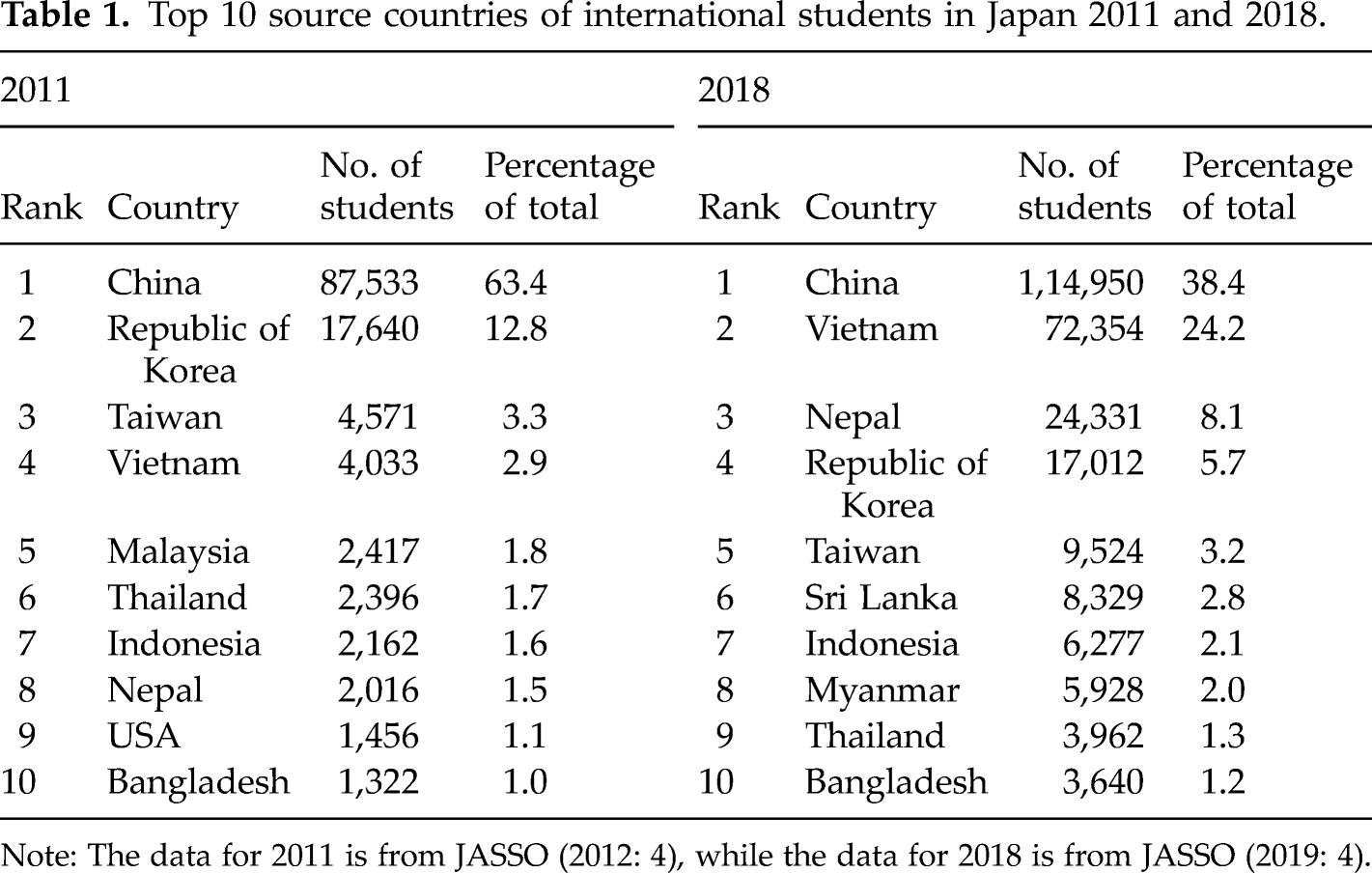
Note: The data for 2011 is from JASSO (2012: 4), while the data for 2018 is from JASSO (2019: 4).
Studying Japanese in a JLI lasts for a year or two. Those who obtained a bachelor’s degree in Nepal can enter the job market after their language program at JLIs. But if they fail to obtain a job, they enroll in a vocational school. The vocational school experience may last for two years. Those who do not have a bachelor’s degree in Nepal need a degree from a vocational school or a university to obtain a work visa in Japan. Among the 315 Nepali students that I met, after completing their courses at language institutions, most of them go to vocational schools (senmon gakko), 2 some enter the host labor market, and a few go to university. Most Nepali students fund their own education in Japan by working part-time since Japan issues work permits to international students, allowing them to work up to 28 hours a week.
The increasing flow of Nepali students to Japan offers a vivid illustration of the “commercialization” of education-related migration. As noted earlier, many JLIs have established a relationship with IECs in Nepal to sustain their business when student enrollment from traditional source countries dropped. I will describe the phenomenon of student migration and the education migration business in much more detail in the next section.
IEC business and the dream of young Nepalis to study in Japan
Data from my fieldwork reveal that the IEC business in Nepal that began just over two decades ago is rapidly growing and thriving. According to Kuldip, a pioneer dalal (broker) and owner of an IEC in Kathmandu, many IECs emerged from the early 2000s to provide services for students migrating to the USA, Australia, or the UK and Europe. Most of these students were from the middle and upper classes who choose English-speaking countries as their overseas study destinations. The violent decade-long armed conflict between the government forces and Maoist rebels (1996–2006) and the post-conflict situation characterized by political instability, poverty and higher unemployment contributed to increasing Nepali student emigration (Karen, 2014), which created business opportunities for IECs. Approximately 575,000 young Nepalis have migrated to study abroad during the period 2011–2018 (Kandel, 2018). During my fieldwork in Kathmandu, I saw hundreds of Nepali students lining up at IECs every day, hoping to migrate to other countries.
IECs’ business targeting young people who want to work and study in Japan has rapidly grown in Kathmandu since late 2011. Nowadays, if you walk in the Bagbazar area in Kathmandu, you may be struck by the ubiquitous billboards advertising study in Japan (Figure 1). During my fieldwork in spring 2018, on this short road bustling with crowds and traffic, I counted over 87 billboards for IEC businesses targeting young people who want to study and work in Japan. These billboards are also seen in Lalitpur, Bhaktapur, and other major cities in Nepal, implying the massive demand for IECs’ services. Billboards in Kathmandu advertising study in Japan.
These IECs have thrived in the last decade. Although there is no accurate data on how many IECs cater to those wanting to study in Japan, a member of the Japanese Language School Association of Nepal (JALSAN) estimates that approximately 1,100 such consultancies are running in Nepal at present. With the surge in the number of IECs, JALSAN was recently established in Nepal to coordinate them. As registration is not obligatory, many IECS function with no affiliation. In my interview, Ranjit, a proprietor of a well-established IEC, described the main reason for increasing IECs’ business in facilitating student mobility to Japan as follows: Before 2011, the Japanese language schools did not approach us to recruit potential students. We IECs had to contact them to get information about their school and request admission. They were reluctant to recruit students from Nepal, and they were not generous paying us commissions. But a whole new trend developed from late 2011. The Japanese language schools started to contact us and ask for potential students. They began to recruit students through us (IECs) and paid a generous commission for every student recruited successfully to their schools. Depending upon the schools, commission payments are from USD 1,000 to 1,500 per student. You see, it’s a profitable business. Targeting this opportunity, many new educational consultancies opened and began their business. (Ranjit, male, age 44, IEC owner, interviewed in Kathmandu in October 2017)
Ashok is another well-known dalal, the owner of Fuji International Educational Consultancy in Kathmandu. He went to Japan in 2006 as a language student. After completing his language school and obtaining a bachelor’s degree, Ashok returned to Nepal and started an IEC business in 2012. During his studies in Japan, he already built networks with Japanese entrepreneurs running JLIs. Ashok utilized the networks for the IEC business. He opened the IEC business at a small, rented office in Bagbazar, Kathmandu and began to recruit Nepali students for JLIs in Japan. He targeted high school graduates from middle and lower-income families who could not afford to go to the United States, Australia, the United Kingdom and other European countries due to their financial and academic limitations. His business slogan was “Study in Japan and earn two lakhas
3
(USD 2,000) a month working part-time.” People from his hometown and neighboring villages already knew that he had returned from Japan with several years’ experience in the country, so they quickly trusted him. During my fieldwork in September 2018, Ashok told me: At first, four of my neighbors and three of their friends from Baglung district wanted to go to Japan. They asked me to apply for admission, as well as prepare visa application requirements. As I already had developed networks with Japanese language schools in Tokyo and knew about the admission processes and visa application requirements, I managed their admission and visas without any difficulties in July 2012. As word of this opportunity spread, I got requests from 28 people among my friends, relatives and neighbors and eight of their friends from other districts to arrange their visas. They paid me a decent amount of money for my service. My relatives, neighbors, and people from different communities also knew about my ability to manage student visas, and I started receiving more and more requests. The news spread so quickly from mouth to mouth – from one to ten and from ten to hundreds. After that, every day, a large number of people would come over and ask, “I want to go to Japan. Please arrange to me a student visa.” I would say, “No problem, I will manage a visa for you to go to Japan.” (Ashok, male, age 39, IEC owner, interviewed in Nepal, September 2018)
According to Ashok, besides his social networks, he also used media and newspapers to recruit potential students. From 2012 to 2019, his consultancy successfully sent over 3,300 students to Japan. He earned millions of rupees within the last few years from the student migration business and gained status as a successful businessman in Nepal. I met many dalals (brokers) like Ashok in Nepal during my fieldwork who had found success in the educational migration industry.
In terms of strategy, IECs make attractive advertisements and services to appeal to the dreams of young Nepalis. For example, Sakura International Educational Consultancy in Kathmandu claims to provide “free language training, document preparation” and “easy admission” to study and work in Japan. Another advert in Kantipur, Nepal’s daily national newspaper, dated 12th November 2016, reads: “Do you want to make your future in Japan? If your answer is YES, join us. We promise your way to study and work in Japan.” These adverts usually use photos from Japan, making them more attractive to those with a dream to go to the country. Most of these IECs’ websites offer a gorgeous vision of the student life in Japan. They show glossy photographs of young Nepalis, successful-looking and enjoying a vibrant life in Japan. Additionally, these consultancies organize fairs and tell stories of beautiful Japan, its cleanliness, safe society, and salaries 20 times more than those at home, aiming to attract many Nepali youths seeking to escape from poverty.
According to owners of IECs, despite the proliferation of study abroad destinations, Japan remains attractive to Nepali students from primarily middle and lower-middle-class families. This became evident from interviews with many Nepali students I conducted during my fieldwork in Japan. Most of the 315 students belonged to lower to middle-income families from the countryside, and over 90 percent of them graduated from public high schools. They all mentioned that their main reason to come to Japan is to study and earn, seeing it as an appealing option than studying and working in Nepal. More than 72 percent of these students had worked in Nepal in different sectors from two to ten years before they migrated to Japan. Most of them expressed not being able to improve their lives by working in Nepal. For example, during my fieldwork in Fukuoka in 2017, I met Lalita, 26 years old, who used to work for a travel and tour company in Nepal, earning a monthly pay of NPR 13,000 (USD 130). According to Lalita, despite working and earning, she was still poor. Japan provided an alternative: “I came here with the hope of a better future, nothing more than that.”
According to the students, the economic disparity between the city and countryside, particularly the disadvantaged situations in the rural areas, and the lack of employment opportunities were vital push factors for emigration. They explained that it is tough to find regular employment in their village after completing higher education or to get a regular job in Kathmandu and other big cities without family networks. Rai’s views reflect this sentiment which prompted him to leave for Japan in 2018: I could not study well, and my marks in high school were just okay. I could enroll in a Bachelor’s program, but it was hopeless to find a regular job after completing the Bachelor’s degree in Nepal as I have no networks. So, I did not have options and decided to come to Japan. (Rai, male, age 22, interviewed in Tokyo in May 2019)
Similarly, Hari (male, 26 years old, interviewed in Tokyo in 2018/19) was bent on finding a better life elsewhere. He is from a lower-middle-class family in the Baglung district. Before coming to Japan, he worked for two years at a company after completing his Bachelor’s degree. The job required long hours of work, but the pay was not enough to cover his living expenses in Kathmandu, which was a source of stress for him. He began to think of other alternatives. One day, Hari followed his friend on a visit to an IEC in Kathmandu, where he heard beautiful stories of studying and working opportunities in Japan from a broker. Hari immediately began to see the dream of studying, earning and having a better life in Japan. He came to Japan in 2018 to enroll in a JLI in Shin-Okubo, Tokyo.
But once he arrived there, he found things were not so easy. Like Hari, many students I interviewed in Japan reported that life in Japan is challenging and requires exceptional self-motivation to achieve dreams. Many of them said, “Our dream – captured by IEC brokers for their business.”
Migration as business: States, JLIs, IECs and student migrants
My ethnographic data demonstrate that JLIs are among the main actors in the educational migration industry. They manage their business in relationship with the Japanese state, IECs and student migrants. On the one hand, the JLIs serve Japan’s interest by inviting international students and supplying them as low-wage labor for their various economic sectors, without recognizing them as migrant laborers. On the other hand, JLIs have established business relationships with IECs and developed proper recruitment strategies to recruit many Nepali students. In my interview with Sato (male, 49 years old, interviewed in Tokyo, 2017), a teacher at a JLI in Tokyo with more than five years’ experience of recruiting Nepali students, he stated that his school cooperated with 7–8 IECs in Kathmandu, and every year he visited them 2–3 times to recruit students. Sato worked together with the IECs to organize various activities, such as international student recruitment fairs, and engage with prospective students.
Sato emphasized the importance of maintaining good relations with IECs to keep the process operating smoothly: “The IECs have the same cultural and local understandings as the students, which can make it easier for them to gain the students’ trust, benefiting us.” Tanaka, a staff member working at a JLI in Miyagi, said that although her institution is a rural area, they have dealt with many students from Nepal due to their business relationship with IECs (Female, 45 years old, interviewed in Miyagi, 2017).
IECs are another key actor in the educational migration industry. They are often under contract with JLIs. From a sample of 18 IECs, every IEC has at least one staff member or teacher competent enough in conversational Japanese to maintain professional relations with JLIs and help students facilitate their migration. The IECs facilitate young and aspiring Nepalis to study in Japan; they help them prepare to apply for admission to a JLI and with visa applications. They also help prepare bank statements, relationship certificates, property certificates, police reports, and offer visa and interview preparation. Students need a document that shows they have sufficient money to live and study in Japan without having to work. However, over 90 percent of prospective Nepali students cannot meet such financial requirements. Therefore, in many cases, the IECs find ways to obtain a fake bank certificate. Students must pay for the certificate.
The IECs also provide students with the necessary Japanese language training before coming to Japan. Generally, JLIs in Japan require prospective students to acquire N-5 level of Japanese language proficiency to enroll in their language schools. According to an admission officer working at a JLI in Fukuoka, this requirement is an indication of the students’ interest and motivation to study the Japanese language. It also helps students to use their basic language skill for daily life conversation upon arrival in Japan. Prospective students need to demonstrate basic level Japanese language skills as part of the visa process at the Japanese embassy in Kathmandu (Interview in 2016). During my fieldwork in Kathmandu in 2016, many prospective students who were preparing to go to Japan said that this requirement was an extra burden and cost for them. For the IECs, conducting beginner and pre-intermediate Japanese language courses was another business opportunity to earn extra income. Indeed, IECs perform dual functions as migration agent and as a Japanese language school. As a migration agent, the IECs manage all the necessary documents, practical issues and services for students’ migration to Japan for a fee.
As consumers, student migrants are important actors for the migration industry. They turn to IECs due to lack of competence in acquiring necessary school admission and visa application documents and lack of self-confidence in preparing for the visa interview. The IECs also nurture the migrants’ dependence on them through various methods and practices. For example, they would raise student migrants’ concerns by passing stories about how in the past, minor errors that the migrants were unable to spot had led to visas being refused by the Japanese Embassy. My fieldwork data in Japan shows that over 95 percent of student migrants depended on IECs’ services to manage their entry through admission to a JLI and obtain a student visa. They received a range of services offered by IECs as a package, which usually included paying consultancy fees, Japanese language training fee, application fee, admission fee, visa application fee, tuition for the first semester, room fee for six months, and a one-way air ticket to Japan. Typically, Nepali students paid a total of USD 12,000–15,000 to an IEC to get into a JLI.
According to student migrants whom I interviewed, at first, they paid an IEC between USD 600 and 900 and gave their academic certificates and other documents to start the application and admission process. With the payment, the students also learned basic level Japanese at the IEC. Once the visa is available, they pay in full to IECs before entering Japan. The students’ families pay for the fees and other migration expenses. Most of the respondents told me that they borrowed from relatives and banks to pay the fees to IECs. Some informants also explained that they sold family-owned land to raise funds to pay the IECs. The IECs keep hold of the original copies of the official admission offer letter, Certificate of Eligibility
According to the staff and students I interviewed, student migration to Japan turns into a lucrative business. The IECs earn from students as a consultancy charge of between USD 1,000 and 1,500 per student, plus they receive commissions from the JLIs to which they send students. A staff member working at an IEC at Kathmandu I interviewed in September 2016 reported that business was thriving. He reported that his consultancy has successfully brokered the transfer of over 120 students from Nepal to Japan in the spring of 2016 and received USD 1,300 per head from JLIs. Similarly, while the exact numbers are not known, when I visited Sakura Dream Japan and Dream Tokyo IECs in Kathmandu in 2016, I was told that they had facilitated the migration of over 550 Nepali students to Japan.
While student applicants and IEC staff viewed IEC as providing needed services, many student applicants considered the fees excessive. Some students also referred to the business as an underground business. When I asked the research participants students why they would pay such a huge fee when they could find a JLI and apply on their own, almost all of my informants said, “The processes and practicalities of migrating are very complicated. We don’t understand them at all. The dalals know them well. They know everything on how to get the visa.” They paid for the services of the IECs to make sure everything was in order. Many did not know about JLIs or how to find information about them; many did not know how to meet the necessary documents for admission and visa application due to language difficulties and other hurdles. Therefore, they turned to IECs to handle all the practicalities and processes. Thus, the activities of the JLIs and IECs fit the description of “migration entrepreneurs” (Hernández-León, 2013) who facilitate mobility of students for financial gain.
“Side-door” recruitment: The Japanese state, the migration industry and student migrants
While talking about the relationship between JLIs and the Japanese state, a JLI principal in 2017 stated, “The government policies are favorable, and the market demand for JLIs is high, so many new JLIs are increasing.” In my interviews, most JLI owners and staff reported that the Japanese government provided them with a favorable environment in which to operate their language school business. JLI owners claimed that they are also playing a crucial role in supporting the government’s plan for the recruitment of international students, even as JLIs are excluded from the official categories of the higher education system. They said that JLIs have become the initial entry point for most international students in Japan, who then proceed to higher education. During my fieldwork in Osaka in 2017, a JLI principal emphasized that the institutes played an essential role in realizing the government plan to accept 300,000 international students by 2020. He further added, “In fact, JLIs are key to accelerating the entry of young migrants to Japan as students and helping the Japanese government fulfill labor shortage problems quickly.”
The views of JLI owners and staff indicate that the emergence and flourishing of JLI businesses are connected to the role they perform in bridging the gap between labor market demands for foreign laborers and the lack of open immigration policies to recruit them (see, for example, Beech, 2018; Liu-Farrer and Tran, 2019; Morita and Sassen, 1994; Sato et al., 2020). Japan has already introduced many schemes for importing cheap labor to solve its acute labor shortage without changing the policy of not admitting less skilled migrant workers. These schemes—free admission of Nikkeijin (descendants of Japanese who migrated to Latin America, largely Brazil and Peru) and “trainees” who are permitted to work in factories for job training—are commonly known as “side doors” to bring in foreign workers (Castles, 1998; Liu-Farrer and Tran, 2019).
As shown in Figure 2, ethnographic data from my research suggest that admitting Nepali students via JLIs can be viewed as another “side door” immigration scheme. Although these students are not considered as migrant workers, the system funnels young Nepali students into various sectors of the Japanese economy. Transition of Nepalis: From students to workers; from JLIs to the labor market.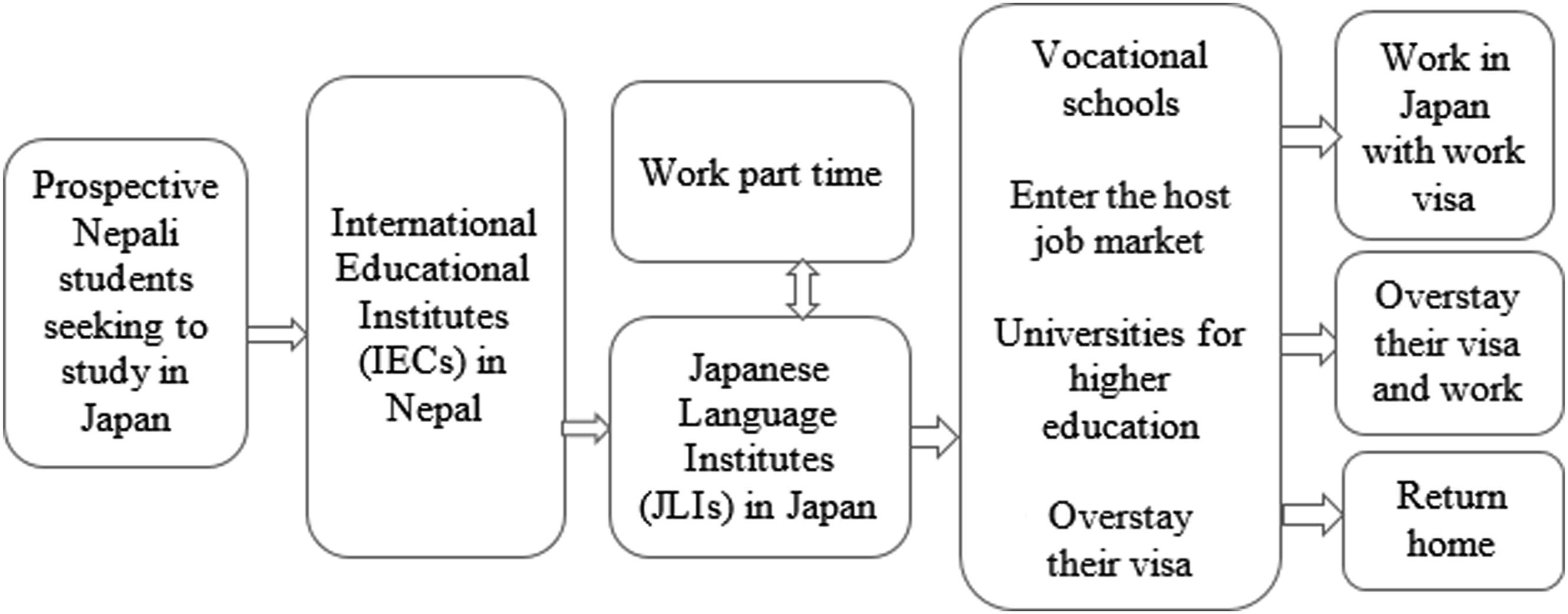
Many of the research participants sought part-time jobs as soon as they arrived in Japan. This corroborates the findings from the study of Sato (2012) which reported that 97.5 percent of Nepali students work part-time. 4 Data from my six-year fieldwork in Japan indicate that most Nepali students follow the trajectory of JLI—vocational school—employment in Japan outlined in Figure 2. While enrolled at JLIs and vocational schools, most of them worked in restaurants, hotels, factories, convenience stores, manufacturing places, and constructions sites. Two hundred and thirty-nine out of the 315 Nepali students whom I interviewed throughout my fieldwork in Japan had planned to go to vocational schools after their graduation at JLIs; 24 had planned to obtain a job in Japan; 21 wanted to go to university in Japan; and remaining 31 students had no plans. From fieldwork and further interviews with 135 informants over the last six years, I found that 79 enrolled in vocational schools, eight were working, two enrolled at universities in Japan, and nine returned to Nepal. The remaining 37 students overstayed their visa and were working or trying to find work. These patterns suggest that Nepali students/workers help meet the need for low-wage workers in Japan.
According to Kumar, a 25-year-old student at a JLI in Tokyo in 2019, said most Nepali students prioritize work more than their studies to pay off the debts accumulated to fund their migration. Kumar works part-time in a convenience store in Tokyo earning about Japanese yen or JPY 1,000 per hour (USD 10 per hour). Another Nepali student—Sarita, female, 23 years old—works part-time with Kumar at the convenience store. According to them, their earnings from the part-time work can fund their education and stay in Japan. Lalit (male, 21 years old, interviewed in Fukuoka, Japan, June 2017), a Japanese language student, added that students may work beyond the 28 hours per week: “Even though legally we are permitted to work for only 28 hours per week, we all work more hours so we can accumulate enough money to go to a vocational school, which you need to get jobs in Japan.”
According to Nepali students, most of them obtained jobs from labor brokers who have partnered with JLIs. According to Miuki, a female teacher at a JLI in Tokyo, her JLI has well-established connections with companies seeking low-wage workers. She told me that the owner of restaurants, hotels, companies, and factories would come directly to the school asking if they could recruit their students (Interview with Miuki, Tokyo, 2017).
During my fieldwork in 2017, I have also found an interesting trend whereby some manufacturing industries struggling with labor shortages have also opened their own JLIs and vocational schools to channel students into workplaces. They are creating this kind of scheme as an alternative solution to manage the immediate need for low-wage laborers and potentially recruit skilled workers.
Some Nepali students found this scheme more attractive as it allowed them to secure a job and visa as soon as they graduated their vocational school. This was the pathway Ramhari, male 29 years old, former student-turned-company employee. I met and interviewed Ramhari, male, 29 years old, in Sendai, Japan in July 2019. He first came to Japan in 2014 as a language student at a JLI operated by the company where he was working. After graduating from the JLI in 2016, he moved to a vocational school run by the same company. While studying, Ramhari also worked as a worker at the company. After completing vocational school in 2018, he easily obtained a work visa allowing him to be employed at the company in April 2019. Kamala (female, age 25, interviewed in Sendai, Japan in July 2019), another student, working part-time at the same company, said, “My focus here is to earn money than study, and here is good, as we can do more than 28 hours of work a week.” 5
The Nepali students’ stories of study and work clearly show the dual identity of international education migration and how Nepali student mobility has become a legitimate means to import much-needed labor, as suggested by other scholars (e.g., Baas, 2007; Beech, 2018; Liu-Farrer and Tran, 2019; Morita and Sassen, 1994; Sato et al., 2020). During my fieldwork, I found five private companies running their own JLIs and vocational schools. These companies derive revenues from their JLIs and also have access to much-needed labor. It is difficult to ascertain how many companies are involved in this type of business, but it seems to be a growing trend.
Conclusion
This article illustrates how Japan has become a popular destination for Nepali students due to several reasons: liberalized visa regulations, no language requirements, an abundance of part-time work opportunities, and the projection of Japan as a desirable destination by JLIs and IECs. While economic inequalities between Nepal and Japan are clearly motivating factors for Nepali students’ decisions to migrate, this article demonstrates the role of the migration industry in Japan and Nepal in facilitating international student migration.
Globally, transnational education has become one of the key conduits of the migration of young people, and a global migration industry in higher education has developed to provide services and gain financial benefits from student migrants. Indeed, international educational migration has become a multi-billion-dollar industry. Language institutions and language students are generally excluded in studies on international education. However, as this article reveals, JLIs are a significant channel for student mobility, providing young Nepalis with an initial entry point to Japan. Since they operate outside formal education and have comparatively low academic requirements, JLIs are an easy entryway for many Nepali students who are otherwise unable to study abroad. In short, JLIs comprise the main actors in the education migration industry and have been actively engaged in facilitating student mobility from Nepal to Japan. Recruiting the large numbers of students brings fee revenue and higher profits for JLIs, which they invest in new schools and facilities that enable them to recruit even more students.
Japan offers legal ways for Nepali students to migrate. It provides student visas to those who gain admission into a JLI and allows them to study and work there. Therefore, one might think that there is no necessity for the facilitating services offered by IECs due to the absence of any legal barrier. However, the article details the widespread migration business interests of IECs in student migration from Nepal to Japan, an aspect that has not been given due attention.
Although many Nepali student migrants viewed IECs as engaging in underground business and their services did not warrant such high fees, most of them recognized the IECs’ services as necessary to handle the cumbersome documentation process to enable their migration. Over 90 percent of them said that they did not regret paying the IECs, as they helped them migrate to Japan, for which people in Nepal were willing to pay any amount. Nepali students could have legally migrated to Japan without having to rely on and pay for the services of IECs. They opted to go through IECs to help them navigate the whole process. Moreover, the IECs’ migration businesses are embedded in their kin and friends’ social relationships in origin communities which demonstrate that the migration industry and social networks are entwined and operate simultaneously in facilitating the migration of Nepali students to Japan. Therefore, this finding provides new insight regarding the relationship between the meso and micro levels in facilitating international migration.
This article reinforces the view of how the dissonance between Japan’s closed-door immigration policy and its acute labor shortage makes international education a convenient channel to bring in students and workers (e.g., Beech, 2018; Liu-Farrer and Tran, 2019; Sato et al., 2020). In this set-up, JLIs and IECs emerge and thrive as an education migration industry. Some scholars argue that migration business entrepreneurs who circumvent legal barriers render international borders less formidable (e.g., Spaan, 1994), while others conceive the state as having ultimate control over national borders (e.g., Spener, 2009). However, this article shows that the relationship among the Japanese government, JLIs and IECs is beneficial to all parties rather than as competitors. JLIs and IECs complement the Japanese government’s efforts to bring young foreign workers for its expanding services without recognizing them as migrant labor by using the international education channel as a side door. The regulations of the Japanese and Nepali government provide new opportunities, sources of business, and profits for JLIs and IECs, which increase the significance of their role in the migration process of students.
In short, Japan’s reluctance to open the main door for immigration, despite the acute scarcity of labor it faces in various sectors, as well as the legal leeway it offers for students to engage in part-time work, have allowed many young Nepalis to study and work (for up to 28 hours per week) in Japan through JLIs. As a result, the business of JLIs and IECs has been flourishing. They have played a vital role in connecting young Nepalis’ dream of a better future in Japan and realizing Japan’s “300,000 international student plan by 2020” through their lucrative businesses. Thus, the research findings indicate that all the major actors of this migration system, IECs, JLIs, migrants and the state in both countries are the winners, with some actors gaining more than the others. This may explain why this international education migration system continues to thrive. The research findings also indicate that JLIs and the education migration industry may play an important role in increasing the potential pool of skilled workers in Japan.
Footnotes
Acknowledgments
I wish to acknowledge the Toyota Foundation International Grant Program for providing financial support to carry out the fieldwork. I would also like to thank the editors of the Asian and Pacific Migration Journal and anonymous reviewers for their constructive comments and editorial support in the publication of the manuscript. Finally, my greatest thanks are due to the Nepali student migrants in Japan and their families in Nepal.
Declaration of conflicting interests
The author(s) declared no potential conflicts of interest with respect to the research, authorship, and/or publication of this article.
Funding
The author(s) disclosed receipt of the following financial support for the research, authorship, and/or publication of this article: The author received financial support from the Toyota Foundation International Grant 2017 for the fieldwork research.
