




Abstract
This article is a comparative study of Filipino and Indonesian migrant workers in the Kingdom of Saudi Arabia. It investigates how these two different transnational communities envisage their lives in the Kingdom. It examines (1) the historical dynamics and contemporary developments of Filipinos and Indonesians in Saudi Arabia, (2) the underlying motives, purposes and rationales of their sojourn and employment in the Kingdom, and (3) their perceptions and insights about their Saudi Arabian experiences. Interviews were conducted with 17 Filipinos and 16 Indonesians living and working in Saudi Arabia. This study suggests that many factors affect these two groups’ perceptions and experiences such as religiosity, employer/employee relations, and/or cultural factors.
Introduction
How do Filipinos and Indonesians in Saudi Arabia (also referred in this article as: The Kingdom, Saudi or Kingdom of Saudi Arabia (KSA)) perceive and engage with Arabs, more specifically, the Saudi Arabs and society? What factors have shaped these groups’ portrayals, opinions, interpretations, understandings, impressions and imaginations of the Saudi Kingdom and the greater Arabian society and culture?
This article focuses on professional and working-class Filipino and Indonesian expatriate laborers in Saudi Arabia and how they envisage their lives in the Kingdom. For Filipinos and Indonesians, Saudi Arabia, in addition to other Gulf countries, is a magnet that offers transnational Filipinos and Indonesians relatively high salaries, economic prosperity and political stability compared to working in their home countries (Amjad, 1996; Silvey, 2006, 2013). In addition, working in Saudi Arabia affords Muslims easy access to holy sites 1 (Diederich, 2004; Lücking, 2021).
The article mainly explores these two transnational groups’ opinions, imaginations and impressions of Saudi Arabia: Specifically examining (1) the history and contemporary developments of Filipinos and Indonesians in Saudi Arabia, (2) the underlying motives, purposes and rationales of their migration to the Kingdom, and (3) their perceptions about their Saudi experiences.
It is noteworthy to compare Filipinos and Indonesians for the following reasons. First, both groups compose the largest Southeast Asian transnational populations in the Kingdom (Johnson, 2011). Second, they represent two different religions. While the vast majority of Filipinos both in the Philippines and in the Kingdom are Christian, the majority of Indonesians at home and in Saudi Arabia are Muslims, 2 offering comparative perceptions, viewpoints and imaginations about the Arab world and Saudi society. Lastly, Indonesia and the Philippines share similar geographies, parallel colonial pasts and their respective governments use labor migration as a development strategy (Silvey, 2004, 2006, 2013).
Notwithstanding, despite having a long history of relations between Saudi Arabians and Indonesians or Filipinos (Diederich, 2004), studies comparing these two communities are almost non-existent. With few notable exceptions, Filipino and Indonesian transnationals remain a largely unreported and under-researched diaspora in the Gulf, particularly in Saudi Arabia. Hence, this article aims to fill this gap.
Literature review
There is a plethora of literature about Filipino global migration that recorded the experiences of Filipinos in the United States of America (USA) and elsewhere (e.g., Espiritu, 1995; Okamura, 1998; Bonifacio, 2013; Constable, 2017). In addition, questions about the feminization of transnational labor were examined for the workers and for the families they left behind (Constable, 2017; Parreñas, 2005). In the Middle East, studies were primarily historical accounts and analyses by historians about migrations from the Middle East (Clarence-Smith, 2004, 2017; Cruz-del Rosario, 2016). Angeles (2011) examined Islamic links, referencing Egypt and Lebanon through material culture and the exchange of ideas. She explored the greater Southeast Asian lives in the Middle East but inconspicuously, pilgrimage or Saudi Arabia was not mentioned.
There were few studies in English directly examining the lives of Filipinos in Saudi Arabia. Margold (1995) was among the pioneering studies to explore the life of overseas Filipino workers (OFWs) specifically in Saudi Arabia; the research examined the experiences of Filipinos with their employers and the conflicting gender constructs of both groups towards each other. Johnson et al. (2010) examined the links Muslim Filipinos have with the Kingdom as a sacred place and the role they have in the greater Saudi–Filipino community as a support group for Christian Filipinos, such as domestic workers who find themselves in difficult situations because of abusive employers. In addition, Magliveras (2019a, 2019b) examined the strategies of survival and the identity of OFWs in the Kingdom.
Similarly, the previous academic literature that discussed Indonesian migrants in KSA is limited. Some studies focused on educational migrants in past centuries, particularly those who studied Islamic sciences living in Makkah after finishing their studies (Azra, 1992; Rachman, 1997; Diederich, 2004). Others focused on male unskilled labor and female domestic workers, exploring labor-related issues and abuses in KSA and domestic worker contributions in supporting their family economies in Indonesia, respectively (Amjad, 1996; Silvey, 2004, 2006). While some issues discussed in the literature are still relevant, others are either irrelevant or less significant than before, due to changes in government regulations related to menial and domestic foreign workers in the Kingdom in recent years 3 (Magliveras, 2019b; Al Qurtuby, 2019).
Al Qurtuby (2019, 2020) explored contemporary educational and academic Indonesian migrants: Students, university professors and researchers, and their impact on Indonesian society. Lücking (2021) compared and contrasted hajj or umrah 4 pilgrims and female laborers, examining the perceptions of the Arab world and the idea of “Arabness” among returning pilgrims and labor migrants from the Gulf countries (mainly Saudi Arabia) to Indonesia. Lücking (2021: 12–13) argued that the pilgrims’ and migrants’ understandings and constructions of “Arabness” or of the Arab world and their mobility (pilgrimage or migration) to Saudi Arabia and the other Gulf countries were influenced and guided by a variety of governmental and non-governmental structures and institutions, as well as spiritual leaders.
However, a comparison of Filipino and Indonesian migrants’ life experiences in KSA is relatively unexplored.
Filipino and Indonesian migration to Arabia
Filipino transnational migration began in the 19th century, during the 1899 Philippine–American War (Espiritu, 1995; Okamura, 1998; Cruz-del Rosario, 2005). 5 After the successful fight for independence of Filipinos against Spanish rule, the Americans denied Filipinos their independence, replacing 400 years of Spanish colonialism with their own form of colonial rule; this resulted in a Filipino–American connection which continued even after the Philippines gained independence from the United States in 1946.
The Saudi Arabian and Filipino governments established bilateral relations in 1973 (Philippine Embassy, 2014). Shortly thereafter, the first Filipinos traveled to the Kingdom of Saudi Arabia as engineers to assist in the development of Saudi Arabia. During those early days, OFWs used the mantra, “Katas ng Saudi” (“the fruits of Saudi”), as a phrase that meant building a better future at home by working abroad (Pedregosa, 2019). Since 1973, almost a million Filipino men and women have been legally employed in Saudi. The majority of Filipinos hold support positions as many are well-educated and speak English (Magliveras, 2019b).
Filipinos hold significant positions in Saudi Arabia but have very limited authority, allowing Filipinos little social capital in the greater Saudi society. Filipinos are paid less and are treated less than their Western counterparts (Margold, 1995). Regardless of known inequities, Filipinos see Saudi Arabia and the rest of the Gulf States as very desirable work destinations to support their families back home (Magliveras, 2019a, 2019b). However, after several generations of labor migration to the Gulf, Saudi is thought to be a place where more money can be saved because there are few venues to spend their money, and thus, fewer distractions (Magliveras, 2019a, 2019b).
In contrast with Filipinos, the presence of more than a million Indonesians in the Kingdom 6 today can be linked to the lengthy contact between the peoples of the Arabian Peninsula and the Malay–Indonesian archipelago established by the pilgrimage. 7 Indonesians have journeyed to Makkah, or more generally, to the Hijaz, 8 long before the existence of the modern states of the Kingdom of Saudi Arabia or the Republic of Indonesia.
Not surprisingly, a district called Kampung Jawah 9 is located in Shamiah or Shi’ib Ali in Makkah. It signifies a long Indonesian presence in Saudi Arabia. Kampung Jawah eventually became a “home base” and one of the Islamic learning centers for long-term residents, new Indonesians arriving in Makkah, or Muslim hajj pilgrims from other areas in Southeast Asia, including Malaysia, Brunei, Singapore, Thailand and the Philippines. 10 In fact, some noted pilgrim figures collaborated to establish Darul Ulum, an Islamic school in Makkah for Southeast Asia’s Muslims in the 1930s (Al Qurtuby, 2019).
In past centuries, most pilgrims returned to Indonesia after performing hajj. For several reasons, many stayed in Makkah. One of the primary reasons was money. They took jobs to purchase provisions to return to the Malay–Indonesian archipelago or to pay off their debts. Many pilgrims ran out of money and supplies because the journey to Makkah was so arduous and expensive. Some worked on date plantations or in small shops, while others assisted pilgrims. Indeed, some even volunteered to become slaves so they could pay off their debts (Hurgronje, 1970; Diederich, 2004). In recent decades, many pilgrims deliberately chose to stay in Makkah after finishing their pilgrimage rituals because they wanted to work, live and die in Arabia. They settled in Jeddah, Makkah or Madinah. These cities offered jobs such as shopkeepers, restaurant employees or bus drivers (Al Qurtuby, 2019, 2020).
The second reason Indonesians in the past chose to live in Makkah was to study or learn the Islamic sciences while simultaneously performing rituals at the Haram Mosque in Makkah and the Nabawi Mosque in Madinah. According to the participants of this study, Muslims believe that unlike other places of worship, worshiping and conducting religious activities are very special in these mosques because God guarantees the practitioner entrance into paradise after death. They also believed that God would grant hundreds of thousands of rewards to these worshipers. In addition, a desire for both Islamic learning and performing rituals compelled many Indonesian Muslims to stay longer in the Haramain, an epithet for Makkah and Madinah. While some settled permanently in Makkah, many remained for months or even years before returning home.
Before the Second World War (WWII), this type of religious and intellectual contact between Indonesia and Arabia was apparent. A great number of Indonesian Islamic scholars and teachers in the Haramain established Islamic schools in Makkah, and later Jeddah where their legacy still exists today (Azra, 1992; Rachman, 1997; Al Qurtuby, 2019, 2020).
After WWII, Indonesian migration to KSA was marked by the arrival of at least three distinct groups. The first group is those seeking “unskilled” labor (i.e., housemaids or drivers) and skilled professional employment who worked in universities, oil industries, construction companies, hotels and hospitals 11 (Diederich, 2004; Silvey, 2006). The second group of Indonesians is those studying Islamic sciences in various Islamic learning institutions such as rubat (informal Islamic boarding schools) or universities (Rachman, 1997). The third group is students studying the “secular” sciences and engineering at several universities 12 (Al Qurtuby, 2019).
Certainly, there are also Indonesian religious pilgrims for both hajj and umrah who continue to visit the Kingdom in the aftermath of WWII, contributing immensely to the “pilgrimage industry.” In the past, the recruitment of professional and working-class migrants was conducted through the government, labor agencies, individual contacts or institutional networks. But recently, professional migrants (e.g., company engineers or university lecturers) could apply for jobs in Saudi Arabia directly through various online sites provided by universities or companies in the Kingdom, while menial laborers were recruited by various agencies, including governments, private labor agencies or informal recruiters (Lücking, 2021).
These “new” groups of Indonesians do not include undocumented migrants who usually went first to Saudi Arabia with an umrah (little hajj) visa since it is the easiest way to enter the Kingdom. However, having or applying for an umrah visa does not necessarily mean they perform the rituals. Once they landed in the Kingdom, “brokers”—who are probably family members, friends or friends of friends—would usually pick them up at airports and bring them to specific accommodations (Al Qurtuby, 2019). Others tried to find jobs after completing their umrah, certainly with the help of social networks in the Kingdom. Such practices have been going on for years. Some Indonesian undocumented migrants have been deported after the Saudi government forgave them by exempting them from all fines and charges (Silvey, 2004, 2006). However, others remain and live in the Kingdom secretly (Al Qurtuby, 2019). The presence of these new groups of immigrants has certainly made the Indonesian society in the Kingdom more diverse and complex, which contributes to the diversity and complexity of perceptions of Saudi Arabia.
Methodology
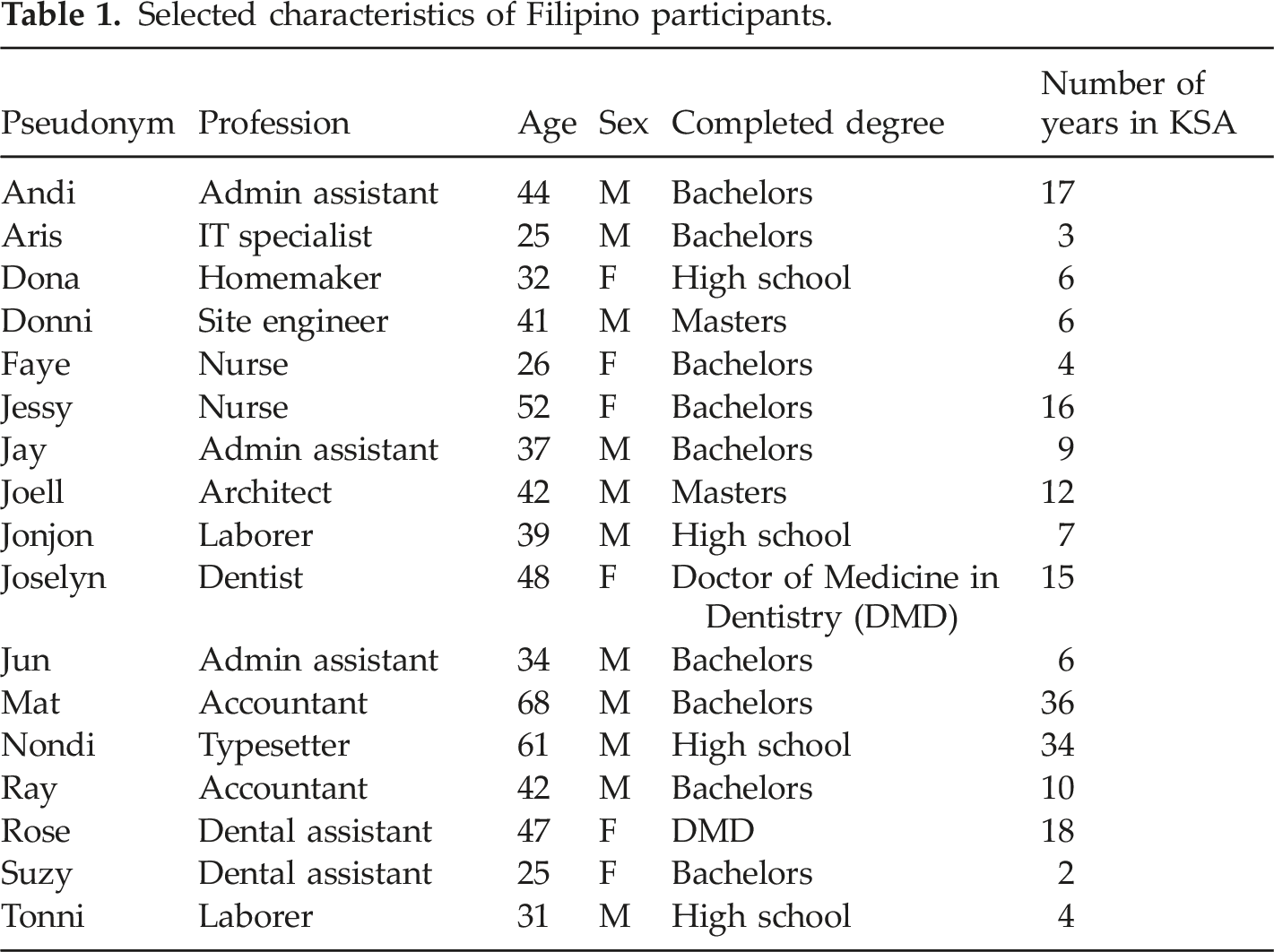
Selected characteristics of Filipino participants.
Selected characteristics of Indonesian participants.

Both Filipino and Indonesian participants were recruited using the snowball sampling approach, wherein several informal connections were established either through friendships or working situations. They were informed about the purpose of the study and that their anonymity would be ensured. All names of the participants in this study are pseudonyms.
The Filipino participants of this study are presently or were previously working 13 in Saudi Arabia. Seventeen laborers and professionals, men and women from the ages of 24 to 68, were interviewed (see Table 1). The professional participants were secretarial support staff, accountants, dental assistants and nurses. However, several held higher positions as construction site engineers or dentists.
All of the participants were either Catholics or non-denominational Christians. Hence the results and conclusion about Filipino transnational motivations might be significantly different from non-Christians. As a result, these Filipino voices do not represent Muslim Filipino communities in the Philippines and their counterparts in the KSA. 14
For the Indonesian portion of this study, data collection techniques include semi-structured interviews, informal conversations and discussions with 16 Indonesian professional and menial workers of both sexes, aged between 25 and 60 (see Table 2), all of whom are legal migrants. The interviews, conversations and discussions were conducted in Saudi Arabia using Bahasa (Indonesian language) before, during and after the COVID-19 pandemic in 2020. At first, the participants were selected and recruited through personal contacts and networks. They then introduced other relevant participants.
The professional expatriates included university professors, lecturers, researchers, students, school teachers and engineers working for large companies such as Saudi ARAMCO and SABIC. 15 For the unskilled laborers, interviews and conversations were carried out among domestic workers, shopkeepers and drivers of public transport (bus or taxi) or personal drivers. All participants are Muslims who are members of various Islamic organizations and madhab (schools of thought in Islamic jurisprudence).
Motives, purposes and rationales for Filipinos
Saudi as a stepping stone and experiencing the world
Younger, educated professional Filipinos in this study provided two main reasons for coming to Saudi Arabia. First, traveling and working are envisaged as an adventure. They romanticized the idea of traveling abroad and seeing the world. Second, young people said that going to Saudi Arabia was relatively less complicated. In addition, working in Saudi Arabia was seen as an easy way to fast-track their careers. 16
For example, Faye recently left her position in KSA to get married in the Philippines. She explained that as a nurse in the Philippines, it takes many years and is costly to receive all the certifications needed to become a fully registered nurse with a specialization. By working in Saudi Arabia, she gained experience and was paid a very good wage. Upon returning to the Philippines, her work experience and specialization helped her leapfrog the difficult process of becoming a registered nurse. A starting nurse gets only 170,000 Philippine Pesos (PHP) per year (approximately USD 3000/year). If I did not go to Saudi, I would have to do many years of internship, take exams and pay for certifications. In Saudi, I assisted the surgeon doing cosmetic surgery in his [clinic], so I did not have to do my practical. I avoided the cost and time when I returned for promotion. (Faye, 22 years old, female, nurse) I came to Saudi for the adventure and to easily go to Europe or America. I like my job here. My accommodation is next to the mall and my boss is good to me. I have good hours and time off. I like working for her so I have decided to stay. (Suzy, 25 years old, female, dental assistant)
They believe that returning to the Philippines with the experience and specialization would make a difference. However, accountants and site engineers in this study did not seem to advance their careers when they chose to return for similar career lines. Their position was the same as they left them and observed that their friends who did not leave progressed to higher positions with relatively better pay. However, nurses and dental assistants seemed to advance if they found a job opening. Ray, who worked for 10 years in Riyadh, is a typical example: I had many expenses at home and my boss told me it was difficult to bring my family. I finally brought my family but when we finally went home I did not advance. My friends who had stayed were in better positions than I was even though we started together.
17
(Ray, 42 years old, male, accountant)
The adventure of seeing new places, being on one’s own or advancing one’s career is part of the package. It is a rite of passage to becoming independent economically and to being a breadwinner for their family who are in great financial need. Being an OFW is living a liminal existence (Pedregosa, 2019), especially in Saudi Arabia where foreign workers must leave after employment ends.
As a result, by going to KSA, they support their families and are transformed from being ordinary young adults, mothers or fathers to becoming family breadwinners and even hailed as bayani (“heroes” or “patriots”). The society in which they have chosen to work limits their individual freedoms and personhood until they return home to be “reborn” as masters of both worlds and true benefactors to their families in the Philippines. 18
The significance of the family
The family’s 19 well-being is the most important factor in deciding to work abroad and is directly dependent on the income OFWs send from overseas (Parreñas, 2005). Parreñas (2005) suggested that even with both “breadwinning” adults working in typical middle-class jobs in the Philippines, it covers only 60 percent of their family’s living expenses. As a result, able-bodied adults willingly “sacrifice” the comfort of home to work abroad as OFWs. When asked why they came to Saudi Arabia, the majority of the participants referred to the family directly.
Jay, 37 years old, male and an administrative assistant, referred to his work as follows: “I have a good job and my boss is good most of the time, but sometimes I want to quit because life is difficult here. But I am the only breadwinner since my aunt returned to the Philippines. My sister has a young child and my parents are now retired.”
Several participants wanted to leave but when discussing their next move, they referred to themselves as their families’ breadwinners and found risking returning home problematic because their families were directly dependent economically on them. One of the frustrations about working and living in Saudi is the delayed payment of their salaries. In one case, salaries were delayed by six or more months causing great stress on individuals whose families depended on them. Many participants mentioned delayed payments, suggesting that this was not uncommon.
The family represents the embeddedness tied to Christian and Filipino virtues. Virtues of “shared self,” (or kapwa) (Reyes, 2015) are part of their heroic sojourn and sacrifice for their family. 20 Thus, family is central to where and how they choose to live and how they attain their basic needs. 21
The concept of sacrifice
Non-Filipinos are often perplexed at why OFWs sacrifice so much of their lives and live under substandard conditions to which “Westerners” in similar positions or even better conditions would simply quit and return home. OFWs often mention the needs of their family, but more importantly, there are deeper connotations to why OFWs frequently talk about sacrifice.
OFWs face many difficult challenges. Challenges can range from purely economic ones, such as the serious basic needs of family members. But challenges also include dealing with bureaucratic systems in the Kingdom or employee abuses, all of which are beyond the scope of this paper. However, all the participants have suffered and have sacrificed themselves in one way or another. To deal with the potential economic hardships and issues of remittances, the participants try to extend their salaries by doing extra work or saving their housing allowance by living in crowded conditions which enables them to send more money back home.
Sacrifice and love 22 are always indicated when participants discuss the trials of being an OFW in KSA. Moreover, it is not a coincidence that love and sacrifice are core to Christian virtue and cosmology (Kearns, 2008; Daly, 2009). According to several participants, to express love, one must sacrifice. Thus, the OFWs sacrifice themselves for the betterment of their children, parents and extended families.
Reyes (2015) examined Filipino culture via the virtues of loób and kapwa, which he suggested is a driving force of people under trying conditions. Loób in Tagalog literally means “inside” in English, however, it might be understood as one’s “rational will.” Kapwa, on the other hand, cannot be translated directly into English, but Reyes suggested that it is a shared identity that can be tribal and Christian simultaneously. This study considers “family” as part of this milieu of kapwa. Reyes also suggested that the unpayable debt or utang-na-loób to a family is an essential part of their sense of self.
Against all odds, there is an assumption of responsibility or lakas-ng-loób, which parallels to the passion of Christ. Thus, OFWs in their suffering are doing a truly Christian act. “The suffering Christ became a new tribal hero…He won through suffering and self-sacrifice. It was a sacrifice for the collective” (Reyes, 2015: 167). Through Christ’s sacrifice and love of humankind, he is a “hero,” bayani, of the people. Christ is a bayani as is the OFW.
The OFW’s venture into the unknown, living or working under trying conditions, is a form of utang-na-loob, sacrifice and love. Their loób, will and understanding of the other as part of themselves gives them the strength to live many years away from home, giving up the opportunity of raising their own children and living with their families, but knowing that they are sacrificing themselves for their good, paying a debt to the people who raised them and sacrificed for them. As a result, Christ-like OFWs, through sacrifice, pay back the unredeemable debt to their family. Thus, the OFW gains hero-like qualities. 23
Motives, purposes and rationales of migration: The case of Indonesians
The research findings from interviews and conversations suggest that the underlying motives and rationales of Indonesian immigrants who come to the Kingdom vary enormously. These variations are driven by various factors, including the migrants’ different socio-economic backgrounds, levels of education, degrees of religiousness, 24 types of employment and organizational affiliations.
These factors can overlap. For example, professionals and menial laborers despite having different levels of employment and education, can have similar motives, objectives and rationales for migrating to KSA because they are “practicing Muslims” who came to the Kingdom expressing strong religious motivations (e.g., easy access to Makkah and Madinah).
However, it is not simply religion that motivates them. They also may have secular (non-religious) motivations. Religious migrants understand that Saudi Arabia is a Sharia-based Islamic nation. Many Muslims across the world desire to visit. In contrast, “secular” migrants conveyed “secular” motives (i.e., financial ones) for coming to KSA regardless of their educational level.
Moreover, several participants such as professional workers, laborers or university or college students, expressed great joy in being in Saudi Arabia because they could perform the hajj pilgrimage easily. Those living in Indonesia must register for hajj. Indonesian Muslims could wait as long as 30 years or more to perform the pilgrimage due to limited hajj quotas (or kuota haji). Many Indonesian Muslims die before performing hajj because of the lengthy waiting lists. 25 Hence, Indonesian Muslims happily live in the Kingdom.
It is also significant to note that these initial motives can change after living and having experiences in the Kingdom. Change depends on their (positive or negative) experiences of living and working in the Kingdom.
Religious motives
The majority of Indonesian participants expressed religious motivations for migrating to the Kingdom, including, but not limited to the following: (1) to perform hajj and umrah pilgrimage, (2) to conduct a variety of religious rituals at the most sacred places of the Haram Mosque in Makkah and the Nabawi Mosque in Madinah, (3) to visit the holy shrines such as those of Prophet Muhammad in Madinah, his companions or wives (in both Makkah and Madinah), (4) to seek a “quick pass” to Heaven and (5) to be able to find halal or lawful foods and visit other lesser significant religious sites.
Of all the religious motivations, performing hajj is perhaps the most common motive among the participants (and religious immigrants). They believe that performing hajj completes their religious obligation as Muslims. They also believe that conducting hajj, in addition to the religious rituals in the holy sites of the Haram Mosque and the Nabawi Mosque, can bring their souls to paradise after death.
All participants interviewed have performed hajj and umrah. For example, Latif, who works in the Eastern Province of KSA, stated, “I have performed umrah more than 30 times and I want to do this pilgrimage again and again.” Latif said that he has “fallen in love” with Prophet Muhammad. To show his love, he visits Makkah and Madinah regularly.
Another informant, Edi, is also a regular visitor to Makkah and Madinah. He proudly and happily works in the Kingdom for the following reasons. First, he believes there are no places for maksiat 26 (“unlawful acts”) in the Kingdom because KSA follows strict rules of Islamic sharia. He also believes that Muslims committing maksiat will go to hell after death. Second, Saudi Arabia is home to halal foods. Accordingly, he is not concerned about mistakenly eating Islam-banned foods, such as pork or any meat being slaughtered or processed with disregard to Islamic law. The third factor is religious tourism. Like other religious migrants, Edi is convinced that worship and prayers conducted in the Two Holy Mosques will be rewarded by God with thousands of pahala (“nonmaterial rewards”) that guarantee worshipers a place in paradise after death.
Many working-class laborers also expressed religious motivations for coming to Saudi Arabia. For example, Sarijem, a 32-year-old Javanese woman who works as a domestic worker, was very happy when her employer allowed and even sponsored her hajj pilgrimage. One of her dreams about migrating to Saudi Arabia was to perform hajj, which she felt was a “mission impossible” because she came from a lower-income family. When she finally got a chance to perform hajj, she could not hide her joy.
Economic motivations
For both professionals and working-class laborers, economic factors are a serious motivation for migrating to Saudi Arabia. Those with strong religious motives also have an economic reason to migrate. For many Indonesian Muslim laborers, working in Saudi Arabia offers twin benefits: To earn money and to earn a hajj title.
Since the 1980s, KSA has been a popular destination for Indonesian migrant workers resulting from Saudi-Indonesian government agreements to provide needed workers, including domestic workers (Diederich, 2004; Silvey, 2006), to the Kingdom. Salaries in Saudi Arabia are much higher than those in Indonesia. Working as a domestic worker fetches about 300–400 Saudi Riyal (SAR) (USD 80–100) a month in Indonesia, compared to SAR 3,000–4,000 (USD 800–1000) per month in the Kingdom. The salary differential widens for professionals.
Many migrant workers aim to save money and hope to run individual or family businesses someday on their return. Ucup, a 42-year-old male taxi driver in Madinah, dreams of having a barbershop in Jakarta. “I save money to purchase or to rent a small building for a barbershop in the Jakarta area,” he explained. Others save money to buy sawah (“rice field”) which would be tilled by themselves or by their families upon their return. Still, others save money for their children’s education which can be expensive in Indonesia. Whatever their dreams, financial motives are obviously significant for the Indonesian migrants.
Family matters
Another important motive for Indonesian migrants is helping their family members back home. For many Indonesians, family 27 has always been central in their hearts and minds. As with their Filipino counterparts, helping them economically is a form of honor and obligation. It is common for Indonesians working at home or abroad to help their families, especially those needing special assistance. In other words, Indonesians do not make money only for themselves but to also help family members. Those who work overseas, including those in Saudi Arabia, send remittances regularly to assist their family members at home.
The purposes of financial assistance vary depending on the needs of the family. Some use the money for school fees while others use it for basic needs or daily expenses. Money is also commonly used to build houses, run small businesses or purchase property. The higher the wages they get, the more money they can send. In some cases, helping parents, brothers or sisters, and others results from “social pressures” or social obligations to help their families, neighborhoods or communities. It is said that an uncaring person to his/her family (especially his/her parents) is selfish. 28
The vast majority of Indonesians believe in the notion of kualat (“accursed” or “ill-fated” in Bahasa). In this context, kualat should be understood to mean that if a person can assist his/her parents and/or family financially but does not, she/he will receive misfortune in life (Al Qurtuby, 2019). In addition, Indonesians also use the idiom of berkah (“blessing”). In Indonesian, this word means good things will happen for those who do or act on good things, such as helping the family (Rachman, 1997; Al Qurtuby, 2020). Helping family is berkah, and God wills good and immediate payback. Many Indonesians, including transnationals, believe in both kualat and berkah.
A mixture of beliefs in kualat and berkah persuades Indonesians to remit money home to assist their families. Indonesian remittances not only help families but also contribute to the national income. As a result, the government uses the term or epithet, pahlawan devisa (i.e., a hero/heroine of foreign exchanges) to refer to migrants. In this regard, for Indonesians, the concept of sacrifice (by helping their families) can be driven by their beliefs towards kualat or berkah. Certainly, Islam also has contributed to the concept of sacrifice, which is one of the fundamental teachings explicitly mentioned in the Qur’an and Hadith.
Safety and security
Those who brought their families to the Kingdom refer to safety and security as an additional reason for choosing to work in Saudi Arabia. Many workers have expressed concerns about safety. Some said that working in Saudi Arabia is safer than in other countries. “I am not afraid of being shot or robbed by gangsters or any such people here,” said Salim, a 27-year-old male shopkeeper.
Filipino and Indonesian perceptions of Saudi Arabia
The personal views of Filipinos about Saudi Arabia vary greatly. However, in contrast with Indonesians, Christian Filipinos see their experience in the Kingdom as directly related to work and to their employers’ attitudes towards them. If they have adequate living conditions, salaries and support, then they feel very good about their sojourn. Alternatively, OFWs are willing to sacrifice their everday living conditions for economic benefits. If employers do not pay them on time and they cannot send support home, then they deem their experiences useless because (1) they cannot support their families economically and (2) their suffering was all in vain.
For the OFWs in this study, being paid fairly and on time and having their rights respected were most important. Timely salary payments guarantee their families’ security and well-being at home and rationalize their sacrifice, loneliness and reasons for leaving home. Sacrifice without reciprocation for the utang-na-loob bears no logic because they have little reason to be in KSA.
Several Filipino participants have lived most of their adult lives in Saudi Arabia. They did not see their families for many years. Moreover, several remained unmarried so that their extended families could study, marry and have children. As seen from interviews and discussions, the OFWs’ experience and perceptions of the Kingdom of Saudi can be summed up as an experience of life, trials and tribulations, of loneliness and of transition. 29 Saudi is always seen as a liminal place for OFWs. Whether their personal experience in the Kingdom is considered good, bad, horrific or wonderful, Saudi Arabia is a place from which one must return home. A place of sacrifice for a place of home, honor and heroics.
Indonesian migrants’ perceptions of Saudi Arabia also vary immensely depending on their religiosity, profession, education or experiences. Some had good experiences with their employers, while others had unpleasant experiences with them. The former tends to view the Kingdom positively, while the latter tends to have negative attitudes towards Saudi society.
Budi, a 37-year-old male specializing in traditional massage, was exploited by his sponsor. The sponsor promised him good wages, but Budi did not receive the wages as promised. He felt his sponsor exploited his skills; thus, he eventually ran away and hid in the Indonesian consulate in Jeddah until he could return home. Others who were in similar situation to Budi’s were also forced to flee and seek shelter in the Indonesian embassy or consulate. Runaways could turn to fellow Indonesians for assistance in finding work clandestinely.
On the other hand, Indonesian Muslim workers who had a good experience consider Saudi Arabia a “second home.” Devout Muslims generally see Saudi Arabia as a good and holy place where they can easily visit Makkah and Madinah and do not have to worry about dietary rules. Saudi is also where they can die in peace, believing that God will give them a place in heaven if they were to die in these “sacred places.”
Yasin, a 35-year-old male, pursued education and lived in Europe. He is a good example of a pious man with a positive image of Saudi Arabia. Even when he studied in Europe, Yasin fantasized about the best way to live and work in the Kingdom. Finally, he found a job at a Saudi university which enabled him to do so. He was thankful to God for listening to his prayers. For him, Saudi Arabia is a “sacred geography” because Makkah and Madinah are located in the modern Saudi territory. Yasin believes Saudi is the world’s most Islamic Muslim majority whose government rules, policies, societal norms and attitudes exactly follow Islamic rule and teachings. He believes many Arab countries share common cultures, traditions and identities. But for Yasin, Saudi Arabia is exceptional as it is the most religious and faithful. Yasin said, “Look at Bahrain, Saudi’s neighbor. Bahrain is completely different from Saudi in ways of appreciating and implementing Islamic norms and teachings.” 30
Yasin’s view about Saudi Arabia remains unchanged despite the Kingdom’s dramatic transformation into a modern, moderate Kingdom of multiple social, cultural and religious reforms in recent years.
Non-practicing, secular or non-religious Muslim Indonesians usually do not care about the “religiosity” (or “irreligiosity”) in Saudi Arabia. Nor do they view the Kingdom as a special religious site for worship. They do not see it as a place that guarantees them heaven. But, like Filipino migrants, they view Saudi Arabia as a good place to make money, to send remittances back to Indonesia to help build homes or to save money for their personal futures. Unlike devout Muslims, their goal is not to live and die in the Kingdom, but to work there temporarily. Generally speaking, skilled migrant workers positively see the Kingdom considering their wages and benefits, such as free annual tickets home, free housing and support for their children’s education.
It is imperative to note that the workers’ views and perceptions of Saudi Arabia are not fixed. Perceptions are subject to change because the workers’ experiences differ throughout their sojourn. It is not uncommon to find cases where workers change their perceptions because of unpleasant experiences with different Saudi bosses, managers, co-workers or the society at large. Similarly, migrants who initially had negative views about the Kingdom could change their perceptions because they received unexpected, pleasant experiences. Indonesian and Filipino perceptions of Saudi Arabia vary enormously depending on individual experiences.
Conclusion
The depiction and analysis sketched above suggest that there are some similarities and differences between Filipino and Indonesian transnationals in the Kingdom with regard to their histories, motives and perceptions. While Filipinos came to the Kingdom in the 1970s, Indonesians had ventured to the Arabian Peninsula, especially Makkah and Madinah, for centuries. Filipinos began coming to KSA for work, whereas Indonesians came for the hajj pilgrimage.
This paper suggests that religious and secular Indonesian migrants tend to have different perceptions and narratives of the Saudi kingdom and society. Non-Muslim Filipinos come to Saudi Arabia for purely secular imperatives, resembling the reasons non-practicing Indonesian Muslims have. One may argue that OFWs also have a deeper set of moral grounds that are rooted in the Christian cosmology of love and sacrifice and Filipino virtues of shared understanding of indebtedness and self-realization.
For Filipinos, Saudi Arabia is a temporary, liminal space. It is a place that contributes to improving their families’ welfare and a place where young adults can grow up and find their place in the world. As seen from interviews and discussions, KSA is a stepping stone to other places or as a place to help them become more competitive at home. However, the Kingdom is a place where they do not belong. It is a place where the ends justify the means. In this case, all the Filipino participants expressed their role and work as a sacrifice in Saudi Arabia, becoming beloved and expressing their love, through sacrifice for the good of the family, community and country.
Some Indonesians are driven by similar secular economic imperatives and consequentially different religious or moral ones. But, because of the long-standing relationship of Indonesia with the Arabian Peninsula, they are better prepared for what awaits them.
In conclusion, though the motivations of the two communities diverge in many ways, they share the same impression of Saudi Arabia as a site that benefits their families’ welfare. As with any study, there were limitations. Since we conducted research in Saudi Arabia, there is limited access to domestic workers that might offer different insights. In the future, there is a need to conduct research from the perspectives of Filipino Muslim migrants, Indonesian Christian migrants or Saudis, who might have and share interesting experiences and perceptions.
Footnotes
Declaration of conflicting interests
The author(s) declared no potential conflicts of interest with respect to the research, authorship, and/or publication of this article.
Funding
The author(s) received no financial support for the research, authorship, and/or publication of this article.
