



Abstract
Although the ubiquity of digital technology among refugees inevitably changes resettlement experiences, studies exploring the utility and usability of mobile applications (apps) centered on refugees’ needs and priorities are largely fragmented. Using focus groups with North Korean refugees in South Korea (N = 40), we explored the utility and usability of mobile apps, examined differences in app preferences among demographic subgroups and proposed recommendations for tailored app features. Six themes emerged under two domains: (a) content needs and priorities, and (b) feature preferences. Study findings highlight refugees as both consumers and producers of knowledge with implications for scaling up digital interventions for refugee resettlement.
Keywords
Introduction
Burgeoning mobile application (app) technology has touched human lives in many ways. Emerging evidence has revealed that mobile communication technologies, such as mobile apps, are changing the experiences of migratory populations, including refugees (Alencar, 2020). Refugees migrating to another country often have prior experiences of persecution, violence, loss of social networks and physical and psychological trauma (Fazel et al., 2005; Jankovic et al., 2013; Porter and Haslam, 2005). As refugees resettle in host countries, they face postmigration stressors related to housing, employment, access to health and human services, language and inclusion in new spaces, among other concerns (Beiser and Hou, 2016; Maleku et al., 2022; Um et al., 2015).
Prior studies in recent years indicated that migrants use smartphones and apps to integrate into a host society by learning the language (Bradley et al., 2017; Kaufmann, 2018; Kukulska-Hulme et al., 2015; Ngan et al., 2016), maintaining and building social networks (AbuJarour and Krasnova, 2017; Alam and Imran, 2015; Gillespie et al., 2016; Ram, 2015; St George, 2017) and accessing educational and employment opportunities (Alam and Imran, 2015; St George, 2017). Digital technology is also used as a coping mechanism and catalyst for collective healing among refugee youth (Maleku et al., 2022). Smartphone-based interventions are not only cost-effective but also potentially efficient in providing information on resources for refugees who are in transition (AbuJarour and Krasnova, 2017) or particularly sensitive about revealing their identity (Mancini et al., 2019). Nevertheless, challenges associated with digital literacy, accessibility and technology use can exclude refugees (Alencar, 2020).
Despite increasing interest in the study of forced migration and digital technologies, refugee populations remain comparatively underrepresented in the literature on digital communication and migration (Leurs and Smets, 2018). Additionally, the current literature has mostly focused on refugees’ use of mobile technologies in the Global North (AbuJarour et al., 2019; Leurs and Smets, 2018), with a few notable exceptions spanning refugee camps in Turkey (Smets, 2018), Kenya and Jordan (Twigt, 2018; Wall et al., 2017), resettlement contexts in Brazil (Alencar, 2020) and Ethiopia (Leurs, 2014). Furthermore, although mobile apps are being developed to assist refugees (MacGregor, 2018), the efficacy of existing apps is largely unknown (Mesmar et al., 2016). It is also questionable whether the development of these apps was centered on refugees’ needs, priorities or voices. Moreover, because the needs, contents and features of apps might differ by the context and unique resettlement needs of refugees in host countries, apps tailored for specific refugee groups might be needed (AbuJarour et al., 2019). Our study focused on the experiences of North Korean refugees (NKRs) in South Korea and explored the utility of mobile apps for their resettlement. Understanding NKR perspectives on forced migration may inform digital technology efforts across various humanitarian sectors to improve the mental, physical and social well-being of this unique population and offer spaces of replication for similar groups. To set the context of our study, we begin with an overview of the research, followed by a review of the literature on the migration context of NKRs, their resettlement experiences in South Korea and their use of smartphones.
Current study
Centering NKRs as both consumers and producers of digital knowledge, our study aimed to: (a) explore the utility and usability of mobile apps to benefit the adaptation of NKRs to South Korean society, (b) garner an in-depth understanding of how technology might positively affect diverse resettlement experiences, needs and perspectives by age groups and, (c) understand priorities and preferences for content and features to garner recommendations for mobile apps tailored for NKRs.
Migration context of NKRs
Entry and support in South Korea
North Koreans have fled to China for reasons that include avoiding famine, political persecution, imprisonment or torture, as well as seeking freedom (Lankov, 2006; Um et al., 2015). These reasons vary depending on the social position of NKRs. However, when Chinese authorities locate an NKR in China, the refugee is immediately repatriated to North Korea (Kim et al., 2007). Because it is a political crime for North Koreans to leave their country without government permission, a repatriated NKR may be interrogated, tortured and sometimes sent to a concentration camp or publicly executed (Lee and Gerber, 2009; Um et al., 2015). These circumstances make NKRs hiding in China vulnerable to human trafficking, forced labor and sexual exploitation (Kim et al., 2009; Um et al., 2020). A few NKRs visit foreign embassies or consulates to request a safe flight to South Korea, whereas many others make deals with brokers who guide them to South Korea or remain in China until there are opportunities to migrate to another country (Lankov, 2006).
In 1997, the South Korean government established the “Act on the Protection and Settlement Support of Residents Escaping from North Korea” to promote NKRs’ self-sufficiency (Ministry of Unification, 2021b). Accordingly, a resettlement facility called Hanawon (which means “House of Unity” in Korean) was created to provide initial resettlement and education support for NKRs (Ministry of Unification, 2021b). When NKRs arrive in South Korea, they are granted citizenship and required to enter Hanawon (Lankov, 2006). Hanawon’s program focuses on educating NKRs about South Korean society. The goal is to help NKRs overcome ideological conflicts and culture shock caused by the lack of understanding of liberal democracy and capitalism, as well as differences in points of view, ways of living and even language, which will be detailed below (Kim et al., 2019).
During their three-month residency at Hanawon (wherein the facility provides NKRs everything for free), NKRs also learn various life skills, such as how to use computers, cook, use public transportation and drive (Lankov, 2006). They also receive basic job training, career counseling and medical care at Hanawon (Kim et al., 2019; Lankov, 2006). After completing the program, NKRs join South Korean society while continuing to receive various types of support to ease the transition and resettlement process, such as education, employment, health care, and housing and living allowances. In addition, in 2010, the Ministry of Unification established the nonprofit Korea Hana Foundation and 25 regional settlement centers throughout South Korea, which assist NKRs who graduated from Hanawon as they resettle in South Korean society (Ministry of Unification, 2021b).
NKRs’ resettlement experiences
Despite support from the South Korean government, NKRs encounter many hardships to acculturate and survive in a fairly different society and culture as they resettle in South Korea (Min, 2008). Specifically, prior research has indicated that NKRs in South Korea struggle to understand the culture, law, liberal democracy, and values and attitudes of South Koreans (Lee et al., 2019; Min, 2018). As a result, NKRs express that the adaptation process is stressful and challenging, proving to be a significant risk factor for their physical and mental health (Kim and Jang, 2007; Um et al., 2015). These struggles may be rooted in the personal context of NKRs themselves.
NKRs come from an internationally isolated, communist country (Chun, 2022; Min, 2008); it strictly controls its people to glorify the Kim regime by teaching them to believe that Kim Il Sung was a great leader and North Korea is a paradise, and to despise the South Korean government (Jeon, 2000). Once NKRs escape from North Korea, they learn that they have been deceived about the outside world and South Korea in their home country (Min, 2008). Indoctrinated in their collectivist and totalitarian home country, NKRs tend to have rigid and dichotomic ways of thinking. Hence, research has reported that NKRs in South Korea often find it difficult to accept how South Koreans can have different opinions on the same issue and behave in an individualist manner (Jeon, 2000; Jung and Kim, 2004). NKRs have reported challenges in the free, competitive, industrialized and capitalist South Korean society (Min, 2008), including how to manage money, which they were taught is a symbol of the evil and selfishness of capitalism (Jeon, 2000).
Moreover, South Korea reports a higher education enrollment rate: 70 percent compared to North Korea’s 20 percent (Kim et al., 2015). Hence, although the South Korean government strongly emphasizes supporting NKRs’ vocational training and employment, prior research has noted that NKRs still experience difficulty accessing full-time employment due to their lack of knowledge and skills that their South Korean counterparts have generally acquired during tertiary education (Lankov, 2006; Min, 2008; Um et al., 2015).
NKRs also experience substantial distress due to language barriers and discrimination by South Koreans (Shim and Mun, 2016; Um et al., 2015). Although the two Koreas share the same original ethnicity and language, several decades of division have created a wide cultural and linguistic gap (Um et al., 2020). Despite using the same language, North and South Koreans have distinct accents, pronunciations, expressions and vocabulary, which makes NKRs easily identified by South Koreans during verbal communication (Chun, 2022; Um et al., 2015). In particular, the widespread use of foreign loanwords among South Koreans makes it difficult for NKRs to comprehend the South Korean dialect, causing hardships in daily life (Lankov, 2006; Min, 2008). Moreover, a previous study has found that NKRs believe that they are discriminated against by South Koreans because they speak with a North Korean dialect, so they need to correct their accent to avoid stigma and discrimination (Chun, 2022).
On the side of their host country, South Korea has a relatively short history of immigration and limited experience with cultural diversity due to its historical emphasis as an ethnically homogeneous nation (Jeon, 2000; Um et al., 2015). Hence, NKRs identified discrimination as a top stressor in South Korea. A majority (72 percent) reported that their different dialect, lifestyle and attitudes were the main reasons they experienced discrimination from South Koreans (Korea Hana Foundation, 2016). Despite the need to promote NKRs’ socio-cultural adaptation to South Korea, knowledge about interventions tailored to this population is limited. In particular, given high accessibility due to the widespread use of smartphones and the internet in South Korea and the low limitations of time and space, there have been increased calls to utilize mobile-based interventions for NKRs (Min, 2018; Shim and Mun, 2016; Song et al., 2016).
Smartphone use among NKRs
According to the Pew Research Center, the rate of adults who own smartphones is higher in South Korea (96 percent) than in any other advanced economy (Poushter et al., 2018). Undoubtedly, smartphones are embedded in South Koreans’ everyday lives, making it difficult to carry out daily tasks without one (Kang et al., 2018). In contrast, although mobile phones have been disseminated to the public in North Korea recently, users do not have control over downloading or deleting apps, which are tightly controlled by the government (Yoon, 2020).
Yet mobile phones have become a crucial tool for NKRs. Despite constraints and risks, many North Koreans who fled to China have used Chinese mobile phones to coordinate escape plans with brokers and confirm their safety and location to family members who already arrived in South Korea (Kang et al., 2018). In addition, internet use is forbidden in North Korea and is limited to high-ranking authorities under strict surveillance (Kang et al., 2018; Yoon, 2020). Hence, most NKRs report that they never used the internet until they left their country (Lee et al., 2019). When NKRs arrive in South Korea, they receive formal training on how to use the internet and mobile phones at Hanawon. Similar training programs are available at regional settlement centers once they enter South Korean society (Lee et al., 2019).
Although NKRs come from the world’s most digitally disconnected society, Kang and colleagues (2018) found that one of the first things they did upon entering South Korean society was to purchase a smartphone with their resettlement allowance. According to a 2018 national survey, 78 percent and 99 percent of NKRs in South Korea had a smartphone and household access to the internet, respectively (Lee et al., 2019). Prior research has found that NKRs use smartphones as their main tool for internet access: They search for jobs or educational opportunities, read the news, network with others and learn about South Korean social norms and value systems (Kang et al., 2018; Lee et al., 2019). NKRs expressed that they prefer using smartphones over any other devices and lauded the ability to search for information anytime and anywhere (Lee et al., 2019; Song et al., 2016).
The sense of being able to solve problems independently through this method increases their self-efficacy and life satisfaction (Song et al., 2016). Specifically, prior research revealed that a mobile video intervention was effective in educating NKR women about women’s health (Lee and Shin, 2018). However, to date, research exploring the utility of mobile-based interventions and apps focused on enhancing socio-cultural adaptation of NKRs in South Korea is sparse and fragmented. Knowledge of refugees’ use of digital technology, utility and usability of mobile apps from their perspective is much needed to scale up digital interventions for seamless transitions and resettlement in new spaces.
Methodology
Participants and procedures
Qualitative data were collected from five focus group discussions (FGDs) among NKRs living in Seoul in August 2016. Each FGD in our study consisted of eight participants, resulting in a total sample of 40 NKR participants. Participants were required to: (a) be an NKR resettled in South Korea with no required duration of stay, (b) own a smartphone and (c) be between 20 and 39 years old. The rationale for this age range was that NKRs in this range represented more than half of the NKR population that resettled in South Korea as of April 2016 (57.6 percent) and as of December 2021 (57.1 percent) (Ministry of Unification, 2016; Ministry of Unification, 2021a). Additionally, people in this age range are more likely to use smartphones regularly than younger or older NKRs (Lee et al., 2019).
To garner an in-depth understanding of diverse resettlement experiences, needs and perspectives on technology by age group, two FGDs were conducted with participants aged 20 to 24 and three with those aged 25 to 39. Study participants from 20 to 24 years old (hereinafter referred to as the “young-adult” group) were generally unmarried college students or had friends who were attending college. Participants from 25 to 39 years old (hereinafter referred to as the “middle-adult” group) were mostly married, had children or both. The five FGDs included participants across demographic strata—age, gender and education level—to generate diverse perspectives and increase qualitative research rigor (Hennink et al., 2019; Maleku et al., 2022).
Comparison of selected characteristics by group (N = 40).
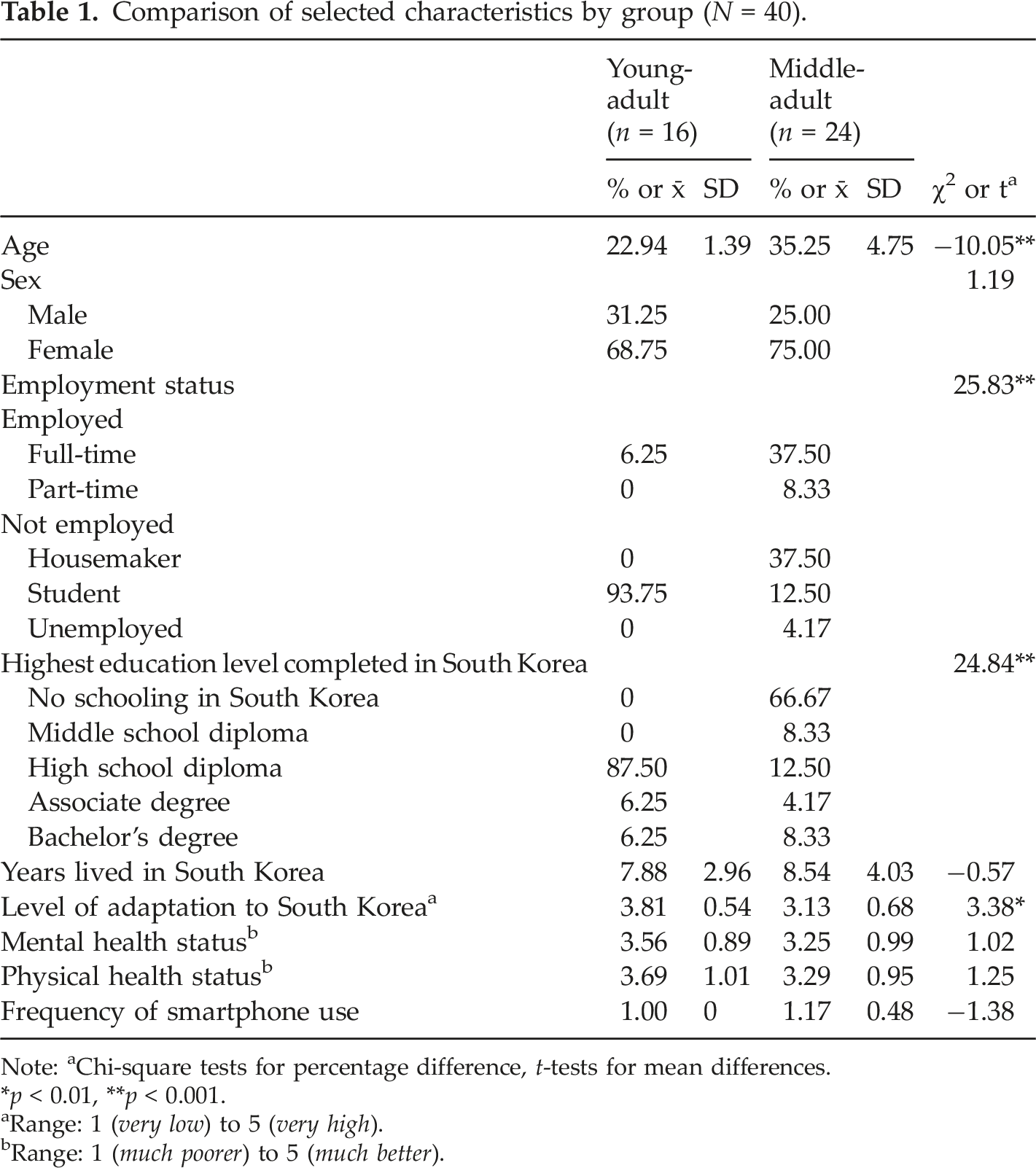
Note: aChi-square tests for percentage difference, t-tests for mean differences.
*p < 0.01, **p < 0.001.
aRange: 1 (very low) to 5 (very high).
bRange: 1 (much poorer) to 5 (much better).
Before qualitative data collection, NKRs were informed about the purpose of the study and that FGDs would be audio-recorded. Prior to the FGDs, participants completed a brief questionnaire regarding their demographic information, level of adaptation to South Korea, health status and frequency and pattern of smartphone utilization. To address NKRs’ sensitivity about revealing their identities, participants received name tags with a number instead of names. Each FGD lasted approximately 80 min and was facilitated by two researchers.
A semi-structured interview guide with unscripted prompts was used to facilitate the FGDs and covered various elements: (a) potential utility of a smartphone app platform (e.g., “What are your opinions about developing a tailored mobile app to better help North Korean refugees adapt to South Korean society by providing critical resources and information?”), (b) types of content desired in the app (e.g., “If this app were to be developed, what type of content would you like to include?”) and (c) preferred features of the app (e.g., “How would you want the app to look like?”). The FGD questions were co-created with an NKR community partner who was part of the research team and were based on the broader epistemological commitment of transformative research (Maleku et al., 2021), which is grounded in viewing the participants both as producers and consumers of digital knowledge. All FGD participants received KRW 30,000 (approximately USD 30) as an incentive for their participation in the study. All study procedures were approved by the Institutional Review Board at Arizona State University.
Data analysis
FGDs conducted in Korean were audio-recorded and transcribed verbatim by an NKR community partner. These transcripts were reviewed by the first author for accuracy and translated from Korean to English by a professional translator, then reviewed again by the first author, who is fluent in these languages. The first author and two trained researchers performed thematic coding and analyses using Dedoose web-based qualitative software.
A three-person research team independently followed a three-step thematic data analysis process of coding, sorting and synthesizing based on the relationship among codes and the synthesis of categories into overarching themes (Saldaña, 2016). The researchers each developed an initial set of codes to describe the information in the transcripts. The research team then discussed, refined and revised these codes to create a codebook. Disagreements in codes were resolved through discussions during peer debriefing (Padgett, 2008) until a final codebook was generated. Acknowledging similarities and differences in needs, preferences and priorities by age group was a crucial part of the data analysis, given the focus on patterns and use of mobile apps based on age. The research team also took extensive notes as part of an audit trail. The first author reviewed the coded transcripts and audit trail to ensure consistency among researchers (Lietz and Zayas, 2010). To maintain methodological rigor, all authors re-evaluated the data analysis, unanimously agreed on the study’s overarching themes and finalized the creation of themes.
Results
Profile of research participants
As seen in Table 1, almost two-thirds (72.5 percent) of the participants were female, which reflects the gender composition of NKRs in South Korea (Ministry of Unification, 2021a). The average age of the young-adult group was 22.9 years (SD = 1.39), compared to 35.3 years (SD = 4.75) in the middle-adult group. With respect to employment status, 45 percent of participants reported being a student, with the majority in the young-adult group, 25 percent were employed full-time, five percent were employed part-time, 22.5 percent were full-time homemakers and 2.5 percent were unemployed. Most participants (87.5 percent) in the young-adult group completed high school or higher degrees in South Korea, whereas the majority (66.7 percent) of middle-adult participants had completed their education in North Korea. On average, participants had lived in South Korea for 8.3 years (SD = 3.62).
Participants identified several barriers to adapting to South Korean society: (a) school-related stress (30 percent), (b) prejudice and discrimination (25 percent), (c) difficulty understanding the culture, economy, law and politics of South Korea (20 percent), (d) difficulty changing their North Korean dialect (20 percent) and (e) frequent use of English loanwords in the South Korean dialect (17.5 percent). The majority (92.5 percent) of participants reported using their smartphones several times a day, excluding use for phone calls, and 35 percent reported looking for educational information when using smartphones to surf the internet.
Six salient themes emerged under two larger domains—(a) content needs and priorities and (b) feature preferences—that emphasized resettlement challenges and content needs in areas such as education, information and networking, which could help build trust and cohesion to improve conditions for successful integration. Reflecting on their resettlement experiences in South Korea, participants emphasized specific needs and priorities, which differed by age group. Participants also discussed preferences for features of the mobile app and provided recommendations that could make the mobile app effective and garner a positive user experience, leading to a more seamless resettlement process.
Mobile apps as a catalyst for positive resettlement experiences: Content needs and priorities
In light of the mutually shaping processes emerging between technology and resettlement in new spaces, participants in both age groups expressed that digital technology like a mobile app might break the invisible wall between NKRs and South Koreans and promote positive resettlement experiences if grounded in culturally responsive needs and priorities. Participants conveyed resettlement needs and prioritized linguistic education, networking, and informational and educational needs. We also found age-specific priorities and discussions of how a mobile app could be tailored to specific age groups for seamless adaptation.
Theme 1. Resettlement needs: Breaking the invisible wall. When discussing needs, NKR participants shared stories of both joyful and dismal moments in their resettlement experiences, particularly gaps in social convoys—the core set of supportive social relationships—in South Korean resettlement spaces. Participants in both age groups described how experiences of continual discrimination and othering due to cultural differences often act as an “invisible wall” between NKRs and South Korean society. Participants reiterated the need to bridge the cultural divide and create a collective sense of community for a positive resettlement experience. The most important thing for us here is cultural consensus. Although we are from the same nation, we have been apart too long and had different education. So, we don’t know too many things about each other. (Middle-adult participant) I have more North Korean friends. I made South Korean friends at church, but it is hard to make a close relationship with them. We don’t have a bond of sympathy because they can’t understand stories about North Korea. I can get along and hang out with South Korean friends, but deep conversation and sympathy are only shared with North Korea[n] friends. I go to church with South Korean friends, but I don’t know why I can’t make a close relationship with them. There is an invisible wall between us. (Young-adult participant)
Theme 2. Linguistic and cultural educational needs. Participants from both age groups raised the issue of language differences and how they can cause miscommunication. This is exaggerated by the fact that South Koreans use many foreign loanwords. Thus, participants promoted the utility of an app that could include a dictionary of commonly used foreign loanwords. I think we need to have a foreign word dictionary as well. When I first came here, my parents and I couldn’t understand conversations because they [South Koreans] used a lot of foreign words. I think using an app to find those will be convenient. (Young-adult participant) When I went out to buy some clothes, sellers were using foreign words. We just say gumjung for black. We don’t use the English word “black” [in North Korea]. We could understand the word if we could search a North Korean dictionary in an app, but it is not available. (Middle-adult participant)
In addition, participants suggested a need for platforms to improve their dialect and pronunciation. When discussing the utility of a linguistic education app, participants emphasized the importance of understanding the cultural background in tandem with language to facilitate adaptation to South Korean culture. Culture and language are interrelated, and the interpretation of language should be grounded in the cultural context. So, the most important thing is overcoming cultural differences, such as our different dialects. Having good communication skills is necessary for jobs and settlement in society. (Middle-adult participant) The accent is the biggest issue. And during phone calls, when I am on the phone for a job interview, I talk like this [without a North Korean accent]. My accent is OK for a couple of comments during the interview, but if the interview lasts long, they end up asking me where I am from. This is the most important issue. (Middle-adult participant)
Some young-adult participants mentioned how useful it would be to have resources about South Korean culture. They wanted to be more familiar with entertainment and recreational activities such as games, restaurants, leisure activities and K-pop culture of the past few decades. Conversation and cultural connections are needed to make friends here. I feel left out when I can’t join the conversation, so I want to understand what they are talking about. (Young-adult participant) It is hard to talk about games, restaurants and activities during their high school days. They talk about their high school, middle school and elementary school. I can understand the high school time, but I don’t understand anything before then. (Young-adult participant)
Theme 3. Networking needs: Blurring the social inclusion and exclusion lines. Social networking for inclusion in new spaces emerged as a consistent theme in both groups. Participants reported feelings of sadness associated with alienation and exclusion from South Koreans. Particularly, NKR parents raising children felt South Korean parents treated them differently. Even though parents get along well with us for a while, their attitudes change when they find out we are North Korean parents. Children get along with others, but because [us] parents don’t have connections, our children are also affected. (Middle-adult participant)
Participants regarded networking as an important factor for resettling, finding opportunities and thriving in South Korea. Many participants described experiences of othering and discrimination. They expressed concern that South Koreans might have negative perceptions of NKRs. Participants discussed how a chatroom app feature could be useful to connect and build relationships with others. Accordingly, there were suggestions to open the app to South Koreans, rather than making it exclusive to NKRs, to allow bidirectional learning. This way, South Koreans might learn about North Korean culture, which could foster relationships and create spaces for inclusion rather than exclusion. I go to college now, and it is hard to communicate. I need to understand the topic to make conversations and make friends, but I don’t have that, and I tend to hang out only with friends from North Korea. Making friends is difficult. I think I would try harder if there were an app like that. (Young-adult participant)
Theme 4. Informational needs. Participants prioritized information on education systems, financial education and cultural and community connections. Specifically, participants expressed that information in video form could be more effective than textual instruction. The middle-adult group emphasized the desire for video lectures to facilitate their adaptation to South Korean society, including thorough general education, particularly in English and Math. Likewise, the middle-aged adults envisioned videos that simulated a typical school day for their children to foster a seamless transition to South Korean education and lifestyle. Furthermore, they felt video lectures could help them learn how to apply for housing. Video lectures are popular because they offer both visual and auditory information and can be paused and replayed as needed. Legal and financial stuff are hard to read and the words they use are difficult. It would be great if you put a video lecture that I can replay with repetition when I need to. You can listen again and again until you understand it. (Middle-adult participant)
Similarly, many middle-adult participants said they wanted video lectures on managing personal finances, featuring topics such as budgeting, credit, loans, interest rates, banking and planning for retirement. They wanted videos that explain important calculations and equations. Young-adult participants were also unsure how to manage money and financial information. They asked for assistance with shopping online and comparing prices, particularly for smartphone shopping. Middle-adult participants further mentioned the need for credible information on how to avoid predatory practices. People who just came over have a lot of skepticism. They have been living in a state of nervousness, and when someone tells them something, they may misunderstand that someone is trying to scam them. (Middle-adult participant)
Both age groups mentioned wanting an outline of the types of schooling options available in South Korea because they came from a different school system. Further, both age groups expressed that an outline of educational benchmarks for each grade level in South Korean schools would be helpful. If people come [to South Korea] when they are students, they don’t know if they should enter middle school or high school or what grade they should join because the education in South Korea is different from that in North Korea. If the app can evaluate them based on their knowledge, they can figure out their school for their education level. (Young-adult participant)
The young-adult group discussed access to information about college and career planning, including how to apply for scholarships and find links to resources. On the other hand, middle-adult participants expressed that they wanted to learn about the process and paperwork involved in registering their children for school. When our children go to kindergarten, we don’t know what to do at first. We want to know how to enter kindergarten, and how the school is running. We learn about the process at the Hana center a little bit, but we want to know where and how to send our kid and the process and documents needed comfortably at home. (Middle-adult participant)
The young-adult group also called for an item-exchange platform in the context of educational and financial needs. For example, participants desired a platform that would allow them to exchange used textbooks and college materials and communicate with former students for information and cheaper textbooks. They felt this feature could help young-adult NKRs adjust financially, ease into a new school system and become aware of school requirements.
Theme 5. Local resource needs: Resources for positive resettlement experiences. Participants in both groups requested updated information on current entertainment and leisure activities that local service organizations host throughout the year. They mentioned that the Hana Foundation and similar agencies hosted events, yet they struggled to stay informed about them. Young adults requested a list of local resources such as stores, restaurants and gatherings that might help them connect with their community. Participants in the middle-adult group requested local information on welfare centers and other service-providing organizations, particularly those with benefits for NKRs. Now that I think about it, we [didn’t] have any information when we arrive[d] here. Someone mentioned there are organizations like NGOs [non-governmental organizations] that help newcomers. If we could post information about those places, sports clubs or even some scholarship opportunities [in the app], it would help newcomers a lot. (Young-adult participant) I want an app that can help newcomers find welfare centers and organizations. If people can find those organizations around them, they can get help to adapt to the new society. So, the best thing for them is helping them find places like that. (Middle-adult participant)
Separate from activities at local organizations, the middle-adult groups asked that the mobile app include information explaining the benefits available to NKRs. They discussed how NKRs arrive in South Korea uninformed about these benefits. Participants in this age group were particularly interested in benefits pertaining to their children’s education and employment. We all have children in our family, and many people who just came out [of North Korea] have children, too. There are benefits from the country and regional offices for our children until middle school. But only a few people know about it. (Middle-adult participant) Hard-working people just enter a company and only think about dealing with their difficult work. They do not know anything about benefits for North Korean refugees. So, if information like this is collected and searchable, then I may at least have a chance to apply for it. It would be nice to have an app like this. (Middle-adult participant)
Everyday barriers, such as insufficient financial means, restricted access to transportation, as well as receiving culturally insensitive care and inadequate information about the availability of health services, impede access to healthcare services for refugees. Participants discussed practical barriers and emphasized the need for information on health care and medical centers, doctors, health insurance and government health benefits for NKRs. I want to know which clinic we should visit for different diseases. I think information on free check-ups and other things will benefit our people. (Middle-adult participant)
Refugee experiences of vulnerability and marginalization are often compounded by complex stressors of displacement and resettlement, which vary across demographic subgroups. In terms of positive resettlement experiences, young-adult participants expressed the need for a hotline to discuss their experiences and seek culturally responsive assistance. We don’t have a place to complain about our issues. We need something like 112 [police number] or 119 [emergency number] that we can call and get advice on what to do. It is hard to get a good solution, and there is nothing that helps. In North Korea, when we make a phone call, there is an operator who helps [with] the phone connection, but South Korea’s phone lines are all automatic. So, it would be great if there is a number that North Korean refugees can call to solve problems. (Young-adult participant)
App feature preferences and recommendations
Theme 6. Mobile app features for positive user experience in a new space. Based on their various needs and priorities, participants provided several recommendations for a mobile app that would be responsive to their needs and assist them in their resettlement. The FGDs uncovered app features on app management, advertising and other features or functions. Both age groups expressed similar preferences and recommendations for app features.
When discussing app management, all groups mentioned the necessity of regularly screening the accuracy of the information posted. They felt the app should announce when information would be outdated. Many participants mentioned still feeling suspicious due to the anxiety of their lives in North Korea and wanted the app to screen for users who might intend to harm others. At the same time, because NKRs are sensitive about disclosing too much personal information, they wanted the app to employ a simple but robust user verification process to protect their identities. Participants said the app could be managed by either a North or South Korean. If we create a chatroom for our people, we can find connections to North Koreans and help them. But that can cause many problems. If we [don’t have to] validate our IDs, our real name is never revealed to the public, and it is better for privacy. There are people who don’t want to reveal their identity. Some may not like it if they find people from the same hometown and recognize each other. Thus, when using the app, identities should not be revealed, but some kind of [anonymous] ID should be used. They can share where they are from, but more information than that will cause problems. (Middle-adult participant)
Participants articulated that the app should be advertised cautiously because given their experiences; NKRs have a difficult time trusting and acknowledging information as credible. NKRs might be suspicious of apps if they are not disseminated through official channels. They expressed that if NKRs learn about the app through well-known organizations, such as Hanawon or the Hana Foundation, or from other NKRs, it might help the app appear more trustworthy. North Koreans take information from well-known organizations. I think people will utilize it if we can collect information from those facilities [Hanawon or Hana Foundation]. (Young-adult participant) If North Korean people tell one another that there is such an app, everyone will actively use that app. Because the environment we lived in is different [than South Koreans], North Koreans need to share something together and let each other know. (Middle-adult participant)
Several participants discussed their desire for an easy-to-navigate interface. They suggested the use of icons with titles on the first screen and organization of content by categories and age groups, rather than making users search for relevant content. They also wanted the app to include functions such as filters, bookmarks, searches and related searches, hashtags and “like” buttons. Moreover, participants wanted the app to include a speech coach and games created for dialect correction, stating they would be motivated to utilize the app if it was entertaining. Many participants also expressed their desire for chatrooms where they can share information and photos with other users. They mentioned the strength of having such a feature in the app is that they could have more comfortable conversations with South Koreans than in-person interactions would allow. There is a speech academy for North Koreans every weekend. We need to have something in the app that can do the same. Can we make it into the form of a game? It would be more fun to play it than learn it. Maybe we can make it a scoring game. It can give scores and tell us what was right and wrong [after we finish]. It would be nice if I could enjoy it like a game. Maybe we can get a certificate after some levels. (Middle-adult participant) Have many chatrooms, categorize them into popular food places, medical information sharing and such. Then, you can enter the ones you want to know about. Here, like this. The title is “chatroom.” [On] the notification page, I can choose whether I want to see only photos or see [descriptions] with the photo. Then I can post comments. (Middle-adult participant)
Discussion and implications
Our study explored the utility and usability of a mobile app to benefit the adaptation of NKRs in South Korean society by garnering an in-depth understanding of their diverse resettlement experiences, needs and perspectives. Study findings provide insights into the priorities and preferences of participants for the content and features of a culturally responsive and tailored mobile app. To the best of our knowledge, this is the first study to investigate the utility of such an app, grounded in NKR perspectives. Findings from the study provide both direct and indirect implications for the prototype development of a tailored app for NKRs in South Korea and iterative user-centered development and evaluation of mobile apps in resettlement spaces.
Our findings also highlight the utility of technology, particularly how smartphones create a prominent pattern of socio-cultural adaptation and facilitate acculturation, identity and socialization domains. Consistent with prior studies, our findings reiterate that the acquisition and use of smartphones by refugees in host spaces, particularly in the initial phases of resettlement, can promote positive resettlement experiences (Mancini et al., 2019). Evidence suggests that the incorporation of technology into the everyday lives of refugees can facilitate access to the information landscape of the host country by providing place-making opportunities, language learning, self-help and relationship-building (Mancini et al., 2019). Our findings corroborate prior studies that found mobile technology to be a catalyst for solving everyday problems associated with adaptation among refugees (Alencar, 2020; Lee et al., 2019) and that the ability to solve problems independently via mobile technology increased NKRs’ self-efficacy and life satisfaction (Song et al., 2016).
The findings reveal that the services provided by existing resettlement organizations are insufficient to navigate daily survival and adaptation among NKRs in South Korea. One promising remedy in addition to these offered services is a smartphone app, which could provide opportunities to build individual agency, mitigate current service gaps and promote positive socio-cultural adaptation among NKRs. Findings show that information needs related to general adaptation, language and culture, education, employment and networking were prevalent across the two age groups. Notable differences included the need for legal and financial education, health care and medical information, housing information, and children and parenting knowledge as priorities for middle adults. Young adults discussed a platform to share experiences and find information on cultural education, scholarships, entertainment and recreation.
Consistent with prior studies among NKRs (Lee and Shin, 2018), our study revealed that videos would be effective in educating this population. Additionally, similar to prior research (Kang et al., 2018; Lee et al., 2019), our findings reiterate the ongoing need to expand social networks and create opportunities for social inclusion for NKRs. NKRs face gaps in cultural understanding, experience exclusion and othering, and want to use mobile technology to foster social capital in new spaces. Prior evidence suggested that mobile apps can strengthen social and emotional bonds, which are major determinants of refugees’ overall well-being and social inclusion (Mancini et al., 2019).
Although mobile apps are being developed to assist refugees (MacGregor, 2018), studies examining the efficacy of such apps remain limited (Mesmar et al., 2016). Therefore, it is crucial to engage refugee consumers in the design, content and implementation processes of refugee services (Kaufmann, 2018; Leung, 2019). Regarding NKRs’ needs, priorities and voices, the findings of our study contribute to the literature on refugees’ recommendations and solutions for mobile apps and inform pragmatic decisions about app requirements, including required features and characteristics for the subsequent development and design of targeted apps. Our study findings suggest that identity protection, trustworthiness, an easy-to-navigate interface and interaction with other users are important app features. Regular screening mechanisms for accuracy and verification processes for identity protection would help build app credibility and user trust.
Further, information on apps should be disseminated through official channels, such as resettlement agencies or refugee networks, to maintain trustworthiness. Although the literature on technology use in forced migration contexts has mostly focused on refugees in Global North countries (Leurs and Smets, 2018) and refugee camps and resettlement contexts elsewhere (Alencar, 2020; Leurs, 2014; Smets, 2018; Twigt, 2018; Wall et al., 2017), our study expanded the literature by illuminating the primary needs of NKRs and representing this unique population.
The findings of our study provide pragmatic implications for policymakers, refugee resettlement agencies and the larger human services sector in resettlement spaces. From a policy standpoint, mobile technologies should be considered a new and open space to protect refugee rights (Mancini et al., 2019). Because mobile apps are usually designed from the perspectives of host societies, refugees face persistent cultural, social and community interaction barriers to accessing and utilizing digital technologies. Therefore, it is crucial to engage refugees in the design, content and implementation of mobile learning apps to address their complex needs and preferences. Given the valuable feedback that NKRs provided in this study, user-informed approaches should be applied in the development of targeted digital projects for refugees in various sectors—including but not limited to health, education, employment and financial literacy—across targeted demographic groups (e.g., young, middle-aged and older adults). Because the use of mobile technologies may strengthen personal agency, targeted apps, particularly for educational, health and human services, may be useful for redefining NKR services.
Limitations and future research
Our study has several limitations. Although a sample size of 40 participants is adequate for a qualitative study (Padgett, 2017), the generalizability of findings outside of Seoul, where data were collected, might be limited. Although the FGDs captured firsthand experiences of NKRs, some contextual and culturally heterogeneous nuances may have been obfuscated by only grouping participants by age. Exploring subgroup differences beyond age or examining intersections of gender and income was beyond the scope of the study. Further, we could not disaggregate the findings based on participants’ length of stay in South Korea, which could affect resettlement experiences and technology use. Future research may benefit from examining differences by participants’ gender, income levels and length of stay in South Korea to illuminate findings not evident when only examining age differences.
In addition, we did not ask participants about their housing arrangements, which can make a difference in the perspective of NKRs when discussing integration and resettlement experiences. Moreover, to measure participants’ self-rated level of adaptation to South Korean society, we asked one question in the brief questionnaire before the FGDs. However, because the concept of refugee adaptation and integration is understood and defined differently based on the individual and context (Ager and Strang, 2008), future studies may better understand how information and communication technology can enable refugee integration by asking refugee participants how they would define and measure their adaptation levels to the host culture during FGDs.
Also, although FGDs conducted in Korean were recorded, transcribed verbatim and professionally translated into English in collaboration with NKR members, the original meanings of participants’ words still could have been misinterpreted or lost in translation. Finally, although our study findings are still relevant and useful today, particularly due to the unique population of NKRs, findings based on data collected in 2016 may have limitations given the rapid changes in the technological landscape. Despite these limitations, our study contributes to the existing knowledge base on the utility and usability of mobile apps in resettlement contexts, particularly expanding the representation of NKRs.
Conclusion
Given that NKRs remain an understudied population, our study provides a unique contribution to amplifying their voices in South Korea and generating community-identified culturally responsive solutions. Refugees are not only consumers but also producers of digital knowledge. Thus, digital efforts and services like mobile apps need to be built not for but with refugee subpopulations. Mobile technology in resettlement spaces can expand opportunities for refugees and nurture their daily lives, fostering productive citizenship. Innovative and culturally responsive mobile app features can also create opportunities for social inclusion in resettlement spaces. Studies that explore innovation in mobile apps in the era of social media and the potential impact on social inclusion among refugee groups may also provide new insights to scale up digital efforts to create spaces for social inclusion of NKRs and other refugee groups.
Footnotes
Declaration of conflicting interests
The author(s) declared no potential conflicts of interest with respect to the research, authorship and/or publication of this article.
Funding
The author(s) disclosed receipt of the following financial support for the research, authorship and/or publication of this article: This research was supported by the USC Graduate School Research Enhancement Fellowship and USC Summer Research Fellowship Award.
