



Abstract
Differences of style between the seams and summaries of Luke and those of Acts have been detected by Patricia Walters (2009). Using the same method (chi-square), but different criteria, still shows significant differences. Dividing her samples and re-testing them reaches very similar results. A third test, this time multivariate (using 30 criteria and including more of Luke and Acts), again shows up a noticeable divergence between the two sets of seams and summaries. A fourth test adds samples from Mark, Dionysius and others. The primary contrast places Mark well to the left and Dionysius well to the right. Samples from Luke are nearer Mark, those of Acts nearer Dionysius. The seams and summaries of Luke are again noticeably distant from those of Acts, the latter being very near to samples from Dionysius. These results support the case made by Walters for serious divergence between these presumably more editorial sections of Luke and Acts.
1a. The Recent Case against Authorial Unity
Whether Acts and the third synoptic gospel share the same authorship is a question re-opened in a monograph by Patricia Walters (2009). 1 She has given previous scholarly discussions of the matter a judicious critical re-examination. 2 Three of these are very briefly noted here, but the main focus of this study is to look closely at the new approach adopted by Walters. This gives specific attention to the seams and summaries of each text as the most suitable material for testing, selects stylistic criteria that match those used by the speakers and writers of the period, and analyses the resulting counts with a method that assesses the probability of common authorship. The result indicates stylometric differences between the seams and summaries of the two works which are in all cases significant, and in all but one case highly significant. 3 That is an important finding and one that deserves further exploration.
I propose, here, first to use the same samples, and the same statistical method, but with criteria more commonly used in stylometric studies of the last 20 years. The aim is to see if using different criteria, such as those words which are most frequent in the texts, can corroborate the results reached when using criteria favoured in Hellenistic and Roman times. Walters is quite right to choose criteria based on stylistic features commended by, or evoking the disapproval of, Dionysius and (works attributed to) Longinus or Demetrius, but it is also desirable to see if other criteria do, or do not, corroborate the results. A second move is then to divide the sample of seams and summaries from Luke into two sub-samples and test each of these against the other, and then to do the same for the seams and summaries from Acts. In each case one sub-sample contains material from earlier chapters, the other from later chapters in each work. That will test whether each work shows internal consistency as well as an overall divergence between the style of the two works in the crucial samples. A third move is then to use a different method which will begin to explore how the seams and summaries relate to other samples from Luke and Acts classified by genre and, in the case of Luke, by suspected source. A fourth test will finally include some further Greek texts from the period, to see to which of these the style of the seams and summaries in Luke and in Acts might be most similar.
1b. Methods and Criteria
The method which Walters uses is to select passages from Luke and Acts that are widely agreed to be editorial. These consist of seams and summaries within each text. This overcomes the problem that Luke evidently shares material with both Mark and Matthew, and that the style of these passages might well to some extent reflect whatever source material was used, even if it was given a thorough revision by the author. There could well be source material in parts of Acts, but that is more difficult to diagnose. Choosing the seams and summaries locates material that is widely agreed to be much more likely to match the characteristics of the author. Also this choice, it is argued, reduces the force of any objection based on the two texts having different overall genres. I would also argue that to focus on the seams and summaries is to focus on components of similar genre within each of the two works. When comparing samples from two such works it is important to allow for genre on the smaller scale than that of the genre of the entire text. Sayings, speeches and narrative within a text can, and do, have different stylistic profiles, so that one should compare sayings with sayings, or narrative with narrative, or, as here, seams and summaries with seams and summaries.
The criteria used in Walters’ tests are chosen to reflect stylistic features discussed and evaluated by ancient writers. These include the presence or avoidance of hiatus and dissonance, prose rhythms, the closing syntactic element in a clause or sentence, and the use of paratactic καί or post-positive particles.
The results of her tests for the seams and summaries in Luke and in Acts are as follows:
For the five tests the resulting p values are: 6
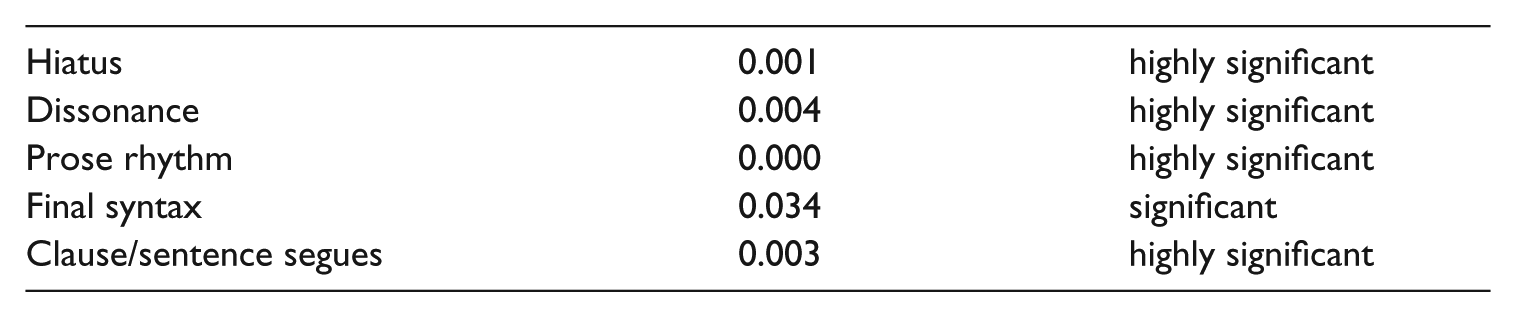
All five tests give results which are statistically significant (p value below 5%, in fact all below 3.5%), and four of the five tests gave highly significant results (p value below 1%). The statistical evidence is strong, and it is unlikely that we would find such large differences if the null hypothesis were true. If some other factor could be found to explain these clear differences, then that would have to be argued, and also then tested on other texts in order to be convincing. But it would be better not to anticipate this issue until it is first shown whether or not other data from these samples confirm the result.
1c. The First Test Using Different Criteria: High Frequency Words
Stylometric studies have experimented with a very wide range of criteria, and comparative studies, such as those by Forsyth and Holmes (1996) and by Grieve (2007), provide evaluations of those that have proved to be the most consistently successful. 7 Amongst these, high frequency words often score very well and are widely used in stylometric tests on texts in many languages and from many periods. The very frequent words tend to be less content related, and to be determined more by their relation to syntactic components of an author’s style. They are regularly referred to as function words for this reason. The five most frequent words across the Greek New Testament are the following: the article, καί, αὐτός, δέ, ἐν. These words are also among the six most frequent in Luke and Acts. 8 Using words from the top end of the frequency range also has the very valuable feature of reaching total counts high enough to allow the testing of sub-divisions of the original samples to check internal consistency.
The samples of seams and summaries from Luke and from Acts are those listed and discussed in Walters’ monograph, and are printed in full in the to that work. 9 The sample from Luke contains 641 words and that from Acts 590. 10 We need to decide between two choices by testing the second of the following two rival hypotheses:
Using the five Greek words most frequent in the New Testament, and the same samples as in the tests by Walters, a chi-squared contingency test gives the following result:
Seams and summaries in Luke and in Acts – Contingency table data (word counts):

The test here uses the same samples, and same method, as is used by Walters, but uses data for the five Greek words most frequent in the text. The test is a contingency test, i.e. it uses data in a table with at least two rows and two columns, and tests the view that any differences between the scores listed for each column are due to nothing more than random variation. If that were so, the data would show no significant differences dependent on, or contingent on, their being in the column for Lkss or the column for Acss. The first table gives the actual counts. A second table then gives the ‘expected counts’, i.e. the numbers expected if the two samples used each of the words tested proportionately. To find these for each cell, its row total is multiplied by its column total, then divided by the overall total for the table. This allocates the row total evenly, while adjusting each cell for the difference in size between the two samples of text.
Expected counts
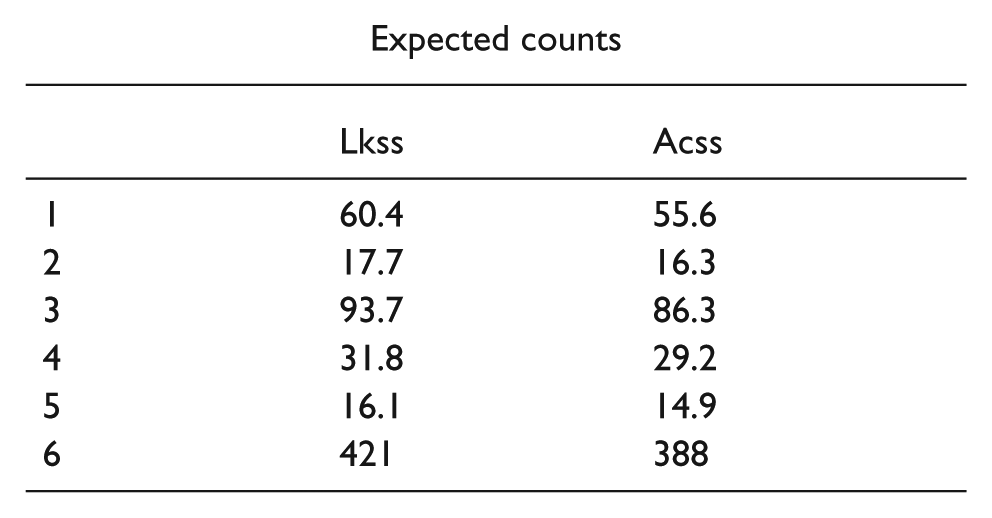
A further calculation then carries out the remainder of the test. 12 The results follow.
Chi-Sq 19.7 DF = 5 p value = 0.001 = 0.1%
Conclusion to the first test
This test uses the same samples and the same statistical method as Walters, but employs different criteria by using the five most frequent words in the Greek New Testament. The result gives a highly significant p value (0.1%), so H0 (that there are no significant differences between the samples) should be rejected. (The lower the p value, the more significant; a low p value means it is unlikely that we would find so large a difference if the null hypothesis were true.) It is therefore right to conclude that the differences between the style of the seams and summaries from Luke and that of the seams and summaries from Acts need to be taken very seriously.
2a. The Second Test: Partitioning the Samples from Luke and the Samples from Acts
An extremely useful convention in literary, and other, statistics is to check whether a test that reveals differences between texts does, or does not, uncover similar differences within any or all of those texts. The seams and summaries from Luke can be tested first, using half samples containing 320 words from earlier and 321 words from later chapters. If significant differences are discovered within the seams and summaries in the text of Luke, it would be problematic for the theory that the two works are differently authored but that the authorial style within each work is consistent. We need to decide between H1 and H0 by testing the null hypothesis H0.
A low p value would count against H0, whereas a high p value would be consistent with it. So the null hypothesis to be tested is that the five very frequent words will not reveal significant differences between the two Lukan half samples.
Seams and summaries in Luke: two half samples (LkA and LkB) Contingency table data:
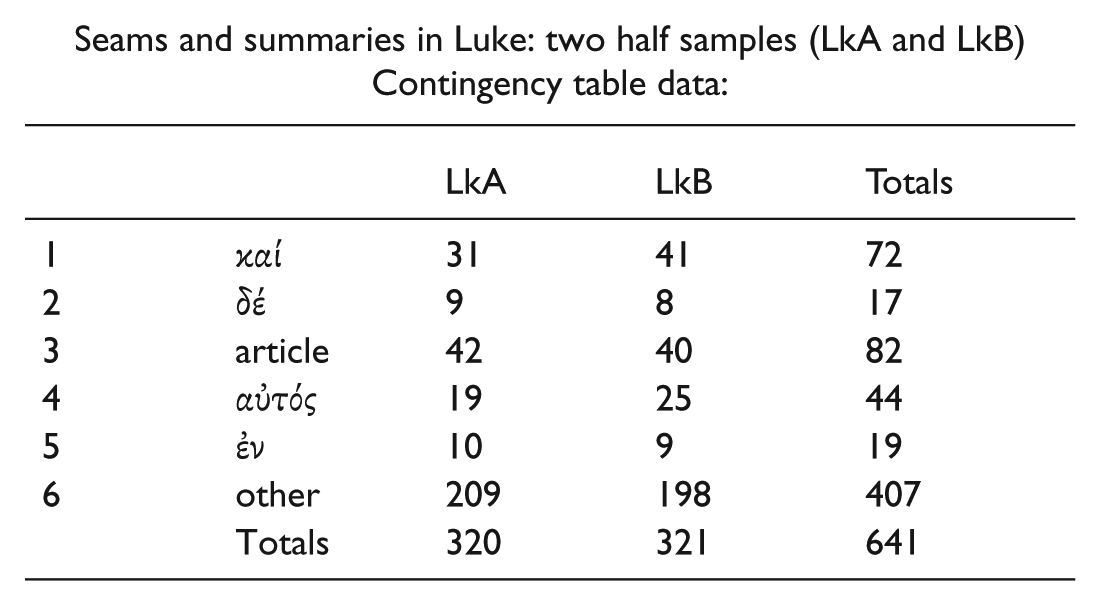
Expected counts:

(For the method of calculation see the previous tests.) Chi-Sq = 2.66 DF = 5 p value = 0.752
The p value here (75.2%) is massively distant from even the 5% significance level let alone 1% or anything below that. The null hypothesis should not be rejected here. The test found no evidence that the editorial style varies significantly within the seams and summaries of the text of Luke, at least as far as these usually reliable criteria are concerned.
We can now ask a similar question about Acts. What happens if the seams and summaries of Acts are divided into two half samples (one from earlier, the other from later chapters), and tested using the same set of five high frequency function words? 13 The procedure to be followed is similar to the one just used for Luke. We need to decide between H1 and H0 by testing the null hypothesis H0.
We need to see if the evidence of the five most frequent words does or does not disconfirm H0.
Seams and summaries from Acts: two half samples (AcA and AcB) Contingency table data:
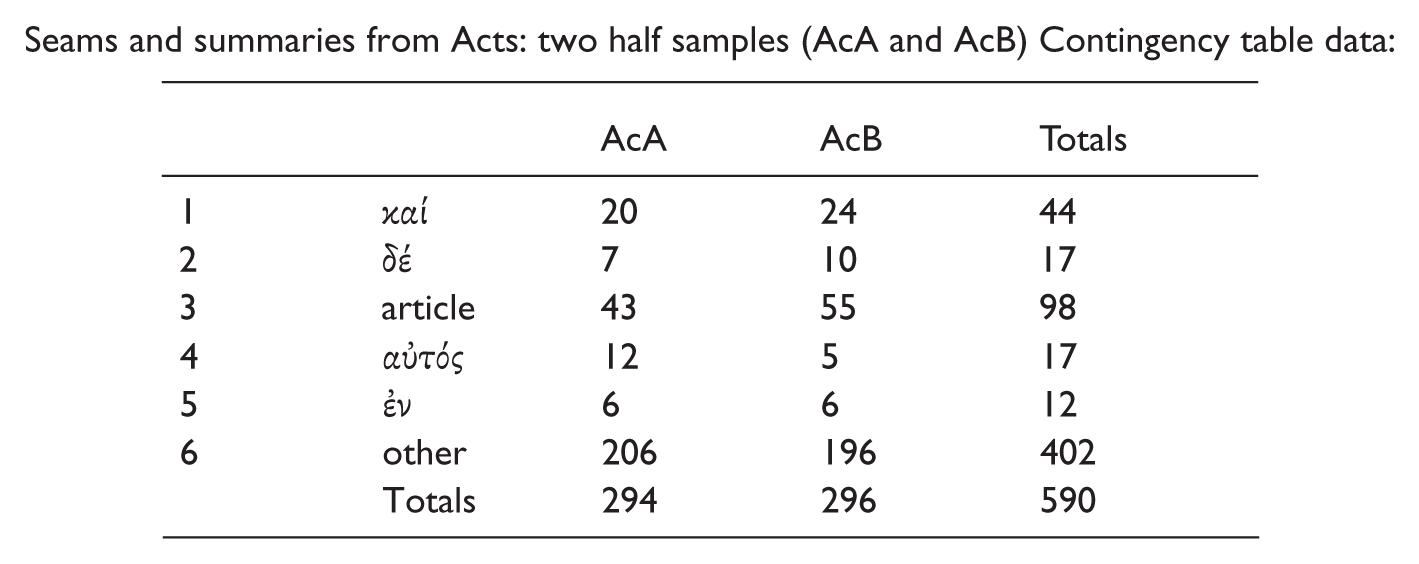
Expected counts:

Chi-Sq = 5.49 DF = 5 p value = 0.359
There is a widespread convention in statistics that this particular type of test should ensure that at least 80% of the cells should have an expected count of 5 or above. In fact, in the three tests reported above, no cells had an expected count less than 5.
Once again the p value (at 35.9%) is nowhere near the significance level of 5% let alone that of 1% or below. The distance from 5% is not quite as massive as in the previous test, but it is still considerable. The seams and summaries of Acts do not display significantly different features within that text as far as the five high frequency Greek words are concerned. 14 This result, using the kind of criteria widely adopted in stylometric studies of other literature, now completes the second set of tests. The pattern which emerges is clear and it corroborates the results in Walters’ monograph.
2b. Conclusion to Parts 1 and 2
One of the main reasons for embarking on these tests was that though, some decades ago, Clark (1933) and Argyle (1974) drew attention to differences of style between Luke and Acts more generally, their work has not had the effect of seriously undermining the assumption of common authorship. The situation since 2009 is different, as Walters’ publication of the tests on the seams and summaries shows very significant differences between sections of text generally held to be editorial. The new evidence put forward to that effect is a very serious challenge to most of the arguments used previously to discount the differences in style between Luke and Acts. Much of the other material in Luke is shared with other texts such as Matthew and Mark, and, though seriously re-edited by Luke, retains enough features of whatever the sources are to make most of Luke more like Matthew and Mark than it is like Acts. 15 Again Acts is often concerned with a different geographical and cultural area from the settings in Luke, and the author may well be writing more freely and more explicitly for a Graeco-Roman audience. But such defences against the questioning of common authorship do not hold nearly so well when differences appear between those sections of Luke and those of Acts that are most likely, in each case, to be editorial.
It has to be admitted, and the results published by Walters oblige me to admit, that the case against assumed authorial unity has made a major advance. The tests set out above represent an attempt to see whether or not the evidence, so carefully and thoroughly presented in Walters’ monograph, would, or would not, be corroborated by further testing using different criteria. The answer from the tests devised in order to do that seems to be unequivocal. The new tests, using different criteria, provide a fresh analysis of those parts of the two works generally agreed to be editorial, and so to reflect the style of the author. The seams and summaries are, on the criteria used, shown to be stylistically coherent within Luke and within Acts, but yet again to display very significant stylistic differences between these two texts.
3a. Wider Stylometric Perspectives on the Seams and Summaries of Luke and Acts
The tests in the first section of this article focus almost exclusively on the editorial seams and summaries in Luke and Acts. A further perspective on this could be obtained by attempting to see how the seams and summaries relate to other parts of the two works. By using a multivariate method, that is, by simultaneously testing a larger number of samples, using a larger number of criteria, it is possible to see from a scatter plot which samples are nearer to each other and which more distant. These plots tend to vary when different texts, or different criteria, are used. For example, if sections of texts are included which differ strongly due to genre differences, these may tend to emphasize differences between samples of sayings and samples of narrative. If some of the samples differ significantly in other ways, such as the extent to which they are more like the standard literary Hellenistic Greek of a writer such as Dionysius of Halicarnassus, or more like the Greek of authors influenced by Hebrew or Aramaic or by the Septuagint, then those differences may tend to be more prominent. The statistical methods simply find the most prominent similarities and differences. The ones to which they award priority may vary if the character of the texts is varied.
For the remaining tests, the samples of seams and summaries from Luke and Acts are used in their undivided state. They therefore provide samples consisting of 641 and 590 words respectively. Further samples from Luke and from Acts, mostly of 1000 words in length, are also included in the third test. The fourth test includes a much larger selection of 1000 word samples in Hellenistic Greek from a range of other authors. These are drawn from some of the authors who can be shown, in more extensive tests on Hellenistic Greek writers reported elsewhere, to be reasonably close neighbours of Luke and of Acts. 16
The criteria used for these tests are also more varied. They use a set of 30 words and word endings, which includes connectives, conjunctions, prepositions and words with specific genitive endings. 17 The method used here is known as Correspondence Analysis. It can test a set of texts against the criteria just specified, to see which of the texts relate more closely to the others, and which are more distant from each other. 18 It also, at the same time, can give information about which criteria are associated with a sample of text being placed in a particular area of the resulting scatter plot.
3b. The Third Test: Seams, Summaries, and More of Luke and Acts
The third test makes use of 23 samples of text from Luke and Acts. These include 13 samples of 1000 words from Luke, and 6 samples of 1000 words from Acts previously used in the earlier published tests on Hellenistic Greek texts noted above. 19 In addition, there are two further samples from Lk. 1–2, one containing only the canticles from those chapters, the other the remainder of the text, the latter totalling 1640 words. (The fact that a few of the samples are different in size from the majority is not a problem for Correspondence Analysis; it can cope well with this.) Finally, the seams and summaries from Luke and from Acts provide the two most important samples for present purposes.
The scatter plot that is shown as Figure A (see next page) displays the relevant output from the test. The vertical dimension on this plot shows where a clear and distinct contrast can be seen between the seams and summaries in Luke and those in Acts. The former are close to the foot of the plot, towards the lower right quarter of the plot, and the latter at the very top of the plot, in the top corner of the upper right quarter.

(Test3r.odg) Information about each sample is given in the .
Before focusing more closely on the feature of this plot most relevant to the present investigation, some observations need to be made about the location of the other samples from Luke and Acts. The first dimension shows the largest contrast in the data, and so flags a heavy contribution made to this by samples of Synoptic sayings on the left, as against samples of narrative from Acts on the right. This contrast is a genre distinction which is given prominence by being placed on the dimension of the plot contrasting left and right. It is not at all unusual for genre to play such a prominent role in distinguishing between samples. 20 It is very evidently the case here.
Correspondence Analysis identifies the contrasts within the data, one after another. A second contrast within this set of samples involves the sample containing the ‘we’ narratives in Acts. That is not shown here, as the primary focus is on the seams and summaries. It is, however, worth noting in passing that the ‘we’ narratives are distinctive within Acts, a feature at least partly due to their fairly heavy use of δέ and their very heavy use of εἰς. Some consider these narratives to be derived from a source, others that they are a literary device. That issue cannot be pursued here but it is reasonable to infer that the specific stylistic features just noted are due, at least in part, to the character of a travel narrative.
The plot shown here displays Dimensions 1 and 3, as it is here that the contribution statistics highlight a clear separation between the seams and summaries in Luke (Lkss at the foot of the plot towards the lower right) and those of Acts (Acss in the top right hand corner of the plot). These are both to the right of the plot, as they both contain a high proportion of narrative. But one is at the foot, the other at the top of this plot. 21 So the highly significant differences between the two sets of seams and summaries, noted earlier when they were studied in isolation, are also matched by this very clear and distinct separation between them here, when other samples from Luke and Acts are also included. It is still possible to add something to the characterization of the difference between the two sets of seams and summaries. The fourth test will do that.
4. The Fourth Test: Seams, Summaries, Luke, Acts and their Neighbours
The previous test does show that the criteria used do reveal a large distance between the seams and summaries of Luke and those of Acts. This distance appears, however, on the third dimension of that analysis. Correspondence Analysis works by identifying successive contrasts in the data, the one explaining the largest amount of variance in the data is placed on Dimension 1, the next on Dimension 2 and so on. In the third test, genre is dominant and the contrast between the two sets of seams and summaries emerges after the genre differences on the first two dimensions. It is not always the case that genre divisions between speech and narrative are quite so dominant, and the next test, by including some of the near stylistic neighbours to Luke and Acts, will show that very clearly.
Earlier stylometric work on a variety of samples from Hellenistic Greek writers shows that 4 Kingdoms and Polybius exhibit very noticeable differences. 22 The differences in those tests form the major contrast, and genre differences are in second place there. These far distant neighbours are not needed here, but samples from closer neighbours of Luke and Acts could include Mark and Matthew on the one hand, and Dionysius and Plutarch on the other. So the fourth test retains the 23 samples from Luke and Acts used in the third test, but also adds 22 further samples from the stylistic near neighbours of Luke and Acts. These include six samples from Mark, five from Matthew, one each from Wisdom, 2 Maccabees, Hebrews, papyrus letters and Philo, three from Dionysius, two from Plutarch and one from Dioscorides. Each of these 22 samples contains 1000 words, and are selected from texts used elsewhere which had appeared to the left, or right, or above, or close to the lower edge of the samples from Luke and Acts.
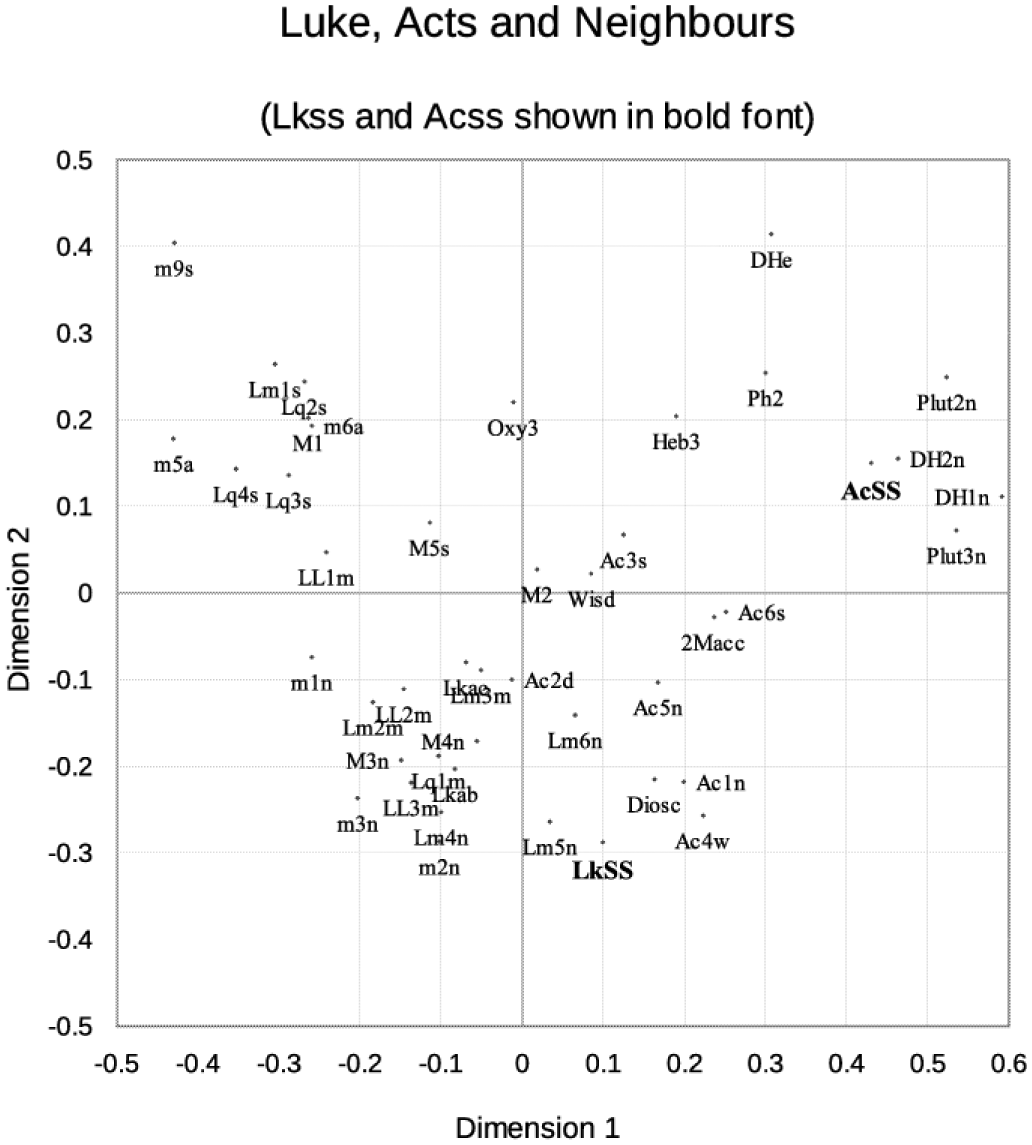
Correspondence Analysis can now be run on these 45 samples, using the same 30 function words as in the third test. The resulting scatter plot is shown in Figure B (see next page). Dimension 1 is shown left to right with samples from Mark towards the left edge, and samples from Dionysius and Plutarch towards the right edge. 23 The former writes in a Greek somewhat influenced by Aramaic, whereas Dionysius and Plutarch write in a more literary Hellenistic Greek prose style. 24 This difference now dominates the resulting output, and forms the primary contrast on the axis from left to right, while differences between speech and narrative take second place, as the second contrast, with speech higher and narrative lower on this plot.
(Test4r.odg) Information about each sample is given in the .
Samples from Luke tend towards the left of the plot; samples from Acts tend towards the right of the plot. Dimension 2 forms the vertical scale on the plot. Samples which are higher on the plot tend to contain synoptic sayings, or set piece speeches, or be sections of treatises or epistles. 25 Samples which are lower on the plot tend to be of mixed genre (some speech and some narrative) or of narrative. 26 The contrast between items which are higher on the plot and those which are lower is mainly that between speech and narrative. (If speeches in Dionysius or Plutarch were to be included, the plot would need to extend much further at the top even than the sample from an epistle by Dionysius.)
The crucial issue is the distance between the seams and summaries from Luke and those from Acts. To put that in context it needs to be seen in relation to the other samples of text. Synoptic sayings in Luke are in a cluster in the upper left. They retain some of the flavour of the underlying Aramaic, so are to the left, and they are sayings, so higher up than the rest of Luke. 27 Slightly to the left of centre are a group of samples of mixed genre from Luke. Below the centre is a cluster of Lukan narrative samples. These cluster either side of the vertical centre line. The sample from the Lukan seams and summaries (Lkss) is shown in bold font and is the furthest to the right of all the Lukan samples.
The samples from Acts begin with the mixed genre sample (Ac2d) containing narrative, speech and dialogue from Acts 4–8 just below the centre of the plot. Narrative samples from Acts are towards the lower right. Samples from earlier and later speeches in Acts are higher up, but also to the right of the centre of the plot. 28 The sample of seams and summaries from Acts are noticeably further to the right, in the upper right quarter of the plot. This sample (Acss) is also shown in bold and underlined. Six of the seven samples from Acts are further to the right than the samples from Luke, and the sample of seams and summaries from Acts is the furthest to the right of all the samples from Acts. The distance between the seams and summaries of Acts and those of Luke is very obvious. The seams and summaries of Acts are much closer to two samples of narrative from Dionysius on the wars of Tarquinius, and two samples of narrative from Plutarch’s Life of Caesar. That might not be so emphatically the case on all criteria, but it is certainly the case on the set of 30 connectives, conjunctions, prepositions and the like used in this study.
The set of tests reported here all give independent corroboration to the statistical findings by Walters. There is a stylistic difference between the seams and summaries of Luke and those of Acts. That difference is clear and distinct. The tests by Walters are correct, and they are corroborated by tests using other criteria. Also her results are confirmed when each of her sets of samples is sub-divided and re-tested. They are again confirmed when the samples of seams and summaries are included in a set of further tests including more samples from Luke and Acts, and also when more samples are included from authors whose texts are their stylometric neighbours.
Conclusions
Using the same samples and the same method as Walters, but different criteria, the first test corroborates the highly significant difference between the seams and summaries in Luke and those in Acts. By dividing each sample into two, the second test shows that, while the seams and summaries in Luke differ very significantly from those in Acts, there are not significant internal differences. Each full sample is internally coherent, but each shows major differences from the other. The third test shows that, when many more samples from Luke and Acts are included, those other samples first exhibit differences due to genre. Yet thereafter a very substantial distance between the two sets of seams and summaries also becomes very evident. The fourth test uses a larger set of samples which includes texts which are close neighbours to Luke or to Acts. These samples give greater prominence to divergences between different types of Hellenistic Greek. This test shows the seams and summaries in Luke to be closer to narratives of a slightly more biblical style, and those of Acts closer to formal speeches containing narration, and even closer, on the evidence of the 30 criteria used, to narratives of a more literary Hellenistic Greek.
The scope of this piece has deliberately been limited to testing the stylometric evidence. 29 It would not be unreasonable, however to offer some very brief observations on the wider issues. These follow.
Of course due account needs to be taken of similarities of theme, characterization and the like between the two works. Due weight also needs to be given to differences due to source material, and to differences arising from the different contexts of the two works. These can be and have been pleaded in mitigation by those who favour common authorship. But the differences between the seams and summaries of the two works are not to be underestimated. They might not compel an immediate change of view about common authorship, but they should compel a much more thorough re-appraisal of the matter, and some very serious questioning of whether those factors which may well be compatible with common authorship are sufficient to demand it.
Footnotes
Appendix
In Figure A and Figure B the character of each sample is given a very brief code. The code is listed in the first column below. An explanation of it follows here:
In the first column (‘Sample’) the sample identifiers use the following symbols: initial L for Luke, Ac for Acts, m for Mark or M for Matthew. After the initial L for Luke the second character is normally m or q or L indicating that the sample contains material parallel to Mark, or to Matthew only, or to neither of these. (Lkab designates material from the opening two chapters excluding canticles, Lkac designates canticles from these chapters.) After initial Ac or m or M the numerals are simply there to show which sample is which. The final letter (or letters) after L, Ac, m or M etc. give an indication of genre as explained below.
The codes for Hebrews, Wisdom and 2 Maccabees should be clear. DH indicates Dionysius of Halicarnassus, Ph Philo, Diosc Dioscorides, Plut Plutarch and Oxy Oxyrhynchus.
In the second column (‘Type’) the genre of each sample is specified.
a = apophthegms c = canticles d = dialogue ep = epistle m = mixed n = narrative p = parables s = sayings sp = speech ss = seams/summaries t = treatise w = we narratives
1.
Her title, The Assumed Authorial Unity of Luke and Acts: A Reassessment of the Evidence, indicates the aim. Her criteria are drawn from ancient stylistic usage; the statistical method she deploys is the widely used chi squared (χ2) test. This test checks whether differences between counts of words in two samples of text are, or are not, significant. This issue is discussed in more detail in Section 1c below.
2.
As well as giving very careful consideration to the very large number of works whose findings support common authorship, attention is paid to Hawkins (1909). He attributes differences of word usage to a lengthy period of time between the two works. Amongst the few to contest common authorship are Clark (1933) and Argyle (1974). Walters notes their evidence based on differences in word and synonym usage, and also the arguments used against them by others. More recently  has again raised the question of whether Luke might be based on an earlier document also used by Marcion. This raises a set of wider issues, most of which relate to matters that are beyond the scope of this article, and are not amenable to stylometric testing, as we only have partial descriptions of what later writers found in Marcion’s text itself.
3.
Stylometry on literary texts uses a wide variety of statistical methods. The criteria are often words or features frequently used in the texts. The term stylometry seems to have been originally used in architecture. The word is so used in the title of his work by Goldmann (1662). The term later appears in the title of an article summarizing a lecture on the style of Plato by Lutoslawski (1897). A total of 99 criteria on the whole of the NT, including Luke and Acts, have been used in a stylometric study by : 72-75). His correlations show Acts to be ‘closer to Luke than it is to any other work in the New Testament’, but Luke to be ‘closer to Matthew and Mark than it is to Acts’. His tests on words and groups of words flag up significant differences in the use of καί, μή and ἵνα, κατά, nouns, and noun cases. Pronouns show ‘a number of significant differences’, and he finds highly significant differences in verb tenses, but judges these to be explicable as due to the ‘influence of subject-matter and genre’. His overall conclusion about Luke and Acts is that ‘the similarities far outweigh the differences’. Kenny is, of course, in this work comparing totals for the two entire texts, and the discovery by Walters of highly significant differences between the two sets of seams and summaries now begins to apply methods similar to those found in Kenny’s book to a pair of text samples much more critical for assessing stylistic consistency between Luke and Acts.
4.
The ‘n k’ dissonance is where a word ending in nu is followed by a word starting with kappa, e.g., Lk. 8.1 κώμην κηρύσσων.
5.
The long-longs are where one long vowel or long diphthong is followed by another, e.g., Lk. 1.80 which has both ἐκραταιοῦτο (within the word) or καὶ ἦν (between two words).
6.
: 186). The p value is the probability that we would find so large a difference if the null hypothesis were true. If the p value is low (below 5%), or very low, then this is unlikely. If that is so, it is normal practice for researchers to reject the view that there is no significant difference between the two sets of samples. This leads to the verdict by Walters, when the p value is very low for the two sets of seams and summaries, that the result is highly significant. See further nn. 11-12 below.
7.
One can find success rates on samples as small as 200 words at around 73% for function words (words which relate more to syntax than to content) and 79% for strings (pairs of letters or other characters) in tests by Forsyth and Holmes 1996: 164, 169. Success at 80-90% is reported by : 251-70, especially 261. These results are found when testing two to four authors using a large set of high-frequency function words, or using pairs of letters or other characters, on samples varying in length between 500 and 2000 words. Problems increase where attempts are made to assign a text to one out of as many as forty authors, but that is not the problem here. The aim here is to test the stylistic agreement, or lack of it, between two samples traditionally attributed to the same author.
10.
In the final version of my tests, one bracketed word is excluded at Acts 4.4 to tally with Walters’ decision (: 206 n. 38), and the count of the sample from Luke is one word less than 642. In each case, tests with, and without, these minimal changes show that they do not affect the significance of the results from either study.
11.
Hypothesis testing regularly sets one hypothesis H1 against its rival H0. The latter is known as the ‘null hypothesis’, and normally makes a statement to the effect that there is no significant difference between two sets of samples (or no significant improvement between an innovation and its predecessor).
12.
For each cell the method first calculates the difference between the observed and the expected value. That number is then squared (to avoid negative numbers) and divided by the expected count. The formula for this is (O-E)2 /E. The results for each cell are calculated in this way, and then added together. The result is the chi squared figure. One more item is needed and that is the total for the formula (r−1) * (c−1): the number of ‘rows minus one’ times the number of ‘columns minus 1’. That is known as the number of degrees of freedom (number of items that can vary) and is shown after the abbreviation DF. From these calculations the test derives the probability that we would find so large a difference if H0 were true. If the p value is very low, then the null hypothesis (that there is no significant difference) is rejected. The actual calculations for p-values are not usually displayed, as their complexity is much reduced by consulting either a printed table of p values, e.g., : 47, or a computer programme.
13.
Function words are words which relate more to sentence structure than to content; see Section 1c above.
14.
The sequence for the tests of the Lukan half samples against those of Acts is as follows: LkA/AcA, LkA/AcB, LkB/AcA, LkB/AcB. The results are p = 0.53, 0.045, 0.0412, 0.0012, i.e. not significant, significant, significant, highly significant. Of these results 3 out of 4 produce a significant or highly significant difference. The one which does not might point to some affinity between the two prologues.
15.
A subsidiary test pursues the observation that some of the seams and summaries in Luke, especially those from Lk. 3 to Lk. 6, contain some words which are paralleled in Mark in the same or a nearby context. Further exploration indicates that of the 641 words in the samples widely agreed to be Lukan editorial material, there are two blocks totalling 384 words in which just over 21% of the words are paralleled in Mark. The rest, mainly the early chapters and the travel section, provide 257 words of seams and samples with hardly any words matched in Mark. These part samples still cohere with each other, giving p = 0.608 (60.8%). Testing the sample of 257 words from the Lukan seams and summaries with minimal Markan matches against the seams and summaries from Acts gives a p value of 0.004 (0.4%), so still showing a highly significant difference between the two works. While that might not disprove every objection of this kind, it certainly rebuts the most obvious one.
16.
See Mealand 2012: 323-45. The samples from Luke match those listed in Mealand 2011: 506-507. The samples from Acts match those listed in : 503. It should be noted that samples 5, 7 and 9 there are numbered consecutively as 4, 5 and 6 here. A lists all the Greek passages used in the tests.
17.
The 30 criteria are: ἀλλά, γάρ, δέ, καί, μέν, οὖν, ἄν, εἰ, ἐάν, ἕως, ἵνα, ὅπου, ὅταν, οὐ/οὐκ, μή, ὅπως, ἀπό, εἰς, ἐκ, ἐν, διά, κατά, μετά, περί, ἐπί, πρός, -ντος, -ντων, -μένου, -μένων (the last four being genitive endings which are often participial endings).
18.
On the method, see Greenacre 1984 and also .
19.
See n. 16 above.
20.
On the role of genre, see Burrows 1992: 91-109, esp. 96, 101-102. Also relevant is Burrows 2004. Further discussion in the second of these can be found at http://www.digitalhumanities.org/companion/ (accessed 23 August 2014) especially at sections 23.1 and 23.2. For the stylometric effects of genre differences in Mark, see : 227-45.
21.
A check with the column of statistics for contributions to the vertical axis on this plot shows the low position of Lkss associated with greater use of the variables καί, ἐν and περί. The much higher position of Acss is associated with heavier pro rata use of μέν, οὖν, and διά, compared with most other samples from Luke and Acts.
22.
See Mealand 2012. There is also a good example of a similar feature in a study of stylistic aspects of the Septuagint by Jobes (2003: 73-95). Her method uses a calculation based on a formula proposed by .
23.
The statistics show that the largest contributions to the left-right contrast on Dimension 1 are made by two samples from Mark, and the sample Lq4s (a sample of sayings from the double tradition in Luke) at the upper left, and by the four samples from Dionysius and from Plutarch on the upper right. The sample of seams and summaries from Acts is the next contributor after these. Samples to the right are characterized by greater use of μέν, δέ, κατά, the words with the genitive endings, and περί. Samples to the left are characterized by greater use of μή, ἐάν, ὅταν and οὐ.
24.
On the Semitic features in Mark’s Greek, see Maloney 1981. The Greek of Dionysius exhibits a mild Classicizing tendency, which in subsequent writers leads to a more distinct Atticism. On this, see : 67-75.
25.
Two factors make this slightly more complex. In Acts the narratives often contain an element of speech, and the formal speeches often contain at least some narrative. Also the narratives of some authors start higher up on the plot, and their speeches, epistles or treatises go even higher. The function words associated with this are discussed in n. 26.
26.
The largest contributions to the vertical axis are the two highest sayings samples in the upper left, and the epistle of Dionysius to the upper right. After these the next largest contributions come from the two lowest narrative samples to the left of the Lkss, and from that sample itself. Samples higher on the plot are characterized by μέν, ὅταν, ἀλλά, γάρ, μή and περί, those lower on the plot by καί and δέ. These inferences are drawn from the counts, in the statistical output, of those function words which make the largest contribution to the first and second dimensions of the plot. (Acss has higher scores for μέν, ἀλλά, γάρ, μή, and a lower score for καί than Lkss. Samples which appear higher on the plot are likely to have some, but not necessarily all, of the features flagged in the contribution column of the statistics.)
27.
28.
Other stylometric approaches using a wider set of data than the seams and summaries show that the first half of Acts is not quite so distant from the style of Luke as the later chapters of Acts. So Greenwood 1995; Erwin and Oakes 2012; : 170. But the wider data set is likely to include more material less directly composed by the author. Results from studies focused on the seams and summaries are more likely to capture the author’s own contribution.
29.
I wish to acknowledge the use of the morphologically tagged electronic text of the Greek New Testament produced by Barbara and Timothy Friberg, and texts in Thesaurus Linguae Graecae©, as sources of material which assisted my investigations. I also wish to thank readers for JSNT, and the editor, for their recommendations of improvements and clarifications for the final version.