



Abstract
For parents to provide effective support for their children’s language development, they must be attuned to their child’s changing abilities. This study presents a theoretically driven strategy that addresses a methodological challenge present when tracking longitudinally the cessation or ‘fading’ of behaviors by capturing withdrawal of maternal assistance over time relative to change in child participation. Data are the co-constructed narratives of 31 mother–child dyads when the children were 3, 4, and 5 years old. Responsibility for providing narrative macrostructure shifted from children relying on maternal prompts to contributing them spontaneously, while maternal contributions showed a gradual cessation. The findings support the notion of bidirectionality in co-construction and are interpreted using a dose-effect model of the shift in responsibility for the narration over time with implications for intervention.
Keywords
To be an effective source of support for a child’s cognitive development, parents must provide scaffolding that is well attuned and appropriately adjusted to the child’s needs and abilities (Wood, Bruner, & Ross, 1976). A similar sensitivity is required of parents when assisting their child’s storytelling efforts (e.g., Fivush & Fromhoff, 1988; McCabe & Peterson, 1991; Reese, Haden, & Fivush, 1993). Too much support and a parent runs the risk of not giving responsibility for the story to the child; too little and the child will not be able to participate successfully in the conversation and sustain co-construction of the story. By way of fine-tuning assistance, the parent provides support within the child’s zone of proximal development (ZPD) to aid in the child’s mastery of a skill that would otherwise be beyond his or her independent efforts (Campione, Brown, Ferrara, & Bryant, 1984; Vygotsky, 1978).
The current study examines the link between maternal language behavior and child language behavior in the context of co-constructed personal narratives. In this study, we adopt Labov’s (1972) definition of personal narrative – the recapitulation of past experiences that (it is inferred) actually occurred (pp. 359–360). Specifically, we examine the personal narratives of children and their mothers that were co-constructed over a number of conversational exchanges in semi-structured observation. We take a microanalytic approach to examine the utterance-level macrostructure supplied by the child per the mother’s scaffolding. Addressing a major methodological and theoretical challenge with longitudinal data – i.e., tracking change in behaviors over time as these behaviors cease to be observed or change in nature – we explore a novel analytical solution that accounts for developmentally driven attrition in mother–child dyads. We propose a dose-effect model borrowed from the behavior health field (e.g., Barkham et al., 2006) that allows us to articulate the shift in responsibility for narrative over time from the mother to the child and identify a nuanced set of implications for intervention.
Development of narrative skills
Oral narratives can recount factual past experiences, discuss future events, or describe fictitious stories. The majority of narratives told in conversation are retellings of past experiences (Hoff, 2001). Past event narratives are defined as a string of temporally or causally sequenced clauses about personal past experiences and as having a minimum of two past events (Labov, 1972). Five macrostructural components – orientation, complicating action, evaluation, resolution, and coda – provide the structure of personal narratives (Labov & Waletzky, 1967) and have been documented in the stories of children and adults from an array of socioeconomic and cultural backgrounds (Labov, 1972; McCabe, 1996; Minami, 1996). The orientation macrostructure serves to create context, providing the who, what, when, and where details in the story. Complicating action contributes the action or event of the story, while evaluation gives significance or personal meaning to the events. Resolution concludes the events, and the coda brings the storyteller and audience back to the present.
Children begin to narrate as early as 2 years old (Eisenberg, 1985). At this age, children’s talk about the past is typically elicited and structured by an adult (e.g., Fivush, 1991; McCabe & Peterson, 1991). Children’s first attempts at personal narration typically consist of two simple past events strung together. Children’s narratives then become more complex but are often told out of temporal sequence. During the preschool years, children gradually straighten out the sequence of their stories, but the narrative is cut short at the high-point or climax, which is signaled by a concentration of evaluative utterances. By age 6, typically developing children from mainstream English-speaking homes tell well-sequenced narratives that build to a climax and bring the action to a resolution. Research has shown narrative style to vary across cultures; however, the narrative structure discussed here is the one privilege by Euro-American society, as it aligns closely with the way language is used in classrooms (Heath, 1983; McCabe & Peterson, 1984; Michaels, 1981).
Social interaction and narrative development
In this study, we draw on Vygotsky’s notion of development through social interaction to explain maternal influence on children’s narrative development. Parent–child interaction during the shared performance of cognitive tasks holds a vital role in children’s burgeoning competence and socialization (Rogoff, 1990; Vygotsky, 1978). With the assistance of a more competent partner, children are able to accomplish tasks that independently they would be unable to complete. Gradually, assistance is withdrawn or ‘fades’ as children are able to perform tasks on their own (Collins, Brown, & Newman, 1989; Granott, 2005). Social interaction with parents within the ZPD is an important context in which much of children’s language appears to develop (e.g., Hart & Risley, 1995).
In the context of narrative co-construction, parents are believed to socialize children into the structure and content of culturally valued narratives (Fivush, 1991; McCabe & Peterson, 1991; Melzi, 2000; Peterson & McCabe, 1992). Previous study of the narrative co-construction of the low-income dyads utilized in the current study found that three types of maternal scaffolds primarily supported the telling of past experiences by either the direct provision of or the prompting for key story macrostructure (Bailey & Moughamian, 2007).
Children tend to take on the reminiscing style of their parents. Mothers with a more elaborative narrating style (i.e., contributing more new information to the story) had children who use a more elaborative style in independent narratives (McCabe & Peterson, 1991) as well as in shared narratives with a parent (Fivush, 1991) and with an experimenter (Hudson, 1990). Maternal narrative style also appears to cross into the domain of literacy, impacting children’s early understanding of the functions of print (Leyva, Reese, & Wiser, 2012). Children acquire the structure of narrating from their parents as well (McCabe & Peterson, 1991). Several studies have confirmed that mothers who contributed more of one macrostructural component (e.g., orientation) in their narrative had children who also used more of that macrostructural component in the same narrative and across time (Fivush, 1991; Haden, Haine, & Fivush, 1997; Peterson & McCabe, 1994). While we acknowledge the contribution of other factors to child narrative development, including individual differences such as child shyness (e.g., Reynolds & Evans, 2009), existing research illustrates clearly the integral role parental input plays in their children’s narrative development. More tenuous, however, is our understanding of the processes by which parents facilitate this development and by which children’s independent abilities unfold.
Describing narrative development within dyadic interaction: Theoretical and methodological considerations
Dominant approaches to the analysis of narrative discourse (e.g., high-point analysis, Peterson & McCabe, 1983; Labov, 1972; story grammar analysis, Stein & Glenn, 1979; and dependency analysis, Deese, 1984) do not easily account for the analysis of multi-authored stories. The microanalytic approach of conversation analysis is especially relevant in the current study as the unit of analysis is focused at the level of turn-by-turn interaction (i.e., conversational exchange) that leads to a completed narrative (Jacoby & Ochs, 1995). According to Schegloff (1987), conversation analysis is an analytic approach grounded in the theory of talk-in-interaction and is well suited to elucidate and to describe the structure, organization, and process of a phenomenon naturally bounded in such a context.
To include the behaviors of those who help the child to develop narrative discourse skills (i.e., a parent), we examined narrative development in the context of the dyad. In using such an approach, we contend not only with tracking the growth of necessary language skills and the demise of undesirable narrative and conversation behaviors in the novice, but also with the expected remission or ‘fading’ (Collins et al., 1989; Granott, 2005) of scaffolding behaviors by the dyadic partner as a child becomes reasonably competent in independent narration. While this decrease in parent contribution is theoretically normative, it can prove challenging from a measurement perspective.
Previous studies of the role of maternal input to children’s narrative discourse development have largely not needed to contend with this methodological issue because they have been either qualitative in nature (e.g., Eisenberg, 1985; Fivush, 1991), or, if quantitative, only examined one or two time points in development using samples of 10–31 dyads (Fivush & Fromoff, 1988; Haden et al., 1997; Kang, Kim, & Pan, 2009; McCabe & Peterson, 1991; Melzi, 2000; Reese et al., 1993). Four studies reviewed here included three or more time points that measured the same behaviors in mothers and children over time as well as, in some cases, additional child outcome measures. Bailey and Moughamian (2007) with a sample of 59 dyads used repeated measures ANOVA to monitor change over time but reported that by T3 the number of dyads contributing to the calculations of some of the narrative support measures fell far below the overall sample size. With such longitudinal data, the number of dyads exhibiting parental behaviors that are present at an initial time point can logically fall to zero over time as children become sufficiently skilled to no longer require their parents’ input. Reese et al. (1993) used ANOVA to examine change over time in maternal and child narrative participation with a sample of 19 dyads; however, time was entered as a within-subjects variable in a standard ANOVA rather than utilizing repeated measures ANOVA. Standard ANOVA is not appropriate in this case as it fails to model the correlation between the repeated measures (i.e., the dependent variable at a number of time points); as a result, the data violate the ANOVA assumption of independence (Weinfurt, 2000). While their analysis did not suffer from case-wise deletion (possibly because their coding included maternal language behaviors that can continue at any developmental stage, e.g., ‘Do you remember ____?’ and ‘Very good!’), the authors reported trouble obtaining statistical significance in some of their analysis, despite apparent mean differences. Low and Durkin (2001) replicated and extended Reese et al.’s findings examining a sample of 24 upper-middle-class dyads during story encoding and recall across time.
Approaches using ANOVA, thus far, have had their limitations from an analytical point of view. Omitting dyads who no longer exhibit target behaviors impacts statistical power, whereas assigning a value of zero to those dyads may maintain the sample size but skews the arithmetic mean used in subsequent analyses. Reese (1995) explored an alternative approach for observing mother–child interactions using growth curve analyses with a modest sample of 20 middle-class dyads and three time points. She calculated both average and change regression models to uncover mother and child narrative contributions to children’s later literacy outcomes. It appears that few other narrative studies have adopted growth analysis to take account of change over time. Therefore, the current study will apply this methodological approach with a larger sample of dyads.
Study aims and research question
Our overarching research question addresses challenges in measuring language development over time as outlined above. We ask: In what ways can maternal cessation of assistance be captured over time and relative to change in child participation? Based in part on conceptualizations from the behavioral health field on dosage and patient response effects (Barkham et al., 2006), we created a new measure of joint behaviors to capture the increasing narrative independence of the child in the dyad as the mother withdraws her assistance (i.e., the dosage amount provided in light of child response). We do not mean to suggest that narrative development can be treated as equivalent to a disease that needs to be cured or that narrative discourse skills would fail to develop without the sensitive maternal scaffolding we report here. Indeed dose-effect models as applied in behavior health research can also be used to entail improvement or growth in psychological functioning. The dosage-response approach is applied to the current study as a useful heuristic for modeling the dyadic nature of interaction by the child’s response to ‘treatment’ – in this case the verbal assistance provided by mothers. We expect that over time children will take on more of each macrostructure in the narrative, as mothers relinquish responsibility. We also expect the degree to which mothers relinquish support will be predicted by children’s increasing ability to narrate independently.
Method
Participants
We investigated the verbal interactions of 31 mother–child dyads when the children were 3, 4, and 5 years old (henceforth T1–T3). The children are 52% girls, 77% Caucasian, 13% Hispanic, 7% African-American, and 3% mixed race. Of the 31 mothers, 29% did not complete high school, 55% graduated from high school, and 16% had 1–2 years of college education. All the families spoke English at home and were eligible for Head Start or other subsidized childcare. Participants were selected from a larger study (Bailey & Moughamian, 2007) of data from the Harvard Home-School Study of Language and Literacy Development (Dickinson & Tabors, 2001). Dyads were selected for the current study if mothers (a) provided substantive story prompts (i.e., those that prompted for narrative macrostructure; identified in the Bailey & Moughamian study), and (b) provided two tokens of at least one of the story prompt types at T1 and T2 but not necessarily at T3. Sample selection criteria were relaxed at T3, because by 5 years old, children are expected to be progressing toward reasonably competent independent narration, which may necessitate less maternal assistance. Thus, we included all dyads who qualified at T1 and T2.
Procedures
As part of the battery of language and literacy tasks assigned during home visits in the Harvard Home-School Study of Language and Literacy Development, mothers were asked to elicit from their child a story about a recent past experience. At T1 and T2, this activity was largely unstructured. At T3, because many of the personal past experiences recounted at T1 and T2 had been found to be scary in nature, researchers streamlined the elicitation process by requesting that mothers simply focus on eliciting a scary personal experience from their child. Despite this change in protocol from T1 and T2 to T3, the resulting narratives across time points adhered to an episodic, event-based structure. However, to address any concern about the story elicitation procedure changing systematically across time points, we tested for and found no significant difference between the types of story. 1 Researchers audio-recorded the home visits, and verbatim transcripts were made from the audio-recordings (all essential details of the procedure are included here; however, further description of non-essential procedures at the time of data collection can be found in Dickinson & Tabors, 2001). The unit of analysis was the utterance, identified by grammatical closure (e.g., question mark), a definite pause, or interruption by another speaker.
Coding
Maternal story scaffolds, macrostructural components, and conversational supports
Maternal scaffolding was identified as functioning as story scaffolds and conversational supports. Maternal story scaffolds supported the elicitation of the story by prompting for or providing specific story macrostructure and were retained from Bailey and Moughamian’s (2007) previous analysis of the data (full description of scaffolds is provided below). Maternal conversational supports provided more general, conversational support during the narrating, did not provide narrative macrostructure, and were retained from Bailey and Moughamian (2007).
Our analysis focused primarily on the maternal story scaffold types identified by Bailey and Moughamian (2007) as Positive Narrative Addition (e.g., ‘Yeah, they were good dancers, weren’t they?’; examples are authentic, illustrative excerpts from the original transcripts), which were mothers’ own contributions of details to the narrative. Specific Event Prompt (e.g., ‘What else did you see on stage?’ when describing a magic show starring a famous fast-food clown), which prompted the child to talk about a new experience not previously mentioned in the narrative, and Request for Detail Prompt (e.g., ‘And what did you like best about the dancing?’), which prompted the child to provide more details about an established topic, were also identified in the data to identify child responses (described later).
We also retained from Bailey, Moughamian, McCabe, Reynolds Kelly, and Huang (2007) coding of the macrostructural components that were contributed by mothers’ Narrative Addition story scaffolds – i.e., Orientation (e.g., ‘There was an owl out back.’), which provides contextual details about location, time, and the actors involved; Complicating Action (e.g., ‘You were runnin.’), which provides the action or event in the story; and Evaluation (e.g., ‘You were really scared.’), which reveals the narrator’s opinion or attitude about the events. Evaluation codings were not necessarily linked to the high-point of the narrative (McCabe & Rollins, 1994). All utterances revealing an opinion, attitude, or implied evaluation (e.g., onomatopoeia, ‘whomp, whomp!’) with regard to the happenings of the story were coded as evaluation.
Maternal conversational supports were coded to identify instances in which children provide macrostructure following non-story-specific support (described later). These included backchannel support (e.g., ‘huhuh,’ repetition of the child’s last utterance or last word of the last utterance), and non-specific comments or requests (e.g., ‘Tell me something that happened.’ ‘What?’ and ‘Tell me a story.’), which were found typically at the beginning of a narrative prior to establishing a topic and developing details (Bailey & Moughamian, 2007).
Child responses and contributions to narration
We used Bloom, Rocissano, and Hood’s (1976) criteria for identifying adjacent speech to determine whether child utterances were responses or spontaneous. Child responses were those utterances that occurred after a maternal story scaffold or a maternal conversational support. Spontaneous utterances were those utterances that occurred without a mother’s previous utterance. In the case that two child utterances, separated by grammatical closure or a definite pause (as indicated in the transcript), occurred after a mother’s utterance, the first child utterance would be considered a response. The second child utterance would be considered a spontaneous contribution, given that it was generated without turn-by-turn assistance from the mother.
Further coding of child utterances captured three possible contexts in which a child contributed macrostructure to the narrative. First, we retained Reynolds Kelly and Bailey’s (submitted) coding of child responses for the macrostructural components (Orientation: ‘Ronald was there.’, Complicating Action: ‘I vacuum.’, and Evaluation: ‘I went way, way, way up!’; see above for code definitions) supplied in response to maternal story scaffolds. Notably, resolution was rarely provided by children in the data (Bailey et al., 2007) and, as a result, not included in our analysis. In the current study, we coded the macrostructural components contributed by the child’s spontaneous utterances, and we coded child contributions of macrostructure to the narratives that followed maternal conversational supports (i.e., children’s contributions that were assisted in non-story-specific ways by their mothers). For example, Aiden’s second turn below provides additional Complicating Action following maternal conversational supports, and his third and fourth turns (in italics) provide Complicating Action through spontaneous contribution.
You want to also tell me about what you did at the pond today?
I don’t [/] I don’t know.
You don’t remember? (maternal conversational support)
And we sawed bugs.
And we sawed Keith felled in the water.
And um [/] and we sawed ants.
Reliability
Reliability for identifying maternal scaffold types was calculated between a primary coder and one of two secondary coders. Reliability was calculated using Cohen’s kappa on at least 20% of the transcripts at all three time points. For maternal scaffold coding, resulting kappas were .74, .74, and .84 at T1 through T3, respectively (Bailey & Moughamian, 2007). For maternal macrostructural components, the mean kappa was .76 (Bailey et al., 2007). For children’s provision of macrostructural components, the mean kappa was .75 (Reynolds Kelly & Bailey, submitted). The resulting kappas are considered substantial to almost perfect (Landis & Koch, 1977).
Results
Variation in narrative length
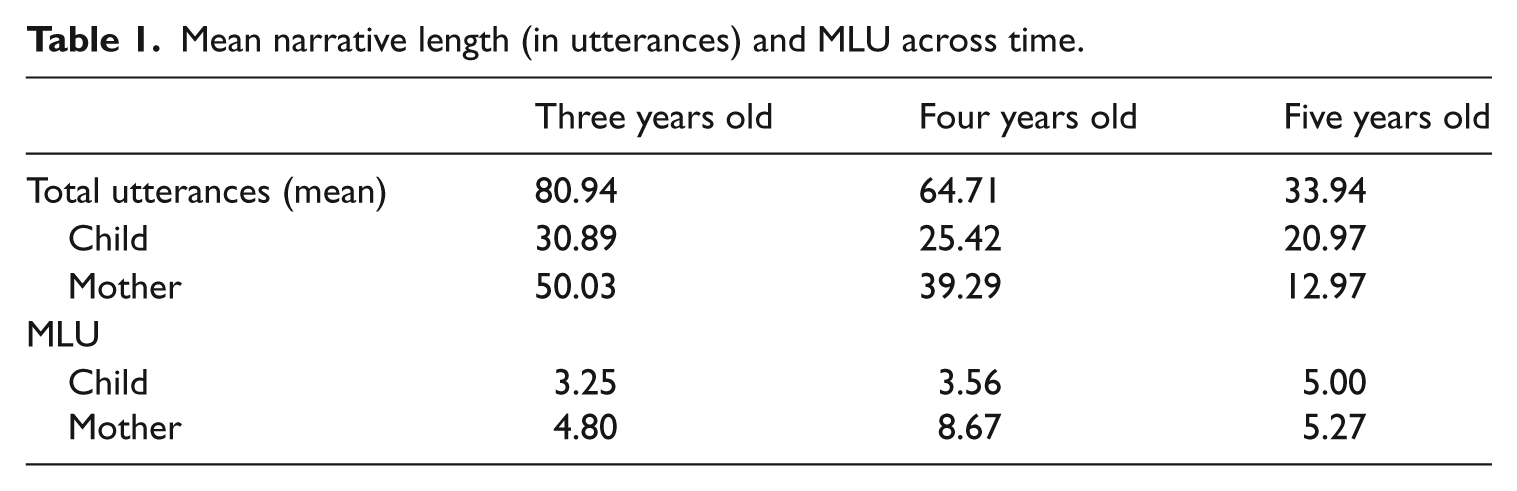
Table 1 displays total narrative length (i.e., the sum of mother and child utterances in each narrative) and mean length of utterance (MLU) for both mother and child. In the regression analyses, total narrative length was used to control for variation in talkativeness.
Mean narrative length (in utterances) and MLU across time.
Modeling change in children’s narrative development and mothers’ withdrawal of assistance
Using Poisson regression to model growth
To answer our overarching research question, we explored a theoretically driven approach to capture withdrawal of maternal assistance over time relative to change in child participation. To analyze growth rates of children’s use of each macrostructural component, we used random effects Poisson regression analysis for three reasons. First, our dependent variables are expressed as count data (i.e., the number of contributions of a given macrostructure attributed to mother or to child). Because counts must be nonnegative and Poisson regression assigns probabilities only to the nonnegative integers, Poisson models have more face validity over the normal-errors linear models. Second, because preliminary analysis suggested the data display nonlinear growth across time, Poisson is the preferred model. Last, Poisson regression is a more appropriate model than negative binomial regression given that overdispersion of the data is not present (i.e., skewness to the upper tail of values is not present). Preliminary analyses revealed the data adequately met the assumptions: (a) the conditional mean statistically equaled the conditional variance, as evidence by lack of overdispersion; and (b) the observations were independent (i.e., children’s spontaneous contributions did not depend on maternal contributions). Goodness-of-fit analyses were further examined; chi-squared analyses were nonsignificant for each model indicating the data fit the model reasonably well.
Shift in child participation in narration over time
We regressed child spontaneous contribution variables, separately for each macrostructural component, on time and on maternal contribution variables (i.e., macrostructures provided by Narrative Addition scaffolds) controlling for child contribution variables and overall length of narrative. Figure 1 provides information about the distribution of each macrostructural component (in mean percentages) attributed to the member of the dyad supplying the component in the narrative. Children’s contributions were further identified by whether the contribution was spontaneous, elicited (in response to maternal story prompts), or other contribution (in response to maternal conversational supports). Using random effects Poisson regression analysis to model growth (change) in child contributions of each macrostructural component, we conducted a series of models examining growth in the number of each macrostructure provided spontaneously by the child. Spontaneous ability was targeted as the dependent variable in our analyses, as it is the developmental goal for children progressing toward independent narrative ability. In the models, we regressed child spontaneous contributions of each macrostructural component (dependent variables) separately on time (time-varying predictor), maternal contribution (time-varying predictor), controlling for child participation (time-varying covariate) and overall length of narrative (constant). The rationale for this order is to apply the most stringent test of maternal contributions; we are able to determine the effect of mothers’ contributions independent of children’s contributions to the narrative and total length of narrative. Time was entered as a categorical variable for two reasons: (a) preliminary analyses revealed the nonlinear and, therefore, noncontinuous nature of the data, precluding the treatment of time as a continuous variable; and (b) given the longitudinal design had only three time points, our data do not fit a fine-grained treatment of time as a continuous variable.
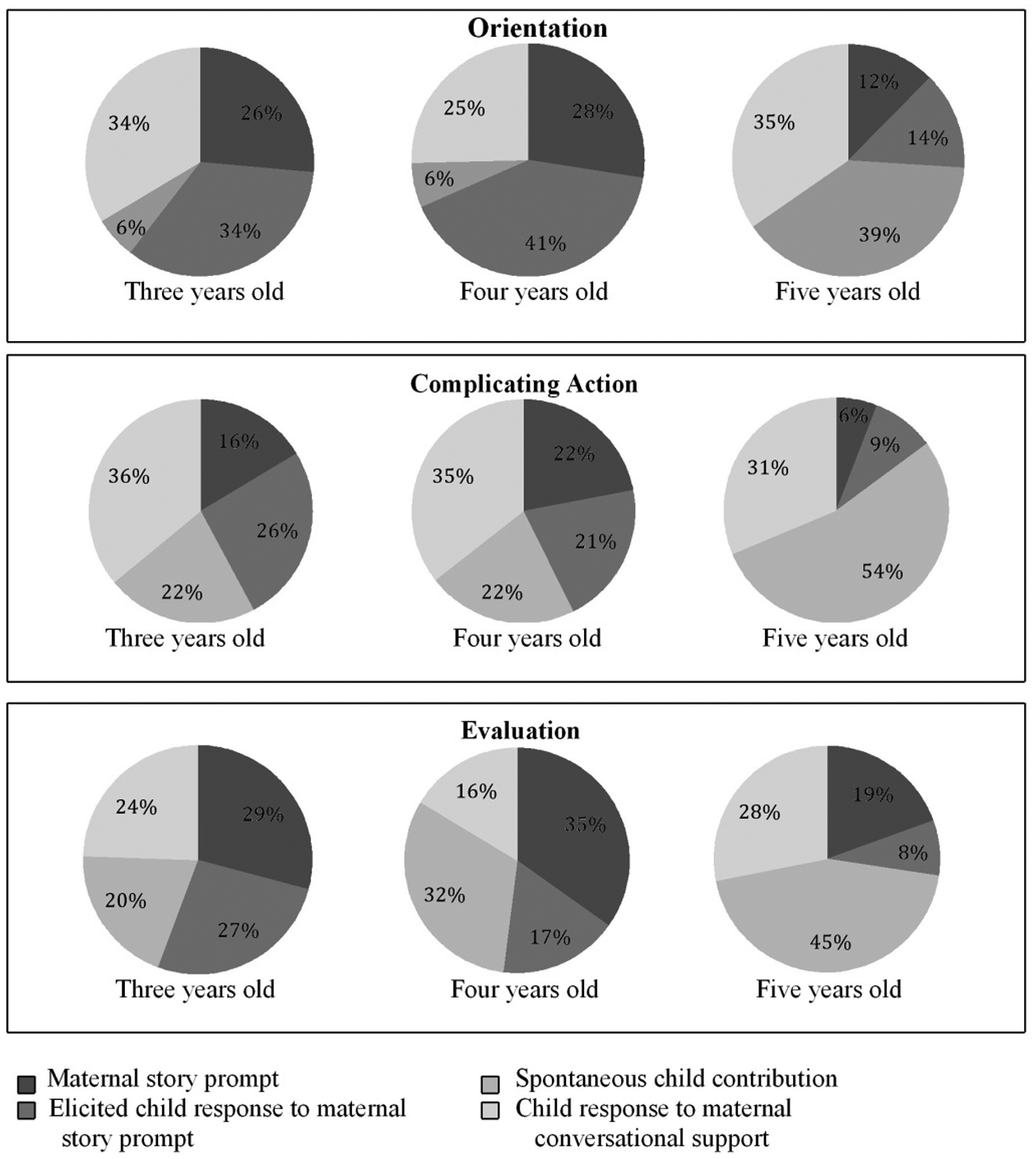
Responsibility for the contribution of Orientation, Complicating Action, and Evaluation by mothers and their children at 3, 4, and 5 years old expressed as a proportion of the total number of each macrostructural component provided in the narrative.
As illustrated in Figure 2, we have fitted the data to the following Poisson regression equation, explaining our spontaneous models:

In the equation above, µ is the expected mean count, time was entered as a categorical variable, and uι represents the normal distribution of the random effects. We separated each time-varying factor – maternal contribution and child contribution – into two variables: group-centered (Level 1), which explains within-group variance (intercept), and group-mean (Level 2), which explains between-group variance (slope) in each model. To create the maternal group-mean variable (m( bar)) for each macrostructural component, we calculated the mean proportion of mothers’ macrostructure contribution over the three time points. We created a maternal group-centered variable (β6m) for each macrostructural component by taking the difference between mothers’ proportional contribution at T1 and m(bar). Similarly, to control for child participation, we created child group-mean (ce(bar)) and group-centered (β5ce) variables for elicited contributions of each macrostructural component. To control for varying length of narratives, we created an exposure variable by summing all maternal and child contributions at each time point, expressed as 1 * log(E).
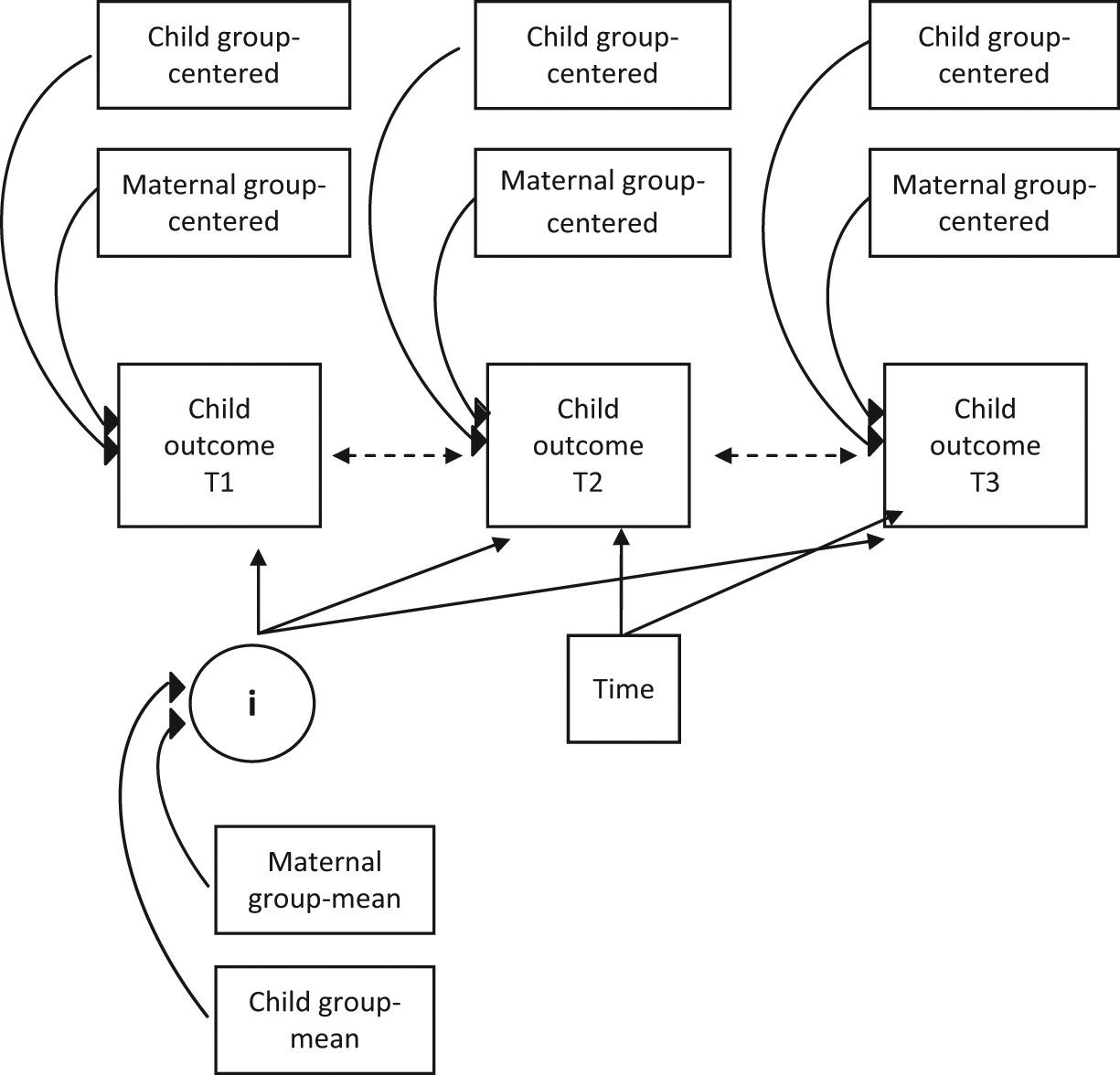
Poisson regression model of growth over time in a given child responsibility variable as predicted by maternal contributions, child verbal behavior, and total length of the narrative.
Responsibility for Orientation
Figure 1 shows children’s contribution of Orientation expressed as mean percentages. Children’s elicited contribution of Orientation (in response to maternal story prompts) at T1 (M = 34%, SD = 21%) and T2 (M = 41%, SD = 27%) comprised a large portion on average of the total Orientation in the narratives. However, at T3, the proportion of elicited child contributions of Orientation deceased by more than half to just 14% (SD = 18%), on average, of the total Orientation.
The Poisson regression model predicting child spontaneous contribution of Orientation from time, group-centered maternal contribution of Orientation, group-mean maternal contribution of Orientation, group-centered child elicited contribution of Orientation, group-mean child elicited contribution of Orientation, and overall length of the narrative was statistically significant (χ2 = 166.09; d.f. = 6; p < .0001). As shown in Table 2, children’s spontaneous contribution of Orientation increased significantly from T1 to T3, where the expected log count of Orientations spontaneously contributed by children increased by 1.01 between T1 and T3. Additionally, predictors group-centered maternal contribution of Orientation and group-mean maternal contribution of Orientation were statistically significant after controlling for child participation and overall narrative length. The expected log count for a 1-unit decrease in mothers’ group-centered contributions at T1 was a 2.9-unit increase in spontaneously provided Orientation across time. That is, for any two children whose mothers’ contributions of Orientation differed by 1 unit, the log count of their elicited Orientations differed by 2.9 units. Similarly, for every 1-unit decrease in maternal group-mean contributions, children’s spontaneous contributions of Orientations showed a 2.8-unit increase across time. These results suggest children whose mothers relinquish responsibility for Orientation across the three time points provide more spontaneous contributions of Orientation than children whose mothers continue to provide heavy scaffolding.
Poisson regression model predicting child spontaneous contribution of the Orientation macrostructure.
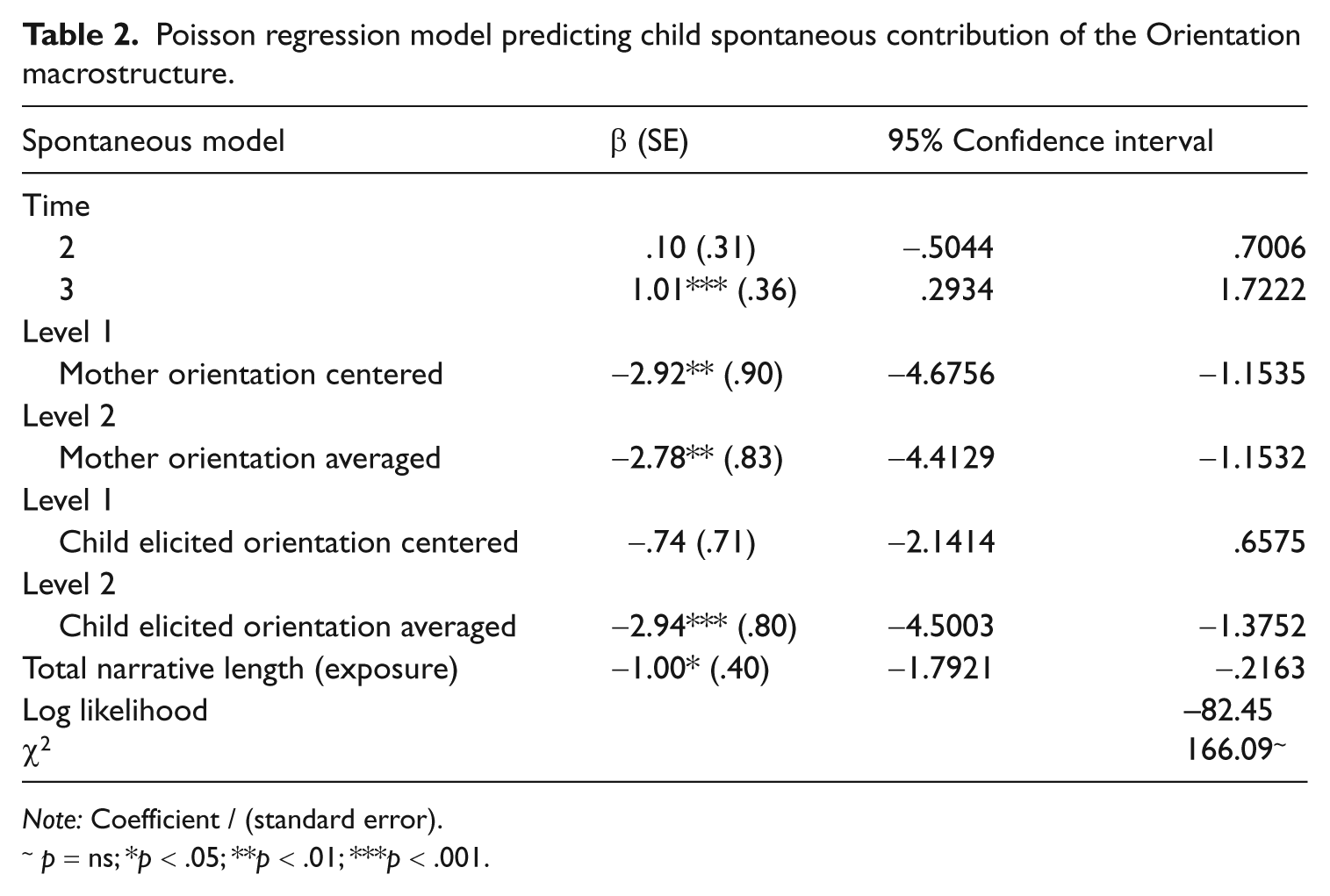
Note: Coefficient / (standard error).
p = ns; *p < .05; **p < .01; ***p < .001.
Responsibility for Complicating Action
Comparing the distribution of responsibility for Complicating Action over time in Figure 1, we see that about a quarter of the responsibility for Complicating Action was attributed to elicited child contributions at T1 (M = 26%, SD = 24%). Again, by T3 however, the proportion of Complicating Actions in the story provided by children in this context decreased.
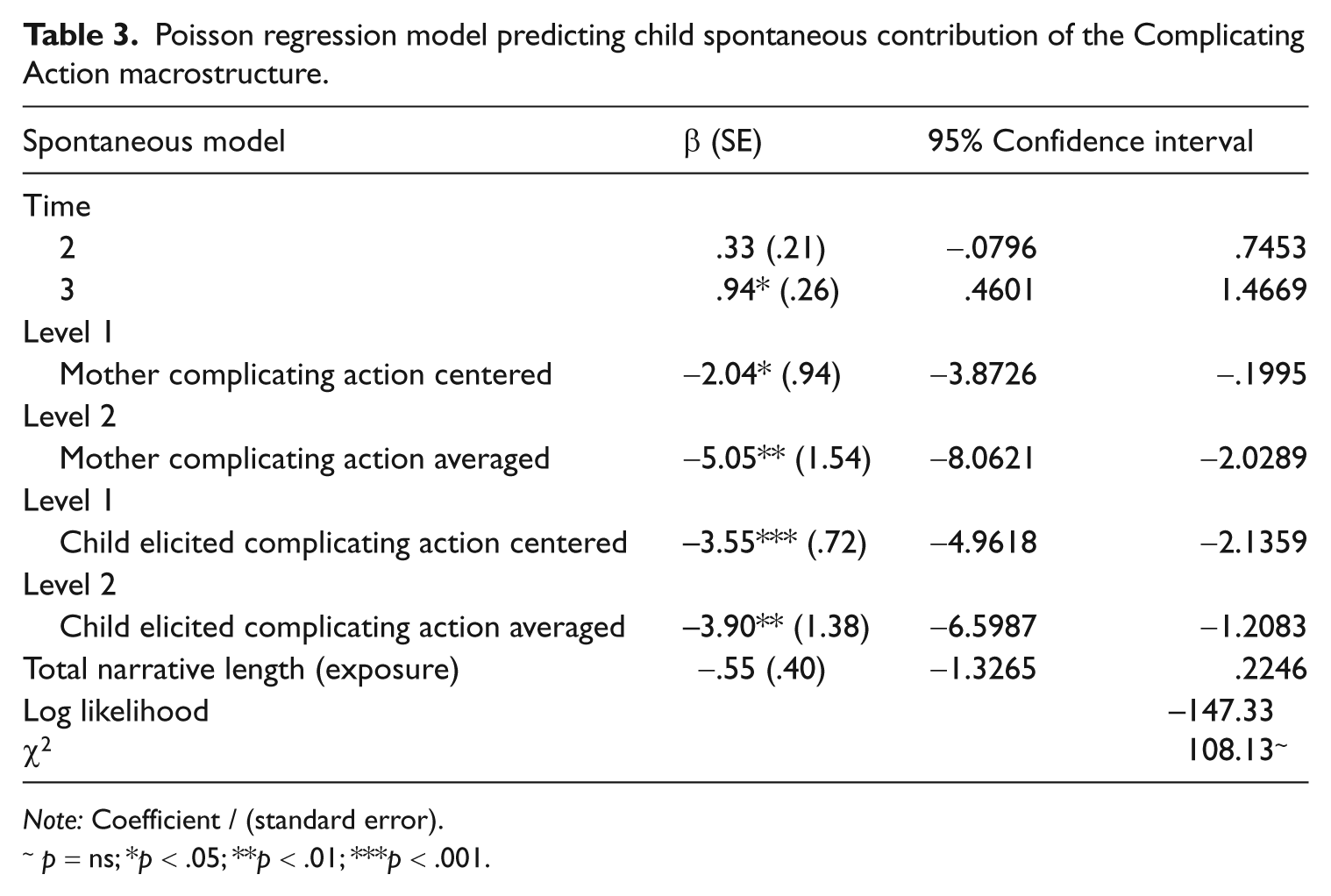
The Poisson regression model predicting the number of child spontaneous contributions of Complication Action from time, group-centered maternal contribution of Complication Action, group-mean maternal contribution of Complicating Action, group-centered elicited child contribution of Complication Action, group-mean elicited child contribution of Complication Action, and overall length of the narrative was statistically significant (χ2 = 108.13; d.f. = 6; p < .0001). As shown in Table 3, children’s spontaneous contribution of Complication Action increased significantly from T1 to T3, where the expected log count of spontaneously contributed Complicating Actions increased by .96 between T1 and T3. Additionally, the predictors group-centered maternal contribution of Complication Action and group-mean maternal contribution of Complication Action were statistically significant after controlling for child participation and overall narrative length. The expected log count for a 1-unit decrease in mothers’ group-centered contributions at T1 was a 2.04-unit increase in spontaneously contributed Complicating Action across time. That is, for any two children whose mothers’ contributions of Complicating Action differed by 1 unit, their spontaneously provided Complicating Actions differed by 2.04 units. Similarly, for every 1-unit decrease in maternal group-mean contributions, children’s spontaneously provided Complicating Action showed a 5.05-unit increase across time. These results again show that children whose mothers’ scaffolding of Complicating Action diminishes across time provide more spontaneous contributions of Complicating Action to the narrative than children whose mothers continue to provide heavy scaffolding.
Poisson regression model predicting child spontaneous contribution of the Complicating Action macrostructure.
Note: Coefficient / (standard error).
p = ns; *p < .05; **p < .01; ***p < .001.
Responsibility for Evaluation
As displayed in Figure 1, the mean proportion of Evaluation provided through elicited child contributions showed a steady decrease from T1 (M = 26%, SD = 34%) to T3 (M = 8%, SD = 16%).
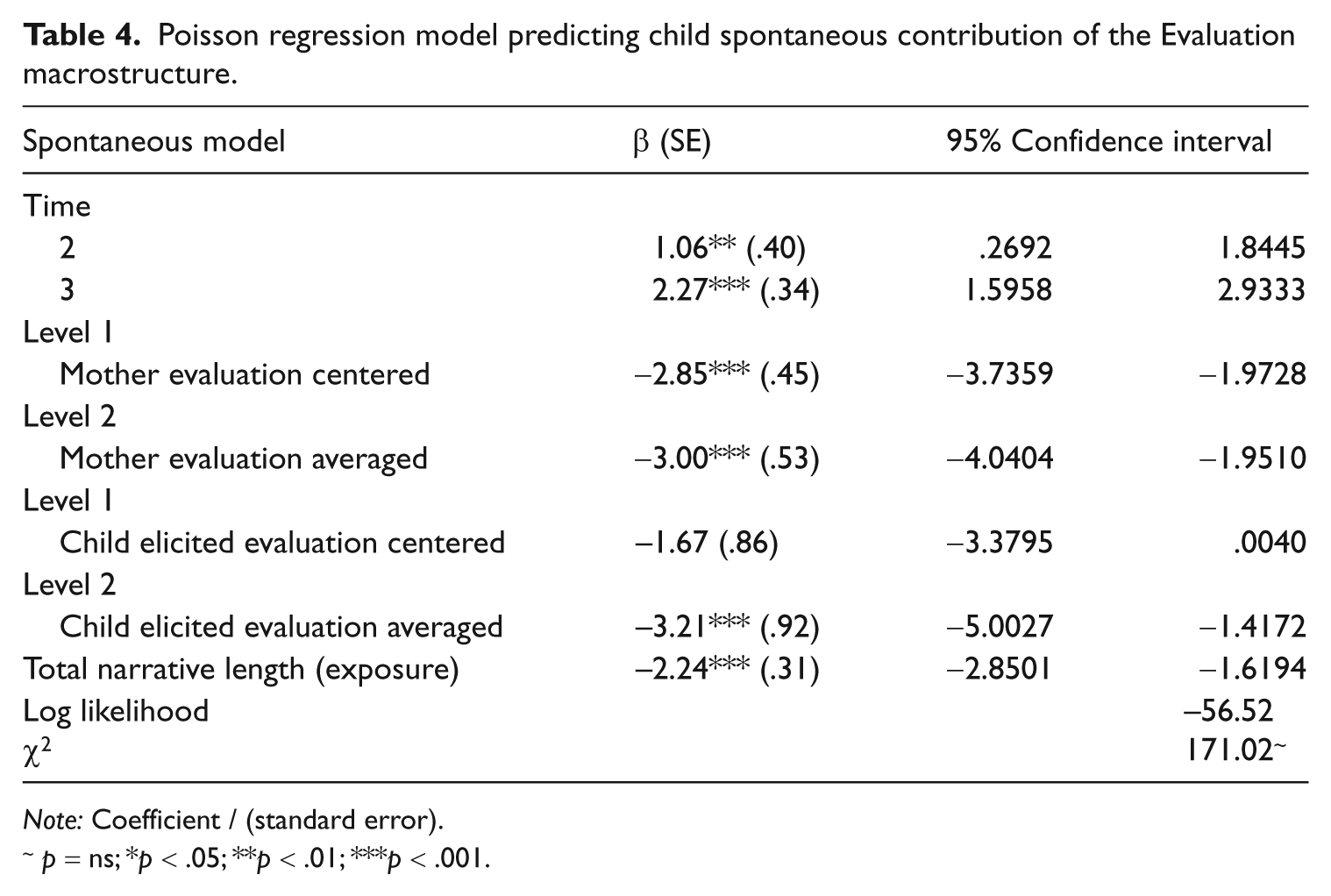
The Poisson regression model predicting the number of child spontaneous contributions of Evaluation from time, group-centered maternal contribution of Evaluation, group-mean maternal contribution of Evaluation, group-centered elicited child contribution of Evaluation, group-mean elicited child contribution of Evaluation, and overall narrative length was statistically significant (χ2 = 171.02; d.f. = 6; p < .0001). As seen in Table 4, children’s spontaneous contributions of Evaluation increased significantly from T1 to T2 and T1 to T3, where the expected log count of spontaneously contributed Evaluation increased by 1.06 between T1 and T2 and by 2.26 between T1 and T3. Additionally, the predictors group-centered maternal contribution of Evaluation and group-mean maternal contribution of Evaluation were statistically significant after controlling for child participation and overall narrative length. The expected log count for a 1-unit decrease in mothers’ group-centered contributions at T1 was a 2.85-unit increase in spontaneously provided Evaluation across time. Similarly, for every 1-unit decrease in maternal group-mean contributions, children’s spontaneous contributions of Evaluation showed a 2.99-unit increase across time. Again, the results show that over time children whose mothers continue to provide heavy scaffolding provide fewer spontaneous contributions of Evaluation to the narrative than children whose mothers’ scaffolding diminishes, whereas children whose mothers relinquish narrative responsibility contribute spontaneously more Evaluation.
Poisson regression model predicting child spontaneous contribution of the Evaluation macrostructure.
Note: Coefficient / (standard error).
p = ns; *p < .05; **p < .01; ***p < .001.
Shift in maternal assistance in narration over time
To determine predictors of change in maternal responsibility for macrostructure in the narrative and to explore the question of bidirectionality in the narrative context, we ran a series of Poisson regression models predicting change in mothers’ contributions of each macrostructure to the shared narratives with time (time-varying predictor) and children’s spontaneous participation (time-varying predictor) as factors and controlling for overall narrative length (constant). We entered time as a categorical variable, group-centered child spontaneous contribution and group-mean child spontaneous contribution variables as well as overall narrative length.
Regression models predicting mothers’ contribution of each macrostructure over time, as displayed in Table 5, were significant: Orientation (χ2 = 14.09; d.f. = 4; p < .007); Complicating Action (χ2 = 37.99; d.f. = 4; p < .0001); and Evaluation (χ2 = 19.53; d.f. = 4; p < .0006). In models for both Orientation and Evaluation, the number of maternal contributions of each macrostructure was predicted by both group-centered child spontaneous contribution and group-mean child spontaneous contribution when controlling for overall narrative length. In the model predicting Orientation, the expected log count for a 1-unit increase in children’s group-centered spontaneous contributions of Orientation at T1 was a 2.59-unit decrease in mothers’ contributions of Orientation across time. That is, for any two children whose contributions of Orientation at T1 differed by 1 unit, the log count of their mothers’ contributions of Orientations differed by 2.59 units. For every 1-unit increase in child group-mean spontaneous contributions of Orientation, the log count of mothers’ contributions of Orientation showed a 3.21-unit decrease over time.
Poisson regression model predicting maternal contribution of each macrostructural component over time.

Note: Coefficient / (standard error) / [confidence interval].
p = ns; *p < .05; **p < .01; ***p < .001.
Similarly in the model predicting Evaluation, the expected log count for a 1-unit increase in children’s group-centered contributions of Evaluation at T1 was a 2.65-unit decrease in mothers’ contributions of Evaluation. That is, for any two children whose spontaneous contributions of Evaluation at T1 differed by 1 unit, the log count of their mothers’ contributions of Evaluation differed by 2.65 units across time. For every 1-unit increase in child group-mean spontaneous contributions of Evaluation, the log count of mothers’ contributions of Evaluation showed a 3.62-unit decrease over time.
In the model for Complicating Action, however, the number of mothers’ contributions of that macrostructure was predicted by group-mean child spontaneous contributions alone when controlling for overall narrative length. For every 1-unit increase in child group-mean spontaneous contributions of Complicating Action, the log count of mothers’ contributions of Complicating Action showed a 4.12-unit decrease over time. Unlike the child models, time was not a significant predictor of change in mothers’ contributions of each macrostructure. Rather, children’s spontaneous production at T1 and their growth in spontaneous production over time best predicted mothers’ contributions to the narrative.
Discussion
In this study, we addressed challenges in measuring child language development over time while simultaneously accounting for the developmentally appropriate cessation of maternal language behaviors. We asked: In what ways can maternal cessation of assistance be captured over time and relative to change in child participation? A decrease in the number of mothers verbally supporting their children’s narration by T3 significantly impacted the ability to statistically describe changes in development over time using traditional methods such as ANOVA with these data. In prior analysis of the current data, we applied repeated measures ANOVA and found that the majority of dyads were dropped from analyses at T3 as a result of missing data (i.e., list-wise deletion); only two to eight dyads remained in the models at T3. To address this issue we modeled the shift in responsibility from T1 to T3 for supplying the macrostructural components (child spontaneous, mother provided, and child response prompted by mother’s story-specific scaffold).
Results confirmed our hypothesis that over time children will take on more of each macrostructure in the narrative. Modeling the shift from T1 to T3 in responsibility for supplying each macrostructural component, our results revealed that children moved from relying on maternal prompts for macrostructures to providing the largest proportion of Orientation, Complicating Action, and Evaluation spontaneously. Additionally, we found that the set of factors contributing to growth in children’s contributions to the narrative differed for each macrostructural component. Mothers’ cessation of narrative support, as expected, was reliably predicted by children’s increasing ability to narrate independently. Results confirmed that the gradual and appropriate cessation of maternal participation was predicted by children’s spontaneous contributions to the narrative no matter the macrostructure in question. These results taken in conjunction with the child models suggest a bidirectional influence over time on the dyad’s narrative behavior. Our regression models show that, while maternal scaffolding appears to impact children’s acquisition of macrostructure (demonstrated through spontaneous contributions), children’s own ability at 3 years old and the growth of their independent ability over the next 2 years appears also to influence maternal participation in the co-constructed narrative. Similar bidirectional associations between child narrative production and maternal scaffolding have been illustrated in prior research (e.g., Haden, Ornstein, Rudek, & Cameron, 2008; McCabe & Peterson, 1991; Reese et al., 1993). The current findings make a unique contribution by further specifying the bidirectional associations between maternal support of and child contribution to the macrostructure of the narrative.
Prior research examining mother–child shared narration across this approximate age range has found that mothers’ elaborations tended to increase over time rather than diminish, as our findings demonstrate (Haden et al., 2008; Low & Durkin, 2001; Reese et al., 1993). Reese et al. proposed a spiral model as a counterpart to the scaffolding metaphor to explain the co-occurrence of increasing maternal elaborations with child memory talk. The findings of the current study do not necessarily run counter to this previous research. Instead, disparate findings are likely due to differences in the coding of maternal language. Reese et al.’s coding was inclusive of all maternal prompt types, whereas the current study focused on the details of mothers’ contributions to the narrative macrostructure solely. This fine-grain examination of maternal language behavior during narrative co-construction is essential in illuminating how children move from narration that is heavily supported and structured by maternal assistance to providing narrative macrostructure independently.
Children’s responses to maternal conversational supports are responsible for large mean percentages of Orientation across all three time points as illustrated in Figure 1. Giving the who, what, and where in their next utterance may be less challenging for children when only non-specific support is given by mothers, whereas macrostructures such as Evaluation require more supportive scaffolding. This conversational device, consisting of general statements and prompts to encourage the children to continue their stories, also seems effective for eliciting Complicating Action from the children. For example, simply asking ‘What happened next?’ or signaling one wants more of a story with a backchannel, may also be a relatively undemanding request with which to comply, because these draw attention to the notion of adding further non-specific events to stories (Imbens-Bailey & Snow, 1997).
Implications and Conclusion
In our concluding remarks, we interpret the findings of the growth analysis modeling shift in responsibility from mother to child by using a dose-effect model borrowed from the fields of psychotherapy and pharmacology (e.g., Barkham et al., 2006; Dekker et al., 2005; Hoagwood, 2000). This model can be used to characterize effectiveness of maternal scaffolding in terms of children’s need, and it makes explicit the nuanced range of possible interventions. We conclude with further implications for theory, research, and intervention.
Modeling the shift in responsibility for the narrative from mother to child
Presumably narrative discourse skills can develop without a mother’s attunement to the child’s current needs, albeit perhaps at a slower rate or via other mechanisms promoting development. However, in this article, we have conceptualized the mother’s role in narrative development as providing the right level and type of ‘treatment’ based on the child’s changing narrative discourse needs over time. Like Vygotsky’s ZPD and possibly notions of fine-tuning linguistic input to match children’s language level (e.g., Newport, Gleitman, & Gleitman, 1977), the dose-effect model can characterize mothers’ attempts to provide effective support to their children so that children can succeed in co-constructing a personal narrative. However, a dose-effect model more closely ties this work to therapeutic implications. Response to the mother’s scaffolds or ‘therapy’ by the child may be the necessary feedback mothers require in order to know when to continue or discontinue their support of different narrative macrostructures.
There may be consequences for providing too much or too little assistance. Mothers who are attuned to their children’s needs are helping to produce the optimal story with their children. Their support is the most effective as they work within the ‘therapeutic window.’ The following narrative co-constructed at T3 shows the continued need of the child (C) to have the support of Orientation by the mother (M) using prompts and support of Evaluation by the mother contributing Narrative Addition:
Nothing’s happened to me, except I fell off my bike.
Over Auntie’s, right? (prompt) [Orientation]
Do you still have a cut? prompt) [Orientation]
Where were you when you fell off? (prompt) [Orientation]
On the road . . . in the driveway. [Orientation]
That was scary? (narrative addition) [Evaluation]
Yeah.
That really hurt. (narrative addition) [Evaluation]
Ow.
These well-attuned mothers cease supporting their children when they demonstrate a ‘good enough level’ of narrative performance, as the following, largely monologic and linearly structured narrative illustrates:
You’re scared of rats?
One time I was eating food [Orientation] and a mouse came under the thing [Complicating Action] and my mommy yelled [Evaluation].
Uhhuh.
Yes you did. And me and my brother standing up on the chair [Complicating Action]. And my auntie catched it [Resolution].
In contrast, mothers who do not continue to aid their children with the sufficient scaffolding of macrostructure when their children still need support during co-construction (i.e., analogous to a dosage level that is too low) may be providing ineffective assistance. Consequently, the inclusion of narrative macrostructure by the dyad may be negatively impacted and the forward progression of the narrative may suffer, as in the following example:
Can you tell me something scary that has happened to you?
Nothing. One time I had a flat tire. [Complicating Action]
Right, Mommy?
Mmhm. (maternal conversational support)
We had two flat tires. [Orientation]
And it scared us xxx long way to my school. [Evaluation]
Tell her again she didn’t hear you.
Um, one, two times we had a flat tire. [Complicating Action]
Once we got one from going home from the store. [Orientation]
And once we got one from going (to) my school. Two times. [Orientation]
Two days in a row on the same road coming from the same place. (narrative addition)
Mothers who continue to supply verbal support when it is not needed (i.e., analogous to a dosage level that is too high) may have deleterious effects on the child’s storytelling in at least two possible ways. Too much support can be ‘toxic’ with the child trying but failing to give their own account of personal experiences when a story becomes overly controlled and dominated by the mother’s additions and prompts, and too much support can also be ineffective in that the mother’s help has diminishing returns when a child becomes ‘resistant’ to her input (e.g., Bailey & Moughamian, 2007).
The current study contributes to the corpus of literature examining longitudinally children’s development of narrative and maternal influence on that process as well as successfully demonstrates ‘fading’ in a novel context. However, the sample was restricted to low-income dyads, and the results therefore may not be generalizable to a broader population. As mentioned previously, the current study used a microanalytic approach examining in detail an important aspect of maternal narrative behavior. Future research should attempt to bridge the current study’s findings and those of Reese et al. (1993) and of Low and Durkin (2001). Lastly, because the current study examined only co-constructed narratives, we are unable to say definitively that children come to internalize the verbal supports that their mothers provided them during narrative co-construction. Future research should address the question of whether different dyadic narrative features (e.g., number/type of macrostructural components contributed to the narrative at this point in development by the child or by mother) can be useful in predicting the quality of children’s later independent narrative performance. This would be further evidence of parental input as an important mechanism by which development in this context occurs.
The dose-effect interpretation holds practical implications for language interventions with mothers and children. As Peterson, Jesso, and McCabe (1999), as well as Reese and Newcombe (2007), successfully demonstrated in separate interventions with low-income families, mothers can receive effective training to promote their children’s narrative development. In sum, the current study suggests a fruitful approach for modeling growth in child behavior while simultaneously tracking cessation of maternal behavior. By conceptualizing the dyad and their shared task (i.e., narrative co-construction) as a single unit of analysis, we have illustrated that children’s spontaneous provision of macrostructure to shared narratives increases with age and is predicted by their mothers’ narrative contributions. Additionally, we have confirmed that the fading of maternal contributions of macrostructure to the narrative is a result of children’s increasing independent ability as narrators rather than simply a function of time. The dose-effect relations modeled here can help account for the influence of both maternal behavior and child developmental level and provide a framework for characterizing dyadic narrative behavior to maximize children’s acquisition of narrative discourse abilities.
Footnotes
Funding
This research was supported by an NIMH pre-doctoral fellowship (grant No. 5 T32 MH18372-15(-20) to the first author under the mentorship of the second author and a grant from the Council on Research of the UCLA Academic Senate through the Faculty Research Grant Program to the second author. All views expressed and all errors remain our own.