



Abstract
The purpose of the study was to evaluate the language status of 120 young, Latino dual language learners living in poverty in the United States. Maternal language input and home language and literacy environments were examined with regard to language development at 24 and 36 months. Results suggested that even when combining English and Spanish language knowledge scores, the children in this sample still performed below, albeit closer to, age level. The home language and literacy environments were significantly related to and predicted child language status at 24 and 36 months. The article discusses the implications of these findings with regard to the focus of early intervention efforts.
Keywords
There are now more bilinguals or multilinguals worldwide than monolinguals (Aronin & Singleton, 2008; Tucker, 1998). Many children in most countries are being instructed or attend schools in a second or even third language (Tucker, 1998) with varying levels of success. In the United States, the number of school-age children (ages 5–17) who speak a language other than English at home increased from 9% to 20% between the years 1979 and 2004 (Passel, 2004; Van Hook & Fix, 2000). The proportion of language-minority children and youth in the United States who demonstrated significant difficulty with English rose from 3% to 6% over this same period. Concomitantly, an increasing number of children from Spanish-speaking homes are being identified as having documented disabilities and are currently receiving early intervention services through Part C of IDEA 2004. The number of children being served in the US through Part C doubled from approximately 170,000 in 1998 (Scarborough et al., 2004) to 342,389 in 2010 (U.S. Department of Education, Office of Special Education Programs, 2010). Spanish-speaking Head Start and English-proficient bilingual children are beginning kindergarten with language and literacy abilities that are below those of their English monolingual peers (Hammer, Lawrence, & Miccio, 2007; U.S. Department of Health and Human Services (DHHS), 2003). Unfortunately, according to the National Literacy Panel on Language-Minority Children and Youth, these early delays often translate into significant difficulties in reading comprehension for many bilingual school-age children (August & Shanahan, 2006). In order to prevent academic problems for children learning English as a second language in the United States we must understand more clearly the English and Spanish language and literacy experiences and environmental influences that may be contributing to poor language and literacy outcomes.
Young, Latino dual language learners in the US face many factors that could contribute to poor language and literacy outcomes such as growing up in poverty or low-SES environments (McLoyd, 1998; Pan, Rowe, Singer, & Snow, 2005). Poverty has long been associated with poor academic outcomes for children (Hart & Risley, 1995, 2003; McLoyd, 1998). Living in poverty predicts lower intelligence scores and cognitive functioning, less academic achievement, and more social-emotional problems even after accounting for family characteristics such as maternal education (McLoyd, 1998). These impacts are greater for children from families whose living conditions are persistently below the poverty threshold than for those who experience occasional or temporary poverty (Brooks-Gunn & Duncan, 1997; McLoyd, 1998). Although research about the impact of the timing of poverty on child outcomes is sparse, it does indicate that experiencing poverty during the preschool and early school years is related to lower rates of school completion (Brooks-Gunn & Duncan, 1997) and that the greatest impacts on later development occur in early childhood (Duncan, Yeung, Brooks-Gunn, & Smith, 1998). Parents in poverty report less time talking to their children (Hart & Risley, 1995) and these same parents may also spend less time reading with their children (Yaroz & Barnett, 2001).
The Early Childhood Study of Language and Literacy Development of Spanish-Speaking Children (ECS; Tabors, Páez, & López, 2003) investigated language and literacy skills in low-SES bilingual children from prekindergarten to second grade. Findings revealed that many Spanish/English bilingual students are progressing more slowly than their English monolingual peers particularly in their English oral language abilities. Although many of these children have been shown to lag behind their peers in both English and Spanish (Tabors et al., 2003), this sample of children was particularly behind in English vocabulary knowledge in kindergarten (Tabors et al., 2003) and first grade (Páez & Rinaldi, 2006). Somewhat lower vocabulary may be expected when children are learning two languages; however, when vocabulary is limited it is likely that children will experience problems learning to read (Dickinson, McCabe, Anastasopoulos, Peisner-Feinberg, & Poe, 2003). Thus, expressive vocabulary knowledge in English and Spanish is of particular concern for those who educate young dual language learners from low-SES families (August & Shanahan, 2006; Rescorla & Acherbach, 2002; Snow, Burns, & Griffin, 1998).
There are a number of factors in addition to poverty that, when experienced in concert, may explain the differences in language and academic outcomes for monolingual and dual language learners. For example, studies have shown that maternal education, in and of itself, may not necessarily be associated with poorer language performance in children (monolingual or dual language learners). However, when lower maternal education is also associated with low income or poverty and a home language that differs from the mainstream, poor language and literacy outcomes become more likely (Snow et al., 1998; Uccelli & Paez, 2007).
Another factor that may contribute to language and literacy outcomes in young dual language learners living in poverty is access to literacy activities. A lack of understanding about the importance of acquiring a ‘preacademics skill set’ may impact how well a child is prepared to benefit from early educational experiences (Hammer, Miccio, & Wagstaff, 2003; Zentella, 2002). Indeed, a critical predictor of later academic success for English monolingual children is the acquisition of early literacy knowledge (Justice, Invernizzi, & Meier, 2002). Justice and colleagues described this knowledge as skills, oral and written, that prepare children to benefit from formal reading instruction provided in school. The presence of literacy materials in the home and the amount of time parents and children spend reading together have been shown to impact later literacy outcomes for young monolingual and dual language learners (Hammer et al., 2003; Ortiz, 1986). In addition, narratives or stories have been identified as a bridge to literacy (Korat, 2001). Alternatively, problems with oral language acquisition, in the language being used for reading, have been shown to be associated with difficulties in acquiring ‘preliteracy’ skills and poorer academic outcomes for young monolingual and dual language learners (Bialystok & Herman, 1999; Boudreau & Hedberg, 1999).
It is important for educators to investigate the impacts of early literacy knowledge and oral language acquisition on the academic outcomes of children acquiring two or more languages (August & Shanahan, 2006; Lindsey, Manis, & Bailey, 2003; Manis, Lindsey, & Bailey, 2004). Simultaneously, we must broaden our understanding of how dual language learners acquire both languages. That is, we need a clearer picture of the growth and rate of language development for both languages so we can better serve dual language learners in our schools (Kohnert, Yim, Nett, Kan, & Duran, 2005).
There are a number of parental language factors that may contribute to vocabulary learning in young dual language learners. For example, the structural hypothesis of language acquisition suggests that parent input that is slightly more complex than the child’s language output promotes growth in child language (Cross, 1977; Weistuch & Brown, 1987; Yoder & Warren, 1993). Structural aspects of parental input may include mean length of utterance (MLU), total number of words (TNW), and total number of different words (TDW). This model predicts significant positive correlations between ‘structural measures’ of parental input (amount, rate of speech, syntactic complexity, and semantic complexity) and measures of child language learning.
For young dual language learners, it may also be important to examine the type of language input that children are receiving (English and/or Spanish) to determine its impact on language learning in both English and Spanish (Pearson, Fernandez, Lewedeg, & Oller, 1997). Pearson and colleagues found a significant relationship between the amount of input that 24-month-old children were exposed to in a certain language (i.e., Spanish) and the number of words that children learned in that language. The researchers were particularly interested in determining whether there was a threshold below which vocabulary learning would not occur for these toddlers. They found that even at low levels of ‘input’ in a particular language, children appeared to be learning that language at a rate that was proportional to or greater than the amount of time spent exposed to the actual linguistic input.
Goldberg, Paradis, and Crago (2008) investigated sources of individual variation in vocabulary acquisition for 19 children for whom English was their second language. They found that higher levels of education of mothers was negatively correlated with English use in the home (r = –.53). However, mothers’ level of education was a significant predictor of children’s vocabulary development in English. Children whose mothers had achieved some level of postsecondary education demonstrated higher receptive vocabulary scores and more lexical diversity (TDW) in English than children whose mothers had spent less time in the education system. Mothers’ level of education was shown to be a significant predictor of English vocabulary knowledge even when English was not used frequently with children. Goldberg and colleagues suggested that the use of ‘higher order’ conversation that is often associated with higher SES families, may be more important for language learning than exposure to a larger number of vocabulary words in the English language. Contrary to prior studies (Cobo-Lewis, Eilers, Pearson, & Umbel, 2002; Pearson et al., 1997), Goldberg and colleagues reported that receptive vocabulary and lexical diversity were not related to the amount of English that was used in the home. However, many of the families in the study were new immigrants to Canada and had limited English fluency. One of these studies (Cobo-Lewis et al., 2002) was conducted with families who demonstrated higher levels of fluency in English and thus used it more frequently in the home. Hence, the issue of English language input is unresolved.
Expressive language skills in preschool dual language learners
By the time English monolingual children are 24 months old they are using 50 or more words in their expressive vocabularies (Patterson, 1998). Research has shown that the same is true for monolingual Spanish-speaking children, about 90% of 24-month-olds use between 40 and 50 words in their expressive vocabulary (Jackson-Maldonado, Thal, Marchman, Bates, & Gutierrez-Clellen, 1993). Unfortunately, we know less about language development in toddlers exposed to two different languages, particularly those who are raised in poverty (Hammer, Lawrence, & Miccio, 2008). The timing of English language exposure prior to school entry is an important factor in understanding young dual language learners’ language development in Spanish and English (Hammer et al., 2008). An understanding of the timing of exposure to a second language in relation to children’s overall language skills is important as children with language delays are at increased risk for academic problems (Nelson, Welsh, Trup, & Greenberg, 2011). Measuring dual language learners’ language skills in just their preferred language is likely to underestimate their language ability. These children are learning two languages, but there is great variability in the exposure, proficiency, and overlap of the languages. Studies that have examined bilingual vocabulary development in toddlers have used a slightly different approach to measuring vocabulary than is typical in monolingual studies. For example, in bilingual studies of vocabulary, it is not uncommon to measure expressive vocabulary as a composite score that combines vocabulary items from both languages (Spanish and English). This is done because it is thought that the child’s true lexical knowledge is a composite of both languages and not just one versus the other (Pearson, Fernandez, & Oller, 1995).
The primary purpose of this preliminary investigation was to examine English and Spanish language and literacy experiences, demographic factors, and environmental influences on language performance in dual language learners, from Spanish-speaking homes in the US, who are living in poverty. Typical methods for gathering information on the language skills of children learning a second language include spontaneous language sampling, parental interviews, and norm-referenced measures of vocabulary knowledge (Goldberg et al., 2008). For this study we used these methods and examined the influence of maternal language, home language and literacy environment, demographics, and acculturation on toddlers’ language skills (vocabulary knowledge, child language productivity) at 24 and 36 months of age in English and Spanish. This study addresses three specific research questions. First, do young Spanish/English dual language learners living in poverty demonstrate language delays as early as 24 and 36 months when multiple assessment methods are used and both English and Spanish words are included? Second, what levels of maternal language input and home language and literacy environment are typical for young dual language learners living in poverty? Third, which maternal and home factors (i.e., home language and literacy environment) are the best predictors of these children’s language development at 24 and 36 months?
Method
Participants
Participants were 120 Spanish-speaking, mother–child dyads who were recruited as part of the comparison group of a larger study from urban neighborhoods in Salt Lake City, Utah. This larger study focused on examining the impacts of a home visiting program for infants and toddlers and an English immersion program for preschoolers. Language transcript data were collected on a subset of 62 of these mother–child dyads who had been assessed at 24 months. Children were enrolled in the larger study at both 24 and 36 months. These families were recruited through a community neighbor-to-neighbor program, schools, and health clinics. All mothers were Latino most of whom reported being born outside of the US (91%), the majority in Mexico (98%). Mothers ranged in age from 18 to 38 years (M = 28) and reported that they had between 3 and 16 years of formal education (M = 9). Families ranged in size from three to nine members per household (M = 6) and reported an average income of US$14,484 per year (SD = US$11,000) ranging from US$0 to US$48,000. Entry criteria were established by the program; however, assuming 2004 DHHS poverty guidelines all families would have been within 150% of poverty. None of the children attended Early Head Start, Head Start, center-based childcare, or other early education programs, which is similar to other immigrant low-income Latino families, who are much less likely to attend these programs than other children (Karoly & Gonzalez, 2011). A few children were in family childcare homes with other Spanish-speaking families during the study. During Time 1, children ranged in age from 23 to 31 months (M = 24.9 months, SD = 1.64 months) and approximately 55% were male. Most mothers (94%) reported speaking only Spanish (72%) or mostly Spanish (22%) to their children. An additional 6% reported speaking English and Spanish equally to their children; however, no mother reported speaking mostly English to her child. During Time 2, children ranged in age from 33 to 44 months (M = 36.6 months, SD = 1.97 months) and approximately 55% were male. Most mothers (97%) reported speaking only Spanish (59%) or mostly Spanish (38%) to their children. An additional 3% reported speaking English and Spanish equally to their children; however, no mother reported speaking mostly English to her child. For those assessed at both time points, mothers’ ratings of their proportion of Spanish to English use in the home did not change between the first and second assessments; t(72) = –.96, p = .34.
Procedures
Staff from community organizations recruited families and obtained mothers’ consent to be contacted by the assessors to explain the study and make an appointment to meet in the home. Trained assessors who had bachelor degrees, were proficient in English, and were native Spanish-speakers then met with the mothers, gained formal consent, and conducted interviews and assessments. The interviews and forms were offered in both English and Spanish. Assessment procedures included mother interviews, in-home videotaped observations of play, and measurement of expressive vocabulary for mothers and children. Assessments were conducted when children were approximately 24 months of age (Time 1) and again when they were 36 months of age (Time 2). Toddlers’ language skills were measured in English and Spanish through the use of parental report (at 24 months), norm-referenced assessment of primarily expressive vocabulary (24 and 36 months), and observation of mother–child play interactions (24 and 36 months). At Time 1, mothers were asked to report on basic demographic information such as age, place of birth, ethnicity, education, income, and number of members in their household. All questions and forms were read to mothers in their preferred language, with 100% choosing Spanish. All of the measures were the same at Time 1 and Time 2 with the exception of three. At Time 2, mothers were not asked about demographics or administered measures of vocabulary knowledge nor did they report on children’s language through parental report to reduce the burden of administering too many measures and the children were older than the recommended age for the parent report measure of children’s language.
Measures
Proportion of English and Spanish
Mothers were asked to estimate, using a Likert scale (1–5), how often they spoke either language in the home in general. A score of 1 corresponded to all English, 2 corresponded to more English than Spanish, 3 corresponded to both equally, 4 corresponded to more Spanish than English, and a score of 5 corresponded to all Spanish.
Parent expressive vocabulary skills
Parent expressive vocabulary skills were measured using the Spanish and English versions of the Woodcock–Muñoz Picture-Vocabulary subtest of the Woodcock–Muñoz Language Survey (Woodcock & Muñoz-Sandoval, 1993). The Woodcock–Muñoz Language Survey has established reliability (Cronbach’s alpha of .82 on the picture vocabulary subtest) and validity on a normative sample of 1143 children 2–5 years of age randomly selected controlling for census region, community size, sex, race, Hispanicity, and parent education. To develop the English and Spanish versions, the banks of English and Spanish items were Rasch calibrated and then the difficulty scale of the Spanish items was rescaled to match the English items (Woodcock & Muñoz-Sandoval, 1993). For these assessments, mothers were asked to name pictures in the language associated with the subtest. For example, for the English version, responses were considered correct only if the English word was used for the stimulus picture. Similarly, for the Spanish version, responses were correct only if the Spanish word was used for the stimulus picture. Standardized assessment procedures were followed to obtain raw scores for the picture vocabulary subtests. Raw scores for the English and Spanish subtests were added together to create a summed total score (Spanish + English). In addition, the number of unique concepts identified by the parent, regardless of the language used by the parent, was determined. This total concept score is based on a concept-matching analysis of the word offerings on the Woodcock–Muñoz Picture-Vocabulary (Boyce et al., 2004). Because the correlations between the Spanish and English total (summed) scores and the unique concept totals were strong (r = .95, p < .001), only the summed scores were used in the data analysis.
Observation of mother–child play interactions
Mother–child dyads participated in reading and play activities in their homes at assessment Times 1 and 2. Dyads were videotaped for a total of 15 minutes and were given standardized instructions to play with the contents of two bags of toys and to divide their time between the bags as they wished. The first bag contained a wordless picture book and two storybooks (one in English and the same book in Spanish). Mothers were free to choose which books to look at with their child and to determine the amount of time spent with the books before opening the second bag. The second bag contained a set of developmentally appropriate toys such as dishes, tools, a doctor’s kit, and stuffed animals. Mothers were asked to use the language of their choosing during their play interactions (Nicoladis & Genesee, 1997). A timer signaled the end of the 15-minute observation session.
Videotaped mother–child dyad language samples were converted to orthographic transcripts by trained bilingual research assistants using a consensus transcription process (Heilmann et al., 2008). A primary transcriber watched the videotape and orthographically transcribed the sample using the Computerized Language Analysis (CLAN; MacWhinney, 2000) manual for transcription guidelines. For example, an utterance was defined as a concept or idea expressed by a speaker in the form of a word, group of words, phrase, or sentence with a syntactic relation expressed between the words. A second transcriber then watched the videotape, reviewed the transcribed sample, and noted disagreements on the transcript. The primary transcriber then listened again to the sections of the sample containing disagreements. Discrepancies were resolved through discussion between the primary and secondary transcribers.
CLAN was used to calculate the total number of words produced (TNW), total number of different words produced (TDW), and mean length of utterance in words (MLUw) for each transcript (MacWhinney, 2000) for mothers and for children. Because mothers and children used both Spanish and English in their spoken language samples, the data represent a composite reflection of their overall language use and not their proficiency in either Spanish or English (Marchman & Martínez-Sussmann, 2002; Nicoladis & Genesee, 1997). An average of 95% of all mother utterances during these interactions occurred in Spanish, resulting in limited variability in English. However, because some English is used in the homes, credit was provided for English when appropriate because English is still part of the children’s experience even when the majority of the language heard is in Spanish. Furthermore, the correlation between maternal Spanish vocabulary and the combined English and Spanish vocabulary is high (r = .75) suggesting that Spanish could have been used in the analyses instead of the combined score. The combined score is used to provide a more accurate reflection of these mothers’ language use and knowledge than just their primary language. Spanish and English morphological systems differ significantly. Thus, mean length of utterance in words (MLUw) was used rather than mean length of utterance in morphemes (MLUm). The total number of ‘wh’ questions that mothers asked children as well as their use of prohibitions, positive feedback, and imitations/elaborations were also coded according to the CLAN manual. Questions counted as ‘wh’ questions included all open-ended questions of varying lengths (e.g., ‘How do you get it to work?’ and ‘What is it?’). Positive feedback included all comments used as positive feedback and acknowledgments of correct actions (e.g., ‘Good job!’). Imitations included all imitations of the children’s speech both exact and expanded (e.g., child: ‘The end!’ mother: ‘The end.’). Elaborations included extensions and additional information provided related to the detail or function of ideas expressed (e.g., child: ‘Need a shot.’ mother: ‘Yes, he needs a shot in the leg.’). These measures reflect maternal behaviors of eliciting language and contingency responding that often encourages language. The total number of imitations and elaborations were combined due to the low number of elaborations. Independent transcribing and question coding accuracy was examined by comparing coded transcripts between primary and secondary coders, any discrepancy was discussed and resolved using a consensus approach to reduce measurement error (Shriberg, Kwiatkowski, & Hoffmann, 1984).
Home literacy environment
The language/literacy subscale of the Home Observation for Measurement of the Environment (HOME; Caldwell & Bradley, 1984) was used to assess the amount and type of language and literacy support available to the child in Spanish, English, or any language used in the home. The HOME uses an unstructured interview and observation approach to assess parent–child interactions and mothers’ provision of objects and experiences to toddlers that provide opportunities for stimulation and growth (Caldwell & Bradley, 1984). For example, literacy questions asked mothers to indicate ‘yes’ (1 point) or ‘no’ (0 points) to questions related to the number of books in the home (10 or more = 1) and whether or not children are taught the alphabet. Language support questions were scored by interview or by observation and related to whether or not mothers named objects or persons, responded verbally to child vocalizations, or used distinct and audible speech during the visit. Total scores are based on the average of all items ranging from 0 (no indicators are present) to 1 (all indicators are present). The HOME has been reported to be reliable (Kuder Richardson-20 coefficient of .89) and stable when used with the same child at different ages (r = .77). Assessors were trained to administer the measure using HOME recommendations, which included independent observations and establishing interrater reliability. Interrater reliability on 10% of observations was 95%. Research suggests that there are few ethnic/racial differences for the psychometric properties of the HOME (Sugland et al., 1995). Assessors were trained to score the test using standardized procedures. Interrater reliability for scoring of the observation/interview sessions was established at 95%.
Demographics
At Time 1, mothers participated in interviews and were asked questions regarding demographic variables including income and education. Income and education information was summarized in the sample description (above) and is also shown in Table 1. The interview process is summarized in the methods section.
Descriptive statistics for maternal English and Spanish combined language sample and environmental influence variables (n = 57–68).
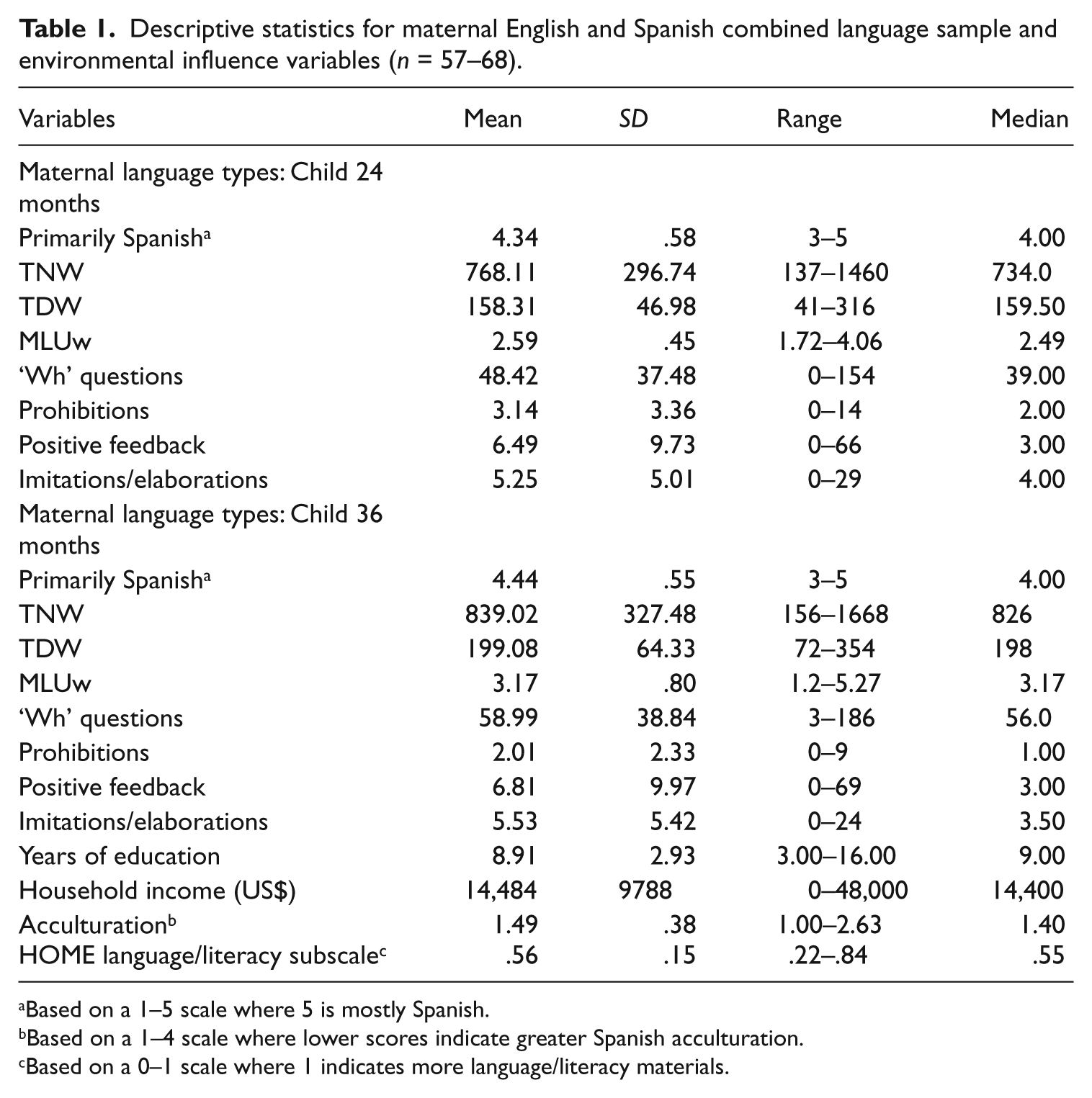
Based on a 1–5 scale where 5 is mostly Spanish.
Based on a 1–4 scale where lower scores indicate greater Spanish acculturation.
Based on a 0–1 scale where 1 indicates more language/literacy materials.
Acculturation
Mothers were also asked questions related to their level of acculturation into the mainstream culture using the Bidimensional Acculturation Scale (BAS; Marín & Gamba, 1996). This questionnaire was administered at the first assessment (Time 1) and consisted of 24 items. It is an orthogonal scale designed to assess acculturation. The BAS contains three subscales that focus primarily on language related behaviors: electronic media (i.e., television), language proficiency, and language use. Only the questions on the electronic media and language use subscales were administered. These subscales measure both English and Spanish language related behaviors. There are six items that address the preference of participants for English language based media and English language use and six items that address the preference of participants for Spanish language based media and Spanish language use. Each item is based on a four-point Likert scale. Higher scores on the Spanish items indicate high levels of Spanish acculturation while high scores on the English items indicate high levels of English acculturation. The instrument has high reliability with alpha coefficients of .87 for the Spanish items and .94 for the English items.
Parent report of toddlers’ language
During Time 1, mothers were asked to report on their children’s Spanish and English expressive and receptive language skills using the toddler forms of the MacArthur Communicative Development Inventory (CDI; Fenson et al., 1993) and the Inventario del Desarrollo de Habilidades Comunicativas (IDHC; Jackson-Maldonado et al., 2003). Because there are vocabulary and grammatical structural differences, the English and Spanish versions were developed separately. Each of 680 words listed on the two forms was read to mothers. After hearing each word mothers were asked whether their child understood and/or produced it. Four scores were calculated from the two forms: (a) the total number of words understood and/or produced by the child in Spanish; (b) the total number of words understood and/or produced by the child in English; (c) the total number of words understood and/or produced by the child in English and Spanish; and (d) the total number of unique concepts represented between the two languages. The correlations between the Spanish and English total (summed) scores and the unique concept totals were almost perfect (r =.99, p < .001). Thus, only the sum of the English and Spanish word total scores was included in the data analyses.
Norm-referenced assessment of toddlers’ language
The Spanish and English versions of the Woodcock–Muñoz Picture-Vocabulary subtest of the Woodcock–Muñoz Language Survey (Woodcock & Muñoz-Sandoval, 1993) were administered to children at the first and second assessment to assess vocabulary. For the first few items of this assessment children were asked to point to pictures reflecting their receptive vocabulary knowledge. For the remaining items on the assessment children were asked to name pictures to examine their expressive vocabulary knowledge. Four scores were calculated from the two versions: (a) the total number of correct responses in Spanish; (b) the total number of correct responses in English; (c) the total number of correct responses in English and Spanish; and (d) the total number of unique concepts represented between the two languages. W scores, provided by the test developers, were used because they represent an equal interval scale providing test equivalency across languages (Stevens, 1951; Woodcock & Muñoz-Sandoval, 1993). In addition, the children’s English scores were combined with their Spanish scores as a more complete indicator of their total vocabulary size. Similar to vocabulary measures used in previous research by Marchman and Martínez-Sussmann (2002) and Pearson (1998) a concept total was created by giving credit for each unique concept, but not for both an English and Spanish label for the same concept referred to as lexical meaning. In addition, the English and Spanish scores were summed together as an estimate for a total comprehensive vocabulary consisting of lexical items (Pearson, Fernandez, & Oiler, 1993). The correlations between the Spanish and English total (summed) scores or lexical items and the unique concept totals or lexical meanings were high (r = .91, p < .001). Because one purpose of this study was to determine if Spanish/English dual language learners living in poverty demonstrate language delays as early as 24 months and 36 months when multiple assessment methods are used and both English and Spanish words are included, the number of lexical items or summed score was used to try to capture all of the words a dual language learner knows as young children may have different representations for the English word than for the same word in Spanish.
Results
Child language scores
Means and standard deviations are presented to examine if Spanish/English dual language learners living in poverty demonstrate language delays as early as 24 months and 36 months when multiple assessment methods are used and both English and Spanish words are included. As shown in Table 2, the IDHC/CDI English scores (M = 15.11, SD = 16.51) were significantly lower (t = 10.25, p = .00) than the Spanish scores (M = 109.86, SD = 89.68). Average percentile scores were 1.1 for English and 21.08 for Spanish. For exploratory purposes, approximate (proxy) percentile scores were obtained for the English/Spanish combined scores (simple totals) using the English and Spanish norms separately, understanding that either proxy value must be viewed with caution. When compared to the Spanish norms of the IDHC, the CDI/IDHC summed total score suggested a percentile of 28.2, However, when the combined language score was compared using the English norms of the CDI (note that a simple average of male and female proxy percentiles was used), the proxy percentiles were lower than when using the IDHC norms suggesting a percentile of 14.5.
Descriptive statistics for child language skills at 24 and 36 months.
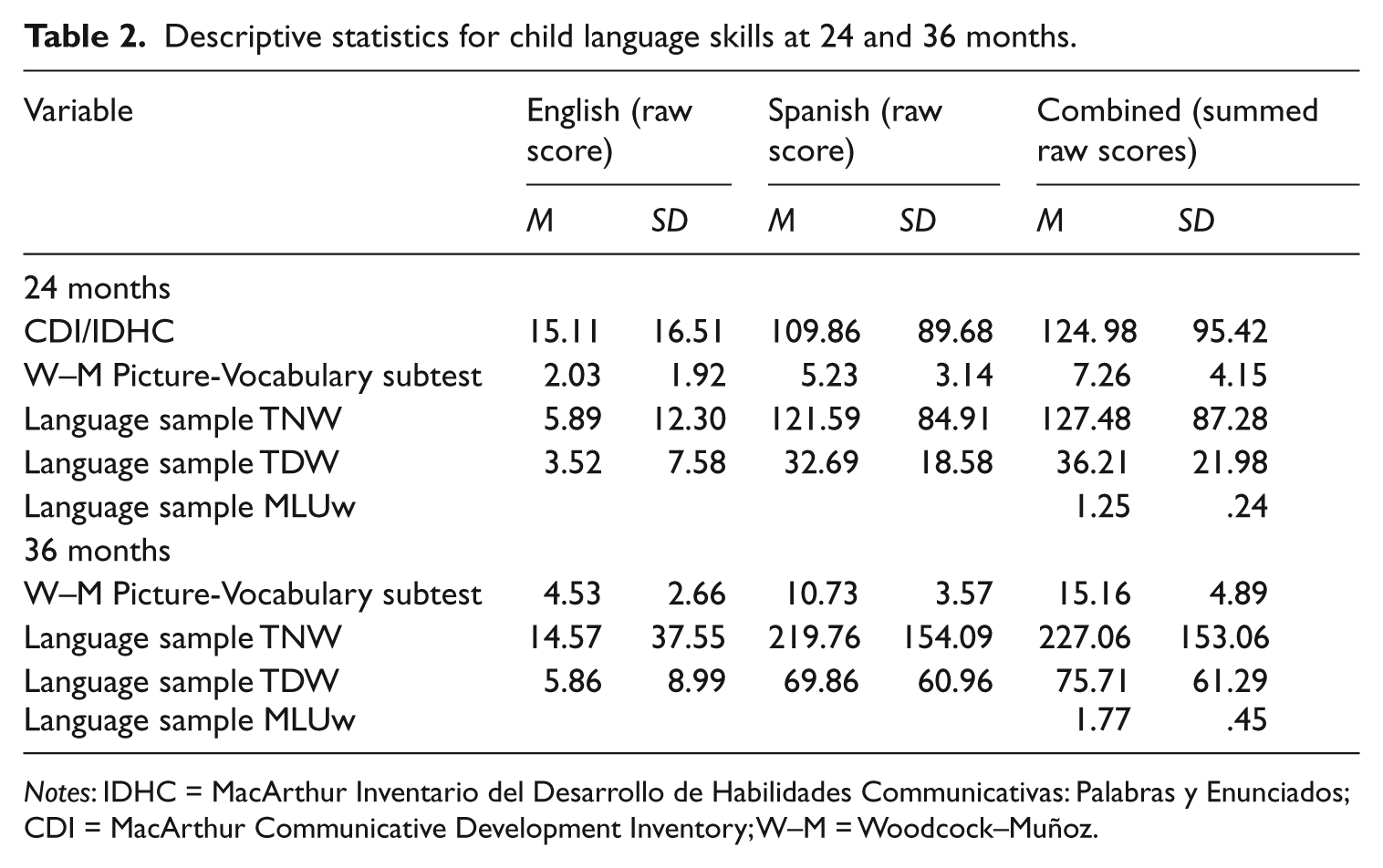
Notes: IDHC = MacArthur Inventario del Desarrollo de Habilidades Communicativas: Palabras y Enunciados; CDI = MacArthur Communicative Development Inventory; W–M = Woodcock–Muñoz.
Standard scores and percentile rankings are not available for the Woodcock–Muñoz Language Survey for children younger than 4 years old. However, a raw score of 7 on both the English and Spanish norms corresponds with age equivalents of 24 months. Raw scores on the Woodcock–Muñoz Picture-Vocabulary subtest in English for 24-month-olds were low (M = 2.03, SD = 1.92), but the Spanish scores were higher (M = 5.23, SD = 3.14). In both cases, raw scores reflect floor effects in word production and age equivalents of less than 24 months. Norms are not available for combinations of English and Spanish vocabulary scores. However, for exploratory purposes the summed scores were compared to the English and Spanish norms at both 24 and 36 months. Interestingly, the English and Spanish average summed score was 7.26 (SD = 4.15) with an age equivalent of 24 months. These results suggest age-level functioning for these 24-month-olds when both languages are included in the score.
Children’s language productivity measures obtained at 24 months from parent–child interactions focused on books and toys are also shown in Table 2. As can be seen in this table, children produced many more words (TNW) in Spanish (M = 121.59) than in English (M = 5.89; t(62) = 10.89, p = .00). The combined total (English + Spanish TNW) averaged 127.48 (SD = 87.28) although there was a wide range of variability between children as indicated by the large standard deviation. The total number of different words (TDW) used in Spanish was significantly higher (M = 32.69, SD = 18.58) than in English (M = 3.52, SD = 7.58; t(62) = 12.90, p < .001). The total number of different words used in both languages combined was an average of 36.21 (SD = 21.98). This total is lower than has previously been found for monolingual English (M = 50+), monolingual Spanish (M = 40–50), or bilingual toddlers (M = 50) who were not raised in poverty (Patterson, 1998; Rescorla, 1989). At 24 months, 37% of the children did not use a single English word and almost half (49%) used two English words or less. Mean length of utterance in words was also calculated. Because of floor effects in English and in Spanish, the MLUw for English and Spanish combined is shown in Table 2. Children at 24 months produced about 1.25 words per utterance (SD = .24). The Preschool Language Scale: Fourth Edition (Zimmerman, Steiner, & Pond, 2002) presents approximate language ages based on children’s estimated MLUs. For example, children’s MLUs ranging from 1.0 to 2.0 have an approximate language age of 12–26 months, MLUs ranging from 2.0 to 2.5 have an approximate language age of 27–30 months, and MLUs ranging from 2.5 to 3.0 have an approximate age of 31–34 months. In comparison, the MLUs for our sample of 1.24 for the children who were approximately 24 months are at the low end of the range.
Raw scores on the Woodcock–Muñoz Picture-Vocabulary subtest in Spanish and English for children at 36 months are shown in Table 2. A raw score of 17 on the English version and 16 on the Spanish version have age equivalents of 36 months. The English raw score for children, while low, was twice that reported for children at 24 months (M = 4.53, SD = 2.66). The Spanish score was also twice as high as that reported at 24 months (M = 10.73, SD = 3.57), but also suggested language skills lower than expected with an age equivalent of 28 months. When compared to both the English and Spanish norms for exploratory purposes, the summed score of 15.16 (SD = 4.89) suggested an age equivalent of 32 months and 34 months respectively.
Children at 36 months continued to produce many more words (TNW) in Spanish (M = 219.76, SD = 154.09) than in English; M = 14.57, SD = 37.55; t(69) = 10.54, p < .001. While the 36-month scores in Spanish are almost double that observed at 24 months, the English value is three times higher than at 24 months. These increases resulted in a combined total (English + Spanish TNW) average of 227.06 (SD = 153.06) at 36 months. The total number of different words (TDW) used in Spanish at 36 months (M = 69.85, SD = 60.96) was significantly higher than in English; M = 5.86, SD = 8.99; t(69) = 8.64, p < .001. The total number of different words used in both languages combined was 75.71 (SD = 61.29). As with the earlier observation, there was a wide range of variability between children on linguistic diversity (TDW). More children used English words at 36 months. Only, 10% of the children at the 36-month observation did not use a single English word and just over one-fourth (27%) of the children used two English words or less. Mean length of utterance in words was also calculated for children at 36 months. Because of floor effects in English and in Spanish, the MLUw for English and Spanish combined is shown in Table 2. Children at 36 months produced on average about 1.77 words per utterance (SD = .45) suggesting delayed language development when compared to average MLUs ranging from 2.5 to 3.0 for children approximately 31–34 months (Zimmerman et al., 2002).
Parent language input and home literacy factors
Next, descriptive statistics are presented to examine the levels of maternal language input and home language and literacy environment for our sample of Spanish/English dual language learners living in poverty. On average, mothers reported speaking almost always in Spanish (3.98 on a 1–5 Likert-type scale where a score of 5 corresponds to all Spanish). The mean maternal expressive vocabulary raw scores on the Woodcock–Muñoz Picture-Vocabulary Test were higher in Spanish (M = 30.15, SD = 3.64) than in English (M = 14.47, SD = 5.88; t = 30.80, p = .00). Their Spanish scores suggest a grade equivalent of 6.69 years when compared with monolingual Spanish speakers. Mothers averaged a summed total raw score of 44.37 (SD = 8.74) when English and Spanish raw scores were combined.
Mothers’ language productivity (TNW, TDW, MLUw), self-report of English and Spanish use in general, and average number of ‘wh’ questions asked, prohibitions used, positive feedback given, and imitations/elaborations provided during the play session are summarized in Table 1. All language productivity measures reflect a summed total of words used in English and Spanish. When children were 24 months of age (first assessment) mothers used an average of 768.11 words during their play interactions with children with an average of 158 of these words being different words. Their mean length of utterance averaged 2.59 words and they averaged asking 48.42 ‘wh’ questions and provided an average of 3.14 prohibitions, 6.49 instances of positive feedback, and 5.25 imitations and elaborations of children’s verbalizations. At Time 2, when children were 36 months of age, mothers used an average 839 words with 199 being different words. Mothers’ mean length of utterance averaged 3.17 during play interactions and they asked an average of 58.99 ‘wh’ questions and provided an average of 2.01 prohibitions, 6.81 instances of positive feedback, and 5.53 imitations and elaborations of children’s verbalizations.
Maternal years of education, household income, acculturation, and home literacy (language/literacy) variables are also summarized in Table 1. Mothers reported an average English acculturation score of 1.49 on the sum of the Likert-type scale questions that ranged from 1 to 4 indicating little use of media in English and speaking English poorly and an average Spanish acculturation of 3.76 on the Spanish items of the scale indicating an almost constant use of Spanish. Families averaged a score of .56 on the home language/literacy subscale that ranged from zero to one. This score suggests that a little over half of the language and literacy supports that were assessed were present in the homes.
Associations among family factors and children’s summed English/Spanish language scores
Finally, associations among parent input, home literacy environment, demographic factors, and child language skills at 24 and 36 months were examined with a hierarchical multiple regression to determine which maternal and home factors were the best predictors of children’s language skills at 24 and 36 months. There were only two significant correlations between family factors and children’s language scores. The significant correlations were between acculturation measured at 24 months (r = .24, p < .05) and the Woodcock–Muñoz Picture-Vocabulary English/Spanish sum total at 36 months, and the home language/literacy environment (r = .37, p < .01) measured at 24 months and the Woodcock–Muñoz Picture-Vocabulary English/Spanish sum total at 36 months.
A hierarchical multiple regression model (Table 3) was tested to determine if specific maternal language and literacy behaviors uniquely contributed to children’s vocabulary above and beyond family demographics and children’s language scores at 24 months. The correlations presented previously guided variable selection for this regression model. Based on these correlations the only demographic-type variable that was related to any of the language measures was acculturation. The measures of maternal vocabulary and income were also included in the model as these variables are often important predictors and included in models addressing child language development. Children’s 36-month Woodcock–Muñoz Picture-Vocabulary English/Spanish total was selected as the outcome variable in an attempt to better understand the predictive value of these maternal characteristics and behaviors. In the hierarchical regression model, maternal acculturation, maternal vocabulary, family income, and children’s 24-month Woodcock–Muñoz Picture-Vocabulary English/Spanish total were entered in the first step as control variables, followed at the second step by the home language/literacy environment. Estimates of the influence of the home language/literacy environment were tested after maternal acculturation, maternal vocabulary, family income, and children’s previous language scores were taken into account.
Regression predicting Woodcock–Muñoz 36-month English/Spanish Picture-Vocabulary score.

p < .05; ** p < .01.
As shown in Table 3, the home language/literacy environment predicted children’s Woodcock–Muñoz Picture-Vocabulary English/Spanish total at 36 months above and beyond maternal factors and children’s previous language scores. The home language/literacy environment made a significant addition to the model accounting for an additional 5% of the variance.
Discussion
The primary purpose of this preliminary investigation was to examine English and Spanish language and literacy experiences, demographic factors, and environmental influences on language performance in young dual language learners who are living in poverty. Our findings suggest our sample of Latino children living in poverty have delays in English and Spanish language compared to normative groups as early as 24 months when assessed through multiple common assessment practices and compared to monolingual norms. At 24 months, children in this study produced significantly fewer words (summed English + Spanish TDW, M = 36.21) than has previously been found for monolingual English (M = 50+), monolingual Spanish (M = 40–50), or bilingual toddlers (M = 50) who were not raised in poverty (Patterson, 1998; Rescorla, 1989). By the time most monolingual speakers are 24 months old they are using two- and three-word utterances to convey a variety of language functions. The children in this study demonstrated mean length of utterance scores (on average) that were 1.25 in length at 24 months. Even at 36 months of age children’s MLU remained below those of monolingual speakers (M = 1.77). However, delays in language skills were less pronounced when languages were combined for total scores, especially when comparisons were made to Spanish monolingual norms. The comparisons of combined language scores with monolingual norms are exploratory, but these findings highlight the dual language learning of these very young children before exposure to preschool. It is noteworthy that mothers in this sample reported speaking primarily in Spanish to their children and had low levels of vocabulary production, scoring at about the sixth grade level.
In this study, we found nonsignificant associations between parental language supporting behaviors (MLU, questioning, imitations, and elaborations) and child vocabulary use at 24 and 36 months. These findings are not in line with previous work documenting the association between parental language complexity and children’s language development (Tamis-LeMonda, Baumwell, & Cristofaro, 2012; Weistuch & Brown, 1987; Yoder & Warren, 1993). This lack of association may be due to the suppressed language complexity of the mothers in this sample. The average MLU of mothers with their 24-month-olds in this sample was 2.59 which is lower than a similar sample of English-speaking, low-income mothers whose MLU with their 24-month-olds averaged 3.23 (Tamis-LeMonda et al., 2012).
In contrast, these results support previous findings (Girolametto, Weitzman, Wiigs, & Pearce, 1999) with children with language delays showing that the structural characteristics (MLU, TNW, TDW) of parental linguistic input were not associated with child language output. For children with language delays, Girolametto and colleagues showed that parent responsiveness to child utterances in the form of imitations, semantically contingent responses, and expansions of child utterances were related to greater child language output than parent MLU, TNW, or TDW. The context used to elicit the language sample may also contribute to the lack of association between parental language and child outcomes. For example, Sparks and Reese (2013) found a significant association between mothers’ elaborations during talk about a past good behavior and children’s language and literacy, but not book reading with their sample of culturally diverse, low-income families.
While income was not found to contribute significantly to measures of child output its impact cannot be ruled out entirely. That is, all of the children in this investigation were living in poverty. The impact of poverty has been shown to be a far-reaching problem for children who are dual language learners (Losey, 1995) particularly if families have lived below the poverty threshold consistently rather than intermittently (Brooks-Gunn & Duncan, 1997; McLoyd, 1998).
The variables that were related to child language output in this study were the level of acculturation reported by the mother and the nature of the language/literacy environment in the home. These two factors may be seen as highly related. That is, knowledge and skills regarding oral and written language are highly valued in the US and are commonly taught well before formal instruction begins. Therefore, children from high print homes who are actively engaged in literacy activities are better prepared to benefit from formal reading instruction provided in school (Hammer et al., 2003; Ortiz, 1986) than children whose early experiences do not include these activities. The extent to which families are aware of the importance of these early literacy activities and incorporate them into rearing their children (acculturation) will predict, to some extent, their language outcomes, particularly vocabulary knowledge.
Recall that there were no significant correlations or predictors for child vocabulary or language productivity measures obtained at 24 months, although on average, children demonstrated suppressed vocabulary and language use at this time period. Crucially, there is a significant correlation between the extent of vocabulary knowledge (Woodcock–Muñoz total Spanish/English) at 24 months (r = .31, p = < .01) and the same knowledge at 36 months (r = .40, p = < .01). This suggests that early stimulation of vocabulary in both English and Spanish (at 24 months) may be an important factor to consider, as it is the only factor that was related to vocabulary knowledge at 36 months.
These findings have implications for the importance and timing of intervention. While it is often difficult to effectively increase family income and education, intervention impacts have been demonstrated in parental support of children’s development as well as their home literacy environments (Boyce, Innocenti, Roggman, Jump Norman, & Ortiz, 2010; Sweet & Applebaum, 2004). Acculturation and the home language and literacy environment were both associated with child language scores. However, acculturation is not necessary for home environments to be high quality. A study by Boyce et al. (2010) involving migrant Head Start families demonstrated the effectiveness of a short-term, culturally relevant intervention on improving the home language and literacy environment, parental language supporting behaviors, and children’s language production. This increase in language production is particularly noteworthy because the direct focus of the intervention was to encourage parents’ behaviors to support their children’s language. The results on children’s language provide strong support for a conceptual model in which intervention activities that affect parent behavior can, in turn, effectively impact children’s language (Boyce et al., 2010). These migrant families reported levels of acculturation lower than the sample of families in this study.
It is likely that parenting interventions targeted at promoting children’s language development could be effective with other Spanish-speaking families living in poverty. Indeed, previous research indicates that home visiting interventions can be adapted in ways to be effective and successfully engage families in intervention activities (Korfmacher et al., 2008). Beginning intervention efforts early for at-risk Latino children even before language delays are documented may be especially helpful as indicated by the strong correlation between breadth of vocabulary knowledge at 24 and 36 months. In a large mixed ethnicity sample, early positive parenting behaviors (at 18, 24, and 36 months child age) predicted pre-academic skills at kindergarten entry (Roggman, Cook, Innocenti, Jump Norman, & Christiansen, 2013).
Several limitations may have influenced our results. Although this sample of Mexican immigrant mothers living in Salt Lake City, Utah may not be fully representative of Latino populations, the low levels of education and English language use are likely generalizable to other low-income Latino populations within the US. Previous research indicates that children’s early language skills could account for many of the effects of the home environments on children’s later school readiness (Forget-Dubois et al., 2009). Research examining language trajectories in studies designed to enrich the home language and literacy environments would provide important information in relation to timing and types of intervention that would be most effective for these high-risk children. In addition, language use of other family members such as fathers and older siblings is not addressed in the current study. Many of these children may have older siblings who speak to them in English and Spanish. Future research should examine the influence of siblings’ language support on young dual language learners’ language development.
This study has important implications for practitioners concerned with dual language learners’ language development and appropriate timing of intervention. Our results indicate that the children in our sample performed below age level when tested in their home language using three assessment methods. However, when credit for test items was given, whether answered correctly in English or Spanish, their scores were closer to age level even though they had very limited exposure to English from their parents. These findings highlight the dual language learning that is occurring with these very young children in primarily Spanish-speaking homes. More importantly, our results suggest a need for encouraging language and literacy activities in the home that are meaningful and engaging for these families. These findings highlight the importance of beginning intervention when children are young, even before they are 24 months when appropriate.
Footnotes
Funding
This work was supported as part of the Developing English Literacy in Spanish-Speaking Children (DELSS) Network, funded by the National Institute of Child Health and Human Development and the Institute of Education Sciences grant RO1 HD39501.