



Abstract
During the first years of language development, toddlers coordinate multiple cues in order to acquire the plural form. The aim of this study was to manipulate object similarity as well as set size in order to determine whether these variables impact children’s comprehension of plurality. One-hundred-and-fifty children ranging in age from 22 to 36 months were provided puzzles with pieces containing arrays of similar or identical objects. Each puzzle was composed of pieces displaying sets of two, four, six, or eight items familiar to two-year-olds (e.g., chairs, dogs, shoes) alongside puzzle pieces depicting the singular form of the objects. It was predicted that large set sizes of identical objects would increase children’s comprehension of plurality. The results establish that smaller set sizes, not similarity, boost children’s comprehension of the plural form.
Introduction
What does it mean to know something? A common goal in the study of language is to tease apart what children know and what children’s performances can tell us about what they know (Cocking, 1977; Cocking & McHale, 1981; Höhle, van de Vijver, & Weissenborn, 2006; Naigles, 2004; Nation, Snowling, & Clarke, 2005). In other words, children’s production in a task may reveal what the children comprehend. This approach is based on the idea that knowledge and the processes that transform knowledge into actual performance are distinct and separable. Under this view, there should be some ideal situation in which children’s performance equals their knowledge. In other words, if a child knows three buttons are called ‘buttons,’ the ideal response from the child when asked ‘what’s here?’ would be the word ‘buttons.’ These assumptions are not without challenge, as there may be no real distinction between competence and performance at all, as knowledge may exist solely in the processes that create performance (Thelen & Smith, 1994). Thus, the current study seeks to determine whether children’s previously determined productive abilities with the regular English plural align with children’s comprehension abilities of the regular English plural. In this way, we utilize a relatively new methodology for the assessment of comprehension to access what children know, teasing this idea apart from what children’s productions in a given task reveal about their knowledge. Comprehension is the focus of the current study because these types of tasks, although certain kinds of tasks may be less demanding or differently demanding than others, seem cognitively simpler in terms of the processes needed to support performance and thus have been assumed to better reveal underlying competence (Cocking, 1977; Fraser, Bellugi, & Brown, 1963; Winitz, Sanders, & Kort, 1981).
What, then, is known about children’s ability to produce the regular English plural? A classic experiment by Berko (1958) tested for the emergence of the regular plural inflection in children while controlling for imitation of the regular plural form from memorized speech fragments. Nonsense words were created, each assigned to a fictional cartoon animal depicted on a picture card. A single depiction of a fictional animal was labeled with its nonsense name (e.g., ‘This is a wug’) on the picture card. Portrayed below the singular form of the fictional animal were two identical versions of the same fictional animal. The experimenter would then prompt the child to produce the correct plural allomorph by omitting the name of the fictional animal from the description (e.g., ‘Now there is another one. There are two of them. There are two ____.’) If the child correctly applies the plural morpheme –s to produce the novel count noun wugs then the correct use of the regular plural form is not due to imitation but due to an understanding of the morphological conventions for pluralization because the name of the fictional animal was not previously in the children’s productive vocabulary. Berko found that within the regular plural form children acquired the plural allomorphs |–s| and |–z| before acquiring the less common and more complex allomorph |–ez|. Therefore, the results from this study suggest that children are sensitive to both frequency and complexity when obtaining the plural morphology.
Past work has also shown that children are attentive to the number and similarity of items in a set as they construct their plural productions. Zapf and Smith (2008) tested two- and three-year-olds to establish whether set sizes of either two or four composed of either similar or identical items impacted plural production. Children were presented with an array of items. Within the array were a singular item and a set of either two or four items which were categorically different from the singleton set. For instance, the singular item consisted of a cow while the multiple-item set contained dogs. The multiple-item sets were composed of either similar or identical items, and were sets of either two or four items. Zapf and Smith tested 34 children between the ages of 23 months and 30 months. The children were asked to instruct a blindfolded teddy bear to get the set of multiple items. During the child’s description of the items it was observed whether the child used the plural inflection for multiple instances. The experimenter placed both the single item and array of either similar or identical items on a table for the child to play with. The teddy bear was then blindfolded and the child was informed that the teddy bear could only hear. The experimenter would then state ‘Tell teddy to get …’ while motioning to either the singleton set or the multiple-item set. The data from this study revealed that children produced the plural form most often when presented with sets of four identical items. In addition, children were significantly more likely to produce the plural when presented with identical items compared to similar items. However, the literature is mixed as to the effect of similarity of object features on children’s plural production. Barner, Lui, and Zapf (2012) concluded that similarity did not increase the production of plural markings in a sample of 24- to 45-month-olds.
Though much is known about factors that influence children’s production of the plural, examining young children’s first understanding of the plural – as measured by their comprehension of plural forms – has proved to be quite difficult. It has problematic ‘performance’ issues of its own. A simple procedure, one used by Fraser et al. (1963), for example, would be a forced-choice task in which a child is presented with two pictures, one of one bird and another of two birds. The experimenter’s goal when asking a child, ‘Can you get the birds?’ is that the child indicates the card with two birds, not the card with one. But all three (two on one card, one on another) are ‘birds’ and, thus, when one child at times chooses the card with two items in response to a plural query and at other times chooses both cards as a response to a plural query, it becomes difficult to assess what the child ‘knows’ about plurality.
One advance in studying plural comprehension has been the recent use of preferential looking paradigms. Deacon, Lalji-Samji, Leung, and Werker (2004) compared the looking times of 23-month-old children using a preferential looking task that varied the phoneme on the end of novel singular items. In Experiment 1, a child sat on their parent’s lap and watched a novel object presented on a TV screen. This object was given a novel name (e.g., ‘mip’). Following this, the child was presented with three of the same items as presented prior on one side of the screen and a singleton of that same item and then either heard ‘mips’ (the correct plural form) or a different phoneme (a control) attached to the end of the single form (e.g., ‘mipt). In this way, it was a child’s specific knowledge of the plural morpheme, and not simply just the addition of any sound at the end of the single form, that could be identified.
The results show that children who do not have a productive plural (as measured by the MacArthur Communicative Developmental Inventory) look longer at the multiple items when presented with the plural form than when presented with the control word. The children who do have a productive plural look longer at the multiple items when presented with the control form than when presented with the plural form. In this way, children are looking to the plural set of objects more when presented with the label they are least familiar with, possibly because it is the form that is most accurate based on their language skills. The children who do not yet produce the plural may be learning it (or at least aware of it) and thus most attentive to the plural items and plural word match. Children who have a productive plural, then, may believe the task is either about something other than the plural (and possibly a new morpheme) and may simply be investigating whether that new morpheme could tell them something about the set. The conclusion the authors make is that specific knowledge of the plural does not emerge until the plural becomes productive. One problem with this interpretation is that the different looking preferences are just that, looking preferences and cannot tell us specifically what the child knows. Perhaps the child ‘really’ knows but just does not care enough to show it in this context. A second problem with this method is that testing is limited to one or two forms at a time. One could not, for example, compare within the same child a variety of allomorphs or nouns with varying frequency in the plural form.
Even with the problems that have arisen from using preferential looking in the assessment of children’s comprehension of the plural, some intriguing and interesting findings have emerged with the use of this technology. Kouider, Halberda, Wood, and Carey (2006) tested 20- to 36-month-olds’ ability to identify plural morphosyntactic markers in English onto sets containing either single or multiple items. Participants were presented two screens. The first displayed a single novel object while the other screen displayed several novel objects. The experimenter used either the single or plural form of a novel count noun as well as indicating plurality through either the use of verb morphology, quantifiers, and noun morphology (e.g., ‘Look, there ARE SOME BLICKETS’) or through the use of only noun morphology (e.g., ‘Look at the BLICKET’/‘Look at the BLICKETS’) on the second trial. Experimenters then observed whether or not the infant looked at the appropriate screen. The preferential looking paradigm was altered to include two arrays of different objects to ensure infants did not group similar items from both arrays into their responses. The results conclude that 24-month-olds matched the screen containing several novel objects with the statement incorporating several syntactic cues in addition to the plural morpheme on the novel count noun; however, 20-month-olds failed at this task. Furthermore, 36-month-olds successfully matched the screen displaying multiple novel count nouns when plurality was only marked on the noun, yet 24-month-olds failed at this task. In general, then, children are using multiple cues for comprehension early and then, later, are able to use solely the plural marker in their understanding, or comprehension, of the plural form. However, one must remember the repeated looking between pictures which likely occurred for those children who did not show a significant difference in looking time could be demonstrating a pattern where ‘blickets’ are attended to, though the children are looking to all items presented, not just the correct screen. In other words, even though both options presented to the child in the preferential looking task during the critical trials were novel and different from one another, if plurality to a given child means ‘more than one’ (and, thus, not necessarily of the same kind) children may have been looking between screens to indicate their understanding. Using looking time measurements in this instance would be taken to show that a child does not have the underlying knowledge to demonstrate comprehension when, in fact, there is knowledge that we are unable to access.
Thus, even with the great advances in preferential looking paradigms, there are still potential drawbacks from using this methodology to analyze children’s comprehension of the plural. Therefore, the current study utilizes a relatively new technique (first introduced by Zapf & Smith, 2010) to assess children’s understanding of singular and plural forms. In this task, children are presented with an initial training puzzle. The purpose of this puzzle is not to train children on the plural form but to provide children with a rationale for the task such that it makes sense that there is only one piece that is the ‘right’ answer. The basis for the task is likely to be familiar to two-year-old children: putting puzzle pieces into a frame in which a hole has been cut out that fits just one piece. This kind of puzzle – the developmental precursor to the more common jigsaw puzzle in which pieces have to fit together – is a common toy for children of this age and younger.
During training, the children see the whole puzzle frame as well as pieces, as shown in Figure 1. This provides them with the complete context in which to understand the format: there is just one piece which will fit into each hole. As shown in the figure, the puzzle pieces are pictures of one or two instances of the same kind of thing. The hole shows the exact same picture, as is common in these kind of puzzles. Thus, when the experimenter asks for ‘the birds,’ the child need not even understand the words but can look to the picture on the frame – the one to which the experimenter is pointing – and find the one matching piece that will fit the hole. During this training phase, the experimenter demonstrates this to the child, pointing to the hole and the picture while making the verbal request. If need be, the experimenter will help the child find the matching picture. Although this training could ‘prime’ attention to number and the plural, attention to number and the plural is not necessary. Again, the main point is to provide the child with a context and task that makes sense: the goal is to find the one and only piece that fits in the indicated hole in the puzzle frame.

Displaying both identical and similar puzzle and corresponding pieces.
The testing phase works much the same way except the puzzle frame with the holes for the pieces and the matching pictures is kept out of view. Thus, the only information the child has to go on is the words spoken by the experimenter. The test puzzles always use different pictures and words, and in this way the task measures the children’s ability to connect the spoken singular and plural forms to puzzle pieces with pictures of one or more than one instance.
The goal of the current study, then, is to align what we know about children’s production of the plural with children’s comprehension of the plural as measured through children’s completion of a puzzle task. Winitz et al. (1981) have suggested that, within plural acquisition specifically, children do have the ability to comprehend the plural form without producing it, but do not have the ability to produce the plural without comprehending that form. Thus, it follows that if children have shown to produce the plural based on factors related to frequency and complexity of the form, as well as similarity and numerical components of the to-be-identified set, they should in fact be able to comprehend the same forms. Ettlinger and Zapf (2011) have shown through the use of a puzzle task that is also utilized in the current study that the complexity of the plural form impacts children’s comprehension of those forms (and see Arias-Trejo, Abreu-Mendoza, & Aguado-Servín, 2014, for comparable findings in Spanish-learning children). However, it has not yet been determined whether or not children utilize the composition of the observed set in their comprehension abilities.
Thus, the present study examines two- and three-year-old children’s plural comprehension when presented with sets that varied in similarity and number. Children were provided puzzle pieces containing arrays of similar or identical objects alongside puzzle pieces with only one example of the same objects. Eight conditions were created. Four conditions presented children with puzzle pieces depicting similar objects while the other four conditions presented identical objects. Both identical and similar objects were offered in sets of two, four, six, or eight alongside puzzle pieces depicting the singular form of the objects. If, in fact, children’s knowledge – as assessed through comprehension measures – utilizes the same factors as does children’s production of the plural, this will be further evidence that the processes that underlie production stem from children’s comprehension abilities. If this is the case, we predict that children will be more likely to correctly respond to queries for the plural form when there are four instances, rather than two (as in Zapf & Smith, 2008), and possibly if those instances are identical, rather than merely similar (as in Zapf & Smith, 2008; but see also Barner et al., 2012). If, however, children’s knowledge does not utilize the same factors as their production, it is possible that the processes that transform knowledge into production are distinct and separable and that the same factors (i.e., set size and similarity) that have been shown to impact children’s plural productions do not impact children’s understanding of plural forms.
We also acknowledge that, although adults realize that the plural form applies to two or more instances of an item, children may not fully grasp this all-or-none category membership and, instead, show graded effects in their comprehension of the plural form as it relates to certain properties of a set. In this way, just as Rosch (1975) has shown that adults find a robin to be a better bird than an ostrich, children may well find certain sets (i.e., those that show more characteristics of the typical instance of a set) more likely to represent the plural form. For example, children may be more likely to understand the plural if presented with many items (i.e., six or eight) because there are more items and this would be perceptually easier to identify as being greater than one. However, it could be that these added items create a situation where children are seeing a lot of just one thing, thus leading to them being less likely to pair the plural form with the representative picture. The manipulation of set size in the current study, then, seeks to go beyond the finding from Zapf and Smith (2010) that shows plural production is increased for set size four versus set size two and determine the role two, four, six and eight items may play in children’s understanding of the plural form.
Method
Participants
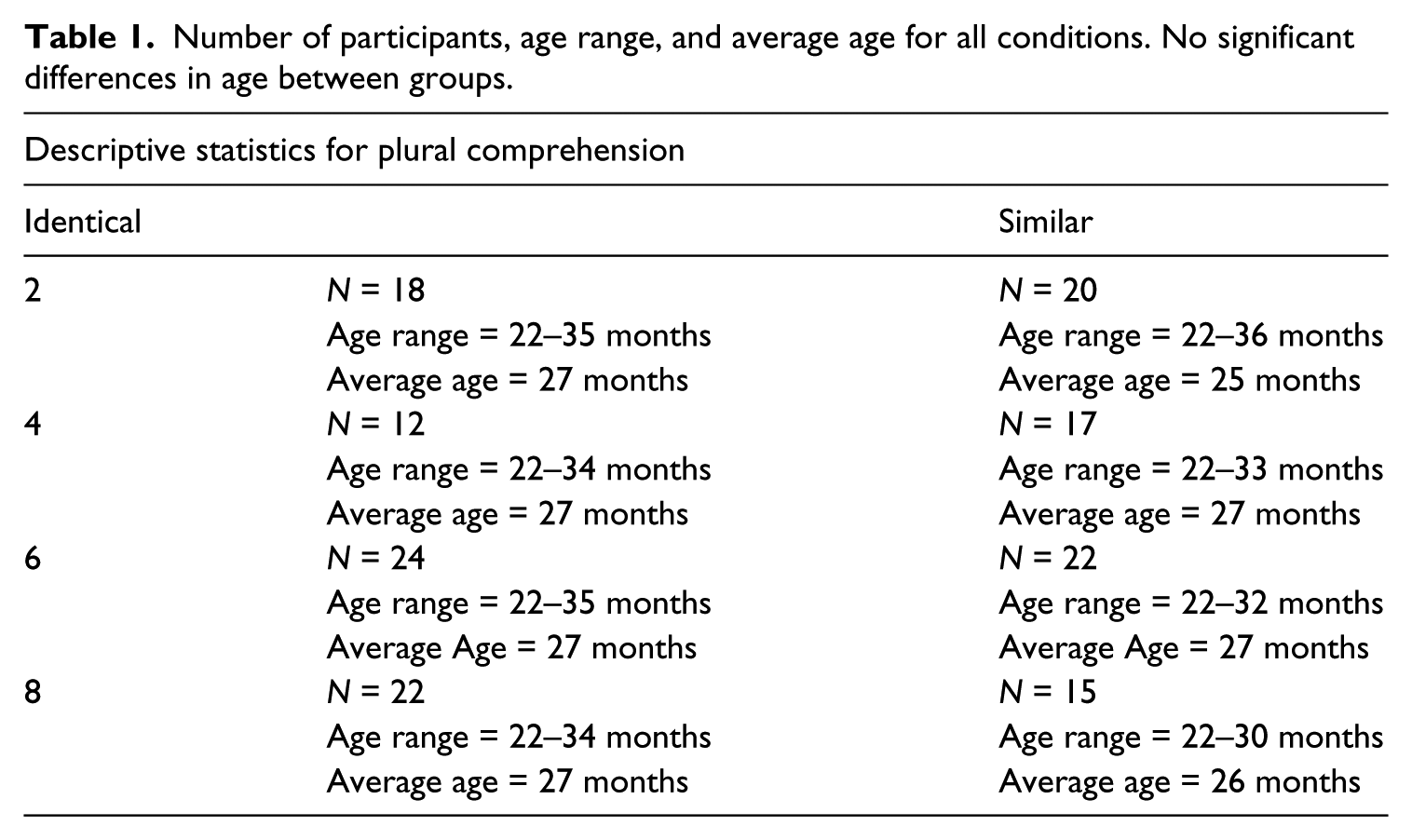
One-hundred-and-fifty children between 22 months and 36 months (M = 27.11 months, SD = 3.52) were randomly assigned to eight groups. All participants were monolingual, English-speaking children, and were tested at a mid-sized, Midwestern university. Refer to Table 1 for the number of participants within each between-subjects condition, the age range, and average age for each condition. No differences in age between groups were found.
Number of participants, age range, and average age for all conditions. No significant differences in age between groups.
Stimuli and design
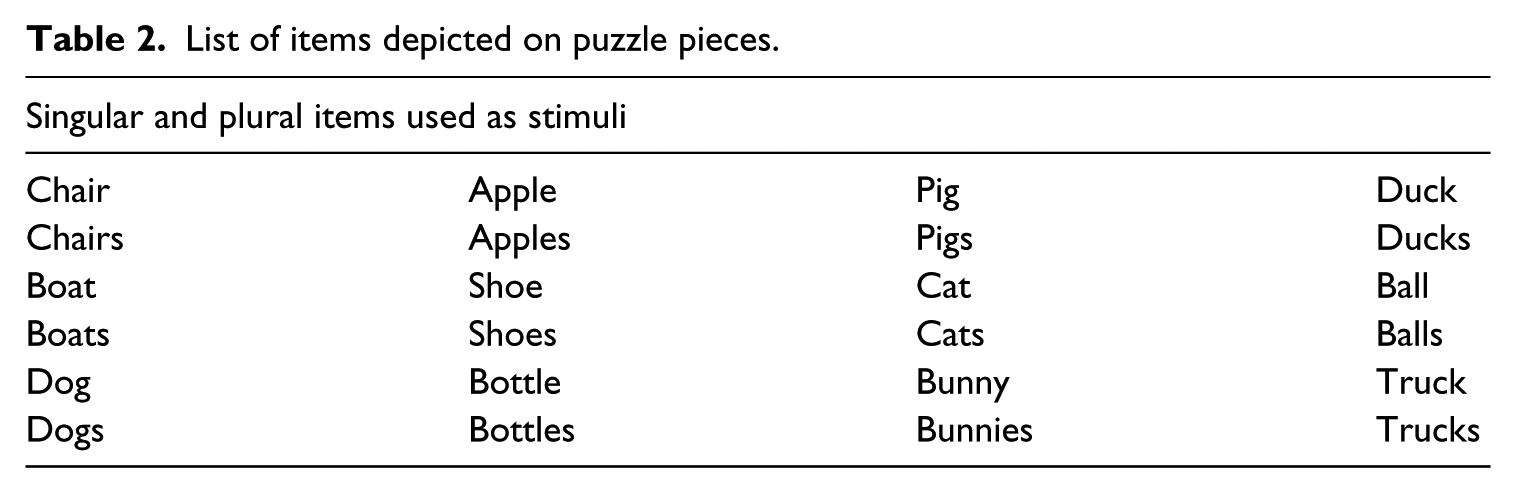
Twenty-four puzzles with eight pieces per puzzle were created. Each puzzle had half of the eight pieces displaying multiple items (e.g., shoes, chairs, apples, boats). The other four pieces per puzzle displayed the singular form of the same items (e.g., shoe, chair, apple, boat; see Table 2). All 24 puzzle boards had spaces where the puzzle piece fit, and each space displayed the same picture as its corresponding puzzle piece (see Figure 1). Velcro was attached to the back of each puzzle piece which could be affixed to the puzzle board. Half of the puzzles were limited to only similar objects and the other half contained only identical objects. The puzzle pieces depicted objects that are typically familiar to 50% of children by 20 months of age (Fenson et al., 1993); all similar items were recognizable by children of this age as well. Two between-subject factors crossed set size (four levels: two, four, six, eight) and similarity (two levels: identical and similarity), equaling eight conditions (e.g., I2, I4, I6, I8, S2, S4, S6, and S8). Each condition included three puzzles which were presented in six different orders to ensure sequence of presentation did not influence responses. The first puzzle was used during the training phase and the other two puzzles were used during the experimental test trials. Pictures were chosen based upon a child’s familiarity with the item as well as his or her ability to recognize the item being depicted in the image. Experimenters selected pictures which were prototypical examples of items portrayed on each puzzle piece. Also, puzzle pieces with larger set sizes (e.g., I6, I8, S6, S8) were not consistently bigger than puzzle pieces with smaller set sizes (e.g., I2, S2, I4, S4). This was to ensure participant responses were not influenced by the size of the puzzle piece.
List of items depicted on puzzle pieces.
Procedure
Children were presented three puzzles. The first was used during the training phase and the second two were used as the experimental test tasks. During the training puzzle the experimenter removed all the pieces from the board and set them on the table. The spaces on the puzzle in which the pieces fit displayed the same image as its corresponding piece. Children were able to view both the pieces and the puzzle board. The experimenter would ask for a puzzle piece from the child (e.g., ‘Can you hand me the piece with the shoe on it?’) while pointing to the place on the board where the piece fit. If the child handed the experimenter an incorrect piece the child would be corrected by the experimenter (e.g., ‘That’s not a shoe. This is a shoe.’). All eight pieces were queried during this phase. If the participant failed to respond the experimenter would model the task for the child by picking up the piece which was requested and naming it (e.g., ‘This is the piece with the shoe on it.’). If the participant attempted to respond by handing the experimenter two puzzle pieces, the experimenter would lay them both down on the table and repeat the query and the point to the picture to reinforce the fact that only one puzzle piece would fit and should be given in response to the query. The key idea here is that the child learned to select just one puzzle piece in response to the experimenter’s query – whether a singular or plural was used in the request, the child learned to select just one puzzle piece.
After completing the training phase the experimenter would take the second puzzle and place the pieces on the table’s surface. The puzzle board was hidden from the child by placing it on the experimenter’s lap beneath the table. As in the training phase the experimenter would request a piece and the child would select a piece from the table, handing it to the experimenter. However, during the test phase no feedback was provided. For instance, if the child handed the puzzle piece with the ‘chairs’ on it when the experimenter asked for the piece with the ‘cups’ the child was not corrected. The only correction that was given was if two puzzle pieces were handed to the experimenter. On the rare occasion that took place, the experimenter would take both pieces and set them down and remind the child that just one piece would fit into the puzzle for that particular query.
Also unlike the training phase, only four pieces were queried in order to ensure that child would have both pieces of each pair (e.g., shoe and shoes) to choose from in response to the query. Three of the queries included the target word in the plural form and one of the queries included the target word in the singular form. Occasionally, children selected the wrong puzzle piece which had not yet been called by the experimenter during that trial. For instance, if the child handed the experimenter the spoon puzzle piece when ‘cups’ was asked for and then ‘spoons’ was to be the next trial, the ‘spoons’ trial was skipped because there would only have been one puzzle piece of the spoon pair of pieces to choose from. The third puzzle was administered in the same way as the second. The experimenter randomly laid the puzzle pieces in front of the child, hid the puzzle board beneath the table, and queried pieces with either singular or multiple items. The child would then hand the experimenter a puzzle piece. No feedback was provided for either test puzzle.
Given there were three puzzles, we created six orders in which the puzzles could be administered. Each puzzle was the training puzzle in two of the conditions, the first test puzzle in two of the conditions and the second test puzzle in two of the conditions. Each order had a predetermined set of words that were queried. For the test puzzles, three of the queries included the target word in plural form such that the total plural queries across the two puzzles equaled six, and one of the queries included the target work in the singular form such that the total singular queries across the two puzzles equaled two. The singular and plural queries varied in order depending on the puzzle used for the testing: one puzzle included the singular query first and the following three queries were in the plural form, a second puzzle included the singular query second and the first, third and fourth queries included a plural form, and a third puzzle included the singular form in the fourth query, with the plural queries happening in the first three trials of that particular puzzle.
Results
The aim of this study was to establish whether set size and similarity of objects affected children’s plural comprehension. Descriptive statistics were calculated for children’s percentage of correct choice when asked for a plural puzzle piece (see Table 1). A two (similarity: identical versus similar) × four (size set: two, four, six, eight) analysis of variance (ANOVA) was performed to determine differences between the means of children’s percentage of correct choice when asked for a plural puzzle piece. Set size yielded a main effect, F(3,150) = 3.255, p < .05, η2 = .06. However, the similarity of objects conditions failed to statistically influence children’s comprehension and there was no interaction found between set size and similarity. Post hoc analyses were then conducted on set size using a LSD multiple comparisons test. As shown in Figure 2, the results of this analysis found children comprehended more plurals with set size two compared to set size six (p = .02), set size two compared to set size 8 (p = .01), and set size four compared to set size eight (p = .02). Set sizes four and six approached statistical significance (p = .05) with children comprehending the plural form more often for set size four compared to set size six. Note that in all cases responses were above chance as participants had eight puzzle pieces to choose from in trial one, seven to choose from in trial two, six to choose from in trial three, and five to choose from in trial four. In addition, there were no age effects found; age was not found to correlate with correct plural piece selection and did not interact with number or similarity.
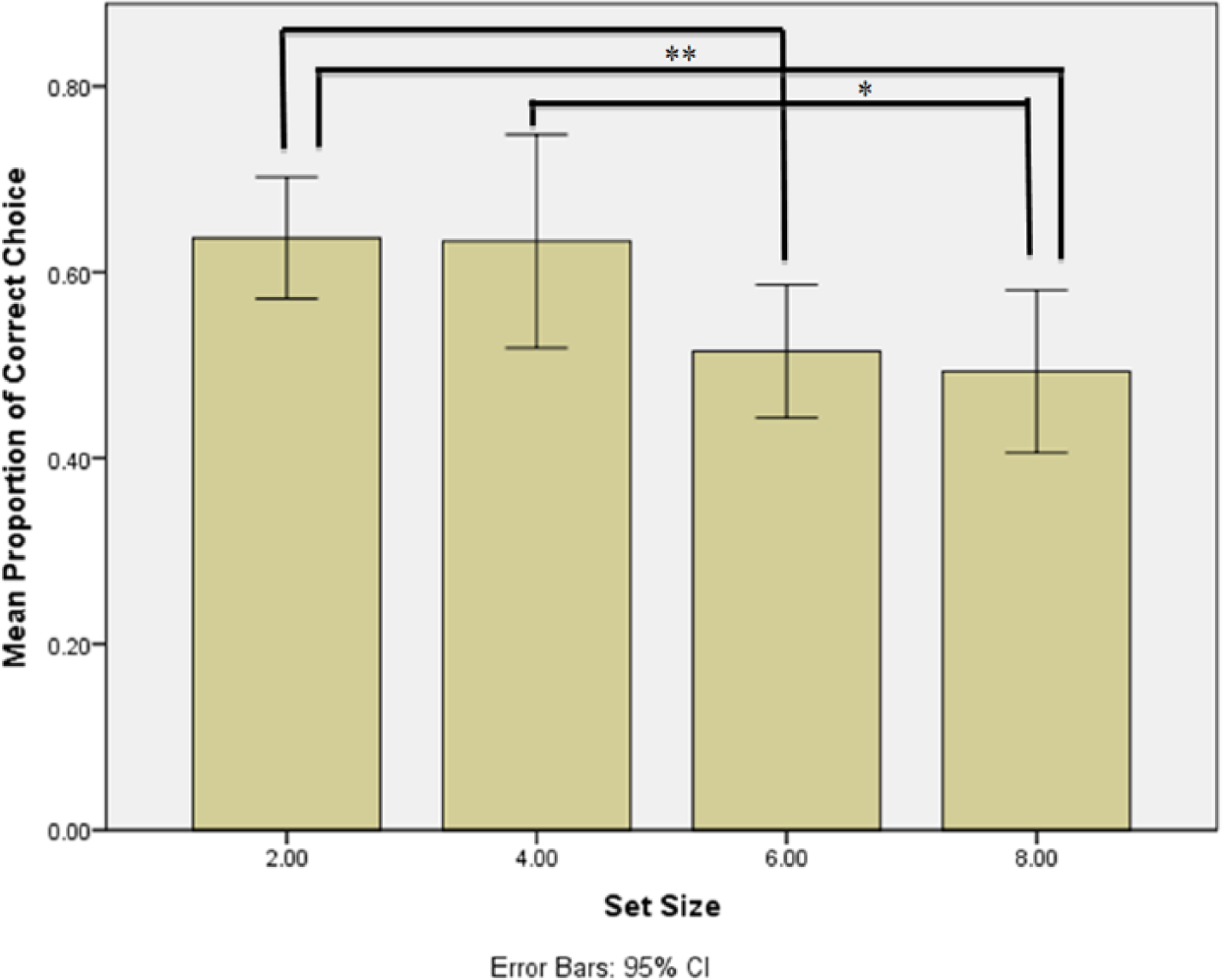
Mean proportion of children’s correct choice when asked for a plural puzzle piece as a function of set size.
Descriptive statistics for the percentage of children’s singular selections in response to a singular query for all conditions were computed. Using singular items as the dependent measure, the difference between groups was then calculated using a two × four analysis of variance (ANOVA). As was observed in the analysis of responses to multiple items number was determined to impact comprehension of the singular form as well, F(3,150) = 3.559, p < .02, η2 = .07. A post hoc LSD multiple comparisons test established that children comprehended more singular queries with set size four compared to set size two (p < .01), set size four compared to set size six (p < .01), and set size four compared to set size eight (p = .01) (see Figure 3). Age effects for both plural and singular comprehension were computed via correlational methods, revealing no effects on either variable.
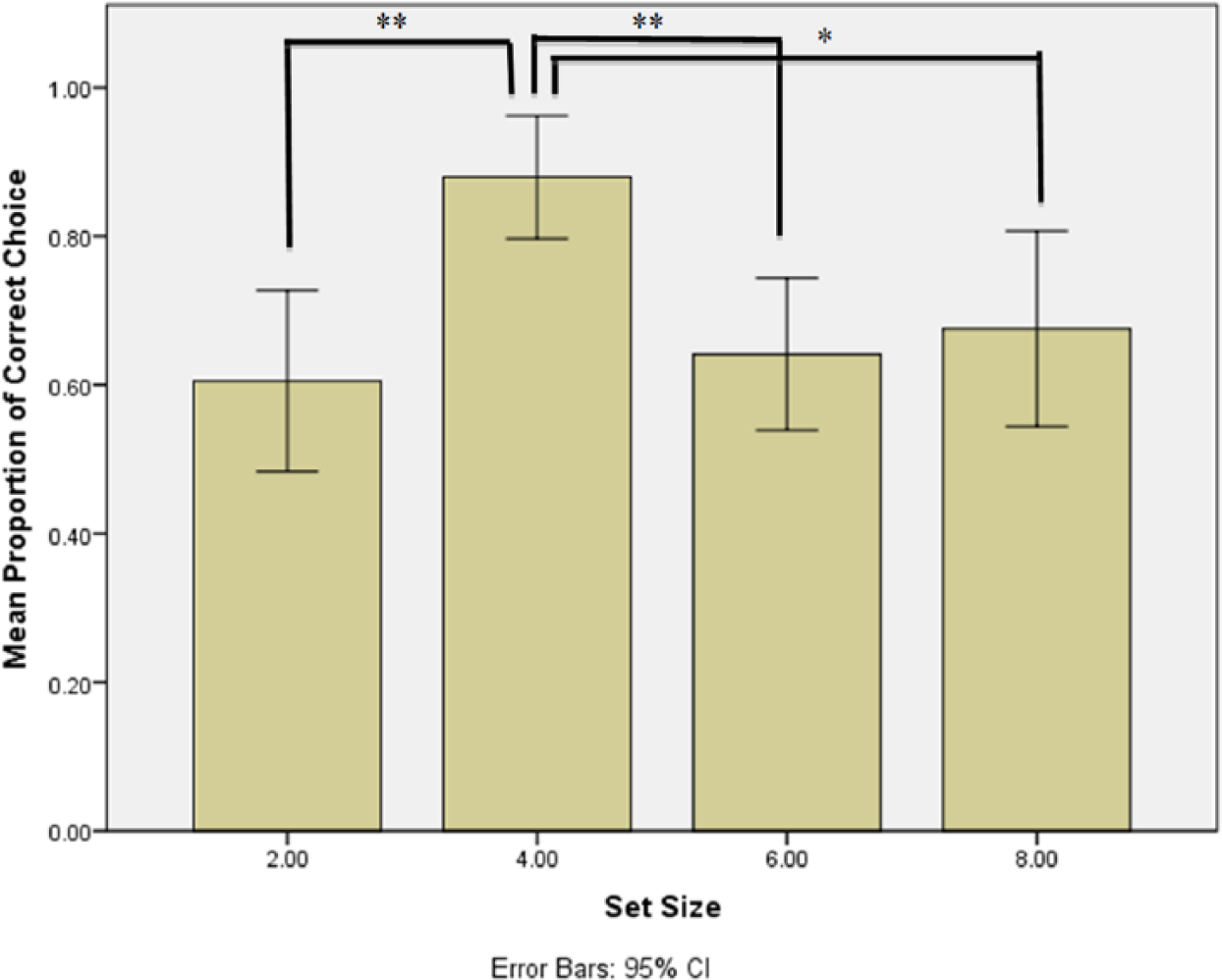
Mean proportion of children’s correct choice when asked for a singular puzzle piece as a function of set size.
Next, we tested to determine if common incorrect responses, namely selecting a singular puzzle piece instead of a plural puzzle piece or vice versa and selecting puzzle pieces which did not match the item queried, were influenced by our independent variables. First, the tendency to incorrectly comprehend the singular form instead of the plural form was analyzed. Set size statistically significantly impacted participants’ tendency to incorrectly select plural pieces for singular queries, F(3,150) = 4.755, p < .01, η2 = .09. A LSD multiple comparisons post hoc analysis revealed children made this error more with set size two compared to set size four (p < .01), set size six compared to set size four (p < .01), and set size eight compared to set size four (p = .01) (see Figure 4). With regard to selecting singular pieces for plural queries, neither of the experimental manipulations impacted participants’ responses. Second, the tendency to select puzzle pieces which did not match the item queried was assessed. The data show that none of the variables of interest influenced incorrect puzzle piece selection, but also that children rarely engaged in this error (mean = 3%).

Mean proportion of children’s incorrect choice of a plural puzzle piece when asked for a singular puzzle piece as a function of set size.
In summary, set size was discovered to have an impact on plural comprehension but similarity of items within a set did not. Additionally, set size, but not item similarity, influenced responses for the singular form. Lastly, set size influenced children’s incorrect selection of a singular puzzle piece instead of a plural puzzle piece, however only in one direction. Number contributed to children erroneously selecting plural pieces for singular queries, yet it played no role in wrongly selecting singular pieces for plural queries.
Discussion
Though past studies have attempted to measure children’s knowledge as well as examine their performance in laboratory studies as evidence for that knowledge, these studies of comprehension have not been without fault. Children’s answers in a forced-choice task could be ambiguous and children’s gaze in preferential looking studies may not accurately indicate their knowledge. In order to alleviate the problems in testing children’s comprehension of the English plural, a puzzle task was used. In this method, children are taught that only one puzzle piece can fill a hole in a puzzle. Thus, when queried, children know to pick one piece in response to the experimenter’s request.
Using this puzzle task, children’s plural comprehension was measured when they were presented with puzzle pieces that displayed arrays of two, four, six, or eight objects that were familiar to two-year-olds while the other half of the puzzle pieces displayed the singular form of the objects portrayed in the multiple-item puzzle pieces. Among the puzzle pieces depicting arrays of items, half showed identical images of an object within the set and half showed different yet similar images of the same object. The data established set size affects plural comprehension, but similarity does not. Specifically, children comprehended the plural form more when exposed to sets containing two items when contrasted with sets of six items, sets of two items more than sets of eight items, and sets of four items more when compared to sets of eight items. Additionally, the comparison between sets of four and six approached statistical significance with children comprehending the plural form more when presented sets of four as compared to sets of six.
The effects of number and similarity were calculated on children’s comprehension of the singular form as well. As with children’s plural comprehension, number but not similarity was determined to play a role in children’s comprehension of singleton sets. According to the results, children comprehended the singular form more when it was contrasted against sets of four items instead of comparing singleton sets with arrays of two items, sets of four items more than sets of six items, and sets of four items more when compared to sets of eight items. There were no significant differences in age between the groups, meaning the variance observed is not due to developmental factors. This finding reveals that a set size of four is likely the ideal number with which to compare one item in order to have a child correctly recognize it while using the singular label.
Furthermore, number, but not similarity, was determined to impact children’s propensity to incorrectly provide the singular form when queried for the plural form. Children tended to make this error when exposed to sets of two when compared to sets of four, sets of six when compared to sets of four, and sets of eight when compared to sets of four. Interestingly, in all cases, children were least likely to make this error when the multiple-instances set contained four items. So, just as children were least likely to make errors on the singular item while comparing it to four items, children were most likely to choose the correct piece when the plural form was queried with four items present. In all, then, set size four seems to be rather unique in children’s understanding of plurality as it leads to the highest levels of comprehension in the current study and past findings related to production (Zapf & Smith, 2008).
We attribute the importance of set size four, in large part, to children’s perception of the set presented. If a greater number of items was present (i.e., six or eight), children may see that larger set as being a lot of one kind of item, rather than multiple items of one kind and in doing so are more likely to apply the singular form to it. Likewise, just two items may not yet be far enough removed from one item to give children the urge to apply the plural form. So, although children may not yet know the number four as distinct from two or three at this age (Schaeffer, Eggleston, & Scott, 1974), their emerging understanding and recognition of the importance of set size as it applies to their language seems to be guided by their perceptions.
The significance of number on children’s acquisition of the plural has been discussed by many, and it seems the importance of number in the current study is no exception. From a young age, infants and toddlers appear capable of discerning between small sets of one versus two versus three (Schaeffer et al., 1974) and as representing singleton sets and sets of two as discrete categories (Wynn, 1990). In fact, by 24 months English-speaking children understand the numeral one signifies a single unit while all other integers symbolize quantities greater than one (Wynn, 1992). It is likely that this knowledge of and attention to number impacts children’s grammatical development and, likewise, children’s grammatical development can impact their knowledge of and attention to number.
To demonstrate, Sarnecka, Kamenskaya, Yamana, and Yudovina’s (2004) research into comprehension of plurality, age, and understanding of number predicted outcomes based on these three variables. Japanese-, Russian-, and English-speaking children at the first level of number conceptualization, the age at which the numeral one represents a single unit and all other integers represent more than one, were asked to hand a puppet either two, three, five, or six erasers. The trials requesting two and three erasers were considered low quantity tasks, and the trials requesting five and six erasers were considered high quantity tasks. Russian-, Japanese-, and English-speaking children were selected for the study because Russian has different grammatical markers for low and high quantities than Japanese and English. It was predicted that the additional cues embedded in Russian would guide the attention toward plural markings earlier than languages which lacked the additional cues. The results of this study revealed that both Japanese-speaking and English-speaking children performed at approximately chance in terms of the low/high distinction while Russian-speaking children performed at above chance. These data suggest that the number of plural cues embedded in a language influences the development of the plural form independent from number conceptualization. In short, the acquisition of the plural form – whether in terms of comprehension or production – does not happen in a vacuum and additional factors such as number knowledge should be taken into consideration as this important grammatical marking continues to be studied.
In this way, number knowledge and grammatical knowledge were providing useful cues to the Russian-speaking children as they were more likely to select the correct number of items in the high quantity scenarios. However, for English-speaking children, using larger quantities, as was presented in the current study with set sizes of six and eight, may have caused children to be confused by the larger quantity sets. For example, children’s knowledge of the pluralization system entails reconciling that all members of a set are simultaneously individual components as well as a unitary group (Zapf & Smith, 2010). To a toddler, coordinating these two, contradictory perspectives may be perplexing. The data for children’s percentage of correct choice when asked for a plural puzzle piece indicate that toddlers tend to represent larger set sizes as a single unit such as a ‘crowd.’ Smaller set sizes, then, provide a manageable quantity which assists in accurately conceptualizing the paradoxical features of the plural form. This may explain the tendency of participants to comprehend plurality more frequently when presented sets of two and four. Evidence from the errors children made bolsters this interpretation. Participants tended to erroneously select multiple-item puzzle pieces when queried for singleton sets more frequently with larger set sizes. This is likely due to children representing larger set sizes as a single body. Children did not comprehend the plural form as much for larger set sizes because they saw larger quantities as a singular unit.
In comparing the comprehension findings with the production findings, we recognize that children’s plural comprehension appears to be a bit ahead of their production during the two- to three-year-old ages. This is not surprising, as many have found that comprehension abilities are acquired before production abilities (i.e., Fraser et al., 1963; Winitz et al., 1981). In particular, children’s productive abilities are much more apparent when provided with four instances, compared to just two instances (Zapf & Smith, 2008). This difference is not apparent in children’s comprehension abilities. Children are shown to be just as likely to comprehend the plural form when there are two items present, relative to four items present. They are, however, more driven to correctly answer a singular query when asked about a lone item as it is compared against four items, rather than two, six, or eight items. Thus, there does still seem to be an underlying knowledge related to the four item trials that appears beneficial in the comprehension task. That said, while we do not yet know what happens to plural production as children are presented with higher quantities, the current study shows that children’s plural comprehension abilities decrease as the sets increase in size, beyond set size four.
An addition comparison one can make between the production findings of Zapf and Smith (2008) and the current comprehension findings relates to the importance of similarity of items in a set. Although Zapf and Smith found that identical sets were likely to boost children’s plural productions, Barner et al. (2012) did not detect a statistically significant effect of similarity with children of the same ages. Thus, the effect of similarity on production remains unclear. The current data are in line with the findings of Barner et al. (2012) as similarity did not impact children’s comprehension of the plural form. In this way, then, it is possible children may not rely on the same components of the meaning of the plural in the comprehension of this form as they do in their production. Two- and three-year -old children were the target ages for both this study and the previous production study. Given comprehension is mastered earlier than production, it could be that similarity would influence children’s comprehension of plural forms when the initial acquisition of the knowledge of plural forms occurs. To test this, future studies should focus on children’s use of the meaning of the plural – use of number and similarity of instances – in their comprehension at earlier ages, perhaps between the ages of 18 and 22 months. If they did in fact show use of similarity earlier in their comprehension, it may be that this factor acts as a guide towards children’s recognition of when the plural is used by others and, thus, understood by young children.
In addition to the make-up of the set a child is perceiving, there is another important factor that likely impacts children’s development of the plural: caregiver speech, particularly focused on number and plural forms. Brown, Cazden, and Bellugi (1969) examined several data sets to compare the correctness of children’s utterances and the expansions and modeling feedback children receive from parent input within a dialogue. Their findings suggest that for inflections, and more specifically noun inflections such as the plural, the order of acquisition of inflections for each child is more strongly related to modeling than it is to the proportion or frequency of expansions. Similarly, Zapf (2004) found that children are most likely to produce the plural forms they hear and that the plural errors they make often happen when the plural form is more frequent in caregiver speech than the singular form is (i.e., keys is more frequent than key). More recently, Tare, Shatz, and Gilbertson (2008) found that varied conversational input for number words was particularly useful as children learned terms that would later help them refer to quantities. In all, caregiver speech is an important factor that, too, fosters children’s understanding and production of the plural form.
As a final note, we recognize that in evaluating children’s pattern of responses, with children selecting the arrays with a smaller number of items correctly most often, it is possible children were selecting the puzzle pieces that included larger objects and avoided selecting arrays that contained the smaller-in-size objects. To some extent the design of the puzzles eliminated the ability to use rather large pictures when eight items were present, for example, thus it was the case that the items presented in the larger sets were smaller in size. So, although we were careful to make sure the overall size of the puzzle piece was not always larger when it contained multiple instances, we did not ensure that the larger sets at times had larger individual items than the single object presented. Figure 1 visually represents the differences in size between one item and the items as they appeared in set size six, as well as items as they appeared in set size eight. While we acknowledge this as a potential reason for our findings, we also suggest that children did at times incorrectly select the plural puzzle piece when queried for the single item and did so as much for set sizes of six and eight and, therefore, did in fact select the arrays that contained the smaller items. Thus, we do not feel this part of the design of the current experiment impacted the results to a measureable degree.
What does it mean to know something? How might we tease apart what children know and what children’s performances can tell us about their knowledge? This is no doubt a difficult task, as even measures related to comprehension are performance-based. Yet, the use of the puzzle task in the current study attempted to remove the confusion of coding that can arise during forced-choice tasks and the preferential looking paradigm. The results of the current study demonstrate a complex pattern that to some extent suggests that the processes that underlie production stem from children’s comprehension abilities. Specifically, the results indicate that children’s comprehension of the regular plural form was greater for smaller set sizes when compared to larger set sizes. (The small set sizes, though, include the set size of four which has been shown previously to lead to increased plural productions.) Toddlers appear to be relying upon their aptitude with smaller set sizes to distinguish between the singular and plural form while consolidating larger set sizes into a single unit. Without the current study, larger set sizes may be assumed to increase children’s plural comprehension due to the presence of more examples. Yet, these data suggest an optimal range of items which children are capable of representing as plural. When items exceed this ideal range children are less likely to view larger sets sizes as plural. If a child is struggling with obtaining the plural form then discovering the ideal range for comprehension of plurality is crucial for plural development. Future research ought to examine how children’s representation of number affects their plural comprehension. Sets of six and eight may impact children’s production of the plural form differently than children’s comprehension of the plural form. Empirical evidence into the influence of large set sizes on children’s production of plurality is a direction for further investigation.
Footnotes
Funding
This research received no specific grant from any funding agency in the public, commercial, or not-for-profit sectors.