



Abstract
Southern Peruvian Quechua is an indigenous language spoken primarily in rural communities in the Peruvian Andes. The language includes a syntactic construction, ‘-paq’, that expresses purpose or function, thus providing an opportunity to trace how parents and children with little formal education express teleological concepts. The authors recorded parent–child dyads (N = 36; children aged 3–5 years) talking about items in a picture book, and coded uses of -paq (e.g., ‘What is that little [toy] bear for?’ [‘Chay usuchari ima
Indigenous languages are valuable objects of study for researchers studying acquisition. They broaden the focus of language development research beyond the small set of languages that have received the bulk of academic attention (typically those spoken in the US, Great Britain, and Europe), to include more of the naturally existing linguistic variation across the world’s 5000-plus languages (Guo et al., 2009). They provide a passing opportunity to document languages that may be dying out, or that are undergoing changes as a result of increasing language contact. They provide insights into communities that may differ markedly from the middle-class, well-educated samples of convenience in so much psychological research. And ideally, the study of indigenous languages can provide insights into targeted questions regarding language and conceptual development, due to particular aspects of the specific language or cultural context under investigation.
The current project examines parent–child conversations in Southern Peruvian Quechua, an indigenous language spoken primarily in the highlands of Peru, for all of the reasons above. By studying parent–child conversations in Quechua, we are able to examine a longstanding debate regarding the nature of teleological concepts in development. In this introduction, we first set out the issues regarding teleological concepts in children, then discuss how Quechua provides a methodological tool for addressing the existing controversy, and finally provide a brief overview of this study.
Teleology
Teleo-functional reasoning involves positing that certain objects, parts, or actions exist for a purpose (e.g., chairs are for sitting; the long neck of a giraffe is for reaching leaves in tall trees; dogs bark in order to communicate). This form of reasoning is widespread, and central to how humans construct explanatory theories of the world. For example, our distinctively human capacity to construct and understand tools and other artifacts relies on understanding purpose and design (Bloom, 1996; Casler & Kelemen, 2005; Kelemen, Seston, & Georges, 2012), misconceptions in understanding biological inheritance can be traced to viewing teleology as a causal mechanism (Ware & Gelman, 2014), and theistic notions may ultimately trace to a powerful tendency to attribute purpose to regularities in the natural world (Kelemen, 2004).
An unresolved debate in the literature concerns the scope of these explanations, captured by two competing models: Selective Teleology and Promiscuous Teleology (see Kelemen, 1999a, for terminology). According to the Selective Teleology model, children and adults alike have a ‘teleological stance’ that applies to biological properties (e.g., the giraffe and dog examples above) as well as artifacts (e.g., the chair example above) (Keil, 1994, 1995). On this view, even young children appreciate that the teleological goals of living things are distinctively in service of themselves (e.g., the giraffe’s neck is for the giraffe itself to reach food). It is this view of teleological function as benefitting the self that is characteristically biological. In contrast, the teleological goals of artifacts are in service of others, typically intentional agents (e.g., a chair is for a person to sit on).
In contrast, the Promiscuous Teleology model proposes that there is a broad human tendency to apply teleological explanation across domains, including non-living natural kinds (e.g., mountains are tall for people to climb) or whole animals (e.g., an animal is for walking around) (Kelemen, 1999a, 1999b, 1999c, 2004). This includes an expectation that even animals and inanimate natural kinds can have purposes that benefit humans, and thus teleology of animals is not restricted to self-beneficial properties, as in Selective Teleology. (It should be noted that neither model predicts that teleological purposes will be restricted to a single function; e.g., on either model, a chair can have both utilitarian and aesthetic functions.) Promiscuous Teleology posits a natural tendency found in early childhood and persisting into adulthood, although it can be suppressed with effort, experience, and education. Thus, the teleological impulse is stronger among children than adults (Kelemen, 1999a) but is also found in adults under speeded conditions (Kelemen & Rosset, 2009) or cognitive decline (Lombrozo, Kelemen, & Zaitchik, 2007). It does not require explicit input or modeling from adults (Kelemen, Callanan, Casler, & Pérez-Granados, 2005).
To summarize thus far: there are two competing models regarding the scope of teleological reasoning over development, varying in their predictions regarding which domains receive teleological explanation in childhood. The evidence to date primarily supports the Promiscuous Teleology position, yet firm conclusions are premature. In a review paper (Kelemen, 1999c), several outstanding questions are listed, concerning teleological reasoning across distinct cultural contexts, the role of scientific concepts in affecting teleological explanations, and the kinds of input that adults provide to children. Fifteen years later, we still know little about these topics. Below, we discuss three limits to the current evidence regarding teleological concepts, limits that the current study is designed to address.
First, in contrast to the wealth of studies among US and British children and adults, little is known about teleological reasoning in other cultural contexts. This is a critical gap, given that industrialized, middle-class communities with high educational attainment are particularly unrepresentative of the world’s population, as assessed by a variety of cognitive measures (Henrich, Heine, & Norenzayan, 2010). For example, education levels and scientific instruction differ dramatically across the globe. The typical middle-class adult in industrialized countries has exposure to scientific concepts in formal education and many additional contexts as well (e.g., documentary programs; news outlets; science museums), in contrast to some adults from countries in which scientific literacy, as measured by western standards, is low. For this reason, Casler and Kelemen (2008) examined teleological reasoning within a group of Romanian Romani adults. Those with less formal schooling extended teleological reasoning to inanimate natural kinds (as do young children in the US), thus supporting the Promiscuous Teleology view. More investigations of this sort are needed.
Second and relatedly, the groups that have been studied to date are typically urban- or suburban-dwellers (including the Romani groups studied by Casler & Kelemen, 2008), where children have knowledge of and interact daily with a tremendous variety of artifacts, but relatively little experience with animals or cultivated crops. Indeed, the urban child’s reliance on animals and plants is so heavily mediated as to seem invisible (e.g., see Gelman, 2003, for a 3-year-old US child who thought that chicken [animal] and chicken [food] were coincidental homophones). Children’s different amounts and kinds of experiences with animals appear to affect their animal concepts (Inagaki, 1990; Unsworth et al., 2012; Waxman, Medin, & Ross, 2007). It is also possible that different amounts and kinds of experiences with artifacts would result in different levels of attention to purpose or function. In this regard, it is worth noting that the typical middle-class child in the US is inundated with artifacts that have highly specialized functions (e.g., bread-maker, lawnmower, apple corer, picture frame, glass vs. mug vs. tea cup vs. paper cup, couch pillow vs. bed pillow, rocking chair vs. dining room chair vs. lounge chair, seat belt, running shoes vs. dress-up shoes vs. sandals, shampoo vs. conditioner). In contrast, Quechua speakers in rural communities do not have exposure to nearly the same variety.
A third factor concerns the tasks that have most often been used to assess teleological reasoning. In many investigations, the experimenter either prompted the participant to supply a teleological response (‘What’s the X for?’), or supplied explanations which participants then evaluated (selecting which of two explanations they thought ‘made most sense’, e.g., a physical explanation [a rock was pointy ‘because bits of stuff piled up on top of one another for a long time’] or a teleological explanation [a rock was pointy ‘so that animals wouldn’t sit on them and smash them’]). Both these kinds of tasks introduce teleological explanation as a topic for participants to consider, and so are unable to examine the question of how spontaneously teleology emerges as a topic of discussion. A rare exception is a fascinating study of teleological talk in US parent–child conversations, as measured by parent report (Kelemen et al., 2005). However, this study was limited in terms of what it reveals about teleological reasoning, as it only looked at children’s ‘why’ questions and parental responses to such questions (thus omitting a large class of teleological talk, such as ‘What is X for?’). Given that most of the questions were ambiguous as to whether they were asking about teleology, and given that most parental responses were not teleological, the data yielded relatively little evidence regarding teleological conversations.
Quechua
Southern Peruvian Quechua (henceforth ‘Quechua’) is a South American indigenous language spoken in Peru (Mannheim, 1991), a member of the ‘Quechua’ linguistic family. ‘Southern Peruvian Quechua’ is part of a linguistic continuum that includes the Bolivian and Argentine varieties of Quechua and those varieties spoken in the six southeastern departments of Peru (i.e., Quechua sureño; Cerrón-Palomino, 1987; Mannheim, 1991). These varieties can be characterized by an overlapping lexicon and pragmatics, and a morphosyntax whose variability is as yet undetermined. A critical sociolinguistic feature of Southern Peruvian Quechua is that it has multiple registers, and the Quechua spoken by the vast majority of speakers from rural areas is distinctly different from that spoken in urban areas by bilinguals, for whom there has been accommodation to Spanish phonology, syntax, and semantics (though with a loan presence of Spanish words smaller than that spoken by monolinguals). The present study is based on data collected in a community in which Quechua is the primary language of social interaction, with children who are monolingual in Quechua and caregivers for whom Quechua is the dominant – and often the only – language.
Southern Peruvian Quechua is an SOV (subject-object-verb) agglutinative language, or Type III on Greenberg’s (1963) typology. It is consistently right-headed. Its highly inflected, agglutinative, suffixing morphology is a direct consequence of the right-headedness, meaning that the mapping of semantic representation onto morphological form is largely transparent (see Muysken, 1981, 1986; Weber, 1976). Quechua includes up to three or four suffixes on any noun and up to five to ten on any verb, as in the example sentence below.
(1) Sarachatapuni pagapuwayku papáy, llank’asqaykumanta Sara-cha-ta-punipaga-pu-wa-y-ku Maize-diminutive-accusative-definitelypay-finally-to.us-imperative-plural papá-y,llank’a-sqa-y-ku-manta mister-vocative,work-nominalizer-1st person-plural-ablative ‘Sir, pay us in maize for the work we did.’
Teleology is expressed in Quechua primarily by a nominal suffix, -paq, which is the focus of the present article.
1
Cusihuamán Gutiérrez (1976: 135) discusses the range of uses of the suffix -paq. The examples are his, the translations ours: (2a) Benefactive (including the recipient of an object) Taytayki-paq-mi chay aha-qa ka-sha-n Father-your-paq-evidential that maize beer-topic be-durative-3rd person ‘That maize beer is for your father.’ (2b) The use or purpose of an object (teleology) Ima-paq-taq-ri kay qura-ri alli-n? What-for-contrastive-question focus this qura herb-question focus good-3rd person ‘What is this qura herb for?’ (2c) A time for which an action is expected or intended Musuq wata-paq-qa ña-chá papa puqu-ra-mu-nqa-ña. New year-paq-topic already-suppose potato ripe-hortative-event begins distant from speaker-3rd person future-already ‘The potatoes should be ripe by New Year’s Day.’ (2d) The use of an object for exchange Papay-paq qu-wa-nki-man-chu chay sara-yki-ta? potato-my-paq give-to.me-2nd person-conditional-question that maize-your-accusative ‘Could you give me your maize for my potatoes?’ (2e) The goal or persistent objective of the action, when a verb is nominalized with the suffix -na Chakra-chi-ku-na-y-paq-mi aqha-sha-ni Field-cause-middle.voice-nominalizer-1st.person.possessive-paq-focus maize.beer-durative-1st.person ‘I’m making maize beer to work my field.’
A second construction, using the nominalizing suffix -na (as in case (e)) turns an action into a corresponding object, e.g., puñu- ‘to sleep,’ puñu-na ‘an object used for sleeping, a bed.’
The present study
The present study addresses the domain-specificity vs. -generality of teleological concepts, by focusing on teleological language in Quechua-speaking children and adults. Participants live in a rural community in a developing country, thus providing a critical comparison to prior research with relatively urban, often middle-class participants in more industrialized and wealthy societies. We studied parent–child dyads in interaction. The procedure was a parent-directed book-reading task, designed to elicit parent–child conversations in Quechua. Our aim was to provide a wide range of content domains, holding the context constant across participants. Book-reading tasks are often used in child language research (see the Frog Stories; Berman & Slobin, 1994), as they provide a naturalistic and open-ended yet controlled context. An advantage of using this book in particular is that it had been used in prior research with English- and Mandarin-speaking dyads (Gelman & Tardif, 1998; Tardif, Gelman, & Xu, 1999), though importantly was also slightly modified to be appropriate for this cultural group. The method permitted an examination of the focus of teleological conversation within the context of spontaneous, unprompted uses in language production.
The variables to be considered were child age and content domain. Although the study was exploratory in nature, we were able to test two competing hypotheses, corresponding to the Promiscuous Teleology position (that teleological talk would be high across domains) and the Selective Teleology position (that teleological talk would be high for artifacts and animal parts only).
Method
Participants
Thirty-six parent–child dyads participated, including 36 children (18 three- and four-year-olds; 18 five-year-olds) and their parents (35 mothers, 1 father). In most cases (25 of the 36 children) we did not have children’s birthdates; therefore, mean ages are not provided. This is a limitation in conducting field research; given potential errors in parental reporting, these reported ages should be interpreted with caution. An additional nine dyads were recorded but their data not used, due to poor transcriptions (n = 5), participant outside of age range (n = 2), a nonverbal child (n = 1), and a child who was a sibling of another participant (n = 1).
The community is located in the central Andes, in a mountainous region within 47.5 kilometers of Cuzco, the former Inka 2 capital. The community is located about 3000 meters above mean sea level, and includes access to high valley lands producing maize and grains as well as to puna grasslands used primary for grazing camelids. While the agricultural, valley settlements in the community are nucleated, the herding settlements are dispersed, with small clusters of one to three houses surrounded by pasture land, but still within an easy walk of each other. Children in these households have few if any books at home, little access to movies or TV (indeed TV programs are in Spanish, and so generally unintelligible to children), and no computers (at home or in the schools). Most parents receive at most a 5th-grade education.
Materials
Materials included a wordless picture book based closely on one that was used in prior research with English- and Mandarin-speaking parent–child dyads (Tardif et al., 1999), but modified to be appropriate to a highland Peruvian context. The book was constructed with the purpose of eliciting conversation about a wide range of familiar, culturally appropriate items (including a variety of people, animals, plants, food, and human-made artifacts). Specifically, pictures included the following (annotated with domain: PE = person, AN = animal, PL = plant, FO = food, AR = artifact, OT = other): puma (AN); scene with Peruvian families (PE) and animals (AN) outside a house (OT) with grassy hills (PL, OT) and the night sky (OT); bowls of potatoes (FO), corn (FO), and soup (FO); soccer ball (AR); saucepan (AR); butterfly (AN); lizard (AN); girl (PE) holding cat (AN); turtle (AN); boy (PE) listening to his wristwatch (AR); boy (PE) with pig (AN); bulldozer (AR); duck (AN); shoes (AR); carrots (FO); toy bear (AR); telephone (AR), saw (AR), wheelbarrow (AR); violin and bow (AR); mouse (AN); dandelions (PL); comb (AR); boy (PE) kicking ball (AR); car (AR); hat (AR); apple with slice removed (FO); man (PE) playing flute (AR) by a river (OT) surrounded by llamas (AN) and sheep (AN); ice cream (FO); boy (PE) holding a top (AR); bird (AN); hammer (AR); dog (AN); coat (AR); tree (PL); teapot (AR); doll (AR); chair (AR); mushrooms (FO) in grass (PL); airplane (AR); monkey (AN); motorcycle (AR); pencil (AR); cow (AN) standing on grass (PL); steam locomotive (AR); frog (AN); beetles (AN); knitted hat (AR) and gloves (AR); tractor (AR); Peruvian dancers (PE) with musical instruments (AR).
Procedure
The research was conducted within the rural community. One of the authors (C.E.) was already familiar to the community, and conducted the study entirely in Quechua, and was always accompanied by one of two assistants, whose first language was Quechua. She explained to prospective participants that the purpose of the project was to study how children learn Quechua, and that the task involved a parent looking through a picture book with their child and talking about the pictures. She obtained verbal consent, and video recorded the interactions. Sessions were approximately 10–20 minutes in length. Sessions were conducted outdoors, with parent and child sitting together on the ground. Afterwards, the child received a t-shirt as well as a copy of the picture book.
The task was modeled on other published investigations of parent–child conversations centered around picture books, which similarly used an open-ended procedure providing minimal instructions (Gelman, Coley, Rosengren, Hartman, & Pappas, 1998; Gelman & Tardif, 1998; Gelman, Taylor, & Nguyen, 2004; Pappas & Gelman, 1998; Tardif et al., 1999). The task was deliberately non-directive and open-ended so that parents would have the opportunity to discuss these pictures in whatever manner they wished.
All conversations were transcribed and translated from Quechua to Spanish, and from Spanish to English. (These were checked by a coauthor who speaks all three languages.) Each utterance appeared on a separate line; a given conversational turn could include more than one utterance. The transcripts were then coded by two coders, each independently coding a subset of the transcripts, with nine transcripts overlapping (i.e., coded by both coders) for the purposes of reliability. See Table 1 for examples for all the coding categories.
Examples of coding. Instances of -paq (indicating teleology) are in bold.
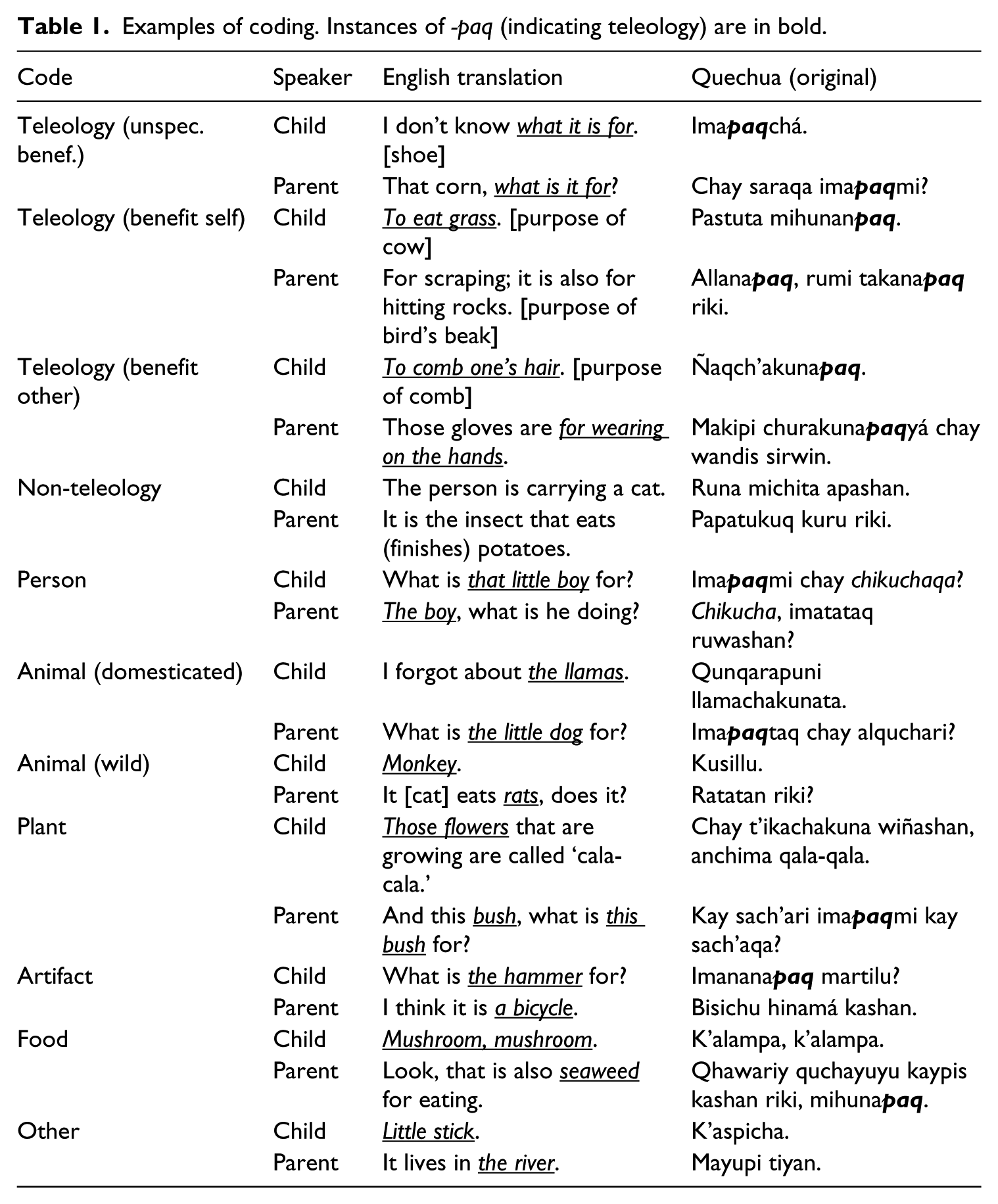
Teleology. Each line was coded as either expressing teleology or not. Coding was based on both the original Quechua (using computerized searches of the transcripts for -paq) and the translations. An utterance was coded as teleological only if both –paq was present and the translation indicated purpose or function. Thus, of the five types of -paq provided earlier, only use/purpose (e.g., ‘What is this qura herb for?’) and goal or persistent objective of action (e.g., ‘I’m making maize beer to work my field.’) would have been coded as teleological.
Teleological benefit: self/other/unspecified. Each line that included a reference to teleology was further coded as beneficial to self, beneficial to other, or unspecified. The self/other benefit was not explicitly stated by participants but rather was inferred based on the information provided. For example, for the utterance, ‘They [sweaters] are good for wearing in the cold’ [‘Iskay kashan chiripaq kayqa valin, churakunapaq’], the beneficiary is inferred to be the human wearer (not the sweater itself), and thus it was coded as ‘other-benefit.’ In contrast, the utterance ‘For scraping’ [‘Allanapaq’] (in response to, ‘What purpose does this [bird’s] beak serve?’ [‘Imapaqmi pikuqa sirvin?’]) implies a benefit to the bird itself, and thus was coded as ‘self-benefit.’ Utterances that did not imply a beneficiary, most typically questions (e.g., ‘That corn, what is it for?’ [‘Chay saraqa imapaqmi?’]), were coded as unspecified.
Teleological focus: whole/part. Whereas Selective Teleology proposes that teleological construals are limited to biological parts or features as well as whole artifacts and their parts, Promiscuous Teleology proposes that teleological construals extend to whole biological entities, as well as non-living natural kinds and their properties and parts (e.g., Kelemen, 1999a). We therefore coded whether teleological language referred to parts and features (as ST would predict) versus extended to whole animals and plants (as PT would predict). That is, the focus of the teleological utterance was either the whole entity (e.g., ‘That cup, what is this cup for?’ [‘Chay tasa, ankay tasaqa imapaqmi?’]) or a part or property of the entity (e.g., ‘What are its [cow’s] udders for?’ [‘Chay ñuñuntari imapaqtaq?’]).
Domain. Each noun 3 was coded into one of six categories: person, animal, plant, artifact, food, or other. However, if an utterance included more than one noun of a given domain, that domain was counted only once. The ‘plant’ category excluded food (e.g., ‘tree’ was coded as a plant, but ‘corn’ was coded as food). For lines that were coded as teleological, the domain of the teleological reference was also coded, even when no noun was provided (e.g., ‘Tiyanapaq’ [‘for sitting’] referred to a chair, and thus was coded as a teleological utterance regarding an artifact).
Animal type. Each line that included a reference to an animal (whether teleological or non-teleological) was further coded as domesticated (e.g., sheep) versus wild (e.g., rat). (Quechua speakers distinguish between animals that humans care for and feed [uywasqa = our ‘domesticated’ category] and those that they do not [purun uywa = our ‘wild’].) The purpose of coding for animal type is to test the hypothesis that teleological talk about animals would appear relatively more often for domesticated animals (that have human purpose) than for wild animals.
Interrater reliability
Teleology coding agreement was 99.7%, kappa was .98. Teleology type agreement for self/other/unspecified coding was 82% and kappa was .62; for part/whole coding, agreement was 95% and kappa was .64. Domain coding of noun phrases yielded agreements ranging from 94% to 99% per domain, with kappas ranging from .72 to .96. For domain coding of teleological references, although agreement was again high, ranging from 99.2% to 99.9% per domain, kappas were more variable. Four of the domains (animals, plants, artifacts, and food) had high kappas, ranging from .89 to .92; however, for the person and ‘other’ domains, kappas were only .50, due to the extremely small numbers of relevant lines. Animal type agreement was 98.9% and kappa was .98.
Results
Table 2 provides a summary of all of the variables that were coded as well as their frequencies as a function of speaker and age group. We first provide an analysis of both teleological and non-teleological uses of -paq. Nearly all instances of -paq in our dataset (97%) were teleological. The non-teleological uses were most typically benefactive (e.g., ‘Aman qarankichu michipaq’ [‘Don’t give any to the cat’]). We suspect that two factors contributed to the paucity of non-teleological uses. First, the picture book content was highly generic and decontextualized (individual items devoid of background, or scenes including people and places unknown to the participants) and so did not encourage the sorts of communicative exchanges that might more plausibly elicit other uses of -paq (e.g., ‘That spoon is for your brother’). Second, the conversations were fairly sparse. A typical exchange involved the parent labeling each picture and sometimes asking what the item is for. For these reasons, the uses of -paq in this book-reading context may not assess the full range of how -paq is used in informal conversational settings.
Mean number of utterances, as a function of coding category, speaker, and child age group.
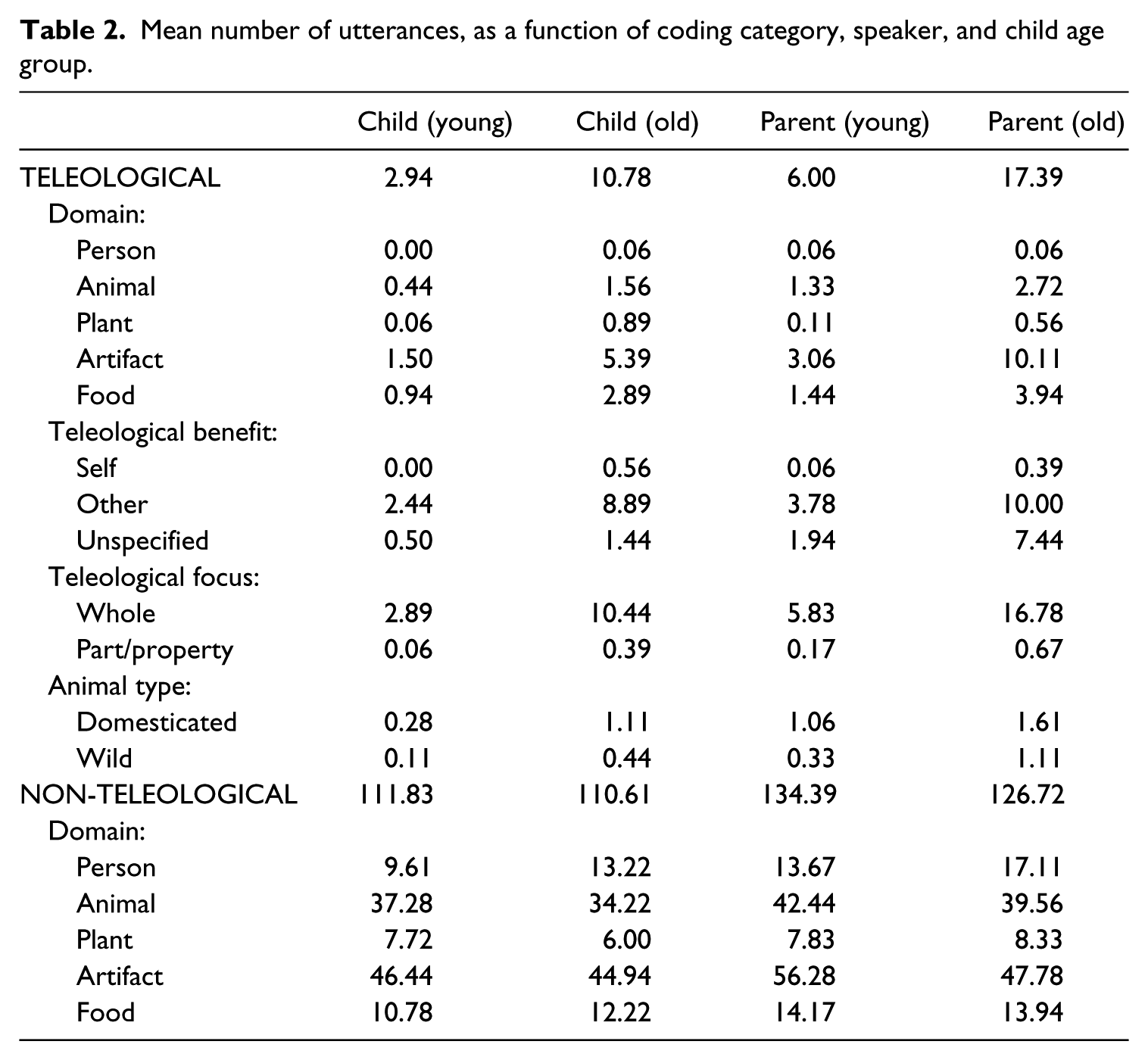
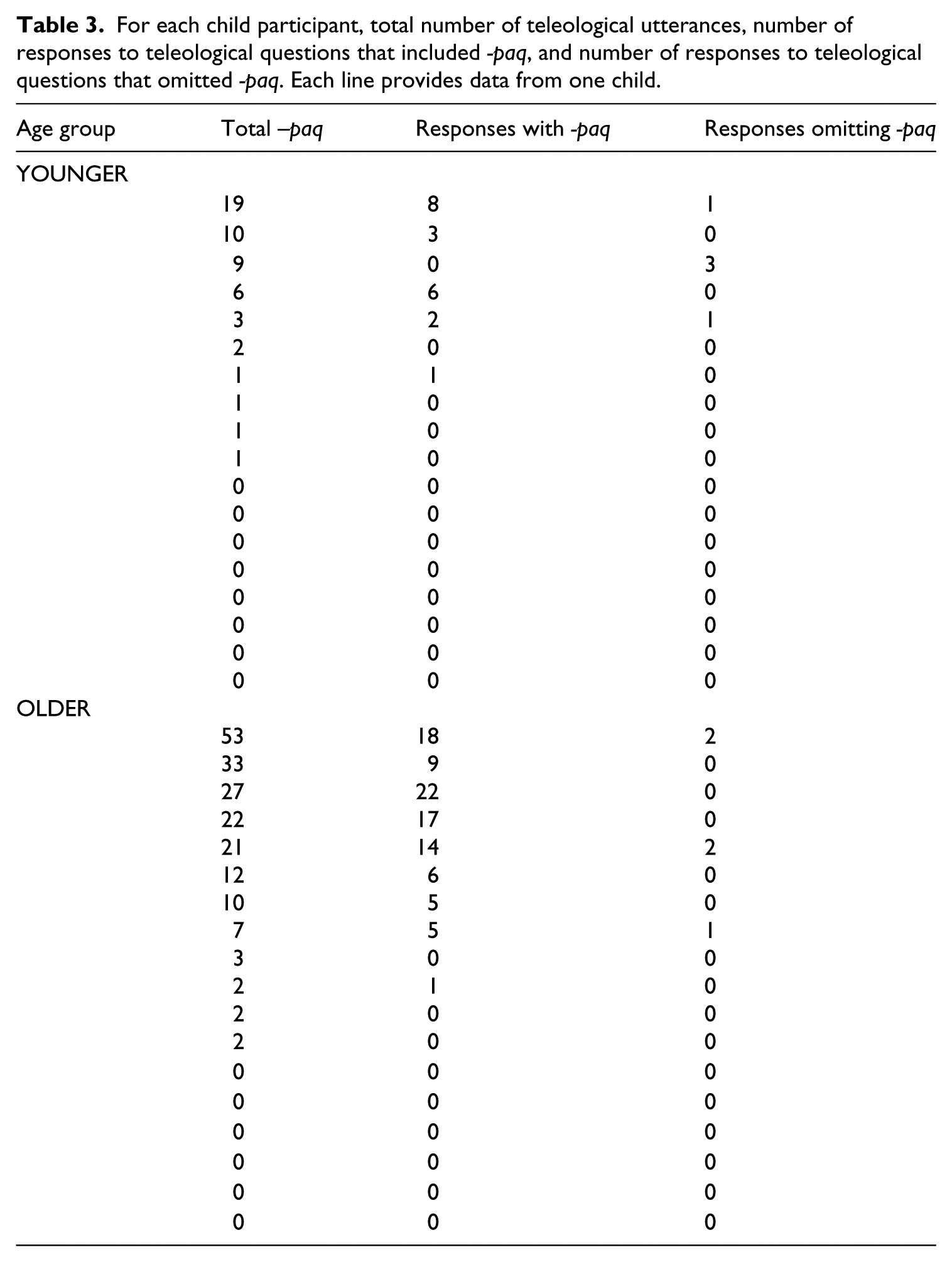
Altogether, 26 of the 36 dyads (72%) produced at least one teleological utterance, and participants produced a grand total of 668 teleological utterances (247 by children, 421 by parents), yielding an average of over 18 per dyad. In order to assess how frequently children failed to produce -paq in appropriate contexts, we examined children’s responses to parental teleological questions. In some instances the child produced -paq (e.g., Parent: ‘Chay saraqa imapaqmi?’ [‘That corn, what is it for?’]; Child: ‘Wall, wallpapaq’ [‘Hen, for the hen’]); in other instances the child omitted -paq (Parent: ‘Akatankaqa imapaqmi?’ [‘What is the beetle for?’]; Child: ‘Al, allpa.’ [‘La, land’]). Occasionally a parent would correct a child omission (e.g., Child: ‘Tumanayá’ [Drink]; Parent: ‘Tumananchispaq riki.’ [‘For us to drink, then’]). Although only 15 of the 36 children received these parental questions (6 younger, 9 older), they reveal some meaningful patterns. Overall, children provided -paq in these contexts an average of 88% of the time (76% at the younger age and 96% at the older age). Ten of the 15 children (67% total; 50% of the younger children and 78% of the older children) met Brown’s criterion of at least 90% production. Thus, production of -paq is fairly well developed in both child age groups, perhaps with improvement from 3 to 5 years. It is important to note that this analysis may underestimate children’s competence, because the omission of -paq can result from ellipsis, as -paq is not obligatory in such contexts.
Because our primary interest concerned how teleological language was distributed across domains for both children of different ages and their parents, we conducted analyses focused on the numbers of teleological utterances. Additionally, because we wished to discover whether the patterns obtained could reflect age or domain differences in overall frequency of speech, we also conducted a separate analysis of the non-teleological responses. Both sets of analyses are reported below.
Teleological utterances
For children and parents separately, we conducted a 2 (age group: younger [3s, 4s], older [5s]) × 5 (domain: person, animal, plant, artifact, food) repeated measures ANOVA, with the number of teleological utterances as the dependent measure. Note that the ‘other’ domain was excluded from analysis, because ‘other’ responses are difficult to interpret, as they are a disparate mixture of unclear references and those that do not fit neatly into any one category (e.g., ‘firewood’). In any case, teleological responses coded as ‘other’ were exceedingly rare (only 7 in the entire corpus). We also collapsed over references to whole entities (e.g., chair, cow) versus parts or properties (e.g., seat, udders), as the vast majority of teleological utterances (96%) concerned whole entities, and thus the data were insufficient to analyze these separately. Table 3 presents the total number of teleological utterances, number of responses to teleological questions that included -paq, and number of responses to teleological questions that omitted -paq, for each participant.
For each child participant, total number of teleological utterances, number of responses to teleological questions that included -paq, and number of responses to teleological questions that omitted -paq. Each line provides data from one child.
Children’s teleological language increased dramatically between the younger group and the older group (Ms = 0.59 and 2.16, respectively), as indicated by a significant effect of age group, F(1, 34) = 4.46, p = .042, ηp2 = .12. There were also significant domain differences, F(4, 136) = 12.79, p < .001, ηp2 = .27, as well as a domain × age group interaction, F(4, 136) = 3.73, p < .01, ηp2 = .10. Post-hoc analyses on the interaction revealed no significant domain differences in the younger group, but a consistent ordering of domains in the older group, as follows (highest to lowest): artifacts > food > animals > plants > people.
Parents showed a non-significant trend to provide more teleological utterances for older than younger children (Ms = 1.20 and 3.48, respectively), F(1, 34) = 4.03, p = .053, ηp2 = .11. As with the children, parents showed a significant effect of domain, F(4, 136) = 14.25, p < .001, ηp2 = .30, and a domain × age group interaction, F(4, 136) = 4.18, p = .003, ηp2 = .11. Parents of younger children displayed no significant domain differences, whereas parents of older children displayed a consistent ordering that was very similar to that of the children, as follows (highest to lowest): artifacts > food, animals > plants > people.
We next examined whether teleological utterances focused on benefit for the self, benefit for another individual, or neither (i.e., unspecified). Thirty-one percent of the teleological utterances were unspecified (typically a question, e.g., What is this for?), 66% expressed benefit for another individual, and only 3% expressed benefit for the self, ps for all pair-wise comparisons ⩽ .001 by planned t-tests. Of the 18 teleological utterances that expressed self-benefit, all concerned either an animal (N = 16) or a person (N = 2). Even when focusing exclusively on teleological utterances concerning animals, however, self-benefit utterances constituted a minority (15%). Thus, at least in the present context, spontaneous teleological language overwhelmingly focuses on benefit for someone other than the entity in question (most typically, benefit for people).
Although teleological utterances were relatively rare regarding animals, they were nonetheless widespread. Thirty-nine percent of the dyads (14/36) included at least one teleological utterance regarding an animal. We therefore wished to know how often such expressions concerned self-benefit of a part (e.g., a llama’s long neck is for reaching leaves from a tall tree) – the canonical adult-like pattern reported by Kelemen and Keil. Only 2.6% of teleological utterances regarding animals were of this sort (produced by a total of 2 of the 36 dyads). One hint as to what motivates teleological talk about animals is the finding that such utterances were produced at a higher rate for domesticated animals (6.6% of utterances) than wild animals (2.2% of utterances), t(71) = 4.20, p < .001, indicating that direct experience with agricultural and herding practices may encourage a teleological stance in this domain.
Non-teleological utterances
Because we wish to discover whether these patterns could reflect age or domain differences in overall frequency of speech, we present a separate analysis of the non-teleological responses. In contrast to the teleological language, non-teleological language yielded no age differences or interaction involving age, for either children or their parents. Instead, we obtained a main effect of domain, for children, F(4, 136) = 120.38, p < .001, ηp2 = .78, and adults, F(4, 136) = 62.89, p < .001, ηp2 = .65. Post-hoc analyses indicated that both children and parents showed an identical ordering, as follows (from highest to lowest): artifacts > animals > people, food > plants.
Importantly, this additional analysis reveals that the patterns obtained for the teleological responses cannot be attributed to overall differences in rates of talk (by domain or by age). For example, whereas teleological responses increased with age, non-teleological utterances did not increase with age. Similarly, teleological utterances were more frequent for food than animals or people, despite that non-teleological utterances were more frequent for animals than food, and equivalent for people and food. The two cautionary notes are that the high rate of teleological talk about artifacts may be inflated by the overall high rates of non-teleological talk about artifacts (which were over-represented in the picture book), and the low rate of teleological talk about plants may be underestimated by the low rates of non-teleological talk about plants (which were under-represented in the picture book).
Discussion
The present study was designed to examine teleological reasoning within a cultural context that differs in substantial ways from those studied in prior research. Participants in the rural, Quechua-speaking community in Peru that was our focus had less scientific knowledge, less formal education, fewer artifacts, and more direct contact with animals and plants than the middle-class US samples investigated previously. Additionally, the Quechua language possesses an explicit morpheme for expressing teleology (-paq), thus providing an opportunity to examine ordinary talk about teleological concepts across multiple domains. To our knowledge, this is the first study to measure spontaneous expression of teleological concepts in parent–child conversation.
The first notable finding is that purpose was a surprisingly salient topic for both parents and children. The majority of dyads made reference to teleology at least once over the course of the book-reading session, and on average each dyad produced roughly 18 teleological utterances. Indeed, many of the parents did little more than label each item and state its purpose. In contrast, prior analyses of parent–child conversations have found that US parents provide relatively little focus on teleology, when responding to their preschool children’s spontaneous ‘why’ questions, more often invoking causal explanations (Kelemen et al., 2005). Thus, an important question for the future is the extent to which participants in different cultural or linguistic settings invoke teleology to talk about the world around them. 4
To the extent that a focus on what things (in particular, whole objects) are ‘for’ may be distinctive in Quechua, an open question is why, and whether or not it reflects culture-specific practices or language. Quechua speakers have a relation to the natural world in which every person interacts directly with a variety of living things to yield items that have value for humans. Plants are cultivated, animals are domesticated, grains are cooked. One possibility is that the functional value of the natural world encourages a teleological stance. Another possibility that remains untested is that the availability in Quechua of an explicit grammatical construction to indicate teleology may play a role. Both English and Quechua have available expressions of teleology, but it remains to be seen if the productivity and explicitness of -paq may have made it easier for adults to raise purpose as a topic of discussion, and for children to attend to this issue.
The second key finding is that in several respects, the results are consistent with teleology being selective in its application. Teleological talk was produced at a higher rate for some domains (artifacts, food) than others (people, animals), and indeed was near zero for the domain of people (i.e., participants did not ask what a person ‘is for’). Furthermore, self-benefit statements, though rare, were attributed exclusively for animals and never for artifacts. These results speak against all domains being treated as equally plausible candidates for teleology.
The third key finding is that, despite the selectivity mentioned above, the patterns of distribution did not fit neatly into the predictions that would obtain if teleology reflected a naive biology (Keil, 1994, 1995). Specifically, Keil proposed that teleology applies to self-beneficial parts or properties of living kinds, yet we obtained a massive difference between plants and animals (not ‘living kinds’ per se). Moreover, in our data, teleological accounts typically referred to whole plants and whole animals (rather than their parts or properties), and focused on their use for people (rather than their benefit to the living item itself). Thus, not infrequently, speakers commented on the benefit of a bush, flower, pig, or cat for humans.
Taken together, if we consider spontaneous teleological language as reflecting the scope of application of teleological reasoning, these data do not fully support either major developmental theory – the Promiscuous Teleology theory (Casler & Kelemen, 2008; Kelemen, 1999a) or the Selective Teleology theory (Keil, 1994, 1995). Ojalehto, Waxman, and Medin (2013) proposed that teleology can reflect ecologically informed statements regarding relationships among entities (what they refer to as a ‘relational-deictic’ framework). In their words, ‘Relational approaches may support teleological responses precisely because they highlight ecological affordances and relations’ (p. 169). This framework is consistent with the current data, if we consider humans to be part of the ecological system (given that teleological utterances tended to focus on the benefits for people).
There are three primary limitations of these data. First, because these are parent–child conversations, it is difficult to know how much to attribute to children and how much to attribute to parents. Certainly the massive increase in teleological language at 5 years of age is likely to reflect something regarding the children – such as limits to their linguistic or conceptual skills, or changes in how parents interact with the children of different ages. For example, perhaps children do not fully understand -paq until age 5, or perhaps children become more independent at age 5, and thus more likely to elicit conversations about the world around them and their broader goals and responsibilities. However, because of the non-independence of the child and parent data, the domain-specificity of children’s teleological attributions cannot be discerned independently in this dataset.
A second limitation to these data is that there were too few utterances regarding non-living natural kinds (most likely because none of the pictures focused on such items) to assess the extent to which these received teleological utterances. This is unfortunate, given that non-living natural kinds are of greatest interest for distinguishing the two developmental theories.
Third, because we relied on spontaneous language, we certainly cannot conclude that the lack of certain kinds of talk means that people would not endorse those concepts had they been asked about them directly. For example, talk about self-beneficial purposes of animal parts or properties was vanishingly rare, but we cannot conclude that such talk would not be sanctioned, if directly queried. Rather, we should think of the current data as providing a rich sample of the kinds of contexts that Quechua speakers (both children and adults) spontaneously think deserving of teleological conversation.
Footnotes
Acknowledgements
We are grateful to the parents and children who participated in this research. We would also like to thank the CBC (Centro Bartolomé de las Casas) in Cuzco, Peru, for their administrative support. We thank Guillermo Salas Carreño, Jocelyn Kuhn, Margarita Huayhua, Rosalía Puma, Chhavi Chaudhry, and Natalie Davidson for their research assistance.
Funding
This research was supported by research funds from NICHD Grant HD-36043 and an OVPR grant from the University of Michigan to Gelman.