



Abstract
The ability to flexibly approach the pronunciation of unknown words, or set for variability, has been shown to contribute to word recognition skills. However, this is the first study that has attempted to teach students strategies for increasing their set for variability. Beginning readers (N = 15) were instructed to correct oral mispronunciations and then systematically alter sounds in words with exception spellings, while a control group (N = 15) was encouraged to decode passages without the set for variability instruction. It was hypothesized that this brief training would result in readers who are more persistent and more successful in attempting to read words with irregular spellings. Participants who received the experimental training made more attempts to read words with irregular spellings; however, they were not more successful in these attempts. It is argued that this means that set for variability is a teachable concept, in that students in this study acquired the strategy.
It is well known that reading comprehension, which is critical for long-term academic success, is dependent on early language abilities (e.g., Dickinson, Griffith, Golinkoff, & Hirsh-Pasek, 2012). Successful reading requires many components working in unison: word recognition (underpinned by phonological awareness), vocabulary, background knowledge, and pragmatic language understanding, as well as many others. For some time, it has been widely acknowledged that word recognition skills are the most important ability a beginning reader must develop, in that poor word recognition is the cause of most reading disability (e.g., Adams, 1990; Perfetti, 1985; Share & Stanovich, 1995). Research has shown that strong readers process every word in a text, registering complete spellings, even as the letters are automatically mapped to speech sounds (Ehri, 1987). Well-developed word recognition skills allow the reader to process words automatically and effortlessly, freeing up short-term memory for the important comprehension tasks. This automaticity does not come easily. It requires practice and explicit instruction.
Some experts have advocated that there are words with such irregular spellings they must be memorized as one unit. Advocates of the whole language approach have recommended memorizing all high frequency words by pointing out logographic features of the word (e.g., reading ‘look’ by remembering the two o’s that look like eyes in the middle of the word). Readers are instructed to use syntactic and semantic cues to guess at content words (based on the work of Goodman, 1967). However, subsequent research (e.g., Gough, Alford, & Holley-Wilcox, 1981) has demonstrated the difficulties of relying on context clues to determine words in a text.
Skillful readers recognize words quickly and automatically because they have such a deep knowledge of spelling–sound associations. In other words, word recognition skills need to be deeply ingrained in order to ensure fluent reading. Students who have not internalized grapheme–phoneme connections must rely on other, less reliable, cues to read unfamiliar words. It is estimated that only around 10% of the content words in a passage would be guessed correctly by context (Gough, 1983). Adams (1998) asserted that acquiring useful knowledge of the spelling–speech correspondences depends on ‘developing a reflective appreciation of the phonemic structure of the spoken language; on learning about letter–sound correspondences and spelling conventions of the orthography; and on consolidating and extending this knowledge by using it in the course of one’s own reading and writing’ (p. 6). The current study aims to address all three of those tasks by calling students’ attention to irregular spellings, asking the students to practice making sense of those irregularly-spelled words by using what they know about letters with multiple sounds, and then having the students implement this knowledge while reading texts.
Training in set for variability
Venezky (1999) argued that English-speaking beginning readers should be taught to be active problem solvers in part because of the complex orthography of English. He recommends training children to generate alternative pronunciations when they come to unknown words, until they produce a pronunciation that is a real word, and which makes sense in context. Gibson and Levin (1975) called this learning [mind]set for variability. When beginning readers apply what they know of letter–sound relationships to an unknown word, they may initially mispronounce the word, due to the fact that many letters, or combinations of letters, have multiple sounds. If the first pronunciation does not produce a known word, the reader has to try altering the pronunciation. The student must have the receptive vocabulary to recognize the word and the phonics knowledge to know which sounds to try (Cave, 2014), as well as the persistence to keep trying new pronunciations. If the correct word is in the reader’s listening vocabulary, the hope is that he/she will eventually hit upon it. Other cues (such as the word’s part of speech or the context in which it is used) are then needed to confirm the meaning.
Tunmer and Chapman (2012) operationalized set for variability by asking students to determine the correct pronunciation of mispronounced spoken English words derived from regularized pronunciations of irregularly spelled words (e.g., stomach pronounced as ‘stow-match’), the incorrect pronunciation of words containing polyphonic spelling patterns (e.g., glove pronounced like ‘clove’), and approximations to correct pronunciations based on the application of context-free spelling rules (e.g., kind pronounced like ‘pinned’). In their longitudinal study, students were also administered tests of reading components and reading comprehension. They found that vocabulary and phonemic awareness contributed to the variance in set for variability and that vocabulary directly influenced future reading comprehension and indirectly influenced future decoding and word recognition through set for variability. Furthermore, set for variability influenced future reading comprehension indirectly through both decoding and word recognition.
Elbro, de Jong, Houter, and Nielsen (2012) found similar results with a pair of studies in which they asked Dutch-speaking students to listen to 24 regularized pronunciations of words with irregular spellings and then produce the correctly pronounced word. They, too, concluded that set for variability made a unique contribution to word reading. These findings are congruent with intervention studies that successfully drew children’s attention to the sounds of language and resulted in substantial growth in phonological awareness (e.g., National Reading Panel, 2000). Set for variability represents an awareness of language similar to phonological awareness, in that students must attend to sounds independent of context. That said, despite the plethora of research into phonological awareness and its role in the reading process (see Wagner & Torgesen, 1987), no previous studies have attempted to teach set for variability directly.
While Gibson and Levin (1975) and Venezky (1999) used the term mindset, set for variability could also be conceptualized as a strategy. Beginning readers could be taught to systematically alter the letter sounds when sounding words out as one strategy in their arsenal for learning to decode. Once they have produced a real word, they could be taught to check the meaning with the use of context clues. As theorized by Tunmer and Chapman (2012), use of this strategy would encourage active reading and should positively impact both the student’s decoding ability and vocabulary, leading to improved overall reading ability.
Learning to use set for variability strategies is a good idea for all students, in that they would be reflecting on the way letters with multiple sounds affect word pronunciation in the English language, and then applying that newfound understanding while decoding unfamiliar words. This improved word recognition would lead to more fluent reading, and, by extension, to improved vocabulary (Stanovich, 1993). That said, it is expected that the set for variability strategies taught in this study will be most effective in improving the word reading of those students with stronger receptive vocabulary at the outset. This is due to the fact that Tunmer and Chapman (2012) found that vocabulary contributes to the development of word recognition skills indirectly through set for variability. Beginning readers who are confident enough in their knowledge of letter–sound relationships can begin sounding out words – even words with exception spellings – to the point where the partial decoding is close enough to the correct phonological form that they are able to identify the word, but only if that word is in their receptive vocabulary.
In addition to improving the word recognition skills of all students, set for variability strategies could prove especially valuable in teaching reluctant readers, because the emphasis is on encouraging active participation in the reading process: if the student does not immediately recognize a word (even one expected to be a sight word at that grade level), he/she is encouraged to sound out as much of it as possible. It is expected that the student will not read the word entirely correctly the first time; instead, the expectation is that he/she can keep changing the sounds until hitting on a familiar word.
Therefore, the primary questions investigated with this study were whether or not set for variability is a teachable strategy, and whether or not the strategy would result in improved decoding and/or persistence in decoding exception words. Two hypotheses were tested. First, it was predicted that a brief training in correcting the mispronunciations of a puppet and in altering sounds while decoding unknown words with irregular spellings would lead to an increase in beginning readers’ attempts to sound out words with exception spellings. Second, it was predicted that the training would lead to beginning readers who are more successful in attempting to read exception words.
Methodology
Participants
Participants were first and second graders recruited from three public schools in the same geographic area of a small northeastern US state in the winter. The population of the schools was lower SES and included students from a variety of ethnic backgrounds, with 75% of the students qualifying for a free or reduced cost lunch. Approximately 17% came from homes where a language other than English was spoken. Participation in this study was limited to fluent English speakers.
All of the children who returned signed consent forms were pretested for reading ability and receptive vocabulary knowledge. The students were matched on their exception word reading scores, in order to randomly assign pairs to condition. Members of pairs were randomly assigned to the experimental and control groups, N = 15 per group. Characteristics and mean performance of the two groups on the pretests are reported in Table 1.
Characteristics of participants at pretest.
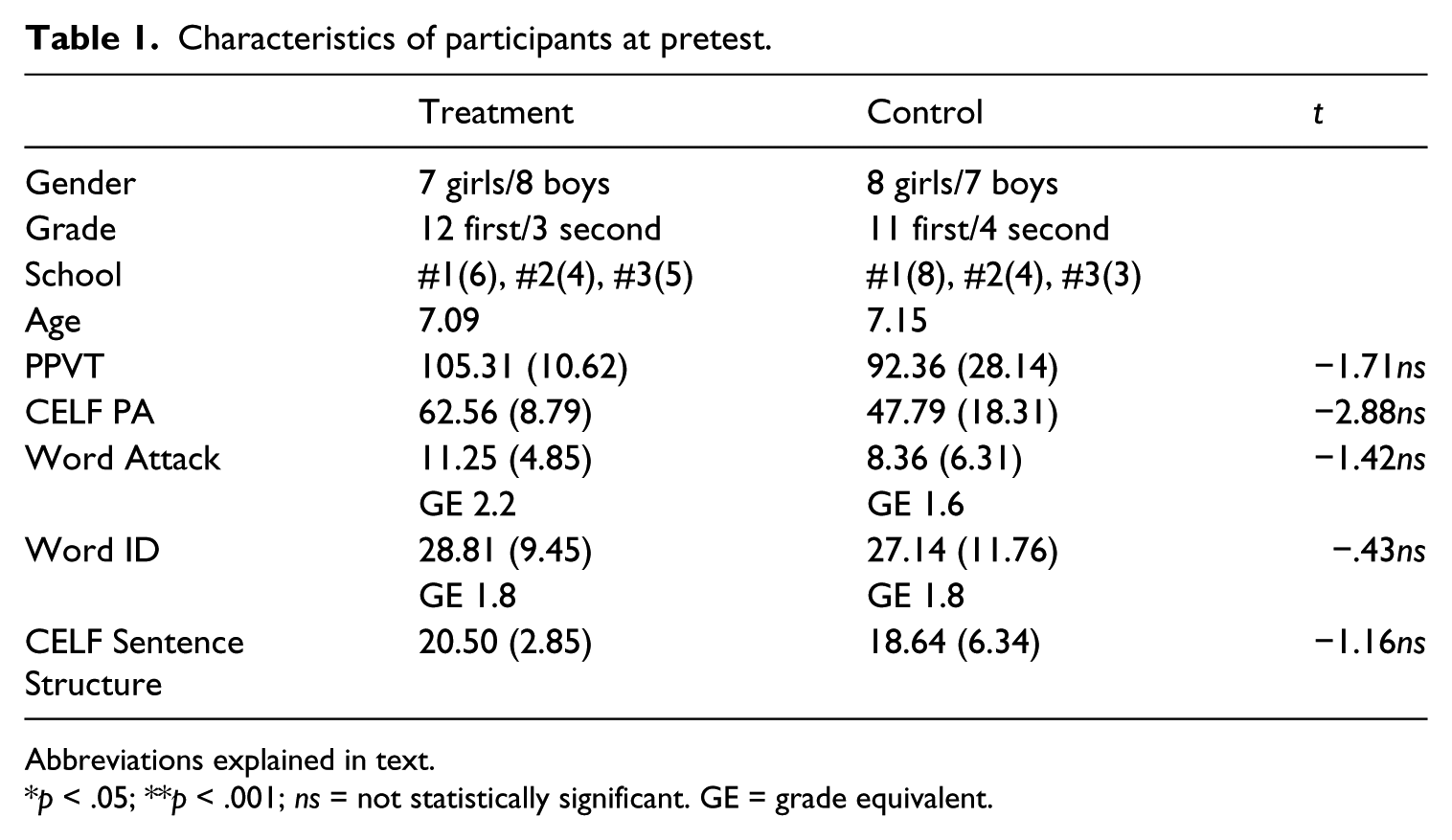
Abbreviations explained in text.
p < .05; **p < .001; ns = not statistically significant. GE = grade equivalent.
Materials and procedures
In order to find participants who were fluent English speakers but not yet fluent readers, first and second grade teachers at participating schools were asked to identify struggling students for possible participation. All potential participants who returned a permission slip were then screened for the following criteria:
A score of between 6 and 40 on the Woodcock Reading Mastery Tests – Revised-Normative Update (WRMT-R/NU; Woodcock, 1998) Word Identification subtest. The WRMT Word ID subtest is a standardized test of context-free word recognition. The student read aloud from a list of words that get progressively more difficult. Testing was discontinued when the student misread six words at the end of a test page. The score represents the number of words read correctly.
A score of at least 12 on the Clinical Evaluation of Language Fundamentals, 4th edition subtest of phonemic awareness (CELF4; Semel, Wiig, & Secord, 2003). The CELF4 is a standardized test of phonological awareness. There were 17 tasks in which the student manipulated sounds or syllables as directed. The score represents the number correct.
A standard score of at least 85 (one standard deviation below the mean) on the Peabody Picture Vocabulary Test, 4th edition (PPVT4; Dunn & Dunn, 2007). The PPVT4 is a standardized test of receptive vocabulary knowledge. The student was presented with four pictures for each vocabulary word and asked to choose the picture that corresponds to a test word spoken aloud by the experimenter. The score represents the number correct.
Once selected to participate, all participants completed pretests/posttests that consisted of the following:
Pretest
Woodcock Reading Mastery Tests – Revised-Normative Update (WRMT-R/NU; Woodcock, 1998) Word Attack subtest: A standardized test of phonological recoding ability. The student read aloud from a list of non-words that got progressively longer and more complex.
Clinical Evaluation of Language Fundamentals, 4th edition (CELF4; Semel et al., 2003) Sentence Structure subtest: A standardized test of syntactic ability. The student connected pictures to sentences of increasing complexity.
Exception word reading: The student read aloud from a list of 18 words chosen because they contained irregular spelling patterns and/or polyphonic spellings. This assessment was scored phonetically to include all of the sounds the student represented correctly from each word. For example, if a word contained four phonemes and the student pronounced three of them correctly, he/she received a score of 3. See Appendix 1 for a list of the words.
Number of attempts to self-correct the reading of written exception words. As the student read aloud from the list of 18 words described in #3 above, the number of times he/she mispronounced and then attempted to self-correct the pronunciation was recorded.
Pronunciation correction (adapted from Tunmer & Chapman, 2012): The student’s ability to determine the correct pronunciation of mispronounced spoken words derived from regularized pronunciations of irregularly spelled words, the incorrect pronunciation of words containing polyphonic spelling patterns, and approximations to correct pronunciations based on the application of context-free spelling rules was assessed. Fifteen mispronounced words were presented by a puppet who was introduced as someone who ‘talks funny.’ The student’s task was to figure out what the puppet was trying to say. For example, the puppet said ‘meetal,’ with a long e sound, instead of the traditional pronunciation of ‘metal.’ The score represents the number of words correctly identified. See Appendix 1 for words.
Posttest
WRMT-R Word Attack subtest.
Exception word reading.
Number of attempts to self-correct the reading of written exception words.
Pronunciation correction.
Experimental group procedures
Students assigned to the experimental group received a series of five one-on-one lessons of 20 to 25 minutes each on set for variability. They were introduced to the idea of trying out different pronunciations of words, then encouraged to practice this strategy while reading short passages written by the experimenter that included target high frequency words with irregular spellings (see Appendix 1). As each student read the target exception words in the texts, if the student misread the word, he/she was prompted to try out an alternate pronunciation with one (or more) of the following prompts:
Is there another way to say that?
What other sound(s) does that letter make?
Try saying it another way.
Do you know another sound for the letter ___?
What’s another word that sounds something like that?
As the student read, the experimenter kept running records in order to measure the student’s success with the training.
SAMPLE INSTRUCTION FROM THE EXPERIMENTAL GROUP SCRIPT:
Administer exception word reading and set for variability pretests. Continue with puppet who mispronounces words. The student’s job is to figure out what he is trying to say. Experimenter: ‘Whew! That was tiring. Harry needs a break. He is going to eat breakfast/lunch now.’ Puppet (Harry): ‘My favorite food is banaynays. Do YOU like banaynays?’ [Give student a chance to correct to ‘bananas.’ If he/she can’t, have puppet pick up fake banana.] Let’s see … what else do I have in here? [Introduce eggs (eeggs), lemon (leemon), grapes (graps), toast (tost), ice cream (is crem), and cookies (cokies) one by one. Give student a chance to figure out what it is first. Have student say both pronunciations aloud.] Experimenter: ‘Harry has to go take a rest now. Let me tell you why I wanted to introduce you to him/her: The way Harry talks is a little bit like what happens sometimes when we read words we’ve never seen before. You might sound a word out and come up with something that sounds not quite right. Then you have to change just one or two sounds to figure out what that word actually is. For example, let’s look at this page (p. 3 of Monkey Flies Away). It says, ‘Monkey flies his banana kite.’ But you might have looked at this word and thought it said ‘banaynay,’ because of the a’s in the middle. And that would be a good start. Once you read ‘Monkey flies his banaynay kite,’ you would have to stop and ask yourself if that makes sense. Then you could come back to this word and try a different sound. Sometimes A says ‘a’ and sometimes it says ‘ah,’ so if you sound it out with the ‘ah’ sound instead, you get ba-na-na. Monkey flies his BANANA kite! Then you can look at the picture and see that yes, Monkey is flying a kite that looks a lot like a banana. Do you see what I did there? … That is what I want you to do while we are reading together: I want you to try to sound out every word you don’t know. And then, if the word you sounded out still doesn’t sound right, I want you to try changing some of the sounds to see if you can come up with a real word that makes sense in the sentence. Do you understand? Let’s start from the beginning of this book and try it out. I’ve covered up the pictures so that you can practice reading the words, then we will check to see if you are right by looking at the pictures. Read Monkey Flies Away with the student. If time allows, begin reading experimenter-written stories.
Control group procedures
Students assigned to the control group also received a set of five lessons of 20 to 25 minutes each in which they practiced reading aloud. However, these students did not receive instruction in set for variability, and the passages they read contained none of the target words that appeared in the passages that students in the experimental group read. Students in the control group read aloud to the experimenter. When students stumbled over a word, the experimenter prompted them with whole word strategies, such as, ‘Read to the end of the sentence and then see if you can think of what word that could be,’ or simply told students what the word said.
Design and analysis
A pretest/posttest experimental design with random assignment to treatment and control conditions was used. The students were matched on their exception word reading scores, in order to randomly assign pairs to condition. Pretests of the groups verified that the treatment and control groups did not differ significantly prior to training. A repeated measures multivariate analysis of variance was used to assess the effectiveness of training on the outcome measures outlined above. The between-subjects independent variable was treatment (set for variability training vs. control) and the within-subjects independent variable was time of test (pretest vs. posttest). The treatment variable was analyzed statistically as an independent group, whereas time of test was considered a repeated measure. Finally, hierarchical regression was utilized to examine relationships of special interest among pretest, training, and posttest measures.
Results
Characteristics of participants
Despite having been identified by their teachers as struggling, participant scores on the WRMT-R subtests of Word ID and Non-Word ID indicated that they were reading more or less as expected for grade level. Furthermore, their scores on the PPVT indicated close to average receptive vocabulary, a prerequisite for participation in the study. Please see Table 1 for mean performance and test statistics comparing the experimental and control groups on the pretests.
Students in both the experimental and control groups were eager to participate in the study. More than one teacher commented that her students were thrilled to see the investigator, and no one ever refused to participate. During training, students showed enthusiasm for the project by interacting energetically and discussing times when the student had made an applicable connection outside of school.
Effectiveness of instruction to teach set for variability
Success during training: Number of attempts
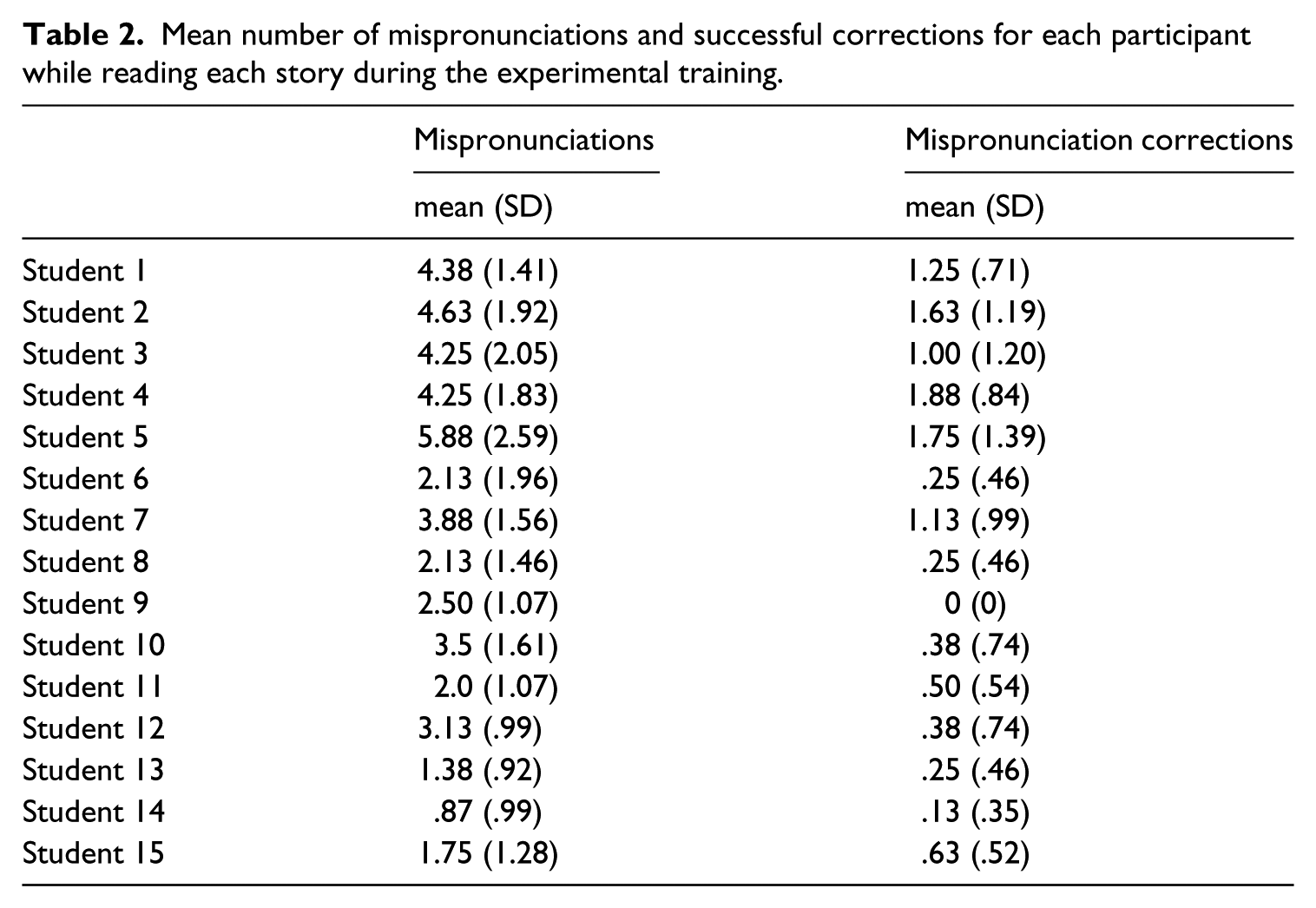
Students’ responses to the words with irregular spellings embedded in the experimental group passages were examined in order to gauge the effectiveness of the training. In Session I students in the experimental group were taught to sound out all unfamiliar words. Then, if a word still did not sound right, the student was taught to go back and try out another pronunciation. Students’ attempts at this strategy were scaffolded with prompts such as, ‘Is there another sound that letter makes?’ until they either figured out the correct word, or gave up. When students were unsuccessful, it was often because the word contained a vowel sound that deviated from the long/short dichotomy most commonly taught. For example, in the sentence ‘Lola lives in a shoe,’ many students initially read ‘shoe’ with a long o (as in ‘show’). When asked if there is another way to say that word, students changed the pronunciation to the short o sound (sounding something like ‘shaw’). While these students did not, ultimately, use the strategy successfully, recoding the vowel in words with exception spellings does demonstrate an understanding of the concept of set for variability. Running records were kept during each training session in order to have an objective measure of the student’s ability to recognize a word that he/she had initially mispronounced as well as employ the strategy. These records showed that all but one of the students were successful at employing the strategy some of the time. Table 2 shows the means and standards deviations of the students’ mispronunciations and self-corrections.
Mean number of mispronunciations and successful corrections for each participant while reading each story during the experimental training.
Success during training: Ability to read exception words
In general, the students were able to correct their mispronunciations about 20% of the time. This finding rose to about 37% of the time on about the third day of training, but then dropped back to about 20% again for the final two stories. One possible explanation for the regression on the final day of training is a floor effect on the number of miscues. These last two stories were slightly shorter, and contained fewer target words; in six separate instances, the student made zero miscues (and therefore zero corrections). These observations indicate that the task of revising pronunciations until a known word was reached was unfamiliar and difficult, but that training was effective in teaching them how to do this.
Posttests
Posttests were given to assess whether instruction was effective in teaching students to apply the set for variability strategy. A repeated measures MANOVA was conducted to test the intervention effect on reading behaviors. The results showed there was a significant difference between the intervention and control group, F (3, 27) = 3.65, p = .03, η2 = .296. Univariate tests indicated there was an intervention effect on the number of attempts students made to read the exception words, F (1, 29) = 9.41, p = .01, η2 = .251. There was no intervention effect on the students’ ability to determine the correct pronunciation of mispronounced spoken words, F (1, 29) = 0, p = .95, η2 = 0, nor on their ability to read the exception words, F (1, 29) = 2.94, p =.1, η2 = .095.
In other words, the students who received the training did go back and look at those words with tricky spellings to try out another pronunciation more often than their counterparts. They did not, however, arrive at the correct answer significantly more often than their peers. These results are encouraging, in that this brief training was successful in imparting the concept of trying out different pronunciations of unknown words. That said, more work would be needed to make this strategy a useful part of the students’ decoding arsenal.
Transfer to reading ability
To determine whether the training facilitated context-free word reading on a standardized test, a two-way ANOVA was applied to the WRMT-R subtest of Word ID posttest. The intervention training was not hypothesized to have an effect on this standardized reading test, since many of the words the students read for this assessment do conform to phonics rules and therefore would not be necessary or beneficial for reading many of the words on the test. In addition, an analysis of the Word ID subtest revealed that, while there are some words with irregular spellings that students are asked to read on both Form G and Form H (pretest and posttest) of the WRMT-R subtest of Word ID, they are spread throughout the test, so that all students face an equal portion of these kind of exception words; it is not the case that only the better readers face words with irregular spellings in this subtest. As expected, there was a significant main effect of time of test, but no signification interaction between time of test and treatment group, F (1, 28) = 2.08, p > .05. The students improved over time, but the students in the experimental group did not improve significantly more than their peers in the control group.
Hierarchical multiple regression
Based on Tunmer and Chapman’s (2012) findings, strong correlations were expected between scores on the pronunciation correction posttest and both the word reading and PPVT scores. Indeed, when correlation coefficients were examined, significant correlations were found between the pronunciation correction posttest scores and the exception word reading posttest scores, r = .382, p < .05, as well as between the pronunciation correction posttest scores and the PPVT-IV, r =.521, p < .05. The exception word reading posttest also correlated significantly with the PPVT-IV, r = .518, p < .05. In other words, students with larger receptive vocabularies were more adept at revising the pronunciations of words to make them sound like real words and more adept at sounding out words with unusual spelling patterns.
Following Tunmer and Chapman (2012), a three-stage hierarchical multiple regression was conducted with the posttest of exception word reading as the dependent variable. Phonemic awareness (CELF4), receptive vocabulary (PPVT-IV), and syntax (CELF4) were entered at stage one of the regression to control for language ability. The Word Attack subtest of the WRMT-R/NU was added at stage two and the pronunciation correction posttest at stage three.
The hierarchical multiple regression revealed that at stage one, phonemic awareness, receptive vocabulary, and syntax contributed significantly to the regression model, F (3, 27) = 5.68, p < .05, and accounted for 42.5% of the variation in exception word reading. Introducing nonsense word reading (WRMT-R/NU, Word Attack subtest) accounted for another 15.6% of the variance and this change in R2 was significant, F (1, 29) = 7.15, p < .05. When pronunciation correction (our test of set for variability) was added to the model at stage three, it was found to account for another 7.3% of the variance, but was not a significant predictor of exception word reading. Altogether, the three measures of language ability, nonsense word reading, and pronunciation correction were found to account for about 74.5% of the variance in exception word reading. This fits with the finding that, while students in this study learned to try out multiple pronunciations of words with exception spellings, this strategy was not successfully applied in the exception word posttest.
Discussion
This is the first training study of its kind. It was expected that the results of this study would provide evidence for the theory that a flexible mindset in approaching decoding is teachable by modeling and encouraging students to try new pronunciations of unknown words. This was supported by the analysis of the running records kept during training and by the fact that students in the training group made significantly more attempts to read the words with irregular spellings on posttest than did the students in the control group.
While it was also hoped that students who were trained in the set for variability reading strategy would show greater gains on the pronunciation correction posttest than their counterparts in the control group, the evidence did not support that. One possible explanation for this finding is that the set for variability training that the experimental group students received was print-based, whereas the pronunciation correction pre- and posttests were administered orally, through the puppet who mispronounces words. No explicit connection was ever made for the students between correcting the oral mispronunciations of another speaker and self-correcting one’s own decoding errors by changing the pronunciations.
A more direct way to test for evidence of the students’ strategy use was in the exception word reading test. Many of the trained students did show knowledge of the strategy on that posttest, in that they attempted to self-correct with different pronunciations of the unknown word more often than their peers did.
The fact that students most often mispronounced vowels and could not recuperate diverges from Cave (2014), who performed an analysis on the types of errors students make while reading aloud, and compared those errors to performance on a set for variability measure. Cave found no evidence for a significant correlation between a higher proportion of errors made on vowel sounds and set for variability scores in his participants. The fact that students in this study did attempt to change vowel sounds most often, and yet still did not arrive at the correct word, is interpreted as evidence of weak phonics knowledge from the participants in this study.
Further evidence for this came from the rejection of the second hypothesis of the study. The second hypothesis was that the use of the set for variability strategy would result in improved decoding of context-free exception words, but this did not prove the case. In sum, the students successfully learned the strategy of trying out different possible pronunciations within words until something recognizable emerges; however, they were not always successful in employing the strategy.
Post-experiment discussions with the teachers revealed that they endorsed and practiced whole word learning strategies. Hence, the children had little prior exposure to, and were sometimes discouraged from use of phonic cues. This means that the students had had no previous encouragement in ever sounding out unknown words in context. Further research could look into the relationship between phonics knowledge and set for variability.
Another difficulty that came up in training that may have affected the students’ mastery of the strategy is that some of the words that came up consistently as troublesome for the students were not words that could be easily figured out with the set for variability prompts. For example, the word ‘prove’ was a difficult word for many of the students to decipher. Most of the participants initially read the word phonetically, saying the long o sound. Prompting them for another sound that o can make did not help, because students invariably replied with the short o sound. But the o in ‘prove’ does not contain either the long or short o sound. More research is needed to determine when and how often the strategy helps students to change their pronunciation to the correct form of the word.
Metalinguistic awareness
While this brief course of instruction did not lead to stronger reading ability in terms of students’ exception word reading, the training was successful in increasing the number of attempts students made to read words with exception spellings. The students’ success during training and the increased number of attempts the trained students made at reading words with exception spellings implies that instruction in set for variability might foster increased metalinguistic awareness.
Metalinguistic awareness is the ability to reflect on and manipulate language outside of a meaning context. Various forms of metalinguistic awareness have been proven beneficial for reading, including phonemic awareness (see Ehri, Nunes, Stahl, & Willows, 2001), morphological awareness (Carlisle, 1995), and syntactic awareness (Gaux & Gombert, 1999; Nation & Snowling, 2000; Tunmer, Nesdale, & Wright, 1987). More recently, Kaplan and Berman (2015) confirmed that linguistic flexibility is an important facet of later language development. One theory for why metalinguistic awareness improves reading ability is that MA training causes students’ thinking about the meanings of words and sentences in and out of text to become less rigid, more active, and more flexible (Cartwright, 2008). Trying out different letter sounds within an unknown word until hitting upon a known word that makes sense in context – the strategy taught in this study – encourages a form of metalinguistic awareness in which students’ thinking necessarily becomes more flexible. Students can be taught to remain open to alternative interpretations (Cairns, Waltzman, & Schlisselberg, 2004).
Training in MA has been shown to have a significant effect on decoding (Ball & Blachman, 1991; Lundberg, Frost, & Petersen, 1988) and reading comprehension (Cain, 2007; Zipke, Ehri, & Cairns, 2009). Moreover, training in MA has been shown to be effective for a wide variety of students, including beginning readers (Zipke, 2007), older readers (Yuill, 1998, 2009; Zipke et al., 2009;), and English language learners (Kuo & Anderson, 2006; Ramirez, Chen, Geva, & Kiefer, 2010).
Zipke et al. (2009) found that training in another form of metalinguistic awareness – ambiguity instruction at the word and sentence level – was effective in teaching students to identify multiple meanings of homonyms and ambiguous sentences and to detect inconsistencies in text. Moreover, that training enhanced students’ reading comprehension on a paragraph completion task (WRMT-R). Although students in the current experiment were learning to try out multiple sounds in words, rather than multiple meanings in sentences, the studies are similar in that students were encouraged to actively try out alternative interpretations and to remain flexible in their understanding. Future research could investigate the relationship between set for variability and metalinguistic awareness.
Strengths and limitations
The design of the study is a strength: pre-existing group differences were ruled out by randomly assigning participants to conditions and administering pretests to verify that the groups did not differ prior to training. The treatment that students assigned to the control group received was designed to engage and motivate them as much as the experimental group. Observations showed that they were convinced they were receiving beneficial instruction. Classroom teachers agreed, and reinforced this belief.
Implications
Most teaching methods do not currently emphasize metacognition in the form of set for variability; this represents a change in instructional methods. This study showed that students who use set for variability strategies become active problem solvers who rely less on memory and have a strategy for approaching unknown words. Therefore, use of these strategies could be beneficial in multiple ways, including improved stamina in attempting to read unknown words and improved metalinguistic awareness.
Invernizzi (2014) recommended that kindergarten teachers abolish the practice of teaching sight words out of context. She points out that students need to learn the crucial concept of word in a text (Flanigan, 2007) before they can remember words in isolation. Set for variability strategies are complementary with this theory of word study in connected text. Rather than memorizing words with irregular spellings on flash cards and then skipping the unknown words when reading connected text, beginning readers might be better served by using their phonics knowledge and set for variability strategies to flexibly approach all words. Further research could compare the memorization of words with irregular spellings as a whole to learning to use repeated attempts to flexibly decode the same words until a known word emerges.
Footnotes
Appendix 1
Declaration of conflicting interests
The author(s) declared no potential conflicts of interest with respect to the research, authorship, and/or publication of this article.
Funding
The author(s) received no financial support for the research, authorship, and/or publication of this article.