



Abstract
For more than 20 years, the MacArthur–Bates Communicative Development Inventory (CDI) and its adaptations for languages other than English have been used as reliable measures of infants’ and toddlers’ early receptive and productive vocabulary size. This article introduces the OZI, the Australian English adaptation of the MacArthur–Bates CDI, now normed for 12- to 30-month-old children. The findings of two studies are presented: (1) a comparison study that demonstrated that toddlers (N = 64) acquiring Australian English (24- and 30-month-olds) obtain higher productive vocabulary scores on the OZI than the MacArthur–Bates CDI; and (2) an OZI norming study that included 12- to 30-month-old Australian infants and toddlers (N = 1496). These studies provide (i) evidence for the greater applicability of the OZI for infants and toddlers learning Australian English and (ii) productive vocabulary acquisition norms for Australian English for ages 12–30 months, a research and diagnostic tool highly anticipated by researchers and clinicians around Australia.
Over the past 20 years, the MacArthur–Bates Communicative Development Inventories (CDI, Fenson, Dale, Reznick, Bates, et al., 1994; Fenson, Dale, Reznick, Thal, et al., 1993) have become widely used instruments for measuring early linguistic skills. The ‘Words and Gestures’ and ‘Words and Sentences’ forms originally normed on a population of infants and toddlers growing up in the United States have since been adapted to over 60 languages (Dale & Penfold, 2011), including three varieties of English: British English (Hamilton, Plunkett, & Schaffer, 2000), New Zealand English (Reese & Read, 2000), and Singapore English (Tan, 2010). This article introduces the OZI, the Australian English adaptation of the MacArthur–Bates CDI, and presents the results of a norming study conducted with 1496 12- to 30-month-old infants and toddlers growing up in Australia.
The use of parental report checklists as a measure of communicative development in the first years of life provides significant advantages for research, language assessment and diagnosis purposes (Fenson, Bates, et al., 2000; Fenson, Dale, Reznick, Bates, et al., 1994; Fenson, Dale, Reznick, Thal, et al., 1993). In comparison to alternative methods such as diary records or recordings of interactions with young children in laboratory sessions, CDIs provide an index of children’s vocabulary knowledge that is not constrained to a limited set of interactions and does not rely upon extensive training of the parent or experimenter administering the task. It is also very cost and time effective as it can be completed and analysed in a period of 20–30 minutes, making it ideal for collection of large datasets.
Moreover, the CDI has been demonstrated to be a valid and reliable measure of children’s vocabulary development (but see Tomasello & Mervis, 1994 for a discussion of the potential limitations of assessing early receptive vocabulary via parental reports). CDI receptive and productive vocabulary scores correlate highly with other forms of assessment of vocabulary development such as maternal diaries (Pine, 1992; Reznick & Goldfield, 1994; Robinson & Mervis, 1999), laboratory recordings (Pine, 1992), behavioural measures of expressive and receptive vocabulary (Ring & Fenson, 2000) and can be successfully used to predict outcomes of parametric tests such as the Peabody Picture Vocabulary Test later in childhood (Fenson, Dale, Reznick, Bates, et al., 1994; Reese & Read, 2000). Validity is also indexed by convergence between infants’ CDI scores and neurophysiological responses on lexical processing tasks. Mills and colleagues recorded event-related potentials in 13- to 20-month-old infants (Mills, Coffey-Corina, & Neville, 1997; Mills, Plunkett, Prat, & Schafer, 2005) in response to familiar and unfamiliar words, where word familiarity for each infant was determined based on their individual CDI scores. Significant differences in location and temporal neural activation between the familiar and unfamiliar words were found, suggesting that parents accurately identified, in their CDI records, the words that were and were not part of their infants’ lexicon.
Nevertheless, the validity of the instrument and norms collected using this instrument can be compromised if the CDI is administered to populations that differ in linguistic, socio-economic, or cultural background from those on which the CDI was normed. That is, different developmental patterns may be observed across populations of infants that differ in their language or demographic characteristics, but also parental response biases may be manifested differently across these populations and across inventories. For instance, British infants were reported to score lower than American infants on both the receptive and productive vocabulary measures of the British English adaptation of the CDI (Hamilton et al., 2000). That is, while it is possible that infants acquiring these two varieties of English differ in their patterns of lexical development, parents in the UK and parents in the US may display different reporting attitudes on the respective CDI inventories. Socio-economic status (SES) and maternal education have also been found to affect CDI scores, but the nature of the reported relationships has not been consistent across studies and CDI forms. Infants from families with lower socio-economic status have been reported to obtain lower scores on the productive vocabulary measure of the CDI than same-aged peers from families with higher SES (Arriaga, Fenson, Cronan, & Pethick, 1998). However, an inverse relationship has been reported between maternal education levels and (1) comprehension vocabulary scores for 8- to 12-month-old infants (Feldman et al., 2000; Fenson, Dale, Reznick, Bates, et al., 1994; Reznick and Goldfield, 1994) and (2) production scores for 19- to 25-month-olds on the New Zealand adaptation of the CDI (Reese & Read, 2000).
Cultural and linguistic differences can be manifested at the earliest stages of vocabulary and grammar acquisition (Dale & Penfold, 2011; Peña, 2007). For this reason, the administration of a CDI designed for a different language or language variety can be ineffective in capturing the patterns or potential cross-linguistic differences in language development and linguistic context and can also be reflected in parents’ ability to accurately estimate the vocabulary composition of their infant. Accordingly, direct translation of the CDI to other languages or the administration of the normed version of the inventory to infants acquiring a different variety of English is not advised (Dale & Penfold, 2011).
An adaptation of the CDI for Australian English was well overdue. The Australian English Communicative Development Inventory or OZI was developed in 2003 (Schwarz, 2007) and since then, it has been used for research purposes in a number of studies (e.g., Hemsley, Holm, & Dodd, 2010, 2013; Lam & Kitamura, 2010; Masso, McCabe, & Baker, 2014; Mulak, Best, Tyler, Kitamura, & Irwin, 2013; Schwarz & Burnham, 2006; Schwarz, Burnham, & Bowey, 2006). Several researchers have also requested to use the OZI for clinical research studies even with norms still under development, for example for a study with preterm infants (Crosbie & Holm, 2008) and another with Down syndrome children (Tang & Smith, 2010). However, until now, norms have not yet been available for the OZI, the Australian English version of the CDI.
Development of the OZI
The Australian English Communicative Development Inventory (OZI) combines sections of the infant CDI form ‘Words and Gestures’ and toddler CDI form ‘Words and Sentences’ into a single brief inventory that assesses productive vocabulary development in infants and toddlers from 12 to 30 months of age. That is, the OZI can be used to assess productive vocabulary in an age range that spans both the infant and toddler MacArthur–Bates CDI forms, but unlike those forms, it does not include sections assessing gesture production and grammatical complexity of children’s utterances.
One of the original purposes for the adaptation of the MacArthur–Bates CDI to Australian English was to develop a linguistically and culturally appropriate instrument to assess early lexical development that can be suitable for longitudinal studies (Schwarz, 2007). For this reason, it was decided to create a single form that could be used with an infant and a toddler sample. The resulting instrument consists of a single form that can be administered across a wide age range and that is a shorter version of the CDI allowing for faster completion. However, users must be cautioned that this inventory is designed as a measure of early productive vocabulary only, and not a comprehensive measure of oral language abilities or of overall early communicative development.
The resulting inventory contains 15 vocabulary sections totalling 558 items, in comparison to the 680 items in 22 sections of the Words and Sentences form of the MacArthur-Bates CDI. The sections of the CDI that were not included in the OZI were: words about time, pronouns, question words, prepositions and locations, quantifiers and articles, helping verbs and connecting words. The remaining 15 semantic sections are: sound effects and animal sounds, animals (real or toy), vehicles (real or toy), toys, food and drink, clothing, body parts, small household items, furniture and rooms, outside things, places to go, people, games and routines, action words, and descriptive words. In addition, the inventory includes another three sections: word forms (25 items), word endings (45 items) and mean length for the three longest sentences (M3L).
Components of the OZI
Productive vocabulary
The productive vocabulary section of the OZI was developed by applying three types of modifications to the MacArthur–Bates CDI forms (Appendix 1): replacements, deletions and additions. Replacements (N = 15) were made when an Australian English version of a word was substituted for the North American CDI item, e.g. ‘crocodile’ for ‘alligator’, ‘possum’ for ‘squirrel’. Words were deleted (N = 50) when their referents were not typically present in the Australian environment and could not be directly semantically substituted, e.g. ‘snowsuit’. And words were added (N = 43) for items that were either missing in general, e.g. ‘computer’, or because they were specific to the Australian environment, e.g. ‘vegemite’.
Word forms and word endings
Although the primary focus of the OZI is to measure early productive vocabulary, the inventory also includes two sections adapted from the MacArthur–Bates CDI Words and Sentences form that assess early morphological competence: word forms and word errors. The word forms section comprises 25 items, including 5 irregular noun forms (e.g. children, feet) and 20 irregular verb forms (e.g. ate, blew). The word endings section includes 45 items comprising 14 over-regularisations of plural noun forms (e.g. childrens, blockses) and 31 over-regularisations of irregular past tense verb forms (e.g. ated, broked).
Mean length for the three longest sentences (M3L)
In the final section of the OZI, parents are required to indicate whether their child has started to combine words into sentences and are asked to provide examples of the three longest sentences that they have heard their child produce. This yields a measure of mean length, in words, for the three longest sentences produced by toddlers before the age of 30 months (Fenson, Dale, Reznick, Bates, et al., 1994). It must be noted that M3L is an approximate indicator of sentence length for each child, and should not be interpreted as a measure of Mean Length of Utterance (MLU). MLU is calculated based on the average utterances produced by the child while this M3L measure specifically involves asking parents to provide the longest sentences that their child has produced. In addition, M3L is calculated based on the number of words reported by the parent, so it does not take into consideration the morphemic complexity of the child’s utterances, i.e. words with inflectional and derivational morphemes are counted as a single item.
Parental reports in this section could also be used to calculate the mean number of morphemes comprising the longest sentences produced by each child (see Fenson, Dale, Reznick, Bates, et al., 1994). However, the decision to calculate words rather than morphemes was made because the instructions for this section do not emphasise that parents should report the exact form of their children’s utterances (‘please list three of the longest sentences you have heard your child say recently’, adapted verbatim from MacArthur–Bates CDI Words and Sentences). This allows for the possibility that parents may consciously or unconsciously report the grammatical versions of the utterances produced by their young children raising questions about reliability of their reports and variability within the sample. Since most of the inventories included in this norming study were completed at home, we were unable to provide parents with additional clarifications about the instructions for this section. However, this is an opportunity that could be pursued in future research focusing on a more detailed assessment of grammatical complexity of utterances produced by young toddlers. With this caution in mind, as reported in the results below, the M3L still provides a robust measure of the development of children’s ability to combine words into sentences.
Additional information
In addition to date of birth, the OZI collects information about children’s gender, which is also a significant factor in early vocabulary development. It has been demonstrated that girls tend to outperform boys in a variety of language measures including early vocabulary size in populations of infants acquiring English (Bauer, Goldfield, & Reznick, 2002; Bornstein, Hahn, & Haynes, 2004; Lovas, 2011; Stokes & Klee, 2009) and other languages (Eriksson et al., 2012; Kern, 2007; Simonsen, Kristoffersen, Bleses, Wehberg, & Jørgensen, 2014). Finally, the OZI includes three additional questions about factors which have been shown to affect vocabulary development: children’s exposure to languages other than English (Pearson, 1998; a very common situation for infants raised in Australia); previous or existing ear infections or hearing problems (e.g. Klee, Pearce, & Carson, 2000); and gestation period in weeks (e.g. Gayraud & Kern, 2007; Marston, Peacock, Calvert, Greenough, & Marlow, 2007).
Here, two studies are reported: first, a comparison between the MacArthur–Bates CDI and OZI in the Australian population; and second a large normative study with 1496 infants from 12 to 30 months of age to produce norms of productive vocabulary for infants and toddlers acquiring Australian English.
Study 1: Comparison of OZI and MacArthur–Bates CDI in a population of toddlers acquiring Australian English
Method
Parents of 24-month-old (M = 34.8 weeks, SD = 20.4) toddlers (N = 32, 18 male) and 30-month-old (M = 68.7 weeks, SD = 23.7) toddlers (N = 32, 15 male) completed the OZI and the MacArthur–Bates CDI Words and Sentences forms. Order of completion was counterbalanced. Half of the participants in each age group were instructed to complete the CDI first, and the other half to complete the OZI first. The instructions indicated that the first inventory should be completed at the time when it was received, and the second inventory should be completed on the following day. Sections 16–22 from Part I (Words Children Use) and the complete Part II (Sentences and Grammar) were excluded from the MacArthur–Bates CDI in this study as their equivalents are not included in the OZI form.
Results and discussion
To compare scores between the two inventories, a 2 (inventory: CDI, OZI) × 2 (age group: 24 months, 30 months) × 2 (gender: female, male) ANOVA was conducted. As the two inventories differ in total number of words (total OZI = 557; total CDI = 566), analyses were conducted using both children’s raw scores and percentages for each inventory. The analyses for raw scores yielded significant main effects of inventory, F(1, 60) = 34.205, p < .001, η2 = .363, age, F(1, 60) = 37.670, p < .001, η2 = .386, and a significant inventory by age interaction, F(1, 60) = 8.673, p = .005, η2 = .126. As can be seen in Figure 1, toddlers obtained slightly but significantly higher scores on the OZI than the MacArthur–Bates CDI, and this difference was more pronounced for the older group. In addition, as in previous analyses of productive vocabulary scores (e.g. Bauer et al., 2002; Bornstein et al., 2004; Fenson, Dale, Reznick, Bates, et al., 1994; Lovas, 2011; Stokes & Klee, 2009), female toddlers were found to know more words than male toddlers on both inventories, F(1, 60) = 5.963, p = .018, η2 = .090. There were no other significant interactions: inventory by gender, F(1, 60) = 2.427, p = .125, η2 = .039, age by gender, F(1, 60) = 3.133, p = .082, η2 = .050, or inventory by age by gender, F(1, 60) = 1.653, p = .204, η2 = .027.
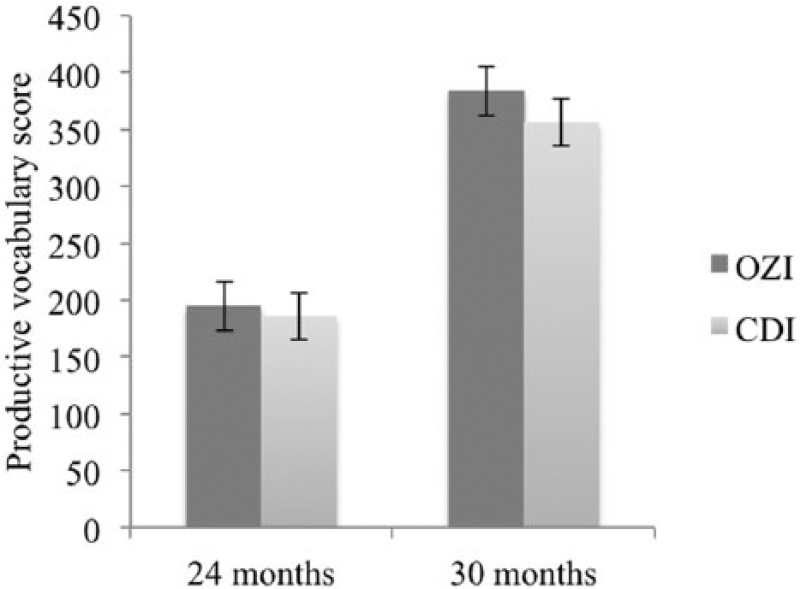
Comparison of OZI and MacArthur–Bates CDI scores for 24- and 30-month-old toddlers acquiring Australian English (error bars represent standard error of the mean).
Similarly, the analyses using percentages showed significant effects of inventory, F(1, 60) = 47.270, p < .001, η2 = .441, age, F(1, 60) = 37.685, p < .001, η2 = .386, and gender, F(1, 60) = 5.967, p = .018, η2 = .090, and an inventory by age interaction, F(1, 60) = 10.573, p = .002, η2 = .150. However, this analysis yielded no significant inventory by gender, F(1, 60) = 2.806, p = .099, η2 = .045, age by gender, F(1, 60) = 3.136, p = .082, η2 = .050, or inventory by age by gender interactions, F(1, 60) = 1.873, p = .176, η2 = .030.
Australian toddlers were reported to produce more words on the OZI, which confirms that it is a suitable measure for this population. The scores for the two inventories were also found to be strongly correlated, r(64) = .987, p < .001 (partial correlation controlling for age, r(61) = .980, p < .001), further confirming the applicability of the OZI as an adaptation of the MacArthur–Bates CDI (it must be noted, however, that this correlation value might have been lower if the excluded sections had been retained in the MacArthur–Bates CDIs that were administered to the present sample). Given the findings from this preliminary comparison study, the normative study was conducted.
Study 2: OZI normative study
Method
OZI productive vocabulary forms were collected for infants and toddlers between the ages of 12 and 30 months. This resulted in 19 age groups (i.e. 12 months, 13 months, [ . . . ], 29 months, 30 months; see Table 1). Each age group included infants and toddlers whose age was within the −2/+2 weeks range from that age (i.e. the 12 months group included infants aged from 11 months 2 weeks to 12 months 2 weeks). OZIs for each age group were collected until a minimum number of 60 children per group was reached, and an effort was made to collect similar numbers of OZIs for males and females. A total of 1571 OZIs were collected, but 75 were excluded from final analyses because they were repeated entries, were from children outside the age range, children born preterm (6 weeks or more prior to the due date) and/or from children with a reported risk of hearing loss. Thus, a final sample of 1496 OZIs was included in the normative study (Table 1).
Number of OZIs collected for each age group for male (M) and female (F) children.

OZIs were collected from parents who had previously expressed their interest in taking part in infancy research at a university infancy lab. All families lived in the Sydney or Greater Western Sydney areas. Only families who did not report any cognitive or sensory deficits in their children were invited to take part. The inventories were either mailed out to the parents after they were contacted by an experimenter and provided with details about the purpose of the study, or completed when the parents were visiting the lab for participation in another infancy study. Information from the additional questions on the inventory was used to exclude children who were born premature or who had reported hearing loss or history of severe or recurrent ear infections. However, children born 1–5 weeks before the expected due date, and children who had other less severe types of hearing infections were included in the final sample following Fenson and colleagues’ criteria (Fenson, Dale, Reznick, Bates, et al., 1994). Children who were reported to have exposure to a language other than English were also included in the final sample. Bilingualism is very common in this region, with 35.5% of Greater Sydney households speaking a second language at home (Australian Bureau of Statistics, n.d.), so excluding these children would not constitute a representative sample of Sydney’s population. Twenty-six per cent of infants (N = 389 of the 1496 sample) were reported to receive regular exposure to a second language (range = 2–70 hours per week).
Families’ average weekly household incomes were calculated based on the postcode of their residence and used as an index of socio-economic status (SES) (Australian Bureau of Statistics, n.d.). This information was available for 82.5% of the sample (N = 1234). The indices were computed based on imputed medians of weekly income per household (range 1–12). The index for the present sample was 10 (median weekly income $1363, index range 7–12), which is comparable to the median for Sydney (index 10, weekly median $1488), but one step on the index higher than the medians for New South Wales (index 9, weekly median $1237), and Australia (index 9, weekly median $1234).
Results and discussion
Internal consistency and reliability of OZI
The Cronbach’s coefficient alpha was computed by entering the 15 sections of the OZI as individual items and indicated high internal consistency for the inventory, Cronbach’s α = .959.
In order to assess long-term reliability of the OZI, a second OZI was collected for a sub-sample of 66 infants (29 male) from the normative study approximately 6 months after the completion of the first OZI. The scores obtained at Time 1 (M age = 15.2 months, SD = 3.1) and at Time 2 (M age = 21.9 months, SD = 4.9) were significantly correlated, r(62) = .434, p < .001, providing evidence for the long-term reliability of this parental report. While this analysis demonstrates that there is significant continuity between parental reports of productive vocabularies completed 6 months apart, it must be noted that this correlation value is moderate compared to that reported by Fenson, Dale, Reznick, Bates, et al. (1994) (production at mean age of 20–26 months, r(224) = .75). This is possibly due to the smaller sample size and the young age of infants included in the Time 1 analyses in our study (some infants were 12-months-old), which could have reduced the variability of scores in that sub-sample.
Productive vocabulary
Figure 2 presents the normative data for all 1496 infants and toddlers across ages from 12 to 30 months in this sample. In order to account for random fluctuations due to variability in the sample across ages, a logistic function (Cavallini, 1993) was applied to the observed scores to produce fitted curves for the 10th, 25th, 50th, 75th and 90th percentile of the OZI scores distribution (Figure 3; also see Appendix 2 for estimated productive vocabulary size by age group and gender). Similar to previous normative samples (e.g. Fenson, Dale, Reznick, Bates, et al., 1994; Hamilton et al., 2000), it can be observed that productive vocabulary development progresses slowly from 12 to 17 months, which is followed by a steeper increase from 17 to 27 months, and then returns to a steadier rate of growth until 30 months (for a discussion of the vocabulary spurt, see Ganger & Brent, 2004). It is important to observe in these data that even the 30-month-olds in the 90th percentile did not obtain ceiling scores in the inventory, which further underwrites the validity of using the OZI at this age despite the deletion of sections with higher complexity. Additionally, it can be seen that while the variability is very small in the first months of the second year (12–15 months), variability in the sample becomes larger at 30 months with a difference of 325 items between toddlers in the 10th and 90th percentile.
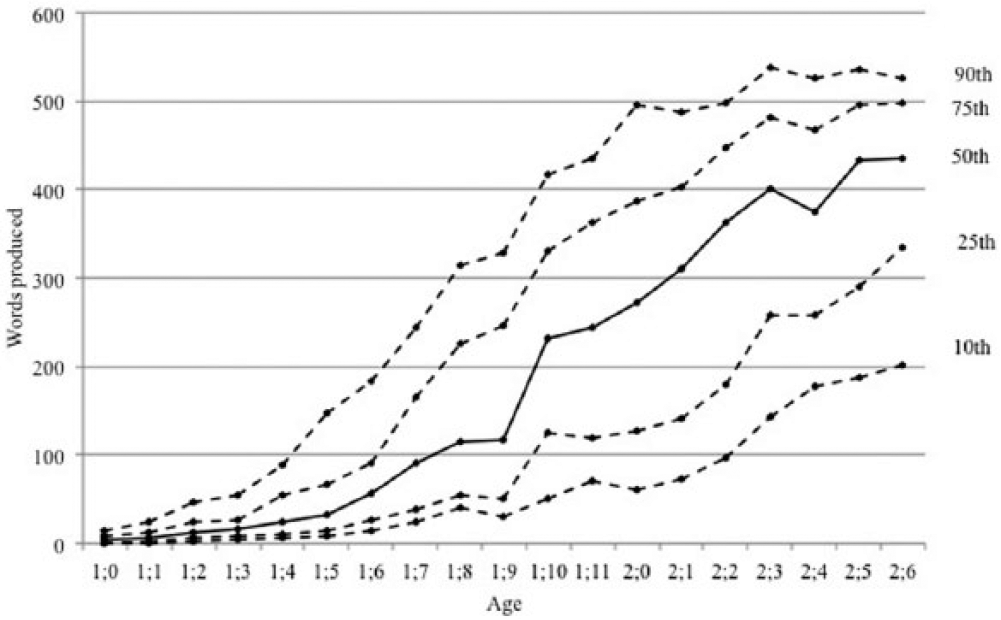
Observed productive vocabulary data for the 10th, 25th, 50th, 75th and 90th percentile of the normative sample of the OZI.
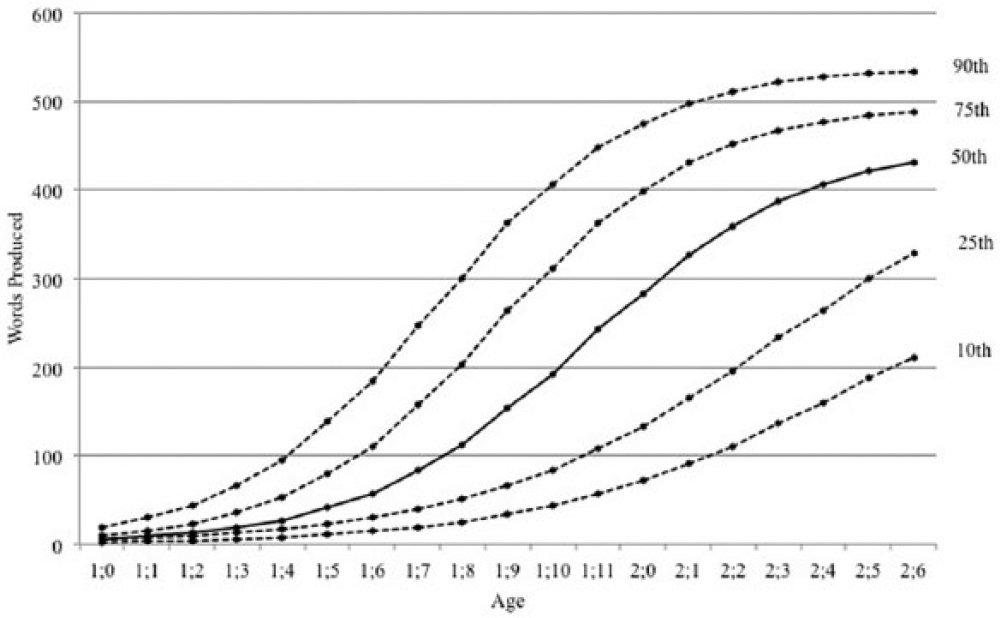
Fitted productive vocabulary data for the 10th, 25th, 50th, 75th and 90th percentile of the normative sample of the OZI.
Word forms and word endings
Only infants and toddlers above the age of 16 months were included in the analyses and norms for these two sections (N = 1183) as all the younger infants obtained scores of 0. Figures 4 and 5 present the observed and fitted data for children’s productions of irregular noun and verb forms. It can be seen that by age of 30 months, on average children produce fewer than 10 irregular forms confirming that this type of over-regularisation is infrequent in toddler’s productions (Marcus et al., 1992).

Observed scores for the word forms section for the 10th, 25th, 50th, 75th and 90th percentile of the normative sample of the OZI.

Fitted scores for the word forms section for the 10th, 25th, 50th, 75th and 90th percentile of the normative sample of the OZI.
The observed and fitted data for word endings are presented in Figures 6 and 7 respectively. The forms comprising this section may appear to represent grammatical errors from an adult point of view. However, their use in young children has been demonstrated to reveal the process through which young children abstract and acquire linguistic rules and apply them to items in their lexicon. As can be seen, toddlers in this sample started producing over-regularised forms around 2 years of age, but overall, not many of these forms were reported to be part of their productive vocabularies.
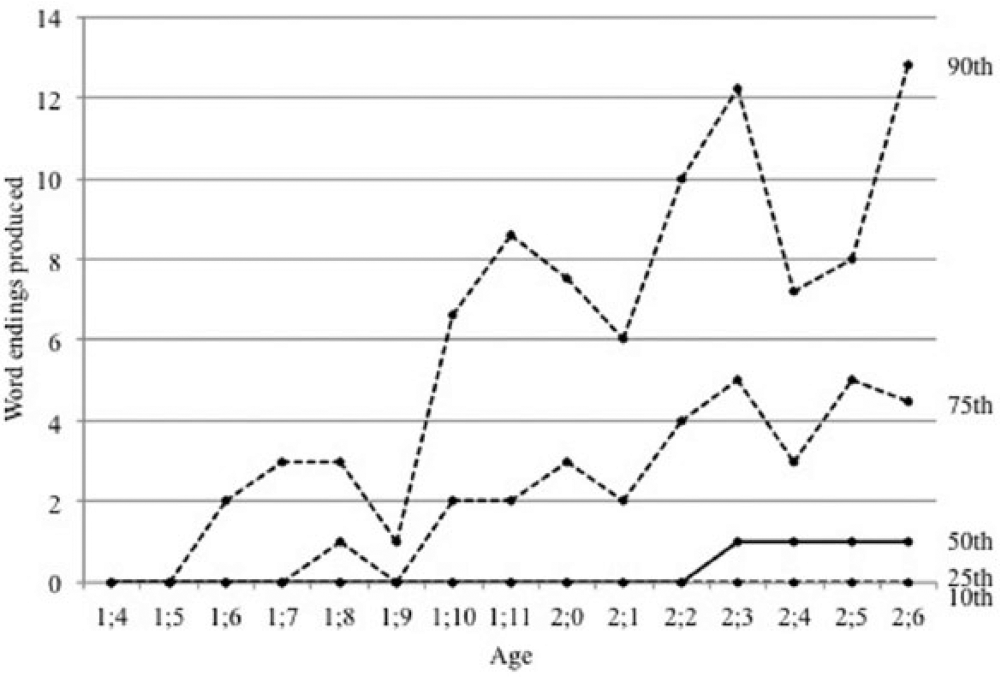
Observed scores for the word endings section for the 10th, 25th, 50th, 75th and 90th percentile of the normative sample of the OZI.
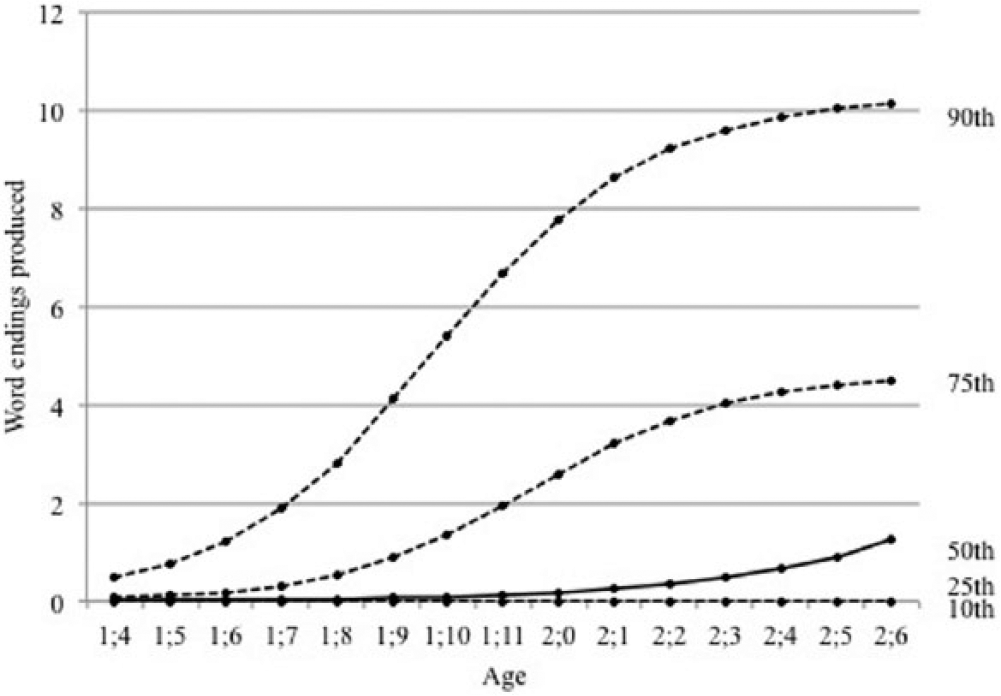
Fitted scores for the word endings section for the 10th, 25th, 50th, 75th and 90th percentile of the normative sample of the OZI.
Mean length for the three longest sentences (M3L)
Only children above the age of 16 months were included in these analyses (N = 1183) as the majority (85%) of infants from 12 to 15 months were not combining words into sentences as reported by their parents. However, some infants in this sub-group were reported still not to combine words into sentences, so an M3L value of 1 was imputed for these infants to avoid treating these cases as missing values and so inflating the values for the sample. As seen in Figure 8, the M3L was highly varied in the sample with toddlers in the 10th percentile producing only two-word utterances until the age of 24 months. Figure 9 presents the fitted normative data for the M3L measure.

Observed mean length for the three longest sentences (M3L) data for the 10th, 25th, 50th, 75th and 90th percentile of the normative sample of the OZI.
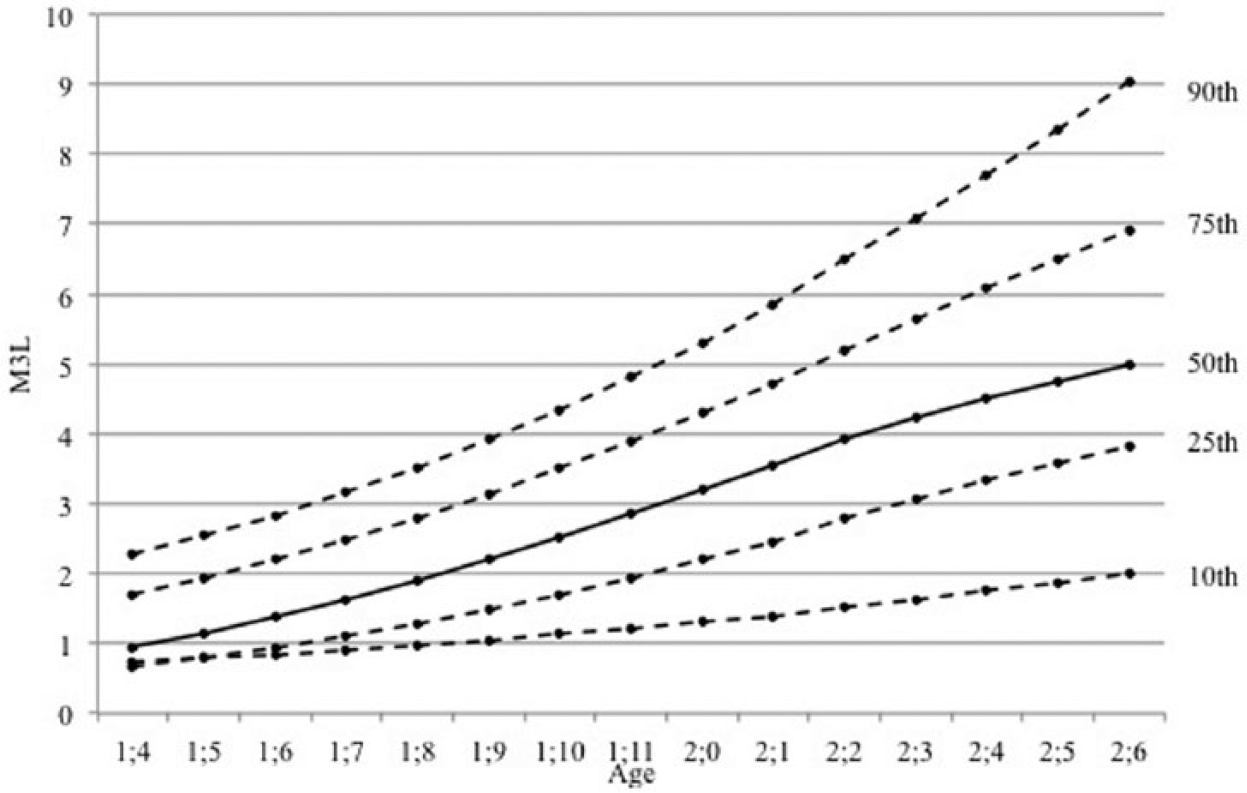
Fitted mean length for the three longest sentences (M3L) data for the 10th, 25th, 50th, 75th and 90th percentile of the normative sample of the OZI.
Children’s M3L scores and productive vocabulary scores were significantly correlated, r(1107) = .739, p < .001 (r(1104) = .527, p < .001, when age is partialled out). These correlations are comparable to those reported by Fenson, Dale, Reznick, Bates, et al. (1994) for their normative sample (.65/.79), and they confirm a strong relation between the size of children’s productive vocabulary and the emergent ability to combine words into sentences.
Individual differences in OZI scores
To assess the effects of gender on productive vocabulary and M3L scores, stepwise linear regression analyses were conducted in which children’s age in days was entered as a predictor in the first step and gender in the second step. This yielded a significant model, R2 = .581, F(1, 1493) = 37.095, p < .001 (R2 change = .010), with age (β = .754, t = 45.032, p < .001) and gender (β = .102, t = 6.091, p < .001) as significant predictors of variance in children’s vocabulary scores.
An identical analysis for M3L, also yielded a significant model, R2 = .423, F(2, 1104) = 404.301, p < .001 (R change = .015) with both age (β = 642, t = 28.05, p < .001) and gender (β = .123, t = 5.377, p < .001) as significant predictors. As can be seen, girls outperformed boys in both overall productive vocabulary scores (Figure 10) and the M3L measure (Figure 11) across the age range assessed in this study. However, it is important to note that while gender was a significant factor, it contributed to explaining a small amount of variance in children’s scores (about 1%).
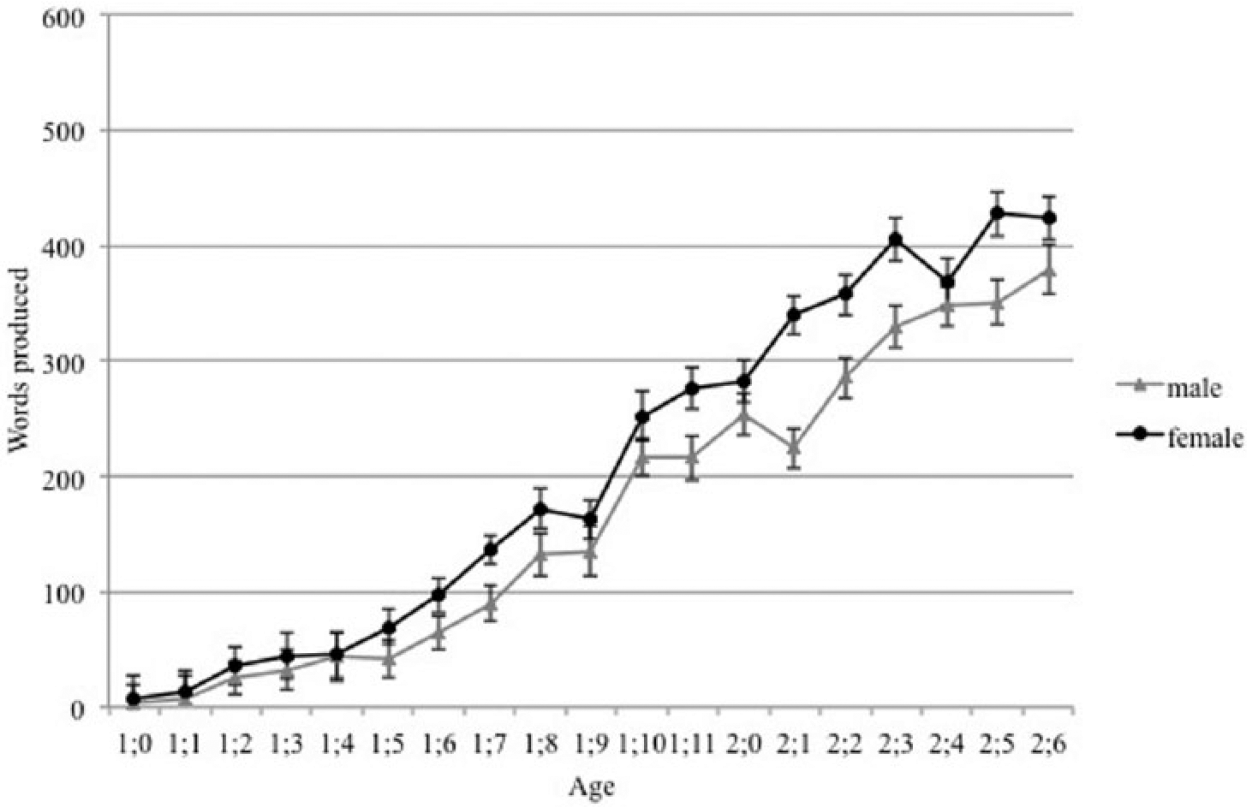
Mean productive vocabulary scores reported for females and males from 12 to 30 months of age. Error bars represent standard errors of the mean.
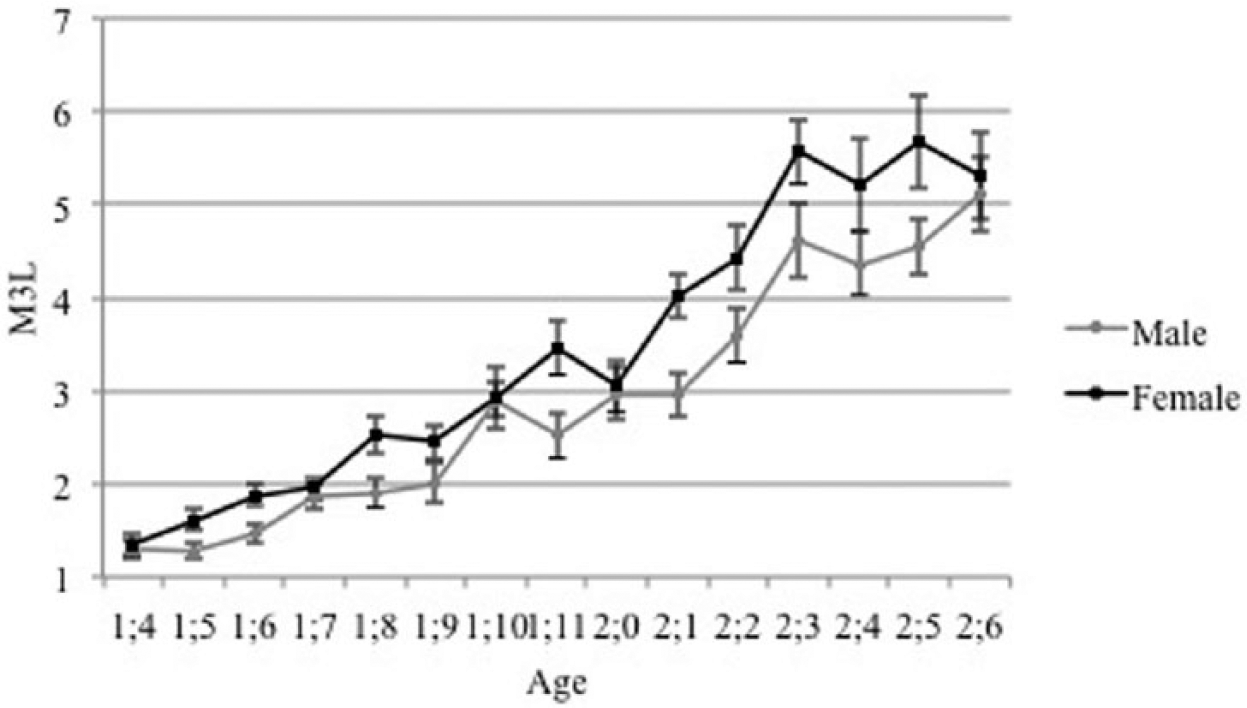
Mean scores for the three longest sentences (M3L) reported for females and males from 16 to 30 months of age. Error bars represent standard errors of the mean.
Relationships between families’ SES scores and productive vocabulary and M3L scores were analysed next. Parallel to the findings of the North American (Fenson, Dale, Reznick, Bates, et al., 1994) and British (Hamilton et al., 2000) norming samples, a correlational analysis between children’s total productive vocabulary scores and their SES showed no significant correlation, r(1234) = −.006, p = .836 (r(1231) = −.044, p = .122, when age was partialled out). Similarly, no significant correlation was found between children’s M3L scores and SES, r(1107) = .009, p = .777 (r(1137) = −.012, p = .714, when age was partialled out).
General discussion
Here we have introduced the Australian English Communicative Development Inventory OZI and presented the results of two studies: a comparison of the MacArthur–Bates CDI and OZI in a sample of toddlers acquiring Australian English, and a large-scale normative study of the OZI. The OZI is an adaptation of the MacArthur–Bates CDI created by adding, removing and substituting items to make the entire inventory of greater relevance to Australian infants. The OZI was demonstrated to be a more sensitive measure of productive vocabulary for children acquiring English in Australia, as our preliminary evaluation showed that toddlers obtain higher scores on the OZI than MacArthur–Bates CDI.
The results of the norming study are consistent with previous large-scale studies using parental reports as measures of early productive vocabulary. Inspection of our norming data demonstrates that infant vocabulary increases steadily from 12 to 17 months of age, but then undergoes a steeper growth from 17 to 27 months, and stabilises again after that age. We also found a large amount of variability in the sample. As infants become older, the productive vocabulary of children between the 10th and 90th percentile of the sample at the same age can differ by over 300 words. This naturally occurring variability must be taken into consideration when using vocabulary assessments as predictors of later vocabulary and linguistic development or as diagnosis tools for language delay or language disorders (Thal, O’Hanlon, Clemmons, & Fralin, 1999).
While our results are consistent with previous CDI norming studies, it is important to note the structural differences between the OZI and the MacArthur–Bates CDI and its other adaptations. Instead of using two forms as in the MacArthur–Bates CDI – the infant form ‘Words and Gestures’ (12–16 months) and the toddler form ‘Words and Sentences’ (16–30 months) CDI – the OZI consists only of one form spanning the age ranges of the infant and toddler samples of the North American English norming study (Fenson, Dale, Reznick, Bates, et al., 1994). While the two forms of the MacArthur–Bates CDI offer a comprehensive assessment of a child’s early communicative development including measures of gesture production, vocabulary comprehension, vocabulary production and sentence complexity, the OZI solely focuses on the size and the development of productive vocabulary. These sections were not included in the OZI resulting in a shorter form that allows for faster completion and for administration across a wide age range. Nevertheless, this structural difference must be considered if the OZI is used for purposes of assessing general communicative development or for cross-linguistic and cross-dialect comparisons using the MacArthur–Bates CDI or its adaptations.
The OZI form is designed to capture the development of vocabulary production from infants’ first words around the age of 12 months until the age of 30 months. Therefore, the OZI is not only suitable to assess productive vocabulary at any particular age in this range, but also for longitudinal analyses of vocabulary acquisition in the first years of life. This, however, can result in a practical limitation in the administration of the OZI since the form may appear to be too extensive for parents of younger infants who do not produce many words (e.g. 44% of infants below the age of 16 months were reported to produce 10 or fewer items out of the 558 items on the OZI). In addition, these infants’ low productive vocabulary scores may compromise the OZI’s ability to capture variability in other areas of early lexical competence in samples of younger infants (e.g. receptive vocabulary). In light of these limitations, it may be advisable to combine the OZI with other measures of lexical development (e.g. assessments of receptive vocabulary) for samples that include infants between 12 and 16 months of age.
While CDIs have been widely demonstrated to be reliable and valid measures of vocabulary development in the first years of life, an important caution must be considered prior to their use, a caution that also applies to the OZI. Even though a large sample was included in the present norming study, the demographic characteristics of the sample were not varied systematically. That is, no specific effort was made to include families from the lower and higher ends of the SES distribution resulting in a sample consisting mainly of middle and higher middle class families. While this was representative of the Sydney population, we must acknowledge that these norms are currently applicable with confidence to only one, however large and population-dense, region of Australia. So, while our analyses showed no significant effects of SES on infants’ vocabulary size, this may be an artefact of the restricted range of the sample. Therefore, these norms must be used with caution when applied to a sample with different demographic characteristics.
The two studies presented here demonstrate a successful adaptation of the MacArthur–Bates Communicative Development Inventory for Australian English. The result, the OZI, is a more suitable measure for vocabulary development in infants and toddlers growing up in Australia than the MacArthur–Bates CDI. This article presents the norms for vocabulary development in infants and toddlers acquiring Australian English between the ages of 12 and 30 months and introduces the OZI as the Australian English version of the CDI. This new instrument is now available to researchers and clinicians across Australia, and it is currently being adapted for online collection of infant vocabulary data. 1
Footnotes
Appendix
Estimated productive vocabulary for female and male infants and toddlers from 12- to 30-months of age (10th, 25th, 50th, 75th and 90th percentiles of the OZI norming distribution).

| Age |
Female |
Male |
||||||||
|---|---|---|---|---|---|---|---|---|---|---|
| 10th | 25th | 50th | 75th | 90th | 10th | 25th | 50th | 75th | 90th | |
|
|
1 | 3 | 7 | 11 | 29 | 3 | 7 | 6 | 7 | 14 |
|
|
2 | 5 | 10 | 18 | 44 | 3 | 9 | 9 | 11 | 22 |
|
|
3 | 7 | 15 | 27 | 61 | 4 | 11 | 13 | 17 | 33 |
|
|
4 | 11 | 23 | 42 | 90 | 6 | 14 | 19 | 27 | 53 |
|
|
6 | 15 | 33 | 61 | 122 | 8 | 17 | 26 | 40 | 77 |
|
|
10 | 23 | 50 | 92 | 169 | 10 | 22 | 37 | 62 | 116 |
|
|
14 | 32 | 69 | 128 | 215 | 13 | 27 | 49 | 88 | 159 |
|
|
21 | 46 | 100 | 180 | 276 | 17 | 35 | 69 | 130 | 219 |
|
|
30 | 62 | 132 | 230 | 327 | 22 | 42 | 91 | 173 | 274 |
|
|
43 | 88 | 178 | 292 | 384 | 28 | 54 | 122 | 232 | 336 |
|
|
59 | 114 | 220 | 340 | 425 | 35 | 66 | 153 | 282 | 382 |
|
|
82 | 152 | 272 | 390 | 465 | 46 | 83 | 194 | 337 | 426 |
|
|
105 | 186 | 312 | 423 | 490 | 56 | 101 | 230 | 376 | 454 |
|
|
135 | 229 | 353 | 452 | 512 | 70 | 127 | 272 | 412 | 476 |
|
|
161 | 263 | 380 | 469 | 526 | 84 | 152 | 305 | 434 | 489 |
|
|
190 | 299 | 405 | 483 | 537 | 102 | 189 | 338 | 452 | 500 |
|
|
211 | 325 | 421 | 490 | 543 | 117 | 224 | 362 | 462 | 505 |
|
|
231 | 349 | 434 | 496 | 548 | 137 | 273 | 384 | 470 | 509 |
|
|
244 | 365 | 441 | 500 | 551 | 153 | 320 | 398 | 474 | 512 |
Acknowledgements
We would like to thank Suzana Bicanic, Alexis Collins, Samia Hawatt, Carly Hayman, Sarah Kilgour, Rachel Lee, Michelle Pal, Esther Raudonat and Michelle Williams for their assistance in contacting participants, data collection and transcription, and Dr Muawiyath Shujau for designing the analysis tool for this project. We are also thankful to Professor Catherine Best, Dr Paola Escudero, Dr Christine Kitamura, Dr Nenagh Kemp and Dr Karen Mulak for sharing their data for this norming project. We would also like to thank the CDI Advisory Board for their support to this project, and Professor Philip Dale for his insightful comments to previous versions of this manuscript. Finally, we are grateful to all the parents for their valuable time and interest in our research.
Declaration of conflicting interests
The author(s) declared no potential conflicts of interest with respect to the research, authorship, and/or publication of this article.
Funding
The author(s) received no financial support for the research, authorship, and/or publication of this article.