



Abstract
Children’s narrative abilities in the preschool years have been found to predict their later literacy skills. Mothers’ verbalizations during shared personal narratives with their preschoolers have been shown to facilitate children’s development of narrative skills. The present study sought to extend the literature by investigating mothers’ use of two types of questions (information requests, ‘yes/no’ questions) and two types of confirmation (praise, repetition of child content) when discussing past events with their preschoolers, as a function of child age and gender. Study participants were 32 American mothers and their preschoolers, who were either 3 years of age or 5 years of age. Mother–preschooler dyads were audiotaped discussing three past events which they had shared. Results indicated that mothers provided significantly more information requests and repetition of child content when co-constructing narratives with 3-year-olds than with 5-year-olds. Overall, the results are consistent with the literature regarding parental sensitivity to children’s specific needs for task assistance in the early childhood period.
Introduction
The content and structure of parent–preschooler shared, or co-constructed, narratives have received increased attention in the past several years (e.g., Bost, Choi, & Wong, 2010; Fivush, Haden, & Reese, 2006; Melzi, Schick, & Kennedy, 2011; Schröder et al., 2013; Winskel, 2010). Co-constructed narratives are stories about past events which are jointly built by two or more individuals (Ellis, 2008). Many studies provide evidence of parental scaffolding of assistance to young children during shared narratives (e.g., Nelson & Fivush, 2004). Scaffolding refers to the provision of task organization, guidance, and feedback (Peterson & McCabe, 1994). Parent verbalizations in shared narratives with young children have been discussed within the context of Vygotsky’s (1978) developmental theory. Vygotsky contended that social interactions are a significant contributor to individuals’ learning processes (Peterson & McCabe, 1994). When young children are first beginning to engage in shared narratives with their parents, the structure and content are largely provided by the parents. Scaffolding for children’s narrative development includes effective questioning and feedback during shared narratives with the child (Peterson & McCabe, 1994). Studies have found that parents do contribute most of the dialogue content to shared narratives when children are younger than 3 years old (e.g., Eisenberg, 1985; Farrant & Reese, 2000; Hudson, 1990). As the child’s narrative skill develops, however, more of the responsibility for the shared narrative is given to the child; the scaffold is reduced (Peterson & McCabe, 1994). Parents’ scaffolded assistance to children in shared narratives helps children to internalize culturally-desired narrative behaviors and eventually to demonstrate independent, competent narrative abilities (Fivush, 2014).
Importantly, narrative skills assessed in the preschool and kindergarten years predict children’s concurrent and later literacy skills (Griffin, Hemphill, Camp, & Wolf, 2004; Snow, Tabors, Nicholson, & Kurland, 1995; Tabors, Snow, & Dickinson, 2001). For example, Griffin et al. (2004) revealed significant correlations between 5-year-old preschoolers’ narrative abilities and their reading comprehension and writing skills at age 8 years. Snow et al. (1995) showed that children’s performance on a narrative production task in kindergarten significantly predicted children’s literacy skills in first grade. According to Michaels’ (1981) ethnographic work, kindergarten teachers’ views of a child’s initial narrative skills may influence the level of opportunities provided to the child for further development of his or her oral language skills during the kindergarten year. Thus, children’s narrative skills developed during the early childhood years may have important implications for their later academic success.
Types of maternal questions and feedback in shared personal narratives
The current study sought to investigate maternal verbal behaviors considered likely to support preschoolers’ contributions to co-constructed personal narratives: information requests, ‘yes/no’ questions, praise, and repetition of child verbalizations. Personal narratives relate to the individual’s own experience; thus, the co-constructed personal narratives in this study were stories told jointly by mother–child dyads about events that the two had shared. Parents’ questions and confirmations have both been found to be positively correlated with preschoolers’ contributions to co-constructed narratives (Chang, 2003; Farrant & Reese, 2000; Larkina & Bauer, 2010). For example, Larkina and Bauer (2010) found that maternal affirmations, defined as confirmations or repetitions of children’s contributions to shared personal narratives, were significantly correlated with 4-year-olds’ unique contributions to shared memory conversations with their mothers. Reese and Newcombe (2007) trained mothers to reminisce elaboratively with their children aged 21–29 months, with the goal of enhancing children’s autobiographical memory. Included in the researchers’ ‘Tips for Talking about the Past’ were recommendations for use of ‘what, where, who, when’ questions and praising the child’s responses (p. 1170). Notably, at both 31.5 and 44 months of age, the children of trained mothers provided more memory elaborations regarding past events than children of untrained mothers.
Parents’ information requests when talking with their child about past events have been studied extensively (e.g., Cleveland & Reese, 2005; Peterson & McCabe, 1994; Snow & Dickinson, 1990). Information requests include open-ended questions (e.g., ‘Who was at the birthday party?’) and commands such as, ‘Tell me what animals we saw at the zoo.’ Information requests may be differentiated from ‘yes/no’ questions, to which the recipient may answer simply ‘yes’ or ‘no’ (e.g., ‘Did we go to the park?’). Farrant and Reese (2000) found that parents’ use of highly elaborative, open-ended questions (e.g., ‘Where did we go for vacation where it was really hot and they had a beach?’) predicted preschoolers’ memory for past events several months later (i.e., as children aged from 25 to 32 months). Questions that only require children to answer ‘yes’ or ‘no’ are thought to be less challenging cognitively than open-ended questions (Haden, Ornstein, Rudek, & Cameron, 2009) but they may be used frequently with children who are early in their language acquisition (Hudson, 1990). In their longitudinal study of children aged 18–30 months, Haden et al. (2009) found that both mothers’ open-ended and ‘yes/no’ questions were significantly correlated with children’s memory contributions to co-constructed mother–child personal narratives. When their children were 18 and 24 months of age, mothers included ‘yes/no’ questions in the shared narratives more frequently than open-ended questions (Haden et al., 2009).
Praise and repetition of child verbalizations in shared narratives are often considered together in the literature, as examples of confirmations (e.g., Haden, 2014; Reese, Leyva, Sparks, & Grolnick, 2010), affirmations (Larkina & Bauer, 2010), backchanneling (Peterson, Jesso, & McCabe, 1999), or evaluations (Schröder et al., 2013). Both praise and repetition may validate the child’s contributions to the narrative (Fivush, 2014). However, praise and repetition are separate constructs. Praise is aimed at affirming the child’s content accuracy and effort (Arnold, Lonigan, Whitehurst, & Epstein, 1994). Parent repetition of the child’s verbalization has been described as rewarding (e.g., Moerk, 1983, 1999; Tomasello, 1992), but may also have additional benefits, e.g., strengthening vocabulary acquisition (Moerk, 1990) and making linguistic corrections to the child’s verbalization (Moerk, 1992). Given the two constructs can be differentiated, maternal praise and repetition of child verbalizations were examined separately in this study.
Relations between child age and maternal verbalizations in shared narratives
Past research relating child age to mothers’ behavior in co-constructed narratives with young children has revealed inconsistent findings. For example, in a longitudinal study of children aged 19–40 months in New Zealand, Farrant and Reese (2000) showed increases in mothers’ use of open-ended elaborative questions and confirmations in mother–child shared personal narratives over time, as well as decreases in mothers’ use of ‘yes/no’ questions over time. Similarly, Haden et al. (2009) reported increases in American mothers’ use of open-ended questions and confirmations as their children aged from 18 to 30 months. Haden et al. found no relation between child age and mothers’ use of ‘yes/no’ questions, whereas Hudson (1990) found an inverse relationship between child age and the frequency of maternal ‘yes/no’ questions in her longitudinal case study with one child between 21 and 28 months of age. Studying American preschoolers longitudinally over the period of 3–5 years of age, Kelly and Bailey (2012) showed that mothers provided proportionally fewer prompts regarding orientation, complication actions, and evaluations (calculated as a proportion of all parent and child utterances related to each structural component) over time, when talking with their child about past events. On the other hand, Peterson and McCabe (1994) found no significant changes across time in North American parents’ inclusion of ‘yes/no’ and open-ended questions related to context (i.e., ‘when’ and ‘where’) in their longitudinal study of co-constructed personal narratives between 10 parents and their children aged from 26 months to 43 months. Studying 16 mother–child dyads in Taiwan, Chang (2003) found no significant change in the frequency of mothers’ use of open-ended questions, ‘yes/no’ questions, repetition of child content, or agreement with child verbalizations as the sample of children aged from 42 to 51 months. Across this set of studies, it is likely that sample differences (e.g., with regard to child age range and cultural background) are contributing to the variation in study results.
Child gender and maternal verbalizations in shared narratives
Studies have revealed that child gender may also be related to mothers’ behavior in the context of co-constructed narratives with their preschoolers. Reese, Haden, and Fivush (1996) reported that American mothers used more evaluations (i.e., repeating children’s utterances, praising the child, or disagreeing with the child) with daughters than with sons, at 40 and 70 months of age. American mothers and fathers have been found to be more elaborative (i.e., asking open-ended questions and expanding the child’s contributions) in their shared personal narratives with their 3-year-old daughters, compared to sons (Reese & Fivush, 1993). Fivush, Berlin, Sales, Mennuti-Washburn, and Cassidy (2003) found that American mothers of 4-year-old girls were more elaborative than mothers of 4-year-old boys when reminiscing with their child about emotionally negative events. Relatedly, American preschool girls have been found to be more developed in their narrative skills than preschool boys (Fivush, 1998; Haden, Haine, & Fivush, 1997; Reese et al., 1996). Other studies have not found a relationship between preschool child gender and parents’ behaviors in the context of shared reminiscing (e.g., Bost et al., 2010; Haden et al., 2009), or have obtained mixed findings, depending on the narrative context (Zaman & Fivush, 2013).
Goals and hypotheses of the present study
This study aimed to add to the literature by examining closely mothers’ use of two types of questions (information requests and ‘yes/no’ questions) and two types of confirmation (praise and repetition of child verbalizations) as a function of child age (3-year-olds vs. 5-year-olds) and gender. Thus far, no studies have looked at mothers’ use of these two distinct types of maternal feedback in co-constructed personal narratives with preschoolers. Moreover, this research area has largely focused on mothers’ support of children’s contributions to co-constructed narratives when children are under 4 years of age (e.g., Farrant & Reese, 2000; Haden et al., 2009; Peterson & McCabe, 1994). There is considerable evidence, however, that children’s narrative abilities continue to develop substantially throughout the preschool years (Haden et al., 1997; Kelly & Bailey, 2012; Nelson & Fivush, 2004). Thus, we chose to include in our sample 3-year-old children and 5-year-old children. Finding that mothers generally include more supportive interactional behaviors in shared narratives with 3-year-olds compared to 5-year-olds would be consistent with Vygotsky’s (1978) theory as applied to preschoolers’ narrative development (Peterson & McCabe, 1994).
Based on previous studies with American families, it was hypothesized that mothers would include more supportive behaviors in shared personal narratives with girls than with boys. Given the lack of studies regarding differences in this set of specific maternal narrative behaviors with children aged 3 and 5 years, analyses relating maternal behaviors to child age were exploratory. Haden et al. (1997) showed that between the ages of 40 and 70 months, children make substantial gains in their inclusion of information about actions, descriptions, context, and internal states when narrating events they have experienced. Thus, we expected in this study that children’s contributions to the co-constructed narratives (i.e., assessed by total number of child words and number of meaningful utterances) would be greater at age 5 than at age 3.
Method
Participants
Study participants were 32 mother–child dyads from the mid-Atlantic region of the United States. Participants were recruited through newspaper advertisements and letters sent home to children attending preschool and childcare centers. In most cases, data were collected at the participants’ homes.
Fifty percent of the children were 3-year-olds (mean age = 42.59 months, SD = 3.43 months) and 50% were 5-year-olds (mean age = 62.17 months, SD = 1.98 months). One-half of each child age sample was male. Eighty-eight percent of the children were described by their mothers as European American, 9% as biracial, and 3% as Asian American. All of the children in the sample were reported to be monolingual English speakers. The single Asian American child in the sample, a 3-year-old, was adopted from South Korea at the age of 11 months. One other child, aged 5, was adopted from Russia at the age of 17 months. Her adoptive mother reported that the child spoke a few words of Russian when she came to the United States, but now only spoke English. Four children (two 3-year-olds and two 5-year-olds) were described as having language articulation (i.e., ‘speech’) problems. One of the 3-year-olds with a language articulation problem was described by her mother as also having auditory difficulties. However, no child was described by his/her mother as having language delays or reported to have any diagnosis of language problems. Across the sample of families, the modal number of children in the family (comprising 53% of the sample) was 2 (range = 0–4). The mean age of the mothers in the sample was 36.59 years of age (SD = 5.29 years). Ninety-seven percent of the sample of mothers were European American; one mother considered herself biracial. All of the mothers reported having English as a first language. Ninety-four percent of the sample had earned at least a bachelor’s degree (i.e., the modal level of education was a master’s degree). The median annual family income for the sample was between US$84,000 and US$92,000. Annual family incomes ranged between under US$18,000 to more than US$134,000, but only 22% of the sample had an annual income below US$33,500. Thus, the sample would be considered largely upper-middle class in the United States. Fifty-three percent of the mothers worked full-time, 28% worked part-time, and 19% did not work outside of the home.
Materials
As part of a larger study of parent–child storytelling, a 29-item questionnaire was developed by the first and third authors to obtain information regarding the study participants, including family demographic and child developmental status information. For the purposes of this study, data regarding the following variables were analyzed: child birthdate, child gender, ethnicity of child, child’s first language, other languages spoken by the child, child adoption status, number of siblings of the child, identified medical or developmental difficulties in the child (i.e., hearing, speech, vision, language), ethnicity of mother, mother’s first language, mother’s current working status, mother’s education level, and family income.
Narratives were recorded using a digital audio-recorder (Sony MZ-RH910) and two microphones (Audio-Technica PRO-44).
Procedure
Before participating in the study, mothers signed an informed consent form and the child completed an assent form.
To help the family become accustomed to the audio equipment used in the study, the mother and child were first asked to ‘just talk as [they] would at home’ for 8 minutes. The researcher was outside the room during this recording of spontaneous conversation. Next, the mother and child were asked to ‘tell three stories about something that happened to [them] both recently,’ with the researcher as the audience. This approach was adapted from the procedure described by Melzi (2000). The mother and child were told to ‘go on to the next story’ after they finished telling one story, until three stories in total were told. The length of parent–child narration was not limited by the researcher. The mean length of the set of narratives was 8 min, 41.2 sec (SD = 1 min, 59.6 sec). The role of the researcher was to listen to the narratives. The researcher showed interest in the stories non-verbally (i.e., through facial expressions) and could respond verbally in a minimal way to questions clarifying the procedure. If the mother–child dyad appeared to be finished telling a story, but was not moving on to a new narrative, the researcher asked, ‘Is there anything else either of you would like to tell me about that story?’ After the narratives were recorded, the mother completed the demographic measure.
Data transcription and coding
The narratives were transcribed verbatim using CHAT (MacWhinney, 2000), which is part of the Child Language Data Exchange System (CHILDES). The first and fifth author transcribed the data. The transcripts were checked for accuracy by the first or fifth author, or a master’s-level research assistant. For each mother–child dyad, the three narratives comprised one speech sample. In eight instances, a dyad produced more than three narratives; only the first three narratives provided by each dyad were included in the analyses. For six of the dyads, there was at least one instance of an individual proposing a topic for a shared narrative, but the partner did not want to talk about that particular event. These ‘abandoned’ stories were transcribed but not included in the set of three analyzed narratives for each dyad.
The narratives were coded with regard to four adult categories and two child categories. The adult categories were Information Request (IR), Yes/No Question (YN), Praise (PR), and Repetition of Child Verbalization (RE). The child categories were Meaningful Child Verbalization (MV) and Unable (U). The category of MV was used to refer to instances in which the child either provided information (e.g., ‘yes’, ‘cat’, ‘We went to Florida’) in response to a prompt by the mother or spontaneously added information to the co-constructed narrative. The category of U was used to refer to child utterances which did not add any information to the narrative (e.g., ‘uh’) or when the child indicated, ‘I don’t know.’ These categories were based on earlier work by Hudson (1990) and Whitehurst et al. (1988). Definitions and examples of each category are presented in Table 1.
Definitions and examples of verbalization categories in mother–child co-constructed narratives.
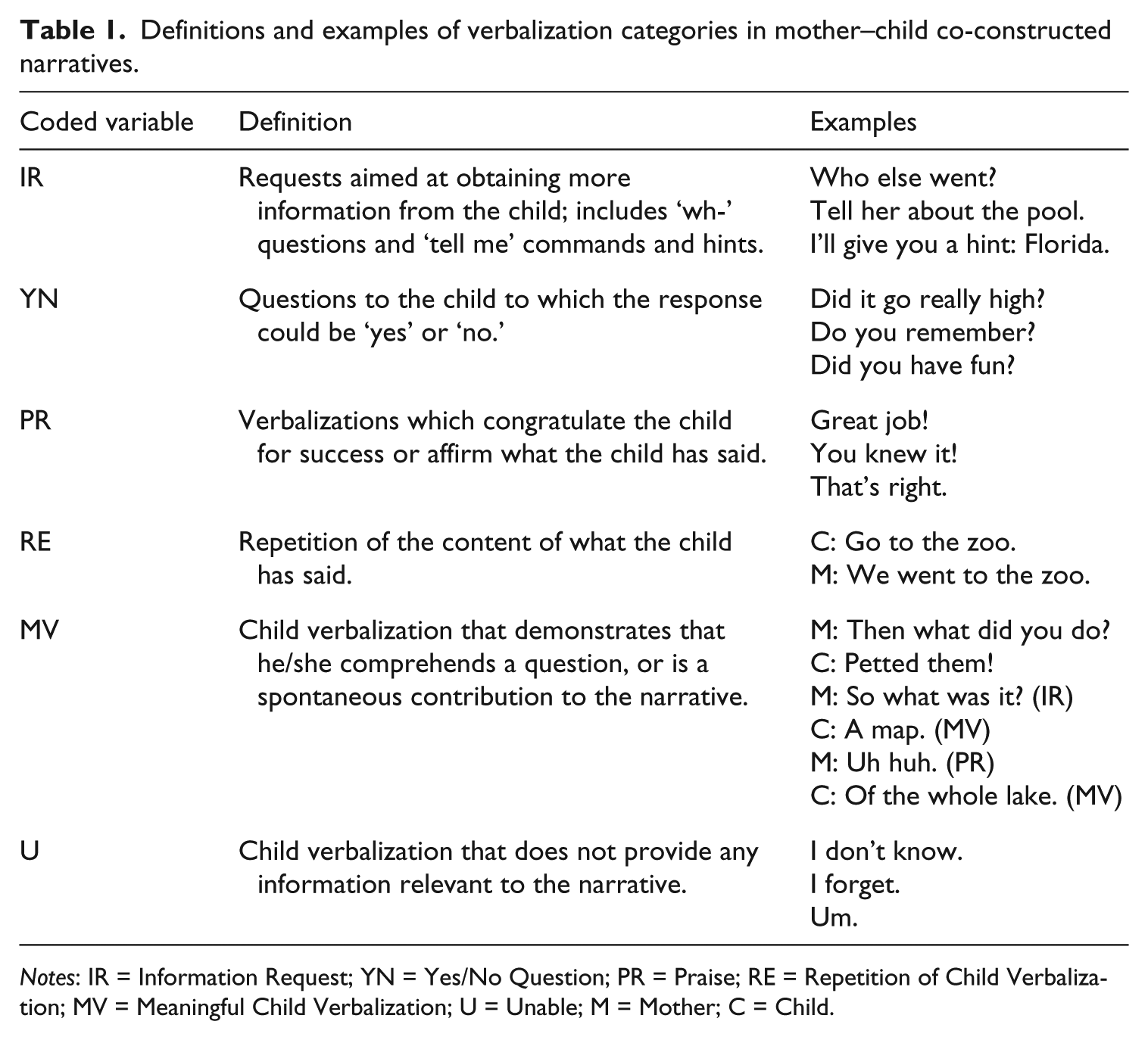
Notes: IR = Information Request; YN = Yes/No Question; PR = Praise; RE = Repetition of Child Verbalization; MV = Meaningful Child Verbalization; U = Unable; M = Mother; C = Child.
The first and second authors both coded 34% of the data (i.e., for 11 of the 32 dyads) to demonstrate reliability of the coding system. Intra-class correlation analyses revealed excellent reliability (range = .97–.99) in the coding of the categories. In cases where the two researchers coded a particular dyad’s set of three shared narratives, coding judgments for that dyad from one of the two researchers were randomly selected for inclusion in the data set. The other transcripts were divided evenly and coded by the first or second author. As only one-third of the transcripts were coded by more than one researcher, it was believed that having independent coding judgments for all data (i.e., not based on consensus) would yield a consistent methodology. For each dyad, instances of each type of verbalization were summed across the set of three co-constructed narratives. To obtain a measure of transcript length, the total number of mother words (i.e., tokens) and the total number of child tokens were calculated through CLAN (MacWhinney, 2000) for each participating dyad.
Results
The total amount of mother talk (i.e., mother tokens) was submitted to a 2 (child age) × 2 (child gender) analysis of variance (ANOVA) to determine if there was a significant difference in the total amount of mother talk (i.e., mother tokens) as a function of child age or gender. Results were non-significant, all ps > .136. A 2 × 2 ANOVA using child tokens as the dependent variable revealed a trend for more child tokens in the 5-year-olds’ co-constructed narratives (M = 317.07, SD = 187.57, range: 55–745 tokens) than in the 3-year-olds’ co-constructed narratives (M = 212.00, SD = 127.18, range: 49–479 tokens), F (1, 28) = 3.35, p < .078.
A 2 × 2 ANOVA was used to assess if the total number of maternal interactional behaviors (i.e., sum of IR, YN, PR, and RE) differed in relation to child age or gender. Next, 2 × 2 ANOVAs were conducted to determine if inclusion of the specific behaviors of IR, YN, PR, RE, MV, and U in the narratives varied as a function of child age or gender. For each significant main effect found using ANOVA, an effect size was computed, using Cohen’s d. Effect sizes between .5 and .7 are considered to be medium effects, and those larger than .8 are considered to be large effects (Cohen, 1992).
Across the set of analyses, there were no significant interactions between child age and gender, all ps > .590. ANOVA revealed that there was a main effect of child age on the total number of maternal interactional behaviors, F (1, 28) = 5.60, p < .026, d = .80. Mothers used more of the coded interactional behaviors with 3-year-olds (M = 99.50, SD = 49.32, range: 31–204 maternal interactional behaviors) than 5-year olds (M = 63.63, SD = 32.70, range: 23–166 maternal interactional behaviors). There was no significant difference in the number of maternal interactional behaviors as a function of child gender, F (1, 28) = .55, p < .464.
Mothers provided significantly more IR to 3-year-olds (M = 42.25, SD = 22.06, range: 16–89 IR) than 5-year-olds (M = 23.56, SD = 12.67, range: 9–49 IR), F (1, 28) = 9.30, p < .005, d = .93. Mothers also used significantly more RE with 3-year-olds (M = 18.56, SD = 14.97, range: 1–57 RE) than 5-year-olds (M = 8.00, SD = 9.04, range: 1–39 RE), F (1, 28) = 5.49, p < .027, d = .79. There was a trend for mothers to use more YN with 3-year-olds (M = 26.25, SD = 14.67, range: 2–55 YN) than 5-year-olds (M = 18.13, SD = 9.54, range: 6–37 YN), F (1, 28) = 3.23, p < .084. Regarding child gender, there was a trend for mothers to use more IR with boys (M = 39.13, SD = 19.50, range: 12–78 IR) compared to girls (M = 26.69, SD = 19.26, range: 9–89 IR), F (1, 28) = 4.12, p < .053. Differences between the groups were non-significant for mothers’ use of PR and children’s inclusion of MV and U, all ps > .137. Descriptive data are included in Tables 2 and 3.
Mean number of words included in narratives as a function of child gender and age.
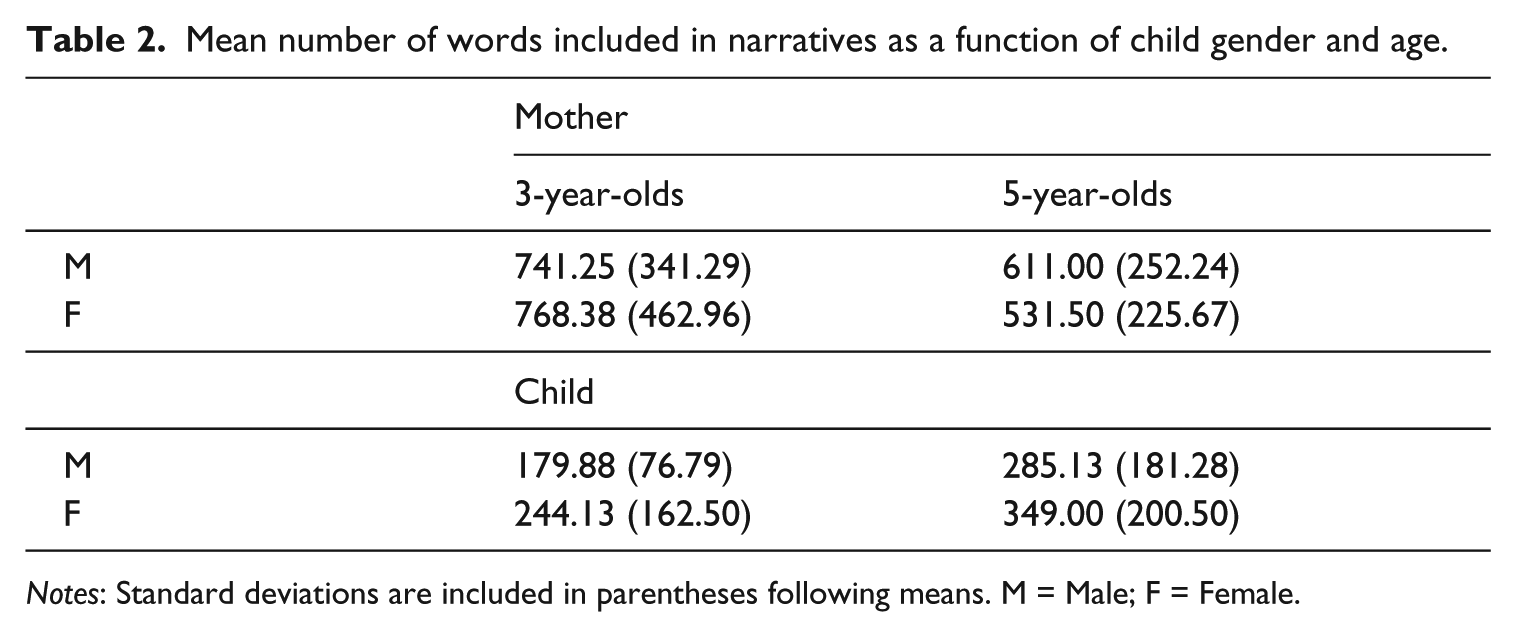
Notes: Standard deviations are included in parentheses following means. M = Male; F = Female.
Mother and child narrative behaviors as a function of child gender and age.

Notes: Standard deviations are included in parentheses following means. M = Male; F = Female; 3 = 3-year-olds; 5 = 5-year-olds; Sum Mother = Sum of Maternal Interactional Behaviors; IR = Information Request; YN = Yes/No Question; PR = Praise; RE = Repetition of Child Verbalization; MV = Meaningful Child Verbalization; U = Unable.
Age difference is significant at p < .005 level.
Age difference is significant at p < .05 level.
Discussion
This study revealed that within the co-constructed personal narratives, mothers of 3-year-olds provided more information requests and more repetition of their child’s verbalizations, compared to mothers of 5-year-olds. The effect sizes related to these contrasts were in the medium to large range. These maternal strategies appear to have been successful in supporting the 3-year-olds’ contributions to the narratives, as there was no age difference found in the number of child meaningful verbalizations. There was a trend for 5-year-olds to talk significantly more than 3-year-olds (i.e., to include more tokens). Five-year-olds do not appear to need as many information requests or repetitions from their mothers to contribute substantially to a co-constructed personal narrative. Overall, the results of this study showed that mothers of 3-year-olds included significantly more of the investigated supportive interactional behaviors than the mothers of the 5-year-olds. Kelly and Bailey (2012) describe the parent’s role in co-constructed narratives as ‘providing the right level and type of “treatment” based on the child’s changing narrative discourse needs over time’ (p. 84). The results of this study support this assertion; parents may be sensitive to what their child needs in terms of narrative assistance (Peterson & McCabe, 1994). This study’s findings are in line with the shared picture book reading literature, which demonstrates parents’ sensitivity to child age and knowledge when posing labeling-related questions to their child (e.g., DeLoache & DeMendoza, 1987; Lachner, Zevenbergen, & Zevenbergen, 2008).
Although there was a trend for the 5-year-olds to contribute more words to the co-constructed narratives than the 3-year-olds, the mothers of 5-year-olds were less likely to repeat their child’s verbalizations. Repetition of child utterances appears to be a strategy most frequently used to encourage children’s talk when children are early in their language development. This maternal support strategy did not disappear even with the 5-year-olds, however, as mothers provided an average of eight repetitions of child verbalizations when reminiscing with their 5-year-olds. Although parent repetitions do not provide information to help the child improve his or her narrative skills, they may facilitate the conversation continuing (Larkina & Bauer, 2010; McCabe & Peterson, 1991) as they reveal attention to the child’s contributions (Cleveland & Morris, 2014). The mothers of younger preschoolers may have used more repetitions than mothers of older preschoolers because these parents were accustomed to repeating their child’s utterances to facilitate their children’s vocabulary acquisition, such as during shared picture book reading (Arnold et al., 1994).
The study results indicated two trends which are potentially worthy of future study. First, there was a trend for mothers to use more ‘yes/no’ questions with 3-year-olds than 5-year-olds. This finding is consistent with the results of Farrant and Reese (2000) and Hudson (1990), both of which studied younger children, and fit within the framework of parental sensitivity to child age and skill. Second, there was a trend for mothers of boys to include more information requests in the co-constructed narratives than mothers of girls. These results are in a direction opposite to what was hypothesized, and generally not in line with other research in this area (e.g., Fivush, 1998; Reese & Fivush, 1993; Reese et al., 1996). However, Zaman and Fivush (2013) have suggested that more highly educated parents may be less gender-stereotyping than parents who are less educated. The mothers in this study were highly educated, with 94% of the sample having earned at least a bachelor’s degree. How parent education, family culture, and child gender relate to parental verbalizations with their young children will be interesting to continue to study in the future (Melzi & Fernández, 2004).
Mothers of 3-year-olds and mothers of 5-year-olds in the present study did not use differing amounts of praise in their co-constructed narratives. Our results are similar to those of Minami (2002), who found no child age-related difference in mothers’ use of un (‘uh huh’), which reveals attention to and praise for the child’s contributions to the conversation when studying co-constructed personal narratives between Japanese 4- and 5-year-olds and their mothers. In the current study, maternal praise did not evidence the ‘drop-off’ associated with increased child age that was seen with mothers’ use of repetition of child verbalizations, as shown in Table 3. This study’s findings provide evidence that maternal praise and repetition of child content are separate behaviors, and probably should not be combined as types of adult confirmation in future studies. The potentially differing impact of these two types of parental feedback on children’s contributions to shared narratives, and children’s narrative development over time, also merits investigation in the future.
It is important to note that there was considerable variability within each age and gender group with regard to both mother and child narrative behaviors (see Table 3). The results of the study were robust with regard to the relationship between child age and the maternal behaviors of information requests and repetition of child verbalizations. However, some other group differences only approached statistical significance, perhaps due to the high level of within-group variation. This level of variation within groups is not surprising; it reflects individual differences in narrative development in preschoolers. Children’s narrative skills develop substantially over the preschool years (e.g., Fivush, Haden, & Adam, 1995; Haden et al., 1997; Kelly & Bailey, 2012); the timing of the development of specific narrative skills varies across children. In this study, each mother’s verbalizations in the shared narratives were likely influenced by her child’s behaviors, as well as her beliefs regarding the purpose and appropriate content of shared parent–child narratives (Zevenbergen, Haman, & Olszańska, 2012).
There are some limitations of this study, which could be remedied in future research. First, our sample included only mothers of children, not fathers or other adults significant in the child’s life. Some studies (e.g., Reese et al., 1996; Zaman & Fivush, 2013) have revealed parent gender differences in narrative behaviors; thus, it is recommended that future studies include more than one parent when possible. Similarly, Pellegrini, Brody, and Stoneman (1987) found that mothers and fathers in triadic conversations with their preschoolers aged 2–4 years engaged in behaviors that differed from those in the parent–child dyadic context. Thus, it would be interesting in future studies to examine co-constructed narratives with preschoolers including more than just two individuals as participants, and to assess whether the number of participants adds significantly to the types of scaffolding the child receives from the adults.
The study sample was limited largely to European American families. Caspe and Melzi (2008) discuss that parent and child contributions to narratives vary across cultural groups. As one example, Fivush and Wang (2005) found that American mothers were more likely than Chinese mothers to discuss sadness with their 3-year-olds in their conversations about past shared experiences. Similarly, Luo, Snow, and Chang (2011) revealed considerable differences between Taiwanese and American mothers’ verbal contributions to shared picture book reading with their preschoolers, with Taiwanese mothers making more information requests of their children during the shared reading than the American mothers. It is recommended that researchers continue to examine behaviors which support children’s narrative and other aspects of language development across cultural groups.
With regard to theoretical issues, it is important to consider that a focus on ‘mothers’ support for preschoolers’ contributions’ has the connotation of adults influencing children, whereas research has revealed a bidirectional effect between parents and children in co-constructed narratives (Farrant & Reese, 2000; Kelly & Bailey, 2012). The influence of parental input during co-constructed narratives on the child’s development of narrative skills will also naturally be bound by the child’s ability to understand parental discourse related to past events (Nelson, 2014). The mother’s ability to understand the child’s verbalizations also influences how the shared narrative progresses, and the meanings which are derived by each participant from the interaction (Grove, Bunning, Porter, & Olsson, 1999). In this study, there were four children (two 3-year-olds and two 5-year-olds) who were identified by their mothers as having language articulation problems. One of these four children, a 3-year-old, was described as also having an auditory difficulty. Although each child was able to contribute to the shared narratives (with a minimum of 177 tokens produced by this set of four children), their mothers’ talk in the narratives likely reflected both inferences and observations of their child’s verbal behaviors (Grove et al., 1999). Future studies should consider child developmental status, rather than only child age, as a predictor of parental behaviors in co-constructed narratives. Children with developmental delays or medical challenges may need assistance from parents that is different from what is needed by their same-age peers (Blackwell, Harding, Babayiğit, & Roulstone, 2015; McNeill & Fowler, 1999; Spencer, Kajian, Peterson, & Bilyk, 2013).
The results of this study have potential implications for interventions aimed at helping children to develop their narrative skills during the preschool years. A burgeoning literature has begun to demonstrate the positive effects of home-based and school-based narrative-related interventions on preschoolers’ narrative skills (Boyce, Innocenti, Roggman, Norman, & Ortiz, 2010; Cleveland & Morris, 2014; Peterson et al., 1999; Reese et al., 2010; Reese & Newcombe, 2007; Spencer et al., 2013). Many of these interventions train adults to become more elaborative in their verbal interactions with preschoolers during co-constructed narratives (e.g., Cleveland & Morris, 2014; Peterson et al., 1999; Reese & Newcombe, 2007; Reese et al., 2010). Adult elaborative reminiscing with children includes behaviors also investigated in the present study: use of information requests, praise, and repetition of the child’s contributions to the shared narratives. It is unknown currently if these types of intervention strategies are differentially effective for preschoolers of various developmental levels. Spencer et al. (2013) individualized narrative skills training for a sample of five 4-year-olds with developmental disabilities attending Head Start; the interventions resulted in improvements in the children’s story retelling and personal narrative abilities. With the results of the present study in mind, it is recommended that future intervention studies consider that particular adult behaviors during co-constructed narratives may vary in their helpfulness to preschoolers, depending on the child’s age. Additionally, it may be beneficial to instruct adults in praise and repetition of child verbalizations during shared narratives as separate behaviors. Given the link between young children’s early narrative skills and their later literacy skills (Griffin et al., 2004; Snow et al., 1995), the development of effective programs to facilitate children’s development of narrative skills is advocated, particularly for children who are at risk for academic challenges due to poverty or developmental disability (Boyce et al., 2010; Reese et al., 2010).
This study adds to the literature in revealing strong relationships between child age and two maternal behaviors, information requests and repetition of child verbalizations, during shared reminiscing with preschoolers. There was overall greater maternal support for the children’s narrative contributions when mothers co-narrated with 3-year-olds compared to 5-year-olds. However, the high frequency of maternal interactional behaviors even with 5-year-olds reveals that mothers may be important partners in their child’s narrations of personal experiences even in the later preschool years.
Footnotes
Acknowledgements
We appreciate the time of the families who participated in this study. We thank Thomas Petros and two anonymous reviewers for their helpful comments on a previous version of this article. An earlier version of this article was presented at the annual meeting of the American Psychological Association, Washington, DC, August, 2011.
Declaration of conflicting interests
The author(s) declared no potential conflicts of interest with respect to the research, authorship, and/or publication of this article.
Funding
The author(s) disclosed receipt of the following financial support for the research, authorship, and/or publication of this article: This research was supported by grant 47.075 from the United States National Academy of Sciences Twinning Program.