



Abstract
This study examines whether an e-book with a dictionary could support parents’ mediation of new words during shared book reading, more than the child’s independent reading of an e-book with and without a dictionary. The participants included 128 kindergartners and 64 mothers who were randomly divided into four groups: independent reading of the e-book with a dictionary; joint mother–child reading of the e-book without a dictionary; joint mother–child reading of the e-book with a dictionary, and independent reading of the e-book without a dictionary (control). For each target word, the dictionary presented (1) word meaning, (2) word meaning within the story context, and (3) a combined meaning. Pre- and posttests included receptive and expressive understanding of the dictionary words. E-books were read four times. Reading the e-book with a dictionary and maternal mediation was the most effective for receptive and expressive word learning, followed by independent reading with the dictionary. Mothers who read the e-book with a dictionary mediated at a higher level than mothers who read without a dictionary. The intervention contributed to advancement in learning new words beyond children’s initial vocabulary level. The research implications are presented in the discussion.
Introduction
Adult’s support or mediation during shared book reading is considered an important vehicle for children’s language development and future reading comprehension (De Temple & Snow, 2003; Sénéchal & LeFevre, 2002). Children who grow up in families from a low socioeconomic status (SES) have, on average, a lower level of language and literacy compared to those from a middle socioeconomic status (middle SES) (Brooks-Gunn, Han, & Waldfogel, 2010). Middle SES mothers read books to their children more frequently, and mediate on a higher level by explaining words and concepts that occur in the story (Aikens & Barbarin, 2008; Heath, 1983). They also tend to discuss topics with their children that go beyond the ‘here and now,’ compared to those from a low SES, who tend to focus more on concrete details (Korat, Klein, & Segal-Drori, 2007). These differences in language input have implications for future acquisition of literacy and school achievement (Brooks-Gunn et al., 2010). Increasing access to electronic books (e-books) may ameliorate or exacerbate these variations in high quality language inputs that support literacy. The crucial importance of vocabulary knowledge and the potential of e-books to support vocabulary learning with and without adult mediation will be discussed in the following four sections.
Vocabulary development
Literacy acquisition is a long-term process, and a rich vocabulary is one of the important factors in its development (Becker, 1977). A higher level of vocabulary elevates reading fluency, and contributes to reading comprehension and academic achievement (Beck & McKeown, 2007). Receptive knowledge of a word generally precedes expressive knowledge and the ability to define the word (Ouellette & Beers, 2010). When children are first exposed to a new word, they understand it on a basic level, and as their understanding grows and deepens, they can actively use the word in the appropriate context (Nagy & Scott, 2000). It is recommended to adopt a ‘rich instruction’ approach in order to effectively enrich children’s vocabulary, and to explain new words in a language that is appropriate for the children’s age and level (Beck & McKeown, 2007).
E-books and their contribution to vocabulary growth
Beyond the known potential of printed book reading to young children (Bus, van IJzendoorn, & Pellegrini, 1995), today, e-books can also serve as a potential tool for vocabulary enrichment (Verhallen & Bus, 2011). Several studies have demonstrated that well-designed e-books with supportive animations can aid young children’s learning of new words during independent reading/listening, particularly for children at risk (Korat & Shamir, 2007; Smeets & Bus, 2014).
Based on the Dual-Coding Theory, visual and auditory multimedia stimulation can complement each other and support better comprehension than the use of either one alone (Moreno & Mayer, 1999). According to Pavio (1990), by presenting the illustration at the same time as hearing the spoken word that represents it, the learner constructs the visual and the verbal representations of the object, and thus forms a connection between the two. Additionally, based on the theory of synergy, animation makes learning more effective and allows for better implementation of information (Neuman, 1995), since it includes an active ingredient that connects between the illustration and the spoken text. It can help focus the child’s attention (the movement attracts the child’s focus more than a static illustration), and can demonstrate processes that might otherwise be hard to understand (e.g., Moreno & Mayer, 1999). For example, children will better understand the word ‘blooming’ if they see a flower slowly opening and turning from a bud into a flower, rather than looking at a static image (Korat, Levin, Atishkin, & Turgeman, 2014).
Adult mediation during book reading and learning new words
Shared book reading was suggested as a potential activity for supporting children’s receptive and expressive word learning (Griffin & Morrison, 1997) by adults ‘providing’ the meaning of difficult words or by ‘requesting’ the child to explain words (Korat et al., 2007). Interestingly, recent studies showed that parents rarely relate to vocabulary in shared book reading (Evans, Reynolds, Shaw, & Pursoo, 2011; Korat, Segal-Drori, & Spielberg, 2018; Massalha, 2014). Nearly half of mothers did not explain any difficult words in the story, and half of those who did, did so for one word (Korat et al., 2018). When they read difficult words, the parents related to relevant illustrations that appeared on the page, provided a definition or synonym for the word, or gave an explanation for the word by connecting it to the child’s life experiences (Evans et al., 2011; Massalha, 2014). This can be seen as a missed opportunity, given that books include non-familiar words that can be discussed with the young children and enrich their vocabulary. The evidence that word explanations by adults to children during shared reading may promote word learning on the one hand (Mol, Bus, de Jong, & Smeets, 2008), and the low frequency of this activity on the other hand (Evans et al., 2011), led us to the thought that there is a need to support parents to improve their shared reading in order to enrich children’s vocabulary (Resetar, Noell, & Pellegrin, 2006).
Although studies have shown that young children can gain learning benefits from independent computer activities as early as at preschool age (Mioduser, Tur-Kaspa, & Leitner, 2000), there is evidence that adult support during such activities can lead to significantly more effective learning (Nir-Gal & Klein, 2004). The assumption is that an adult’s mediation can provide the young child with appropriate cognitive and emotional support, which is not always possible with the software alone.
In this study we aimed to determine whether integrating support via an e-book (with or without an electronic dictionary) with that of a mediating adult is more effective for promoting children’s language compared to either of these supports alone.
Defining words in the ‘Mediation Quality Scale’
During shared adult–child reading, mediation is expressed by the adult, through discourse, explaining the meaning of the story to the child using the description of the illustrations in the book, drawing connections to experiences in the child’s life, explaining words in the story, and connecting to new ideas. Adults adopt these elements of mediation to challenge the child’s cognitive level (Dickinson & Tabors, 2002).
Parents’ mediation behaviors during shared reading were evaluated using a variety of scales. One of the concepts upon which these scales are based is that of ‘distancing,’ suggested by Sigel (1982). This idea is anchored in the theoretical framework of ‘discourse,’ in which three levels of mediation are offered during activities such as reading a book to a child: mediation at a high, intermediate, or low level. High level distancing will include discourse on topics beyond the text, such as forming connections to the child’s personal experiences, defining words, or discussing the writing system (Sigel & McGillicuddy-Delisi, 1984). Intermediate level distancing will include discussing topics relating to the child’s personal experiences. Low level distancing will include discussing specific information from the story (or the illustrations) and less discussion on the general story line (Korat et al., 2007).
In this study we focused on mothers mediating difficult words in the story for their children. This study is innovative in its examination of whether and how the dictionary in the e-book served as a model for mothers’ mediation of new words. To evaluate this we analyzed the discourse between mother and child during the shared e-book reading, and compared the discourse characteristics between the group that read with the dictionary and the group that read without the dictionary. We based the analysis on Bus, Leseman, and Keultjes’ (2000) mediation level scale. The scale presents mediation levels from lowest to highest based on the general concept of ‘distancing’: (1) labeling details and objects in the illustrations that were mentioned in the text; (2) relating the text to the illustrations; (3) labeling elements in the illustrations that were not mentioned in the text; (4) discussing personal experiences that contribute to understanding the text; (5) paraphrasing the text; (6) drawing connections beyond the text; (7) discussing the writing system.
Parents’ mediation during shared e-book reading
There is little evidence that children who read an e-book with a mediating adult learned more words compared to independent reading of the e-book (Korat & Shamir, 2008). It was found that the adult’s mediation during this activity depended on the quality of the e-book. Software designed with animations that supported the story content helped the adult to mediate on a higher level compared to software that was not designed this way (Korat & Or, 2010). In an additional study (Korat, Shamir, & Heibal, 2013), a brief training session (one meeting) was provided to mothers from a low SES on how to mediate to children during shared reading. One group read an e-book, while the other read the printed book. The results showed that mothers in both groups were able to effectively mediate, and that the children progressed in word learning compared to a control group, where the mothers received no training. At the same time, analysis of the mothers’ mediation showed that those who read the e-book used a higher level of mediation than those who read the printed book. The assumption is that the mothers modeled their mediation after the software, in this case a dictionary that defined difficult words. These studies demonstrate the possibility that a short training session accompanying an educational e-book can elevate the mediation level of mothers from a low SES.
In the current study we used an e-book that provides support for difficult words for the child, support that has been shown to be effective in individual activities. Compared to an adult who explains one or two words during shared reading (Evans et al., 2011; Massalha, 2014), children who read an e-book with a structured dictionary can receive support for more words. In addition, this support is provided in an effective manner using both an animated representation and a verbal explanation (Korat & Shamir, 2007). The books we used included narration of the story text, animations, and an automatic dictionary that explains difficult words in the story. These components provide different types of mediation that have been found to promote the learning of difficult words. In addition to serving as mediation tools for the target words that we wanted the child to learn, the e-books can also help the adult with the need to provide explanations for difficult words, and to demonstrate how to do so. We expected that the combination of the e-book and the mediating adult would provide unique growth in the process of learning new words for children from a low SES. In other words, the e-book will serve both the child who is learning and the parent in the mediation process.
Research question
Our main research question is: Can e-books with a dictionary serve as an effective model to encourage parents to mediate the difficult words for children during shared reading, and not only as a tool for learning new words during children’s independent reading/listening?
Based on previous studies (Korat & Or, 2010; Korat & Shamir, 2007; Korat et al., 2013), our first hypothesis was that children’s progress in learning new words will occur in the following descending order: joint parent–child reading of an e-book with a dictionary, child’s independent reading of the e-book with a dictionary, joint parent–child reading of an e-book without a dictionary, child’s independent reading of an e-book without a dictionary. The second hypothesis was that mothers who will read an e-book with a dictionary with their child will mediate more difficult words compared to mothers who read an e-book without a dictionary. We also hypothesized that the mediation method will resemble that provided by the dictionary. Our third hypothesis was that differences will be found in the mediation level based on the shared reading group: reading an e-book with a dictionary versus reading an e-book without a dictionary.
Method
Participants
The participants included 128 kindergartners (68 boys, 60 girls) from 11 Hebrew-speaking kindergartens in the center of Israel, divided into four research groups of 32 children each. Two groups included children only and the other two included children and their mothers (total 128 children and 64 mothers). The children ranged in age from 5;7 (67 months) to 6;9 (81 months), (M = 67.10, SD = 3.37). They lived in low SES neighborhoods. Information about the families was gathered during an interview conducted with the mothers. Children with learning difficulty, language delays and new immigrants were not included in the study. All kindergartens that participated in the study received a similar literacy program led by the Israeli Ministry of Education, and had one or two computers for the children’s use.
The mothers’ ages ranged from 21 to 55 years (M = 38.09, SD = 8.43). The fathers’ ages ranged from 24 to 57 years (M = 41.45, SD = 8.28). The number of years of parents’ education ranged from 6 to 16 (M mothers = 12.13, SD = 3.15; M fathers = 11.70, SD = 2.94). The parents’ occupations were ranked according to Row (1956), where professions are divided into fields and the level of necessary skill. Meir (1978) adapted the rankings for use in Israeli society. In the current study, the parents’ occupations were ranked according to Korat and Levin’s (2002) analysis of this ranking. The average level of the mothers’ profession was M = 2.94 (SD = 1.27) and their average employment rank was M = 2.73 (SD = 1.37). The average level of the fathers’ profession was M = 3.15 (SD = 1.06) and their average employment rank was M = 2.84 (SD = 1.18). These averages reveal a medium-low to low level of education and employment according to the Israeli Central Bureau of Statistics (2009).
Procedure
At the pretest phase, we examined the children’s general vocabulary level using the Peabody Picture Vocabulary Test (PPVT). The children’s word use during story production, word definitions, sentence completion with target words, and receptive target word understanding (similar to the PPVT structure) were examined before and after the intervention.
Phase 1: grouping children and analysis of pretests
Eleven kindergartens were included and the number of children ranged from 8 to 12 in each. The children in each kindergarten were randomly divided into four groups: (a) independent reading of the e-book without the dictionary (control); (b) independent reading of the e-book with the dictionary; (c) joint mother–child reading of the e-book without the dictionary; and (d) joint mother–child reading of the e-book with the dictionary. Thirty-two children were included in each group. During the pretest, we showed the children the e-book once with straight reading without the dictionary. We then measured the child’s productive use of the word while telling a story, defining the word, completing a sentence with the word, and receptive understanding of the word. Reading the e-book within the framework of the pretest was used to allow the child to become familiar with the story and to retell it. In this way we were able to follow the children’s initial knowledge level of the target words and compare this to their level at posttest. We are aware that reading/listening to the story during pretest can be considered an intervention itself, and can perhaps impact the children’s initial abilities in a way that neutralizes the actual intervention. At the same time, there is evidence that a single exposure to a book is not sufficient for children to learn the meaning of new words deeply and fully (see Robbins & Ehri, 1994; Sénéchal, 1997).
Phase 2: intervention program
The children in all four groups read two e-books: The Bridge (book 1) and Grandmother’s Magic Needles (book 2), which were developed for the current study. Each book was read four times in each group. For each book, pretests were administered in phase 1, followed by four readings of the book. After the readings, the posttests were administered. After the posttests for the first book, we began the same process for the second book. Groups (a) and (b) read the books in the preschool while groups (c) and (d) read the books at home.
Each group received a different treatment, as mentioned above. We video-recorded the fourth and final shared reading of group (c), the children who read the e-book without a dictionary with their mothers, and of group (d), the children who read the e-book with the dictionary with their mothers. The video-recorder was placed on a tripod and the researchers left the room during the recording. To prevent the order of reading (first vs. second) from influencing the results, we counterbalanced the order of presentation of the books, such that half of the participants received book 2 as the first book to read and the other half received book 1 as the first book to read. The directions to the child for independent reading were: ‘I brought you a story that you can read with the computer. Would you like to try it now?’ We showed the child how to open the program and how to turn the ‘pages.’ The children received technical support as needed during the intervention, but did not receive any help with the content. The directions to the mother and child for joint reading were: ‘I brought you a story that you can read with the computer. Please read it together.’ We showed the child and the mother how to operate the program and how to turn the ‘pages.’ Each group received the appropriate book – with or without the dictionary. The mother was asked to read the book with the child four times, twice per week, separated by two to three days. The researcher was in touch with the mother by telephone to verify that the reading was, in fact, taking place, and to encourage the mother to read. The mother was also asked to complete a short report including the date and time of the interactions with the child, and a brief description of what transpired during the activity (see Korat, Shamir, & Heibal, 2013 for a similar study).
Phase 3: posttests
After the fourth and final reading of the first book, we administered the posttests to the children in their preschools. Following a 10–15 minute break, we administered the pretests for the second book. After the fourth reading of the second book, we administered the posttest for the second book. After the posttests for the first book, the children in the joint reading groups (c, d) were given the pretests for the second book in preschool. On the same day, we came to the child’s house and gave the mother the second book and asked her to read it four times with the child. We also scheduled the fourth reading to arrange the recording of the activity.
Tools and measures
E-books
We used two e-books that are based on existing print children’s books. One book is called The Bridge, written by Heinz Yanish (2010) and illustrated by Helga Benash (translated into Hebrew by Shimon Riklin-Benat). The book tells the story of a giant and a bear who meet in the middle of a bridge, each trying to get across, but neither willing to retrace his steps. At the end, through cooperation, they find a solution to the problem. The second book is Grandmother’s Magic Needles, written and illustrated by Einat A. Shimshoni (2009). The book tells the story of a kind-hearted grandmother who knits various pieces of winter clothing for anyone who asks, and she even has a solution for the person who ‘feels winter in their heart.’ The book focuses on helping others, trying to match the type of help to each person’s need. Both books were converted by the authors of this article to an electronic format for research purposes. The books include an option for straight reading without a dictionary, and an option with a dictionary. In both options the narrator reads the book while the text is simultaneously highlighted. With the dictionary, at the end of the reading of each screen, a definition of one difficult word automatically appears. The definitions are said by the narrator and are accompanied by a dynamic picture that illustrates the action of the verb. This presentation is based on Pavio’s (1990) Dual-Coding Theory relating to the advantage of learning when presenting visual and verbal representations stimulatingly. In the e-book The Bridge, we included 9 difficult words, for example: crossed, snarled, and stood. In Magic Needles we included 12 difficult words, for example: sang, whipped, sandwiched. The words were selected following a pilot study with 20 kindergartners (age 5–6).
PPVT
Children’s vocabulary was evaluated using the Peabody Picture Vocabulary Test (Dunn, 1981). We used Solberg and Nevo’s (1979) Hebrew version of the test, which includes 110 items. The tester said a word to the child and the child was asked to point to one of the four pictures that illustrate the meaning of the word. A correct answer received one point. The test ended after six incorrect answers in a row. Cronbach’s alpha internal reliability of the test in this study was .83.
Receptive understanding of target words
This test was administered along the same lines as the PPVT using the 21 target words. Scores for the target words ranged from 0 to 21. A similar test used by Korat (2010) had a Cronbach’s alpha internal reliability of .68.
Sentence completion
The child was asked to complete sentences using the 21 target words that appear in the e-book dictionary. Two sample sentences were given to the child prior to beginning the test. The sentences in the test differed from those in the e-book. For example, for the word ‘crossed’ we presented the sentence: ‘The child____ the street from one side to the other.’ The researcher told the child: ‘I will read a few sentences to you. Each time, one word is missing in the sentence. In the place that the word is missing I will knock on the table, so you can know where the word is missing. Tell me which word is missing.’ Scores for the test were coded on a scale of 0 to 3. A score of 0 was given if the child said, ‘I don’t know’ or said a word that did not fit the sentence. A score of 1 was given if a child used a synonym to the target word (e.g., for the word crossed, the child said ‘went’ or ‘walked’). A score of 2 was given when the child used the dictionary definition (e.g., ‘he went from one side to the other’). A score of 3 was given when the child used only the target word. Scores on the test ranged from 0 to 63 across the 21 words. Inter-rater reliability for the test by two independent raters for 20% of the tests yielded a kappa of .98 (p < .001).
Target word definitions
The child was asked to explain the meanings of the 21 dictionary words that appeared in the two e-books. Definitions were scored on a scale of 0 to 4: 0 was given if the child said, ‘I don’t know’; 1 was given if the child provided a definition for a word that sounded like the target word or rhymed with the target word (e.g., for the word ‘chatza’ [crossed] the child defined ‘ratza’ [wanted]; 2 was given when the child used the target word in an appropriate context (e.g., the child said ‘crossed the street’); 3 was given when the child used a word similar or close to the target word (e.g., the child said ‘crossed is when he wants to get somewhere’ – does not explain going from one side to another); a score of 4 was given when the child provided a precise definition for the word as it appears in the e-dictionary (e.g., ‘crossing is going from one side to the other’). That is, a general definition that is not related to the specific context of the story. Scores for the test ranged from 0 to 84. Cronbach’s alpha inter-rater reliability for the test was .87. Internal reliability by two independent raters for 20% of the tests yielded a kappa of .90.
Use of target words during story production
The child was asked to tell the story, as he/she remembers it, while paging through the print version of the story containing illustrations but no text. Each time the child used a target word or a conjugation of the word (e.g., ‘crossed’ – conjugation of ‘to cross’) the child received one point. Scores for the test ranged from 0 to 21 points. Cronbach’s alpha internal reliability for the test was .59. Inter-rater reliability conducted by two independent raters for 20% of the tests yielded a kappa of .98 (p < .001).
Analysis of mothers’ mediation
The videotapes of the shared parent–child reading were transcribed and the mothers’ mediation was analyzed, focusing on (a) the mother’s level of elaboration during mediation; (b) the mother’s relating to difficult words in the story. The mother’s level of elaboration was coded on an eight-level scale, from lowest to highest: (1) labeling details and whole objects in the illustrations; (2) relating the text to the illustration; (3) labeling details in the illustrations that are not mentioned in the text; (4) discussing the child’s experiences; (5) paraphrasing the text; (6) defining words; (7) drawing connections beyond the text; (8) discussing the written language. The scale is based on the work of Bus et al. (2000), and was adapted to the purposes of the current study by adding category 6 – defining words. The hierarchy of the mediation scale was determined based on the transition from discussing information relating to concrete aspects and the here-and-now to discussing aspects of the story that require higher-order thinking skills (De Temple & Snow, 1996) and on the ‘distancing’ principle (Sigel, 1982).
Mothers’ relating to the difficult words was analyzed according to the following measures: (1) overall number of words that the mother explained; (2) number of dictionary words that the mother explained; (3) number of words that the mother explained that do not appear in the dictionary; (4) number of times that the mother provided the definition herself (‘providing’); (5) number of times the mother asked the child to explain the word (‘demanding’); (6) number of times the mother used both ‘providing’ and ‘requesting.’ We also examined the nature of mothers’ definitions: (1) providing short dictionary definition; (2) defining the word within the context of the story or using an example from the story; (3) defining the word by using an example from the child’s life; (4) combining the methods, providing both a dictionary definition and an example from the story; an example from the child’s life; or providing both types of examples. Inter-rater reliability for the mediation measures yielded a kappa between .81 and 1.00.
Results
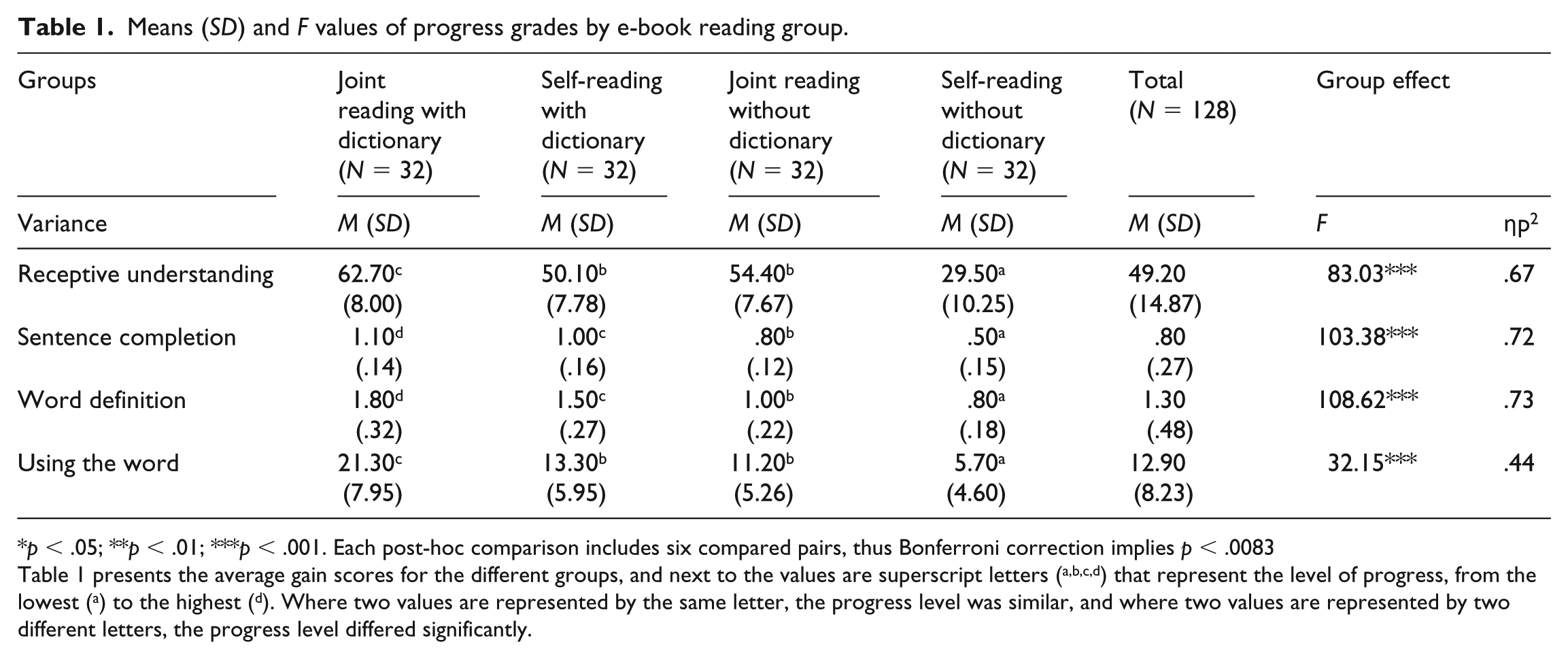
The first hypothesis was that children would progress in learning difficult words in the following descending order: shared mother–child reading of the e-book with the dictionary; child independently reading the e-book with the dictionary; shared mother–child reading of the e-book without the dictionary; and child independently reading the e-book without the dictionary. In order to examine this hypothesis, we looked at pretest–posttest differences for each measure and conducted various analyses. Table 1 shows the results of these analyses.
Means (SD) and F values of progress grades by e-book reading group.
p < .05; **p < .01; ***p < .001. Each post-hoc comparison includes six compared pairs, thus Bonferroni correction implies p < .0083
Table 1 presents the average gain scores for the different groups, and next to the values are superscript letters (a,b,c,d) that represent the level of progress, from the lowest (a) to the highest (d). Where two values are represented by the same letter, the progress level was similar, and where two values are represented by two different letters, the progress level differed significantly.
It can be seen that the greatest level of progress across the four measures was for the shared mother–child e-book reading with the dictionary, compared to the two other intervention groups and the control group. The first hypothesis was fully supported for the sentence completion and definition measures, and partially supported for the receptive understanding of words and word use. To determine the source of these significant differences, we conducted Bonferroni post-hoc comparisons. Similar results were found for each two pairs of measures: (1) receptive understanding of words and using words; (2) sentence completion and word definitions. Consequently, we present subsequent results for the pairs of measures.
Receptive understanding of words and using words
In line with our hypothesis, the results showed that children in the shared reading with the dictionary group progressed more than the children in the other groups on receptive understanding of words and using word measures. Contrary to this hypothesis, differences were not found in terms of children’s progress on these measures between children in the shared reading with dictionary group and the independent reading with dictionary group. In addition, and supporting this hypothesis, children from each of the three treatment groups progressed on these measures more than the control group (independent reading without a dictionary). Progress on these measures can be seen in Figures 1 and 2.
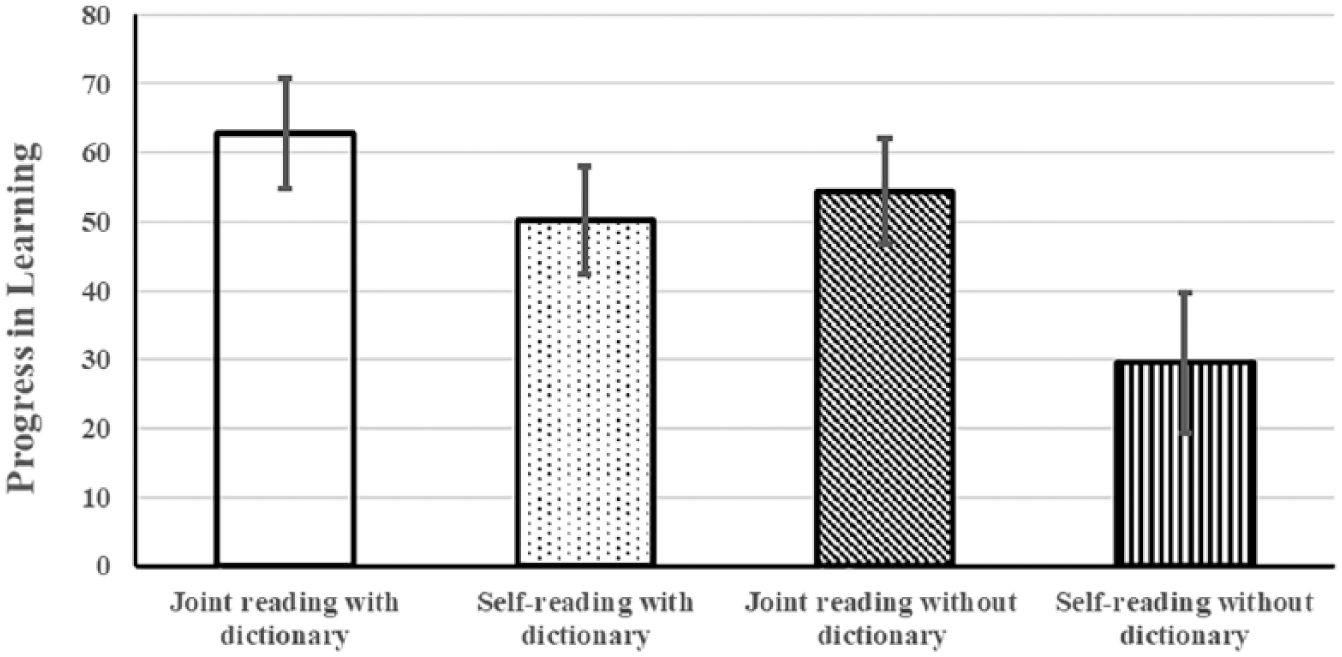
Improvement in receptive understanding of target words by group.
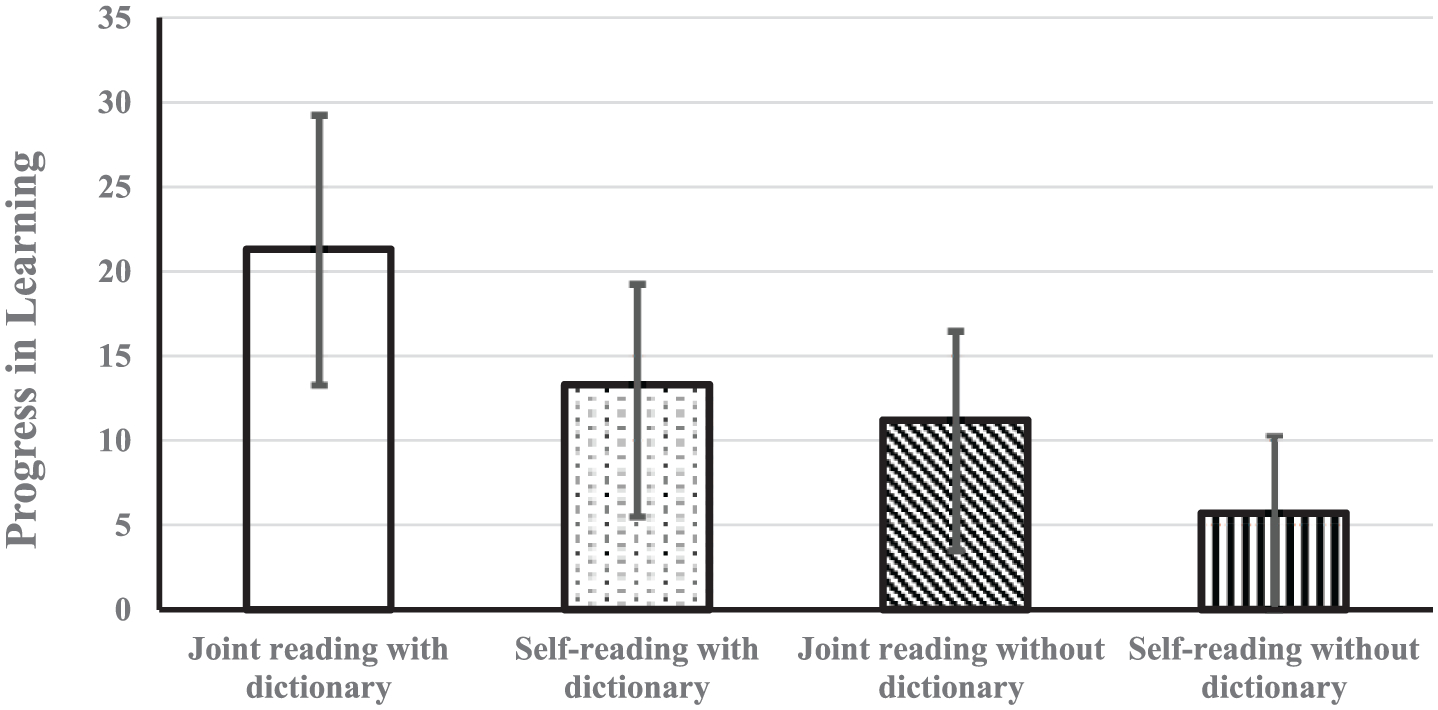
Improvement in use of words by group.
Figure 1 shows that the greatest improvement was for the shared reading with dictionary group. In addition, the improvement in the shared reading without a dictionary and independent reading with a dictionary was similar, though the latter group made greater progress. Figure 2 demonstrates the results regarding the using words measure for all four groups. The figure shows that the shared reading with dictionary group improved the most on the using words measure. In addition, the improvement in the shared reading without a dictionary and independent reading with a dictionary was similar, although the latter group made greater progress.
Sentence completion and word definitions
For the sentence completion and word definition measures, the children from the two dictionary groups (shared reading and independent reading) progressed more than children in the groups without the dictionary. The children in the independent reading with the dictionary progressed more than the children in the shared reading without the dictionary, and more than the children in the independent reading without the dictionary. Children in the control group (independent reading without dictionary) made the least progress of all four groups. Figures 3 and 4 show improvement on these measures across the four groups.
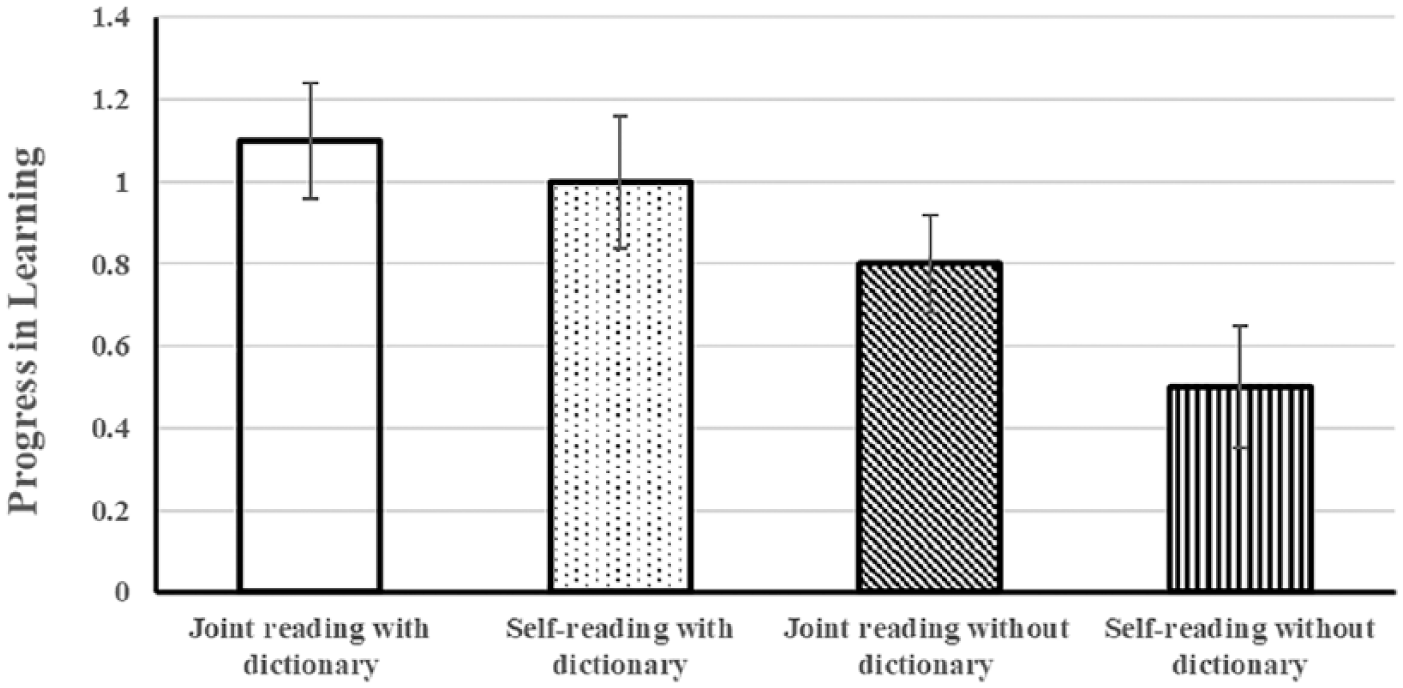
Improvement in sentence completion by group.
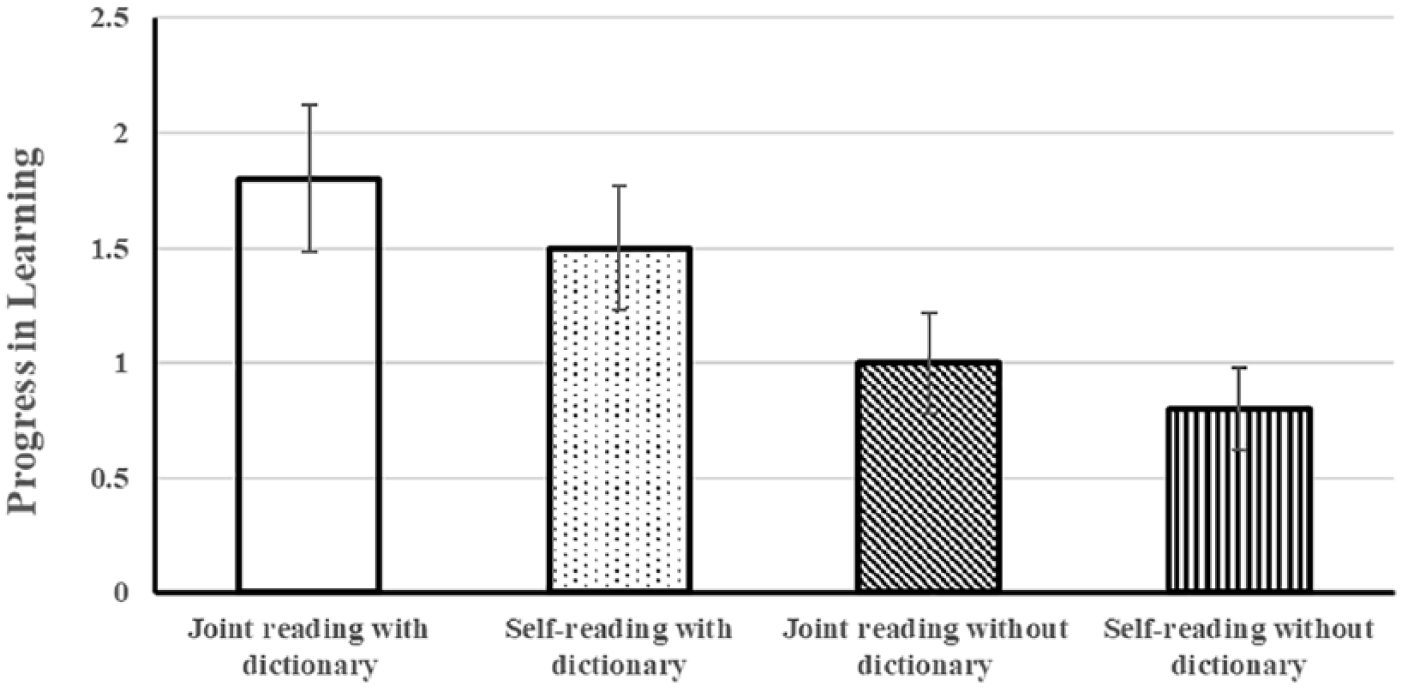
Improvement in word definition by group.
Figure 3 shows that the greatest improvement on the sentence completion measure was for the children from the shared reading with dictionary group, followed by the independent reading with dictionary group and then the shared reading without dictionary group. The control group made the least progress. The differences in improvement between the groups were found to be significant.
Figure 4 reveals that children in the shared reading with dictionary group showed the greatest improvement on the word definition measure, followed by the independent reading with dictionary group, and then the shared reading without dictionary group. The independent reading without the dictionary (control group) made the least progress. Differences between the groups were found to be significant.
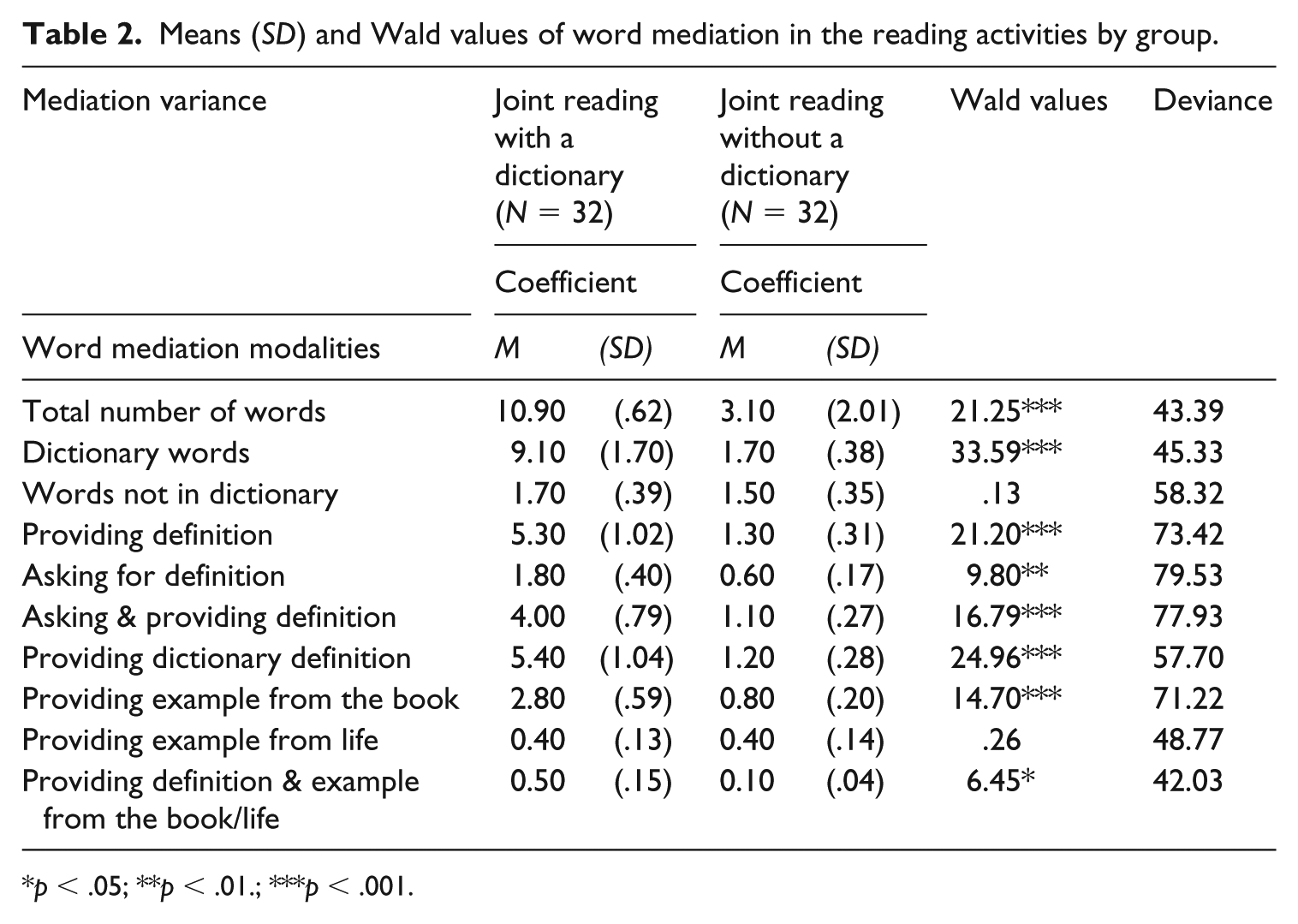
The second and third hypotheses were related to the maternal mediation measures during shared reading of the e-book with the child. These measures were evaluated after transcription of the video recordings and counting the number of times a particular measure appeared. The results relate to the frequency of a particular behavior. The findings show a right-tailed distribution with a large variability from the average for each of the measures. We used negative binomial general estimating equations (GEE) for a Poisson distribution in order to correct for this non-normal distribution (Garson, 2012; Hilbe, 2011). In our second hypothesis, we expected that mothers reading the e-book with the dictionary with their children would mediate more difficult words from the story compared to mothers who read without the dictionary. Table 2 shows the results of the comparison between the number of words that mothers from the two groups (with and without the dictionary) mediated.
Means (SD) and Wald values of word mediation in the reading activities by group.
p < .05; **p < .01.; ***p < .001.
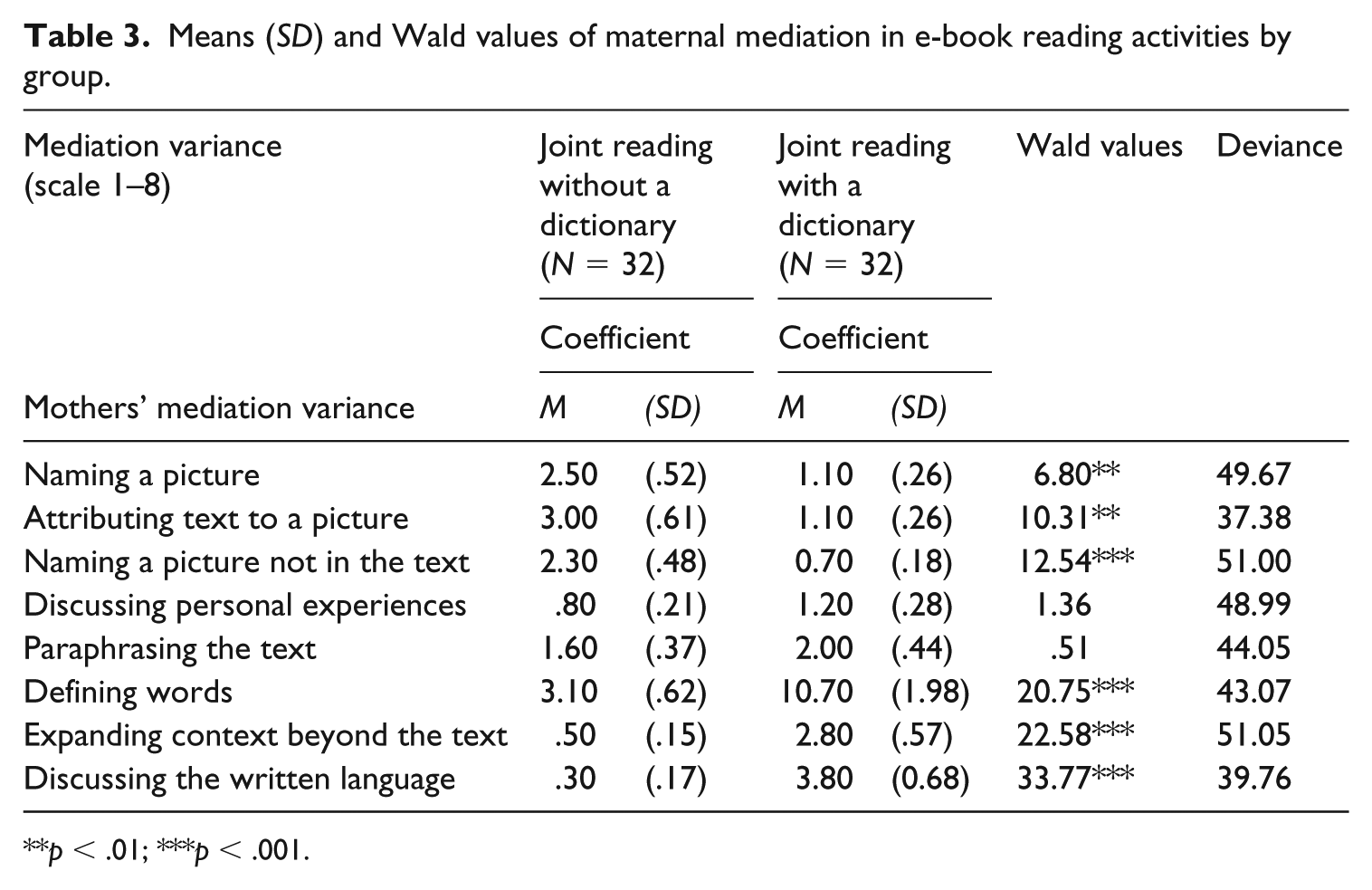
Table 2 reveals that our hypothesis was supported. The mothers who read the e-book with the dictionary mediated more words overall compared to the mothers who read without the dictionary (Wald = 21.25, p < .001). These mothers also mediated more words from the dictionary compared to the mothers who read without the dictionary (Wald = 33.59, p < .001). No significant differences were found between the groups in terms of the number of mediated words that did not appear in the dictionary. We also expected that significant differences would be found for the mothers’ mediation measures between the two shared reading groups, with the mothers reading with the dictionary mediating on a higher level than the mothers reading without the dictionary. Table 3 shows the means, standard deviations, and ranges for each of the quality of mediation measures.
Means (SD) and Wald values of maternal mediation in e-book reading activities by group.
p < .01; ***p < .001.
Table 3 shows that our hypothesis was supported. Significant differences were found for the three basic mediation measures (1,2,3) on the mediation scale in favor of the mothers reading without the dictionary: labeling illustrations (Wald = 6.80, p < .01), relating the text to the illustration (Wald = 10.31, p < .01), labeling an illustration that does not appear in the text (Wald = 12.54, p < .001). In contradistinction, for the three measures at the highest end of the scale (6,7,8), significant differences were found in favor of the mothers reading with the dictionary: defining words (Wald = 20.75, p < .001), drawing connections beyond the text (Wald = 22.58, p < .001), and discussing the written language (Wald = 33.77, p < .001).
Discussion
We found that children who read the e-book with the dictionary together with their mothers learned more words compared to children who read the e-book independently with the dictionary, with a mother but without the dictionary, or independently without the dictionary. The dictionary supported the children directly using the information provided and indirectly, and the mothers probably used the dictionary as a model when mediating difficult words to the children. The dictionary support included: (1) saying the dictionary word; (2) word bubble showing the written dictionary word; (3) verbal explanation of the word; and (4) dynamic illustration depicting the meaning of the word. The children and the mothers were exposed to the words in two channels (visual and auditory). We believe that this made the child’s learning more effective, and also supported the mother to strengthen the explanation of difficult words (Mayer & Sims, 1994; Pavio, 1991), including words that did not appear in the dictionary. Beyond word mediation, the mothers expanded their discourse with the child, forming connections that went beyond the text, relating to personal experiences, and discussing the written text. Compared to the children in the other groups, the children in the mediation and dictionary group learned the words by ‘rich instruction’ (Beck & McKeown, 2007), and improved on both the receptive and the expressive learning levels, including completing sentences, providing definitions, and using the words while producing the story.
It is important to note that we did not provide the mothers with any guidance other than the explanation on how to use the e-book software. The mothers were exposed to the dictionary during the activity with the children, which seems to have encouraged them to use this strategy on their own. We assume that the dictionary served as a guide for the mothers, such that during the repeated readings, they learned how to use it and implemented it, and sometime even provided definitions for words not included in the dictionary. At the same time, the e-book without the dictionary encouraged the mothers to relate more to the details in the illustrations. That is, they were influenced by the unique features of the e-book. This is consistent with previous studies which showed that mediation is influenced by the format of the book (print vs. electronic) and the information that these books provide (Fisch, Shulman, Akerman, & Levin, 2002; Smith, 2001).
Children’s progress on different measures
Receptive understanding and dictionary use
Children who read with their mothers using an e-book with a dictionary gained receptive word understanding more than children in the other groups. This supports our hypothesis that the combination of support from the parent and the dictionary is more effective than either support alone.
Contrary to expectations, children reading independently with the dictionary and children participating in shared parent–child reading without the dictionary progressed to the same degree on the receptive knowledge measure. This indicates that the dictionary support when reading independently was equal to the support provided by the mother without the dictionary. Receptive understanding of a word is a reasonably easy task. The electronic dictionary support and maternal mediation, or even just exposure to the text without any support, promoted learning words at this level. Nonetheless, the combined supports were the most effective.
Similar results were found for the task of using the dictionary words. It is interesting that for both receptive understanding of the words and using the words during story production, children’s progress was similar despite the differing level of difficulty between the tasks. Receptive understanding is considered a relatively easy task compared to the ability to produce the new word. These results were thus surprising and unexpected. As anticipated, the pretest for receptive understanding showed a ceiling effect, while producing the words showed a floor effect. In both situations, the combined support yielded the most effective learning for the measures with both high and low pretest scores. That is, the combination of the dictionary and mothers’ mediation was the most effective in advancing the learning of new words for children with an initially high level of knowledge and for an initially low level of knowledge, and for tasks that were more difficult (using words) and less difficult (receptive understanding).
An explanation of why integrated mediation is effective for the use of words is fairly easy – because it is a difficult task that requires, perhaps, more investment in the teaching and learning process. We asked the children to tell the story from the e-book while looking at the illustrated, wordless print version. We counted the number of dictionary words that the children used in telling the story. Telling a story orally using new words that were heard from the story is a highly demanding cognitive task. For the children to use the word, they had to know the word at a high level; that is, they had to be able to retrieve the word and integrate it into the text they were producing. It seems that the combined support of the dictionary and the mother’s mediation, which in itself was supported by the dictionary and which included discourse surrounding not only difficult words but also connections beyond the written text, supported the child and brought him/her to a more effective level of learning compared to the other groups.
Why did learning words at the receptive level require combined support? The answer may lie in the relationship between the measure and the intervention activity. On the test that examined receptive understanding of a word, the children were asked to point to the picture that depicts the meaning of the word among four pictures that were not related to the content of the story that was read. To succeed at this task, the children needed to have an understanding at the generalizable level. That is, the children had to transfer the meaning of the word from the context of the story, to a different context, as it was presented in the picture. Support for this explanation can be found from Nagy and Scott (2000), who argued that gaining knowledge of a word occurs on a scale from no knowledge, through a variety of levels of partial knowledge, until full understanding of a word.
Sentence completion
Children’s progress on the sentence completion for the dictionary words was in accordance with the level of support they received. More specifically, as with the previous measures, the children who read the e-book with the dictionary with their mothers progressed more than the children in all other groups. In addition, as we hypothesized, the children who independently read the e-book with the dictionary progressed more on this measure than those who read with their mothers without the dictionary. This shows that the dictionary support when reading independently was even more effective than reading with the mother’s mediation without the dictionary. It should be noted that the children in the control group also progressed on this measure, but made the smallest gains compared to the other groups. This shows that children can learn new words indirectly from context (Beck & McKeown, 2007; Lane & Allen, 2010) in shared book reading (Sénéchal, 1997), although this method of learning is not the most effective.
The dictionary provided: (1) oral pronunciation of the word; (2) the written word; and (3) supporting animation. The children from the two groups that read with the dictionary improved more than those who read without the dictionary. This highlights the significant contribution of the dictionary to the learning of new words, at a level that enabled them to complete sentences. In this case, the support of the dictionary with its two modalities, the oral and the visual (Mayer & Sims, 1994; Pavio, 1991), contributed to more effective learning than the mother’s mediation without the dictionary.
Defining words
As with sentence completion, the dictionary meaningfully contributed to children’s progress in defining words, both directly and indirectly through the mothers’ mediation. For this task the children were asked to define the words that were said orally. Success on this type of task requires hearing the definition repeatedly. The dictionary provided this kind of teaching with each encounter with the word. Indeed, children in the independent reading with the dictionary group learned to define the word more effectively compared to the children who read without the dictionary. Moreover, the most effective learning was for the children who received the combined support. Beyond the definition that the mother provided, she also added meaningful discussion surrounding the word, which seems to have increased the effectiveness of the definition’s assimilation. This explanation is supported by Lane and Allen’s (2010) study, where it was found that effective learning of words occurs when the definition of the word is adapted to the children’s development level, and when examples for use of the word are provided.
Contribution of the e-book dictionary to maternal mediation
Number of words and how they were mediated
Analysis of mothers’ mediation in the two reading groups shows that those who read with the dictionary defined 10 to 11 difficult words; 9 words were from the dictionary and 1 or 2 words appeared in the story without a dictionary definition. Mothers who read with their children without the dictionary defined 2 words on average, of which half a word (on average) was a dictionary word. Thus, in most cases, mothers in the former group related to words that were not included in the dictionary. These results show that the support provided by the dictionary encouraged the mothers not only to repeat the words’ definitions, but also to explain additional words from the story. Previous studies found that parents only minimally mediate difficult words during shared reading (Evans et al., 2011), but when they receive focused training, they mediate effectively and support children’s language (Biemiller & Boote, 2006). Our results expand the knowledge in this area, and demonstrate that minimal guiding to parents using computer software could be a useful way for word teaching and learning. The dictionary in the e-book served as a model for parents to mediate to their children, without the need for significant investment in training or repeated practice. This is a unique finding within the corpus of existing literature.
Quality of mediation during shared reading
We focused primarily on mothers’ mediation of difficult words, but the question remains: what was the quality of her overall mediation of the story? Our analysis clearly showed that the discourse in the group that read with the dictionary was longer; it included twice the number of words and twice the number of parent’s and child’s new topic discussions than the group that read without the dictionary. Mothers who read without the dictionary related primarily to the illustrations in their discussions, while mothers who read with the dictionary related more to the meanings of difficult words by using the short dictionary definition, or explaining using the story context. It is interesting that mothers who were exposed to the dictionary included behaviors that are not specifically connected to difficult words, such as drawing extra-textual connections or relating to the written text, which are considered to be higher levels of mediation (Sigel, 1982). These results are particularly important, since the e-book itself did not offer support other than providing definitions for difficult words. We assume that the dictionary support served to convey a ‘hidden message’ of sorts to the mothers regarding the importance of mediating to the children during reading in a general manner, beyond providing word definitions. This encouraged the mothers to mediate the story content as well, and to do so beyond the ‘here-and-now.’ In addition, it seems that the written dictionary stimulated a discussion of letters in the word and letters in general between mothers and children. This raises the level of awareness of the written text and promotes the children’s early literacy skills (De Temple & Snow, 1996). In conclusion, it seems that the e-book with the dictionary served as a model that encouraged mothers to challenge the children and to mediate on a higher level.
Limitations and future research
Since the sample in our study was small, and taking the different types of word explanation and different dependent variables into account, a larger scale study replicating this research is needed in order to confirm better conclusions. It is also important to note that we focused on mothers’ behaviors, and we recommend additional research that follows mothers’ beliefs. This type of investigation can contribute to our understanding of mothers’ attitudes regarding providing definitions for difficult words during shared reading, an issue that is currently not clear.
Educational implications
This study shows that shared parent–child reading of an e-book with a dictionary can significantly support low SES children’s vocabulary learning and the parents’ ability to support their children. These results demonstrate that there are new options for parent and educator support in our digital age, which can improve processes of instruction for adults as well as learning for young children. These findings can help policy-makers and educators construct intervention programs that promote language and literacy within the family among the general population, and specifically among those from a low SES.
Footnotes
Funding
The authors received no financial support for the research, authorship, and/or publication of this article.