



Abstract
The acquisition of quantifiers is a central topic in cognitive science. The present study investigated the emergence, frequency, and non-target-like production of the universal quantifiers all, every, and each in child English from a linguistic perspective, based on the data from longitudinal naturalistic observation of 10 English-speaking children and their caregivers. We found that the use of these quantifiers as adverbs or in adverbials generally appeared earlier, and was more frequent, than their use as (pre)determiners in early child English. We also found that input frequency exerts a great influence on some aspects of the acquisition of universal quantifiers, for example, the frequency of the predeterminer all, but there are still some patterns that cannot be explained by mere input frequency, such as children’s initial preference for using universal quantifiers in A(dverbial)-quantification and their non-target forms. Their initial overreliance on A-quantification may be explained by event quantification being cognitively less demanding than entity quantification, and their non-target productions likely result from their developing grammatical systems. We argue that the acquisition of universal quantifiers involves multiple factors, such as cognitive complexity, children’s developing grammatical systems, and input frequency, interacting with each other.
Keywords
Introduction
Quantifiers have long occupied logicians. One quantifier in predicate logic is the universal quantifier, to which English determiners all, every, and each bear a close resemblance. A sentence like Every man is mortal can be interpreted as ‘for every x, if x is a man, then x is mortal’ where every is a device for applying a predicate (‘mortal’ in this case) to a restricted domain (‘man’). Another view is that the quantifier is a relation between two sets. On this view, the meaning of the sentence above is roughly that the set of mortal things includes the set of men. As the use of quantifiers reflects the interaction between mathematical logic and language ability, it is an intellectually crucial area in natural language and a central topic in cognitive science.
Besides quantificational determiners, or D(eterminer)-quantifiers, there are also A(dverbial)-quantifiers, such as always (Bach et al., 1995). In A-quantification, the A-quantifier modifies the verb phrase (VP) and quantifies the event encoded by the VP. Cross-linguistically, A-quantification seems to be more fundamental than D-quantification: not all languages have D-quantification (Vieira, 1995), but every language has A-quantification (Bach et al., 1995). This typological generalization invites the idea that A-quantification is more natural than D-quantification for human cognition. The structure that is fundamental cross-linguistically tends to emerge earlier in child language (Jacobson, 1968). If this is true, one expects to see A-quantification privileged over D-quantification in child language.
There is evidence from Chinese corpus studies that A-quantification emerges before D-quantification in children’s productions. Lee (2012) found that universal A-quantifiers appear in the naturalistic speech of four 2-year-old children acquiring Mandarin Chinese, but the D-quantifiers mei ‘every’ and suoyou ‘all’ are absent when the recording ends at 2;6. 1 However, in the case of Chinese, it is not possible to conclude that this is due to a universal bias for A-quantification, because the input from adults is also biased in this direction (see Lee, 2012). It has been argued that input frequency effects are ubiquitous in every domain of child language acquisition, and all other things being equal, frequent forms will be acquired before less frequent forms (Ambridge et al., 2015; Lieven, 2010).
If A-quantification is indeed simpler for children, this may help to explain the cross-linguistic existence of quantifier spreading errors first observed by Inhelder and Piaget (1964). Philip (1995), for instance, found that if asked Is
Therefore, there is evidence consistent with the privilege of A-quantification in the order of emergence observed in Chinese, and the emergence order may explain the phenomenon of quantifier spreading. However, in the Chinese case, the adult input is consistent with the emergence order. For this reason, we consider the case of English, asking whether English-acquiring children also first use universal quantifiers in A-quantification. If the bias in Chinese children is purely due to input factors, then we expect a different pattern in English-acquiring children, since English adult input is not reported to be biased toward A-quantification. In contrast, if it is about cognitive ease/language universals, then we would expect a similar bias for A-quantification in English-acquiring children. We ask the following specific questions:
Do English-acquiring children prefer to use universal quantifiers in A- or D-quantification initially?
To what extent can English-learning children’s acquisition patterns for universal quantifiers and their use in A- versus D-quantification be attributed to input frequency?
If the preference for A- or D-quantification can’t be explained by mere frequency, where does it come from?
In this article, we will first introduce the properties of universal quantifiers all, every, and each and then present a corpus-based study of their acquisition to answer the questions.
Syntactic and semantic properties
All, every, and each are commonly held to be determiners. A determiner appears before the noun phrase (NP) to add some grammatical meaning, for example, definiteness, allowing people to use the NP repeatedly in an infinite number of situations. In the quantified NP (QNP), the NP associated with the quantifier is its restriction, or quantifying domain. All also serves as a predeterminer (Quirk et al., 1985), as shown in
All has a less discussed adverbial function, modifying verbs, adjectives, prepositional phrases (PPs), and so on, and expressing ‘completely’, as in (1). The ability to float is a well-studied behavior of all and each. As in (2), all seems to move from the NP that it quantifies and appears in a position where an adverb typically occurs, but its interpretation is still connected with the NP. Such floating quantifiers (FQs) are found cross-linguistically (Kobuchi-Philip, 2007).
(1) The students were dressed (2)
There is still debate over the origin and nature of the FQ: some hold that they are determiners moved rightward, away from the NP; some propose that they are base generated in an adverbial position (Al Khalaf, 2019; Cirillo, 2010). Sometimes, all is ambiguous between an adverb and an FQ. When the subject is an uncountable mass noun or a plural countable noun as in (3a) and (3b), respectively, all may either be a FQ associated with the subject or an adverb modifying the verb (Buchstaller & Traugott, 2006). We identify another ambiguous case in our study: all between a pronoun object and an adverb or a PP may either quantify the object or modify the adverb or PP, as in (3c). Due to reanalysis in language change, the FQ in some contexts gradually shifted to an adverb (Buchstaller & Traugott, 2006). Because of its historical relation to the adverb, and its syntactic position coinciding with the adverb, we classify the FQ as an A-quantifier, following Bach et al. (1995, p. 5).
(3) a. The water was (i) All the water was dried up. (ii) The water was completely dried up. b. The women c. You pushed them
Distributivity is a marked semantic relation, involving a scope dependency between two NPs. The feature of distributivity distinguishes all, every, and each: all gives a collective reading, while every prefers a distributive reading (Gil, 1995); every is used to express broad generalizations that are ‘generic’, whereas each is used for talking about local domains and adamantly distributive (Roeper, 2007, p. 95; Knowlton & Lidz, 2021). Viewed from an event structure perspective, a sentence containing each can only be true of event structures that are completely distributive – the participants must act or be acted upon individually in their own subevents, differentiated from the other subevents; a sentence containing every can be true of event structures which are partially distributive – the participants can act or be acted upon individually or in subgroups; whereas in a sentence containing all, all participants act collectively and the event does not have subparts (Tunstall, 1998, pp. 96–100). On this collective-partially distributive-completely distributive scale, cognitive complexity increases as more subevents are involved. Alternatively, the distinction between the three universal quantifiers can be viewed as syntactically based: QNPs headed by each are endowed with a [+ Distributive] feature, which must be checked at the Spec(ifier) position of the Distributive Phrase (DistP); QNPs headed by every are underspecified for [Distributive], and move optionally to Spec of DistP; while QNPs headed by all do not have this feature and do not move to DistP (Beghelli & Stowell, 1997). To summarize, every and each, in contrast with all, are marked with the distributivity feature. The contrast is reflected in morphosyntax: the former two combine with morphologically singular NPs while the latter is grammatically plural.
The acquisition of universal quantifiers
Due to semantic and syntactic complexities, universal quantifiers have been a focus of language acquisition research. Previous studies are mainly experimental, investigating children’s comprehension of universal quantifiers. Some studies show that 3- to 5-year-old English-speaking children understand sentences containing all or every, suggesting their competence to associate the D-quantifier with the correct NP (Brooks & Braine, 1996; Crain et al., 1996). However, it has also been known that young children interpret universal D-quantifiers in a non-adult-like way, for example, making quantifier spreading errors (see the review in Crain, 2017). The event quantification account of quantifier spreading by Philip (1995) reviewed above has been challenged based on experiments on children from different linguistic backgrounds. Some provide linguistic accounts: quantifier spreading arises when the pragmatic condition of plausible dissent is not met in the experimental task (Crain et al., 1996) or when experimenters fail to specify a clear ‘question under discussion’ (Skordas et al., 2022); children’s quantifier spreading results from distributive inferences, implicatures derived by negating domain alternatives that indefinite NPs such as a pony activate, since they give rise to free choice inferences (Denić & Chemla, 2020); children treat the quantifier as the modifier rather than the head of the QNP (Kang, 2001); children cannot interpret universal quantifiers but understand the sentence under discussion as generic with silent always (Kuznetsova et al., 2007). Others give cognitive accounts: children expand the restriction to all the entities in the picture instead of the test sentence (Aravind et al., 2017; Kang, 2001; Kiss & Zétényi, 2017); children committing spreading errors have difficulty in switching perspectives using successful cognitive control (Minai et al., 2012). These cognitive accounts hold that spreading errors stem from non-grammatical factors.
As for the production of universal quantifiers, a few corpus-based studies on English-acquiring children show that all is the first to emerge and the most frequently used. Based on one or two sessions of data collected from six English-acquiring children, Valian (1986) found that the determiner exists in the linguistic system of 2-year-olds; among the three universal quantifiers, only all, as a (pre)determiner, emerges, accounting for 1% of all the determiner tokens. Valian et al. (2009) confirmed the presence of the determiner at the beginning of combinatorial speech in 21 English-speaking children (1;10 to 2;8) and found that they only produced the predeterminer all among the three universal quantifiers. The study by Merchant (2005, cited in Roeper, 2007, p. 183) reveals thousands of instances of all but only 10 of every + NP in the utterances by 18 children under the age of 5.
Regarding the different uses of every in child English, Gordon (1982, pp. 33–34) found seven tokens of every in the longitudinal data from two English-acquiring children (1;9 to 3;6, and 2;3 to 3;5, respectively), four occurring in the adverbial phrase every day. Similarly in Strauss et al. (2003, cited in Roeper, 2007, p. 183), 17 out of 25 tokens of every in the transcripts of six children aged 4 or 5 from the Child Language Data Exchange System (CHILDES) occur in adverbials such as every time and the other in QNPs serving as subject or object, for example, *every boys and girls. In this example, the child mistakenly collocates every with a plural N, echoing Gordon’s (1981) forced-choice judgment experimental finding that 48 English-acquiring children aged 3;3 to 5;10 accepted over-pluralized QNPs such as each car
Both constructivist (‘usage-based’) and nativist (‘knowledge-based’) accounts of language acquisition recognize the importance of the child’s input. Where these views differ is in whether they assume that this input is sufficient for driving language acquisition or that additional mind-internal constraints on the potential space of hypotheses are needed. Therefore, the nature of the input and its relation to what ultimately gets acquired is extremely important. Despite this, there are surprisingly few studies on the universal quantifiers in adult input. Based on more than 1.7 million caregivers’ utterances from several North American English corpora from the CHILDES, Knowlton and Lidz (2021) identified 538 utterances with each, 728 with every (compounds such as everybody excluded), and 20,558 with all, revealing the order in frequency: all > every > each. All QNPs containing each basically appear in subject/object position, while most QNPs containing every appear in adverbials; the vast majority of each quantify the individual entity, while the majority of every quantify the time. Knowlton and Gomes (2022) further confirmed the distinction by analyzing the videos of parent–child interactions in a corpus: parents often use each to quantify over entities physically present in small numbers, use all to quantify over domains that are larger than children’s working memory capacity, and use every to quantify over times or individuals that are not present.
In summary, all emerges earlier than every and each in child language, and it is more frequent than the latter two in adult input. Most of the QNPs by children and caregivers that contain every appear in adverbials. Children are found to over-pluralize the NP that follows every and accept over-pluralized QNPs with every or each. The few corpus-based studies are mainly concerned with the determiner use of universal quantifiers. There is a lack of research that has tracked the emergence of different uses of a universal quantifier, including its adverbial use, vis-à-vis adult input. This study aims to fill the gap. If children’s production of universal quantifiers is biased toward A-quantification in a way that is not predicted by the input, this supports the argument that A-quantification is cognitively more accessible. Such a finding would also provide support for the event quantification account of quantifier spreading. In contrast, if D-quantification is acquired earlier than A-quantification, this would be evidence against the event quantification account of spreading errors.
Method
We raised three research questions in the Introduction, asking whether English-acquiring children prefer to use universal quantifiers in A- or D-quantification initially and whether their emergence and frequency order in child language can be explained by input frequency or other factors. For the first question, in keeping with the view that event quantification is cognitively simpler than object quantification, we hypothesize that English-speaking children prefer A-quantification initially. If so, we expect to see them first use all, every, and each as adverbs or in adverbials. Specifically, we expect to see the adverb use of all appearing first and being more common than its (pre-)determiner use, every appearing in the adverbial earlier and more frequently than in the subject/object, and each initially used more often as an FQ (considered an adverb) than as a determiner. For the second and third questions, we hypothesize that input frequency will not completely determine the order of acquisition of quantifiers and their various uses, but will interact with other factors. Take the emergence sequence of all, every, and each as an example. Two factors are possible. The first one is input frequency. The more frequent lexical string in adult input will emerge earlier and be used more frequently than the less frequent one. The second is cognitive complexity. Every and each, being distributive, are more complex than all, and between each and every, the former is completely distributive and thus is cognitively more complex. The cognitively more demanding quantifier is supposed to emerge later. Input frequency is found to interact with other factors in many fields of child language development (Ambridge et al., 2015), so we hypothesize that it will interact with cognitive complexity to determine the acquisition order of all, every, and each. To test these hypotheses, we used corpus data which contain naturalistic conversations between very young children and their caregivers.
Corpora
Ten widely studied English-speaking children were analyzed from seven longitudinal corpora of CHILDES (MacWhinney, 2000). They are balanced in gender, with Thomas, Aran, Anne, and Lara from the United Kingdom and the rest from the United States. Table 1 shows the age range during which each child was recorded and the range of their mean length of utterance (MLU) in morphemes. 2 The data in this table are sorted by age at the end of the observation. There is a high sampling rate, a long observation period, and abundant adult input in the corpora, especially in Thomas’ data.
Subject information.
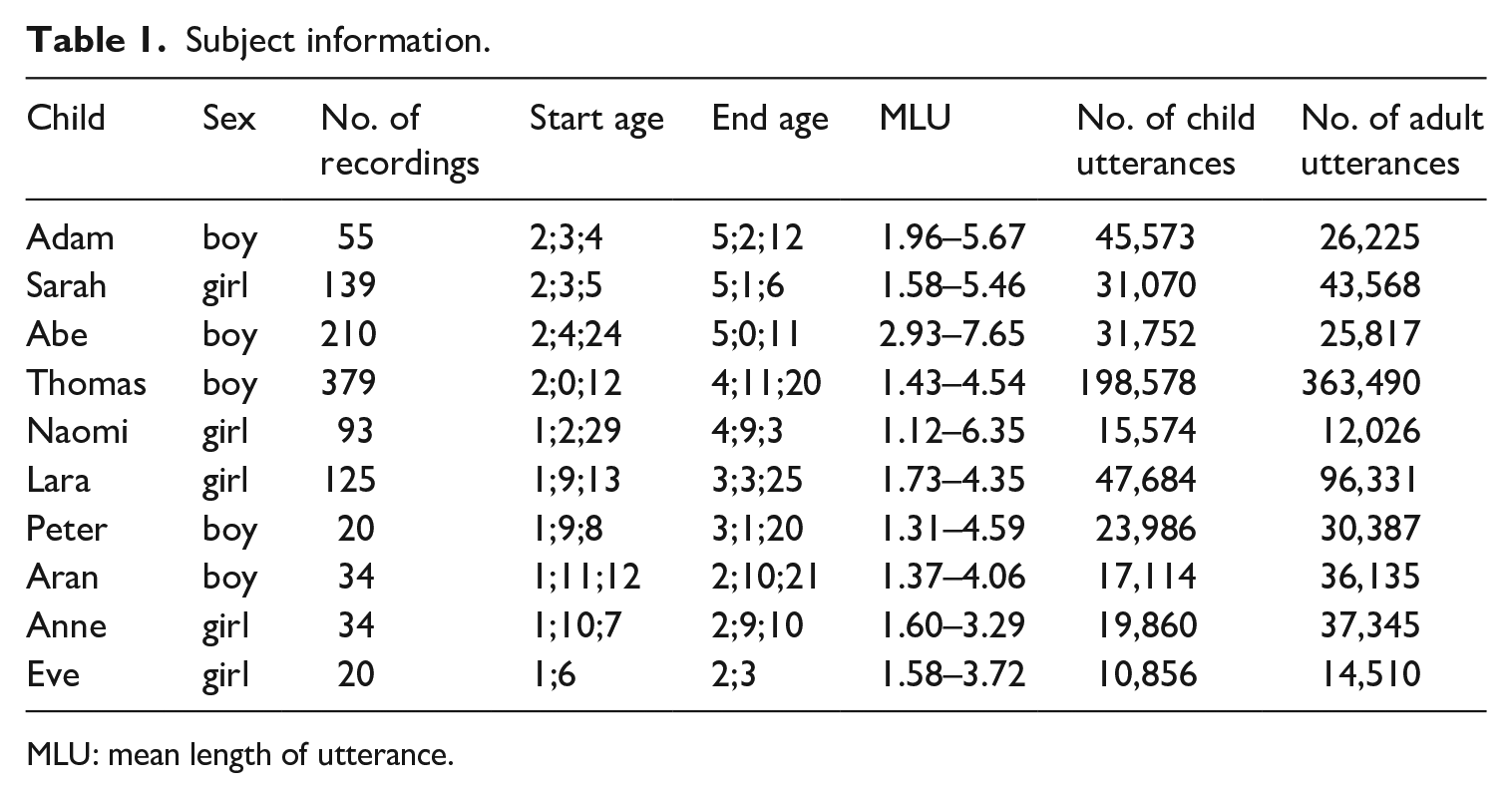
MLU: mean length of utterance.
Coding
We used the CHILDES keyword search command to retrieve target utterances containing all, every, or each. The preceding five utterances and the following two in addition to the target child utterance were used since understanding a child’s utterance requires context. Child imitation was excluded if it was a partial or full repetition of the previous five utterances except for self-repetition. Mechanical imitation was less likely in children over 3 years old, so we no longer considered imitation from them. We excluded children’s songs and rhymes, as well as dubious target words marked with [+?] (indicating best guess) in the transcripts. Among the target sentences, some contain ‘xxx’ (unclear), ‘+ . . .’ (unfinished), or ‘+/’ (interrupted) and lack the crucial context for syntactic analysis, so they were only used in counting the frequency of the target word but were ruled out in syntactic analysis. Idioms such as all right, every now and then, and each other were also counted but excluded from syntactic analysis. Tables 2 –4 provide coding details. 3 The coded data files are available at the following link: https://doi.org/10.17605/OSF.IO/T7QZM.
Coding of all.

PP: prepositional phrase; FQ: floating quantifier.
Coding of every.
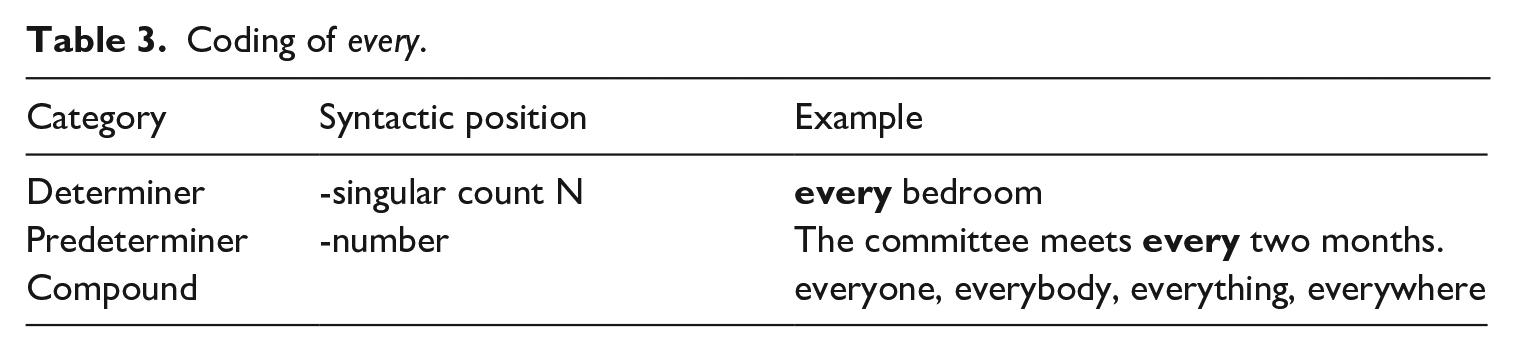
Coding of each.
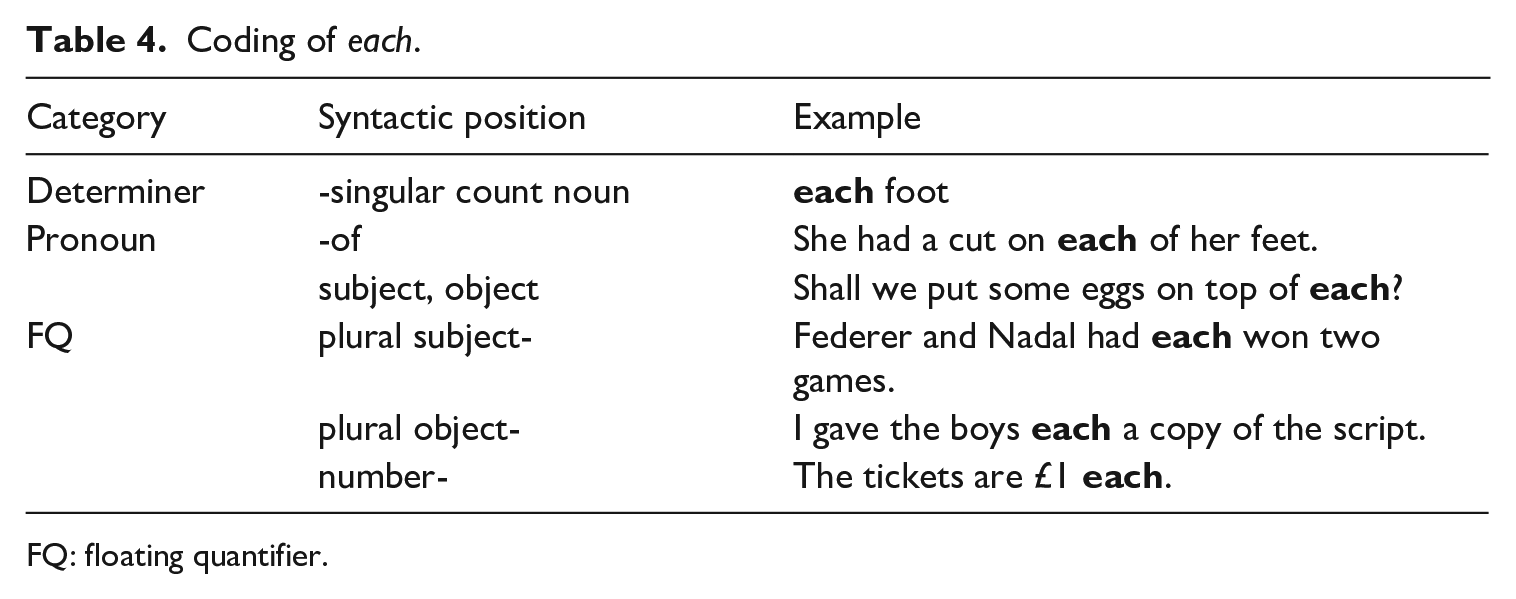
FQ: floating quantifier.
Results
In this section, the emergence and frequency of the universal quantifiers and their different uses are reported. When calculating the frequency of each quantifier and its different uses, we compare child speech and adult input to find out whether there are correlations or significant differences between the two. In the last subsection, we highlight some non-target forms produced by the children.
Emergence sequence
Table 5 summarizes each quantifier’s emergence. Given that all is recorded in the earliest recordings of the first four children, and prior to the age of 2 in the other children, it is safe to say that all emerges before 2. All the children began to produce every after all, mostly after the age of 2. Each appears after 2;6, and four of the children did not produce it. Next, we examine the frequency of each quantifier in the input, to determine whether the sequence in (4) can be explained by input frequency.
Emergence of English universal quantifiers.
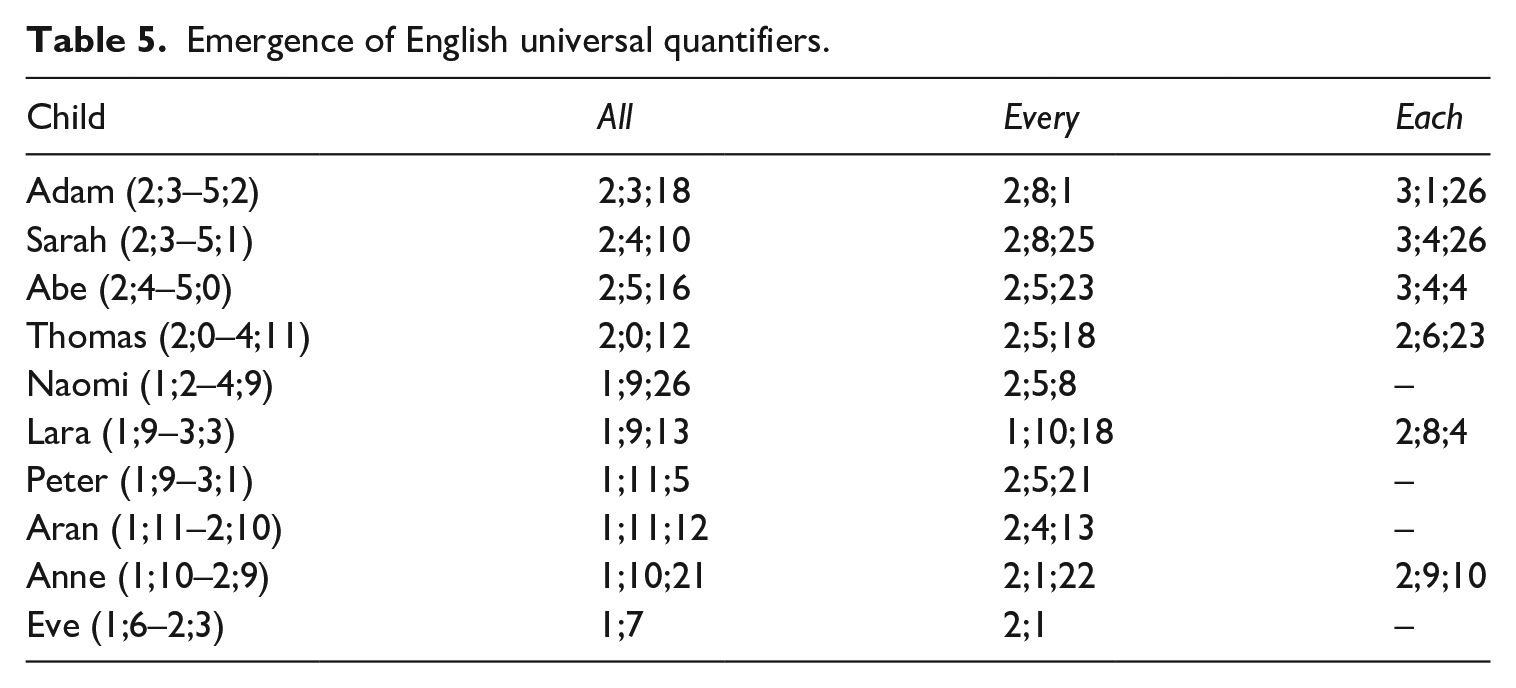
(4) Emergence order of universal quantifiers in child English all>>every>>each
Frequency
Table 6 shows the order of each quantifier’s frequency in the adult input: all higher than every, and every higher than each. This order is consistent with the emergence order in (4) and the frequency order in the child language. Nevertheless, the children produce the quantifiers at a significantly lower frequency than the adults. At the individual level, each child produced all less frequently than their caregivers. At the group level, both the paired-samples t-test and Wilcoxon signed-rank test, with relative frequency (i.e. the ratio of the quantifier tokens to the total number of utterances) as the dependent variable, show a significant difference between the children and adults in the frequency of all, t(9) = −3.687, p < .01; Z = −2.803, p < .01; every, t(9) = −2.569, p < .05; Z = −2.090, p < .05; and each, t(9) = −2.444, p < .05; Z = −2.073, p < .05. No significant correlation was found between the children and adults (ps > .403).
Frequency of universal quantifiers in child English and adult input (in raw token number and token number per 1000 utterances).
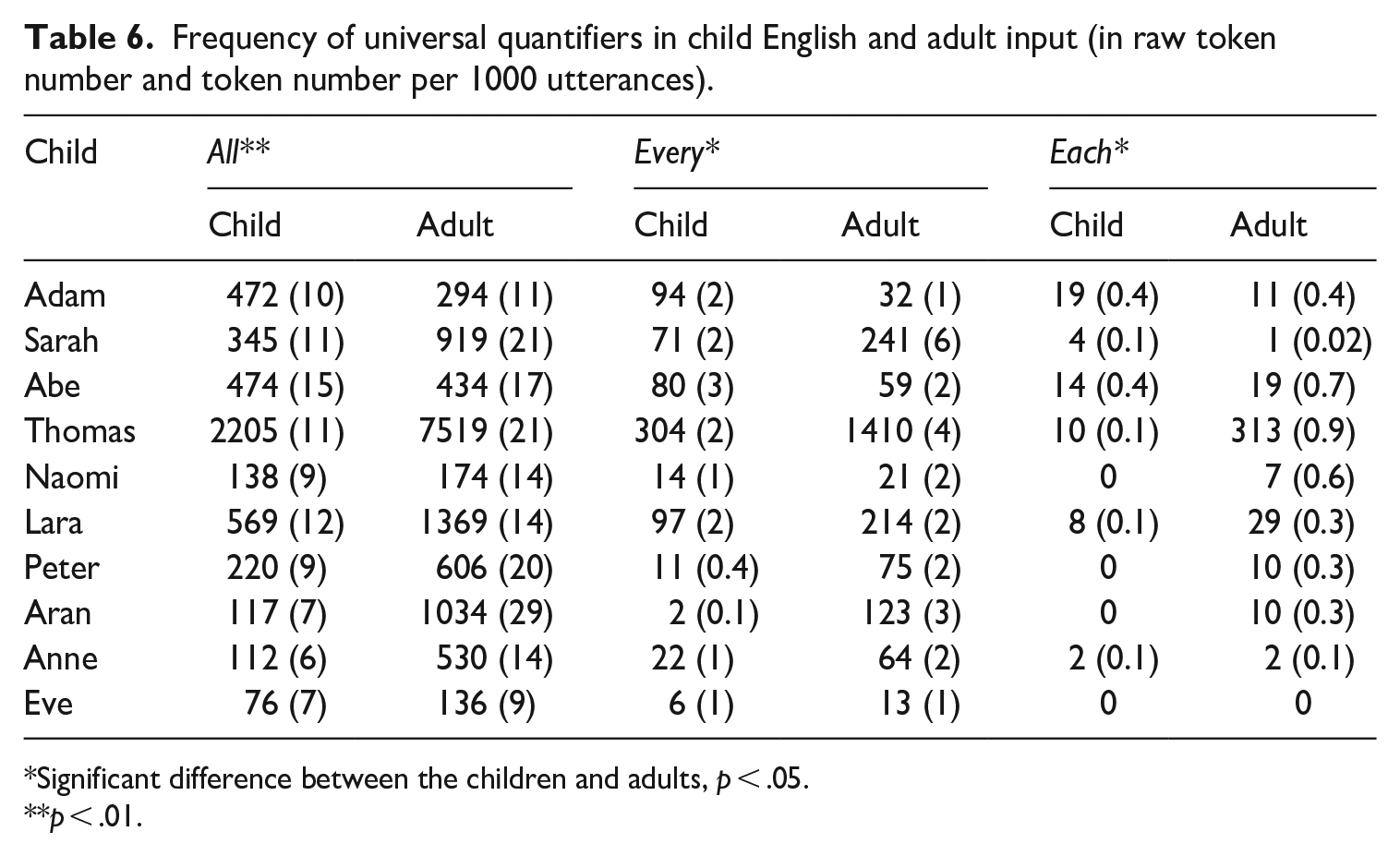
Significant difference between the children and adults, p < .05.
p < .01.
Different uses of all
Figure 1 summarizes the distribution of all’s different uses in child and adult speech at the group level. The adverb or FQ use (simplified as the adverb use) accounts for around half of the total tokens of all in the adult input, 4 followed by the predeterminer use, the pronoun use, and then the determiner use. There is no significant difference in the relative frequency of all the uses between the children and adults (ps > .169 in paired-samples t-tests, ps > .203 in Wilcoxon signed-rank tests), except for the pronoun use (p = .025 in paired-samples t-test, p = .022 in Wilcoxon signed-rank test). Positive correlations between the children and adults were found for the predeterminer use, r(8) = .652, p = .041, statistical power = .54, and the pronoun use, r(8) = .756, p = .011, statistical power = .7424, but not for the other uses (ps > .129).
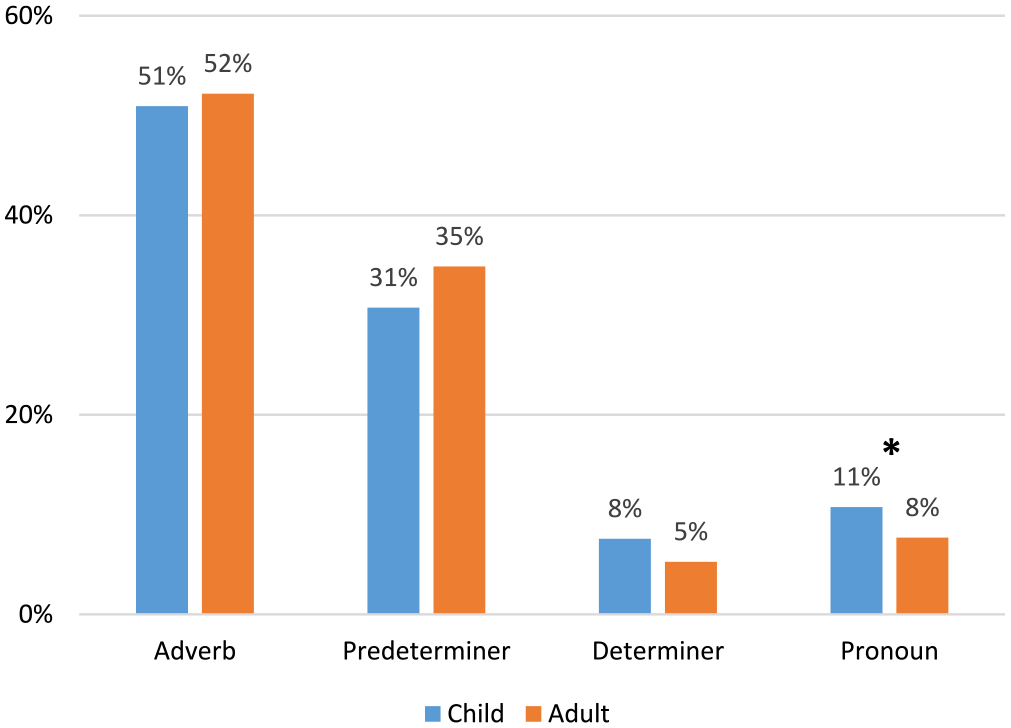
The distribution of different uses of all in child and adult speech (group mean).
Figure 2 compares the distribution of the four uses at the individual level. 5 In the adult input (except the caregivers of Thomas and Aran), the adverb use is more frequent than the other uses. Most of the children also use the adverb all more frequently, except for Naomi and Aran. The exception of Aran can be explained by his input, and Naomi’s frequency of the adverb use is actually close to that of the determiner use.
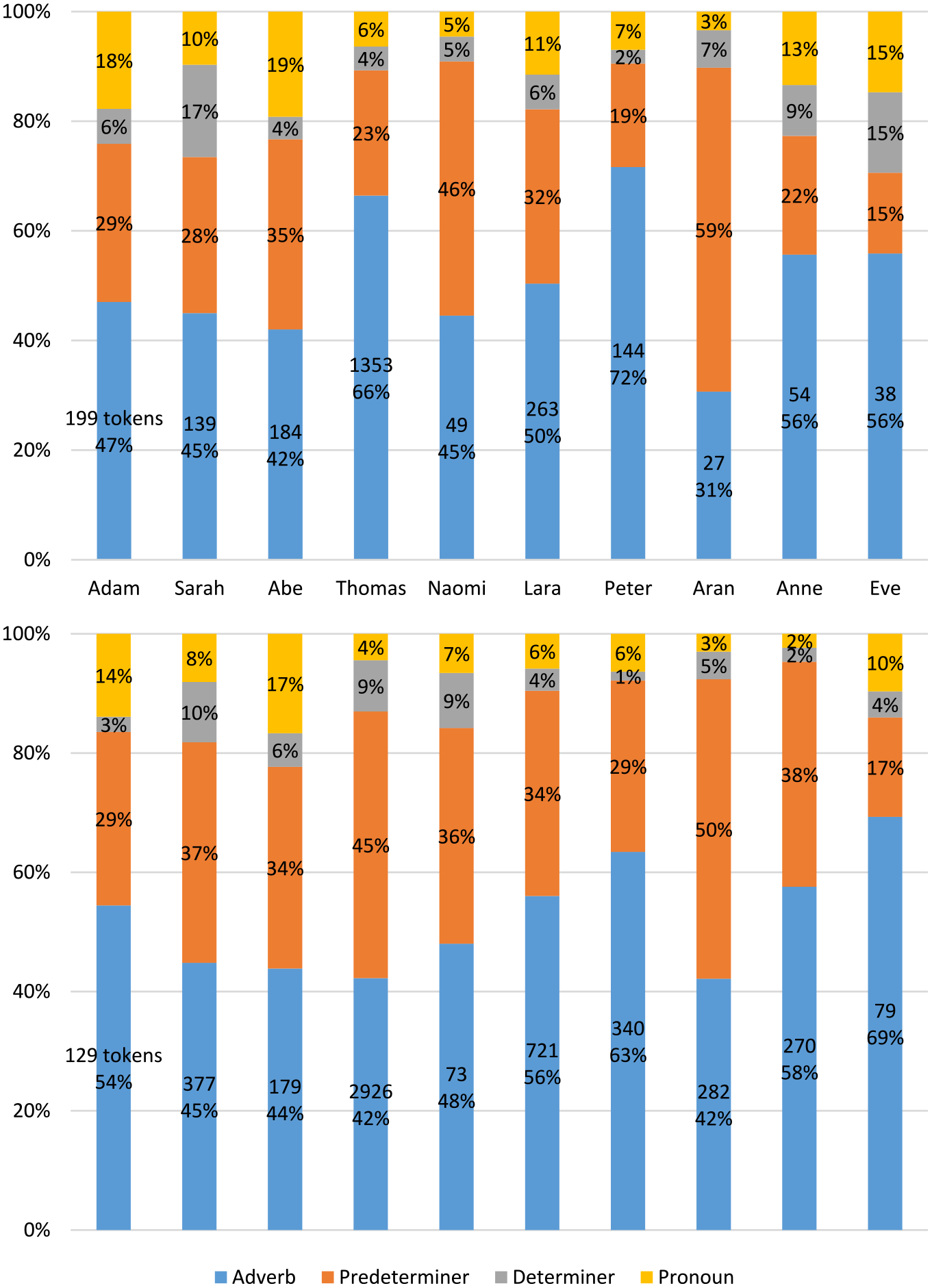
The frequency of different uses of all in child speech (above) and adult input (below).
Overall, the statistical analyses do not reveal a difference between the children and adults in the frequency of the adverb use of all throughout their observation periods. However, the emergence of the four uses in each child shows an early overreliance on the adverb use compared with adults. Starting with Thomas, we found that all first appears in all done at 2;0;12. In the next six months, his all is mainly used in all done and occasionally in all gone where all modifies the past participle, and is an adverb, as shown in (5). The first predeterminer use occurs in all the choc(olate)-choc(olate) at 2;0;16. The first reliable determiner use in all day long appears at 2;5;16. The first pronoun use in all fall down occurs at 2;4;27. There is one caveat: due to subject drop in early child language, sometimes all looks like a pronoun subject, but is actually an adverb between the omitted subject and the predicate, as shown in (6). The children’s use of pronouns is significantly more frequent than that of adults (see Figure 1), which may be caused by their subject drop, rendering the adverb all looking like a pronoun subject.
(5) Grapes (6) Mother: They’re all having a bath? Anne: Mother: Now they’re
Besides Thomas, four of the children produced the adverb use earlier than the (pre)determiner use, and the two uses emerged in Aran at the same time. Anne, Lara, and Sarah are no different from them after a closer analysis of the context. For example, Anne’s first analyzable all appeared in all fall down at 1;11;18, which was coded as a case of pronoun, but the context suggests that she might have dropped the subject, and all is underlyingly an adverb before the predicate. Peter was the only child to produce the determiner use first at 1;11;5, and then the adverb use in all finished two days later. In the following three recordings, he only produced one token of the determiner use and 31 tokens of all finished. Most of the children started with the adverb all and used it frequently, and high-frequency expressions such as all done and all finished contribute to this frequency.
Finally, Figure 1 shows that the children’s use of the predeterminer all is less frequent than that of adults, while the use of the determiner all is more frequent. It happens because some children omitted the after all, using the structure that generally expresses genericity in adult language to convey the definite meaning. 6 As an example, Eve’s all tea produced at 1;9 should be all the tea according to the context.
Different uses of every
Figure 3 shows that the caregivers used every most frequently in compounds, where every is generally the determiner, followed by the determiner use, and then the predeterminer use. The distribution of the compound, determiner, and predeterminer uses in child language does not differ significantly from that in adult speech (ps > .147 in paired-samples t-tests, ps > .109 in Wilcoxon signed-rank tests). No significant correlation was found between children and adults for the compound and determiner uses (ps > .924, no result for the predeterminer use due to small sample size). Individually, in 7 of the 10 children, compounds were used more frequently than adults, and two children used every exclusively in compounds, suggesting their reliance on the high-frequency compounds. Up to 5 years old, children do not exhibit the predeterminer use, which has extremely low frequency in adult input.
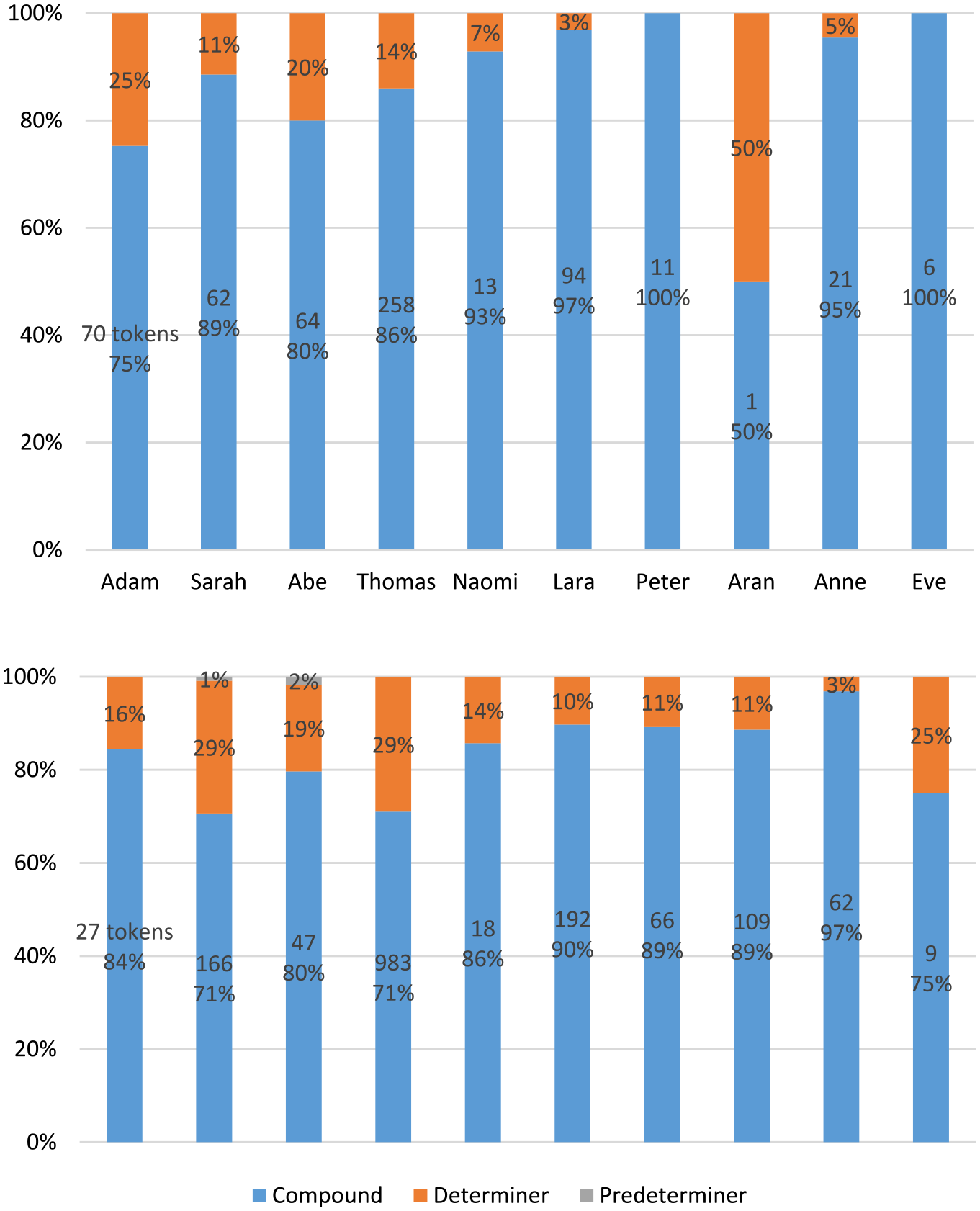
The frequency of different uses of every in child speech (above) and adult input (below).
We calculated the relative frequency of every used in adverbials, such as every time and everywhere, in child and adult speech, as shown in Table 7. No significant difference (p = .509 in paired-samples t-test, p = .333 in Wilcoxon signed-rank test) and no significant correlation (p = .729) between the children and adults was found.
The frequency of every used in adverbials.
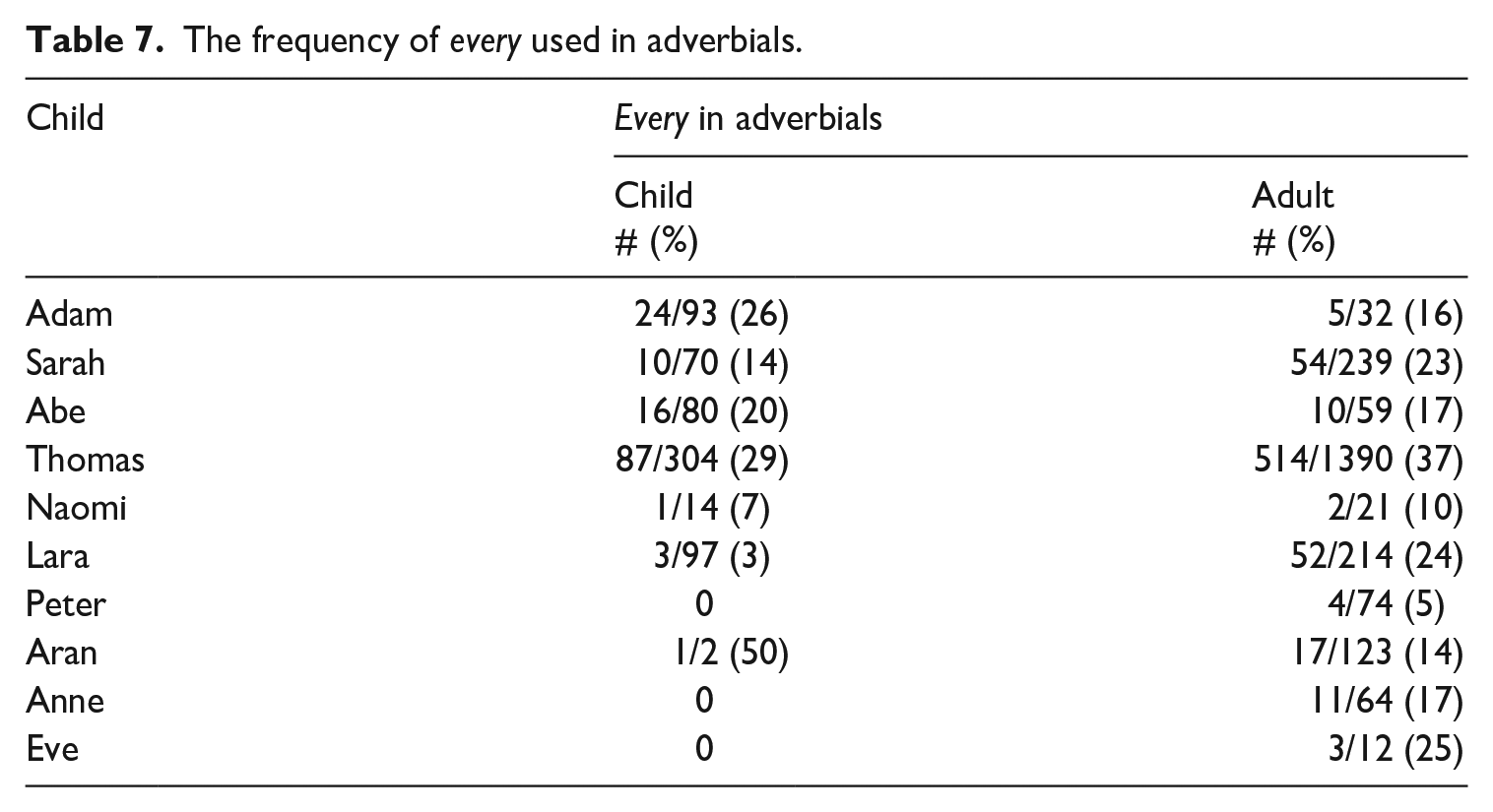
Peter, Anne, and Eve mainly used every in compounds such as everybody and never used it in adverbials. In the remaining seven children, Thomas and Abe first used every in adverbials and then in the subject or object. For instance, Thomas first produced several tokens of everywhere at 2;5, and one month later produced everything; from 2;8;3, he produced every as a standalone determiner, but mainly in time adverbials such as every time. Four children – Aran, Lara, Sarah, and Adam – first produced every in adverbials after compounds were excluded. Noticeably, Sarah’s every was used exclusively in adverbials, mostly in time adverbials and one in the place adverbial every place. Naomi is the only exception: she first produced draw every book at 2;11, while the adverbial use in everywhere was not produced until 4;9.
In summary, on the one hand, every first emerges in compounds with predominantly high frequency, suggesting young children’s reliance on high-frequency expressions in the input; on the other hand, although every in the adult input is mainly used in the subject or object instead of the adverbial (see Table 7), most children first use it in adverbials after compounds have been excluded.
Different uses of each
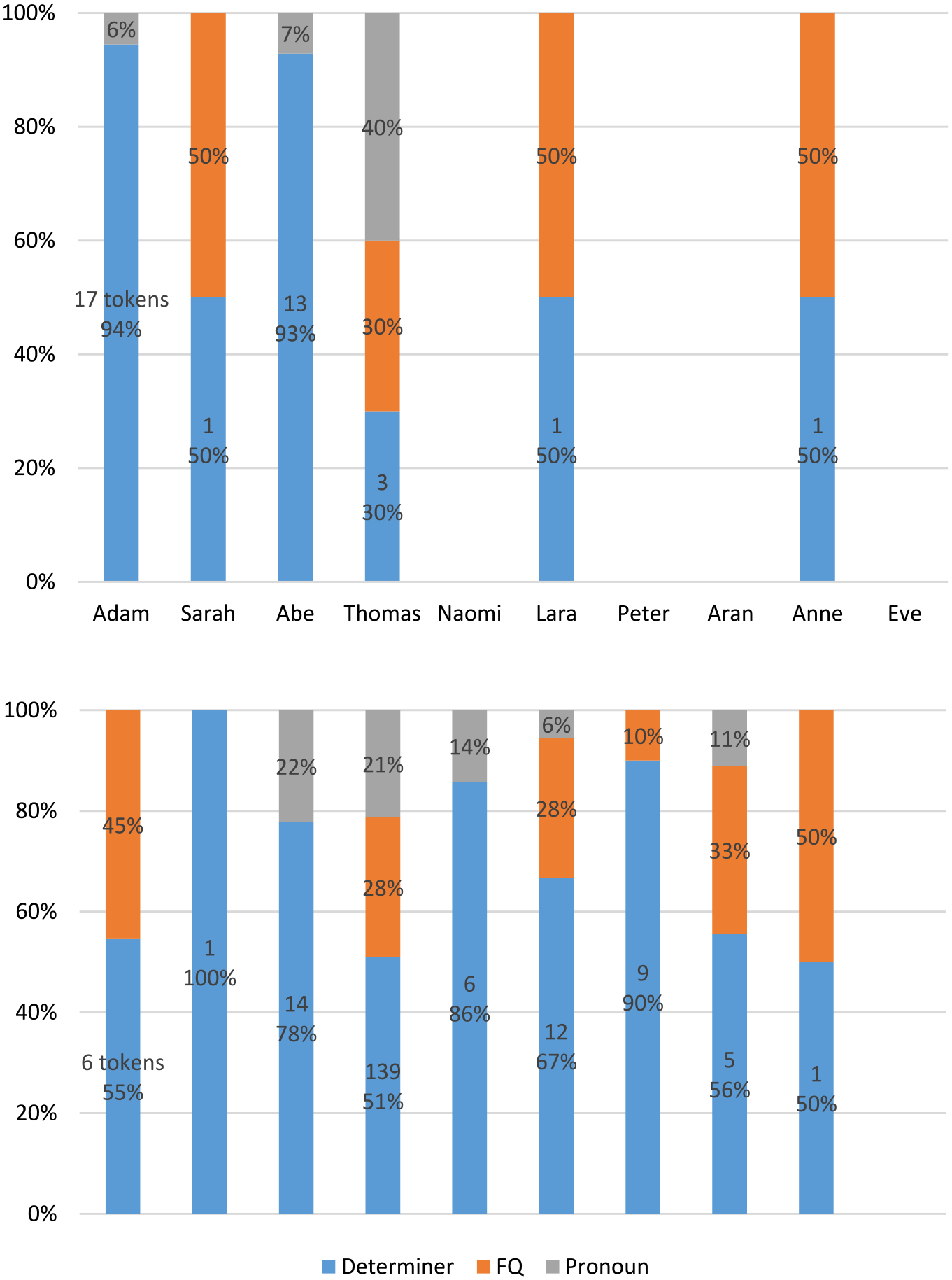
Only nine children’s caregivers and six children produced each (see Table 6); among them, eight children’s caregivers used the determiner each more frequently than the FQ each, but only two children did so, and the other four children (Thomas, Sarah, Lara, and Anne) used them with the same frequency, as shown in Figure 4. In a word, more children than adults favor floating each. At the group level, there is no significant difference in the relative frequency of the three uses (ps > .436 in paired-samples t-test, ps > .414 in Wilcoxon signed-rank tests) and no significant correlation (ps > .235) between the children and adults. 7
The frequency of different uses of each in child speech (above) and adult input (below).
The first each Thomas produced is FQ as in (7). By saying two each, he meant to have two blue ones and two green ones. At 2;8;23, he produced four tokens of the pronoun use, all in one of each. From 3;11;5 on, he started using the determiner each. Sarah and Abe also produced the FQ use or used each in the adverbial before the other uses. For instance, Abe first produced each at 3;4;4 in the time adverbial each day, 11 out of his 14 tokens of each are in each day, and one in each time. When Anne started to use each at 2;9;10, she produced four steps each (FQ) and each sides (determiner). Adam and Lara were the only ones who used the determiner each first.
(7) Thomas: blue ones. Mother: you want the blue ones. Thomas: No, green ones too. Mother: The green ones too. Thomas: Two
There are three types of floating each (see Table 4), in order of frequency in adult input: (i) after the plural subject; (ii) after the plural object; and (iii) after the number word. Surprisingly, the first two with higher frequency do not appear in the child data.
To summarize, the determiner use is generally far more frequent than the FQ use in the input, but among the six children who produced each, three produced the FQ or adverbial use first, and one started with both uses simultaneously. Moreover, four children produced both uses with the same frequency throughout their observation periods. In a word, the children preferred using each in adverbials more than the adults did.
Non-target production
Although the children produce universal quantifiers early, non-adult-like productions persist for a long while. Some children float all to a non-target position. All in (8) should be placed in front of the object to be a predeterminer because only the pronoun object can be followed by the floating all.
(8) a. *Have you eaten your dinner b. *I wanna play after I eat my orange c. *And a hawk eats the hawk trap d. *May I use the other one
English-speaking children are found to accept over-pluralized QNPs and produce over-pluralized QNPs with every (Gordon, 1981; Roeper, 2007). We find abundant such cases, including each as shown in (9). In addition, the QNP containing every or each requires a singular verb when serving as a subject, but such subject-verb agreement is absent in some children’s data, as in (10). This may be because children have not mastered subject-verb agreement in general. However, an analysis of Adam’s data before 4;9 shows that Adam had been able to add -s to third-person singular verbs as in (11a), but he did not do it in (11b), which suggests that as a universal quantifier, each may mislead Adam into thinking that the following verb should be plural.
(9) a. * b. *To make (10) * (11) a. b. *
Another common problem is dropping the after all, failing to mark definiteness. The mother’s recast in (12) indicates that the reference of the letters is fixed in the context. The child did not mean all letters in the world, but those in the context, so all the letters should be used.
(12) Mother: Who’s that? Aran: Postman Pat. Mother: What’s he doing? Aran: *Put Mother: Putting all the letters in there. (2;3;2)
Discussion
Preference for A-quantification
All the 10 children in our corpus data first produce all among the three universal quantifiers, and most of them first use it as an adverb or FQ. All emerges as an adverb in child English at a similar time to the universal A-quantifiers in other languages, for example, dou ‘all’ in child Chinese (see Lee, 2012). Most of the children use all as an adverb more frequently than as a (pre)determiner. The high frequency even causes floating errors in contexts where the less frequent predeterminer is the target as shown in (8). Put succinctly, English-acquiring children use all as an adverb earlier and more frequently than as a (pre)determiner in their early development. The use of every in adverbials (e.g. every time) emerges early in child English, while its use in QNPs as subjects or objects (e.g. every boy) is less frequent (Strauss et al., 2003). In our data, most children first produce every in adverbials after compounds are excluded. Finally, three of the six children who produced each first use it as FQ or in adverbials such as each day, and one started with both uses simultaneously; besides, more children than adults favor producing the floating each. In summary, young English-speaking children prefer to use universal quantifiers in A-quantification.
English-speaking children are generally in line with Chinese-speaking children, relying more on A-quantification than D-quantification initially. This preference suggests possible influence from cognitive and language universals. Event quantification is pervasive in human cognition, and cross-linguistically, A-quantification is more fundamental than D-quantification (Bach et al., 1995; Vieira, 1995). On the other hand, English-acquiring children do not show the same strong developmental discontinuity of A- before D-quantification as Chinese-speaking children, likely due to the influence of different adult inputs given by typological differences.
Besides cognitive and language universals, adult input which reflects language-specific features also seems to bring about English-acquiring children’s preference for universal A-quantification, as the frequency of all as an adverb in the children’s speech matches input frequency (see Figure 1) and the use of every in adverbials does not differ significantly between children and adults (see Table 7) all through their observation periods. Despite this, there is no significant correlation between children and adults in the frequency of the adverb all, as well as in the frequency of every in adverbials. Moreover, input frequency cannot explain the emergence of the adverb(ial) use of these quantifiers: only half of the tokens of all in the input are adverbs, but most of the children begin with the adverb use, or in other words, 100% frequency of the adverb use; while every is primarily used for subjects or objects in adult input, most children first produce every in adverbials after compounds are excluded; and half of the children begin with the adverb(ial) use of each despite the low frequency of such uses in the input. Finally, even though the floating each is less frequent than the determiner each in adult input, four out of the six children who have used each produce both uses with the same frequency (see Figure 4).
Children’s preference for A-quantification is a prerequisite for the event quantification account of children’s spreading errors with D-quantifiers (though, as noted above, there are also other explanations on offer, e.g. Aravind et al., 2017; Minai et al., 2012). It is possible for children to interpret D-quantifiers as adverbs since A-quantification emerges early and is more fundamental in their grammar. A-quantifiers are ambiguous: which NP or NPs in the sentence are their quantifying domain is a problem (Evans, 1995). Therefore, children may break out of the restriction of the D-quantifier and associate it semantically with the other NP(s) in the sentence or even the other entities in the physical context.
Input frequency and other factors
We have examined input frequency at both the lexical and abstract levels. At the lexical level, there seems to be input frequency effects on the emergence and frequency of the three universal quantifiers. All emerges earlier and is used more frequently than every and each in child English. This emergence and frequency order coincides with the order of frequency in adult input. However, children produce the three quantifiers with a significantly lower frequency than adults and there is no significant correlation between children and adults in producing them. We argue that the lower frequency is caused by the cognitive/semantic complexity of universal quantifiers because compared with other lexical items, their interpretation involves mathematical logic. On the non-distributive-partially distributive-completely distributive scale, cognitive complexity increases, so within the three quantifiers all (non-distributive) emerges earlier than every (partially distributive) and every earlier than each (completely distributive) (see Beghelli & Stowell, 1997; Knowlton & Lidz, 2021; Tunstall, 1998). The earlier appearance and higher frequency of every than each may also be explained by formal complexity: every only appears before NPs while each appears in different positions as a determiner, an FQ, or a pronoun. Thus, cognitive and formal complexity, in interacting with input frequency, determine the emergence and frequency of the three universal quantifiers.
At the abstract level, the distribution of the different uses of a quantifier in adult input also seems to influence that in child language, as shown by the parallels between the children and adults in Figures 1 –4. For instance, the children pattern like adults in producing every in compounds with very high frequency; they do not produce the predeterminer every, which has a low frequency in adult input (see Figure 3). The predeterminer and pronoun uses of all were found to be significantly positively correlated between the children and adults, suggesting input frequency effects. However, no significant correlation was found between the children and adults for all the other uses of the three quantifiers. Moreover, there are three types of floating each in the input, but the first two with higher frequency do not appear in the child data. In other words, input frequency plays an important role in the acquisition of some uses of universal quantifiers, but not all.
So far, we have shown that input frequency alone cannot explain the acquisition of universal quantifiers at both lexical and abstract levels (cf. Ambridge et al., 2015). Children’s non-target production, such as over-pluralization of QNPs, problematic floating of all, and dropping the after all, is the most striking qualitative difference from adults. Children do not acquire quantifiers simply by imitating adults but generate quantified expressions based on the rules in their developing grammatical systems. For instance, they have never heard each sides from adults, yet produce such expressions. The only way they can do this is to apply their own pluralization rule across the board to the NPs following different quantifiers, despite the difference between these quantifiers in morphosyntactic restrictions. The distributivity feature is a marked semantic relation embodying a higher degree of cognitive complexity. Many children seem to have trouble in discerning and mastering the distributive feature of each and every which is associated with singular form in morphosyntax, and thus fail to mark the NP that they quantify as singular.
Children’s problematic floating of the predeterminer all may be caused by their preference for the adverb all, and, arguably, the high frequency of the adverb all in adult input (see Figure 1). However, their omission of the after the predeterminer all is against the input frequency account, as the predeterminer use of all is higher in frequency than the determiner use in adult input (also see Figure 1). Again, these non-target productions likely result from children’s own developing grammatical systems.
Why is A-quantification easier?
Young children’s preference for using all, every, and each in A-quantification cannot be explained by mere frequency as shown earlier. Then where does the preference come from? We argue that it is from the cognitive ease of A-quantification compared with D-quantification. This has something to do with the grain size of what’s being quantified: A-quantification operates on the whole event while D-quantification requires zooming in on particular event participants. Some have thought that children pay attention to objects before actions and events in cognitive development, but our study shows that in quantification they go from coarse-grained to fine-grained quantification, first grasping the entire event before focusing on individual objects. It is the development of the ability to count and compute concrete entities that get children from A- to D-quantification. Parents use each to quantify entities physically present in small numbers but use every to quantify over times or individuals that are not present (Knowlton & Gomes, 2022). This contrast is also found in our child data. The later emergence and lower frequency of each compared with every suggest that children are less able to quantify over concrete objects than to quantify over times or events.
Conclusions
There are three major conclusions regarding the acquisition of universal quantifiers all, every, and each based on the English child corpora we examined. First, as hypothesized, universal A-quantification is preferred over D-quantification in early child English. Second, input frequency correlates with some aspects of children’s use of universal quantifiers, for example, the frequency of the predeterminer all. However, children’s early overreliance on A-quantification and their non-target productions cannot be explained by mere input frequency, but seem to involve multiple factors, such as cognitive complexity, children’s developing grammatical systems, and input frequency, interacting with each other. Third, young children’s preference for A-quantification cross-linguistically may be explained by event quantification being cognitively less demanding than entity quantification. One of the limitations of this corpus-based study is the limited sample size of each in the children’s naturalistic speech. Therefore, our generalization that children initially prefer to use each as an adverb or in adverbials still awaits verification from future studies. We also hope that future experimental studies will provide further psycholinguistic evidence for our conclusions.
Footnotes
Acknowledgements
We thank Katherine White, Chloë Marshall, and two anonymous First Language reviewers for their insightful comments on previous versions of this manuscript. We are indebted to Ziyin Mai, Hannah Lam, Jiahui Yang, Zhuang Wu, Hua Gao and the audience at the 29th Annual Conference of the International Association of Chinese Linguistics (IACL-29), especially Thomas Lee, Xiaolu Yang, Aijun Huang and Ting Xu, for the helpful discussion and valuable suggestions. We also thank Joyce Wong, Bradley C. Phillips, Bianca Villamor and Jiangling Zhou for their assistance with this project.
Abbreviations
In this study, D = determiner, FQ = floating quantifier, N = noun, NP = noun phrase, PP = prepositional phrase, QNP = quantified noun phrase, VP = verb phrase, DistP = distributive phrase.
Author contributions
Funding
The author(s) disclosed receipt of the following financial support for the research, authorship, and/or publication of this article: This research was supported by grant GD20CWY16 from the Guangdong Planning Office of Philosophy and Social Science, China and a visiting scholarship provided by the China Scholarship Council to Xiangjun Deng.
