



Abstract
This article explores the applicability of mean length of utterance (MLU) as a language assessment measure for Georgian child language, as to-date, Georgian, a morphologically rich language with numerous inflectional categories, experiences an extensive lack of instruments for early language assessment. To this end, a set of guidelines for calculating Georgian MLU was developed based on the analysis of a longitudinal corpus of two Georgian-speaking children aged 12–35 months. This was supported by the findings of previous studies on Georgian acquisition. Furthermore, the guidelines were used to compare MLU in morphemes (MLU-m) with MLU in words (MLU-w) and MLU in syllables (MLU-s) to determine the most suitable method for assessing morphological development in Georgian. These results indicate that MLU-m closely aligns with the description of language development in Georgian children. MLU-s is useful for demonstrating early linguistic development, while MLU-w correlates with age but does not capture changes within words over time. Further testing on a larger corpus is needed to refine the guidelines for more accurate assessment of Georgian-speaking children.
Keywords
Introduction
Documentation of children’s languages in naturalistic contexts has exceptional validity for measuring language use. This has been considered the gold standard for assessing language status in children (Loeb et al., 2000; Tager-Flusberg & Cooper, 1999). Among the various procedures based on natural language analysis that are available for evaluating morphosyntactic development, mean length of utterance in morphemes (MLU-m) is reported to be the most frequently used (Loeb et al., 2000). Furthermore, while MLU and age demonstrate a developmental relationship across languages, the specific features and complexities reflected in MLU can vary based on the linguistic characteristics of a particular language, for example, the agglutinative nature of its grammar.
Georgian, the official language of the Republic of Georgia, has around five million speakers and belongs to the Kartvelian (South Caucasian) language family (Tuite, 2008). It is primarily an agglutinative and ergative (Boeder, 1979; Comrie, 1978) language with poly-personal agreement. However, to date, none of the existing procedures for evaluating morphosyntactic development have been adapted to Georgian, and no systematic database has been developed to facilitate the establishment of normed standards of Georgian language acquisition or to measure morphosyntactic development for the clinical assessment of Georgian-speaking children. The sole comprehensive screening tool adapted and normed for Georgia, which relates to communication development, is the Ages and Stages Questionnaire, 3rd edition (ASQ-3; Zirakashvili et al., 2018). It identifies developmental progress in children between the ages of 1 and 66 months and can be used only for screening purposes.
That said, it should be noted that the psycholinguistic aspects of Georgian acquisition have been discussed in several works by Georgian scholars. These works were mainly based on diary studies (Avalishvili, 1961; Chrelashvili, 1965; Imedadze, 1957, 1960, 1967; Kakhadze, 1969; Uznadze, 1947). Imedadze and Tuite (1992) examined the process of Georgian first language acquisition within the realm of Slobin’s (1989) cross-linguistic inquiry. They meticulously scrutinized the diary notes collected by Avalishvili, Chrelashvili, Kakhadze, and Imedadze. Their findings revealed that during the one-word phase, children predominantly employ nouns in the nominative case. This preference persisted for several months following the commencement of multi-word utterances (Imedadze & Tuite, 1992; see Supplemental Appendix 3).
Notably, with respect to verbs the authors observed that at around 1;6 children predominantly utilize imperative verbs, particularly those in the second person, along with verbs in the first person singular present tense (e.g. mome ‘give me’ and ade ‘get up’). Around age 1;7, the use of the indicative mood emerges, and stative verbs in the present tense, such as minda ‘want’, make their debut. However, changes in state verbs continue to be employed in imperative form. By age 1.9, indicative mood verbs prevail.
Subsequently, during the latter part of the second year and the early stages of the third year, the objective person marker ‘m-’ and the subjective first-person prefix ‘v-’ begin to appear. It is only toward the end of the second year or the beginning of the third year that Georgian children start producing present-series forms for change-of-state verbs. Simultaneously, a dichotomy between present stem and aorist stem usage emerges, primarily for first-conjugation (transitive change-of-state) verbs.
In addition, children tend to employ second-person verb forms when referring to first or third persons. However, by the conclusion of the third year, most person-marking issues had dissipated, with only a few residual problems remaining, such as the accurate selection of the appropriate third-person marker and the infrequent utilization of third-person plural agreement with multiple animate subjects. Furthermore, the acquisition of the quasi-lexical category ‘version’, which pertains to the orientation of an action either toward or away from the subject, is largely accomplished with minimal errors.
Considering findings relating to Georgian acquisition and the absence of normed instruments for measuring early linguistic development in the language, this article uses developmental information about Georgian morphosyntax from previous studies and a new longitudinal corpus to form a set of guidelines for calculating the MLU for Georgian early language acquisition. Moreover, recognizing the vital role of morphosyntax in language development and acknowledging the unique linguistic features of Georgian as an agglutinating language, we tailored our MLU guidelines to the specific characteristics of the language. Building on Brown’s (1973) basic tenet, our research examines how morpho-syntactic changes in the early acquisition of Georgian affect MLU scores over time. The comparison of developmental milestones with changes in MLU scores enables us to compare our proposed measure with other typologically related and unrelated languages, thus highlighting the distinctiveness of the MLU guidelines for Georgian (see Supplemental Appendix 3). Nonetheless, it should be noted that additional effort is required to establish comprehensive MLU guidelines for detecting language disorders in Georgia; thus, our endeavor to confirm the validity of MLU as a measure of language development forms the first step in this process.
Mean length of utterance
MLU is one of the earliest and extensively documented cross-linguistic measures of language development. In Brown’s (1973) seminal work, naturalistic speech samples were used to ascertain a speaker’s linguistic age by calculating the average length of their utterances within a given corpus. The foundational premise underlying the MLU calculation is that as language develops, a speaker’s utterances progressively increase in length. Brown’s findings consistently revealed developmental patterns in all three children.
According to Brown (1973), in English, the initial morphological marker to surface between 19 and 28 months is the progressive (-ing), succeeded by the plural (-s) emerging from 24 to 30 months. The irregular past tense emerges at 31–34 months, followed by possessive morphological marker (’s). Within the time frame of 35 to 40 months, the regular past tense (ed) becomes apparent. The third person singular marker (-s) emerges within the same period, and finally, the third person irregular present tense form emerges between 40 and 46 months. Irregular forms of the plural are typically acquired at a later stage, often extending beyond preschool years. This morphological development corresponded to an increase in the MLU value. Thus, studies such as by Brown (1973) and subsequent research by Miller and Chapman (1981) and Wells (1985) have demonstrated that MLU serves as a more reliable indicator of grammatical proficiency than chronological age, showing that an increase in MLU scores reflects the development of children’s grammatical proficiency, beyond the variability observed in the developmental pace of children’s language skills.
Research has also affirmed the reliability of MLU as a measure of early linguistic development in languages other than English (Allen & Dench, 2015; Dromi & Berman, 1982; Ezeizabarrena & Garcia Fernandez, 2018; Rice et al., 2010), as well as establishing a developmental relationship between MLU, grammatical development, and age in languages typologically similar to Georgian, such as Turkish (Ege et al., 1998). A correspondence between children’s syntactic development and MLU was also reported for a later adaptation of the LARSP 1 to Turkish (Topbas et al., 2012; see Supplemental Appendix 3).
Numerous published studies investigating MLU adaptations in languages with more complex morphological systems than English underscore the need to consider morphological complexity in the evaluation of MLU across languages, including Dutch (Arlman-Rupp al., 1976), German (Park, 1981), Spanish (Linares, 1981; Linares-Orama & Sanders, 1977), Iclandic (Thordardottir & Weismer, 1998), Hebrew (Dromi & Berman, 1982), Irish (Hickey, 1991), Inuktitut (Allen & Crago, 1996), and Russian (Tomas & Dorofeeva, 2019), among others. The importance of such adaptation has been highlighted for some agglutinating languages such as Turkish (Ege et al., 1998) and Finnish (Nieminen, 2009).
The use of MLU as a valid measure of linguistic development faces challenges rooted in methodological considerations, particularly in determining what constitutes a morpheme. This concern is accentuated in languages such as Hebrew, which is known for its high degree of synthesis and intricate root-pattern system, leading to ad hoc decisions about morpheme identification (Dromi & Berman, 1982). Consequently, diverse guidelines for morpheme counting have emerged with alternative MLU calculation methods, such as MLU in words (MLU-w) or syllables (MLU-s). The rationale for using words and syllables per utterance lies in their time efficiency and applicability across languages (Tomas & Dorofeeva, 2019). Certain studies (Arlman-Rupp et al., 1976; Hickey, 1991) have examined the number of words (MLU-w) or syllables (MLU-s) per utterance and compared their reliability against MLU-m. For example, research on Dutch children found strong correlations between MLU-w, MLU-s, and MLU-m, suggesting their comparable efficiency in predicting Dutch children’s grammatical development (Arlman-Rupp et al., 1976). A similar conclusion emerged from an Irish study wherein MLU-w and MLU-m were compared (Hickey, 1991).
However, some studies have revealed that certain MLU calculation methods exhibit varying reliability across languages, depending on the language’s structural attributes. For example, Allen and Dench (2015) suggested using mean word length in syllables to reliably assess Inuktitut proficiency. However, MLU-w may underestimate morphosyntactic abilities in Inuktitut-speaking children because of complex grammatical notions within words. In addition, the ellipsis of subjects and objects in Inuktitut poses challenges for accurate MLU-w calculations because they are not typically expressed as separate words. A similar predicament exists in Hebrew, where overt subjects are absent in specific contexts, with subject inflection manifested in verb morphology. Consequently, MLU-w might underestimate language skills by not capturing the complexity of verb morphology, which is indicative of advanced proficiency (Uziel-Karl, 2001).
As highlighted by Allen and Dench (2015), languages such as German and Spanish, where a single verbal inflection embodies tense, person, and number features, might face underestimation if only morphemes rather than features are counted in MLU. In contrast, agglutinating languages with extensive derivational and inflectional morphology demand morpheme counting to ensure an accurate assessment of children’s grammatical development (Linares, 1981; Linares-Orama & Sanders, 1977; Park, 1981). In the case of an agglutinating language such as Turkish, in which nouns and verbs employ suffixes to express negation, tense, aspect, person, dative, accusative, ablative, and grammatical relations, MLU-m was found to be a reliable predictor of language development (Ege et al., 1998). This emphasizes the necessity of tailoring MLU calculations to the intricate linguistic characteristics of each language.
Thus, the construction of established protocols for calculating MLU in Georgian would inevitably require consideration of the grammatical structure of that language and making evidence-based decisions, given its complex grammatical structure and the differences between it and the neighboring Armenian and other Indo-European, Semitic, and Turkic languages.
Another factor that needs to be considered when MLU-m is adapted to different languages is productivity. Language-specific productivity criteria should be established, because only productive morphemes should be counted according to the original MLU guidelines (Brown, 1973). For example, the past simple of irregular verbs in English should be counted as one morpheme, as there is no evidence that children link the form to the present tense of the verb. However, given cross-linguistic variations, the task is not as straightforward as it may seem, especially when dealing with morphologically rich languages (Allen & Dench, 2015; Linares, 1981; Linares-Orama & Sanders, 1977; Park, 1981). Spanish researchers proposed an individual-based approach to determine productivity (Linares, 1981). Productivity is assumed only if the evidence shows that the child knows the alternative inflections for a particular base. According to a different approach, for example, in the case of German, Inuktitut, and Icelandic, all morphemes are subject to scoring except for fossilized morphemes (fossil words; Allen & Crago, 1996; Allen & Dench, 2015; Park, 1981).
Productivity definitions are based on the idea that there should be some kind of variation in the forms of a word used by the child. Uziel-Karl (2001) proposes productivity criteria based on Bloom (1991). ‘Children are said to have acquired a given inflectional category if and only if they demonstrate a productive, self-initiated use of this inflection. “Use” is defined as “productive” in either of the following cases: (1) The child produces more than one inflectional form of a given category (e.g. singular and plural number, masculine and feminine gender, past and present tense) with three different lexemes; or (2) the child produces a given inflectional form (e.g. singular or plural number, feminine or masculine gender, past or present tense) with five different verb lexemes’ (Uziel-Karl, 2001, p. 78). In Uziel-Karl’s approach, developmental patterns are well considered, and criteria are formulated so that researchers and clinicians can easily apply them.
The Georgian language grammar
Georgian’s grammatical structure is quite complex, particularly in verb systems. In Georgian, bound morphemes are expressed by a rich system of prefixes and suffixes representing case and number in nouns and person, tense, number, version, aspect, and causation in verbs. Georgian has no gender category; even pronouns are gender neutral. For example, the third-person singular pronoun is ‘he/she/it’ corresponds to any gender or an inanimate object.
Georgian nouns, pronouns, adjectives, and numerals may have seven morphological cases: nominative (NOM), ergative (ERG), dative (DAT), genitive (GEN), ablative (ABL)/instrumental (INS), adverbial (ADV), and vocative (VOC).
Nouns
Noun declension depends on the stem ending, whether it ends with a vowel or a consonant (see Supplemental Appendix 1.1).
Verbs
In Georgian, a single lexical verb can take up to two thousand different inflectional forms, including subject (SBJ)/object (OBJ) person markers, version (VER), causation (CAUS), and conjugation (CONJ) markers (Lobzhanidze, 2022; Makharoblidze, 2012). 2
Georgian verbs can be modified according to the morphological categories of ‘screeves’. ‘Screeves’ refer to a combination of tense, aspect, and mood when describing a verbal paradigm (Kibort, 2008). Georgian has 11 ‘screeves’ divided into three series. The first series comprises two subcategories: the present and the future. The second is referred to as the aorist series and the third is the perfective series.
Agglutination plays a significant role in the structure of Georgian verbs. The verb stem serves as the basic component that carries the core meaning. However, the stem is not inherently endowed with lexical meaning; its meaning is realized through the addition of various affixes (see Supplemental Appendix 1.2). For instance, a finite verb form may incorporate a preverb, a marker for subject/object (see Supplemental Appendix 1.3), a version marker preceding the stem. The stem may be followed by a thematic marker, an imperfective marker, suffix denoting person, and a marker for number.
Considering the complexity of Georgian grammar and the widespread cross-linguistic utilization of MLU as a measure of early language development, our study has two main goals. First, we aim to formulate a set of guidelines for measuring MLU-m in Georgian, ensuring that it maintains a balanced assessment of language proficiency in Georgian-speaking children, while refraining from both underestimation and overestimation of their developmental scores. Second, we compare MLU-m with two additional MLU measures (words and syllables) to ascertain the most appropriate MLU measure for describing early language development in Georgian.
The proposed MLU-m measure was constructed based on data analysis from a longitudinal corpus 3 of two Georgian-speaking children aged 12–35 months. The rationale behind the chosen age range is threefold: First, this age range effectively captures the early phases of language acquisition in children. Second, a solid body of scientific research (Allen & Dench, 2015; Dromi & Berman, 1982; Ezeizabarrena & Garcia Fernandez, 2018; Rice et al., 2010) substantiates the suitability of this age span as the optimal window for evaluating MLU scores. Finally, by concentrating on this specific developmental stage, we not only gain insights into early language acquisition but also facilitate a comparative analysis with pre-existing diaries from earlier investigations (Imedadze & Tuite, 1992), thereby enhancing the robustness of our findings.
Drawing on the insights gained from prior research on Georgian child language development and cross-linguistic investigations into MLU application within agglutinating and richly inflected languages, we formulate the following hypotheses (see Supplemental Appendix 3): (1) We predict that the devised guidelines for MLU calculation for Georgian will effectively reflect the authentic linguistic development of Georgian-speaking children, as these guidelines will consider basic inflectional forms of early emerging parts of speech, inflectional clusters, basic forms, and productivity. (2) We expect that MLU-m aligns more with the morphosyntactic development of Georgian-speaking children than MLU-w or MLU-s do.
Method
Participants
The study is based on an analysis of 67.3 hours (130 files) of naturalistic speech samples from two monolingual Georgian-speaking children, a boy (A) and a girl (G). Both children were first born, and at the onset of the study, they were only children. Both were 12 months old at the beginning of the study and were followed up for 2 years until 36 months. They were selected based on the following criteria: (1) typical language development as assessed by the ASQ, Georgian version (Zirakashvili et al., 2018) and Assessment, Evaluation and Programming System for Infants and Children-Revised (AEPS®); the assessment was conducted in a semi-naturalistic environment (in playrooms), using the aforementioned assessment tools, observation of a child-parent interaction, a child play, and a parent interview; (2) monolingual language environment – the parents were native speakers of Georgian and the children were not routinely exposed to any other language; (3) mid-high socioeconomic status (SES), with at least college education of parents; (4) normal health with no neurological disorders, severe illness, or psychological trauma.
The children were recorded at home in interactions with their primary caregivers at intervals of 1 month apart, yielding a total of 570 recordings (219:26 hours). In this study, 130 recordings (67:3 hours) were selected for analysis. To avoid circularity, we utilized different language samples from the two children between the ages of 12 and 35 months for each of our research goals. For the MLU-m guidelines, we used language samples collected at 3-month intervals, and for comparison of MLU measures, we used samples at 6-month intervals. From each recording, the first 100 utterances were selected, manually coded, and analyzed for their morphology (see Figure 1).
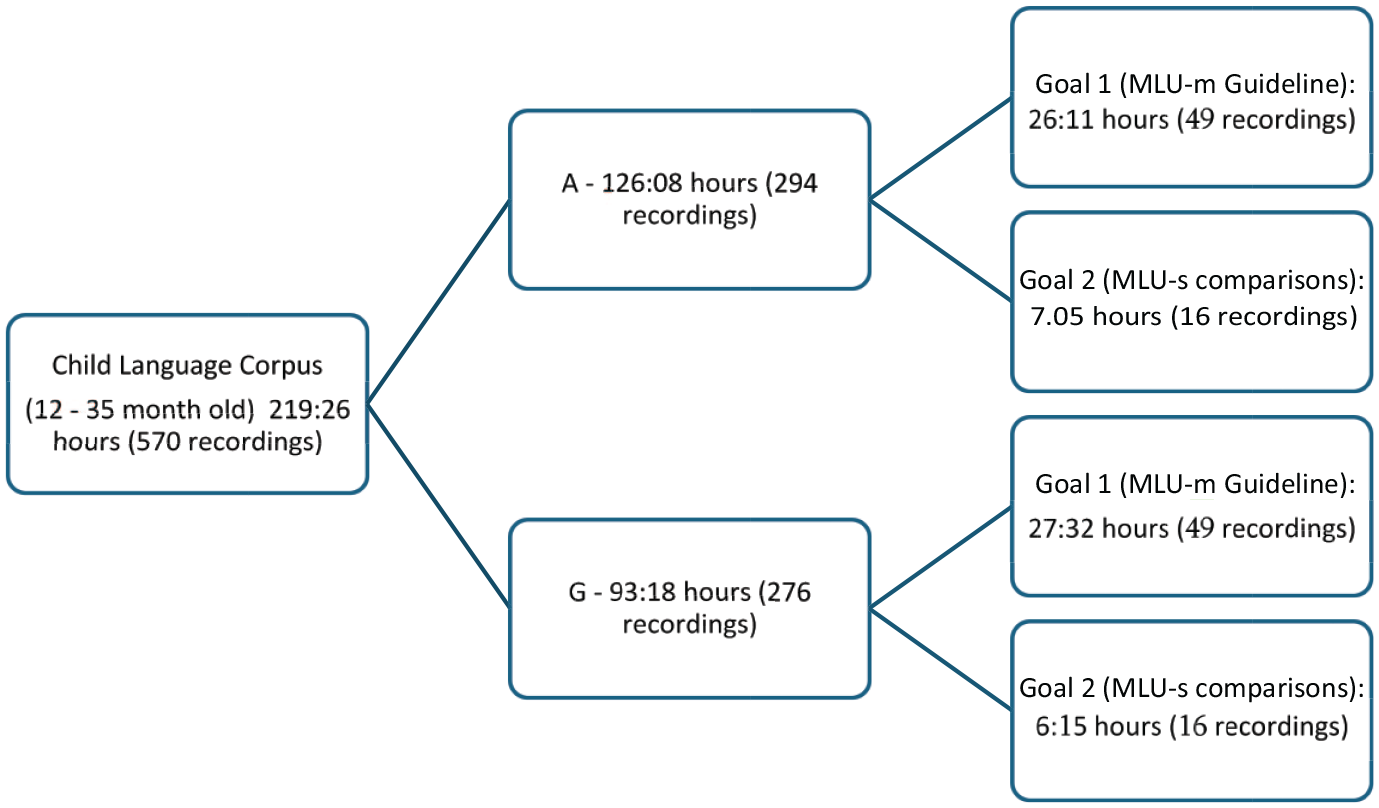
Distribution of Analyzed Language Samples by Research Goals.
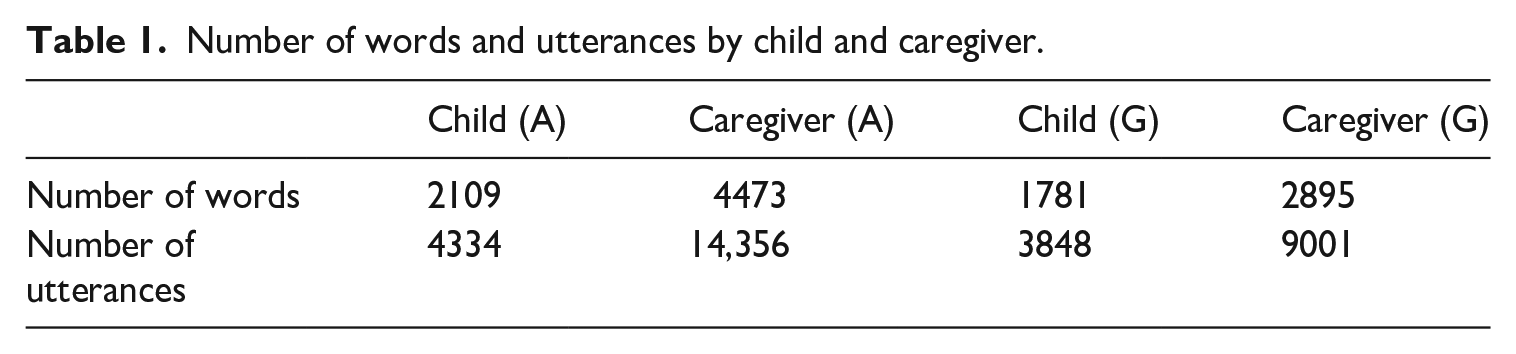
The total number of utterances produced by each child and caregiver in this study are presented in Table 1.
Number of words and utterances by child and caregiver.
Procedure
This study was approved by the ethics committee of Ilia State University, Georgia, and the children’s parents were asked to sign an informed consent form prior to the beginning of the study.
Families were recruited for this study through advertisements. At the onset of the study, the children’s parents were provided with video cameras (Panasonic HC-V770 4H PAV770) and microphones (Boya pro shotgun mic PVM1000-44) to ensure the quality of recordings. The children’s parents and primary caregivers received detailed technical instructions regarding the video recording. The children were video-recorded during spontaneous interactions with their parents and primary caregivers in a variety of naturalistic settings to avoid bias (at home, garden, or playground). The children’s family members were instructed to record the children every day for 1 week per month for at least 1 hour during their everyday routines, preferably during mealtimes, playtimes, and book reading, when children are expected to be more engaged in conversations with adults. The reason for recording the children while doing similar kinds of activities was to ensure a better comparison between them. No specific instructions were given regarding the toys or books used or the topics of the conversations.
After completing the recordings of their chosen week, language samples were obtained from parents and primary caregivers. The recordings were collected by a research assistant and transcribed by qualified native speakers of Georgian in the CHAT format (MacWhinney, 2000). For transcribing the Georgian alphabet, we used a transliteration system based on the Latin alphabet (Apridonidze, 2011) with some modifications: the symbol c was used instead of ts to transcribe the phoneme /ც/, and the symbol x was used instead of kh to transcribe the phoneme /b/. For privacy reasons, data excerpts are cited using the first letter of the child’s name and his or her age, for example, A20015 – a boy, 2 years and 15 days old; G11120 – a girl, 1 year, 11 months, and 20 days old.
We used the FREQ command in CLAN (MacWhinney, 2000) to extract lists of children’s words with their frequencies. The words were imported into an Excel file and manually coded for their part-of-speech and inflectional morphology.
Transcription and coding reliability
To ensure the reliability of the transcriptions, the authors randomly selected 10.7% of the recordings (14 out of 130 files). Nine recordings were from the G corpus (13.8%) and five from the A corpus (7.6%). Two of the authors independently transcribed 20% of each file (M = 25 min). In 80% of the interactions, the children played with their mothers. After the transcriptions were ready, the authors verified that they were identical to the recordings and complied with the transliteration rules. They were then compared with the original transcriptions by another author to assess their reliability. Inter-rater reliability was calculated as the number of agreements between raters divided by the number of agreements and disagreements multiplied by 100 (Shriberg & Lof, 1991). An inter-rater reliability of 93.1% was obtained. For comparison, Cucchiarini (1996) noted that sometimes 75% is an acceptable criterion for inter-rater reliability, whereas Shriberg and Lof (1991) suggested that for children’s speech, acceptable reliability is between 60% and 80%.
Coding reliability was performed on samples of the wordlists used to develop the MLU-m guidelines by three authors independently and then compared. Coding differences (constituting 15% of all cases) were individually discussed and resolved by the coders until 100% agreement was obtained. These differences are described in the ‘Results’ section.
Base unit
To calculate MLU without overinflating the scores, it is necessary to establish which forms are the default forms and the basic units (scored 1) of each lexical category. In this study, the basic unit of a word was defined based on its first appearance in the child’s language. Thus, the definition of basic or what constitutes a basic form is dynamic and initially driven by early emergence and frequency of use, and later becomes more structure-dependent or rule-based, ‘with the onset of grammar acquisition, which becomes less usage-based and more structure-dependent and grammatically based so that it corresponds largely to morphologically unmarked form’ (Uziel-Karl, 2001, p. 78). According to the stages of morphological acquisition by Dressler and Karpf (1995), the pre-morphological stage forms used by children may be mostly frozen and partial, which makes it difficult to determine the features they exhibit. Along these lines, unclear words in the current sample were not used to determine the base units.
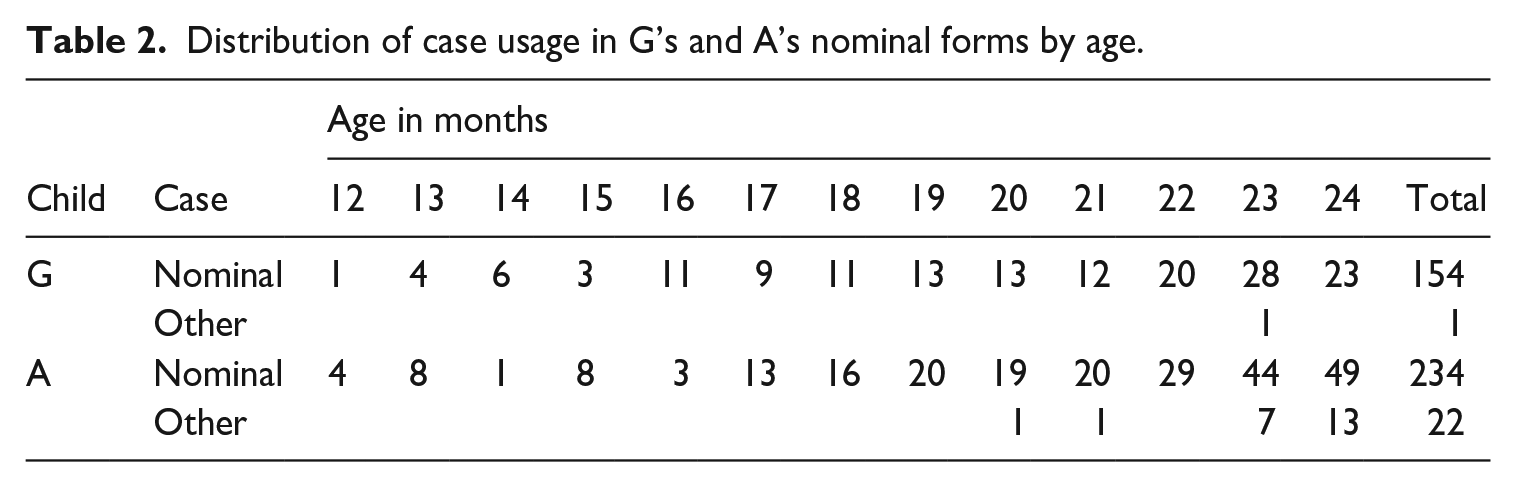
Examination of the children’s data for MLU guidelines revealed that 100% of the nominal forms they produced (G, N = 154; A, N = 234) during the 12–24 month period were nominative forms, as shown in Table 2. The most frequent words used by G were deda ‘mother’, aua ‘dog’, babu ‘grandpa’; all nominal forms used by G till 23 months of age were in nominative form. The first use of a non-nominative form appeared at the age of 23 months, sashi ‘at home’. A’s most frequent words were babu ‘grandpa’, mama ‘father’, deda ‘mother’; his first use of non-nominative form appeared at age 20 months – pekhit ‘by foot’ (noun in instrumental case). Thus, the nominative singular form was determined to be the base form of the early nouns. This finding corroborates the findings of Imedadze and Tuite (1992, p. 48).
Distribution of case usage in G’s and A’s nominal forms by age.
This study, as well as previous research (Imedadze & Tuite, 1992), provides evidence to argue that the second person aorist of subjunctive conjugation, which coincides with the imperative of objective conjugation for TELIC (change of state) verbs: ade, dade, mome – ‘get up, put down, give me’, and the present forms for the ATELIC (stative) verbs: minda, aris – ‘I want’, ‘it is’ is the base form of the verb in children’s utterances and, therefore, should be considered the basic verb form for MLU calculation. In our data, children at 18 months use the imperative most frequently, as shown in Table 3.
Frequency of verb forms for G and A by age.
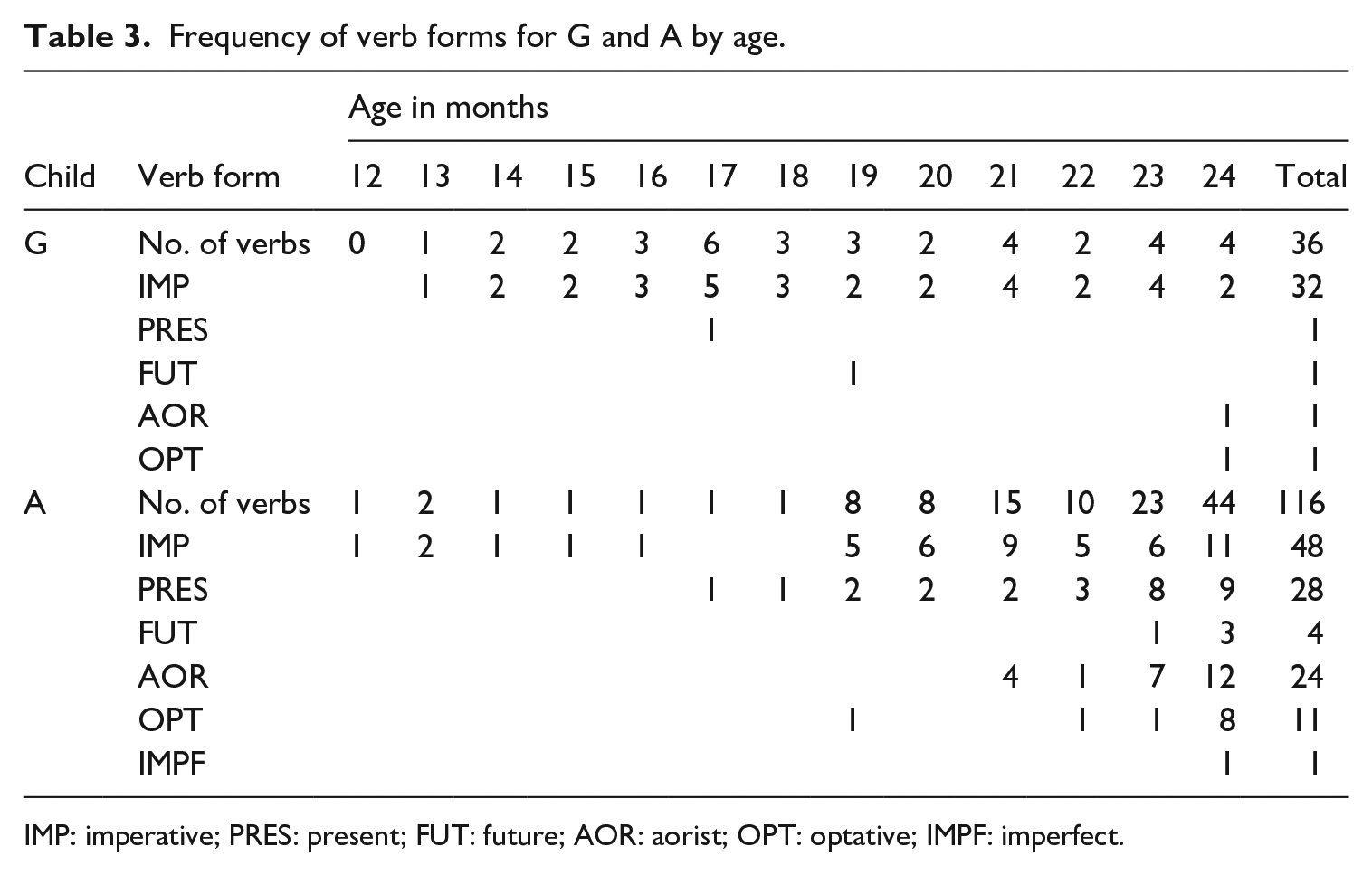
IMP: imperative; PRES: present; FUT: future; AOR: aorist; OPT: optative; IMPF: imperfect.
Early verb forms used by the children in communication were the active forms (subjunctive conjugation) of the second person dialogic imperative/interrogative, for example, dɑjeki ‘sit down’ [G20621], midi! ‘go!’ [A10913]. Therefore, this form was used as the base unit for the active verb form.
Some verbs are used in objective conjugation early and frequently, so they take the form of the base unit because of their frequency. For example, in the speech of 18-month-old A, minda ‘I want’ is recorded 25 times, suggesting that it should be considered the base form.
Productivity
Finally, to be included in the MLU calculation, a morpheme must be productively used. In this study, noun productivity was measured according to the use of self-initiated case forms or postpositions in obligatory contexts. The use of a case form/postposition will not be considered productive unless the child correctly uses that form at least three times in a single sample. Alternatively, if a child uses three different case forms with the same verb in a single interaction, it is considered productive. For example, in our speech samples, at 21 months, the form xeshi [xel-shi] ‘in [one] hand’ [A109] only occurs once, and therefore, is not considered productive. However, at 24 months, the same postposition (-shi – ‘in’) is used with different nouns, which allows us to qualify the form as productive: (ta-shi – [tsa-shi] ‘in the sky’); (maghazia-shi ‘in the shop’); (shava-shi ‘in the trousers’) [A200].
The demonstrative pronoun es ‘this’ is not considered productive if used in the Nominative and once only (esh, esh ‘this, this’ [A106]). However, at 21 months, the pronoun occurs in the speech samples several consecutive times and thus qualifies as productive: es aris mankana ‘this is a car’; es da [dade] ‘put this down’; es ese ‘ [let] this be this way’ [A109]. Another example is the use of different case forms of the demonstrative pronoun: while at 21 months only ‘it’ occurs in the samples ɑm peris ɑris ‘ [it] is of this color’ [A109], at 30 months, the use of the same pronoun is more diverse: exlɑ [axla] ‘now’; gadavabijo ɑmɑs? ‘Shall I step over this?’ [A206] is considered productive.
At 18 months, cemi ‘my’ [A106] is the only possessive pronoun found in the samples, while at 30 months, first and second person possessive pronouns may occur in the same utterance: axa sheni jebia [jeria] mere chemi jeri ikneba ‘it is your turn now; then it will be my turn’ [A206]; thus, at 30 months, possessive pronouns can be considered productive.
For verbs, productivity is established based on the use of morphological markers – whether a particular morphological paradigm is represented in more than one form. For example, if a child only uses the form minda ‘I want’ [A106], it will not be considered productive. However, if the sample contains additional inflectional forms of the same verb ginda ‘you want ‘or unda’ [someone] wants’ [A209], the use of that verb should be considered productive (see Dressler & Karpf, 1995).
Participles were not productive at 18, 21, and 24 months, as the form only appeared once in the boy’s speech at that age. From 25 months onwards, participial forms occurred more frequently and productively.
Sample size for MLU calculation
There is controversy regarding the representative sample size for the MLU calculation. Some studies suggest Brown’s original 100-utterance sample size (Lahey, 1988; Retherford, 1993), whereas others recommend a minimum of 50 utterances (Miller & Chapman, 1981). Gavin and Giles (1996) proposed an acceptable reliability of ⩾ 175. Casby (2011) found that the MLU can be reliably determined with smaller samples than the typical 50–100 recommendation. In our study, we followed Brown’s (1973) original suggestion, using a standardized 100-utterance sample (lines 50 to 150) for each child.
Determining the MLU calculation measure for Georgian
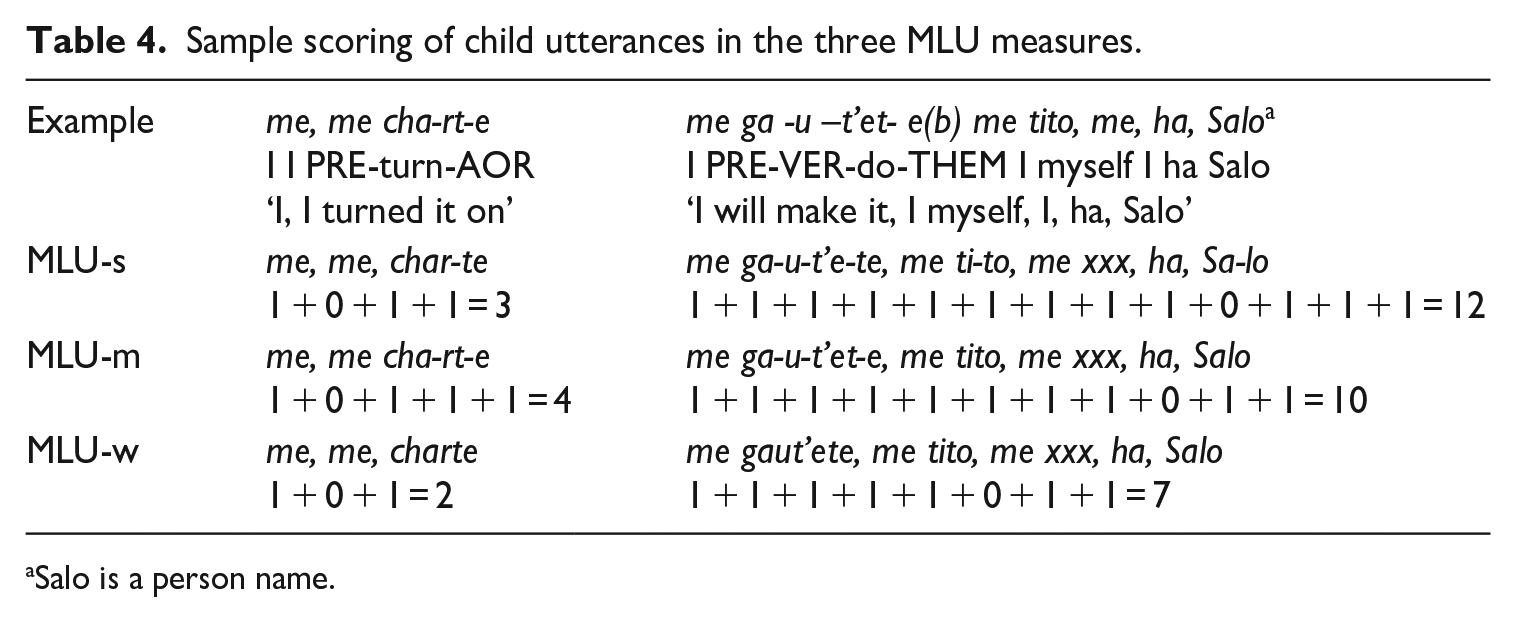
To identify the most suitable MLU measure for analyzing Georgian language acquisition, considering its intricate morphology while preventing MLU score inflation, we examined the three MLU measures described in the acquisition research: MLU-s, MLU-m, and MLU-w. The MLU calculations for each of the three measures were performed separately by different researchers, and their scores were then compared. MLU-m was calculated based on our preliminary guidelines. To prevent score inflation, we counted only non-repetitive words. If a word appeared consecutively within the same utterance, it was counted once. The sample scores of the child utterances for all three MLU measures are displayed in Table 4.
Sample scoring of child utterances in the three MLU measures.
Salo is a person name.
In the MLU-w scoring, the utterance me, me charte ‘I, I turn on’ [A20017] received a total of 2 points due to the consecutive repetition of the word me ‘I’. However, the utterance me gaut’ete, me tito, me xxx, ha, Salo ‘I will make it, I myself, I xxx, ha, Salo’ [G20626], where no repetitions occurred, receives 7 points. In Georgian, syllables are identified by vowels. The number of syllables in a word is identical to the number of vowels in that word. Thus, for example, the utterance me, me charte ‘I, I turn on’ [A20017] receives 3 points as it consists of 3 syllables (me char-te), whereas the utterance me gaut’ete, me tito, me xxx, ha, Salo ‘I will make it, I myself, I xxx, ha, Salo’ [G20626] receives 12 points as it consists of 12 syllables (me ga-u-t’e-te, me ti-to, me xxx, ha, Sa-lo). According to MLU-m scoring, the utterance me, me cha-rt-e ‘I, I turn on’ [A20017] receives 4 points as it consists of 4 morphemes, whereas the utterance me gaut’ete, me tito, me xxx, ha, Salo ‘I will make it, I myself, I xxx, ha, Salo’ [G20626] receives 10 points, consisting of 10 morphemes (me ga-u-t’et-e, me tito, me xxx, ha, Salo).
Results
Scoring guidelines for the Georgian MLU-m measure
To calculate the MLU-m scores for designated language samples, we formed a set of guidelines. Prior to the formation of the guidelines, discrepancies related to morphological coding were resolved by the authors until 100% agreement was reached. Such discrepancies are related to the scoring of participles, preverbs, and syncope/apocopes as follows.
One of the methodological challenges was determining scoring rules for the participles, which in Georgian functioned like adjectives but were derived from verbs. In particular, the point at issue was the counting of Georgian participle-forming affixes – uli, sɑ-eli, as in gɑk’eteb-uli sakme – ‘done work’, gɑ-sɑ-k’eteb-eli sakme – ‘to be done work’. Data evidence suggests that the use of participles starts at 24 months, as the forms do not occur in the children’s speech before then, while at 25 months the forms are so frequent and diverse that they can be qualified as productive. Therefore, the participles markers were assigned one additional point, and their appearance in children’s speech marks progression to a new level of language development.
Prepositions were also a subject of discussion, as in Georgian there are derivational and inflectional forms of prepositions that should be scored differently. Consequently, it was decided that an additional point should be given to the inflectional manifestation of the verb prefix, which is a separate morphological marker. In the case of derivation, the verb prefix is merged with the root, and no additional points are assigned to it.
Syncope and apocope are also a matter of discussion in relation to morpheme count. In Georgian, these processes have morpho-phonological value and manifest as the loss of a vowel in several case forms (the genitive, instrumental, and adverbial). It was decided not to assign an additional point to the correct use of syncope and apocope, as in Georgian these are merely phonological processes.
The following guidelines are based on the present corpus, incorporating insights from earlier studies on early Georgian language development along with considerations related to base forms and measures of productivity.
Similar to previous research (Imedadze & Tuite, 1992), we observed that, during the one-word stage, nouns primarily appear in the nominative case and serve as base units in a child’s language. Regarding verbs, between 18 and 24 months, children begin producing present tense forms such as midi-s [A111] for ‘she/he goes’, zi-s [A109] for ‘she/he sits’ and v-edzeb [A200] for ‘I am looking for’, alongside the use of aorist forms like g-i-k’i-e [gik’bine] for ‘I have bitten you’ [A110].
These findings corroborate those reported by Imedadze and Tuite (1992), suggesting that Georgian children undergo a significant phase of morphological and syntactic development during the latter part of the second year and the beginning of the third year. This can be seen in Supplemental Appendix 3, where our findings are compared with those of Imedadze and Tuite (1992) and with studies on the early language acquisition of another agglutinating language, Turkish and English. Furthermore, our research corroborates observations by Imedadze and Tuite (1992) that the emergence of the ‘v-’ marker for the first-person subject occurs after the appropriate use of the ‘m-’ objective person marker, typically toward the end of the second year v-edzeb for ‘I am looking for’ [A200]. Suffixes that convey information about the third person, including tense, mood, verb class, as well as person and number, present greater challenges for Georgian-speaking children than those for the first and second person.
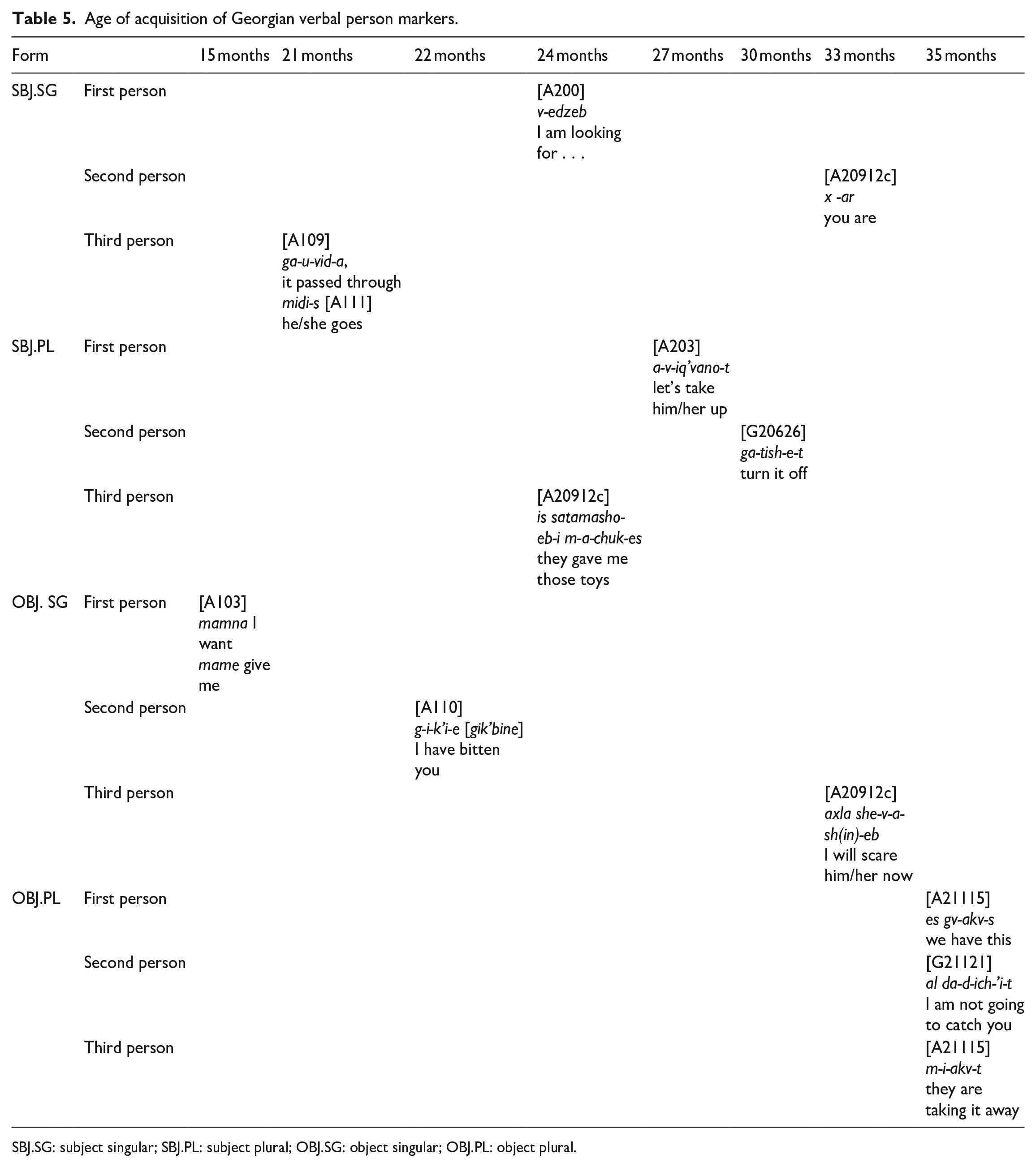
Our findings also indicate that second-person forms appear the earliest, coinciding with the imperative of objective conjugation, confirmed in speech at around 12 months. The first objective person markers became active from around 15 months, while singular markers for the third subjective person were confirmed from around 21 months. Plural forms emerged relatively later, at approximately 33 months. Singular markers for the second-objective person were confirmed at approximately 30 months, with multiple forms appearing at approximately 35 months (see Table 5).
Age of acquisition of Georgian verbal person markers.
SBJ.SG: subject singular; SBJ.PL: subject plural; OBJ.SG: object singular; OBJ.PL: object plural.
Guidelines for Georgian MLU-m calculation
Based on our data analysis and the findings of previous studies on Georgian first language acquisition reported above, we propose the following set of guidelines for MLU-m for Georgian:
General.
1. Base units determined according to the guidelines for each part of speech are assigned 1 point.
2. In productive forms, each morphological marker is assigned 1 point according to the guidelines below (inflected nominal: case, number; inflected verbs: number, tense, aspect, version, causality), as illustrated in examples (1) and (2):
(1) sk’am-eb-ma
chair-PL-ERG
‘chair’ = 3 points;
(2) v -a -k’eteb
1SBJ-VER-do
‘I do’= 3 points.
3. No additional points are given to the following forms:
The 3SG form of the defective impersonal (weather) verbs: cʼvims, tovs, kris ‘[it] rains/is raining, [it] snows/is snowing, [it] blows/is blowing’.
Modal verbs mgoni ‘I think’; unda ‘must’ and sheidzleba ‘may’ and polite forms such as madloba ‘thanks’ [G20921] and gtxov ‘please’ [A20619], which are considered as grammaticalized/frozen/lexicalized forms.
Reduced forms that are semantically ambiguous and can be associated with several meanings (gɑ – gaaghe ‘open’ [A20017], gɑ – gaxseni ‘undo [the knot]’ [A10913]; gɑ – garet ‘outside’ [A10913]; bu ‘owl’ [A10714]; bu – burti ‘ball’ [A10614], bu – ɑvt’obusi ‘bus’).
MLU-m guidelines by lexical category.
1. Non-inflecting lexical categories
(a) Adverbs, conjunctions, postpositions, particles, and interjections (e.g., ak ‘here’; da ‘and’; vai ‘wow’), child-specific forms (daji ‘sit down‘) and onomatopoeia (aua ‘dog‘) are assigned 1 point.
(b) Adverbs, postpositions, and conjunctions, like nominal forms, may take the verbal suffix -a at the end ɑghɑrɑ-ɑ ‘[it] is no more [there], it is gone’ [A20520]. This suffix is assigned 1 point.
2. Nominal forms – The Nominative case form considered the basic form for all the nominal categories: Nouns, Adjectives, Numerals and Pronouns is assigned 1 point.
Each case marker other than nominative is assigned 1 point.
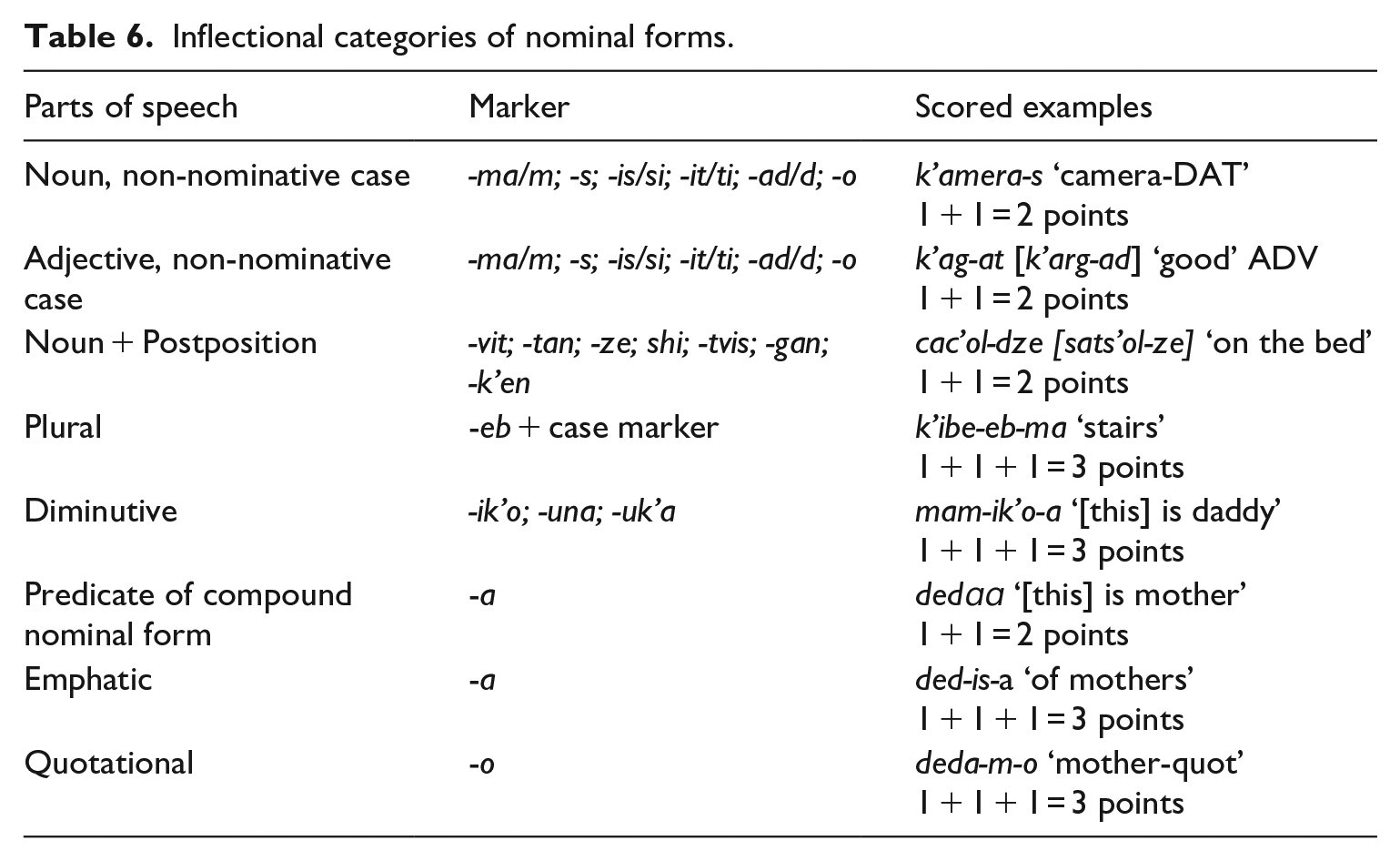
The plural marker, postpositions, diminutives, and predicates of nominal compound forms are assigned 1 point.
For example, the word k’ameras ‘camera’ k’ɑmerɑ receives 1 point, and 1 additional point is given to the case marker –s, this word is scored with 2 points.
The maximal score may be 8, as in mɑm-ik’o-eb-is-tvis-ɑ-ɑ-o ‘one said that’s for daddy’s’ – mam-stem, iko – diminutive, -eb – plural marker, is – case marker, tvis – postposition, a – empathic, a – predicate of compound nominal form, o – quotational. Each type of marker in Table 6 is scored as 1 point.
Inflectional categories of nominal forms.
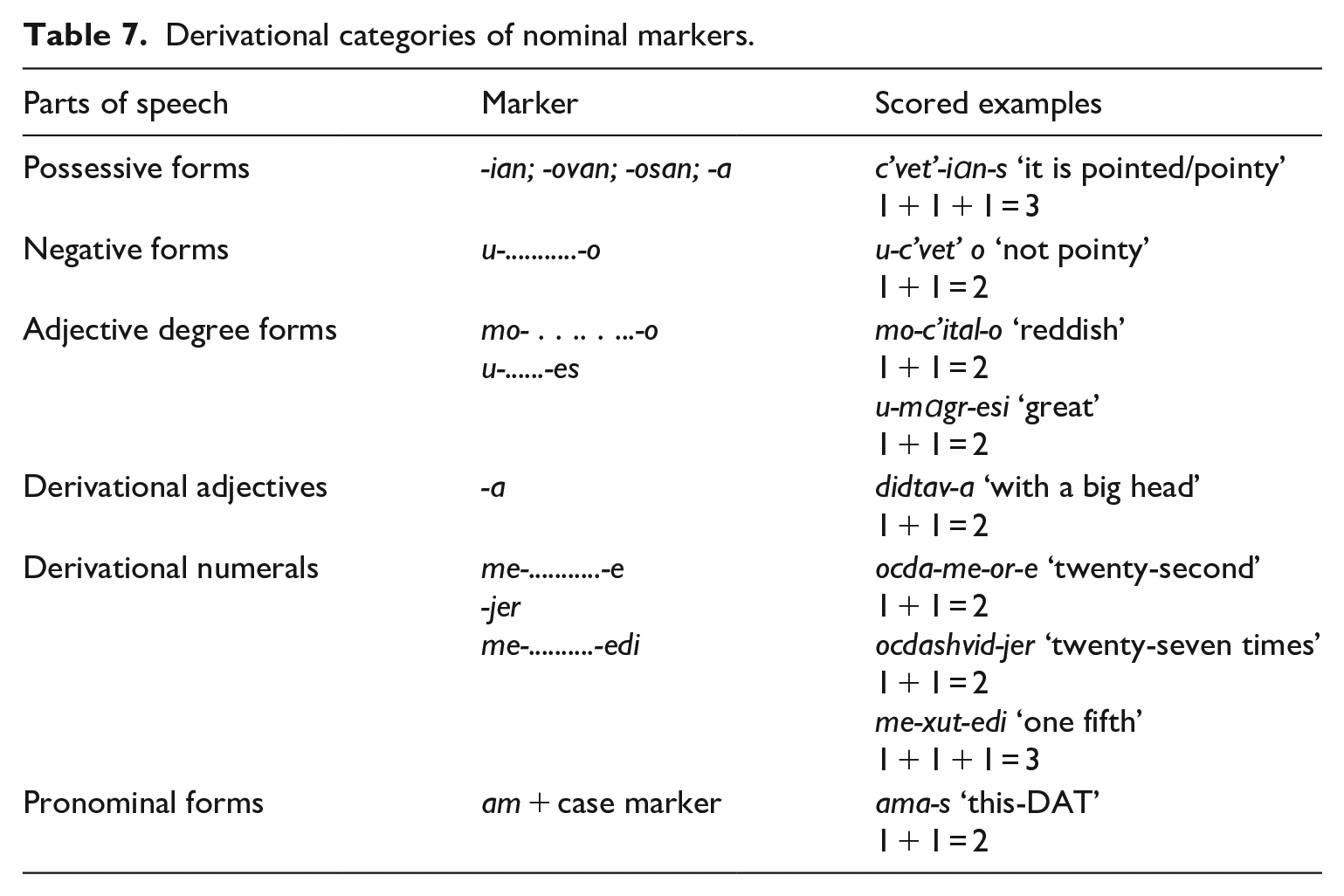
3. Each derivational affix represented in the word form is assigned 1 point (see Table 7).
Derivational categories of nominal markers.
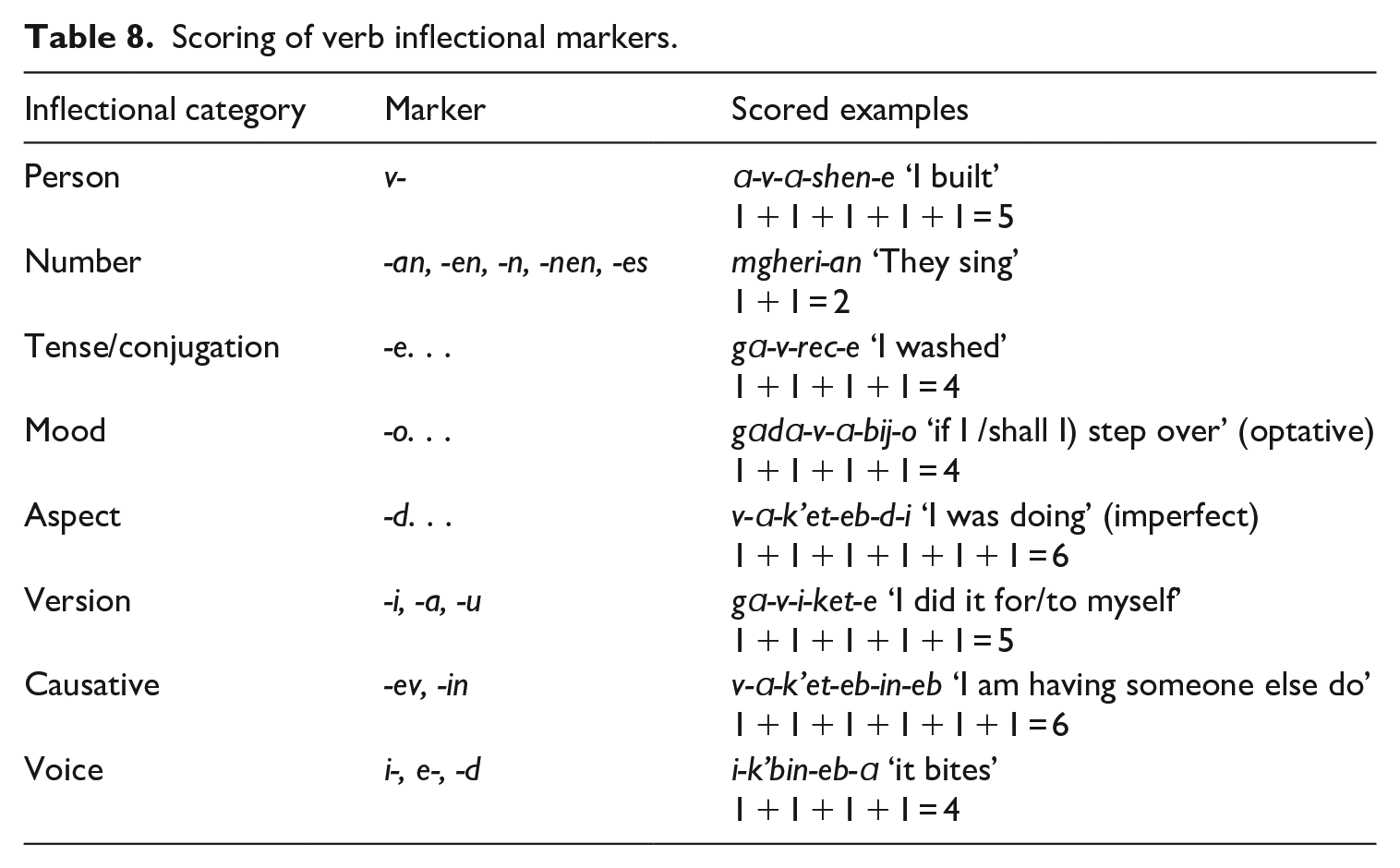
3. Verbal forms – the basic verbal form – are the second person imperative form of subjective construction.
(a) Inflectional markers affixed to the verb stem are each assigned one point (see Table 8).
Scoring of verb inflectional markers.
Comparison of MLU measures
To determine the most suitable MLU method for Georgian morphosyntactic development, a two-step process was followed. Initially, we present data validating MLU as a measure of language development, demonstrating its increase over time, and its correlation with two other independent measures: mean length of turn (MLT) and vocabulary diversity (VOCD). These measures reflect the growth in utterance length and lexical richness, respectively, and were calculated based on the same samples of A and G used for calculating MLU in the three measures. Having established this alignment, we then analyzed the data to determine which MLU measure best predicts Georgian morphosyntactic development. Although preliminary, these findings demonstrate the efficacy of MLU-m.
We computed the MLU scores in the three measures using our MLU-m scoring rules, along with syllable and word counts for all parts of speech. This process was performed on the selected transcripts (see Figure 1). Figures 2 and 3 provide a comparative analysis of the three MLU measures across different ages and children.
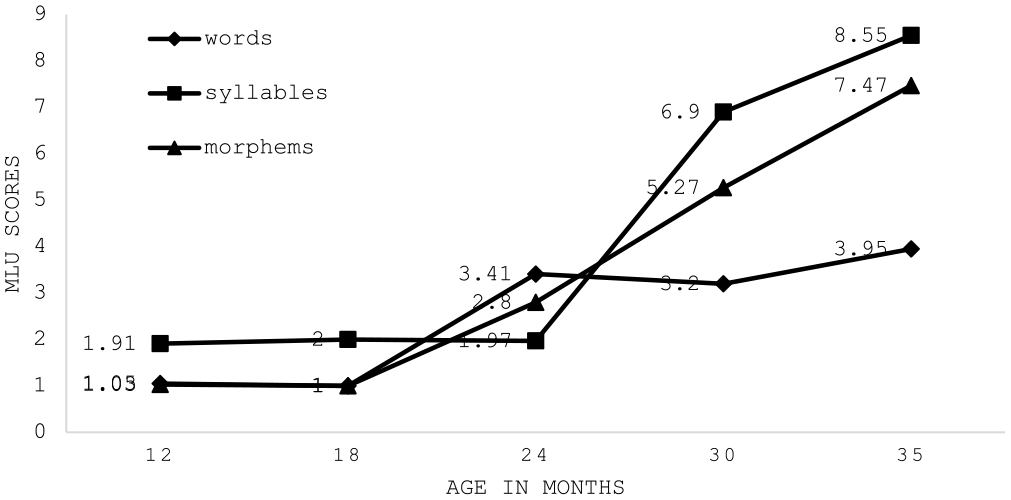
A’s Comparative MLU Scores by Age.
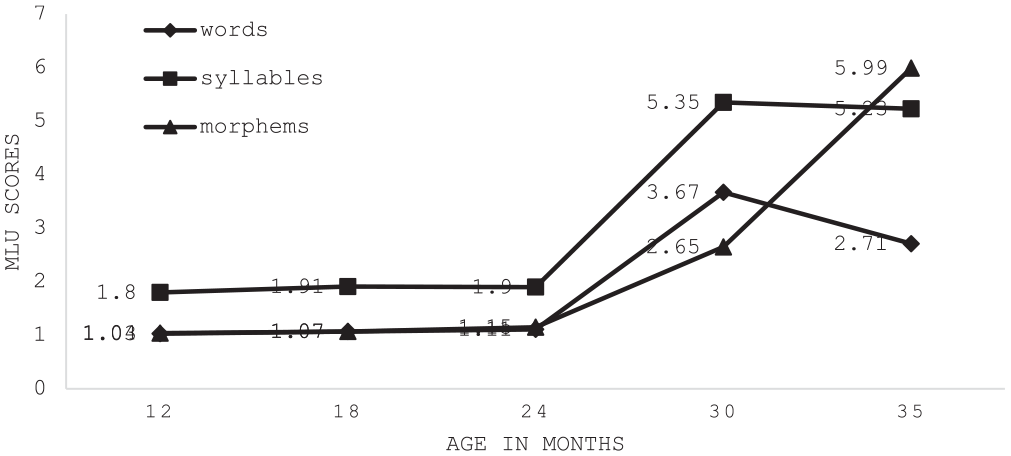
G’s Comparative MLU Scores by Age.
The figures reveal that all three MLU measures showed an increase in MLU scores with age. MLU-s yielded the highest score per age point, whereas MLU-w consistently yielded the lowest score per age.
To further assess the relationship between age and the MLU scores obtained from each of the three MLU measures, we calculated Spearman’s correlation coefficients using data from both children with five data points each. As shown in Table 9, this correlation was statistically significant at p < 0.01 for all three measures, suggesting that the MLU scores increased consistently with age. A post hoc power analysis demonstrated that the study had an 81.2% probability of detecting an observed effect size of 0.8 among 10 participants/units of measurement (based on Fisher’s z-transformation and normal approximation). However, given that the correlation is based on a very small set of data per child, these findings should be considered preliminary.
Spearman’s Rho Correlation Between Age and Three MLU Methods (N = 10).
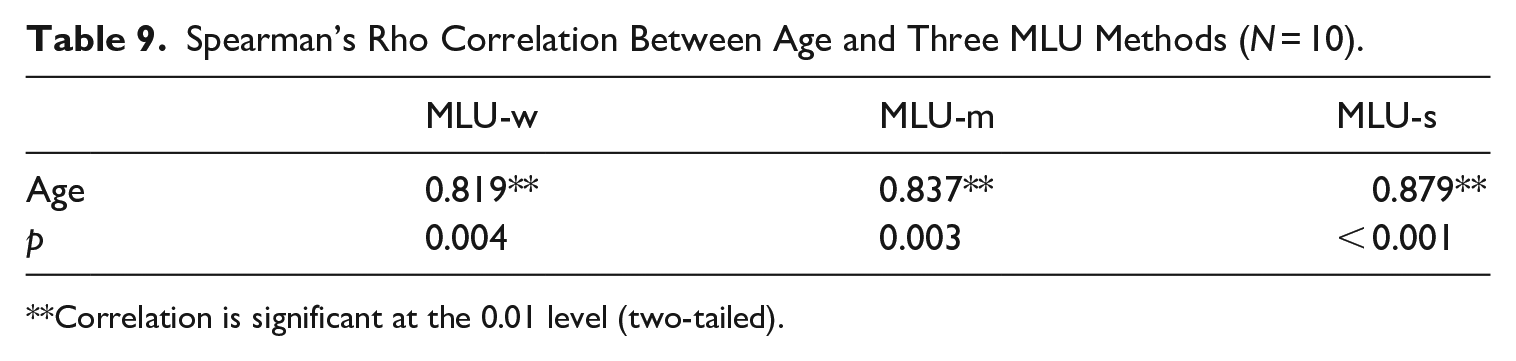
Correlation is significant at the 0.01 level (two-tailed).
Figures 4 and 5 depict the progression of MLT and VOCD scores for A and G over time. When compared with graphs illustrating MLU score development over time (see Figures 2 and 3), a parallel developmental trajectory emerges. Both MLU and the two independent language development measures (MLT and VOCD) exhibited a gradual increase with age. This, along with the results of the statistical analysis, may provide sound evidence for the validity of the MLU as a measure of Georgian language development.
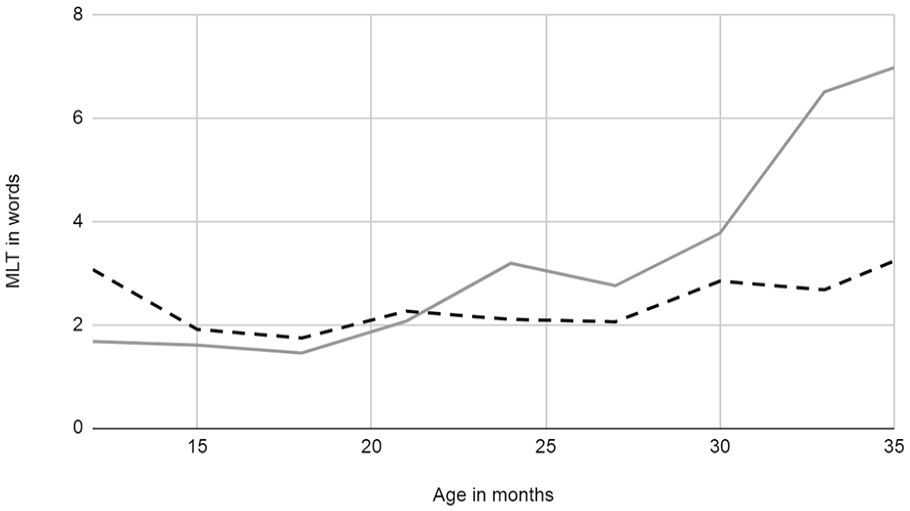
A’s and G’s MLT Scores by Age.
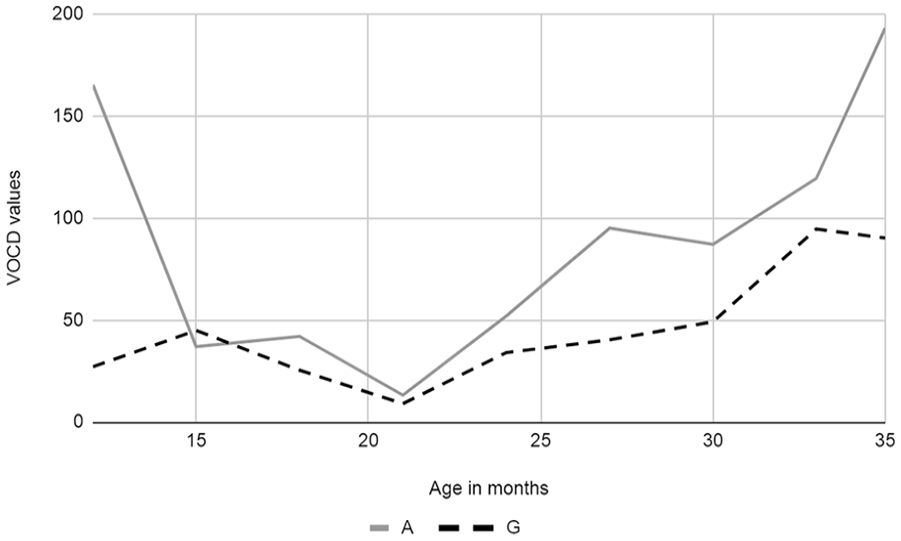
A’s and G’s VOCD Scores by Age.
Finally, we used a targeted approach to determine the most effective MLU measure for predicting Georgian morphosyntactic development. Specifically, we calculated the MLU based solely on the verbs produced in the designated language samples by the two children under study. This focus on verbs was informed by the understanding that verbs represent the most inflected lexical category in Georgian, as noted in the introduction. Given that Georgian morphemes are typically represented by syllables and that certain morphemes may carry multiple inflectional features, we hypothesized that MLU-m scores, which consider morphological features, would demonstrate a more pronounced increase over time compared to MLU-s and MLU-w scores. This was confirmed by the findings shown in Figures 6 and 7.
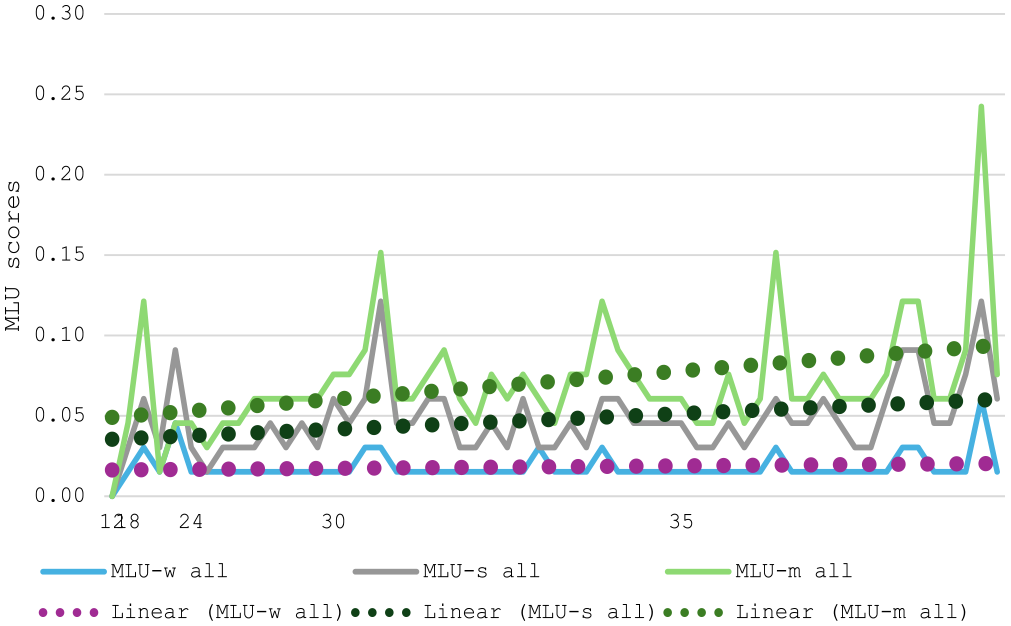
A’s Comparative MLU Scores by Age (Verbs-Based Only).
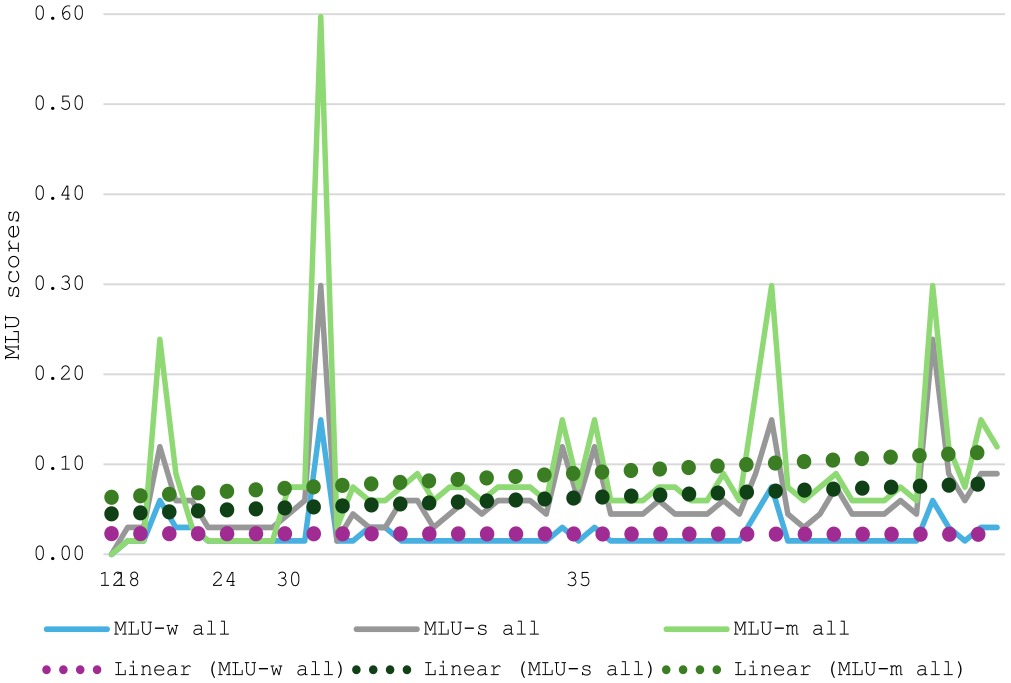
G’s Comparative MLU Scores by Age (Verbs-Based Only).
While these findings are preliminary, they suggest that MLU-m may offer greater predictive power for assessing Georgian morphosyntactic development than alternative MLU measures such as MLU-s and MLU-w.
Discussion
In this article, we explored the applicability of MLU as a language assessment measure for the Georgian child language. To this end, we developed a set of guidelines for calculating Georgian MLU based on an analysis of a longitudinal corpus of two Georgian-speaking children, supported by the findings of previous studies on Georgian acquisition. We then used these guidelines to compare MLU-m with MLU-w and MLU-s to determine the most suitable method for assessing Georgian morphological development.
The need to develop MLU guidelines tailored to the linguistic characteristics of each language is emphasized in the ‘Introduction’ section. To strengthen this claim and justify the development of MLU guidelines specific for Georgian, we compared the early stages of development in Georgian and its typological sister Turkish, and with a typologically different language – English (see Supplemental Appendixes 2 and 3).
Although Turkish and Georgian share similarities as agglutinating languages, they also exhibit differences in the specific morphological features and developmental trajectories observed in children’s language acquisition. In terms of similarities, both languages exhibit a gradual increase in morphological complexity over time, with children acquiring various morphological features at different developmental stages. Similar morphological features emerge in both languages, for example, the use of nominal forms, verb inflections, and syntactic structures, and both languages demonstrate the emergence of basic linguistic elements in early stages, for example, first one to two syllable ‘words’ and two-word utterances.
The differences lie in the specific morphemes and grammatical structures that are acquired early. For example, Turkish shows the emergence of verbs in the first person singular present tense, whereas in Georgian the only form which takes first person in the verb minda ‘I want’ which is not used productively at age 18 months. The timing of the acquisition of certain morphological features may vary between Turkish and Georgian. For instance, Turkish children demonstrate the utilization of specific morphological forms at earlier ages than Georgian children, and there may also be differences in the complexity of the morphological system between the two languages, with one language exhibiting more intricate morphological patterns or a wider range of inflectional categories than the other. These differences highlight the unique linguistic characteristics of each language and emphasize the importance of considering language-specific factors when analyzing language development.
Considering the comparison with English, the two languages show some similarities at the onset of language acquisition such as the emergence of basic linguistic features. Both share common developmental milestones, and in both there is evidence for a gradual increase in MLU over time. Yet, over time, the differences between the two languages also become apparent, going beyond individual differences between the two Georgian-speaking children (see comparative MLU graph in Supplemental Appendix 2). The comparative Table in Supplemental Appendix 3 shows that English children tend to demonstrate earlier acquisition of linguistic features such as two-word utterances and plural nominal forms compared to Georgian children. In addition, English-speaking children appear to use more complex morphological structures, such as possessive and progressive forms, earlier than their Georgian counterparts most probably due to the complexity of Georgian morpho-syntax which requires more time to develop. As noted, this changes over time as Georgian children acquire more morphological markers and construct more complex morphological structures. This comparison also emphasizes the need to tailor MLU guidelines to the properties of each individual language.
Challenges and future research
In this study, we faced several challenges.
Variability in the natural environment: During recorded sessions, our participants interacted with their parents in their natural environment in a variety of activities. This could be challenging, as families used different materials in their activities and different discourse styles, which might have affected the quantity and quality of child output, leading to individual differences between the two children.
Individual differences: There were differences in the pace at which each child progressed during the early stages of language development (see Figures 2 and 3). While one child began using words at 12 months of age, showing a swift increase in vocabulary and grammatical complexity, the other child’s language growth was slower but steady. This variation highlights the need for additional data to define standard benchmarks for typical language development, beyond individual differences. Moreover, it emphasizes the importance of refining the guidelines to enable reliable differential diagnosis between children with typical and atypical language development.
Video recording: Some video recording guidelines, including the timing, angles, and background noise control, were not consistently followed. Consequently, some recordings were shorter than others, and in some instances, it was challenging to simultaneously observe both the child and his or her communication partner. Background noise, such as TV noise, was also present in some recordings.
Corpus size: This study was based on language samples from two children. To establish the validity of the Georgian MLU guidelines as a tool for language assessment, particularly the use of MLU-m, a larger corpus is required. This proved critical in the statistical analyses. However, using this corpus we identified certain trends and directions for further exploration.
One such direction involves the automation of MLU calculations to enhance and facilitate its usability by professionals. We have initiated the construction of an MOR grammar for Georgian using CHILDES tools, although further refinement and efficiency testing are needed to complete this task. Future studies will be necessary to evaluate the applicability, validity, and reliability of MLU-m calculation rules once the morphological annotation of MOR is completed for all transcripts. Testing will have to be done initially on children with typical language development, and later expanded to include children with various language impairments.
Conclusion
Our study demonstrates that all three types of MLU measures – MLU-m, MLU-s, and MLU-w – correlate well with age. Furthermore, MLU-m and MLU-s change significantly from 24 months in reflecting the linguistic development. Over time, MLU-m emerged as a better predictor of morphosyntactic development than MLU-s or MLU-w. The alignment of MLU-m with the complex morphological structure of Georgian makes it a more suitable measure for assessing grammatical development. Consequently, our devised guidelines aimed to streamline the workflow of the researcher or clinician. In cases where time or linguistic expertise is limited, MLU-s may serve as a viable alternative given their ability to track language development and its relationship with age.
Footnotes
Correction (July 2024):
The funding information is updated for this article.
Author contributions

Funding
The author(s) disclosed receipt of the following financial support for the research, authorship, and/or publication of this article: This work was supported by the Shota Rustaveli National Science Foundation of Georgia (SRNSFG) under the project FR-18-782: Language acquisition in Georgian-Speaking Children.
Supplemental material
Supplemental material for this article is available online.
Notes
References
Supplementary Material
Please find the following supplemental material available below.
For Open Access articles published under a Creative Commons License, all supplemental material carries the same license as the article it is associated with.
For non-Open Access articles published, all supplemental material carries a non-exclusive license, and permission requests for re-use of supplemental material or any part of supplemental material shall be sent directly to the copyright owner as specified in the copyright notice associated with the article.
