



Abstract
This study examined the inter-related development of self-esteem and delinquency across three years. Participants were 3449 Korean high school adolescents (age M = 15.8, SD = 0.42, 1725 boys, 1724 girls) from Korea Youth Panel Study (KYPS), in 2005–2007, nationally representative of Korean adolescents. Latent growth modeling was employed for analysis. Results showed that: 1) there were linear growth in self-esteem and delinquency. Moreover, there were significant individual differences in initial level of self-esteem and delinquency, and rate of change in self-esteem and delinquency; 2) the analyses of panel data did not support Kaplan's theory by showing that delinquency was negatively associated with growth in self-esteem among adolescents. Cultural implications are illustrated. Theoretical and practical implications of the results are discussed.
Keywords
Self-esteem and delinquency are two major issues in adolescence. Concern regarding these two issues appears to be culturally universal. Many researchers in America, Asia, Oceania, and Europe have investigated self-esteem and delinquency in contexts including aggression, bullying, stealing, fighting, and drug use (Boulton, Smith, & Cowie, 2010; Carranza, You, Chhuon, & Hudley, 2009; Carroll, Houghton, Wood, Perkins, & Bower, 2007; Liu, Kaplan, & Risser, 1992; Mason, 2001; Mcknight & Loper, 2002; Miller & Daniel, 2007; Ooi, Ang, Fung, Wong, & Cai, 2006; Roman, Cuestas, & Fenollar, 2008; Shin, 2010; Ybrandt & Armelius, 2010; Yu, Chan, Cheng, Sung, & Hau, 2006). These issues deserve academic attention, as adolescents are vulnerable to delinquent behaviors and the development of poor self-esteem regardless of language or race. School personnel may use the results of such studies to improve quality of life for adolescents.
Unfortunately, the directions of causal relationships between self-esteem and delinquency remain ambiguous despite numerous studies examining the relationships between these variables. While some investigated the effects of self-esteem on delinquency (Barry, Grafeman, Adler, & Pickard, 2007a; Baumeister, Smart, & Boden, 1996; Diamantopoulou, Rydell, & Henricsson, 2008; Donnellan, Trzesniewski, Robins, Moffitt, & Caspi, 2005, Faulkner & Adlaf, 2007), others examined those of delinquency on self-esteem (Chung, 2007; Jang & Thornberry, 1998; Kim & Kim, 2000). However, the results of these studies have been mixed. Although self-esteem was found to have a significantly negative effect on delinquency in most studies (Diamantopoulou et al., 2008; Donnellan et al., 2005; Barry et al, 2007a; Faulkner & Adlaf, 2007), some showed that high self-esteem provoked violence (Baumeister et al., 1996) and others revealed that self-esteem did not influence significantly delinquency (Baumeister, Cambell, Krueger, & Vohs, 2003; Cho & Kwon, 1998; Lee, Bell, & Watson, 2007; Otsuki, 2003). The studies on the effects of delinquency on self-esteem also reported both positive (Chung, 2007) and negative effects (Jang & Thornberry, 1998; Kim & Kim, 2000).
As a reason of these mixed results about the relationship between self-esteem and delinquency, Mason (2001) pointed out a methodological limitation and analysed the relationship between the two variables with latent growth curve modeling (LGM) which can explain trajectories of changes and individual differences. In particular, he tried to conduct an empirical test of Kaplan's (1975, 1980) self-derogation theory according to passage of time.
According to Kaplan's self-derogation theory, self-esteem and delinquency have a countervailing loop. In other words, self-esteem affects negatively delinquency over time (self-defense hypothesis), but delinquency influences positively self-esteem over time (self-enhancement hypothesis). Human beings want to avoid a negative self-evaluation, so damage to self-esteem leads to alternative actions to recover it. In adolescence, one available alternative is to be involved in delinquent behaviors. When adolescents are rejected by peers, they can experience serious damage to self-esteem. In turn, they try to improve their low self-regard by participating in delinquency and associating with deviant peers. This development process is the core of Kaplan's theory of self-derogation. Also, insecure high self-esteem can be problematic, an issue that has recently been prominent in the literature on self-esteem and problem behaviors (Barry et al., 2007a; Barry et al., 2007b; Baumeister et al., 1996; Bushman et al., 2009; Ostrowsky, 2010; Thomaes, Bushman, Stegge, & Olthof, 2008).
Mason (2001) said that latent growth modeling (LGM), which allows researchers to predict change over time, was appropriate for testing Kaplan's theory, because Kaplan's theory explained a developmental process with the passage of time. He supported Kaplan's theory by finding a negative association between initial delinquency and initial self-esteem (higher initial delinquency was related to lower initial self-esteem), a positive association between initial delinquency and the growth in self-esteem (higher initial delinquency was related to faster self-esteem increase), and a negative association between initial self-esteem and delinquency in three years (lower initial self-esteem was related to higher delinquency in three years), but, the growth in self-esteem was not associated with delinquency in three years in American adolescents.
However, the majority of participants studied by Mason (2001) were of European descent and were located in the continental United States. This is a crucial limitation, because homogeneous samples may not allow for generalizations of results to other groups. Specifically, significant relationships observed among variables in Western samples may not apply to Asian samples without the additional examination of cultural context. As such, researchers have begun recently to explore relationships among these variables while accounting for differences in cultural context (Davidson, Demaray, Malecki, Ellonen, & Korkiamaki, 2008; Jung & Stinnett, 2005, Lee, Oakland, & Ahn, 2010; Park, 2005; Shin, Lee, & Kim, 2009). For example, Jung and Stinnett (2005) reported that South Korean children appear to behave in a more controlled, less self-reliant, and internalized manner than American children.
In particular, the perception of self is known to have cultural roots, hence, self needs to be evaluated in a cultural context. Thus, the current study examines the inter-related development of self-esteem and delinquency in South Korean adolescents to determine whether the results of the Mason (2001) study apply in a different cultural context. This aims to verify Kaplan's self-derogation theory, and specifically tests this theory through latent growth modeling (LGM). Additionally, we tried to investigate the association between growth in self-esteem and growth in delinquency, which was not proven in the study of Mason (2001), by using cross-domain LGM conducting both of changes of independent and dependent variables simultaneously.
Schools employ professionally trained psychologists in South Korea, Australia, Canada, New Zealand, and the United States (Jimerson, Skokut, Cardenas, Malone, & Stewart, 2008; Jimerson, Stewart, Skokut, Cardenas, & Malone, 2009). Research has shown that the presence of school psychologists in a country is related to the socio-economic development of that country, and is associated with higher quality of life for students with special needs (Cook, Jimerson, & Begeny, 2010). Additionally, school satisfaction in South Korea has been shown to be strongly related to psychological adjustment and life satisfaction, because Confucianism places an extremely high premium on education (Lee, Hong, & Espelage, 2010; Park, 2005). Thus, it is important to examine the relationship between the development of self-esteem and growth of delinquency in South Korea. The results of this study have the potential to enhance academic understanding and to provide practical meaning through applications of the results of this study to the school environment.
The current study
The purpose of this study was to examine: 1) individual differences in the developmental trajectories of self-esteem and delinquency; 2) the influences of initial values (intercept) of delinquency on the initial values (intercept) and rates of change (slope) of self-esteem; and 3) the influence of the initial values (intercept) and rates of change (slope) of self-esteem on the rates of change (slope) of delinquency in South Korean adolescents. Ultimately, we aimed to compare the results of this study with those of Mason (2001), and used Kaplan's theory to discuss the results with respect to cultural context.
Methods
Participants
Participants included 3449 adolescents (age M = 15.8, SD = 0.42, 1725 boys, 1724 girls) who were in the 10th grade at the beginning of the study. This age matches Mason (2001)'s study's participants. The data were obtained from Korea Youth Panel Survey (KYPS), a nationally representative sample of Korean adolescents. The 3449 adolescents were assessed annually from 2005–2007. Regions for sampling included all the country except Jeju-Irsland. The data were collected using a stratified multi-stage cluster sampling design. The sample retention rate recorded 90.5% and 86.0% in 2006 and 2007, respectively. Missing data was handled withfull information maximum likelihood (FIML). FIML can more precisely work than traditional methods such as listwise deletion, pairwise deletion, and meanimpution. Its parameter estimates have less bias than these other three methods (Enders, 2001).
Father's education level was graduation from elementary school or less, graduation from middle school, graduation from high school, graduation from college or university, and graduation from graduate school or higher in 4% (122), 7.8% (240), 44.9% (1374), 36.9% (1129) and 6.4% (196), respectively, and Korean male average years of schooling was 12 years (3rd year in high school) in 2005 (Korea Research institute for Vocational Education & Training, 2006). Mother's education level was graduation from elementary school or less, graduation from middle school, graduation from high school, graduation from college or university, and graduation fromgraduate school or higher in 4.4% (134), 13.0% (395), 59.0% (1795), 21.9% (666) and 1.6% (50), respectively. Korean female average years of schooling were10.5 years (1st year in high school) in 2005 (Korea Research Institute for Vocational Education & Training, 2006). Average monthly income was less than $1000, $1000–2000, $2001–3000, $3001–4000 and over $4000 in 7.7% (236), 24.2% (745), 31.2% (960), 17.6% (541), and 19.4% (599), respectively. Korea household's average monthly income was about $3000 in 2005 (Statistics Korea, 2005). With regard to family structure, 93.2% were residing with two biological parents.
Measurement tools
Self-esteem
Six items of the self-esteem questionnaire in KYPS were used. They were ‘I think I have a good personality’, ‘I think I am a capable person’, ‘I think I am a valuable person’, ‘I sometimes think I am worthless (reverse coding)’, ‘Isometimes think I am a bad person (reverse coding)’, and ‘I tend to feel sometimes I am a looser (reverse coding)’. All of the items were answered on a five-point Likert scale ranging from 1 = I disagree strongly to 5 = I agree strongly. Thus, higher scores reflect higher self-esteem. This study measured self-esteem with an average of scores of the six items (10th grade: M = 3.32, SD = 0.60, 11th grade: M = 3.34, SD = 0.61, 12th grade: M = 3.42, SD = 0.62). Cronbach's α showing reliability was 0.752, 0.755, and 0.763 in the students in the 10th, 11th, and 12th grades, respectively.
Delinquency
We used the delinquency questionnaire of KYPS. Thirteen items asking the degree of own delinquency (absence without leave, runaway, sexual relation with much older persons, beating others seriously, group fight, stealing money or a thing from other and others) from the KYPS questionnaire were utilized. No, one time, two to three times, four to five times and six or more times experience(s) during the past one year of each were recorded with 0, 1, 2, 3, and 4 points, respectively. Thus, higher scores reflect more serious tendency to be delinquent. This study used a sum score of the 13 items.
Analysis
Latent growth model
To investigate the countervailing relation between self-esteem and delinquency, Auto-Regressive Cross-Lagged (ARCL) could be allowed. It can be assumed that self-esteem at Time 1 predicts delinquency at Time 2, and reversely delinquency at Time 1 predicts self-esteem at Time 2 using ARCL. However, Mason (2001) argued that the assumption had largely two limitations: ARCL evaluated changes of a group by using averages of the group, which means one cannot explore individual-related changes or consider individual differences; the model cannot investigate trajectories of changes of variables. Fortunately, LGM supplements these two limitations.
LGMs are a class of structural equation models (SEM), and can obtain thedevelopmental trajectories by measuring variables repeatedly with longitudinal data. In addition, it can determine easily whether there are significant individualdifferences in the developmental trajectories by statistical significances of variances. If individual differences in the development trajectories are observedto be significant, what produces the differences is analysed in the following step.
We conducted cross-domain latent growth curve model for evaluating the countervailing relationship between self-esteem and delinquency. It was used to examine easily both changes of independent and dependent variables simultaneously as a class of LGM. Self-esteem and delinquency, as investigated in this study, are known to grow gradually and linearly in adolescence. Studies by Chung (2007) and Mason (2001) revealed that self-esteem had a gradual and linear growth and the study by Reitz, Prinzie, Dekovi'c, and Buist (2007) reported that delinquency also grew linearly although their growth was not outstanding. Hence, to measure both self-esteem and delinquency changes, we determined that cross-domain LGM evaluating the growth of the two variables was appropriate.
Two-stages of analyses were conducted with AMOS 7.0. In the first step, LGM was used to examine individual differences of self-esteem and delinquency, and changes in the two variables during the passage of time are presented in Figure 1. Factor loadings of the initial levels of self-esteem and delinquency were fixed to 1 as unchanged intercepts. In the meantime, factor loadings of the slopes of the self-esteem and delinquency were fixed to 0, 1, and 2 in the first, the second and the third years by assuming their linear growth based on previous studies (Chung, 2007; Mason, 2001; Reitz et al., 2007).
Baseline growth models.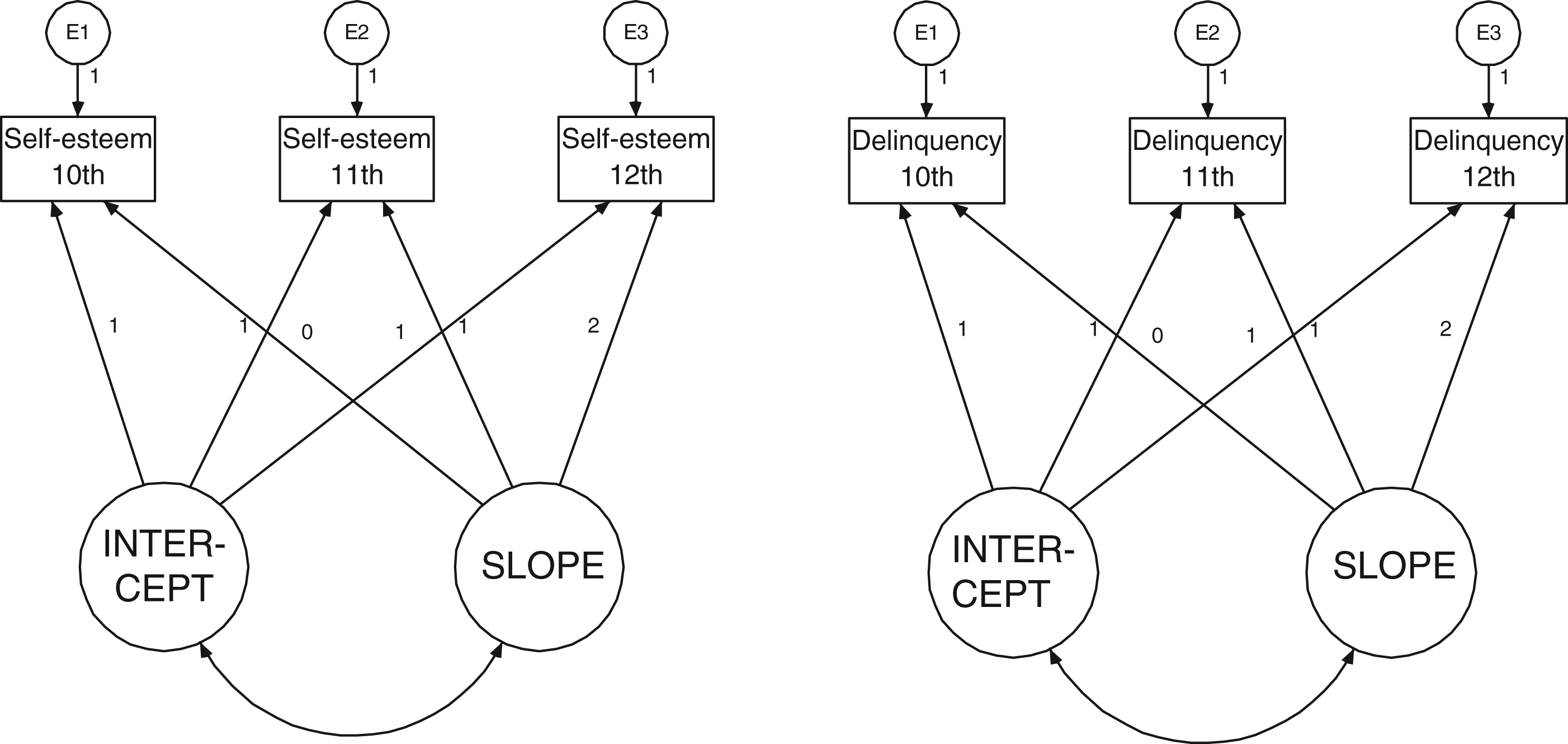
In the second step, after examining trajectories of self-esteem and delinquency over time and individual differences in them, cross-domain LGM was conducted as presented in Figure 2. Cross-domain LGM was considered to be more appropriate to prove the relations between the changing variables over time.
Standardized path coefficients of cross-domain latent growth model.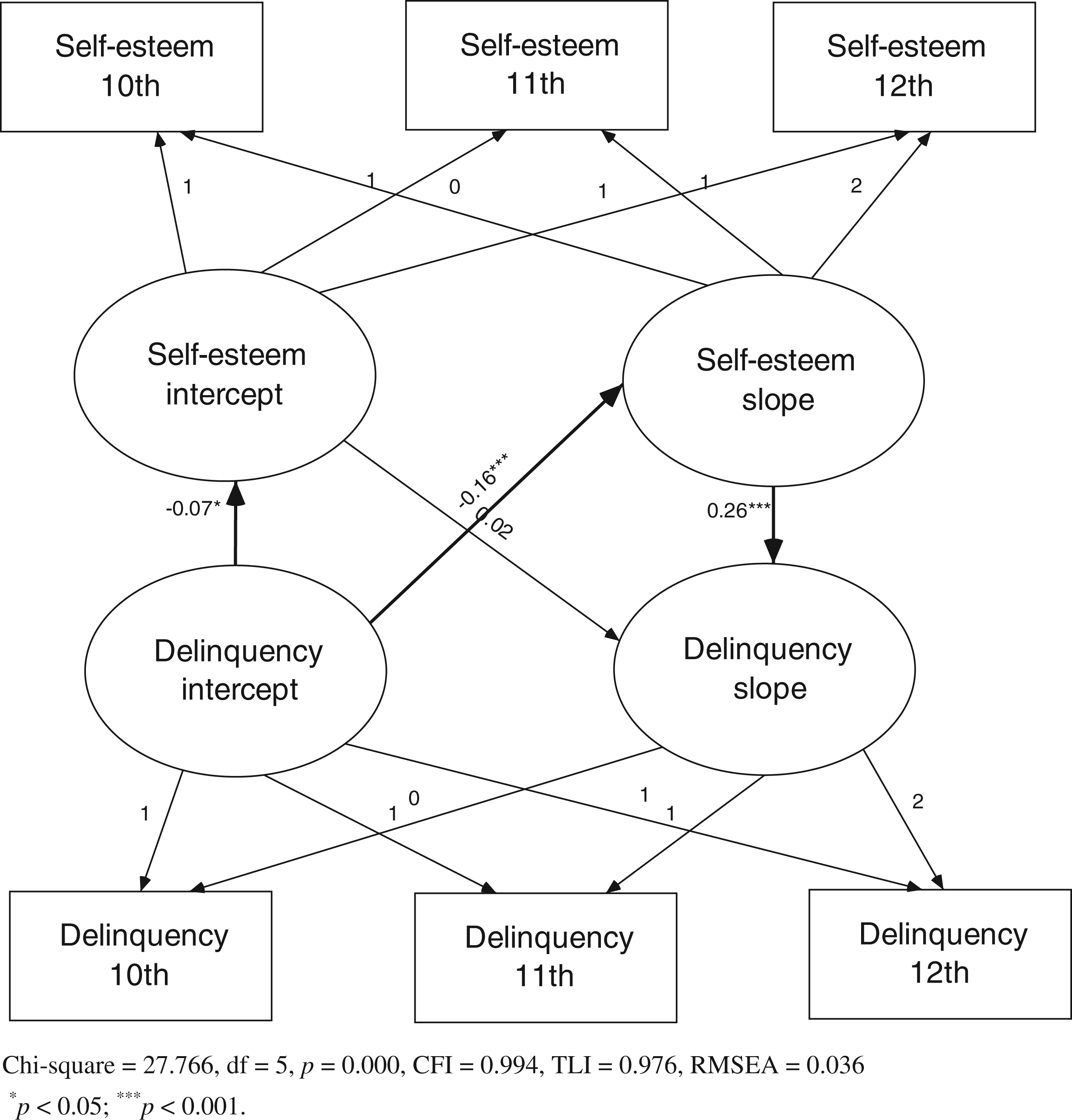
Results
Baseline growth models
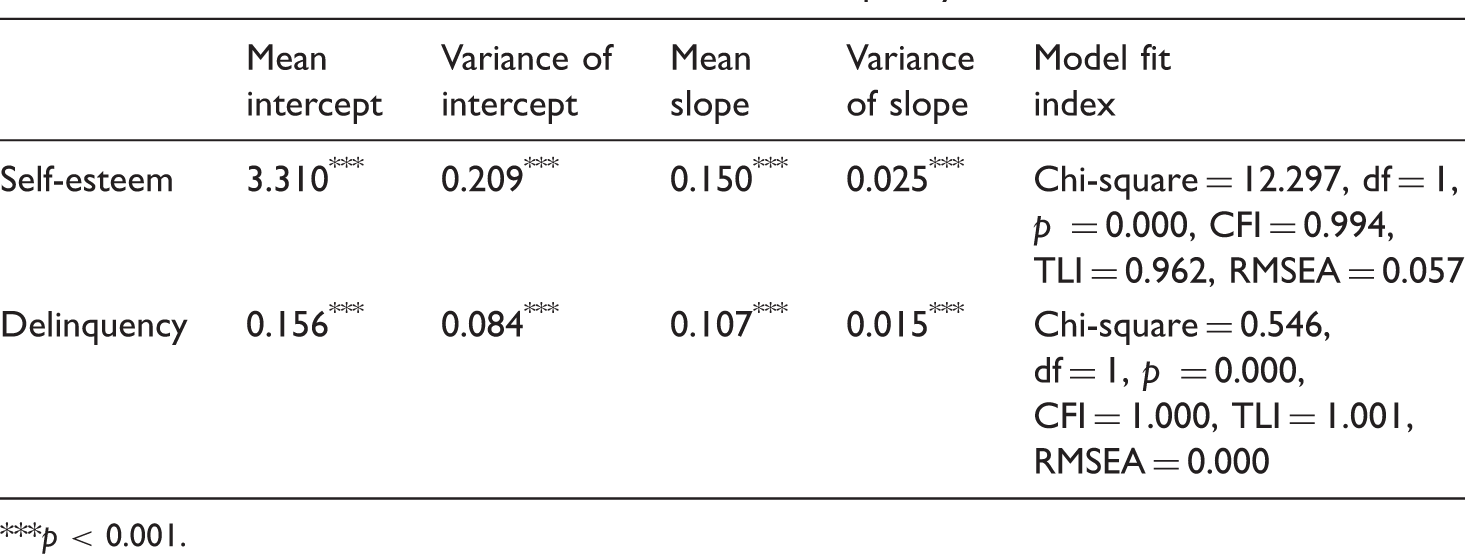
Estimations of LGM on self-esteem and delinquency
***p < 0.001.
First, for self-esteem, the linear trajectories provided an acceptable fit to the observed data (χ2 with 1 df = 12.297, p < 0.001, CFI = 0.994, TLI = 0.962, and RMSEA = 0.057). The mean starting point of self-esteem was estimated to be 3.310 (p < 0.001) and the mean of slope was done to be 0.150 (p < 0.001). Thus, self-esteem was increased gradually over time. Variance estimates for the intercept and the slope of self-esteem recorded 0.209 (p < 0.001) and 0.025 (p < 0.001), respectively, indicating significant individual differences in initial self-esteem and growth in self-esteem. In addition, as covariance between the intercept factor and the slope factor as a latent factor was - 0.025 (p < 0.001); thus, they were observed to be related negatively. This finding showed that self-esteem of adolescents with higher levels of initial self-esteem grew slower whereas that of adolescents with lower levels of initial self-esteem increased faster over time.
Second, for delinquency's linear growth model, fit indexes indicated an acceptable fit of the model to the observed data (χ2 with 1 df = 0.546, p < 0.001, CFI = 1.000, TLI = 1.001, and RMSEA = 0.000). The mean initial starting point and the mean slope of delinquency were estimated to be 0.156 (p < 0.001) and 0.107 (p < 0.001), respectively. Variance estimates of the intercept and the slope of delinquency recorded 0.084 (p < 0.001) and 0.015 (p < 0.001), respectively, indicating significant individual differences in initial delinquency and growth in delinquency. As the covariance of the intercept factor and the slope factor of delinquency was - 0.014 (p < 0.001), they had a negative correlation like self-esteem. Thus, higher levels of initial delinquency were slightly associated with slower growth on delinquency over time.
Cross-domain latent growth model
Correlations between variables
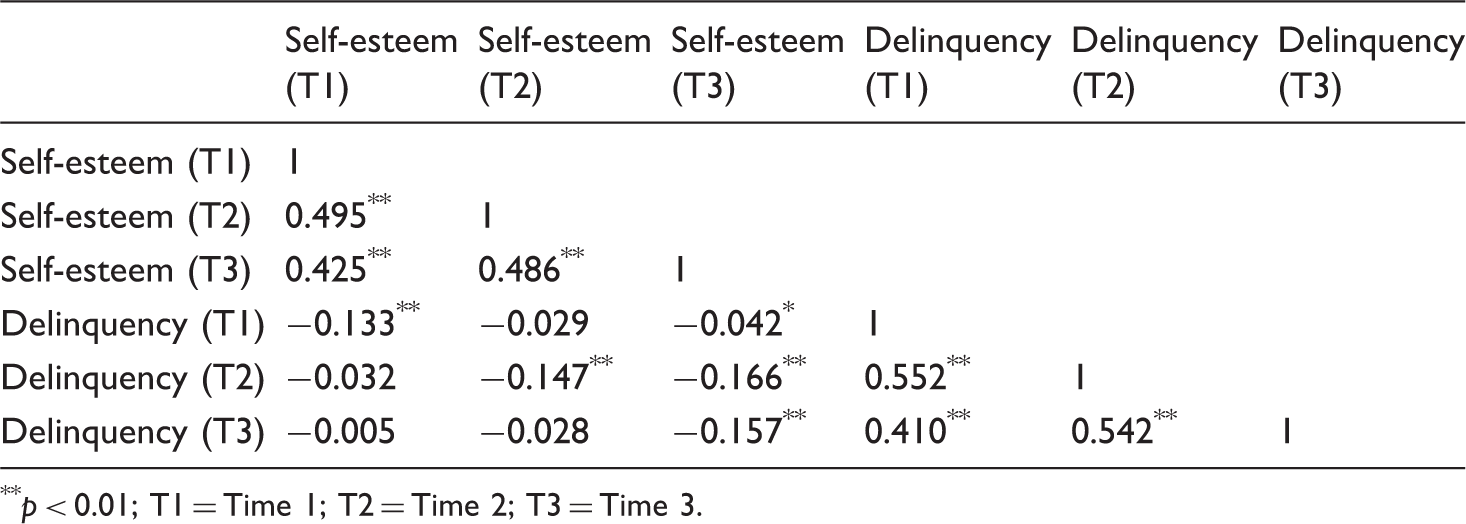
**p < 0.01; T1 = Time 1; T2 = Time 2; T3 = Time 3.
Cross-domain LGM's fit indexes indicated an acceptable fit of the model to the observed data (χ2 with 5 df = 27.766, p < 0.001, CFI = 0.994, TLI = 0.976, and RMSEA = 0.036). The intercept of delinquency was shown to be negatively related to the intercept of self-esteem (β = - 0.07, p < 0.05) and the slope of self-esteem (β = - 0.16, p < 0.001). In the meantime, the intercept of self-esteem did not influence significantly the slope of delinquency (β = 0.02, ns), but the slopeof delinquency was positively related to the slope of self-esteem (β = 0.26, p< 0.001). This finding indicated that faster growth of delinquency was associated with faster increase of self-esteem.
Discussion
The current study examined the inter-related development of self-esteem and delinquency across three years in Korean adolescents by using LGM and verified Kaplan's self-derogation theory empirically.
First, the developmental trajectories of both of self-esteem and delinquency were found to be a linear growth. That was consistent with prior studies reporting that self-esteem (Chung, 2007; Mason, 2001) and delinquency (Reitz et al., 2007) increased gradually in adolescence. Therefore, it was seemed cross culturally universal developmental process that the adolescents' self-esteem and tendency to be delinquent increased over time. However, despite this general tendency, the development trajectories of self-esteem and delinquency had significant individual differences in Korean adolescents.
In the study by Mason (2001), only the developmental trajectory of self-esteem showed significant individual differences and individual differences of delinquency was not significant. It appears that these different results are not due to cultural differences between the East and the West, but are due to the data used in his study (Mason, 2001). His data were collected in around 1970. A recent study conducted with adolescents in The Netherlands by Reitz et al. (2007), also reported a sameresult of this study that the individual difference in changes of the slope of delinquency was significant. Second, this study tested Kaplan's self-derogation theory that delinquency was positively associated with growth in self esteem among adolescent boys who initially reported having low self-regard. We found that lower intercept of delinquency was related to higher intercept of self-esteem and more growth of self-esteem over time. This finding did not support Kaplan's theory, contrary to Mason (2001)'s study in a Western setting.
According to Kaplan's theory, adolescents enhanced their self-evaluation through a tie with deviant peers by participating in delinquency as a way to recover their impaired self-esteem. However, this study found that self-esteem of Korean adolescents was not enhanced through participation in delinquency. Delinquency was negatively associated with the growth of self-esteem among Korean adolescents. Korean adolescents' self-esteem was influenced mostly by academic achievement in general. In Korea, which has a high regard for academic performance, many adolescents experience depression and self-derogation due to their poor academic performance, which is often referred to as a major cause of suicide of adolescents. The strong effect of academic achievement on self-esteem in Korean adolescents was reported well in the study of Chung (2007). When he investigated predictors of the developmental trajectory of self-esteem in Korean adolescents, among 12 predictors such as individual factors, family factors, peer factors, and school factors including delinquency, poor academic achievement was most strongly associated with negative self-esteem. This finding suggests that academic achievement should be considered when self-esteem of Korean adolescents is examined.
Why was delinquency negatively associated with subsequent self-esteem in Korean adolescents? As one of the reasons, we consider academic achievement's mediation effect between delinquency and self-esteem based on the result of a prior study that delinquency influenced negatively academic achievement (Fleming et al., 2005). In other words, decreased academic achievement caused by delinquency could negatively affect self-esteem in Korean adolescents. Therefore, in future studies, the mediation effect of academic achievement in the link between changes of self-esteem and those of delinquency should be considered. Additionally, socially reserved, quiet, and controlled behaviors are viewed as more appropriate in the context of traditional Korean culture (Jung & Stinnett, 2005). Therefore, adolescents with externalizing problems, such as delinquency, may be more likely to be negatively evaluated in South Korea than in Western society. The stigma associated with externalizing problems may impair adolescent self-esteem in South Korea. Hence, according to Kaplan's theory, the idea that delinquency encourages the development of self-esteem does not apply in South Korean culture.
Third, although the association of initial self-esteem with the subsequent delinquency was not significant, growth in self-esteem significantly enhanced the increase of delinquency. This was not tested in the study by Mason (2001) and was a meaningful finding in this study. This finding is in line with recent literature on self-esteem and problematic behavior. A recent study by Menon et al. (2007) revealed a negative effect of high self-esteem on antisocial behaviors by focusing on the dark side of self-esteem. They explained the result with disposition rationalizing hypothesis by saying that adolescents with insecure high self-esteem rationalized their antisocial behaviors after conducting them. For example, the rationalization such as ‘I am good and I threaten or hit others, then threatening or hitting others is also good’ (Rudman, 2004, p. 81) eventually promoted antisocial behaviors. A prior study conducted with Korean adolescents also reported a similar finding. In a study by Lee (2009), adolescents' positive self-evaluation became a risk factor provoking runaway. The author said that the reason for that was because high self-evaluation sought a certain stimulus by forming a sense of superiority and the practice of a delinquent behavior worked as a compensation to secure one's position among peers. The finding of this study that growth in self-esteem activated the development of delinquency could be interpreted in the same context.
Implications for practice
The results of this study have important implications for parents and teachers working with adolescents all over the world. First, delinquency was negatively associated with the rate of change (slope) in self-esteem among South Korean adolescents while Mason (2001) reported that the United States American adolescents' delinquency was positively associated with the slope in self-esteem. Thus, we suggest that international school personnel should approach the solution of adolescents' delinquency and self-esteem differently according to the cultural context. Kaplan's theory that delinquency is expected to have a positive effect on self-esteem over time was not applicable to South Korean adolescents. South Korean adolescents involved in higher levels of delinquency at the initial assessment had more rapid decreases in self-esteem over time. As such, the modification and prevention of conduct problems, such as delinquency, may be an effective intervention strategy for the promotion of adolescent self-esteem. The finding that the initial level of delinquency influenced the slope of self-esteem across all three years of assessment suggests that changes in self-esteem resulted from the levels of delinquency that were present several years prior to the assessment of self-esteem. Thus, it is crucial to execute interventions for adolescent self-esteem when children are young. The results of previous Western studies showing that delinquency results in increases in adolescent self-esteem are not applicable to youth in South Korea, and therefore interventions intended to increase adolescent self-esteem in South Korea should focus on reducing the frequency of delinquent activities.
Second, the rate of change (slope) of self-esteem positively predicted the rate of change (slope) of delinquency. Thus, it appears that increases in self-esteem promoted delinquent behaviors in adolescents despite the fact that delinquency was associated with impairments to the development of self-esteem. It is generally assumed that self-esteem has positive effects on youth development. However, the results of the present study reveal that there are also risks associated withhigh self-esteem. We could infer from a couple of previous studies in Western settings studies that the dark side of insecure high self-esteem is universal (Kernis, Grannemann, & Barclay, 1989; Menon et al., 2007). Self-esteem is the general evaluation of self-value, while narcissism is described as sense of entitlement and superiority (Taylor, Davis-Kean, & Malanchuk, 2007). In other words, individuals who have secure and high self-esteem think ‘I am a good person’; while people high in narcissism think ‘I am a better person’. Thus, teachers and parents should encourage adolescents to take advantage of healthy self-esteem while conforming to social rules. Carroll et al. (2007) reported that adolescents use delinquency as a way to gain the attention of peers and adults. Thus, they recommend that adolescents learn proper assertiveness skills. We suggest that teachers and parents teach these skills, as well as positive social skills.
Both Western and Eastern teachers may have to facilitate functional coping strategies to promote healthy and secure adolescent self-esteem. We should guide adolescents into diverse, constructive, and confidence-building activities including academic achievement, helping peers in the classroom, undertaking voluntary work, and participating in sports. These activities can help adolescents develop more positive self-esteem due to prosocial behaviors rather than due to delinquent activities.
Conclusion and limitations
Kaplan's theory, proven in the study of Mason (2001) performed in a Western setting, was not supported in this study performed using a Korean sample of adolescents. Therefore, generalization of Kaplan's theory needs to be tested in more diverse cultural contexts. Additionally, it was interesting that growth in delinquency is positively associated with the growth in self-esteem. Nevertheless, this study has a limitation. First, the 13 items used to measure delinquency seem to be situated in various types ofdelinquent situations such as sexual behaviors, stealing, and smoking. The potential need to narrow it down was evident in the delinquent scale. Hence, we recommend that future studies should measure delinquency in a unidimensional construct.