




Abstract
The Incredible Years (IY) universal child Classroom Dinosaur and Teacher Classroom Management programmes are delivered in all 102 primary schools in Gwynedd County, Wales. This article describes a pilot study of the IY Therapeutic (small group) Dinosaur School social and emotional coaching programme, developed as a treatment programme, in one such school. The aim was to assess the added benefit of this programme for young high-risk children in order to inform a larger randomized controlled trial. Twenty-four children, aged between 5- and 9-years-old, were identified as likely to benefit from the programme. Twelve children received ten two-hour sessions, the other 12 were wait-list control. The-programme was reduced to ten weeks to fit the school and research timetable. A full set of pre- and post-intervention data was collected for 19 children, using child and researcher completed measures. No significant differences between conditions were found post-intervention. Sub-sample analysis of 12 children rated by teachers as high-risk demonstrated significant benefits for the intervention children by comparison with control in terms of increases in problem-solving skills. These findings suggest an important role for psychologists in training and supporting schools in implementing the evidence-based IY interventions as is currently happening across Wales. The study also provided guidance on targeting and evaluation measures for a more rigorous study using the full programme.
Children with social and emotional skill deficits struggle to engage in the educational curriculum, are uncooperative with teachers and likely to behave antisocially (Raver, 2002). They also receive less peer support (Coie, 1990). Failure to acquire these skills results in long-term emotional and behavioural problems (Eron, 1990), school dropout, substance abuse and violent criminality (Loeber & Farrington, 2000). Teachers can spend more time managing disruption (Greenberg et al., 2003) than delivering the curriculum (Joseph, Webster-Stratton, & Reid, 2006; Latham, 1997).
The Incredible Years (IY) programmes for parents, children, and teachers have international evidence for both the treatment and prevention of conduct disorder. They are based on psychological principles and psychologists have played a key role in their development, research, and successful implementation (Baker, Clark, Crowl, & Carlson, 2009; Webster-Stratton et al., 2001). The Therapeutic Dina (TD) programme is a treatment programme that reduces conduct problems and improves children’s peer relationships and problem-solving skills (Webster-Stratton & Reid, 2003). It is delivered to groups of six children over 18–22 weeks in two hourly sessions. The Classroom Dina curriculum (CD) follows the same curriculum and is delivered class-wide in 20-minute lessons throughout the school year (Webster-Stratton, Reid, & Stoolmiller, 2008). The Teacher Classroom Management (TCM) programme introduces teachers to effective classroom management strategies (Webster-Stratton & Reid, 2002).
The county of Gwynedd invested in the IY TCM and CD programmes. By 2009 they had introduced them into all of their 102 primary schools and they quickly received positive external school inspection reports (Hutchings, Williams, Martin, & Pritchard, 2011). Their introduction was co-ordinated by an educational psychologist. Pilot studies of the TCM and CD programmes showed good results (Hutchings, Daley et al., 2007; Hutchings, Lane, Owen, & Gwyn, 2004) and a randomized controlled trial (RCT) of the TCM programme showed significant improvements in teacher and child behaviour (Hutchings, Martin, Daley, Whitaker, & Williams, 2011).
The rationale for this pilot study was that, despite satisfaction with the TCM and CD programmes, teachers recognized that some children needed additional support and there was interest in whether additional coaching in the treatment version of the Dina programme (TD) would benefit high-challenge children. This created an opportunity to evaluate the TD programme in a way that had not previously been done, as an additional support to young high-risk children who had TCM trained teachers and were receiving the universal CD curriculum. The study was designed to inform a larger RCT and to explore whether the programme could significantly improve child social and problem-solving skills and reduce behavioural difficulties over and above any benefits derived from the TCM and CD programmes.
Method
This was a small-scale pilot study with pre- and post-intervention measures.
The intervention
The headteacher, one classroom assistant and one class teacher undertook TD training, delivered by the first author. TD is typically delivered over 18–22 sessions however, due to constraints on the research timetable, it was only possible to deliver ten, weekly, two-hour sessions. The social and emotional skills curriculum is similar to the CD version of the programme but the small group format allows for very high rates of praise and incentives and increased opportunities for children to role-play effective social and problem-solving skills.
Participants
Teachers identified 24 pupils (six girls and 18 boys) aged 5- to 9-years-old (M = 7.17, SD = 1.44), 23% of a total of 104 pupils across four classes. Half of the children, two groups of six, received the intervention and half were wait-list controls.
Measures
Teacher Strengths and Difficulties Questionnaire (TSDQ; Goodman, 1997)
This is a 25-item behavioural screening inventory. The clinical cut-off for concern on total difficulties is 16 (see www.infosdq.org).
Wally Problem Solving Task (Webster-Stratton, Reid, & Hammond, 2001)
Fifteen different problematic social situations are presented pictorially to the child and the child’s solutions are rated for quantity and quality (see www.incredibleyears.com).
Teacher-Pupil Observation Tool (T-POT, Martin et al., 2010)
The T-POT is an objective observational tool designed to identify a wide range of teacher and child classroom behaviours.
Data collection
Intervention measures were collected from teachers and pupils and by researchers who undertook blind classroom observations. Baseline measures were collected in January/February, the intervention was delivered between March and May and follow-up measures were collected in June, ensuring that all children remained in the same classes for the duration of the study. Teachers completed the TSDQ. One teacher administered the Wally Problem Solving Test to the entire sample of children. Observers blind to condition, and inter-rater reliable (Martin et al., 2010) undertook the T-POT observations.
Results
Baseline description
There were no significant differences, at baseline, between intervention (M= 19.50, SD = 5.45) and control children (M = 18.17, SD = 6.51) on the TSDQ or on any T-POT categories. There were significant differences between the groups on the Wally Problem Solving task with intervention children showing significantly less solutions than controls (t(22) = 2.135, p = 0.045, d = 0.95).
Outcomes
A full set of pre- and post-intervention data, available for 19 children, revealed no significant additional benefits for intervention group children although there were some improvements for both groups over the four-month period. Given the intended target population for the TD intervention, a subgroup analysis was undertaken to establish whether there were differences for the children rated as giving significant cause for concern on the TSDQ.
Subsample analysis
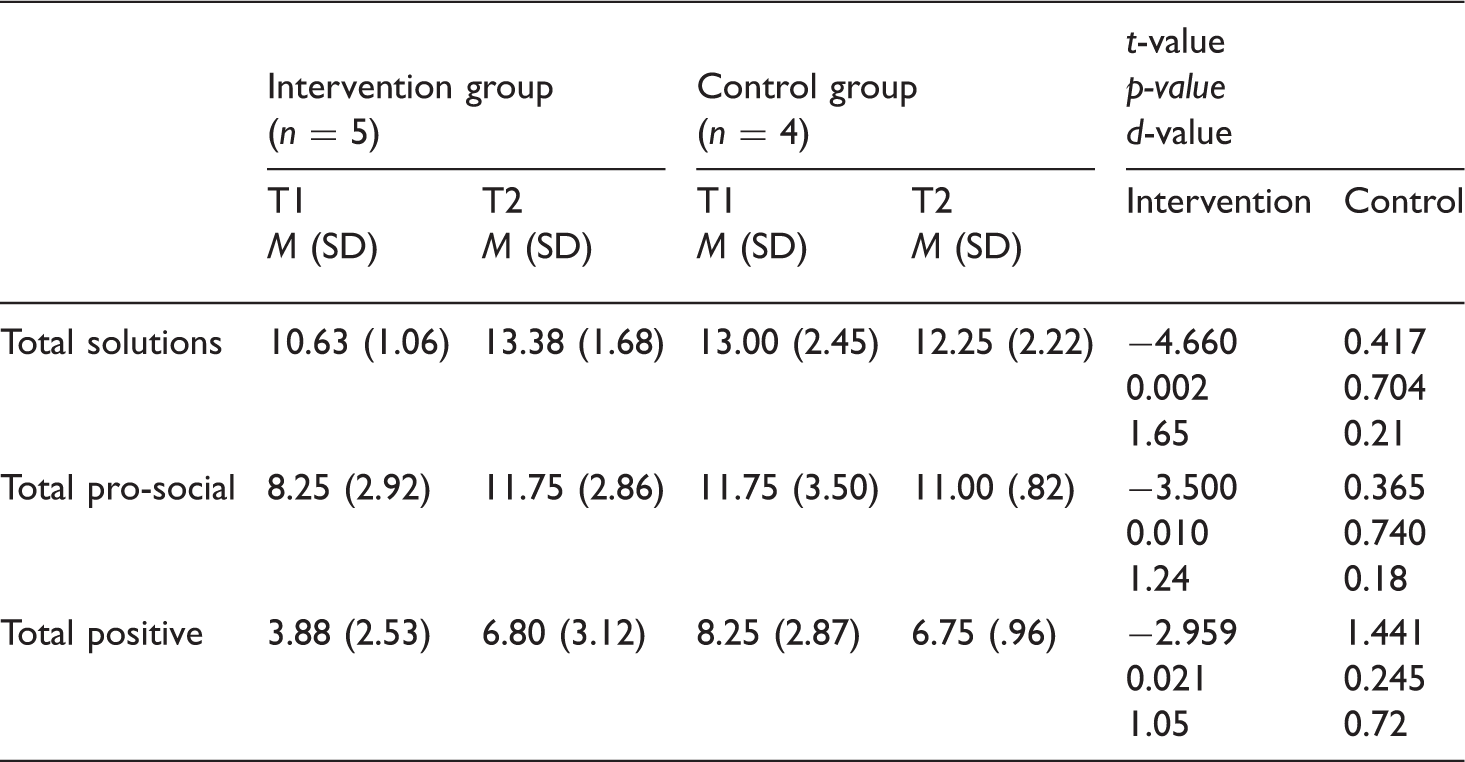
Paired t-tests for the Wally Problem Solving Task subscales pre- and post- intervention (control n = 4, intervention n = 8)
Analysis of T-POT observations revealed that overall intervention children showed increased positive behaviours towards teachers, and likewise their teachers showed an increase in positive behaviours towards them. However, these did not reach statistical significance. Control group children, by contrast, demonstrated a reduction of positive behaviours towards their teachers, and their teachers showed reduced positive behaviours towards these children. However, these differences also did not achieve statistical significance.
Discussion
Teachers trained in TCM methods, and who delivered the CD universal social and problem-solving skills curriculum, identified children, who represented 23% of the pupils in their classes, whom they thought would benefit from additional social, emotional, and problem-solving skills coaching provided by the TD programme. Half of the children received the intervention. Data for the full sample did not show significant differences in outcomes between intervention and control children, and both groups tended to improve over time, however, significant increases in problem-solving skills were demonstrated for children with clinical level difficulties, for whom the TD therapeutic intervention was developed.
The ten-week version of the TD programme decreased disruptive behaviour and significantly increased problem-solving skills for identified high-risk children. The 18–22 week version may yield stronger effects and future research is needed to investigate this possibility.
The study has a number of limitations. The sample represented 23% of all children within the classes and included sub-threshold children who may not have required/benefited from additional social and emotional skills coaching. Due to school and research timetabling constraints, the curriculum was delivered in ten as opposed to the 18–22 sessions specified in the manual and is likely to have reduced programme potency. Finally, teachers were not blind to condition, however, this would not have affected the results of the Wally Problem Solving test or the blind T-POT observations.
The study has some strengths. This is the first trial of the TD programme as an adjunct to the TCM and CD programmes. The results suggest the TD programme provides added benefits for children exceeding the clinical cut-off on the total TSDQ score. Data were collected from multiple sources, teachers, children, and independent observation and the study has informed selection criteria and evaluation tools in the larger RCT trial (Bywater, Hutchings, Whitaker, Evans, & Parry, 2011) in which Gwynedd Education Service are currently participating. This RCT of the TD programme in 20 schools will establish the effectiveness of the TD programme with high-risk children in schools where teachers have undertaken IY TCM training and are delivering the CD curriculum.
The need to support effective teacher classroom management skills and to establish a social and emotional skills curriculum in schools is core work for educational psychologists who are ideally placed to train and support teachers, as is increasingly happening across Wales. They can also make a useful contribution to the identification and targeting of children needing additional help and support delivery of the TD programme to groups of children as part of their therapeutic work with schools.
The Welsh Assembly Government has monitored the developments in Gwynedd and is now funding training and supervision in the IY parent, child, and teacher programmes, delivered by one clinical and two educational psychologists, for education based staff across Wales. Gwynedd Education service has continued to work with Bangor University and is now also collaborating in researching the brief, four-session, school readiness parent programme delivered to parents as their children are starting school (Cooper, 2011).