



Abstract
Gender differences in bullying behavior among adolescents have been observed, but the reasons for the discrepancy in males’ and females’ bullying experiences has been the focus of few studies. This study examined the role of the cognitive and affective empathy in explaining gender differences in bullying through multiple mediation analysis. The participants of the study were 795 Turkish adolescents (455 females, 340 males) ranging in age from 13- to 18-years-old. The Revised Cyber Bullying Inventory, Traditional Bullying Questionnaire and Basic Empathy Scale were utilized to gather data from participants. Findings revealed that the total effect of cognitive and affective empathy mediated the gender differences in traditional bullying in addition to the unique effect of affective empathy. However, only the combined effect of affective and cognitive empathy mediated the gender differences in cyberbullying. The findings are discussed in the light of the related literature and implications for practice.
School bullying has been one of the most common problems among school age children across countries as international research has reported; studies from Australia (Rigby, 2005), Canada (Chan, 2006), Finland (Sairanen & Pfeffer, 2011), Italy (Gini, 2007), Norway (Olweus, 1993), Taiwan (Wei & Jonson-Reid, 2011), the United Kingdom (Boulton, Smith, & Cowie, 2010), the USA (Hoover, Oliver, & Hazler, 1992), and Turkey (Yılmaz, 2011) have reported substantial number of students experiencing bullying either as a perpetrator, a victim, or a bystander. Peer bullying as a longstanding issue appears to be changing its forms parallel to the developments of information and communication technologies (ICT). ICT provides bullies with a new medium where they can bully others while hiding their identities (Patchin & Hinduja, 2006). This new type of bullying, called cyberbullying, is defined as ‘an aggressive, intentional act carried out by a group or individual, using electronic forms of contact, repeatedly and over time against a victim who cannot easily defend him or herself’ (Smith et al., 2008, p. 376). Bullying, therefore, can now takes place not only in and around schools but also can occur anywhere that the Internet communication technologies are available, starting from very early ages (Monks, Robinson, & Worlidge, 2012) and continuing through young adulthood (Beran, Rinaldi, Bickham, & Rich, 2012).
Regardless of whether it is traditional or cyberbullying, one challenging issue remains the role of gender differences in both cyberbullying and traditional bullying. Despite some inconsistent findings, the majority of studies have reported that males bully others more than do females in both physical (Camodeca, Goossens, Terwogt, & Schuengel, 2002; Olweus, 1993; Scheithauer, Hayer, Petermann, & Jugert, 2006) and cyber environment (Erdur-Baker, 2010; Gradinger, Strohmeier, & Spiel, 2010; Li, 2006). Sakellariou, Carroll, and Houghton (2012) recruited only males; examined their cyberbullying experiences in detail and concluded that males frequently experience all types of cyberbullying and cyber victimization. As for the reasons for males’ tendency to be bullies, it is possible that males are more likely than females to be bullies because of differences in gender role socialization (Wade & Beran, 2011). One such factor may be the discrepancy between males’ and females’ level of empathy. Empathy is defined as ‘an emotional response that stems from another’s emotional state or condition’ which ‘is congruent with the other’s emotional state or situation’, and it thought to have two dimensions, cognitive and affective empathy (Eisenberg & Strayer, 1987, p. 5). The cognitive component of empathy reflects the ability to adopt another’s perspective and identify one’s emotions, while the affective component is taken as ‘sharing the other’s feelings’ (Caravita, Di Blasio, & Salmivalli, 2009). Affective empathy is described as more immediate and unintentional, whereas cognitive empathy develops with age as a more intentional and controlled component (Hodges & Wegner, 1997). Whatever the utilized methodology, females are always found to be more empathetic than males (Rueckert & Naybar, 2008). Such research findings suggest that empathy level may explain the gender differences in bullying. In other words, females are less likely to be a traditional bully or cyberbully due to their relatively higher level of empathy. Thus, the main goal of this study is to examine whether empathy can be helpful in explaining the gender differences in peer bullying.
The relationship between empathy and bullying has been examined in a limited number of studies. The results of these studies reported somewhat inconsistent results in terms of the facilitative or preventive role of empathy in traditional bullying (Gini, Albiero, Benelli, & Altoe, 2007; Jolliffe & Farrington, 2011; Warden & MacKinnon, 2003) and cyberbullying (Ang & Goh, 2010; Dautenhahn & Woods, 2003). Some of these studies reported that bullies have lower levels of empathy than non-bullies in physical settings (Joliffe & Farrington, 2006a). However, other researchers have argued that bullies whose cognitive empathy level is high will be good at ‘mind reading’ which enables them to more easily manipulate others and understand the consequences of their actions (Dautenhahn & Woods, 2003).
Furthermore, different components of empathy seem to be playing different roles in the relationship between gender and bullying. On the one hand, findings for all of the related studies indicate that males with lower levels of affective empathy engage in traditional bullying more than those who have high levels of affective empathy (Caravita et al., 2009; Jolliffe & Farrington, 2006a, 2011). For females, while Jolliffe and Farrington (2006a, 2011) reported the same pattern as males, Caravita et al. (2009) found a lack of relationship between affective empathy and traditional bullying.
Alternatively, Sutton, Smith, and Swettenham (1999) contended that systematic bullying requires understanding and manipulating the minds of others. That is, bullies are capable of mind reading, understanding emotions, and predicting the consequences of their actions. In fact, these characteristics make them better at bullying because they know what hurts their victims (Sutton et al., 1999). The victims’ distress may only further reinforce the bullies’ behavior (Davis, 1994). Likewise, in their theoretical paper, Dautenhahn and Woods (2003) claim that bullies’ cognitive empathy level needs to be higher than non-bullies because they need a certain level of cognitive empathy to manipulate others and engage in bullying behavior. The findings of Caravita et al. (2009) support this argument in that both males and females with higher levels of cognitive empathy are found to engage in traditional bullying more than those who do not have high levels of cognitive empathy.
Previously, the relationship between empathy and bullying has been evaluated in physical environments; of late, the interests of researchers have turned to cyber space. In one of the rare studies which investigated the empathy, gender and cyberbullying relationship, Ang and Goh (2010) reported that the critical variable which predicts the difference in cyberbullying experience between males’ and females’ is affective empathy. Ang and Goh (2010) stated that affective empathy has a preventive role in balancing the negative effects of lack of cognitive empathy only for females, and suggested that a replication of their study is necessary to make a more confident conclusion. In a more recent study, Steffgen, König, Pfetsch, and Melzer (2011) validated that lack of empathy facilitates cyberbullying behavior.
Given the different nature of affective and cognitive empathy levels for males and females, the question is whether these differences play a significant role in explaining gender difference in traditional and cyberbullying. Answering this question will help researchers and practitioners to integrate and make use of empathy within bullying prevention and intervention strategies. Fuelled by empirical findings, this study aims to examine the preventive role of affective empathy and facilitative role of cognitive empathy in bullying research with regard to gender. It is hypothesized that females would be more empathetic and therefore less likely to engage in bullying, while males would be less empathetic leading them to engage in bullying.
Method
Participants
Participants consisted of 795 (455 females, 340 males) Turkish adolescents aged between 13- and 18-years-old (M = 16.67; SD = 1.28). The majority of the participants’ (61.5%) family income was in the middle income group; others were equally distributed in the low income group (17%) or in the high income groups (17.4%). Participants were recruited using a sampling of convenience procedure.
Instruments
Revised Cyber Bullying Inventory (RCBI)
The Cyber Bullying Inventory (Erdur-Baker & Kavş ut, 2007) was revised by Topcu and Erdur-Baker (2010). The scale has two parts with 14 identical statements providing scores for being a bully and a victim for the past six months. For cyberbullying, participants responded to the items as ‘I did it’; in the case of cyber victimization, the participants responded to the items as ‘It happened to me’. Participants were asked to report their experiences on a four-point rating scale (1 = never, 2 = once, 3 = two to three times, and 4 = more than three times). One sample item from RCBI read as ‘sending threatening or hurtful comments through e-mail’. The lowest possible score was 14 and the highest possible score was 56 where higher scores indicated more frequent cyberbullying experience. RCBI was reported to have a one-factor structure with an internal consistency coefficient of .82 for the cyberbully part and .75 for the cybervictim part (Topcu & Erdur-Baker, 2010).
In the present study, only the cyberbully part was used and confirmatory factor analysis (CFA) via AMOS 18.0 (Arbuckle, 2009) verified the one-factor structure (GFI = .94, AGFI = .91, RMSEA = .07) with an internal consistency coefficient of .83.
Traditional Bullying Questionnaire (TBQ)
The Traditional Bullying Questionnaire was constructed by Topcu (2008). The TBQ was developed and used instead of the measurement tools for traditional bullying which already existed in the literature because existing measurement tools aimed to measure the physical type of traditional bullying. However, cyberbullying was found to be closely related to relational bullying rather than physical bullying (Keith & Martin, 2005) and the TBQ aimed to measure the relational type of traditional bullying.
In order to provide information about face and content validity, a focus group of six students (two females and four males aged between 16- and 18-years-old) and three experts (counseling psychologists) evaluated the items in terms of their age appropriateness and understandability. The scale had seven items aiming to measure covert bullying on a four-point rating scale (1 = never, 2 = once, 3 = two or three times, 4 = more than three times). The lowest possible score was 7 and the highest possible score was 28 where higher scores indicated more frequent traditional bullying experience. One sample item from TBQ read as ‘I have spread rumours about someone’. The one-factor structure of the TBQ was confirmed by CFA via AMOS 18.0 (Arbuckle, 2009) (GFI = .98, AGFI = .97, RMSEA = .05) in the present study and the Cronbach alpha coefficient was .75.
Basic Empathy Scale (BES)
The Basic Empathy Scale was originally developed by Jolliffe and Farrington (2006b) and adapted into Turkish by Topcu, Erdur-Baker, and Çapa-Aydın (2010). The BES has 20 items, nine of which measure cognitive empathy, and 11 of which measure affective empathy on a five-point Likert type scale (1 = Strongly Disagree, 2 = Disagree, 3 = Neither Agree nor Disagree, 4 = Agree, 5 = Strongly Agree). Before the analyses, seven of the items were reverse coded. Therefore, higher scores indicated a higher level of empathy. Jolliffe and Farrington (2006b) found a two-factor solution (affective and cognitive empathy), and Cronbach alpha coefficients were .85 for the affective component and .79 for the cognitive component. ‘My friend’s emotions don’t affect me much’ was a sample item for the affective empathy component of BES and ‘I can understand my friend’s happiness when she/he does well at something’ was a sample item for the cognitive empathy component of BES.
In the present study, a two-factor solution was confirmed by CFA via AMOS 18.0 (Arbuckle, 2009) (GFI = .90, AGFI = .88, RMSEA = .07) and the Cronbach alpha coefficient was .75 for affective component and .81 for cognitive component. Although GFI and AGFI values did not seem to be high enough to continue to the analysis, the RMSEA value indicated a moderate fit and was considered to be acceptable to continue with the analyses (Byrne, 2001).
Demographic information form
The age and gender of the participants and income level of their parents were solicted using a demographic questions form.
Procedure
After obtaining permission for this research from the Ethical Board of the university, the students were contacted on the day of data collection (all procedures adhered to the Declaration of Helsinki ethical code). The purpose of the study was explained to the students and only those who freely volunteered participated in the study.
Results
The aim of the present study was to examine the roots of gender differences in two types of bullying. In order to achieve this aim, the empathy level of the participants was investigated as an explanatory mediating factor of gender difference in cyber and traditional bullying.
Preliminary analyses
Mean, Standard Deviations and Correlation Coefficients of Variables
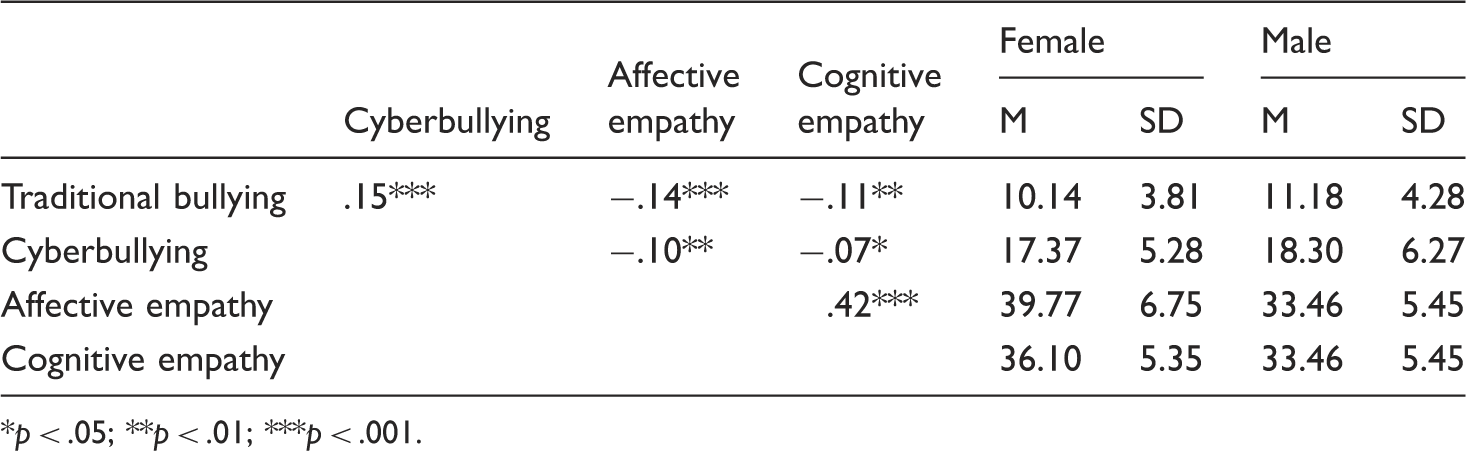
p < .05; **p < .01; ***p < .001.
Multiple mediation analyses
Since both affective and cognitive empathy were found to be significantly related to gender and bullying (in both traditional and cyber forms), multiple simultaneous mediation analysis was used in order to test the total and specific indirect effects of mediators (Preacher & Hayes, 2008).
Mediation of the Effect of Gender on Traditional Bullying through Affective and Cognitive Empathy

Note. BCa, bias corrected and accelerated; 5000 bootstrap samples; ΔR2 = .02.
p < .05; **p < .01.
Mediation of the Effect of Gender on Cyber Bullying through Affective and Cognitive Empathy

Notes. BCa, bias corrected and accelerated; 5000 bootstrap samples; ΔR2 = .01.
p < .05.
Discussion
This study endeavored to uncover the reasons for gender differences in bullying behavior. The present study examined the mediator role of empathy level with its two components—affective and cognitive—in explaining the differences between males’ and females’ bullying experiences in both physical and cyber environments. As expected, males tended to bully others more than females did because males were seen to be less empathetic than females. The results suggested that the combined effect of affective and cognitive empathy mediated the gender and traditional bullying relationship as well as the specific effect of affective empathy. Affective empathy mediated the gender and traditional bullying relationship even after the effect of cognitive empathy was controlled; however, only the total indirect effect of affective and cognitive empathy was found as mediating the cyberbullying and gender relationship.
As a contribution to the literature, the present study replicated the findings of studies which found that bullies differ in their empathy levels with regard to gender, and empathy functions as a preventive factor (Ang & Goh, 2010; Jolliffe & Farrington, 2006a, 2011). These findings implied that the risk factor for engaging in bullying was not due to being a male or a female; but, being less empathetic than others put a child in a risky situation for engaging in bullying. As a practical implication, empathy training which aims to increase affective and cognitive empathy should be integrated into bullying prevention and intervention programs for physical settings at schools by psychological service providers. When males’ lower levels of empathy in both of the components are considered, offering empathy training to males would be especially helpful. Kowalski, Morgan, and Limber (2012) have suggested using different prevention and intervention strategies for males and females tuned to the special needs of each gender. To fight against cyberbullying, intervention programs should place greater emphasis on increasing both affective and cognitive empathy as findings suggest that their combined effect mediates the relationship between gender and cyberbullying. One critical recommendation to psychology practitioners in schools is to emphasize the increase in affective empathy while working to prevent traditional bullying—because a deficiency in affective empathy has a unique role in leading to traditional bullying.
Since the literature lacks effective prevention and intervention programs for handling cyberbullying (Von Marees & Petermann, 2012), researchers have proposed innovative approaches (such as Quality Circles; Paul, Smith, & Blumberg, 2012) to understand cyberbullying and deal with it. Based on these proposals, it is clear that the roles of school administrators, teachers, and psychological service providers are crucial in implementing prevention and intervention strategies (Cassidy, Brown, & Jackson, 2012).
This study also revealed an interesting finding substantiating evidence for the nature of traditional and cyberbullying. The pattern of the mediator role of affective and cognitive empathy was not the same for traditional and cyberbullying. Although both of the components of empathy worked as a mediator when they were taken as a set for both traditional and cyberbullying, affective empathy was found as a specific mediator for the relationship between gender and traditional bullying. The specific indirect effect of cognitive empathy was found not to be a mediator of the relationship between gender and both types of bullying. As it is widely acknowledged, there is an established relationship between traditional and cyberbullying (Dempsey, Sulkowski, Nichols, & Storch, 2009; Sontag, Clemans, Graber, & Lyndon, 2011); however, there are still studies arguing that traditional and cyberbullying should be considered independently because of the unique characteristics of cyberspace (Smith et al., 2008). The nonparallel results of the present study for cyberbullying and traditional bullying support the latter contention and suggests that future research should investigate the causes for this difference. While the present study does not have empirical evidence to shed light on this finding, it can be speculated that empathy and its presentation are highly related to experiencing the other person’s reactions— and in the case of bullying, it means receiving feedback from the victim. At this point, cyberspace does not consistently provide this opportunity to the bully.
The present study has some limitations, and while interpreting the results these limitations should be taken into account. Although the mediation analyses are statistically significant, the effect sizes are small, which results in problems in terms of practical significance. One of the most important limitations is the usage of self-report measurement tools which always incorporate the problem of social desirability. In order to overcome this weakness, multiple sources (e.g., parent, teacher, peer reports) should be used to obtain more reliable information about the empathy levels and bullying behaviors of adolescents. Another limitation of the study comes from the sample selection strategy which was based on convenience sampling, meaning that the results of this study cannot be generalized. Beside the aforementioned limitations, to the best of our knowledge, the present study has been the first empirical research study which has attempted to analyse the role of empathy in clarifying the gender difference in both cyberbullying and traditional bullying of adolescents in one study.