




Abstract
The aim of this study was to determine the prevalence of harassment in high school and into university, and the impact of one particular form of harassment: cyber-harassment. Participants were 1,368 students at one US and two Canadian universities (mean age = 21.1 years, 676 female students). They responded on five-point scales to questions about the frequency and impact of harassment. A total of 33.6% of students stated they had been cyber-harassed and 28.4% had been harassed off-line when in high school. Also, 8.6% were cyber-harassed and 6.4% were harassed off-line while in university. Hierarchical logistic regression analyses show that the type of harassment experienced in high school is associated with the type of harassment experienced in university. Various negative outcomes of cyber-harassment were also identified.
Despite growing awareness of peer harassment, school psychologists face many challenges implementing prevention and intervention strategies (Sherer & Nickerson 2010). In particular, harassment has increased over the intervening decade because electronically mediated communication has opened a new variation—cyber-harassment. Mental health and well-being are largely dependent on perceptions of belonging and connection (Colarossi & Eccles, 2003), and harassment, the use of power to control someone who has difficulty defending him/herself (Nansel et al., 2001), rejects the person targeted and disrupts feelings of belonging and connection. Thus, being a victim of harassment has significant mental, as well as physical, health consequences (Rigby, 2003).
In-person (off-line) harassment takes several forms, including physical (e.g., pushing) and verbal (e.g., threatening) behaviours directed at the targeted person, and social (e.g., excluding or rumour-mongering) behaviours that target a victim through a peer group. Rates of in-person harassment among children around the world have been estimated to range from 5% to 54% depending on the sample and the measurement methods (Craig & Pepler, 2003).
In contrast, cyber-harassment occurs through communications devices such as cell phones and the internet where threatening or excluding messages are sent as emails, text messages, or posted on social media or other websites (Patchin & Hinduja, 2006). In one of Canada’s first studies examining this behaviour, Beran and Li (2005) reported rates among middle school age children to be 21% for victimization (children who are targeted) and 3% for perpetration (children who harass others). In the US, researchers documented a victimization rate of 19% for youth who regularly used the internet, and a perpetration rate of 12% (Ybarra & Mitchell, 2004). These results are similar to a recent study in Australia of 11.5% and 8.5% for victimization and perpetration, respectively (Sakellariou, Carroll, & Houghton, 2012).
Research has shown that any form of off-line harassment has a wide range of detrimental effects on children (Hawker & Boulton, 2000). Academic difficulties include impaired concentration, reduced school marks, and absenteeism (Beran & Lupart, 2009; Reid, 1985; Spriggs, Iannotti, Nansel, & Haynie, 2007; Ybarra, Mitchell, Finkelhor, & Wolak, 2007). Mental health injury may include anxiety, depression, and loneliness (Brunstein, Marrocco, Kleinman, Schonfeld, & Gould, 2007). Cyber-harassment, in particular, has been found to result in emotional problems, poor concentration, lower academic achievement and school avoidance (Beran & Li, 2005; Patchin & Hinduja, 2006).
While harassment among children has received considerable attention in the research, harassment among adolescents has received less attention (with some exceptions e.g., Kowalski, Morgan, & Limber, 2012; Popovic-Citic, Djuric, & Cvetkovic, 2011). Harassment has been shown to have continuity through the school age years (Beran, 2008), but there is limited research examining if it continues beyond high school. The developmental stage of emerging adulthood (18 to 25 years), the age of many undergraduate university students, has been conceptualized as a transitional period between late adolescence and young adulthood, and it includes traits such as identity exploration and self-focus that are extensions of adolescence (Arnett, 2000, 2004, 2007). As such, behaviours present in an adolescent may continue into early adulthood. Walker, Sockman, and Koehn (2011) reported that 11% of university students were cyberbullied, and Chapell et al. (2004) reported that 23.7% of university students were bullied off-line. Other studies of undergraduate university students have found that 10% experience indirect forms of victimization (i.e., gossip), 7% perpetrate cyber-harassment (Leenaars & Rinaldi, 2010), and one-third experience cyber-stalking (Spitzberg & Hoobler, 2002). Similarly, 12% of 12- to 17-year-olds report cyber-harassment (Navarro & Jasinki, 2012), suggesting similar rates between high school and university. Furthermore, research has found that students harassed off-line in university are likely to report having been harassed off-line in high school (Chapell et al., 2006) indicating some evidence of consistency of harassment from adolescence into emerging adulthood.
Attachment theory provides an explanation of why harassment may continue over subsequent years. According to Ainsworth, insecure emotional bonds with a caregiver at an early age may create negative expectations about relationships with others, such as peers, in later life (Ainsworth, 1973). For example, children who do not experience trusting relationships with a caregiver may have difficulty trusting others and instead expect hostility and aggression in their peer interactions. This link has been supported in several studies (Rokach, 2012; Suess, Grossman, & Sroufe, 1992; Urban, Carlson, Egeland, & Sroufe, 1991). Moreover, Beran (2008) found that children who are bullied at ages 10- to 15-years-old are at risk of subsequent harassment two years later.
The extent to which both off-line and cyber-harassment continues from high school to university is not yet known. Evidence of this continuity in harassment would emphasize the importance of intervention at the high school level. The goals of this study are to examine the prevalence of cyber-harassment and off-line harassment in high school and university to determine the extent to which high school harassment translates into similar behaviours in emerging adulthood, and to explore the emotional and behavioural consequences of cyber-harassment. We expected that students who had experienced harassment in high school would also experience some form of harassment in university. Given that children report negative effects of cyber-harassment, we expected a similar finding with university students.
Method
Participants
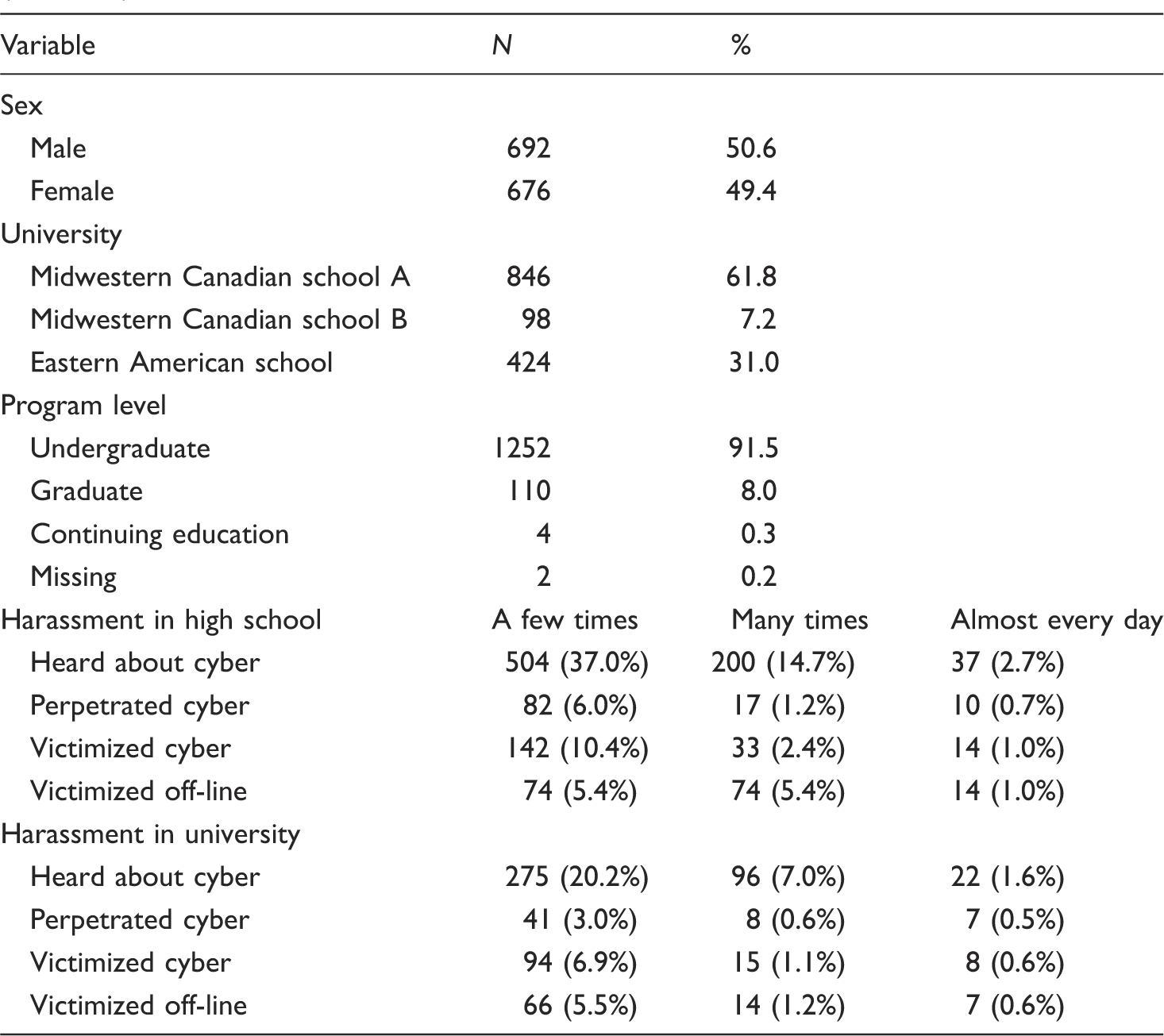
Demographic characteristics and prevalence of harassment for the sample (N = 1368)
Measures
The university harassment survey was adapted to be age and stage appropriate from a questionnaire originally developed for middle school students (Beran & Li, 2005). In section 1 several demographic questions were presented including sex, name of university, program level (undergraduate or graduate), and age. In section 2, participants were asked how often they used cell phones, landline phones, computer and internet. The five-point response scale ranged from ‘never’ to ‘frequently’. In this section participants were also asked to estimate how many hours per day they used each medium. Section 3 showed a definition of harassment as repeatedly doing one or more of the following to another person for whom it was difficult to defend him/herself: 1) saying mean and hurtful things, teasing, making fun, or calling him/her mean and hurtful names; 2) ignoring or excluding him/her; 3) telling lies or spreading false rumours about him/her; or 4) trying to make other people dislike him/her. Participants were asked about these experiences both online and off-line while in high school. These included: ‘Had you heard of students using technology (emails, instant messaging, text messaging, video cell phones, Web sites, blogs, etc.) to harass other students? Had you used technology to send harassing messages to other students? Had you been harassed by students through technology? Had you been harassed by students in other ways (e.g., face-to-face, physically attacked, excluded at school)?’. Answers were given on a five-point scale from ‘never’ to ‘almost every day’. These same questions were re-administered with instructions for participants to think only of their experiences in university. The types of communications devices used in these experiences were also reported.
If participants stated that they had been cyber-harassed then they completed section 4 about its emotional and behavioural impact. They rated impact on a five-point scale from ‘never’ to ‘almost every day’ for the following items: Sad and hurt; angry; embarrassed; anxious; missed class; cried; had difficulty concentrating; marks dropped; and blamed myself.
Procedure
Research assistants contacted randomly selected professors by email to request permission to visit classrooms and request participation. The questionnaire was administered in class or distributed to participants to return when completed. The response rate of class-administered surveys was 59.9% and there were no sex differences between those who did and did not volunteer. Potential participants were also randomly selected at frequented locations throughout campus. Completion time of the questionnaire was about 15 minutes. Participants were asked to record their name on a separate piece of paper if they wanted to be entered into a raffle to win an iPod® at each site. Ethical clearance was obtained by all the researchers’ university ethics review boards. Participation was taken as consent to participate in the study.
Statistical analyses
Analyses of variance were conducted to examine differing experiences according to demographic characteristics. Bivariate correlations were calculated to estimate the relationship between the use of communication devices and the likelihood of cyber-harassment. To determine the extent to which harassment in high school is related to harassment in university, four separate hierarchical logistic regression analyses were conducted for off-line and cyber-harassment victimization and perpetration in university. Given that children who harass others are also likely to be victimized (Espelage & Swearer, 2003), we included current victimization and perpetration variables to determine how they are related with current perpetration and victimization, respectively.
Harassment values ranging from ‘a few times’ to ‘almost every day’ were coded as 1, and values of ‘no’ and ‘once/twice’ were coded as 0. Given that cyber-victimization in university varied as a function of student sex and university location, these two demographic characteristics were entered in step 1 of the regressions. SPSS 19.0 was used for all calculations.
Results
Rates of harassment are shown in Table 1. By summing the response frequencies of ‘a few times’, ‘many times’, and ‘almost every day’ (Solberg & Olweus, 2003), the frequency of harassment is as follows. A total of 54.2% of the participants had heard of cyber-harassment when in high school, 33.6% were victimized by and 8% perpetrated cyber-harassment. Also, 28.4% experienced off-line forms of harassment. Rates reported in university were lower, with 28.7% of participants stating that they heard of cyber-harassment, 8.6% were cyberbullied, and 4.1% perpetrated cyber-harassment. In addition, 6.4% of university participants were victimized by off-line harassment.
Rates of each type of harassment were not related to age, and did not differ across program level. However, male students reported being harassed off-line in high school (M = 2.23, SD = 0.98) more often than did female students (M = 1.98, SD = 0.92), F(1,1192) = 6.00, p < 0.05, partial eta squared = 0.01. Male students also reported being harassed off-line in university (M = 1.52, SD = 0.79) more often than female students (M = 1.30, SD = 0.61), F(1,1192) = 8.80, p < 0.05, partial eta squared = 0.01.
During high school, participants in the US were more likely than participants in Canada to have heard about cyber-harassment, F(1,1192) = 4.39, p < 0.05, partial eta squared = 0.01; and to have been cyber-harassed, F(1,1192) = 16.20, p < 0.05, partial eta squared = .03. They also reported higher rates of cyber-victimization, F(1,1192) = 4.73, p < 0.05, partial eta squared = 0.01. Regarding university experiences, participants in the US were more likely than Canadian participants to be cyber-harassed, F(2,1190) = 30.22, p < 0.05, partial eta squared = 0.05, or to have cyber-harassed others, F(1,1192) = 11.56, p < 0.05, partial eta squared = 0.02.
Usage of communication devices
Devices used for general purposes, perpetration, and victimization in university (N = 1368)
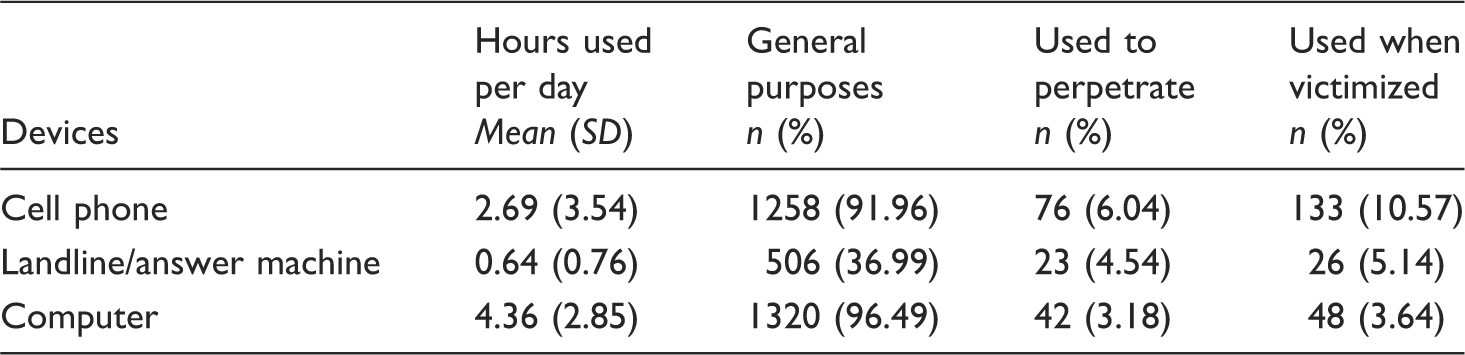
Cell phones appear to be the most commonly used device for cyber-harassment (Table 2). A total of 6.04% of regular cell phone users employ them to perpetrate cyber-harassment and 10.57% have been victimized through their cell phones. Landline phones and computers were also used for cyber-harassment or cyber-perpetration (Table 2).
Continuity of Harassment
Hierarchical logistic regression results for cyber and off-line victimization in university, controlling for demographic characteristics

Note. Victimization in university was scored using the Solberg and Olweus (2003) method as reported in Table 1 whereby ‘never’ and ‘once/twice’ were coded as 0, and “a few times”, “many times”, and “almost every day” were coded as 1. No multicollinearity is evident; the last root of the Conditioning Index was well below 30 and only one of the Variance Portions is greater than 0.5.
Hierarchical logistic regression results for cyber and off-line perpetration in university, controlling for demographic characteristics
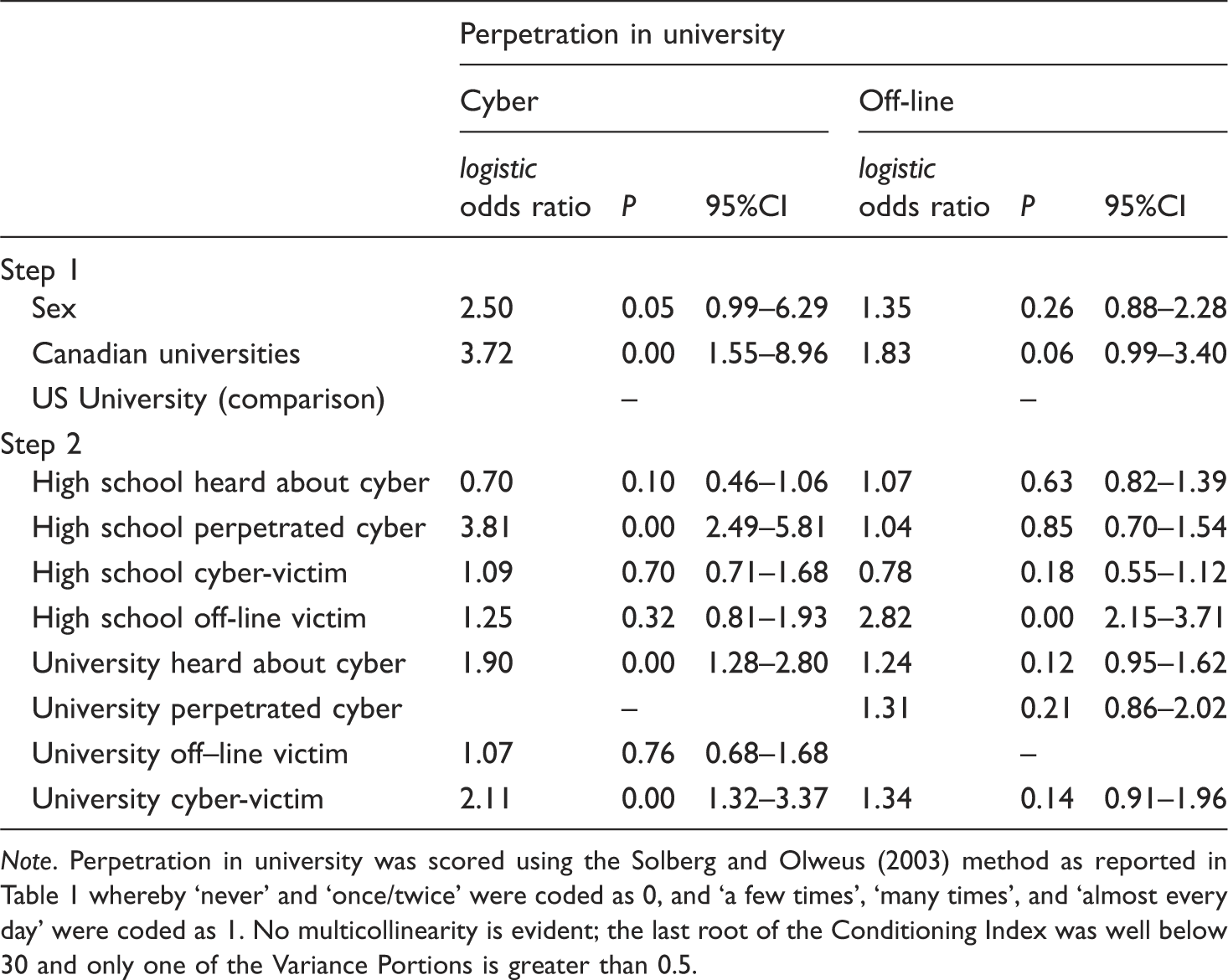
Note. Perpetration in university was scored using the Solberg and Olweus (2003) method as reported in Table 1 whereby ‘never’ and ‘once/twice’ were coded as 0, and ‘a few times’, ‘many times’, and ‘almost every day’ were coded as 1. No multicollinearity is evident; the last root of the Conditioning Index was well below 30 and only one of the Variance Portions is greater than 0.5.
Self-reported psychological and academic impact of victimization
Among the 351 participants who reported being cyber-harassed at least once or twice in university, 31.62% reported feeling angry because of the experience, 21.37% felt sad or hurt, 20.23% felt embarrassed and 18.23% felt anxious a few or more times. A total of 12.82% of victims reported feeling afraid and a similar number reported crying (12.54%), while 9.12% reported blaming themselves. Academically, 17.95% experienced poor concentration, 9.97% low achievement, and 7.69% absenteeism. Only 24 (6.83%) reported no negative impact. Multivariate analysis of variance did not show any significant differences in impact across demographic groups.
Discussion
Based on a large sample of Canadian and American university students, this study determined that victimization in high school is likely to transfer to the university setting. Moreover, the type of harassment experienced in high school significantly predicted the type experienced in university. Participants also reported a variety of negative effects of cyber-harassment, particularly anger and sadness.
Prevalence of cyber-harassment and victimization
The off-line victimization and perpetration rates of university students in our study are similar to those reported in another similar sample (Chapell et al., 2006). While the cyber-victimization rate in this university sample was lower than the rate among middle-school students (Beran & Li, 2005), the perpetration rates were similar. It is puzzling that victimization rates are lower for higher age groups, yet rates of perpetration are similar. Perhaps the university environment is more accepting of difference so that fewer individuals are isolated or targeted as victims, thereby resulting in a smaller number of students sharing the brunt of the harassment. We also speculate that young adults may be more informed about healthy relationships, and, thus, actively avoid or take steps to prevent harassment of themselves and others. These issues need to be explored in future research. Nevertheless, some people are harassed in their young adult years and male students are at slightly higher risk than female students.
Interestingly, reported rates of cyber-harassment differed between students in the US and Canada. Considering their experience in both high school and university, the former reported more cyber-perpetration, cyber-victimization, and awareness of cyber-harassment than the latter. However, these differences were small in magnitude, and were not consistent with results for off-line harassment. Also, the difference in proportion of male to female students across schools may also explain varying rates between the US and Canada. Additional research using stratified representative samples is necessary to determine if national cyber-harassment rates differ in the US and Canada in ways similar to those found in this sample.
Communications devices usage
Consistent with previous research, we found that the majority of students use cell phones and computers for several hours each day and spend less time using more traditional communication devices such as landlines and answering machines (Diamonduros, Jenkins, & Downs, 2007; Gordon, Juang, & Syed, 2007). Cell phone and computer usage among these students is higher than use reported by younger adolescents (Lenhart, Madden, & Hitlin, 2010). The lower rates of cyber-victimization among university students, is not, therefore, a result of less electronic device use within this age group. Moreover, the higher rates of use among this group do not seem to lead to higher rates of cyber-victimization or perpetration. Thus, it seems that students who spend more time using communication devices are not at higher risk of cyber-victimization than students who spend less time online or using cell phones.
The most frequently used device for harassment was the cell phone. Given its portability and options for texting, picture taking, and connecting to the internet, it provides access and opportunity to send harassing messages. Computers were least often used for harassment, perhaps because they are less portable than cell phones, which have similar capabilities. The percentage of students who reported perpetration and victimization across the devices ranged from about 3% to 10% indicating that no single device is solely used.
Continuity of harassment and victimization from high school to university
When asked to recall harassment in high school, university students who reported one form (either cyber or off-line harassment) in university were likely to recall experiencing a similar form in high school. Similarly, there was continuity in the specific type of harassment: university students who cyber-harassed others in university also reported using this same form of perpetration in high school. The same was true for off-line perpetration. With the sample mean age of 21.1 years, this suggests that similar harassment occurs about four years after high school graduation. Longitudinal research has shown continuity in being harassed over two years, and evidence that the role of victim transfers from one school to the next (Beran, 2008; Sourander, Helstela, Helenius, & Piha, 2000). Perhaps students maintain contact with their peers after high school through on-line social networking sites, which provides opportunities for further harassment. Another explanation is that during their early years of interactions with schoolmates, children may adopt victim and perpetrator roles according to how others act towards them, and their own reactions. If they identify themselves as such, they may adopt these roles in future relationships. Researchers indeed argue that children bring these self-reflections into new relationships and expect that they will be treated and will treat others according to these beliefs (Bretherton & Munholland, 1999). Our findings expand this perception of the continuity of the perpetrator and victim identity to include continuity of the type of harassment perpetrated and experienced.
Psychological impact on victims
While it is well established that harassment victimization is harmful to children, the impact is not well known among older adolescents and young adults. In the present study, university students reported a wide range of responses to being cyber-harassed. Anger was the most commonly reported, followed by sadness, embarrassment, and anxiety. They also reported academic consequences including poor concentration, low achievement, and absenteeism. Children in middle school who completed the same questionnaire reported similar effects (e.g., 57% felt angry, 18% felt anxious, 22% had impaired concentration) (Beran & Li, 2005). Thus, it seems that university students are as much at risk of psychological problems and academic hardship from harassment as are children. These symptoms might, moreover, predispose someone to being victimized or to harass others, creating a cycle of peer abuse. Further research should explore if these experiences are especially harmful on this population considering that they are learning to manage increased responsibilities such as living independently, working, and studying.
There are some limitations to consider. The retrospective method may have resulted in recall bias of high school experiences whereby current university experiences triggered recall of similar events in high school but not of different harassment events. Longitudinal research is needed to confirm the continuity of roles found in this work. In addition, even though a definition and examples of harassment were provided, students may have considered general online conflict rather than specifically what is considered cyber-harassment when reporting their behaviours. In addition to this potential for over-reporting, social desirability may have resulted in under-reporting. Also, students may be reluctant to disclose victimization if they feel they should be able to manage it. The use of a voluntary sample may also result in under-representation of victimization because students who had been victimized may be unlikely to agree to complete a survey that required them to remember unpleasant experiences. Given that students in our study were surveyed at school, it is possible that rates of harassment are under-estimated if absenteeism is a consequence of harassment. Also, ethnicity and socio-economic status were not reported, and validity of the responses from the survey is not known.
Role of school psychologists
School psychologists in high schools are uniquely positioned to identify and address harassment through their direct contact with students and families as well as with school staff. Given that adolescents in high school are at risk, not only of being harassed again in university, but also of serious harm, it is crucial that school psychologists include direct questions about these experiences when conducting assessments. One-to-one interaction with a student is an advantageous time to ask sensitive questions that adolescents may have never been asked and may feel emotionally safe to share with someone who is not a direct authority figure over them, as are teachers and parents. School psychologists must manage these disclosures with caution to ensure that the child is not re-victimized. Once harassment is identified, intervention can be planned accordingly. Specific interventions that school psychologists report to be useful for managing harassment include, for example, identifying clear rules about harassment behaviors, enforcing consequences, positively reinforcing non-harassing behaviors, and providing support to children with problematic behaviors (Sherer & Nickerson, 2010). In addition, school psychologists must inform themselves and others about by-laws and legislation that pertain to harassment and internet providers (Stanton & Beran, 2009). Given that students and teachers may not be aware of strategies or resources to prevent or manage online harassment (Cassidy, Brown, & Jackson, 2012; Yilmaz, 2011), school psychologists are instrumental in activating school-wide awareness strategies.
Conclusion
School psychologists are situated in schools where children congregate, allowing many opportunities for contact. Knowing that the negative impact from cyber-harassment may interfere with the development of students’ higher education goals of economic, social, and health leadership calls for help from school psychologists and other health professionals at the earliest years, not excluding high school. To be clear, if school psychologists, who are charged with the responsibility of supporting children’s academic, social, behavioral, and emotional development, do not address harassment at school–who will?