



Abstract
This study examines the contribution of epistemological beliefs to middle school students’ reported use of self-regulated learning strategies. One hundred and sixty 8th and 9th graders from three public middle schools participated in the study. Gender was about equally represented in the sample (89 girls, 71 boys). During the group examination phase, the participants were asked to complete a Greek version of Epistemological Beliefs Questionnaire (EBQ), based on Schommer-Aikins, Mau, Brookhart and Hutter’s (2000) middle school version of EBQ. During the individual examination phase, they were interviewed using the Self-Regulated Learning Interview Schedule (SRLIS). Epistemological beliefs about the speed of learning and the ability to learn significantly predicted the reported use of cognitive as well as motivational regulation strategies. The educational implications of the results are discussed in relation to cultural influences on the formation of epistemological beliefs.
Keywords
This study aimed at combining two research traditions, epistemology and self-regulated learning (SRL), by exploring the contribution of epistemological beliefs to middle school students’ reported use of self-regulated learning strategies. SRL has recently emerged as an important construct in education with its focus on the way students initiate, monitor and exert control over their own learning (Boekaerts & Cascallar, 2006; Efklides, 2011; Zimmerman, 2000; for a review see Boekaerts & Corno, 2005). SR learners are cognitively, metacognitively, and motivationally active learners (Schunk & Zimmerman, 1994). While self-regulation efficiency has been found to positively affect school achievement from the first years of primary school until adolescence (Bakracevic-Vukman & Licardo, 2010; Liew, McTique, Barrois, & Hughes, 2008), lack of self-regulation has been related to lower levels of achievement, regardless of students’ intellectual ability, motivation, and self-efficacy beliefs (Bakracevic-Vukman & Licardo, 2010; Kadivar, 2003).
From an educational point of view, the crucial questions are: (a) why do some students choose to be actively involved in a self-regulated learning process more than others? (b) What are the underlying personal and/or situational factors that facilitate or hinder this engagement? (c) How can educators and school psychologists identify students who lack the necessary self-regulated skills and then design and apply intervention practices?
Many researchers have tried to delimit the factors that facilitate or hinder SRL by adopting either a metacognitive or a motivational perspective. Recently there has been an attempt to combine different theoretical frameworks in order to capture the complexity of the SRL processes. For many researchers the reasons students have for striving to gain control over their learning process are mediated by their epistemological beliefs—specifically their beliefs about the nature of knowledge and the ways of knowing and learning (e.g., Hofer & Pintrich, 1997; Muis & Franco, 2009).
Epistemological beliefs
There are many methodological approaches that depend on the theoretical model held by researches about the nature of knowledge and the ways of knowing and learning (for reviews see Duell & Schommer-Aikins, 2001; Hofer, 2000). The present study is based on Schommer’s theoretical approach (Schommer, 1990; Schommer-Aikins, 2002), according to which epistemological beliefs are multidimensional and more or less independent set of beliefs—ranging across a continuum from naïve to sophisticated beliefs. Working initially with college students, Schommer developed a questionnaire to assess four different dimensions of epistemological beliefs. Namely, the ability to learn (ranging from the belief that the ability to learn is innate and fixed to the belief that ability to learn is acquired through effort and study), the speed of learning (ranging from the belief that learning is a quick process to the belief that learning is a gradual process), the structure of knowledge (ranging from the belief that knowledge is organized in isolated bits to the belief that knowledge is organized as complex, interrelated concepts), and the stability of knowledge (ranging from the belief that knowledge is stable and unchanged to the belief that knowledge is evolving). This instrument has been adapted by Schommer-Aikins, Mau, Brookhart, and Hutter (2000) for middle school students. In the present study a Greek version was constructed based largely to this middle school version of Epistemological Beliefs Questionnaire (see Method section).
Schommer’s work has inspired many researchers to study the relations between epistemological beliefs and various aspects of learning, despite critiques of her theoretical model and instrument (see Clarebout, Elen, Luyten, & Bamps, 2001; Hofer, 2000, 2001). The critique is focused mainly on the theoretical assumption that epistemological beliefs are independent constructs which are not necessarily interrelated and on the inclusion of beliefs about learning as core dimensions of epistemological beliefs. This theoretical discrepancy is evidenced by the presence of inconsistent findings and the weak psychometric properties of the instrument. Despite all the criticism, considerable research evidence is based on Schommers’ work and the EBQ remains one of the most widely used instruments for measuring epistemological beliefs. Moreover, the inclusion of two learning dimensions (speed of learning and control of learning ability) in the questionnaire facilitates the theoretical connection between epistemological beliefs and various aspects of learning.
Empirical studies within this theoretical tradition have consistently shown the predictive value of epistemological beliefs for various aspects of learning and achievement, such as achievement in mathematical comprehension tasks (Schommer, Crouse, & Rodes, 1992), as well as comprehension monitoring (Schommer, 1990), school achievement (Lodewyk, 2007; Schommer, 1993; Schommer, Calvert, Gariglietti, & Bajaj, 1997; Schommer-Aikins, Duell, & Hutter, 2005), carrier choice (Trautwein & Lüdtke, 2007), cultural differences in study strategies (Schommer-Aikins & Easter, 2008), personal achievement goals (Bråten & Strømsø, 2004; DeBacker & Crowson, 2006; Neber & Schommer-Aikins, 2002; Phan, 2009), and various aspects of SRL (Bråten & Strømsø, 2005; Dahl, Bals, & Turi, 2005; Muis & Franco, 2009; Neber & Schommer-Aikins, 2002).
Epistemological beliefs and self-regulated learning
While there is a growing interest among researchers in studying the mediated role of epistemological beliefs in various processes of SRL, most of these studies have been conducted with undergraduate students. Muis (2007) claimed that epistemic beliefs are one component of the cognitive and affective conditions of the task, which is activated during the task definition and planning phase of self-regulated learning and, as such, set the standards for the adoption of specific achievement goals by the individual (see also Muis, 2008; Muis & Franco, 2009). Also, Dahl et al. (2005) found that some epistemological beliefs may be more influential than others in the selection process of effective learning strategies. They found that the reported use of cognitive and metacognitive learning strategies was associated mainly with beliefs about the structure of knowledge and the ability to control learning. Certainty beliefs and beliefs about the speed of learning did not affect the reported use of strategies, contrary to prior evidence (Kardash & Howell, 2000), according to which the beliefs about certainty of knowledge were found to affect the number of reported strategies while the beliefs about speed of learning were found to affect not only the number but also the quality of reported strategies. Recently, Phan (2009) found in a sample of university students that sophisticated epistemological beliefs positively affected deep processing strategies via effort expenditure. Finally, Cano (2005) in a sample of students from 12- to 20-years-old found that students’ epistemological beliefs affected achievement directly and indirectly via the students’ learning approaches.
In general, empirical results have shown that the more naïve epistemological beliefs about the structure of knowledge the person holds the more surface strategies (e.g., passive rehearsal and memorization) and the less deep cognitive and regulatory strategies he or she reports. Despite the growing interest in the area, very little empirical research has been conducted in examining the relations between epistemological beliefs and specific processes of SRL (i.e., cognitive, metacognitive, and motivational) in school-aged students. It is worth mentioning that Neber & Schommer-Aikins (2002) found no direct effects of epistemological beliefs on SRL strategies in science-learning in a sample of highly gifted elementary and middle school students.
The present study
The present study aimed at examining the contribution of epistemological beliefs to the reported use of SRL strategies in Greek middle school students. Previous evidence has emphasized the importance of the socio-cultural context in the development of epistemological beliefs about knowledge and knowing (Kuhn & Park, 2005; Tabak & Weinstock, 2008; see also Hofer, 2006).
As regards the Greek socio-cultural context of child development, family is a highly valued institution in Greek society and education has an immense importance to the Greek family, since is considered a means for gaining social recognition (for a more detailed presentation of this context see Savina, Coulacoglou, Sanyal, & Zhang, 2011). Much pressure for school achievement is exerted on students, especially after elementary school years. This has created a very competitive learning environment, which is maximized by the fact that the Greek educational system is centralized; that is, the curriculum is established at national level. At the same time, in the last two decades the number of immigrant children from a variety of cultural backgrounds attending mainstream public schools is increasing—creating a challenging environment for implementing standardized programs that meet the educational and social needs of diverse groups of students. While there has been a rapid expansion of psychology in Greece, school psychological services in mainstream public schools remain limited, despite efforts made to provide alternative school psychological services including research, assessment, prevention, and intervention programs, which link theory, research, and practice in the school environment (see Cook, Jimerson, & Begeny, 2010; Hatzichristou, Issari, Lykitsakou, Lampropoulou, & Dimitropoulou, 2011; Hatzichristou, Polychroni, & Georgouleas, 2007; Jimerson, Stewart, Skokut, Cardenas, & Malone, 2009). Further, there is a significant need for establishing parent-school cooperation schemas (see Koutrouba, Antonopoulou, Tsitsas, & Zenakou, 2009); the role of school psychologists in facilitating the establishment of such schemas is very important.
Apart from the need for studying the development of beliefs about the nature of knowledge and learning in an achievement oriented educational context, like the one presented, the importance of studying the mediated role of epistemological beliefs on SRL in middle school stems from the well documented evidence that the transition from elementary to secondary school years is a very critical period—given the declining trends found in the value of learning and the self-efficacy for self-regulation in students’ reports mainly in this developmental period (see Caprara, Fida, Vecchione, Del Bove, Vecchio, et al., 2008; Mok, Fan, & Pang, 2007; Pajares & Valiante, 2002). Further, epistemological beliefs undergo a significant change through the secondary school years (see Cano, 2005).
Following Zimmerman’s (2000) socio-cognitive perspective, SRL in the present study is viewed as an interaction and coordination of three kinds of learning processes: (a) personal (cognitive and affective), (b) behavioral, and (c) environmental (physical and social), which involve cognitive, metacognitive, and motivational components. It is important, then, to examine the predictive value of epistemological beliefs for each of these components separately. It was expected that naïve epistemological beliefs would negatively predict the reported use of deep cognitive and regulatory strategies (including environmental structuring and motivation) and would positively predict the reported use of surface strategies (e.g., memorization).
Method
Participants
The total sample consisted of 160 children drawn from the 8th (N = 109) and 9th (N = 51) grade classrooms of three public secondary schools located in Thessaloniki, the second larger city in Greece. Gender was about equally represented in the sample (89 girls, 71 boys), while participants were from different socioeconomic status [SES] groups (69 low, 53 middle, and 38 high SES), based on their parents' educational level and profession.
Measures
Epistemological Beliefs Questionnaire
Students were asked to complete a Greek version of Epistemological Beliefs Questionnaire (EBQ-Gv), which was based mainly on Schommer-Aikins et al. (2000) middle school version of Epistemological Beliefs Questionnaire (EBQ). The (EBQ-Gv) consisted of 40 items. The scale assessed epistemological beliefs about: (a) the ability to learn (11 items); (b) the speed of learning (8 items); (c) the structure of knowledge (13 items); and (d) the stability/certainty of knowledge (8 items). Confirmatory factor analysis of middle school students’ data in the original questionnaire resulted in three instead of four-factor solution, after the exclusion of the structure of knowledge factor from the model (see Schommer-Aikins et al., 2000). Thus, the 11 items that were added in the Greek version of the EBQ aimed at fostering mainly the stability/certainty of knowledge and the structure of knowledge dimensions. These items were either constructed for the purposes of the study or translated from Jehng, Johnson, and Anderson’s (1993) and Trautwein and Lüdtke’s (2007) respective scales. Translation and back translation procedure was followed for all the translated items. Students rated on a five-point scale their agreement with each statement. A high degree of agreement with each statement corresponded to naïve epistemological beliefs as in the original questionnaire. For this reason, statements which referred to sophisticated epistemological beliefs were recoded.
The factorial validity and reliability of the EBQ-Gv was tested initially in a larger sample of 569 Greek students from 8th, 9th, 11th, and 12th grades from five public schools. Factor analysis of students’ responses resulted in three factors which explained 36.89% of the total variance of students’ ratings: (a) an intelligence/ability to learn factor; (b) a combined structure/stability of knowledge factor; and (c) a speed of learning factor (for a detailed presentation of these results see Metallidou, Megari, & Konstantinopoulou, 2010). Factor analysis of participants’ responses in the present study resulted in the same three factors with factor loadings above 0.4, which together explained 45.4% of the total variance of students’ ratings: (a) an intelligence/ability to learn factor (8 items—eigenvalue = 4.34, 19.7% explained variance, Cronbach α = 0.81); (b) a speed of learning factor (7 items—eigenvalue = 3.78, 17.2% explained variance, Cronbach α = 0.78); and (b) a combined structure/stability of knowledge factor (7 items— eigenvalue = 1.87, 8.5% explained variance, Cronbach α = 0.71).
Self-regulated Learning Strategies Interview Schedule (SRLIS)
Students were interviewed individually with the revised version of SRLIS, a theory-guided structured interview, which was developed by Zimmerman and Martinez-Pons (1990), to assess self-regulated learning strategies. Eight different learning contexts were presented to the student describing different learning situations in classroom and at home (e.g., when studying at home, one must motivate oneself to complete homework). Students were asked to report the methods they would use in these learning situations. After reading each scenario, the researcher kept record of the student’s answers. All the answers were categorized by two independent trained postgraduate psychology students into classes of self-regulated learning strategies provided by Zimmerman and Martinez-Pons (1986, 1990). The reliability check with the formula used in the original study (identical categorical judgements by the two researchers were divided by the total number of strategies initially identified) resulted in 81% inter-rater agreement. Disagreements were resolved through discussion. A strategy frequency (SF) measure (Zimmerman & Martinez-Pons, 1986) was used, which corresponded to the number of times a particular strategy was mentioned in all the eight learning contexts. The categories of strategies that were used in the present study as well as example answers are given in Appendix A. The revised SRLIS has been tested in the sample of the present study and proved valid for identifying the theoretically predicted categories of SRL strategies Greek students. Namely, it was found to provide empirical support to Zimmerman’s socio-cognitive model of SRL and to predict students’ performance in language tasks as well as their self-evaluated performance in language. SRLIS’s validity issues in the Greek sample are presented in details in Metallidou, Arambatzi, Dardagani, Karambela, & Takou (2009). In the present study 160 students participated out of the 171 students that had been interviewed, since 11 students had not completed the EBQ-Gv.
Procedure
In the first phase of data collection, the EBQ-Gv was administered in groups in the students’ classrooms. Students participated voluntarily after being informed about the purpose of the study and assured that it was an anonymous survey and that no-one else, except the researchers, would have access to their ratings. In the second phase, students were examined individually by trained postgraduate psychology students in a quiet room in their school. Their examination with the SRLIS lasted about 30 minutes.
Results
Descriptive statistics and correlations
Descriptive statistics
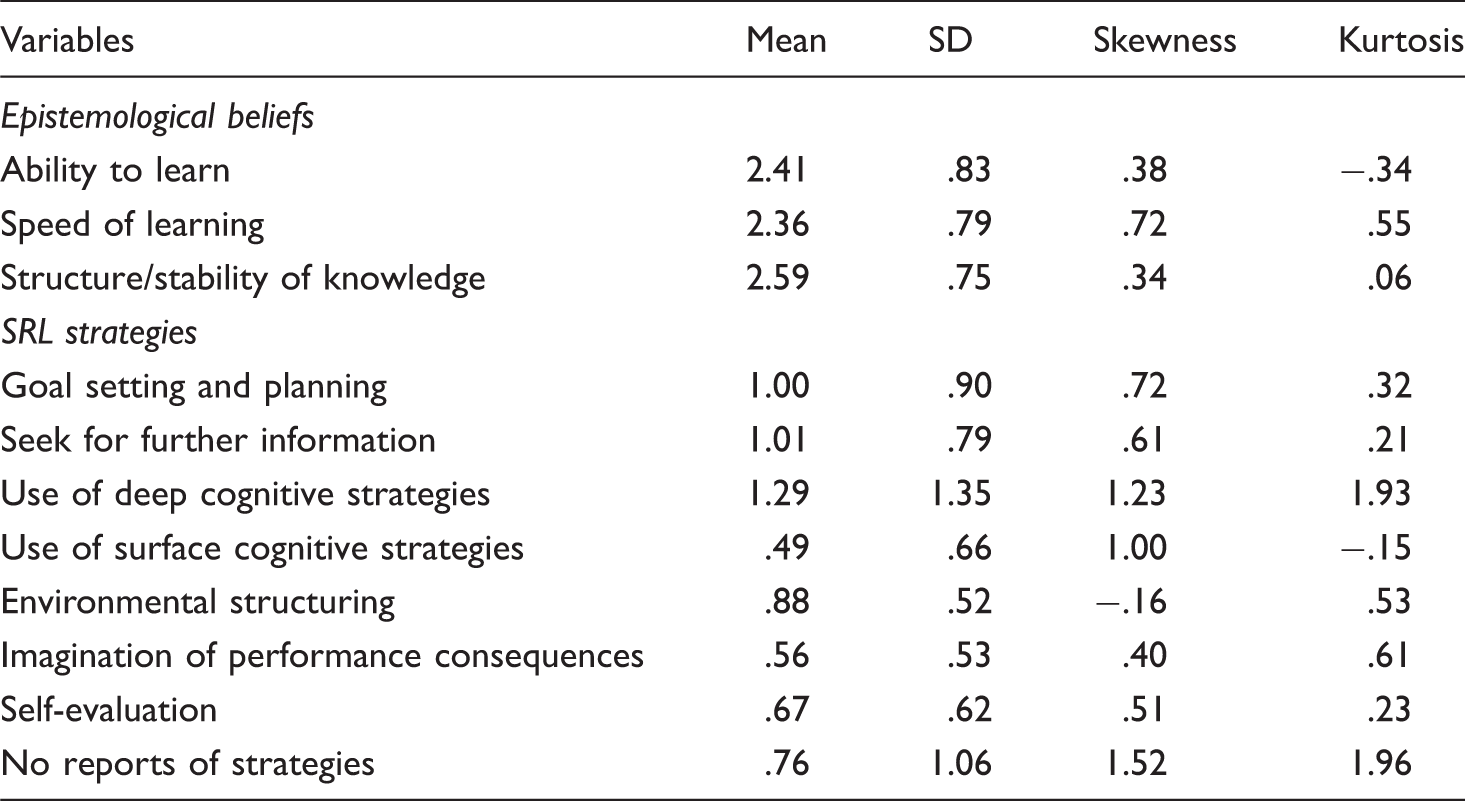
Correlations among variables
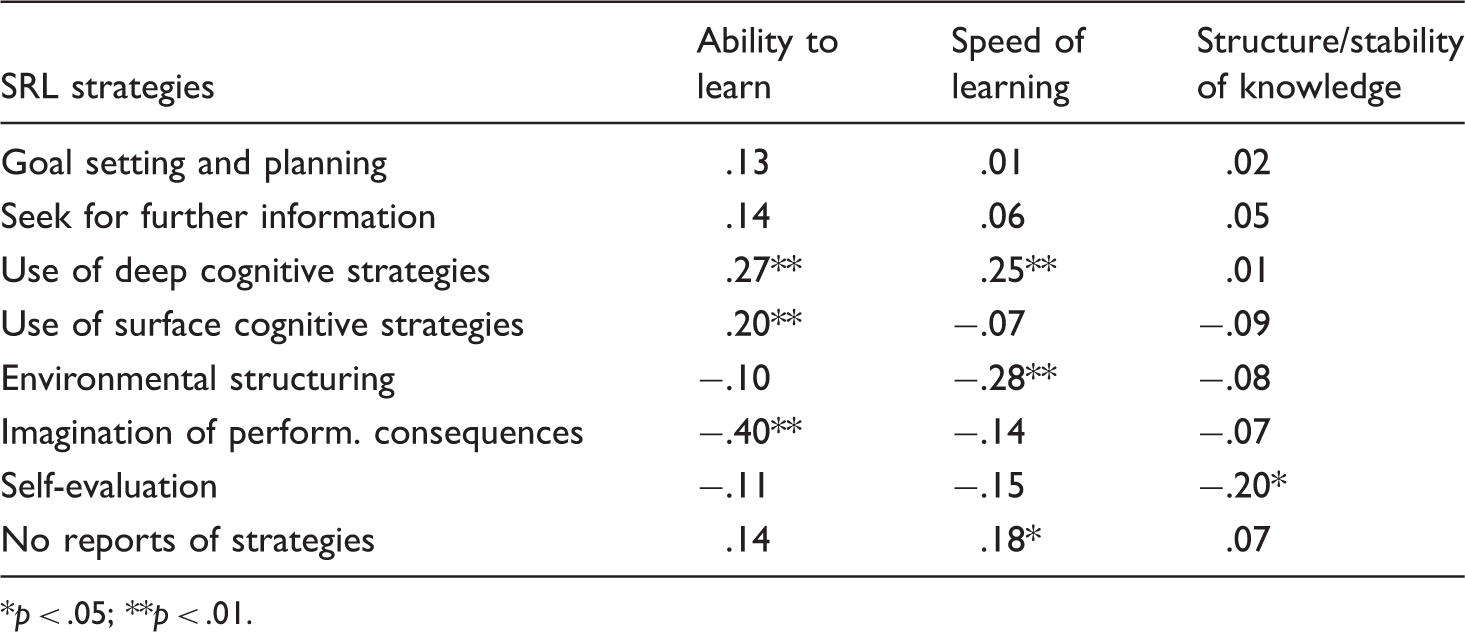
p < .05; **p < .01.
Epistemological beliefs as predictors of srl strategies
Regression results with SRL strategies as dependent variables showed that the epistemological beliefs factors predicted significantly different SRL strategies. Specifically, epistemological beliefs about the ability to learn positively predicted the reported use of deep (R2 = 0.072, β = 0.274, t = 3.692, p < 0.001) and surface cognitive strategies (R2 = 0.041, β = 0.203, t = 2.608, p < 0.05), and negatively predicted the imagination of self-consequences after the success or failure (R2 = 0.161, β = −0.405, t = −5.61, p < 0.001). Epistemological beliefs about the speed of learning positively predicted the reported use of deep cognitive strategies (R2 = 0.065, β = 0.255, t = 3.443, p = 0.001) and the non-reported use of strategies (R2 = 0.033, β = 0.182, t = 2.33, p < 0.05) and negatively predicted the reported environmental structuring (R2 = 0.079, β = −0.280, t = −3.673, p < 0.001) and the imagination of self-consequences (R2 = 0.022, β = −0.148, t = −2.054, p < 0.05). Finally, epistemological beliefs about structure/stability of knowledge negatively predicted only the reported use of self-evaluative processes after the completion of homework (R2 = 0.040, β = −0.201, t = −2.580, p < 0.05).
Discussion
This study aimed at examining the contribution of epistemological beliefs to middle school students’ reported use of cognitive, metacognitive, and motivational SRL strategies. An answer to this question could open a window for teachers as well as school psychologists to understand individual differences in students’ willingness to be actively involved in a self-regulated learning process. Such awareness could, in turn, help them to identify students who lack self-regulated skills and to implement interventions.
Epistemological beliefs as predictors of cognitive strategies
One of the most puzzling findings of the present study was that the more students believed that learning is a quick or not-at-all process and that intelligence is a fixed and not-evolving capacity the more they reported not only the use of surface strategies, which it was expected, but also the use of deep cognitive strategies. This finding clearly contradicts previous research evidence which suggest a positive predictive path from sophisticated epistemological beliefs to deep cognitive and regulatory strategies (see, Dahl et al., 2005; Kardash & Howell, 2000; Phan, 2009).
In order to better understand this finding we need to take into consideration the Greek educational and social context. As has been already mentioned, high school achievement is highly valued by teachers, parents and, consequently, by students in Greek educational system. Emphasis is placed on having high intellectual ability and be the best in various achievement settings. This has created a very competitive learning environment, which is usually accompanied by a different conceptualization of the nature of learning and intelligence. Naïve beliefs about learning and intelligence are not necessarily ‘dysfunctional’ or ‘less helpful’ for academic success in an ability-bound academic context. The belief that learning is a quick or not-at-all process is justified by the belief that someone who learns quickly is cleverer than others and that such a person will usually be more successful in schoolwork. Thus, it is not incompatible, at least in this developmental phase, to report frequent use of deep cognitive strategies and simultaneously to value quick learning and to hold a naïve theory about intelligence as a fixed capacity. This finding accords with prior evidence emphasizing the importance of culturally-valued beliefs for what is considered naïve and sophisticated in epistemological beliefs about knowledge and knowing (Chan & Elliott, 2002; Tabak & Weinstock, 2008; see also Hofer, 2006).
Epistemological beliefs as predictors of motivational regulation strategies
These results support the claim that epistemological beliefs about learning have motivational consequences. The more students believed that leaning is a quick process the more they report that they do not use SRL strategies and the less they report the need to organize their study environment in order to concentrate and avoid interruption. Further, the more they believe that their ability to learn is a fixed capacity and that learning is a quick process, the less they reported imagining the consequences of their success or their failure in school tasks. Finally, one interesting finding is that the more naïve beliefs they hold about the structure and stability of the learning process the less frequently they evaluate the quality of their learning outcomes. Taking into consideration that various motivational regulation strategies have significant indirect effects in school grades (Schwinger, Steinmayr, & Spinath, 2009) as well as in diploma grades and in students’ intention to continue with their education after secondary school (Nota, Soresi, & Zimmerman, 2004), future research should focus on the dynamics in the relation between epistemological beliefs and motivational regulation strategies as children age. Also, future studies should emphasize more the area, until now neglected, of the motivational components of SRL (Little, Akin-Little, & Lloyd, 2011; Schwinger et al., 2009; see also Chen & Pajares, 2010), such as self-evaluation and self-rewarding strategies as well as environmental control.
These conclusions are limited not only by the age span of the sample and the cross-sectional design but also by the methodological tools (data from previous studies in the area resulted from the use of questionnaires, which usually measure the self-reported use of learning or regulatory strategies on a likert-type scale). Data from structured interviews, such as the one in the present study, even though they do not diminish the shortcomings of self-reports questionnaires regarding the actual use of reported strategies, do permit the spontaneous expression of strategies that students’ have in their repertoire in order to handle obstacles in achievement situations. Future replication studies are needed with middle school students from countries with different educational and social contexts to verify the present results. Future attempts should use multimethod designs with reported and on-line measures of SRL, keeping always in mind that only longitudinal data can capture the dynamics of the relation between epistemological beliefs and SRL strategies along with development.
Conclusion and educational implications
The present results stress the importance of considering the culturally-bound aspects of epistemological beliefs as well as the significant change that epistemological beliefs undergo through the secondary school years (Cano, 2005). Future empirical studies should take into consideration the age of the participants and the social/educational context as mediated factors in determining the predictive value of epistemological beliefs for various processes of SRL. The existence of a common factor for the structure and stability/certainty of knowledge in the present study confirms previous evidence from other countries for a slower developmental pattern in the construction of sophisticated beliefs for the structure and the certainty of knowledge as compared to the beliefs about learning during high school years (Schommer, 1993; Schommer et al., 1997; Schommer-Aikins et al., 2000). This may imply a difficulty at a conceptual level that middle school students’ have in understanding the constructive and evolving nature of knowledge and knowing. Also, according to Schommer-Aikins et al. (2000), the beliefs about knowledge are rather abstract as compared to the beliefs and ideas about learning, since the latter are part of their everyday school reality. Students spend a great amount of their time trying to learn new things. Teachers make frequent reports in the process of learning and how this process could be effective; they do not focus on explaining the structure and criteria for what comprises knowledge and why it is important.
This study, along with those already mentioned from other countries, indicate that middle school is a critical period for the formation of epistemological beliefs. Middle school teachers should provide their students with direct information about the source, stability and justification of school knowledge and world knowledge in general, in order to create the basis for the construction of a sophisticated theory of personal epistemology during the secondary education. It is important, however, to reflect upon one’s own personal epistemologies as well as implicit theories of intelligence. The way students conceptualize intelligence and learning, and the value teachers ascribe to learning is important, since teachers communicate these implicit theories to their students, indirectly most of the times. School psychologists can play an important role by making sure teachers are aware of the significance of students’ epistemological beliefs on the activation of SRL strategies and on performance in various academic settings. Further, school psychologists can help teachers recognize the socio-cultural factors that are involved in the formation of epistemological beliefs and prepare them to provide culture-sensitive services especially to those students who are at risk for developing a dysfunctional behavioral pattern in school settings (see Psalti, 2007; Savina et al., 2011).
One of the most interesting results of the present study that could set the basis for future interventions in schools is the significant contribution of epistemological beliefs to the activation of motivational SRL strategies. Naïve epistemological beliefs— that learning is a quick or not-at-all process—were found to have detrimental effects on motivation regulation and resources control. Namely, students tend to report that they do not use SRL strategies (probably because they do not think it worthwhile); they do not, it seems, feel a need to control their environment and to think about the consequences of their performance. Further, naïve beliefs that knowledge is simple and stable lead to fewer self-evaluations. Teachers should invest in identifying and changing these dysfunctional motivational patterns by introducing learning as a self-constructive process which has implicit value.
SRL students are intrinsically motivated, active and autonomous learners, who exert control over their negative feelings and are able to evaluate their learning process. In a parallel vein, in the social domain self regulation focuses again on motivational and emotional control, on cooperation and on conforming to external rules of behaviour (e.g., classroom rules and teachers’ requests). It is interesting that recent empirical data from a cross-cultural study in middle school students showed that students from western countries schools as compared to Asian countries exhibited more problem behaviours related to lessons or conflicting with others, and these problems had strong relationships with their academic achievement (Gu, Lai, & Ye, 2011). The researchers propose that we should explore the relationships of students’ problem behaviours with their values on knowledge and school learning. Getting students intellectually engaged by raising their awareness of the importance of school learning as well as their interest in learning as a gradual, self-constructing process is a great challenge for teachers’ and school psychologists. According to Kuhn and Park (2005) mature epistemological understanding is the key for developing and sustaining intellectual motivation through adolescence into adulthood. One of the most interesting findings in that cross-cultural study was that similar patterns of variation were found across cultural and sub-cultural groups of parents and children in their intellectual values and epistemological beliefs. This opens a new window for future interventions that should be focused not only on students’ intellectual skills but equally on students’ and parents’ intellectual valuing.
Footnotes
Acknowledgements
I would like to thank Xanti Arabatzi, Katerina Dardagani, Olymplia Karabela, Eleni Konstantinopoulou, Kalliopi Megari, and Eleni Takou for their assistance in the collection and coding of data in this research.