



Abstract
The United Nations (1989) Convention on the Rights of the Child was designed to promote and protect the survival, development, and well-being of children, thus extending human rights to individuals from birth to age 18. This article examines the consistency of the Articles of the Convention with the professional standards for school psychology, as articulated by the major organizations representing the profession in the USA––American Psychological Association, International School Psychology Association, and National Association of School Psychologists. Although the standards for ethics, practice, and training of these organizations are generally consistent with the UN Convention, the standards lack the specificity provided by the Convention’s 54 Articles. To facilitate the application of child rights’ principles in school psychology practice, we propose a model for integrating the professional standards with the Articles of the Convention. In addition, we describe a curriculum for training of school psychologists, developed through a partnership of several organizations, which is consistent with the model. In the curriculum, the school psychologist is regarded as the mesosystem in the child’s ecology, to characterize the psychologist’s central role in ensuring the promotion and protection of child rights within school, family, community, and society.
Keywords
The United Nations Convention on the Rights of the Child (United Nations, 1989) provides guidelines for ensuring and advocating for the promotion and protection of the health, well-being, education, and safety of children worldwide. School psychologists are uniquely qualified and positioned at the intersection of school, family, and community to promote and protect child rights. The major tenets of the Convention, articulated in its Articles, are consistent with the principles that guide ethical practice of school psychologists in their role of promoting psychological well-being and learning of children in schools, families, communities, and society. Professional organizations that influence and represent school psychology in the USA [e.g. American Psychological Association (APA), and the Division of School Psychology, Division 16; International School Psychology Association (ISPA); National Association of School Psychologists, (NASP)] have endorsed the Convention and support professional practice consistent with it. However, these organizations have not necessarily made explicit the link between professional guidelines for ethics, practice and professional development (training, education), and the articles of the Convention.
This article examines the Convention on the Rights of the Child as a framework for guiding and enhancing professional standards for school psychology, expressed in organizational standards for ethics, practice, and training. The consistency between the Convention and professional guidelines for several organizations are examined: ISPA, NASP, and APA. The implications of the Convention for interpreting and applying these professional guidelines are discussed. The article concludes with recommendations for interpreting and extending current guidelines to ensure that school psychologists understand child rights and are prepared to actively engage as advocates for child rights.
Professional standards and child rights
The purpose of the United Nations’ Convention on the Rights of the Child was to extend human rights to all children (birth to 18 years) through a legally binding international instrument (for detail see Hart & Hart, 2014, this issue). Child Rights, as outlined in the Convention, denotes the ‘entitlement of all children to have requisite physical, psychological, spiritual, social and cultural needs met to ensure optimal growth, development, physical health, psychological well-being, and learning’ (Nastasi & Varjas, 2013, p. 36). Development, learning, and psychological well-being are particularly important to schooling and education, and thus within the purview of school psychology [ISPA & Child Rights Education for Professionals (CRED-PRO), 2010]. These constructs are defined as follows: Development refers to the optimal growth of the individual and encompasses cognitive, social, physical, behavioral, spiritual, and moral domains. Learning is defined as the ‘acquisition of thinking, reasoning, language, and numerical skills, typically associated with academic achievement resulting from schooling/education, but greatly facilitated by informal education through planned and incidental experiences within and across the social ecology’. Well-being encompasses ‘physical, emotional, cognitive, social, spiritual, moral, and behavioral health’. (ISPA & CRED-PRO, Module 1, Handout 1.1)
The Articles of the Convention address specific child rights (Articles 1–41) and implementation measures (42–54). The first 41 Articles encompass four guiding principles: Non-discrimination, best interests, participation, and survival and development; and three general categories of rights: Survival and development, protection, and participation (UNICEF, 2011). For our purposes, we collapsed these to five categories of rights: Best interests, survival and development, non-discrimination, participation, and protection.
Consistency between the UN Convention on Rights of the Child (CRC) and professional standards relevant to school psychology.

APA = American Psychological Association; ISPA = International School Psychology Association; GP = Guiding Principles (SD, PR, PA are categories of rights, as outlined by UNICEF, 2011); NASP = National Association of School Psychologists; PA = Participation; PR = Protection; SD = Survival & Development. For detail on all of the articles, see http://www.unicef.org/crc/.
Best interests and non-discrimination are considered Guiding Principles as articulated in Articles 3 and 2, respectively. Participation, Survival and Development, and Protection encompass multiple articles (as indicated in the table). These three categories, suggested by UNICEF (2011), can be defined as follows:
Survival and Development ensure life, survival, and development to promote a child’s full potential––through adequate food, shelter, clean water, formal education, primary health care, leisure and recreation, cultural activities, and information about rights. These rights protect children, including those with disabilities, from minority/indigenous or refugee groups. They also ensure freedom of thought, religion, and conscience. Protection provides children with safety from all forms of harm and abuse, including neglect, exploitation, violence, and cruelty. These rights also address a host of child rights issues related to abduction, sale, trafficking, child labor, detention, punishment, juvenile justice, adoption, separation from family, war, and armed conflict. Participation ensures that children’s voices will be heard by promoting their freedom to express opinions and to have their views respected in matters relating to their social, economic, cultural, and political lives; the right to information (e.g. access to mass media); freedom of association; freedom of thought, conscience, and religion; and right to privacy. These rights, in particular, help ensure that children can actively participate in realizing their rights and will eventually, as adults, take an active role in society (Nastasi & Varjas, 2013, p. 33–34).
In general, the professional standards of APA, ISPA, and NASP recognize the responsibilities of professional psychologists for promoting and protecting human/child rights. For example, APA ethical guidelines address the importance of respecting people’s rights and dignity, ensuring justice and fairness, protecting the welfare of clients/consumers, avoiding or minimizing harm, and protecting privacy, confidentiality, and self-determination. ISPA ethical standards make reference to social justice and respecting child rights, without specifically mentioning the Convention on the Rights of the Child. ISPA training standards make general reference to respecting the rights and welfare of all stakeholders (those whom they serve) and engaging in policy work at school, community, and societal levels. NASP ethical standards refer to respecting the rights and dignity of all, engaging in advocacy, and ethical responsibilities to children and youth, schools, families, and society. NASP practice guidelines also emphasize social justice and the role of advocacy for school psychologists.
There is consistency between the Convention on the Rights of the Child and respective professional standards (summarized in Table 1). Ethics codes across the three organizations address most of the general categories, the exception being ‘survival and development’ which is only addressed by NASP ethics. ISPA training standards address survival and development and non-discrimination. NASP training and practice standards address all categories expect participation. Taking all of the standards into consideration, both NASP (ethics, training, practice) and ISPA (ethics, training) address the five categories: participation, survival and development, protection, best interests, and non-discrimination. The APA ethical code addresses four of the five, failing to mention survival and development rights. This suggests that all three organizations value human/child rights and have developed standards that are consistent with the Convention on the Rights of the Child, although none of the standards are sufficiently comprehensive in their coverage of specific Articles.
As indicated in Table 1, the specific issues addressed in the professional standards of ISPA, NASP, and APA do not address all relevant articles. Indeed, issues relevant to 16 of the 42 Articles listed in Table 1 are not addressed by any of the organization’s professional standards (ethics, practice, or training). These include rights relevant to survival and development (e.g. Articles 7, 8, 10, 14, 20, 22, 26, 27, 31), protection (Articles 11, 20, 22, 32, 35, 37–39), and participation (Articles 14, 15). In addition, training and practice standards for ISPA and NASP (APA only provides ethical standards) give minimal or no attention to other Articles relevant to protection (21, 33, 34, 36, 40, 41), participation (12, 13, 16, 17), and survival and development (9, 42). These include Rights that assure children access to information (Articles 17, 42). Insufficient attention to specific Articles in professional standards for training and practice standards does not necessarily reflect lack of concern. Indeed, all three organizations have endorsed the UN Convention on the Rights of the Child. Moreover, child/human rights are consistently reflected in the ethical standards of the three organizations, which are expected to guide practice, research, and training. However, articulation of specific Articles across ethics, training, and practice standards can facilitate the application of child rights by school psychologists. Failure to clearly delineate the Rights of the Child as central to the professional’s responsibilities and roles may preclude full consideration in practice.
Child rights as framework for school psychology
The endorsement of the Convention on the Rights of the Child and attention to child rights issues in professional standards suggest a shared value for promoting and protecting the rights of all children through professional practice and advocacy. Nevertheless, the lack of specificity about child rights in the standards limits understanding and implementation. To fully realize the import of child rights in school psychology, more detailed guidelines are needed. Ultimately, this might mean revising standards with more specific reference to the Convention on the Rights of the Child and/or inclusion of issues that cover the scope of the Convention on the Rights of the Child articles. In addition, the Convention on the Rights of the Child could inform ethical decision making, research, practice, and professional development in school psychology. Thus, the Convention on the Rights of the Child could guide the interpretation and implementation of professional standards.
Model for articulating child rights in professional standards
Figure 1 presents a proposed four-component model for linking the Convention on the Rights of the Child with professional standards and practice: Common goals, child rights, professional standards, and professional roles. The model builds on common goals of the Convention on the Rights of the Child and professional school psychology (as reflected in standards for ethics, practice, training): Developing social-cultural ecologies to promote child well-being, learning, and development (Figure 1, top left quadrant). These goals reflect ecological systems theory (Bronfenbrenner, 1989, 1999) and the responsibility of school psychologists to facilitate child well-being, learning, and development by helping to build capacity within critical ecologies (i.e. school, family, community, and society). According to the UN Convention on the Rights of the Child, all children are entitled to (have right to) requisite conditions for ensuring their basic needs (as articulated in the Articles) and adults and societies are responsible for promoting and protecting those rights.
Model for integrating child rights with professional standards in school psychology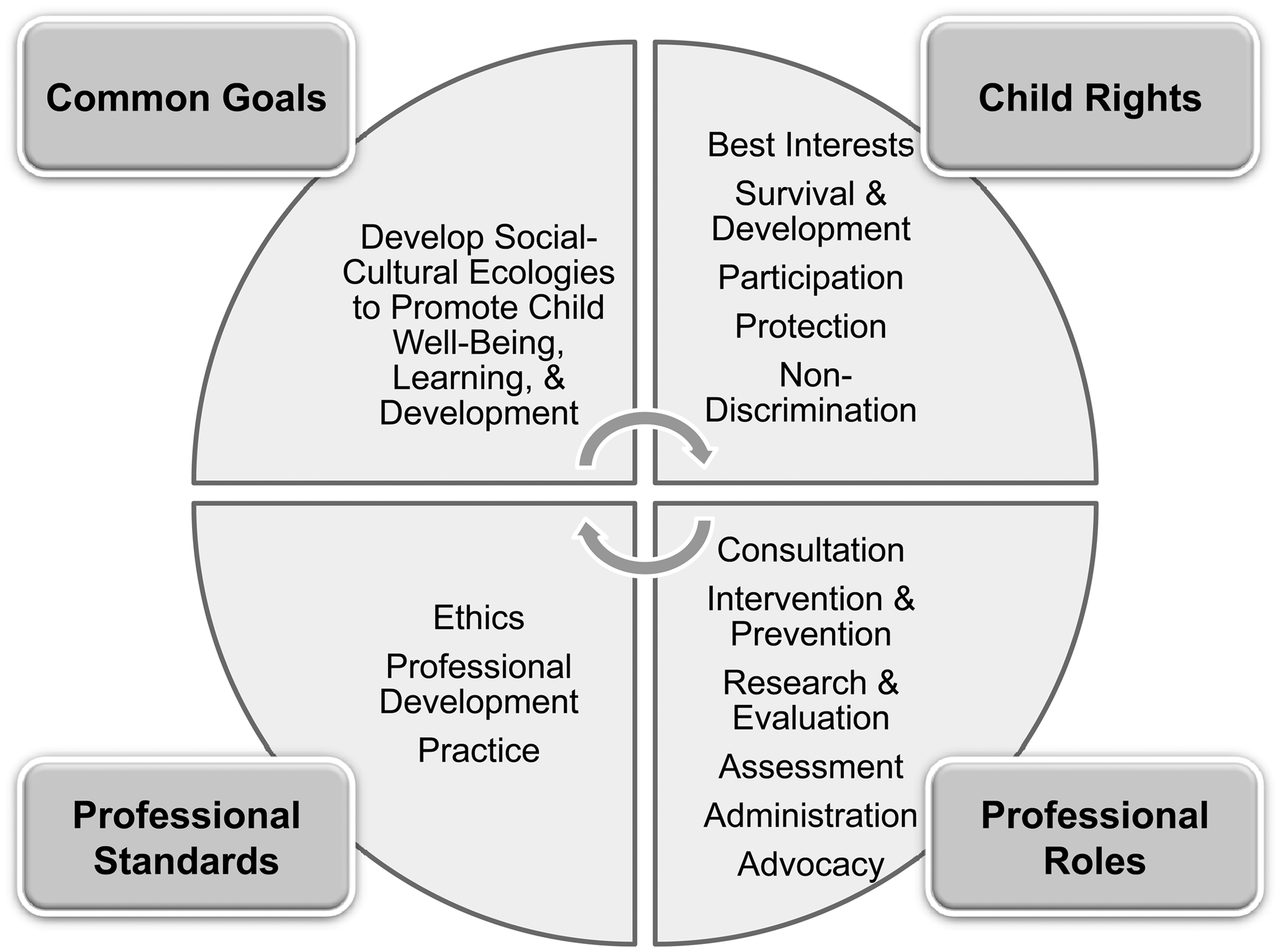
The common goals (depicted in Figure 1) attest to the assumed responsibility of school psychologists for protecting and promoting child rights. These responsibilities are articulated in the professional standards (lower left quadrant) for school psychology, including ethics, professional development (training), and practice. The consistency between the Convention on the Rights of the Child and professional standards for APA, ISPA, and NASP (see Table 1) further confirms the shared values and goals. Needed is more specific articulation of how the Convention on the Rights of the Child articles can inform the implementation of professional standards. The right quadrants of the model are the bases for articulating the responsibilities of school psychologists for promoting and protecting child rights. These responsibilities, in turn, have implications for further delineation of existing standards for ethics, training, and practice.
The major categories of Child Rights (top right quadrant) reflected in UN Convention on the Rights of the Child (UNICEF, 2011) are best interests of the child, survival and development, participation, protection, and non-discrimination. As depicted in Table 1, these major categories are expressed in the Convention on the Rights of the Child Articles. The Articles provide the specificity for guiding the actions of school psychologists and for informing professional standards. For example, survival and development (SD) is defined in Article 6, and includes (but is not limited to) parental responsibilities (5, 18), provision of health care (24), review of treatment/care (25), right to education (28, 29), right to leisure and play (31), and protection of children who are members of minority, indigenous, and refugee groups (22). Participation (PA) encompasses the rights of children to express their views, be listened to, and participate in decisions that affect them (12, 13); right to privacy (16); access to information (17); freedom of association (15); freedom of thought, conscience, and religion (14); and protection of their rights (4). Protection refers to protection from all forms of violence (19), sexual exploitation and other forms of exploitation (34, 36), and harm related to kidnapping (11), adoption (21), refugee status (22), child labor (32), drug abuse (33), detention and punishment (37), war and armed conflict (38), juvenile justice (40), and abduction, sale, and trafficking (35). Although not specifically included in this category, Article 28 also addresses protection from violence and harsh discipline in schools. Furthermore, the protection category includes rights to rehabilitation for child victims (39), protection of rights (4), and respect for superior national standards (41). The latter article supports the implementation of stricter standards that go beyond the Convention on the Rights of the Child. General principles (GP) of best interests and non-discrimination are addressed in Articles 3 and 2, respectively.
Current professional practice standards and models (e.g. ISPA & CRED-PRO, 2010; Nastasi, 2010; NASP, 2010a; Rodolfa et al., 2005; Ysseldyke et al., 2006) provide the foundations for delineating professional roles (bottom right quadrant): (a) consultation, (b) intervention and prevention, (c) research and evaluation, (d), assessment, (e) administration, and (f) advocacy. Drawing from the standards and models, Nastasi and Varjas (2013, pp. 38–39) defined the roles as follows:
Consultation—using communication and collaboration to facilitate problem solving to address individual or systemic issues and/or facilitate change. Intervention & Prevention––designing and implementing evidence-based practices to promote well-being and learning; ameliorate learning, behavioral, and mental health problems; and/or build system capacity. Research & Evaluation––Using research methods (quantitative, qualitative, single case designs) to assess incidence and prevalence of problems (e.g. learning, behavioral, physical health, mental health); identify contributing factors (e.g. individual, social-cultural); plan or develop culturally and contextually relevant interventions; and evaluate acceptability, integrity and effectiveness of interventions. Assessment—using systematic data collection methods (e.g. observations, interviews, record review, standardized measures) for the purposes of diagnosis, problem solving, treatment or intervention planning, at individual or systemic levels. Administration—directing, managing, or supervising the delivery of school psychological services. Advocacy—engaging in actions to promote the development and/or implementation of policies to protect and promote children’s well-being, learning, and development at all levels of the social ecology (microsystem, exosystem, macrosystem, mesosytem).
The purpose of the proposed model is to (a) facilitate the integration of child rights (as articulated in the Convention on the Rights of the Child) with professional standards related to school psychology training, ethics, and practice; and (b) guide implementation of both the Convention on the Rights of the Child and professional standards in the context of professional roles of school psychologist. Over the past several years, four groups have participated in a project initiated by ISPA and devoted to development of child rights training materials for school psychologists: (a) ISPA’s Task Force on Professional Practices and Development and Committee on Child Well-Being and Advocacy; (b) APA’s Division 16 Working Group on Social Justice and Child Rights; (c) Child Rights Education for Professionals (CRED-PRO), International Institute of Child Rights and Development (IICRD), Royal Roads University, British Columbia; and (d) Tulane University Child Rights Team (TUCRT), School Psychology Program, Tulane University, New Orleans. The outcomes of these joint efforts are professional development curriculum (ISPA & CRED-PRO, 2010) and online self-study modules (TUCRT, 2013) for use in graduate education or continuing professional development contexts. The curriculum and self-study modules address children’s rights and needs within an ecological framework consistent with the Convention on the Rights of the Child, provide detailed information about the Convention on the Rights of the Child and its articles, and examine the roles and responsibilities of the school psychologist or other mental health professionals as individual practitioners, system change agents, advocates, and evaluators. In these curricula, the school psychologist is regarded primarily as the mesosystem in the child’s ecology, and thus responsible for connecting the various ecosystems (i.e. school, family, peer group, community, and society) that influence the child. The psychologist’s all-encompassing role is to facilitate interactions among the various ecosystems with the goal of supporting the child’s development, learning, and psychological well-being, and promoting and protecting the child’s rights. Although the school psychologist has particular responsibility for mental or psychological well-being, this does not preclude a holistic approach to well-being as defined in the Convention (i.e. physical, mental, social, spiritual, moral). Indeed, the school psychologist is obliged to consider the best interests of children from a holistic perspective and to help secure needed services to address all aspects of well-being.
The curricula provide opportunities for considering how to integrate child rights within the specific roles depicted in Figure 1. For example, the practitioner considers how to promote and protect child rights when conducting assessments, including how to ensure child ‘participation’ in the assessment and decision making process. Within the advocacy role, the practitioner considers how to influence policies at school, district, state, and national levels that protect and promote child rights (e.g. at the school level, advocating for non-punitive discipline and bullying prevention). In addition to influencing school psychology practice, curriculum programs such as these could inform content of graduate education and continuing professional development, and standards for practice and professional development.
Conclusions
Examination of the standards for ethics, training, and practice across three major professional associations that influence school psychology (APA, ISPA, NASP) indicates consistency with the UN Convention on the Rights of the Child, at least in terms of covering the major categories of rights—best interests of the child, non-discrimination, survival and development, participation, and protection. This is especially true for respective ethical standards, confirming agreement between professional ethics and child rights principles and thus shared values. However, professional standards relevant to school psychology have limited specificity, as none of the standards addresses all the specific ‘rights’ of the child as delineated in Articles 1–42 of the Convention on the Rights of the Child. Thus, professional standards are consistent with the Convention on the Rights of the Child in breadth but not depth. The scant detail about child rights in professional standards may limit the implementation of the Convention on the Rights of the Child.
A model for integrating child rights with school psychology ethics, professional development, and practice is proposed (see Figure 1). Building on common goals and general principles, detailed attention is given to child rights and responsibilities of the school psychologist and to the potential links between the Convention on the Rights of the Child articles and specific professional roles. Joint efforts of several organizations, including ISPA and Division 16 of APA, have resulted in development of curricula for incorporating child rights in the professional preparation of school psychologists. These curricula help to articulate the proposed model by facilitating the application of the Convention on the Rights of the Child in professional roles related to practice at individual (child), systemic (organization), and policy levels.
Future efforts within relevant professional organizations (e.g. ISPA, Division 16 of APA, NASP) could focus on more specifically addressing child rights in standards for ethics, training, and practice. At a minimum, the standards could acknowledge the importance of the UN Convention on the Rights of the Child and suggest the use of the Convention on the Rights of the Child for guiding ethical decision making, professional preparation, and practice. The standards also could include greater specificity with regard to child rights (e.g. expanding content to include issues covered by Convention on the Rights of the Child Articles 1–42). Furthermore, the professional organizations could provide additional guidelines for interpreting and implementing standards with reference to CRC articles and professional roles (e.g. as represented in Figure 1). In addition, graduate training and continuing professional development programs could include child rights in their curricula. Finally, individual professionals could assume responsibility for increasing their knowledge about child rights and developing plans for action related to protection and promotion of child rights as integral to practice.