




Abstract
Systematic research into bullying has a short history spanning about 40 years. However, investigations into school bullying from a multicultural context are especially limited. As schools in the 21st century become increasingly diverse due to rapid globalization and immigration, there is a need to consider bullying within changing populations. The goals of this study were three-fold. First, to explore the prevalence of bullying between refugee, immigrant, and native born children. Second, to explore the impact of immigration status, and age and gender on the prevalence of bullying. Finally, through a socio-ecological model framework, this study examined the influence of individuals and teachers upon bullying among refugee children. This study employed a mixed methodology consisting of both the Swearer Bully Survey and in-depth interviews. A purposeful sampling of 116 Grade 3 and Grade 6 students and 13 teachers from an inner city USA public school participated. Quantitative results suggest that statistically significant differences were found only in regard to grade level. A new image of the concept of ‘victim’ emerged from the qualitative data. Refugee children responded as non passive victims in contrast to the ‘passive victim’ adopted by immigrant and native born children.
Bullying has gained tremendous global media attention in recent years. Smith (2010) suggests the surge in attention can be attributed to a number of forces. These include: Rapid increase in our knowledge base, publicity given to bullying, victim suicides, pressure from former victims and parents, and emerging legal repercussions. According to the US Department of Education (2011), bullying in school has become an urgent social, health, and education concern globally. To address this important issue, in 2010 the US Departments of Education and Health and Human Services organized the first Federal Partners in Bullying Prevention Summit to study this phenomenon. Emerging from this summit was a heightened concern regarding bullying. Similarly, this heightened concern is reflected in publication trends. In a recent meta-analysis of school bullying, researchers found that from 1980–2000, there were fewer than 190 peer-reviewed articles published on the topic compared to more than 600 articles published from 2000 to the present day (Cook, Williams, Guerra, Kim, & Sadek, 2010).
In 1998, the National Institute of Child Health and Human Development (NICHD) conducted a study using a survey developed by the World Health Organization to explore bullying issues with a sample of 15,686 Grade 6 to Grade 10 students (Cornell & Bandyopadhyay, 2010; Nansel et al., 2001). Results suggest that nearly one-third of the sample reported being involved in bullying. Of these, 13% reported being a bully, 10.6% reported being victims of bullying and 6.3% reported being both (Nansel et al., 2001). These data suggest that 30% of students in the USA are involved in some form of bullying behavior.
In a more recent survey of 9th to 12th graders, 20.1% of students reported having been bullied on school property during the 12 months before the 2011 Youth Risk Behavior Surveillance Survey (Centres for Disease Control and Prevention, 2012). The prevalence of being bullied was highest among White (22.9%), followed by Hispanic (17.6%), and Black (11.7%) students. Prevalence of bullying was higher among 9th Graders (24.2%) as compared to the 12th Graders (15.2%). In addition, according to UNICEF Office of Research (2013) Innocenti Report Card, 11% to 53% of children aged 11, 13, and 15 in 29 developed countries reported ‘being bullied at least once in the past couple of months’ (p. 28). Unfortunately, there are currently few studies exploring the issue of bullying at the levels where quality intervention is most likely to impact a decrease in this global problem—in the early grades. This lack of research is especially the case when considering one of the most vulnerable student groups in our world’s schools—refugee children.
This study explores issues of bullying in the early grades among the most vulnerable––refugee children. Specifically, the goals of this study were three-fold. First, it explores the prevalence of bullying among refugee, immigrant, and native born children in Grade 3 and Grade 6 classrooms. Second, it considers the impact of immigration status, age, and gender on the prevalence of bullying, Finally through a social-ecological model framework, this study examined the influence of individuals and teachers on bullying among refugee children.
Conceptual framework of this research
A social-ecological framework (Bronfenbrenner, 1979) has been commonly used to study school violence and has been extended to bullying and peer victimization influenced by the individual, family, peer group, school, community, and society (Espelage & Swearer, 2010). Bullying is not just a group phenomenon determined by the characteristics of bullies and victims but the social relationship within the groups (Fandrem, Strohmeier, & Roland, 2009). According to Swearer, Espelage, Vaillancourt, and Hymel (2010), an ecological perspective provides ‘a conceptual framework to investigate the combined impact of social contexts and influences on behavioral development’ (p. 42). Moreover, Hazler and Carney (2010) propose that the social-ecological perspective integrates ‘the fullest possible diversity of people and groups into community planning and implementation effort’ (p. 428).
School bullying
School bullying has been a major societal concern for generations (Carney & Merrell, 2001). With greatly increasing globalization, Scherr and Larson (2010) suggest the school context is a likely location for bullying to occur because of the rapidly increasing immigrant, racial, and ethnic composition of classrooms. The presence of these new immigrants and refugees in the receiving country can result in perceived resource competition, differing value systems, and possible suspicion due to the increased focus on security as a response to global terrorism. While victimization is a distressing experience in any context, it is made worse when the victim is a refugee since bullying might be based upon the child’s ethnic, racial identity, or immigration status.
Bullying and immigration status
The United States is known as a land of immigrants. These immigrants, however, are generally subdivided into three broad categories: (1) voluntary immigrants who left their places of birth by choice (Adams & Kirova, 2006); (2) refugees and asylum seekers who enter the country not by choice; and (3) undocumented immigrants who enter the country illegally. Suarez-Orozco (2001) predicts that by 2020, one in every five students will be an immigrant or a child of immigrants. The rapid influx of these migrants and refugees might present resource competition and differing value systems in the host country (Scherr & Larson, 2010). Since immigrants and refugees are becoming such a rapidly growing population, it is important for school personnel (e.g. teachers and school psychologists) to educate themselves about this emerging group.
Soriano and Soriano (1994) further suggest that ignorance of increasing diversity and insensitivity may increase the likelihood of school violence—even with students from the same ethnic background because of differences in class and generations. McKenney, Pepler, Craig, and Connolly (2006) coined the term ‘ethnic bullying’ to describe when bullying occurs on the basis of differences in ethnic background or cultural identity. This form of bullying may include ‘direct forms of aggression such as racial taunts and slurs, derogatory references to culturally-specific customs, foods, and customs, as well as indirect forms of aggression, such as exclusion from a mainstream group or peers because of ethnic differences’ (p. 242). Scherr and Larson (2010) expanded this definition to include ‘immigrant bullying’ as ‘bullying that targets another’s immigrant status or family history of immigration in the form of taunts and slurs, derogatory references to the immigration process, physical aggression, social manipulation, or exclusion because of immigration status’ (p. 225). While the presence of diversity may not result in ethnic or immigrant bullying, it can present differential social status that is a pre-requisite for bullying.
Bullying and age
Bullying is a transnational issue (Cook et al., 2010). There have been mixed results in research pertaining to bullying behavior and age. However, studies of the transition from elementary to middle school have shown interesting results. Smith (2010), investigated bullying intervention programs in schools and found that intervention is more successful in elementary as compared to middle schools. This suggests that bullying behavior seems to increase when children approach middle school as compared to elementary school (Cook et al., 2010; Jenson, Dieterich, Brisson, Bender, & Powell, 2010; Shariff, 2008).This could be due to the maturation of students from child to adolescence as well as organizational changes in the school.
Bullying and gender
Research on bullying pertaining to gender differences has also produced mixed results. Several studies indicated boys bully more than girls and that boys are also bullied more (Cross, Hall, Hamilton, Pintabona, & Erceg, 2004; Pellegrini & Bartini, 2000; Vaillancourt et al., 2008). Galen and Underwood (1997), for example, found that girls engaged in more social aggression whereas boys engaged in more physical aggression. On the other hand, Swearer and Carey (2003) found no significant differences in perceptions and attitudes of males and females towards bullying in a five-year longitudinal study among 133 middle school youth from Grades 6–8. Expanding on this research, the current study seeks to explore potential gender differences in Grades 3 and 6.
Instruments for assessing bullying
One of the earliest instruments to assess bullying was developed by Olweus (1993). This instrument collected data from three target groups—the school, the classroom, and the individual. Using this instrument, Olweus assessed an anti-bullying program in Norway and found that it significantly reduced bullying. The positive results have led other countries to adopt or adapt Olweus’ bullying prevention program in their school. However, the Olweus program did not have universal positive results. Olweus and Limber (2010) proposed that this could be due to the cultural adaptation of the Olweus Bully Prevention Program.
Although the Olweus Bully Prevention Program has been the most widely used international anti-bullying programs, other bully preventive measures have also been proposed such as the Reynolds Bully Victimization Scales (2003) and Swearer Bully Survey (2001, 2003) (Greif & Furlong, 2006). The Swearer Bully Survey (2001, 2003) has been used in assessing bullying experience in school. Since 1998, the Swearer Bully instrument has been used in the USA, Germany, Guatemala, and Peru (Swearer & Cary, 2003). Grief and Furlong (2006) completed a comparative study on core components of these three bully prevention instruments and found that the Swearer Bully Survey (2001) differs from the others since it collects data from multiple informants such as parents and teachers as well as student participants. Since children are impacted by the different systems within the environment, this study employed the Swearer Bully Survey as instrument for this study.
Research methodology
This study adopted a mixed methodology consisting of the Swearer Bully Survey (2001, 2003) and qualitative interviews. The Swearer Bully Survey was used since it took into consideration the perspectives of both teachers and children. However, the researcher was required to adapt this instrument by adding pictures to the original since picture adaptations were a more reliable way of gaining responses to questions asked when there were more than 50 different languages spoken in the school studied. This concept was adopted from the Picture Exchange Communication Systems (PECS). Once questionnaires were completed, data were input into SPSS software. ANOVA was used to determine significance of variables under investigation. Qualitative interviews followed surveys to triangulate the information and provide a more in-depth understanding of the phenomenon.
Quantitative methods are applied to the Swearer Bully Survey system consisting of: (1) elementary (BYS-E; 44 items) and (2) teachers (BYS-T; 28 items). The elementary version (BYS-E) (Swearer, 2001) is a four-part (A–D) survey for Grades 3 to 6 that queries students regarding their experiences with bullying, perceptions of bullying, and attitudes toward bullying. Two more questions on country of birth and the immigration status of the child were added to the original BYS-E. The Bully Survey–Teacher Version (BYS-T) (Swearer, 2003) is a three-part survey (A–C) that queries teachers regarding their experiences observing bullying among students, perceptions of bullying, and attitudes towards bullying.
Since this investigation was not conducted with assured anonymity, a ‘confirming sample’ (Fraenkel & Wallen, 2008) was incorporated to validate the findings through an 11-question qualitative interview. The questions attempted to elicit from the participant’s the definition of a bully, a victim, and how the school and home can ensure a safer place for children.
Measures and variables
The dependent variable in this study was the prevalence of bullying in three areas: Prevalence of being bullied; prevalence of witnessing bullying; and prevalence of being a bully. The dependent variable was a quantitative variable based on a five point scale. The independent variables in this study were categorical variables consisting of: (1) immigration status (refugee, immigrant, and native born); (2) age (Grades 3 and 6); and (3) gender.
Sample
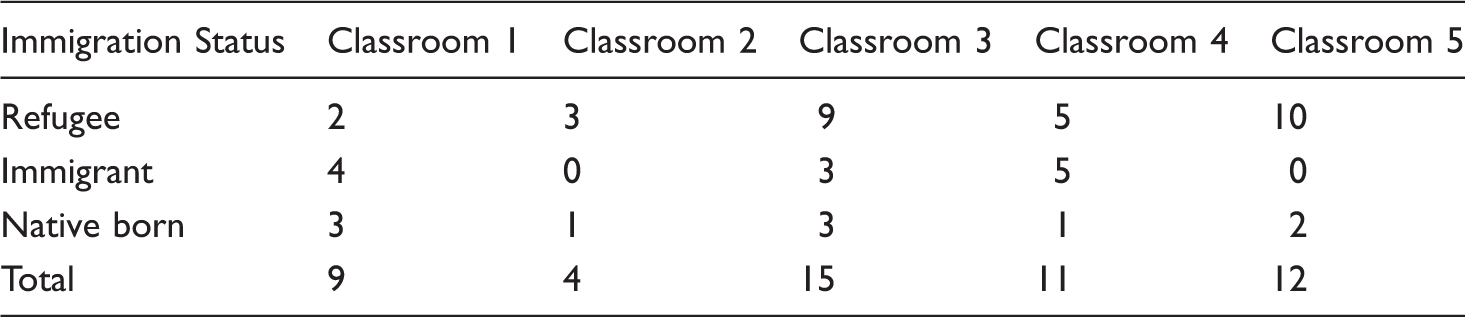
Grade 3 participant immigration status.
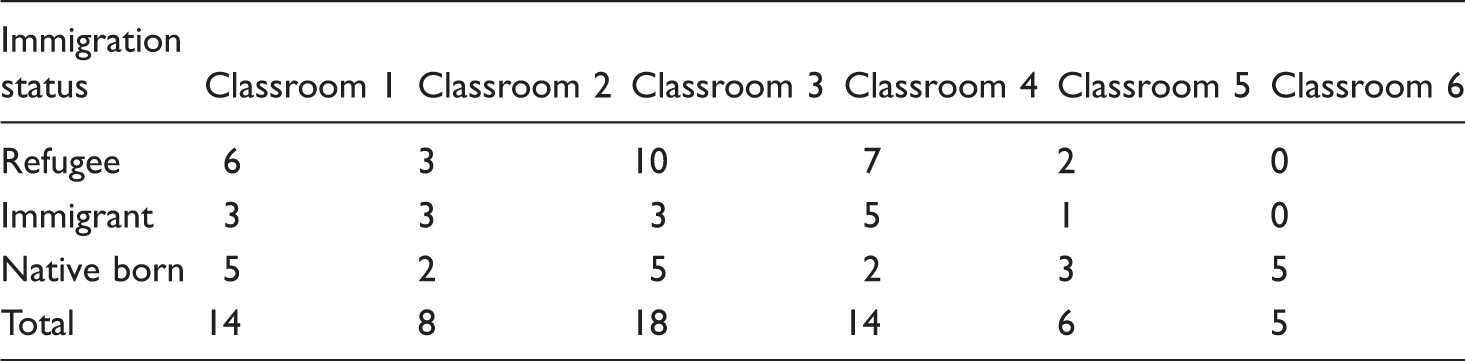
Grade 6 participant immigration status.
Following the survey, a sample of 22 students were selected for follow-up interviews. Students were selected based on survey findings indicating a high prevalence of bullying either as a victim, bystander, or bully and also their ability to communicate in English. In Grade 3, three refugees, three immigrants, and four native born children were interviewed. In Grade 6, four refugees, one immigrant, and seven native born children were interviewed. A total of seven refugees, four immigrants, and 11 native born children were interviewed.
Thirteen teachers participated; of the teacher sample, 11 were female and two males. A majority were Caucasian (85%) with a minority of Latino (7%) and Asian (7%). Ages of the teachers ranged from 26 years to 65 years, with 54% between the ages of 26- to 35-years-old; 15% between 36- to 45-years-old; 23% between 46- to 55-years-old and 7% between 56- to 65-years-old.
Results
Prevalence of being bullied, two-way ANOVA.

Note: *p < 0.05.
Part B of the elementary version (BYS-E) (Swearer, 2001) was completed by 39 respondents with the dependent variable as prevalence of witnessing bullying. Of these, 41% of the native born students witnessed bullying as compared to 38% of refugee children and 21% of immigrant children. A two-way ANOVA found no statistically significant main effect for immigration status F (2, 33) = 0.184, p > 0.05 and grade level, F (1, 33) = 0.454, p > 0.05.
Part C of the elementary version (BYS-E) (Swearer, 2001) was completed by 15 respondents with the dependent variable as prevalence of being a bully. More native born children (47%) admitted to being a bully as compared to refugee children (33%) and immigrant children (20%). In addition to a rather small response rate, the results for this variable were not surprising as the survey was not anonymous so few would admit to being a bully. Employing two-way ANOVA, results showed there was no statistically significant main effect for immigration status F (2, 9) = 2.414, p > 0.05 and grade level, F (1, 9) = 2.516, p > 0.05.
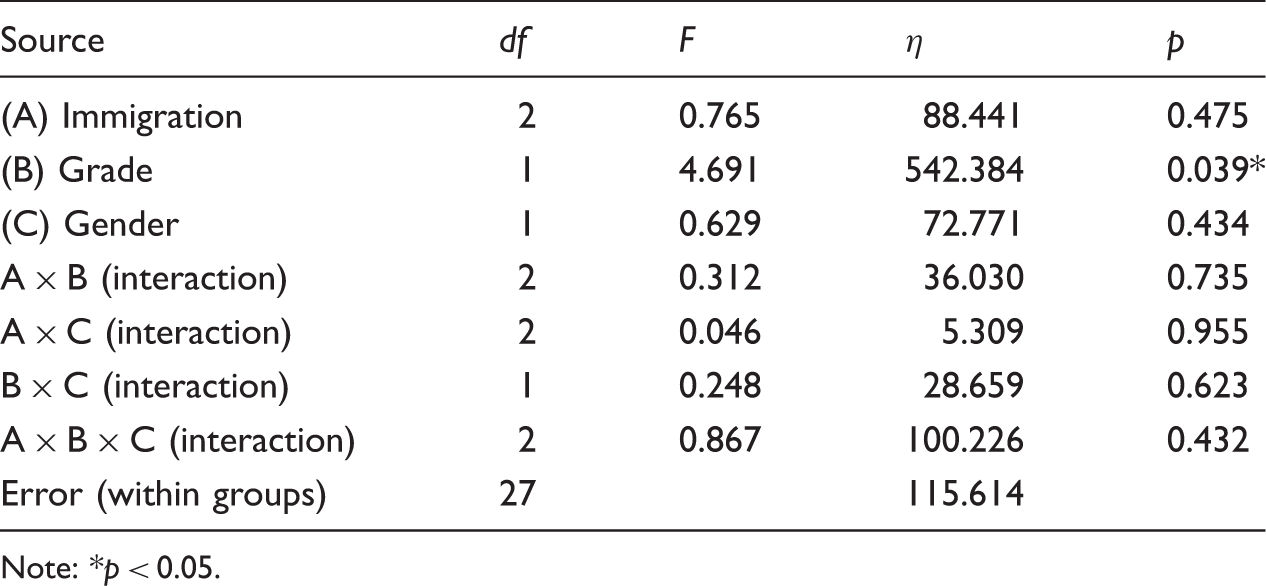
The second hypothesis explored sought to determine if immigration status, grade level, and gender influenced bullying. Part A of the elementary version (BYS-E) (Swearer, 2001) was completed by 39 respondents with the dependent variable as prevalence of being bullied. More Grade 3 (59%) than Grade 6 (41%) respondents identified themselves as having been a victim. Of these, refugee children comprised 62% of the sample as compared to 20% of native born children and 18% of immigrant children.
Prevalence of being bullied, three-way ANOVA.
Note: *p < 0.05.
Post hoc comparisons were employed to assess possible differences between immigration status, grade level, and gender. None was found. However, descriptive statistics suggests that more Grade 3 children (M = 27.7) were being bullied than Grade 6 children (M = 18.7).
Part B of the elementary version (BYS-E) (Swearer, 2001) was completed by 39 respondents with the dependent variable as prevalence of witnessing bulling. More boys (54%) than girls (46%) admitted witnessing bullying. Of these, 41% of native born witnessed bullying compared to 38% refugee children and 21% of immigrant children. A three-way ANOVA found no statistically significant main effect for grade level, F (1, 27) = 1.060, p > 0.05, immigration status, F (2, 27) = 0.197, p > 0.05, and gender, F (1, 27) = 2.081, p > 0.05.
Part C of the elementary version (BYS-E) (Swearer, 2001) was completed by 15 respondents with the dependent variable as prevalence of being a bully. Of these, more native born children (47%) admitted to being a bully as compared to refugee children (33 %) and immigrant children (20%). A three-way ANOVA found no statistically significant main effect for grade level, F (1, 4) = 2.362, p > 0.05, immigration status, F (2, 4) = 2.480, p > 0.05 and gender, F (1, 4) = 2.881, p > 0.05.
The third research question adopted a social-ecological model framework to examine the influence of individuals and teachers upon bullying among refugee children. Of the 22 children interviewed, seven were refugee children from Grade 3 (N = 3) and Grade 6 (N = 4). Of these, four were girls and three boys. These refugees came from Africa, Myanmar, Cambodia, Iraq, Rwanda, and Thailand. A new image of ‘victim’ emerged from the results when comparing the definitions of bully and victim among the interviewees.
The image of the victim described by both grade levels portrays a child calling for help. One of the Grade 6 African refugees stated ‘A victim is scared, he or she needs help, they feel like they are prisoner … want to move on with life’. The refugee children consistently expressed the notion that ‘the victim is someone who is picked on by a bully and has always been bullied’. This description reinforced Olweus’ (2010) criterion of repetition as part of the definition for bullying. Refugee children also shared the characteristics of a victim as someone who is quiet and shy but at the same time can be angry. Victims’ academic performance is affected as a Cambodian refugee shared ‘He doesn’t complete his homework, he gets bad behavior points’. As a result, a Grade 3 refugee said ‘… it makes them not come to school’.
A different image of a victim, however, emerged from a Grade 6 refugee from Iraq as ‘someone who tries to defend themselves’. This new image seemed to suggest that the victim was trying to take control of the situation, being more active than passive in the bullying scenario. The non-passive image was also supported by a Grade 3 Thai refugee: ‘When they are mean to me, I tell don’t treat me like that. If they actually hit me, I say don’t touch me’; his defensive response results in the bully leaving him alone. This response appears to be more of a ‘non passive’ victim.
In addition to being non-passive, three of the Grade 6 refugees suggested they would report the bullying situation to the teacher, principal, and parents. Although the outcome is not always positive (as stated by one African refugee child, ‘I tell the teacher but she is always telling me to ignore that person but it never works’) it illustrates how a victim can take action instead of demonstrating passivity. The image of a non-passive victim seemed more prevalent among refugee children than native born and immigrants. One native born in Grade 6 responded, ‘They know I won’t do anything about it’. Other native born and immigrants interviewed would walk away but none would react visibly or act upon the bullying situation. Perhaps, since refugee children have experienced the trauma of war and separation, they have learned to be more resilient and exhibit an image of a non-passive victim.
Discussion
Moving from a passive to non-passive victim
Data from this study did not support the notion that refugee children are subjected to a higher prevalence of bullying. However, one of the major outcomes of this investigation was the responses towards bullying among the refugee, immigrant, and the native born children in the classroom. Refugee children tended to react as non-passive victims as compared to the passive traits displayed by immigrant and native born children. Passive victims were defined as those who did not react visibly or act upon the bullying situation. Non- passive victims, on the other hand, were defined as those who reacted to bullying by defending themselves and by reporting to a higher authority (e.g. teacher, principal) during the bullying encounter.
This study supports a new category of victims as non-passive. This finding contrasts with data reported by Petrosino, Guckenburg, DeVoe, and Hanson (2010) who reported that 64% of respondents who experienced bullying did not report it. Newman, Murray, and Lussier (2001) acknowledged the vital role of the victim, yet limited research is based on the victim’s decision to seek help rather than remaining silent. Rigby (2012) also addressed the importance of strengthening the victim to become more assertive when bullied. He further acknowledged that empirical study in this area of research is still lacking. No one chooses to be victimized. However, if victims could be supported in moving from being passive to non-passive, then the bullying cycle might be short-circuited.
According to Nastasi and Naser (2014), the school psychologist is regarded as the ‘mesosystem in the child’s ecology’ in ensuring protection from all forms of violence and refugee status and promotion of children’s rights within school, family, community, and society (pp. 36, 44). As teachers and school psychologists work with an increasingly diverse school population globally, this study suggests a range of differing reactions of victimized children—especially refugee victims. Refugee children have been subjected to prior trauma and this resiliency could be their way of coping when faced with adversity. Data from this study suggests a need to investigate more globally the international bullying phenomenon so schools have a better understanding of means to prevent bullying in our growing multicultural school settings.
Implications of bullying to future acts of violence
One of the statistically significant findings of this study was differences in bullying among grade levels. Grade 3 children were subjected to a higher prevalence of victimization as compared to Grade 6 children. This study also supported other research that found higher victimization among younger children in the school (Nishioka, Coe, Burke, Hanita, & Sprague, 2011; Vaillancourt et al., 2008) This suggests that bullying might occur regardless of immigration status and may be starting at a younger age than previously imagined. This is an alarming wake-up call for policy makers, researchers, psychologists, and educators who need to consider that aggression can take place within the younger age groups. Moreover, just as aggression may be happening earlier, appropriate early intervention is likely to produce significantly greater long-term socio-economic dividends.
The qualitative findings of this study also suggest the potential of current bullying behavior to future acts of bullying. This was vocalized by a Grade 6 African refugee boy who stated ‘cause I believe that what you learn in school helps you understand how to act outside of school, they were bullied, so they learned to be bullies, then they need to bully …’. The Centre for the Study and Prevention of Violence (2001, 2008) suggests that bullies are up to four times as likely as non-bullies to be convicted of crimes by age 24. Moreover, bullying victimization has been related to school shootings and this cycle of violence can progress to adulthood in the form of dating violence, harassment, assault, child abuse, and hate crimes (Greif & Furlong, 2006).
Developing a more culturally appropriate bullying instrument
The Swearer Bully Survey was employed in this study because it collected data from both children and teachers. Since the diverse school population of this study consisted of refugees, immigrant, and native born children, many did not have the English literacy capability to complete the original 17-page survey. As a result, the survey was extended to include pictorial representations. Rigby’s (2010) Peer Relations Assessment Questionnaire-Revised (PRAQ-R) bully instrument also adopts pictorials for young children with limited reading skills. Although adding pictures to the original Swearer Bully Survey aided the refugee and immigrant children’s comprehension, there is still a need to consider the cultural appropriateness of the pictorial presentation as each culture might have a different interpretation of the pictures. A pictorial bully survey instrument for elementary and middle school children can be used as a bridge to investigate the bullying phenomenon for younger children and children with limited English capacities from a diverse culture.
Building a safer school for better learning
Maintaining a safe school is a top priority for schools. However, one of the major challenges in accomplishing this task is the increasing prevalence of bullying. Higher prevalence of school bullying is negatively related to academic performance especially in the areas of mathematics and reading (Konishi, Hymel, Zumbo, & Li, 2010). This finding was supported in the current study in the qualitative interviews.
This study also suggests that teachers and children may have a different understanding of the prevalence of bullying in schools. When comparing the Swearer Bully Survey-Elementary and Teacher Version, results suggest that children may be victimized more frequently than teachers and school psychologists realize. Children who are victimized felt that 44% of the teachers in this study were unaware of their bullied status. Teachers might have a different interpretation of bullying. Rigby (2012) suggests the need to distinguish between aggressive acts and bullying behavior. There is, then, a need to consider more qualitative interviews with teachers to better understand the adult’s perception of the prevalence of bullying. In an international meta-analysis of bullying research, Altomare, McCrimmon, and Beran (2013) found that teacher involvement is rated by students as the most powerful strategy for addressing bullying. This suggests that in addition to school psychologists working with children who are being victimized, it may be equally important to work with teachers in establishing their definition of bullying and providing bullying prevention strategies for them. If there is no consensus to the bullying phenomenon, it will be difficult to ensure a safe school environment for all children to learn.