



Abstract
Numerous studies indicate that intrinsic motivation predicts academic achievement. However, relatively few have examined various subtypes of intrinsic motivation that predict overall achievement, such as motivation for exercise and physical activity. Based upon the 16 basic desires theory of personality, the current study examined the motives of 178 senior high school (gymnasium) students (mean age = 17.6, range = 16–20) from Finland, using the Reiss School Motivation Profile. In structural equation models that controlled for gender and age, intellectual curiosity was positively associated with achievement, whereas the family motive was negatively associated with achievement. Boys had a higher intellectual curiosity and a lower family motive than girls. The physical activity motive had a significant negative interaction with intellectual curiosity, such that youth with higher intellectual curiosity had the strongest achievement when their physical activity motive was lower. This suggests that adolescents with a strong desire for exercise may have some difficulty in selective high schools that require rigorous study and long hours of sitting, even when they enjoy learning. Implications for motivational theory, education research, physical education for promoting fitness, and school psychology practice are discussed.
Keywords
Numerous studies, based on self-determination theory, have linked intrinsic motivation to learn with positive emotional health, persistence, academic engagement, mindfulness, and achievement (e.g. Brophy, 2013; Deci & Ryan, 2008; Froiland, 2011; Froiland, 2015; Froiland & Oros, 2014; Froiland, Oros, Smith, & Hirchert, 2012; Ryan & Deci, 2000; Ryan, Huta, & Deci, 2008; Vansteenkiste, Simons, Lens, Soenens, & Matos, 2005). A very similar construct within the 16 basic desires theory is curiosity, which entails enjoying intellectual activities (Reiss, 2000; Reiss, 2002; Reiss, 2004). Like intrinsic motivation to learn, intellectual curiosity has been linked to mindfulness and achievement (Reiss, 2000; Reiss, 2009; Reiss, 2012). However, the 16 basic desires theory includes other intrinsic motives that can help explain students' happiness pursuits and achievement. For instance, the physical activity motive on the Reiss Profile is a measure of the extent to which one enjoys exercise and movement versus finding sedentary activities pleasant (Reiss, 2004). Because high school requires more hours of homework, sitting in class, and more rigorous study than elementary and middle school (Froiland, 2014), it is likely that a strong motive for physical activity could interfere with academic performance even when one has fairly high intellectual curiosity. In particular, frustration with not being able to satisfy a motive that one highly values could interfere with well-being and performance (Unanue, Dittmar, Vignoles, & Vansteenkiste, 2014). Reiss, Wiltz, and Sherman (2001), found that high school and college students who participated in more sports had strong physical activity motives and lower intellectual curiosity. Those with high physical activity motives also had stronger family motives. Studies using the 16 basic desires theory have not yet examined interactions between motives, but it is possible that students with a high physical activity motive and a low intellectual curiosity could be at-risk for lower achievement, due to finding school less interesting and studying often interfering with physical activity.
Another motive that may be associated with lower achievement in high school is the family motive, which entails a strong desire to raise and nurture a family. While parents play a crucial role in supporting students’ cognitive, emotional, social, behavioral, and academic development from early childhood to college (e.g. Froiland & Davison, 2014a; Froiland & Davison, 2014b; Jeynes, 2012; Jungert, Landry, Joussemet, Mageau, Gingras, & Koestner, 2014; Pomerantz, Ng, Cheung, & Qu, 2014; Powell, Son, File, & Froiland, 2012; Rinaldi & Howe, 2012), students with a higher family motive may not see the connection between studying hard in school and better family conditions in the long-term, even though the education levels of parents predict the education levels and well-being of future children (Froiland, 2014). In fact, many young adults find that the family motive (e.g. ‘I put my family first’) clashes with their motivation for achievement in the work place and higher education (McAdams, 1993). Also, a high family interest or family centrality (similar to a high family motive) predicts the experience of work-family conflict, which can affect performance and achievement (Michel, Kotrba, Mitchelson, Clark, & Baltes, 2011). This is an issue in many highly developed countries, including Finland, where nearly half of workers report work-family conflict (Kinnunen & Mauno, 1998). A study in Israel suggests that at-risk high school students are more inclined to emphasize family over career aspirations, whereas normally developing adolescents place a stronger emphasis on career aspirations (Cinamon & Rich, 2014). In sum, the family motive may hinder achievement, if students do not see how what they are learning at school will prepare them to contribute to the wellbeing of their family (Froiland, 2014).
Current study and hypotheses
This study will examine whether the physical activity and family motives help to explain achievement among high school students in Finland, which is internationally known for promoting excellence in high school reading, mathematics, and science achievement (Ahtola & Niemi, 2014). Whereas many studies have found that adolescent students who enjoy learning and are intellectually curious have higher achievement (Froiland & Oros, 2014; Reiss, 2004; Vansteenkiste et al., 2005) this is the first to examine whether the physical activity motive interacts with intellectual curiosity in contributing to achievement. The following hypotheses each involve gender and age as control variables in a structural equation model (e.g. the relationship between gender and achievement, as well as the covariance between gender and curiosity, is factored into the model): 1) curiosity will be positively associated with achievement; 2) the family motive will be negatively related with achievement; 3) the physical activity motive will be negatively related with achievement; 4) physical activity and intellectual curiosity will interact such that higher intellectual curiosity and a lower motive for physical activity will be associated with the highest achievement.
Method
Data source and participants
Descriptive statistics for motives, gender, grade average, and age.

Note: N = 178. Grade avg. = grade average. 10 = excellent; 9 = very good; 8 = good; 7 = average; 6 = below average; 5 = bad; 4 = fail.
Procedures
The school staff was informed about the usage of the Reiss School Motivation Profile (RSMP) and the study in a school meeting. Each student was informed that the profile would be a voluntary part of the career counseling curriculum and discussion. The motivation profile was offered via the school online internal communication system to second through fourth year gymnasium students. Students who were interested in the profile clicked yes and were sent a secure link to the RSMP. The RSMP survey items were in Finnish. The test results were used in career counselling discussions about their future educational options.
Measures
Reiss School Motivation Profile
Based upon the 16 basic desires theory, the Reiss School Motivation Profile examines 13 motives that are appropriate for administering to youth in school settings (Havercamp & Reiss, 2003; Reiss, 2002; Reiss, 2012). Namely, the subscales for the romance, savings, and eating motives are not included (Reiss, 2009). Curiosity entails a thirst for knowledge and enjoyment found in thinking deeply. Physical activity entails one's desire for exercise and fitness promoting activities versus favoring sedentary tasks. The family motive involves one's level of desire for being with family and starting a family. There are various other motives emanating from personalities such as the following: Idealism, which is an altruistic desire to make the world a better place; power, which is a desire to influence others; honor, a motive to be morally sound and responsible; and vengeance, a desire for competition and revenge. The full list of motives and their thorough descriptions can be found elsewhere (Reiss, 2002; Reiss, 2009). The Reiss Profile has demonstrated strong validity and stability reliability in previous studies (e.g. Havercamp & Reiss, 2003; Reiss & Havercamp, 1998; Reiss & Havercamp, 2005). Furthermore, internal consistency is adequate for each sub-scale, with Cronbach's alpha ranging from 0.79 for Honor to 0.94 for Vengeance (Havercamp & Reiss, 2003).
Gender
1 = male; 0 = female. Previous studies have found that girls have stronger achievement than boys (Froiland & Oros, 2014).
Age
The age in years of students in the study. Ages ranged from 16–20.
Achievement
Grade average of the last evaluation: 10 = excellent, 9 = very good, 8 = good, 7 = average, 6 = below average, 5 = bad, 4 = fail. Grades were acquired from administrative records at the gymnasium.
Data analysis plan
Structural equation modeling (SEM) in AMOS 19 was implemented to test the model (see Figure 1), which enabled a simultaneous examination of the multivariate relations between curiosity, the family motive, physical activity, curiosity X physical activity, gender, age, and achievement. Model fit was determined by a non-significant chi-squared, a comparative fit index (CFI) and Tucker-Lewis Index (TLI) of 0.95 or higher, as well as a root mean square error of approximation (RMSEA) less than 0.06 (Froiland & Davison, 2014b; Froiland, Powell, Diamond, & Son, 2013; Hu & Bentler, 1999). In order to test indirect relationships between gender and achievement via motives (i.e. curiosity, physical activity, and family), the bootstrapping test was used to examine the significance of the indirect effect (Froiland, Powell, & Diamond, 2014; Shrout & Bolger, 2002).
All direct paths are significant at p < 0.05, except physical activity to grade average. χ2(6) = 2.60, p = 0.86; CFI = 1.0; TLI = 1.24; RMSEA = 0.00. All path coefficients refer to standardized variables with mean 0 and variance 1.0. Exhaustive covariances between exogenous variables were included in the tested model but are not depicted here for the sake of aesthetics. Physical X Curious = the interaction between Physical Activity and Curiosity.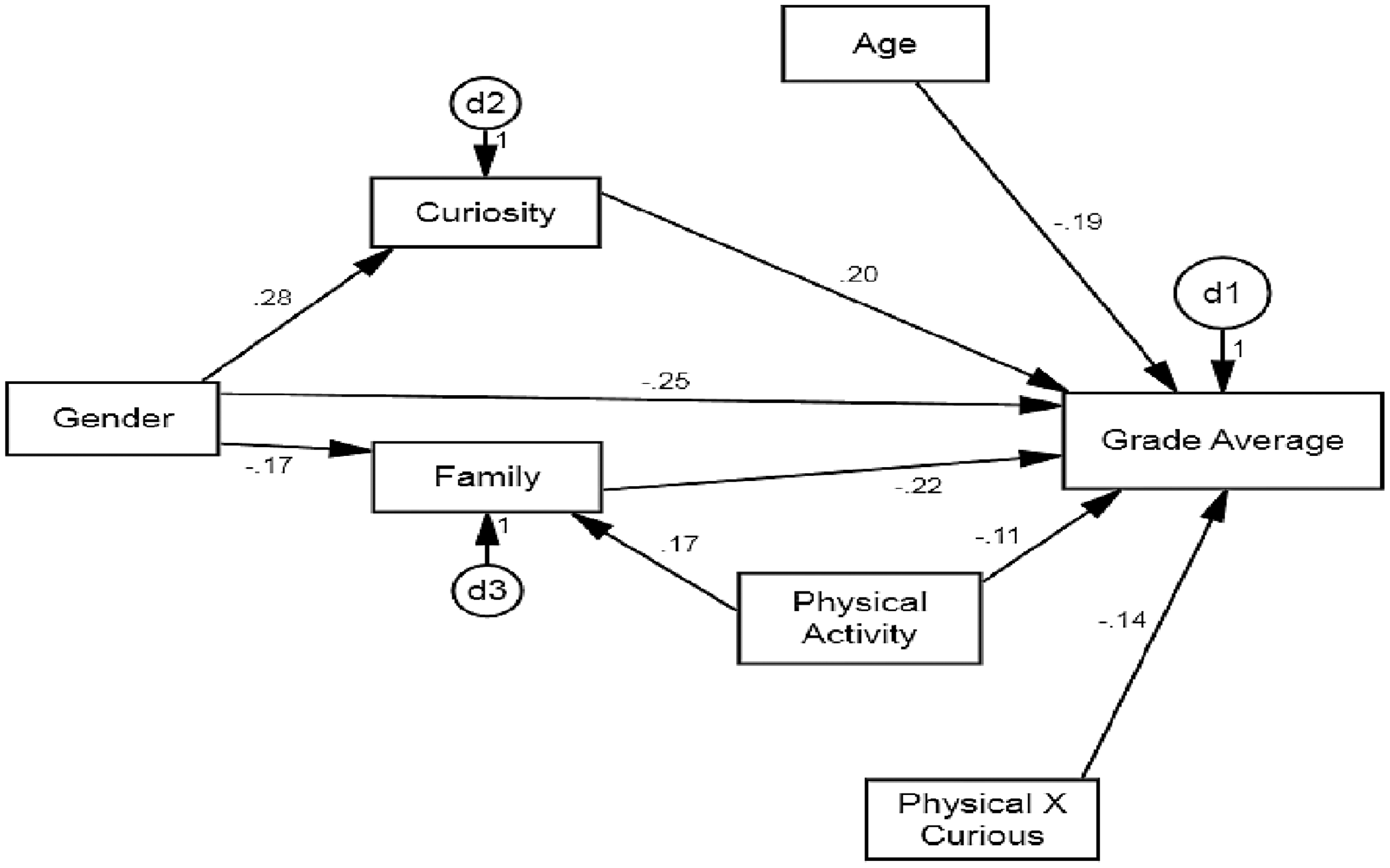
Results
Preliminary analyses
Bivariate correlations between motives, age, and grades.
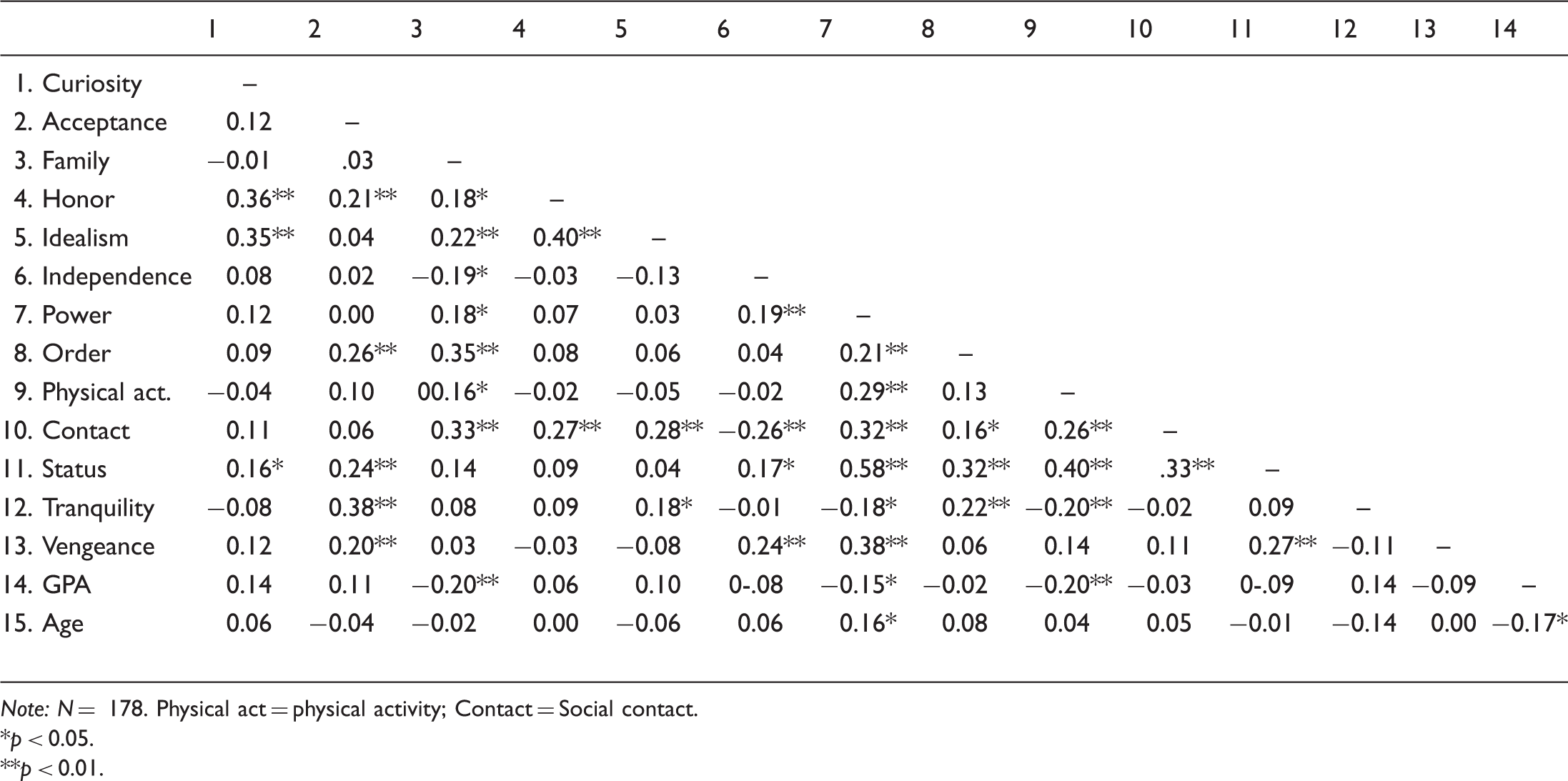
Note: N = 178. Physical act = physical activity; Contact = Social contact.
p < 0.05.
p < 0.01.
Structural equation model findings
The structural equation model (see Figure 1) provided a good fit with the data according to numerous indices: χ2(6) = 2.60, p = 0.86; CFI = 1.0; TLI = 1.24; RMSEA = 0.00. As predicted in hypothesis 1, intellectual curiosity had a significant positive association with achievement (see Figure 1 for the SEM diagram with standardized coefficients). Hypothesis 2 was also confirmed in that the family motive had a significant negative association with achievement. The effects of intellectual curiosity and the family motive were comparable in magnitude to that of gender and age (see Figure 1). Hypothesis 3 was not confirmed in that physical activity was not significantly negatively associated with achievement in the Structural Equation Model, despite the significant bivariate correlation between the two variables (r = −0.20, p < 0.01). However, hypothesis 4 was confirmed in that there was a significant negative interaction between the physical activity motive and intellectual curiosity (see Figure 2 for a graph of the interaction effect).
Interaction effect between curiosity and physical activity is significant (p < 0.05). Physical = physical activity motive. Curiosity is most strongly positively associated with achievement when the physical activity motive is low.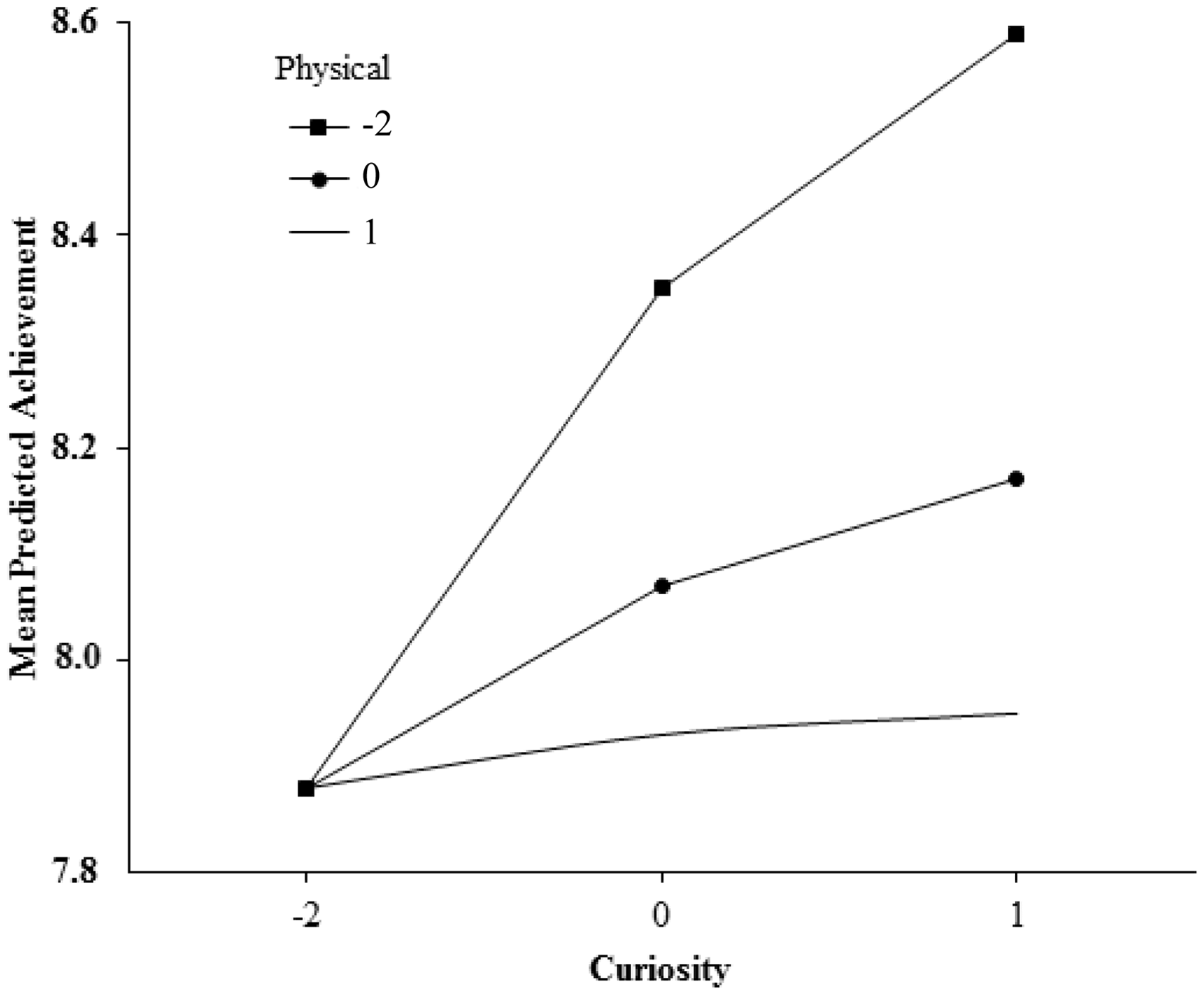
Girls had higher achievement than boys (standardized direct effect = −0.25, p < 0.05); however, the standardized indirect effect of gender on achievement was 0.09 (p < 0.05), which led to the total standardized effect of gender being −0.15 (p < 0.05). In other words, the advantage that girls have over boys on achievement is decreased when considering that boys have higher intellectual curiosity and a lower family motive (see Figure 1).
Interaction between curiosity and physical activity motives
The negative interaction effect between curiosity and physical activity was significant (p < 0.05), indicating that curiosity is most strongly positively associated with achievement when the physical activity motive is low (see Figure 2). Conversely, when the physical activity motive was higher, the positive association between intellectual curiosity and achievement was attenuated.
Discussion
As expected based on the 16 basic desires theory (Reiss, 2008) and self-determination theory (Ryan & Deci, 2000; Vansteenkiste et al., 2005), intellectual curiosity was positively associated with achievement among gymnasium students in Finland. In addition, based upon the 16 basic desires theory, additional intrinsic motives were associated with achievement. For instance, a significant negative interaction between the physical activity motive and intellectual curiosity was discovered, such that students with high intellectual curiosity and a low physical activity motive had the highest levels of achievement. Conversely, those with low intellectual curiosity and a high physical activity motive had the lowest levels of achievement. This is in accordance with Reiss' 16 basic desires theory because students with a high physical activity motive dislike sedentary work (Reiss, 2002), which advanced schooling requires in abundance. Disliking rigorous thinking and having an aversion to sedentary work could be a very problematic combination of motives when in a competitive academic environment. On the other hand, students who are less motivated for physical activity can better tolerate or perhaps enjoy long study sessions, reading on the couch, and taking notes during extensive lectures, especially if they are intellectually curious. Reiss et al. (2001) found that youth who played more sports had lower intellectual curiosity and higher physical activity motives, but the current study is the first to find a significant interaction between these motives in relation to achievement.
The direct association between intellectual curiosity and achievement suggests that helping students find wonderment in learning and homework is worthy of further research and investment (e.g. Froiland, 2011; Froiland, 2015; Savard, Joussemet, Pelletier, & Mageau, 2013). Future longitudinal studies may wish to see if the negative interaction between desire for physical activity and curiosity holds over many years. If so, it may be necessary to teach students that are moderate to high in both curiosity and physical activity how to defer physical exercise until after homework is completed and to focus first and foremost on intellectual curiosity while studying or attending class. They could be taught to imagine themselves exercising after successfully completing their homework. Alternatively, exercise breaks could be better interspersed throughout the high school day. Exercise has many benefits in terms of stress reduction, promoting physical health, and longevity (Penedo & Dahn, 2005). Furthermore, rigorous aerobic exercise has some cognitive benefits (e.g. increasing visual-spatial memory; Stroth, Hille, Spitzer, & Reinhardt, 2009), so the key would be to teach students how to utilize their higher physical exercise motive in the most fruitful way possible. One avenue could be helping students with a high physical activity motive to transfer the rigorous approach they take to exercise and sports to learning by viewing the mind as similar to a muscle that gets stronger with vigorous exercise (Blackwell, Trzesniewski, & Dweck, 2007; Froiland, 2014; Froiland, 2015).
Although a strong physical activity motive may dampen the effect of curiosity on overall achievement, it is important to point out that the items on the physical activity motive scale are similar to self-determination theory derived measures of intrinsic motivation for physical education courses or for exercise in general (Haerens, Kirk, Cardon, De Bourdeaudhuij, & Vansteenkiste, 2010; Silva et al., 2011). High autonomous motivation (either intrinsic motivation or identified regulation) for physical activity or for physical education predicts more physical activity (Haerens et al., 2010), fitness, weight loss, and physical health (Silva et al., 2011). These findings suggest that a strong physical activity motive is important for long-term physical health and may contribute to good outcomes in physical education classes that are increasingly aiming to teach students to adopt a healthy lifestyle (Haerens et al., 2010). However, the current findings add complexity to the situation by indicating that a strong motive for exercise can interfere with intellectual curiosity and achievement. Students with a strong physical activity motive may need guidance in figuring out how they will schedule enough exercise each day, while still spending enough time studying. School administrators who have reduced the amount of time that students spend in physical education may want to reconsider, because physical education provides important exercise opportunities during the school day for all students and helps meet a core psychological need for students with above average physical activity motives.
The family motive (a strong desire to be with family and raise a family) was negatively associated with achievement. Although a student's parental involvement contributes to high school achievement in various ways (Froiland & Davison, 2014b), Finnish adolescents who think about their current or future family significantly more than others may not see how diligence at school connects to their family motive. This should be investigated further as the current finding is in accordance with recent evidence that lower achieving students put a greater emphasis on their future family than career aspirations in high school (Cinamon & Rich, 2014). In accordance with Reiss et al. (2001), we found further evidence that those high in the physical activity motive also have a higher family motive. This is worthy of further investigation in future studies as it could be due to families enjoying exercise and sporting events together (Powell et al., 2012; Reiss et al., 2001).
Limitations
Future studies could employ additional rigorous controls such as family SES, family structure, and prior achievement (Froiland, Peterson, & Davison, 2013; Jeynes, 2012). This is important because SES, for instance, is positively associated with both motivation and achievement (Steinmayr, Dinger, & Spinath, 2012). Furthermore, following the students over the course of multiple school years could help to establish that various motivational variables predict achievement development. In addition, classroom engagement is a key expression of intrinsic motivation to learn (Froiland, 2014) and serves as a key mediator between intrinsic motivation and achievement (Skinner, Kindermann, Connell, & Wellborn, 2009). Future studies could examine whether intellectual curiosity, physical activity, and the family motive affect achievement via classroom engagement, over the course of many years.
Implications for school psychologists and educators
The findings of this study regarding intellectual curiosity support both the theory of 16 basic desires (Reiss, 2004) and self-determination theory (Ryan & Deci, 2000) among gymnasium students in a Finnish high school. The fact that intellectual curiosity was the only motive that was positively associated with achievement, suggests that students in Finland may benefit from preventive interventions that support intrinsic motivation to learn similar to those studied in North America (e.g. Froiland, 2011; Froiland, 2014; Froiland, 2015; Solomon et al., 2000). Indeed, researchers in Finland have called for more preventive programs to be delivered by school psychologists to families and schools (Ahtola & Niemi, 2014). Programs that promote intrinsic motivation to learn have been found to support the development of positive emotions, reductions in anxiety, and decreases in psychosomatic complaints (e.g. headaches, stomachaches, and muscle tension; Froiland, 2011; Froiland, 2015), further suggesting the importance of the mind-body health connection in the schools.
The negative interaction between curiosity and physical activity contributing to achievement needs to be further examined because it suggests an important mind-body health connection. If longitudinal studies indicate that the family and physical activity motives contribute negatively to the development of engagement and achievement, interventionists may wish to consider assessing and addressing family and physical activity motives among high school students who are getting closer to deciding whether to raise a family and who are expected to sit and study more than any time earlier in their life. Theorists may also consider that self-determination theory and the 16 basic desires theory provide complementary insight. For instance, self-determination theory guides interventions to increase motivation via autonomy support and relatedness, while the 16 basic desires theory suggests that additional motives (e.g. physical activity) are also relevant to achievement and happiness (Reiss; 2004; Reiss, 2008). School psychologists across the world may benefit from utilizing the Reiss School Motivation Profile as it provides a detailed understanding of students' personalities and motives, which predict achievement, career pursuits, participation in sports, and behavior (Reiss, 2004; Reiss, 2012). For instance, high school students with moderate to high curiosity and a high physical activity motive may need school psychological counseling to help them figure out how to harness the strength of their physical activity motive for promoting physical health, while activating their curiosity (and deferring gratification of the physical activity motive) during periods of studying and sedentary class participation.