




Abstract
Many have claimed, but only some have shown, that the social nature of teaching and classrooms is likely to have a direct effect on students’ achievement goals. This study examined the extent to which Dutch secondary school students’ (N = 2892) achievement goals were related to the interpersonal quality of teaching. Students’ goals were examined in terms of individual student perceptions of their teacher and their teacher’s general interpersonal disposition. Multivariate multilevel models were tested, specifying the student and the teacher level and using two achievement approach and two achievement avoidance goals as dependent variables. The most remarkably finding was that students who like a generally tough teacher (Level 2 effect) better than their peers do (i.e. Level 1 effect, students who report relatively high teacher communion) were more likely to report higher levels of approach goals. In particular when considering interpersonally more ‘extreme’ teacher dispositions, effects on students’ goals were considerable. Regarding students’ goals, identifying teachers who generally convey low levels of interpersonal agency and/or communion seems worthwhile for practitioners. Also identifying students with more pronounced, interpersonally negative perceptions of their teachers may be valuable when targeting students’ achievement goals.
Goal theory, the study of students’ academic achievement goals, has a longstanding history in educational research. Achievement goals refer to students’ reasons for engaging in a certain task (Anderman & Patrick, 2012). The primary focus in goal theory is on two types of goals: Mastery goals and performance goals (Dweck, 1986). When students pursue mastery goals, that is, when they focus their efforts on truly mastering a task and on developing personal competence, they tend to process their tasks more deeply and use effective learning and self-regulation strategies and enjoy school more. Results are more mixed for performance goals regarding these outcomes (Anderman & Patrick, 2012). Nevertheless, when students pursue performance goals, that is, when they want to demonstrate their ability relative to others, they show higher academic achievement than their peers (Anderman & Patrick, 2012; Bong, 2009; Elliot & McGregor, 2001). Mastery goals and performance goals can co-exist. Additionally, both have been conceptualized to include an approach component and an avoidance component; when behavior is guided by avoidance, it is directed by undesirable rather than desirable potential outcomes (Elliot & McGregor, 2001).
Urdan and Schoenfelder (2006) have argued that the goals students pursue should not be regarded as an individual-difference variable but as malleable constructs that reflect a combination of student and situational characteristics. The current study follows a recent call for a (renewed) focus on the social-relational basis for students’ achievement goals (Turner, Gray, Anderman, Dawson, & Anderman, 2013) as opposed to a focus on, for example, the nature of tasks or performance evaluation. Interpersonal theory is utilized as an approach to the social-relational aspects of classrooms, which represents one of the basic psychological conceptualizations of how people interact and perceive one another (Horowitz & Strack, 2010). Specifically, this study investigates how the general interpersonal dispositions of teachers and students’ idiosyncratic interpersonal perceptions of a teacher affect students’ achievement goals, that is, how students perceive the nature and purpose of their learning (Ames, 1992).
The interpersonal basis of achievement goals
Urdan and Schoenfelder (2006) emphasized the social nature of schools and classrooms, noting that teachers are quite likely to have a direct effect on their students’ achievement goals. Although early thinking about academic achievement goals included social-relational aspects of classrooms as important foundations for students’ academic goals (Ames & Ames, 1984; Maehr, 1984), much research had focused on other aspects such as the nature of classroom tasks and the messages evaluations convey regarding competence and effort (e.g. Ames, 1992; Elliot & Dweck, 2005). Recently, specific interest in the social foundations (such as social roles, norms, and relationships) of the achievement goals communicated in class has increased. For example, Turner et al. (2013) focused on the growing evidence that teacher support in the classroom is strongly associated with teachers’ emphasis on learning rather than performance goals (Anderman, Andrzejewski, & Allen, 2011; Patrick & Ryan, 2008). These authors hypothesized that, ‘it may be that teachers communicate their goals for student effort and improvement through their offers of personal and academic support’ (Turner et al., 2013, p. 317). In the same vein, Anderman and Maehr (1994) viewed goals as arising from and being fulfilled in relational contexts. According to Martin and Dowson (2009), teachers’ classroom practices directly and indirectly shape students’ motivation to achieve because relationships are central to teaching and instruction and the ‘why’ of behavior is communicated by interactions. In fact, Martin and Dowson concluded that there is a parallel between the extent to which achievement goals have a social basis and the degree to which educational practices at the level of the student and teacher or the class should be framed in relational terms.
However, the teacher’s messages as conveyed by teaching and interaction with students may not be evident to all students in the same manner. Thus, in addition to a consensual part in their perceptions, different students perceive their teachers differently in the identical classroom while witnessing identical teacher behavior. In students’ perceptions of classroom goal structures, the consensual part in students’ perception represents up to 15% of the variance in students’ goals (Urdan, Midgley, & Anderman, 1998; Urdan & Schoenfelder, 2006); consensus is roughly twice as large in students’ interpersonal perceptions of their teachers (Mainhard, Brekelmans, den Brok, & Wubbels, 2011). Urdan and Schoenfelder argued that a perceived emphasis on mastery goals in the classroom has potential benefits for students but is not a cure for all students with maladaptive motivational profiles.
What can teachers do?
Patrick and Ryan (2008) summarized student perceptions of how teachers motivated them to learn. According to students, these teachers were friendly, approachable, concerned with students’ learning, and patient when students did not understand. Urdan and Schoenfelder (2006) described how teachers who promote mastery goals use democratic communication styles, demonstrate an interest in student input, have respect for individual differences, are patient in interpersonal interaction, and are able to simultaneously provide constructive criticism. In her seminal paper, Ames (1992) theorized that not only recognition but also authority affects students’ goal orientations. Focusing on competition may be perceived as cold or even hostile behavior and may enhance failure-avoiding goals. A mix of giving students responsibility for their own learning, guided decision-making, planning and providing a general direction has been connected with intrinsic motivation and mastery goals. Recognition and authority are reminiscent of the two basic dimensions interpersonal theory uses to map human interaction and interpersonal perceptions.
Interpersonal theory
In this article interpersonal theory (Horowitz & Strack, 2010) is used for a fine-grained scrutiny of teacher behavior and students’ general perceptions of that behavior. In interpersonal theory, interaction and interpersonal perceptions are conceptualized in terms of two basic dimensions, agency (i.e. dominance, interpersonal influence) and communion (friendliness, warmth), which are combined using an interpersonal circumplex (IPC). The IPC is a weighted combination of levels of both factors, reflecting all combinations of agency and communion (Wiggins, 1979). An application of interpersonal theory to the classroom context is the IPC for the teacher, which describes a teacher’s general behavioral patterns (Créton and Wubbels, 1984; Wubbels, Brekelmans, van Tartwijk, & den Brok, 2006). This model is generally used to map either interactions (Pennings et al., 2014) or, as in the present study, students’ interpersonal perceptions of how a teacher generally behaves in class (Wubbels et al., 2014). See Figure 1 for the IPC for the teacher used in the present study.
The Interpersonal Circle (IPC) for the teacher. The IPC is a weighted combination of levels of the two basic dimensions Agency and Communion. Octant labels are prototypical interpersonal teacher characteristics that each represent a specific blend of Agency and Communion.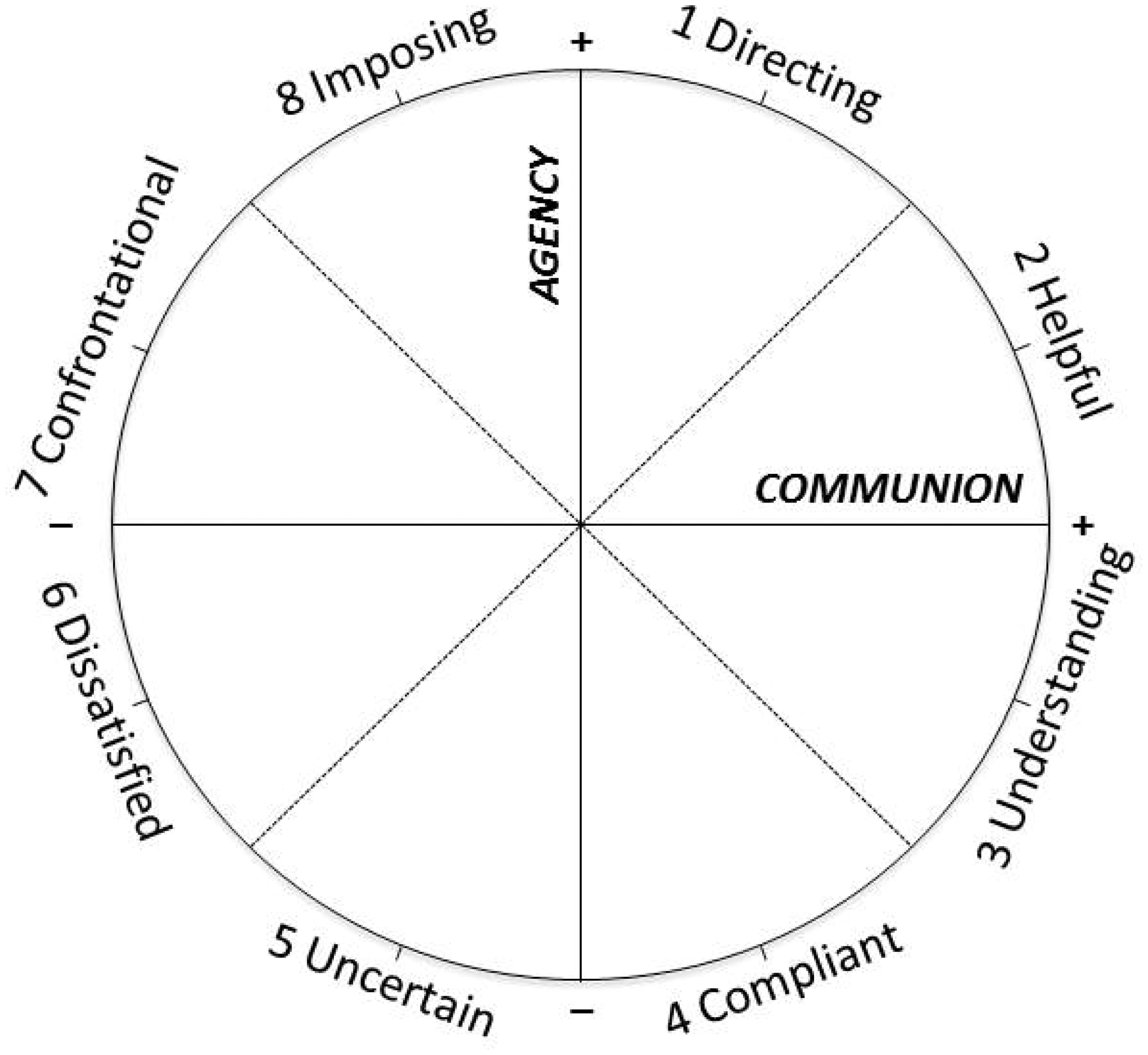
The eight octants reflect prototypical labels of behavior that correspond to a specific blend of agency and communion. Octants on the right side of the model represent behaviors characterized by relatively high levels of communion, and behaviors in the upper portion of the model represent relatively more agentic behavior. Octants near one another are positively correlated (e.g. dissatisfied and confrontational) whereas behaviors on the opposite sides of the IPC are negatively correlated (e.g. dissatisfied and helpful). An important characteristic of the model is that agency and communion are (theoretically and empirically) orthogonal (Fabrigar, Visser, & Browne, 1997). In other words, knowing the level of agency a teacher conveys in class does not tell us how this agency is enacted; it may be through confrontational behavior or through helpful behavior, which reflect a similar level of agency but opposite values on communion. A student’s perception of these eight octants can be used to map idiosyncratic perceptions but also to tap, in classroom aggregated form, the classroom interpersonal climate and finally, if summarized over several classes, a teacher's general interpersonal disposition (den Brok, Brekelmans, & Wubbels, 2006; Lüdtke et al., 2009; Mainhard, Brekelmans, & Wubbels, 2011).
Studies have generally shown positive effects of agency and communion on cognitive and affective outcome variables (den Brok, Brekelmans, & Wubbels, 2004; Wubbels et al., 2006), although for subject-specific motivation, communion has been observed to have a somewhat stronger effect than agency. Den Brok et al. (2004) found that interpersonal predictors in the classroom explain large amounts of the variance (up to two-thirds) in student affective outcome variables such as enjoyment, perceived relevance, confidence, and effort at the teacher-class level.
The present study
The present study relates students’ achievement goals to the general interpersonal dispositions of teachers and students’ idiosyncratic interpersonal perception of a teacher. Specifically, effects at the teacher level are studied combining general (i.e. by students’ shared) teacher effects with students’ idiosyncratic views of their teacher (students’ private perceptions).
Based on earlier findings, it is expected that a substantial part of the variance in students’ achievement goals at the teacher level can be explained by interpersonal teacher characteristics. Specifically, consistent with den Brok et al. (2004) and Turner and colleagues’ observations (Turner et al., 2013), it is expected that if teachers are generally perceived as communal or warm, students are more likely to adopt a mastery approach goal. Consistent with Ames (1992), it is expected that if students perceive teachers as cold (low on communion), the students tend to report stronger avoidance goals. The current research is not decisive regarding the connection between interpersonal agency (i.e. dominance) and performance goals although according to Ames, a strong focus on competition is likely to correspond to teacher behaviors that are low on communion and relatively high on agency (being confrontational and imposing).
Method
Sample
Participants were 2892 students from 44 secondary Dutch schools (representing 182 classrooms). Students were recruited through teachers via e-mails and phone calls to schools and additionally through advertisements in school magazines. A total of 95 teachers agreed to participate: Thirteen teachers participated with one of their classes, and the remainder of the teachers with two or three classes. The number of student ratings per teacher ranged between ten students and a maximum of 64 students (M = 32.49, SD = 10.35). Each student rated only one teacher. In the Netherlands, there are three general achievement tracks in secondary education (pre-vocational track, senior general secondary track, pre-university track), and the participating classrooms were approximately evenly divided among these three tracks. Students were between 12- and 18-years-old; 16% of the students were from grade 1 (11- to 12-years-old), 25% of the students were from grade 2 (12- to 13-years-old), 15% from grade 3 (14- to 15-years-old) and the remainder of the students were from grades 4 and 5 (15- to 18-years-old). Ethnicity in the sample was consistent with the general Dutch distribution (80% Dutch, 15% non-Western immigrants and 5% Western immigrants). Note that ethnicity has not been linked to specific patterns in students’ achievement goals (Midgley, Kaplan, & Middleton, 2001). Teachers (45% male, Mage = 42.38, SDage = 11.17) had on average a teaching experience of 12.67 years (SD = 10.22).
Measures
Achievement goals
To tap students’ achievement goals, a Dutch translation of Elliot and McGregor's (2001) Achievement Goals Questionnaire (AGQ) was used; however, students indicated the extent to which they thought an item was true of themselves on a 1 (not at all true) to 5 (very true) scale instead of a seven-point scale to accommodate the participation of younger students and to maintain the rating categories constant for the QTI and AGQ combined questionnaire. In the AGQ, items are equally divided across four subscales measuring Mastery approach goals (MAP), Performance approach goals (PAP), Mastery avoidance goals (MAV) and Performance avoidance goals (PAV). In their original article Elliot and McGregor reported Cronbach’s alphas well above 0.80 and adequate fit indices for the questionnaire in an undergraduate sample.
A confirmatory factor analysis was conducted on the 12 AGQ items used here using MPlus Software (Muthen & Muthen, 2012). After deleting one item from the Performance Approach subscale (‘I just want to avoid doing poorly in this class’), which showed correlated errors with several items in other subscales, a reasonable fit was achieved, χ2(38) = 1117,71, p < 0.01, RMSEA = 0.08, CFI = 0.93, TLI = 0.90. The reliabilities (Cronbach’s alpha) were acceptable for Mastery approach (MAP) at 0.82 and Performance approach (PAP) at 0.80 but somewhat lower for Mastery avoidance (MAV) at 0.68. The alpha for Performance avoidance (PAV) was only 0.57. The results for PAV goals, especially for individual students, should therefore be interpreted with caution.
Interpersonal teacher behavior
Students’ general perceptions of how their teacher behaved interpersonally were mapped with a 24-item version of the Questionnaire on Teacher Interaction (QTI; Créton & Wubbels, 1984; Wubbels et al., 2006). The QTI assesses each of the octants (three items per octant) of the IPC for the teacher representing different combinations of Agentic (dominance, interpersonal influence) and Communal (affiliation, warmth) teacher behaviors (see Figure 1). The instruction printed on the form was ‘What do you think of this teacher?’. The QTI includes items such as ‘This teacher acts hesitantly’ and ‘This teacher is strict’, and items are rated on a five-point Likert-type scale bounded by ‘never’ (1) and ‘always’ (5). The circular structure and spacing of the QTI items was evaluated with CircE (Grassi, Luccio, & Di Blas, 2010) and deemed satisfactory, χ2(28) = 2240.243.12; p < 0.01, RMSEA = 0.05; CFI = 0.99, TLI = 0.98; free circumplex structure. Cronbach’s alphas for the octant scales at the student level ranged between 0.71 and 0.82. For Confrontational (octant 7) and Imposing (octant 8), the alphas were 0.67 and 0.61, respectively. The descriptives at the student level for the octant scores were for Directing (octant 1) M = 0.70, SD = 0.22; Helpful M = 0.69, SD = 0.23; Understanding M = 0.63, SD = 0.22; Compliant M = 0.52, SD = 0.20; Uncertain M = 0.24, SD = 0.22; Dissatisfied M = .28, SD = 0.20; Confrontational M = 0.41, SD = 0.22; and Imposing M = 0.53, SD = 0.20. Scores varied across the entire range (scaled 0–1).
The teacher's general interpersonal disposition was represented by the average octant scores as perceived by students of all classes that rated that teacher. This average score represents how a teacher is perceived equally in all classrooms. Use of student perceptions at the teacher level was justified by high reliabilities of the aggregated ratings. ICC1 values for the octants, reflecting the average correlation of two random students of the same teacher, were all well above 0.30; and all ICC2 values (Lüdtke, Robitzsch, Trautwein, & Kunter, 2009) were above 0.90.
Students' personal perception of a teacher was calculated as a student’s deviation from the class mean, with the classroom and teacher variance cancelled out (i.e. within teacher centering; Lüdtke et al., 2009). Such a score reflects the unique portion of a student’s perception of the teacher.
Procedure
Teachers received the student questionnaires with instructions for the data collection to ensure that all teachers followed a similar procedure. Students were informed of the goals of the study, and it was made explicitly clear that confidentiality was guaranteed and that participation was voluntary. Questionnaires were administered in a normal classroom situation at the end of a lesson. A student collected the questionnaires, sealed them in an envelope and the teacher returned the envelope to the researcher.
Analysis
The dependent variables were distributed normally, and no univariate outliers were detected. Relations between the octant sores and students' goals were linear.
Given the partial overlap between the four mastery goals, a multivariate multilevel model with students’ four achievement goals as dependent variables was fitted with MLwiN (Rasbash, Charlton, Browne, Healy, & Cameron, 2005). Initially, a three-level model was fitted with individual students represented at Level 1, classes at Level 2 and teachers at Level 3. Prior to exploring the manners in which interpersonal variables associated students’ achievement goals, the variance components of students’ achievement goals at each level were estimated. Teacher gender and age (grand mean centered), school type and grade level (0 = first year, 5 = sixth year) were entered for all dependent variables’ common covariates. Because all goals had only quite small and at p = 0.05, non-significant variances at the class-level (MAP = 4%; PAP = 3%; MAV = 3%; PAV = 0.04%), it was decided for practicality to collapse the teacher and class levels into a single level, reflecting the combined effect of a teacher in a specific classroom. The reason for the non-significant variance components at the class level is most likely related to the combination of a relatively small number of classes that were nested under a teacher with small effects at these levels (Hox, 2010). Thus the models reported in the results section represent teacher/classes at Level 2 and students at Level 1. For the reader’s convenience, we refer to Level 2 as the teacher level.
Results
Because the number of ratings per teacher varied widely (see sample section), it was examined whether the number of ratings was associated with the most central teacher characteristic studied here: The interpersonal disposition of teachers (i.e. octant scores). No significant bi-variate correlations were identified except for octant 4 (Compliant) r = 0.11, p < 0.01 and octant 8 (Imposing), r = −0.07, p < 0.01. It was therefore concluded that no strong association between number of ratings and interpersonal style of a teacher existed.
Teacher, class, and student components of students’ achievement goals
Largely replicating the work of Urdan and colleagues (Urdan, Midgley, & Anderman, 1998; Urdan & Schoenfelder, 2006), the multivariate variance component models including the covariates showed that 18% of the variance in students’ MAP goals was due to the teacher and the remaining 82% of the variance was because of differences between students. Of students’ PAP goals, 8% was due to the teacher and 92% was located at the student level. For MAV the distribution was 12% of the variance due to the teacher and 88% due to students. For PAV goals the distribution was 10% due to teachers and 90% due to students. The average correlation between the reported level of an achievement goal between two random students in the same class (intraclass correlation or ICC1) was 0.17 for MAP, 0.07 for PAP, 0.12 for MAV, and 0.09 for PAV. These values are comparable to earlier studies in secondary education (e.g. Schwinger & Stiensmeier-Pelster, 2011; Wolters, 2004), although the ICC for MAP was somewhat higher in the present study. Thus, although most variance in students’ achievement goals occurred at the student level, the teacher/class level accounted for some variance in students’ motivation.
Students’ interpersonal perceptions of their teachers
Bs and SEs for the multivariate multilevel model with four achievement goals as dependent variables and the octant scores of the IPC for the teacher as predictors.
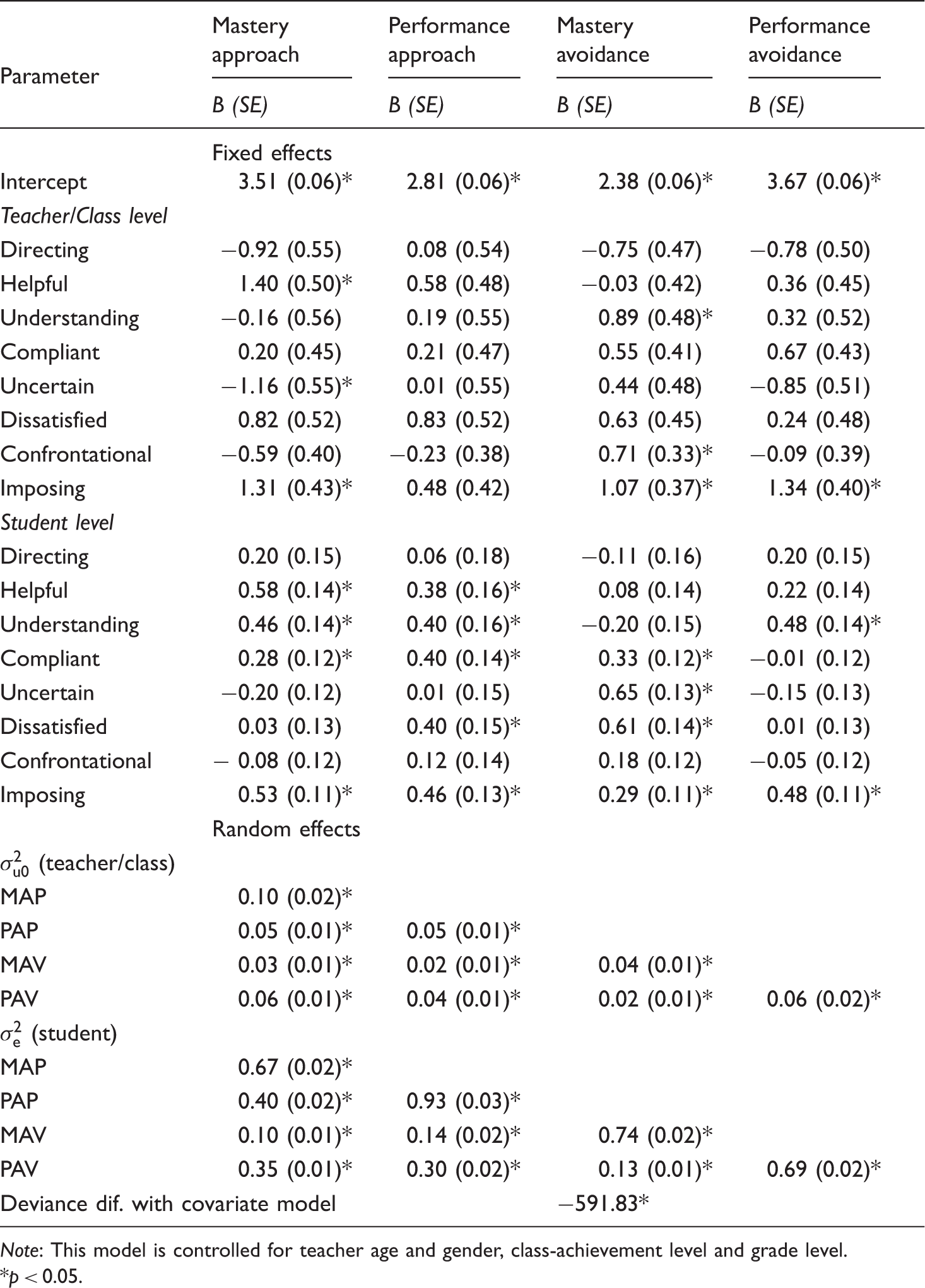
Note: This model is controlled for teacher age and gender, class-achievement level and grade level.
p < 0.05.
Octants reflect especially a teacher’s agency predicted students’ achievement goals at the teacher-class level, thus cancelling out effects of students’ personal perceptions. Being Imposing (octant 8) was a positive predictor for all achievement goals except for PAP; here none of the predictors was significant. An additional predictor for MAP was a teacher's disposition to be Helpful (octant 2). Being generally perceived as Uncertain (octant 5) was negatively associated with MAP. MAV was next to Imposing also positively associated with Confrontational (octant 7) and Helpful. Together, the predictors explained 25% of the variance in MAP because of teacher and class, 31% of the variance because of teacher and class in MAV, 5% of the teacher-class variance in PAP, and 19% of the variance in PAV.
At the student level, the degree to which a student perceived a teacher in class as more or less Imposing (octant 8) than his or her peers perceived the teacher was a significant positive predictor for all four achievement goals. Eight percent of the variance in MAP was explained by students’ idiosyncratic views. Next to perceiving a teacher as Imposing, additional positive predictors were students’ idiosyncratic views of Helpful (octant 2), Understanding (octant 3), and Compliant (octant 4).
In MAV, the interpersonal predictors explained 6% of the variance at the student level. Next to Imposing, perceiving a teacher as relatively more Compliant (octant 4), Uncertain (octant 5), and Dissatisfied (octant 6) was associated with reporting stronger MAV goals.
Only 3% of the variance in students’ PAP goals was explained by students’ idiosyncratic views of a teacher. The small amount of variance that was explained was because of perceiving relatively more warm or communal behaviors (Helping, Understanding, and Compliant) but also due to Dissatisfied and Imposing.
In PAV, finally 4% of the variance at the student level was explained. Next to perceiving a teacher as relatively more Imposing than classroom peers perceived the teacher, perceiving a teacher as Understanding was positively associated with PAV goals.
Thus, in total and considering teacher-class level and student level predictors together, this model explained approximately 10% of students’ MAP goals, 12% of MAV goals, 3% of PAP, and 5% of PAV goals.
To understand the effect a difference in interpersonal teaching styles might have on students’ achievement goals, the regression weights of the multivariate multilevel model were used to compare different types of teacher interpersonal profiles (Brekelmans, 1989, Wubbels at al., 2006). Comparing, for example, a repressive teacher and an uncertain/tolerant teacher yields a large effect on MAV (Δ MAV = 1.11) and a medium-to-large effect on PAV (Δ PAV = 0.68) but no effect on PAP goals and only a small effect on MAP (Δ MAP = 0.32). Whereas repressive teachers score comparatively high on Agency and relatively low on Communion (high scores on octants 1, 6, 7, and 8 and low scores for the other octants), uncertain/tolerant teachers are characterized by low Agency and high Communion (relatively higher than average scores on octants 2, 3, 4 and 5 and low scores for the other octants, compare Figure 1). Thus, although interpersonal variables explained at most 12% of the variance in students’ mastery goals, being taught by teachers with more extreme interpersonal dispositions (approximately 14% of the teachers in Brekelmans’ (1989) sample had either a repressive or uncertain tolerant profile) can make an important difference in students’ mastery goals. According to our model, this indicates that an average student of a teacher who is generally perceived as repressive would report, for example, a MAV score of approximately 1 scale point higher for MAV than a student of an uncertain tolerant teacher.
Discussion and conclusions
The goal of this study was to explore which interpersonal characteristics of teachers render different achievement goals salient to students. Teacher support, which relates to teacher interpersonal communion or warmth, has particularly been studied and shown to be related to students’ goals, specifically to the adoption of mastery approach goals (cf. Turner et al., 2013). Far less attention has been paid to concepts that relate to teacher interpersonal agency or influence in class. Ames (1992) theorized that threatening a student’s sense of control may enhance avoiding goals. By employing interpersonal theory (Horowitz & Strack, 2010), a fine-grained examination of the association between interpersonal teacher characteristics and students’ goals was conducted.
Consistent with earlier research (Urdan & Schoenfelder, 2006), it was observed that differences in achievement goals within classes are larger than differences between classes. Thus, in general, the sphere of influence teachers appear to have on students’ achievement goals is not large. Conversely, of the variance due to the teacher, rather substantial portions of the variance (20% to 30%) in achievement goals (except for PAP goals) were explained by the interpersonal constructs used in this study. Additionally, how students perceived their teacher differently from how their classroom peers perceived the teacher accounted for some of the within-class differences in achievement goals.Twelve percent of the variance in students’ mastery goals could be explained by interpersonal predictors, and there was considerably less variance in performance goals (3% to 5%). However, comparing rather extreme interpersonal teacher profiles (a repressive compared with an uncertain tolerant profile, Brekelmans, 1989; Wubbels et al., 2006) yielded medium-to-large and large effect sizes for avoidance goals, showing the possible effect of the interpersonal characteristics of teaching in specific situations.
The clearest message the findings of the current study convey is that according to students, a generally imposing interpersonal style (i.e. being perceived as a strict or tough teacher), characterized by high levels of agency combined with moderately low communion, adds to all types of achievement goals in terms of both general teacher dispositions and students’ idiosyncratic views. Combining the current findings on teacher effects (teachers’ interpersonal disposition) and students’ personal views, personally liking a generally tough teacher (perceiving a generally imposing teacher as relatively more friendly than one’s classroom peers perceive that teacher) adds the most to mastery approach goals. This finding is consistent with Ames’ (1992) seminal paper in which she theorized that recognition (i.e. communion) and authority (i.e. agency) affect students’ goal orientations. For PAP goals, general interpersonal teacher disposition as such appeared not to be important at all. Below, the findings are discussed in more detail.
Regarding approach goals, dispositional Uncertainty (octant 5, see Figure 1) in teachers (low agency and low communion, see Figure 1) was negatively associated with mastery approach goals whereas being perceived as Helpful (octant 2) was positively associated. In terms of students’ private views of their teacher (the degree the student’s views differed from their peers’ perceptions), associations with MAP and PAP goals were largely comparable. In general, perceiving more agency combined with communion in teachers (octants 2, 3, and 4) was positively associated with approach goals. The most important distinction was that if students perceived a teacher as more dissatisfied than their classroom peers perceived the teacher, these students were also more likely to adopt PAP goals.
Regarding avoidance goals, next to generally being perceived as imposing, being perceived as confrontational and understanding was related to stronger mastery avoidance. Specifically this latter finding is not consistent with the general idea as expressed by Turner et al. (2013) and Ames (1992) that supportive or warm teachers reduce avoidance goals. An explanation for this finding may be that understanding is, after high communion, also characterized by moderately low agency. Indeed, this association was mirrored for performance avoidance at the student level. In addition, other octants characterized by low agency (4 and 5) were positively associated with mastery avoidance. This may be an indication that using the two interpersonal dimensions together may indeed yield more fine-grained information on how interpersonal processes connect to student goals. Focusing on support only, as appears to be the trend in the current literature (cf. Turner et al., 2013), may result in a distorted view of these processes.
Thus, next to teacher communion, which connotes warmth and support, teacher agency is worthwhile to consider when thinking about how teaching is connected to students’ achievement goals. It is not simply perceiving support that connects to a student’s goals; whether the teacher substantiates support with relatively high levels of agency is also important. In general, low agency adds to avoidance goals, and high agency adds to approach goals whereas communion is positively associated with approach goals and negatively associated with avoidance goals. A student perceiving a teacher as warm and agentic is more likely to adopt mastery approach goals, which are often considered to be most adaptive (also see Anderman & Patrick, 2012).
Limitations and future directions
One goal of this study was to identify the association between the interpersonal classroom climate and students’ goals, with the effect of teachers’ general dispositions cancelling out the effect of idiosyncratic student perceptions. However, most likely because of the relatively small number of classes per teacher, variance at the class level was not significant. According to Hox (2010), approximately 25 units per higher order unit are necessary to yield stable estimates. In the actual school environment, such numbers are not possible to realize; however, it may nevertheless be worthwhile to enhance the number of classes in a future sample.
Another limitation of the approach adopted here is that all analyses are based only on student perceptions. However, many studies have advocated that how students perceive what occurs in class may be more informative when studying student outcomes than using more objective measures (Shuell, 1993).
Further, a more person-centered approach, for example, using goal profiles as variables rather than four separate goals, may further clarify associations between students’ goals and interpersonal factors in class.
Implications for practitioners
Despite the fact that students’ achievement goals differ more within than between classes, Urdan and Schoenfelder (2006) urged practitioners not to discard achievement goals as a student individual difference variable because ‘the individual-difference view of motivation takes power away from teachers. When educators believe that motivation lies entirely within individual students, there is no incentive to alter the motivational structure of the school or classroom’ (p. 345). Consistent with earlier studies, we observed that approximately 10% of the variance in achievement goals, with up to 18% of MAP goals, resided at the teacher/class level. These percentages reflect the sphere of influence a teacher generally has regarding his or her students. Except for PAP goals, teachers’ interpersonal dispositions roughly explain one-fourth of that variance. Thus, as a teacher or teacher coach, it is worthwhile considering how students perceive teachers interpersonally in class. The effects of such dispositions become clear particularly when considering more specific or interpersonally ‘extreme’ teacher dispositions as opposed to the average influence of interpersonal variables on students’ goals. As the example for repressive compared with uncertain, tolerant teachers (Brekelmans, 1989; Wubbels et al., 2006) that was provided in the results section shows, the effect of how a teacher is perceived can be substantial on some students’ achievement goals, particularly for their mastery approach and avoidance goals. Thus, it appears worthwhile to identify teachers who generally convey low levels of interpersonal agency and/or communion in and to consider their teaching practices in light of students’ goals. Also identifying students who have more pronounced, negative perceptions of their teachers compared with their classroom peers may be worthwhile. Finding ways to alter these perceptions may be one of the avenues to positively affect students’ achievement goals.