



Abstract
The goal of the study was to examine the joint and distinct contribution of attachment security and social anxiety to Arab children’s peer competence in middle childhood. We focused on Arab children as very little research has examined close relationships for this group. A sample of 404 third-, fourth- and fifth-grade Arabic students (203 boys and 201 girls), mostly from lower middle-class neighborhoods in northern Israel, participated in the study. In a cross-sectional design, bivariate correlations and regression analyses were performed, and findings revealed that attachment security was negatively related to distancing strategies in help-seeking and help-giving contexts, whereas social anxiety was positively related to these strategies. Secure attachment was also associated with providing reassurance to friends, and with peer competence as perceived by teachers. The possible implications of the socio-cultural context, suggestions for future studies, and implications for school intervention are discussed.
In middle childhood, the peer group is especially important and children spend substantial time with their peers. Children rely less on their attachment figures and turn more to others outside their family, though parents’ availability remains essential (Kerns, Tomich, & Kim, 2006). The importance of peer relationships is also underscored by evidence, from Western samples, that peer relationships are related to child adjustment. For example, frequent difficulties with friendships are associated with problem behaviors and maladjustment (Morrison, You, Sharkey, Felix, & Griffiths, 2013), whereas having close mutual friendships buffers psychosocial maladjustment (Erath, Flanagan, Bierman, & Tu, 2010). Friendship and peer competence also predict children’s school adjustment (Ryan & Ladd, 2012). Thus, an important topic of research is identifying factors that are related to children’s peer competence, and to examine these risks factors in different cultural contexts. In this study, we examined two risk factors for peer problems in Western countries—insecure mother-child attachment and social anxiety—to examine their relevance for peer competence for Arab children.
Past research has indicated that attachment security assessed in infancy, preschool, or middle childhood is associated with greater peer competence, friendship quality, and popularity with peers (Groh et al., 2014; Pallini, Baiocco, Schneider, Madigan, & Atkinson, 2014). In contrast, socially anxious children experience difficulties in their peer relationships, such as low popularity (Kingery, Erdley, Marshall, Whitaker, & Reuter, 2010). Thus, both parent-child attachment and social anxiety may be important predictors of children’s friendships and peer competence, although to date they have been examined individually. However, the two risk factors are not independent, in that securely attached children are less likely to experience internalizing symptoms, including anxiety (Brumariu & Kerns, 2010; Colonnesi et al., 2011; Groh et al., 2012). The goal of the current study is to test whether attachment security and social anxiety, when examined jointly, are each uniquely related to Arab children’s peer relationships. The present study is one of the first to examine attachment security, social anxiety, and peer competence in a non-Western sample, and thus provides an opportunity to examine if earlier findings generalize to other cultural contexts.
Another importance of the current study relates to children’s social background. Children from lower SES backgrounds are more vulnerable than children from more advantaged backgrounds to develop insecure attachments (Cyr, Euser, Bakermans-Kranenburg, & van IJzendoorn, 2010; Raikes & Thompson, 2005), emotional and behavioral problems, and low academic achievement (McLoyd, 1998). They are often exposed to multiple stressors that might challenge their families and their own coping resources. The current study focuses on children from lower SES backgrounds that might be at increased risk for developing insecure attachment, social anxiety, and lower acceptance by school peers.
Attachment, social anxiety, and peer competence
Internal working models of parent-child attachment relationships serve as templates for the child’s subsequent relationships, including those with peers. Secure attachment promotes children’s social adaptation via children’s expectations about how others might respond to their social initiations, greater exploration of peer relationships (Kerns & Brumairu, 2016), enhanced social skills (Boling, Barry, Kotchick, & Lowry, 2011; Scharf, 2014), and better emotional regulation capacities, which are especially important for peer relationships in middle childhood (Contreras et al., 2000). Consistent with theory, secure attachment has been consistently linked to higher quality of peer relationships (Kerns & Brumairu, 2016; Groh et al., 2014; Pallini et al., 2014), although these links have been studied almost exclusively in Western samples (Pallini et al, 2014).
Similarly, social anxiety is associated with peer relationships. Children with social anxiety symptoms fail to develop age-appropriate social skills, experience low levels of peer acceptance (La Greca & Stone, 1993), and low levels of intimacy and support in friendships (Beidel & Turner, 2007; Brumariu & Kerns, 2010; Erath et al., 2010; La Greca & Lopez, 1998), and elevated loneliness (Beidel & Turner, 2007). Their loneliness and lower quality peer relationships may result from negative expectations, avoidance and low initiation in peer contexts (Rubin & Burgess, 2001), and the experience of peer rejection reinforces their avoidance and continuing difficulties. Socially anxious youth are often targets of peer harassment (Erath et al., 2007), and their exposure to victimization intensifies their social fears (Storch, Masia-Warner, Crisp, & Klein, 2005). Without an effective intervention, social anxiety disorder is likely to follow a chronic path (Ollendick, 2012). Since achieving peer popularity is more difficult for these children (Schneider & Tessier, 2007), close friendship might be a relatively less challenging arena, and may also facilitate peer acceptance (Schneider & Tessier, 2007). Although social anxiety may be viewed as a risk factor for poor quality peer relationships in Western societies (Kingery et al., 2010; Tillfors, Persson, Willén, & Burk, 2012), there is a need to study whether social anxiety is invariably linked to peer difficulties in other cultural contexts.
Relationship influences: The cultural context
Interpersonal relationships reflect the cultural context in which they are embedded. In collectivist societies individuals perceive themselves as being part of a collective and emphasize their connectedness to other members of society. These cultures emphasize emotional interdependence, group solidarity and sharing, and the need for stable and predetermined relationships (Triandis, 2001). In Arab society, the centrality of the family is emphasized, and members of the extended family maintain extensive close relationships through mutual commitment to one another (Dwairy, Achoui, Abouserie, & Farah, 2006). In a rare study conducted with Arab mother-child dyads in Indonesia (Zevalkink, Riksen-Walraven, & Van Lieshout, 1999), the distribution of secure attachment patterns of Indonesian children (assessed with the Strange Situation), was similar to the distribution reported in meta-analyses (van IJzendoorn & Bakermans-Kranenburg, 1996). Within the insecure group, there was an over-representation of ambivalent children, similarly to the distribution in Japanese samples.
Social anxiety is characterized by excessive distress in social situations because of intense fears of negative evaluation (Beidel & Turner, 2007; Erath et al., 2010). Nevertheless, the evaluation of one’s functioning is bound to the social standards of the culture in which individuals are embedded (Hofmann, Asnaani, & Hinton 2010). For example, shy and unsociable individuals in Korea showed better social and emotional adjustment than their counterparts in Australia (Kim, Rapee, Oh, & Moon, 2008). In another study, (Heinrichs, Rapee, & Alden, 2006), individuals in collectivistic countries reported more positive attitudes toward socially avoidant behaviors than individuals in individualistic countries; nonetheless, individuals in collectivistic countries also reported greater levels of social anxiety than in individualistic countries. Although initially it was found that shy, anxious children in China were not less popular with peers and were in some ways seen as more socially competent (Chen, Rubin, Li, & Li, 1999), more recent studies have found that shy, anxious children in urban China are less accepted by their peers (Liu, Chen, Coplan, Ding, Zarbatany, & Ellis, 2015). Liu et al. (2015) suggested that, given changes of increased urbanization and industrialization that is occurring in many countries, socially anxious behaviors may be viewed more negatively than in the past, and thus associated with lower quality peer relationships in diverse cultures. The mixed findings point to the need to study, in different cultural contexts (including countries outside East Asia), how social anxiety is related to peer relationships.
Attachment and social anxiety
Attachment and anxiety are interrelated rather than independent, as insecure attachment is a risk factor for the development of childhood anxiety disorders, including social anxiety (Colonnesi et al., 2011; Ollendick & Benoit, 2012). Over time, repeated experiences with attachment figures can lead to chronic anxiety if children perceive that their attachment figures are not consistently available, protective, and comforting. These negative expectations in turn may lead to elevated avoidance behaviors or elevated contact demanding behaviors in interpersonal contexts, that in turn might elicit negative responses from others, and exacerbate this awkward cycle (Ollendick & Benoit, 2012). Thus, insecure attachment influences, promotes, and reinforces the development and maintenance of anxiety in children over time, and can have lasting adverse effects on child adjustment (Lewis-Morrarty et al., 2015). Insecurely attached children were more likely than secure children to have anxiety disorders in general and social anxiety in particular, especially if they were also behaviorally inhibited (Ollendick & Benoit, 2012), whereas securely attached children are less at risk for internalizing symptoms (Brumariu & Kerns, 2010; Colonnesi et al., 2011; Groh et al., 2012; Madigan, Atkinson, Laurin, & Benoit, 2013).
Given that insecure attachment and social anxiety are related to one another, it is important to determine whether the two independently relate to peer competence (i.e., are separate and unique rather than redundant risk factors). Further, they may interact in predicting peer competence, such that insecure attachment might exacerbate or mitigate the influence of social anxiety symptoms.
Friendship skills in children
Although there is an extensive literature on peer relationships, there is relatively sparse research on the competencies children need to be successful in friendships, which are distinct from the skills they need to be well liked by peers (Rose & Asher, 1999; Scharf, 2014). The ability to turn to their friends in times of stress and need, and the willingness to provide support to their friends, are important competencies. Rose and Asher (2004) found that US children who distanced from their friends when experiencing stress had fewer best friends than others. Notably, children’s helping strategies were related to quality of friendship only within the context of providing help to a friend, and not in the context of help-seeking, and their endorsed strategies (especially the negative strategies) predicted changes in friendship adjustment (Glick & Rose, 2011).
Attachment and social anxiety have been linked to friendship quality and peer competence, although few studies with children have examined how these constructs are related to specific friendship skills. Securely attached children, who experience empathic care and learn to understand and recognize feelings in themselves and others, may carry over this behavioral style to other close relationships (Kerns & Brumariu, 2016). Consistent with this hypothesis, secure attachment orientation was positively associated with prosocial friendship competencies and negatively associated with disengaging strategies, whereas ambivalent attachment was related to disengaging strategies, in the context of seeking and giving help in a sample of Jewish Israeli children (Scharf, 2014). Social anxiety is also related to friendship skills. In a longitudinal study of children aged 8- to 11-years-old from the UK, socially anxious children sought more social support from others in stressful peer interactions (Wright et al., 2010). In addition, their use of distraction increased across time when peer rejection was low, but was hindered when they were exposed to chronic peer problems.
The aim of the current study is to extend our knowledge about the contribution of attachment security and social anxiety to Arab’s children peer competence. Specifically, we test how attachment and social anxiety are related to support seeking and support giving in friendship, and to teacher reports of peer competence and victimization at school. We examine these questions in later middle childhood, when friendships and acceptance by peers are highly salient social concerns. Studies linking attachment and social anxiety with peer relationships have almost exclusively included Western samples, and we thus extended earlier work by examining how these constructs are related in an Arab sample to see if prior findings replicate in a more collectivist culture. We expect that attachment will be more strongly related to support seeking and giving behaviors that promote closeness within friendship, whereas social anxiety will be more strongly related to avoidance and distraction behaviors. We also hypothesized that higher levels of attachment security and lower level of social anxiety would be associated with greater peer competence and lower levels of victimization, as perceived by children’s teachers.
Method
Participants
Participants were 404 third (n = 165), fourth (n = 123) and fifth grade (n = 116) Arabic students (203 boys and 201 girls) from 17 classes in three public schools in northern Israel. The communities in those villages include 54% Muslims, 16% Christians, and 30% Druze. All the third, fourth and fifth grade classes in these schools were sampled, because we aimed to examine elementary school children and recruit a relatively large sample. Although we did not ask children to report family income, the students at these schools were mostly from lower middle class neighborhoods, similar to other villages in that surrounding area. After receiving permission from the Ministry of Education, we sent consent letters to each parent two weeks before we visited schools, asking if the parent wished to opt out of the study. There were no parental refusals. Before data collection commenced, children’s assent was obtained and all the students that were present in the class participated in the study.
Procedure
Questionnaires were administered at school in two 50-minute sessions (two weeks apart). Research assistants introduced the project and demonstrated how to complete questionnaires. Children were assured of the confidentiality of their responses. At the first session children filled out questionnaires on seeking and giving social support within friendship (404 children). At the second session, rehearsals for the year-end party and children’s illnesses allowed us to collect questionnaires from only 318 children, who completed the questionnaires on attachment and social anxiety. No differences were found between children who participated both times and those who participated at the first session on the measures gathered at the first session. Additionally, ten homeroom teachers reported on children’s peer competence and victimization (n = 187 children).
Two graduate students independently translated the questionnaires from English to Arabic. Then, we compared the two versions to identify discrepancies or other problems and to reach consensus. We consulted a third bilingual person to develop one version. Finally, another person back translated the questionnaire into English. We compared it to the original version and consulted with the third person in cases where rewording was needed.
Measures
The Security Scale (Kerns et al., 2001)
The Security Scale is a 15-item questionnaire assessing children’s perceptions of mother-child attachment. Each item is represented by two different descriptions, and children are asked which child is more similar to them, and whether it was ‘really true’ or ‘sort of true’ for them. Each item is measured on a four-point scale, and higher scores reflect greater security (e.g., ‘Some kids do not really like telling their mom what they are thinking or feeling but other kids do like telling their mom what they are thinking or feeling’; alpha was 0.70). The measure was found reliable and valid in earlier studies in Western samples (see Kerns, Brumariu, & Seibert, 2011, for a summary).
Social Anxiety Scale for Children -SASC-R (La Greca & Stone, 1993)
Children are asked how much they feel each of the statements is true for them on a Likert scale from 1 (not at all) to 5 (all the time). The measure includes three subscales: Fear of Negative Evaluation—FNE (six items, e.g., ‘I worry about what other kids say about me’); Social Avoidance and Distress—New Peers/Situations —SAD New (eight items, e.g., ‘I feel shy around kids I don’t know’); Social Avoidance and Distress General— SAD General (three items, e.g., ‘It’s hard for me to ask others to do things with me’). We used the total score, averaging the three subscales (alpha = 0.79). The measure was previously found to be reliable and valid (see also La Greca 1998, for more details).
Friendship competencies: Children’s strategies in response to seeking and giving help within a friendship (Rose & Asher, 2004)
Children are presented with 12 hypothetical situations, and asked to rate what they would do in the situation. Six represent contexts in which a child personally encounters a challenge with peers, and six represent contexts where a child’s friend encounters a peer challenge. For example, a help seeking scenario was: ‘One day, right before recess, your class is supposed to be doing work at their desks, and some children in your class start teasing you by knocking your papers off your desk’. A context in which children could give help is the following: ‘One day your best friend has to make a presentation in front of the class, and when he gets up in front of the class he seems to forget what he was going to say and he does very poorly at making the presentation. All during his presentation you see a couple of children whispering and laughing at him. You see him looking at the children who are whispering and laughing at him. When he goes back to his seat after the presentation, they keep laughing and talking and start pointing at him’.
The measure assesses six help-seeking support strategies, and nine help-giving strategies, and children rated how likely they would be to adopt each strategy on a five-point Likert scale. To reduce the number of variables, we aggregated scales with r > 0.40. After aggregation, help-seeking included four scales: Self-disclosure/advice seeking (combined two scales), distraction seeking, behavioral denial, and excluding friend (solitude and refusal subscales combined; for more details see also Glick & Rose, 2011; Rose & Asher, 2004). The inter-relations among scales ranged from 0.01 to 0.25, and alphas are 0.76, 0.77, 0.69, 0.82 respectively. After aggregation, help-giving included eight scales: Initiating discussion, sympathizing, reassuring, advice giving, offering distraction, behavioral denial, dismissing, keeping away (blame and avoidance subscales combined). The inter-relations among scales ranged from 0.02 to 0.35, and alphas are 0.65, 0.75, 0.65, 0.65, 0.77, 0.66, 0.63, 0.79 respectively. The reliabilities of a few scales are relatively low, and might result from the young ages of the participants, and/or reflect that those behaviors are less prevalent at these relatively young ages, and/or are less customary in this culture.
Teacher reports of peer competence
A subset of the children (n = 187) had data on peer relationships provided by classroom teachers. Teachers completed the peer competence subscale from the Teacher –Child Rating Scale (T-CRS) (Hightower et al., 1986) (e.g., ‘popular by class’ peers’, alpha = 0.84). They also rated to what extent the child is exposed to victimization (three items, e.g., ‘gets teased, called names, or made fun of by other kids’, alpha = 0.84; adapted from Ladd & Kochenderfer-Ladd, 2002). No differences were found between participants with teachers’ reports and participants without teachers’ reports on social anxiety levels or on attachment scores.
Results
We first examined the associations of attachment security or social anxiety individually with our measure of peer competence. Because preliminary analyses showed some gender and grade differences for our main constructs, we performed partial Pearson correlations, controlling for gender and grade. Second, we performed regressions to examine the unique and interactive contributions of attachment and social anxiety to children's peer competence (friendship competencies, peer competence, and victimization).
Mother-child attachment and social anxiety: Associations with help-seeking and help-giving strategies within friendship and peer competence
The associations between attachment, social anxiety, seeking and giving support within friendship and class adjustment (controlling for gender and class).

p < 0.05; ***p < 0.001.
As demonstrated in Table 1, more securely attached children reported they would be less likely to exclude a friend when they experienced stress. Regarding help-giving, they were more likely to offer reassurance and less likely to keep away from a friend who experienced stress.
As expected, social anxiety was associated with distancing strategies, in that more socially anxious children reported they would engage in exclusion of their friend and distraction seeking after they experienced a stressful situation. They also reported they would keep away or engage in denial if their friend experienced a stressor.
Finally, teachers perceived students with higher levels of attachment security as more socially competent, although more socially anxious children were not rated as less competent by teachers. Surprisingly, neither attachment nor social anxiety was related to teacher reports of peer victimization.
Mother-child attachment and social anxiety: Unique and interactive associations with friendship and peer competence
To explore the joint and unique association of mother-child attachment and social anxiety with peer competence, hierarchical regression analyses were conducted. All predictors were centered. In the first step gender (boys = 0; girls = 1) and grade were entered; in the second step attachment security and social anxiety were entered; In the third step the interaction between attachment and social anxiety was entered; and in the fourth step the interactions between gender and attachment and gender and social anxiety were entered.
Prediction of help-seeking strategies in friendship
Regression analyses: The contribution of attachment, social anxiety, gender, and grade to children’s strategies in seeking support from a friend.

p < 0.05; **p < 0.01; ***p < 0.001.
The model for excluding a friend following a peer stressor also was significant, predicting 18% of the variance. Attachment security, social anxiety, and the interaction between gender and social anxiety all uniquely predicted excluding a friend (see Table 2). The relations between social anxiety and excluding a friend is stronger among boys than among girls (r = 0.45 versus 0.21, Z = 2.69, < 0.01). Finally, the model for distraction seeking was significant, explaining 5% of the variance, with social anxiety a unique predictor. More socially anxious children reported greater use of distraction following a peer stressor.
Prediction of help-giving strategies and peer competence
Regression analyses: The contribution of attachment, social anxiety, gender, and grade to children’s strategies in giving support to a friend and peer competence.
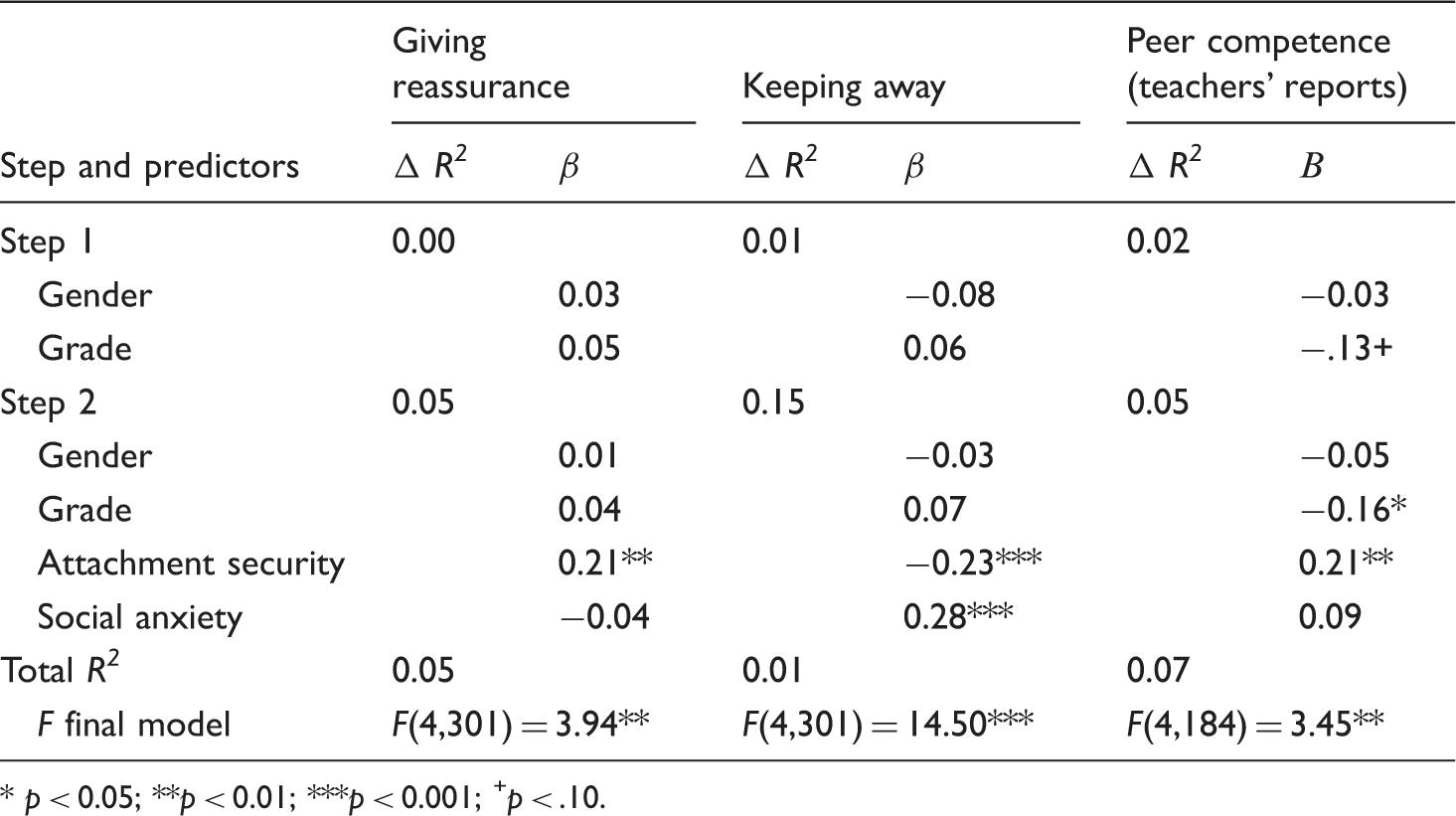
p < 0.05; **p < 0.01; ***p < 0.001; +p < .10.
In predicting teacher reports of peer competence and victimization, the model predicting peer competence was significant, explaining 7% of the variance, but the model predicting children’s victimization was not. Grade and attachment security predicted social competence, indicating that more securely attached children and younger children were rated by teachers as more competent with peers.
Discussion
The goal of the study was to examine the joint and distinct contribution of attachment security and social anxiety to Arab children’s peer relationships. Although more insecurely attached children were more prone to report greater social anxiety, we nevertheless found that both attachment and social anxiety uniquely predicted children’s social support strategies in friendship, and that for the most part the effects were additive rather than interactive. As expected, attachment security was negatively related to distancing strategies in help-seeking and help-giving contexts, whereas social anxiety was positively related to these strategies. Secure attachment was also associated with providing reassurance to friends, and with peer competence (as perceived by teachers). These effects were modest in magnitude, which is not surprising given the large number of factors that influence peer competence. It appears that children adopt approach or avoidance tendencies, and although there is a complex interplay between genes and environments, experiences with others (including parents) may play an initial formative role in the development of these tendencies (Dix & Buck, 2012). Children’s experiences with peers might further contribute to the perpetuation of these characteristics.
Secure attachment has been consistently associated with greater peer competence in Western samples (Groh et al., 2014; Pallini et al., 2014). Our findings suggest that these associations are also found in more collectivist cultures. Most work on attachment and friendship has focused on broad measures of friendship quality rather than specific friendship skills, and thus has not evaluated the mechanisms that may explain associations between attachment and peer relationships. The present findings suggest that securely attached children may internalize patterns of giving and receiving care from their relationships with parents, and show compassionate and socially oriented behaviors to friends, which may also lead them to be viewed as more socially competent by teachers.
Social anxiety was most strongly related to distancing strategies such as excluding a friend when seeking support, using distraction, and avoiding or denying the needs of a friend who needs support. Socially anxious children may experience highly arousing and negative emotions when they or their friends experience peer difficulties, and may subsequently engage in avoidance as way of managing their emotions. Some relations were stronger among boys. Boys are generally encouraged to act independently (Fiese & Skillman, 2000). Their socialization toward more agency and autonomy might contribute to the stronger tendency of boys with higher levels of social anxiety to exclude friends. We also found that highly anxious children who are also low in attachment security report the lowest levels of seeking advice and disclosure. It appears that the most vulnerable children, who probably need support, are least likely to seek advice and support, probably because of their unsuccessful past experiences and worries that their support seeking will be rejected.
Some friendship competencies were not related to attachment or social anxiety, and such strategies (e.g., discussing problems, sympathy) may be less prevalent at the relatively young ages of the children in the current sample, and therefore are not differentially related to children’s competencies. Alternatively, some of these strategies may be maladaptive, as high levels may indicate that children are ruminating with friends (Rose, Schwartz-Mette, Glick, Smith, & Luebbe, 2014). Further, in general, Arabs tend to turn for support to persons within their extended family (Dwairy et al., 2006; Scharf & Hertz-Lazarowitz, 2003), and it may be that attachment and social anxiety are more highly related to help giving and seeking within family relationships than within peer relationships. This should be examined in future studies.
It is interesting that attachment, but not social anxiety, was related to children’s peer competence at school, as rated by teachers. The finding that secure attachment was related to peer competence in an Arab sample replicates findings found in Western cultures (Groh et al, 2014; Pallini et al, 2014), and suggests that a secure parent-child attachment may be universally linked with higher quality peer relationships. Interestingly, although social anxiety predicted the use of distancing strategies with friends in support seeking and support giving contexts, it did not predict peer competence. This suggests the possibility that socially anxious behaviors may not be viewed so negatively by Arab peers, which is consistent with the proposal that socially anxious behaviors may be viewed less negatively within collectivist cultures (Heinrichs et al., 2006). Neither attachment nor social anxiety predicted peer victimization. Although this may indicate that other factors explain peer victimization in Arab children, it is also possible that teachers might not discern more subtle behaviors, or that in collectivistic culture children refrain from bullying other children in the presence of adult authorities. This hypothesis should be examined in future studies.
Limitations and Implications
The current study is cross-sectional, and although we hypothesized that attachment and social anxiety would influence peer relationships, conclusions about causality and direction of associations are precluded. The predicted variances are modest, consistent with the idea that other variables, such as children’s temperament, are associated with peer relationships.
We used self-report measures for some constructs, which are open to various biases. Nonetheless, children are a major and important source regarding their friendships, and self-reports are warranted because of the internal nature of anxiety. Although we included teachers’ reports, the use of other perspectives such as children’s friends and parents, and other measures (e.g., observations of behaviors within friendships), might enrich our understanding. Further, the reliabilities of a few of the scales assessing help-giving are relatively low, and future studies might explore whether it relates to the younger ages of the children, and/or to characteristic of giving help in the Arab cultural context, where support might be generally enacted by adults or family relatives rather than peers.
This study is one of the few to examine social anxiety and close relationships in Arab children. The study could be extended by studying other school adjustment outcomes such as task persistence or cooperation, variations in Arab families (e.g., extended versus nuclear families; Seven & Ogelman, 2012), and attachment to other caregivers (e.g., fathers). Further, given recent changes (e.g., greater exposure to Western values), it is important to study the potential compensatory role of peers in diverse cultural contexts. We did not directly assess the cultural values of the children, and therefore the current data do not allow us to fully examine cultural influences. In future studies it will be important to directly examine (rather than infer) the cultural orientations of the participants.
The study has practical implications for school psychologists and for educational counselors. First, it suggests that Arab children who are socially anxious may have difficulties developing supportive friendships, which could in turn impact their long term school adjustment. It may be helpful to screen school children to identify students who are experiencing anxiety as these students may be left unnoticed because of the non-disruptive nature of their problems. Second, the findings have implications for what skills to include in broad school based interventions. Without an effective intervention it is likely that at-risk children might develop chronic problems with peers that might be less malleable in the long run and that might impact their ability to learn at school. School interventions should consider including friendship-oriented strategies that could facilitate children’s friendships, and thereby potentially buffer the harmful effects of insecure attachment and social anxiety symptoms. For example, this study suggests school psychologists could teach children to use more effective social support strategies such as turning to others or reassuring their friends rather than turning away from others. Incorporating these skills as a focus in school-wide prevention programs might help to establish a more supportive culture in a school. Moreover, intervention programs are especially needed among children from lower SES families to counteract the more stressful family and school contexts they might be exposed to.
Footnotes
Declaration of Conflicting Interests
The author(s) declared no potential conflicts of interest with respect to the research, authorship, and/or publication of this article.
Funding
The author(s) received no financial support for the research, authorship, and/or publication of this article.