




Abstract
Based on Hirschi’s social control theory (1969), this study examined the relationship between attachment (an element of social bonds) and the onset of substance use among South Korean adolescents. Using discrete-time logistic regression, the study investigated how attachment to parents, teachers, and close friends was associated with the timing of first alcohol and cigarette use. A nationally representative sample of Korean youth from five waves of the Korea Youth Panel Survey (N = 3,449 at baseline) was studied. Higher levels of parent and teacher attachment were associated with delayed onset of alcohol consumption and cigarette smoking. Attachment to close friends, however, was associated with earlier onset of substance use. These findings suggest that strategies for early substance use prevention should specifically target the relationships that youth develop with parents and teachers. Furthermore, the results highlight the importance of managing youth’s relationships with close friends to prevent the inadvertent negative social influence of particular types of peers.
Keywords
Adolescent substance use is increasing worldwide; however, most studies have investigated the prevalence of substance use, rather than its initiation, when examining correlates of substance use among adolescents. Prevalence indicates how many adolescents engage in substance use during a particular point in time, whereas initiation measures the first incidence of substance use. Both measures explain patterns of substance use and its correlates, but they often yield different results. According to one national study on Korean adolescents’ substance use behaviors, although initiation of drinking and smoking is most common during the second year in middle school, prevalence peaks during high school years (Ministry of Gender Equality and Family, 2012).
Few studies have examined the initiation of substance use and its correlation with various risk behaviors. Earlier onset of substance use has been shown to relate to an increased risk of various substance use disorders (Behrendt, Wittchen, Höfler, Lieb, & Beesdo, 2009; Chen, O’Brien, & Anthony, 2005; DeWit, Adlaf, Offord, & Ogborne, 2000), depressive symptoms, and suicidal ideas and attempts (Cho, Hallfors, & Iritani, 2007; Swahn & Bossarte, 2007) among North American and European youth. Consequently, delaying the onset of substance use may be an important prevention and intervention approach for alleviating substance-related disorders and other problem behaviors (Chen et al., 2005; DeWit et al., 2000).
Very few studies (Han & Grogan-Kaylor, 2015; Han, Kim, & Ma, 2015; Lo & Cheng, 2010) have investigated the correlates of substance initiation in non-Western contexts. This paper gives particular attention to South Korea, a country with one of the highest smoking rates among male adults (OECD, 2014), many of whom start developing substance use habits in adolescence (Kim & Jeong, 2010). Although legislative action has been taken to protect youth from underage drinking and smoking through Korea’s Juvenile Protection Act of 1997, most public efforts have focused on penalizing providers of substances (e.g., bars and liquor stores), rather than identifying protective resources available to adolescents. Though current legislative measures are important, taken alone, they are seemingly ineffective in delaying the onset of alcohol consumption and cigarette smoking among Korean youth. For example, the Korea Youth Risk Behavior Web-based Survey (2014), a nationally representative study of Korean youth, showed that average ages of first alcohol and cigarette use were 12.9 years and 12.6 years, respectively, and have been stable for the past ten years. Also, the proportion of youth who started using alcohol and cigarettes prior to age 14 was 19.4% and 4.8%, respectively.
As these statistics show, legislative efforts alone cannot fully eliminate substance use (Han & Grogan-Kaylor, 2015); therefore, we should more closely examine youth relationships with parents, teachers, and peers, as protective factors against adolescent substance use. These are the people to whom youth are attached, and who play important roles in shaping adolescents’ lives. Given the substance use landscape in Korea, and the importance of examining correlates of substance use initiation in adolescence, this study investigated the role of attachment with parents, teachers, and peers. As implied by the ecological systems framework (Bronfenbrenner, 1986), these three domains are critical in the development of adolescent behavior, and may thus provide important implications for the clarification of patterns of first-time alcohol and cigarette use among Korean youth. Additionally, based on Hirschi’s (1969) social control theoretical perspective, the present study specifically focused on the role of the attachment—a crucial element of social bonds—that youth develop towards parents, teachers, and peers.
Attachment and social control theory
In the field of development, attachment is a well-known concept that is often used to describe the bond between infants and mothers (Bowlby, 1969). However, it can be widely applied to clarify how various relationships influence human behavior throughout a person’s lifespan (Buist, Dekovic, Meeus, & van Aken, 2004). The positive influence of affectional bonds may be particularly salient in adolescence, which is a period of dynamic biological, emotional, cognitive, and social transition, that can be accompanied by confusion, uncertainty, and distress (Buist et al., 2004; Laible, Carlo, & Raffaelli, 2000; Moretti & Peled, 2004). Adolescents’ attachment may be represented by the degree to which they like, respect, feel close to, or get along with the important people in their lives (Thaxton & Agnew, 2004).
Not only has attachment long been a major research topic in developmental theory, it has also been adopted in sociological and criminology theories. Hirschi (1969), in his seminal work on the social control theory, highlighted the instrumental role of attachment with others––such as parents, teachers, and peers––in youth risk behaviors. Attachment is one of the four elements (along with commitment, involvement, and belief) that comprise an individual’s bonds with society and determine youth’s decision not to participate in risk behaviors. Attachment may be the most central of social bonds, as it is indispensably linked with the remaining three types of bond elements. Hirschi (1969) specifically focuses on the interdependency between attachment and commitment, and attachment and belief: Strong attachment to conventional others may directly influence youth’s commitment to achieving prosocial goals, such as higher education aspirations, and also may elicit respect for the values and norms accepted by those conventional others.
Hirschi (1969) claimed that attachment to conventional others, particularly to parents and teachers, is a crucial element in the restriction of delinquent behaviors among youth. In other words, the degree and quality of the bonds that youth maintain with members of conventional society may influence their decision to conform to or deviate from society’s norms and values. Conventional bonds that youth establish with society increase the costs of engaging in risk behavior, which consequently restricts individual inclinations toward delinquent actions (Hirschi, 1969). In terms of practical implications, this social bond is of particular interest as a protective factor against youth risk behaviors because various youth development programs utilize relational resources (Huebner & Betts, 2002). Youth who develop strong affectionate and emotional connections with significant adults in their lives may refrain from delinquent behavior to avoid jeopardizing these positive relationships. When such bonds are weak, however, youth may decide to participate in high-risk activities. Numerous empirical studies have confirmed that, in diverse contexts, youth who have strong affectionate bonds with significant individuals in their lives tend to have fewer substance use behaviors (Barnes, Reifman, Farrell, & Dintcheff, 2000; Choi, He, & Harachi, 2008; Chui & Chan, 2012; Han et al., 2015; Hwang & Akers, 2003).
What is lacking in literature is a comprehensive single investigation of how attachment with multiple important figures—parents, teachers, and peers, collectively—is linked with youth substance use patterns, especially because parents no longer become the sole agent of socialization for adolescents during this unique developmental period. The importance of simultaneous accountability to various sources of attachment figures stems from the idea that one form of attachment may be related to another (Hirschi, 1969). It is possible that attachment to peers, for example, is conditional on the degree to which youth are attached to their parents. Similarly, the level of attachment with adults outside the family, such as teachers, may differ from that within the family. Most previous research has examined attachment in a single domain, such as parents only (e.g., Chui & Chan, 2012) or teachers only (e.g., Han et al., 2015), or at most two areas (e.g., Laible et al., 2000), rather than considering multiple types of attachment figures in a single study.
Attachment to parents, teachers, and peers
One of the most important types of attachment involves the relationships between youth and parents. Despite the growing influence of relationships outside the family during adolescence, the quality of parent-youth interactions continues to be important (Galambos, Barker, & Almeida, 2003; Moretti & Peled, 2004). As one of the most frequently examined types of attachment (Chui & Chan, 2012), youth’s attachment to parents is considered a paramount factor for successful development in numerous areas of adolescent functioning, including drinking and smoking in various global contexts. Some areas influenced by parent-youth relationships include delinquent and aggressive behavior (Buist et al., 2004), anxiety and depression (Brumariu & Kerns, 2010; Buist et al., 2004), school adjustment (Kim & Page, 2013), and mental health problems (Moretti & Peled, 2004). Furthermore, Scragg and his colleagues (2008) found an inverse relationship between parental attachment and adolescent smoking habits in a study of students aged 14 to 15 years in New Zealand. They found that adolescents who reported lower parental attachment were more likely to show an increased risk of smoking (Scragg, Reeder, Wong, Glover, & Nosa, 2008).
As youth transition from childhood to adolescence, they seek supportive relationships outside the family. During this period, school emerges as a critical ecological environment, as youth spend a greater proportion of their daily time at school (Crosnoe & Johnson, 2011) and develop close ties and bonds with teachers (Wang & Eccles, 2012). Such affectional ties with teachers may encourage youth to refrain from engaging in risk behaviors. In support of this idea, numerous studies have reported that positive interpersonal relationships with teachers serve as a protective factor against youth social and psychological maladjustment, as well as substance use behaviors (Demanet & Van Houtte, 2012; Murray & Greenberg, 2000; Wang, Brinkworth, & Eccles, 2013). For example, Perra, Fletcher, Bonell, Higgins, and McCrystal (2012) found that adolescents with positive relationships with teachers had a 48%, 25%, and 52% decreased risk of daily smoking, weekly drunkenness, and weekly cannabis use, respectively.
Despite considerable research on parent or teacher attachment, relatively scant research has examined the role of peer attachment (Demanet & Van Houtte, 2012; Huebner & Betts, 2002; Laible et al., 2000). Hirschi (1969) specifically pointed to parents and teachers as conventional figures that inhibit youth’s engagement in risk behaviors, but found mixed evidence of the role played by strong bonds with close friends in the prediction of youth risk behaviors. There is little consensus regarding whether strong bonds with conventional adult figures, such as parents or teachers, work similarly to the bonds established in peer relationships. Close friend attachment, like parental attachment, may be associated with improved adolescent adjustment, since supportive relationships with peers is another critical domain that helps youth successfully navigate adolescence (Laible et al., 2000). However, since youth substance use is strongly contingent upon the type of peers to whom youth are attached, it is equally possible for an inverse relationship to exist between strong peer bonds and youth substance use behaviors (Demanet & Van Houtte, 2012). In other words, forming strong ties with substance-using peers may endorse the use of substances, whereas having close friends who disapprove of substance use may deter youth from this risk behavior.
Current study
Grounded in the social control framework, the current study examined how attachment to parents, teachers, and peers, may play a crucial role in youth involvement in substance use behaviors. This study is unique, as it focuses on substance use initiation, not prevalence. As mentioned earlier, although both initiation and prevalence are important indicators of youth substance use, knowledge concerning predictors of initiation can be especially crucial for directing prevention and intervention strategies (Lo & Cheng, 2010). Only a small subset of studies examining the onset of substance use have adopted the social control perspective to test the applicability of the theory in non-Western youth samples (e.g., Chui & Chan, 2012; Han et al., 2015). However, there is heightened interest in and increased demand for extending the applicability of the social control theory to different cultural contexts.
Given these limitations in the existing literature, the present study investigated the link between attachment—an element of social bonds, as proposed by Hirschi (1969)—and the initiation of youth substance use. More specifically, this study examined the role of strong affective ties in three important domains (i.e., parents, teachers, and close friends) in predicting first-time alcohol use and first-time cigarette use. Survival analysis—specifically, discrete-time logistic regression—was used based on longitudinal data from a nationally representative sample of Korean adolescents.
In accordance with the predictions of the social control theory, the present study hypothesized that strong affective bonds with parents and teachers would predict delayed onset of alcohol and cigarette use among adolescents. The role of attachment to close friends, however, was left open to analysis, given literature suggesting that peer bonds have an ambiguous relationship with youth risk behavior. The results for alcohol and cigarette use were expected to be similar, as youth’s experimentation with both alcohol and cigarettes is often considered a gateway to the use of illicit drugs such as marijuana and harder drugs (Kandel, 2002).
Methods
Data
This study used data from the Korea Youth Panel Survey (Korea National Youth Policy Institute, 2010), with a representative sample of 3,449 second-year middle-school students in Korea who were followed for six consecutive years (2003–2008). The follow-up rate was 71.3% over the course of the survey. The present study used information from waves 1–5, which included information from the second year of middle school to the third year of high school.
Retrospective data on first-time alcohol and cigarette use that occurred prior to wave 1 of the survey was used to construct two person-period datasets (Allison, 1982), to examine first-time alcohol consumption and first-time cigarette smoking, respectively. For each dataset, youth (‘person’) provided information for multiple waves (‘period’), until the wave wherein youth reported their first substance use experience. Youth who experienced substances prior to wave 1 were omitted from the analysis sample because information about key covariates in the model (e.g., parent attachment, teacher attachment, and close friend attachment) in the years prior to the baseline survey was not available. Once youth experienced substance use for the first time, they were no longer included in the analysis sample of person-period data. Finally, youth who had not used substances by the end of the survey underwent all five person-period observations. After the reconstruction of censored data, the analytic sample size was 2,852 youth (9,255 person-period observations when including repeated observations) for the alcohol-drinking model and 3,203 youth (13,002 person-period observations when including repeated observations) for the cigarette-smoking model.
Measures
Dependent variables
The first dependent variable, alcohol drinking, was ‘1’ if the youth reported consuming alcohol in the past year for the first time in their lives and ‘0’, otherwise. The second dependent variable, cigarette smoking, was ‘1’ if the youth reported smoking cigarettes in the past year for the first time in their lives and ‘0’ if they had not.
Independent variables
Attachment, an element of social bonds (Hirschi, 1969), was examined in three types of relationships, namely, with parents, teachers, and close friends. All three types of attachment were reported by the youth. The measures were designed by researchers at the National Youth Policy Institute (National Youth Policy Institute, 2010) based on studies (Kim, 1991; Kim & Lee, 1996) that developed and tested for reliability and validity for items regarding attachment to parent, teacher, and close friends. Parent attachment represented affectional relationships between a youth and his/her parents. This measure consisted of six items (e.g., ‘My parents and I try to spend much time together’, ‘My parents always treat me with love and affection’, ‘My parents and I understand each other well’). The second measure, teacher attachment, reflected the degree to which youth felt connected to their teachers. There were three teacher-related items (e.g., ‘I can talk about all of my troubles and worries to my teachers without reservation’, ‘Teachers treat me with love and affection’). The third measure was attachment to close friends, which included four peer-related items (e.g., ‘I hope to maintain close relationships with them for a long time’, ‘I am happy whenever I get together with them’).
Each item was answered on a five-point Likert scale (1 = very untrue; 5 = very true). Responses to the items were equally weighted and combined into a single score, with higher scores indicating higher levels of positive attachment. The internal consistency of the items for parent attachment, teacher attachment, and close friends attachment were 0.85, 0.75, and 0.81, respectively.
Control variables
Several demographic and socioeconomic variables were included as covariates in the model, given the importance of gender (Huebner & Betts, 2002), family socioeconomic status (Goodman & Huang, 2002), and family structure (Barrett & Turner, 2006) in youth substance use behavior. All covariates were reported by the primary caregivers, with the exception of youth gender and age (which were reported by the youth). Average monthly family income was measured in Korean currency (10,000 Korean won). Parent’s education was measured as the highest level of completed education by either the mother or father (1 = no schooling; 2 = elementary school; 3 = middle school; 4 = high school; 5 = junior college (2–3 years); 6 = college or university (4 years); 7 = Master’s degree; 8 = Doctoral degree). Family structure was coded as three dummy variables (living with both parents, father only, and mother only, with living with both parents as the reference group). Male youth were coded as ‘1’ and female as ‘0’. Age, the indicator of duration in the event history model, was measured in the number of years and was represented by four dummy variables in the model (age 15 as the reference group). Number of close friends who engage in alcohol and cigarette use was the averaged response to two questions, namely, ‘How many of your close friends drink alcohol?’ and ‘How many of your close friends smoke cigarettes?’.
Analysis strategy
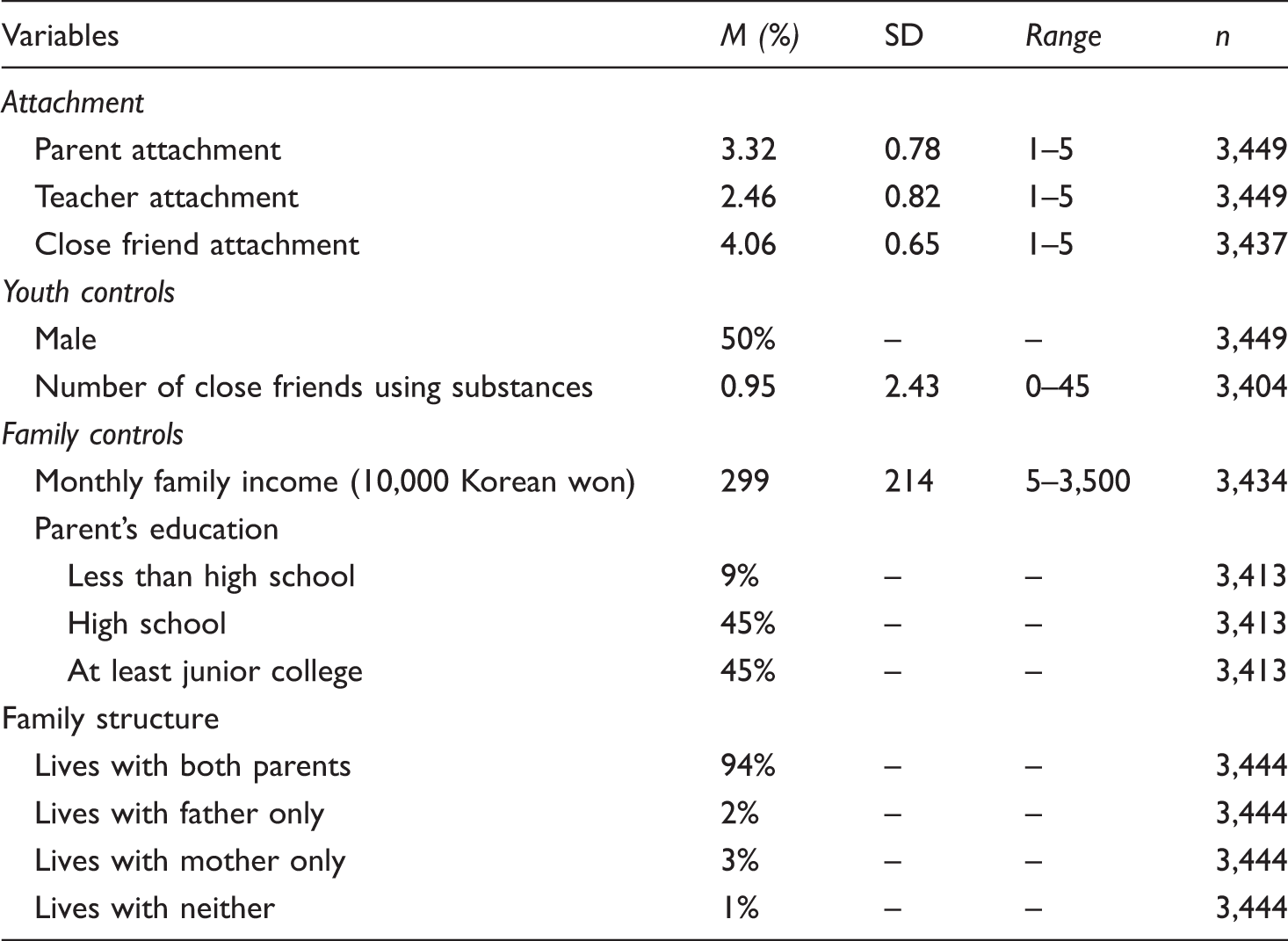
First, a summary of the descriptive characteristics of the sampled youth at the baseline wave was examined. Pearson’s correlation coefficients for the three types of attachment were also examined, to identify the existence of possible multicollinearity. The study employed discrete-time survival analysis with logistic regression to identify the predictors of first alcohol and cigarette use. The discrete-time event history method is ideal for analyses in which the timing of an event, rather than its occurrence, is of importance to the researcher (Yamaguchi, 1991). The results were reported as logistic coefficients, which represented the conditional probability of engaging in substance use, given that the event had not yet occurred (Allison, 1982). Wald tests were conducted to compare the relative effects of the three types of attachment on the initiation of substance use.
Results
Descriptive statistics and correlations
Descriptive statistics at baseline.
Correlations among types of attachment at baseline.
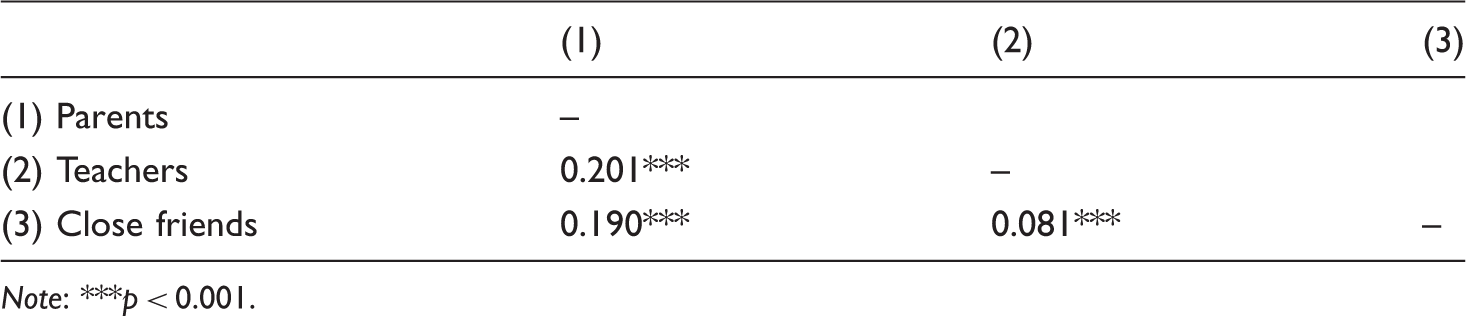
Note: ***p < 0.001.
Survival analysis: Discrete-time logistic regression
Discrete-time logistic regression: Onset of alcohol consumption (N = 9,255) and cigarette smoking (N = 13,002).

Note: Standard errors in parentheses; ***p < 0.001; **p < 0.01; *p < 0.05; aReference group is ‘Lives with both father and mother’. Sample sizes in survival models are naturally inflated, as data from multiple waves are considered individual points of observation in the analysis. A total of 2,852 youth constitute the 9,255 person-period observations in the discrete-time logistic regression models for alcohol consumption. A total of 3,203 youth constitute the 13,002 person-period observations in the discrete-time logistic regression models for cigarette smoking.
As for covariates, males showed earlier cigarette use experience than did females. Substance-using close friend was associated with early onset of both alcohol and cigarette consumption. Parental education and average monthly family income, however, did not show any significant relationship with the onset of substance use. There was a difference between the alcohol consumption and cigarette smoking models in the results obtained for family structure. Compared to youth living with both parents, youth living with a father only showed earlier initiation of alcohol consumption, whereas youth living with a mother only, or without any parents, were more likely to experience earlier smoking initiation.
Discussion
This research examined the relationship between the attachment element of social bonds and first alcohol and cigarette use during adolescence among Korean youth. The study results were in accordance with the premises suggested by social control theory—stronger social bonds, particularly attachment with adult figures, may prevent youth from engaging in risk behavior. Specifically, the results showed that parent attachment and teacher attachment were significantly associated with delayed initial alcohol and cigarette consumption. However, peer attachment was associated with substance use initiation at an early age. Social control theory is applied as a basis for the explanation as to why adolescents delay or expedite initiation of substance use behaviors.
Attachment relationships that delay the onset of substance use
Consistent with previous work that highlights the benefits of prosocial relationships between adolescents and parents (Chui & Chan, 2012; Ford, 2005), results from the discrete-time logistic analysis showed that the presence of positive attachment to parents was related to delayed onset of alcohol and cigarette use. The quantity of time spent together, affectionate interactions, and candid communications between parents and youth work concurrently as protective qualities. This was in alignment with the social control theory’s assertion that strong attachment to adult figures may help adolescents abstain from delinquent behaviors (Hirschi, 1969), as stronger bonds with parents may increase the perceived costs of engaging in substance use behavior. The fear of eliciting a negative reaction or disapproval from parents and jeopardizing established relationships can deter youth from engaging in risk behaviors (Thaxton & Agnew, 2004).
Stronger attachment may not only play a significant role in youth decisions to use substances (Hirschi, 1969; Thaxton & Agnew, 2004); it could also have an indirect effect on self-perception or choice of peers through parental skills, which also have a great impact on the onset of substance use (Chui & Chan, 2012; Parker & Benson, 2004). In other words, the protective role of parent-youth attachment may be effective in preventing substance use behaviors, since affective and emotional bonds (built by practices such as effective parental monitoring and frequent parent-youth communication) are highly related to a lower risk of substance use, while simultaneously lowering youths’ association with risk-taking peers (Chui & Chan, 2012). Higher parental support, which is a crucial dimension of attachment, could also affect an adolescent’s positive self-perception and lower peer pressure (Parker & Benson, 2004), eventually leading to less involvement with substances.
Similarly, our findings showed that teacher attachment was also associated with a higher average age of first alcohol consumption and cigarette smoking. Students who had formed strong social bonds with their teachers were found to be more likely to start drinking alcohol and smoking cigarettes later than did students with less attachment to teachers. The results were in line with previous research documenting an opposing affiliation between teacher attachment and various delinquent behaviors (Demanet & Van Houtte, 2012; Erickson, Crosnoe, & Dornbusch, 2000; Freidenfelt Liljeberg, Eklund, Fritz, & af Klinteberg, 2011; Hirschi, 1969). In social control theory, adolescents who are strongly attached to conventional others are more likely to avoid risk behaviors, since those behaviors could affect those strong emotional relationships (Hirschi, 1969). In school, teachers represent ‘conventional others’, in that they guide students toward prosocial behaviors with rules and norms (McNeely & Falci, 2004). Thus, adolescents who are strongly attached to a teacher are willing to comply with school rules and norms set by their teachers. Prosocial behaviors are naturally followed since youths have strong bonds with their teachers.
Attachment relationships that expedite the onset of substance use
Whereas affective relationships with parents and teachers were associated with a delayed onset of substance use, close friend attachment contributed to a decrease in the age of first alcohol and cigarette use. Considerable research has found a strong effect of peers on substance use during adolescence (Laible et al., 2000). As implied in existing literature, however, the exact mechanisms through which attachment bonds with close friends lead to specific patterns of substance use are less clear (Demanet & Van Houtte, 2012; Laible et al., 2000). More specifically, whether adolescents develop conventional or unconventional links to others, could be the key to their decision to use substances. Although relationships with teachers or parents are mostly conventional, peers can be either conventional or unconventional.
On the one hand, attachment to prosocial peers may contribute to social adjustment through similar processes that prevent youth who are attached to their parents and teachers from engaging in substance use. On the other hand, strong ties with close friends who endorse the use of substances and/or are users themselves may encourage early participation in risk behaviors. This duality of peer attachment is accounted for by the fact that the effect of close friends is greatly dependent on the quality of peers. It is also possible that youth who fail to develop strong affective ties with adult figures may instead resort to the support of risk-taking friends. The role of close friends is complicated by the fact that youth’s choice of peers—whether to befriend substance-endorsing or non-substance-endorsing youth—is highly influenced by the extent of the former’s social conformity, which is also tightly interlinked with attachment to parents and teachers (Hirschi, 1969). Thus, literature pertaining to the protective or risky role of peer relationships would benefit from an examination of the exact processes that link strong social bonds with close friends and youth risk behavior.
The results of the current study highlight the possible role of relational resources in delaying initiation of smoking and drinking. Strengthening attachment and positive ties that youth develop with parents and teachers may be important in the prevention of earlier initiation of smoking and drinking. However, the quality and type of youths’ peers may influence their substance use behaviors. Close friends who promote more prosocial behaviors could prevent earlier substance use behaviors, whereas peers who are substance users themselves or encourage other forms of risk behaviors could hasten the initiation of substance use (Bahr, Hoffmann, & Yang, 2005).
Limitations and suggestions for future work
The results of the current study must be interpreted with caution, in view of the following shortcomings. First, this study examined the independent roles of parent, teacher, and close friend attachment, controlling for covariates in the prediction of substance use initiation. Previous research, however, suggests that various domains of youth attachment may interact with each other (e.g., Laible et al., 2000). Future research should consider how the interplay between key domains of attachment may contribute to shaping youth substance use patterns.
Second, although this study examined the timing of first substance use, utilizing longitudinal information and discrete-time logistic regression, the findings do not indicate a causal relationship. Furthermore, the direction of influence is unclear: not only can attachment affect youth behaviors, but it is equally plausible that youth risk behaviors influence the quality of attachment. Previous studies that have identified a reciprocal relationship between attachment and youth behaviors (Buist et al., 2004; Freidenfelt Liljeberg et al., 2011) may support this idea. These studies maintain that although youth with strong bonds are less likely to engage in risk behaviors, it is also possible for risk behaviors to cause lower attachment to parents, teachers, and close friends. Thus, there is a need for further investigations concerning long-term effects that would examine causal relationships and define a clear time sequence between attachment relationships and youth risk behaviors.
Third, the use of a three- to six-item score for attachment with parents, teachers, and peers may not capture the depth of the concept. Although scores from relatively fewer items have been used in previous work (e.g., Huebner & Betts, 2002), a more detailed and comprehensive measure such as the Inventory of Parent and Peer Attachment (as in Laible et al., 2000) or the Psychological Sense of School Membership scale (as in Demanet et al., 2012) that encompasses multiple conceptual components would provide a richer assessment of the youth attachments.
Finally, this study predicted factors associated with first substance use. However, the study findings may not necessarily be applicable to youth at the greatest risk (who may be of interest to policy makers), for three reasons. First, the study results may have been influenced by the fact that youth who reported having used substances for the first time before wave 1 were omitted from the main analysis. Post-hoc analyses showed that the omitted sample was relatively more disadvantaged in terms of socio-demographic characteristics. Left-censoring is a type of selection issue that could cause bias in the estimates of attachment variable coefficients, possibly limiting the interpretation of the results. Second, some youth who had not initiated substance use prior to the study, but had missing information on at least one key variable, were also not included in the analysis. The interpretation of the results should take into consideration that oftentimes, individuals with missing information in panel data come from low socioeconomic households (Fitzgerald, Gottschalk, & Moffitt, 1998) and may be most vulnerable to substance use behaviors (Goodman & Huang, 2002). Additionally, the current study treated the quality of ‘initiation’ of substances to be the same across youth, regardless of their subsequent substance use patterns. At a given age of initiation, some youth may have used substances as a one-time experience due to curiosity, whereas others may be involved in heavier and more problematic use. Thus, further consideration of subsequent substance use patterns is warranted to identify youth who are at a greater risk of developing severe substance using behavior.
Conclusion
Regardless of these limitations, this study contributes to literature on the initiation of substance use behaviors among adolescents in an understudied population. To the best of our knowledge, no other study has comprehensively applied event history analysis in a single model to examine the relative roles of attachment to parents, teachers, and peers, while being grounded in the social control perspective and using a sample of Korean youth or in any other international context.
Grounded in the ecological perspective (Bronfenbrenner, 1986) and the social control theoretical framework (Hirschi, 1969), the current study examined the extent to which attachment to parents, teachers, and close friends—three domains that are equally salient during adolescence—predicts the onset of cigarette and alcohol use using nationally representative data from Korean adolescents. The findings suggested that early prevention strategies for delaying the onset of substance use should specifically target relational resources that youth develop with parents and teachers. Furthermore, the results highlighted the importance of managing youth relationships with close friends, such that socialization with particular types of peers does not inadvertently lead to youth exposure to negative influence. Taken together, this research may provide an empirical basis for emphasizing the crucial role of school psychologists: Their work as a supportive liaison that facilitates collaboration across multiple domains—parents, teachers, and close friends—is necessary for preventing early onset of cigarette and alcohol use among youth.
Footnotes
Declaration of Conflicting Interests
The author(s) declared no potential conflicts of interest with respect to the research, authorship, and/or publication of this article.
Funding
The author(s) disclosed receipt of the following financial support for the research, authorship, and/or publication of this article: This research was supported by a grant ‘Development of Psychological Modeling based on Disaster Analysis’ [MPSS-SD-2014-40] from the Social Disaster Prevention Research Center, Ministry of Public Safety and Security, Republic of Korea.