



Abstract
Authoritative school climates have been associated with less school bullying and other antisocial behaviors. However, studies focusing on the classroom level, as well as on bystander behaviors, are lacking. The aim of the current study was to examine whether authoritative classroom climates were associated with bullying victimization and various bystander behaviors (reinforcer, outsider, and defender behaviors) in school bullying. We included gender as a covariate at the individual and classroom levels. Participants were 1540 5th-grade students (824 girls) from 104 classrooms in Sweden who completed a questionnaire. The findings revealed that girls and students in classes with greater authoritative classroom climates were more inclined to defend. Boys reinforced more as did students in classes with more boys and more authoritative classroom climates. Boys showed more outsider behaviors as did students in classes with less authoritative classroom climates. Students in classrooms with less authoritative climates were victimized to a higher degree. Thus, the current findings suggest that a warm, caring, supportive, controlled, demanding, and cohesive classroom climate should be considered a vital protective factor against bullying victimization and negative bystander responses, and a facilitator of defending and supporting victims.
Bullying, usually defined as repeated aggression toward someone in a less powerful situation (Olweus, 2010), is a worldwide problem in schools (Chester et al., 2015). Being bullied in school is associated with a greater risk of mental health problems such as depression, anxiety, suicidal ideation and behavior, and psychosomatic symptoms and problems in childhood and adolescence (Gini & Pozzoli, 2013; Holt et al., 2015; Silberg, Copeland, Linker, Moore, Roberson-Nay, & York, 2016). Victims of school bullying are also at greater risk of suffering from mental and physical health problems in adulthood (Copeland, Wolke, Angold, & Costello, 2013; Copeland, Wolke, Lereya, Shanahan, Worthman, & Costello, 2014; Evans-Lacko et al., 2017; Meltzer, Vostanis, Ford, Bebbington, & Dennis, 2011; Silberg et al., 2016).
Further, in most bullying episodes, peers are present as bystanders (Atlas & Pepler, 1998; Hawkins, Pepler, & Craig, 2001). The participant role model (Salmivalli, 1999) states that peers can take different social roles in bullying situations as a result of the interplay between group processes, the expectations of others, and individual behavioral dispositions. In addition to the bully role and the victim role, there are four possible bystander roles. Assistants are individuals who join in and help the ringleader bullies. Reinforcers are individuals who support and thus signal their approval of the bullying by laughing or cheering. Outsiders are individuals who remain passive and try to stay away. Defenders are individuals who help and support the victim, and who therefore may display disapproval of the bullying or toward the bully depending on whether their intervention is more direct (e.g., telling the bully to stop bullying) or indirect (e.g., comforting the victim). In the current study, we were interested in bystander behaviors in addition to bullying victimization because large-scale studies have demonstrated that the more classmates reinforce bullying and fail to defend the victims, the more likely it is that bullying will continue (Kärnä, Voeten, Poskiparta, & Salmivalli, 2010; Nocentini, Menesini, & Salmivalli, 2013; Salmivalli, Voeten, & Poskiparta, 2011).
In order to develop strategies to prevent bullying, school psychologists need to understand its link to school contextual factors. Further, understanding how such factors are related to various bystander behaviors in bullying is crucial as well in bullying prevention as we need to increase defender behaviors and decrease reinforcer behaviors among students in order to decrease bullying victimization. According to the social-ecological framework (Espelage & Swearer, 2011; Hong & Espelage, 2012), victimization and bystander responses in school bullying are ecological phenomena in which contextual variables such as school climate and classroom climate play important roles.
School and classroom climate
Although there is a lack of consensus about how to define and measure school climate (Wang & Degol, 2016), Bradshaw, Waasdorp, Debnam, and Johnson (2014) define it as ‘the shared beliefs, values, and attitudes that shape interactions between students, teachers, and administrators and set the parameters of acceptable behaviors and norms for the schools’ (p. 594). As a construct, school climate often includes the quality of teacher–student and student–student relationships, orders/rules/discipline, school safety, and school connectedness/belongingness aggregated at the school level (Bear, Gaskins, Blank, & Chen, 2011; Zullig, Koopman, Patton, & Ubbes, 2010). Whereas the social-ecological framework emphasizes that individual behaviors are shaped by the school environment, such as the school climate, the risk and resilience perspective focuses on risk and protective factors within the school environment, and how the quality of school climate may increase or decrease a student’s probabilities of positive and negative outcomes (Wang & Degol, 2016). A positive school climate can be considered as a protective factor because it has been associated with less aggression and fewer behavioral problems (for a review, see Thapa, Cohen, Guffey, & Higgins-D’Alessandro, 2013), including bullying perpetration and victimization (Fink, Patalay, Sharpe, & Wolpert, 2018; Konishi, Miyazaki, Hymel, & Waterhouse, 2017; La Salle, George, McCoach, Polk, & Evanovich, 2018; Modin, Låftman, & Östberg, 2017; White, La Salle, Jeffrey, & Meyers, 2014).
Classroom climate in turn can be defined as ‘the sum of all the group processes that take place during teacher–student and student–student interactions’ (Zedan, 2010, p. 76), and includes interpersonal relationships and level of teacher control. Whereas the school climate is the overall climate of the school (school level), the classroom climate is a part of the school climate that varies across classrooms (classroom level). Although it has been found to be associated with academic achievement (for a systematic review, see Hattie, 2009), the question of whether classroom climate may be linked to bullying victimization and bystander behavior in bullying is still overlooked in the research literature, with a few exceptions. One previous study found that a poor class climate, in terms of student–student relationships at the classroom level, was associated with greater victimization (Stefanek, Strohmeier, van de Schoot, & Spiel, 2011). Findings from a more recent study suggest that peer victimization is less likely to occur in classrooms characterized by positive, warm, fair, and supportive relationships among students and between teachers and students (Thornberg, Wänström, & Pozzoli, 2017). A multilevel study conducted by Thornberg, Wänström, Hong, and Espelage (2017), found that positive, warm, and supportive student–student relationship patterns at the classroom level were associated with more frequent defender behaviors.
In the current study, we focus on the classroom climate for three reasons. First, there are significant between-classroom variations in victimization and bystander behaviors in school bullying (Atria, Strohmeier, & Spiel, 2007; Coelho & Sousa, 2018; Salmivalli et al., 2011; Stefanek et al., 2011). Second, in Sweden (the focus of the current study) as well as in other countries, elementary school students usually remain in a single school class with the same classmates for the full school day and for more than one year. Third, fewer studies have examined classroom climate as compared to school climate in relation to bullying prevalence. Ramelow, Currie, and Felder-Puig (2015) argue that school climate is a multi-dimensional and complex phenomenon, and its measurement should therefore be grounded in theory. We would like to add that this argument is also valid in the case of studying classroom climate, and we have therefore adopted the authoritative school climate model.
Authoritative school climate and classroom climate
With reference to Baumrind’s (1967, 1971, 1989) classic work on authoritative parenting and its positive outcomes (for a comprehensive review, see Larzelere, Morris, & Harrist, 2013), researchers have proposed the authoritative school climate (Gregory & Cornell, 2009; Gregory, Cornell, Fan, Sheras, Shih, & Huang, 2010; Konold & Cornell, 2015) as a theoretical framework for conceptualizing a positive school climate. This model highlights two dimensions of school climate: Support (responsiveness) and structure (demandingness). Support refers to the degree to which students feel supported and respected by their teachers, including experiences of warmth, care, and open communication. Structure refers to strict but fair enforcement of school rules and high academic expectations and demandingness. An authoritative school climate thus refers to a school climate with high levels of both support and structure. A growing body of research has shown that an authoritative school climate is linked to lower levels of bullying and victimization (Cornell & Huang, 2016; Cornell, Shekla, & Konold, 2015; Gerlinger & Wo, 2014; Gregory et al., 2010).
In the current study, we have developed and conceptualized the authoritative classroom climate as a classroom interaction and relationship pattern characterized by high levels of teacher support, warmth and responsiveness, high levels of teacher structure and demandingness, and high levels of student support, warmth and responsiveness. Whereas Thornberg et al. (2017) examined the supportiveness, warmth, or responsiveness of both teachers and classmates, we have also included teacher structure/demandingness. This is the first study, as far as we know, to investigate whether an authoritative classroom climate is related to bullying victimization and defender, outsider, and reinforcer behaviors in school bullying.
Gender differences in bullying
Findings on gender differences in victimization are mixed (Hong & Espelage, 2012). In their meta-analysis, Cook, Williams, Guerra, Kim, and Sadek (2010) found that gender had a weak but significant effect as a predictor of bullying perpetration meaning that boys tended to engage more in bullying than girls (also see Álvarez-García, García, & Núñez, 2015), although gender failed to significantly predict bullying victimization. In regard to bystander behavior, studies have shown that boys are more engaged in reinforcer behaviors than girls, whereas girls are more engaged in defender behaviors than boys (Coelho & Sousa, 2018; Espelage, Green, & Polanin, 2012; Gini, Pozzoli, & Bussey, 2015; Pöyhönen, Juvonen, & Salmivalli, 2012; Thornberg & Jungert, 2013). Because boys are more inclined than girls to engage in bullying perpetration, it seems plausible to expect a higher frequency of victimization in classrooms with more boys (cf., Coelho & Sousa, 2018). On the other hand, findings in the literature are inconsistent. In some studies, bullying was found to be more frequent in classrooms with a higher proportions of boys, whereas others did not find any classroom-level effect of the gender distribution on peer victimization (for a review, see Saarento, Garandeau, & Salmivalli, 2015).
The current study
The aim of the current study was to examine whether authoritative classroom climates are associated with bullying victimization and various bystander behaviors (reinforcer, outsider, and defender behaviors) in school bullying. Considering the protective characteristics of authoritative parenting (Baumrind, Larzelere, & Owens, 2010; Georgiou, Ioannou, & Stavrinides, 2017; Larzelere et al., 2013) and the authoritative school climate (Cornell & Huang, 2016; Cornell et al., 2015; Gerlinger & Wo, 2014; Gregory et al., 2010), it is plausible to assume that an authoritative classroom climate is a protective factor in preventing school bullying. Thus, we hypothesized that an authoritative classroom climate is associated with greater defender behavior, less reinforcer behavior, less outsider behavior, and less bullying victimization.
Gender was included as a covariate at the individual and classroom levels. Based on previous findings, we hypothesized that boys would be more engaged in reinforcer behavior than girls, and girls would be more engaged in defender behavior than boys, whereas we hypothesized that there would be no gender differences in bullying victimization. Due to the inconsistent findings in the literature, we did not assume a particular hypothesis on gender proportion at the classroom level, but simply included the variable as a covariate at the classroom level in an exploratory manner.
Social-ecological theory (Espelage & Swearer, 2011) emphasizes that behaviors are produced by interdependent associations between individual and contextual factors. Therefore, we assumed that it would be possible to detect cross-level interaction effects between gender and an authoritative classroom climate. However, as empirical research on the subject is lacking, we were unable to deduce any clear hypotheses suitable for testing. We were able to examine possible cross-level interactions in an exploratory manner.
Method
Participants
The study participants consisted of 1540 5th-grade students from 104 classrooms in 63 public schools located in ten different municipalities in the south and middle of Sweden (age range = 10.42–13.08 years-old, M = 11.55, SD = 0.32). Of these, 716 (46%) were boys and 824 (54%) were girls. The students’ self-reported ethnic background was mainly Swedish (81.45%) (born in Sweden with at least one Swedish-born parent), whereas 18.55 % had a foreign background (i.e., born in another country and/or both parents born in another country). We obtained parental consent (written) and student consent (oral) from all the participants.
Procedure
The participants completed a web-based questionnaire on tablets in their ordinary classroom settings with a member of the research team present. This researcher explained the study procedure, assured students of confidentiality, and assisted any participants who needed help.
Measures
Authoritative classroom climate
The list of items in the Authoritative classroom climate scale (including Cronbach’s α of the subscales)

Bullying victimization
An 11-item self-report scale was developed to measure bullying victimization. With reference to research showing that students might have various understandings of the word ‘bullying’ (Frisén, Holmqvist, & Oscarsson, 2008; Guerin & Hennessy 2002; Purcell, 2012), and that the word itself is considered to be negatively value-loaded (Felix, Sharkey, Green, Furlong, & Tanigawa, 2011) and associated with a risk of under-reporting, our scale did not provide the word bullying with an a priori definition. Instead, it started with the question, ‘Think of the past three months: How frequently have one or more students who are stronger, more popular, or more in charge in comparison to you done the following things towards you’? The following behavioral items included physical, verbal, and relational bullying victimization. For each item, the student responded on a five-point scale from 1 = ‘Has never happened to me’ to 5 = ‘Several times a week’, Cronbach’s α was 0.90. The one-dimensional scale was confirmed by a CFA using the ULS estimator for ordinal data (CFA: χ2(44) = 977.170, p < 0.001, CFIrobust = 0.987, RMSEArobust = 0.076; 90% CI [0.072, 0.080]). The bullying victimization score was obtained by computing the average score for each individual.
Bystander behavior
We used a three-dimensional 15-item seven-point scale (1 = strongly disagree to 7 = strongly agree) to measure students’ bystander behavior (Thornberg, Wänström, Hong, & Espelage, 2017) but removed the three assistant behavior items. Thus, the scale used in the analysis consisted of 12 items. Moreover, the word ‘bullying’ was replaced with ‘victimizing’ to reduce the risk of an under-reporting of negative bystander responses. The participants were asked the following question, ‘Try to remember situations in which you have seen one or more students victimizing another student (e.g., teasing, mocking, threatening, physically assaulting, or freezing out). What do you usually do’? Two items depicted reinforcer behavior (e.g., ‘I laugh and cheer on those who victimized the kid’, Spearman-Brown coefficient = 0.59), five items depicted outsider behavior (e.g., ‘I just walk away’, Cronbach’s α = 0.80), and five items depicted defender behavior (e.g., ‘I help the victimized student’, Cronbach’s α = 0.81). The three-dimensional solution was previously confirmed for the same sample (Sjögren, Thornberg, Wänström, Gini, Bjärehed, & Alsaadi, 2018). The scores were obtained by computing the average score for each individual.
Statistical models
Because students were nested within classrooms, we analysed each dependent variable (defender behavior, reinforcer behavior, outsider behavior, and victimization) using random intercept regression models. In model 1, the individual predictor ‘gender’ was entered. In model 2, class predictors ‘proportion of boys’ and ‘authoritative classroom climate’ were entered as well. Finally, in model 3, the interaction between gender and authoritative classroom climate was entered. Model 3 is shown below:

In this final equation, DVij is the defending, reinforcing, outsider behavior, and victimization score, respectively, for the i:th student in the j:th class,
Results
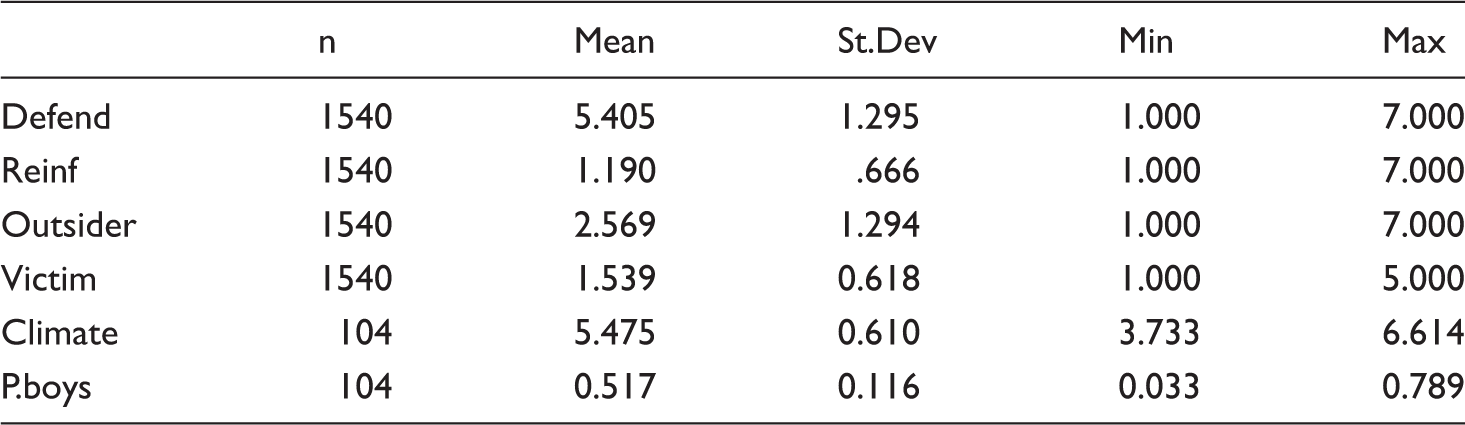
Number of observations, means, Standard Deviations, min- and max scores for individual- and class level variables
Correlations for class level variables (N = 104)

Note: *p < 0.05; **p < 0.01; ***p < 0.005. Class mean scores are used for the individual variables defender, reinforcer, outsider, and victimization.
Regression coefficient estimates and standard deviations from variance component regression models.

Note: *p < 0.05, **p < 0.01, ***p < 0.005. All variables except gender are grand mean centered.

Illustration of interaction effect between gender and authoritative classroom climate for reinforcing behaviors.
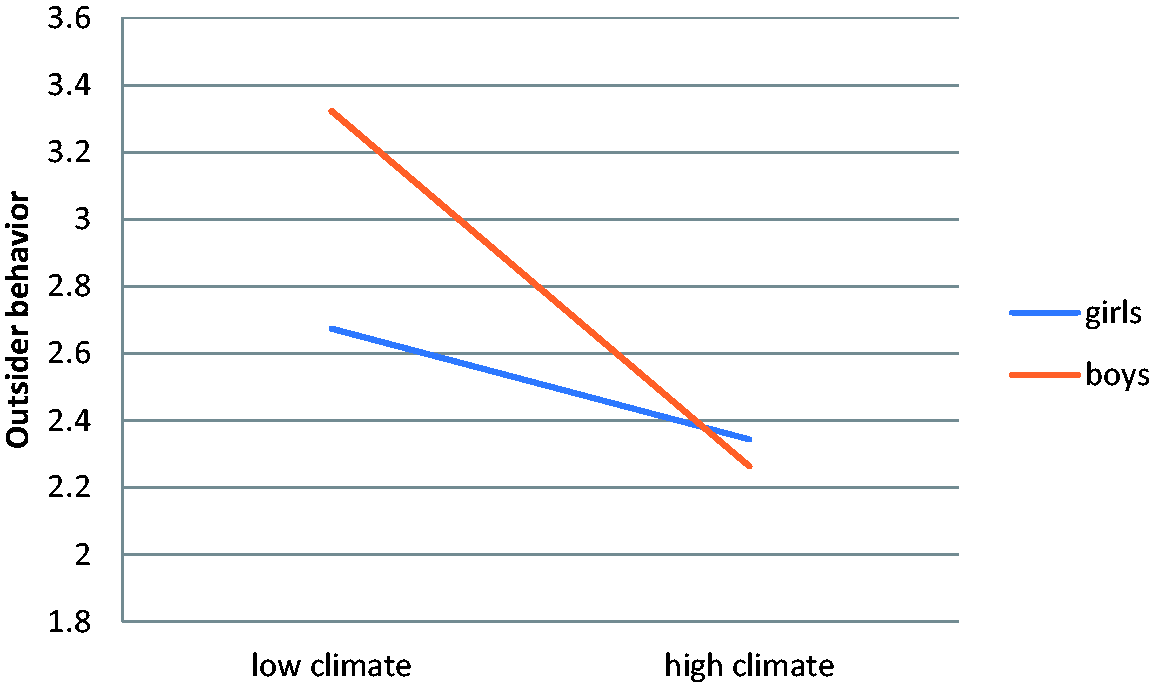
Illustration of interaction effect between gender and authoritative classroom climate for outsider behaviors.
Discussion
Although an authoritative school climate has been linked to lower levels of bullying and victimization (Cornell & Huang, 2016; Cornell et al., 2015; Gerlinger & Wo, 2014; Gregory et al., 2010), relatively little is known about whether classroom climate is associated with bullying victimization and various bystander behaviors in school bullying. Victimization has been related to poor student–student relationships at the classroom level (Stefanek et al., 2011) and lower levels of warm, caring, and supportive classroom climate (Thornberg, Wänström, & Pozzoli, 2017), whereas defender behavior has been related to warm, caring, and supportive student–student relationships at the classroom level (Thornberg, Wänström, Hong, & Espelage, 2017). This study was the first to test whether an authoritative classroom climate, measured as student perceptions of teacher structure, teacher support, and student support aggregated at the classroom level, was associated with bullying victimization, defender behavior, outsider behavior, and reinforcer behavior in school bullying.
Consistent with our hypotheses, and controlling for gender at the individual level and the proportion of boys at the classroom level, we found that students who belonged to classrooms with a more authoritative climate were less likely to be bullied in school. Moreover, when they were witnessing bullying or peer victimization, they were more inclined to defend, help, and support the victim and less prone to reinforce bullying by laughing and cheering or remaining passive and neutral as bystanders. Thus, the current findings suggest that an authoritative classroom climate functions as a protective classroom-level factor against bullying, both in reducing the risk of bullying victimization and enhancing the likelihood of bystander responses associated with a low prevalence of bullying. The finding showing that an authoritative classroom climate is related to greater defender behavior and less reinforcer behavior (i.e., bystanders who laugh and cheer) is novel and significant as previous research has shown that such a bystander reaction pattern among classmates is linked with less bullying (Kärnä et al., 2010; Nocentini et al., 2013; Salmivalli et al., 2011). Overall, our results support a social-ecological perspective in which contextual variables such as classroom climate and peer ecology at the class level are important factors in victimization and bystander behaviors (Espelage & Swearer, 2011; Hong & Espelage, 2012).
In terms of gender, the present findings showed, in accordance with our hypotheses and previous findings (e.g., Espelage et al., 2012; Gini et al., 2015; Pöyhönen et al., 2012; Thornberg & Jungert, 2013), that girls were more inclined to defend victims, boys were more inclined to reinforce bullying, and there were no significant gender differences in bullying victimization. In addition, we found that boys as bystanders in bullying were more inclined than girls to take an outsider role as well. A possible explanation for these gender differences might be gender-specific socialization practices across various socialization agents, including parents, peers, teachers, other adults, and the media. Girls are encouraged to engage in nurturing and caring behaviors, whereas aggression is more socially acceptable for boys (Carlo, 2014). Furthermore, the interaction effects in the multilevel regression models suggest that boys are more inclined than girls to take reinforcer and outsider roles as bystanders when they belong to a classroom with poor teacher structure and less teacher and student support. Thus, boys seem to be more influenced than girls by a low authoritative classroom climate, considering their likelihood to act as reinforcers or outsiders in school bullying.
Limitations
Some of the limitations of this study are worth mentioning. First, we used self-reported data, which may have resulted in under- or over-estimation. However, to decrease the risk of under-reporting of bullying victimization, we did not include the term ‘bullying’ in the bullying victimization scale. Still, self-reported data is vulnerable to various biases, including memory distortion and social desirability. Second, the reinforcer behavior subscale only included two items, which may have limited the full range of the construct as well as measuring the internal reliability. Third, the Authoritative Classroom Climate scale in the current study is a brand-new scale and its psychometric qualities need to be further tested. Fourth, we could not draw causal conclusions or pinpoint the direction of the identified relations among variables due to the cross-sectional design. Fifth, the sample has a very limited age span, and we did not control for socioeconomic background or ethnicity. Future studies should replicate the current findings with other samples of students of different age levels and from different cultural backgrounds, in which socioeconomic and ethnicity data are included in the analyses.
Implications for practice
These limitations aside, the current study has important practical implications. The findings support the authoritative school climate model (Gregory & Cornell, 2009; Gregory et al., 2010; Konold & Cornell, 2015) by suggesting that teachers who create and maintain an authoritative classroom climate are a vital component of bullying prevention programs. In order to reduce the risk of bullying victimization, reinforcer behavior and outsider behavior, and to increase the probability of defender behavior among their students, teachers should design a classroom climate with strict but fair enforcement of rules and high expectations and demandingness, while building warm, caring, and supportive relationships with their students through modelling and relationship-building. Teachers should also develop strategies that encourage students to develop and maintain warm, caring, and supportive relationships with their classmates.
The findings also have implications for practicing school psychologists. First, they should have a better understanding of how an authoritative classroom climate is related to bullying victimization and bystander behaviors in order to support and counsel teachers in bullying prevention as a part of their classroom management. Second, in addition to a regular student bullying questionnaire to measure bullying prevalence, school psychologists could use the authoritative classroom climate scale developed in the current study, or a similar scale, to screen classrooms with a less authoritative classroom climate and to provide interventions to increase both support and structure in the classroom. They should select and implement interventions that target both teacher support, teacher structure, and student support (e.g., feedback information based on student-reported data from the authoritative classroom scale; follow-up classroom observations to provide collegial support; and offering information and consultation on authoritative classroom management and authoritative classroom and school climate).
School psychologists need to inform teachers about how an authoritative classroom climate is not only linked to less bullying victimization but is also associated with fewer negative bystander behaviors (reinforcer and outsider behavior) – particularly among boys – and more frequent defender behaviors. School psychologists might also introduce, support and monitor the implementation of suitable programs in the schools. One such program is the Child Development Project (Developmental Discipline) program, which is an evidence-based program to classroom management and discipline consistent with an authoritative approach to classroom management and climate. This program includes the development of warm, supportive, and mutually trusting teacher–student relationships, classrooms as caring, just and democratic learning communities, and classroom control with structure, guidance, and firm, consistent and explanation-oriented responses to misbehavior (Shaps, Battistich, & Solomon, 2004; Solomon, Battistich, Watson, Schaps, & Lewis, 2000; Watson, 2014). An authoritative teacher style is also prominent in the core principles behind the evidence-based Olweus Bullying Prevention Program (Olweus & Limber, 2007).
Footnotes
Declaration of Conflicting Interests
The author(s) declared no potential conflicts of interest with respect to the research, authorship, and/or publication of this article.
Funding
The author(s) disclosed receipt of the following financial support for the research, authorship, and/or publication of this article: This research was supported by a grant awarded to Robert Thornberg from The Swedish Research Council [Grant Number D0775301].