



Abstract
In the current study, we followed motivational theories and investigated whether granting junior high school students one more opportunity to take the high-stakes high school entrance exam alleviates students’ depressive symptoms, and whether the effect is comparable for adolescent boys and girls residing in Taiwan. We analyzed two longitudinal datasets (seventh to tenth grade) from two neighboring cohorts, in which one cohort could take the exam just once (i.e., the pre-reform cohort) and the other twice (i.e., the post-reform cohort). Using a lagged-dependent-variable difference-in-differences model to compare the level of depressive symptoms before and after the entrance exam for the two cohorts, the results revealed that the reform was associated with increases in the level of depressive symptoms for both boys and girls. Despite a higher level of depressive symptoms overall, adolescent girls in the post-reform cohort showed a slower increase in the level of depressive symptoms than boys.
Keywords
Junior high school students in most East and Southeast Asian regions, including China, Hong Kong, Japan, South Korea, Taiwan, and Vietnam, are required to take a nationwide or state-wide high-stakes high school entrance exam (HSEE) to be able to enroll in a senior high school. The exams are designed to be the major assessment tool to ensure the fairness and efficiency of the meritocratic admission process, funneling junior high school graduates into either academic- or vocational-track, elite or non-elite senior high schools. Notwithstanding the improving admission rates since the late 1990s, under the prevalent credentialism and elitism, students still strive for—or are forced to strive for—a spot in an elite, college-preparation senior high school to secure a better chance to enter a prestigious college later.
What correlates with facing these educational contests are intense anxiety, heightened depressive symptoms, and worsening suicidal ideation and suicide (Li & Zhang, 2008; Nguyen et al., 2013; Park & Chung, 2014), and exam-related academic achievements are found to be associated with adolescents’ depressive symptoms in many Asian populations, including adolescents in Taiwan (Huang & Chien, 2013). To improve adolescents’ mental well-being, in 2001, the HSEE in Taiwan was substantially reformed so that students could opt to take two exams annually rather than one. Accordingly, students have a second chance to better prepare for the HSEE and make up for the failed first exam.
Although the influence of the 2001 HSEE reform may be profound and comprehensive, little attention has been given to the cost that follows every choice (Eccles & Wigfield, 2002). When students choose to make up a perceived undesirable grade of the first HSEE by attempting the exam again, they must endure the prolonged pressure of exam preparation, the long hours when taking the second HSEE, and the anxiety stemming from waiting for the report card. That is, preparing for the second HSEE may be perceived as a stressful life event, which can be negatively related to mental well-being in general (Garber et al., 2002). However, since existing research on retaking high-stakes exams (e.g., SAT) solely focuses on the improvement in exam performance and postsecondary academic achievement (Goodman et al., 2018; Krishna et al., 2018; Vigdor & Clotfelter, 2003), the cost of mental well-being is largely ignored.
As such, the 2001 HSEE reform in Taiwan provides a natural educational experiment through which researchers can empirically evaluate whether the HSEE reform in Taiwan has effectively improved adolescents’ mental well-being, such as depressive symptoms that have been linked to academic stress among adolescents in North America and Asia (e.g., Cornell et al., 2006; Hishinuma et al., 2012; Lee & Larson, 2000; Li & Zhang, 2008). In the current study, we asked the following question: Does having the option to take the HSEE twice, as opposed to only once, improve adolescents’ depressive symptoms? Furthermore, given that adolescent girls overall, including those residing in Taiwan, tend to have a trait-like, higher level of depressive symptoms than boys (Merikangas et al. 2010; Wang et al., 2015), we further asked: Do adolescent girls particularly benefit from the reform? Because of the competing theoretical frameworks between the self-determination theory and expectancy-value theory, we did not have specific hypotheses for the two research questions; rather, we adopted a quasi-experimental design in an exploratory manner to understand the causal effect of the HSEE reform in Taiwan.
Relevant literature
Relationship between depressive symptoms and high-stakes exam preparation
Depressive symptoms are not uncommon among adolescents in Taiwan. Among individuals who entered adolescence in the early 2000s in Taiwan, the target cohorts of the present study, approximately 30% of them reported that they felt depressed in the past seven days (Ministry of Interior Affairs, Taiwan, 2003; Wei, 2008). The level of depressive symptoms and the prevalence of major depression among Taiwanese adolescents escalate with age (Chen et al., 2015). On par with international trends (Merikangas et al., 2010), the severity of depressive symptoms heightens as youth progress, peaking in middle adolescence when they face the transition from junior to senior high school (Strong et al., 2016; Wang et al., 2018).
While adolescents exhibit a trait-like development of depressive symptoms, depressive symptoms can also be triggered by stressful life events in general (Ge et al., 1994), including academic stress stemming from high-stakes exams. Beyond a general correlation between academic performance and depressive symptoms (Hishinuma et al., 2012; Li & Zhang, 2008), high-stakes exams pose a special threat to adolescents’ depressive symptoms across cultures (Nguyen et al., 2013; Park & Chung, 2014). For example, Cornell et al. (2006) surveyed Minnesotan high school students who were falsely told that they failed the state high-stakes math exam, and more than half of the adolescents reported that they felt depressed after learning about the news. Lee and Larson (2000) found that Korean high school seniors spent more time on schoolwork, which largely involved preparing for the upcoming college entrance exam, than their U.S. counterparts. In turn, time spent on schoolwork was related to clinical depression for Korean students but not for U.S. students, and the magnitude of such correlation was stronger for Korean students than that of U.S. students. A similar trend has been documented among adolescents in Taiwan, in which there is a correlation between academic pressure and the level of depressive symptoms among adolescents (Yi et al., 2009). Moreover, approximately one in six junior high school students demonstrate a heightened level of depressive symptoms when approaching the HSEE (Wang et al., 2018).
It is also plausible that adolescents’ exam performance, as Hishinuma et al. (2012) speculated based on a U.S. population, is influenced by their prior level of depressive symptoms. However, adolescents in Taiwan with varying academic performance do not differ in the level of depressive symptoms (Crystal et al., 1994). Rather, researchers have documented a universally worsening trend of depressive symptoms when approaching the HSEE among one-sixth junior high school students, implying that depressive symptoms are a reaction to the upcoming high-stakes exam (Lin et al., 2008).
The incentives and cost of retaking high-stakes exams
Generally, existing theories do not provide a definite account of the effect of granting a second chance of taking high-stakes exams. When given choices, students tend to retake high-stakes exams. Across the existing literature, approximately one-third to a half of high school students retake high-stakes exams (e.g., SAT; College Board, 1998; Goodman et al., 2018; Krishna et al., 2018). The incentive is clear: given that colleges tend to review only the highest grade, retaking the exam allows students opportunities to improve their chance of being admitted to the targeted institution (Vigdor & Clotfelter, 2003). That is, such opportunity embodies an extra option that helps adolescents gain more control and autonomy over their academic pathway, particularly when adolescents make progress in the second attempt. According to the self-determination theory (Ryan & Deci, 2000), access to and taking advantage of the second attempt may effectively satisfy the needs of competence (i.e., a better exam performance) and autonomy (i.e., being able to make choices), two fundamental needs that collectively contribute to intrinsic motivation. In turn, adolescents’ academic performance and psychosocial adjustment may benefit from the fueled intrinsic motivation (Beyers & Goossens, 1999). As a result, the second opportunity holds great potential for alleviating depressive symptoms stemming from academic pressure, one of the central goals of the HSEE reform.
Nevertheless, choices accompany cost (Eccles & Wigfield, 2002). The expectancy-value theory posits that in addition to the inevitable opportunity cost in which individuals make one choice and have to forgo others, the cost of time and energy to take advantage of additional choices, as well as the toll on mental well-being stemming from possible failures, can accumulate (Flake et al., 2015). Consequently, cost reduces individuals’ perceived value of the task and may lead to lower academic performance (Perez et al., 2014; Rosenzweig et al., 2020). In this sense, taking the second chance may not always result in a more desirable outcome.
Gender differences in depressive symptoms and reactions to high-stakes exams
Research has found that adolescent boys and girls, including those residing in Taiwan, experience different levels and developmental trajectories of depressive symptoms (Conley & Rudolph, 2009; Wang et al., 2015). Across countries, adolescent girls tend to have a higher level of depressive symptoms than boys, and the difference manifests in early puberty and persists into adulthood (Merikangas et al. 2010). Moreover, adolescent girls are more responsive to stressful life events (e.g., harsh parental practice for adolescents in Taiwan; Wang et al., 2015), but adolescent boys are more responsive to events related to achievement, school, and athletics (Hankin et al., 2007; Weis et al., 2013), further complicating our knowledge of possible stressors in adolescence.
However, gender differences in performance on the first high-stakes exam may motivate adolescent boys and girls to attempt the second HSEE in different ways. Generally, adolescent boys and young adult men outperform female peers in a competitive environment (Gneezy & Rustichini, 2004; Price, 2008), including educational competitions at secondary and postsecondary levels and across countries (e.g., Canada, Czech Republic, France; Jurajda & Münich, 2011; Morin, 2015; Ors et al., 2013). It is likely that male individuals are under greater pressure to perform well, which may exacerbate their level of depressive symptoms when confronting an event with high stakes. Therefore, it is imperative to study how changes in the admission process, such as the HSEE reform in Taiwan, contribute to flattening the level of depressive symptoms separately for adolescent boys and girls.
The 2001 HSEE reform in Taiwan
The reform of the meritocratic high school admission process in Taiwan took place in 2001 and involved major changes, such as moving from one entrance exam to two entrance exams annually and from regional to nationwide administration. Before the reform, there was only one HSEE, which was held annually in mid-July, one month after junior high school graduation. Students had to perform their best on the exam and turned in a senior high school preference list. The score obtained on the HSEE was the sole criterion used to match students to the senior high school for which the students put on the preference list and qualified. After the reform, the HSEE is held twice annually, once in May (before junior high school graduation) and another in early July (after graduation). All students are required to take the first HSEE, while the second HSEE is optional. The HSEE score(s) is the major criterion to match students to senior high school on their preference list.
Current study
To understand the impact of the HSEE reform in Taiwan on adolescent depressive symptoms, in the present study, we estimated a difference-in-differences (DiD) model and analyzed data from two cohorts of students, one facing the one-exam HSEE and the other the two-exam HSEE. Responding to the call for more rigorous research on causal mechanisms in psychology (Foster, 2010), DiD has gained more attention in education and developmental psychology research (e.g., Cuartas et al., 2020; Deschacht & Goeman, 2015) to estimate the causal relationship between a treatment and effect when random assignment is not feasible. Furthermore, DiD allows for a flexible modeling approach to tackle the direction between cause-and-effect and the trait-or-state debate given the development of depressive symptoms in adolescence (Cole et al., 2006). Due to the lack of prior research and uncertainties arising from conflicting theoretical frameworks, we did not assume whether the reform alleviates or exacerbates adolescents’ depressive symptoms.
We chose the level of depressive symptoms as the outcome measure because of its correlation with academic performance in high-stakes exams (Lee & Larson, 2000) and its salience to later mental well-being among youth in Taiwan (Wang et al., 2015, 2018). To isolate the effect of the HSEE reform, we further controlled for trait-wise, prior levels of depressive symptoms and other stressful life events that may be related to the state-like fluctuation of depressive symptoms, which helps clarify the potentially bidirectional relationship between the HSEE reform and depressive symptoms (Hinushima et al., 2012). Finally, we compare the gender difference in the regression coefficients to understand whether adolescent girls show a greater reduction (or increase) in depressive symptoms after the HSEE reform.
Methods
Data and sample
Two birth cohorts—a pre- and a post-reform cohort—from northern Taiwan were surveyed. The pre-reform cohort was obtained from a longitudinal survey dataset The Etiology of Adolescent’s Substance Abuse (EASA), in which the 1983-1984 birth cohort participated in the survey starting in 1996. The post-reform cohort was obtained from another longitudinal dataset, Taiwan Youth Project Phase I (TYP), in which the 1986-1987 birth cohort was first surveyed in 2000. The pre-reform cohort took the HSEE in July, 1999 and the post-reform cohort in May (and July if they opted to take the second HSEE), 2002. That is, they were neither the last cohort to take the single exam nor the first cohort to have the opportunity to take two exams, so that their depressive symptoms may not be caused by uncertainties of and anxiety resulting from the reform. In both datasets, school-based cluster sampling was conducted in which seventh graders (i.e., first year of junior high school) residing in northern Taiwan were recruited and followed annually. In the present study, we analyzed the first four waves of data from both datasets, which contained information from junior high school (i.e., from seventh to ninth grade) and the first year of high school (i.e., the 10th grade).
EASA and TYP data, however, did not survey students from the same districts. To ensure the comparability of the pre- and post-reform cohorts, data from students from Taipei City and the adjacent Taipei County, which were one of the most academically competitive districts in Taiwan, were analyzed. We further excluded individuals who submitted incomplete sociodemographic information or who participated for only one year. Finally, the analytic sample consisted of 3,353 adolescents, including 1,300 adolescents in the pre-reform cohort (86% of the original sample of the EASA dataset) and 2,053 in the post-reform cohort (92% of the original Taipei City and Taipei County sample of the TYP dataset). Of the 3,353 adolescents, 72% had complete information over all four years, 19% had information over three years, and 9% had information over two years. Definitions of all variables used in this study and their descriptive statistics are presented in Table 1.
Summary of variable definitions and descriptive statistics.
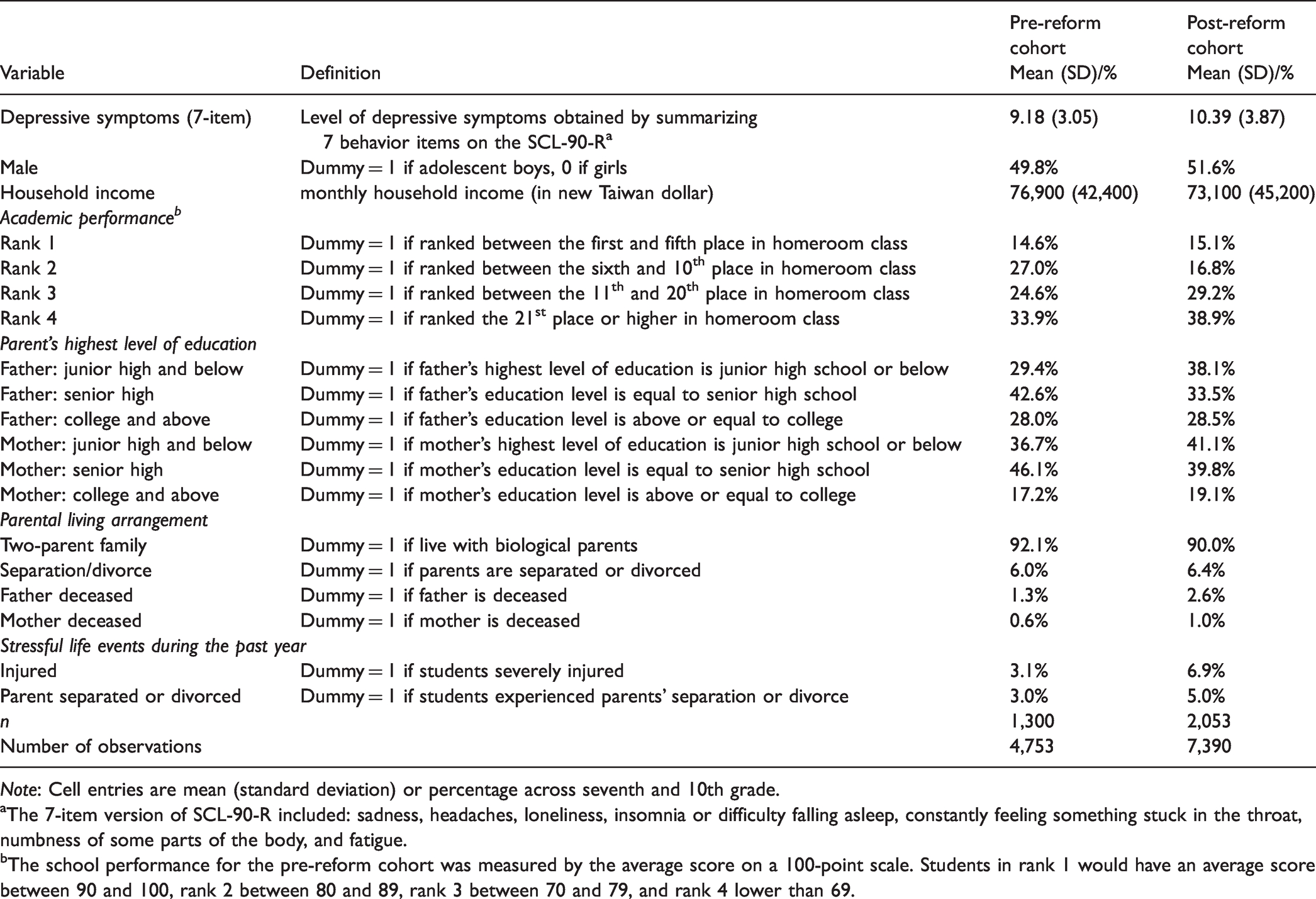
Note: Cell entries are mean (standard deviation) or percentage across seventh and 10th grade.
aThe 7-item version of SCL-90-R included: sadness, headaches, loneliness, insomnia or difficulty falling asleep, constantly feeling something stuck in the throat, numbness of some parts of the body, and fatigue.
bThe school performance for the pre-reform cohort was measured by the average score on a 100-point scale. Students in rank 1 would have an average score between 90 and 100, rank 2 between 80 and 89, rank 3 between 70 and 79, and rank 4 lower than 69.
Measures
Adolescents’ Depressive Symptoms
Adolescents’ depressive symptoms were measured by the Symptom Checklist-90-Revised (SCL-90-R; Derogatis, 1983). Students were asked “Over the last week, have you felt certain degrees of [symptom]?” on a five-point Likert scale (1 = none, 5 = very severe; see Appendix A in the online supplementary material for details). The EASA and TYP used the same 16-item scale when the students were in junior high school year. The seven-item version was administered when the participants were in 10th grade. Both versions have been validated and used in prior studies based on adolescents in Taiwan (Huang & Chien, 2013; Wu, 2007). To maximize the comparability, we analyzed the seven-item version in most analyses, and the 16-item version was used only in the robustness check process (see Results section for details; items for the depressive symptoms are reported in Table 1). The summations of the seven or 16 items were used in analyses. The Cronbach’s α of the seven- and 16-item scales from seventh to ninth grade ranged between 0.70-0.79 and 0.86-0.88, respectively.
Sociodemographic Background Characteristics
Following existing research (Cole et al., 2006; Hankin et al., 2007; Salk et al., 2017), a number of students’ sociodemographic background characteristics and life history were controlled for, including gender, school performance, parental socioeconomic characteristics, and stressful life events in the past year (e.g., severely injured). All variables were derived from the same questions in both surveys, except the school performance indicators, which were measured by ordinal variables representing the class rank in the previous semester (see Appendix B in the online supplementary material for details).
Procedures
Before the first wave of data collection, a multistage sampling design was adopted in the EASA and TYP to maximize the representativeness of seventh graders in northern Taiwan. In each wave of data collection, surveys were all administered in the homeroom during regular class hours. The surveys of the first three waves (i.e., from seventh to ninth grade) were conducted in March of each year, and the survey of the fourth wave (in tenth grade) was conducted in October. Thus, depressive symptoms were comparable before and after the HSEE since the information for ninth graders was collected two months before the first HSEE and for tenth graders two months after they entered senior high school.
Statistical analysis
Our first research interest is inherently a causal question. When random assignment is not feasible, as in our case, we estimated a DiD model to answer the question. The treatment effect of the HSEE reform on adolescents’ depressive symptoms is the difference in the depressive symptoms between adolescent i facing the two-exam HSEE system and the same adolescent facing the one-exam HSEE system. Unfortunately, it is impossible to measure both potential depressive symptoms of the same adolescent i simultaneously (i.e., counterfactual). The ideal way to estimate counterfactuals is to randomly assign each participant to either the treatment or control group. In nonexperimental settings, assignment to treatment is seldom random, and a direct contrast between the treatment and control groups is biased due to the correlation between treatment status and factors correlated with depressive symptoms and the self-selection mechanism. To eliminate such bias, causal inferences rest on the control for all observed and unobserved factors correlated with adolescents’ depressive symptoms (Angrist & Pischke, 2010; Foster, 2010). Prior depressive symptoms may capture several individual and ecological factors (e.g., biological characteristics) that predict adolescents’ overall depressive developmental trajectory, and thus may be the best predictor of later depressive symptoms (Hinushima et al., 2012)
The HSEE reform is a quasi-natural experiment in which adolescents graduating from junior high school in or after 2001 were involuntarily assigned to the two-exam HSEE (i.e., post-reform cohort, the treatment group). Conversely, students graduating before 2001 were subject to the one-exam HSEE (i.e., pre-reform cohort, control group). Since the timing of enrollment in compulsory education in Taiwan solely depends on the child’s birthday, the HSEE reform assignment is nearly random.
As such, the treatment effect of the reform on adolescents in the treatment group can be estimated by comparing the differences in depressive symptoms between pre-HSEE (seventh to ninth grade) and post-HSEE (10th grade) of the post-reform cohort with those of the pre-reform cohort, effectively the DiD model. The lagged-dependent-variable DiD model used is the following:

Finally, to further explore potential mechanisms behind the gender differences as a response to the HSEE reform, we investigated the probability of participating in the second HSEE conditional on their first HSEE score for the entire post-reform cohort. The record of the first HSEE score was provided by students’ junior high schools. To examine whether adolescent boys are more likely to choose to participate in the second HSEE than girls, hence the larger increase in depressive symptoms among boys, we estimated the probability of participating in the second HSEE conditional on the score of first HSEE of the post-reform cohort by a probit model (see Appendix D in the online supplementary material for details). See Appendix E in the online supplementary material for details of handling missing data.
Results
Regional comparisons of adolescents’ depressive symptoms
Since we focused on the most competitive districts in Taiwan (i.e., Taipei City and the neighboring Taipei County), we first examined regional differences in adolescents’ depressive symptoms in the post-reform cohort to ensure the comparability of the two districts in later analyses. Using parametric (t-test) and nonparametric (Kolmogorov-Smirnov test) two-sample equality tests, the results indicated that the two districts did not differ in the distributions of adolescents’ depressive symptoms (see Appendix F in the online supplementary material for details).
Parallel trends assumption
The unbiasedness of the DiD model relies on the parallel trends in the treatment and control group assumption, which implies that the depressive symptoms of the post-reform cohort moved parallelly with those of the pre-form cohort. Figure 1 demonstrates that the depressive symptoms between the post- and pre-reform cohorts developed nearly parallelly for both boys and girls, suggesting that the parallel-trend assumption is broadly valid. In addition, depressive symptoms in the prior year, regardless of gender, were positively associated with those of the following year. The post-HSEE DiD estimation summarized in Table 2 indicated that the pre- and post-reform cohorts did not significantly differ in the level of depressive symptoms after taking the HSEE, controlling for prior depressive symptoms and sociodemographic background. The nonsignificant difference persists when we separately analyzed data from adolescent boys and girls. In addition, to cope with the missingness in the data collected in 10th grade, we estimated the same model again but only with students who still responded to the post-HSEE survey. The results were consistent with those with the full sample (see Appendix G in the online supplementary material for details).
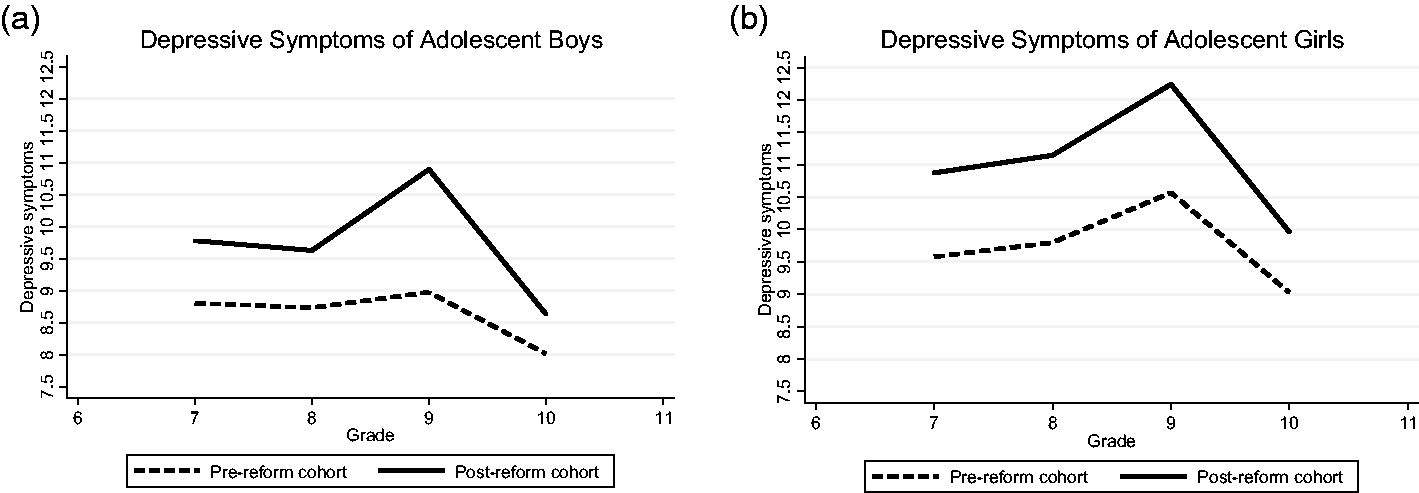
Trend of depressive symptoms in junior high and high school stages by adolescent gender and cohort. (a) Depressive symptoms of adolescent boys in junior high school (grade 7–9) and high school (grade 10), by cohort. (b) Depressive symptoms of adolescent girls in junior high school (grade 7–9) and high school (grade 10), by cohort.
Comparison of post-HSEE depressive symptoms in 10th grade.
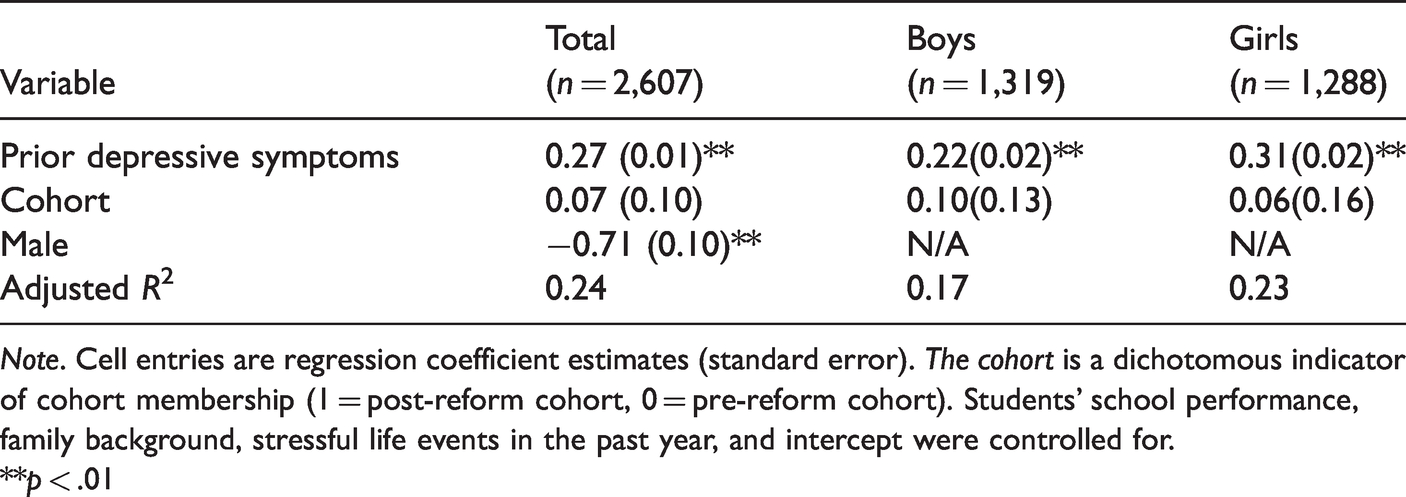
Note. Cell entries are regression coefficient estimates (standard error). The cohort is a dichotomous indicator of cohort membership (1 = post-reform cohort, 0 = pre-reform cohort). Students’ school performance, family background, stressful life events in the past year, and intercept were controlled for.
**p < .01
Effects of the HSEE reform on depressive symptoms
Basic comparisons of pre-HSEE (i.e., from the seventh to ninth grade) and post-HSEE (i.e., 10th grade) depressive symptoms for treated students and controls are summarized in Appendix H in the online supplementary material. After controlling for prior depressive symptoms and associated factors, the lagged-dependent-variable DiD models shown in Table 3 confirmed that the 2001 reform significantly raised the level of depressive symptoms. The coefficient estimates of eighth and ninth grade suggest that the high-stakes HSEE gives rise to depressive symptoms for both pre- and post-reform cohorts. As students progress to eighth and ninth grades and approach the HSEE, the level of depressive symptoms increases significantly and substantially for all adolescents, suggesting that the HSEE has a universal negative effect on adolescents’ mental well-being. Estimating whether adding an additional exam improves students’ depressive symptoms, the interaction terms between the grade level and cohort (i.e., the eighth grade × cohort and ninth grade × cohort terms) revealed the significantly aggravating effects of the 2001 HSEE reform on adolescents’ depressive symptoms in the eighth and ninth grades. Comparing adolescents’ depressive symptoms of pre- and post-HSEE for both pre- and post-reform cohorts suggested that adding a second HSEE further exacerbates depressive symptoms for the post-reform cohort.
Impacts of 2001 HSEE reform on depressive symptoms (7-item version).
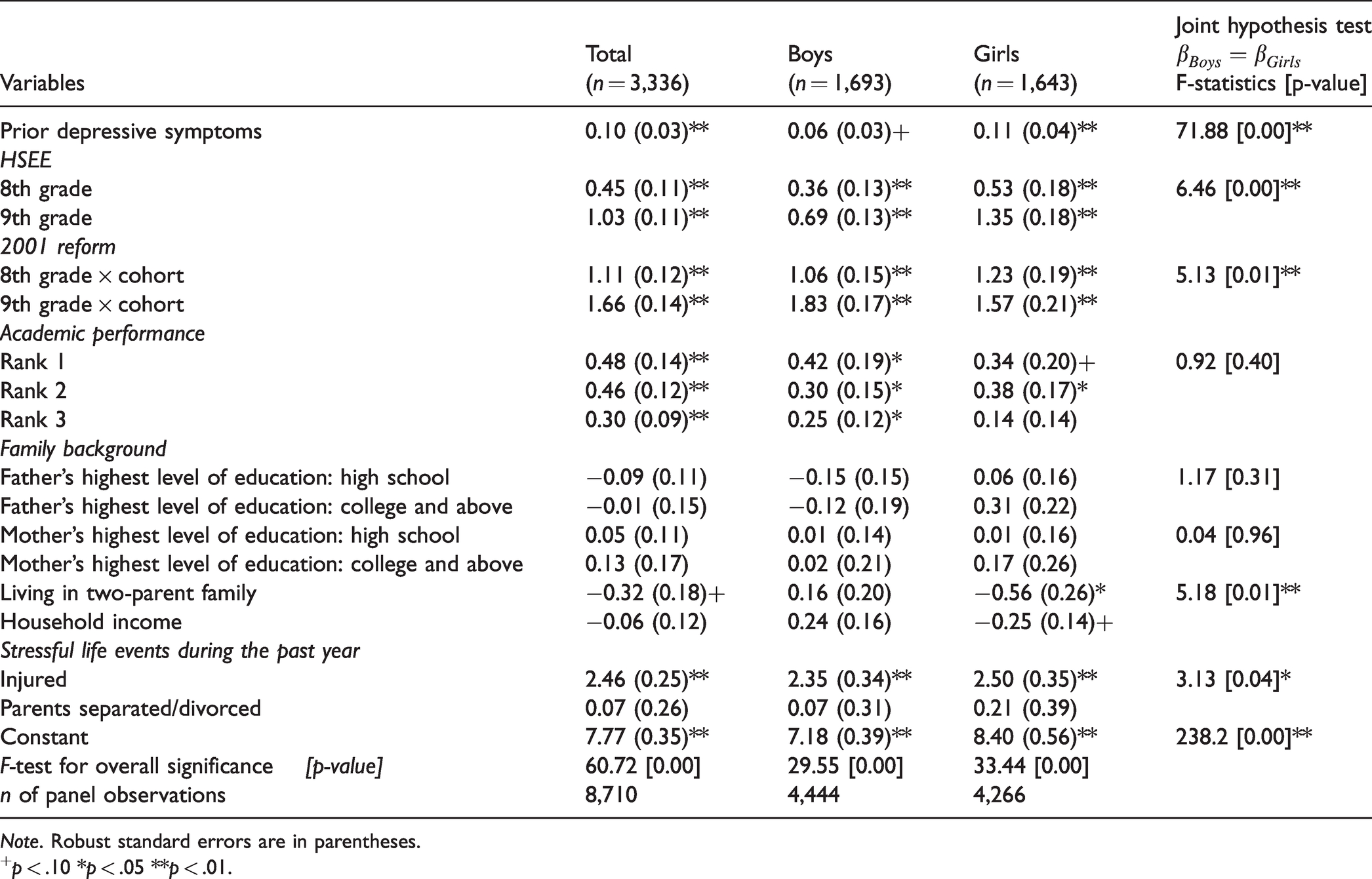
Note. Robust standard errors are in parentheses.
+p < .10 *p < .05 **p < .01.
Gender differences in depressive symptoms
The joint hypothesis tests in Table 3 show that, for prior depressive symptoms, the relationship between earlier and later depressive symptoms for boys is significantly different from that of girls. Girls’ prior level of depressive symptoms showed a significantly greater correlation with their later symptoms than boys’. The group of variables HSEE shows that adolescent girls have significantly higher levels of and larger increases in depressive symptoms since seventh grade than boys when facing HSEE. Furthermore, the p-value for the 2001 Reform variables reveals that the 2001 reform has jointly and significantly different effects on depressive symptoms in the eighth and ninth grades for boys and girls, in which boys report a greater hike in depressive symptoms than girls in ninth grade for the post-reform cohort. This gender difference is further resonated by the relationship between self-report class rank and the level of depressive symptoms. Overall, the academic performance category reveals that academic achievement is positively associated with depressive symptoms. Adolescent boys show a more pronounced yet nonsignificant level of depressive symptoms than girls.
To ensure the robustness of these causal effects, we alternatively performed the nearest neighbor matching method with the 16-item version of depressive symptoms from seventh to ninth grade (see Appendix I in the online supplementary material for details). With the balanced samples, the average treatment effect on the treated (ATET) and the average treatment effect (ATE) demonstrated that our results are robust.
Differential effect of the HSEE reform on the level of depressive symptoms
We further investigated whether the HSEE reform casts a uniform effect on adolescents’ level of depressive symptoms post-HSEE when they vary in the levels of depressive symptoms before taking the HSEE. We divided adolescents into two groups—one with a seventh-grade level of depressive symptoms lower than or equal to the median seventh-grade level of depressive symptoms (called the low depression group) and the other (called the high depression group). As shown in Table 4, during junior high school, the level of depressive symptoms in the previous year has a greater effect on the level of depressive symptoms in the following year for adolescents in the low depression group than the high depression group. However, for adolescents in the high depression group, the 2001 reform had a greater impact on the level of depressive symptoms than that of adolescents in the low depression group. That is, adolescents with a lower level of depressive symptoms were subject to the prior condition, whereas those with a higher level of depressive symptoms were subject to the HSEE. However, boys showed a steeper hike in the level of depressive symptoms due to 2001 HSEE reform in both low and high depression groups. In particular, the reform would raise the level of depression symptoms by 2.22 and 1.51 points out of a total of 35 points, or by 6.3% and 4.3%, for boys and girls in the high depression group, respectively. For those in the low depression group, the reform was estimated to increase the level of depressive symptoms by 3.6% and 2.4% for boys and girls, respectively.
Impacts of HSEE reform on depressive symptoms by the level of depressive symptoms at seventh grade.
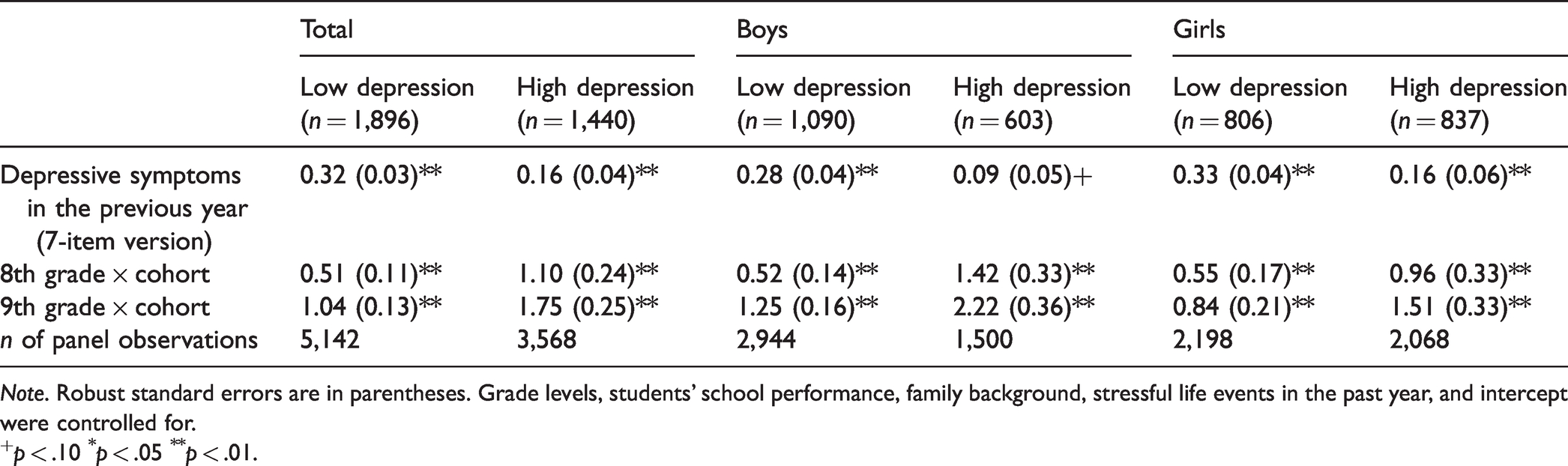
Note. Robust standard errors are in parentheses. Grade levels, students’ school performance, family background, stressful life events in the past year, and intercept were controlled for.
+p < .10 *p < .05 **p < .01.
The probability of participating in the second HSEE
Estimating the probit model, we found that adolescent boys in the fifth, seventh, and eighth deciles and the TOP are significantly more likely than girls to take the second HSEE with a probability of 10.3%, 5.9%, 5.7%, and 13.8% (i.e., α1+ α2 j ), respectively (see Appendix J for the marginal effect of participating in the second HSEE). That is, boys are more likely to participate in the second HSEE than girls with a similar performance in the first HSEE, even though they already performed above median scores in the first HSEE.
Discussion and implications
Despite the benign intention of the 2001 reform in Taiwan, we found that, at least in academically competitive districts, the good will seemingly falls short in terms of adolescents’ depressive symptoms. Since the two cohorts differed in depressive symptoms before the HSEE but not after, our quasi-experimental design implies that depressive symptoms are likely a reaction to the reformed high-stakes exam. Therefore, the additional opportunity to improve one’s odds of entering a better senior high school is arguably a double-edged sword for adolescents in competitive districts that disrupts adolescents’ mental well-being: The cost of mental well-being cannot be overlooked (Lee & Larson, 2000), even with additional autonomy of improving performance. Moreover, resonating with Cole et al.’s (2006) research based on U.S. adolescent population, we found a cumulative effect for adolescents residing in academically competitive districts that when they exhibit a trait-like, high level of depressive symptoms early on, they are estimated to report a greater increase in the symptoms when the exam date draws near.
Moreover, consistent with the existing literature on gender differences in preferences for competition and that this difference might begin early on (Gneezy & Rustichini, 2004; Morin, 2015), adolescent boys in competitive districts are more likely to attempt the HSEE again than girls. Ironically, these adolescent boys might have scored well in their first attempt, partly reflecting the keen sensitivity to the prevailing elitism and credentialism when adolescents face high competition in the district (Crosnoe & Benner, 2016) or a sense of insecurity among adolescent boys (or their parents) in Taiwan (Wang et al., 2018). Consequently, the tendency to attempt both HSEEs appears to cast a toll on adolescent boys’ well-being.
Whereas adolescent girls in academically competitive districts showed a higher level of exam-induced depressive symptoms than boys overall, resonating with studies conducted with adolescents in North America (Salk et al., 2017), Taiwanese adolescent boys seem to be more responsive to high-stakes educational achievement-related stressors, replicating findings from existing studies based on non-Asian populations (Hankin et al., 2007; Weis et al., 2013). In this sense, changes in the level of depressive symptoms among young adolescent girls could be understood as a dispositional trait responsive to stressful life events, while adolescent boys may be a state in which their mental well-being is more easily impacted by academic stressors (Cole et al., 2006). Without properly controlling for state dependence, inferences concerning the impacts of 2001 educational reform on adolescents’ depressive symptoms would be biased.
Given the detrimental effect of stressful life events on adolescents’ mental well-being, school psychologists can help instructors, parents, and students make informed decisions about whether to attempt the exam again, and, when deciding to do so, monitor students’ depressive symptoms and provide timely assistance. It is also imperative for school psychologists, particularly for those who work in academically competitive districts, to track depressive symptoms longitudinally when providing professional support for adolescents preparing for high-stakes exams (Wang et al., 2018). School psychologists will benefit from integrating students’ academic records with the results of psychological assessments when charting intervention plans to help ease the process of exam preparation. Moreover, among adolescent boys in an academically competitive district, a high score on the first HSEE may not quench the angst of losing the spot in an elite senior high school. Mental health prevention and intervention efforts should thus be tailored to gender differences to better address the changes in depressive symptoms among adolescent boys and girls (Salk et al., 2017). Policy-wise, stakeholders can advocate other types of reform, such as limiting the number of high-stakes exams or eliminating the high-stakes exams altogether.
Limitations and future directions
Given the limitations inherent in the panel data, the findings should be interpreted cautiously. First, we analyzed data from the most academically competitive districts in Taiwan, and adolescents from other districts may present a different development of depressive symptoms due to easier academic competition. Second, it is imperative to gauge the long-term effect of the additional HSEE on the level of depressive symptoms later in high school for both cohorts. Such information will be particularly necessary when students face another high-stakes exam upon college admission. Third, it is plausible that other societal events beyond the reform that impacted one cohort and not the other may also influence adolescents’ mental well-being. For example, an earthquake struck Taiwan in September, 1999, but the pre-reform cohort had completed the HSEE back in July, 1999, and the post-reform cohort would not take the HSEE exam(s) until 2002. It is unlikely that students’ mental well-being was seriously affected by the negative consequence of the major natural disaster. Finally, researchers could embed structural equation modeling within the DiD framework when the latent structure of the depressive symptoms is of central interest.
Supplemental Material
sj-pdf-1-spi-10.1177_01430343211010873 - Supplemental material for The effect of high school entrance exam reform on adolescents’ depressive symptoms in Taiwan: A closer look at gender differences
Supplemental material, sj-pdf-1-spi-10.1177_01430343211010873 for The effect of high school entrance exam reform on adolescents’ depressive symptoms in Taiwan: A closer look at gender differences by Fung-Mey Huang, Hsun-Yu Chan and Hung-Lin Tao in School Psychology International
Footnotes
Acknowledgements
The opinions expressed are those of the authors and do not represent the views of the Ministry of Science and Technology, Taiwan. Approval from the Institutional Review Board is waived by the datasets’ provider (Institute of Sociology, Academic Sinica). Questions and requests should be directed to Hsun-Yu Chan, email:
Declaration of conflicting interests
The author(s) declared no potential conflicts of interest with respect to the research, authorship, and/or publication of this article.
Funding
The author(s) disclosed receipt of the following financial support for the research, authorship, and/or publication of this article: This study was funded by the Ministry of Science and Technology, Taiwan (#103-2410-H-002-015-).

Supplemental material
Supplemental material for this article is available online.
Author biographies
References
Supplementary Material
Please find the following supplemental material available below.
For Open Access articles published under a Creative Commons License, all supplemental material carries the same license as the article it is associated with.
For non-Open Access articles published, all supplemental material carries a non-exclusive license, and permission requests for re-use of supplemental material or any part of supplemental material shall be sent directly to the copyright owner as specified in the copyright notice associated with the article.
