



Abstract
The relationships between visuo-spatial abilities and geometry performances in school-aged children were examined. A battery of tests assessing non-verbal reasoning, visuo-spatial mental imagery, and academic achievement in geometry (i.e., geometric knowledge and geometric problem-solving competencies) was presented to 162 8-9.5-year-old pupils attending primary school. After controlling for age, significant associations were found between non-verbal reasoning abilities and knowledge in geometry (r = .31, p = .013) and geometric problem-solving skills (r = .35, p = .005), respectively. Similarly, using age as covariate, mental imagery abilities were significantly related to geometric knowledge (r = -.28, p < .001) and geometric problem-solving skills (r = -.24, p = .002), respectively. Furthermore, pupils with high visuo-spatial mental imagery abilities outperformed their peers with low visuo-spatial competences in the geometry tasks and further visuo-spatial abilities measure computed by their teachers. Finally, male participants showed better geometry skills than females.
The ability to temporarily retain and process visual (i.e., information about shape, texture, color) and spatial (i.e, the position of the stimulus in the space) stimuli is crucial for different academic achievements such as geography (e.g., Coluccia et al., 2007), drawing (e.g., Fastame, 2020), mathematics (e.g., Soltanlou et al., 2019). Within the latter learning domain, non-verbal working memory abilities and geometrical expertise attainment are linked, because geometry “involves problem-solving and reasoning about shape, size, the relative position of figures, and the properties of space” (Peng et al., 2016, p. 457). Attention on the cognitive functions underpinning geometry-related achievements must be drawn since geometric learning acquired at school is a mathematical subject very relevant for the successive development of STEM (i.e., sciences, technology, engineering, and mathematics) careers (e.g., Weckbacher & Okamoto, 2014, for a review see Khine, 2016).
A robust tradition of research pinpointing the relationship between the development of visuo-spatial abilities and geometry achievement in primary school-aged children is yet to be addressed. Nonetheless, there is growing evidence about the implication of non-verbal functions on different types of geometry attainments, especially in older children. In this regard, Giofrè et al. (2014) found significant associations between intuitive geometry skills (e.g., knowledge concerning the Euclidian geometry principles uncontrolled by formal education, Spelke et al., 2010) of fourth and fifth graders and their visuo-spatial reasoning abilities (i.e., fluid intelligence) assessed by the Raven’s Coloured Matrices (Raven et al., 1998). Moreover, according to the authors, a large portion of the variance (i.e., 40%) in geometry-related learning (i.e., geometrical skills acquired by explicit educational attainment) in primary school is predicted by general intelligence abilities and active working memory processes (i.e., memory functions implicated in the manipulation of information to be recalled), whereas the passive working memory component (i.e., underpinning the temporary storage of stimuli) does not seem to play a relevant role. However, that study does not clarify the specific contribution of active visuo-spatial functions in predicting geometry-related achievements in the fourth and fifth grades, since the authors did not consider the domain-specificity (e.g., verbal, visual) of working memory and they computed a composite index including both measures of active verbal and visuo-spatial working memory performances. Concerning this issue, a study conducted by Weckbacher and Okamoto (2014) with adolescents showed that the ability to mentally rotate and match three-dimensional configurations of blocks located in different spatial positions (i.e., tasks involving the active non-verbal working memory) positively correlated with geometry performance. In line with this, Bizzaro et al. (2018) documented that pupils attending the last year of primary school and the first year of secondary school with good geometric learning skills outperformed a group of peers with poor geometric competences in a set of passive and active visuo-spatial working memory tests as well as in a visuo-spatial mental imagery task requiring the manipulation of geometric shapes, (i.e., to mentally build or decompose some figures, to find an embedded geometric pattern and to color the intersection segments defined by the overlapping of some figural stimuli). It is noteworthy that these findings extend previous outcomes pointed out by Hannafin Truxaw et al. (2008), who found that high proficient spatial problem solvers (assessed by Raven’s Progressive Coloured Matrices) attending the sixth grade outperformed low proficient spatial problem solvers in some geometry-related academic achievement tasks. Expanding on this, Giofrè et al. (2013) documented that the most salient predictor of intuitive geometry and school-based geometry problem-solving performances of 17-18-year-old students is an active working memory measure requiring the mental manipulation of visual information to mentally resemble a set of familiar objects. Additionally, a further study carried out with atypically developing participants attending the early years of the Italian secondary school showed that 11-13-year-old children with visuo-spatial learning deficits performed poorly in some intuitive geometry tests (e.g., Euclidean geometry tasks requiring to solve some problems based on principles about parallel or straight lines), as well as in several active visuo-spatial working memory tests requiring the mental manipulation of visual and spatial stimuli, whereas no significant group differences with typically developing peers were found in passive visuo-spatial working memory conditions (Mammarella et al., 2013). These findings have been recently extended by further investigations conducted with primary and secondary school-aged students, pointing out the significant impact of spatial visualization (i.e., manipulating and modifying stimuli in one’s mind such as in the paper-folding tasks) and mental rotation (i.e., imagining to modify the angle of rotation of a stimulus such that it can be seen in different perspectives) skills on mathematics achievement (e.g., Harris et al., 2020; for a meta-analysis see Xie et al., 2020).[AQ: Please provide complete details for (Harris et al., 2020; Xie et al., 2020) in the reference list or delete the citation from the text.] However, it must be also noticed that evidence concerning the relationship between geometry skills and active visuo-spatial memory processes is controversial, since several studies did not report any significant association between geometry proficiency and visuo-spatial working memory in school-aged participants (Kyttälä & Lehto, 2008) or that relationship becomes not significant after controlling verbal intelligence and age (Frick, 2019).
There is also evidence about the effectiveness of specific computer-assisted mental rotation (Cardillo et al., 2014) and active visual working memory (Zhang, 2017) interventions for the enhancement of geometric learning performances in primary schools and college students. In contrast, the impact of gender on geometry learning in school-aged children is less clear, since according to Battista (1990) high school males performed better than female classmates in some geometric problem-solving tasks, whereas further authors (Casey et al., 1995; Friedman, 1995; Weckbacher & Okamoto, 2014) did not found any significant gender effect in terms of geometry-related learning.
The current investigation intended to examine: 1) the associations between geometric learning skills, visuo-spatial reasoning, and visuo-spatial mental imagery abilities in 8-9-year-old pupils, using age as a covariate; 2) the impact of gender on geometry-related performance of school-aged children, controlling for the effect of age; 3) the impact of visuo-spatial mental imagery proficiency on the geometry-related performance of pupils attending the primary school; 4) whether pupils with low or high visuo-spatial mental imagery competences were capable of self-assessing the efficiency of their non-verbal functions in a consistent fashion; 5) whether pupils with low or high visuo-spatial mental imagery skills reported lower or higher visuo-spatial abilities scores in a questionnaire completed by their teachers; 6) whether the visuo-spatial esteem scores reported by the teachers and pupils are significantly associated with the geometric skills objectively assessed by two geometry tasks.
To pursue the third, fourth, and fifth goals, a good vs. poor ability design was adopted, since previous literature suggests that this approach is successful for examining individual differences (e.g., Bizzaro et al., 2018; Fastame et al., 2018; Kane & Engle, 2002). Therefore, performances of two subgroups of pupils with high and low visuo-spatial mental imagery abilities (i.e., assessed and matched through a validated visuo-spatial imagery task for children attending the Italian primary school) were compared in two geometry tasks and in two visuo-spatial questionnaires validated to be used in the Italian primary school.
Overall, following previous research, the following hypotheses were yielded:
geometric knowledge and geometric problem-solving skills were expected to be significantly associated with visuo-spatial reasoning and mental imagery abilities, respectively, because to perform an academic geometric task one has to understand the nature of the problem, to mentally represent it, to plan and perform a set of strategic procedures to solve it (e.g., Bizzaro et al., 2018; Giofrè et al., 2013; Weckbacher & Okamoto, 2014). If gender differences were present, males were expected to outperform female pupils in terms of geometric knowledge and geometric problem-solving skills (Battista, 1990). However, consistently with further investigations (e.g., Casey et al., 1995; Friedman, 1995), no statistically significant gender differences regarding the participants’ geometric performances could also be hypothesized in the two abovementioned geometry conditions. Following Weckbacher and Okamoto (2014), low visuo-spatial mental imagery skills were expected to affect performances in geometric knowledge and geometric problem-solving tasks, respectively. Following previous evidence (Fastame & Manca, 2019) suggesting statistically significant associations between the visuo-spatial mental imagery measure and the visuo-spatial questionnaire for teachers used in the current study, it was hypothesized that pupils with objective low mental imagery skills would have reported lower visuo-spatial scores in the questionnaire completed by their teachers.
Finally, due to the lack of previous findings, no further a priori predictions were provided.
Method
Participants
One hundred and sixty-two 8-9.5-year-old pupils, 81 males and 81 females (Mage = 8.8 years, SD = 3.5 months) were recruited in several public Italian primary schools attended by children with both low and high SES. All children were typically developing, that is, they did not present any sign of intellectual disability, socio-cultural disadvantage, or specific learning disabilities according to the teacher's reports. The participants attended the third and fourth grades of primary school.
Gender was counterbalanced across the children (χ2 < .0001, df = 1, p = 1).
Materials
The following battery of tests was presented:
The Raven Coloured Progressive Matrices test (CPM, Raven et al., 1998; Italian version Belacchi et al., 2008), which was administered as a measure of fluid intelligence to assess the efficiency of visuo-spatial problem-solving abilities and to exclude the presence of participants with intellectual deficits. Each participant was asked to select among six alternatives the element necessary to complete 36 colored geometrical patterns (divided into three series), to satisfy some abstract and logical reasoning rules. One point was assigned to each non-verbal problem correctly solved (maximum score = 36). The test’s coefficient alpha is .909 (Raven et al., 1998), whereas the correlation index between each series and the total CPM score ranges between .64 and .93 (Belacchi et al., 2008).
Part A of the Spatial Understanding Test (Rigoni et al., 1997) was administered to assess visuo-spatial comprehension and mental imagery skills. This is an ecologically valid open access visuo-spatial imagery tool that was originally developed to be used in the Italian primary school. To perform the task, each child was invited to draw 5 sets of well-known stimuli (e.g., a book, a frog, a ball) located in a certain environment described by the experimenter. Specifically, each verbal description of the scene was read aloud twice by the experimenter, then the pupils were asked to perform the drawing of the visuo-spatial description on an A4 piece of paper. Thus, to carry out the task, one must visualize each described object in the scene, and then he/she must locate each item in the environment, respecting the spatial relationships (e.g., between, in front of) among the stimuli. For each of the five drawings carried out by the participants, the criteria suggested by Rigoni et al. (1997) were used to compute a total error score (maximum error score = 15).
The Geometric Knowledge Subtest is part of the Geometry Test battery (Mammarella et al., 2012) that is designed to assess the geometry skills in the Italian primary school. The Geometric Knowledge Subtest is composed of 8 problems assessing the knowledge about the properties of the geometric figures (e.g., what sort of triangle is this? What is a segment?) and the lexicon (e.g., what is the name of the following geometric figures?) used in the geometry field. One score was assigned to each correct response (maximum score = 13). Subtest’s coefficient alpha of Chronbach is .50 (Mammarella et al., 2012).
The Geometric Problem-Solving Subtest of the Geometry Test battery (Mammarella et al., 2012) consists of 8 exercises/problems requiring reasoning procedural abilities, strategic and geometric competencies to solve the task (e.g., calculate the area of this geometrical pattern). Two points were assigned if the problem was solved correctly, 1 point if the solution was partially correct and 0 in case of error (maximum score = 16). The internal consistency of the subtest is expressed by .69 Cronbach’s alpha coefficient (Mammarella et al., 2012).
The Shortened Visuospatial Questionnaire for Children (i.e., SVS-child, Ferrara & Mammarella, 2013) is an open-access tool developed to be used to esteem what the pupil thinks about his/her non-verbal skills. The questionnaire can be administered to 7-11-year-old pupils and it is composed of 15 items, 6 of which provide a visuo-spatial skills efficiency (e.g., spatial recall, visuo-motor coordination) index, whereas the further items are used to compute some verbal, attention, and learning efficiency measures, respectively. For each statement, the child has to self-rate the frequency of that behavior in his/her school life on a Likert scale ranging from 1 (i.e., never) to 4 (i.e., always). For the aims of this investigation, only the visuo-spatial index was used (maximum score = 24). The internal consistency among the four SVS-child indexes is expressed by a coefficient alpha ranging between .56 and .78 (Ferrara & Mammarella, 2013).
The Shortened Visuospatial Questionnaire for Teachers (i.e., SVS-teacher, Cornoldi et al., 2003) is an 18-item tool for the teacher being designed mainly to screen the efficiency of non-verbal functions in 7-11-year-old pupils. This open-source questionnaire has been validated in English and Italian to detect children with suspected visuo-spatial deficits attending primary school. For the aims of the current study, for each student their teachers had to rate the frequency of 10 visuo-spatial abilities on a 4-point Likert scale ranging from 1 (i.e., never) to 4 (i.e., always), therefore the maximum score was 40. The internal consistency of this measure ranges between .90 and .95 (Cornoldi et al., 2003).
Procedure
Once the heads of the schools approved the procedure for the data collection, to be enrolled in the study, prior written informed consent had to be provided by at least one parent of the potential participants.
Children were collectively tested in groups encompassing maximum 25 participants in a quiet room of their school in two distinct experimental sessions. No time limits were given to perform the tests, that is, each task was considered completed when the participant stated that.
The presentation order of the cognitive tasks was counterbalanced across the groups of participants according to the Latin square procedure. Each collective session lasted approximately 40 minutes. In case a participant obtained a score in the CPM test condition indicating the occurrence of intellectual deficits (i.e., performance < 5th percentile), his/her data were excluded for the successive statistical analyses. None of the participants was excluded for this reason. Moreover, the teacher of each participant was asked to complete the SVS-questionnaire, to collect further information about the visuo-spatial skills of each pupil. The questionnaire completion took approximately five minutes for each pupil.
Results
First, possible significant associations between geometry measures (i.e., Geometric Knowledge and Geometric Problem-Solving abilities), non-verbal reasoning (i.e., CPM), and visuo-spatial mental imagery (i.e., Spatial Understanding Test –Part A) indexes were examined via the computation of partial correlation coefficients, after entering age (i.e., expressed in months) as the covariate. Significant correlations were found between CPM index and Geometric Knowledge (r = .31, p = .013) and Geometric Problem-Solving abilities (r = .35, p = .005) measures, respectively. Similarly, significant correlations were also found between the errors made in the Spatial Understanding test and the number of correct responses provided in the Geometric Knowledge (r = -.28, p < .001) and in the Geometric Problem-Solving (r = -.24, p = .002) subtests, respectively. Table 1 illustrates these outcomes.
Pearson’s r indexes between visuo-spatial problem-solving (i.e., CPM), Geometric Knowledge Subtest (i.e., Geometric Knowledge), Geometric Problem-Solving Subtest (i.e., Geometric Problem Solving) scores and the total number of errors made in Part A of the Spatial Understanding Test, controlling age.

Note. * p < .05, ** p < .01, *** p < .001
Additionally, Pearson-product moment coefficients were calculated between SVS-Child, SVS-Teacher visuo-spatial scores, and Geometric Knowledge and Geometric Problem-Solving measures detected in the whole sample. Significant associations were found between the SVS-teacher esteems and Geometric Knowledge (r = .23, p = .003) and Geometric Problem-Solving (r = .41, p < .001) scores, whereas the relationship between the latter measures and the SVS-Child visuo-spatial index did not reach significance (r = .14, p = .07 in Geometric Knowledge condition and r = .04, p = .60 in Geometric Problem-Solving one).
Next, a between-subjects Multivariate Analysis of Covariance (MANCOVA) was performed to investigate the impact of gender on Geometric Knowledge and Geometric Problem-Solving tasks, controlling for the effect of age. The Multivariate tests revealed the significant main effect of age [Wilks’ λ = .93, df = 2;161, p = .003], whereas the effect of gender was not significant [Wilks’ λ = .97, df = 2;161, p = .06]. In Geometric Knowledge condition there were both the main effect of gender [F(1,162) = 4.88, p = .03, η2p = .03] and age [F(1,162) = 8.86, p = .003, η2p = .05], whereas in Geometric Problem-Solving condition there was the significant main effect of the covariate [F(1,162) = 8.58, p = .004, η2p = .05] but not the significant main effect of gender [F(1,162) =.052, p = . 82]. Overall, males outperformed females in terms of Geometric Knowledge (M = 8.6, SD = 2.78 for males vs. M = 7.77, SD = 2.18 for females) but not in terms of Geometric Problem-Solving skills (M = 7.10, SD = 3.41 for males vs. M = 7, SD = 2.85 for females).
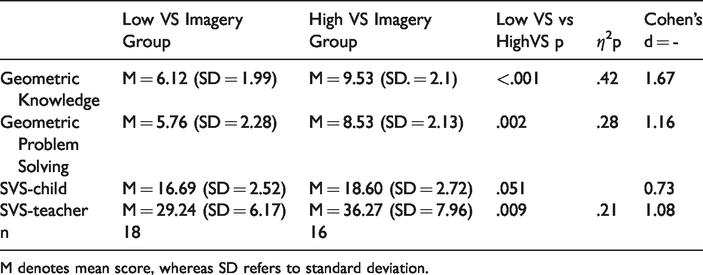
Therefore, using the cut-off norms for the Part A of the Spatial Understanding test suggested by the authors, a subgroup of pupils (n = 18) with low visuo-spatial mental imagery abilities (i.e., error score > 6) was gender-matched with a subgroup of classmates showing high (i.e., error score < 1) mental imagery competences (n = 16). The non-verbal mental imagery level (i.e., low vs. high) was counterbalanced across the selected participants (χ2 .125, df = 1, p = .724). Then, to compare the performances of children with high and low visuo-spatial mental imagery abilities on Geometric Knowledge and Geometric Problem-Solving tasks, two separate t-test comparisons were performed. There was the significant effect of visuo-spatial mental imagery skills both in Geometric Knowledge (t(30) = -4.71, p < .001, Cohen’s d = 1.67) and in Geometric Problem-Solving (t(32) = -3.38, p = .002, Cohen’s d = 1.16) conditions, respectively. Overall, pupils with high visuo-spatial mental imagery abilities (i.e., those pupils who reported fewer errors in Part A of the Spatial Understanding test) showed better Geometric Knowledge (M correct responses = 9.53, SD = 2.1) and Geometric Problem-Solving (M correct responses = 8.53, SD = 2.13) competences than children with low visuo-spatial mental imagery abilities (M correct responses = 6.12, SD = 1.99 in the Geometric Knowledge condition and M correct responses = 5.76, SD = 2.28 in the Geometric Problem-Solving condition, respectively). In the Geometric Knowledge condition, the mean difference from the low proficient mental imagery group to the high proficient one was 3.42, with a 95% confidence interval ranging from -4.9 and -1.94. Following Cohen (1988), the eta squared statistic (.42) indicated a large effect size. Furthermore, the magnitude of the differences in the Geometric Problem-Solving means (mean difference = 2.55, 95% Cl: -4.08 to 1.87) was large too (eta squared = .28).
Moreover, two further separate t-test comparisons were carried out to evaluate whether children with high/low visuo-spatial mental imagery ability level (i.e., low vs. high mental imagery skills assessed through the Spatial Understanding test) also reported high and low scores on the visuo-spatial SVS-teacher and visuo-spatial SVS-Child scores, respectively. As reported earlier, these non-verbal efficiency esteem measures were computed by asking the participants and their teachers to complete the SVS-Child and the SVS-Teacher Questionnaires. There was a statistically significant decrease in visuo-spatial SVS-teacher score from pupils with high visuo-spatial mental imagery abilities (M = 36.27, SD = 7.96) to children with low imagery competences (M = 29.24, SD = 6.17), t(30) = -2.81, p = .009, Cohen’s d = 1.08. The mean decrease in SVS-teacher scores was 7.03 with a 95% confidence interval ranging from -12.14 to -1.923. The eta squared statistic (.21) indicated a large effect size (Cohen, 1988). Finally, the decrease in SVS-Child visuo-spatial score from children with high non-verbal mental imagery competences (M = 18.6, SD = 2.72) to pupils with low imagery competences (M = 16.69, SD = 2.52) was not significant, t(29) = -2.031, p = .051, Cohen’s d = 0.73. Table 2 summarizes the mean scores and standard deviations of the high and low visuo-spatial mental imagery groups in each geometry task and the SVS- questionnaire conditions.
Mean scores of the subgroups with low (i.e., Low VS Imagery) and high (i.e., High VS Imagery) visuo-spatial mental imagery skills in Geometric Knowledge, Geometric Problem-Solving, SVS Questionnaire for children (i.e., SVS-child) and SVS Questionnaire for (i.e., SVS-teacher) conditions.
M denotes mean score, whereas SD refers to standard deviation.
Discussion
The main goal of the present study was to provide insights into the role played by visuo-spatial mental imagery abilities on learning geometry in 8-9-year-old children attending primary school. First, the nature of the relationships between academic geometry-related achievement, visuo-spatial reasoning, and visuo-spatial mental imagery competencies was investigated. Besides, this research also intended to examine whether there were significant differences in terms of geometry-related knowledge, geometric problem-solving, and visuo-spatial abilities (i.e., assessed by the SVS-teacher and SVS-child questionnaires) in pupils with proficient mental imagery skills and those with poor competences. Finally, the gender effect on the geometry-related tasks was investigated.
Thus, for the aims of the current investigation, visuo-spatial mental imagery was assessed by an open-access ecologically valid tool developed for Italian pupils attending primary school (Rigoni et al., 1997). Specifically, the test requires the drawing of a mentally manipulated scene in which a set of familiar stimuli must be located according to the verbal description of their spatial relationships provided by the experimenter.
In line with previous studies (e.g., Bizzaro et al., 2018; Hannafin et al., 2008), and following Cohen (1988), statistically significant small and medium relationships were found between non-verbal problem-solving, visuo-spatial mental imagery, and each of the geometry-related academic achievements measure proposed to the participants. Furthermore, following Weckbacher and Okamoto (2014), pupils with stronger mental imagery abilities (i.e., they made fewer errors in the Part A of the Spatial Understanding test) tended to be stronger in the tasks assessing geometrical problem-solving and geometry-related knowledge, respectively. Besides, extending the evidence recently pointed out by Fastame and Manca (2019), children objectively reporting poorer visuo-spatial mental imagery competencies (i.e., those pupils who reported more errors in Part A of the Spatial Understanding test) were described by their teacher as poorer in terms of visuo-spatial abilities (e.g., visuo-motor coordination, comprehension of spatial relationships). In line with this, the scores reported by the whole sample in two objective geometry tasks were significantly associated with the esteems about the visuo-spatial abilities of each participant which were expressed by their teachers. Additionally, unlike what Friedman (1995) and Casey et al. (1995) reported, but in line with Battista (1990), male pupils showed better geometry-related knowledge than female classmates. Finally, unlike previous evidence (Ferrara and Mammarella, 2013), the self-assessment of the visuo-spatial abilities reported by the pupils in the SVS-child questionnaire was not consistent with their objectively assessed non-verbal performance. Besides, children with high and low visuo-spatial imagery abilities reported similar SVS-child visuo-spatial scores. Overall, these outcomes suggest that the self-perception of the visuo-spatial competencies of children was not accurate.
It is worth noting, however, that caution is needed, because this investigation must be considered exploratory and preliminary. Indeed, the current study has several limitations, such as the paucity of visuo-spatial proficient and poorer participants, the limited age range of the pupils, the administration of a limited number of visuo-spatial and geometry tasks. Moreover, it is important to consider that although the magnitude of the geometrical skills in the participants with very low vs. very high mental imagery was quite large, the adoption of an approach based on the comparison between the most proficient pupils exhibiting very high mental imagery skills and a subsample of peers showing very poor active visuo-spatial working memory reduced the statistical power. This implies that the risk of committing a type II error must be considered.
Future research should overcome these issues, replicating the study with wider samples of younger and older typically and atypically developing participants (e.g. individuals with Williams and Down syndromes or students with a visuo-spatial learning disability; for a review, see Cornoldi et al., 2016). This will serve also to clarify whether children with poorer geometry learning skills are aware of their limits, self-assessing in a consistent way the efficiency of their visuo-spatial abilities. Indeed, current findings do not allow to track any conclusion, since the level of consistency between the mental imagery efficiency index and self-assessment of non-verbal abilities by the participants of this study fell just short of the traditional definition of statistical significance (p = .051).
Moreover, future studies should use a wider battery of visual and spatial WM tests, including some tasks assessing the efficiency of non-verbal executive functions. Accordingly, following Miyake et al. (2000), the administration of different executive function tasks would help to clarify the role played by distinct central attentional resources (e.g. updating, shifting, planning, inhibition) in driving children’s geometry-related performances. Indeed, the existing literature does not allow for making any definitive conclusion about this, since usually a significant relationship has been highlighted between geometry-related academic achievement and working memory tests requiring the active manipulation of spatial positions into matrices or the mental assembly of well-known objects (e.g., Giofrè et al., 2013). Therefore, future research should fill this gap.
In conclusion, from a theoretical perspective, this investigation seems to corroborate the view of a strong association between the development of visuo-spatial mental imagery and academic achievement in the geometry of pupils attending primary school. Therefore, from an applied educational viewpoint, bearing in mind that visuo-spatial abilities (e.g., non-verbal reasoning, visual working memory) are implicated in STEM careers (e.g., Khine, 2016), this investigation provides at least two suggestions. First, the use of well-validated and open-access screening tools for the assessment of mental imagery and visuo-spatial abilities at school such as some measures used in the current study (i.e., Cornoldi et al., 2003; Ferrara & Mammarella, 2013; Rigoni et al., 1997) should be encouraged to detect children with suspect non-verbal deficits, which in turn could perform poorly in academic subjects like geometry. Second, in order to promote successful geometry-related academic performances, children with low non-verbal reasoning, poor visuo-spatial WM, and mental imagery skills could benefit from specific psychoeducational interventions aimed at enhancing these abilities. In this regard, a good deal of research showed the improvement of geometry learning achievement of adolescent students being trained at school by a psychoeducational program aimed at enhancing mental rotation abilities (e.g., Zhang, 2017). Therefore, bearing in mind the role played by visuo-spatial imagery and abstract reasoning on academic achievement, the empowerment of geometrical and non-verbal skills should be promoted at school, using validated psychoeducational interventions tailored to the school-aged children’s needs.
Footnotes
Availability of data and material
The data that support the findings of this study are not publicly available due to privacy or ethical restrictions.
Declaration of conflicting interests
The author(s) declared no potential conflicts of interest with respect to the research, authorship, and/or publication of this article.
Funding
The author(s) received no financial support for the research, authorship, and/or publication of this article.
Ethical approval
This study was conducted in conformity with the provisions of the Declaration of Helsinki. The heads of the schools approved the procedure for the data collection and prior written informed consent was given by the parents of the children involved in this investigation.
