




Abstract
In response to national attention regarding issues of racial injustice facing Black Americans, education has been highlighted as a field that has systematically operated in a way that has been detrimental to Black children in the form of underfunding, segregated schools, discriminatory discipline policies, and disproportionate placement in special education. While current estimates indicate a narrowing of the achievement gap, also referred to as opportunity gap, a large difference remains regarding how Black students perform on standardized tests when compared to their White counterparts. According to the Education Opportunity Project at Stanford University (Reardon et al., 2019), the differences in standardized test scores are reported to amount to a deficit of approximately two academic years for Black students. While racial disparities in education are a longstanding issue, greater focus on dismantling structural inequity is required for Black students to have equal access to quality education. To accomplish this goal, educational professionals across all disciplines must examine their practices through an anti-racist lens. Within the field of school psychology, anti-racism has been defined as an ethical responsibility to acknowledge the inequities that exist within the school system and a willingness to advocate for anti-racist practices (García-Vázquez et al., 2020). In regard to assessment practices, school psychologists are urged to critically examine their own implicit biases and adopt nondiscriminatory and culturally responsive evaluation procedures.
Early assessment research: Black pioneers in psychology
Given the history of psychological testing and the widespread negative impact stemming from the misuse of intellectual tests, the assessment of Black children remains a heavily debated topic. Albert Beckham, who is considered the first Black school psychologist, focused his work in the 1920's on utilizing culturally appropriate assessment methods to assess Black children (Graves, 2009). Most of his work took place at his psychological laboratory at Howard University, which was one of the first laboratories of that kind to be created at a predominantly Black higher education institution. He also later established one of the first school-based psychological clinics in 1934. Beckham devoted most of his early work to countering the narrative that Black people were intellectually inferior by advocating for the use of culturally fair assessment practices. Like many Black psychologists during that time, Beckham did not take issue with the test instruments themselves, but instead focused on how they were used and interpreted, which requires greater clinical judgment. For instance, Beckham believed that differences in performance on intelligence tests were not due to genetic inferiority but rather were a result of Black Americans having less access to quality education. Consistent with the work of other early Black scholars like Howard Hale Long and Inez Beverly Prosser, Beckham's (Prosser, 1933) research focused heavily on the misuse of assessment tools with Black people and how inequitable educational opportunities negatively impacted standardized test scores. Their legacy was continued on throughout the century by Black scholars in the 1970s who challenged the utility of intelligence tests and clinical judgment of school psychologists in the Larry P. V. Riles court case (Powers et al., 2021). Their legacy not only laid crucial groundwork in regard to advocating for culturally fair assessment of Black children, but also helped paved the way for current research like the recent publication of The Fortieth Anniversary of Larry P. V. Riles: Cognitive Assessment and Black Children (Woods & Graves, 2021).
Disproportionality
One outcome that has been extensively linked to unfair assessment practices is disproportionality. Black students across the United States are often at higher risk for referral for special education eligibility when compared to non-minority students (Sullivan & Bal, 2013). According to Sullivan et al. (2009), disproportionality is the result of systematic inequity, discrimination, and marginalization in society. Decades ago, Hilliard (1980) criticized special education as being inherently biased because of educators’ perceptions of cultural differences of minoritized students. Blanchett (2006) asserted that educators see whiteness as the norm and as a result, Black students are often compared to White students. This construction of White privilege within the school setting was further emphasized by Alexander (2010) as the lack of understanding of Black culture and the acceptance of negative stereotypical characterizations of Black students. This, in turn, maintains the status quo of perpetuating the norm of whiteness while pathologizing the behavior of Black children and placing them at higher risk for special education placement.
Implicit bias and clinical decision making
In relation to school discipline, McIntosh et al. (2014) believe there are Vulnerable Decision Points (VDP) in which implicit bias impacts decisions more when uncertainty, ambiguity, and the need for discretion arise. Furthermore, there is evidence that race is a contributing factor to many of the actions and outcomes that occur at the school level, such as the likelihood of a Black student being referred to a gifted program (Elhoweris et al., 2005), higher ratings of externalizing behaviors for Black students (Downey & Pribesh, 2004), and higher suspension and expulsion rates for Black girls and boys (Wesley & Ellis, 2017).
Within the realm of intelligence testing, there are many stages during the assessment process that require school psychologists to depend on their clinical judgment to guide their practices and procedures. For instance, when conducting a psychoeducational evaluation of a student to determine special education eligibility, school psychologists use their clinical judgement to determine which assessment batteries to administer and are often required to use their discretion to score student responses that are vague or not clearly defined in the administration manual. It is important to note that there has been very little change to specific assessment practices utilized by school psychologists, with Wechsler assessments reported as the most utilized intelligence measures by school psychologists for the past four decades (Benson et al., 2019). However, it is crucial for school psychologists to consider how strict reliance on the use of Wechsler assessment tools for students from diverse cultural backgrounds could impact the validity of the scores and contribute to disparate educational outcomes. This concern was raised by a recent study conducted by Graves et al. (2020), which found that two subtests on the Wechsler Intelligence Scale for Children-Fifth Edition (WISC-V) were not invariant by race and thus operated differently for Black and White children.
Purpose of the present study
Clinical judgment plays a significant role in the promotion of nondiscriminatory assessment practices. While previous literature has highlighted several factors that may impact the overall validity of assessment results for Black children, there remains a need to examine the specific practices that school psychologists employ when assessing a student from a minoritized group. According to Aston and Brown (2020), 42.9% of the school psychologists in their sample endorsed the belief that current intelligence tests may be culturally biased toward Black students and less than half of their entire sample agreed that intelligence tests accurately measured the intellectual ability of Black students. Regarding disproportionality, over half of the participant sample agreed or strongly agreed that Black students were more likely to be identified as having an intellectual disability, which is consistent with national statistics on disproportionality patterns. Like concerns raised by Beckham and his colleagues in the 1930's, the practitioners from the survey identified poverty, linguistic differences, and access to equitable educational opportunities as contributing factors that impacted the test performance of Black students (Aston & Brown, 2021). In other words, it is believed that lower scores on intelligence measures may be more indicative of the systemic inequities that Black children are more prone to encounter, rather than a true learning disability.
Given the important role that intelligence testing plays in determining special education eligibility decisions, exploring the role of clinical judgment during the assessment process is imperative for preventing the misclassification of Black students in special education. Therefore, the purpose of this exploratory research study was to closely examine how school psychologists utilize clinical judgement when conducting psychological evaluations to determine special education eligibility. Specifically, the researchers were interested in examining whether school psychologists adjusted their assessment approach when evaluating Black students in comparison to their White counterparts, given the possible impact of cultural variables. Interviews allowed for the collection of information directly from current practitioners that regularly conduct school-based psycho-educational evaluations.
Method
A qualitative research design was utilized in this study to investigate the assessment practices of school psychologists and the role of clinical judgement when evaluating Black students for special education eligibility. Qualitative studies operate under the assumption that reality is subjective and seek to investigate the quality or qualities of an experience or phenomenon. This design enabled the researchers to understand the phenomenon of how and why school psychologists use various assessment practices when conducting psycho-educational evaluations. To recruit participants, snowball sampling was utilized for the selection of participants (Goodman, 1961; Biernacki & Waldorf, 1981). While snowball sampling is unlikely to obtain a representative sample because there is no real control of the snowball effect, this form of sampling is often used when it is difficult to identify all those who might fall into the project's category of interest (Winkler & Buckner 2006). For this study, authors forwarded a link to an online pre-screening form to school psychologists in the Atlantic region of the United States and encouraged them to forward the link to other colleagues.
Procedure
Data were collected through individual participant interviews. A semi-structured interview form, developed by researchers, was used (Appendix A). Specific questions were developed to expound upon findings from a recent survey study that investigated assessment practices of Black children (Aston & Brown, 2020). The interview questions were reviewed by two school psychology faculty with expertise in nondiscriminatory assessment practices before proceeding with the interview process. During the interview, participants were presented with 10 broad questions that explored their current assessment practices, with a specific focus on the practices employed when assessing Black children. The length of the individual interviews ranged from 30 min to 1 h, with opportunities for follow-up with participants if additional questions emerged after review of initial interview responses. This study received approval from the University Ethics Committee and all interviews were recorded and transcribed with participant consent in alignment with polices outlined by the Institutional Review Board (IRB) at the primary investigator's institution.
Participants
To be eligible for this study, participants were required to be affiliated with a school district as a school psychologist and have had at least one experience assessing a student that identified as Black or African American. In addition, researchers identified the school setting (i.e., urban, rural) and ethnicity of the practitioner as additional variables to consider when selecting participants to gather diverse perspectives. For this study, a total of five participants were selected to participate in the interview process. Demographic information for each participant is provided in Table 1. While there is no consensus regarding how many participants are necessary for qualitative research, researchers are prompted to consider issues such as the heterogeneity of the population (Bryman, 2012) and aim of the research (Becker et al., 2012) when determining the number of interviews to conduct. We believed a sample size of five practitioners who were purposefully selected would adequately capture the range of responses we might expect and would provide in-depth detailed accounts. According to Sandelowski (1995), researchers are recommended to select sample sizes that allow for the uncovering of a new understanding but that are also small enough to ensure researchers can conduct a thorough case-oriented analysis.
Description of participants according to sociodemographic characteristics.
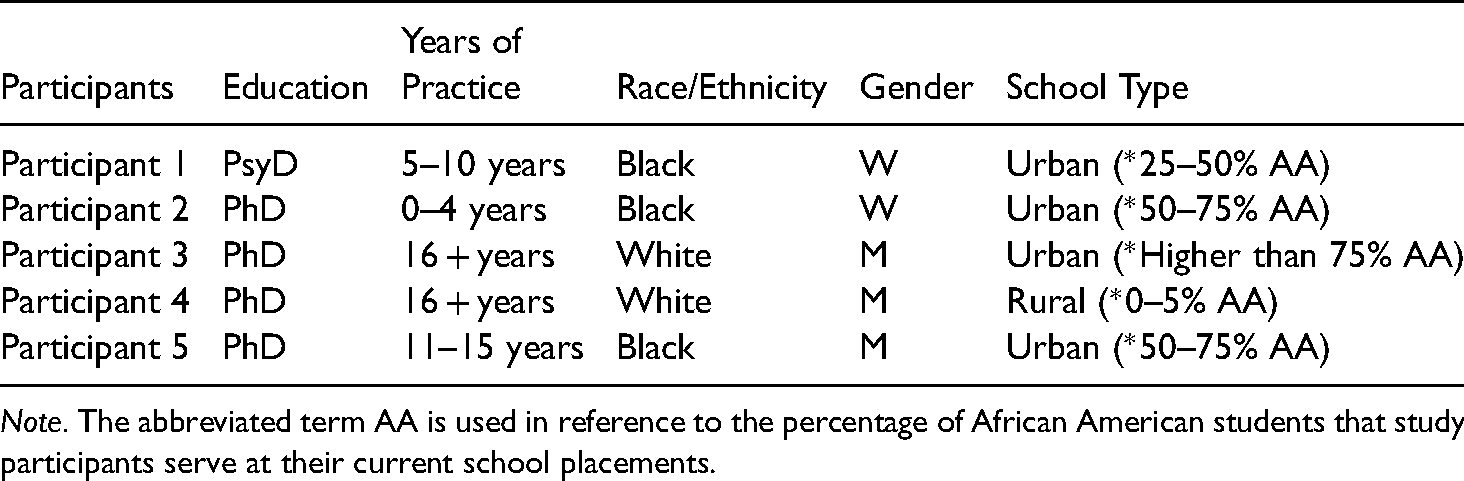
Note. The abbreviated term AA is used in reference to the percentage of African American students that study participants serve at their current school placements.
Data analysis
For analysis purposes, grounded theory was selected as the theoretical framework to explore the role of clinical judgement when conducting psycho-educational evaluations. Grounded theory presents the guidelines for how to identify categories, make links between categories, and how to establish relationships with them (Creswell & Poth, 2018). This method has also been found to be ideal for research that examines social and psychological processes. Given the nature of the topic selected for this exploratory study, this method allowed researchers to collect and analyze data simultaneously from the initial phases of research. As such, researchers began interviews with an initial set of 10 questions but were able to conduct further questioning based on participant responses.
Further, the constant comparative analysis technique guided the coding process to account for instances of variation (Kolb, 2012). Once all the interviews were conducted and transcribed, a group of researchers reviewed the transcriptions. Themes were refined throughout the coding process as new ideas emerged, and similar concepts were ultimately grouped together in broader themes. Each theme was discussed and clarified among researchers until consensus emerged on a final set of themes that best represented the positions of the participants. Moreover, additional procedures were implemented to support the integrity of the data. These procedures included ensuring that each participant interview was reviewed and coded independently by two researchers with at least five years of experience conducting qualitative research.
Results
Based on analysis of participant responses, there were several themes that emerged during the interviews regarding clinical decision making during the assessment process. As depicted in Figure 1, the following four themes will be discussed: (a) standardization practices, (b) diverse representation, (c) nondiscriminatory assessment practices, and (d) rapport building with students and families.

Depiction of Key themes.
Theme 1: standardization practices
Based on a review of participant responses, adhering to test standardization practices is a common barrier that school psychologists encounter when assessing students from minoritized groups. All participants expressed difficulty balancing adherence to standardization practices outlined within the test manuals with the need to ensure that they were conducting culturally fair assessments that accounted for potential cultural influences on student test performance.
It is important to note that participants who practiced with majority African American student populations placed greater importance on exercising clinical judgement during test administration, whereas Participant 4, who practiced mostly with non-minority students, placed more emphasis on strict adherence to standardization guidelines. Specifically, Participant 4 provided the following remarks when discussing how they would respond to a situation in which the answer of a student from a culturally or linguistically diverse background did not correspond with the scoring criteria of the examiner's manual but, given the cultural context of the student's response, could have been interpreted as appropriate based on clinical judgement. This is something that has occurred regularly in my practice. While I can’t give credit for the response, I will often include a description of this situation within my psychological report discussing the possible impact of cultural influences. The way I understand my current ethical obligation to standardized testing, I can’t give credit in these situations.
In contrast, Participant 3 discussed a different view toward alignment with standardization, placing greater emphasis on exercising clinical judgement that aligned with what was in the best interest of the student: I don’t think strict alignment to standardization always aligns with culturally competent practices. If you focus strictly on standardization, you often ignore important cultural considerations, which can ultimately impact the accuracy of your scores and most importantly student eligibility decisions.
Theme 2: diverse representation
Remarks regarding the limited representation of racial ethnic minorities within the field of school psychology emerged during all participant interviews. Based on the most recent estimates from the 2020–2021 NASP membership survey, White practitioners represent 86% of the field, compared to just 4% of practitioners identifying as Black/African American. Study participants who identified as Black or African American discussed at length the numerous consequences of limited diversity in the field, with disproportionality identified as an issue inextricably linked to the limited preparedness of non-minority practitioners to assess culturally and linguistically diverse students. This is best illustrated in the following response from Participant 2: During my training program, there was very limited curriculum devoted to preparing students to assess students from diverse backgrounds. The assessment courses focused heavily on Weschler test batteries and there was very little guidance regarding the complexities of nondiscriminatory assessment. Therefore, upon entering my first job, I frequently sought out professional development opportunities to ensure that I didn’t contribute to the misclassification of Black Students due to biased assessment practices.
Regarding the racial/ethnic match between practitioners and the students they serve, the following remarks were provided by Participant 1: As one of few Black practitioners within a district comprised of a majority African American population, I have observed differences in IQ scores when reassessing a student that was initially assessed by a non-minority practitioner. While this is likely contributed to a multitude of factors, I believe this illustrates the importance of the need for more diverse practitioners in the field of school psychology to help shape the future practices and procedures employed when assessing Black children.
Theme 3: nondiscriminatory assessment practices
One of the main aims of this study was to explore whether school psychologists adjust their assessment practices when assessing Black students. While all participants expressed the importance of understanding cultural considerations when assessing a student from a racial ethnic minority background, there was some variation regarding how cultural considerations translated to practice. Participant 3, who identifies as White but has extensive experience working in urban schools with majority Black student populations, expressed the following sentiments regarding the assessment of Black students. When choosing an assessment, it is important for school psychologists to understand the norms for the various assessments for different groups. Through my involvement in the racial equity workgroup through my district, we have identified improper test selection as one of the factors that contribute to disproportionate rates of Black students identified for special education. Data from my county also indicated that when assessing Black students, parent behavior rating checklists were less likely to be collected from Black parents during the evaluation process. As part of my routine practice, I make it a priority to conduct face to face interviews with parent/guardians to obtain background information and to gather more information regarding important cultural components.
While Participant 4 acknowledged the importance of recognizing culture as an important factor to consider regarding understanding the whole-child, significant differences were expressed regarding whether the culture of a student may require the use of different assessment practices. What's filtering in my head today is not that I need to do something that is culturally fair, that's not what is going through my head, what is in my head is am I doing best practices for this individual child that I am working with. I believe the same best practices that work for one student group can be applied for all. I approach all students the same and always try and do what is ethical.
Similar to sentiments expressed by Participant 3, Participants 1, 2, and 5 discussed several important steps during the evaluation process when additional practices were employed to provide greater assurance that cultural factors were considered throughout the evaluation process. These practices included extensive record reviews, careful selection of test batteries, examination of access to quality education, inclusion of multiple raters when collecting behavioral rating scales, and knowledge of and familiarity with the student's culture. When evaluating a student from a diverse background, I am constantly questioning the role of culture at that particular juncture. For instance, I take a student's cultural background into consideration when selecting a test battery, determining what questions to ask during the various interviews I conduct, when interpreting the scores, and most importantly when presenting my testing results to the school team. (Participant 2)
At all stages of the evaluation process you really must be questioning the role of culture and how cultural variables could be impacting your data. (Participant 1)
In grad school we are taught the importance of RIOT when evaluating and gathering information through record reviews, interviews, observations, and testing. What I find is often missing during graduate training is discussing how we conduct each stage of RIOT, in a way that aligns with nondiscriminatory practices. A lot of the assessment practices that I currently use are the result of years of experience working with Black students and really seeing firsthand the ways in which culture can show up during the assessment process. (Participant 5)
Theme 4: rapport-building with students and families
An ability to establish positive rapport and establish trust with students and their guardians resonated with all participants, especially during the assessment process. According to responses from Participant 3, rapport building is crucial to the success of White practitioners providing services to Black students. Further, transparency and a willingness to openly engage in conversations regarding race was also noted as a key to their success. I don’t pretend race doesn’t exist. I really seek to understand the lens to which my students experience the world, including how issues impacting their community may affect them. Through my years of practice, I have found that engaging in a more informal rapport building process has allowed me hopefully to alleviate some of factors that have been found to impact Black students when completing standardized assessments like stereotype threat.
Participant 5 also discussed how rapport building is essential before administering any test instrument: To obtain an accurate estimate of a student's cognitive ability, I first make sure that I have established positive rapport. While rapport building is key to working with students of all backgrounds, I find it even more important when assessing Black students due to the systemic issues that they often face within the education system.
Discussion
The provision of culturally responsive and evidence-based services for minoritized students has been a topic of concern for the field of school psychology for over 20 years. The current study sought to understand the ways in which current practitioners utilize clinical decision-making when assessing Black students in school-based settings. The use of qualitative research methods provides a more contextualized understanding of how practitioners from differing social backgrounds navigate decision-making. Results suggest that there remains some evidence of a research-to-practice gap as it relates to how culture is integrated into the process of assessment and how race/culture is to be considered. To begin to resolve the research-to-practice gap, we situate the research findings in a larger discussion regarding the need for school psychologists to acknowledge cultural variables during the decision-making process to mitigate the potentially negative impact that color evasive assessment practices may have on Black children. Indeed, we posit that decentering race and context when assessing Black children (i.e., not seeing their race and other intersecting social group memberships) creates more opportunity for bias to undermine well-intentioned school psychologists’ attempts to conduct bias-free assessments and continues a trend of inequitable educational experiences for Black youth.
Statements from the practitioners in our participant sample indicated a trend of desiring to be more culturally responsive without having the requisite knowledge or training of how to fully support those efforts. While all participants detailed their commitment to promoting culturally fair assessment practices, there was some variation in how this translated to the individual practices of each practitioner. For instance, while some practitioners emphasized the importance of rapport building with students, other practitioners placed an emphasis on the importance of adhering to strict standardization guidelines and test selection. While all these factors likely impact the clinical judgment of the evaluator, there remains a need for a more structured decision-making process for practitioners to utilize as they progress through the various stages of the evaluation process. To address this issue, we have provided a clinical decision-making guide in which we highlight opportunities for practitioners to pause and consider how their personal biases may be impacting their practices at various stages of the assessment process (See Figure 2). This guide serves to further root out potential biases that may emerge throughout the evaluation process by providing practitioners with a practical resource to examine their practices at various stages to ensure they are in alignment with culturally fair assessment practices. It is important to note that, within this proposed guide, the examination of one's practices is not confined to the actual evaluation process but should be initiated at the pre-referral stage. For instance, prior to a school team determining the necessity of psychological testing, it is important for school psychologists to begin their own inquiry process regarding their knowledge of the student's cultural background as well as the culture of the school and how these factors could influence the evaluation process. This requires practitioners to engage in their own self-work regarding their cultural identities and how their beliefs and views may influence their interactions with students and families from minoritized populations. This process is often referred to as cultural humility, which was a term originally defined in 1998 to address inequities in healthcare through a process of self-reflection (Tervalon & Murray-Garcia, 1998). While still a relatively new term within the field of school psychology, tenets of the concept of cultural humility were evident among participant statements regarding their approach to working with Black students. For instance, participant statements reflected the importance of demonstrating openness to discussing issues stemming from one's racial identity or group membership as well as a willingness to actively learn about various cultural backgrounds by pursuing continuing professional development. Cultural humility has also been proposed as a framework to advocate for social justice within schools and challenge inequitable educational practices (Fisher, 2020).
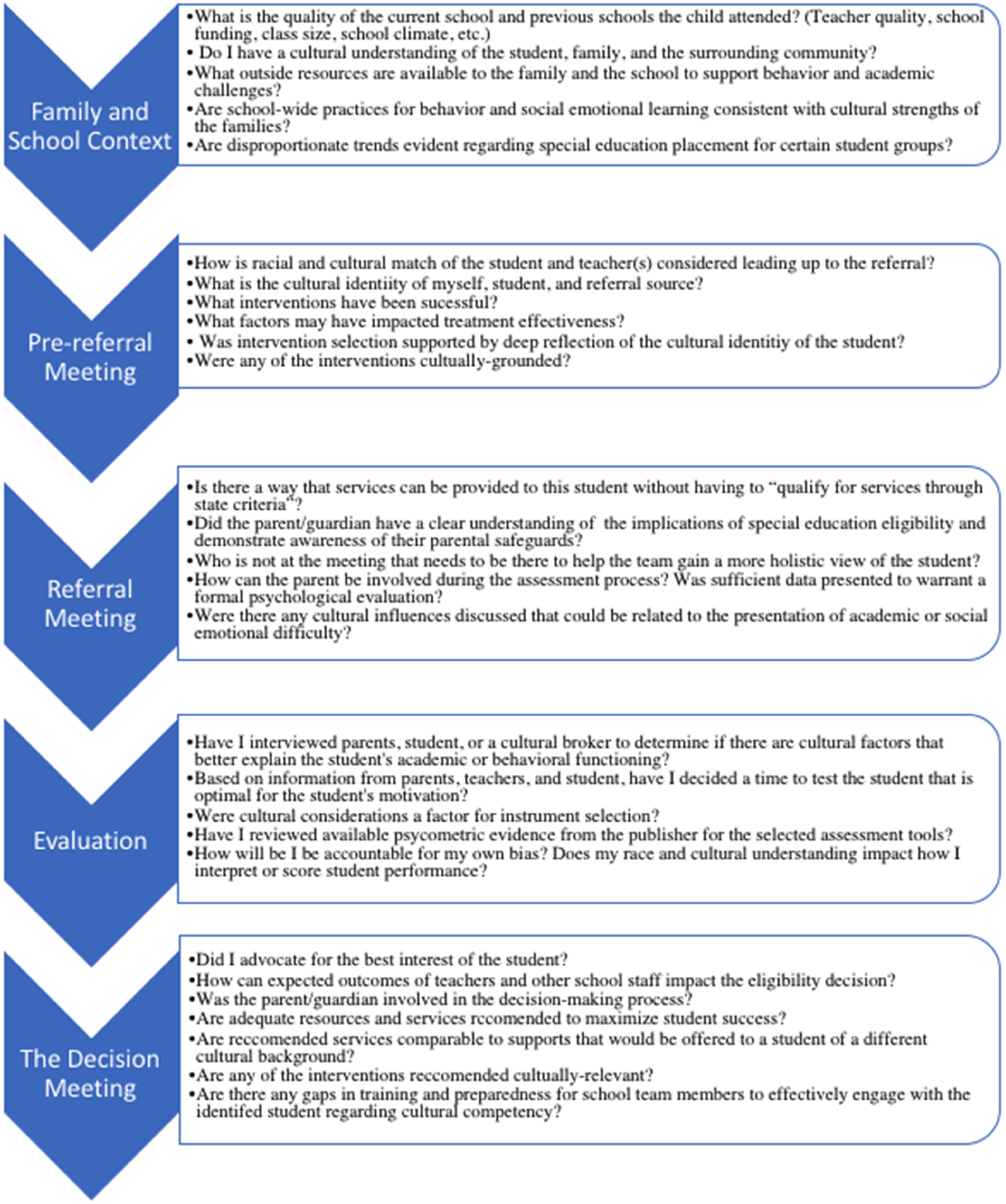
Decision making guide.
Limitations
There are several limitations that should be considered when reviewing the results of the present study. Given the use of the snowball sampling method and limited sample size, the representativeness of the sample may be limited. However, the snowball method has been found to be an appropriate method for exploratory studies and is a commonly used method for qualitative studies (Hendricks, Blanken and Adriaans, 1992). To provide more generalizable results, future replications of this study should include a larger sample size and consider ways in which a more random participant sample can be selected. In addition, given the everchanging field of school psychology and the momentum towards promoting anti-racist practices, future research may also seek to examine trends in clinical judgement among graduate trainers.
Conclusion
To further ensure the widespread promotion of culturally sound clinical judgement within the field of school psychology, further guidance is required at the graduate training level to ensure current trainers can effectively prepare future school psychologists. One step toward ensuring greater cultural competence among school psychologists that was recently implemented by the National Association of School Psychologists (NASP) requires practitioners seeking renewal of their national certification status to complete three hours of professional development training that focusses specifically on equity and diversity. In addition, the NASP (2020) Practice Model now includes a standard for equitable practices for diverse student populations. While these changes reflect greater commitment to issues of diversity within the school psychology profession, to dismantle the structural inequities that exist for Black students, continued efforts will be necessary at both the training and professional level to ensure that these changes translate to the day-to-day practices of school psychologists.
Footnotes
Acknowledgements
The authors would like to acknowledge Christina Robinson and Zari Press for their assistance and support with the completion of this research project.

Appendix A
Semi-Structured Qualitative Interview Questions
How would you define non-discriminatory assessment practices? Describe what you think it means to be a culturally competent school psychologist. Are there any cultural variables that should be considered during the evaluation process? Prior to accepting your first job, tell us about your graduate training as it relates to assessment of culturally and linguistically diverse students. If you were assessing a student from a non-minority background for a specific learning disability, emotional disability, or autism, walk us through what practices and procedures you would utilize. If you were assessing a student from a diverse background for a specific learning disability, emotional disability, or autism, walk us through what practices and procedures you would utilize. Any specific practices in regard to assessment of African American students? How does your district view the importance of accounting for cultural variability of a child? Do your current practices with children from culturally and linguistically diverse background align with your graduate training? What are your current needs in regard to implementing non-discriminatory assessment practices? Can you cite any specific answers in an assessment when testing a culturally and linguistically diverse (CLD) student and felt there was a disconnect between what the assessment determined was a correct answer?