




Abstract
As marginalized graduate students and faculty, we have stories to tell about our experiences within school psychology. Many of these stories center our oppression, trauma, and exclusion but some of them also center our joy and resistance. The purpose of this collaborative autoethnographic project was to create a counterspace in which we, BIWOC faculty and graduate students, could come together to engage in storytelling and build community amongst one another as a way to survive and thrive in academia. As a result of the counterspace, we are able to provide critical feedback and recommendations for school psychology programs to better support marginalized students and faculty. And we also offer critical hope and knowledge to marginalized graduate students and faculty who are currently in the field.
Keywords
School psychology is a white, woman-dominated subdiscipline of the broader field of psychology. In fact, the 2020 NASP Membership Survey indicates that more than 80% of school psychologists are white and female. In contrast, Latinx (7.6%), Black (3.9%) and Indigenous (0.6%) school psychologists are grossly underrepresented (Goforth et al., 2021). Yet, the proportion of Black, Indigenous, and People of Color (BIPOC) students in school psychology programs does not reflect the field. During the 2019–2020 school year, about one-third of graduate students enrolled in a school psychology program were from racially or ethnically minoritized backgrounds (Goforth et al., 2021). We posit that this difference stems from the expectations, values, and priorities of school psychology programs to center and uphold whiteness (McKenney, 2021) that keep BIPOC school psychology graduate students from entering the field. For minoritized individuals, who are not successfully socialized into whiteness or actively resist these expectations, this can be a traumatizing experience (Blevins, 2021; Grollman, 2018; Wedemeyer-Strombel, 2018) leading to mental health problems and ultimately attrition (Boyle et al., 2022; Chrzanowski & Poudyal, 2019).
BIPOC graduate students experience added layers of physical and emotional stress due to racism causing them to experience what is called racial trauma (Comas-Díaz et al., 2019). Microaggressions that occur in the classroom are one category of racial trauma as race-based stressors negatively impact physical and mental health (Carter, 2007). For groups who already experience systematic challenges (e.g., poverty, low high school graduation rates) because of historical trauma (e.g., Indian residential boarding schools, chattel slavery), racial trauma contributes further to their marginalization (Lebron et al., 2015). For minoritized faculty, this can look like academic gatekeeping that disrupts their recruitment and retention (Settles et al., 2021) at predominantly white institutions (PWI). This results in an overwhelmingly homogeneous field of researchers and practitioners serving diverse children where the likelihood of replicating harmful practices and environments increases. Therefore, intentional community building and knowledge sharing among minoritized graduate students and faculty can provide a sense of belonging and healing that allows for joy, safety, and cultural expression. Telling stories is one method by which many cultures share critical knowledges that sustain their futures. We utilize storytelling as a way to survive and thrive in school psychology.
Situating ourselves—What it means to be “other” in school psychology
We are situating ourselves first with one form of storytelling—describing our positionalities as Black, Indigenous, and Women of Color (BIWOC) in school psychology. We answer the call put forth by Drs. Arora, Sullivan, and Song to “share responsibility to recognize, call out, and prevent the centering and invisibility of whiteness in school psychology scholarship in order to advance our collective (and individual) antiracist, social justice commitments” (Arora et al., 2022, p. 3). In centering our own stories, we are allowing the reader to get to know us in an intimate way uncommon in school psychology research and thus decentering whiteness, colonialism, anti-Blackness, and U.S. imperialism.
Carissa: Navigating the scholar realm as a Latina has, on many occasions, left me feeling the need to overexert myself in order to claim a spot in graduate school. In my experience thus far in higher education, I have felt the need to present my best out of fear that a glimpse of imperfection would leave opportunity for others to make unfair judgments because of my identity and background. This battle of belongingness has been a recurring theme. As a second-generation Mexican American on my father's side and third-generation on my mother's side, I find myself being especially assimilated into mainstream culture. At times I felt very removed from my Mexican Heritage. The larger portion of my childhood I was ostracized and convinced I did not truly belong in the Latiné community. Yet I have also experienced discrimination at the hands of my white peers reinforcing the notion that I am the other as well. It is strange growing up in this in-between, but I realize that this experience is not unique to myself. The nature of these interactions are deeply rooted in historical and transgenerational trauma. However, during my time in higher education, I found community and strength to explore my cultural identity. I found purpose in working towards a career in the school psychology field. I seek to answer the questions of how historical trauma within the United States has played a role in stripping us from our cultural roots and what impact this has on the educational system serving Black and brown students.
Hanna: My identity as an Asian South African woman often leaves me on the outskirts of the various contexts I operate in. Due to history-long manifestations of sinocentrism and Asian invisibility, my racial position usually supersedes the variety of multicultural experiences I possess. I often find my story is told “for” me instead of “by” me. Every space I enter, I feel that the authenticity of my story is questioned because it does not “fit neatly” into imperialist classification labels. As I pursue my degree in America, I continue to experience resistance and opposition to the fluid alignment I have adopted to my heritage culture. I want to approach my work and research as a future school psychologist in the same way—with intentionality and reflexivity. As someone who has always been an “outsider,” I seek to join the pursuit of providing accessible and culturally responsive educational opportunities for students and youth. I am extremely humbled to be working with each and every individual on this project. Not only have they validated my position as an international student in the United States, but I am always left inspired by their active resistance and passion for changing the school psychology field. My own situation in this project and journey to pursue a degree in school psychology is not due to my sole effort as an individual. I recognize my ability to take up space in academia and the field is due to the privileges and resources my family possesses. I am the product of the cumulative decisions, choices, and sacrifices of those before me, which has led to the overabundance of opportunities I have been able to experience.
Ja'Toria: As a Black woman, specifically the first Black woman in my immediate family to pursue a degree beyond high school is a great privilege. Reflecting on such privileges forces you to recognize opportunities you’ve been presented with, familial sacrifices, demanding expectations that wake you at night, and the loneliness of being the only one to take on this journey. Navigating my way through the halls and classrooms of a PWI is not an unfamiliar one but it doesn’t get easier overtime; I feel that you must adapt, be “resilient” they say. When wanting to pursue a PhD in school psychology I was shockingly told, “if that comes into fruition.” Thus, it's like my skin is unqualified to take up space, my academic excellence isn’t enough, my voice holds no weight, and my efforts go unacknowledged. As a result, I grapple with my sense of belonging as imposter syndrome begins to settle in. I make strides in building community with women of color that support and validate my experiences offsetting the abundance of oppressive practices along my path. Hence these are my lived experiences as a Black female scholar that has shaped my “truth.”
Successfully joining the PhD track in school psychology, I know that I can be a voice for minoritized individuals that look like me in a field that is predominantly white. Advocating on the behalf of future graduate students giving them access to opportunities and guidance, they may not otherwise benefit from. Additionally, as a researcher, I aim to expand on the literature of culturally responsive assessment and intervention as it relates to minoritized students that will improve their educational experiences. Being a part of this project utilizing an autoethnographic approach with intelligent and passionate women of color who are changemakers was a great joy—sharing how we thrive in spaces centering whiteness and creating spaces that empower us is a responsibility I don't take lightly.
Jaylin: Growing up in a military family where changing schools and moving cities every few years was commonplace; I’ve learned the necessity of adaptability and acculturation as a means of survival. The educational and social spaces I found myself in left me feeling alone and othered as a Puertorican in white-dominated spaces where the size of my hoops and the brownness of my skin marked my deviance from whiteness. The underrepresentation of Latinx authority figures and leaders growing up led me to believe that academic success was inaccessible to those who looked like me. This has impacted my passion for greater representation and supporting minoritized students in k-12 and beyond. My identity as a Latina in graduate school, a space I never saw as an option for myself previously, has led me to be involved in research related to the experiences of minoritized individuals. Therefore, I am honored to be a part of this project as it includes a group of women who are extremely intelligent, supportive, loving, and whose passions align with mine. Found family—a popular trope in literature—refers to the bonds that can be fostered and developed outside of biological ties. This concept is something I believe was created in this project and represents a path of what research can be for our communities.
Karina: My grandparents and parents were not able to pursue their education any further than elementary school. “La educación es lo único que te hemos podido dar” is something my parents tell me often. So, I recognize the immense privilege that I have in being able to pursue a graduate degree, but with that I also recognize that my family and I have made great sacrifices in order for me to be here.
As a first-generation Mexican American in the United States, I often feel like I am in the out-group. And while I know that in all fields, especially those pertaining to academia it feels like there is always an in-group and an out-group, I choose to struggle my way in. I choose to make it possible for people like me to make a path.
Going into the school psychology field, I knew that this would just be another group that (a) I wouldn’t belong in and (b) one that would make me question my worth as a student and future professional. Questioning my worth and not seeing the representation of women who look like me in this field fuels my motivation to stay. I want to not only become a school psychologist, but I want to be a school psychologist who is proactive in advocating for my community, communities like mine, and other future graduate students. I want them to know that there will be challenges, but that change can happen, and we will be able to 1 day make a space where we feel like we truly belong. As a student and future professional, I know I hold great privileges and responsibilities that others who did not have the opportunity or access to an education do not. I will forever be grateful for this opportunity and appreciate all the support I have received in the field and graduate school in general but know that there is still much room for improvement. I joined this project to share my experiences in hopes of opening the eyes of the field of school psychology to create more room for dialogue and reflect on ways they can be more culturally humble and kind to the individuals trying to join the field.
So, as I continue to struggle my way in, I hope that we can all succeed and make it possible for our communities to forge a path of success and happiness. With this I leave you with some words of encouragement that my parents always give me, “échale ganas.”
Lisa: As an Indigenous woman in school psychology, it has taken many years for me to be comfortable with calling myself a “scholar.” Scholarship is something I did not think I was capable of producing because I was told as a first-year graduate student that I was lucky to have gotten into graduate school due to being waitlisted at the PWI I attended. I sat through courses, seminars, training, and lectures feeling like the “other” for most of my academic career. My dad is an “immigrant” from what is now known as Mexico and my mom is a “rez girl.” My parents, their parents, and their parents have sat on the periphery of society for generations because their identities have never aligned with settler society. Neither does mine. And academia does not let me forget that. As a graduate student, I listened to others talk about their parents as pediatricians and business owners while mine were oil field workers, sometimes unemployed, and other times incarcerated. As a faculty member, I taught classes where students felt comfortable, under the anonymity of course evaluations, telling me how to teach or that I’m “frightening.” These and other experiences within higher education have made me feel that my voice, my ideas, and my identity were not valued and that by proxy neither was my community. As a result, imposter syndrome has been a pervasive feeling and the pressure to be resilient (read: disembody your brownness to meet white expectations) is overwhelming. Thus, I seek to change the experience of graduate school for minoritized students and the women whom I have had the pleasure of working with on this project. I recognize the privilege that I hold by being a faculty member and that I have access to spaces that people from my communities and in my family do not have. Therefore, I view this project as an act of love, care, and resistance to how research is typically carried out in the field of school psychology. My people have been doing "research" on this land since time immemorial. Therefore, I know that research should not harm or oppress but should empower and heal. This project reflects the values that I hold and the lens by which I experience the world, which is that stories are data and community is essential to how we survive and thrive in the world and in academia.
Lourdes: To begin my positionality statement, I have chosen to use my response to a fellowship application question that was asking what factors have limited the opportunities available to me: Being a first-generation Latina college student, often the assumption is that my Latinidad, my parents’ inexperience with America's unjust higher education system, and so many other factors that come with being a family of immigrants, are what have limited my opportunities. Realistically, it is also what I would have answered 3 or 4 years ago. As I have navigated more systems that are white-dominated and built to support those in power, I have come to understand that my Latinidad, my beautiful family of hard-working individuals (who are also just as much deserving of rest and, emphasis on, FAIR WAGES), and all the experiences that my cultural heritage has given me are not at fault for the limited opportunities I have received. If anything, they are the reason I have created opportunities for myself in systems that have not been built for me. So, if I had to start with the greatest factor that has limited opportunities in my life, it would be colonization and the rest of the systems that have been built with white supremacy as its foundation – one of those being education.
In choosing school psychology as my future career, it was with and continues to be with the intention that I will dedicate my time and energy to serving communities of color who are often stripped of opportunities and resources. As for this work, while I have a lot to say about my strong dislike for research, this piece serves as a reminder to myself, my family, and anyone else who may get it twisted, que mi lealtad is to my community, not to systems, or in this case graduate programs, that were built to lastimar, discriminar, y oppressar. It also serves as a thank you to my parents, que dejaron todo lo que amaban atras, for providing the perfect environmental factors that have led to me sharing this experience with this insanely amazing group of women.
Counterspaces as a site for community building
Counterspaces are academic and social safe spaces that allow historically excluded and intentionally underrepresented individuals to vent frustrations through storytelling, promote their own learning, and challenge deficit notions of minoritized peoples while creating a positive climate for themselves (Solórzano et al., 2000; Solórzano & Villalpando, 1998). As defined by Sabnis and Proctor (2021), counterspaces provide “momentary relief, succor, laughter, and strength to members of a marginalized group who enter it” (p. 11). Counterspaces can be physical (e.g., conferences) or conceptual and ideological spaces (e.g., mentoring and peer-to-peer relationships) and include a variety of participants (Ong et al., 2018). Counterspaces provide room for community building but cannot in and of themselves build community. Rather, counterspaces act as a site by which community building occurs.
In higher education, women of color have identified peer-to-peer relationships, mentoring, diversity conferences, and even whole departments as counterspaces because they have provided a space for honest reflection, support, and shared belief (Ong et al., 2018). Counterspaces have also been formed with, for, and by undocumented scholars to share their views and stories of inclusion within academia (Salazar et al., 2022). For school psychology, counterspaces have the potential to foster a strong sense of community and affirmation as the stories shared can serve as a source of strength even after an individual has exited the counterspace (Sabnis & Proctor, 2021). Thus, the physical or conceptual space that is a counterspace creates an environment ripe for storytelling and community building to take place.
Storytelling as a method for community building
here we are and we are walking into your space, make way and don’t hinder, because we have a story to tell, and our story is also your story. (Geia et al., 2013, p. 15)
Counterspaces come alive through the relationships that are developed and relationships are at the core of storytelling (Phillips & Bunda, 2018). We talk about our relationships with other beings as part of the stories we share and in doing so we share something of ourselves. Stories foreground lived experiences and personal truths. Indeed, Lumbee scholar, Bryan McKinely Brayboy, makes the critical argument that stories are data (Brayboy, 2005). Stories are connected to culture and identity. Therefore, storytelling as an action changes within cultures across time and space. One author shares that the intention of storytelling from her Thai family members is to impart wisdom (Y. Chombhubol, personal communication, November 21, 2022). Storytelling is more than just giving advice, it is medicine. When an elder shares their experiences, healing takes place for both the storyteller and listener. The storyteller is given a space of respect to reflect and make peace with past qualms. The listener is encouraged to process any feelings or insights that are elicited and apply them to their present-day concerns.
While, school psychology makes room for stories as a “narrative” (e.g., structured developmental histories, interviews with parents and student self-reports), this term limits access to knowledge through intellectualization (Sobol et al., 2004). School psychology is unsure how to fit stories into its “objective” and “evidence-based” applied field. We quantify the story and the storyteller. If we want to change school psychology, we have to recognize the value in storytelling and how central it is to the identities and cultures of many BIPOC individuals.
Intersectionality framework
As BIWOC, our thinking, understanding, and writing are guided by the intersectionality framework. Intersectionality was first conceptualized by Kimberle Crenshaw, a Black woman and legal scholar, to describe the race and sex discrimination that Black women experienced in the workplace (Crenshaw, 1989). Prior to this seminal article, gender and race were thought of as mutually exclusive. As a result, Black women's multiplicity of identities is and continues to be erased because the coexistence of their experiences as both racialized and gendered individuals are and were not accounted for. Crenshaw (1989) explains that discrimination is like the flow of traffic, it “may flow in one direction, and it may flow in another. If an accident happens in an intersection, it can be caused by cars traveling from any number of directions and, sometimes, from all of them” (p. 149). Thus, Black women can experience discrimination similar to Black men and white women and also experience a different kind of discrimination as Black women (Crenshaw, 1989).
In school psychology, the intersectionality framework has been used as a lens by which to critique practice, training, and research. Researchers have examined Black girls and discipline disproportionality, gender and bilingual status and the experience of microaggressions, and BIWOC graduate students understanding of the hidden curriculum (Proctor et al., 2017; Proctor et al., 2018; Sabnis et al., 2023). As noted by Crenshaw (1989), “the intersectionality experience is greater than the sum of racism and sexism” (p. 140). Therefore, we chose the intersectionality framework over other critical theories (i.e., Critical Race Theory, LatCrit, AsianCrit, and TribalCrit) because intersectionality allows us to exist at the convergences of our differing identities and demands our legitimization.
A word about intentionality
If school psychology is committed to embodying anti-racism and social justice, then it must consider why the perspectives of BIWOC are integral to their efforts to recruit, train, graduate, hire, and retain us. To begin finding a place for community building and storytelling to exist, there must first be intention. Intention requires listening to those who have been harmed; sitting with one's emotions; refraining from making excuses for harm; engaging in reflexive questioning as individuals and as systems; and bearing witness to the ongoing experiences, stories, and contributions of BIWOC faculty and students. If intentional care is not taken to ground response and reparation in these perspectives, we foresee the field employing the same tactics that have always worked for some (i.e., white students) while continuing to keep many of us (i.e., Black, brown, disabled, queer, and international students) out. We urge the field to consider how to integrate community building practices such as counterspaces and storytelling in authentic and intentional ways that match the cultural experiences, backgrounds, desires, and needs of BIPOC students and faculty.
We believe that this project is one of many collective and story-driven works that deserves to be heard in the library that is colonial school psychology research. At the same time, we also recognize that our work, often classified as me-search, is devalued and discouraged, when done by minoritized researchers, by our field (Arora et al., 2022). Yet, we would like to push back on this unwritten norm to say that our lived experiences are an asset with deep significance for how school psychology moves forward to meet its anti-racist and social justice goals. The current project aims to offer (a) critical knowledge and hope to BIWOC graduate students and faculty navigating predominantly white school psychology programs, and (b) critical feedback to school psychology programs for supporting BIWOC students and faculty.
Method
The current project employed collaborative autoethnography (CAE) to critically examine and reflect on the experiences of six school psychology graduate students and one faculty member, identifying as either Black, Indigenous, Latina, Asian South African or a multiplicity of these identities. CAE is a qualitative research method that is simultaneously collaborative, autobiographical, and ethnographic (Chang et al., 2016). CAE focuses on a team of researchers who work in community to collect, analyze, and interpret autobiographical data in order to gain a meaningful understanding of some sociocultural phenomenon. In CAE, researchers can alternate between group and individual reflection of their experiences (Chang et al., 2016). Thus, CAE is a relational process and perspective that aims to inform ourselves, as researchers, of the social phenomenon we study (Hernandez et al., 2017). To our knowledge, there is only one study in school psychology that has been conducted using CAE (See Goforth et al., 2022).
We chose this approach because of our desire to tell stories, reflect on our own and each others’ experiences as BIWOC in a white-centered field, inform the broader field from a grounding of our lived experiences rather than theoretical or hypothetical examples, and because it aligns with our view of how school psychology should operate (i.e., relationally, communally).
Ethical considerations and reflections
As an approach to inquiry, CAE is ripe for highlighting the stories that we all hold. But, we must identify the nuanced ethical concerns in regards to the relational aspect of the method if it is to be used in school psychology. First, we engaged in this project knowing that anonymity was not guaranteed considering our names and institutions are attached to the manuscript. Thus, we had discussions about how to protect ourselves as BIWOC but more importantly how to further protect the graduate students. A compounding factor, the graduate students were aware of Lisa's institutional transition prior to the beginning of the project. Therefore, we held several discussions on the potential risks (e.g., retaliation from colleagues/peers, appropriation of our stories, hindrance of potential opportunities and consequences to students staying at an institution after faculty member transition) of engaging in this work. As a result of these discussions, one student opted out of the project. For those remaining, we enacted protection of ourselves by anonymizing our quotes, such as not attaching our race or ethnicity to the quotes and referring to ourselves as author rather than student or faculty. Worth noting is that Lisa did identify herself in one theme because the visibility of Indigeneity in the academy is important. Also, because Lisa serves as the corresponding author, we had a conversation about the graduate students directing questions and more formal inquiries toward her (i.e., “I suggest you direct your question toward Lisa as she is the corresponding author”), should we feel too vulnerable to answer. As part of the review process for this manuscript, we continued to have conversations about risk sparked by both reviewers and group members.
Second, we discussed at length the power dynamics within the group. One of our first conversations centered on the difference between our counterspace and class. The counterspace was intended to be co-constructed (e.g., rules, topics and making decisions together), in which language, tone, and participation were not policed. We also discussed the power differential between Lisa and students. Three of the graduate students were her advisees at the time. Lisa requested that students use her first name. Admittedly, this was difficult for many of us as we address in our analysis. Fortunately, the project took place during the summer term and none of the students were taking courses with Lisa. In addition, it is worth mentioning that the hierarchy dissolved when Lisa switched institutions and no longer had the power to evaluate students. Lisa also encouraged the graduate students to take the lead in analyzing the data, addressing reviewer feedback, and facilitating weekly conversations.
Lastly, we considered the anonymity of the people in our stories. We chose not to name or share identifiable details in our stories so as to center our experiences. We recognize that our institutions are attached to our author biographies and purposefully engaged in this process so as to provide meaningful data for the field. We debated the location of our meetings quite heavily. Most of the meetings took place online but we did have one session in a restaurant and we were mindful of where we sat, who was behind us, and let the server know we were recording. For our online session, we agreed to participate from a secure location and be mindful of who could hear and had visual access to the screen. Furthermore, the recorded meetings were saved to Lisa's personal laptop and then uploaded to a shared Google Drive because we did not want the university to have access to our videos.
Data collection
Lisa introduced the idea of engaging in CAE with us based on informal conversations that occurred after class, in individual Zoom meetings, and during research team meetings. These informal conversations often included discussions about how we felt we were not being supported by the program and the need for a space where we felt safe and comfortable to speak about our concerns and experiences. Therefore, Lisa proposed we meet more formally and use what we learn from each other to inform the field. All authors agreed to be a part of the project knowing that the intention was for the project to be collaborative.
CAE provided the structure and method by which data (i.e., stories) were collected. We met once per week for a total of 9 weeks. Most weeks, we met via Zoom and 1 week we met in a restaurant setting. The weekly meetings were loosely structured to last about two hours. The meetings were video and audio recorded except for the meeting that occurred in the restaurant setting. This meeting was only audio recorded. The first meeting consisted of determining the logistics and purpose of the group. We agreed that having topics to discuss and reflect on would help us gather and organize our thoughts and reflections. Therefore, the weekly topics were co-developed by all authors and served solely as a conversation starter. Topics were chosen based on their importance and salience within our own lives and included, microaggressions, imposter syndrome, white fragility, belongingness/connectedness, re-/traumatization, and names.
Analysis
Transcripts of the meetings were coded using thematic analysis. Thematic analysis consists of six steps: (1) familiarizing yourself with the data, (2) generating initial codes, (3) searching for themes, (4) reviewing themes, (5) defining and naming themes, and (6) producing the report/manuscript (Clarke & Braun, 2021).
To gain familiarity with the data (step 1), most authors participated in checking the transcriptions for accuracy. This included listening to the audio/video and conducting line-by-line edits to enhance readability of each transcript. Six authors had at least one transcript that they checked while four authors had at least two transcripts that they checked. To generate initial codes (step 2), the coding team consisted of all authors. Every author coded the first transcript individually and assigned our own original codes. Then, we met as a group to discuss the codes. This process took four group meetings. In a separate, individual process, the Lisa grouped all child codes into broader parent codes based on similarity in content of the child codes. During this process, she also renamed some of the child codes that were unclear, too abstract, too broad, or too inferential. Then, we met to discuss the parent codes that had been generated. Accuracy of the parent codes were discussed and consensus was reached. The resulting parent codes were used as the initial coding frame and applied to the second transcript. The second transcript was coded using the same process explained above. While coding the second transcript, codes that did not fit within an established parent code were noted and discussed as a group. After two rounds of collective coding, the remaining transcripts were coded individually. During this process, if a team member had a question about a potential code or the transcript, we would discuss and come to consensus as a group during our weekly research team meetings.
To search for themes (step 3), we analyzed, combined, and compared the parent codes and their child codes to determine how they related to one another. Themes were determined through inductive analysis. Therefore, the coded data supported the development of themes, linked more directly to the original data, and were reflective of the entire data set (Clarke & Braun, 2021). We asked questions during this time such as “how do these data support our research questions?” to determine which parent codes were the most meaningful. For example, we excluded parent codes that related to the logistics of the project because they did not provide meaningful support for providing critical hope or feedback to graduate students, faculty, and programs. When reviewing themes (step 4), we determined whether each theme had adequate supporting data that was coherent and meaningfully different from the other themes. We recorded all meetings in which coding was discussed as one way to document our thought processes and decisions. We also kept a Google Document that captured our decision making for each meeting. Themes were developed across four meetings. During these meetings, we discussed how each theme relates to one another and whether the resulting themes are representative of the whole data set. If there were specific child codes that did not support the theme then we discussed as a team whether the child code should be moved to another theme or if it was a better fit under a parent code not used. Therefore, we ceased revisions to the themes once all the data included appeared relevant to the study questions (Clarke & Braun, 2021). Upon defining and naming themes (step 5), we looked for areas of overlap between themes and clearly defined how each theme was different from the others. Between three and five exemplary data excerpts were selected to illustrate key features of the theme, support our narrative, and provided context for the importance of the broader story of the theme (Braun & Clarke, 2012). Lastly, this manuscript is the manifestation of producing the report/manuscript (step 6) in thematic analysis. We have moved beyond a mere description of the codes and themes identified and have provided a narrative of how we have interpreted the data and why our selection of themes is important and accurate (Braun & Clarke, 2012; Clarke & Braun, 2021).
Findings
Below we discuss the 10 major themes identified through thematic analysis as a result of the conversations we had within the counterspace. Themes are informed by the intersectional framework and can be conceptualized as the mirror we hold up to school psychology so that the field can understand its impact on BIWOC graduate students and faculty. We view our stories as threads that connect us to each other but also how they connect us to the field. As a note, some of us prefer anonymity and do not want our names attached to our excerpts.
Theme 1: Discomfort about accomplishments and acceptance of compliments is culturally influenced
Graduate programs facilitate and encourage discussion of educational accomplishments in classes, at conferences, and in advising meetings. Accomplishments and the compliments that are often attached lead to feelings of discomfort for us. We have identified that our respective cultures expect that we are humble and modest about our accomplishments in varying ways. To speak too highly of oneself is seen as bragging as in the excerpt below: In this program … we are constantly around white people that brag about themselves and all of their accomplishments and achievements. And I feel like for me, as a person of color, as a [racial identity] person. And I think I've said this before, we're taught to just not speak about what you do, but just show what you do. And it's like, if I was home, and I was bragging, my parents would probably be like, ‘Just shut up, like, no one cares if you're talking all this smack. Just go do it, and like, your actions will show or speak for itself.’
A second example highlights the collectivist cultures that we come from and how individual accomplishments are minimized: [Instructor] asked something that we're proud of. And I said [laughs] two things. I'm proud of my younger brother for finishing his first year and I'm proud of my partner for finishing his Masters. And she said, ‘Oh it's great that you're proud of other people's achievements and that you see it as your achievement.’ I was like my collectivistic culture ass did not pick that up! But it was like, true, I do. I saw other people's achievements and I saw it as something that I was proud of.
Another author said, “It's so weird accepting compliments, like I’m not, ugh. It's just, it's so uncomfortable.” In mainstream culture, compliments are easily tossed out in response to any mention of an accomplishment because it is the “polite” thing to do. Contrived situations and the way in which compliments are prompted is uncomfortable. As one example, several authors took a course where they were instructed to give a compliment to everyone in the room. One of the compliments given by a white peer made one author reflect on the intention of the compliment. “And then that comment was made and then those smirks at the end was like hmm I don't like that. Like if you didn't mean it you shouldn't say it. Especially if it wasn't intentional.”
We were all able to identify examples of unspoken cultural norms in our families that make discussing accomplishments and accepting compliments difficult as BIWOC. One author talked about how her family believes that you bring “bad luck” when you brag. Thus, our view of discussing accomplishments is framed as “bragging” because our collective experiences have demonstrated to us that this is mostly acceptable and expected in predominantly white spaces and often by our male counterparts. Yet, we also recognize that context and feelings of safety matter. It was difficult for each of us to discern our peers’ intentions when discussing their own accomplishments or receiving compliments being made because we had little understanding of the cultural value. On the other hand, sharing personal or academic achievements with family or close friends is often framed as a collective pride and discussed in terms of benefit to the family and community. In our experience, this differed from the conversation around accomplishments and compliments in our school psychology program. While many of us are encouraged to be proud by our families, we are hesitant to demonstrate this pride to others that do not understand our intersecting lived experiences and cultural selves.
Theme 2: Can we really be imposters in a system that wasn’t built for us?
We shared many stories regarding imposter syndrome with one another. Our data suggest that this term is impressed upon us so that we identify ourselves as the ones who need to change and fit in with the system. Take the following excerpt as an example. I just feel like I'm constantly having to ask myself if I deserve to be in the places that I am in. And I know we already talked about this. I think it's just really hard sometimes, especially when you see those around you who are just such amazing people. It's just like a problem of … not necessarily comparing myself … but like, not comparing myself to others, but comparing myself to myself. I always struggle with that. So it just feels like I am an imposter even within myself sometimes. If that makes any sense? Especially at school.
Lisa's experience further illustrates that being a faculty member does not eliminate feelings of being an imposter: And so, when I shared that with professors that I had at [university], I remember getting looks of surprise. And like, that made me feel like, “Did [university] make the wrong choice?” Because these professors know me. So did [university] not ask me the right questions? Or did they not screen me well enough?
Additionally, one author highlights how the school psychology program has her questioning herself and sense of belonging, when we should really be placing attention on the environment that is systemically driven to harm us. I think I’m having a hard time, like I said earlier, kind of figuring out is this a me problem for me feeling bad or whatever? Or is it actually the whole system? And it's also, I think for me, I would like to benefit from [CAE] and just kinda knowing where I stand. Because I tend to be like, ‘Okay, yeah. I’m the problem.’ I’ll just guilt trip myself, that I just don’t fit in [to the program]. But it's not … I shouldn’t be the one who has to fit in, right?
Over time, and with support from other BIWOC individuals, we become intimately aware that we are navigating a program that was not built with us in mind. Nothing about the physical space of universities signifies our belonging and gatekeeping of information on behalf of administrators, faculty, and our peers makes it harder for us to survive and thrive. One author speaks about the presence of the hidden curriculum: I feel like that's also like navigating the hidden curriculum. Like we come in thinking, ‘Oh, we don't know anything. I am an imposter. I'm faking it. I don't know what I'm doing. I should not be here.’ But, honestly it's just because, again, the hidden curriculum. We're not told certain things.
We want to make clear that imposter syndrome is a misnomer for what actually happens to BIWOC in school psychology programs. Our feelings of inadequacy are because of the racism, sexism, colonialism, bigotry, and xenophobia that we experience. Thus, we cannot be imposters in a system that was not built by or for us. We are surviving, resisting, and thriving in intellectually and emotionally exhausting environments. We do this by carving out spaces that allow us to gather in well-intentioned communities that affirm our intersectional existence. Within the counterspace that we created for ourselves, we were able to dissect the hidden curriculum, share knowledge among and across age, race, and education levels, and tell hard truths about being a member of a school psychology community. Perhaps most importantly, we were able to shatter the false notion of imposter syndrome for ourselves, identify the intersectionalities that make us unique, and begin visioning a better school psychology.
Theme 3: “What's a little bit more suffering?” BIWOC work harder for less support
As BIWOC, we have noticed a difference in the ways that we are treated within the program versus how our white peers are treated, specifically our female counterparts. One author describes this sentiment: White women will be challenged and then someone always comes to help them out. And that's not … that same thing doesn't happen for Black women, for Brown women, for other minoritized women. It just doesn't happen to the same frequency or degree that it happens for white women.
One author also noticed a discrepancy in how the program handbook was used differentially to reprimand students of color and support white students. Another author illustrates this point by speaking to an experience about a white student who was speaking poorly of her to a practicum supervisor: The [white female student] is breaking the handbook. I was like, it's literally under the handbook that it calls for termination and you're gonna sit here and look at me and tell me, ‘What can I do?’ I was like, don't get me wrong I'm not trying to get her ass terminated, but [hard shrug] there at least should be something.
We perceive this differential support as permission for white students and faculty to be vulnerable in ways that are not afforded to us. One author comments on the difference in fragility between ourselves and our peers: Because it sounds like white women are seen as fragile and you know women of color like we have to be strong. We have to be resilient. Like we can take that pain or that suffering, and it's like no. I don't wanna do that. I don't want it to be heavy. I want to be light.
We are always ready to defend ourselves, our work, and our livelihood. As a result of the counterspace, one author affirmed another by validating her desire to be protected: Yeah we're expected to suffer, right? Because we've always been suffering. So, like what's a little bit more suffering on top of what you’ve already had right, but like [group member] I also want to be light. I want people to stick up for me. I want somebody to say, ‘Hey! That was fucked up you shouldn't talk to her like that.’
We learned that as BIWOC we are not afforded the same space to demand gentleness in times of need. As the intersectionality framework indicates, the experiences of white women are centered and protected while women of color do not have this same privilege, as we have collectively experienced. It is expected that we carry on as usual bearing the heaviness of oppressive policies and practices, the Covid-19 pandemic, and the environmental and climate injustices threatening our livelihoods. For some, academia is about learning how to be a competent school psychologist or teaching graduate students how to give assessments. For us, academia has become a space in which we must deal with being called resilient as a tradeoff for the extra tasks we take on. Our identities have not been honored in a way that demonstrates our value and need for protection and care.
Theme 4: Our names are colonized without our permission
Our names are who we are but we have a complex relationship with them because our names cause a lot of emotional stress. Colonization is at the core of much of this stress as one author describes: My grandfather named us all, and he was like very Christian and again, why Christian? Again, missionaries in Malaysia. So it's all like literally the history of trauma, and like that's kind of sad in the way that my name is a product of trauma and colonization.
Colonization of our names continues when proper pronunciation is not prioritized. In school psychology, white faculty pronounce and spell names based on their own cultural understandings of a name. Mispronunciations and misspellings send the message that school psychology programs do not care about us. Yeah, and like phonetically, all of our names like you can figure it out. If I said it, you could probably get really close to spelling it right? Or if you just saw it, you could probably get really close to pronouncing it. For all of our names. So it's just ridiculous that [white people] have command of the English language but it's almost like [they] are choosing to struggle. [They are] supposed to be the superior race. Can’t you just pronounce a name correctly?
I mean it goes back to relationships for me right? If you take the time to understand someone's name you're likely gonna have a better rapport with that person. Like if you really care about students, from my view, you’ll try to say their name correctly.
As a result, many of us make our names easy for others by simplifying its spelling, using anglicized names, or not correcting mispronunciations: So yeah, I feel like I learned really early on that we have to make names easier for other people and never question why. We just have to make our names easier and that makes me really sad.
One author shares that because the mispronunciation of her name has been going on so long, she takes some of the blame. I definitely think that I never like even though I have acknowledged that that's not how my name was intended to be said. I don't think I've ever made any efforts to have it be said a different way. So I definitely agree, a lot of it has fallen on me at this point but also like, is it truly our fault, ya know? Just because it's something that's been happening for so long.
The act of having to simplify or allow our names to be mispronounced contributes to feelings of not belonging or isolation. However, we recognize that this is not a unique phenomenon to school psychology or to us as BIWOC. Yet, what we would like to make clear is that getting our names right is the bare minimum and it is no coincidence that our names are the ones most often jumbled in the mouths of those who do not look like us. When our names are mispronounced, misspelled, or misused in any way, we question our own integrity and value. We ask ourselves whether we have done enough to correct others; or internalize these feelings and put the sole blame on ourselves. We also experience feelings of unhappiness and are discouraged by the lack of care we receive from those who say they want to support us.
Theme 5: Research is a tiered system of inaccessibility, exclusion, and oppression
School psychology research is oppressive at multiple levels. The most obvious might be in the way it oppresses marginalized communities in which research is being conducted. One author speaks to her hesitancy to engage in research for this purpose: A lot of our value comes from research and it's like yeah but do I want to do research where I realize it can be used to oppress more of my community? I’d just rather get through education or my degree and go into my own community.
Research is also oppressive at the program level. Doctoral students are valued differently than specialist students based on their research output. Two authors were excluded from a celebratory research dinner because the role they played was viewed as inconsequential. One author talks about her feelings regarding this incident: [Team member] and I weren't invited [to a research team dinner], even though we were involved in the research of the coding and stuff. It wasn’t like the writing and all that but like. But, it did throw us off because we still were a part of it. And [doctoral student] made the comment of like, ‘I feel like it just shows that this part of the work isn’t valued by this certain like person leading the research.’ And then also, it was a bit upsetting too because it was kind of like okay, cool.
Furthermore, messaging received by specialist students is that they are forgettable if they do not contribute to faculty research projects. Specialist students develop negative feelings toward research. One author shares: And so I think that also kind of made me a little scared of not getting involved in research. Because I was like I don't want to be forgotten either. Because, like you know, if I don't get involved, will they not remember? Will they not think of me? … If I don't get involved in research, then what do I have? That was a little scary. So I also think it's interesting to see how [specialist students] get forgotten if they're not super involved in research.
Not only do school psychology programs exclude and oppress BIWOC and our communities, they also create barriers for these same groups to engage in research altogether. Students without research experience are only considered for specialist programs. Additionally, BIWOC students are less likely to be able to afford a doctoral degree. One author comments: So and that makes me wonder, if you're a person of color, how likely is it that you have the resources to afford a PhD program right? And feel welcome in that space? Or is it [more] likely that you can get your EdS and you're going to practice? And then that's another barrier to engaging with the field right?
We find ourselves treading with caution when choosing to engage in school psychology research as BIWOC. From an intersectionality standpoint, we recognize the importance of research that is conducted by and for individuals who hold our same identities. Yet, we do not want to participate in our own oppression or our community's oppression through our involvement in research. But, the route to engaging in empowering and healing research is not easy or clear. For those of us who were able to overcome the financial obstacles to pursue a PhD, there are little to no opportunities to learn about research methods and practices that deviate from Western frameworks (e.g., intersectionality framework, Black and Indigenous feminist theory, and participatory methods). Furthermore, specialist students are differentially treated in comparison to doctoral students. Our value as researchers is not recognized and as such we are given less opportunities to engage in research that could positively impact how we conceptualize ourselves as scholars and contributors of knowledge in the field.
Theme 6: Graduate school creates a disconnect such that we become guests in our own home
Graduate school is a privileged space. But, only because school psychology has engaged in gatekeeping against us. As BIWOC, we have been privileged with access to spaces and knowledge that our families never had. There are personal ties as to why we choose to go to graduate school. Our educational accomplishments also serve our families. One author describes that the “Biggest reason I'm even going into this field, or like doing higher ed or anything is you know, for my future generations and my family who mean everything to me.”
Many of our families have encouraged us to pursue graduate school because of the benefits of higher education such as financial stability and class mobility. Yet, a phenomenon occurs in which our relational ties become weak due to time spent in academia. The phenomenon is twofold—we are guests in the way that guests are often treated better because they are visitors and we are guests in that we do not have as strong a connection with family because we are not present all the time. One author shares her aunt's perceptions of graduate school and feeling left behind: My aunt she'll be like, “Yeah, she's the one that made it out and she's doing everything. She's left us behind … ”. I'm like, I really didn’t, you can go to school too if you would like … [laughs] I mean, you would just have to have some motivation. It's not always going to be there but … what do you want for yourself? And I'm just like well … like what do you say to those things? This is like yeah, I'm living my life but it's not as easy as you think … they’ll all be like, “Oh well, all you just do is go to school … ” and I'm like, no, I do more than just go to school. [laughs] It's not easy. I'm tired, I'm up for hours and hours and hours, doing things that are unimaginable.
Lisa shares an experience in which her father is proud of her status as a professor but unintentionally creates rifts between herself and other family members. While we are favored for “making it,” we become disconnected from those who do not have the access or opportunity we have had. And I get he's proud but it's almost like he's inadvertently isolating me from my family, right? But, then it's like, “Oh, Lisa thinks she's better than everyone.” But, no, like I actually don’t. Now that I’ve been through this I don’t think there's much value in having the letters behind your name [because of] what the system “taught” me.
Another author shares the impact of the financial aspect of graduate school. Although graduate students make very little money, many of us have experienced a positive change in financial stability that our families have not. Financial privilege benefits our families but makes us feel guilty for the freedom that affords us as well. One author states: Even just like the financial disconnect I mentioned [earlier]. I’ve been talking to my mom and she has [a shitty and physically exhausting] job. I wish she didn’t have one. But I make more than she does and that's a sad realization of like I'm a grad student and I also have [a physically easier and higher paying job] and so like I mean I’m sure [she is happy for me] but [it sucks] the disconnect of [that]. Something that I was talking to my sister [about recently was how] we can’t talk about even financial achievements with our parents.
Familial ties are not only a motivating factor in our pursuit of higher education but also one of the first aspects of our lives negatively impacted by higher education. Higher education affords us multiple privileges that many of our family members do not have access to, thus creating a notion of otherness within our own families. Intersectionality positions single issues such as financial privilege and patriarchy as compounding factors. Such as when one author described how her parent's pride in her career led to unhealthy comparisons and negative feelings from her siblings. Being that we live in a patriarchal society and come from cultures impacted by patriarchal values, this aspect of finances creates separation between us and our families. It is difficult to be aware that we will eventually become financially stable when our families are not or may not ever be. Additionally, there is an added pressure to financially support our families. The pursuit of higher education, while intended to further our families’ position, inevitably removes and disconnects us from our communities and is complicated by patriarchal and economic expectations.
Theme 7: Current spaces and interpersonal supports are inadequate for BIWOC students to express career concerns
We have a need for physical spaces to support our growth and development as professionals. We envision these spaces as decentering whiteness and recentering the joys and pains of the marginalized experience within school psychology. Yet, money from enrollment rates and diverse admissions appear to be more important to the program and school of education than making the current environment welcoming, accessible, and comfortable for us. One author shares that she had an interaction with Black students in the school of education that led to her think about belonging in her school psychology program: Because like again there's no sense of community. They don’t connect us. There's no events or like just a designated space for students of color to go and to just meet with each other and just have discussion on things and just to relax. So, that creates a sense of loneliness. Which I hate … sometimes you do want to see people that look like you. Like, even though you guys are students of color, you may not relate to something that I’m talking about. I’m [racial identity]. You guys aren't. Like, can [the program] make space? … Like, [white faculty] gave all these great ideas but I feel like nothing has been done. Although they said, “Oh yeah that's in the works.” We [unintelligible] talking about them providing the space for us but nothing's been done. And like other students of color as well have been saying like, they’ve been like advocating for this. But, I’m just like, do you really care?! … You don’t care if we have a sense of belonging. As long as you get your money.
Counterspaces, such as the one we created, have the potential to provide support to BIWOC graduate students when they express concerns about entering the field as practitioners, clinicians, and academics. Ideally, these conversations would happen in a practicum course. But, we quickly learned that these courses were not created to support discussions about backlash we might face due to our marginalized identities, protecting ourselves and the families we serve, or the general uncertainty and fear about entering the profession. One author shares: I don't know if I'm necessarily scared. I think I’m not scared to teach or anything like that. I'm scared to have to deal with people you know? I'm scared about the mental and emotional energy that's going to be taking a toll on me … It's not even [that the career] scares me. It seems like you said, like you don't want to be frustrated by people right away or have to fight someone right away. So that's what is always on my mind. I'm like well when we're out there in the field like how, how is that going to work? Like a lot of people burn out because they're constantly having to advocate for what they believe in, or like students that are being misrepresented or mistreated. So it's just like I think we've already gone back and forth on this, but like, how do we protect ourselves? But also protect those that we care about, you know?
We have learned that we must create informal spaces amongst ourselves to be reflective and engage in critical conversations about the field when these are not provided for us. The following excerpt was shared in the counterspace because the author did not feel that the support was available to discuss this as part of a class or with her advisor: Like, the lack of belonging, like when you're like the only one, there's just too few of you that look like you within the program … I kind of felt that when I went to the NASP conference, it was so white. And I was like, wow … and now that we're talking about imposter syndrome it's like, it is like a white female dominated you know field. And it's like, we're probably still going to feel like that [laughs] when we get into the profession. Because there's not a lot of people that look like this. And it's like, I don't know … will they take us, I mean obviously they should take us seriously. But when we do bring up points of things that need to be changed to benefit people of color, that of course is probably going to cause an uproar. But will it be validated or seen as valued? Or something that needs to be changed, when there are so few of us that see these issues need to be addressed.
There is a clear need to decenter whiteness in school psychology because of how these spaces do not make room for our voices, visions, and experiences. The racial demographics of programs also send covert messages of who belongs and who does not. We depend on support from BIWOC faculty. One author speaks to the impact of the Indigenous faculty member in potentially pursuing her doctoral degree: Yeah and I just think it is a big thing because, like you said, there aren't very many people that look like us in, you know, [in] higher ed places. So it's necessary to have someone like you [referring to Lisa] and just like others there to uplift students to make them understand that they do belong where they are and they do deserve their spot. So that's also why I'm not completely taking it off the table, because it's like, I would like to also, you know, in a sense, get back on … But yeah, got to get over my own fears first.
The intersectionality framework posits that those who hold marginalized identities will often place their own needs and perspectives at the margins. Although there is a clear need for us as BIWOC to have access to spaces to share our feelings, thoughts, and ideas about varying career concerns and aspirations, our needs are often bound up in the collective program needs and go unacknowledged and unaddressed. Therefore, it becomes our burden to create spaces for ourselves as evidenced throughout this project and our use of the counterspace. We have found that courses with dedicated discussion time do not meet our needs and the program's failure to create spaces and events to facilitate connection has resulted in feelings of estrangement.
Theme 8: Positive graduate school experiences are grounded in financial support, wellness, and sense of control
Graduate school feels more manageable for us when we are financially supported through assistantships. In fact, one author describes feeling excited due to the burden of financial stress being alleviated for the following school year: I'm excited for all of us, because I think most of us have assistantships and we will have less of that financial stress and all that jazz. And I also think that we're gonna learn a lot in these roles so I'm excited for all of us.
Importantly, we had many conversations regarding the accessibility of food and how that contributes to our physical wellness. Given that we live on small stipends and many of us do not come from affluent families, we often have to be more restrictive with what foods we purchase. Thus, food provided at program meetings, trainings, during research teams meetings, and at program parties become critical in supporting our physical and mental wellness. One author discusses the joy of free food: I've been getting free lunches out of it because my supervisor wants the candidate to meet the students as well. So we go for lunch and we're like trying all the foods on the fourth street. That's been fantastic. Free food.
Messaging around productivity varies among and between faculty members within school psychology programs. The phrase, “Rest is productive!” was used by Lisa to alleviate pressure on students to overextend themselves in classes or on her research team. There was no expectation that students should sacrifice sleep to read every article or take on another research task. Furthermore, we should have agency over our educational careers. One author remarked during the theme development phase that engaging in this project gave her a sense of control over her narrative. A different author shared that being proactive would likely help her take control of her education: But I know like this year I do need to be more serious and actually like take control of my situation and be more proactive. Instead of just letting everything hit me and like I complain about it, I complain about when things don't go right, but I think now, especially this semester, I need to learn to actually just take control of my experiences. I remember something that one of our classmates said. She was saying, like you know practicum seems like it is what you make it. It is frustrating, but you can still try to advocate for your experiences so [while] that scares me, like trying to be assertive. I do think I'm gonna try to do a little bit of that.
As women of color in school psychology who are pursuing advanced degrees, we require multiple streams of support to aid our success. At the time of this study, while all of us BIWOC students held assistantships none of them were funded by the program. Rather the program sought funding through university mechanisms (e.g., fellowships or instructor positions for undergrad classes) and relied on students securing their own funding (e.g., assistantships in other departments or campus offices, hourly campus work, and off-campus work). It did not appear that programs made a clear and transparent effort to earmark funding prior to our recruitment. Furthermore, program-driven initiatives to provide access to food and mental and physical health support were lacking. As one example, a BIWOC student organized a field day and was given a pittance (i.e., there were not enough funds to purchase a variety of cultural foods, organically grown foods, or drinks without a high sugar content) for a large group. Aside from the typically designated activities (e.g., administering a cognitive assessment without supervision, conducting a behavioral observation, and interviewing research participants), the school psychology program did not intentionally build in opportunities for BIWOC students to have agency in other areas of their training, research, and practice that would make their graduate school experience positive and meaningful.
Theme 9: Why does your social justice hurt?
We have stories of harmful acts and statements that occurred across all settings of the school psychology program. This hurt occurs on two levels. The first is the hurt that we experience. For example, white faculty may be well-intentioned but their behaviors are incongruent with social justice aspirations, as one author affirms: [white faculty member] who specializes in social justice but then says that that's not their area of expertise when that situation of discrimination occurs. That's just one quirky example of white liberalism.
Or, when white faculty engage in gaslighting, whether intentionally or unintentionally, as a means to deflect racism that has been brought to their attention. One author speaks to how this contributes to retraumatization because students are asked to report harmful behavior but then do not see favorable actions or outcomes: Or when you are sharing your victim story, of a racist situation or something that occurred. It's like okay, share it with me and then people will gaslight the shit outta you and then be like ‘Alright, I think you are fine now.’ And that person [who caused the harm] can continue being racist. Yeah, the idea of retraumatization and having to share your victim story over and over again.
And especially harmful is the power that white faculty and peers have to name harmful actions against themselves or others that we do not have. It is easier for our white peers to name harm because their whiteness carries power and believability in the academy. As BIWOC, our words do not hold the same weight. One author expands on this to say: It's like not having our voices heard when clearly there was like a discriminatory action. Or just like the way a white peer spoke to you, and the white faculty didn’t name it. So, like the whole idea of white people naming something having more power than us naming it.
The second hurt is the concern we have for the harm that will happen to minoritized children in schools and their families. When school psychology programs do not require graduate students to learn and practice anti-racist and anti-colonial behaviors, then room is left open for harm to occur. When we witness or learn about this harm secondhand, it causes us distress. One author shares concerns: And then thinking about like even peers, who are microaggressive and crappy and can retraumatize and thinking about them going to work with like students from marginalized communities. Which is really, really sad and just like sometimes disheartening too and also just scary to think about.
Much in the way that intersectionality frames white women's reluctance to include Black women in their feminism because they do not want to sacrifice their racial privilege. Programs fail to hold white students and faculty accountable to the tenets of social justice at the expense of BIWOC because they do not want to be uncomfortable. As a result, BIWOC graduate students and faculty experience microaggressions, exclusion, and erasure of their identities. And we are also worried about the ways in which minoritized K-12 youth will be harmed in similar ways. Therefore, we cannot simply leave the field so that we are free from all of the “isms.” Despite our negative experiences, we want to see our white peers and colleagues grow in their understanding and pursuit of social justice. But, our collective values also lead us to question if programmatic social justice efforts are capable of holding all graduate students accountable to both their peers and the students they are purported to serve.
Theme 10: Indigenous faculty member occupies a liminal space in school psychology program
The liminality lies in reckoning with the academic, social, racial, and cultural pressures while acknowledging that holding a faculty position is immensely privileged. On one hand, being an Indigenous faculty member is like being invited to the dinner table when your plate is already full and you did not get to choose what you are eating. Lisa shared many stories of being “voluntold” to do something without regard for what she might already have on her plate. She also shared that the support available to her did not account for her lack of understanding of the hidden rules and politics of academia. She speaks about how she struggled with teaching during the COVID-19 pandemic because there was no support in building a syllabus that could account for hybrid teaching: I felt like I didn’t frankly get a lot of support in how to build the class … It's like just follow the syllabus, right? This is how you normally teach a class, so I'm just gonna do that. So I had to build my own, and I used that, but it didn't transfer as well as I thought it was going to, and then they wanted other things for it, and it wasn’t communicated well to me. So I struggled a lot in that class.
Despite there being other minoritized faculty within the department, there was only one other woman of color whom Lisa felt comfortable being open and honest with. She found it difficult to speak up in faculty meetings because all of her colleagues were white and had been in the academy for many years. Lisa speaks to what it feels like to be the only BIWOC faculty in a program: I was gonna say, I think for me it's hard to feel a sense of connectedness sometimes because I’m the only faculty of color in our program and I don’t wanna put the burden on [BIWOC students] to be my friend, right? Just to feel like I have community. So, it's like trying to find the balance, for me, of like who within my sphere of like the School of Ed can I trust to feel like I am safe here and can have a happy life and that sort of thing. And I think, like, yeah, I haven’t been able to find that.
As an Indigenous faculty member, Lisa grapples with the power dynamics that are inherent in all classrooms. She reflects on how much power she actually has because white students have used their tears against her when they do not like something that occurred in class: Yeah, I felt like as faculty women of color we're supposed to acknowledge the power dynamic right? Between an instructor and a student. But, in my experience, I feel like these white students have a lot of power over me, even though I am the instructor. And it's like I don't know how to navigate that … So like, for example, that example I told you last week or the other week of a white student calling me terrifying. It's like the white student was able to wield their power in a feedback form talking about my instruction style, but then, when I asked the student about that they're then able to weaponize their tears against me. Right? I get how a male white or even female white instructors could have a lot of power, especially over students of color but I'm having a hard time seeing how I also have that same power over white students. I mean, I know I do but it's just I haven't. It's a really weird dynamic that I don't think we talk enough about in academia. Like we just assume all instructors have equal power over students.
On the other hand, it would be disingenuous not to acknowledge the immense privilege that comes with being a faculty member in a top university. Lisa shares that she enjoys the privilege of working at times that suit her best and being able to work with graduate students: But I will say it's been a privilege to work in academia, because nobody tells me when to work … [I] can work, I have class, I get to meet with you wonderful people. There's so many benefits to it right?
Lisa's experiences in higher education are grounded in an otherness that is nestled in a space between privilege and oppression. As an assistant professor, she enjoys the flexibility and financial stability of working in higher education but struggles to identify and adhere to the unspoken rules that exist within PWIs. It may be assumed that as an “educated” woman she is able to navigate the system, but she has often felt she could not articulate the intersectional aspects of her struggles and this has held her back. For example, colleagues’ (in and outside of the program) understanding and conceptualizations of Indigeneity often caused her to feel othered because broad statements were made about who and who is not Indigenous or her own Indigeneity was questioned. Additionally, the context of the COVID-19 pandemic exacerbated these feelings of otherness because she risked both her health and livelihood to teach and work alongside colleagues who chose not to mask despite the devastating impact of the pandemic on Indigenous communities. Indigeneity and its cultural values (e.g., cultivating good relationships and taking care of one another) are not explicit values within the academy sometimes due to its white racial context but more often as a result of its commitment to white values (e.g., individualism, authority, hierarchy, and independence, among others) and norms (e.g., if white faculty choose not to mask then students follow their lead). Currently, there are not enough Indigenous faculty within school psychology to shift values, norms, and expectations of what it means to be a good relative and researcher.
Implications of our stories
We aim to offer critical feedback for school psychology programs along with critical hope and knowledge for BIWOC school psychology students and faculty. We are taking this opportunity as a way to speak directly to school psychology program directors, faculty, and BIWOC. We encourage school psychology programs to utilize our recommendations, but also keep in mind that these recommendations cannot be applied hastily. We urge school psychology programs to put in the time and effort to solicit meaningful feedback from BIWOC graduate students and faculty, so that support can be provided in ways that are specific to the needs of individuals in their respective programs. However, we also embarked on this project as a way to share our stories so that BIWOC faculty and students do not feel compelled to share their stories if there is no support to do so. Therefore, this manuscript serves as a starting point for programs and faculty. We expect and demand that the work does not end here.
Implications for school psychology programs
School psychology programs bear the responsibility of supporting BIWOC graduate students and faculty in ways that fit us. Programs can no longer expect BIWOC to assimilate into the norms of the program but instead must make room for our differing backgrounds and experiences to inform programs. We provide recommendations for programs and faculty below, which are specific to the 10 themes in Table 1.
Recommendations and questions for school psychology programs by theme.

Refocus recruitment and retention efforts of BIWOC students and faculty
School psychology graduate programs must be transparent about two key main areas in the recruiting process to increase the likelihood of retention: finances and demographics of programs. Care for BIWOC cannot only be communicated through verbal messaging. Substantial financial offers to attend the program or work at the university also communicate care for our overall well-being. Programs must build competitive financial packages to recruit and retain a diverse pool of BIWOC candidates. Additionally, programs should be transparent about the racial, cultural, and gender demographics of the existing cohorts to which school psychology programs are trying to recruit potential graduate students and faculty. BIWOC graduate students deserve the opportunity to consider how a program's student body may or may not be conducive to their feeling affirmed and honored in their identities. BIWOC faculty can also anticipate how they might be received if they understand the students they will be expected to work with, teach, and support. One way programs can do this is by publishing their demographic and climate survey data or sharing data during recruitment sessions and orientation programming.
Similarly, transparency of social justice efforts includes how a program is addressing anti-Blackness, colonialism, and racism in their curriculum and practicum activities. These efforts should be apparent to all students and faculty during information sessions, interviews, and campus visits. Particularly useful for BIWOC faculty would be a clear understanding of where a program may be falling short in their social justice goals. It would be prudent for school psychology programs to reflect on, engage with, and integrate the work of critical education scholars like Paolo Freire, Gloria Ladson-Billings, Bryan McKinely Brayboy among others throughout their curriculum. Given the low number of faculty of color, white faculty must develop a nuanced understanding of critical issues in education as it pertains to racialized students and faculty. Furthermore, instead of waiting for BIWOC students and faculty to prompt the program for change, programs can start by understanding how many of their current students have developed the necessary critical consciousness skills to engage in practice and research with minoritized individuals. Program directors and faculty should know what their students know and what they do not know when it comes to their own and others’ identity development, conceptions of anti-racism, colonialism, and intersectionality, as well as plans to support students who are demonstrating low levels of critical consciousness and a lack of understanding of critical issues in education. This allows a potential BIWOC faculty member to consider whether they can contribute to a program's vision or if the program is a good fit.
Build trust in relationships with BIWOC students
Our experiences have made explicit to us that there is limited trust in school psychology programs to support us. School psychology programs should commit to handling experiences of racism at the program level instead of deferring to offices of diversity, equity, and inclusion (DEI). This mitigates the trauma that comes with sharing a story of harm multiple times and allows the harmed student to hold the faculty accountable instead of casting off a student issue to someone who does not have a stake in said issue. School psychology faculty must bear witness to the harm that is occurring in their programs whether this is at the hands of students or their colleagues. A core prerequisite for bearing witness is believing students when they come forth with experiences of harm. BIWOC graduate students are among the most vulnerable individuals within systems of higher education. Our intersectional experiences are often obscured by the experiences of our white peers. To dismiss a student's experience of harm effectively ruins any chance at establishing a relationship in which BIWOC students feel safe, seen, and affirmed. When harm occurs on the part of white peers or faculty, those individuals must be held accountable in ways that are visible to the student who has been harmed. Additionally, accountability must be informed by the student themselves and be consistent across similar types of harmful behavior.
Support BIWOC students and faculty in the classroom through programmatic expectations
The classroom environment appears to be where a majority of negative experiences for BIWOC students and faculty occur. It appears that this is the case because programs have not engaged in reflective conversations about the problems that arise in classrooms. Program directors and white faculty members can support BIWOC faculty and students by considering how classroom racial dynamics may impact their well-being. For new faculty, support for how to respond to racism or disrespect from white students toward themselves or students is warranted. We believe that a good starting point for this work is to examine how the program handbook may be upholding whiteness, colonialism, and anti-Black expectations in the classroom, at practicum, and on internship. For students, program expectations of respectful interpersonal interactions should be communicated across courses by all faculty, so that every student understands how they are to conduct themselves and treat their peers and instructors. Additionally, programs can require all students to attend program meetings in which information regarding white fragility, calling in/out, and implicit bias, among other topics is communicated. It would be wise to consider whether to include BIWOC faculty and students in these conversations or if this would be a time in which counterspaces can be utilized for support. Furthermore, students and faculty can be encouraged to report problematic classroom behavior and initiate the assessment or observation of classroom dynamics. Observations would not be used to inform tenure decisions but may be utilized as a visible way to communicate to students and faculty that they are being held accountable for their words and behaviors. In these instances, tapping DEI staff would be appropriate for this and the expectation should be that observations or classroom visits are conducted multiple times and result in feedback for ongoing improvement.
Implications for BIWOC school psychology graduate students
BIWOC students have been forced to deal with harmful experiences both in and out of the school system. When making the decision to pursue higher education, another space that was not made for us, be gentle with yourself as you consider the risks and benefits that come with it. We provide critical knowledge for potential and current BIPOC graduate students in Table 2.
Collaborative knowledge for potential and current BIWOC school psychology graduate students.
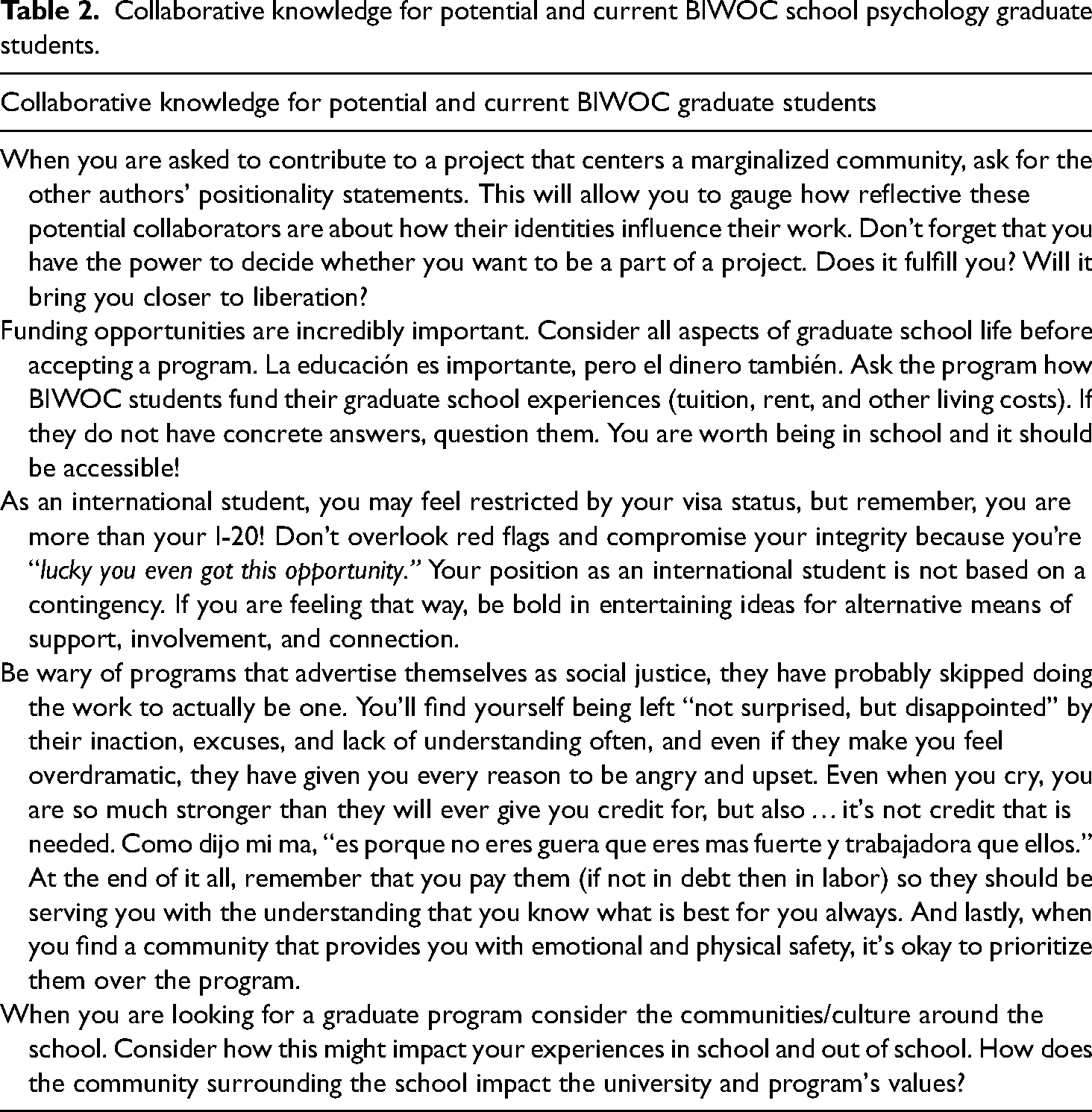
Advocate for what is best for you … and yes, that means saying no, even if you are made to feel like you should say yes
In graduate school, advocacy plays a big part in our personal and professional development. BIWOC students are not provided the resources that we deserve and need to succeed. Oftentimes, we are afraid to ask for those resources because of the reaction we will receive from those in power. Even with the common response from these systems being “No,” advocacy of those resources in graduate school are essential to our success. Furthermore, advocacy for our emotional well-being is also an act of love to ourselves, our families, and our communities. Do not be afraid to protect your time and energy by creating boundaries for who is allowed into your space. Advocacy does not mean that you stand up for everybody but it does mean that you take a step back and protect yourself.
You can protect yourself by seeking sustainable and practical forms of self-care. Resting and recharging are important—you cannot expect to do the work that you care about if you are not taking care of your mental and physical self. Remember that you are a student first and above all a person! Sustainable self-care can also look like making the hard decisions that will benefit you in the long run. For example, setting aside time to intentionally plan out your week in blocks so that it is not as overwhelming. If you feel like you are struggling and need mental health support, seek them early on. In many of our communities, topics concerning mental health are stigmatized and seen as taboo, but it is imperative that you find the help that you need. Ask other BIWOC students and faculty what culturally humble and responsive resources exist. As a BIWOC student, you should request spaces that allow you to simply be—counterspaces are a good example of this.
Build your community to nourish yourself
We all know humans are social creatures and therefore thrive on social support. For many of us, our ancestors’ survival was based on nourishing communal relationships that provided comfort, feelings of security, and story sharing. This has been reminiscent of our experiences in grad school—community has allowed us to survive in this space. Graduate school does not have to be a lonely process—do not isolate yourself. Look for program events, school-wide events, and other activities happening around the community. Some ways that we have found community is by initiating and hosting a program field day for students and faculty, tutoring at a grassroots community-based organization, and facilitating events for the international student community. As with anything, we should always be aware of the roles we play in the activities and events we attend. Due to instances of tokenism and a lack of security, ask fellow BIPOC graduate students about their experiences and where they feel safe. Pass on these funds of knowledge to the next generation of BIPOC students who are seeking ways to build their community and survive.
Reconceptualize and redefine what research means to you
Research can be extremely elitist and can come across as intimidating, confusing, and inaccessible to BIPOC. However, it does not have to be like this and you do not have to limit your research interests. In fact, research becomes less intimidating for BIPOC who have the support from caring advisors and mentors. Reach out to faculty and staff within and outside of the program to seek out research opportunities that directly align with your own interests and the communities you want to serve. If you cannot find ways to incorporate existing projects into your own research hopes, do not be discouraged! This is what makes your candidacy unique—no one else shares the same exact research niche as you. Reconceptualize research by creating your own and experimenting with different strategies and methods outside of those being used by the principal investigator. The present paper is an example of how we collaborated and explored research on our own terms by recognizing the value in learning about the experiences of others through storytelling.
For one author who rarely agrees with traditional methods of research due to its history of weaponization, redefining what it means for her and her community has added to her graduate school journey. The way research is traditionally done often feels like it centers the words of those in power while negating the true voices of the communities in which those research findings are imposed upon. However, research can incorporate decolonial methods that collect information by the community for the community. Some ways she has considered incorporating research into her future practice are, building accessible services, as well as, connecting said services to families in the community who are often excluded. After all, the best form of research can simply mean being involved and engaging with the community. And, as a reminder, our value in academia is not derived from the research we conduct or how “productive” we are. Instead, it is the implications of our research and how it impacts the communities we serve. But most of all, please remember that we exist outside of academia (e.g., as a friend, a sibling, and a family member) and that is more than enough.
Implications for BIWOC faculty
For BIWOC individuals who are thinking about becoming a faculty member, transitioning between universities, or in need of hope to continue in the position you are in, we see you. We acknowledge that the work to make you feel comfortable in your program falls on the shoulders of those who recruited you to be there. We offer several recommendations that we hope will prevent you from burnout and shield you from harm.
Question how a program is engaging in critical reflection of its processes
As students and faculty who have only ever known academia in the context of the pandemic, we strongly encourage future and current BIWOC faculty to inquire how your program is engaging in critical reflection. It is valid to question how, whether, and to what degree programs and faculty are decentering whiteness and colonialism in their processes, behaviors, and expectations. Are these topics addressed during faculty meetings and program townhalls? Is there a genuine effort to acknowledge, document, and change mechanisms that are conducive to othering? It is okay to expect and even demand that these conversations take place. And it is okay to leave if you feel these conversations are not being had or are being given minimal attention, such that folks are superficially engaging. School psychology programs will never be able to support us if they do not hold up a mirror to themselves and identify where there are cracks. You have the power to determine how much you will engage in these efforts. You do not have to sacrifice your well-being, your research aspirations, or your time.
Engage in meaningful research that brings you and your community closer to liberation
To engage in meaningful research that uplifts and empowers marginalized individuals and communities is one way to thrive within school psychology programs. We must become comfortable with not seeking permission or validation from the system and people that historically, and presently, exclude research that is community-engaged, culturally informed, critical, and decolonial. This paper is one example of work that has been both meaningful and empowering to those of us engaged in it. But, we also have a responsibility, as BIPOC scholars, to protect our communities and those that we work with. When we go to interview for positions, we need to ask questions like, What is your view on community-engaged research? Sometimes it might take years to form meaningful relationships with communities that I do research with, how do you feel about that? My work is not always accepted in top-tier journals due to the questions I ask and the methods I utilize. How will you account for that as part of my tenure portfolio? There are ways that we can push back on tenure expectations in regards to research by making potential employers, deans, and department chairs aware of the barriers that we face as BIPOC scholars who work with communities that have been harmed by research.
Maintain teaching integrity despite pressures to conform to whiteness
It might be attractive to change everything about your teaching style after that first round of poor course evaluations; however, you cannot please everyone nor should you try. More importantly, you should not have to compromise your teaching style to please students, tenure committees, or department chair observers. Often as BIWOC faculty, we feel pressure to conform to how “teaching” is conducted. Yet, school psychology students deserve to witness the diversity in teaching styles with BIPOC students especially deserving to see faculty that look like them teaching in ways that bring joy. Teaching should not be a performance but a genuine representation of who you are as a person. You should be able to bring your full cultural self to the classroom without fear of backlash from white students who may not understand that you care deeply about their growth and transformation. We do not do this work to be recognized but we do this work to be thoughtful, supportive, and relational.
Conclusion
The stories, recommendations, critical feedback, and questions presented cannot encompass the complexity and nuances of BIWOC students in other programs, those who have come before us and those who will come after us. Nor is this paper intended to blame white school psychology faculty, supervisors, or graduate students for the outcomes of colonization, Western hegemony, or white supremacy. However, this is a declaration that our stories should not be ignored and that we expect acknowledgement, accountability, and change. School psychology cannot and must not move forward without the voices of those most marginalized, leading the efforts toward anti-racism, decolonization, and liberation.
IRB statement
The institution at which this research took place, Indiana University, did not require IRB approval or require an application for a waiver of ethnographic research at the time the study was conducted. In accordance with federal guidelines, we are not considered subjects but co-authors. Additionally, Indiana University does not categorize ethnographic research as empirical research requiring review. Nonetheless, we have been intentional about the ethics of the study, as we consulted national experts in ethnographic methodology at Indiana University and at other universities throughout the study. Through multiple conversations and reflection with these experts, we discussed the various ways in which our methods ensured ethical decision making and care.
Justification for word length
Our manuscript is unique in that it highlights the lived experiences and stories of minoritized women in school psychology. The findings, arguably the most important part of the manuscript, equate to about half of the total words and our positionality statements are ∼2500 words. Without these two components, the manuscript will lose its integrity. To do justice by the stories shared and give appropriate context for our study and findings, it is imperative that we be given the page space to do so. Additionally, we were asked by reviewers to include a theoretical framework and provide summary paragraphs for each theme which added to the length of the manuscript. We are happy to cut down on the wording as appropriate based on peer-review and welcome suggestions for doing so.
Footnotes
Declaration of conflicting interests
The author(s) declared no potential conflicts of interest with respect to the research, authorship, and/or publication of this article.
Funding
The author(s) received no financial support for the research, authorship, and/or publication of this article.
