



Abstract
Vocational education and training measures have featured prominently in the responses of EU member states to the economic crisis that erupted in 2008. Existing training programmes have been expanded and new programmes introduced. In addition, employers and trade unions have negotiated new entitlements to education and training. This article explores the various training measures that have been adopted since the start of the crisis and compares countries with different types of training systems. Particular attention is paid to the UK, Ireland and Germany. The article also examines the role that training measures have played in governments’ active labour market programmes. While the European Commission has called for a ‘training-first’ approach to the unemployed, the article suggests that ‘work-first’ principles are becoming even more dominant.
Introduction
The jobs crisis has led all European Union (EU) member states to expand existing active labour market programmes (ALMPs) and introduce new measures aimed at reducing unemployment. Education and training have featured prominently among these measures and international agencies have regularly stressed the importance of pursuing a training-intensive path to recovery. The OECD (2009a: 19), for example, has recommended that countries should increase expenditure on labour market policies so as to ‘provide workers with the skills that will be needed as the economy recovers, including through the use of compulsory training programmes’, and has argued that training programmes are more appropriate than ‘work-first’ measures for vulnerable workers. The OECD’s emphasis on training has been echoed by its member countries and also by the European Union. In considering how Europe should respond to mounting job losses, the European Commission (2009: 9) has advocated that ‘For men and women facing difficulties in gaining new employment, the “training first approach” should be considered. For the entire workforce, up-skilling and re-skilling is crucial to ensure adaptability and employability in uncertain times.’
The article has three main objectives. First, it identifies and examines the various types of training measures that have been introduced by EU member states in response to the economic crisis. Second, it explores differences and similarities in the responses adopted by member states with vocational education and training (VET) systems that have been described as ‘corporatist’ (e.g. Germany) and those with systems that have been characterized as ‘market-led’ (e.g. the UK) (Ashton et al., 2000). Third, the article considers whether there has been a significant shift in favour of a ‘training-first’ approach towards the unemployed. The article begins by discussing the role that education and training play in the employment policies of EU member states and the policy prescriptions of the European Commission. It goes on to examine the extent of training activity across the EU since the start of the economic crisis. This is followed by a discussion of specific training-related initiatives. It is argued that alongside the implementation of new training measures, a number of EU member states have weakened social protection and given workfare schemes a sharper emphasis. These developments are explored through a detailed investigation of crisis responses in Germany, Ireland and the UK. The article concludes by highlighting a number of policy concerns and by discussing the extent to which supply-side reforms, including education and training measures, are likely to encourage a jobs-rich recovery from the crisis.
Training and labour market policy
The term vocational education and training (or technical and vocational education and training) can be thought of as referring to the ‘acquisition of knowledge and skills for the world of work’ (Hollander and Yee Mar, 2009: 41). This process of acquisition can occur within the education system (mainly at upper-secondary level) and through post-compulsory education and training. The term VET is, however, subject to a degree of conceptual ambiguity, given that universities also prepare young people for participation in the world of work (Bosch and Charest, 2010: 1). Furthermore, while there is a clear distinction between VET provision and general education in some countries, in others they are more closely linked (Bosch and Charest, 2010). This article, however, is primarily concerned with education and training measures relating to workers, whether employed or unemployed. To that extent, the definition provided above will suffice.
The relationship between training, employment and competitiveness has been at the centre of European social policy debates for the past three decades. European strategies for competitiveness and growth, as enshrined in the Lisbon Agenda and Europe 2020 initiative, have emphasized that the EU’s ability adapt in the face of globalization, technological change and the growth of knowledge-intensive occupations will require increased investment in skills and knowledge and improved ‘lifelong learning’ opportunities. Education and training are also regarded as the principal means by which workers will secure ongoing employment security. This assumption underpins the European Commission’s concept of flexicurity, which has come to dominate its employment policy prescriptions. The Commission (European Commission, 2007: 10) has defined flexicurity as an ‘integrated strategy to enhance, at the same time, flexibility and security in the labour market’ and has claimed that the implementation of flexicurity measures will result in a multitude of economic and social benefits, including enhanced productivity, smoother transitions within the labour market, improvements in the prospects of labour market ‘outsiders’, higher rates of employment and shorter periods of unemployment (for a discussion, see Burroni and Keune, 2011; Heyes, 2011). Education and training (‘lifelong learning’) are key components of flexicurity. Alongside active labour market programmes (ALMPs), they are supposed to ensure workers’ ongoing ‘employability’, a concept that has been interpreted in a variety of ways but generally denotes a ‘concern with improving (or maintaining) people’s ability to participate successfully in the processes of recruitment, selection and career progression that characterise the labour market in Europe, the US and similar societies’ (Gore, 2005: 341–342).
National policy-makers have therefore been directed to develop employment policies that are consistent with the EC’s ‘flexicurity’ agenda and improve access to lifelong learning opportunities. Various education and training initiatives have been launched in an effort to boost education and training, for example the ‘Education and Training 2010’ agenda, directed at making the European approach to education and training a ‘world reference’. However, the ability of the EC to influence VET policy and interventions within member states is restricted. Article 150 of the European Community treaty stipulates that member states of the EU retain sole responsibility for the content and organization of vocational training provision within their national borders, and explicitly rules out an imposed harmonization of rules and regulations (Heyes, 2007). Consequently, there continues to be substantial cross-border diversity in relation to national education and training policies and institutions, the relationship between general and vocational education and the relationship between vocational training and the labour market (Bosch and Charest, 2010). Participation rates and educational outcomes also vary. Participation in ‘lifelong learning’ by people aged 25–64, for example, tends to be consistently high in countries such as Sweden, Denmark and the Netherlands and consistently low in countries such as Romania, Bulgaria and Greece (Heyes and Rainbird, 2009).
A number of studies have sought to account for differences in the extent of training activity. Comparative studies (for example, Ashton and Green, 1996; Brown et al., 2001; Whitley, 1999) have analysed linkages between national skill formation and production systems and examined the extent to which decisions relating to training are discussed, negotiated or co-determined by employers and worker representatives. On the basis of such considerations, the UK and US ‘training systems’ have been identified as examples of a ‘voluntarist’ or ‘market-led’ model of VET, in which decisions relating to training are generally left to employers, with trade unions having little or no formal involvement (Ashton et al., 2000; ILO, 1998). By contrast, training systems in countries such as Austria, Germany, Denmark and the Netherlands, where employers and unions both have a role in the regulation of training, have been defined as ‘corporatist’ or ‘co-operative’ (ILO, 1998: 69). Corporatist training systems tend to be associated with relatively strong apprenticeship programmes, relatively high levels of participation in continuing vocational training (CVT) and other forms of ‘lifelong learning’, and skills-intensive production (Bosch and Charest, 2010; Heyes and Rainbird, 2011). Market-led systems, by contrast, encourage an emphasis on relatively low-level general skills and ‘sub-optimal’ investments in training (Ashton and Green, 1996).
Comparative studies of vocational training have tended to focus on initial training and (to a lesser extent) CVT undertaken by employed workers (see, for example, Bosch and Charest, 2010). Insofar as pre-employment education and training activities are addressed, the focus of enquiry has tended to be restricted to the schooling and training of young people and their transition from education to employment. The unemployed have tended to receive less attention, yet in many countries training is an important component of ALMPs and tends to account for the largest share of overall state expenditure on activation measures (Martin and Grubb, 2001: 25). Across the EU, expenditure on training is positively associated with expenditure on passive labour market measures per person, the most important component of which is unemployment benefit. Relatively high benefit levels may create an incentive for government spending on active measures so as to facilitate speedier transitions from unemployment to employment and limit total benefit costs (Grubb, 2007: 9; OECD, 2009b). Participation in training measures and government spending on training-related ALMPs have thus tended to be highest in countries with ‘corporatist’ VET and welfare systems and relatively high replacement rates, including Germany and Denmark.
The emphasis placed on training-related activation measures has, however, decreased in several countries during the past decade. One reason for the de-emphasizing of training has been increased scepticism on the part of policy-makers concerning the effectiveness of training as a means of combating unemployment. Danish policy-makers, for example, have expressed doubts about the benefits of job training in the public sector (Madsen, 2004: 198). A more fundamental reason for the de-emphasizing of training, however, has been the widespread adoption of work-first oriented social policies in which the relationship between paid work and welfare is refashioned by cutting the duration of social benefits, restricting entitlements to benefits and making those entitlements conditional on participation in the labour market (Bruttel and Sol, 2006; Van Berkel, 2009). The introduction of workfare measures in the UK coincided with a marked reduction of expenditure on government-sponsored training. In 1996 training-related ALMPs accounted for 0.19% of GDP. By 1998 expenditure had fallen to 0.05% of GDP and it continued to fall thereafter, reaching 0.02% in 2007. The only EU member states that spend less on training than the UK relative to their GDP are Slovakia and the Czech Republic. Reduced state spending on training in Denmark, albeit from a much higher base, also appears to be related to a shift in emphasis in favour of work-first employment policies, as well as concerns relating to cost (Bredgaard et al., 2005, cited in Gray, 2009: 51). Nevertheless, training measures continue to play an important part in Danish ALMPs. In Sweden, by contrast, where the shift towards work-first has been more considerable, expenditure on training-related ALMPs has fallen substantially, as have participation rates (see Figure 1).
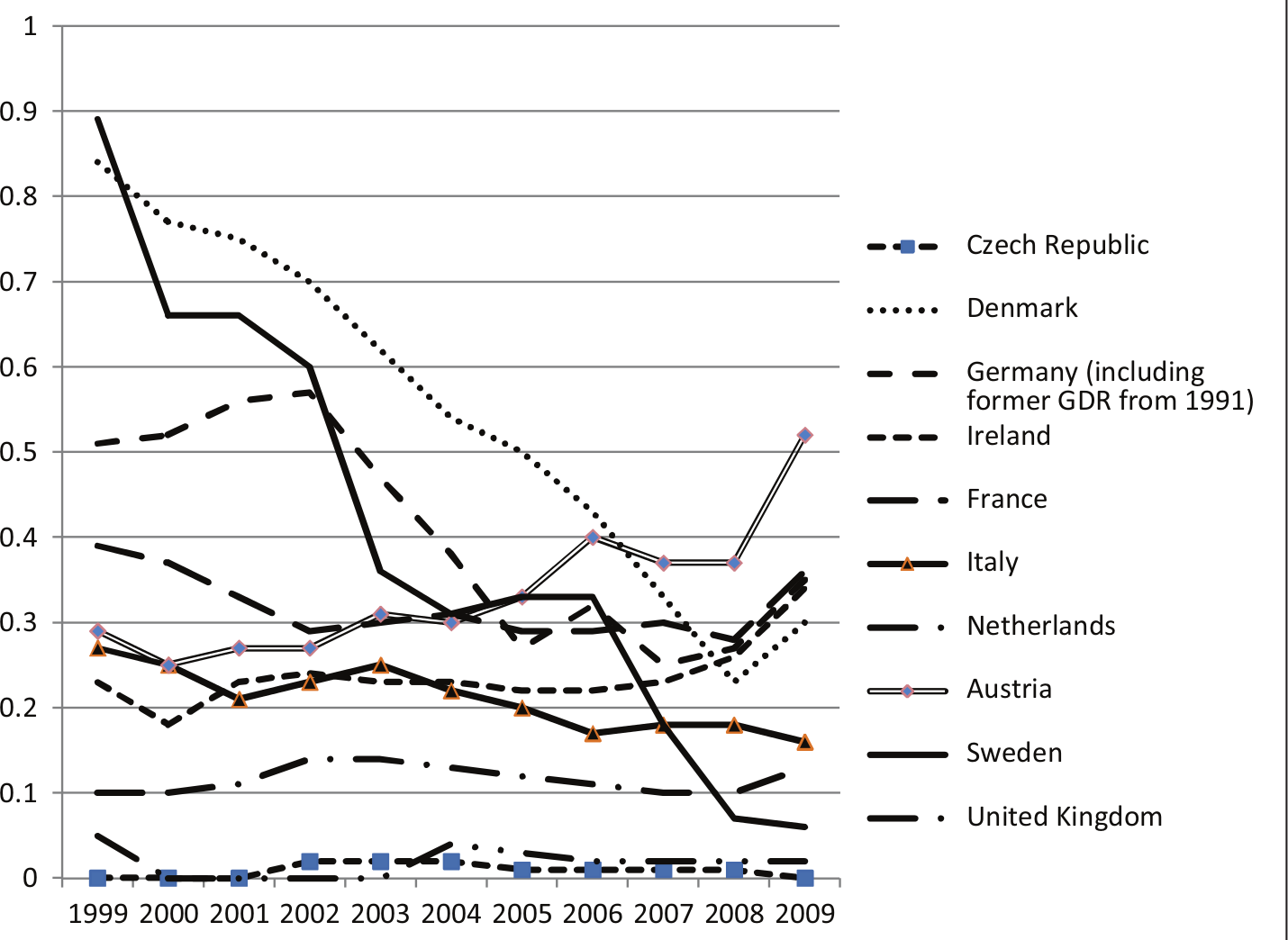
Government expenditure on training measures as a percentage of GDP in selected European countries: 1998–2009.
Education and training during the economic crisis
Training for those in employment
The European Commission intended that the rate of participation by adults in lifelong learning would reach 12.5% by 2010 (CEDEFOP, 2010). However, total participation rates for the EU27, as measured by the Labour Force Survey (LFS), have fallen since the mid-2000s. The participation rate for those aged 25–64 years peaked at 9.8% in 2005 and has fallen consistently since then, reaching 9.1% (below its 2004 level of 9.3%) in 2010. The participation rate for employees aged 25–64 years fell from 11.2% to 10.4% over the same period. As can be seen from Figure 2, however, declining participation has not been the experience of every EU member state. Some countries, including Denmark, Estonia, Sweden and Luxembourg, witnessed increased participation following the start of the crisis.
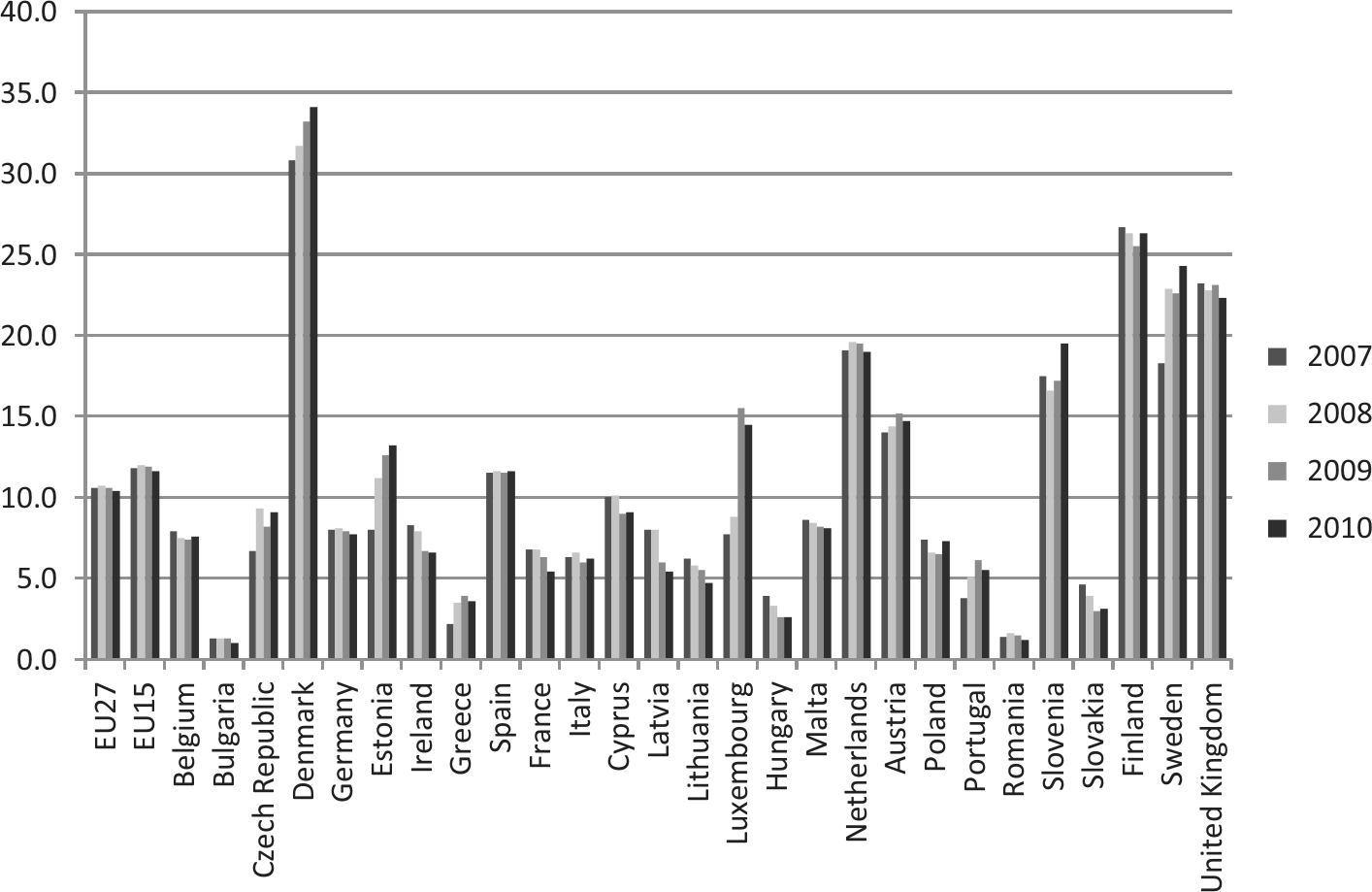
Participation by employees aged 25–64 in education and training (in percentages).
The data in Figure 2 do not provide an indication of the relative merits of education and training systems. CVT participation in Germany is relatively limited yet it retains a strong initial vocational training system. Support for both initial training and CVT is strong in the Nordic economies while the UK lacks a strong initial training system yet performs well in terms of participation in CVT (Gallie, 2007: 24). However, the proportion of working-age UK respondents who participate in informal education or training tends to be substantially larger than the proportion attending formal courses. Participation rates in formal education among adults are highest in the Nordic countries and in some CEE economies (notably Slovenia, Poland, Lithuania and Estonia).
The LFS data do not provide information about participation in employer-funded training or training budgets, although other evidence indicates that employers in many countries have cut their training budgets since 2007 (Eurofound, 2011: 8). However, several countries introduced additional training support and opportunities for employees. The government of the Netherlands, for example, offered employers grants for retraining workers, increased employers’ tax credits so as to compensate for the costs of retraining and reimbursed the costs incurred by employers who permitted low-skilled workers to participate in accreditation of prior learning programmes. A number of countries that provided support for training leave prior to the crisis introduced more generous leave provisions. For example, following the start of the crisis, the length of Austrian workers’ entitlement to a ‘training allowance’ (equivalent to the unemployment benefit they would have received had they become unemployed) was extended from a maximum of 12 months to 18 months (Eurofound, 2009: 14). Several countries, including Austria, Czech Republic, Denmark, Portugal and Germany, also expanded or introduced short-time work measures in an effort to preserve jobs and in most cases additional financial support was provided for (mainly) company-focused training measures for under-employed workers. In the Netherlands and Slovenia, employers have been required to enable workers to participate in training during periods of short-time working or temporary leave (European Commission, 2009), although most countries with short-time working schemes have relied on incentives in the form of subsidies, rather than compulsion. Subsidies have typically taken the form of contributions by the state or the public employment service to wage, training or social security costs.
In countries with strong traditions of social dialogue or encompassing collective bargaining, employers and trade unions have played an important part in the development of new measures. In Belgium’s private sector, a ‘time credit’ agreement was reached by employers and trade unions in 2008, allowing workers in companies with 10 or more employees the right to a one-year career break and a monthly flat-rate allowance provided by the federal government (Eurofound, 2009: 13). Collective agreements concluded in the German metalworking sector in 2010 provided employees with a right to continuous training leave for up to five years (Eurofound, 2011: 23). In Sweden, an agreement concluded in 2009 for the manufacturing sector allowed for workers to be temporarily laid off and to undertake training in place of time away from work. This framework agreement provided the context for local collective agreements in companies such as Volvo and Scania (Lovén, 2009). Employer and trade union involvement in training measures has been particularly extensive in France, reflecting the extent to which employers and unions are involved in the regulation of French CVT, particularly at the national and inter-sectoral levels (Méhaut, 2010: 122–124). In January 2009, French employers and trade unions signed a national inter-sectoral agreement on the development of training throughout the working life, professionalization and securing career paths. The agreement resulted in workers being granted a right to transfer their existing individual right to training (droit individuel à la formation, DIF, introduced in 2003) should they lose their job as a result of either dismissal or redundancy (Alleki, 2009). French employers and trade unions have also negotiated new training-related agreements for particular sectors. The employer association for the chemical sector, Union des Industries Chimiques, and the Ministry of Economy, Industry and Employment, for example, reached a national framework agreement to use training programmes as a way of avoiding redundancies (Glassner and Keune, 2009).
Training for the unemployed
The magnitude of increases in unemployment since the start of the crisis has varied according to workers’ levels of education. Between the third quarter of 2007 and the third quarter of 2009, the EU27 unemployment rate for adult workers (i.e. those aged 25–64) who were educated to no more than lower-secondary level increased from 8.8% to 12.6%. The increase in unemployment among more highly educated adults was comparatively modest. The unemployment rate for workers with upper and post-secondary (but not tertiary) education rose from 5.6% to 7% between 2007 and 2009, while the rate for those with tertiary-level education increased from 3.7% to 4.6%. However, the average figures mask substantial differences in the experiences of individual member states. In Ireland and Spain, for example, large increases in unemployment occurred across all levels of education attainment.
Young people have been particularly affected by the crisis: the unemployment rate among people aged under 25 years in the EU27, which stood at 15.3% in 2007, reached almost 20% in 2009. The percentage of young people who were NEET (not in education, employment or training) in 2010 was greater than in 2007 in a substantial majority of member states (exceptions included Germany, Luxembourg, Malta, Austria and Poland) (see Figure 3). While it is often claimed that stringent employment protection is a cause of high youth unemployment (e.g. OECD, 2004), unemployment rates for young people have increased substantially in a number of countries that have relatively lax rules on hiring and dismissals. In 2009, the unemployment rate for workers under the age of 25 years was around 20% in the UK and 25% in Ireland. These rates were comparable with, and in some cases substantially greater than, those found in countries with much stronger employment protection (e.g. in Germany and Austria the youth unemployment rate remained under 11% while in the Netherlands it was less than 7%). On the whole, those countries, such as the Netherlands, Austria and Belgium, that have experienced relatively modest increases in unemployment among older workers have also experienced comparatively mild increases in youth unemployment. Increases in unemployment among young workers have tended to be most substantial in countries such as Spain, Ireland and Latvia that have also witnessed large increases in unemployment among older workers.

People aged 18–24 years not in employment, education or training (NEET rates).
Many governments provided additional resources to facilitate training access for unemployed workers. The Italian and French governments, for example, created new funds to support training while the former also introduced a training voucher scheme. Many measures have been focused on young people. For example, the Dutch municipalities have encouraged young people without a basic vocational qualification to train towards an upper-secondary vocational diploma (OECD, 2009c: 20). Measures to support displaced apprentices have also been widespread. However, despite the various measures that have been introduced, there is little evidence of a widespread shift towards train-first employment policies. The extent of participation by the unemployed in training programmes varies considerably across Europe, being particularly low in the UK and Czech Republic and relatively high in the Nordic countries (with the recent exception of Sweden), Austria and Ireland. The substantial cross-national differences in participation in training-related ALMPs that were evident before the start of the crisis have persisted: increases in participation have been confined to countries such as the Netherlands, where participation rates were already relatively high. In countries where participation rates were low prior to 2008, participation has either exhibited little change or fallen further. As shown in Figures 4 and 5, reductions in participation rates and expenditure on training per unemployed worker have occurred in a number of those countries that have experienced the most substantial increases in unemployment, including Greece, Spain and Lithuania.
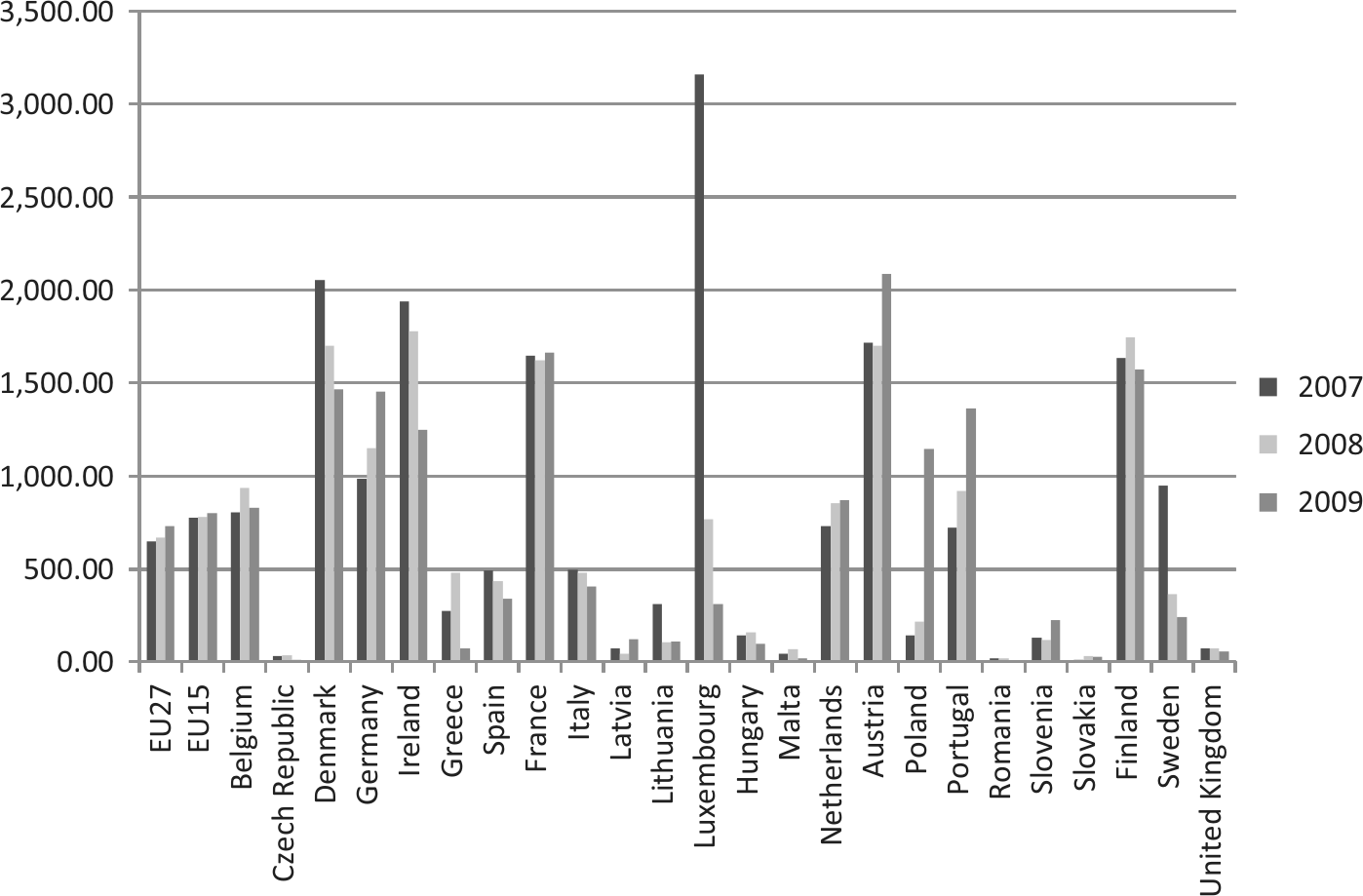
Expenditure on training per person wanting to work (PPS).
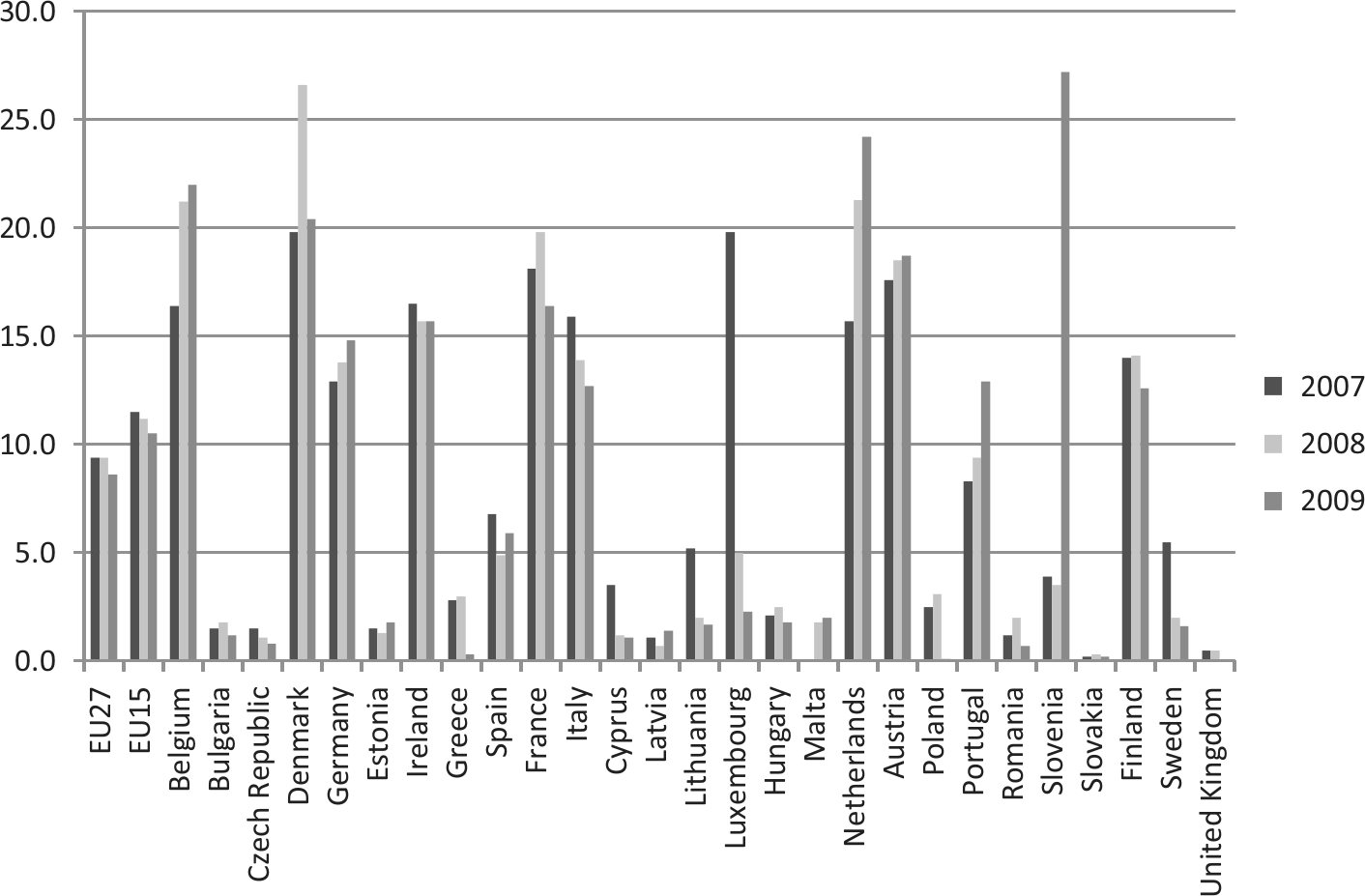
Participation in training measures, per 100 persons seeking work.
Three key points have emerged from the discussion thus far: first, education and training activity has decreased in a number of countries since the start of the crisis; second, despite the exhortations of the EC and OECD there is no evidence of a widespread shift towards a train-first approach to the unemployed; and third, there have been substantial differences in the responses of EU member states to the crisis and the role that training has played in those responses. These issues are now explored further through an investigation of crisis responses in the UK, Ireland and Germany. In addition to published sources, the discussion draws on semi-structured interviews conducted in 2010 with officials and representatives of the German Federal Ministry of Labour and Social Affairs (Bundesministerium für Arbeit und Soziales, BMAS), Ireland’s Department of Education and Skills, and the Department of Work and Pensions (DWP) in the UK.
Germany
Germany’s dual system of vocational training is commonly argued to have contributed to strong economic performance by facilitating production strategies that involve ‘high skills’ (Hall and Soskice, 2001). While continuing vocational training is largely controlled by employers, both employers and trade unions play a central role in determining the content and duration of apprentice training programmes and, in contrast to most other developed economies, vocational training continues to be a highly regarded route for young people (Bosch, 2010). Vocational training measures have also played an important role in labour market measures for the unemployed. However, following the Hartz reforms of 2003–2005, the emphasis in German employment policy shifted away from training-focused measures and towards workfare. According to Bosch and Charest (2010: 16–17) long-term retraining for unemployed workers, geared towards the acquisition of an occupational qualification, ‘virtually disappeared’ and the benefit entitlements of participants in training programmes were substantially reduced.
Germany’s response to the crisis included a number of measures for people in work and at risk of job loss. In 2009 Germany relaxed the eligibility criteria associated with its WeGebAU support programme for low-qualified and older employees in work, through which the Federal Employment Agency (Bundesagentur für Arbeit, BA) subsidizes wage and training costs. The number of participants increased from 61,968 in 2008 to 101,890 in 2009 (Eurofound, 2011: 21). A distinctive feature of Germany’s response to the economic crisis was the extensive use of working time reductions as a means of reducing labour costs and preventing job losses. Of particular significance was the use of short-time working measures supported by the government and the public employment service. The number of German workers involved in short-time working increased from an average 20,000 per month in 2007 to a peak of 1.5 million during 2009. Financial incentives were provided so as to encourage employers to provide additional training opportunities for partially unemployed workers. The German Federal Employment Agency normally covers 50% of the social security costs of enterprises operating short-time working schemes. However, during the crisis the subsidy was increased to 100% for firms that provided partially unemployed workers with training. According to officials of the Federal Ministry of Labour and Social Affairs, 148,000 workers with reduced hours had participated in training measures by the end of 2010. A large majority (approximately 120,000) took part in European Social Fund-financed training courses lasting two or three weeks; a further 25,000 workers were involved in longer term state-financed training. However, these figures need to be placed in perspective. Of all firms with workers in short- time measures, only one-seventh provided training and fewer than 2% of all workers with reduced hours were in training at any given time (Dietz et al., 2011: 24). Employers experienced difficulties in finding courses that met both the needs of workers and the needs of enterprises and it is also possible that the government’s decision to extend the 100% social security cost subsidy to all short-time work lasting more than six months from July 2009 reduced financial incentives for firms to offer training (Dietz et al., 2011).
Economic downturns tend to have a negative effect on apprenticeship numbers and the ratio of apprentices to employees (Bosch and Charest, 2008; Felstead and Green, 1996). The current crisis has proved to be no exception. Economic difficulties and the closure of businesses have affected the ability of firms to offer apprenticeships and governments have responded by providing additional support. In Germany, the criteria relating to extant measures enabling apprentices from insolvent firms to transfer to other firms were relaxed. Employers that agreed to take on displaced apprentices received a bonus. A parallel bonus measure was introduced for young people who had been searching for a training place for at least one year. The bonus was intended to contribute to employers’ training costs and by February 2010 almost 31,000 applications for the bonus scheme had been made. 1 However, the BMAS’s subsequent evaluation of the latter programme suggested that 80% of those employers who took on young people would have done so even in the absence of the bonus payment (interview data).
Additional protection for apprentices has also been achieved through collective bargaining. The 2010 bargaining round in the chemical sector resulted in a commitment by employers to create 9000 new apprentice training places per annum between 2011 and 2013 and to make a donation to a fund to support firms that retained qualified apprentices who would otherwise have become unemployed (Vogel, 2010). Measures for apprentices were also agreed in the steel industry in 2011. Following strike action, employers and unions reached an agreement that committed employers to retain apprentices on a permanent basis following completion of their training, except in particular circumstances (such as serious economic difficulty) (Dribbusch, 2012).
Despite the central role played by employers in regulating VET, the government has experienced certain difficulties in engaging them in training-related crisis measures. Since 2004 German employers and governments have negotiated three-year ‘training pacts’, which have resulted in the creation of targets for vocational training measures directed at young people and the development of an internship programme. In 2009, the government called upon employers to provide 600,000 new apprenticeship places. Subsequent objections from employers led to the refusal of the then Federal Minister of Labour and Social Affairs to sign the 2009 Training Pact declaration. While the declaration was eventually signed in October 2010 (with a commitment to create an average of 60,000 new apprenticeship positions annually), the difficulties encountered during its negotiation reflect a longer-standing problem relating to the declining propensity of German employers to offer apprenticeship training places (Bosch, 2010).
Training for the unemployed was cut substantially during the Hartz reform process. In 2000, there were 343,000 participants in further training measures. By 2005, following the implementation of the Hartz reforms, the number of participants had dropped to 114,000. In 2009, however, the number increased to approximately 200,000 participants (interviews). Attempts have also been made to link training programmes to projected future skill demands by providing funding for older unemployed workers to retrain as nurses. According to BMAS officials, policy-makers have come to believe that the cost cutting associated with the Hartz reforms may have been too drastic and that the long-term effectiveness of training measures was under-estimated. However, there has not been a substantial reorientation of employment policies in favour of retraining; on the contrary, some of the principles associated with the Hartz reforms are being strengthened. Following the 2009 general election, which brought to power a coalition government composed of the Christian Democratic Union, the Free Democratic Party and the Christian Social Union of Bavaria, Germany began to reform welfare entitlements and labour market policies. The bonus scheme for employers taking on apprentices was abandoned, parental leave benefits were reduced, transitional supplements for unemployed workers transferring from ‘unemployment benefit I’ to ‘unemployment benefit II’ (a lower basic benefit) were removed and the government ceased paying the pension contributions of people receiving basic income support. As is the case elsewhere in Europe, German policy-makers are seeking to strengthen employment incentives. Job advisors in local employment offices are due to be given greater discretion in respect of the forms of support they recommend to the unemployed (thus furthering a process begun by the 2003–2005 Hartz reforms) and support measures that are currently available to unemployed workers by right are likely to become discretionary.
Ireland
Ireland enjoyed comparatively low levels of aggregate unemployment and youth unemployment throughout the decade prior to 2008 (European Commission, 2010: 173). During this period, Ireland placed considerable emphasis on workforce up-skilling and compared favourably among EU member states in terms of government spending on training-focused ALMPs (Heraty and Collings, 2006; Meager, 2009) and participation rates. The Irish government established a National Training Fund, financed by a levy on businesses (0.7% of payroll costs), to support measures for employees, the unemployed and apprentices. Spending on social protection also increased during this period, partly as a consequence of national-level social dialogue that began in 1987. Employers and trade unions were also provided with a degree of involvement in the regulation of the apprenticeship system and a voice in other regulatory and advisory VET bodies, including an ‘Expert Group on Future Skills Needs’ and employer-led learning networks (‘Skillsnets’) supported by the National Training Fund.
The rate of unemployment in Ireland almost tripled between 2007 and 2009, increasing from 4.6 to 11.9%. Construction sector employment was particularly hard hit, falling by more than one-third between 2008 and 2009 (Expert Group on Future Skills Needs, 2010). Measures to prevent job losses and support workers most at risk of job loss were extremely limited. Ireland’s short-time working scheme was reformed so as to allow workers with reduced working hours to receive training on days on which they did not work. However, the number of workers affected was relatively small. The pilot initiative involved approximately 240 people and it has been estimated that by the end of 2010 a maximum of 4000 workers had participated in the (mainly short-duration) programmes (interview data).
The measures taken by the government in response to the crisis also included an expansion of further and higher education places, a one-year social insurance exemption and a temporary employment subsidy designed to encourage firms to hire unemployed workers. Ireland experienced a substantial fall in the number of people entering apprenticeships, mainly as a consequence of the massive contraction of the construction sector (FÁS, 2010). FÁS – the Irish National Training and Employment Authority – introduced measures to help redundant apprentices to progress through their training, including employer subsidies and off-the-job assessment and accreditation of prior learning (FÁS, 2010: 22). However, by the end of 2010 almost 7500 apprentices remained redundant (FÁS, 2010: 22).
A labour market activation fund of €32 million was created to support training interventions for the young, the low-skilled and the long-term unemployed and 1500 free part-time undergraduate college places were made available to unemployed workers. The state employment and training agency (i.e. public employment service), FÁS modularized its own training provision so as to reorientate provision away from long courses and towards short duration ‘modules’, which enabled it to provide training opportunities to a larger number of workers (increasing from 66,000 in 2008 to 160,000 in 2010). The government also stipulated that activities of Skillsnets be expanded so as to cover unemployed workers. However, overall funding for vocational training was not increased. To support the measures the government instead reallocated substantial resources from FÁS’s ‘training in employment’ budget to ‘training for employment’, with a resulting cut in training support for employed workers. Employers also cut back on training expenditure. A survey of 340 firms by the Irish Business and Employers’ Confederation (IBEC, 2010) found that training expenditure fell between 2008 and 2010 from a mean average 3.3% of payroll costs to 2.6% (the median figure was 1.5%).
A particularly controversial element of the government’s response to the jobs crisis was the introduction of a work placement programme for the unemployed. The scheme was presented as an opportunity for workers to obtain work experience and skills by working for an employer for nine months, during which time they would receive unemployment benefit rather than a wage. Employers were provided with social security exemptions for any workers they took on. However, they were not placed under an obligation to provide workers with training and the programme met with objections from the Irish Confederation of Trade Unions (ICTU). IBEC, by contrast, supported the scheme and subsequently launched its own version.
While training measures have played a key role in Ireland’s response to the crisis, the government has focused on short, mainly three-month, courses rather than significant longer-term intervention to re-skill the unemployed for new occupations. Progress has been made towards meeting the targets associated with Ireland’s National Skills Strategy for 2020 (introduced in 2007), yet a fifth of Ireland’s workforce remains educated to no higher than lower-secondary level while the proportion that is educated up to upper-secondary level has declined slightly (FÁS, 2011). Furthermore, social protection has been cut since the start of the crisis. In 2009 the rate of unemployment benefit paid to new claimants aged 18–19 years was cut from €204.30 per week to €100 per week, followed by a similar cut in 2010 for those aged 20–24 years. The maximum unemployment benefit rate for older workers was cut from €204.30 to €196 per week, with provision to cut it further to €150 per week where job offers or activation measures were refused. In addition, the number of contribution weeks that workers must pay before becoming eligible for unemployment benefit was increased from 52 to 104 and the maximum duration of benefits paid to new claimants was cut from 15 months to 12 months or 9 months, depending on their contributions.
UK
Compared to Germany and Ireland, employers and trade unions in the UK play a limited role in the regulation of training and, despite efforts on the part of successive governments and the creation of employer-dominated bodies with a remit to develop solutions to the UK’s skills deficiencies, the history is one of weak employer engagement in training policy initiatives (Payne and Keep, 2011; Rainbird, 2010). Unlike Germany, apprenticeship training programmes have withered in the UK while participation in higher education has greatly increased. Moreover, training measures have come to play a minor role within ALMPs, with participation rates and government expenditure ranking among the lowest in Europe.
As in Ireland, the response of the (then) Labour government to the jobs crisis focused on measures for the unemployed rather than measures to limit job losses or support those most at risk of job loss. The trade unions called for the government to introduce support for short-time work measures, but the main employers’ federation – the Confederation of British Industry (CBI) – was successful in opposing this idea. A certain amount of assistance for employed workers was provided; for example, the eligibility criteria associated with the government’s Train to Gain programme were relaxed and £350 million was provided so as enable SMEs to provide employees with training irrespective of their existing qualifications. A right for employees to request training during working time was introduced in early 2010, although the measure was developed before the start of the crisis, applies only in firms with 250 or more employees and places employers under no obligation other than to consider requests.
Many of the measures introduced in respect of the unemployed focused on younger people. A ‘clearing house’ system was created to match apprentices who were due to be made redundant with employers that wished to hire trainees, thereby enabling apprentices to complete their training, and the UK construction sector’s training body, ConstructionSkills, was provided with £1 million to support construction companies that took on apprentices laid off during the crisis. 2 The Labour government also launched a ‘Young Person’s Guarantee’ initiative, which guaranteed all 18- to 24-year-olds who were NEET a place in employment, education or training. The scheme was supported by a Future Jobs Fund, which was established to allocate £1 billion to create 150,000 jobs, two-thirds of which were intended for young workers.
The Future Jobs Fund and Young Person’s Guarantee were terminated in mid-2010 following the replacement of the Labour government with a Conservative–Liberal Democrat coalition (the schemes were not evaluated before being abandoned). The new government rapidly forged a new narrative in respect of the economic crisis, seeking to depict the size of the state’s fiscal deficit as a product of profligate spending by the previous Labour government. Continuing financial uncertainty and the debt crises experienced by some other EU member states helped the government to re-frame the crisis in these terms and provided it with a means of justifying subsequent austerity measures. Many of these measures have had implications for education and training. The coalition government has created new barriers to training and education by axing an educational maintenance allowance that had previously helped young people from low-income families to access further education, substantially increasing the cost of a university degree, abandoning the Train to Gain programme of in-work training (which by 2010 had supported training for approximately 1 million workers), increasing the cost of further education courses and abandoning plans to extend the right to request time-off for education and training to employees of SMEs. While it has also made a commitment to increase the number of apprenticeships, doubts have been expressed concerning the adequacy of the funding that has been provided and the extent to which employers will be willing to take on apprentices and co-finance training, particularly given ongoing economic turbulence (Payne and Keep, 2011).
With regard to unemployed workers and other welfare recipients, the government has eschewed a ‘training-first’ approach and has instead strengthened the existing ‘work-first’ orientation of UK labour market policy. The main plank of the coalition’s employment policy is the ‘Work Programme’, which will increase the involvement of private and voluntary sector organizations in the delivery of employment services. The government announced that unemployment benefits would be withheld from unemployed workers who failed to accept a ‘reasonable’ job offer and emphasized that job advisors should no longer be able to use their discretion to allow unemployed workers to remain on benefits. In addition, the government has begun to test the work-fitness of people claiming incapacity benefit, with the aim of transferring many of these people to Job Seeker’s Allowance or a new Employment Support Allowance (ESA) and linking their benefit entitlements to their willingness to seek paid employment.
Conclusion
Education and training have long been central to European social policy and the importance of training in ensuring ‘employability’, competitiveness and growth was re-emphasized in the European Commission’s European Economic Recovery Plan (European Commission, 2008). Governments of the EU member states were advised to ensure that their policies for tackling joblessness were focused on ‘training-first’ rather than ‘work-first’ measures. Yet with few exceptions (e.g. Denmark and the Netherlands), levels of participation in training activity by employed and unemployed workers have fallen or stagnated in Europe since 2007. New or expanded training initiatives have occurred in some countries, yet there has also been a greater emphasis on earlier activation and speedier transitions from welfare to work. In a number of countries (e.g. Ireland, the Czech Republic) both tendencies have been present.
The experiences of Germany, Ireland and the UK provide three contrasting examples of responses to the jobs crisis and the role of training in that regard. In Germany, the extensive use of short-time working measures, combined with additional financial support for training, has helped to preserve the skills base. While retraining measures for the unemployed have regained some of the support that was lost in the immediate wake of the Hartz reforms, it also appears that the employment ‘incentive’ (i.e. weaker social protection) aspects of the Hartz reforms are being reinforced. In the case of Ireland, financial support for training the unemployed has been increased, yet much of the training has consisted of short-term courses and a plausible strategy for addressing structural unemployment resulting from the collapse of the construction industry has yet to emerge. Furthermore, the escalation in unemployment has coincided with an erosion of unemployment benefit entitlements. In the UK, initial attempts were made to channel unemployed workers into subsidized employment in sectors that were anticipated to expand in the future. Training for the employed was also bolstered. However, the Labour government’s efforts fell far short of a training-intensive response and once the current government took office new barriers to education and training access were erected and the work-first aspect of UK employment policy further strengthened.
The emphasis placed on training-related measures in the responses of EU member states to the jobs crisis has varied in ways that reflect established differences in rights and obligations relating to vocational training, the orientation of employment policies, national industrial relations institutions and the relative strength of trade unions. For example, the negotiation of new entitlements to training has occurred mainly in countries where collective bargaining in relation to training was well established prior to the crisis. In countries with ‘market-led’ VET systems (Ashton et al., 2000) and limited collective bargaining in respect of training, such as the UK, training measures played a relatively minor role in responses to the jobs crisis. This is not to say that responses to the crisis were institutionally pre-determined. As the different approaches taken by the UK Labour and current coalition governments to the issue of youth unemployment illustrate, politics remain important in explaining responses and outcomes.
The impact of the economic crisis on employment in countries such as the Netherlands and Germany has been cushioned by short-time working measures. While this has obviously been of benefit to workers who have retained their jobs, evidence from previous recessions (Lloyd, 1999) has shown that employers also benefit from short-time working by retaining skills and therefore being in an advantageous position when the economy begins to recover. The advantages of short-time working have led the European Commission (2010: 3) to embrace it as an example of ‘internal flexicurity’. However, short-time working schemes are most firmly established in countries that provide workers with relatively strong employment protections and it is likely that constraints on employers’ freedom to dismiss encourage them to retain workers on reduced hours (Appelbaum, 2011; Heyes, 2011). Several EU member states have diluted employment protections since the start of the crisis, which suggests that the conditions for a further extension of short-time working measures across Europe are currently unfavourable. Even where short-time working measures are present, employers are rarely compelled to provide under-employed workers with training. The Netherlands is unusual in requiring employers to involve workers in training while they are working reduced hours; most other countries have relied on subsidies to provide an incentive to employers. Given that many workers who become partially unemployed may ultimately be laid off, employers face a disincentive to invest in their education and skills. There is a case, therefore, for compelling employers to provide under-employed workers, and all workers who are facing redundancy, with training or paid time-off for training. Of course the likelihood of any such proposal making headway, particularly in the current economic climate, is low. It seems more likely that existing entitlements to training, and the perennially thorny issue of ‘who should pay for training?’ (Heyes, 2007), will become more contentious, particularly if the European economies re-enter recession.
The crisis has also served to expose the vulnerability of trainees and other young people within the labour market. Apprentices have been shed in both ‘corporatist’ and ‘market-led’ training systems and although governments have introduced measures designed to place apprentices with new firms or provide them with alternative means of completing their training, the supply of additional training places has not kept pace with demand. This problem implies a weakening of the skills base. Moreover, the more general problem of youth unemployment has been greatly exacerbated by the crisis and the number of young people who are NEET has increased dramatically in several countries. The question of how to integrate these people into the labour market and avert the threat of a ‘lost generation’ is perhaps the single most important employment issue currently facing policy-makers. This problem will not, however, be resolved through education and training initiatives alone. Unemployment among young people with ‘tertiary’ level education reached almost 18% across the EU in the third quarter of 2011, with rates far in excess of this being witnessed in economies such as Spain and Greece. The European Commission’s oft-made claim that education and training provide workers with the means of achieving ongoing employment security looks increasingly hollow. Areas of skills shortage notwithstanding, Europe’s current problem is not a lack of skills but a lack of jobs and a lack of policies to create jobs. Austerity measures and a new fiscal pact in the Eurozone are placing additional constraints on government spending, and are likely to further encourage policy-makers at national level to pursue reforms designed to dilute social and employment protections, bolster ALMPs and improve ‘employability’. While advocates (such as the UK government) of supply side reforms argue that employment will grow as workers lose welfare entitlements and employers become more prepared to hire workers, it is more plausible that a weakening of social and employment protection will lead to further reductions in incomes and employment security while doing little or nothing to boost the supply of decent jobs.
Some countries, such as Germany, have targeted employment incentives and retraining measures on sectors such as nursing, social care, tourism and hospitality, in which employment is expected to increase over the next decade (CEDEFOP, 2010). These attempts at targeting are in line with the European Commission’s recent New Skills for New Jobs initiative, which is intended to bring about an improved match between the supply and demand for skills through improved information about employers’ current and possible future requirements. Growth in the service sector is expected to coincide with a further reduction in skilled manual jobs in the manufacturing and agricultural sectors (CEDEFOP, 2010). Yet the jobs associated with occupations such as sales, security, catering and caring are often non-unionized, low-paid and offer limited opportunities for continuing training. Low-paid service sector work may be preferable to unemployment, but it is also possible that young workers will find themselves trapped in low-quality jobs (Scherer, 2004). Moreover, the New Skills for New Jobs initiative is informed by predictions based on recent occupational trends, which the European Commission appears to regard as immutable. The possibility that governments might intervene to shape industrial and occupational structures is barely acknowledged in the Commission’s recent pronouncements relating to employment and skills development (e.g. European Commission, 2010). While increased attention to the demand for skills and efforts to improve labour market intelligence are to be welcomed, a more fundamental step would be to link training policy to industrial policies geared to the promotion of decent work.
Footnotes
Acknowledgements
I am very grateful to the journal’s referees for supplying extremely helpful comments on an earlier version of this article. I am also grateful to the International Labour Organization for providing financial support. I am responsible for any errors that remain.