



Abstract
Before the onset of the global financial crisis in 2008, flexicurity topped the European labour market and social policy agenda. It was acclaimed for combining the flexibility of liberal labour markets with the security of social welfare states, thereby offering a viable formula for success in the new global economy. Nowhere was this better exemplified than in Denmark, with the Danish system repeatedly highlighted as a good example of flexicurity in action. In this article, we revisit the flexicurity concept, assessing how the Danish labour market came through the crisis. We argue that the economic crisis and especially political reforms of the unemployment insurance system have challenged the institutional complementarities of flexicurity, but that the Danish labour market is recovering and adapting to new challenges. The Danish case illustrates that institutional complementarities between flexibility and security are fragile and liable to disintegrate if the institutions providing flexicurity are not maintained and supported.
Introduction
In the late 1990s, policy-makers and academics in the Netherlands (Wilthagen, 1998; Wilthagen and Tros, 2004) and Denmark (Bredgaard et al., 2005; Madsen, 1999) came up with the concept of flexicurity. In the early 2000s, it gained momentum at European level, with the European Commission starting to explore and promote it. Flexicurity was included in the early European Employment Guidelines and culminated in 2007 with the adoption of a set of Common European Principles on Flexicurity (European Commission, 2007). The initial idea of the Commission was to encourage a shift from job security towards employment security by trading more flexible dismissal regulations against investments in active labour market policies, modern social security systems and lifelong learning policies. In later versions, the flexicurity concept was broadened to accommodate sceptics and increase its legitimacy by including different ‘pathways’ to achieving it (including internal pathways like the German industrial model) and different components (flexible contractual agreements, modernised social security systems, active labour market policies and lifelong learning policies) (European Commission, 2007).
However, the economic crisis in Europe in the wake of the 2008 global financial crisis also led to a crisis for flexicurity as a guiding concept and vision for European labour market reform. The crisis called into question the alleged superiority of flexicurity policies and countries (Auer, 2010a, 2010b; Wilthagen, 2014). At the same time, the interest of European and national policy-makers faded as they turned their attention towards the more immediate concerns of crisis management and economic recovery (Bredgaard, 2013).
Wilthagen (2014) has argued that the economic recession put the implementation of flexicurity in the EU Member States under pressure and even questioned the features underlying the concept itself. The main concern was that flexicurity policies could not prevent the steep rise in youth and long-term unemployment (especially in southern Europe) because of the dramatic drop in economic output as a result of the crisis.
Furthermore, in an early assessment of the response to the economic crisis, Auer (2010a) suggested that the Danish model of flexicurity performed worse than the German model: This may mean that the Danish model will be buried in the graveyard of socio-economic models, where it will lie in the vicinity of other former celebrities like the Swedish model, the Japanese model, the Irish Celtic Tiger model, former versions of the German model and so on, while the usually badly noted German model could be resurrected as a European alternative to the low employment, low social protection model of the United States. (Auer, 2010a: 40) Prior to the global financial crisis this model [the Danish flexicurity model] delivered excellent outcomes in terms of labour market dynamism and inclusiveness, but it has struggled recently. (OECD, 2016: 11)
Danish flexicurity and the crisis
In the mid-2000s, Danish flexicurity achieved celebrity status for combining (1) a flexible labour market with low levels of job protection, with (2) generous – in an international comparison – unemployment benefits and (3) strong activation and education policies (Jørgensen and Madsen, 2007; OECD, 2004). The flexicurity ‘golden triangle’ became synonymous with the three elements and the strong performance of the Danish labour market (Bredgaard et al., 2005; Madsen, 1999). It was therefore reasonable to assume that this performance was a function of Danish flexicurity, although causality was difficult to measure and document (Auer, 2000; Bredgaard et al., 2005; European Commission, 2006; OECD, 2004). With Denmark entering a deep and protracted economic recession in 2008, the hype and interest in Danish flexicurity also declined. In this section, we will take a closer look at the performance of the Danish labour market during the crisis, comparing it with the EU in general and with certain other European economies. 1
Denmark was particularly hard hit by the economic crisis which lasted from autumn 2008 until around 2012. The unemployment rate increased rapidly when the economy fell into deep recession in the second half of 2008. By the end of 2009, GDP had contracted by more than 6 per cent (compared to 4.5 per cent in the eurozone). Unemployment peaked at 7.8 per cent in the second quarter of 2012 after a record low of 3.2 per cent in 2008, one of the highest increases in the OECD area, both in absolute and relative terms (Madsen, 2014; OECD, 2016: 52–53).
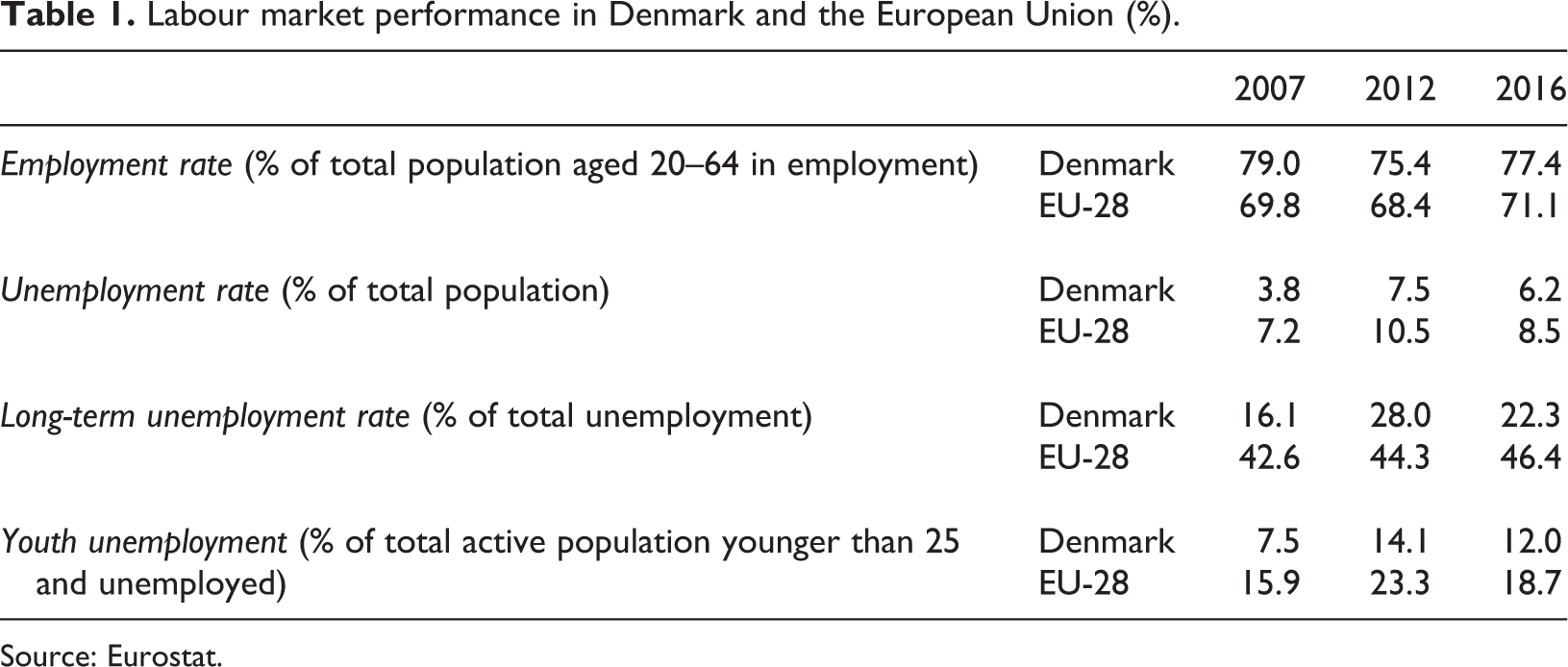
Table 1 shows changes in the main indicators of labour market performance in Denmark compared to the EU-28.
Labour market performance in Denmark and the European Union (%).
Source: Eurostat.
The table shows a sharp decline in overall employment and an increase in unemployment in Denmark during the crisis.
From 2007 to 2012, the employment rate fell by 3.6 percentage points in Denmark compared to 1.4 percentage points in the EU-28. In the initial post-crisis years, Danish employment recovered rather slowly, mainly due to sluggish domestic demand and a bursting ‘housing bubble’ that aggravated the crisis. From 2014 to the second quarter of 2017, employment in Denmark increased by 5.8 per cent, above the EU-28 average (5.4 per cent) and higher for instance than in France (2.5 per cent), Germany (4.2 per cent) and the UK (5.1 per cent).
Unemployment also climbed fast during the crisis, increasing from 3.8 per cent to 7.5 per cent in Denmark and from 7.2 per cent to 10.5 per cent in the EU-28. The relative increase in Denmark was thus significantly higher than in the EU. After the crisis, unemployment declined in both Denmark and the EU-28, but, as with employment, initial recovery was slower in Denmark. However, in 2016 and 2017 the Danish unemployment rate dropped, and is now considerably below the European average.
The large increase in the unemployment rate and the accompanying sharp decline in the employment rate during the first years of the economic crisis were an expected reaction of a flexible labour market with relatively low dismissal protection. Companies mainly reacted to falling demand for their products and services by laying off workers (numerical flexibility) rather than using other types of flexibility (e.g. working time flexibility, functional flexibility or wage flexibility) (Wilthagen and Tros, 2004).
One important cross-national observation is the great variance in the relationship between the depth of the crisis measured in GDP and the corresponding changes in employment measured in persons. Many studies have revealed significant differences (Aiginger et al., 2012; Eichhorst et al., 2010; Leschke and Watt, 2010; Madsen and Bjørsted, 2016; Madsen, 2016; OECD, 2010; Van Ours, 2015). Illustrating this variance, Figure 1 shows employment elasticity in Denmark and a number of other European countries, based on the changes in GDP and employment measured from the peak to the bottom of each country’s business cycle during the Great Recession.
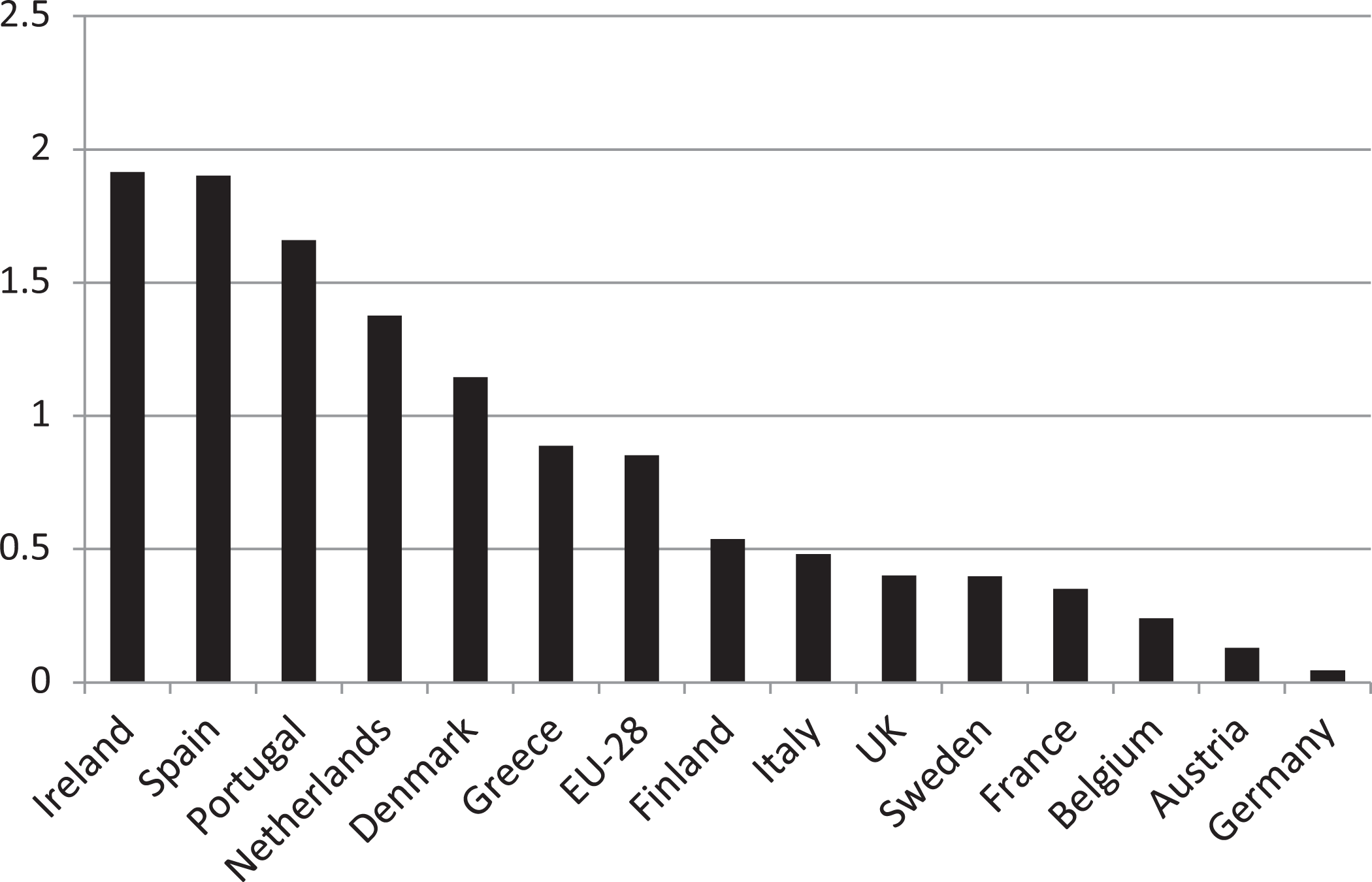
Employment elasticity (in persons) with respect to GDP. Source: Madsen and Bjørsted (2016), Figure 4, p. 19.
Figure 1 highlights large national variance in how employment reacts to a change in GDP. The relationship is influenced by several factors including the level of employment protection legislation for workers on a permanent contract (EPL), the share of employees on temporary contracts and the employment intensity of the sectors most severely affected by the crisis. Based on the available studies, the main interpretations of the national differences are as follows (Madsen, 2016: 217). The high elasticity in Ireland and Denmark reflects the low level of employment protection (EPL) for ordinary workers in these two countries. In Spain and Portugal, the large decline in employment in response to the crisis was probably a consequence of the large share of employees on temporary contracts. Belgium, Italy, Austria, France, Sweden and Germany are all countries with a rather high level of EPL, where one can expect employment (measured in persons) to react more slowly to a decline in production. Germany especially is renowned for its short-time working arrangements during the crisis (Boulin and Cette, 2013). The United Kingdom is more of a puzzle, as its low EPL would have made one expect a more drastic decline in employment. Some observers have pointed to high downward wage flexibility as a counteracting factor.
The main observation from this brief international comparison is therefore that the Danish flexicurity model is far from immune to significant declines in employment and high increases in unemployment, when hit by an economic downturn. The upside, as already noted, is that employment rises quickly once the economy recovers.
A flexible labour market is also supposed to promote a less segmented labour market, since employers are more prone to take high-risk recruitment decisions, like hiring ‘disadvantaged’ and ‘vulnerable’ workers (e.g. the long-term unemployed, youth and older workers) if employment protection regulation allows for flexible dismissal procedures. Flexible standard employment contracts also reduce the need for ‘atypical’ and ‘non-standard’ employment relationships in which ‘disadvantaged’ and ‘vulnerable’ groups may be trapped. An additionally relevant stress test of Danish flexicurity is therefore whether the economic crisis led to a more segmented labour market and marginalisation in the form of persistent long-term and youth unemployment. As seen in Table 1, Denmark experienced an increase in the share of long-term unemployed from 16.1 per cent to 28.0 per cent of total unemployment between 2007 and 2012. In the EU-28, the long-term unemployment rate increased from a higher initial level but at a lower rate from 42.6 per cent to 44.3 per cent in the same period. Since 2012, long-term unemployment has declined in Denmark (from 28.0 per cent to 22.3 per cent) while it has continued to increase in the EU-28. It is therefore at a low and declining level in Denmark compared with the other European countries.
Finally, Table 1 shows that the crisis hit young people in particular. In Denmark, the youth unemployment rate doubled between 2007 and 2012 (from 7.5 per cent to 14.1 per cent) and then declined (to 12.0 per cent in 2016). The EU-28 also experienced a sharp rise in youth unemployment (from 15.9 per cent in 2007 to 23.3 per cent in 2012), though it declined after the crisis (to 18.7 per cent in 2016). Despite the sharp decline in employment, Denmark retained its position as one of the EU countries with the lowest youth unemployment rates.
Thus, the changes in long-term and youth unemployment in Denmark during and after the crisis do not indicate an increase in structural unemployment or increasing labour market segmentation. The OECD came to a similar conclusion in a recent report on displaced workers (OECD, 2016), reporting that Denmark had overcome most of the recent challenges, with little sign that the rise in unemployment between 2008 and 2012 was structural. Moreover, Eriksson (2012) found no strong signs of ‘unemployment hysteresis’ after the first crisis years compared to previous recessions. Finally, Andersen et al. (2016) argued that job mobility and job-creation rates remained high during the crisis, while indicators of marginalisation and long-term unemployment remained low.
A final point with regard to the performance of Danish flexicurity concerns the long-term performance of the labour market. While it is clearly not immune to business cycle downturns, the litmus test is its ability to adapt to the structural changes in the national and global economy. Denmark has retained its position as one of the OECD’s high-income members since 1980. The indicator is in this case GNI in current prices, which captures the benefits from both income from abroad and gains from terms of trade. Denmark’s average position in this ranking is ninth, with its relative position even improving during the crisis (Madsen and Bjørsted, 2016: 13–14).
Institutional resilience of Danish flexicurity
The economic crisis not only affected the performance of the labour market, but also the balance between the institutions of Danish flexicurity. Denmark features a delicate balance between flexibility (low dismissal protection) and security (high income and employment security). If, for instance, income or employment security declines, it may have negative consequences for labour market flexibility and vice-versa. In the following, we will describe the main political and structural reforms of the Danish labour market during the economic crisis, analysing their effects on the balance between flexibility and security.
There are two main complementarities in Danish flexicurity. The first is between the flexible labour market and a relatively generous income security system (especially unemployment insurance benefits). The assumption is that a generous income security system supports voluntary job mobility by decreasing the risk aversion of workers (Schmid and Reissert, 1991). High voluntary job mobility in turn benefits the competitiveness of Danish employers.
The other complementarity is between employment (employability) security provided by active labour market policies and lifelong learning policies and the flexible labour market. High employment security may compensate for the lack of formal job protection and promote numerical flexibility. This complementarity also reflects the shift from job security to employment security initially envisaged by the European Commission. 2
It is important to note that certain types of reforms and institutional changes may reinforce and support flexicurity, while others may challenge and undermine the balance between flexibility and security. In the following, we discuss the current challenges to the Danish flexicurity system, assessing the resilience of the flexicurity institutions. 3
First complementarity: income security and labour market flexibility
In recent years, reforms of Denmark’s unemployment insurance system have challenged the relative generosity of income security, and led to demands from trade unions for stronger job security.
In 2010, the liberal-conservative government decided to cut expenditure on unemployment benefits by reducing the duration of the benefit period from four to two years. Furthermore, eligibility for a new period on unemployment benefits was tightened by requiring 52 weeks of prior employment before becoming eligible for unemployment benefits, compared to 26 weeks before 2010. A direct reaction of the government to the economic crisis and increasing public deficits, the unemployment insurance reform provoked a lot of debate and criticism. Not least because the restrictions on unemployment benefits were implemented during the economic downturn, thereby affecting a far higher number of individuals than anticipated. Early government forecasts estimated that some 3000–5000 persons would lose their benefits due to the reform, but in fact around 50,000–70,000 persons lost them between 2013 and 2015, when the reform took full effect. Many were also not eligible for social assistance due to means-testing (Dagpengekommissionen, 2015). 4
The reaction of the trade unions to the unemployment insurance reform was to put demands for stronger job protection high on their bargaining agenda for the upcoming collective negotiations, thereby responding to rising feelings of job insecurity among their members. In 2013, we conducted a representative wage-earner survey, finding that 22 per cent of all employees were concerned that they might lose their current job, compared to 11 per cent in 2005. 51 per cent also replied that they would find it difficult to get a new job that was at least as good as their current job, compared to 36 per cent in 2005 (Larsen and Madsen, 2015: 112–113). We also found a clear link between rising job insecurity and the unemployment benefit reform. 75 per cent of blue-collar workers and 61 per cent of white-collar workers responded that job security was now more important due to the unemployment benefit reform (Klindt and Rasmussen, 2015b: 141). Thus, the survey data indicated that Danish employees experienced increased job insecurity and had a stronger preference for job protection regulation. The trade unions took these preferences to the negotiating table, but were unsuccessful in negotiating stronger job protection during or after the crisis, as the Danish employer associations insisted on not making concessions on the flexible dismissal rules. 5
Demands for stronger job protection legislation in the wake of the economic crisis were reinforced by a gradual reduction in the net replacement rates of unemployment benefits and a structural transformation of the workforce towards white-collar jobs. Since 1990, benefits have followed the average growth rate in wages with two important exceptions. Each year a small amount is deducted (0.3 per cent if annual wage growth is above 2 per cent) for specific social investments and the state pension contribution of persons in employment is not included in the calculation of the average wage growth (about 12 to 17 per cent of gross wages). This means that the gap between income benefits and the minimum wage level has been gradually increasing over time. OECD calculations show that the average net replacement rate over 60 months of unemployment had fallen from 63 per cent in 2001 to 47 per cent in 2014. 6 The replacement rate for low wage-earners remains, however, among the highest in the OECD (90 per cent of former income up to a ceiling of €2450 per month), while that for high wage-earners is comparatively lower (about 50 per cent on average) (Dagpengekommissionen, 2015). The gradual decline in the generosity of unemployment benefits may partially explain the gradual decline in persons with unemployment insurance (members of unemployment insurance funds) from 80 per cent in the early 1990s to currently around 70 per cent.
Despite declining generosity, the Danish unemployment benefits system remains relatively generous in an international comparison. Bjørn and Høj (2014) compare its generosity with six other northern European countries, finding that the Danish system, even after the 2010 reform, remains relatively generous. The OECD similarly ranks the Danish system as one of the most generous of all OECD countries in terms of duration and net replacement rates (OECD, 2016: 108).
Some Danish scholars argue that flexicurity is no longer the right label and description since it only covers the minority of the workforce, i.e. those in blue-collar jobs (Jensen, 2011; Jensen, 2017). The argument reflects a long-term shift in the occupational structure from blue-collar to white-collar jobs and the fact that an increasing proportion of workers are covered by the law on ‘white-collar workers’ (funktionærloven). This law grants those covered a higher level of job protection than that enshrined in collective agreements, for instance longer notice periods (related to seniority) and higher severance payments (Larsen and Madsen, 2015). About two-thirds of all employees are now covered by this law (53 per cent of all employees are ‘white-collar’ workers and 11 per cent work in ‘white-collar’ jobs, while the remaining 36 per cent are covered by collective agreements) (Scheuer and Hansen, 2011). Jensen (2011: 734–735) estimates that 58 per cent of the workforce are affected by the classical blue-collar model of flexicurity, while the remaining 42 per cent are subject to so-called ‘white-collar flexicurity’. However, even the level of dismissal protection for white-collar workers is relatively low in Denmark compared to other northern European countries. As an indication, our 2013 survey on notice periods found that one-third of all employees had a notice period of less than one month and two-thirds less than three months. A regression analysis showed no significant difference between the notice periods in the private and public sector, despite the higher share of white-collar workers in the latter (Larsen and Madsen, 2015: 108).
In addition, one should note that large groups of white-collar workers also have access to financial support in the event of becoming unemployed. A study in 2010 thus showed that 85 per cent of all employed persons would have access to some form of income support in the event of unemployment, the majority in the form of unemployment insurance benefits (Arbejderbevægelsens Erhvrevsråd, 2010). This reflects mainly the widespread tendency of white-collar workers to join an unemployment insurance fund.
Second complementarity: employment security and labour market flexibility
Institutions providing employment security, such as active labour market and adult vocational training policies, play an important role in Danish flexicurity through reducing the job-seeking disincentives of a generous income benefit system (motivation effect) and improving the employability of both unemployed and employed workers (qualification effect). However, the crisis also saw cuts in adult vocational training policies, while the political reforms of the unemployment benefit system challenged the active labour market policies.
Unemployment increased rapidly during the first years of the crisis and local job centres struggled to deliver contact interviews and to activate the unemployed on time. The ‘work-first’ approach of employment services was criticised for being ineffective during an economic crisis where ordinary jobs were in short supply. Evaluations of the experiences of unemployed workers who had participated in activation programmes also indicated a lack of confidence in the ability of job centres to assist them in finding a new job (Bredgaard et al., 2015).
During and after the economic crisis, a number of reforms of active labour market and social policies were implemented 7 , all aimed at increasing the supply of labour and providing more effective employment services.
For some groups, the economic incentives for actively seeking a job were boosted by benefit cuts (e.g. unemployed workers on sickness or disability benefits and refugees). For other groups, entitlements to adult vocational training have been improved (targeting e.g. unskilled unemployed workers), while the path from unemployment to education has been strengthened (e.g. young persons on social assistance). In a nutshell, the reforms strengthen both the ‘motivation’ and ‘qualification’ sides of active labour market policies, thereby boosting the employability of the different target groups. Finally, employment services have been reformed to ensure that local job centres provide earlier and more effective activation programmes (e.g. wage subsidies in the private sector, workplace training programmes, recruitment assistance for private employers) (Bredgaard, 2015).
It therefore seems fair to conclude that Danish active labour market policies still provide employment security compensating for the lack of formal job protection as well as the disincentive effect of a relatively generous unemployment benefit system. Spending on active programmes and the intensity of job-seeking activities continue to rank among the highest in the OECD. The latter also argues that Danish labour market policies demonstrated considerable adaptability during the crisis, with the design and content of measures fine-tuned to take account of the labour market situation and with new evidence proving their effectiveness (OECD, 2016: 67).
Conclusions
One of the first victims of the Great Recession in Europe was flexicurity, at least as a top priority of European policy-makers for integrated reforms of social and employment policies. Flexicurity gradually slipped down the agenda as European and national policy-makers became more preoccupied with short-term crisis management and economic recovery. However, with the recent adoption of the European Pillar of Social Rights and economic recovery in Europe, flexicurity may again move up the European employment and social policy agenda.
Flexicurity is more than just a political vision and strategy. The Danish case illustrates that flexicurity can also be an empirical reality as a certain ‘state of affairs’ on the labour market. The complementarity of flexibility and security is claimed to produce superior labour market outcomes. It is therefore of general interest to see how the Danish labour market performed during and after the Great Recession and how the flexicurity institutions coped with the crisis.
Our first finding is that the economic crisis has had no lasting negative impact on the Danish labour market. Although unemployment increased rapidly as a reaction to the economic crisis, there were no major signs of increasing marginalisation or segmentation on the Danish labour market. Youth and long-term unemployment remained low by international comparison. As the economy recovered, employment rapidly picked up, as one would expect from a labour market with flexible dismissal rules.
Our second finding is that the crisis and the political and structural reforms following in its wake challenged the balance between flexibility and security, though without fundamentally altering the complementarities of Danish flexicurity. Instead, the institutions gradually adapted to the challenges, while keeping the basic complementarities between flexibility and security intact. We can therefore continue to describe the Danish labour market as a specific version of flexicurity, combining a flexible labour market with relatively generous income security and active labour market and education policies. However, if institutions providing income and employment security are further eroded, and if the trade unions succeed in negotiating stronger job protection for their members, this could mean a gradual departure from Danish flexicurity. The balance between flexibility and security is based on fragile institutions and compromises that require active maintenance and support to thrive.
Footnotes
Funding
This research received no specific grant from any funding agency in the public, commercial, or not-for-profit sectors.