




Abstract
The present study investigated to what extent perception of closure management (informational justice, severance package satisfaction) as well as individual resources and barriers (employability, tenure) were associated with well-being and organizational attitudes during plant closure. This was studied in a sample of 129 Swedish workers in a plant undergoing closure. The results showed that those who felt communication to be fair reported higher well-being and more positive attitudes. Those who were satisfied with the severance package reported lower intention to leave but also felt fewer obligations towards the organization. Those with higher employability reported higher subjective health. The results also indicated that tenure moderated the relation between informational justice and felt obligations, and employability moderated the relation between severance package satisfaction and organizational attitudes. It can be concluded that closure management together with employees’ different resources and barriers are vital for organizational attitudes and well-being during the closedown process.
Introduction
In today’s globalized economy, many organizations go through recurring cycles of changes such as downsizing, plant mergers or plant closures in order to cut costs for labour, production or transportation (Burke, 2011). These strategies often lead to significant changes of employment conditions (Datta et al., 2010) and in the most drastic case of plant closure, not only some but all employees are dismissed from the closing plant and forced to go through involuntary job transitions (Tosti-Kharas, 2012). Naturally, this implies high uncertainty regarding the employees’ post-closure lives, in terms of their future career, and the securing of re-employment and income (Karren, 2012). Laid-off workers in global or locally declining sectors are likely to face even more insecure times (Donnelly and Scholarios, 1998), as re-employment may be difficult when there are limited jobs available.
After the announcement of closure, employees may continue working at the factory for several months, or even years, before the closure is finalized, and during that time daily routines are subject to quite a lot of changes (Marks and Vansteenkiste, 2008). Workers in closing organizations have to mentally let go of the old (Blau, 2006) and need to start thinking of new personal work-related goals for their future (Häsänen, 2010). Unlike victims or survivors of downsizings, employees going through plant closure are less concerned with justice perceptions in terms of who has been laid off or not (Mishra and Spreitzer, 1998). Instead, closure management strategies that matter mostly pertain to justice in terms of how the closure has been communicated, and what compensation and severance packages are provided (Blau, 2006). Earlier research has studied management of informational processes in connection to closure (Stroud and Fairbrother, 2012) as well as redundancy processes (Donnelly and Scholarios, 1998) and effects of severance packages in relation to employee motivation and performance (Bergman and Wigblad, 1999; Häsänen et al., 2010), and employee grieving as well as acceptance of the organization’s ‘death’ (Butler et al., 2009). With the exception of studies by Blau (2006, 2007, 2008) however, there is a lack of systematic models relating employees’ perceptions of closure management in terms of information and compensation to employee well-being and organizational attitudes.
Furthermore, in a workforce that is laid off, individuals also differ in which resources they possess or alternatively, what barriers they have to overcome to safeguard job continuity and re-employment after job loss. Such individual resources may for example pertain to differences in perceived employability and feasible job alternatives (Karren, 2012; Wanberg et al., 2002), whereas a potential barrier could pertain to varying organizational tenure and past employment experiences (Blau, 2007). While the importance of these factors has been highlighted in research on unemployment typically focusing on individuals who already are out of work (Wanberg et al., 2002) it is unclear how perceived employability or organizational tenure relate to well-being before the onset of the actual job transitions, or affect organizational attitudes in the time before closure.
The present article aims to address this void and draws on transactional stress theory (Lazarus and Folkman, 1984) to explain how employees’ appraisal of organizational and individual circumstances may result in perceptions of having the resources to handle the stressful event of job loss and forthcoming employment transition. This article reports findings from an ongoing research project in which we study a plant closure as experienced by the affected workforce prior, during and after the closedown. More specifically, the article reports findings from the time prior to closure and provides valuable knowledge about how employees’ perceptions of closure management (informational justice, severance package satisfaction) and their individual resources (perceived employability) and barriers (organizational tenure) relate to well-being (depressive symptoms, subjective health) and organizational attitudes (felt obligations, withdrawal intentions) during a time when the plant is still operating.
This article is organized as follows. First, the situation of plant closure is mapped on a stress–strain perspective. Furthermore central concepts of the article are discussed in terms of individual perceptions of closure management, and individual resources and barriers. This is followed by a report on the methods used for our study before our main findings are presented and discussed.
Plant closure from a stress–strain perspective
Job loss is generally known as being a major life stressor (Holmes and Rahe, 1967). From the perspective of transactional stress theory (Lazarus and Folkman, 1984) however, this particular situation in itself may not be stressful, since an individual can appraise any given situation as neutral, positive or negative. If the situation is appraised as negative in terms of being potentially challenging or threatening, or even implying a loss, it is considered a stressful event. Transactional stress theory furthermore postulates that this is followed by a secondary appraisal, during which individuals evaluate their available resources to adequately address the potentially stressful event. In the case where the individual does not feel that adequate resources to cope with the stressor are available, a perception of threat, potentially inflicting personal harm or loss, arises and as a consequence strain reactions follow.
Applying transactional stress theory (Lazarus and Folkman, 1984) to understand workers’ experiences of closure we argue that during primary appraisal, the certainty of job loss has been realized which induces high levels of uncertainty regarding the post-closure work life for most employees (Häsänen, 2010). As a result of the subsequent secondary appraisal of available resources and feasible coping alternatives, it can furthermore be expected that individuals who feel well prepared to meet the challenges of work-role transitions after closure react less negatively to the organizational closure than those who appraise their available resources to be inadequate. Perceptions of available resources can arise from both situational and individual circumstances (Lazarus and Folkman, 1984). In this study of a plant closure, such perceptions of the situational circumstances are framed as employees’ perceptions of closure management in terms of informational justice and severance package satisfaction. Individual circumstances that may influence secondary appraisal may represent individual barriers and resources, which in this study have been included in terms of organizational tenure and perceived employability.
Individual responses to stress have frequently been studied with respect to health and well-being reports (Kristensen et al., 2005; Steptoe and Kivimäki, 2012), but extending this view to also include organizational attitudes and behavioural intentions may increase our understanding of individual reactions to the closure and the uncertainty this implies for employees’ future. The link of stress and organizational attitudes seems plausible on a conceptual level: those employees feeling threatened and stressed may withdraw and wish to leave a situation which is perceived as harmful and damaging to health (Göransson et al., 2009). In addition, it may be that if employees feel stressed and worried about the forthcoming job loss and forced employment transition, this also decreases their organizational commitment and reduces felt obligations of having to work in the best possible way for the closing company.
Perceptions of closure management: Informational justice and satisfaction with severance package
Informational justice
Through the information process an organization has the means to control collective reactions to a closure, such as union responses and to also influence the way rumours arise (Stroud and Fairbrother, 2012). An organization that manages to inform workers about closure early on, explains the details of the procedures well and communicates openly is more likely to induce perceptions of informational justice (Colquitt, 2001) and to provide workers with control and predictability, which should reduce stress and strain reactions (Bordia et al., 2004). Also, perceptions of informational justice have been positively related to organizational commitment and negatively to withdrawal (Colquitt et al., 2001). In the context of plant closure, advance notification (Blau, 2006) and clear communication (Butler et al., 2009) have been advocated as resulting in more positive and constructive reactions among employees. To sum up, there is reason to believe that informational justice is an important factor of closure management, and our first aim of this study is to investigate how informational justice as perceived by the employees going through a plant closure relates to individual well-being (depressive symptoms, subjective health) and organizational attitudes (felt obligations, turnover intentions).
Severance package satisfaction
Another situational factor tied to closure management is related to what resources organizations provide to facilitate their employees’ transitions into post-closure lives. To varying degrees, organizations offer severance packages such as paying a certain amount of money and/or funding outplacement and career counselling activities (Donnelly and Scholarios, 1998). These services are ways for the organization to shift to a new psychological contract (Conway and Briner, 2005); instead of offering intra-organizational long-term employment, means are provided to facilitate workers’ transitions into new employment elsewhere without, or with only short periods of, interruption (Marks and Vansteenkiste, 2008). Accordingly, if the workers evaluate the severance package as supporting them to get another employment or compensating for some time of unemployment, the severance package may be viewed as a resource. Plausibly, that reduces employees’ stress reactions and may also help to keep positive organizational attitudes while the plant is still operating (Blau, 2006). For some individuals these incentives may even turn the job loss into a blessing in disguise (Jones, 1989; Marks and Vansteenkiste, 2008), which seems to particularly be the case when counselling provides workers with possibilities to explore career changes (Zikic and Klehe, 2006). Consequently, being satisfied with the severance package might signal that the worker perceives it as a resource facilitating the coping with loss of employment. Accordingly, our second aim in this study is to investigate how the employees’ satisfaction with the organizational severance package during a plant closure is related to well-being (depressive symptoms, subjective health) and organizational attitudes (felt obligations, turnover intentions).
Resources and barriers: Organizational tenure and perceived employability
Organizational tenure
Previous experiences of job changes have been suggested to differentiate individuals, since those with more positive experience may be better prepared to meet the challenges of job change (Blau, 2006). However, it is also plausible that a long organizational tenure at the closing organization relates to being less adequately equipped to manage the forthcoming employment transition. Those with longer organizational tenure may have formed relational psychological contracts with their employer, and such contracts are characterized by a long-term focus, expectations of job security and socio-emotional exchange (Robinson et al., 1994; Rousseau, 2001). The case of plant closure in particular means a fundamental breach of such a relational psychological contract (Blau, 2007). The announcement of closure may thus evoke strong negative reactions in terms of strain and negative attitudes towards the employer (Zhao et al., 2007).
Also, longer organizational tenure could be argued to be strongly associated with age, specifically in a blue-collar setting, which in turn has been found to exacerbate the negative consequences of layoffs on employees (Gallo et al., 2000). Thus, workers with longer tenure may feel more obliged to the organization and develop withdrawal cognitions more slowly than those with shorter tenure and less attachment to the company. To sum up, there are both conceptual and empirical reasons to expect that longer organizational tenure may be a barrier due to which the forthcoming job loss and employment uncertainty is perceived in more negative terms. The third aim of this article therefore is to explore how organizational tenure is related to well-being (depressive symptoms, subjective health) and organizational attitudes (felt obligations, turnover intentions) during a plant closure.
Perceived employability
A resource differentiating employees in terms of their possibilities to adequately handle uncertainty about post-closure employment relates to their employability. In spite of the employability concept being very important for worldwide labour policies, there is no consensus on its definition (McQuaid and Lindsay, 2005). According to McQuaid and Lindsay (2005) it is valuable to consider a person’s useful skills and attributes in relation to personal circumstances as well as external factors like the labour market. However if the purpose is to study effects of employability on person’s actions it is more meaningful to focus on individual perceptions of employability instead of objective measures, as it is the perceptions that finally determine behaviour (Berntson, 2008). Perceived employability has been defined as an individual’s perception of how easy or difficult it will be to get an equal or better job elsewhere (Berntson, 2008). Perceptions of employability may be rather diverse for the workforce facing dismissal, as their competences and skills may to varying degrees match the local labour market (Berntson et al., 2006). Furthermore, feelings of employability are also boosted if the individual possesses knowledge of labour market requirements, has social and occupational networks as well as job search skills (Griffeth et al., 2005). Higher levels of employability, i.e. a stronger feeling of being able to get new employment, are likely to lead to the individual considering the threat of job loss as less severe, and fears of an uncertain employment future should be less pronounced. Several studies have found that employability perceptions positively affect individual well-being (cf. Berntson, 2008). Also, there is some evidence that high employability relates more positively to high commitment (De Cuyper and De Witte, 2011; Pfeffer, 2007), but this has rarely been studied under the condition of plant closure. A fourth aim of our study is therefore to investigate how perceptions of employability relate to individual well-being (depressive symptoms, subjective health) and organizational attitudes (felt obligations, turnover intentions).
The interplay of perceptions of closure management and resources and barriers
According to Lazarus and Folkman (1984), perceptions of situational and individual circumstances may be interrelated in their effect on individual reaction towards a potentially stressful event. In the event of plant closure, it may be conceivable that associations between workers’ perceptions of closure management and their reactions in terms of well-being and organizational attitudes in part also are related to their perception of own resources and barriers. For example, individuals with high perceptions of employability may be less bothered even if management gives sparse information or provides an unsatisfactory severance package, whereas those with lower employability may to a greater extent feel dependent on transition-facilitators to feel able to cope with the closure and job transition. Thus, employability may moderate the relation between company closure management and individual strain as well as attitudes to the organization (Berntson et al., 2010).
We also expect that organizational tenure may moderate how perceptions of closure management impact workers’ well-being as well as their attitudes towards the organization. For example, those who have put longer time and effort into the company may feel more betrayed than those with shorter tenure, and if they are not content with either the kind of severance package offered or the information provided by management, they may view these incentives as too little to compensate for the broken psychological contract (Chaudhry et al., 2011). This, in turn, could reduce their felt obligations towards the employer and increase their intentions to leave their job before they are dismissed. On the other hand, long tenure may also function as a buffer, upholding commitment and willingness to stay with the company even though informational justice and severance packages are unsatisfactory. In terms of stress and well-being reactions, longer tenure may mean that workers are dependent on help for the coming job transitions and thus are more vulnerable if they consider the severance package or the information given as not adequate to transition to a new job.
To sum up, individual resources may work as moderators of the relationship between perceived closure management and well-being and organizational attitudes, respectively, during a plant closure. Since previous studies are scarce, several ways of how individual and organizational resources in their combination may relate to outcomes are conceivable. Thus our final aim in this study is to investigate potential interaction effects between organizational tenure or employability and informational justice or severance package satisfaction on individual well-being (depressive symptoms, subjective health) and organizational attitudes (felt obligations, turnover intentions).
Methods
Setting of this study
Data for this study were gathered during early 2012 in a plant situated in a Swedish urban region. The plant is part of a large private national company in the manufacturing business and was closing down since production was being moved to a rural area in another part of Sweden. The distance between the old and new site is approximately 250 kilometres, which makes daily commuting to the new plant site impossible, but workers were given the possibility to apply for a job transition to the new work site. Management informed all employees about the closure process more than two years in advance of the planned closure date. The transfer of production to the rural plant was planned to be executed in steps, meaning that groups of workers were dismissed at different points in time during the stepwise closure. Terms of dismissal and severance package had been agreed upon with the union before the workforce was informed about the closure. Order of dismissal followed the ‘last-in, first-out’ rule, which is stated in law in Sweden and highly valued by unions since it protects those with highest seniority, who often are older and more experienced workers. All workers were offered monetary compensation for job loss if they stayed until their planned final day; at best, this amounted to a payment approximately equivalent of three months’ salary. All laid-off workers were furthermore offered individual professional job coaching, held at the plant during working hours. In addition to this, all workers were invited to visit the new plant prior to deciding if they wanted to apply for moving their job to the new site. After these conditions had been agreed upon with the union, managers were told the news of closure before a general meeting was held to inform the workforce. This general meeting was followed by meetings providing more information tailored to the stepwise process of closure that affected each work group’s time plan differently.
Data collection procedure and sample description
Data were collected nine months after the workers were informed about the closure. Paper questionnaires were distributed at the workplace, with the first author joining work group meetings, presenting the aim of the research and guaranteeing the confidential treatment of the answers. All participants were assured that only the research group would have access to their answers and that results were going to be presented on group level only. All employees who volunteered to participate filled out the questionnaire during these work group meetings and handed the questionnaire back to the researcher and thereafter received a monetary incentive (gift voucher worth approx. €15) for their contribution. Information about gender, age, organizational tenure and position was collected from company records.
In total, out of 188 employees 129 workers participated, which corresponds to a response rate of 68.6%. Of these, 22% were women and 91% blue-collar workers. The mean age was 43.1 (SD 10.9) years. Among the sample, 43% had completed the compulsory basic school education, 39% held a high school degree and 18% had a higher education (post-school vocational training or academic degree).
Measures
Control variables
Gender was dichotomous (1 = woman, 2 = man). Educational level was dichotomized (1 = up to high school, 2 = higher education).
Perceptions of closure management
Informational justice was assessed with a four-item index that was modified from earlier scales on informational justice (Colquitt, 2001) to capture whether respondents rated the organization’s communication and information about the closure as open, timely, clear and satisfying (e.g. ‘Has the organization explained the upcoming closing procedure clearly and consistently for you?’). Response alternatives ranged from 1 (totally disagree) to 5 (totally agree). Severance package satisfaction was assessed with our own three-item index, reflecting the person’s contentedness with the action package offered in terms of incentives to stay until closing date, union support and access to job coach. Responses were measured on a five-point Likert scale ranging from 1 (not at all satisfied) to 5 (very satisfied).
Individual resources and barriers
Organizational tenure was measured in years. Employability was measured with a four-item index (Berntson et al., 2006) reflecting the person’s subjective rating of their prospects of getting an equivalent or better job. An example item was ‘I could without problems get an equivalent job in another company/organization’. Responses were measured on a five-point Likert scale ranging from 1 (to a very low degree) to 5 (to a very high degree).
Outcome variables
Well-being was assessed as aspects of mental well-being (depressive symptoms) and an overall rating of subjectively perceived health. Depressive symptoms were measured with five items reflecting the person’s degree of depressive symptoms (Magnusson Hanson et al., 2014). An example item was ‘How much during the last week have you been troubled by worrying too much?’ Response alternatives ranged from 1 (not at all) to 5 (very much). Subjective health, which is commonly used for measuring perceived health status as it is predictive of both morbidity and mortality (Bailis et al., 2003), was assessed with a standard single item: ‘How would you rate your health at the present?’ and the response alternatives ranged from 1 (very good) to 5 (very poor). The item was reversed so that a high value corresponds to high ratings of subjective health. Organizational attitudes were assessed as aspects of felt organizational obligations and turnover intentions. Felt organizational obligations were assessed with a two-item scale (Eisenberger et al., 2001) reflecting the obligations the worker felt towards the company. An example item was ‘I owe it to [the company] to give 100% of my energy to [the company]’s goals while I am at work’. Turnover intentions were measured with a three item-index based on Hom and Griffeth (1991), reflecting to what degree a person was considering leaving the company in the pre-closure period (e.g. ‘It is plausible that I will leave [the company] before I am laid off’).
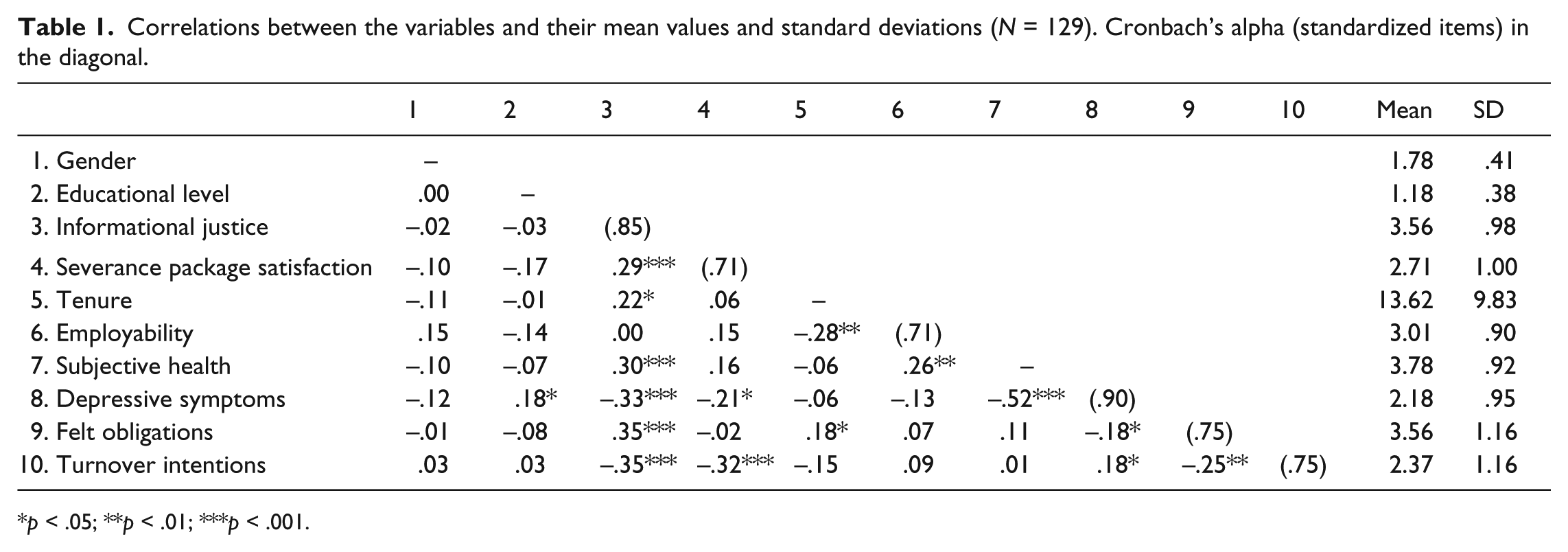
Means, standard deviations, Cronbach’s alpha for the scales and correlations between the study variables are presented in Table 1.
Correlations between the variables and their mean values and standard deviations (N = 129). Cronbach’s alpha (standardized items) in the diagonal.
p < .05; **p < .01; ***p < .001.
Data analysis
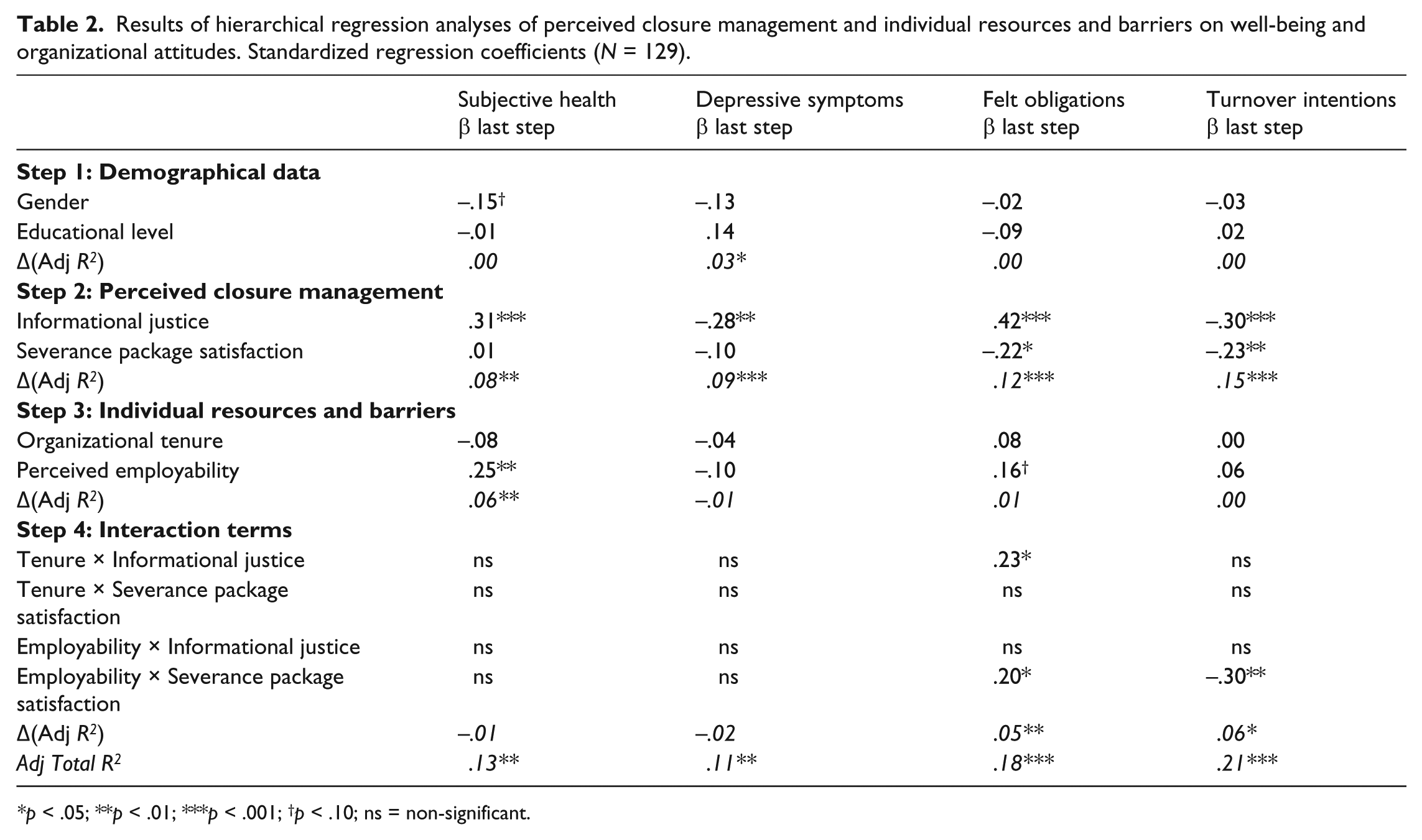
In order to answer the research questions, the data were analysed by means of hierarchical regression analysis. Four regression analyses were performed on the outcome variables (1) subjective health, (2) depressive symptoms, (3) felt obligations and (4) turnover intentions. Control factors (gender, education) were entered in step 1 (age was not included as it was highly correlated with tenure and tenure was deemed a more important predictor in this context). Informational justice and severance package satisfaction were added in step 2, in order to examine any effects of individual perceptions of closure management after controlling for the background variables. In the third step, perceived employability and organizational tenure were entered to investigate if these individual resources and barriers made any further contributions to explain variance in the outcome variables. Finally, in step 4, the interaction terms (calculated as the products of the mean-centred predictors, following recommendations by Aiken and West [1991]) for employability × informational justice, employability × severance package satisfaction, organizational tenure × informational justice and organizational tenure × severance package satisfaction were entered to see if these explained any additional variance in workers’ well-being and organizational attitudes.
Results
Table 2 shows the last step of the regression analyses. Demographic information (gender, educational level) was entered as control variables in step 1. As can be seen in Table 2, demographics were significantly associated only with depressive symptoms (R2 = .03, p < .05). In the second step, employees’ perception of closure management added significantly to the explanation of variance in all outcome variables; explained variance was increased for subjective health (R2change = .08, p < .01), for depressive symptoms (R2change =.09, p < .001), for felt obligations (R2change = .12, p < .001) and for turnover intentions (R2change = .15, p < .001). Concerning our first research aim, informational justice was positively related to subjective health and negatively associated with depressive symptoms, indicating that those who perceived higher levels of informational justice also reported higher levels of well-being. Further, informational justice associated positively with felt organizational obligations and negatively with turnover intentions, indicating that higher informational justice was also related to organizational attitudes in a positive way. In regard to our second research aim, concerning the role of severance package satisfaction, the results were a little mixed. No significant associations between severance package satisfaction and well-being were found, but both turnover intentions and felt obligations were found to be negatively related to severance package satisfaction. In step 3, the explained variance was increased significantly only for subjective health (R2change = .06, p < .01) when including factors associated with individual evaluation of one’s own resources and barriers to deal with the plant closure (focus three and four). There was a significant positive association between perceived employability and subjective health. No relation was found between individual evaluation of one’s own resources and barriers and organizational attitudes.
Results of hierarchical regression analyses of perceived closure management and individual resources and barriers on well-being and organizational attitudes. Standardized regression coefficients (N = 129).
*p < .05; **p < .01; ***p < .001; †p < .10; ns = non-significant.
Regarding any moderating role of individual resources on the association between perceptions of closure management and organizational attitudes (step 4 in regression analysis and our last and most explorative aim in this study), the explained variance increased significantly for felt obligations (R2change = .05, p < .01) and for turnover intentions (R2change = .06, p < .05) when the interaction terms were entered. A significant positive moderating effect was found for organizational tenure on the relation between informational justice and felt organizational obligations. As Figure 1 illustrates, those with longer organizational tenure reacted more negatively if they perceived low informational justice in terms of felt obligation, but they also reacted the most positively to high justice perceptions.

Moderating effect of organizational tenure on the relation between informational justice and felt organizational obligations.
Next, turning to the moderating role of perceived employability on the relation between perceptions of closure management and the outcomes, moderating effects were found on the relation between severance package satisfaction and both of the attitudinal factors, felt obligations and turnover intentions. First, as Figure 2 indicates, severance package satisfaction did not play any major role on felt organizational obligations for people perceiving high levels of employability, but for those with low employability perceptions higher severance package satisfaction related to lower felt obligations.

Moderating effect of perceived employability on the relation between severance package satisfaction and felt organizational obligations.
Secondly, the moderating effect of employability on the relation between severance package satisfaction and turnover intentions indicated that satisfaction with the severance package was more important for those with higher employability in terms of their intention to stay until the final day, as compared to those with lower employability (see Figure 3).

Moderating effect of perceived employability on the relation between severance package satisfaction and turnover intentions.
After including all used explanation variables in the analyses the resulting effect sizes for all four outcome variables were of medium size (r > .3) according to Cohen (1992).
Discussion
The aim of present study was to analyse how employees’ perception of closure management (informational justice, severance package satisfaction) and their individual resources (employability) and barriers (organizational tenure) related to employee well-being (depressive symptoms, subjective health) and organizational attitudes (felt obligations, withdrawal intentions) during the closure process of a plant.
A main finding from this study, consistent with previous research on plant closures, was that closure management in terms of informational justice and severance package satisfaction mattered for attitudes towards the closing organization (for similar conclusions, see, for example, Blau et al., 2012; Butler et al., 2009). Informational justice was the more prominent predictor compared to severance package satisfaction, and as has been found in earlier research (cf. Bordia et al., 2004), informational justice was associated with both well-being and organizational attitudes. In the case of this study, time factors may be a relevant explanation for this finding. When data were collected, most workers had had about half a year to digest the information about their plant being closed. Thus, the time of immediate reactions, such as surprise or anger (Blau, 2007), may already have passed, and there was still a rather long time left until employment ended for the first group of workers (between 6 and 18 months). At that time, the company had implemented open communication as an important strategy of closure management, and informed about the closure plan during company-wide meetings with the management and the CEO; the unions had held meetings; and each employee had had an individual talk with the HR manager about when in the process their employment would come to an end. Furthermore, all individuals had had a first meeting with their outplacement agency and their coach, who established a first contact to inform about how and when the re-employment search would start. It seems that at this stage of the closing procedure, all this information was what was most important for employees to get an accurate idea about the process and induced feelings of being in control. Thus, both transactional stress theory (Lazarus and Folkman, 1984) and theories about the importance of communication for reducing uncertainty and maintaining well-being (Bordia et al., 2004) and to assert clarity of the closure process (Butler et al., 2009) fit well to explain these findings showing that informational justice was the most essential contributor to well-being. Further, in line with earlier research (Colquitt et al., 2001), perceptions of informational justice were shown to be positively related to felt obligations and negatively related to withdrawal intentions, indicating that clear and timely communication was important for keeping positive organizational attitudes in the time prior to plant closure. This is an interesting finding showing that informational justice may be an important factor to work with for management particularly early in the closure process.
Regarding satisfaction with the severance package, our results did indicate associations between severance package satisfaction and organizational attitudes, which is in accordance with suggestions by Blau (2006). Employees who were not satisfied with the severance package tended to have higher turnover intentions than their colleagues, which is what could be expected for workers not feeling appropriately compensated (Conway and Briner, 2005). Surprisingly, individuals who were more satisfied with the severance package reported lower felt obligations towards their organization than persons less content with the offers. One explanation for this finding may be that satisfaction with the compensation offered facilitates detachment from the organization, which according to Blau (2006) is an important step to explore the future and mentally prepare for transitions into post-closure life. Thus, from the perspective of the employees, being content with the severance package and feeling lower obligations to the employer may signal that the incentives given promote a reorientation of resources to plan one’s future (Häsänen, 2010; Karren, 2012). Concerning well-being, no associations to severance package satisfaction were found in this study. It may be that the timeline of closure is important to consider here, since the severance package, with respect to the provision of a coach to facilitate re-employment and the extra amount of money to be paid after job loss, may have a bigger impact on well-being when the employment has actually come to an end and a period of unemployment and the associated loss of monthly income has become reality. Further research using a longitudinal design may help in detecting whether these situational factors have a different priority and different impact on well-being when the end of employment is closer in time.
Perceived employability and organizational tenure, which this study framed as appraised individual resources and barriers to cope with a potential stressor such as closure (Lazarus and Folkman, 1984), explained only a little variance in workers’ well-being and were not related to organizational attitudes. More specifically, it was found that higher perceived employability was positively associated with subjective health, which is in line with previous research (e.g. Berntson, 2008). No main effects were found for organizational tenure on any of the outcome variables. Thus, longer or shorter organizational tenure was not directly related to employees’ attitudes towards the closing organization, nor did it explain differences in individual well-being.
However, this study furthermore showed that in line with transactional stress theory (Lazarus and Folkman, 1984), variance in individual reactions towards stressful events can be further explained when different types of resources are studied in their interactive effect. For example, whereas organizational tenure was not found to be of significance for the outcomes as a single factor, it moderated the relation between informational justice and felt obligation. The finding that informational justice has a stronger impact on felt obligations towards the organization for those with long tenure is in accordance with Robinson et al.’s (1994) research that longer tenure, in light of the psychological contract, implies higher expectations of the company and that when these expectations are not realized, more negative reactions will result.
Furthermore, we found that the association between severance package satisfaction and both attitudinal outcomes was moderated by perceived employability. The results of this study show that predominantly those with low employability reported decreasing felt obligations towards the organization as their satisfaction with the severance package increased. For those with lower employability, this result may indicate that when they feel the severance package is adequate they are able to detach from the organization and ‘let go’ (Blau, 2006), meaning that the company’s closure management strategy may indeed provide these workers with the right type of intervention to lessen threats of unemployment (Karren, 2012), whereas those who feel they can get a job (high employability) are less reliant on the severance package as a resource to meet the challenges to find re-employment.
Interestingly, however, whereas those with high employability seem to uphold their obligations towards the organization regardless of their satisfaction with the severance package, this package still seemed to matter to them since this study also found that those with high employability who are dissatisfied with the package offered are more willing to leave the company in the pre-closure time. This finding is reasonable since those with high employability possess an important individual resource to find re-employment (Wanberg, 2012), which makes them less dependent on organizational resources such as coaching or monetary compensation for job loss. However, they may uphold their obligations towards the employer since they may want to secure good references during their job search process.
In a wider perspective it is conceivable that the results of this study also relate to specifics such as the geographical area and particular sector in which the closing plant operates. This case study was carried out in a suburb of one of Sweden’s major cities, which means that a lot of other potential employers are situated in the same area, increasing the options of the laid-off employees to find employment elsewhere. However, this plant closure marks the end of a series of plant closures manufacturing similar products, and thus, the local labour market has no potential job openings with similar requirements of product and process knowledge for dismissed workers. The educational level of some of the workforce was quite low and thus, transitions to a new job may be most problematic for those who wish to hold similar jobs. In this light, the findings for those who perceive low employability who uphold high obligations and express low turnover intentions despite being dissatisfied with the severance package may communicate feelings of meeting an insecure working future (Donnelly and Scholarios, 1998).
Putting our findings in a global context, Sweden has a rather strong social security net compared with other countries, like for example the US (König et al., 2011). This may in part explain the relatively weak associations of individual resources with well-being. Furthermore, this may also be a contributing factor to better understand why this study found informational justice to be more important than satisfaction with severance package when it comes to understand workers’ well-being and organizational attitudes. Therefore we may speculate that for closing organizations in other countries, fair information and good severance packages offered by the closing company play a role at least as important as found in this study in a Swedish context.
Strengths and limitations
With a majority of the workforce being blue-collar male and relatively low educated workers in the industry and production sector, the study focuses on a population for which it is known to be more difficult to gather data from (Armstrong et al., 1992), which increases risks of non-response biases and low response rates (Baruch and Holtom, 2008). However, the overall focus of this study is not on absolute levels of the measured variables but on relations between variables. Also, the overall response rate was increased by means such as attending work group meetings to present the aim of this research, letting the respondents answer the survey in working hours, and giving monetary incentives in the form of gift vouchers. Some workers with an immigrant background had difficulty with some of the item formulations, but since the questionnaire was kept short and the first author of this study attended all work group meetings during which respondents filled in the questionnaire in order to clarify any possible questions, we believe that this poses no severe threat to the answers provided and analysed here.
Another methodological limitation may be seen in the cross-sectional nature of the data; this poses limitations on the possibility to draw causal conclusions in terms of the direction of the relationship between the studied variables. However, the cross-sectional study provides us with an indication that there are associations between the study variables as early as half a year and up to a year before actual job loss. Also, this study is one of the few to be carried out before the onset of job loss, which provides important insights for the following process and outcome of re-employment success (Blau et al., 2012).
Furthermore, only subjective ratings were collected, which may increase common method variances (Campbell and Fiske, 1959). However, this study seeks to understand workers’ own perceptions of closure management in relation to their own resources and barriers, well-being and attitudes towards their employer, and evidence from the few earlier studies on workers going through plant closure shows that these perceptions are strong predictors even for re-employment success and length of unemployment (Blau et al., 2012). Undoubtedly, however, this research could be further strengthened if objective data in terms of actual turnover, productivity or health status could be provided. This was not possible in the current study but would be a valuable extension for future research in this field.
Concluding remarks
Despite its limitations, this study makes a useful contribution to the literature for scientists as well as practitioners. There is a lack of systematic models to understand employees’ reactions to plant closure (Blau, 2006), but in this study transactional stress theory (Lazarus and Folkman, 1984) appeared to be a suitable framework shedding light on how situational and individual circumstances and resources as perceived by the laid-off workforce are associated – as single factors or in their interaction – with individual well-being and organizational attitudes. Also, this study provides valuable insights to better understand workers’ reactions during an early phase of the closure process during which important preparatory steps are taken for this type of involuntary job transition following a layoff (Tosti-Kharas, 2012). The result of this study reveal that closure management strategies in terms of information and communication seem to have an important role during the early stages of the closedown process both for well-being and organizational attitudes of the laid-off workforce. Informational justice appears to be of particular importance for workers with long organizational tenure in order to continue feeling obligated to work hard for a closing company. If the organization is depending on the workforce to stay until the closedown process is finalized, this study shows that attractive severance packages seem to be important for retention of highly employable workers. Another valuable insight of this study is that already in an early stage of the closure, perceptions of employability identify as a positive correlate to subjective health ratings. Employability thus seems to be an important key variable not only in the sense that people act upon this perception and apply for new work (see, for example, Blau et al., 2012) but also since employability perceptions seem to help individuals in maintaining well-being early on in the closure process, and good health is known to be an essential factor for successful re-employment (Wanberg et al., 2002). Nevertheless, more research on how plant closures are experienced by employees is needed to place findings from a Swedish case study like this in a wider perspective. For example, the analysis of constraints such as the (local) labour market or the given societal and economic context (Oesch and Lipps, 2013) may provide further insights to better understand workers’ experiences with and reactions to plant closure and job loss.
Footnotes
Funding
This research was supported through a grant from Vinnova (grant number: 2009-03077).