



Abstract
This article presents findings from a longitudinal analysis of postwar (1945–2008) changes to coordination in wages and working conditions within a single-case study sector in the UK – ceramic tableware production. It proposes three modes of incremental change during this period: layering in the immediate postwar years (c. 1950); conversion during the 1970s; and displacement in the early 1980s. Shaped by (a) the internal and external pressures actors faced, (b) the veto possibilities and (c) the levels of discretion in the implementation and enforcement of targeted institutions for key actors at different stages, this sector saw different forms and levels of coordination in wages and working conditions come to prominence at different points during the second half of the twentieth century.
Introduction
There has been a growing recognition within the literature that the institutional features of national economies may only shape and structure behaviour – and thus facilitate growth – on a spatially and temporarily confined basis (Lane and Wood, 2009, 2011). That is to say, periods of relative stability will over time be punctuated by sustained periods of ‘tinkering’ and experimentation at various levels by entrepreneurial, self-interested actors as they seek to reinforce or secure advantages vis-a-vis other actors and respond to particular internal and external pressures (Hall and Thelen, 2009; Streeck, 2009). The institutional environment within a national economy is therefore not only considered to be diverse, but also ‘constantly developing in a nonlinear manner and never can be made to assume the precise logic of function as at the time of original design’ (Wilkinson and Wood, 2012: 381). This introduces the notion of serendipity, in the sense that an institutional environment should not only be considered as an outcome of conscious design, but also as an outcome of fortuitous diversity (Boyer, 2006). Accordingly, there has been a growing interest in ‘what makes for contextual diversity and change, and the bounded yet, in some manners open ended nature in which processes unfold … [and more precisely] … in the nature of internal diversity within national institutional settings and its relationship to systems change’ (Wood and Lane, 2011: 1).
This article explores the issue of internal diversity and its possible relationship to systems change within the context of the United Kingdom (UK). The 18 years of the Thatcher/Major Conservative governments (1979–1997) have often represented the starting point for analyses concerning the emergence of a liberal capitalist system ‘logic’ within the modern UK economy. Accounts of developments in the domain of industrial relations during this period identify the liberalization of coordination in wages and working conditions (Brown, 1993; Brown and Walsh, 1991; Brown et al., 1995; Crafts, 1991; Millward et al., 1992; Pontusson, 2005). Nevertheless, by extending both the period and level of analysis, the trajectory of change for coordination in wages and working conditions within the UK context during the second half of the twentieth century has come to be considered as much more incremental and ‘patchy’ than the coherent, politically-driven strategic transformation process otherwise suggested by analysis of post-1979 changes and developments (Gospel and Edwards, 2012; Howell, 2007).
In this respect, the present study contributes to the development of a more detailed understanding concerning (a) internal diversity and the possible confined basis of different forms and levels of coordination in wages and working conditions within the UK during the period of analysis (1945–2008) and (b) the influence of the institution-building context and the features of existing arrangements at various levels on such diversity. This is achieved through the presentation of findings from an empirical study that used a longitudinal single-case study method and backward looking research design to explore diversity and change in the domain of industrial relations (1945–2008) within a particular industrial sector – ceramic tableware production.
The exploratory nature of the research design drew upon concepts and themes from the diversity of capitalism literature and a power-distributional consequences perspective of institutional development, continuity and change. Data were drawn from semi-structured interviews with various actors within this sector; oral history archives and biographical accounts; numerical data; documentary sources from national, industry, trade union, community and company archives; and other contemporary sources.
In terms of structure, the next section outlines the key theoretical concepts and foundations for the empirical study. The third section outlines the research design and data sources used. The fourth presents the findings. The fifth concludes.
Conceptual framework
This section outlines the conceptual framework for the study. While the first part relates to internal diversity within national economies, the second considers issues of conflict and bargaining in a power-distributional consequences perspective of institutional development, continuity and change.
Internal diversity within national economies
There has been a growing appreciation within the literature that the institutional features that shape and structure behaviour within national economies may not be as closely coupled as hitherto believed. While the level of the nation-state remains significant for analyses of institutional relations, in practice significant internal diversity is evident at many different levels (Lane and Wood, 2009, 2011). This can be observed through the enactment, contestation and interpretation of existing arrangements in contrasting ways, or the building of new structures, by entrepreneurial, self-interested actors (Hall and Thelen, 2009; Streeck, 2009), as they seek appropriate structures to cater to their specific needs and purposes (Boyer, 2006; Lane and Wood, 2009; Morgan, 2007; Streeck and Thelen, 2005; Wood and Lane, 2011). Consider, for example, appropriate structures that reflect particular spatial, regional, industrial and/or global value chain dynamics (Jessop, 2011), and culminate in possible variations in specializations and growth.
As well as the effects of such spatial, regional, industrial and/or global value chain dynamics and the uneven, experimental and contested nature of institutional change, for Lane and Wood (2009) the nature of institutional complementarities within national economies represents a key driver for such internal diversity. This focuses on two themes in particular. The first looks to expand beyond the ‘functionalist trap’ (Lane and Wood, 2009: 539) encountered in some previous typologies and frameworks of capitalist systems. This relates to a conceptualization of complementarity that reflects ‘the mutually reinforcing effects of compatible incentive structures in different subsystems of an economy’ (Deeg, 2007: 613). Analyses have often concentrated on ‘particular sets working together, with further supporting ones being introduced to make for even better complementarities’ (Lane and Wood, 2009: 539). Such a conceptualization has been used to support arguments for co-evolutionary development dynamics within capitalist systems. It is argued that over time these have led to the development of distinctive system ‘logics’ that constrain, structure and enable the behaviour of actors in fundamentally different ways; with the emergence and developmental path of particular institutional forms increasing tendencies concerning the selection and developmental path of others (Hall and Soskice, 2001).
Research now suggests however that not only do different forms of institutional complementarity exist, but that these can coexist within the same institutional environment (Boyer, 2006; Deeg, 2007). Consider, for instance, circumstances in which one institution may make up for the failings or deficiencies of another (‘supplementarity’) (Deeg, 2007). What is more, and relating to Lane and Wood’s (2009) second theme, the relationship between institutional features, as well as between these features and practice, is increasingly understood to be one that is in fact not always associated with complementarity. At any one time different institutions and practices – with quite distinct origins – can coexist and operate, often separately from one another, within the same capitalist system or indeed domain of activity. These arise through the contestation, ‘tinkering’ and experimentation by actors at various levels as they seek to modify existing structures and complementarities or create new ones to cater to specific purposes and needs. Indeed, according to Boyer (2006), because of this, in instances of such coexistence the presence of one institutional form (or cluster of practices) will not necessarily impede the emergence or operation of another.
Expanding the conceptualization of institutional complementarity has therefore brought a broader range of possible permutations and forms of institutions and complementarities into the analyses of institutional relations. These can exist either independently or as combinations (or indeed re-combinations) and can operate in mutually reinforcing, supportive, distinctive or divergent ways. Nevertheless, internal diversity within national economies still appears to be bounded; with only finite numbers of permutations and forms possible. In this respect national economies are often characterized by ‘both heterogeneity and order’ (Lane and Wood, 2009: 541). This presents an important issue for empirical and theoretical enquiry concerning the mechanisms and processes behind the development of such diverse, yet still bounded, institutional environments. The next part of this section identifies one such approach for exploring this issue.
A power-distributional consequences perspective of institutional development, continuity and change
Based upon arguments that (a) institutions create both winners and losers (Gruber, 2000; Offe and Wiesenthal, 1986; Swenson, 2002) and (b) political compromise is often intrinsic to the institution-building process (Palier, 2005; Schickler, 2001), it is considered necessary to accommodate issues of conflict and bargaining into analyses of internal diversity and change. There needs to be an examination of their influence on the contestation, ‘tinkering’ and experimentation outcomes as actors seek particular structures to suit specific spatial, regional, industrial and/or global value chain dynamics. This can be achieved through a power-distributional consequences perspective, which emphasizes that because ‘institutions determine the ways in which the benefits of joint activity are distributed’, they can ‘be distinguished by their distributional consequences’ (Knight, 2001: 42). As a result, because they are ultimately developed by, and communicated through, the claims and actions of various rational self-interested actors, institutions are considered:
The outcomes of substantive conflicts over the distributions inherent in social outcomes and therefore the efforts of actors to secure strategic advantage vis-a-vis other actors with whom they strategically interact.
To be fraught with tension because these pressures and conflicts do not disappear upon development, but rather are ongoing, dynamic and built into resulting institutional features and their substantive content.
In this respect, the power-distributional consequences perspective does not consider institutional development, continuity and change as a straightforward rational, Pareto-superior or punctuated equilibrium action to resolve collective action problems and secure mutual gains, such as by enhancing the efficiency of economic exchange. Indeed, it suggests that resulting arrangements may not always be socially efficient. This is because resulting institutional features should be considered a by-product of conflicts over their distributional outcomes (Bates, 1989, 1990; Knight, 1992, 2001; Libecap, 1989; Tsebelis, 1990). The features of an institutional environment ‘may be structures of cooperation … but they may also be structures of power. And the theory should recognize as much’ (Moe, 2005: 215).
Recent work has sought to develop a more detailed understanding of how the dynamic tensions and pressures built into institutions permit (or indeed produce) different modes of institutional change, as well as to consider why these modes occur in some contexts or at certain points in time, but not in or during others. This has required the development of conceptual tools and frameworks for the analysis of gradual, yet transformative change processes, such as through the reinterpretation, ‘tinkering’ and experimentation by rational, self-interested actors at various levels. In this regard, Mahoney and Thelen (2010) propose a framework for explaining modes of endogenous institutional change. This combines the features of the political context and the institutional feature in question with the type of institutional change process to be expected, the type of dominant change agent likely to be shaped and the kind of strategies likely to be pursued in order to affect change.
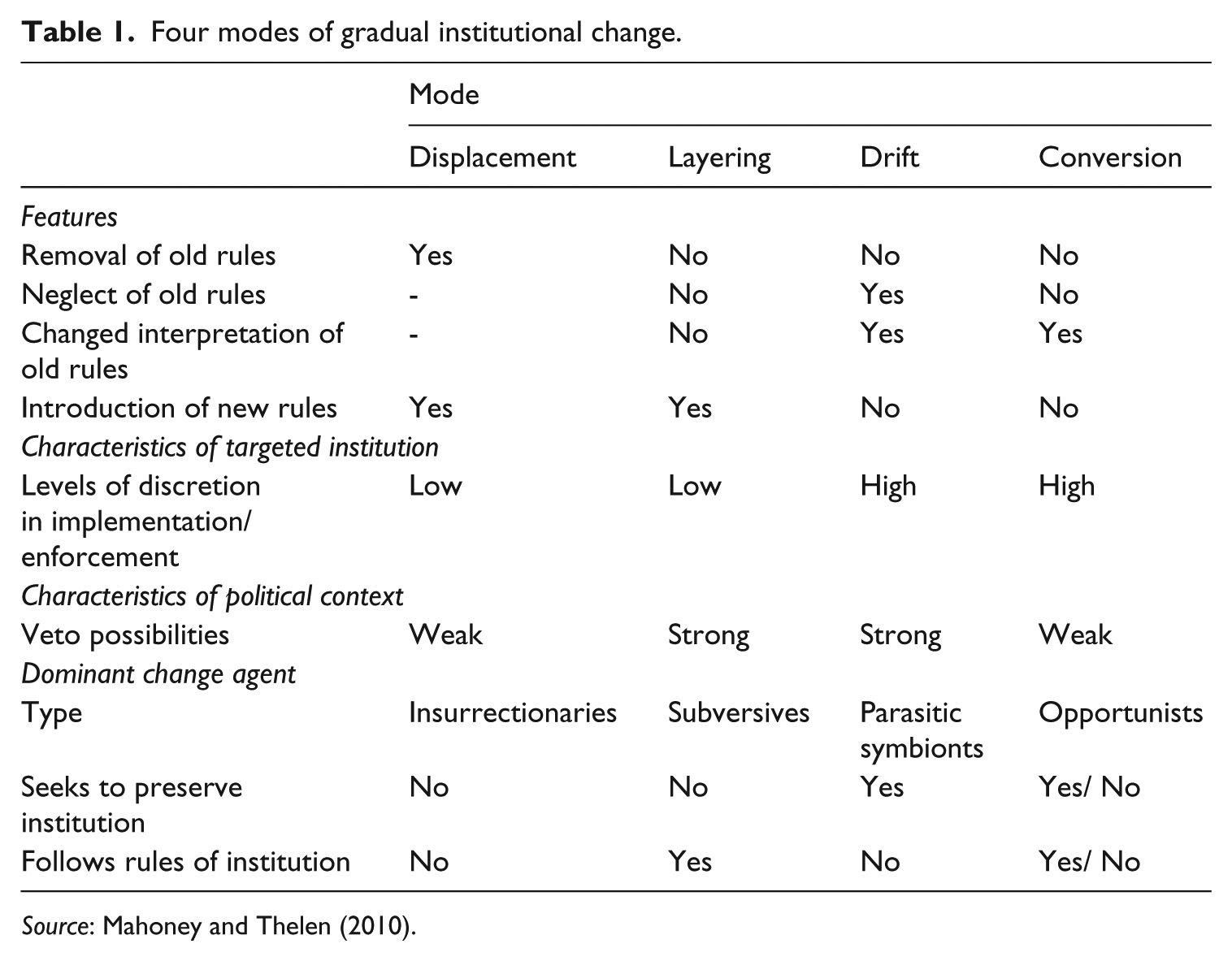
Through this framework, Mahoney and Thelen (2010) present a typology of four gradual change processes, the features of which are summarized in Table 1. These processes relate to:
Displacement – in which existing features are removed and replaced with new ones. This is in a political context that affords weak veto possibilities for defenders of existing arrangements and where the targeted institution affords limited opportunities for actors to exercise discretion in implementation or enforcement.
Layering – in which the original features that structure behaviour are changed through the introduction of new arrangements on top of or alongside existing ones. This is in a context that affords strong veto possibilities for defenders and where the targeted institution affords limited opportunities for actors in exercising discretion in implementation or enforcement.
Drift – in which existing features remain formally the same, but their impact changes due to changes in external conditions. This is in a political context that affords strong veto possibilities and where the targeted institution affords high levels of discretion for actors in implementation or enforcement.
Conversion – in which, in a political context that affords weak veto possibilities and high levels of discretion in implementation or enforcement, existing arrangements also remain formally the same, but are interpreted and enacted differently through strategic redeployment.
Four modes of gradual institutional change.
Source: Mahoney and Thelen (2010).
Research design and data sources
This section outlines the research design and types and sources of data used for the empirical study of the ceramic tableware sector in the UK. The first part presents some background information on the sector in the UK. The second and third parts present the key methodological considerations for the longitudinal single-case study method and backward looking research design, while the fourth outlines the types and sources of data used.
Background and context
This study was concerned with ceramic tableware production – a key sector within the wider pottery/ceramics industry and one traditionally clustered in the UK around six towns (now the city of Stoke-on-Trent) in North Staffordshire, the West Midlands. There are a number of segmented categories within the sector. The main product types are earthenware, bone china, stoneware, porcelain and vitreous china tableware and kitchenware. A number of firms also produce more decorative articles such as figurines and vases. In this respect, the term ‘ceramic tableware’ relates to earthenware, bone china, stoneware, porcelain and vitreous china tableware and kitchenware plus ornamental ware and giftware.
In 1959, the UK Ministry of Labour and National Service reported that the North Staffordshire manufacturers represented 75% of total firm numbers and 94% of total employment in the general earthenware tableware subsector in the UK and 94% of total firm numbers and 91% of total employment in the china tableware subsector. Within this, medium-sized enterprises (101–500 employees) constituted 56% of firm numbers (87/155) and 71% of employment (20,629/28,940) in the ceramic tableware sector. This was compared with 38% (59/155) and 8% (2407/28,940) for small enterprises (< 100 employees), and 6% (9/155) and 20% (5901/28,940) for large enterprises (> 500 employees) (Ministry of Labour and National Service, 1959).
The period from the mid-1960s through to the late 1970s represented a significant phase of restructuring for the sector in North Staffordshire. This saw employment and production capacity increasingly consolidated within a relatively small number of large corporations and groups – a trend that has continued through to the present day and been accentuated through mergers and acquisitions, plant closures and small numbers of new start-ups. This phase of restructuring was associated with the most sustained period of growth (1963–1980) for UK exports of pottery (CN666) since the end of the Second World War. This saw the value of UK exports increase annually by an average of 9%: from $39m in 1963 to $178m in 1980 (original date from UN COMTRADE, subsequently adjusted for inflation by the author [1960 = 100]). This was despite slight decreases in 1966, 1967 and 1976.
Following four years of contraction in the early 1980s (decreasing annually by an average of 14% between 1981 and 1984), UK exports of pottery increased annually by an average of 8% from 1985 to a peak for the postwar period in 1996 of $234m (UN COMTRADE [1960 = 100]). This was despite decreases in 1992 and 1993. Sales by UK firms of ceramic tableware have however decreased significantly since, as producers have looked to respond to a new international division of labour in the sector. This has seen a significant shift in the UK’s total net balance of trade for this commodity from a large surplus to a deficit (Lambert, 2014), which has been associated with a number of plant closures, workforce redundancies and an increased adoption of out-sourcing policies to suppliers based in lower-cost locations, notably the Far East. For instance, between 1996 and 2006 UK exports of pottery decreased by an average 8% to stand at $122m in 2006 – a level not seen since before 1986 (UN COMTRADE [1960 = 100]).
In April/May 2008, 36 ceramic tableware producers operated within Stoke-on-Trent: 76% small (< 100 employees) operations, 12% medium-sized (100–500 employees) and 12% large (> 500 employees) enterprises (Lambert, 2014). In May 2006, firms registered in the Stoke-on-Trent area represented 22% of the total number of firms registered in the UK Companies House Directory under SIC (2003) code 2621 – ‘the manufacture of ceramic household and ornamental articles’. In 2001, the Ceramic National Training Organisation (Ceramic NTO, 2001) reported that the tableware sector employed approximately 17,000 workers.
Longitudinal single-case study method
A longitudinal single-case study method was selected. For Yin (1984: 23), the case study method represents ‘an empirical analysis that investigates a contemporary phenomenon within its real-life context, when the boundaries between phenomenon and context are not clearly evident and in which multiple sources of evidence are used’. In this respect, the phenomenon under investigation was changes to coordination in wages and working conditions in the context of the ceramic tableware sector in the UK during the postwar period (1945–2008). Data were however also collected outside this period of interest (pre-1945). This was to avoid any presumption of stability and continuity prior to the period of analysis, or alternatively in perceiving all ‘movements’ encountered by the analysis as ‘new’ (Holt and Turner, 1970).
This method was chosen in accordance with the following aims and objectives:
The inference of the research was descriptive rather than causal, and the research strategy exploratory rather than confirmatory.
Propositional depth was favoured over propositional breadth, and internal case comparability over external representativeness.
The causal mechanisms and processes of institutional change were of greater interest than their causal effects.
While the author’s ongoing research interests in the ceramic tableware sector conditioned the single-case study selection, it remained necessary to consider whether the chosen site of investigation is a case or merely a unique theoretical event, and what is it a case of? In the sense that while an instance is just that and goes no further, ‘a case’ implies a ‘family’ and alleges that the particular event or social setting is a case of something else (Walton, 2000). Hence as with any single-case study method an inherent trade-off persisted between (a) the ability of the case to produce, or at least partially contribute to, a detailed, theoretically founded description of the empirical world (Ragin, 2000; Ragin and Zaret, 1983), while (b) also looking to ensure the validity of findings beyond the individual case at hand.
Therefore, despite the selection of a single-case study method, as well as the preference in the research for internal comparability and propositional depth over representativeness and breadth, it remained necessary to ensure the relevance of any findings beyond the individual case in hand (its ‘external validity’) through the implementation of an effective conceptual framework and quality hypotheses. The research was therefore conditioned and ultimately directed by prior analytical expectations developed through a review of the available literature. It was the confirmation, and indeed also the disconfirmation in some instances, of such expectations that provided the basis for the development of valid explanations. These prior expectations provided the necessary framework regarding the ‘questions that are worthwhile asking, the factors that are likely to have high explanatory potential, and the type of data that would generally be useful in supporting or invalidating specific explanations … an empirical framework is more easy to communicate and to criticise and hence to correct and to improve … to discover whether or not we are talking about the same thing and thus to compare assumptions, hypotheses, and findings across the variety of complex and unique cases that we are studying’ (Scharpf, 1997: 31–32).
Backward looking research design
The ‘backward looking’ analysis began with the institutional features and practices shaping behaviour in the domain of industrial relations for the present-day (c. 2008) UK ceramic tableware sector, which sat at the end of a hypothetical chain of causation leading back to arrangements in the immediate postwar years (c. 1945). This type of analysis was selected over the alternative ‘forward looking’ research design – one that examines the effect of a specific independent variable and confirms or disconfirms a specific single-factor hypothesis – for four reasons.
First, the study looked to examine and describe the phenomenon under investigation and not the effect of any one particular variable/factor. Second, when looking forward, the length of the hypothetical chain of causation is crucial in eliminating the interaction effects of additional variables (interacting variables). This is less of a problem with small periods of analysis. However, research involving longer periods (such as was the case for this study) can encounter significant difficulties in confirming or disconfirming empirically a single-factor induced effect.
Third, in looking to reach back far enough in order to incorporate sufficient ‘pragmatically useful independent variables’ (Scharpf, 1997), backward looking research design can trace a larger number of possible chains of causation. It can therefore incorporate a plurality of independent variables and chains of causation, thus presenting a capacity to accommodate multi-causality – dealing with a large set of independent variables – without having to assume their complete independence from one another.
Finally, different combinations of variables/factors and varying contexts can in many cases induce the same observed action, event or outcome. Therefore, by focusing on combinations of factors, backward looking research design is equipped to circumvent possible ‘illusory differences’ by considering the issue of ‘context’ through the notion of ‘multiple conjunctional causations’. This is to say that what makes a particular independent variable causally significant in one case, but not in another, is the presence of other contextual factors or independent variables. Consequently, by making this provision, it is possible to examine and identify how different combinations or conditions could have the same causal significance and how similar causal factors could operate in entirely different directions (Skocpol, 1984).
Types and sources of data
Data collection was conducted between September 2005 and September 2008. Data were drawn from a number of different sources. First, 20 interviews were conducted with various (past and present) actors within the ceramic tableware sector in the UK and Stoke-on-Trent area. Interviewees included representatives of local, national and international trade associations and organizations, the industry trade union, ceramics technologists, education and training providers, suppliers and ceramic artists/designers. Interviews lasted 90 minutes on average, were digitally recorded and subsequently transcribed.
Other data sources were oral history archives (electronic recordings and transcripts) and published biographical accounts from actors who had operated within the sector at various points during the second half of the twentieth century. These included company owners, management personnel, employees and trade union officials. I also drew on previous published research and documentary sources from national, industry, trade union, community and company archives, including reports, wage agreements, newspaper articles and surveys; other contemporary sources, such as attendance at trade shows, exhibitions and industry networking events and seminars; and numerical data relating to industry/firm performance, industry structure and comparative world trade performance.
Data analysis began during the collection activities. Initially categories were developed from the data and relationships identified between substantive codes/concepts using a coding paradigm – theoretical concepts and themes drawn from the literature. This provided the necessary axis around which subsequent coding and category building were achieved.
Diversity and change in the domain of industrial relations within the UK ceramic tableware sector 1945–2008
Three distinct forms and levels of arrangements within the domain of industrial relations gained prominence in the sector at different points during the second half of the twentieth century. These were:
Informal workplace bargaining arrangements within individual establishments, workshops or organizational units – between individual (or small groups of) workers and their immediate foreman, supervisor or directly with a master-potter (owner-craftsman) – during the first two decades following the war.
An annual bilateral, multi-employer agreement with the trade union becoming the principal wage-determination mechanism for labour across the sector by the mid- to late 1970s.
Arrangements becoming increasingly mixed and multilateral from the early 1980s, with both a multi-employer and increasing numbers of single-employer formal agreements in operation.
In relation to the causal mechanisms and processes driving such diversity and changes to the prominent forms and levels of arrangements in the sector, this section presents three identifiable stages of gradual, yet transformative institutional change during the period of analysis. The various internal and external pressures facing actors, the political context of institution-building processes and the features of existing arrangements within the sector shaped these three stages. The stages were: a layering mode of change in the immediate postwar period (c. 1950); a conversion mode of change during the 1970s; and a displacement mode of change in the early 1980s. The features of these stages are outlined in Table 2.
Three stages of institutional change within the UK ceramic tableware sector.

A layering mode of change in the immediate postwar period (c. 1950)
Postwar industrial relations within the ceramic tableware sector in the UK have been synonymous with the annual NJC (National Joint Council of the Pottery Industry) Wage Structure agreement. Established shortly after the war, this bilateral bargaining arrangement consists of no more than 12 members appointed by the employers’ federation and 12 members appointed by the industry’s trade union. This includes the General Secretary, Assistant General Secretary and union organizers, plus seven other members of the National Executive Committee. Negotiations between the various representatives begin six weeks prior to 25 March (the annual ‘settling’ day), when written notices concerning general, departmental or individual wages and hours will be exchanged and discussed. These notices concern (a) general issues relating to basic day-, hour- and overtime rates, minimum piecework levels, holidays, methods of payment and transference of occupations, and (b) pay and conditions disputes relating to individual firms or plants.
Nevertheless, despite the establishment and operation of this bilateral, multi-employer arrangement, the UK National Board for Prices and Incomes (NBPI, 1970) identified that even up to the mid- to late 1960s the NJC Wage Structure only determined the actual earnings of a ‘minority’ of pottery workers:
… of the 23,000 plain timeworkers, fewer than 25% were on the NJC minimum rates, over 50% were paid rates above the minima. The remainder were paid rates set outside the NJC agreement. In short two out of every three timeworkers employed by NJC firms were paid above the NJC rates. In non-federated establishments almost half the timeworkers were paid above the NJC rates. (NBPI, 1970: para. 57)
Indeed, it was found that in line with the findings of the Royal Commission on Trade Unions and Employers Associations (Donovan, 1968) a previous well-established system of informal workplace bargaining remained the principal wage determination mechanism for the majority of labour in the sector in the first two decades following the war. This was through tacit agreements and understandings within individual establishments, workshops or organizational units between individual (or groups of) employees and their employers (whether foremen, supervisors, production managers or directly with master-craftsmen/owner-managers themselves). Insights regarding the presence of these two forms and levels of arrangements, as well as the nature of complementarity between them, are provided through an understanding of the mechanisms, processes and internal pressures behind the introduction and function of the bilateral multi-employer bargaining arrangement.
Although it determined the actual wages for some workers within the sector, following its introduction, the NJC Wage Structure essentially performed an employed wage protection function to establish, and if need be enforce, minimum wage levels and conditions of work across the pottery industry. The internal pressures for such a mechanism could be traced back to periods of systemic price undercutting by some firms during the late nineteenth and early twentieth centuries. This was in response to external pressures in the form of economic downturns and/or increased competition (Owen, 1901). These activities had been both highly contentious and financially damaging for the industry, forcing selling prices ever lower, which had a severe impact on already small margins as well as industrial relations.
Nevertheless, the NJC Wage Structure presented a structure that sought to prevent the reoccurrence of undercutting strategies on a large scale by negotiating basic hours, wage settlements and considering minimum rates for workers. The employers’ federation and trade union – as subversive change agents – had limited discretion and involvement within the individual tacit agreements and understandings of existing workplace bargaining arrangements. This was also a context in which there were long-standing issues in the establishment of minimum selling prices (Popp, 2003), particularly between the small and medium-sized producers that continued to characterize the sector and Stoke-on-Trent cluster in the first two decades following the war and larger industrial concerns. As a result, because wages represented approximately 40% of costs, during hard times there was a greater tendency to place the stress on quality rather than price competition, unless wage-cutting policies were undertaken (Williams, 1958). The effectiveness of this structure is evident in the fact that despite the persistence of historic perceptions of pottery workers being low paid (relative to other UK industries), studies identified that this was something of a misconception during the 1960s. They were instead just not ‘highly paid’ (Gregory and Smyth, 1971; NBPI, 1971).
The multi-employer agreement was introduced to supplement existing arrangements within individual establishments, workshops and organizational units through a layering mode of change (Mahoney and Thelen, 2010) – as opposed to one of displacement, which would have seen such an agreement installed as the principal wage coordination mechanism. This was due to the strong veto possibilities for employers concerning the introduction of more extensive formal multi-employer arrangements.
The variability of conditions within the sector at this time, in terms of products and production processes, represented a significant internal factor in the continued operation of existing workplace bargaining arrangements. This had historically been a major inhibiting factor for the establishment of more extensive collective bargaining arrangements across the sector (Whipp, 1990). These elements continued to impede the greater standardization of processes across the sector in the early postwar period. For instance, results-based payment systems remained a central issue for workplace bargaining well into the 1960s, and, in some aspects of production, the 1970s. At this time, 54% of the industry’s total adult workforce was affected by a payment by results system. Of these, 46% of adult males were on a form of results-based payment, compared with 61% of adult females, of whom 50% were on straight piecework rates (NBPI, 1970). What is more, piece-rates were highly variable between different firms as well as within organizational units. The reasons for this were two-fold. First, it resulted from variations in product type, size and complexity, the organization of production and the level of skill and input required by the worker. For example, many were paid a piece-rate ‘by the dozen’. However, this could range from two to 36 pieces. As a result, despite apparently identical earnings and, to the lay person, carrying out analogous processes to produce closely related products, two workers could often be remunerated through entirely different mechanisms. Second, wages were often also determined according to internal administrative principles and informal job ladders based on skill acquisition and transformation, the taking on of additional tasks and responsibilities and length of service.
As well as the practical implications this limited standardization presented in implementing more extensive collective bargaining arrangements, employers wanted to ensure any such arrangements would not adversely come into ‘conflict’ with, and as a result impact the operational benefits of, existing workplace practices and bargaining arrangements. For example, at a presentation to the Hanley branch of the British Pottery Managers’ Association in 1950 by management consultants Noel-Brown & Co. (Ltd), the suitability of work measurement techniques for fixing rates had been questioned from the floor. The questioning by a number of attendees centred on the nature of production processes in the pottery industry, the immense versatility and variety of products handled in any one firm and the need for flexible allowances in order to encompass variations in the time taken for different products and processes. Indeed, for many discussants, the piecework system and associated workplace practices and bargaining arrangements still remained the most suitable system (Rowntree, 1950).
A conversion mode of change during the 1970s
Throughout the 1970s, bargaining arrangements in the sector evolved in a coherent and incremental manner. This culminated in the elevation of the annual NJC Wage Structure agreement – from an initial ‘safety net’, employed wage protection function for restricting certain competitive practices such as price-cutting – to become by the mid- to late 1970s the principal wage-determining mechanism for labour involved in the production of ceramic tableware. This process represented a conversion mode of change (Mahoney and Thelen, 2010) with the following features:
Despite involving the removal of an old institution in the form of the system of informal workplace bargaining within individual establishment, workshops and organizational units, bargaining arrangements within the sector remained formally the same, but were interrupted and enacted in a new way.
Change was driven not by neglect in the face of a changing setting (as would be the case with a of drift mode of change), but rather through the active redeployment of formal arrangements by actors in order to meet new goals, functions and purposes.
Employers represented opportunist change agents within a context of weak veto possibilities (so long as agreed minimum standards and conditions were upheld) and with a high degree of discretion in relation to the internal standardization of wages and working conditions in accordance with the levels set by the formal multi-employer NJC Wage Structure agreement.
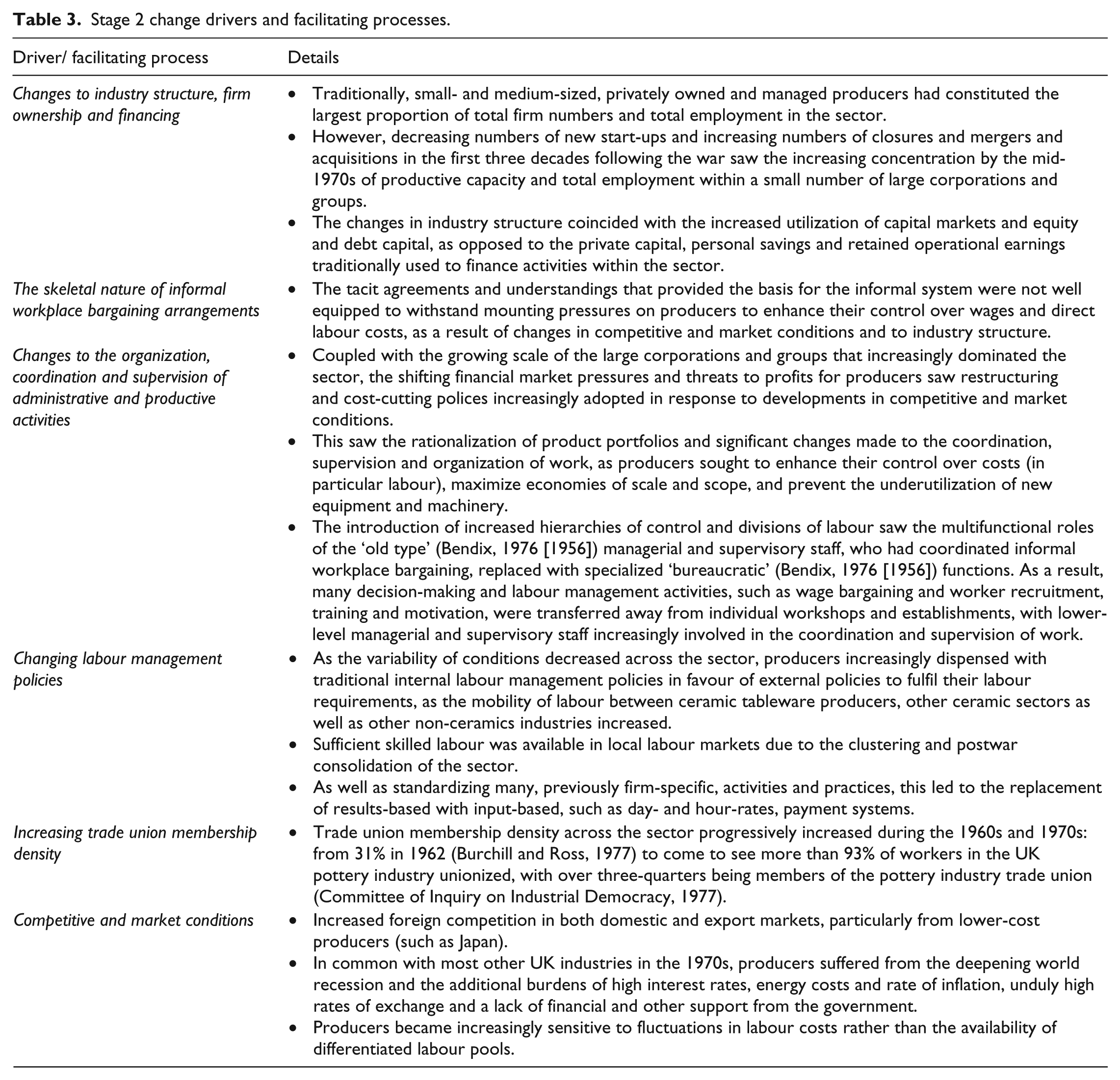
This coherent and incremental evolution of arrangements during this period was driven/facilitated by a number of internal and external factors. These are summarized in Table 3, which shows that some of these change drivers and facilitating processes had originated in earlier periods during the second half of the twentieth century. Nonetheless, it was not until the 1970s that these aligned and reached the necessary critical mass to trigger the incremental reinterpretation and redeployment of existing formal bargaining arrangements on a large scale and the disappearance of the tacit agreements and understandings within individual workplaces.
Stage 2 change drivers and facilitating processes.
For instance, the data presented in Table 4 show the number of mergers and acquisitions in the tableware (domestic ware) sector in the first three decades following the war. These accounted for 91% of the total mergers and acquisitions in the UK pottery industry during this period. This saw tableware producers acquiring or merging with other tableware producers or themselves becoming subsidiaries of large local, national and international pottery and non-pottery corporations. As a result, by 1970, 33 (27%) of the 154 establishments in the UK ceramic tableware sector were under the control of four groups (NBPI, 1970) – a proportion that would increase as the decade proceeded due to further mergers, acquisitions, closures and small numbers of new start-ups. 1
Mergers and acquisitions in the UK pottery industry 1945–1974.
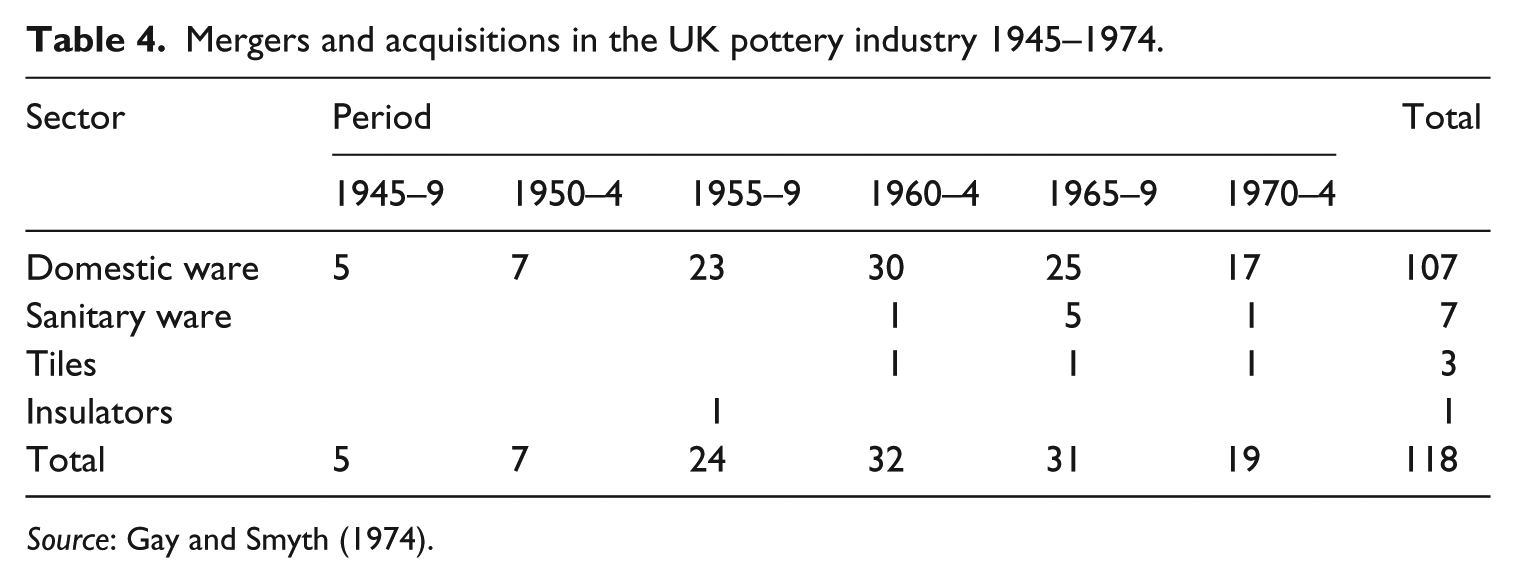
Source: Gay and Smyth (1974).
However, these changes in ownership had not themselves been sufficient to elicit changes to the forms and levels of bargaining arrangements. When producers had undergone mergers and acquisitions to form or become part of larger corporations or groups, they had often subsequently operated as disintegrated, autonomous subsidiaries; producing the same products through existing processes, from their existing sites; and with previous owner-managers employed as directors and managers. As a result, many existing institutional arrangements and workplace practices, such as the coexistence of the informal system of workplace bargaining and the formal NJC Wage Structure agreement, remained unaltered up until the 1970s. This was despite changes in the ultimate ownership of the firms and the sources of finance and resources that could be drawn upon.
However, shifting financial pressures, developments in competitive and market conditions and the increased sensitivity of producers to fluctuations in costs linked to the increased scale of their operations subsequently saw pressures mounting on producers to enhance their control over costs (notably labour) and achieve greater economies of scale and scope. The focal action pattern of decisions that emerged in response to these internal and external pressures concerned (a) the application of aspects of new technology and control systems, (b) changes to the organization, supervision and coordination of production and (c) associated changes to behaviour in product and labour markets. This saw arrangements in the sector change in a coherent and incremental manner – a process driven by the complementarities between different forms of arrangements and practices. While the previous informal workplace bargaining system had complemented the variability of conditions within the sector, the NJC Wage Structure complemented this emerging focal action pattern. This was because it presented a more appropriate mechanism through which to achieve greater economies of scale and scope and enhance control over, and look to prevent fluctuations in, direct labour costs.
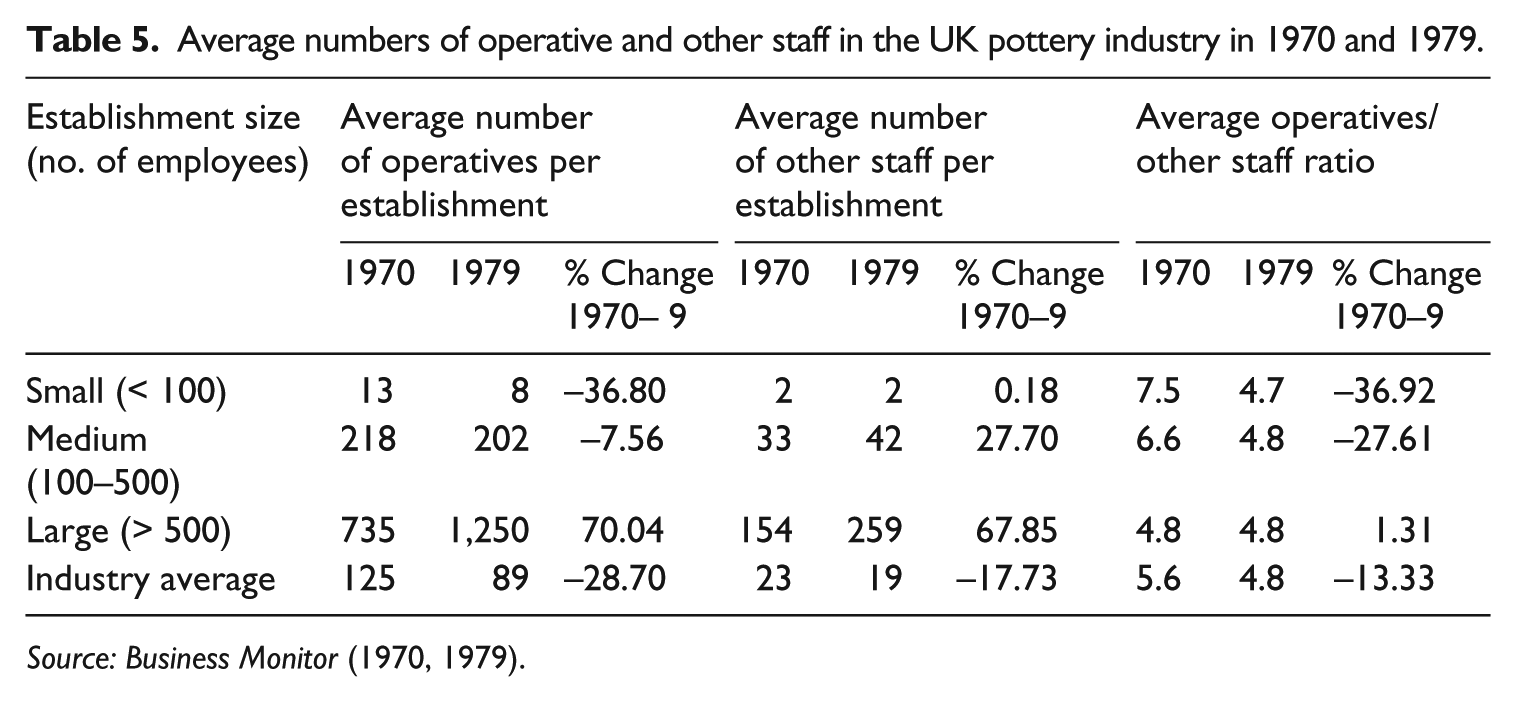
The propagation of this focal action pattern across the sector and wider pottery industry at this time is demonstrated by the data presented in Table 5 for the average numbers of operatives and other staff employed in the UK pottery industry in 1970 and 1979. These show the convergence in the average ratios of operatives to other staff for small, medium and large establishments during this period. This resulted from significant reductions in the operatives to other staff ratios for small and medium-sized establishments (37% and 27% respectively), and a negligible increase for large establishments (1%), which contributed to a reduction in the average ratio for the UK pottery industry.
Average numbers of operative and other staff in the UK pottery industry in 1970 and 1979.
These changes saw the reorganization of many previously autonomous workshops, establishments and subsidiaries with increasing hierarchies of control and divisions of labour. Coupled with reductions in the variability of conditions, this enhanced employers’ control over labour costs and wage bargaining through the consolidation of many previously decentralized labour management activities, such as recruitment, training and wage bargaining, within designated firm- or group-level personnel/human resource management functions and management structures.
The increased standardization of production processes across the wider UK pottery industry at this time is demonstrated by the rationalization of the occupational groups included within the NJC Wage Structure. For instance, the 1960 NJC Wage Structure concerned 24 occupational groups (six female and 18 male) (NJC, 1960), compared to 11 in 1970 (three female and eight male) and eight non-gender-specific occupational groups in 1980. Although the total number of occupations covered by the groups did increase (from 149 in 1960 to 162 in 1980) (NJC, 1960, 1970, 1980). 2
A displacement mode of change in the early 1980s
Despite the potential benefits it appeared to present for enhancing their control over costs, many employers in the sector increasingly found the aggregations of interests within the bilateral multi-employer arrangement unsympathetic and restrictive in the face of mounting pressures in energy, financial, labour and product markets.
Unlike previous informal workplace bargaining arrangements, employees often found it difficult to identify a direct link between their individual input, in terms of effort as well as commitment, discipline and loyalty, and their wages and employment prospects. In addition to employment relationship issues, this presented issues in terms of workforce motivation and engagement. As well as growing incidences of industrial disputes, absenteeism and labour turnover within the sector, there had been incremental changes made to existing institutional frameworks in the form of employee productivity schemes across the sector as a possible solution during the 1970s. For instance, in 1971 the union reported that some ‘major’ producers operated Suggestion Box Schemes through which employees could receive rewards of cash or in kind for suggestions that either improved efficiency, reduced costs or created safer working conditions (CATU, 1971). The continued implementation of productivity schemes during the 1970s saw guidelines established as part of the 1978 NJC Wage Structure for Self-financing Productivity Schemes on a company or group basis (NJC, 1978).
Nonetheless, a number of producers were increasingly unable to reconcile mounting internal and external pressures with the nature of, and the limited discretion and control they – as individual employers – possessed within the bilateral multi-employer arrangement. This saw a number of larger producers seek to take advantage – as insurrectionary dominant change agents – of the trade union’s weakened veto possibilities following stepped changes in government policy towards unions and collective regulation after 1979. Through a displacement mode of change (Mahoney and Thelen, 2010), this phase of discontinuity, uncertainty and change saw producers’ withdrawal from the annual multi-employer NJC Wage Structure agreement from the early 1980s onwards (the first in 1983), to experiment and ‘tinker’ with alternative forms and levels to suit their specific needs and purposes. This resulted in the coexistence of the multi-employer NJC arrangement alongside a small number of producers in single-employer bargaining arrangements. The distribution across these separate arrangements has gradually shifted since, with a growing proportion of the sector establishing single-employer arrangements.
Today, less than half of the trade union’s membership is covered by the annual NJC Wage Structure agreement across the pottery industry. For instance, members across 28 Stoke-on-Trent establishments (16 separate firms) and two out-lodges voted for the 2006 agreement, compared with 58 establishments (40 firms) in Stoke-on-Trent and four out-lodges in 1995 (Unity Trade Union Archives). In terms of membership numbers, in 2005 total membership of the trade union was approximately 8000 (63% male and 37% female) members across 113 establishments and 21 out-lodges, compared with just under 36,000 members in December 1980 (Unity Trade Union Archives).
Conclusions
The contribution of the study presented in this article has focused around two themes. The first theme relates to the development of a more detailed understanding concerning internal diversity and the possible confined basis of different forms and levels of coordination in wages and working conditions within the UK during the period of analysis (1945–2008). In this respect, three distinct forms and levels of arrangements were found to have gained prominence at different points within the domain of industrial relations for producers in the ceramic tableware sector during the second half of the twentieth century.
During the first two decades following the war there existed informal workplace bargaining arrangements within individual establishments, workshops or organizational units – between individual (or small groups of) workers and their immediate foreman, supervisor or directly with a master-potter (owner-craftsman). Then, by the mid- to late 1970s, an annual bilateral multi-employer agreement with the trade union became the principal wage-determination mechanism for labour across the sector. Finally, from the early 1980s, arrangements became increasingly mixed and multilateral, with both multi-employer and increasing numbers of single-employer formal agreements in operation.
The second theme relates to a better understanding of the influence of the institution-building context and the features of existing arrangements at various levels on such internal diversity. This entailed examining their influence on modes of institutional change and the strategies and types of dominant change agents involved, as actors looked to respond to various internal and external pressures. In this respect, drawing upon themes and concepts from a power-distributional consequences perspective of institutional development, continuity and change, developments in the domain of industrial relations within the sector during the second half of the twentieth century were attributed to three stages of incremental, yet transformative, institutional change.
First, a layering mode of change in the immediate postwar period (c. 1950) saw a formal multi-employer agreement introduced to supplement existing informal workplace arrangements by subversive change agents, in the form of the employers’ federation and the trade union. This was in the context of (a) strong veto possibilities by employers concerning the introduction of more extensive formal multi-employer arrangements and (b) in which change agents possessed low levels of discretion in the informal system of tacit agreements and workplace understandings for preventing wage-cutting policies and in the establishment of minimum selling prices.
Second, a conversion mode of change during the 1970s saw employers – as opportunist change agents – reinterpret and actively redeploy the formal multi-employer bargaining arrangement to achieve new goals and a new function. This saw the disappearance of the informal system and the elevation of the NJC Wage Structure agreement from its previous ‘safety net’, employed wage protection function to become the principal wage-determination mechanism for labour in the sector by the mid- to late 1970s. This was in a context of weak veto possibilities (so long as agreed minimum standards were upheld) and with a high degree of discretion in relation to internally standardizing wages and working conditions in accordance with the levels set by the formal multi-employer agreement.
Third came a displacement mode of change in the early 1980s, which saw a number of larger employers – as insurrectionary change agents – withdraw from the aggregations of interests within formal multi-employer arrangements. This presented them with limited discretion and control in aligning wage agreements to meet changing conditions and circumstances. This phase of discontinuity, uncertainty and change saw them look to experiment and ‘tinker’ with alternative forms and levels to suit their specific needs and purposes. It resulted in the coexistence of the multi-employer NJC arrangement alongside a small number of producers in single-employer bargaining arrangements. This was in a context of weakened veto possibilities in the light of stepped changes in government policy towards unions and collective regulation after 1979.
Further comparative and historical research is required nonetheless. This should be focused around two interconnected themes in particular. First is the extent to which ‘national traditions’ (Hyman, 2001; Hyman and Ferner, 1994) and the nature of organized interest representation within the UK (Crouch, 1993) may have bounded internal diversity through possible path-dependent ‘lock-in’ effects for actors in the ceramic tableware sector. For instance, despite some moves towards an interventionist approach to both collective and individual employment rights by various postwar UK governments, coordination in such domains has traditionally been voluntarist – left to the activities of actors and their organizations. As a result, with limited legally embedded arrangements, such moves may have not been sufficiently ‘path breaking’. This could have potentially presented contrasting political veto possibilities and discretion in enforcement/implementation to key actors – through the nature of organized capital and labour representation – relative to their counterparts in more organized ‘national traditions’, resulting in significant differences in the modes, processes and therefore the outcomes of institutional change.
Second, further research is required in order to explore the extent to which the timing and synchronization of industrial relations as an issue for other economic, social and political actors may have influenced internal diversity and systemic change within the UK. For instance, on the one hand, the trajectory for the ceramic tableware sector was a much more regional rather than national-level story, due to the clustering of the sector in Stoke-on-Trent. Hence, events and developments in other industries and sectors more closely associated with the salience of industrial relations as an issue at the national level (e.g. mining, steel, communications and transport) might have set in place a developmental ‘path’ in the form of policies, a national agenda or public opinion based upon universal, as opposed to differentiated or regional, policies and initiatives. These may have influenced the bargaining power and veto possibilities of key actors and as a result the decisions, action choices and future trajectories available to change agents.
Similarly, on the other hand, further research is required in order to explore the extent to which the causal sequence of actions, events and outcomes for the ceramic tableware sector characterized a pattern across other sectoral contexts within the UK at this time. Any synchronization or homogenization found might help explain the systemic change within the UK which came through the internal and external pressures on government leading up to the post-1979 changes to employment rights. Alternatively, might the ceramic tableware sector represent a ‘deviant’ case? If the sector contradicts the general pattern, further analysis would help the development of a more detailed understanding of such a pattern and identify the special factors that permitted the unexpected within the deviant case to occur (Gospel and Druker, 1998; Lipset, 1967).
Footnotes
Funding
This research received no specific grant from any funding agency in the public, commercial, or not-for-profit sectors.