



Abstract
This article develops and examines the idea that internal labour flexibility practices are beneficial for labour productivity and innovation performance of companies. This is tested in two studies using unique company level datasets. In Study 1, results obtained from 377 independent companies revealed that internal labour flexibility practices are positively related to objective labour productivity and its growth in the year following, also when controlled for objective labour productivity and objective external labour flexibility from the year before. In Study 2, results obtained from 4271 companies indicated that internal labour flexibility practices were positively related to product innovation and labour productivity. Findings suggest that internal labour flexibility practices benefit both labour productivity and innovation performance of companies. If innovation and labour productivity are considered key to long-term survival, firms and policymakers should consider internal labour flexibility practices.
Keywords
In order to deal with today’s highly dynamic economic, social and technological circumstances, there is an increasing need for organizations in Europe to flexibly arrange their labour demands. Companies can broadly meet labour flexibility demands via a strategy of external (i.e. numerical) or internal (i.e. functional) labour flexibility strategies and practices (Atkinson, 1984; Hutchinson and Brewster, 1994; Kalleberg, 2001). Through external labour flexibility, organizations react to changes in the demand for their products or services by adjusting the amount of labour they employ by making use of temporary and seasonal employees, short fixed-term contracts, lay-offs, agency labour, freelance work, subcontracting and homework or outwork (Atkinson, 1984). Through internal labour flexibility practices, companies adjust to output demand changes by reallocating, changing personnel and redesigning jobs within their own organizations (Atkinson, 1984).
Most companies seem to rely on external rather than internal labour flexibility practices. In fact, external labour flexibility seems to be rising in European countries in the last several years (Eurofound, 2010; Sandor, 2011). In the Netherlands, for instance, organizations are increasingly using flexible, temporary contracts (Hilbers et al., 2010; Verbiest et al., 2014), whereas the use of internal labour flexibility practices seems less popular here. Yet, while external labour flexibility has been often found to have negative or mixed consequences for organizational performance outcomes (Chadwick and Cappelli, 2002; Michie and Sheehan, 1999, 2001; Zhou et al., 2011; for overviews, see Preenen et al., 2013; Zhou et al., 2011) as well as employee outcomes (e.g. job attitudes, see Aletraris, 2010), the effects of internal labour flexibility practices on both organizations and employees seem a lot more promising.
For example, labour economic research has demonstrated positive relationships between internal labour flexibility and firm sales and employment growth (e.g. Kleinknecht et al., 2006) and company innovation performance (Arvanitis, 2005; Chadwick and Cappelli, 2002; Kleinknecht et al., 2006; Zhou et al., 2010, 2011). However, internal flexibility indicators were mainly included as control or ‘minor’ variables in these studies and operationalized as internal labour turnover numbers (Chadwick and Cappelli, 2002; Kleinknecht et al., 2006; Martínez-Sánchez et al., 2008; Zhou et al., 2010, 2011), which solely reflect the percentages of people that change function within the firm but do not provide specific knowledge about the impact of internal labour flexibility practices per se, or were investigated with a cross-sectional research design (Martínez-Sánchez et al., 2008). In human resource management (HRM) and organizational sociological studies, researchers have widely associated broad HRM work systems, such as high commitment work practices and high road work practices, which often include internal labour flexibility related practices, with higher company performance, innovation and R&D investments (e.g. Beugelsdijk, 2008; Huselid, 1995; Michie and Sheehan, 1999, 2001, 2003, 2005). Also, organizational psychological research suggests that specific internal labour flexibility practices (i.e. job rotation, multi-skilling, job autonomy) can have beneficial effects on individual-level outcomes, such as employee-driven innovation (for an overview, see De Spiegelaere et al., 2014; Hammond et al., 2011; Shalley and Gilson, 2004; Shalley et al., 2004) and creativity or innovative behaviour (e.g. Chen et al., 2011; Dorenbosch et al., 2005; Pot et al., 2009). Hence, the beneficial effects of both internal labour flexibility numbers and practices seem quite well established for outcomes at both the individual and company level.
Yet despite the research attention for internal labour flexibility in several research areas, two crucial company outcomes have been mostly overlooked so far, namely company innovation and, in particular, labour productivity. Innovation is reflected in novel outputs, such as new goods or a new quality of a good, a new method of production, a new market, a new source of supply or a new organizational structure (Schumpeter, 1934). In labour flexibility research it is often measured in terms of product innovation (e.g. Preenen et al., 2013; Zhou et al., 2010, 2011), which is defined as the development and commercialization of new products to create value and meet the needs of the external user or the needs of the market (Damanpour and Gopalakrishnan, 2001). Innovation is widely regarded as a fundamental source of competitive advantage in today’s increasingly changing environment (e.g. Dess and Picken, 2000; Tushman and O’Reilly, 1996). In fact, according to scholars, innovation capability is the most important determinant of firm performance (e.g. Mone et al., 1998). Hence, not surprisingly, stimulating innovation is a focal topic on the European 2020 research and policy agenda. Labour productivity, which can be defined as the value added per full-time employee for companies, is an important dynamic measure of both organizational performance and competitiveness. Labour productivity is often coupled with company innovation performance because successful product innovations are expected to raise the value added to the firm (e.g. Lucidi and Kleinknecht, 2010; Vergeer and Kleinknecht, 2011), and might be explained by similar mechanisms.
The aim of the present study is therefore to empirically investigate and theorize on the impact of internal labour flexibility practices on labour productivity (growth) and product innovation, and to complement the existing body of knowledge on the possible beneficial outcomes of internal labour flexibility practices. We examine this in two studies using two samples based on unique Dutch representative company-level datasets. In Study 1, we combine subjectively assessed internal labour flexibility practices with two objective labour productivity indicators measured a year later among 377 companies. The data allow us to control for reversed causality and to eliminate common method bias. Furthermore, we control for baseline effects by controlling for labour productivity from the year before in the model. In Study 2, we relate subjectively assessed internal flexibility practices with a subjectively assessed innovative output and labour productivity measure among 4271 companies, to test our ideas on a larger sample. In both studies, we control for (objective, Study 1) external labour flexibility and a number of other control variables commonly used in innovation research. We draw on and integrate economic, organizational and psychological literature to develop our hypotheses.
With our study, we aim to contribute (to the literature) in several ways. First, we fill the research gap on the effects of internal labour flexibility practices on two important company outcomes: labour productivity and company product innovation. Second, we contribute more generally to the economic labour flexibility research literature, in which most attention has still been given to the company outcomes of external labour flexibility practices (e.g. Altuzarro and Serrano, 2010; Lucidi and Kleinknecht, 2010; Preenen et al., 2013). Third, we integrate theory from different fields (economics, HRM, organizational sociology, organizational psychology) and develop new theory to possibly explain our expected relationships. Fourth, by relating internal labour flexibility to objective performance outcomes measures a year later, we add important empirical knowledge to the HRM practices literature, much of which lacks such a design (for an overview, see Wall and Wood, 2005), but has been called for (Martínez-Sánchez et al., 2008). In general, the (quasi-longitudinal) research that we conduct, in which we combine micro- (employee) level HR domains with organizational (meso) outcomes, is scarce in both organizational as well as psychological literatures, but has been encouraged in the past (e.g. Huselid and Becker, 2011; Wright and Boswell, 2002). Also, most studies that relate job characteristics (i.e. job complexity, job rotation) to creativity and innovative behaviour are based on cross-sectional designs and single sources (see Hammond et al., 2011; Shalley and Gilson, 2004; Shalley et al., 2004), leaving the direction of the causal relation unknown (De Spiegelaere et al., 2014). Fifth, we contribute to knowledge of internal flexibility practices in the Netherlands. Whereas most attention in the Netherlands currently seems focused on external labour flexibility practices among both organizations and practitioners and researchers (e.g. Preenen et al., 2013), little attention has been paid to internal labour flexibility practices. Finally, our study provides empirical and theoretical material useful for organizations and policymakers that want to flexibly arrange labour needs and enhance innovation performance and labour productivity. Hopefully, our findings can help inform the current labour flexibility debate in the Netherlands and Europe, in which the activation of the employed through internal flexibility is largely ignored by European and national policymakers (De Spiegelaere et al., 2014).
In what follows, we first provide a short theoretical overview of internal labour flexibility practices. Subsequently, we theoretically and empirically develop our hypotheses. Hereafter, we describe our methods and results for both Study 1 and Study 2. We end with a general discussion of both studies.
Theory and hypotheses
Internal labour flexibility practices
Internal labour flexibility or functional labour flexibility refers to a process through which enterprises adjust to changes in the demand for their output by an internal reorganization of workplaces (Arvanitis, 2005). Internal labour flexibility practices reflect the measures that companies take to facilitate their employees in flexibly performing different tasks and roles in their organization. It is based on employment practices that focus on redesigning jobs around a functionally flexible worker (Friedrich et al., 1998). Stated otherwise, they are practices focused on enhancing the employees’ ability to perform a variety of jobs (Kalleberg, 2001). These internal labour flexibility practices consist of arrangements that allow personnel to carry out a wider range of tasks, such as multi-tasking (parallel work in different functions) and job rotation (sequential work in different functions) (Arvanitis, 2005), but also in a less direct manner, such as the participation of workers in job design, work arrangements, procedures, the organization of their own work and allowing for tailor-made arrangements of the job content. This offers personnel the opportunity to perform more tasks, and provides people with more flexibility in how they define their role because they will have greater discretion in deciding how to perform their work (Fried et al., 1999; Troyer et al., 2000). This flexibility also enhances job autonomy, which is defined as ‘the degree to which the job provides substantial freedom, independence, and discretion to the employee in scheduling the work and in determining the procedures to be used in carrying it out’ (Hackman and Oldham, 1975: 162). Moreover, increased control over the work environment may motivate employees to try out and master new tasks, leading to a greater role-breadth (Morgeson et al., 2005) and thus internal flexibility.
All in all, in this article we define internal labour flexibility practices as the extent to which an organization applies labour practices that facilitate internal flexibility in the organization, such as job rotation, flexible working schedules and allowing for individual tailor-made arrangements regarding the contents of the job.
Hypotheses development
Below, we utilize different research literatures (in combination) to provide several theoretical arguments for why we believe that internal labour flexibility practices positively impact company (product) innovation and labour productivity.
First, drawing on HRM, organizational and creativity research (e.g. Beugelsdijk, 2008; Kang et al., 2007), we believe that internal labour flexibility practices may stimulate innovation because they stimulate innovative behaviour. As explained above, internal flexibility practices enhance the autonomy and control of workers in the design, (time) scheduling, execution and organization of their work (e.g. Fried et al., 1999; Troyer et al., 2000), which in turn enhances opportunities to experiment, develop and apply new ideas (Amabile et al., 1996). In support of this idea, it has been argued and summarized by researchers (Beugelsdijk, 2008) that employee empowerment and self-discretion allow employees to address problems and opportunities that arise contemporaneously (Kang et al., 2007; Lepak and Snell, 1999) and that job autonomy and empowerment stimulate creativity and innovation and provide ground for exploratory behaviour (Drucker, 1999). Moreover, task autonomy in the form of allowing flexible working schedules and tailor-made arrangements allows employees to anticipate changing circumstances. Such greater flexibility will help them to deal with the intrinsic uncertainty of the innovation process (Griffin et al., 2007; Sanchez, 1995). Additionally, allowing employees to make autonomous decisions regarding the performance and planning of tasks increases individual task adaptivity and proactivity (Griffin et al., 2007), which may benefit innovative and productive behaviour. Indeed, job autonomy has been positively associated with innovative behaviour (e.g. Axtell et al., 2000; Spreitzer, 1995), personal initiative taking, idea implementation and problem solving (Bindl and Parker, 2010). A recent meta-analysis (Hammond et al., 2011) even identified job-related variables, such as job complexity and job autonomy, as the job characteristics most strongly associated with employee innovation.
Second, internal labour flexibility practices, such as the rotation of jobs and multi-tasking, can also contribute to learning and development, which is beneficial for productivity and innovation. Namely, internal flexibility practices enhance exposure to a variety of tasks, experiences and people, situations in which individuals have to develop new strategies and skills. Indeed, research has associated job rotation with skill acquisition (Campion et al., 1994). In addition, employee learning and managerial development research has consistently shown strong positive relationships between complex, challenging assignments and jobs, in which employees have to deal with new and different situations, tasks and people with on-the job-learning (e.g. McCauley et al., 1994; Preenen et al., 2011), and positive stimulation (Preenen et al., 2014). In turn, a highly skilful workforce with a broad range of abilities is expected to benefit companies’ innovation performance and productivity. Employees’ cognitive and learning behaviours are mentioned as success factors for organizations because of the extent to which learning and innovative atmospheres that are created by this (e.g. Megginson, 1996; Van der Sluis, 2004). Moreover, it has been noted that individual learning processes contribute to companies’ competitive advantage, and that organizational innovation emerges from the experimentation and learning experiences of employees (Gherardi et al., 1998; Van der Sluis, 2004). Also, knowledge-based HRM practices that stimulate the development of human capital have been positively associated with innovation performance (Bornay-Barrachina et al., 2012).
A third explanation for why internal labour flexibility practices may enhance company innovation and labour productivity lies in the idea that internal flexibility practices promote employees’ feelings of trust, fairness and commitment towards their organization. Internal flexibility practices and strategies, such as allowing for flexible working schedules, tailor-made arrangements and job rotation, reflect the willingness of organizations to invest in their employees and to take account of employees’ needs and desire for autonomy. In fact, internal flexibility practices may relate to the inherent needs of people, such as the need for autonomy, which is an individual’s universal urge to be the causal agent of one’s own life and act in harmony with one’s integrated self (Deci and Ryan, 2000, 2010), because they allow people to influence their work content and work schedules and may therefore elicit feelings of trust towards the organization, enhance commitment and boost productivity. Stated differently, functional flexibility improves the quality of working life by reducing monotonous, repetitive work, which enhances employees’ identification with the business and improves teamwork (Kelliher and Riley, 2003; Martínez-Sánchez et al., 2008).
In empirical support of the latter idea, a wealth of organizational psychological and management literature has already shown the beneficial effects of job complexity and job autonomy, which we stated earlier are related to internal flexibility practices, on a long list of individual-level, employee outcomes (for overviews, see Fried and Ferris, 1987; Humphrey et al., 2007; Spector, 1986). For example, job autonomy (practices) have been found to be positively related to employee motivation, commitment, job satisfaction, well-being and individual performance, and negatively related to stress, burnout, absenteeism and employee turnover (see Dhondt et al., 2014; Fried and Ferris, 1987; Humphrey et al., 2007; Spector, 1986). Positive relationships between job rotation and organizational commitment have also been reported (e.g. Campion et al., 1994; Ho et al., 2009). Feelings of trust, fairness and commitment towards the organization are important for company innovation and productivity. Successful innovation depends on the willingness of employees to contribute to and stay with their organization. In high trust organizations, employees dare to take on risky and innovative projects and are willing to share their ideas (Buchele and Christiansen, 1999a, 1999b). Fairness is a norm that features often in business decisions (Freeman, 2005) and is considered key to firm innovativeness (Buchele and Christiansen, 1999a, 1999b; Vergeer, 2010). Moreover, higher employee commitment may diminish knowledge spillover effects associated with employees leaving the firm to work for competitors (Vergeer, 2010).
A fourth explanation may lie in the proposition that internal labour flexibility stimulates knowledge sharing and cooperation within the organization (Zhou et al., 2011). Internal flexibility practices involve rotation of jobs, multi-skilling and flexible working schedules, which all enhance the chance that employees move between jobs and roles within an organization, work together with different people, and share more knowledge and information with other teams and departments (Zhou et al., 2011). Indeed, researchers have argued and shown that knowledge sharing can be facilitated by creating a work environment that encourages interaction among employees, such as through the use of fluid job descriptions and job rotation (Kubo et al., 2001; Wang and Noe, 2010). Researchers have even proposed that knowledge sharing occurs automatically in job rotation (Ortega, 2001) and that job rotation should be incorporated into the measure systems for knowledge sharing (Du et al., 2007), because the mix and crossover of knowledge available in different positions or fields may lead to new knowledge creation. It is well known that most organizations that emphasize knowledge sharing implement job rotation to stimulate the blend and crossover of different knowledge in different fields and units (Du et al., 2007: 41). Internal flexibility may therefore reduce communication barriers between different departments, decrease misunderstandings, and may enhance better sharing and transfer of knowledge and collaboration (Zhou et al., 2011). This stimulates the process of generating organizational knowledge, which again is favourable for innovation and productivity (Zhou et al., 2011). Indeed, innovation has been widely considered the outcome of successful collaboration (e.g. Fagerberg, 2004), and knowledge sharing in the innovation process has been discussed as an important factor for performance (Lee et al., 2005). The use of functional flexibility practices like multi-skilled teams and job rotation may therefore indeed contribute to a wider dispersion of knowledge and improvement of innovation performance (Arvanitis, 2005; Martínez and Pérez, 2003; Martínez-Sánchez et al., 2008). Additionally, the enhanced mobility of personnel within the organization may reduce the likelihood that employees become conservative, attached to old products and processes and reluctant to adapt to significant changes, or even become less productive, which is unfavourable for innovation.
Finally, internal labour flexibility practices may help companies to better adjust to output demand changes and fluctuations by reallocating personnel and redesigning jobs within their organizations when needed. An internally flexible organization helps the firm to better respond to changing demands from the environment. In this context, Kuipers et al. (2010) refer to Ashby’s (1956) law of requisite variety. They argue that internally flexible organizations can take on different constellations in a semi-autonomous way, and can do so more quickly and more suitably. For example, for organizations that operate in highly competitive and quickly changing markets, such as in information and technology businesses, internal flexibility practices enable companies to quickly and adequately respond to market changes and demands by ‘out innovating’ competitors.
Some final empirical support for our ideas may stem from research mentioned earlier, in which labour economic studies have shown positive impact of several indicators of functional or internal flexibility measures on productivity and innovation outcomes (e.g. Arvanitis, 2005; Chadwick and Cappelli, 2002; Kleinknecht et al., 2006; Michie and Sheehan, 1999, 2001). Moreover, HRM researchers have widely associated broad HRM work systems, which often include certain internal labour flexibility related practices (e.g. Gittleman et al., 1998), with higher company performance, innovation and R&D investments (e.g. Beugelsdijk, 2008; Huselid, 1995; Michie and Sheehan, 1999, 2001, 2003, 2005).
Based on the above theoretical reasoning and the overall reported beneficial effects of internal labour flexibility for companies and employees, we hypothesize as follows:
Hypothesis 1: Internal labour flexibility practices are positively related to company labour productivity.
Hypothesis 2: Internal labour flexibility practices are positively related to company product innovation performance.
We test our hypotheses in two studies. In Study 1 we test Hypothesis 1. In Study 2, both Hypotheses 1 and 2 are tested. Taken together, we believe the studies provide a robust estimation of the effect of internal flexibility strategies on labour productivity and innovation performance. In the following sections, we discuss our design, methods and results for each study.
Study 1
Study overview
To test Hypothesis 1, we investigate the relationship between subjectively assessed internal flexibility practices within the company with an objectively assessed measure for labour productivity and its growth measured in the year following. In the analyses we control for objective external labour flexibility, labour company age, company size and employee education level as these may influence our innovation performance indicators (Damanpour, 2010; Martínez-Sánchez et al., 2008; Zhou et al., 2011). Moreover, we control for labour productivity in 2008 to correct for baseline effects. That is, we allow the level of labour productivity in year 2008 to affect labour productivity (growth) in the year following. Other studies estimating similar models (e.g. Lucidi and Kleinknecht, 2010; Roca-Puig et al., 2008) lack such a correction.
Methods (Study 1)
Sample and data
Our base sample was derived from the Netherlands Employers Work Survey 2008 (NEWS 2008) database gathered in 2008. The NEWS survey (in Dutch: Werkgevers Enquête Arbeid 2008) is a large-scale, cross-sectional, biennial and representative questionnaire survey among Dutch companies. For this survey, a total of 15,233 Dutch companies and institutions at branch level with at least two employees were approached through the LISA branch register, a database of Dutch companies at branch level. The LISA database contains information on all company establishments in the Netherlands where paid work is performed and where at least one person is employed. It includes information, such as business address, industrial classification, employment, chamber of commerce number and city code. It is based on regional company registry databases, with the primary aim of collecting and providing data to influence policy and foster research.
The sample was stratified by industry and company size. Respondents were first contacted by phone and then received an online or postal questionnaire. The net response (35%) consisted of 5387 companies and institutions at branch level. The respondents were directors or HR managers. The response group is representative of the Dutch company population at branch level (for more information, see Oeij et al., 2009, 2011). From this database we derived a measure for internal flexibility practices and our control variables.
To obtain our objective measure for external flexibility we matched the NEWS 2008 sample with individual wage-tax registration statistics (LA statistics) from the Dutch government collected by Statistics Netherlands (CBS) for 2008. This dataset covers all income tax statistics in the Netherlands. To obtain our innovation performance indicators, we matched the NEWS 2008 sample with balance sheet data for non-financial firms (NFO statistics) from the Dutch government collected by Statistics Netherlands (CBS). This dataset consists of balance sheet and annual account data for small and large firms in the Netherlands with sample totals of respectively 150,000 and 2500 firms.
We matched the NEWS 2008 data via an anonymized Dutch Chamber of Commerce number with a fiscal number of the NFO statistics. We then used a company-ID (Rog_ID) to match with another company-ID (BE_ID) that exists in the LA statistics. Lastly, we aggregated the LA data from the level of the employee to the level of the firm using a company-ID. For more details on the matching process, see Dhondt et al. (2012).
The NFO statistics database covers all independent firms with a balance total over €23,000,000 and a sample of independent firms with a balance total lower than €23,000,000. In the matching process with the NFO (independent firms), our original NEWS 2008 data (firms at branch level) were substantially reduced. Furthermore, we eliminated outliers according to the method proposed by Aubert and Crépon (2006) and removed organizations from the public sector. Moreover, we only included companies for which data were available for all study variables. This resulted in a dataset with 377 valid observations. Because the reduction was substantial, we checked the representativeness by comparing the distribution of the valid observations with the distribution of the NEWS sample over sectors, size and other indicators (see Dhondt et al., 2012). We found that the shapes of the distributions were fairly similar. However, in our analysis, we control for size and sector among other indicators.
Measures
Internal labour flexibility practices
Internal labour flexibility practices were measured with five items from the NEWS survey. The items correspond to our theoretical notions about internal flexibility practices, like flexible working schedules, job rotation, allowing for individual tailor-made job arrangements and self-roistering. They are based on practices that focus on redesigning jobs around a functionally flexible worker (e.g. Arvanitis, 2005; Friedrich et al., 1998). The items are: (1) ‘To what extent is there room for individual, tailor-made arrangements for your employees in general?’, (2) ‘To what extent is there room for individual, tailor-made arrangements for your employees concerning their work?’, (3) ‘To what extent does your organization apply multi-functional use of personnel?’, (4) ‘To what extent does your organization apply flexible working schedules?’, and (5) ‘To what extent does your organization apply self-roistering?’ For items 1 and 2, response categories ranged from (1) very little/no room to (5) a lot of room and for items 3–5 from (1) not at all to (5) to a very large extent. Cronbach’s alpha was .77.
Labour productivity
Objective labour productivity was derived from companies’ balance sheets and employees’ tax registrations. It was calculated as the value added per FTE (in 1000 euros).
Labour productivity growth
Objective labour productivity growth was calculated as the year-to-year difference (2009 minus 2008) in labour productivity divided by its value in the starting year.
Control variables
We controlled for external labour flexibility (measured objectively through the tax registration statistics as the sum of full-time equivalents [FTEs] of temporary, temp agency and flex-time contracts divided by the sum of all FTEs of the firm); labour productivity 2008; company age (natural log); company size – categories: (1) 2–4, (2) 5–9, (3) 10–49; sector – categories: (1) Industry and agriculture, (2) Construction, (3) Other services (Healthcare and welfare, Education), (4) Remaining sectors (Transport and communication, Trade, Hotel and catering, Commercial, and Financial services); and education level – categories in percentages: (1) low (lower secondary: LBO, MVO or VMBO or lower), (2) middle (upper secondary: HAVO, VWO, or MBO), (3) high (bachelor’s degree or higher) as they may influence our innovation performance indicators (Martínez-Sánchez et al., 2008; Roca-Puig et al., 2012; Zhou et al., 2011). Due to data limitations we were limited in the number of categories for company size and sector.
Results (Study 1)
Descriptives and correlations
In Table 1, we provide descriptive statistics (means and SDs) and correlation coefficients of the main study variables in Study 1. Internal flexibility practices were positively related to labour productivity (r = .05, p < .001) and labour productivity growth (r = .10, p < .10). External labour flexibility was negatively related to labour productivity (r = –.12, p < .05) but unrelated to labour productivity growth (r = –.06, n.s.). Labour productivity and labour productivity growth correlated positively (r = .15, p < .01).
Means, standard deviations and correlations among main study variables of Study 1.

N = 377. † p < .10, * p < .05, ** p < .01, *** p < .001.
Hypotheses testing
We test our hypotheses through multiple regression analyses in which we put the control variables (labour productivity 2008, company age, company size, sector, education level) in the first step, the control variable external flexibility in the second step (to check for separate effects of external labour flexibility), and internal flexibility in the third step of our model. In Table 2, columns 1 and 2 summarize the results of our regression analyses for Study 1. Together the control variables, external labour flexibility and internal labour flexibility explained 79% of the variance in labour productivity 2009 (R2 = .79, F(11, 365) = 128.71, p < .001) and 8% of the variance in labour productivity growth (R2 = .08, F(11, 365) = 3.03, p < .001). As can be expected it was found that the control variable labour productivity 2008 was positively related to both labour productivity 2009 (b = .78, p < .001) and its growth 2008–2009 (b = –.001, p < .001).
Regression analyses predicting labour productivity and product innovation on two samples of Dutch firms.

Notes: Unstandardized regression coefficients (b) are reported in which control variables are added in the first step, the control variable external flexibility in the second step, and internal flexibility in the third step of our model. Results of the third step are displayed. SDs are in parentheses. † p < .10, * p < .05, ** p < .01, *** p < .001. Calculations are made by the researchers based on data from the CBS (NFO statistics) and the Dutch tax authorities and the UWV (LA statistics) over the years 2008–2009. Due to data limitations in Study 1 we only included company size controls (dummies) for categories 5–9 to 10–49 and sector controls (dummies) for industry, construction and other services. The reference categories are 2–4 for company size and remaining sectors (trade, hotel and catering, agriculture and financial services) for sector in Study 1. For Study 2, company size controls for categories 5–9 and 10–49 were unavailable for the analysis of product innovation. The reference categories for dummy controls in Study 2 were for company size: 2–4 (labour productivity growth) and 10–49 (product innovation) and trade for sector.
For product innovation N = 1046 because only companies with > 10 employees were included.
The R2 change for the addition of internal labour flexibility practices in the regression model was 2% for labour productivity 2009 (R2 change = .02, F(1, 365) = 3.87) and 0.01% for labour productivity growth (R2 change = .001, F(1, 365) = 4.34). Interestingly, external labour flexibility was negatively related to labour productivity 2009 (b = –.11,p < .001), but unrelated to labour productivity growth 2008–2009 (b = –.00, n.s.). Internal labour flexibility practices were both positively related to labour productivity 2009 (b = 3.59, p < .05) and its growth over 2008–2009 (b = .06, p < .05), thereby supporting Hypothesis 1.
Study 2
Study overview
Results of Study 1 show that internal labour flexibility practices are indeed positively related to objective (growth of) labour productivity. Hence, these results also show some support for our idea that internal labour practices are beneficial for company product innovation performance (Hypothesis 2), because labour productivity and its growth are often used as proxy indicators for innovation performance indicators (e.g. Lucidi and Kleinknecht, 2010; Vergeer and Kleinknecht, 2010). A successful product or process innovation raises value added per employee. However, these are still proxies for innovation, and thus in Study 1 innovation performance was not directly assessed. Besides that, the Study 1 sample consisted of ‘only’ 377 companies, which decreases the statistical power.
By means of a robustness check, we therefore test in Study 2 whether our Study 1 results are replicated if we use a different operationalization of labour productivity on a larger sample. Specifically, to test Hypothesis 1, we investigate the relationship between internal labour flexibility practices and labour productivity as reported by directors or HR managers. To test Hypothesis 2, we investigate the relationship between internal labour flexibility and product innovation output as reported by directors or HR managers.
Methods (Study 2)
Sample and data
We use the NEWS 2008 sample as described earlier (Study 1) for which data on independent private firms were available for our study variables. The sample size was 1046 for our product innovation analyses, because this measure only exists for companies with more than 10 employees, and 4271 for the labour productivity analyses. In both analyses we control for external labour flexibility, company age, company size and education level.
Measures
Internal labour flexibility practices
Internal labour flexibility practices were measured the same way as in Study 1. Cronbach’s alpha was again .77.
Labour productivity growth
Labour productivity growth was assessed with the question: ‘The labour productivity of our company has improved over the last year.’ The response category ranged from (1) not at all to (5) to a very large extent.
Product innovation
Product innovation was assessed with the question: ‘In our company our products and services are often renewed and refined.’ The response category ranged from (1) not at all to (5) to a very large extent. Similar indicators for innovation performance at firm level have been used previously (e.g. Preenen et al., 2013; Zhou et al., 2011).
Control variables
We used the same control variables as in Study 1. However, labour productivity 2008 was not available. External labour flexibility was measured by the amount of employees on a flexible contract (temp agency, temporary, flex-time) divided by the total amount of employees. Moreover, for company size, we added categories 10–49 and 50–99 and for sector we specified all sectors.
Results (Study 2)
Descriptive statistics and correlations
In Table 3, we provide descriptive statistics (means and SDs) and correlation coefficients of the main study variables in Study 2. Internal labour flexibility practices were positively related to external labour productivity (r = .12, p < .001), labour productivity growth (r = .13, p < .001) and product innovation (r = .18, p < .001). External labour flexibility was unrelated to both labour productivity growth (r = .03, n.s.) and product innovation (r = .03, n.s.). Labour productivity growth correlated positively with product innovation (r = .26, p < .001).
Means, standard deviations and correlations among main study variables of Study 2.
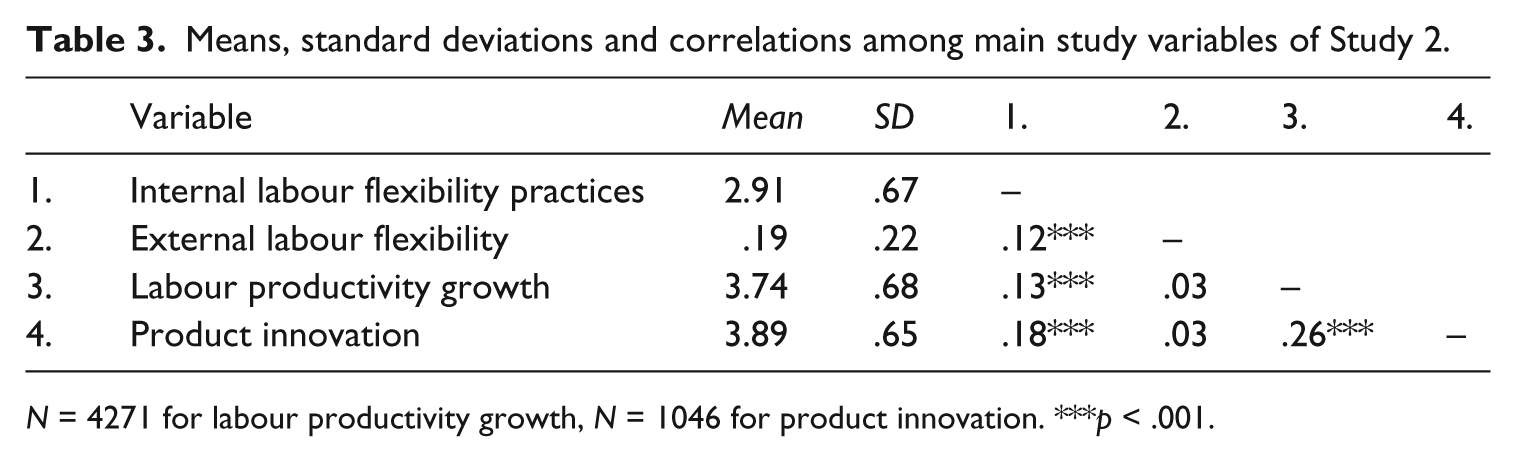
N = 4271 for labour productivity growth, N = 1046 for product innovation. ***p < .001.
Hypotheses testing 1
We test our hypotheses through multiple regression analyses following the same steps as in Study 1. In Table 2, columns 3 and 4 summarize the results of our regression analyses for Study 2. Together the control variables, external labour flexibility and internal labour flexibility, explained 5% of the variance in product innovation (R2 = .05, F(17, 1028) = 3.14, p < .001) and 5% of the variance in productivity growth (R2 = .05, F(19, 4252) = 11.42, p < .001).
The R2 change for the addition of internal labour flexibility practices in the regression model was 3% for product innovation (R2 change = .03, F(1, 1028) = 26.93), and 2% for labour productivity growth (R2 change = .02, F(1, 4251) = 100.85). External labour flexibility was unrelated to product innovation (b = –.01, n.s.) and labour productivity growth (b = –.04, n.s.). Results indicate that internal labour flexibility practices were positively related to labour productivity growth (b = .15, p < .001) and product innovation (b = .18, p < .001), which supports Hypothesis 1 and Hypothesis 2.
Discussion
The aim of the present article was to theoretically develop and empirically investigate the relationship between internal labour flexibility practices, labour productivity and company innovation performance. Drawing on several research literatures, we argued based on theory that internal labour flexibility practices are beneficial for labour productivity and innovation performance of companies. We tested this in two studies using Dutch representative, large-scale company-level data sources, using several (objective, in Study 1) indicators for labour productivity and controlling for baseline effects and objective external labour flexibility (Study 1), which is often lacking in other studies predicting company innovation and performance (e.g. Lucidi and Kleinknecht, 2010; Roca-Puig et al., 2008). This allowed us to check for the robustness of our findings, avoid common method bias, include important control variables and solve causality issues. As hypothesized, results showed a robust, positive relationship between internal labour flexibility practices and both labour productivity and product innovation performance, suggesting that internal labour flexibility practices do indeed stimulate labour productivity and company innovation.
Theoretical and empirical contributions
With our study we offer several contributions to different research literatures. First, we add new empirical knowledge to the general labour flexibility and innovation literature (e.g. Kleinknecht et al., 2014; Preenen et al., 2013; Zhou et al., 2010, 2011). We empirically established the relationship between internal flexibility practices and companies’ labour productivity and innovation performance. To our knowledge, no study has focused on testing and explaining this like we have done. Labour flexibility research to date has mainly focused on external labour flexibility (e.g. Altuzarra and Serrano, 2010; Lucidi and Kleinknecht, 2010; Preenen et al., 2013). Labour flexibility studies that did investigate the relationship between internal flexibility and innovation of company performance mostly operationalized internal flexibility as internal labour turnover numbers, and only included internal flexibility as a ‘minor’ variable (Chadwick and Cappelli, 2002; Kleinknecht et al., 2006; Zhou et al., 2010, 2011). Our findings corroborate the latter economic labour flexibility research that showed positive relationships between internal labour turnover numbers and different innovation outcomes (e.g. Chadwick and Cappelli, 2002; Kleinknecht et al., 2006; Zhou et al., 2010, 2011), as well as studies that found positive relationships between internal labour flexibility numbers and practices and company performance (e.g. Roca-Puig et al., 2008, 2012) and innovation (Martínez-Sánchez et al., 2008). Apparently, both labour flexibility practices and internal labour turnover numbers are positively associated with company performance outcomes.
Second, our results extend and corroborate the, mostly cross-sectional, organizational psychological research that has shown positive relationships between specific internal labour flexibility practices (i.e. job rotation, multi-skilling, job autonomy) and outcomes at the individual-level, such as employee-driven innovation (for an overview, see De Spiegelaere et al., 2014; Hammond et al., 2011; Shalley and Gilson, 2004; Shalley et al., 2004) and creativity or innovative behaviour (e.g. Chen et al., 2011; Dorenbosch et al., 2005). Apparently, internal labour flexibility practices seem to be beneficial for both individuals and organizations.
Third, our findings contribute to the HRM and organizational literature in multiple ways. Generally speaking, (quasi-longitudinal) research of our kind, in which we control for baseline effects (Study 1) and combine micro/employee-level HR domains with hard organizational (meso) outcomes, is scarce but has been encouraged in the past (e.g. Huselid and Becker, 2011; Wright and Boswell, 2002). In fact, many studies investigating the effect of HRM practices on performance lack such a design (for an overview, see Wall and Wood, 2005). Additionally, our findings extend and are in line with strategic HRM theories and research that have shown the beneficial effects of high commitment work practices and high performance work practices, which stimulate the development of human capital, on innovation and company performance (e.g. Beugelsdijk, 2008; Bornay-Barrachina et al., 2012; Combs et al., 2006; Huselid, 1995; Michie and Sheehan, 1999, 2001, 2003, 2005). Although these studies take a ‘total’, integrated approach to HRM and include a ‘bundle’ of practices, such as comprehensive recruitment policies, careful selection, formal performance evaluation, group incentives and flexibility in job design (e.g. Guthrie, 2001; Huselid, 1995), these practices also focus on increasing employees’ skills and promoting their commitment via a collaborative approach to work (e.g. Beugelsdijk, 2008; Roca-Puig et al., 2008), like internal labour flexibility practices. However, a meso approach makes it difficult to understand how and why specific (individual) work practices relate to innovation. More importantly, many of these studies investigated the effect of HRM practices on (innovation) performance through cross-sectional designs, used single sources, or failed to control for past performance (for an overview, see Wall and Wood, 2005). Our empirical strategy was designed to overcome some of the latter mentioned critiques.
Fourth, by drawing on and synthesizing literature on labour flexibility, HRM and organizational psychology, we developed new theoretical arguments for why internal flexibility practices may stimulate labour productivity and innovation. That is, we reasoned that internal labour flexibility practices are beneficial for labour productivity and innovation because they stimulate innovative and creative behaviour, learning, knowledge sharing and cooperation, trust and commitment, as well as organizational adaptation. This theoretical reasoning can be used as a starting point for further research on this topic.
Fifth, we contribute to knowledge on internal labour flexibility practices in Europe, and the Netherlands in particular. Whereas most attention in the Netherlands today seems focused on external labour flexibility practices, among organizations, practitioners and researchers alike (e.g. Verbiest et al., 2014), very little attention has been paid to internal labour flexibility practices to date. Hopefully, our findings will be used in the current labour flexibility debate in the Netherlands and Europe, in which internal labour flexibility has played a marginal role so far (De Spiegelaere et al., 2014), and where currently downward trends of job autonomy among employees have been reported (Lopes et al., 2014; Van Zwieten et al., 2014).
Limitations and future research
This study has some limitations that should be discussed. First, we used self-report data to assess internal flexibility practices in both studies and our innovation performance indicators in Study 2. The use of self-reports as indicators of the objective environment may decrease measurement accuracy (Spector and Jex, 1991). Furthermore, in Study 2 our use of self-reports may have led to common method bias (Podsakoff et al., 2003). However, we feel rather confident about the accuracy of these data. First, they were in line with our Study 1 findings, in which we used objective measures for innovation performance. Second, they were retrieved from company HR managers and directors, who may be expected to properly estimate their companies’ innovation performance and labour productivity. Indeed, there is considerable evidence that perceptual measures do reflect the objective environment (Spector, 1992). Nevertheless, future studies should try to include objective measures of internal flexibility practices and innovation performance. Innovation performance could, for example, be measured by the number of patents or R&D efforts (Kleinknecht et al., 2002), as calculated by expenditures on R&D or by the number of persons carrying out R&D.
Second, Study 2 was based on cross-sectional data, which may have inflated our results and cannot provide conclusive evidence for causal relationships. Although the results of Study 2 are supported by theoretical reasoning, earlier research findings and our ‘hard’ findings in Study 1, additional longitudinal studies and field experiments can provide conclusive evidence.
Third, we conducted our study on data from the Netherlands in one specific year. This study’s single country and time setting could limit the generalizability of the findings to other countries. Our study could be repeated in other countries and years to account for this.
Fourth, we extensively theorized the positive impact of internal labour flexibility practices on company innovation and labour productivity by providing multiple new arguments and combining different research literatures and findings. However, though it was not the aim of our study, we nevertheless acknowledge that our operationalizations of internal labour flexibility practices and study design could not fully examine and test the underlying explanations for the observed relationships. We therefore view our arguments as initial theoretical contributions and propositions that need to be scrutinized further. Future research should therefore further unravel the underlying explanations, and may then take our (newly) developed explanations as a starting point for theory, alternative study designs, and additional operationalizations of internal labour flexibility practices.
A final question for future research is whether internal labour flexibility practices may elicit negative consequences. As scholars have noted, flexible working and living always entail a struggle between flexibility and rigidity to some degree (Musson and Tietze, 2009). For example, too much internal flexibility practice may lead to role conflict of employees: a conflict among roles corresponding to two or more statuses (Kahn et al., 1964) in which the expectations of a role are ill-defined (Kahn et al., 1964). Role ambiguity has been widely associated with negative job attitudes and job performance (Jackson and Schuler, 1985; Tubre and Collins, 2000), higher levels of work stress and the propensity to leave an organization (Jackson and Schuler, 1985). Also, internal flexibility practices may stimulate broad skill development but weaken the specialized knowledge of employees, which companies also need. Future research should investigate these possible negative effects of internal flexibility practices and its conditions.
Practical implications
Labour productivity is an important dynamic measure of both organizational performance and competitiveness, and innovation is widely regarded as a fundamental source of competitive advantage in today’s increasingly changing environment (e.g. Dess and Picken, 2000; Tushman and O’Reilly, 1996). In fact, it has been stated that innovation capability is the most important determinant of company performance (e.g. Mone et al., 1998). Logically, it is of the utmost importance for companies to find effective and obtainable ways to enhance their labour productivity and innovation. Moreover, in the current dynamic environment organizations need to find creative ways to flexibly arrange their labour needs in order to adjust to these circumstances. Internal flexibility practices may help to address both needs. They not only help organizations to better cope with changing market demands, but, as we showed, may enhance companies’ labour productivity and product innovation performance. Companies should therefore consider internal labour flexibility practices, such as job rotation, multi-tasking, flexible working schedules and allowing for individual tailor-made arrangements, when designing their labour flexibility and innovation policies.
In fact, companies may, if possible of course, even opt for internal flexibility strategies rather than external flexibility strategies, as our findings and other studies also have demonstrated that external labour flexibility can be negatively related to innovation performance and productivity (Chadwick and Cappelli, 2002; Kleinknecht et al., 2014; Michie and Sheehan, 1999, 2001; Zhou et al., 2011). This is perhaps so because external labour turnover and fixed-term contracts discourage investments in human capital, which lowers productivity (Bentolila and Dolado, 1994). At the macro level, researchers have even shown that labour productivity in ‘externally flexible’ Anglo-Saxon countries grew significantly more slowly than in more ‘rigid’ Continental Europe (Vergeer and Kleinknecht, 2010). Of course, in times of crisis, firms may feel pressured to cut costs in the short term by relying on external flexibility measures. Indeed, trends in the European labour market and EU backed policies do not focus on enhancing functional flexibility, but rather aim to increase external (contractual) and financial flexibility (De Spiegelaere et al., 2014; Eurofound, 2010; Sandor, 2011).
This does not, however, guarantee raised competitiveness. Rather, the road to external flexibility may decrease the benefits of internal flexibility. Laying people off may be at odds with stimulating innovative behaviour, knowledge sharing, building trust, commitment and fairness among employees, and as a result, innovation and productivity. If innovation and labour productivity, but also employee well-being, are considered key for long-term survival, firms and policymakers should consider combating the crisis by relying on internal rather than external flexibility.
Footnotes
Acknowledgements
The authors thank two anonymous reviewers and Peter Oeij and Emma Jansen for their valuable comments and feedback.
Funding
This research was supported by a grant from TNO’s Behaviour and Performance Enabling Technology Programme (ETP) 2014.