



Abstract
University spin-offs (USOs) are an important firm class since they constitute an economically important sub-group of high-tech start-up firms: they have, consequently, engendered many academic studies. However, what the firms deliver by way of innovation in the form of new products and services has largely been missing from the academic entrepreneurship literature. By adopting a mixed research methodology of in-depth interviews and a survey, this study highlights key factors associated with the success of product and service development by USO firms in the United Kingdom – such as understanding customer needs, networks, clear market analysis, applications of technology, and the vision, mission and value of the company. The findings resonate with various studies in innovation management on the key elements of product and service performance predictors. The article also helps to fill a gap in the academic entrepreneurship literature by providing an understanding beyond the success factors in setting up USOs. The study should therefore raise the awareness of and benefit various actors (e.g. academic entrepreneurs and technology transfer offices) with regard to the provision of the activities and skills required to develop products and services successfully.
University spin-offs (USOs), also known as academic spin-offs, are an important firm class since they constitute an economically important sub-group of high-tech start-up firms. Many studies have sought to clarify the diversity of spin-off activities; for example, by sector, by their employment and wealth generation possibilities, and by institutional and public policies designed to escalate this activity (see, e.g. Druilhe and Garnsey, 2004; O’Shea et al., 2004; Shane, 2005; Siegel et al., 2003). However, the focus on the economic returns from USOs has been criticized, with questions being raised about their longer-term impact (Colombo et al., 2010; Harrison and Leitch, 2010; Siegel and Wright, 2015). Moreover, what the firms deliver by way of innovation in the form of new products and services, as well as factors driving their development, has largely been unrepresented in the academic entrepreneurship literature (but see Druilhe and Garnsey, 2004; Shane, 2005; Stephan, 2014; Sternberg, 2014; Wright et al., 2007).
In general, firms that have maintained their leading position in the market have established an ability to develop products and services effectively and successfully. In other words, there is an evident connection between innovation and economic progress and the effective management of product and service development processes that can bring success to businesses (Cooper and Kleinschmidt, 1995, Shepherd and Ahmed, 2000). Therefore, the development and launch of new products/services is not only critical to the growth and success of firms but also creates new markets, which in turn provide economic growth and employment (Ahlstrom, 2010).
In this article, contributions to markets made by UK USOs through transferring and transforming newly invented knowledge and technology into products and services are examined (Shane, 2005). The importance of understanding the factors that contribute to the success of the development of products and services is considered. Therefore, this study addresses two questions: What are the important factors driving the development of products and services in the UK USO context? What is the relationship between these factors and the success of product and service innovations?
The answers are derived from a mixed methods study comprising in-depth interviews with 20 USO founders and a survey of 204 UK USO companies. The structure of the article is as follows. It begins with a discussion of the literature related to the economic contribution of UK universities through spin-off activity. This is followed by two strands of literature relating to the two research questions that inform the framework for analysis of the evidence from the study. Following this, findings from the mixed methods, that is, in-depth interviews and a survey, are reported and discussed. The article concludes with the insights and implications for universities and academic entrepreneurs.
USOs and product and service innovations
Context
Universities have played a crucial and creative role in translating knowledge for economic and social development (Etzkowitz, 2016). The creation of technology transfer offices (TTOs) and an increasing number of spin-offs have been found in many European countries, including Italy (Algieri et al., 2013; Iacobucci and Micozzi, 2015) and Germany (Egeln et al., 2004). In the United Kingdom, successive governments have become increasingly interested in whether academic research will have a direct ‘impact’ on the economy; for example, through the formation of companies that commercialize research outcomes. In the late 1990s, government funding was allocated to facilitate this process, for example, through the Universities Challenge Fund, which enabled many universities to establish TTOs and provide support services to the new companies (Wright et al., 2002). Indeed, the 2004 Higher Education Business–Community Interaction survey (HE-BCI) recorded that between 1999 and 2002 there was a rapid growth in the number of spin-off firms. Since then, while the number of spin-offs has slowed down, more are surviving. According to the HE-BCI report for 2015/2016, the number of spin-off companies established for 3 years or longer had risen to around a thousand (see Figure 1).
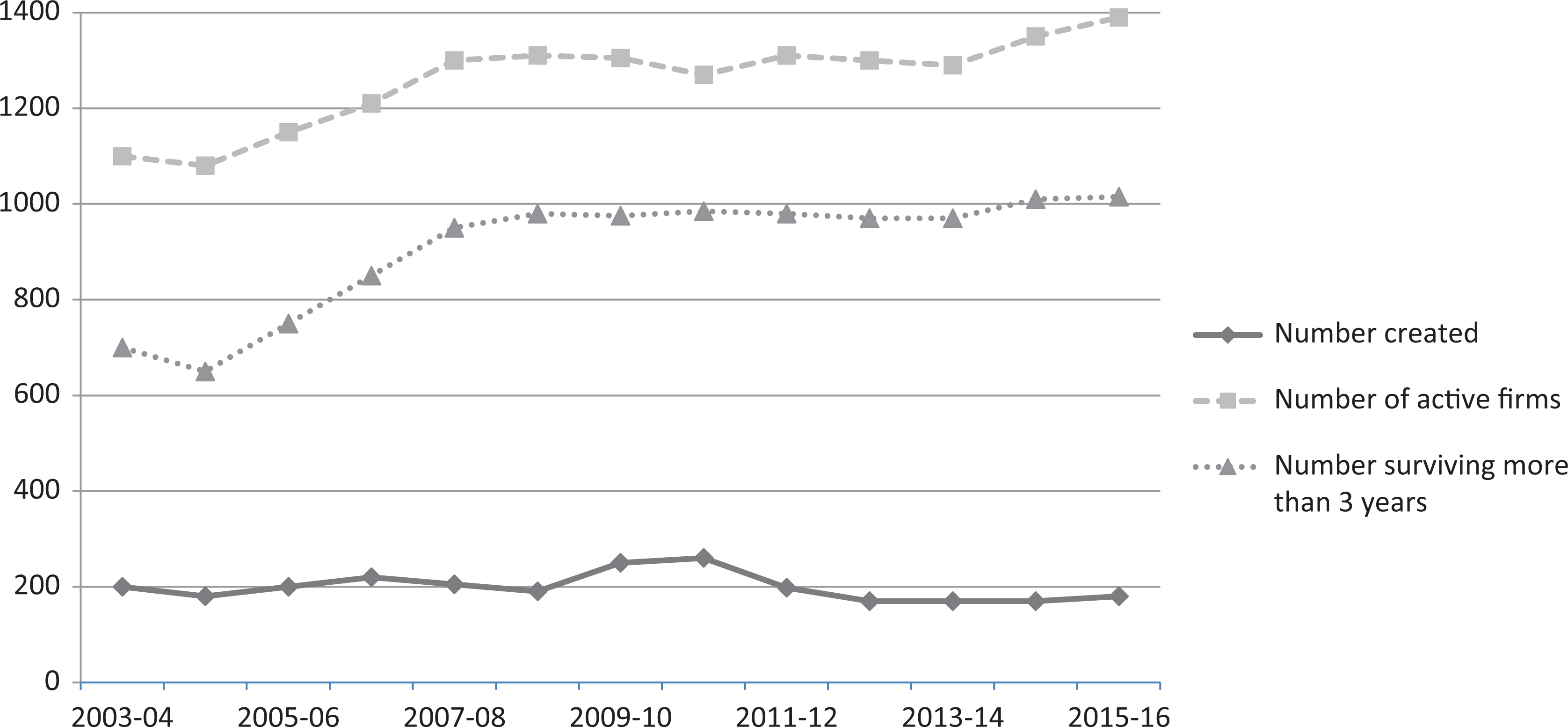
USOs formed in the UK, 2003–04 to 2015–16.
While the number of USOs is increasing, the direct creation of jobs and wealth by USOs is not enormous (Harrison and Leitch, 2010, Ortin-Angel and Vendrell-Herrero, 2014). Focusing on this aspect, however, underplays their broader importance as they are potentially an effective means of transferring novel technological knowledge to the market in the form of new products and services (Sternberg, 2014). Indeed, while it has been noted in many studies that the majority of spin-offs are in biotech and Information and Communication Technology (ICT) (see, e.g. Salvador and Benghozi, 2015) only a handful of studies on academic entrepreneurship have looked at the nature of the innovations offered to the market. Shane (2005) in particular has focused on this topic. In his study of the product and service development process of USOs from MIT in the United States, he found that prior market knowledge of academic entrepreneurs enables them to see entrepreneurial opportunities anchored in the technologies. This also motivates them to undertake further development to create marketable products/services.
Important factors driving the success of product/service innovation
While it is acknowledged that product and service innovations can bring competitiveness to firms (Shepherd and Ahmed, 2000), the development process has numerous associated uncertainties together with a high chance of failure. This has rendered product/service innovation one of the more perilous activities for business (Cooper, 2003). Discerning the factors that support the success of new product development therefore continues to be a matter of keen managerial interest (McNally et al., 2011). A review of empirical research by Ernst (2002) underlined the success-driving factors of product and service development for firms in general, such as the existence of formal or informal development processes within the company, the formation of a devoted project team, the awareness and understanding of senior management and so on. Later, Bessant and Tidd (2011) found that, generally, funding, resources and identified target markets were considered the critical success factors in product and service development. In addition, Knockaert et al. (2011) discovered that in science-based entrepreneurial firms, a key factor leading to the delivery of product to market was the availability of staff with commercial experience coupled with technical background.
Moreover, an understanding of customers’ needs and experience is necessary in product and service development. A study by Cooper and Kleinschmidt (2011) highlighted that a development process that begins with clear definitions is 3.3 times more likely to be successful, with an 85.4% success rate for the end product. Clear definitions include clarity about the target market and customers’ needs. As also noted by Pullen et al. (2012), the diversity of networks is positively linked to internal innovation capabilities. According to Haeussler et al. (2012), many new high technology firms have formed strategic collaborations to gain access to knowledge, skills, resources and expertise in order to develop new products and services (see also Faems et al., 2005).
Clarity of vision also has a positive relationship with success in technical and radical innovations, while stability of vision is positively associated with success in incremental innovation (Reid and De Brentani, 2010). This point was made earlier by Lynn and Reilly (2002), who argued that a well-defined and well-constructed vision played a role in successful product and service development. It is also very important to have clear guidelines for implementation.
In addition, an awareness of the mission is regarded as a strong predictor of R&D project achievement and firm success. Joshi and Sharma (2004) have noted that knowledge about customers’ demands is an evolutionary learning process for organizations and can occur at all phases or stages of product/service development. Kahn et al. (2012) also emphasize the importance of a company’s strategy and mission in new product/service development. Skarzynski and Gibson (2008) note the strategic importance of empathy with customers.
For USOs, Shane’s (2005) evidence is consistent with that in other studies which found that customers’ demands and the application of technologies to match those demands were important factors in developing products and services. Additionally, Wright et al. (2007), like Chen and Huang (2009), note the importance of human capital by showing a significant relationship between both the general and the specific human capital of technological entrepreneurs and innovative products and services offered to the market.
In summary, evidence from a number of studies has shown that a variety of key factors drive the success of product and service development. These include the existence of a development process, the formation of a project team, support from senior management, funding, clearly identified target markets, commercial experience, networks, a clear vision and mission, acknowledging customers’ demands, technology application and human capital.
Methodology and data
The data for this research were obtained via a mixed methodology. A combination of in-depth interviews and a survey was employed to explore the important factors driving product/service innovations in USOs. A qualitative method was first chosen to explore and ascertain these factors. Then, a questionnaire survey was employed to empirically test the factors identified in the qualitative stage to examine the linkage between those factors and the success of product/service innovations.
Population and sampling
The study population is USO companies in the United Kingdom, following the definition provided by the Higher Education Funding Council for England (HEFCE). 1 However, the study focuses on spin-off firms established by academic or university staff (where the university owns the intellectual property (IP) or where academic entrepreneurs own the IP) as it is then easier to identify the population. In addition, firms in the service sector set up without any appropriation of IP are included, as are technology-based spin-off firms.
The sample was drawn from the public websites of universities in the United Kingdom. A list of 133 universities was obtained from Universities UK, 2 which is the central organization representing all universities in the United Kingdom. Its comprehensive list was cross-checked with information provided by HEFCE and the Scottish Funding Council. The database of USOs was constructed by searching through the websites of universities’ business and innovation centres, such as Oxford University Innovation, as well as departmental websites. Since some universities do not provide a list of spin-off firms on their public website, the relevant people in the university were contacted to ensure that there was no omission of any USO firm. These data were then merged and reconciled with the company list gathered by a private sector organization, Spinouts UK, 3 which provides a list of spin-off companies from universities in the United Kingdom. In order to ensure that all those included were USOs from academic or university staff, the names of company directors were checked against the university’s website to see if they were affiliated with the university. From 1356 spin-out companies in the database, 844 independent USO companies were active and those 844 companies thus constituted the sample.
Data collection
A qualitative method, that is, in-depth interviews with founders of USOs, was employed to explore important factors, first, in developing products and services and, second, in their success. The interviews were conducted with the academic founders of 20 USOs. The sample was selected from the database of UK USOs developed for the purpose of this study, aiming to represent the various sectors, firm size and different regions in which USOs operate. The respondents were selected based on the following criteria:
– being a founding member of a USO;
– owning equity in the firm;
– used to hold or currently holding an academic position when establishing the company; and
– having product/service offerings on the market.
The firms were spread throughout the United Kingdom. With regard to sector, six were in software, five in consultancy, four in biotech, three in engineering, one in pharmaceutical and one in geographical consultancy. The majority could be categorized as micro, with 1–10 employees; only one was a medium-sized firm (more than 50 staff). Most of the founders interviewed were men; five female founders were interviewed. Additionally, 14 founders in the sample still maintained their academic position while running the firm’s operations. The findings from the in-depth interviews allowed the development of observed variables in the survey questionnaire.
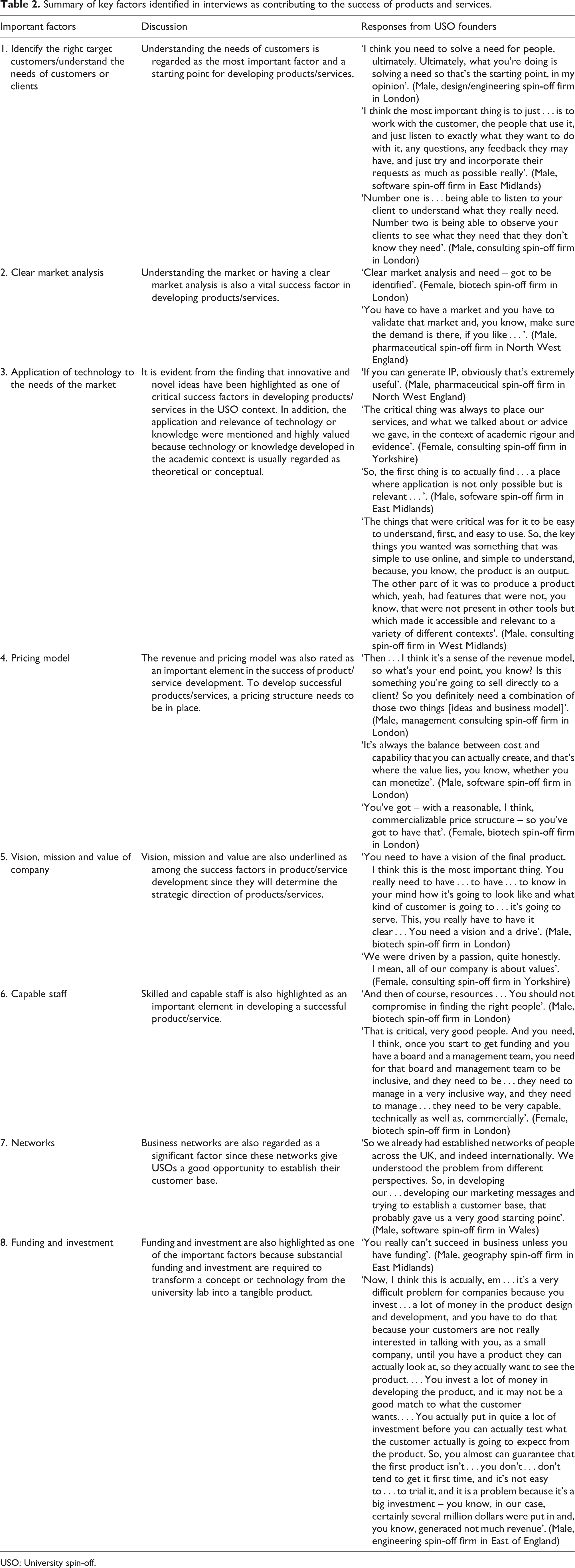
Subsequently, the collection of quantitative data used a structured online and postal questionnaire (see Table 1 for sampling and response rate). The survey was conducted between October 2013 and March 2014. Founders were targeted since they usually have a broad knowledge of the firm’s history (Carter et al., 1994). The sample (n = 844) at this stage was from the database of UK USOs developed for the purpose of this study as explained in the preceding subsection. The questionnaire was pre-tested as thoroughly as possible in discussions with founders and product development managers of USOs prior to distribution. As noted above, the questionnaire and its observed variables were derived and developed from the in-depth interviews, which are identified and summarized in Table 2.
Sampling and response rate for survey.
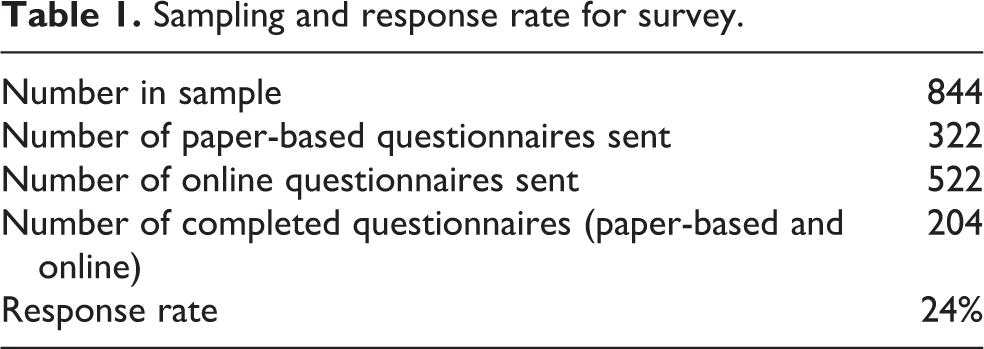
Summary of key factors identified in interviews as contributing to the success of products and services.
USO: University spin-off.
Findings
The findings are divided into two parts in order to address the two research questions. Those on the key factors driving the development of products and services derived from the in-depth interviews with 20 founders of USOs in the United Kingdom are first presented. These are followed by the empirical evidence from the survey, which shows the relationship between the key factors and the success of product and service innovations.
Research question 1 data from the in-depth interviews: identifying key factors driving the development of products and services in the UK USO context. The data from the interviews are summarized in Table 2. Some of the factors identified apply to new innovative firms generally, while others are more directly related to the university environment. Those that most relate to the nature and context of the academic commercialization process are factors 3 (Application of technology to the needs of the market), 7 (Networks) and 8 (Funding and investment).
Research question 2 data from the questionnaire survey: examining the relationship between the key factors and the success of product and service innovations. This section examines the relationship between the factors identified from the in-depth interviews and the success of product and service innovations. The number of products and services is used as a proxy for the success of the innovations: this number was obtained from the questionnaire surveys. The assumption was made that the reported number of products and services was the number of products and services currently available on the market. With this assumption, the data enable consideration of which factors can be attributed to the higher number of products and services. However, this assumption also introduces a limitation since it discounts incremental innovations that could potentially be counted as part of the success of product/service innovations.
A multinomial logistic regression was employed to examine the relationship. In this case, the dependent variables are categorical data containing the number of products and services (e.g. 0–1 product/service, 2–5 products, etc.), while the independent variables are important factors in developing products and services identified from the in-depth interviews. The controlled variables are sector and size (based on the number of employees). The output shows the R2, the value of the Cox and Snell measure is 0.5 and the value of Nagelkerke’s measure (adjusted R2) is also 0.5. They are the same values and indicate a relatively good fit of the regression model.
In the likelihood ratio tests, ‘understanding the needs of customers’, ‘application of technology’, ‘vision and mission of the company’, ‘funding and investment’, ‘capable staff’ and ‘networks’ are predictors that significantly allow us to predict the outcome category, though the effect is not presented (See Table 3).
Likelihood ratio test results.
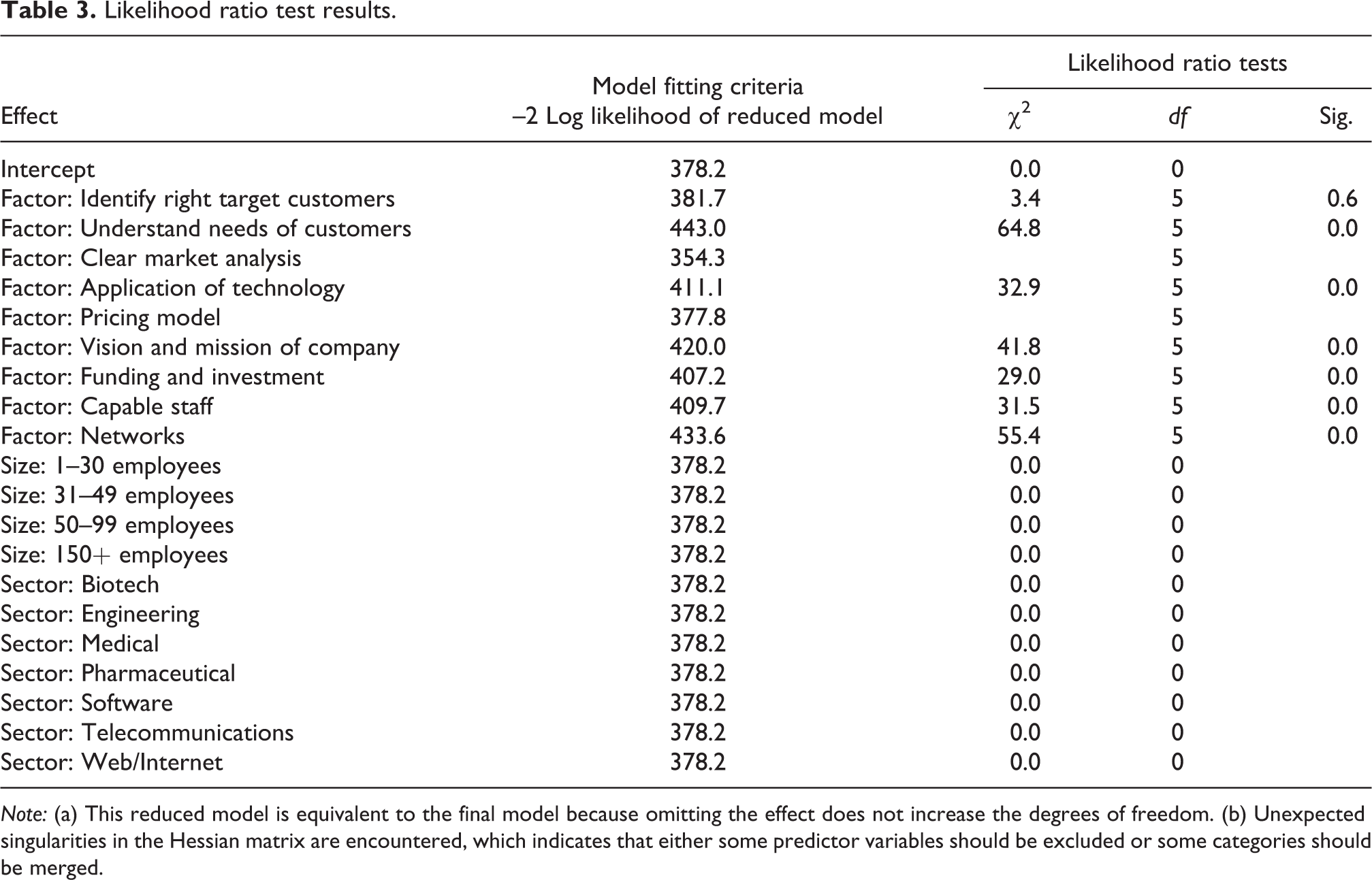
Note: (a) This reduced model is equivalent to the final model because omitting the effect does not increase the degrees of freedom. (b) Unexpected singularities in the Hessian matrix are encountered, which indicates that either some predictor variables should be excluded or some categories should be merged.
Table 4 presents a summary of parameter estimates and shows the results for the predictor effects by category. These parameters summarize the results of the compared pairs of outcome categories, with six categories of products and services. The category 0–1 product or service is used as a reference category (baseline). This means that the category 2–5 products and services, for example, is compared against the 0–1 product or service.
Summary of parameter estimates.
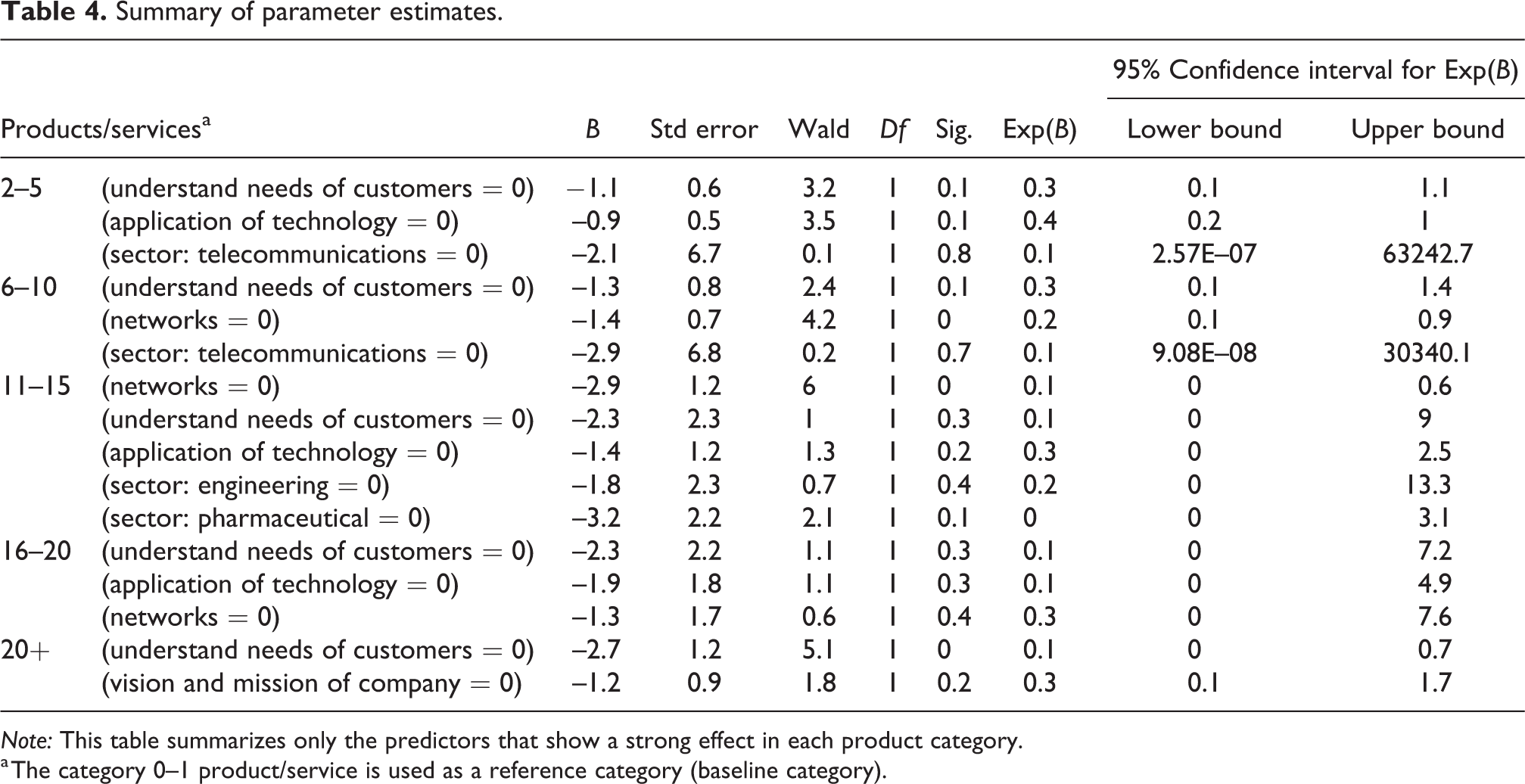
Note: This table summarizes only the predictors that show a strong effect in each product category.
a The category 0–1 product/service is used as a reference category (baseline category).
Explaining the predictor effects by category
2–5 products and services
The odds ratio (Exp(B)) shows that the odds of having 2–5 products and services are increased 3.33 times when importance is given to the factor ‘understand customers’ needs’. The chance of having 2–5 products and services is increased 2.5 times when importance is given to the ‘application of technology’.
6–10 products and services
The odds ratio shows that, when the predictor ‘understanding customers’ needs’ is changed from not important to important, the odds of having 6–10 products and services are increased 3.33 times. When the same change is made for the predictor ‘network’, the odds of having 6–10 products and services are increased 5 times more.
11–15 products and services
When the predictor ‘network’ is changed from not important to important, the odds of having 11–15 products and services are increased 10 times. Similarly, the odds of having 11–15 products and services are increased 10 times when the predictor: ‘understanding customers’ needs’ is given importance. The odds of having 11–15 products and services are increased 3.33 times when importance is given to the factor ‘application of technology’.
16–20 products and services
For the predictors ‘understanding customers’ needs’ and ‘application of technology’, the odds of having 16–20 products and services are increased 10 times when importance is given to these factors. In addition, the odds of having 16–20 products and services are increased 3.3 times when the predictor ‘network’ is given importance.
More than 20 products and services
When the predictor ‘understanding customers’ needs’ is given importance, the odds of having 20 or more products and services are increased 10 times. The odds of having 20 or more products and services are increased 3.33 times when ‘vision and mission of the company’ is given importance.
To summarize, the factor ‘understanding customers’ needs’ seems to be the common predictor for a higher number of products and services. Additionally, the factor ‘network’ appears to be a key predictor for the categories of 11–15 and 16–20 products and services. The factor ‘vision, mission and value of the company’ acts only as a predictor of the category of 20 or more products and services.
Discussion
Factors driving the development of products and services in UK USOs
To address the first research question, the data from the in-depth interviews show that the key factors that contribute to the successful development of products and services in USOs are application of technology to the needs of the market, networks and funding and investment. These reflect the nature and context of the academic commercialization process – and in particular the importance of building links external to the university in order to develop a viable business model. The data reveal patterns in a sample of USOs and point to areas in which technology transfer support systems need to be effective, which are further complicated by the diversity of product and service categories offered by USOs.
Relationship between key factors and success of innovations
To address the second research question, the discussion is based on the findings shown in Table 4. The findings indicate that understanding the needs of customers is a predictor of a higher number of products and services, with a generally strong effect. This result is consistent with those of other studies of new technology based firms. As noted by Skarzynski and Gibson (2008), product/service innovation should be generated by empathy with customers as well as an intention to mitigate customers’ problems. Additionally, with the factor networks, this research agrees with previous studies that the degree of product/service innovation and a firm’s competitiveness depend on the success with which firms form collaborations with external partners and obtain access to external technological knowledge and skills (Faems et al., 2005).
In addition, the factor application of technology emerges as a predictor with a reasonably strong effect. Having to find the application or market relevance is important to successful product/service development. According to Bessant and Tidd (2011), the main factors distinguishing winners from losers are product superiority in the eyes of the customer, real differential advantage, a high performance–cost ratio, and the delivery of unique benefits to customers. This element of unique benefit to the customer connects with the points made in this study concerning the need to understand both customers’ demands and the market. It is interesting that vision, mission and value of the company appears to be only a predictor for the category of more than 20 products and services. This finding resonates with those of Reid and De Brentani (2010), who show that having the right vision of the market for new products enables companies to attain competitive advantage.
Some factors do not predict a higher number of products and services. These include capable staff, identifying the right target customers, funding and investment and pricing/revenue model. However, these factors do seem to be important for the first launch of products and services on the market – especially funding and investment and capable staff. As explained by Chen and Huang (2009) with respect to the crucial roles of people in the innovation process, to design and develop products and services, human skills (both managerial and technological) have to be readily available (Bessant and Tidd, 2011). This may explain why they do not predict a higher number of products and services. Unlike the factors understanding the needs of customers and networks, they continually play an important role not only throughout the development process but also beyond the first launch of the products and services. For example, networks would enable firms to expand or increase their products and services because firms can gain access to knowledge, expertise or market, which they may not necessarily have at the initial launch of their first product/service.
As well as networks, understanding customers’ needs may well be a consequence of success in product/service innovations and the growth of the company. Zheng et al. (2010) suggest that, when spin-off or start-up firms become more mature and have successful product/service innovations, they tend to develop routines that allow them to extract higher value from networks as well as to manage more effectively through either internal innovation or external collaboration. Consistent with Joshi and Sharma (2004), learning as well as resources has played an important role in establishing this process. When firms have grown or have become successful, more resources and routines can be set up to better attain, analyse and utilise knowledge about customers’ needs.
Conclusions
In sum, this article has highlighted key factors that drive successful product and service development in USOs, including the skills and actions required to transform academic research to a commercially viable product or service. Key factors identified include understanding customers’ needs, application of technology, networks and funding and investment. Additionally, the relationship of the driving factors to the number of product and service innovations achieved has been explored. The results are consistent with previous studies of product and service innovation regarding the strong effects of various factors, especially understanding customers’ needs, networks, and vision, mission and value of the company, on the number of products/services developed (Faems et al., 2005; Reid and De Brentani, 2010; Skarzynski and Gibson, 2008). Although most of these factors have been shown to be applicable to other types of firms, especially small firms, application of technology is deemed to be more important specifically for USOs than for other firm classes, since basic research developed in an academic context will need to be transformed into applied technology that can respond to customers’ problems and needs.
This study contributes to the literature on academic entrepreneurship by illuminating a key aspect of USOs’ operations in bringing the innovative elements of their technology, in the form of products and services, to the market. The study offers novel insights into academic entrepreneurship by highlighting the factors and skills that are essential for USOs to successfully develop products and services. The article arguably provides a different perspective on the contribution of USOs to the market through the development of products and services from that provided by the data collected in the HE-BCI survey or in previous studies focusing on firm formation, job creation and other indicators of technological advancement, such as patents and licences.
The findings have various implications for those involved in academic entrepreneurship. For academic entrepreneurs at firm level, the study offers an increased awareness of the key success factors in product and service development. These factors highlight the actions that are required to transform academic research to a commercially viable product, especially with regard to the importance of understanding the needs of customers and devising an adaptation and application of technology to respond appropriately to these needs. For TTOs, certain activities or driving factors, such as clear market analysis or setting goals for the company, may be foreign to the academic culture and environment. At university level, TTOs can play a vital role in introducing or fostering the required management skills so that academic entrepreneurs can further develop and transform their innovations into commercial and ultimately profitable products or services.
This study has limitations. Its scope is limited to firm-level investigation; hence, it reflects only on those elements required by USOs to undertake successful product or service innovation. Further research should be carried out to investigate supporting factors such as financial and fiscal conditions, market regimes and the regulatory environment. These factors are significant in determining the success and sustainability of an innovative business in both the short and the long term. In addition, support programmes provided by host universities for entrepreneurial activities need to be further explored so as to understand the effectiveness of the existing schemes and their impact on product and service development activities.
Footnotes
Declaration of conflicting interests
The author(s) declared no potential conflicts of interest with respect to the research, authorship, and/or publication of this article.
Funding
The author(s) received no financial support for the research, authorship, and/or publication of this article.