




Abstract
Long working hours among migrant workers have been regarded by academic studies both as a cause for concern and as a super-saving strategy for transnational investment back home. However, there is a lack of systematic research as to whether or not migrant workers find their working hours too long and wish to have them reduced. The evidence retrieved from the Annual Population Survey points to a marked desire among migrants to work shorter hours, despite the recessionary climate. By filling the research gap specifically in the reasons behind such a desire, this article informs not only equality policies but also improved management of supply–demand in the labour markets. Predicated on logistic regression modelling, the results suggest that using an intersectional approach by covering various demographic and work-related characteristics helps explain migrant workers’ demand for shorter hours. The influential factors considered are conceptually framed by advancing a ‘special model of gendered confidence’.
Introduction
The aim of this article is to explore the reasons behind migrant workers’ overemployment, as defined by a desire to work fewer hours (Golden and Gebreselassie, 2007). Long working hours among the migrant workers have been heralded as a cause for concern in precarious jobs (Anderson, 2010). Paradoxically, lengthy working hours have also been claimed to be an opportunity for migrant workers to make strategic savings that could be multiplied by favourable currency rates when they were invested back in their home countries (Mann, 2005). The length of working hours among professional migrants, on the other hand, has hardly drawn any academic or public attention.
In particular, no academic study has been carried out in the UK so far as to whether or not migrant workers themselves find their working hours too long or if they would wish to work fewer hours. The data I have retrieved from the Annual Population Survey (APS) highlight the remarkable scale of the issue, as over a quarter of migrant workers want to work fewer hours, 1 with two-thirds wishing to have more than eight hours reduction and one-third expressing preparedness for pay deductions (APS, 2013).
It is important to develop a proper insight into migrant workers’ overemployment. One reason for this is because nationally aggregated statistics in the international literature have shown that overemployment in general has implications for life satisfaction, job satisfaction (Wooden et al., 2009), absenteeism (Lee et al., 2015), job-quitting (Böheim and Taylor, 2004), commitment (van Emmerik and Sanders, 2005) and labour productivity (Smyth et al., 2013). Understanding the demand of migrant workers for reduced hours can have important implications for both equality policies and the improved management of labour markets – while the populist pressure on policy makers grows to heed the notion of ‘British jobs for the British’.
For a proper evaluation, however, it is essential to avoid reducing overemployment to long working hours since people may wish to have fewer working hours for a variety of reasons, as will be stipulated in the following sections. Accordingly, this article asks, what are the dynamics of migrant workers’ overemployment in the UK? To answer this question, I analyse the APS data and develop a model that one might call a ‘special model of gendered confidence’ for the sake of convenience. The model refers to a set of demographic and work-related characteristics that influence overemployment among migrant workers through a sense of confidence in others, one’s environment and oneself. It suggests that the reasons behind these workers’ overemployment have significant peculiarities, despite some similarities with the rest of the workforce in the UK. To show this, the article makes some comparisons between the two groups – although a systematic comparison between them is beyond the article’s scope. The model will stipulate that migrant workers’ vulnerable position at work and in society renders their demand for working fewer hours much more dependent on a sense of confidence than other workers. The model will further elaborate that migrant workers’ overemployment is distinctly gendered, with a higher likelihood among women, especially in safer positions at work. The gender issue will be covered through a systematic comparison between male and female migrants. For a step-by-step unfolding of the model, first let us consider some ‘usual suspects’ along with references to the existing overemployment debates in general.
‘Usual suspects’
A ‘long hours culture’ has been underlined in the UK over the past couple of decades (Bond et al., 2002), despite some decline in more recent times (Bonney, 2005). Reference has been made particularly to certain occupational groups such as managers and professionals (Bryan, 2007) including women in these positions (Smith and Elliott, 2012). Some industries have also been pointed at for the prevalence of long hours, such as transport and communication, whereas female-dominated industries have been shown to have shorter hours due to part-time jobs, as in the case of health and social work (Bryan, 2007). Long working hours have caused concern over the well-being of employees and work–life balance (Chatzitheochari and Arber, 2009; Rigby and O’Brien-Smith, 2010).
Nevertheless, long working hours are not a proxy for overemployment (Drago et al., 2009). Evidence from Australia suggests that even if people work long hours, sometimes they can be reluctant to work fewer hours due to various incentives such as pay and authority at work (van Wanrooy and Wilson, 2006). Conversely, even though some people work shorter hours, they may prefer fewer hours due to childcare or other responsibilities. In particular, some part-time workers wish to have shorter hours since they actually work comparably long hours to full-time workers (van Echtelt et al., 2006).
In addition to long hours, there is already some information about the various dynamics behind overemployment in general. Men, for example, are more likely to desire shorter hours than women. Likewise, being discontented with one’s job, having higher pay and having better qualifications are among the predictors of overemployment (MacInnes, 2005). On the other hand, we lack systematic evidence regarding the role of some potentially critical issues such as holding a second job (Butler and Harris, 2015) or pay strategies, as the evidence from Finland points to the importance of the difference between hourly and weekly earnings (Lundberg and Karlsson, 2011).
This article seeks to rectify the lack of research evidence regarding the implications of the dynamics mentioned above for overemployment in the specific case of migrant workers. Although there is a growing convergence between migrant workers and the rest, especially with regard to the educational attainments required by the UK’s point-system (Cam, 2014), it is worth considering their peculiarities, as detailed in what follows.
A special model?
In the late 1990s, Bell (1998) highlighted that working hour preferences in the US varied on the basis of – what he considered to be – race. Socio-economic differences between migrant workers and the rest can bestow peculiar characteristics to their overemployment. We already know that longer hours among migrant workers, as opposed to the rest, is particularly prevalent at the lower end (Datta et al., 2007) and among ‘illegal’ jobs (Ahmad, 2008). Industrial variations can also have exclusive implications for migrant workers’ overemployment, although they are not significant in the UK in general (MacInnes, 2005). Notably, ethnic minority businesses are associated with unsocial/long hours (Ram et al., 2011). The evidence from Canada further indicates that project-based and therefore contingent engineering industries are discriminatory against the hiring of black and minority ethnic people (BMEs) under the pretext of skills deficiency (Shan, 2013).
In the nationally aggregated analyses, occupation and family situation are shown to have little effect on overemployment (MacInnes, 2005). However, such issues may turn out to be important for the migrant workers. Overqualification can be given as an example. There is a sizeable propensity towards overqualification among migrant workers: roughly one in five migrants who have higher education or above work in elementary occupations, 2 compared to 5% for the rest (APS, 2013). Among migrant workers, this can add critical importance to occupational differences in terms of overemployment since the better educated migrants in elementary jobs are not easily able to afford shorter hours financially (Wooden et al., 2009). Further, migrants are more likely to be single and younger which, as the evidence from the US populations suggests, can be accompanied by fewer family responsibilities (Jacobs and Gerson, 2001) but more physical capacity to tolerate longer hours (Perreira et al., 2007).
Pertinently, part-time jobs are also relatively limited among the UK’s migrant workers (25%), especially since work permits are usually granted on the basis of full-time jobs – compared to 30% of the rest (APS, 2013). Against this, although migrant workers’ part-time jobs are no different to the rest in terms of weekly averages of working hours, 26, they are variegated at the industrial level: in health, for example, part-time migrants work over 30 hours on average whereas the remainder work fewer than 24 hours (APS, 2013). Such disparities have possible implications for the overemployment of migrant workers in full-time and part-time jobs. As discussed below, the peculiarities of migrant workers can be further related to a issue of confidence .
Confidence
Confidence in general has a complex character. It is about how much you can rely on others along with the surrounding conditions, and how much you can trust yourself in terms of your talents, skills, knowledge, etc. (Griffin and Tversky, 1992). It varies from one dimension to another and from one person to another: one can be confident about one’s financial state, but not necessarily about one’s social status (Crouch, 2012). The same events also affect people’s confidence differently, depending on personal characteristics (Koriat et al., 1980). Confidence is affected by a variety of additional factors including social and legal rights, privileges (Seligman, 1997), familiarity, experience (Luhmann, 1988), stability, uncertainty (Peterson and Pitz, 1988), culture (Dequech, 1999), perceived intentions of others and collectiveness (Allwood and Montgomery, 1987).
Confidence at work is important not only for ethical reasons, but also for employees’ commitment and productivity since they can be adversely affected by a lack of confidence in their employers (Nichols et al., 2009). Research has long shown that some companies exploit the insecure positions of precarious workers in general in order to compel them to undertake extra working hours (Stier and Epstein, 2003). This implies that overemployment may well be informed by the sense of confidence. Employees probably become hesitant about shorter working hours due to its implications for earnings and savings – or tensions with employers, especially if there is no pay deduction. Confidence can become an issue for the professionals as well, not least due to the factors outlined above such as personal characteristics, the level of social/legal rights, privileges, familiarity and uncertainty, in addition to the perceived intentions of others. Bearing all these in mind, I will in this article systematically relate migrant workers’ overemployment to the sense of confidence.
Migrant workers’ confidence and hence their attitudes towards working fewer hours, to start with, are probably affected by a number of factors which are exclusive to them. As a set of social and legal rights, citizenship entitlement, for instance, can be considered one of such potential factors (Anderson, 2010). Likewise, the time spent in the UK may inform migrants’ confidence and overemployment by increasing their familiarity with the socio-economic environment and awareness about the available networks (Cam, 2014).
People’s country of origin hints at potential influences on their sense of confidence and overemployment: French migrants typically inherit a conflictual political culture about long working hours (Rigby and O’Brien-Smith, 2010). The evidence from Norway about the influence of the country of origin on one’s position at work in general (Karlsen, 2012) also shows that it is worth examining whether such varieties play a role in the specific case of overemployment. Furthermore, migrants’ confidence in the UK is arguably affected by the latter’s policies with regard to the migrants’ country of origin. Legally, the more precarious position of migrant workers from countries outside the European Union is an important issue (Meardi, 2012), even though Brexit is also expected to push the EU migrants to a vulnerable position over time (Oliver, 2016).
Migrant workers are likely to retain more sensitivity than the rest about some potentially confidence-related factors. These include working in larger establishments as it implies business stability (Milkman et al., 2012), and union membership as it represents the strength of collectiveness (Rigby and O’Brien-Smith, 2010), although these correlates do not appear to be significant in the nationally aggregated analyses (MacInnes, 2005). Working in the public sector, which is another likely influence on confidence – for prioritizing social responsibilities over financial considerations – has been proven to have boosted the wish to work fewer hours among the US population (Golden and Gebreselassie, 2007). Similarly, the length of work with the same employer as an indicator of experience with potential bearings for confidence (Taylor, 2013) has been linked to trust in managers in the UK (Nichols et al., 2009) and overemployment in the Netherlands (van Emmerik and Sanders, 2005). Evidence from American hotels points to overemployment in temporary jobs as a result of racist managerial practices (Zamudio and Lichter, 2008). Especially, specific types of temporary jobs such as agency or seasonal work may undermine people’s confidence and assertiveness about working arrangements by causing varying levels of uncertainties about the job prospects (Broschak et al., 2008). In addition, training provided by employers tends to create a ‘paradox of autonomy’ (van Echtelt et al., 2006): the new skills that trainees obtain give them a sense of privilege and confidence to negotiate working hours, on the one hand, and yet the same skills tempt the companies to extend working hours, on the other.
Gender
Intersectional debates have highlighted that a proper understanding of migration-related issues would require taking the role of gender into consideration (Bradley and Healy, 2008) amid the growing proportions of women among the migrant populations (Robertson and Sgoutas, 2012). It was highlighted, for example, that their migration motivations vary from men’s since, among others, they seek emancipation or fulfilling gender identities (Luibheid, 2004). Women also face different levels and types of discrimination in receiving societies (Nash, 2008). We already know that demand for fewer hours is influenced by gender at the national level (MacInnes, 2005). A recent survey in the UK has additionally highlighted the relationship between women’s preferences regarding working-hours flexibility and their low level of self-confidence at work, compared to men (Glassdoor, 2016).
However, it is not known what sort of role, if at all, gender plays in the case of migrant workers’ wish to have fewer working hours. The limited evidence related to the issue testifies to the impact of motherhood. White American women reduce labour supply more than Asian women in response to parenthood (Greenman, 2011). The less likelihood of single motherhood among the UK’s migrants (45%) compared to the rest (55%) can also affect their attitudes towards working hours (APS, 2013).
Work-related factors presumably alter the gender aspect of overemployment among migrant workers: although the migrant women are more likely to fill part-time jobs than their male counterparts similarly to the rest of society, the gender gap is less pronounced among them compared to the remainder: 38% of migrant and 47% of other women are in part-time jobs, whereas the migratory status implies little difference for men with a 15% overall average (APS, 2013). In particular, overemployment in part-time jobs can involve gender variations as the evidence shows that much of the discrepancy between American men and women’s overemployment reflects their different responses to the specific job characteristics of part-time contracts such as total weekly hours (Golden and Gebreselassie, 2007). In this study I also examine the potential impact of female-dominated industries (Bryan, 2007), occupational gender segregation (Smith and Elliott, 2012) and the educational gender gap (Karlsen, 2012).
Confidence-related influences may have a gendered aspect. Stier and Epstein (2003) highlighted that insecure positions at work are a common issue for women among the OECD countries with regard to the imposition of long hours by employers. Aziz (2015) further documented that the sense of confidence is crucial human capital in the case of the UK’s female migrant workers from Poland to improve their positions at work. In addition to these, I also examine the relation of migrant men and women’s overemployment to the themes associated with confidence earlier: time spent in the UK, country of origin, citizenry status, working in the private or public sectors, receiving job training, working in small or larger companies, seniority and temporary jobs.
Broadly speaking, I explore migrant workers’ attitude towards fewer working hours through a ‘special model of gendered confidence’, covering the potential predictors discussed so far under five broad categories: demographic profiles (country/region of origin, year of arrival, citizenry status, age, marital status and dependent children), tenure (the time worked for the current employer and temporary/permanent jobs), workplace characteristics (establishment size, public/private sectors and industries), work-status indicators (occupation, hourly/weekly pay, education, union membership and training provided by the employer) 3 and hours-related correlates (full-/part-time jobs, usual working hours and the second job).
Method
Data are analysed from the latest round of the UK Annual Population Survey (APS, 2013) with a boosted sampling for the BME populations (ONS, 2011). Predicated upon face-to-face and telephone interviews with a small amount of postal surveys, APS conducted a total of 318,850 questionnaires, with an 85% response rate (ONS, 2014).
APS asks respondents whether they would wish to have fewer working hours. Their affirmative answers are used here as the dependent variable, which picked up 1927 male and 1699 female migrant workers who want to work fewer hours (out of 15,497 male and 18,374 female migrant workers in total). I also considered using the question asking respondents ‘if they would wish to have fewer working hours with less pay’, but its sample size was relatively smaller for various clusters used in the analyses than the threshold advised by the APS, 25 before grossing out (ONS, 2011).
The concept migrant workers in this study excludes second generation ‘immigrants’ (Castles and Miller, 1993). My analyses are not limited to a certain arrival year in Britain, although various scholars use different cut-points (Bell and Jarman, 2004). The reason for this is because in this study I explicitly control the impact of arrival years.
Independent variables
Among the demographic variables, ‘the regions of origin’ is produced by collapsing the countries of origin into a widely used classification (Black and Skeldon, 2009). Although this is a broad categorization, it was good enough to evidence the impact of origins on overemployment. The year of arrival is recoded to control the impact of time spent in the UK as specifically as possible. The beginning of the second most recent bracket (2006–2009) marks the average minimum years to be spent in the UK to become a British citizen as well as an expanded arrival of EU migrants (Anderson, 2010). Even so, we added a specific citizenship variable. The ages of respondents and dependent children are bracketed in line with the conventional practices (Blanden and Machin, 2003), excluding the respondents over 65 years old due to small sample size. Marital status is also embedded within demographic characteristics.
The tenure-related variables include the number of years worked for the present employer and temporary employment with its specific types, but seasonal and casual workers are collapsed due to small sample size.
Workplace characteristics (as well as part-/full-time, temporary/permanent work and occupations) are reported for the main jobs. Industries are derived from the international classification of SIC-2010 (double-digit: Industry Sectors). Due to the small sample size, we dropped agriculture, forestry and fishing, while splitting public administration, education and health. The second workplace characteristic is a dichotomous variable of respondents’ work in the public or private sector. The third variable in this group, establishment size, refers to the number of co-workers reported by respondents. Establishments were first collapsed into three bands: small (< 50), medium (50–249) and large (≥ 250) companies (Forth et al., 2006). However, considering the high proportion of migrant workers in non-unionized small businesses with fewer than 20 employees (Cam, 2014), we separated them from the rest.
Among the work-status nominators, occupations are distinguished by their major level (single-digit) international classification (SOC-2010). Education, as defined by the highest qualification obtained, was taken into the analysis within this group due to its work-status implications, although it is a demographic indicator (the results hardly change when it is taken within the demographic factors). Pay is taken as weekly and hourly quintiles (ONS, 2011). The lowest hourly pay threshold roughly coincides with the national minimum wage and below. The training variable reports the migrant workers who received employer-funded training in the past three months. Since the APS has no union question, it was borrowed from the Labour Force Survey (LFS), and hence it could not be incorporated into the logistic analyses (Brook, 2001).
Working hours-related indicators comprise three variables, part-time/full-time employment, holding an additional job and the quintiles of usual working hours, including overtime. Because the first variable (as well as the public/private sectors and temporary jobs) is based on self-definitions, responses may not be consistent across the sample.
Analytical technique
The analysis uses logistic regression, which is widely employed when modelling binary outcomes and for predicting the probability of an event. Independent variables are successively added to logistic models in sequential blocks, which allows the observation of changes in the predictors’ relationship to the outcome variable and assessment of the relative importance of each predictor in the model. Neither the order of variables within the blocks, nor that of blocks within the models, makes a significant difference to the results. However, using demographic variables for Model 1 and then adding workplace characteristics in Model 2 proved better than other combinations for the goodness of fit.
Results
Descriptives
I now proceed to account for the results of the APS data that I have analysed. I present the relevant categories in the form of tables and comment on or point out differences and/or similarities with regard to women and men. The first observation from Table 1 refers to region of origin. It shows that female migrants from Western Europe and other developed countries are less likely to be overemployed than men from these regions. The same difference is also observed for those of Latin or Central American origin, whereas Southeast Asian women are more likely to wish for shorter hours of work than men. 4
Overemployed migrant workers by demographic profiles.

Number of migrant workers demanding fewer hours is weighted and grossed out.
Overemployed as % of all in each category, weighted.
Chi-square results (weighted) for ‘All’ are based on the differences from the rest in each category; and they are for the gender gap in the ‘women’ column: *p < .05, ** p < .01, ***p < .001.
Exclusively covers ‘EU migrants’ – A8 accession countries, Romania and Bulgaria (they are not included in the category of ‘Eastern Europe and ex-USSR’).
Source: APS, 2013.
Recently arrived migrant workers do not present a strong gender difference, although the women who came between 2000 and 2005 are slightly more likely to desire fewer working hours than men. The gap becomes apparent among those who came before 1980, but this time women are less likely to be overemployed, compared to men.
There is no gender gap among the migrant workers who gained British citizenship as in the case of non-citizens, despite a lower level of overemployment among the latter.
Gender difference in terms of overemployment is also limited across the age brackets, with the exception of a lower likelihood for women aged from 50 to 65 years compared to men.
Marital status does not point to substantial variations between men and women either, in spite of some difference in the case of separation and divorce with a similar yet reversed discrepancy.
There is no gap between men and women without dependent children, but some variations emerge on the basis of dependent children’s ages. Critically, if toddlers under 2 years old are involved, then women are more likely to wish to have fewer working hours than men, whereas the result essentially reverses if the age bracket increases to between 16 and 18 years old.
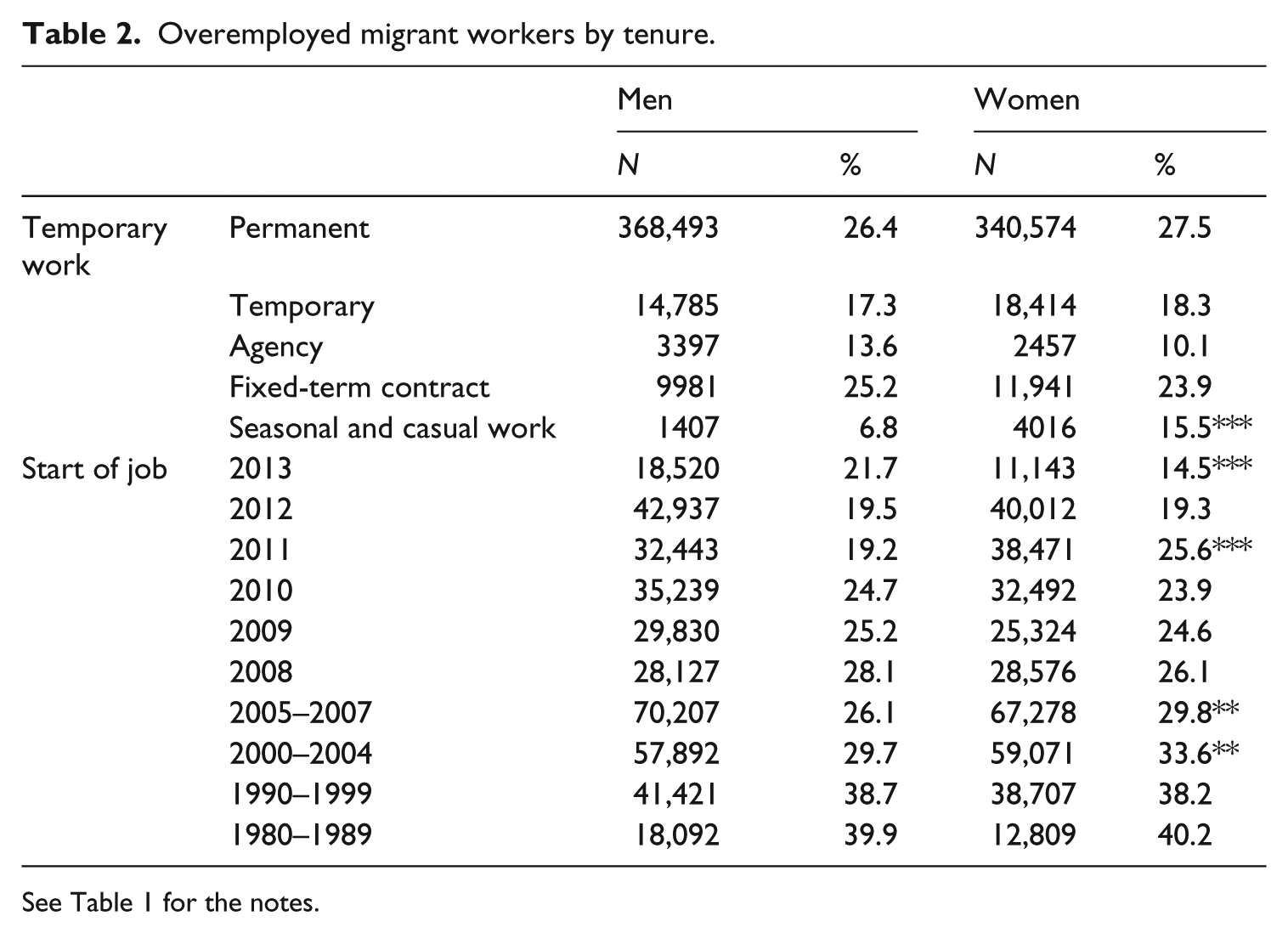
When people’s working lives are considered, it is possible to say that permanent jobs imply no gender difference with roughly one-quarter wishing to have shorter hours (Table 2). In temporary jobs, the proportions remain equal for men and women, while going down to almost one-fifth. Even so, the proportion halves for men in the specific context of seasonal and casual work.
Overemployed migrant workers by tenure.
See Table 1 for the notes.
Just after starting to work, fewer women report overemployment compared to men. Yet this reverses as the proportion goes up for women after the completion of a full year with the same employer. The gender difference becomes slightly more evident during the following decade, but it disappears in the longer run.
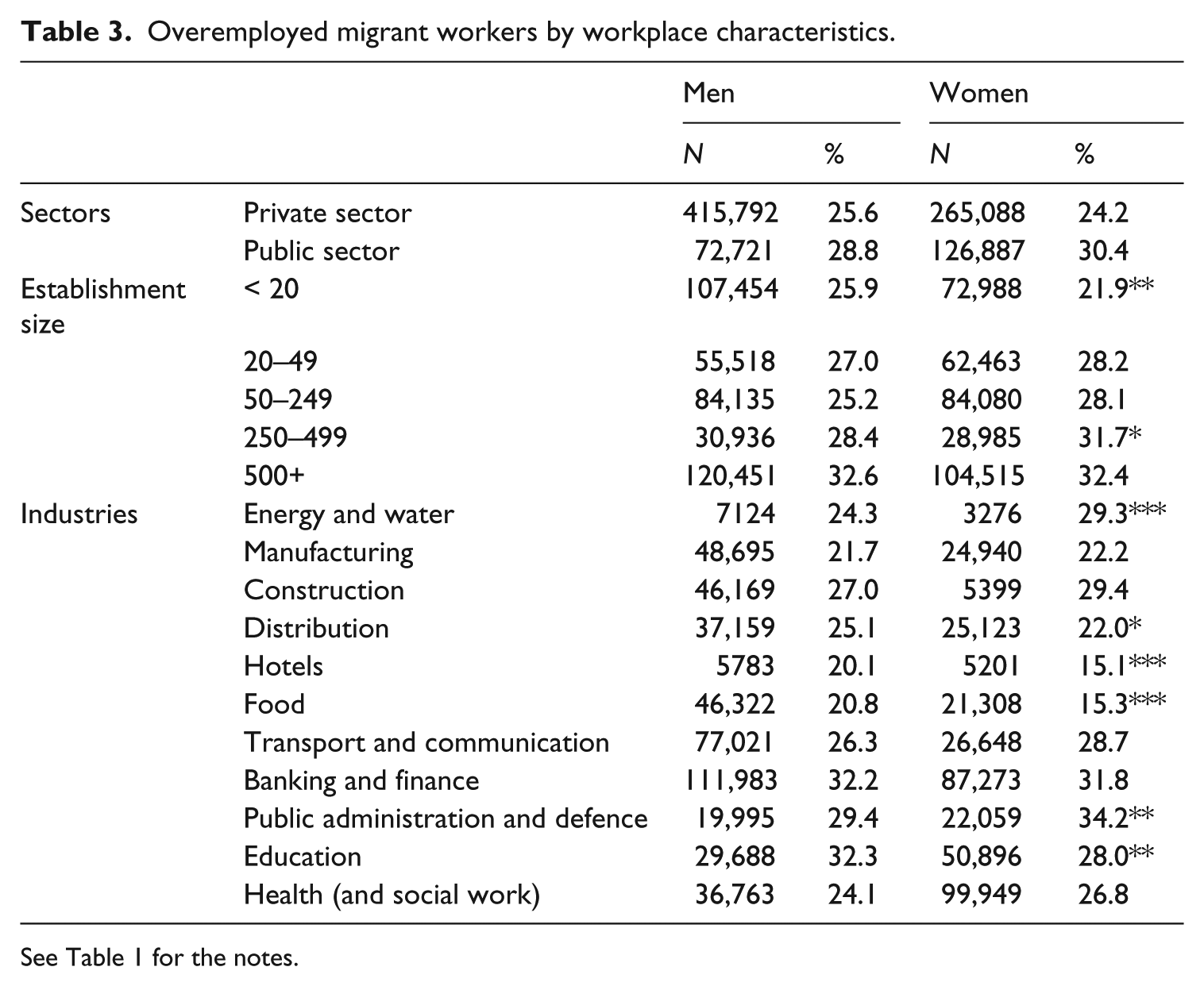
As for workplace characteristics, there is little difference between men and women in the public and private sectors, although a residually higher proportion in the public sector is evident for women (Table 3).
Overemployed migrant workers by workplace characteristics.
See Table 1 for the notes.
Establishment size does not imply a strong gender difference, albeit women are slightly less likely to be overemployed compared to men in the establishments with fewer than 20 employees. Nor does an upward trend in overemployment along with the establishment size sustain a substantial gender difference. 5
A gender gap is evident across the industries. Only a limited proportion of women in hotels and food industries want to have fewer hours compared to men. However, the proportions become higher, especially for women, in some other industries such as energy, water, public administration and defence. 6
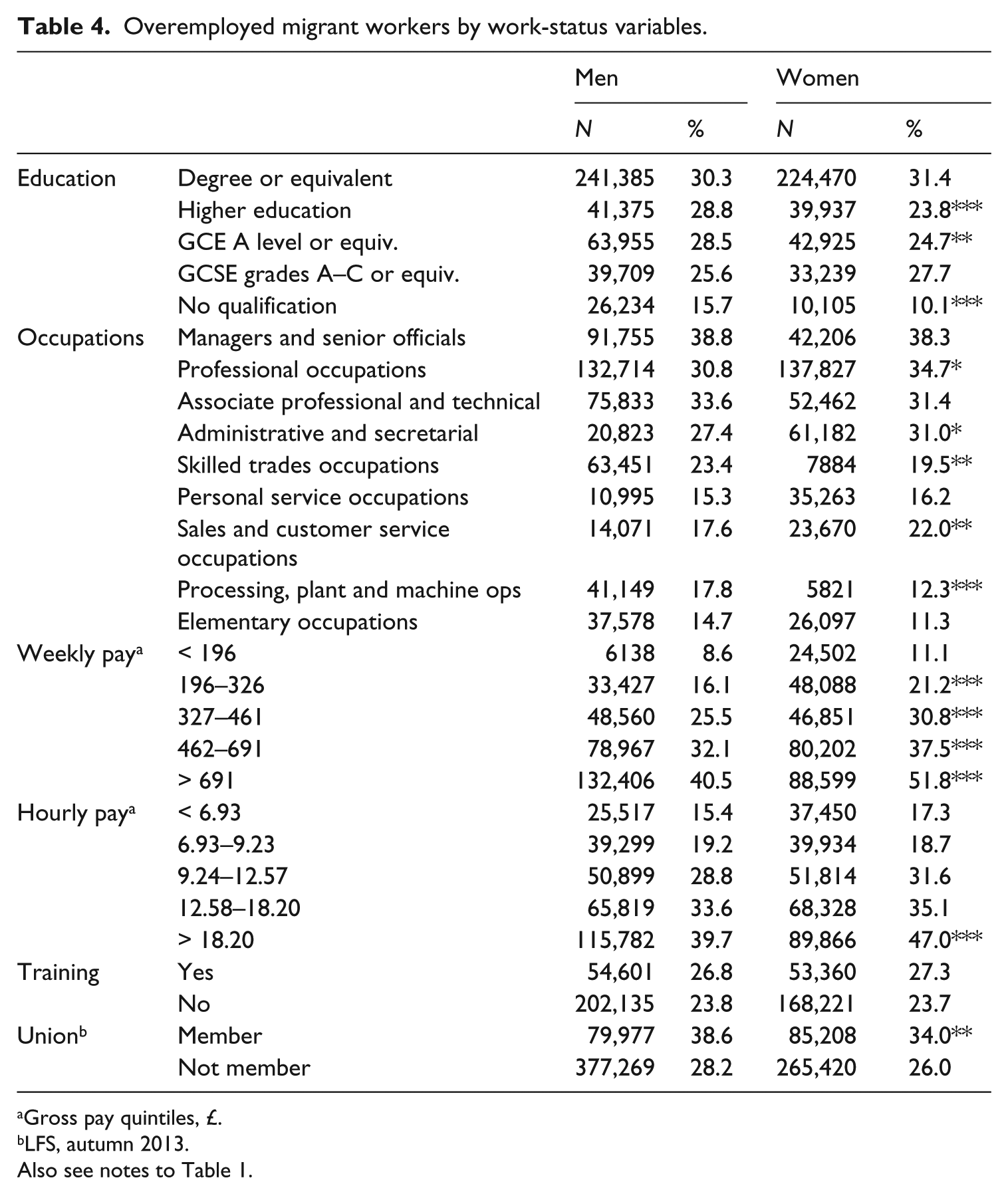
Among the work-status indicators, educational differences reveal significant gender differences (Table 4). Women who have no qualifications are less likely to wish to have fewer hours compared to men. Speaking in relative terms, however, the gap decreases as overemployment goes up along with the educational level.
Overemployed migrant workers by work-status variables.
Gross pay quintiles, £.
LFS, autumn 2013.
Also see notes to Table 1.
Occupations point to a gender gap in some respects. In lower occupational positions including processing, plant and machine operatives, women report less demand for fewer hours than men. Along with occupational status in general, demand for fewer hours augments, especially among women in professional occupations, implying a reverse yet smaller difference in relative terms. 7
Women are more likely to wish to have fewer working hours across all the quintiles of weekly earnings. Overemployment rises along with the quintiles, but the gap remains largely unaffected. The decline in demand for shorter hours in higher earnings brackets is confirmed by hourly pay quintiles as well, but with a residual gender difference this time.
Receiving employer-funded training denotes little gender difference, yet female trade union members are less likely to wish to have fewer working hours than men, and the discrepancy is further limited among non-members.
Among the working hours-related variables, having a full-time or part-time job implies some gender difference (Table 5). A higher proportion of women in full-time jobs are overemployed than men. The gender gap narrows down slightly while overemployment goes down substantially in the case of part-time jobs.
Overemployed migrant workers by hours-related indicators.

Including overtime, quintiles.
Also see notes to Table 1.
Holding a second job does not indicate a gender gap, but more women are overemployed than men across all the quintiles of weekly working hours. The gap is most pronounced in the lowest quintile, albeit overemployment soars in the higher quintiles.
Overall, with a varying degree of influence, the majority of the demographic and work-related characteristics considered are coupled with gender differences. Whether women or men are more likely to wish to have shorter hours, as well as the lack of a significant gap appears to be dependent on the specific benchmarks considered.
Logistic regression models
Both separate and joint logistic regression models to examine the differential effects of demographic and work-related circumstances on male and female migrant workers’ demand for fewer working hours are provided in Table 6. For each predictor variable, the last category in the multivariate analyses is defined as the reference category (I).
Overemployed migrant workers.

Source: APS, 2013, weighted.
Significance of difference from the reference category *p < .05, **p < .01, ***p < .001.
Model 1 for demographic profiles shows that the region of origin has a significant effect on migrant workers’ overemployment (p < .001). Compared to the rest of the world, migrant workers from Western Europe usually display a higher inclination towards wishing to have fewer hours – the reference category (Table 6). However, some results do not fit into this generalization, especially in the case of women from Eastern Europe and ex-USSR countries as well as Afro-Caribbean origins and the rest of the developed countries.
The year of arrival in Britain is a strong predictor, as the earlier arrivals are more likely to wish to have fewer working hours (p < .001): Demand for fewer working hours among those who came between 2010 and 2013 (OR = .32, p < .001) is roughly three times lower compared to those who arrived before 1980. 8
Age is an important factor on migrant workers’ demand for fewer working hours (p < .001), but this is essentially because of a negative correlation between age and such a demand among women, rather than men.
Marital status further influences overemployment (p < .001), yet this impact is exclusive to the married men who are either living together with, or separated from, the wife. They are roughly 50% more likely to demand fewer working hours than divorced men.
There is a significant relationship between having dependent children and overemployment (p < .001), largely as a ramification of having children aged from 5 to 15 years old for women, with a roughly 20% less likelihood, compared to not having dependent children.
Model 2 suggests that migrant workers in temporary jobs are less likely to demand fewer working hours, but this is basically a reflection of the impact on migrant women’s attitudes (OR = .058, p < .001).
There is a positive linear relationship between the time spent with the same employer and overemployment: demand for fewer working hours among those who started to work less than a year ago (OR = .51, p < .001) is approximately less than half compared to those who had started to work a quarter of a century ago or before.
Bringing in workplace characteristics, Model 3 illustrates their impact on migrant workers’ wish to have fewer working hours. Although the model failed to find a difference between the public and private sectors, establishment size tends to inversely correlate with the likelihood of overemployment (p < .001): demand for fewer working hours among those who work in establishments with under 20 employees is one-third less compared to those who work in establishments with 500 or more employees (OR = .65). For women, however, middle-sized establishments are not much different from the larger ones.
Industry has marked implications (p < .001) as the likelihood of demand for fewer hours turns out to be, for instance, more than 50% higher in construction (OR = 1.52) as well as in banking and finance (OR = 1.58), compared to health. However, the results for construction, in addition to a similar finding in transport and communication, apply only to men. Women in the food industry, on the other hand, are one-third less likely to be overemployed than their counterparts in health.
The incorporation of workplace characteristics into the analysis in Model 3 weakened the role of demographic factors, especially by eradicating the significance of marital status for men, and that of having dependent children for women. Likewise, the model also denied the importance of time span with the same employer. That is, such factors were largely a reflection of workplace characteristics.
Model 4 gauges the relation of migrant workers’ demand for fewer hours to work-status indicators. To start with, education enhances the likelihood of overemployment (p < .001), but this is true only for women. The gap between migrant workers who have no qualification and the remainder is roughly three times on average. Even so, the data fail to elicit a clear sense of direction in terms of the impact of educational levels due to little variation.
As for occupation, migrant workers’ wish to have shorter hours varies across occupational levels (p < .001). Overemployment in elementary jobs, for example, is considerably low compared to associated professional occupations (OR = 1.36) as well as to managers, senior officials and directors (OR = 1.69). The impact on men, however, is less pronounced to some extent since they are more keen on fewer working hours in lower-ranking occupations such as sales and customer services (OR = 2.04).
There is a linear correlation between weekly pay and the demand for fewer working hours (p < .001). Such a demand is more than 10 times lower among those who are in the bottom quintile (OR = .08) compared to their counterparts in the top quintile. This contradicts an inverse relationship between overemployment and hourly pay (p < .001). Those in the bottom hourly pay quintile are almost four times more likely to demand fewer working hours (OR = 3.86) compared to those in the top quintile of hourly pay.
Adding Model 4 to the analysis weakened the role of the region of origin, especially by eradicating its significance for women. It also had a similar effect on age, but particularly in the case of men. It further denied the role of establishment size both for men and women, implying that the hitherto highlighted influences of these factors are actually a function of one’s status at work. The addition conversely indicated that having dependent children can be an important driver of attitudes towards working hours, depending on work-status.
Model 5 evidences that part-time working migrants are up to four times less likely to become overemployed than full-time workers. However, this only applies to women (OR = .25, p < .001). Similarly, migrant workers in the lowest quintile of weekly working hours are over three times less likely to wish to have fewer working hours than those in the top quintile. However, the aforementioned result applies only to men this time (OR = .30, p < .001).
Including Model 5 in the analysis weakened the role of arrival year as well as eradicating the significance of temporary jobs and education for women. It also had similar effects on occupation and weekly pay for both men and women, implying that these factors were largely mirroring working-hours related factors. Further, it reversed the impact of lower hourly pay in general, underlining that such pay would not actually raise but curtail the likelihood of overemployment if the impact of (longer) working hours is isolated. Finally, taking the hours-related factors into consideration unearthed the role of age, dependent children and establishment size for men as well as the length of time worked with the same employer for women in addition to the difference between the private and public sectors for both.
Generally speaking, all but four variables controlled in the logistic analyses were proven significant: having tried with various combinations of the region of origin, citizenship did not fit into the model, although it appeared to be relevant in the descriptive results reported in Table 1, as was the case for the specific types of temporary jobs (Table 2). Employer-provided training (Table 4) and having a second job (Table 5) did not fit into the model either.
Discussion and conclusions
Rectifying the lack of research into migrant workers’ demand to work fewer hours, this article analysed various demographic and work-related correlates in order to explain their overemployment through a special model of gendered confidence.
Evidence of a sizeable demand among migrant workers for shorter hours does not sit happily with the assumption of ‘a rationalist response to the relative value of a penny’ (Mann, 2005). Their overemployment is lower than the rest of the workforce largely owing to a higher proportion of male overemployment among the latter group, especially in professional jobs, water, energy supplies, manufacturing and larger establishments. However, the gap between the two populations is by no means incomparable.
Migrant workers’ wish to work fewer hours has common characteristics with the rest: working long hours in full-time jobs creates desire among the migrants for shorter hours (van Wanrooy and Wilson, 2006), but overemployment in part-time jobs is also unmistakable (van Echtelt et al., 2006). Such a result is in line with the data for the rest of the workforce since 43% of them wish to have shorter hours in full-time jobs, compared to 15% in part-time jobs (APS, 2013). The findings further indicate that better pay implies a higher likelihood of migrants wishing to have fewer hours. This points to the role of financial ability to afford shorter working hours in general (Böheim and Taylor, 2004). Likewise, little effect of marital status among migrants conforms to the national picture (MacInnes, 2005).
However, migrant workers have peculiarities as well. Specific outcomes reported in the present article suggested that some ‘usual suspects’ such as education, occupation and industry had a limited effect on migrant workers’ attitudes towards the length of working hours. Among other workers, on the other hand, the demand for shorter hours runs parallel with the status at work in general (MacInnes, 2005). In particular, an inconsistency between higher education and the enhancing impact of better pay on the demand of migrant workers for fewer working hours resonated with their overqualification since many of the better educated migrants work in poorly paying jobs (NAO, 2008). Besides, even when they hold higher-ranking occupations, their pay may not always be proportionate to what the rest would receive for the same job (Cam, 2014). In other words, migrant workers’ overemployment is less likely to be contributed to by, metaphorically speaking, a chain reaction between higher educational attainment, higher occupational level and higher pay rates.
Closer analyses provided by this study also evidenced that migrant workers’ wish for fewer hours had a paradoxical relationship with earnings: separate considerations of hourly and weekly earnings have shown that although the demand for fewer hours was positively affected by (higher) hourly pay, aggregated weekly earnings did not correlate with such attitudes (Lundberg and Karlsson, 2011). In other words, lower weekly earnings involved as much keenness about fewer working hours as higher weekly earnings. The reason for this was because lower weekly earnings tend to imply long working hours. Indeed, almost one-in-two in the bottom quintile of weekly pay works over 45 hours (with a quarter working over 50 hours) per week (APS, 2013).
Migrant workers’ wish to work shorter hours goes up if they are in a potentially confidence-boosting position at work and in British society (Nichols et al., 2009). A general tendency is that the more years the respondents have been working – with the same employer – the more the share of those who want to work fewer hours increases. An explanation for this could be the respondents’ ageing and/or the fact of having been worn out by many years at their jobs. Nonetheless, as highlighted earlier, previous studies have further related tenure to the sense of confidence like the other social profile characteristics considered in the present article. Accordingly, the likelihood of preferring shorter working hours is also increased by migrating from a Western country and living longer in the UK in addition to British citizenship – although the latter works only to a certain degree, arguably because of a deterioration in the labour market status of ‘naturalized’ citizens (Anderson, 2010). Likewise, working in public sector companies, larger private establishments and union membership imply a more pronounced desire to work fewer hours. So do permanent jobs – as opposed to all temporary ones, regardless of their specific type (Broschak et al., 2008).
Having a secure position at work is important for both migrant workers and others, but it is more so for the former (Bell, 1998). As in the case of migrant workers, for example, demand for fewer hours within the rest of the populations is high in permanent jobs (37%), compared to the temporary ones (22%). Speaking relatively, however, the overemployment gap between union members (37%) and non-members (27%) is markedly higher among the migrants than the gap within the remainder, 43% and 37%, respectively (LFS, 2013). Further, working in the private or public sector does not affect workers’ overemployment in the latter group (APS, 2013).
Logistic regression results demonstrate significant differences between men and women, but the gender issue is slightly complicated. Although women’s overemployment is nationally lower than men’s in the UK (MacInnes, 2005), migrant workers appear to have no gender gap, especially for a relatively less pronounced over-representation of migrant women in part-time jobs (Robertson and Sgoutas, 2012). However, separate analyses of part-time and full-time jobs in this article revealed a gender gap (Golden and Gebreselassie, 2007) as women’s overemployment turns out to be higher than men’s among the migrants – as opposed to little gender difference for the rest whose overemployment is 12% in part-time and 43% full-time jobs, on average (APS, 2013).
A higher level of overemployment among the migrant women occurs despite the limited tendency of single motherhood. Accordingly, their demand for shorter hours has little to do with dependent children (Greenman, 2011). Notwithstanding a consolidating impact of full-time work, it does not reflect actual working hours, either. The desire of migrant women for shorter hours is rather informed by the gendered aspect of confidence (Nash, 2008). Compared to men, for instance, migrant women’s overemployment is less reduced by some confidence-challenging factors, including a non-Western country of origin, relatively more recent arrival in the UK, middle-age and working in smaller companies. This is basically in harmony with a high likelihood of migrant women covering long zero-hours with low-pay contracts in such establishments (The Clarion, 2016) as well as men’s patriarchal sense of breadwinning responsibilities (Luibheid, 2004). Migrant women’s demand for shorter hours, on the other hand, responds more positively, if not exclusively, to certain confidence-boosting factors which directly affect one’s personal position at work. With a varying degree of influence, these factors comprise working with the same employer for longer periods, having a qualification, holding higher occupations and holding permanent, as well as full-time, contracts (Bradley and Healy, 2008). Such a finding may well attest to women’s need for reassurances against gender-specific disadvantages (Stier and Epstein, 2003) as well as extra time to join personal development programmes in order to fulfil their career ambitions despite the glass-ceiling (Aziz, 2015).
In general, the results of the analyses support the special model of gendered confidence by illustrating that migrant workers’ overemployment has substantial peculiarities with an apparent dependence on the sense of confidence because of the unique or accentuated characteristics of their work and demographic profiles. Likewise, it is distinctly gendered, with a higher likelihood of women’s overemployment, especially in safer positions at work.
The findings bear some policy implications. Addressing the issue of overemployment among migrant workers would help improve employment opportunities for both migrant workers and the rest of society by promoting, for example, job-sharing practices. This can be assisted through the reduction of segregation between ethnic economies and the remainder in terms of multicultural recruitment (Ram et al., 2011). Further improvements can come from exercising regulatory powers more decisively to raise labour standards in workplaces dominated by migrants.
Since the overemployment among migrant workers had long been neglected, future research should rectify the gap by systematically mapping out specific types of jobs which accommodate higher levels of overemployment in an attempt to develop target-oriented policy suggestions. There is also a need to explore the relation of migrant workers’ overemployment to some likely dynamics such as the patterns of working hours, job satisfaction, home-based work, zero-hours work, intentions in relation to the duration of stay and being the main breadwinner.
Footnotes
Declaration of conflicting interests
The author declared no potential conflicts of interest with respect to the research, authorship, and/or publication of this article.
Funding
The author received no financial support for the research, authorship, and/or publication of this article.
