




Abstract
The article investigates the relationship between codetermination at the plant level and paid vacation in Germany. From a legal perspective, works councils have no impact on vacation entitlements, but they can affect their use. Employing data from the German Socio-Economic Panel (SOEP), the study finds that male employees who work in an establishment, in which a works council exists, take almost two additional days of paid vacation annually, relative to employees in an establishment without such institution. The effect for females is much smaller, if discernible at all. The data suggest that this gender gap might be due to the fact that women exploit vacation entitlements more comprehensively than men already in the absence of a works council.
Introduction
In many industrialised countries, employees are legally entitled to four or more weeks of paid vacation annually. The actual number of vacation days taken usually exceeds this legal minimum (Ray and Schmitt, 2007; Ray et al., 2013). Therefore, the total duration of paid vacation may amount to up to 10% of total working time. Especially psychologists argue that vacation time is important to build new resources by recovering from work demands. Empirical evidence indicates that such a recovery is associated with fewer health complaints and higher subjective well-being after returning to work (e.g. De Bloom et al., 2011; Fritz and Sonnentag, 2006; Westman and Etzion, 2001). Nonetheless, the determinants of paid vacation have not attracted much attention yet. So far, analyses of vacation use have focused on individual-specific and job-related correlates, while institutional features have been less prominent. In this article, we put a particular labour market institution at centre stage which substantially affects industrial relations in Germany: non-union employee representation at the workplace. More specifically, we analyse the relationship between works councils and the number of vacation days used.
The presence of a works council is correlated with various outcomes affecting an employee’s income or working conditions in Germany. Wages and employment stability, for example, are higher in plants or establishments, terms which we use synonymously, with a works council. Moreover, the remuneration structure and working time arrangements differ for establishments in which a works council exists, in comparison to plants without such an institution. In cases such as the regulation of working time, including the use of vacation days, the relevant law, the Works Constitution Act, explicitly grants works councils codetermination rights. As a minimum, therefore, works councils can increase the employees’ awareness of vacation entitlements. Councils can also support employees to ensure that they do not forego the use of vacation entitlements. Furthermore, works councils can protect staff who takes vacation from disadvantageous treatment by employers. These arguments suggest that works councils may be expected to positively affect the actual number of days of vacation taken by an employee.
In order to investigate the relationship between the presence of a works council and vacation, we use data from the German Socio-Economic Panel (SOEP) for 1999–2011. This is, to the best of our knowledge, the only panel data set with information on both relevant variables. During the period under consideration, data on vacation are available for the years 1999, 2004 and 2009, while a question on the presence of a works council has been included into questionnaires in 2001, 2006 and 2011. Therefore, our initial task is to impute the information on works councils for the years for which vacation data are available. Applying an OLS-estimator to the imputed data, we show that employees who work in a plant in which there is a works council take more than one additional day of paid vacation annually, relative to comparable employees who work in observationally equivalent plants without such an institution. This works council vacation effect can also be observed when we employ alternative dependent variables or estimation methods. When analysing the relationship in more depth, we find a positive works council vacation differential for male employees of up to two days, also across various regional- and sector-specific subgroups. In contrast, there generally is no effect for female employees. Our data suggest that this gender gap arises because women exploit their vacation entitlements to a significantly larger extent than men do, even without a works council being present. Hence, there is inherently less scope for a works council effect. When looking for the causes of the vacation effect, we find no evidence that it is due to a strict formalisation of working time arrangements, higher perceived job security, an income effect, or informational advantages of employees working in plants in which there is a works council. Therefore, the channels by which works councils affect the use of vacation entitlements deserve further scrutiny.
The estimated gain for male employees from codetermination at the plant level is economically relevant, as the subsequent back-of-the-envelope calculation indicates. Assuming 200 working days per year, a works council differential of two days is tantamount to a reduction in working time by 1% or, alternatively, a wage increase by about the same magnitude. To put this number into perspective, it may be noted that Addison et al. (2010) find a direct wage effect of works councils of 4.5% for male employees. Accordingly, the monetary equivalent of the works council vacation differential equals about 20% of the direct wage gain from plant-level codetermination.
The present article develops as follows. In the next section, we survey the literature. The third section provides institutional background information relating to paid vacation and works councils. The fourth outlines the data and the empirical strategy. In the fifth section, we initially present descriptive evidence and findings for regression analyses for the entire sample and various subgroups. Subsequently, we focus on gender differences and analyse potential causes for the works council vacation nexus. The sixth section summarises.
Review of the literature
Our investigation is mainly related to two strands of literature, namely contributions which evaluate the relationship between works councils and firm-specific outcomes, and analyses of vacation use. Following the seminal contribution by Freeman and Lazear (1995), works councils have often been viewed as institutions which help to create and/or share rents. Since there are a multitude of indicators of rent-sharing and rent-creating activities, a complete survey of contributions is a daunting task and clearly beyond the scope of this article. 1 Instead, we highlight investigations which may provide guidance with regard to the impact of works councils on vacation use.
First, wages are notably higher in establishments in which a works council exists, relative to comparable plants without such an institution (Addison et al., 2001, 2010). This effect may, however, no longer be observable if a change in council status is considered (Grund and Schmitt, 2013; Kraft and Lang, 2008). Additionally, the simultaneous applicability of a collective bargaining agreement can affect the wage level (Hübler and Jirjahn, 2003; Jirjahn, 2017). Works councils can also counteract wage reductions resulting from the application of collective contracts’ opening clauses (Ellguth et al., 2014). If, therefore, works council establishments pay higher wages, also other elements of the employees’ remuneration package, such as vacation, can be affected positively. However, if works councils do not raise the level of labour costs but change their composition, wages may be substituted for vacation days. This line of argument suggests that a positive wage effect of works councils could result in a negative relationship between co-determination and vacation use. 2 Focusing on the demand for vacation, higher income will result in more vacation days if the latter is a normal good. Thus, a positive relationship between works councils and vacation use can be expected. All in all, the wage effects of works councils do not generate an unequivocal prediction with respect to the direction of the impact but they make a positive effect of works councils on vacation use likely.
Second, there is substantial evidence that training activities are higher in works council establishments (Gerlach and Hübler, 2001; Hübler, 2003; Stegmaier, 2012; Zwick, 2005). These findings are consistent with those of studies indicating a positive correlation between productivity and the existence of a works council (Brändle, 2017; Hübler, 2015; Jirjahn and Mueller, 2014; Mueller, 2012, 2015), although the effect may vary with firm size (Addison et al., 2001; Jirjahn and Mueller, 2014). The net impact of higher productivity and higher wages, i.e. the relationship between works councils and profitability, appears to be sensitive to the data set used, the specification of profit measures and collective bargaining coverage (Jirjahn, 2011; Jirjahn and Smith, 2018; Mueller and Stegmaier, 2017b). Therefore, assuming that higher rents created by greater productivity are shared between firms and their employees, the evidence outlined above suggests a higher vacation use in works council establishments. However, the ambiguous findings with respect to profits indicate that such a prediction may be premature. If higher rents are already redistributed via higher wages, vacation use may no longer be affected by works councils.
Third, job stability is more pronounced in establishments with a works council. Addison et al. (2001) and Frick and Möller (2003) find that works councils are associated with a reduction in labour turnover and Pfeifer (2011) reports that codetermination reduces quits in firms covered by collective bargaining at the industry level. Similarly, Grund et al. (2016) document a negative relationship between works councils and quits and dismissals. Related, Hirsch et al. (2010) show that works councils are associated with lower separation rates, particularly for male employees. Kraft and Lang (2008) also observe a reduction in labour turnover, which can, however, not be discerned once unobservable heterogeneity of establishments is accounted for. On the firm level, Jirjahn (2010) observes a positive effect of works councils on employment growth and Jirjahn (2012) shows that works councils are associated with a lower probability of closure, at least for establishments that are part of multi-establishment firms. Given the finding that concerns about job security are less prevalent subsequent to the introduction of a works council (Kraft and Lang, 2008) and the descriptive evidence provided by the German Trade Union Federation (DGB, 2016) that lower job security induces employees to forego vacation entitlements, the positive correlation between works councils and job stability suggest that vacation use is higher in works council establishments.
Fourth, there is a higher probability of family-friendly practices at the workplace, such as flexible working time arrangements and childcare, if employees are represented by a works council (Beblo and Wolf, 2004; Heywood and Jirjahn, 2009). Heywood and Jirjahn (2009) furthermore find that the impact of the works council will be larger if the share of female employees increases. Looking at other working time arrangements, it has been observed that works councils and the existence of shift work are correlated positively (Jirjahn, 2008). Additionally, Gralla et al. (2017) show that the relationship between works councils and overtime depends on the number of regular working hours. Employees of codetermined establishments have fewer overtime hours if the standard contracted working time is high (40 hours per week), whereas they have more overtime hours in the case of a reduced number of contracted working hours per week (i.e. 35 hours). Other studies observe no such association (Jirjahn, 2008; Schank and Schnabel, 2004). 3 Absence behaviour can also be interpreted as choice of working time (Allen, 1981; Leigh, 1984). Therefore, findings on works councils and absence behaviour can also be informative with respect to the impact on hours of work. Pfeifer (2017) shows that apprentices are less absent in establishments with a works council than in their counterparts without such codetermination mechanism. Arnold et al. (2018) find the reverse relationship, looking not only at such young employees with a temporary contract who undergo dual education, but considering the universe of employees. Similarly, Heywood and Jirjahn’s (2004) and Pfeifer’s (2014) findings indicate a positive relationship. Accordingly, the extant studies on the correlation between working time and the existence of a works council suggest that codetermination may also affect vacation use. However, they deliver no consistent indication with respect to the direction of the impact. First, the empirical evidence provides no clear picture relating working time to indicators of codetermination. Second, even if works council establishments were, for example, characterised by more flexibility and fewer work hours, the consequences for vacation are ambiguous. On the one hand, greater flexibility and fewer hours can reduce the need for vacation use. On the other hand, these features can indicate that employees are more able to utilise their vacation entitlements.
In sum, previous analyses on the relationship between works councils and various economic outcomes suggest that there may also be linkage with vacation use. In the majority of cases a positive linkage can be predicted.
Turning to the second branch of relevant contributions, the impact and correlates of paid vacation have primarily been looked at for Anglo-Saxon countries. Starting with the United States, Green and Potepan (1988) employ data from the Panel Study of Income Dynamics (PSID) and observe vacation to rise with tenure. Altonji and Usui (2007) also use PSID data and investigate the impact of vacation days on various indicators of working time. They show that the number of vacation days taken is higher, inter alia, for females, more educated people and that it rises with tenure and vacation entitlements. Maume (2006) utilises the National Study of the Changing Workforce and shows that the determinants of vacation entitlements and days used partly differ for males and females. For a joint sample, he finds that both measures increase with education and tenure. Females, however, use more vacation days than males and the number rises with firm size for females, but does not vary with education. Glauber and Young (2015) consider information on females from the National Longitudinal Survey of Youth. Having an entitlement to paid vacation is higher in urban and unionised establishments and the respective probability rises with age, tenure and firm size.
Fakih (2014) presents findings for Canada on the basis of the Workplace and Employee Survey (WES). Vacation entitlements and days used are higher for married respondents and full-time employees, inversely U-shaped in age, and their numbers rise with tenure, education and firm size. Moreover, females have more vacation days and there is a positive relationship with entitlements. Fakih (2018) also employs WES data. For male employees, vacation entitlements and days used rise with age, being a union member and firm size, and decline with working part-time. For females, similar qualitative results are obtained, with the exception of age. 4 Shi and Skuterud (2015) use the Canadian Labour Force Survey and observe a positive correlation between tenure and the probability of being absent in a reference week due to vacation.
Turning to Great Britain, Bryan (2006) investigates entitlements to paid vacation employing data from the Quarterly Labour Force Survey. He finds entitlements to be inversely U-shaped for age and tenure, to rise in educational attainments, to be higher for married respondents, but not to vary with gender. 5 Moving further around the globe, Wooden and Warren (2008) utilise the Household, Income and Labour Dynamics in Australia data set and show that respondents do not completely consume their vacation entitlements. Moreover, hours of work are positively associated with the number of vacation days taken. Finally, Ohtake (2003) shows that vacation days rise with firm size and vacation entitlements in a firm-level data set for Japan.
With respect to Germany, Saborowski (2005) and Schnitzlein (2012) study the difference between entitlements and vacation days used, employing data from the German Socio-Economic Panel (SOEP). They find, inter alia, that the number of vacation days to which an employee is entitled but which are not taken declines with age, firm size and tenure. Moreover, Saborowski (2005) and Schnitzlein (2012) investigate the impact of unused vacation entitlements on various indicators of subjective well-being. Goerke et al. (2015) also utilise the SOEP, exploiting observations on vacation days taken from 1985 to 2009. Their focus is on the impact of an individual’s trade union membership, which is positively correlated with vacation use. Furthermore, Goerke et al. (2015) show that the number of vacation days taken varies with age, tenure, firm size and the nationality of employees. In neither of these studies works councils play a role.
The relationship between employee representation and vacation has already been looked at for other countries. There is, for example, evidence that individuals covered by collective bargaining agreements enjoy longer vacations in the United States (Buchmueller et al., 2004; Buckley, 1989; Glauber and Young, 2015) and Japan (Ohtake, 2003), while the information for Canada is contradictory (Fakih, 2014, 2018; Shi and Skuterud, 2015). Moreover, coverage and union recognition are associated with higher holiday entitlements in Great Britain (Bryan, 2006; Green, 1997) and Canada (Fakih, 2014, 2018). It should be emphasised, though, that the findings with respect to vacation days and collective bargaining coverage for other countries cannot simply be extended to Germany. First, the industrial relations system in Germany differs fundamentally from those in Anglo-Saxon countries and Japan. Second, and more importantly, works councils do not constitute the German equivalent to firm-specific trade unions, since they have substantially different rights and obligations. Therefore, the impact of works councils on vacation use deserves closer scrutiny.
Institutional background
Paid vacation
In Germany, the Federal Vacation Law (Bundesurlaubsgesetz) establishes an entitlement to paid vacation of 24 days per annum for dependent employees, on the basis of a six-day work week (§ 3). Individual or collective agreements often extend these entitlements to 30 or even more days, generally presuming five working days per week (WSI, 2017). Since bargaining coverage in the private sector in Germany in 2010 was more than 60%, while labour contracts of a further 20% of the workforce reflected the content of collective agreements (Ellguth and Kohaut, 2011), vacation entitlements are determined by collective negotiations in most cases.
The entire vacation entitlement can only be used once the contract has lasted for six or more months (Federal Vacation Law, § 4), that is, after the common probation period has expired. Within the first six months of an employment relationship, the right to take paid vacation exists on a pro rata basis. Since entitlements are based on calendar years, employees can generally use remaining vacation entitlements in the first months of the subsequent year (§ 7). Moreover, periods of illness which occur during vacations and which have been certified by a doctor effectively prolong the vacation entitlement. Note, finally, that the law rules out the possibility to substitute additional wage payments for vacation days not taken, unless the employment relationship is terminated.
The exact dates of paid leave have to be agreed upon between the employee and the employer. The Federal Vacation Law, moreover, states that the timing of vacation has to take into account the preferences of the employee, unless they are incompatible with business needs or the requests of other employees, which are more important from a ‘social perspective’ (§ 7). In addition to paid vacation, there are between 9 and 13 days of public holidays in Germany annually. Their number varies regionally and also depends on calendar dates.
Works councils
Collective bargaining mainly at the industry level and codetermination at the plant level are constituent elements of the industrial relations system in Germany. As mentioned above, more than 60% of all employees were covered by collective bargaining agreements in 2010, while 44% of the employees working in private sector plants with five or more employees were represented by a works council. The overlap between collective bargaining and works council representation is high, but by no means universal. In 2010, almost one in five employees who worked in a plant in which a works council existed was not covered by a collective bargaining agreement, while about 35% of all employees covered by a collective contract worked in a plant without a works council. 6 In addition to works councils in the private sector, there are so-called personnel councils, which constitute the codetermination body at the establishment level in the public sector. Most public sector employees are represented by such institutions.
The rights and obligations of works councils are laid down in the Works Constitution Act (WCA), which originates from 1952. This institution may be more thoroughly embedded in western Germany, because the WCA only became applicable in the eastern part of the country after reunification in 1990. Works councils are mandatory in all private sector establishments having five or more permanent employees. However, they will only come into existence if elected according to the procedures laid down in the WCA. If no such election takes place, this neglect of the law will not be sanctioned. This may explain the works council coverage rate of less than 50%. Works councils have to be re-elected every four years.
According to the WCA, works councils are legally obliged to cooperate with management to the advantage of the workforce and the establishment (§ 2). The law establishes information, consultation and codetermination rights, which become more extensive the larger the plant. Furthermore, the legal entitlements of works councils are more widespread with regard to personnel policy and social affairs, and less pronounced with respect to financial and economic aspects. Codetermination rights exist in particular with respect to what the law calls ‘social matters’ (WCA, § 87), which include vacation arrangements, principles of remuneration – though not its level – and health and safety regulations. This is the only place in the WCA where vacations are mentioned explicitly. The relevant part reads (translation provided by the Ministry of Labour and Social Affairs): The works council shall have a right of co-determination in the following matters in so far as they are not prescribed by legislation or collective agreement: … The establishment of general principles for leave arrangements and the preparation of the leave schedule as well as fixing the time at which the leave is to be taken by individual employees.
This section of the WCA implies that organisational issues regarding vacation cannot be decided upon by the firm or its personnel department but have to be determined jointly with the works council. So-called workplace agreements (Betriebsvereinbarungen; WCA, § 77) between a works council and a plant’s management often regulate how to apply for vacation and stipulate conditions under which such applications have to be granted or can be denied. Further, they contain provisions relating to the transfer of vacation entitlements from one year to the next as well as to the treatment of different groups of employees (cf. Neuhaus and Heidemann, 2011). Such involvement of a works council is likely to increase the employees’ awareness of regulations concerning vacations, especially with regard to the actual number of paid vacation days they are entitled to, and can help them to exploit their entitlements. Similar possibilities to affect vacation arrangements, as they are contained in the WCA, are found in the laws governing the rights and obligations of personnel councils, the codetermination body of public sector employees.
In addition to their direct, often legally founded impact, works councils may also influence vacation use via a number of further, indirect channels. Because working time is subject to codetermination rules, formalisation of according arrangements may be more pronounced in works council establishments. If formalisation enhances use of entitlements, employees in works council establishments may take more vacation. Furthermore, job security and tenure are higher in works council establishments. If vacation use is affected positively by such features, we will again observe a positive impact. Note finally, that if there is collective bargaining between a trade union and employers on an issue, the WCA generally rules out negotiations between works councils and the employer about this subject (see the quote above). Because vacation entitlements in excess of the legal minimum are mostly dealt with in collective negotiations they should not be influenced by works councils. However, the use of vacation days is often decided upon at the plant level and not regulated in collective bargaining contracts. Additionally, employees usually do not consume all vacation entitlements, as documented in the previous section. In sum, there are a number of reasons which suggest that works councils may enhance the number of vacation days taken.
Data description and empirical strategy
To investigate the relationship between vacation use and the existence of a works council, we employ the German Socio-Economic Panel (SOEP). It is a nationally representative survey, conducted each year since 1984. It covers about 20,000 participants, belonging to approximately 11,000 households in recent waves. The SOEP contains a host of information on personal and household characteristics, labour market outcomes, life events, health status and attitudes on an annual basis. 7 More sporadically, respondents have been asked about vacation use, according entitlements, and the existence of a works council.
The question relating to vacation days reads: ‘How many days of vacation did you actually take last year?’ Directly afterwards it is clarified that the question refers to working days and, hence, excludes public holidays. Furthermore, the relevant waves contain a question about vacation entitlements: ‘How many vacation days can you take according to your contract?’ Since this entitlement query directly precedes or follows immediately after the question about vacation days used, we assume that the information provided also relates to the year prior to the survey. Additionally, vacation entitlements are relatively constant over time. The query on vacation is contained in the waves 2000, 2005 and 2010 and, hence, provides information for the years 1999, 2004 and 2009. Moreover, in the waves 2005 and 2010 respondents were asked to indicate whether they did not use up their vacation entitlements in the previous year and carried them forward into the present year.
The question concerning works councils asks: ‘Is there a works or personnel council in your establishment?’ and is included in the years 2001, 2006 and 2011. Taking into account that councils are elected every four years, the SOEP questionnaires from 2001 and 2011 contain information about the respective outcomes for 1998 and 2010. The data for 2006, however, provide information about the elections in 2002 or 2006, since works council elections take place between March and May, while SOEP interviews are conducted throughout the year. Table 1 depicts the timing of council elections and the relevant SOEP information.
Timing of events and questionnaire information.
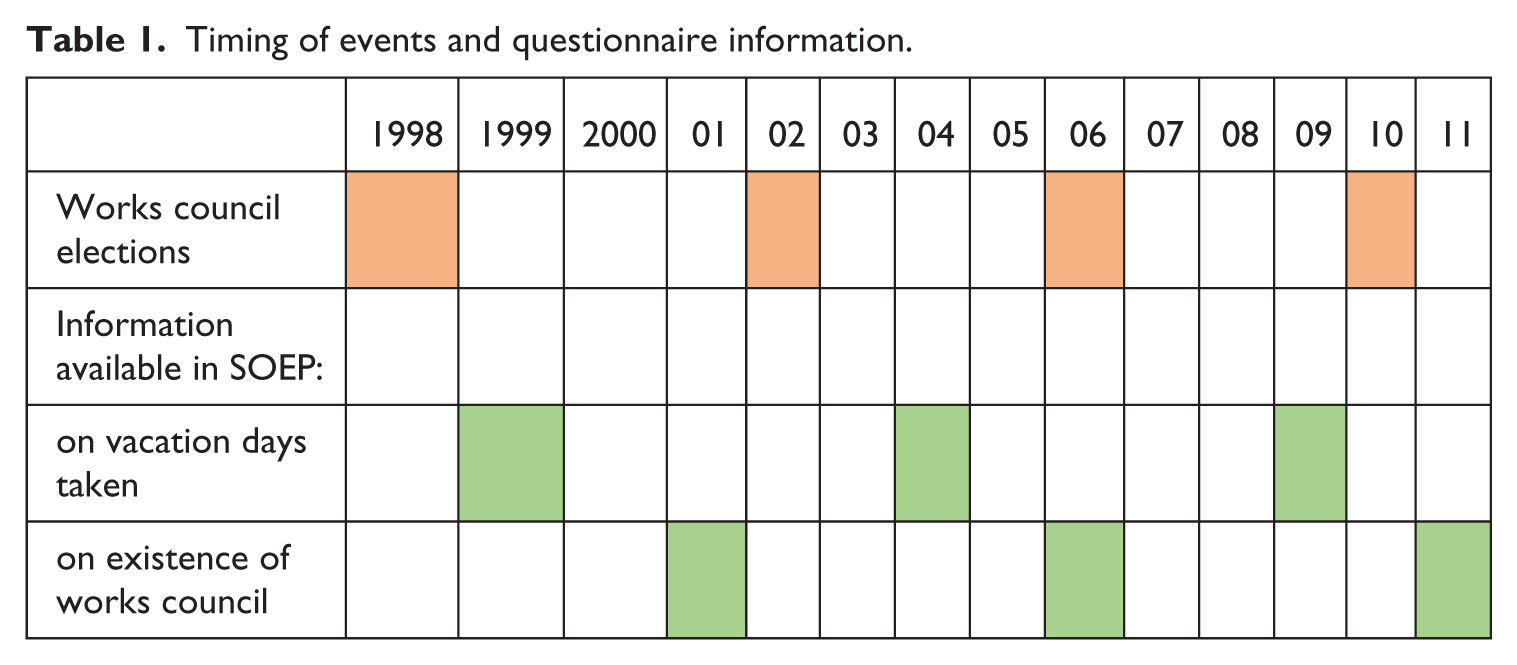
Given the data structure described above, we have to impute the information about works council status for the years 1999, 2004 and 2009 in order to combine it with vacation data. By taking into account the year in which works council elections took place and the month in which a respondent was interviewed, and by imposing appropriate tenure requirements as well, we especially ensure that the person-specific vacation data and the plant-specific works council information relate to the same employment relationship. 8 As a by-product, this approach automatically eliminates all employees from the sample who have not completed the probationary period and may only be able to make limited use of their vacation entitlement. Furthermore, we drop all observations for which we cannot ascertain the works council status for the year for which vacation data are available.
In the main part of the article, we estimate the following linear regression:

In equation (1),
In addition to the number of vacation day taken (vit), we also use three other dependent variables in order to ascertain the robustness of our main findings with respect to two aspects. First, we take into account that the same number of days of vacation can imply different effective lengths of vacation due to variations in the regular number of working days per week. Accordingly, weeks of vacation (vwit) are defined as the ratio of vacation days taken and the number of usual working days per week. Using this measure allows to rule out the possibility that a works council vacation effect is due to an impact on the number of weekly working days. Second, we consider two measures which take into account the possibility that employees in plants in which there is a works council take a different number of vacation days simply because they have other entitlements. This approach caters for the fact that entitlements constitute a sort of focal point and that the effect of works councils may relate to how employees behave relative to this implicit or explicit standard. More specifically, the vacation differential (vdit) is calculated as vacation entitlement less the number of days taken. Since greater usage of entitlements reduces this differential, we expect the sign of the works council dummy to be the opposite of that found for the number of vacation days taken. Finally, we create a dummy variable (vuit) which is set equal to one if vacation entitlements are fully used and to zero if the number of days taken is less than the number of days an employee is entitled to.
Our sample consists of regular full- and part-time employees that fulfil the tenure restrictions for the imputation of the works council data as described in Appendix 1. Additionally, we exclude civil servants (Beamte), for whom different legal regulations apply than for regular employees, as well as self-employed people. Since works councils can only be elected in establishments with at least five permanent employees, we also exclude individuals working in smaller establishments. In consequence, there is a maximum of 8570 observations.
We use inverse selection probabilities as provided by the SOEP for the computation of descriptive statistics and for all regression analyses. This allows us to account for survey design as well as panel attrition in the SOEP and to consistently calculate population statistics. Note, though, that the estimation of coefficients in regression models might become less precise if weights are employed (Solon et al., 2015). However, this does not constitute a problem in our case since the estimated coefficients presented below are qualitatively and quantitatively comparable to those we obtain when we refrain from using weights. We document this equivalence for our main estimations. 10
Results
Descriptive findings
In our imputed data set, 70.44% of all employees work in establishments in which there is a works council. This percentage is somewhat higher than numbers reported in other sources, mainly for two reasons. First, we also include employees who state in the SOEP questionnaire that they work in the public sector, as long as they are not civil servants. Traditionally, works or personnel councils are more widespread in such sectors. Second, tenure is higher in establishments with works councils than without. Since we have to impose minimum tenure requirements in order to impute the works council information this also contributes to an increase in the share of employees working in plants in which a council exists. 11
Additionally, there is a huge variation between firms. In small firms (between 5 and 19 employees), 16.67% of employees are represented by a works council, whereas this rate increases to 57.80% for firms with 20–199 employees. Already 88.91% of the employees who work in firms with 200–1999 employees have elected a works council and this percentage rises to 94.02% in firms with at least 2000 employees. 12 Looking at other subgroups, the differences are less pronounced. We find that the coverage rate is approximately 8 percentage points higher in western than in eastern Germany (71.72% vs 63.96%). Comparing industry with services, we can discern only a small difference of about 4.5 percentage points (73.49% vs 69.12%).
Finally, note that 102 individuals in our sample change their works council status during the 10-year observation period, as illustrated in Figure 1. If we restrict this sample to individuals with more than five years of tenure, we can ensure that the change in the works council status is not due to switching the employer and, hence, selection into or out of a firm that has already had a works council. Thereby, we lose another 11 observations. Given that a newly established works council (see bar (3) in Figure 1) is likely to have a different impact than a disappearing one (bar (6) in Figure 1), these cases should be looked at separately. Moreover, works council could only be established in the eastern part of the country after reunification in 1990. Given findings that the impact of works councils changes with their lifetime (Jirjahn et al., 2011; Mueller and Stegmaier, 2017a), their vacation effect may differ between western and eastern Germany. Therefore, both parts of the country should be looked at separately. However, when doing so, we end up with extremely low numbers of observations for the single groups. These small numbers make it nearly impossible to take into account time-invariant, unobservable individual- or firm-specific characteristics.
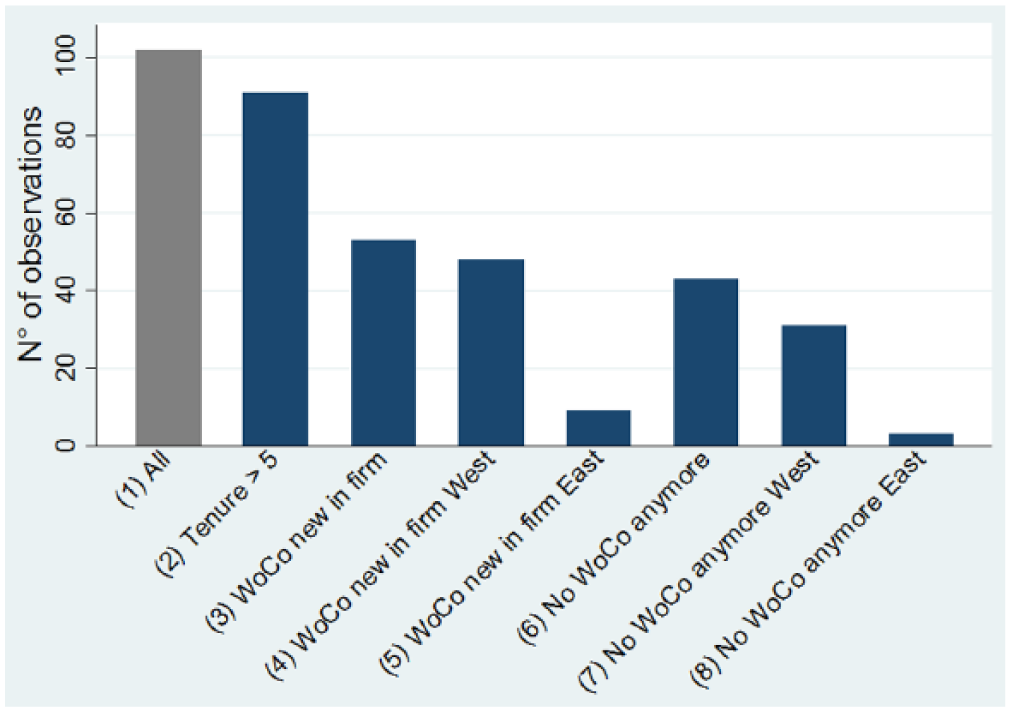
Individuals changing their works council status.
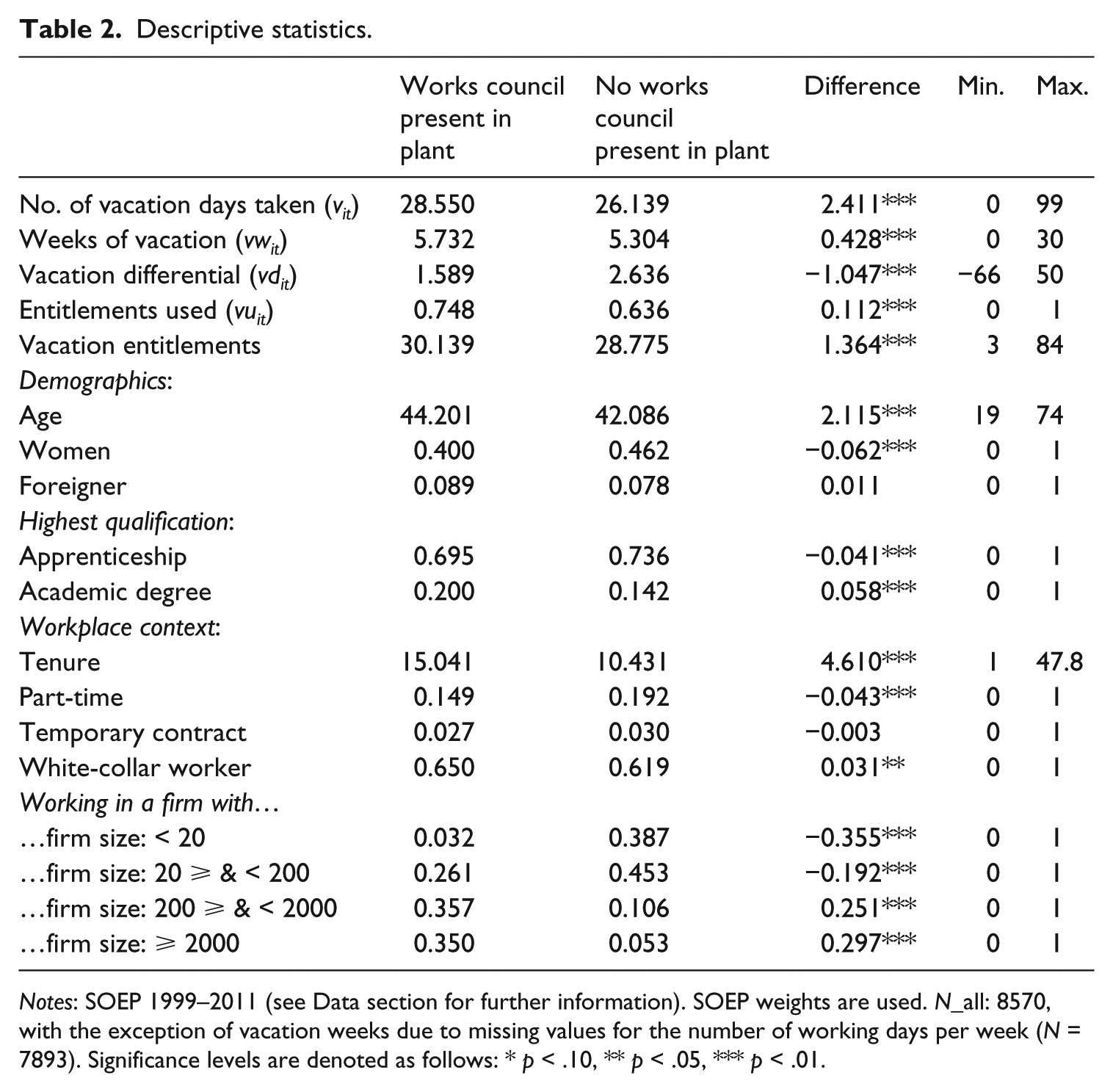
Table 2, which reports further descriptive statistics, indicates that individuals represented by a works council take almost 2.5 days more of paid vacation than respondents who have no works council in their establishment. We observe no relationship to the number of regular working days per week. Accordingly, individuals represented by a works council take about 0.4 more vacation weeks than their non-council counterparts. Vacation entitlements for employees working in plants with a works council exceed those of employees working in a plant without such institution by almost 1.5 days. Hence, the (positive) difference between the contractually agreed number of vacation days and the number of days taken, vdit, is lower in plants with a works council. In particular, employees not represented by a council leave on average 2.64 days of their vacation entitlements unexploited, whereas employees of an establishment in which a works council is present only forego 1.59 days. Finally, the probability that an individual’s vacation entitlements are fully used is about 11.2 percentage points higher for employees represented by a council. In sum, the evidence presented in Table 2 clearly suggests that a works council will support employees in vacation issues.
Descriptive statistics.
Notes: SOEP 1999–2011 (see Data section for further information). SOEP weights are used. N_all: 8570, with the exception of vacation weeks due to missing values for the number of working days per week (N = 7893). Significance levels are denoted as follows: * p < .10, ** p < .05, *** p < .01.
Table 2, however, also points out that individual characteristics of workers differ significantly between plants with and without a works council. It is, for instance, noteworthy that average tenure of employees represented by a works council is more than 1.4 times the tenure observed for employees working in establishments without a council. This observed tenure difference in our data is consistent with observations based on other data sets (Addison et al., 2010) and the fact that works councils reduce labour turnover (Addison et al., 2001; Frick and Möller, 2003). 13 Moreover, the share of part-time employees is much lower and that of white-collar employees somewhat higher in works council plants. Finally, we see that about 35% of all employees in establishments in which a council exists work in firms with 2000 or more staff, whereas the same percentage for non-works council firms is much lower (5.3%).
Basic regression results
In this subsection we report OLS regression results to control for observable differences between employees working in establishments in which there is a works council and plants in which no such institution exists. We start with the findings for our main dependent variable, the number of vacation days taken, in specification (1) of Table 3. Furthermore, we present the relationships for the three other dependent variables outlined above in specifications (2) to (4).
Pooled regression results – four alternative dependent variables.

Notes: SOEP 1999–2011 (see Data section for further information). Models (1) to (3) are estimated by OLS. Because vuit is a binary variable, in specification (4) a probit model is used. The depicted coefficients display average marginal effects. Standard errors in parentheses, clustered on the individual level. * p < .10, ** p < .05, *** p < .01. SOEP weights are used.
Specification (1) shows that an increase in entitlements by a day is associated with about 0.8 more days of vacation taken. Therefore, employees do not seem to fully exploit their vacation entitlements. This finding is consistent with results for Germany (Goerke et al., 2015; Saborowski, 2005; Schnitzlein, 2012) and can also be observed in other countries (Fakih, 2014; Maume, 2006; Ohtake, 2003; Wooden and Warren, 2008). Contrary to most previous studies, we do not observe an increase in the number of vacation days taken for higher educated individuals. Even white-collar workers, who are more likely to have a higher educational qualification, take fewer vacation days than their blue-collar colleagues. Employees working in a firm with 200 or more colleagues take more days of vacation than employees in smaller firms. Similar firm size effects have also been observed in previous investigations (Fakih, 2014, 2018; Goerke et al., 2015; Maume, 2006; Ohtake, 2003), but the probability to fully exploit entitlements is not significantly related to firm size. Additionally, the number of vacation days is inversely U-shaped in tenure with a minimum at about 17 years in specification (1). This tenure effect is opposite to what has been observed in other countries (Altonji and Usui, 2007; Fakih, 2014, 2018; Green and Potepan, 1988; Maume, 2006). When excluding the works council dummy and vacation entitlements, however, we find the same pattern as the other studies. This indicates that the tenure variable may additionally capture the impact of other determinants of vacation use in Germany. Lastly, we can observe that women tend to have more vacation time than men. This finding is in line with results obtained for other countries (cf. Altonji and Usui, 2007; Fakih, 2014; Maume, 2006), while the point estimate is rather small. As a result, if vacation use is calculated as number of weeks, this positive association vanishes, as illustrated in specification (2).
Turning to the variable of main interest, it is noteworthy that the works council dummy is consistently estimated to be positive (negative in specification (3) because unused vacation entitlements decline) and significantly different from zero (at the 1% level). Controlling for vacation entitlements in specifications (1) and (2) shows, however, that a large part of the raw difference in vacation days taken (cf. Table 2) can be attributed to disparities in vacation entitlements. Quantitatively, specifications (1) to (3) suggest that working in a plant with a works council raises the number of vacation days by at least one day per year. This finding concurs with the result (cf. specification (4)) that being an employee in a plant in which there is a works council enhances the probability of fully exploiting vacation entitlements by roughly 11 percentage points. Therefore, we obtain consistent evidence that vacation time and the existence of a works council are positively associated.
Above, we argued that vacation entitlements are an important determinant of the actual number of vacation days taken. Moreover, the entitlement variable also allows us to indirectly control for the impact of collective negotiations because such agreements almost universally contain regulations on entitlements. 14 Using the information on bargaining coverage for 1995 (the only year until 2014 for which it is available in the SOEP) for those respondents who stay with their employer long enough, we indeed observe that entitlements are higher for employees covered by a collective agreement. This finding supports our argument that vacation entitlements are a proxy, though an imperfect one, for bargaining coverage. However, we still do not know whether bargaining coverage might not only affect vacation entitlements but also its use. Hence, we additionally ran separate regressions for covered and uncovered employees for the restricted sample as previously mentioned. The point estimates indicate that the vacation effect may be more pronounced in plants which are not covered by collective bargaining agreements. If that is the case, the coefficients presented in Table 3 may even represent a lower bound for the strength of the works council vacation nexus in more recent years, given that bargaining coverage has declined from 2000 (62%) to 2010 (55%) (cf. Ellguth and Kohaut, 2011). This suggestion would be in line with cross-section estimations which indicate that the positive effect of a works council increases over time: whereas the point estimate is 0.673 days for 1999, it rises to 1.493 for 2004 and to 1.871 in 2009, based on specification (1).
Comparing the raw differentials relating to the number of vacation days and weeks of vacation taken, as summarised in Table 2, with the estimated coefficients depicted in Table 3, we note that the latter are about half the magnitude of the former. This indicates that some individual and firm characteristics which are positively correlated with the existence of a works council, such as tenure and firm size, are also positively linked to vacation use. Interestingly, the estimated works council coefficients in the specifications using the vacation differential and the probability of fully utilising entitlements as dependent variables do not differ from the raw differences (cf. Table 2). Therefore, characteristics affecting the use of entitlements may likewise be correlated with entitlements as such, so that the descriptively identified works council impact is unaffected by the inclusion of covariates.
Robustness checks
To illustrate the robustness of our findings, we first report results obtained from different estimations methods. Afterwards, we consider various subgroups. In particular, we differentiate according to region, sector, firm size and gender.
Since our main dependent variable, the number of vacation days taken, is a count variable, we start with re-estimating equation (1) by using a Poisson model. With an average marginal effect of about 1.3 days, the estimated works council effect is quantitatively and qualitatively the same as in our main specification (cf. Table 3, column 1).
To take into account time-invariant, unobservable individual- or firm-specific characteristics, which are likely to violate the OLS assumption that
We also employ different matching techniques to capture selection effects into establishments in which a works council exists in a further robustness exercise. Neither nearest-neighbour propensity score nor Mahalanobis metric matching suggests that our positive council effect is driven by a selection bias. To the contrary, results indicate that we rather underestimate this effect using pooled OLS. Depending on the particular matching method employed, we find an average treatment effect of roughly two days per year. 16
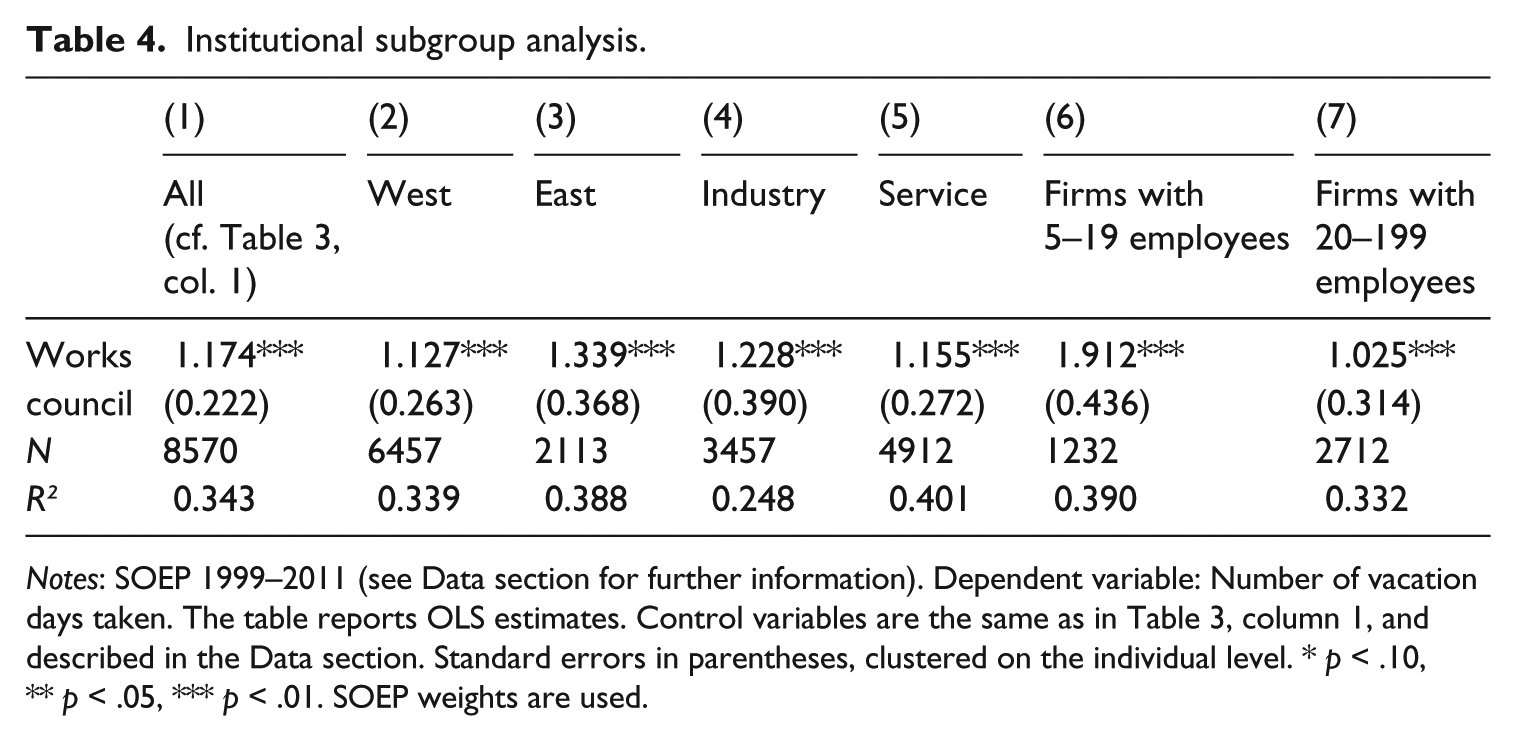
Turning to the possibility of heterogeneity across subgroups, we present results for the entire sample (for specification (1)) and important subgroups for the variable of interest in Table 4. In particular, we differentiate between eastern and western Germany to cater for the different historical development of both parts of the country. Additionally, we present separate estimations for the industrial and the service sector because works councils have traditionally been more widespread in male-dominated sectors, such as manufacturing or energy and mining. 17 Finally, we look at different plant size categories. Works councils in small firms with 5–19 employees may play a substantially different role than in larger enterprises because labour relations are less likely to be formalised. In addition, works councils are relatively rare in such smaller firms. In contrast, the fraction of medium-sized plants with 20–199 employees which have or do not have a works council is broadly the same. Hence, we observe a more balanced incidence of councils across such firms (cf. Addison and Teixeira, 2006; Addison et al., 2001; Jirjahn and Mueller, 2014).
Institutional subgroup analysis.
Notes: SOEP 1999–2011 (see Data section for further information). Dependent variable: Number of vacation days taken. The table reports OLS estimates. Control variables are the same as in Table 3, column 1, and described in the Data section. Standard errors in parentheses, clustered on the individual level. * p < .10, ** p < .05, *** p < .01. SOEP weights are used.
Again, the works council vacation nexus is consistently estimated to be positive at the 1% significance level and varies only slightly in size. We find a somewhat stronger effect for employees in small firms (5–19 employees), who seem to benefit more comprehensively from the existence of a works council with almost two additional vacation days per year.
We also estimated the specifications depicted in Table 4 for a sample from which we excluded all those respondents who state to work in the public sector, since the SOEP questionnaire does not explicitly differentiate between representation by a works or personnel council. The results for the restricted sample (not documented) are qualitatively and quantitatively comparable to those for the more encompassing sample.
In our final subgroup-specific analysis we differentiate men and women (see Table 5). We do so mainly for two reasons: first, the estimates presented in Table 3 indicate that women tend to take more vacation days used; second, works councils may be more inclined to pursue issues which are important for the male part of a firm’s workforce since their members are largely male (61.6% in our 10-year observation period). For the subsample of men, we again find a highly significant correlation between the existence of a works council and vacation use. Compared to the pooled sample, the estimated effect increases by roughly half a day. For women, however, we do not observe such a correlation.
Subgroup analysis by gender.
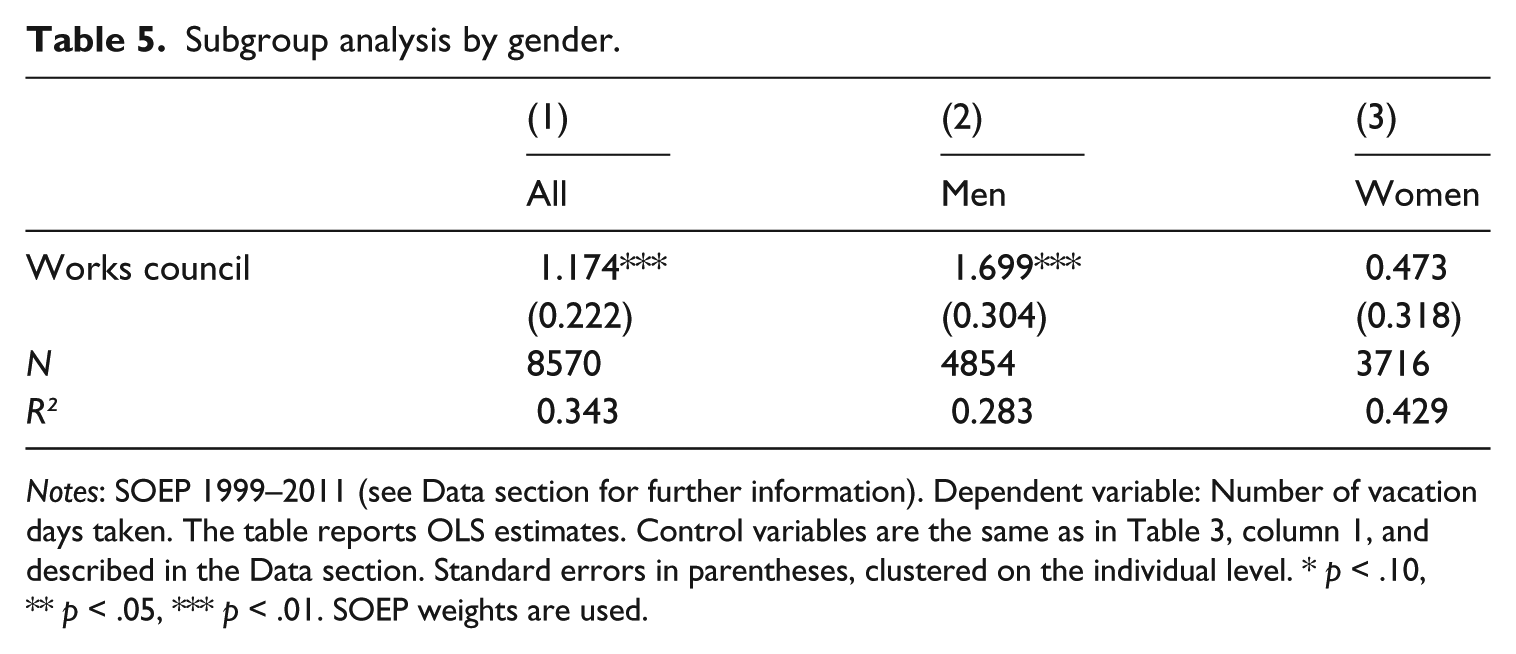
Notes: SOEP 1999–2011 (see Data section for further information). Dependent variable: Number of vacation days taken. The table reports OLS estimates. Control variables are the same as in Table 3, column 1, and described in the Data section. Standard errors in parentheses, clustered on the individual level. * p < .10, ** p < .05, *** p < .01. SOEP weights are used.
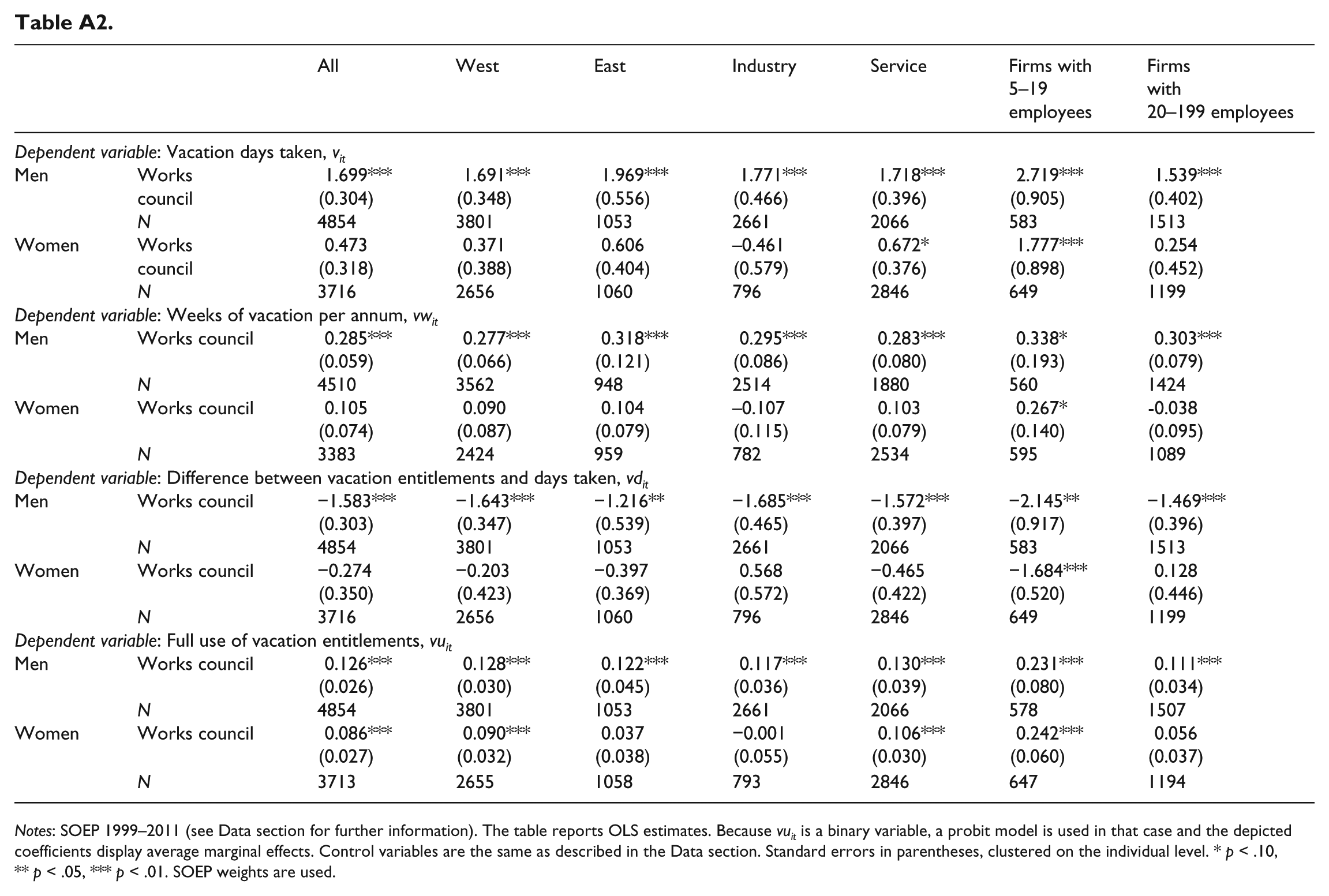
In order to ascertain the robustness of these differential findings for men and women, we further look at the various subgroups scrutinised above (cf. Table 4). Across all subsamples and all specifications, the estimated coefficients for the subgroup of men are significantly different from zero and exceed those depicted in Tables 3 for a combined sample (for detailed results, see Appendix 2). The estimated coefficients of the works council dummy for the subsamples of women are mostly insignificant. However, there are two exceptions. First, women seem to benefit in some cases from the existence of a works council in that their probability to fully exploit vacation entitlements is higher than for their non-works council counterparts. Second, we consistently find a significantly positive works council effect for women in very small firms, and in two out of four cases also within the service sector.
When searching for the cause of the gender differences one may hypothesise that works councils predominantly act in the interests of the median employee. Since labour force participation of women is lower than that of men in Germany and because the share of part-time employees was much higher among women than among men during the observation period, the median employee in many plants is likely to be a man. This line of argument does not necessarily apply to the service sector and to small firms, where the shares of female employees in our sample exceed 50%. In addition, the labour force participation rate of women in eastern Germany was much higher than in western Germany for historical reasons. Therefore, we would expect a positive correlation between the existence of a works council and vacation use by women in subsamples of firms, sectors or regions, for which the median employee is more likely to be female. However, even within these subsamples we only find a works council vacation effect for women who work in very small firms. Hence, we obtain no consistent evidence in support of the conjecture that there is no works council vacation effect for women because councils act on behalf of the median employee, who generally is male.
An alternative explanation for the gender-specific findings is based on investigating the degree of utilisation of vacation entitlements only for those workers who work in establishments without a council. Employing a Tobit or fractional response logit model with vacation days taken divided by vacation entitlements as dependent variable, we find that women exploit their entitlements to a greater extent than men (depending on the model between 3.3 and 7.9 percentage points but always significant at the 1% level) even in the absence of a works council. 18 This positive and highly significant female dummy can be found for most subsamples. The exceptions are those subsamples for which we also observe a positive works council vacation nexus for women, namely very small firms and the service sector. Hence, there is some evidence which suggests that women may simply not need a works council in order to increase the use of vacation. They already exploit their vacation entitlements to a statistically and economically significantly higher degree than men do. If this is not the case, as it appears to be true in small firms, the existence of a works council is not only associated with more vacation days taken by men, but also by women. If we now look at the utilisation of entitlements in establishments that have a works council, we do not observe any gender differences, independent of investigating the whole sample or any specific subsample. This finding may suggest that works councils take care of gender equality issues, also as regards paid vacation use.
Looking for the causes of council influence
The Works Constitution Act (WCA) provides some indication that works councils may affect the use of vacation entitlements but establishes no detailed legal procedures of how such an impact can be attained. In this subsection we analyse potential channels of influence in order to gain further insights into the relationship between works council and vacation use. Since we observe a works council vacation effect consistently solely for men, we focus on the male subsample in the subsequent exposition. The findings, however, also apply to the full sample.
The WCA establishes codetermination rights not only with respect to vacation arrangements in § 87 (see earlier discussion), but also more generally with regard to daily and weekly working time. Therefore, working time arrangements may be more formalised in plants in which there is a works council. Hence, employees working in such plants could be more aware of their vacation entitlements and, therefore, less likely to leave them unexploited. In order to analyse this conjecture we make use of information available in waves 2004 and 2009 of the SOEP which indicates whether there are so-called working time accounts in the plant in which the respondent works. Such accounts allow firms and employees to deviate from the daily or weekly working time as stipulated in the contract and to balance the actual and the paid volume of hours of work over a longer time horizon.
Moreover, the Federal Vacation Law enables employees to some extent to transfer unused vacation entitlements from one year into the next (as noted earlier). The possibility of such transfers can be argued to raise the probability of eventually foregoing entitlements. If works councils establish tighter rules on shifting unused entitlements into the future, it becomes less likely that such intertemporal transfers indirectly reduce the number of vacation days taken. In 2005 and 2010, the SOEP provides information on whether employees transferred vacation entitlements from the previous into the current year and whether the remaining entitlements would be used in the future or had already been consumed by the time of the interview.
If the works council vacation effect is partially due to a stricter formalisation of working time arrangements, we would expect such formalisation to increase the use of vacation days and to lower the works council effect since the estimated coefficients in the specifications without these additional control variables describe the combined impact of working time formalisation and the remaining (unexplained) works council impact.
Works councils may also alter vacation use if they affect an employee’s job security: individuals with greater concerns for their job might be less likely to take paid vacation (DGB, 2016). Support for this line of argument can be deduced from the evidence reported in the literature review section that job stability is higher in establishments with a works council (cf. Addison et al., 2001; Frick and Möller, 2003; Hirsch et al., 2010) and vacation use by employees with temporary contracts is lower (cf. Table 3). The SOEP contains information on concerns regarding job security and on the own economic situation for all the three relevant waves. As in the case of indicators of the formalisation of working time, we would expect that the estimated coefficients for the works council dummy become smaller and may lose significance when additionally including a measure of job security in equation (1).
Finally, we know that works councils are associated with higher wages (see, inter alia, Addison et al., 2001, 2010; Hübler and Jirjahn, 2003 to some extent). If taking vacation is a normal good, the observed works council vacation nexus may simply be an income effect. In order to scrutinise this conjecture, we additionally control for monthly gross income, additional Christmas payments and holiday allowances. This information is also available for all three relevant waves. We expect that the works council dummy shrinks in size and significance if the vacation effect is due to differential income levels in works council and non-works council plants.
In Table 6 we present the estimated coefficients of interest for specifications of equation (1) in which we have added the additional control variables separately. In the first row we also depict the estimated coefficients for the works council variable for the same specifications without the additional variables, but based on exactly the same sample. This becomes necessary because using the additional information often reduces sample size.
Inclusion of additional covariates.
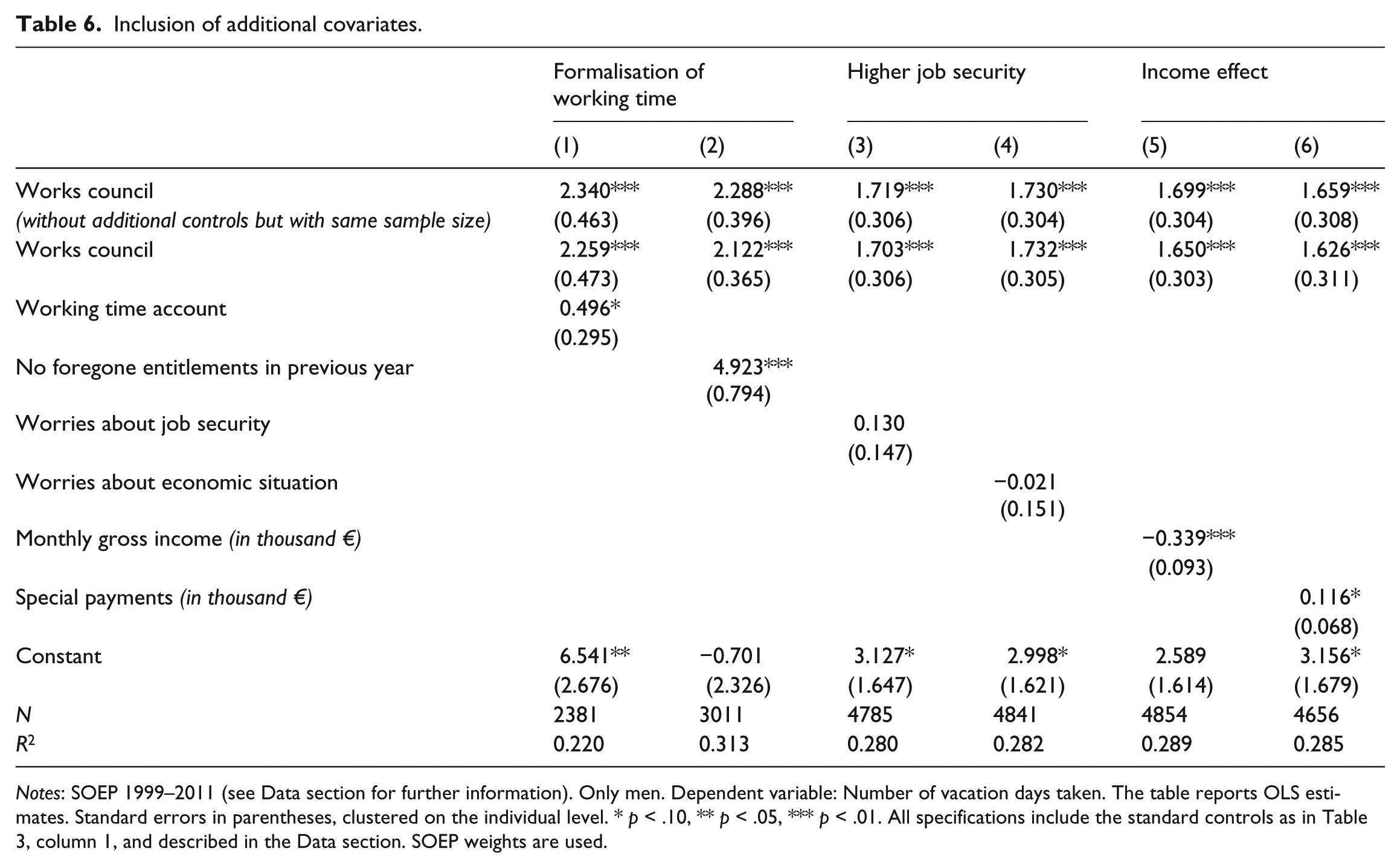
Notes: SOEP 1999–2011 (see Data section for further information). Only men. Dependent variable: Number of vacation days taken. The table reports OLS estimates. Standard errors in parentheses, clustered on the individual level. * p < .10, ** p < .05, *** p < .01. All specifications include the standard controls as in Table 3, column 1, and described in the Data section. SOEP weights are used.
The findings support the suggestion that a stricter formalisation of working time arrangements indeed enhances vacation use (Table 6, col. 1, 2). However, we find no indication of a job security effect (col. 3, 4) and the estimated coefficients on income variables (col. 5, 6) provide mixed evidence with regard to vacation being a normal good. More importantly, the estimated coefficients of the works council dummy are basically unaffected by the inclusion of the additional control variables, as the comparison of rows 1 and 2 shows. Hence, the works council vacation nexus does not appear to be due to greater formalisation of working time and vacation arrangements, greater job security or a higher income in works council plants.
A further potential explanation for the existence of the works council vacation nexus may be their informational role. Employees who are working in a firm in which a works council exists may be better informed about vacation entitlements and how to enforce them. To fit in with the observed gender differences, this line of reasoning would require that women are generally better informed about their rights than men. Additionally, such an ‘information effect’ could be expected especially for such employees who are unfamiliar with the firm and its vacation regulations. By splitting the sample into different tenure intervals, however, we show that new employees (up to 5 years of tenure) are the ones who do not benefit at all from the existence of a works council (see Figure 2). Consequently, the evidence on gender and tenure differences does not provide support for a purely informational role of works councils with respect to vacation entitlements.
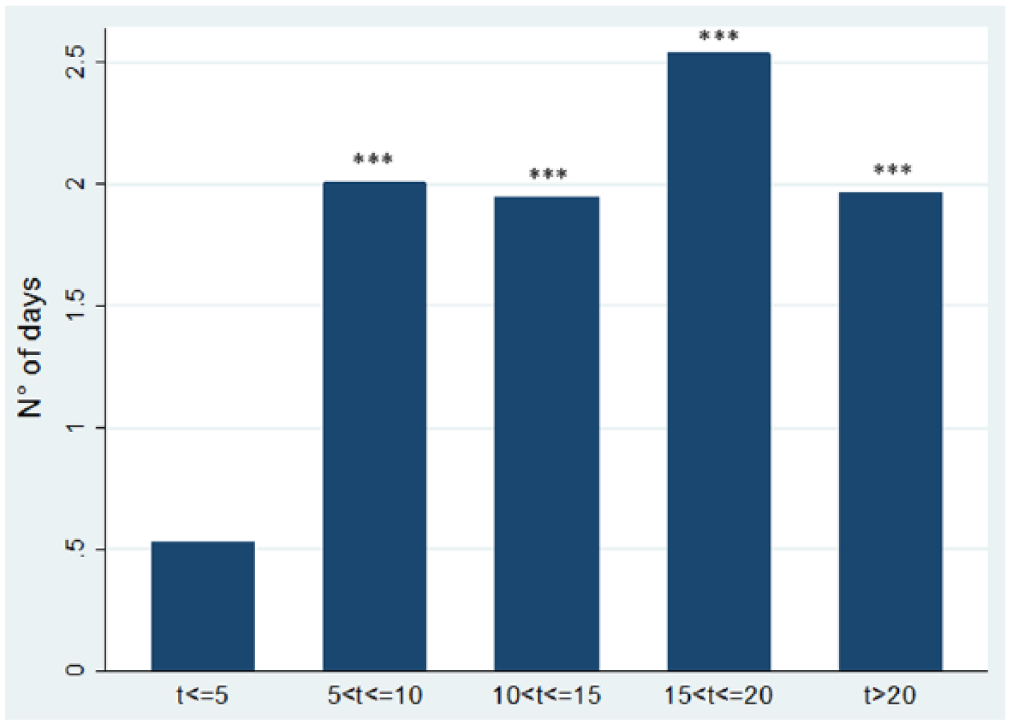
The works council vacation effect by tenure subgroups.
Summary
This article draws attention to an effect of works councils which has hitherto gone unnoticed. Looking at the period 1999–2009, we find that the existence of a works council is associated with more extensive vacation use by employees, relative to employees who work in plants without such an institution. This relationship is particularly strong for men and can be observed consistently across subgroups. For the entire sample, our OLS estimates indicate that male employees substantially benefit from a works council, in that the duration of vacation taken annually rises by about two days. This finding is corroborated for other measures of vacation use. Assuming 200 working days per annum, the vacation effect translates into a wage increase of close to 1%. For women, however, no such works council vacation effect is consistently discernible. We only find evidence of a positive correlation for female employees in small firms and in the service sector. From further regression analyses we tentatively conclude that works councils do not comprehensively enhance vacation use of women because they generally utilise their entitlements to a much greater degree than men even without a works council being present. Consequently, there is less scope for a works council effect.
As regards the channel by which works councils might raise the number of vacation days used, the findings presented above do not support the hypotheses that works council plants are characterised by (1) more extensive formalisation of working time arrangements, (2) greater job security or (3) higher income and that the works council vacation nexus is due to such effects. Works councils neither seem to affect vacation days taken by providing (legal) information. Our findings are consistent with the view formulated above that works councils enable employees to better utilise their vacation entitlements. However, this effect is apparently restricted to male employees with a minimum degree of seniority. The available data neither provide the necessary information to identify how exactly works councils help employees to enforce their claims nor allow drawing causal inferences in general. Hence, our investigation points to a previously unnoticed additional benefit of an existing works council in an establishment, but also indicates directions for future research.
Footnotes
Appendix 1: Detailed information on imputation of works council information
We impute the information on the works council status of the respondent’s workplace for the year for which s/he provides information on vacation in the following manner. First, we establish the works council status of the firm in which the respondent works for the years 1999, 2004 and 2009, i.e. those years for which we have information on vacation. When doing so, we take into account that works council elections normally take place between March and May of an election year and neglect the possibility that works councils are either abolished or newly introduced in between election years. Anecdotal evidence suggests that such changes in council status are indeed rare events. Second, we ascertain that the respondent was actually employed in the firm for which we determined the works council status during the entire year for which we have information on vacation.
Appendix 2: Gender differences by subsample and dependent variable
| All | West | East | Industry | Service | Firms with |
Firms |
||
|---|---|---|---|---|---|---|---|---|
| Dependent variable: Vacation days taken, vit | ||||||||
| Men | Works | 1.699*** | 1.691*** | 1.969*** | 1.771*** | 1.718*** | 2.719*** | 1.539*** |
| council | (0.304) | (0.348) | (0.556) | (0.466) | (0.396) | (0.905) | (0.402) | |
| N | 4854 | 3801 | 1053 | 2661 | 2066 | 583 | 1513 | |
| Women | Works | 0.473 | 0.371 | 0.606 | –0.461 | 0.672* | 1.777*** | 0.254 |
| council | (0.318) | (0.388) | (0.404) | (0.579) | (0.376) | (0.898) | (0.452) | |
| N | 3716 | 2656 | 1060 | 796 | 2846 | 649 | 1199 | |
| Dependent variable: Weeks of vacation per annum, vwit | ||||||||
| Men | Works council | 0.285***
|
0.277***
|
0.318***
|
0.295***
|
0.283***
|
0.338*
|
0.303***
|
| N | 4510 | 3562 | 948 | 2514 | 1880 | 560 | 1424 | |
| Women | Works council | 0.105 |
0.090 |
0.104 |
–0.107 |
0.103 |
0.267*
|
−0.038 |
| N | 3383 | 2424 | 959 | 782 | 2534 | 595 | 1089 | |
| Dependent variable: Difference between vacation entitlements and days taken, vdit | ||||||||
| Men | Works council | −1.583***
|
−1.643***
|
−1.216**
|
−1.685***
|
−1.572***
|
−2.145**
|
−1.469***
|
| N | 4854 | 3801 | 1053 | 2661 | 2066 | 583 | 1513 | |
| Women | Works council | −0.274 |
−0.203 |
−0.397 |
0.568 |
−0.465 |
−1.684***
|
0.128 |
| N | 3716 | 2656 | 1060 | 796 | 2846 | 649 | 1199 | |
| Dependent variable: Full use of vacation entitlements, vuit | ||||||||
| Men | Works council | 0.126***
|
0.128***
|
0.122***
|
0.117***
|
0.130***
|
0.231***
|
0.111***
|
| N | 4854 | 3801 | 1053 | 2661 | 2066 | 578 | 1507 | |
| Women | Works council | 0.086***
|
0.090***
|
0.037 |
−0.001 |
0.106***
|
0.242***
|
0.056 |
| N | 3713 | 2655 | 1058 | 793 | 2846 | 647 | 1194 | |
Notes: SOEP 1999–2011 (see Data section for further information). The table reports OLS estimates. Because vuit is a binary variable, a probit model is used in that case and the depicted coefficients display average marginal effects. Control variables are the same as described in the Data section. Standard errors in parentheses, clustered on the individual level. * p < .10, ** p < .05, *** p < .01. SOEP weights are used.
Acknowledgements
We are grateful for helpful comments and suggestions by an anonymous referee and participants of the Fourth SOLE EALE World Conference, a seminar in Trier and the annual meeting of the Committee for Population Economics of the Verein für Socialpolitik in Nürnberg.
Declaration of conflicting interests
The authors declared no potential conflicts of interest with respect to the research, authorship, and/or publication of this article.
Funding
The authors received no financial support for the research, authorship, and/or publication of this article.
