



Abstract
The emergence of the gig economy is mostly an alternative to the core service economy, which is gradually being transformed in spatial and temporal dimensions. It is not work in the gig economy, per se, that is problematic, but the way in which it is organised or structured is creating ruptures across several dimensions. This article seeks to explore the work organisation and work relations practised in these gig economies. In particular, it provides empirical findings on work practices in e-cab services so as to highlight the growing precariousness, in both economic and social contexts, among the service providers.
The technological revolution and digitalisation is significantly transforming the service economy, which, as a sector, is often criticised for its contribution towards productivity, employment and work. 1 The developing nations continuously strive to upgrade their economies through service-centric development practices in the expectation of increasing trade, economic growth and employment (Beukema and Carillo, 2004; Braverman, 1974; Castells, 1996, 2010; Hill, 1977; Katouzian, 1970; Patel, 1991). However, in countries like India such practices are often resorted to without assessing their impact on both the existing and emerging workforce concerned. An emerging, yet expanding niche, the technological and digital manifestation in services has been coined the gig economy. Though digitalisation, per se, is not a problem, the economies evolving through digitalisation such as the gig are seen to be bending and bypassing regulated structures and institutions.
The gig economy involves short-term, unpredictable and contingent work arrangements where the market for personal services is transacted in a digital marketplace (Brinkley, 2016; Kennedy, 2016; Manyika et al., 2016; Riley, 2017). This economy resembles a horizontal organisation 2 with simultaneous sharing and organising of goods, tools, spaces and citizens’ ‘networks’ through high internet intermediation (Bertrand et al., 2016; Clarke and Urata, 2016; Rogers, 2017). 3 The gig economy is increasing rapidly, mostly as a response to high unemployment prevalent across both developing and developed countries. Statistics show that around 36% of the workforce in the US are already engaged in the gig economy whereas in India it is claimed to have added 56% new employment to the economy, which is further expected to increase by 25–30% per annum (McCue, 2018; Mukerjee, 2018; Salman and Bansal, 2019).
These gig economies are capitalising on and extracting surplus value through the (re)commodification of traditional services, which, in turn, is radically changing traditional work patterns and structures. This, on the one hand, is threatening established traditional services and employment therein, whereas, on the other hand, it is creating new work forms that are highly precarious in nature. It raises a serious concern whether such a proposed ‘high road’ for the economy is leading to a ‘low road’ for its workforce. The low road has already set in with uncertain, non-standardised and insecure work practices as well as massive reliance on ambiguous and disguised work relations. This article seeks to evaluate the e-cab services operating in the North Eastern region in India. It first tries to address how work in these e-cab services is organised with regard to both work practices and work relations. It aims to help highlight the nexus concerning work in gig services as an employment form and its underlying informalised and precarised nature. This leads to the second research question, as to whether these economies possess the potential to formalise the highly volatile labour markets in the economy, or are they leading to further informalisation? To cast light on the focus of the article, that is ‘work in e-cab services’, an attempt has been made to use extensive empirical data to evaluate work structurisation, and work relations. This has been done against debates related to control and power dynamics as well as flexible and precarious work dimensions. This will reveal the paradoxical situation concerning the claimed status of the service providers and the work arrangements in the services.
The article has been structured into five broad sections, starting with the theoretical perspective by which the issues at stake are analysed. The first research question is approached from the radical or critical management perspective, and thereafter the article uses theorisation concerning informalisation and non-standardisation to address the second research question. The second section discusses the research methodology used in conducting the research with emphasis on approach, methods and procedures related to data collection. The third section brings an empirical insight to the research and discusses the organisation of work in e-cab services with particular emphasis on its underlying precariousness. This is supported by the fourth section, which evaluates the work relations emerging in these services and how low or no social support adds to the disadvantageous positions of the service providers. The final section concludes the research, paving way for further research, to look deeper into the new hidden informality and precariousness entailed in the gig services.
Theoretical insights
This research uses a critical management perspective to explore work organisation and work relations. Work organisation 4 has changed significantly over time, spanning across the simple organisation to mass production and eventually to flexible production that is scattered across the globe. This contemporary workplace restructuring encompasses the devolution of decision making, casualisation of the employment relationship and a shift from collective bargaining to individual bargaining (Cornfield et al., 2001; Leicht, 1998). To explore such change it becomes necessary to adopt a critical perspective that aids in understanding work in the context of its members as well as the wider society in general (Grint and Nixon, 2015; Thompson and McHugh, 1990, 2002). Work organisations in critical theory are seen to be distinct from other organisations where they operate as structures of control and embody contested rationalities over universal rationality (Thompson and McHugh, 2002). Work such as Braverman’s ‘scientific-technical revolution and degradation of work’ (1974) or Alvesson’s (1987) ‘six theses for a critical organisation theory’ 5 laid the basis for critical examination of work organisation.
Braverman’s de-skilling thesis (1974) derived from his ‘scientific-technical revolution and degradation of work’ kickstarted the labour process debates and was built mostly on Marxian notions of technology and work. Braverman (1974) emphasises three main aspects of the labour process debate: that is, de-skilling, control and the implication of the scientific revolution on class structure. He considers Taylorism to have broken down the labour process in a way where workers’ creativity is being degraded through compelling them to perform mindless tasks at work. This has arisen through a division between conception and execution of tasks in the production process and is being further aggravated by the stricter imposition of control over the workers. Technology at the workplace has profoundly increased the possibility to have control over alienated labour, and over time this has been claimed as the central concept of all management systems. The second wave in labour process theory emphasised more complex aspects concerning structure and agency, where several influences on action by global level, state and sector have been highlighted 6 (Thompson and McHugh, 2002; Thompson and Newsome, 2004). Resistance was seen as a stronger driver of changes in capitalism and accordingly, efforts were made to understand the control strategies and practices in work organisations (Knights and Willmott, 1990; Thompson and Newsome, 2004).
Burawoy’s (1979, 1985) ‘capitalist labour process theory’ stressed that rather than being coerced or forced by the capitalist system, it is the workers’ consent to this very system that constrains them. The consent is secured through organising activities at the workplace in a way that institutionally separates relations of production from relations in production. This works like a game to breed individuality among the workers through arranging choices and outcomes in a way whereby each worker strives to maximise their earnings through maximising production that ultimately benefits the system. 7 This growth of individualism over collective solidarity helps in reducing worker–management conflict over time, wherein the ‘relations in production’ 8 shape and form the practical aspect of the labour process. Edwards (1979), on the other hand, largely assumed a historically successive linear process concerning control forms, starting with simple and direct control, technical control, and bureaucratic control (Knights and Willmott, 1990). He laid significant emphasis on ‘technical control’, where the content and pace of work were determined by the plant layout and the imperatives of production technology. Technology provides management the opportunity to incorporate elements of control in the machine that directs, monitors and evaluates operations. The ‘bureaucratic control’ is claimed to be ‘embedded in the social and organisational structure of the firm and [is] built into job categories, work rules, promotion procedures, discipline, wage scales, definitions of responsibilities and the like’ (Edwards, 1979: 21). Edwards (1979) mostly emphasised how capitalists designed new forms of labour control in response to workers’ resistance to the increasing size of organisations and the changing nature of inter-capitalist competition. Both technical and bureaucratic control seem to be relevant in the current control process in the gig economy. Although, the current economic restructuring has reorganised the workplaces and workspaces in which these control mechanisms could be contextualised completely. Over time, the concept and meaning of work have undergone sea changes. The binary division into organised and unorganised employment has been an integral component in the urban economy. Initially recognised as a distinct sector, the informal economy has even started to pitch into the formal sector through increasing informalised and non-standardised work practices 9 (Fenwick et al., 2016; Kalleberg, 2000, 2009; Kalleberg et al., 2000). The changes in the political economy since the early 1990s have driven changes in work and employment relationships. The Financial Crisis of 2007–8 in particular has led to the displacement of workers, downward pressure on wages, instability and so on. This research draws on Castells and Portes’ (1989) informalisation thesis that claims informal employment in the contemporary era is a new form of advanced capitalism rather than a ‘lag’ from traditional relations of production. This is because informalisation, in the current context, is seen to persist even in highly institutionalised economies.
Technological development has been a driving force for change in the nature of employment and the number of people working in employment relationships (Kalleberg, 2000). The informal economy, generally signified as an economy with no regulation, easy entry and low technological usage, includes both self-employment in small unregistered enterprises and wage employment in unprotected jobs (Chen, 2007; Hart, 1973). Informal employment, on the other hand, refers to employment without legal and social protection, as seen both inside and outside the informal sector (International Labour Organization, 2003). The employment relationship in the informal sector is without legal recognition or protection owing to its disguised, ambiguous and unclear definition (Chen, 2007). The employment relations in the gig economy are disguised as well as ambiguous in nature. As Williams and Windebank (1998) show, informal employment is not a homogeneous category as it ranges from organised to individual forms of informality. Concerning the gig economy, it is a mostly organised form of informal employment with elements from both ‘core’ and ‘peripheral’ informal employment. On the one hand, the sector is portrayed to possess significant autonomy and flexibility at work, whereas the other side witnesses relative degradation in both economic and social terms. The peripheral evidence is that such work is seen to be taking its toll on a huge section of the informal economy, especially in developing countries with weak regulatory mechanisms (Hyman and Gumbrell-McCormick, 2017; International Labour Organization, 2016). Further, the gig companies are seen to be oriented towards ‘zero-hour contracts’ that signify an arrangement whereby the employment lacks a guaranteed minimum number of hours and employees can be called on at short notice as and when required by their employer (BIS, 2013; ONS, 2017, as cited in Koumenta and Williams, 2018).
The dualist studies the economy as two extreme sectors, one as organised and the other as unorganised, whereas others have tried to understand the economic model as a continuum. Tokman (1978), on the other hand, contradicted the entire homogeneous nature of the informal economy, claiming that the informal sector itself comprises different segments within it. The gig economy is running on similar principles, which raises concern as to whether it is an informal economy or a subset of the informal economy or something beyond informal economy? Clark and Colling (2019) highlight that formal and informal economies are interlinked and overlapping both within and beyond the labour process, which implies a fine line between the sectors. Similarly, the new gig economies possess elements from both paid work and self-employment, yet also appear to reproduce the labour process that is generally seen to be associated with formal sectors. Similar to Clark and Colling’s (2019) findings, this present research also shows that the service is characterised by informal employment with the formal constitution of technical rules and forces of production that are informally regulated. However, whether there is autocracy in the labour process (Ram et al., 2016) in comparison to formal employment is subject to work relations practised in these services. This will be explored through the service process, regulations, personal relations, etc. prevalent in the gig economy.
Research methodology
Being an exploratory research, the study has been conducted through a mixed methods process (Creswell, 1999, 2009; Creswell et al., 2002, 2003), using a plurality of approaches to derive knowledge about the problem. Accordingly, the research adopts a concurrent procedure (Creswell, 1999; Creswell et al., 2003; Greene et al., 1989; Patton, 1990, 2002; Steckler et al., 1992; Tashakkori and Teddlie, 1998) where quantitative and qualitative data are brought together to provide a comprehensive analysis of the research problem. Within the regime of concurrent procedure, under a mixed methods approach, the research uses a concurrent triangulation strategy and concurrent embedded strategy. This research is oriented on the pragmatic school of thought whereby knowledge claims are seen to arise out of actions, situations and consequences (Creswell et al., 2003). Similarly, the theoretical framework and research questions have been designed to understand the contexts shaping the actions and arrangements. As stated, the philosophical underpinning for mixed methods research is to focus on the research problem and use pluralistic approaches to derive knowledge about the problem (Patton, 1990, 2002; Tashakkori and Teddlie, 1998). Hence, this research is liberal in the use of methods, techniques and procedures for addressing the research problem as the main purpose is to understand all possible ways through which the problem can be addressed.
This research is rooted in the changing dynamics of the transportation sector in India. Within this, the research seeks to highlight the impact of digitalisation on the sector and the emergent e-cab services as part of the broader gig economy. The e-cab service has been chosen as it represents one of the most rapidly expanding units of the gig economy across the country. It is in turn changing existing and generating new employment opportunities in the transportation sector. The area chosen to study is the city of Guwahati in the state of Assam. Guwahati is emerging as an attractive destination for the growth of gig jobs, and subject to a different political economic and sociocultural setup as compared to other metropolitan cities in India. As multilayered analysis is involved, sample categorisation had to involve different categories of respondents. The primary sample consisted of 100 workers engaged in the e-cab services of the gig economy, who were selected through basic mixed methods sampling strategies (Patton, 1990, 2002; Teddlie and Yu, 2007). To understand the complexity involved in work and employment relations, the research involved both drivers working as self-employed and workers hired by individual owners of the cars. Moreover, the sample was not selected to take into account race, ethnicity, age or gender. Other key informants comprised state and non-state actors, e-cab company officials and traditional service providers. Expert opinion sampling and maximum variation (heterogeneity) sampling (Patton, 1990, 2002; Teddlie and Yu, 2007) were used. To collect data across all the samples, a combination of tools comprising documents, unstructured interview schedules, as well as non-participant observation methods (Bryman, 2012; Flick, 2009; Langdridge, 2004) were applied. The quantitative data were analysed through descriptive and inferential statistics using SPSS and the qualitative data were analysed by a thematic approach through second order coding.
Work organisation in e-cab services: Precarious work practices through changing capital–labour relations
Work in the contemporary economy, in general, and the gig economy, in particular, has undergone sea changes, with work practices being highly non-standardised. Technology has given the corporate giants enough leeway to manoeuvre work and despite its idiosyncrasies, is spreading as prospective employment tools across economies. Marx claims technology to act as a dependent variable in the social system that is shaped to a purpose by the dominant class and is also subject to reshaping based on new purposes under a new hegemony. 10 The gig services are mediated by the companies to operate the business under a lawfully precarious, if not informal, occasional or with no regular time, work relationship (Brinkley, 2016; Junior and Silvia, 2017; Kennedy, 2016; Manyika et al., 2016; Riley, 2017). This workplace restructuring is highly visible in work organisation, work timing and earnings structurisation in e-cab services. Work structures, which Kalleberg (1987) describes as the rules for solving economic and political problems of production and distribution, have turned against the workers in the gig economy. Although the capital–labour relation has changed with more empowerment to the labour class in the gig economy, the work structurisation rather reflects more autonomy and discretionary power at the company’s end. This in ways recalls old practices where workers are still subordinated as sheer tools for exploitative capitalist gains. Further, perplexing mechanisms, often built through technological permeation, have helped the capitalists to take a back seat and misrepresent the working class as ‘bourgeoisie’. The empirical evidence shows that these workers have no control, let alone exhibit power in their work and indeed, trapped in the debt game, are moving towards economic and social precariousness.
App-based work
Work in the gig economy is an app-based work where it acts as an object and subject of technology. The work in e-cab services is connoted as ‘independent work’, or ‘independent contracting’, thereby often camouflaging the highly controlled work structurisation. The app acts as the demand and supply matcher or, as the company denotes, ‘aggregator’, whereby it is constantly in the process of connecting the service providers with the customers in the market. Hence, the work of these service providers is not guaranteed or fixed in advance and is highly contingent upon the environment in which work is performed. This on-demand nature of their work is a key theme cutting across different gig jobs however, each exposed to its vulnerability. Technology in e-cab services has been injected with control mechanisms by the management that serve to monitor, direct and evaluate performance. This was well captured in the ‘technology and control’ theory of Edwards (1979) and is generally seen to be in practice through the app being used to operate the e-cab services. In aggregating, the app in e-cab services acts as a non-human manager as well as a supervisor that maintains a constant surveillance mechanism over the service providers and the customers. Hence, the empowerment of the app highlights the evolution of a new class of managers that has cut down on the human involvement drastically and is also threatening the middle layers involved in these services.
The app, acting as the main work organiser, is prone to occasional breakdowns in fetching rides, calculating fares or managing the service provider’s account. Added to this, using the app at a stretch for more than 12 hours or poor connectivity also leads to the app’s malfunctioning, thereby causing significant disruption at work, as is found to be a common occurrence among 35% of e-cab service providers. The app, besides intermediating between demand and supply, also tends to organise and structurise the service. In e-cab services, there are different ranges tailored to suit the requirements for high, middle and low-end demands. As an example, there are different cars employed to cater different services, like a hatchback for usually low and middle-end services, or a sedan for meeting high-end demands. Each time the demand is received, the app has to route the demand to the specific service provider; however, many a time the app fails to maintain the difference and ends up blurring the lines. In this, rides that are meant for middle-end service providers are transferred to high-end service providers and thereby create tension between the parties. According to the research, the possibility for mismatch is relatively higher between middle-end services and the low or high-end services. These potentials indeed breed insecurity and dissatisfaction among service providers. In reference to Burawoy’s (1979) making out the game, the service providers are also seen to be working against each other in the quest to secure their earnings and this competition impairs the unity and solidarity among the workers.
The e-cab service providers are mostly seen to be trained in behavioural aspects, stressing the importance of social relations in services, as opposed to skills upgrading or increasing productivity. Although being proclaimed as ‘independent work’, the service providers do not possess the flexibility to decide their interaction with customers. They are subjected to constant monitoring and regulation by the respective companies through the apps whereby the latter can easily track down any discrepancies arising with regard to work, transaction, and interaction with customers. Unlike in Taylorism, the gig services do not depend on hiring the right person for the right job. Their prime motive is to hire a person who can follow the app and act without really having to question it. Hence, as highlighted in Sharma (2017), the focus of these gig companies is more towards developing social, emotional and aesthetic skills. There is clear technological encroachment in the work, as depicted by Braverman (1974), where the service providers are technologically instructed and directed at work. The limitations in executing the tasks or even to question such structurisation signify a de-skilling process in place that might soon engulf the entire service process. This, in turn, leaves one with the question as to whether these work forms are just targeted as a source of employment for unemployed youth, or do they also possess the potential to empower the workers?
Management principles have also evolved with these services where, unlike previous times, the workers’ performance monitoring and appraisal in gig work is highly digitalised. The service providers are provided instant feedback on their service after completing each ride, thereby allowing them to know their rating, quality of service, login hours and so on. It enables the service provider to opt for self-comparison throughout the day and hence strive towards enhancing their productivity. However, these features are also subject to myriad factors that might be external to the way work is organised. For example, the feedback or performance in terms of car quality, amenities available, or the service providers’ attitude is highly subject to individual customers. These might not be a true reflection of the service rendered. It also has significant repercussions on the earnings as the algorithmic calculations are devised in a manner to link such evaluation with the ratings, ride allotment and, thereby, the earnings of the service provider. Hence, one miscalculation on the app’s part can create a vicious circle for the worker and lead towards the debt trap and exit from the service. Other aspects like the login hours, the balance remaining to be paid to the company, or the earnings of the service provider do represent a true picture of their performance. Taylor’s (1947) emphasis on the importance of middle level management is seen to be eroding in these services where the application is seen to be taking over the management’s duties and responsibilities. Hence, a simple app possesses the power in this context to allocate work, track work and even take work away from the service providers. In the current e-cab technical politics, 11 there is both operational autonomy, as well as limited and temporary resistance seen among the managed.
Non-standardised work: Increasing working hours and declining rides
The work practices in e-cab services, though formalised as compared to traditional services, are still non-standardised especially with regard to working hours and work content. Over time the working hours have increased drastically, but the rides, both in number and distance, have declined relatively. The work in e-cab services is structured in a manner that the time required to perform the work is predetermined and even continuously governed through technology. As seen in Taylorism’s time and motion practice (1947), each move is designed and structured in a manner whereby service can be delivered in the best possible way. However, this organisation, running on strict time-bound tasks, is also responsible for blurring the boundaries between work and non-work time. The hyped ‘flexibility’ in these services has completely eroded working culture and destabilised work–life balance, thereby profoundly impacting workers’ social and cultural lives. This imbalance can be attributed to the encroachment of technology in the work that has led to this significant blurring of the boundaries between work and non-work (Alvesson and Willmott, 2002; Collinson, 2003; Du Gay, 1996; Lewis, 2003; Rose, 1990). These services, promoted as ‘working from anywhere, anytime’, has shifted the perception towards work. Work is no longer seen as ‘a central component in one’s life that acts as an outlet for one’s creativity, skills and purpose’, but rather as ‘an end in itself where work becomes one’s life’. The ‘eight-hour work’ concept has vanished in these services, leading to frustration and agitation among the workers because of their inability to spend time with their families or engage in any recreational activity. Around 38% of the respondents said they had entered this service because of the flexible timing of work. However, the notion of flexible timing has proved to be a trap where these same e-cab service providers are seen to be working more than 12 hours a day (see Figure 1). Irrespective of the type of service provider, self-employed or driver, the minimum hours of work stand at 12 hours a day. This cannot be interpreted as high commitment among the service providers but as a necessity mainly to cover car loan payments or contract amount. 12 Work, which in Marxian conceptualisation seems to add meaning to the life of an individual, is currently serving as a means to an end. As depicted in Figure 1, around 34% of the respondents work 12 hours a day, with 31% working between 12 and 14 hours a day. However, 30% of the respondents reported working for more than 14 hours, up to as many as 18 hours a day. The mental and physical state of the e-cab service providers has a direct repercussion on their health, as will be discussed in the next section on work relations. This ‘overwork culture’, unlike in white-collar jobs, does not arise owing to the blurring of spatial and temporal boundaries but due to a dramatic decline in earning and bargaining capacities among the service providers.
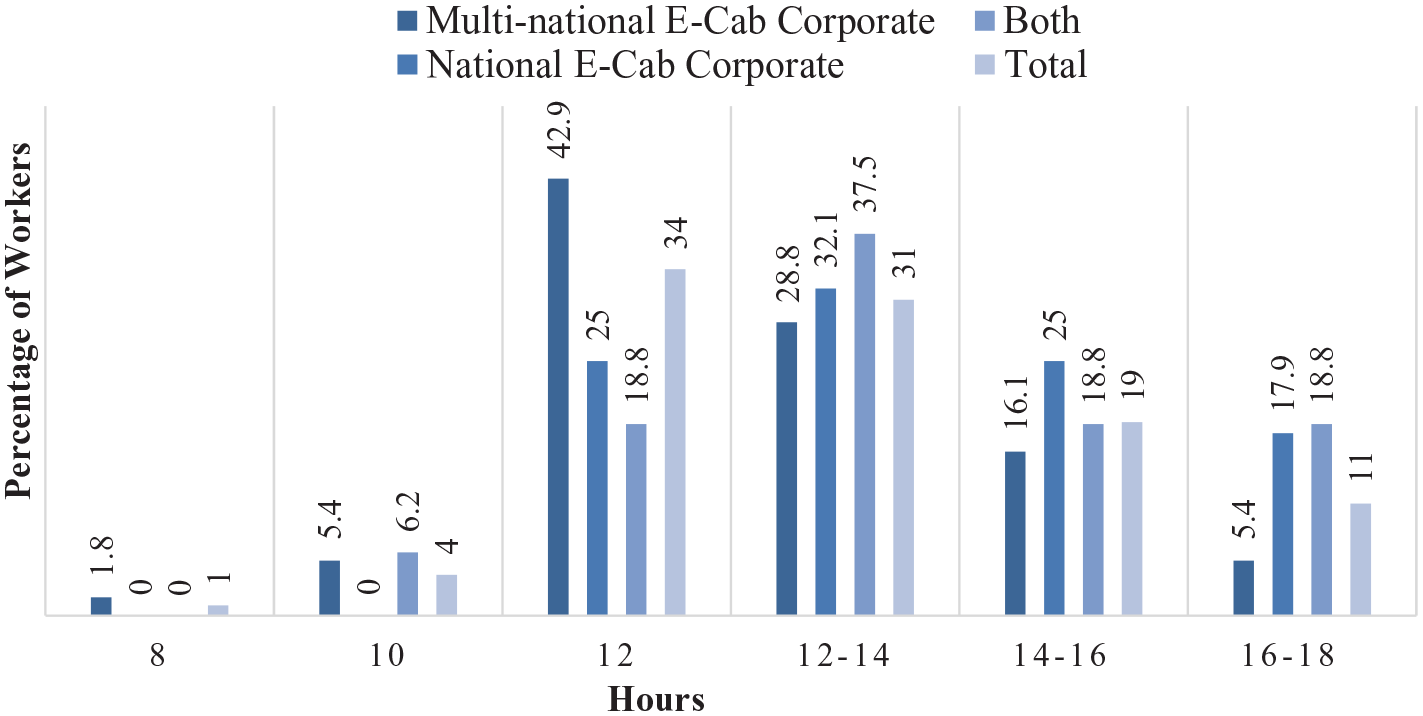
Hours worked by drivers in a day.
The concept of a break during work is also blurred whereby, despite having the choice, the service providers are reluctant to take it, as it means a significant loss in their earnings. As one of the respondents stated, ‘I have no fixed time to work as such . . . I go out to work at 4 pm and then work till around 1 am . . . I sleep in the car because if I go home, I will not be able to come out . . . then again at 4 am I switch on the device and work till 9 to 10 am . . . sometime I doze off during work . . . .’ The time off pattern and habits display significant variation, whereby 31% take time off on a weekly basis as against 36% who take time off once in 10 or 15 days. There are around 33% who do not take any time off so as to maintain consistency in login hours and also earn something for the day. Furthermore, service providers are opting not to take time off on various occasions where there is a viable prospective to earn additional income. Such occasions, in turn, serve to significantly increase the workload of the service providers with an increase in demand as well as rates. In the research, 92% of the service providers claim to work more than their regular working hours on occasions and within this, 9% work more than 18 hours a day.
The increase in working hours gives a general impression that there is a simultaneous increase in rides and thereby, prospects of earning. However, this is not so in e-cab services, where rides per service provider have been decreasing drastically with the significant increase in numbers of cabs in the city over time. This decline in the number of rides indeed creates significant pressure and stress, as claimed by 90% of the service providers, to meet their financial needs. The highest number of rides were recorded in 2014 with an average of 30–35 rides per cab per day. Since then it has gradually declined with rides reducing to 25–30 per cab in 2015, 20–25 rides in 2016 and 15–20 rides in 2017 (see Figure 2). The years 2015–2016 were claimed to be the golden years, where the service providers witnessed tremendous demand for their services and there were times when they did not even have time to use the toilet. In 2019, the same respondents hardly had 7 or 8 trips over 10 hours resulting in a drop in rides by over 50–60%. As per the current situation, 49% and 41% of the respondents get only 15–20 and 10–15 rides a day, respectively. Some e-cab service providers also stated that they might go to the airport in the morning and wait till evening without receiving a single ride and hence come back empty-handed.

Average number of rides per e-cab service provider per day.
Income structurisation: Formal and informal means
There has been much hue and cry over the drastic decline in earnings among the service providers relative to their initial months of joining. The e-cab economy was introduced with an unparalleled incentivisation system which was suddenly suspended after the companies gained significant market penetration. At present, the entire mechanism is seen to be running on the ‘no work no earnings’ principle, like Taylor’s (1947) piece-rate system. There is no guaranteed payment or regular earnings in the service and hence drivers are highly subject to fluctuating incomes. This is related to the zero-hours contract wherein the workers are not guaranteed any specific hours of work by the employer and are at the same time basically subject to work at extremely short notice. It thereby portrays a vulnerable market wherein the workers are not covered under minimum wages or overtime payment, and in some shifts, they do not earn any money at all (Aloisi, 2016; Clarke and Urata, 2016; Davidov, 2017). As a new initiative on this front, New York has passed a minimum pay rate of around $17 per hour for drivers working in Uber and Lyft as against the $11.90 earned previously (Ghaffary, 2018).
The decrease in earnings over the years has been related to increasing numbers of cabs, where starting with around 36 cars, these companies have around 10,000 cars operating in the city at present. Around 87% of the respondents claim that they are experiencing a decline in earnings as compared to what they earned at the time of starting the work. As shown in Figure 3, the average income reported by the e-cabs service providers in the year 2014 was around Rs. 70,000 13 per month. In 2015, the average earnings declined to Rs. 50,000 with around 82.4% of the respondents earning above Rs. 30,000. In 2016, the average earnings further declined to Rs. 45,000 with the lower range of earnings falling to Rs. 25,000 and the higher bracket reducing to Rs. 65,000 as compared to Rs. 80,000 in 2015. In 2017, the average income was around Rs. 25,000 with the lower range being around Rs. 10,000 and the higher income Rs. 40,000.
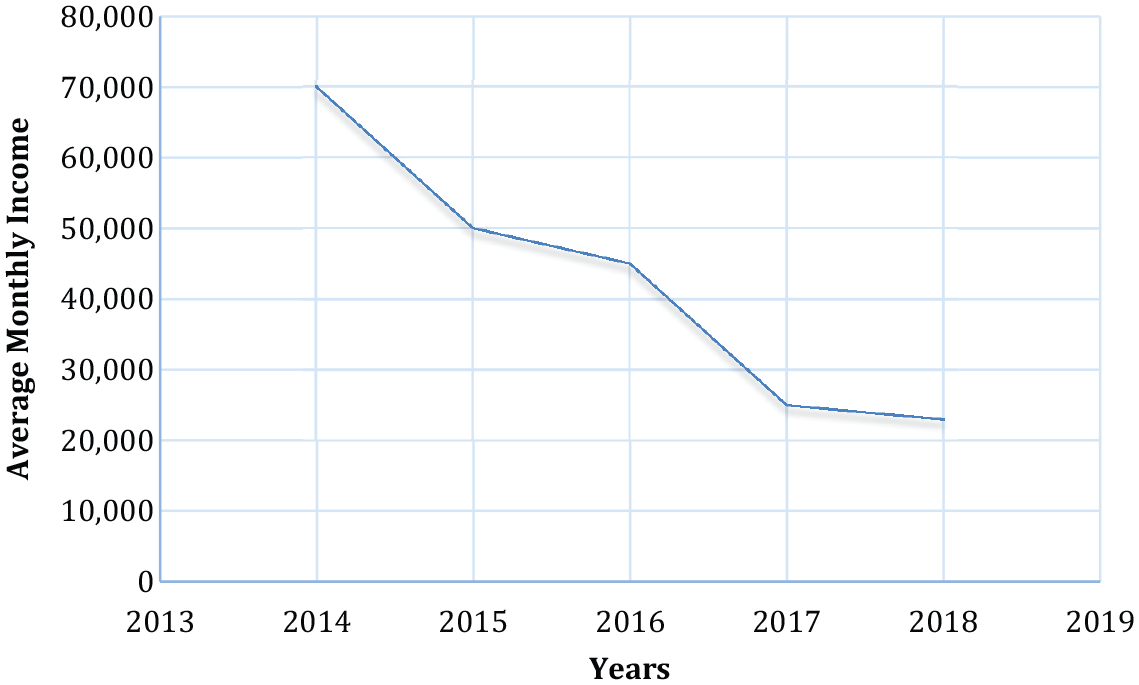
Average monthly income (Rs.) per e-cab service provider.
The incentive that served as the main mechanism for market penetration by these e-cab companies is now the major cause of concern and dismal status of the service providers. Initially, the incentive system was on an income basis whereby the service providers were granted a 200% incentive on the income earned in each trip. This was gradually reduced to a 100% incentive implying say an incentive of Rs. 100 on a ride amounting to Rs. 100. This system provided scope to the service providers to earn an additional amount ranging from Rs. 40,000 to Rs. 45,000 in incentives over and above the normal earnings on rides. The incentive system based on the cash collected was then changed to a ride basis whereby, on completing a specific target in the week, the service providers were paid a specific amount weekly. In this, there were different slots allotted, like 75 rides per week, 100 rides per week and 125 rides per week. For 125 rides, the service provider received an incentive of Rs. 5698; for 100 trips, he received Rs. 4070; and for 75 trips, he received Rs. 2072. However, without any warning to the e-cab service providers, the entire incentive system was withdrawn. This was a massive blow to the e-cab service providers who entered the occupation with cars on loan in the expectation that the monthly instalments could be easily cleared with the incentives received. This has led to a severe debt trap for workers who can now neither move out of the services nor are they receiving any significant return on their investments. This is especially worrisome for those who sold off their rural properties to run these services in urban areas. There have been numerous strikes and protests all over India and Guwahati concerning this issue but there is no authority or negotiation space for the sector. One of the cab companies has maintained a difficult incentive system whereby the service providers are asked to secure Rs. 2200 per day with a minimum of three rides during the peak hours, which keeps changing weekly. However, what the service providers claim is that the company through certain technical arrangements does not allow the driver to complete the target and there have been instances where they miss the target by a mere Rs. 20. Further, another company has recently reintroduced its incentive system whereby they pay Rs. 700 on completion of 40 trips and Rs. 1200 on completing 60 trips per week.
The work environment in which these service providers are working has meant recourse to parallel work arrangements, mostly informal in nature. The unofficial arrangements or the informal organisation in these services are important in shaping their formal work organisation. The work schedule of these service providers is generally so tight as to negate the possibility to indulge in other activities. However, the incommensurability of their earnings to the costs involved makes the e-cab service providers look for other alternatives in the market. The most prominent practice highlighted through the research is offline services catered by the service providers. It resembles further informalisation within the ‘informal’ e-cab services whereby the unofficial services are provided in parallel to the routine services. These practices have mostly resulted from the workspace relations maintained by the service providers with customers and around 78% of the respondents claimed to be working offline along with online services. Within these, around 50% are using the offline mode of service only at times, usually when the need arises, whereas 18% are seen to be using it frequently. The other 10% is seen to be using this mode of service rarely and only on certain occasions. This has been a recent trend among the e-cab service providers arising predominantly since 2017 and 2018, which witnessed a significant drop in their earnings from e-cab services. These provisions prevail due to inadequate institutional means whereby the market also stands to gain through such informalisation. The problem is not about these e-cab service providers working in such informal ways because both the state and the companies have failed to look after their interests. Rather, the problem emerges when, despite the growing precariousness in the informal sector, these actors promote and allow further degradation. In short, these cabs are trying to assume the work structurisation of normal auto-rickshaws in the city whereby, at more or less the same rate, they lure customers to provide a better service. This also has major repercussions on those e-cab service providers who are working only in online services, subject to taxes and fees from their respective companies.
Contested social relations: Ambiguous and conflicting work relations
The work organisation in e-cab services, apart from the internal structuring, is also significantly influenced by the work environment in which the work is performed. The work relations developed at the workplace, as well as workspace, significantly shape the work organisation. The origin of work sociology or management was more concerned with the technical aspects concerning work; however, with the evolution of the human relations school or neo-human relations school, the focus shifted to the relations practised at work. With the emergence of critical or radical perspectives of work organisation (Burawoy, 1979; Friedman, 1977; Littler, 1990) more emphasis has been placed on job design, employment relations and power relations. Drawing on the employment relations framework of Leat (2007) and Blyton and Turnbull (1998), this research considers the aspects of employee relations procedures, employee relations processes and employee influence. It is important to highlight that employment relations represent the economic, social, psychological and political linkages between the employers and their workers (Baron, 1988, cited in Kalleberg, 2009). These gig services are operating more on the psychological linkage rather than economic, social and even political linkages. It is no longer feasible to examine the current relations through those benchmarks set by traditional standardised social relations and protocols at work. This section discusses the organisational structure, employment relations and negotiation practices encountered in e-cab services.
Ambiguous organisational structure
There has been a massive restructuring of organisations especially in the context of these contemporary gig companies. This can be linked to workplace restructuring, comprising ‘new forms of organizing work, new workplaces (including work at home), new work relations (including with customers), new work hours, and new legal forms . . . in which there is ambiguity and often no clear responsibility for training, health and safety, benefits, legal obligations, and the other societal demands of the workplace’ (Dunlop Commission, 1994: 1–2, as cited in Cornfield et al., 2001). ‘Aggregating’ in e-cab services is nothing but another arrangement for contracting out work. This service signifies a new form of flexibility in work organisation whereby work is contracted out to individuals rather than to an establishment or firm. Flexibility in the post-Fordist era banks on decentralised leadership with horizontal communication among self-regulating units and relatively weak power controls. However, it is not the same in the context of e-cab services where the degree of formalisation and standardisation in procedures and instructions is relatively medium in nature. Similar to adhocracy, these companies are seen to centre around their support staff who connect the service providers with the companies. Adhocracy serves as an alternative bureaucratic form and, as Mintzberg highlights, is the ‘structure of the future’ (Thompson and McHugh, 1990, 2002). A structure based on adhocracy is a highly organic structure, characterised by an increase in horizontal job specialisation, informalisation of behaviour and greater significance of the work of the support staff (Mintzberg, 1983). The support staff in e-cab companies are responsible for registering the e-cab service providers, training them at work, and also following up on further courses of action during work. The documentation process involved in this service is extremely cumbersome and rigorous, in which the service providers are not only subject to checks at the organisational level but also to state scrutiny. Once these are checked and verified, the applicant is registered as a service provider and then trained on the company policies, practices, service delivery and most importantly, the application usage. In this case, an entry cum security deposit, in the form of a one-off payment, is also charged to the e-cabs service providers.
An e-cab company is virtual in nature with a flat superstructure that allows flexible lateral linkages and ‘decentralised decision making’ among the workers concerned. However, these companies, despite these characteristics, resemble more or less rigid structures, especially when it concerns the e-cab service providers. The organisational structure is ambiguous, and characterised by both bureaucratic and post-bureaucratic features. With regard to the level of authority and decision making, the work of e-cab service providers, unlike other work, is somewhat individualistic or so-called ‘flexible’ in nature. Individualistic or ‘flexibility’, in this context, implies that the willingness to work or not to work, or when to work, rests upon the e-cab service providers. It has already been shown that such flexibility is highly contested and limited, whereby the service providers have no authority over their rides, incomes, or even behaviour. Even with regard to decision making, the micro level, as discussed above, is partially restricted and highly controlled by the company. On the other hand, at the macro level, implying decisions concerning the work organisation, it can be seen that the companies maintain complete control over the design of work, income and incentive structurisation, ride allotment and so forth. Neither are the service providers included in the consultation process concerning these aspects or informed about any initiative being proposed to change the existing work arrangements. Furthermore, the companies are seen to be taking drastic decisions or changes as per the requirements of the external environment. This, as a part of the contingency approach, has major repercussions on the work of the e-cab service providers. As an example, if there is a sudden rise or decline in the ride rate, these service providers are required to take calls within seconds thereby leaving no scope to understand the market demand and organise their work accordingly. Though the first impression of these organisations reveals a non-hierarchical organisational structure, there is evidence of bureaucratisation when examined at the levels of authority and decision making. While there is much discussion on the growing informalisation of formal structures or the flexibilisation of bureaucratic structures in work organisation, the service structure of e-cabs adopts the opposite approach. In other words, there is bureaucratisation within adhocracy. It works on a hidden bureaucratic structuration within the anti-structural or post-bureaucratic organisational design.
However, with regard to communication channels, similar to adhocracy, there is more reliance on informal communication and mostly the app serves as the first contact ‘person’ and thereafter it is routed to the support staff. The service providers are not allowed to approach the higher managerial rank, irrespective of the issues concerned. Furthermore, the toll-free numbers provided to the service providers are not user-friendly as most drivers do not speak English and even when it is accessible, complaints are rarely addressed. There is, on the one hand, unilateral communication that takes place among the e-cab service providers and the virtual channels of communication, and on the other, bilateral and ineffective communication between the e-cab service providers and the support staff. The support staff, as per Mintzberg’s (1983) characterisation, are indeed seen to be working with other core members of the team to provide necessary inputs, market information and the like, gathered via service providers.
Disguised employment relations
Employment relations are the economic, social, psychological and political linkages between the employers and their workers (Baron 1988, as cited in Kalleberg, 2009). These employment relations, as Kalleberg (2009) highlights, have undergone significant changes with the transformations in managerial regimes and systems of control. Through the advent of the gig economy, the standardised employment relationship has moved towards informalisation, or non-standardisation. The negotiation is mostly implicit in nature, often avoiding culmination in written agreements, and thus the terms, conditions and performance expectations are mostly communicated orally during the registration of the service providers with the companies. The companies get more leverage in these slack markets as the regulatory authority is still occupied in evaluating the position of these companies and the workers in these services. Drawing on Otto Kahn-Freund’s (1972) conception of employment relationships, the relation between the e-cab service providers and their companies is one based on power and consequent acts of subordination and submission. The companies tactfully structure the work with an emphasis on ‘responsible autonomy’, as seen in Friedman’s (1977, 1990) labour process theorisation. However, on closer observation, the service providers are merely seen to be acting as agents taking on the instructions of the application and succumbing to the practices of the technology and the companies. The real employment relationship is disguised, whereby the service providers, while being framed as self-employed, are seen to be working as any other blue-collar worker in an organisation. With regard to arrangements and practices at work, as well as work relations at both state and organisational level, the service provider is not, in any real sense, seen to be working as self-employed but as a mere employee of these companies. The work organisation is indeed responsible for blurring the known and accepted boundaries. The application on which the work of these e-cab service providers is based is not accorded the status of a control apparatus simply because there is no visible human involvement in it. According to the labour process debate, power and control would be understood to be mostly attributed to humans. However, as stated in the previous sections, technology has evolved in a manner whereby invisible power and control structures are created that camouflage the precarious labour practices involved. Similarly in the context of e-cab services, as Edwards (1979) highlights, the companies have designed the apps in a manner that not only manages the content and pace of work but also acts as labour control.
The work organisation and work relations are extremely structurised, however the entitlements and rights are blurred and ignored under ‘no employment relation’. The disguised nature of the employment jeopardises rights at work, be it in relation to receiving minimum wages, having access to safe and secure working conditions, or receiving redress for grievances, and so on. One emerging concern regarding rights at work in e-cab services is related to occupational safety and health. There are hidden health hazards in these services arising due to work structurisation and the external environment in which the service is delivered. Work on wheels, as highlighted by Sharma (2017), possesses significant challenges for the health of the service providers. Being work based on continuous movement, spanning 12–18 hours a day, the service providers face different issues in terms of their health. As per the research, physiological issues account for an average of 46.6% of the problems faced by the service providers whereas 94% of respondents claim to suffer psychological stress at the workplace and workspace. The companies are well known to avoid workers’ rights on employment grounds and even the state turns a blind eye to such practices, including its duties to protect this marginalised workforce. Though occupational safety and health has been considered a basic right at work, including some believing it to be a human right rather than work right, its importance has declined drastically in the context of these services. The e-cab companies have no provision either for the Employee State Insurance Scheme (ESI) or other sick pay or compensation. There is provision for accident insurance, however its coverage and liability are conflictual. Though some have suggested the creation of ‘portable benefits’ 14 for the workers in the gig economy (Davidov, 2017; Fenwick et al., 2016), in the case of India, it would be problematic as the services are highly scattered and the state also has no record of these service providers. Further, the state’s outlook towards these gig workers is indifferent; it promotes such work to increase the national employment count but pays no attention to basic rights and protection at work. The social security schemes are also not adequate to look after the general health issues and expenses of these service providers, who can be claimed to be working in an informal economy.
Limited negotiation and bargaining scope
As highlighted above, restructuring, in addition to changing employment relations, has also significantly restricted the negotiation and bargaining space for the e-cab service providers. The drivers are constantly exposed to issues and confrontation at the workplace as well as the workspace, be it with regard to changing company policies and practices or wrongful behaviour by the owners and/or customers. The blurred negotiation boundaries prohibit the service providers from approaching, let alone seeking redress from, their respective companies. However, a certain space has been included ‘on paper’ to ‘communicate’ with the companies about issues faced at both the workplace and workspace. The most common and quickest method is said to be the feedback mechanism through the comment section in the app that allows the service providers to submit their complaints online. However, its approachability and usability is questionable as the language, English, is not familiar to many service providers and it somehow merely acts as psychological appeasement as there is no guaranteed action once a complaint has been placed. The second tool is to call a toll-free number that connects the service providers to offices operating in other parts of the country. Some prefer to approach the support staff directly, especially when the issues are financial in nature. However, these two approaches suffer from the same problems, that is, language and inadequate action in regard to complaints registered. Apparently, the resort to support staff is preferred by the service providers as they can vent their frustration and stress arising due to work practices.
With regard to external issues at the workspace, arising with customers, traffic police and/or fellow transport providers, the companies do not provide any form of support to the e-cab drivers. For example, a significant incident occurred between the e-cab service providers and some local unions in 2016. The clash was initiated between the e-cab service and some students where the latter declined to follow certain protocols during a late night trip. However, it got further aggravated when the traditional transportation unions, mostly the auto-rickshaw drivers, started using the students’ union as a puppet in the game. Several cabs were destroyed during the clash, however neither the state nor the companies interfered in the matter. Even in issues arising with customers, who serve as an integral part of the service, the companies do not address these. While the companies may, on the one hand, give the service providers ‘freedom’ to handle their rides, they are only responsive to their customers. That is, when the customers provide a negative feedback or review, the rating drops immediately, leading to the vicious circle of low ratings, low rides, and hence, low earnings. Similar to issues arising at the workplace, the negotiation techniques available for external complaints comprise the feedback mechanisms in the app, mostly through the ratings system, and resort to support staff only in certain extreme or urgent cases. According to the research, around 10% of the respondents claim that there is actually no grievance redressal mechanism in these companies. Around 40% of the respondents who have used the methods claim no action was taken, whereas the slightest complaint against the service providers themselves is seen to have huge repercussions. With regard to complaints regarding non-payment of fares, 10% of the respondents claim to have received adjusted fares on their next trips. However, such adjustment, especially for cash trips, is subject to different verification procedures. Hence, the negotiation space of these service providers is extremely blurred: there is a mechanism through which issues can be registered but again its effectiveness is highly questionable. Hence, the entire employment relations or work relations are based on psychological arrangements where the service providers are made to believe they are associated with an organisation without having any economic, social or political linkage with the same.
Collective bargaining is extremely limited where the e-cab companies acting as aggregators tend to refuse to entertain any demand put forward by the service providers. The service providers claim that the companies mostly will not agree to meet the leaders or members of the union even after repeated attempts at persuasion and pressure. As per Clegg’s (1976) dimensions of the structure of collective bargaining, the scope, level and depth of bargaining are extremely limited among the service providers. The concept of collective bargaining in gig economies is highly questionable anyway as there is no explicit employment contract signed between the parties. The entire service operates on an implicit psychological contract that, in turn, acts as the reason for evading bargaining practices. Hence, the extent of the bargaining process in these companies is itself flawed and limited. The depth of bargaining in e-cab services is further limited as certain service providers themselves avoid participating in these bargaining techniques. The lack of trust among the members and of their capability is the main reason for such non-participation. As for union security, there is no support from either the company or the government for the activities of the union members. These e-cab service providers have continuously approached state officials and even organised joint meetings with the company officials concerned. However, these have not turned out to be beneficial in any way.
The level of bargaining that is taking place in these unions is restricted to local level bargaining where requests are placed at both company and state level. In this, however, e-cab unions operating in other cities are seen to be supporting these local unions to put forward their demands. The degree of control over collective agreements is extremely low as there is no obligatory standard and machinery for enforcing such agreements. The grievance mechanisms that are in place are mostly individualised in nature and there is no scope to opt for collective action in these services, unlike that in other industrial and traditional service sectors. Added to this, there is no agreement concerning such bargaining processes, which makes the concept of collective bargaining in these services highly questionable. Furthermore, the practices that can be pursued in this regard are mostly restricted to the preliminary level, where unions are confined, at the most, to put forward their demands or complaints to the support staff.
Conclusion
The e-cab services in India can be claimed to be operating under similar labour processes practised in formal establishments, but subject to informal and non-standardised work practices. The disguised employment relations and work practices are the premise on which these companies are operating and accumulating at local, national and global levels. The work structurisation and work relations in these e-cab companies have been responsible for blurring the known and accepted boundaries. This has led to ambiguity and confusion regarding the classification of the sector to which these services belong. In countries like India, such services being introduced with a short sighted view of lucrative earnings has led to a trap for the workforce as well as the state. The state has been criticised numerous times for allowing multinational and national corporate giants to operate at the margins of the country’s huge educated and uneducated unemployed labour force. The political economic scenario and the labour markets in India have been too flexible and vulnerable to look after the basic work rights, let alone the interests of these service providers. Furthermore, the selective (de)regulation is further creating space for the corporate giants to run their operations at the cost of the working poor.
There is a dual perspective in analysing the sectoral domain of these services. Their mode of operation is based on highly informalised settings wherein the service providers are seen to be operating under informal work terms. However, the same service providers can be seen to be working under highly formalised and standardised structures. The power and control dynamics are designed through technological intervention and monitored by the same. The claims towards power (re)balancing and subsequent empowering of the working class serves as a myth to lure people into the game. Further, the intrusion of the non-human element into the working and evaluation process has complicated the labour process through absolute rigidity and alienation. Drawing on Friedman’s (1977, 1990) concept of responsible autonomy, the e-cab service is seen to be banking on a similar kind of control mechanism. This has mostly been done through portraying the service providers as ‘independent contractors’ or ‘business partners’. This, on the one hand, has given the companies freedom from the responsibilities as employer and, on the other, trades upon the malleability of the service providers. Furthermore, as Littler (1990) highlights, the impact of technology on work, in the context of e-cab services, is visible through control over accountability, instructions and directions procedures. Despite considering these services as flexible organisations, significant control and authority is retained by the organisation through its technology. The technological impact and control over work in e-cab services relate to Blauner’s (1964) four ‘dimensions of alienation’, encompassing powerlessness, meaninglessness, isolation and self-estrangement. There is a high power imbalance in these services under the mirage of ‘self-employment vs disguised employment’. The subsequent separation between conception and execution of tasks does not allow the service providers to utilise their skills or creativity at work, leading to monotonous work being carried out. Thirdly, isolation from other fellow workers, as well as from self, is highly visible through the struggles confronted at the workspace wherein high emotional labour is also seen. These issues lead towards self-estrangement whereby the service providers are engaged in these services as a matter of survival rather than deriving any intrinsic meaning from it. The findings pave the way to analyse the impact of such work arrangements in the broader gig economy.
Considering the characteristics of the informal economy and non-standardisation (Chen, 2007; Fenwick et al., 2016; Hart, 1973; Kalleberg, 2000, 2009; Kalleberg et al., 2000; Moser, 1978; Tokman, 1978) these companies are working on a different level of disguised informalisation. Indeed, the gig economy can be seen as an organised form of informal employment with elements from both core and peripheral informal employment. It is relatively autonomous in orientation, non-routine in nature, well paid in comparison to traditional services but with employees not benefiting as much as the employer. Added to these, the services also require relatively higher skills and the relations between employer and employee are based on ‘cooperation’ rather than domination. However, there is evidence within the service of weak labour regulation, reduced access to trade union representation, no career upgrading and workers being subject to ‘hiring and firing at will’. The most pressing need in the current context is to develop an identity among the service providers whereby they can be allotted rights based on their occupational status. This actually marks the paradox of being an on-demand service provider that stands between the conflictual poles of petty bourgeoisie and worker. Further, the employment relations and work structurisation are generally not committed to paper but are carried out through implicit and psychological arrangements between the company and the service providers. This provides the companies the leverage to exploit their workers through hidden work arrangements. However, these work relations signified by unwritten arrangements and tacit understandings, unlike the conclusions in Edwards et al. (2003) and Ram et al. (2016), do not imply lenient autocracy, and indeed operate under a ‘wage labour relation’. The capital–labour relation in this work is socially constructed and mimics the relation found in formalised employment but at the cost of service providers’ degradation at work. Capital upgrading through technical control at work has been used in a manner that has led to de-skilling of the service providers as well as relative economic and social degradation. Through disguising or (de)regulating the employment relation, the companies have exposed the gig workers to issues where even the state is grappling to secure the basic rights for these service providers. Advocates of gig economies mostly portray them to possess the potential to transform or alter the capital–labour relation as compared to Marxian debates on class conflicts. Proponents claim that these economies empower and raise the service providers into an ‘owner’ class that helps them in both economic and social upgrading. This is also considered by some to lead towards alteration in the production economy, the production regime as well as the capitalist system in particular. However, through the Schumpeterian ‘creative destruction’ model it can be observed that these economies have indeed empowered the capitalist regime to remain intact, while further challenging the fragmented and insecure workers in the informal sector in India.
This capital–labour relation indeed impairs the social relations practised at work. The gig economy has challenged the relations involved in capitalist production through alterations in social relations without really affecting the power dynamics involved. The economy is seen to have created a different workforce signified by relatively different working relationships, ideology and culture. The capital–labour relations depict space to create agency among the service providers, however, as Burawoy (1979) highlights, the managerial practices are seen to breed significant individualism at work through localised politics of production. The separation of ‘relations of production’ from ‘relations in production’ has led to growing individuality where each worker is driven towards maximising their own earnings through maximising production that is ultimately benefiting the system. Hence, the social relations are designed in a manner that mostly breeds competition, alienation and individualism. These conflicts and antagonisms are so well maintained and suppressed that the service providers are caught in the loop and cannot move forward to collective solidarity in these services. The technical control is designed in a manner to make the individual services highly rewarding where the service providers alienate themselves from the larger interests of the service class. However, each individual service provider has underlying conflicts that are not allowed to materialise through work and other institutional arrangements in these gig economies. This is indeed an important cause that leads to low unionisation and solidarity among the gig workers across the globe.
Footnotes
Declaration of conflicting interests
The author declared no potential conflicts of interest with respect to the research, authorship, and/or publication of this article.
Funding
The author received no financial support for the research, authorship, and/or publication of this article.
