




Abstract
Work intensification and job insecurity undermine the quality of working life. To what extent can different types of employee involvement in decision-making ameliorate their impacts on employee well-being? Deploying job demands–resources theory and interrogating the European Working Conditions Survey 2021, this study shows that work intensification and job insecurity reduce well-being via lower work engagement and higher exhaustion. While each enhances job quality, individual organizational influence has a greater effect than task discretion in suppressing the negative effects of work intensification. The largest gains for employee and societal well-being will come through greater worker involvement at this level of participation.
Introduction
Job quality ‘comprises those characteristics of a job that normally contribute to allowing workers to fulfil their material, social and psychological needs from paid work’ (Berg et al., 2023: 349). Certain characteristics of the working environment, however, threaten the quality of jobs and, consequently, the fulfilment of worker needs or their well-being. Work intensification and job insecurity are two of the most critical factors that undermine job quality. The former is associated with increasing work demands during the individual’s working hours, a process that can generate negative outcomes such as role overload, fatigue and work–life imbalance (e.g. Anderson-Connolly et al., 2002; Fein et al., 2017; Green, 2006; Macky and Boxall, 2008). For its part, job insecurity, characterized by contingent or precarious employment conditions, is one of the most undesirable features of contemporary labour markets, rendering it more difficult, if not impossible, for workers to secure regular income and, thus, participate more fully in the material and social benefits of society (e.g. Kalleberg, 2011; Standing, 2011). Based on an analysis of workplace regimes in Europe from 1995 to 2015, Ó Riain and Healy (2024: 439, 440) underline the growing influence of the twin threats of ‘pressure and precarity’ and argue that there is an ‘ever-narrowing path to the “good job”’.
What defences do we have against these negative forces? One potential suppressant is greater employee involvement in decision-making. This is commonly defined as of two types or on two levels: the first is the extent to which individual workers have task discretion, exercising direct control or autonomy in how they do their job (Boxall et al., 2019; Gallie, 2013; Lopes et al., 2017; Wood and Ogbonnaya, 2018). The second level is more variably defined across these sources, but the essential issue is the extent to which workers can influence higher levels of decision-making that affect their work. They may, for example, take part in the decision-making of a self-managing team or engage in problem-solving activities associated with a lean production or service system in which their job is embedded. The demand–control model (DCM) of job strain argues that the opportunity for workers to make work-related decisions can reduce the incidence of unhealthy ‘high-strain’ jobs that combine low decision latitude with high levels of pressure (Karasek, 1979). Similarly, research suggests that participative decision-making in work reorganization can better inform and engage workers in ways that reduce feelings of job insecurity and their impact on job satisfaction and turnover intentions (Gallie et al., 2017; Probst, 2005).
In this article, we broaden the theoretical lens to apply the job demands–resources (JD-R) model to our analysis (Demerouti et al., 2001). Our goal is to address the question: to what extent can different types of employee involvement in decision-making suppress the negative impacts of work intensification and job insecurity on employee well-being? In accordance with JD-R theory, we aim to assess the links between work intensification and job insecurity and well-being via the mediators of (lower) work engagement and (higher) exhaustion and to test whether task discretion and individual organizational influence moderate the negative impacts on worker well-being of work intensification and job insecurity. To do so, we use one of the largest datasets currently available: the European Working Conditions Survey (EWCS) 2021.
The analysis enables us to make contributions to ongoing issues in the literature on types of employee participation and the quality of work (see for example: Gallie, 2019; Lopes et al., 2017). Research by Gallie (2013), using the British Skills Survey 2006, implies that task discretion and individual organizational influence are both helpful in ameliorating work intensification but that the former has the more powerful effects. Our analysis of the EWCS 2021 confirms the value of each form of involvement but shows that individual organizational influence is the more powerful moderator of work intensification across Europe as a whole. Furthermore, in contrast to Gallie et al.’s (2017) study of the British Skills and Employment Survey 2017, we show that neither task discretion nor individual organizational influence alleviates the negative effects of job insecurity on European well-being, although this result may reflect the particular survey items in EWCS 2021. These are important contributions to the theory of employee participation, with consequent policy implications.
We begin by outlining core concepts in our theoretical framework and justifying our hypotheses. Following a description of the research method, we present our results. The final section of the article presents our discussion, limitations and conclusions.
Theoretical framework and hypotheses
The job demands–resources (JD-R) model (Demerouti et al., 2001) provides a valuable, though not entirely comprehensive, framework for examining the quality of work (Boxall and Purcell, 2022). According to JD-R theory, job demands and job resources influence employee well-being through motivational and health-impairing pathways. The motivational pathway posits that job resources, such as autonomy, variety, feedback and supervisor support, help employees achieve their goals and foster work engagement, a state of mind in which employees feel energized, absorbed in and enthusiastic about their work (Bakker and Demerouti, 2017; Schaufeli, 2014). Job demands are characteristics of the job that ‘require sustained physical and/or psychological effort’ and, thus, can lead to exhaustion and, when chronic, employee burnout (Demerouti and Bakker, 2023: 214). It is commonplace to categorize them as either challenges that positively stimulate employees or hindrances that ‘interfere with an individual’s work achievement’ (Cavanaugh et al., 2000: 68). As demands, work intensification and job insecurity are likely to undermine work engagement by generating role overload, in the case of the former (e.g. Huo et al., 2022), or undermining employee confidence in management and in their prospects of continued employment, in the case of the latter (e.g. Gallie et al., 2017).
On the other hand, task discretion and individual organizational influence are two forms of job resources. As Lopes et al. (2017: 451) emphasize, it is ‘crucial’ that they are distinguished. In this article, we follow Gallie and Zhou’s (2020) analysis of EWCS 2015 in using ‘task discretion’ as the preferred terminology for describing the scope workers have to control their ‘immediate’ job tasks and speak of ‘individual organizational influence’ for the second level or type of participative decision-making. The latter turn of phrase helps to underline that we are talking about the influence individuals may have in decisions about the organization of their work and their working environment in addition to, or instead of, immediate task control. Both are types of direct rather than representative (e.g. union-mediated) participation but Gallie’s (2013) research alerts us to their potential to have different effects, and different sizes of effect, on employee well-being. In an analysis of the British Skills Survey (BSS) 2006, he shows that task discretion ‘had the strongest influence on employees’ welfare’ (Gallie, 2013: 470). Whether this finding can be generalized across Europe is something that we can test through the analysis of EWCS 2021.
As far as the JD-R model is concerned, both types of direct participation are likely to foster greater engagement. Task discretion can do so by enabling employees to control their methods and experiment with them through ‘trial and error’, unlocking more of their creative ideas and energy in shaping the job and their response to its demands (Gallie, 2019: 378). Individual organizational influence can do so by involving employees in the important information flows and decisions that shape the productive system and work environment in which their job is embedded, which is likely to foster their understanding, contribution to organizational success and commitment (Gallie, 2019; Probst, 2005). Accordingly, we hypothesize that we will see the following relationships between engagement and these demand and resource factors:
Hypothesis 1: Engagement is (a) negatively associated with work intensity, (b) negatively associated with job insecurity, (c) positively associated with task discretion and (d) positively associated with individual organizational influence.
As Tuckey et al. (2017: 372) explain, certain types of hindrance demand are ‘threats’ that can inflict ‘personal harm or loss’. Work intensification, characterized by a faster work pace and tighter deadlines, is likely to harm employees through increasing exhaustion and role overload. Similarly, job insecurity is likely to increase exhaustion through the anxiety it generates about their future employment. On the other hand, task discretion enables workers to use their personal knowledge and experience to take actions that better organize their tasks and thus reduce the potential for harm, while individual organizational influence gives employees a voice in important decisions relating to their work organization and its reorganization over time, potentially enabling them to help tackle the drivers of exhaustion or insecurity in their environment (e.g. Gallie, 2013; Gallie et al., 2017; Probst, 2005). In respect of the latter, as Gallie (2019: 382) argues, ‘participation is conducive to better communications’ and ‘involvement in decisions . . . restores some of the control that is eroded by job insecurity’. Accordingly, we hypothesize that:
Hypothesis 2: Exhaustion is (a) positively associated with work intensity, (b) positively associated with job insecurity, (c) negatively associated with task discretion and (d) negatively associated with individual organizational influence.
Consistent with these hypotheses, the JD-R model sees resources, such as task discretion and individual organizational influence, as fulfilling a buffering role, moderating the negative impacts of hindrance demands or threats on engagement and alleviating the negative impacts on exhaustion (Demerouti and Bakker, 2023). Accordingly, we formulate the following hypotheses:
Hypothesis 3: Task discretion weakens the negative association between engagement and (a) work intensity and (b) job insecurity. Task discretion weakens the positive association between exhaustion and (c) work intensity and (d) job insecurity.
Hypothesis 4: Individual organizational influence weakens the negative association between engagement and (a) work intensity and (b) job insecurity. Individual organizational influence weakens the positive association between exhaustion and (c) work intensity and (d) job insecurity.
In the JD-R model, as attested by numerous studies, engagement and exhaustion are expected to have positive and negative effects, respectively, on employee well-being (Demerouti and Bakker, 2023). They act, then, as mediators, transmitting the impacts of the threats of work intensification and job insecurity on well-being. Accordingly, we hypothesize that:
Hypothesis 5: Well-being is negatively associated with (a) work intensity through lower engagement, (b) work intensity through higher exhaustion, (c) job insecurity through lower engagement and (d) job insecurity through higher exhaustion.
Finally, resources such as task discretion and individual organizational influence can be expected to moderate the mediating relationships noted above (Bakker and Demerouti, 2017), thereby reducing the transmission of the negative effects of work intensification and job insecurity through lower engagement and higher exhaustion. As a result, we formulate the following hypotheses:
Hypothesis 6: Task discretion weakens the negative association of well-being with (a) work intensity through lower engagement, (b) work intensity through higher exhaustion, (c) job insecurity through lower engagement and (d) job insecurity through higher exhaustion.
Hypothesis 7: Individual organizational influence weakens the negative association of well-being with (a) work intensity through lower engagement, (b) work intensity through higher exhaustion, (c) job insecurity through lower engagement and (d) job insecurity through higher exhaustion.
Collectively, these hypotheses are depicted in Figure 1.
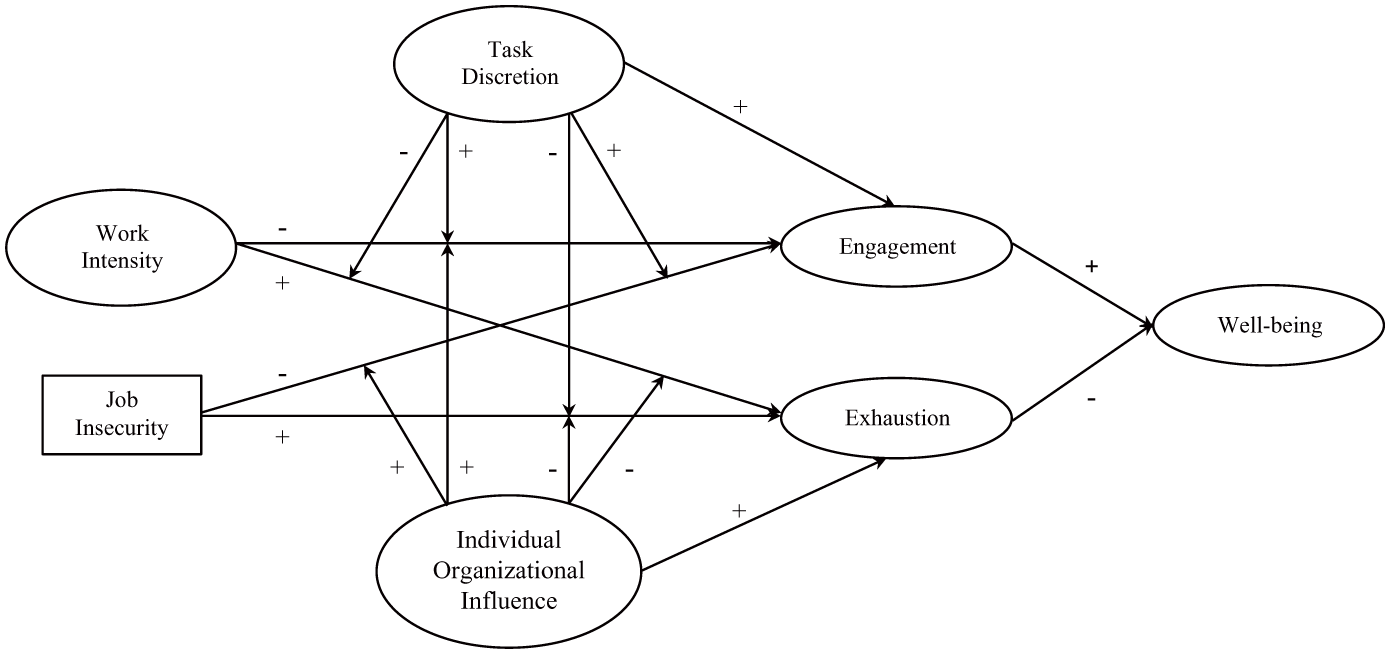
Hypothesized model.
Method
The data utilized in this study were sourced from the EWCS 2021, encompassing 71,758 respondents across 36 European countries: the Member States of the European Union plus the United Kingdom, Montenegro, Norway, Albania, Bosnia and Herzegovina, Switzerland, Kosovo, North Macedonia and Serbia (Eurofound, 2021).
Due to the COVID-19 pandemic, Eurofound conducted telephone interviews between March and November 2021. The study participants were individuals aged 16 or older who were employed at the time of the survey. A random probability-sampling approach was employed, generating nationally representative samples for each country (Eurofound, 2021). The current study exclusively focused on 62,126 employees, excluding self-employed individuals. Since about half of the respondents did not respond to the questions on engagement and exhaustion, 1 we ran our analyses both with the whole sample and a reduced sample (N = 31,084) of those who responded to the engagement and exhaustion questions. We compared the means of the key variables between those included and excluded in our final sample. The mean differences in task discretion, job insecurity, individual organizational influence and well-being are all less than 1%, while the difference in work intensity is 1.35%. We report the results of the reduced sample in the manuscript and the whole sample in the supplementary file. On average, each country had approximately 844 responses: Germany (1880) and Belgium (1861) had the highest and Albania (362) had the lowest.
Males accounted for approximately 51% of the respondents, while females comprised around 49%. 2 The average age of the respondents is 41.6 years. About 84% of the participants worked full-time, while the remaining 16% worked part-time. The average number of years with the current organization is 10.6 years. Concerning the occupational sector, 61% worked in the private sector, 30% in the public sector, 4% in joint public–private organizations, 2% in non-profit organizations, and the remaining individuals in other sectors. Twenty-four percent of respondents were employed in organizations with one to nine employees, 33% in organizations with 10 to 49 employees, 25% in organizations with 50–249 employees, and the rest (19%) in organizations with 250 employees or more. The sample size and demographic information for each country are provided in Table S1 in the supplementary file.
Measures
We followed Gallie and Zhou (2020) in selecting the items to measure each variable, allowing our results based on EWCS 2021 to be compared with their results based on EWCS 2015.
Work intensity
EWCS 2021 measured work intensity as an index by taking the average of two items employing a five-point scale, ranging from 1 (never) to 5 (always): ‘Does your main job involve working at very high speed?’ and ‘Does your job involve working to tight deadlines?’ Previous studies have utilized these items to investigate the relationship between work intensity and sustainable work (Avgoustaki, 2019) as well as well-being (Avgoustaki and Frankort, 2019).
Job insecurity
EWCS 2021 measured job insecurity using the item ‘I might lose my job in the next 6 months’ on a five-point scale, ranging from 1 (strongly agree) to 5 (strongly disagree), which has been employed to examine the relationship between job insecurity and psychological well-being (Pires, 2025). This item was reverse-coded such that a larger number represents higher job insecurity.
Task discretion
EWCS 2021 measured the index of task discretion by averaging the scores of three items that asked the respondents the frequency with which they are able to choose or change the order of tasks, the methods of work and the speed or rate of work in their main job, each utilizing a five-point scale from 1 (never) to 5 (always). Avgoustaki and Frankort (2019) utilized this index to find that work discretion is negatively associated with stress and positively associated with job satisfaction, using the EWCS 2015 data.
Individual organizational influence
EWCS 2021 provides an index of individual organizational influence when we average the scores of three items: ‘You are consulted before objectives are set for your work’, 3 ‘You are involved in improving the work organization or work processes of your department or organization’ and ‘You can influence decisions that are important for your work’. The respondents assessed the frequency on a five-point Likert scale, ranging from 1 (never) to 5 (always).
Work engagement
EWCS 2021 measured work engagement using the three-item Utrecht Work Engagement Scale (UWES-3; Schaufeli et al., 2019) on a five-point scale ranging from 1 (never) to 5 (always). Respondents were asked how often: ‘At my work I feel full of energy’, ‘I am enthusiastic about my job’ and ‘Time flies when I am working’.
Physical and emotional exhaustion
While previous studies only used the item ‘I feel physically exhausted at the end of the working day’ to measure (physical) exhaustion (Eurofound, 2019; Hakanen et al., 2019b), we also included the item ‘I feel emotionally exhausted by my work’ to measure emotional exhaustion, where participants were asked to evaluate the frequency of their experiences on a five-point scale, ranging from 1 (never) to 5 (always).
Employee well-being
EWCS 2021 assessed employee well-being using the five-item World Health Organization-5 Well-Being Index (WHO-5; World Health Organization, 2024). Respondents were asked how often they have been feeling ‘cheerful and in good spirits’, ‘calm and relaxed’, ‘active and vigorous’, ‘fresh and rested when you woke up’ and ‘that your daily life has been filled with things that interest you’ over the last two weeks, using a six-point scale, ranging from 1 (all of the time) to 6 (at no time). These items were reverse-coded such that a higher number represents a higher level of well-being.
We controlled for the effects of gender, tenure and workplace size, as previous studies found that these variables are correlated with engagement (Hakanen et al., 2019a) and well-being (Li et al., 2024; Marin-Garcia et al., 2020) in European countries. We also controlled for representation, ‘the exercise of voice through elected committees or trade unions’ (Gallie and Zhou, 2020: 57), because engagement has been found to be higher when employee relations are institutionalized through representative bodies (Gallie and Zhou, 2020). Representation was assessed by two questions: whether there was trade union/works council representation and whether a health and safety committee was in place.
Data analysis
All analyses were conducted using Mplus 8.10 (Muthén and Muthén, 1998–2017). Since EWCS 2021 involves complex survey data, we used the ‘core-weight’ variable in EWCS 2021 for sampling weight information (Eurofound, 2022) and the ‘country’ variable for clustering information to estimate the parameters. Following Asparouhov and Muthén’s (2010) suggestion to use bootstrap samples to generate replicate weights, we generated 2000 bootstrap samples to produce replicate weights for estimating the standard errors.
We combine all samples into one large sample after establishing configural and metric invariance, as the model is too complex for a multilevel model with random effects and interactions. Since the respondents came from 36 countries, we adjusted the standard errors of the estimated parameters for the non-independence of residuals by country using a sandwich estimator with the ‘TYPE = COMPLEX’ function in Mplus 8.10. Because of the large sample size, we adopted Type I error rates of 0.01 and 0.001 to test the main effects, and a 99% bias-corrected confidence interval (BCCI) to test the (moderated) mediating effects.
We tested the hypotheses using the four-step procedure for testing interaction effects described in Cheung et al. (2021). Step 1 involves examining the quality of the measurement scales. Step 2 involves estimating a structural model without latent interaction. Step 3 involves estimating the model with moderating effects. Since the two independent variables and the two moderators are indices, we created product terms between the components to test for interaction effects, rather than utilizing latent-moderated structural-equations modelling (LMS; Klein and Moosbrugger, 2000) for latent interactions. Step 4 involves producing the BCCIs for the mediating and moderated-mediating effects using 2000 bootstrap samples and conducting simple slopes tests if the moderating effects are statistically significant.
Measurement model
Before combining the data, we tested for configural and metric invariance on the latent variables across the 36 country samples. The fit indices of the configural invariance model are as follows: χ2(684) = 2,159.829, CFI = .970, RMSEA = .050 and SRMR = .032, indicating that the measurement model fits the data adequately across all samples. The metric invariance model, with all factor loadings constrained to be equal across groups, yielded fit indices of χ2(894) = 2,820.558, CFI = .961, RMSEA = .050 and SRMR = .058, indicating that the measurement model provides an adequate fit to the data across all samples. Since the change in CFI is less than −.01 after adding the constraints on factor loadings, we concluded that the metric invariance holds across the 36 countries (Cheung and Rensvold, 2002).
In Step 1, we performed a confirmatory factor analysis to evaluate the reliability of the measurement scales and their convergent and discriminant validity. Table 1 presents the descriptive statistics and correlation coefficients among the variables. The fit indices are as follows: χ2(89) = 680.542, CFI = .972, RMSEA = .015 and SRMR = .024, indicating that the measurement model provides a good fit to the data. Since reliability and convergent validity are only applicable to reflective measures but not to indices, we examined the construct reliability and convergent validity for engagement and well-being. The construct reliability of engagement and well-being is 0.68 and 0.81, respectively, which are deemed acceptable (Hair et al., 2009: 619). Regarding convergent validity, the factor loadings of all items are above 0.5, except for one item of engagement that has a factor loading of .48, providing initial support for convergent validity. Although the average variance extracted (AVE) for engagement (.42) and well-being (.46) are below .5, AVEs above .4, along with adequate reliability, could be considered evidence of adequate convergent validity (Fornell and Larcker, 1981). All (absolute) correlation coefficients are lower than .7, providing evidence for discriminant validity for our variables (Cheung et al., 2024).
Descriptive statistics (observed means, standard deviations and correlation coefficients).
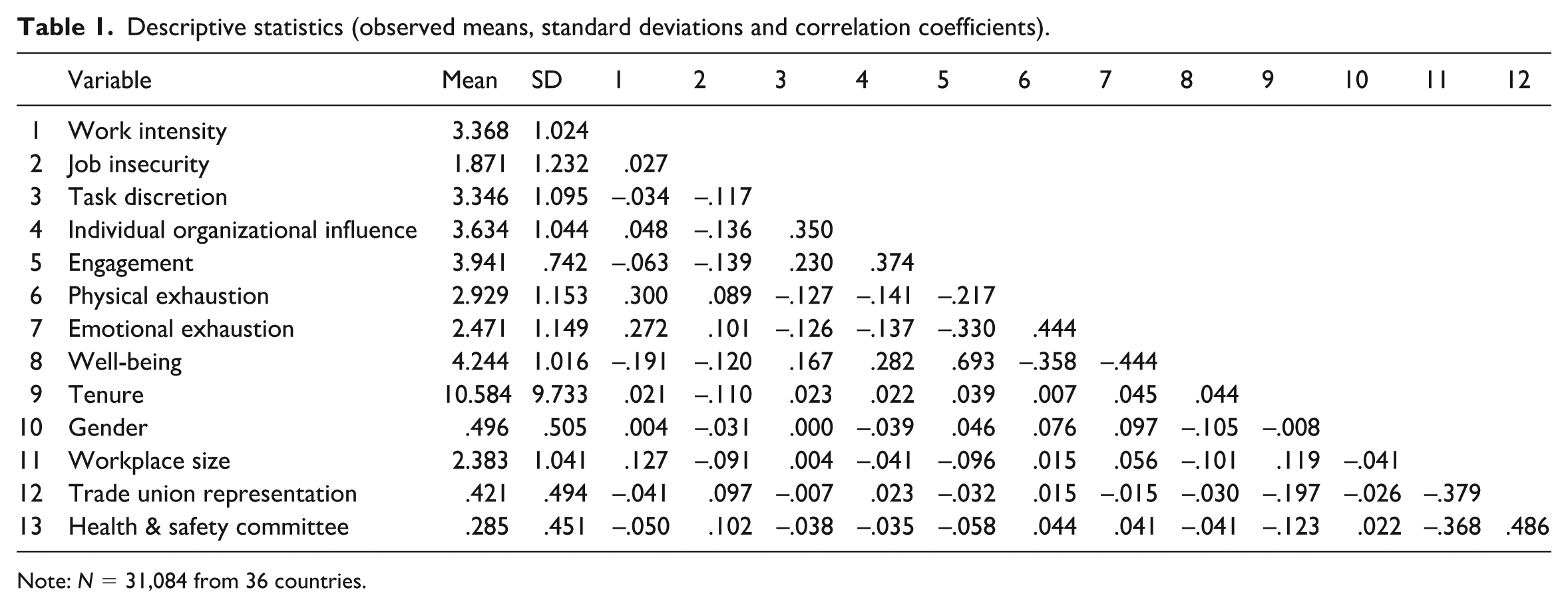
Note: N = 31,084 from 36 countries.
Structural model
Step 2 involves estimating a model without the latent interactions. Following Cheung and Lau (2012), we also estimated the direct effects of work intensity, job insecurity, task discretion and individual organizational influence on well-being in the structural model, ensuring that the indirect effects are unbiased. 4 We first estimated Model 1 with only the control variables and then Model 2 with all the main effects. The fit indices of Model 2 are as follows: χ2(89) = 680.546, CFI = .969, RMSEA = .015 and SRMR = .024, indicating that Model 2 provides a good fit to the data. Step 3 involves estimating the moderating effects in Model 3, which includes the interaction effects of work intensity with task discretion, work intensity with individual organizational influence, job insecurity with task discretion and job insecurity with individual organizational influence on work engagement, physical and emotional exhaustion. The fit indices of Model 3 are as follows: χ2(117) = 784.455, CFI = .968, RMSEA = .014 and SRMR = .021, indicating that Model 3 provides a good fit to the data. The regression coefficients of Models 1, 2 and 3 are shown in Table 2. In Step 4, we created the 99% BCCI of the mediating and moderated-mediating effects with 2000 bootstrapped samples to test the hypotheses. The results are shown in Tables 3 and 4.
Estimated regression coefficients of the analytical model.
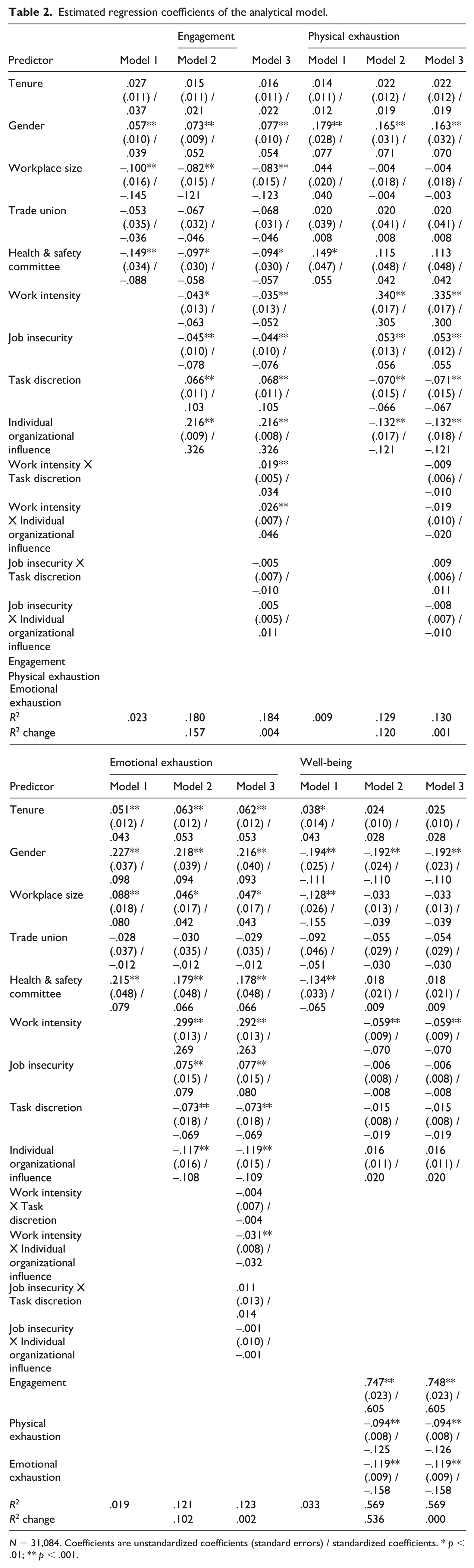
N = 31,084. Coefficients are unstandardized coefficients (standard errors) / standardized coefficients. * p < .01; ** p < .001.
Breakdown of relationships between work intensity/job insecurity and well-being.
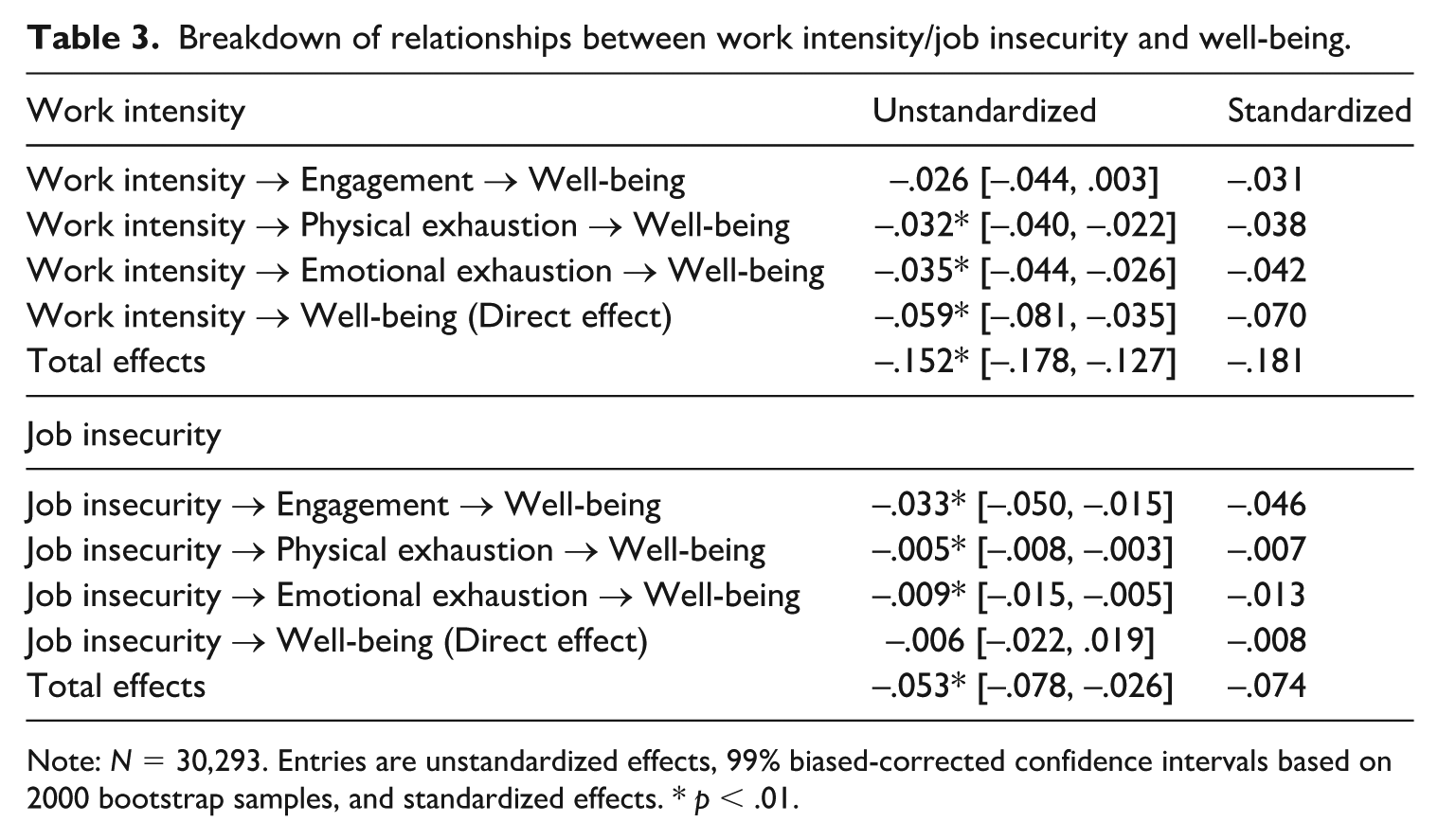
Note: N = 30,293. Entries are unstandardized effects, 99% biased-corrected confidence intervals based on 2000 bootstrap samples, and standardized effects. * p < .01.
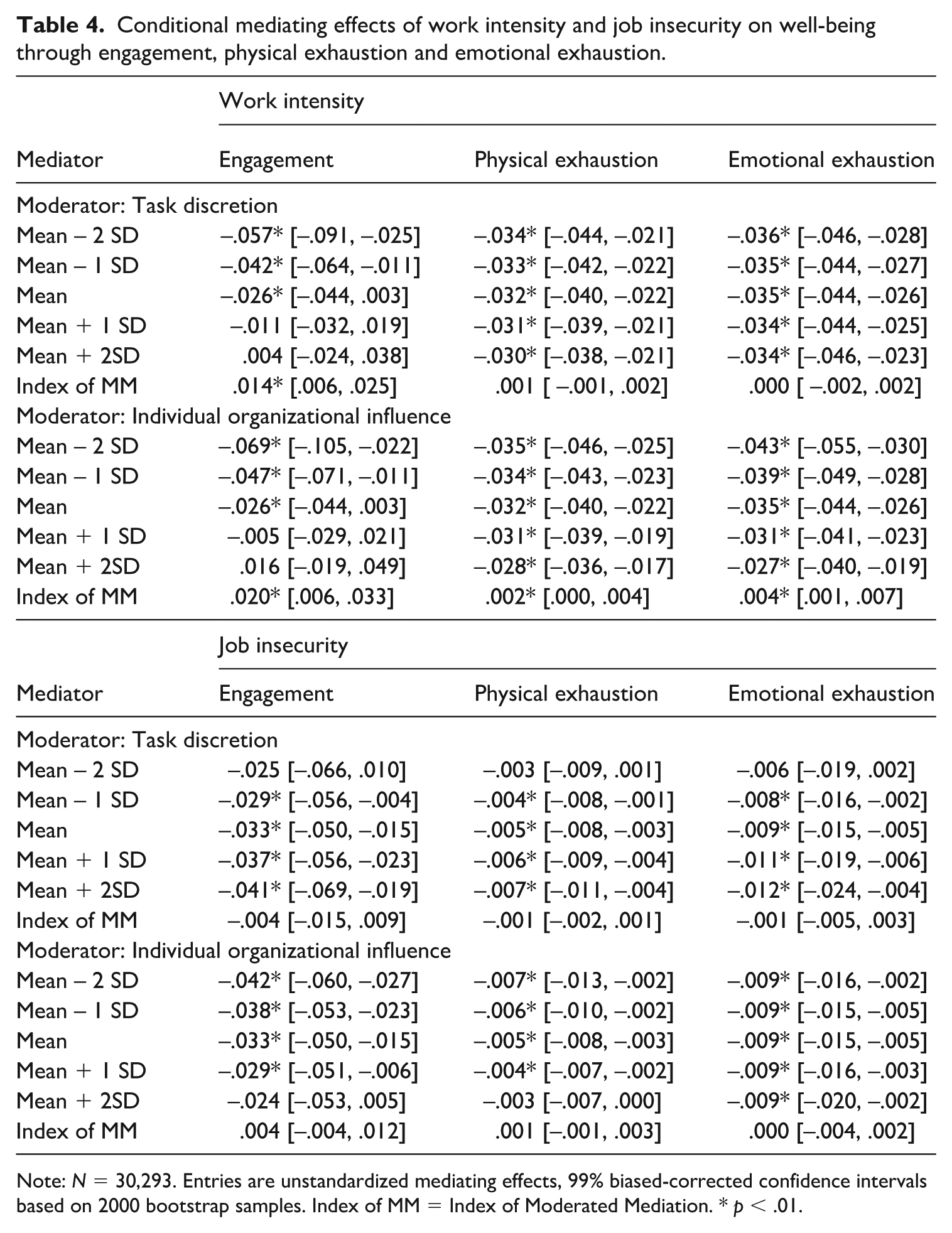
Conditional mediating effects of work intensity and job insecurity on well-being through engagement, physical exhaustion and emotional exhaustion.
Note: N = 30,293. Entries are unstandardized mediating effects, 99% biased-corrected confidence intervals based on 2000 bootstrap samples. Index of MM = Index of Moderated Mediation. * p < .01.
Hypothesis testing
Hypothesis 1 posits the relationships between engagement and work intensity, job insecurity, task discretion and individual organizational influence. The results of Model 3 in Table 2 indicate that work intensity (b = −.035, p < .001) and job insecurity (b = −.044, p < .001) are negatively associated with engagement, while task discretion (b = .068, p < .001) and individual organizational influence (b = .216, p < .001) are positively associated with engagement. All relationships are statistically significant with p-values lower than .001, supporting H1a to H1d.
Hypothesis 2 posits the relationships between exhaustion and work intensity, job insecurity, task discretion and individual organizational influence. Results of Model 3 in Table 2 show that the relationships of work intensity (b = .335, p < .001) and job insecurity (b = .053, p < .001) with physical exhaustion are both positive and statistically significant, while work intensity’s relationships with task discretion (b = −.071, p < .001) and individual organizational influence (b = −.132, p < .001) are both negative and statistically significant. The relationships of work intensity (b = .292, p < .001) and job insecurity (b = .077, p < .001) with emotional exhaustion are both positive and statistically significant, while work intensity’s relationships with task discretion (b = −.073, p < .001) and individual organizational influence (b = −.119, p < .001) are both negative and statistically significant. Hence, H2a to H2d are supported for both physical and emotional exhaustion.
Hypothesis 3 posits that task discretion weakens the associations between engagement and exhaustion with work intensity and job insecurity. The results of Model 3 in Table 2 show that the interaction effect between work intensity and task discretion on engagement is statistically significant (b = .019, p < .001). Simple slopes test results show that the relationship between work intensity and engagement at a low level of task discretion (mean – 1 standard deviation) is negative and statistically significant (β = −.056, p < .001), but is not statistically significant (β = −.015, p = .276) at a high level of task discretion (mean + 1 standard deviation), supporting H3a. The standardized effects are shown in Figure 2a. On the other hand, the interaction effect between job insecurity and task discretion on engagement (b = −.005, p = .485) is not statistically significant; H3b is not supported. The interaction effects between work intensity and task discretion on physical exhaustion (b = −.009, p = .139) and emotional exhaustion (b = −.004, p = .621), as well as between job insecurity and task discretion on physical exhaustion (b = .009, p = .156) and emotional exhaustion (b = .011, p = .380) are not statistically significant; H3c and H3d are not supported.
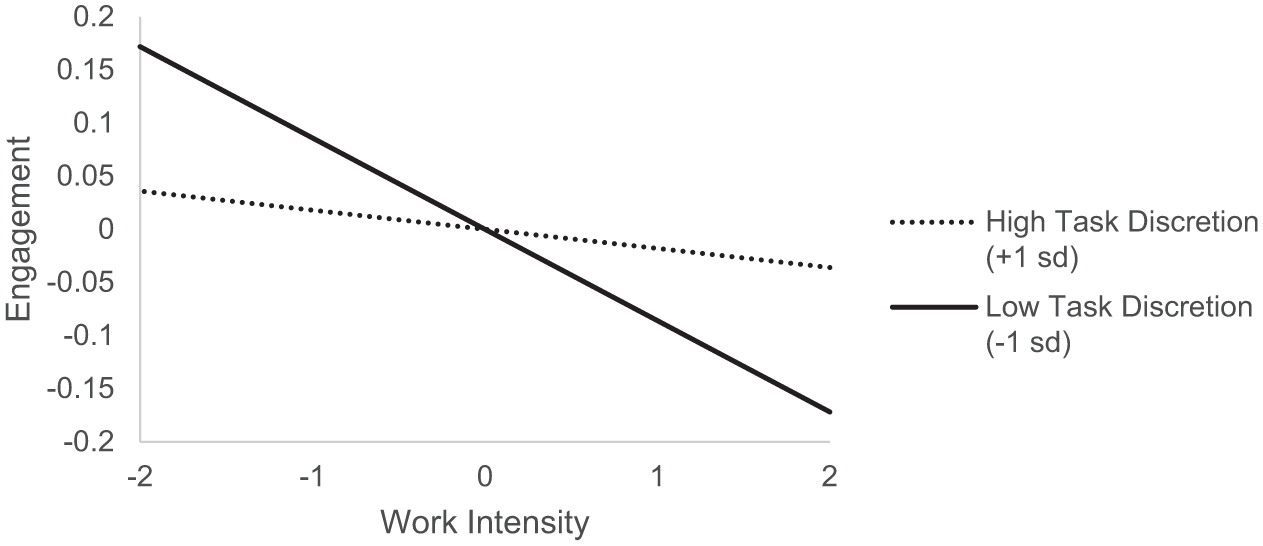
Standardized effects of work intensity on engagement moderated by task discretion.
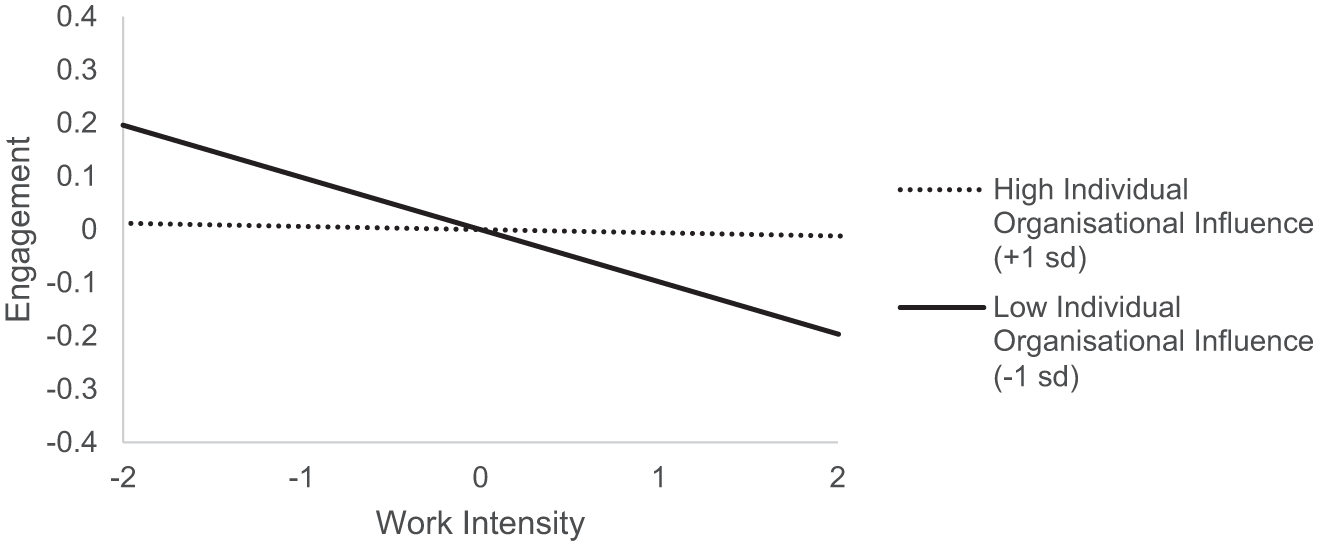
Standardized effects of work intensity on engagement moderated by individual organizational influence.
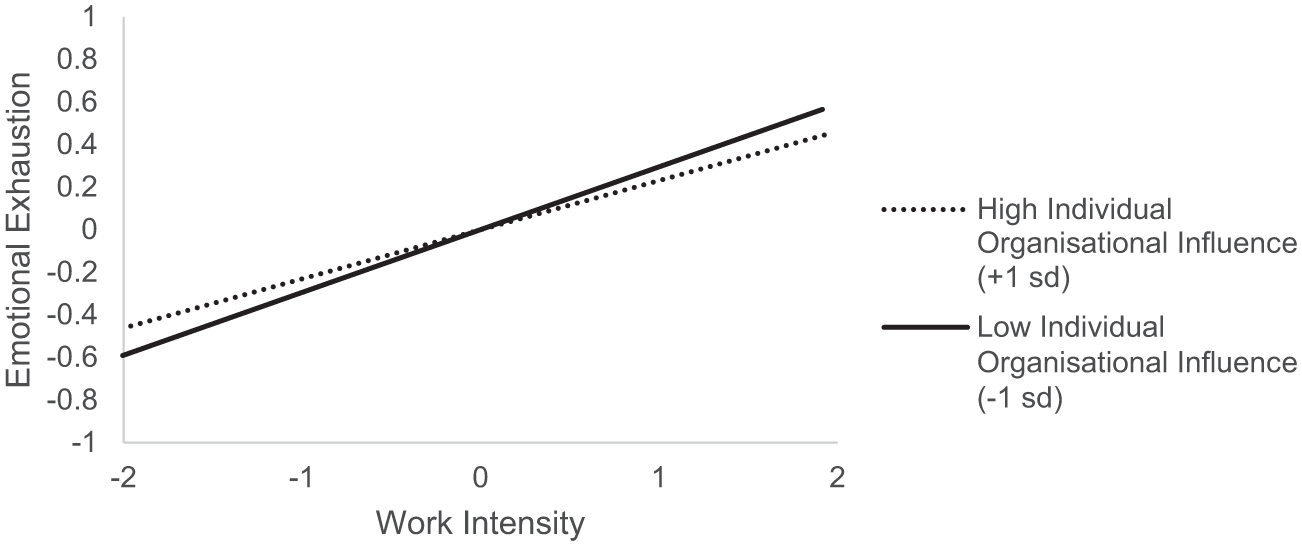
Standardized effects of work intensity on emotional exhaustion moderated by individual organizational influence.
Hypothesis 4 posits that individual organizational influence weakens the associations between engagement and exhaustion with work intensity and job insecurity. The results of Model 3 in Table 2 show that the interaction effect between work intensity and individual organizational influence on engagement is statistically significant (b = .026, p < .001). Simple slopes test results show that the relationship between work intensity and engagement at a low level of individual organizational influence (mean – 1 standard deviation) is negative and statistically significant (β = −.063, p < .001), but is not statistically significant (β = −.007, p = .617) at a high level of individual organizational influence (mean + 1 standard deviation), supporting H4a. The standardized effects are shown in Figure 2b. On the other hand, the interaction effect between job insecurity and individual organizational influence on engagement (b = .005, p = .230) is not statistically significant; H4b is not supported. The interaction effect between work intensity and individual organizational influence on physical exhaustion (b = −.019, p = .053) is not statistically significant; however, the interaction effect on emotional exhaustion (b = −.031, p < .001) is statistically significant. Hence, H4c is partially supported. Simple slopes test results show that the relationship between work intensity and emotional exhaustion at a low level of individual organizational influence (mean – 1 standard deviation) is positive and statistically significant (β = .325, p < .001), but is weaker (β = .260, p < .001) at a high level of individual organizational influence (mean + 1 standard deviation). The standardized effects are shown in Figure 2c. Finally, the interaction effects between job insecurity and individual organizational influence on physical exhaustion (b = −.008, p = .240) and emotional exhaustion (b = −.001, p = .957) are not statistically significant; H4d is not supported.
Hypothesis 5 posits that well-being is negatively associated with work intensity and job insecurity, mediated by engagement and exhaustion. Results in Table 3 show that the negative association between work intensity and well-being through engagement (b = −.026, p < .05, 99% BCCI [−.044, .003]) is not statistically significant with a Type I error of .01; H5a is not supported. On the other hand, the negative associations between work intensity and well-being through physical exhaustion (b = −.032, p < .05, 99% BCCI [−.040, −.022]) and emotional exhaustion (b = −.035, p < .001, 99% BCCI [−.044, −.026]) are statistically significant; H5b is supported. Moreover, the negative associations between job insecurity and well-being through engagement (b = −.033, p < .001, 99% BCCI [−.050, −.015]), physical exhaustion (b = −.005, p < .001, 99% BCCI [−.008, −.003]) and emotional exhaustion (b = −.009, p < .001, 99% BCCI [−.015, −.005]) are statistically significant; H5c to H5d are supported.
Hypothesis 6 posits that task discretion weakens the relationships of well-being with work intensity and job insecurity through engagement and exhaustion. Following Hayes (2015), moderated mediation hypotheses were tested using the statistical significance of the Index of Moderated Mediation (IndexMM), which is calculated by multiplying the interaction effect between the independent variable and the moderator on the mediator by the effect of the mediator on the dependent variable. Table 4 shows that the moderating effect of task discretion on the mediating effect of work intensity on well-being through engagement (IndexMM = .014, p < .001, 99% BCCI [.006, .025]) is statistically significant. Figure 3a shows that the higher the level of task discretion, the weaker the negative mediating effect of work intensity on well-being through lower engagement, supporting H6a. On the other hand, Table 4 shows that the moderating effects of task discretion on the mediating effect of work intensity on well-being via physical exhaustion (IndexMM = .001, 99% BCCI [−.001, .002]) and emotional exhaustion (IndexMM = .000, 99% BCCI [−.002, .002]), the mediating effect of job insecurity on well-being via engagement (IndexMM = −.004, 99% BCCI [−.015, .009]), physical exhaustion (IndexMM = −.001, 99% BCCI [−.002, .001]) and emotional exhaustion (IndexMM = −.001, 99% BCCI [−.005, .003]) are all statistically non-significant. Hence, H6b, H6c and H6d are not supported.
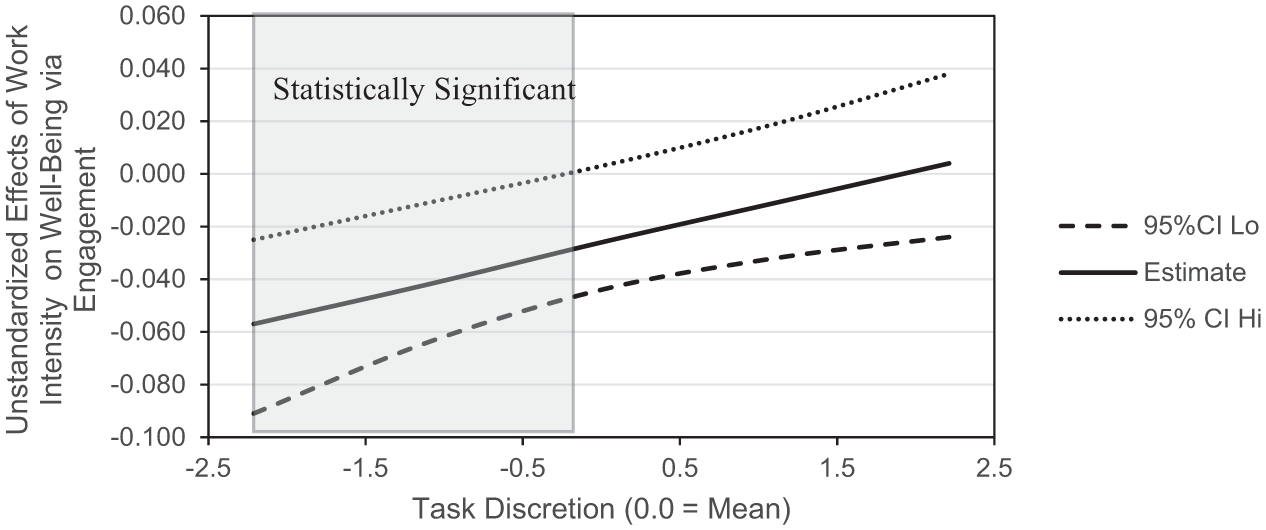
Work intensity on well-being via engagement conditional on task discretion.
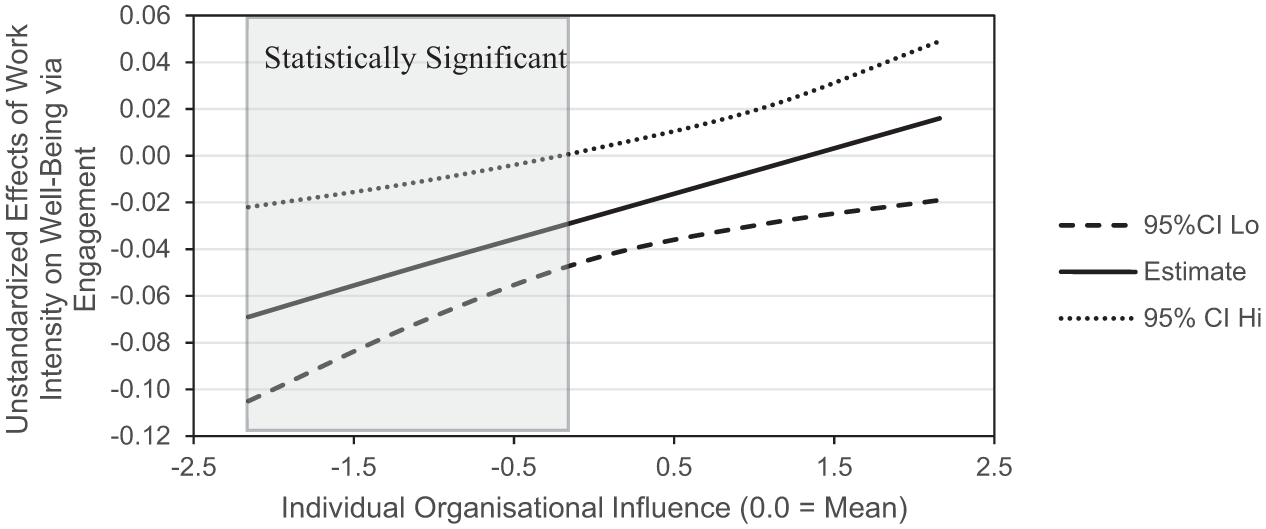
Work intensity on well-being via engagement conditional on individual organizational influence.
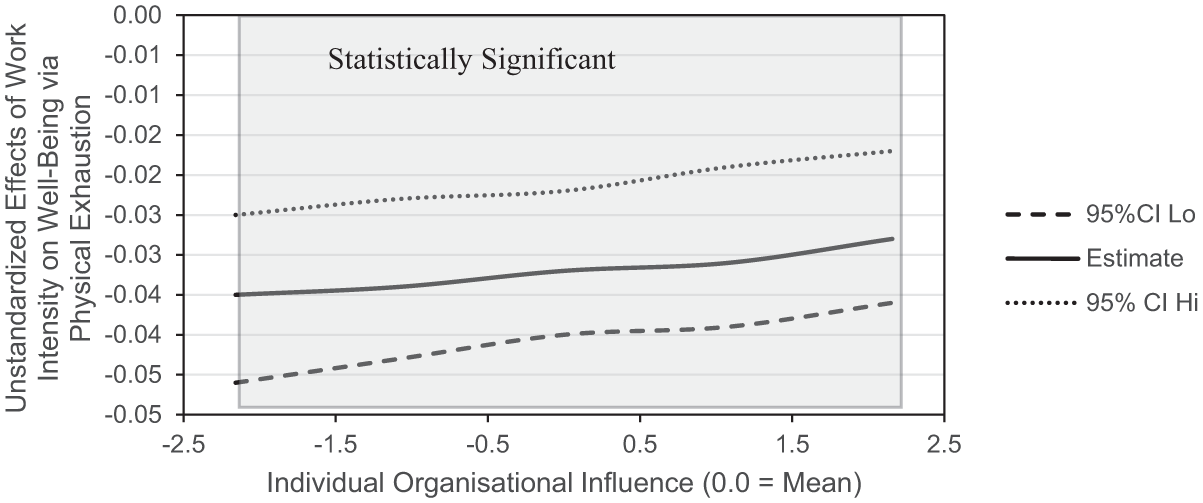
Work intensity on well-being via physical exhaustion conditional on individual organizational influence.
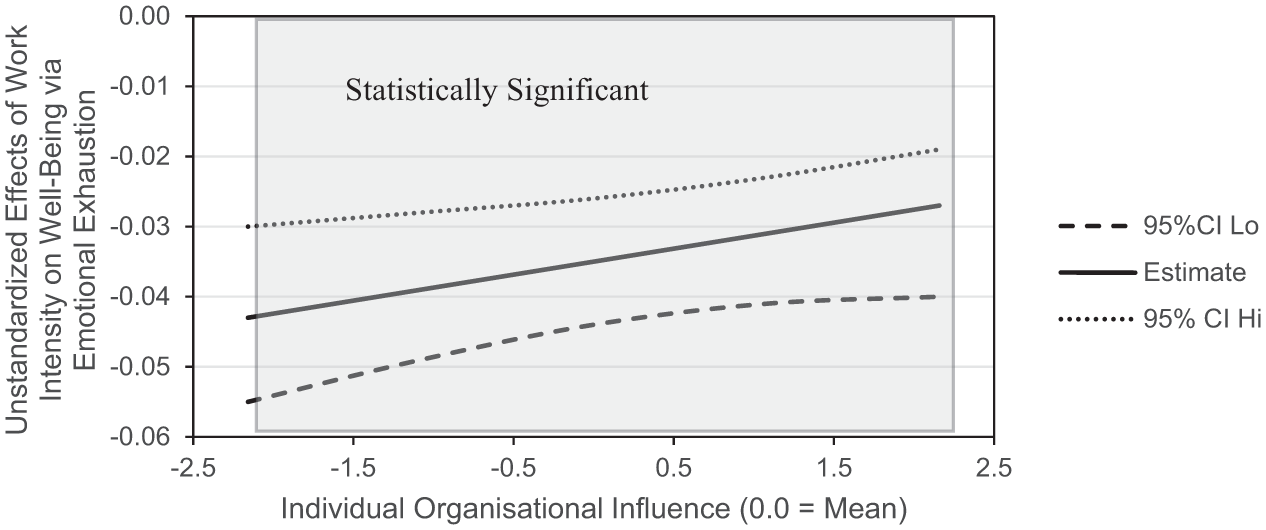
Work intensity on well-being via emotional exhaustion conditional on individual organizational influence.
Hypothesis 7 posits that individual organizational influence weakens the relationships of well-being with work intensity and job insecurity through engagement and exhaustion. Table 4 shows that the moderating effects of individual organizational influence on the mediating effect of work intensity on well-being through engagement (IndexMM = .020, 99% BCCI [.006, .033]), physical exhaustion (IndexMM = .002, 99% BCCI [.000, .004]) and emotional exhaustion (IndexMM = .004, 99% BCCI [.001, .007]) are statistically significant; H7a and H7b are supported. The moderated mediating effects are plotted in Figures 3b to 3d. On the other hand, the moderating effects of individual organizational influence on the mediating effect of job insecurity on well-being via engagement (IndexMM = .004, 99% BCCI [−.004, .012]), physical exhaustion (IndexMM = .001, 99% BCCI [−.001, .003]) and emotional exhaustion (IndexMM = .000, 99% BCCI [−.004, .002]) are statistically non-significant; H7c and H7d are not supported.
Supplementary analyses
In addition to the analyses presented above for testing the hypotheses, we conducted several supplementary analyses to examine the robustness of the results. First, we conducted all analyses again using the entire sample (N = 62,126), and the results are presented in Tables A1 to A4 in the supplementary file. All the estimates are similar to those reported in Tables 1 to 4 using the reduced sample. The conclusions for all hypotheses remain the same across the two sets of analyses. Hence, despite about half of the respondents not responding to the questions on engagement and exhaustion, the missing values do not affect the results of our hypothesis tests.
Second, we estimated a model with moderated direct effects from work intensity and job insecurity to well-being. The results of Model 3, presented in Table B1 of the supplementary file, show that none of the moderated direct effects on well-being are statistically significant.
Third, we estimated the models with one item removed from the engagement scale and one item removed from the well-being scale to improve the AVEs. The AVE of engagement and well-being improved to .51 and .48, respectively. The results of Models 1 to 3, presented in Table C1 of the supplementary file, show that all estimates are comparable to those reported in Table 2, which utilizes all items. The conclusions for all hypotheses remain the same across the two sets of analyses.
Finally, we classified the 36 countries into seven regions and tested all the hypotheses for each region. The regional classifications are primarily based on Gallie and Zhou (2020) with additional countries in the EWCS 2021: Continental (Austria, Belgium, Germany, France, Luxembourg, Netherlands, Switzerland), South East (Bulgaria, Cyprus, Croatia, Romania, Montenegro, North Macedonia, Serbia, Albania, Bosnia and Herzegovina, Kosovo), Central East (Czechia, Hungary, Poland, Slovenia, Slovakia), Nordic (Denmark, Finland, Norway, Sweden), North East (Estonia, Lithuania, Latvia), Southern (Greece, Spain, Italy, Malta, Portugal) and North West (Ireland, United Kingdom). The results are presented in Table 5.
Hypothesis testing: results by region.
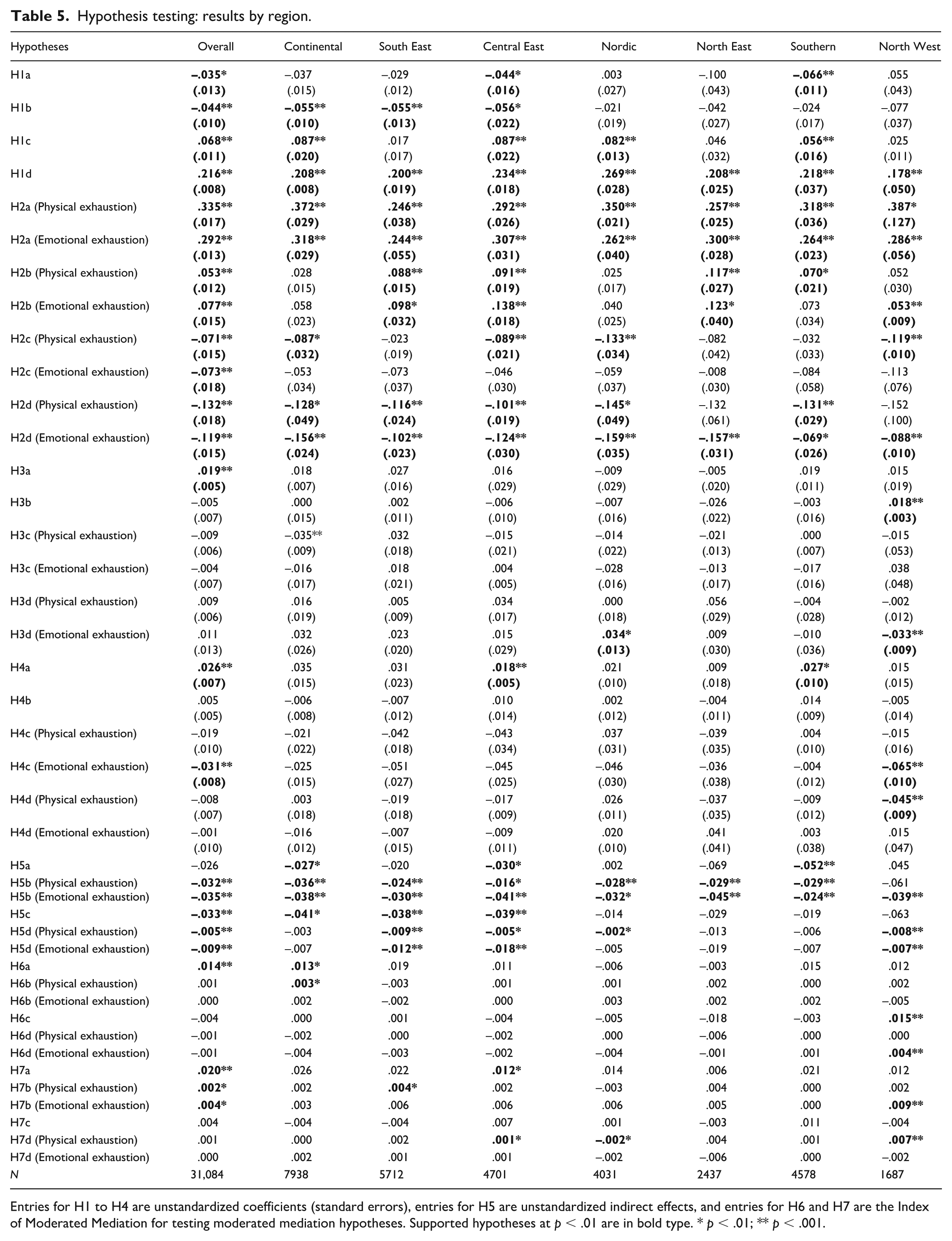
Entries for H1 to H4 are unstandardized coefficients (standard errors), entries for H5 are unstandardized indirect effects, and entries for H6 and H7 are the Index of Moderated Mediation for testing moderated mediation hypotheses. Supported hypotheses at p < .01 are in bold type. * p < .01; ** p < .001.
Discussion
The predictions associated with Hypothesis 1 are all fulfilled. As expected, higher levels of work intensity and job insecurity are associated with lower work engagement (Hypotheses 1a and 1b). Similarly, the positive relationships between engagement with task discretion and individual organizational influence are statistically significant (Hypotheses 1c and 1d). The relative strength of the relationship with these two involvement resources is noticeable, with the latter having greater strength.
The expectations associated with Hypothesis 2 are also entirely fulfilled: greater physical and emotional exhaustion are associated with higher work intensity and greater insecurity, while greater task discretion and individual organizational influence are associated with lower physical and emotional exhaustion. Our results show that work intensity has a stronger effect on both forms of exhaustion than job insecurity. This stands to reason: work intensity has a very direct impact on how people feel day by day as a result of their employment conditions. As with the findings of Hypothesis 1, we also see individual organizational influence making a stronger impact than task discretion on the types of exhaustion.
Hypothesis 3 tests the moderating effects of task discretion on the relationships between the threats of work intensification and job insecurity with work engagement and exhaustion. The only significant result shows that higher task discretion reduces the negative impact of work intensity on engagement (Figure 2a). This is consistent with the DCM, in which greater worker control (‘decision latitude’) fosters ‘active jobs’ in conditions of high work demand (Karasek, 1979). However, task discretion does not diminish the impact of work intensity on exhaustion or job insecurity on engagement or exhaustion. This suggests that task discretion, while beneficial for an individual’s work engagement, has limitations in the face of rising work volumes and that it does not counter the physical and emotional impacts of looming economic insecurity.
Hypothesis 4 tests the moderating effects of individual organizational influence on the relationships between the threats of work intensification/job insecurity and work engagement/exhaustion. Here, there are two significant results. Like task discretion, and consistent with the DCM (Karasek, 1979), individual organizational influence weakens the negative association between work intensity and engagement (Figure 2b), but it has the additional benefit of weakening the positive association between work intensity and emotional exhaustion (Figure 2c). Individual organizational influence, then, may have a greater impact on the causes that contribute to emotionally-exhausting work intensification than task discretion. As with task discretion, however, it does not weaken the negative relationship between job insecurity and engagement, or the positive relationship between job insecurity and exhaustion. Both forms of involvement seem powerless in terms of alleviating the physical and emotional impacts of economic insecurity.
With the exception of the link from work intensity through engagement to well-being, the mediating hypotheses encapsulated in Hypothesis 5 are supported, as consistent with the motivational and health-impairing propositions of JD-R theory (Demerouti and Bakker, 2023): engagement conveys the negative impact of job insecurity on well-being while exhaustion transmits the effects of work intensity and job insecurity on employee well-being.
Except for the role of task discretion in weakening the relationship between work intensity and employee well-being via engagement, the moderated mediation relationships in Hypothesis 6 are not supported, while two of the predictions in Hypothesis 7 are supported. These are that the higher the level of individual organizational influence, the weaker the negative mediating effect of work intensity on well-being via engagement and physical and emotional exhaustion. Neither form of employee involvement alleviates the effects of job insecurity on well-being via engagement or types of exhaustion.
What can we say, then, about the overall patterns? First, they confirm that task discretion and individual organizational influence must be distinguished as different forms of employee involvement (Gallie, 2013; Lopes et al., 2017). They each have value to add in fostering better work outcomes for employees.
Second, except for the effect of job insecurity on well-being through lower engagement, work intensity poses a greater threat to well-being than job insecurity, a finding that holds across all European regions (Table 5). Work intensity has much greater effects on physical and emotional exhaustion (Table 2) and, via these types of exhaustion, on well-being (Table 3). Clearly, work intensification is a threat that makes itself more immediately felt in an individual’s work experience. We should note that work intensity and job insecurity are only weakly correlated (r = .27). Many insecure jobs are likely to be vulnerable because they are associated with lower work demands.
Third, across Europe, it is individual organizational influence that is more powerful in its positive impacts on engagement (Table 5, H1d versus H1c) and in suppressing the negative impacts of work intensification (Table 5, H2d versus H2c). Individual organizational influence may help employees contribute to making work organization and processes more engaging and help them challenge or reduce the drivers of work intensification at a higher level. For its part, however, task discretion offers help in maintaining work engagement in the face of rising work intensity.
Fourth, neither form of direct involvement is helping to alleviate the negative effects of job insecurity on engagement and exhaustion, and on well-being via these variables. Why might this be so? One interpretation is that feelings of job insecurity often relate to the impact of wider product market or financial factors that pose greater challenges for meaningful employee involvement. An alternative interpretation is that we are limited by the items used in the EWCS, which are less helpful in addressing the issue of job-threatening change than those available in the British Skills and Employment Survey 2012. Using this survey, Gallie et al. (2017) were able to measure employees’ assessments of the extent to which they would have a say in a potential work reorganization, finding that the more employees could do so, the lower their feelings of job tenure and job status security.
These results add a somewhat different twist to those found by Gallie’s (2013) analysis of the BSS 2006. This may be because the BSS 2006 is a British survey rather than a pan-European one. However, as we have just observed, different survey items can make a difference. We note that different items are used to measure ‘consultative participation’ in BSS 2006 and individual organizational influence in the EWCS 2015 (Gallie and Zhou, 2020) and 2021 (this paper). The latter two cases use the same items (with an additional item in 2021; see endnote 3), where the emphasis is clearly on direct individual involvement in important decisions. In contrast, the measure for consultative participation in BSS 2006 asks whether management holds meetings ‘in which you can express your views about what is happening in the organization’ and then designates the range of possible topics (Gallie, 2013: 459). The possibility of expressing views in such meetings, however, is not as direct as the process of actively being consulted as an individual about important work decisions. This suggests that the measure in EWCS 2021 provides a more powerful assessment of direct participation and is aptly called ‘individual organizational influence’ (Gallie and Zhou, 2020).
In sum, the findings support the view that governments can expect gains in employee well-being and, by extension, societal well-being when the ‘complementary’ processes of task discretion and individual organizational influence are fostered (Gallie, 2019: 383). In terms of public policy implications, these direct forms of employee involvement have something to add to job quality that cannot easily be achieved by representative systems of participation (although the latter can influence the institutional context and organizational climate for direct participation) (Esser and Olsen, 2012). Without diminishing the critical role of task discretion in fostering informal learning and employee health (Gallie, 2019), a key implication is that individual organizational influence deserves greater priority in terms of governmental support: the EWCS 2021 shows that by operating at a higher level, it may have advantages over task discretion in better suppressing the threat of work intensification. If not capable of ‘heading off trouble at the pass’, it can, at least, significantly help to reduce its driving forces. Neither form of direct participation, however, is making an observable impact on the drivers of job insecurity, although this may reflect the fact that the EWCS does not offer a question on the options for employee participation when restructuring is threatened.
Limitations
While most of the hypotheses were supported, the statistically significant results may be due to the large sample size and high power for testing a small effect. We, therefore, used a lower Type I error rate of .01 to test our hypotheses. Unfortunately, we were unable to estimate the effect size or practical significance of the effects. While many effect size measures have been proposed for mediating effects (e.g. Lachowicz et al., 2018; Preacher and Kelley, 2011), these measures were either developed for models with only one mediator or for models where the direct and indirect effects are in the same direction. There is also no measure of effect size for moderated-mediating effects. While the mediating and moderated-mediating effects of work intensity on well-being are beyond doubt, the effects of job insecurity on well-being should be interpreted more cautiously.
We followed Gallie and Zhou’s (2020) report of the EWCS 2015 in selecting the items for measuring each variable. However, due to the limitations of a telephone survey in EWCS 2021, most variables were measured with only two or three items, raising some concerns about the validity of the measures. The AVEs of the two reflective measures – engagement and well-being – are both below .5. Although AVEs above .4 with adequate construct reliability are deemed acceptable evidence for convergent validity, we conducted a supplementary analysis with one item removed from the engagement scale and one item removed from the well-being scale, such that the AVEs are close to .5. The similar results of the two analyses provide further evidence of the validity of the original scale.
Finally, the EWCS 2021 is a cross-sectional study, which limits causal inferences and underscores the value of panel studies in the future. Additionally, common method variance (CMV) may also inflate the relationships identified in this study. Hence, we have stronger confidence in the relationships between individual organizational influence and engagement/exhaustion, as well as the relationship between work intensity and exhaustion. Although our results for testing moderating and moderated-mediating effects should be minimally affected by CMV because previous simulation studies show that CMV can deflate, but cannot artificially create, an interaction effect (Evans, 1985; Siemsen et al., 2010), causal relationships and the mediating effects should be interpreted cautiously. Following Spector’s (2021) recommendation, we included control variables to partial out spurious correlation among the variables of interest.
Conclusion
Across Europe, the EWCS 2021 reveals that work intensity and job insecurity pose significant threats to employee well-being, with the former having the most pronounced negative impact. In countering their impact, analysis of this survey, like others, confirms that task discretion and individual organizational influence must be distinguished as different forms of employee involvement having somewhat different effects. Based on the data from the EWCS 2021, we can conclude that the answer to the question of whether employee involvement can mitigate the negative impacts of work intensification and job insecurity on employee engagement, exhaustion and well-being is ‘yes’. However, it is a qualified ‘yes’. Both forms of involvement have their benefits in terms of ameliorating the impacts of work intensification. In this respect, individual organizational influence, as defined by the items used in the EWCS, is the more powerful agent of resistance. On the other hand, neither form of involvement, at least as measured in the EWCS questions, is helping to moderate the effects on employees of rising job insecurity. A modified pan-European survey that better assesses employee involvement when restructuring is threatened would be helpful. With that proviso in mind, public policy would do well to encourage greater employee involvement in decision-making, particularly at the higher level of direct employee input into the organization of work. Our analysis suggests that the largest gains for employee and societal well-being will come through greater worker involvement at this level of participation.
Supplemental Material
sj-docx-1-eid-10.1177_0143831X261421726 – Supplemental material for Can different types of employee involvement in decision-making suppress the effects of work intensification and job insecurity on employee well-being? An analysis of the European Working Conditions Survey 2021
Supplemental material, sj-docx-1-eid-10.1177_0143831X261421726 for Can different types of employee involvement in decision-making suppress the effects of work intensification and job insecurity on employee well-being? An analysis of the European Working Conditions Survey 2021 by Peter Boxall, Gordon W. Cheung, Md Shamirul Islam, Kenneth Cafferkey and Keith Townsend in Economic and Industrial Democracy
Footnotes

Funding
The authors received no financial support for the research, authorship, and/or publication of this article.
Declaration of conflicting interests
The authors declared no potential conflicts of interest with respect to the research, authorship, and/or publication of this article.
Supplemental material
Supplemental material for this article is available online.