



Abstract
This study examined whether outcomes in early intensive behavioral intervention (EIBI) during a university-led multisite project could be replicated by the same community agency independently of the project. Participants, age 18 to 75 months at onset of intervention, were 48 children with autism spectrum disorder (ASD) enrolled in 35 hr per week of publicly funded, community-based EIBI for 3 years and 46 children who were matched on baseline characteristics and received early childhood services as usual (SAU) through local early childhood special education providers. Linear mixed models indicated that EIBI participants improved significantly more than SAU participants on standardized tests of IQ, nonverbal IQ, adaptive behavior, and academic achievement, administered by independent evaluators. Although limited by the use of a matched comparison group rather than random assignment, the study provides evidence for the sustainability of effective EIBI in community settings for children with ASD who start intervention at varying ages throughout early childhood.
Thirty years have passed since the seminal publication on early intensive behavioral intervention (EIBI) by Lovaas in 1987, followed by the long-term outcome evaluation in 1993 (McEachin, Smith, & Lovaas, 1993), which represented the first evidence for the efficacy and long-standing effects of early intensive applied behavioral intervention (EIBI) for children with autism spectrum disorder (ASD). EIBI is an intervention that is based on applied behavior analysis (ABA). It emphasizes discrete trial methodology and principles of learning to improve socially significant behavior, and it is ideally delivered for 35 to 40 hr per week (Cohen, Amerine-Dickens, & Smith, 2006; Smith, 2011). Although Lovaas’ (1987) report was criticized for methodological limitations, such as nonrandom assignment to groups, early publications in EIBI germinated a plethora of studies devoted to replication throughout the world, by providers attempting to achieve comparable results. Multiple Lovaas-sanctioned replication sites published results supporting the efficacy of EIBI utilizing Lovaas’ model, as part of a National Institute for Mental Health grant (Cohen et al., 2006; Eikeseth, Smith, Jahr, & Eldevik, 2002; Sallows & Graupner, 2005; Smith, Eikeseth, Klevstrand, & Lovaas, 1997; Smith, Groen, & Wynn, 2000). Two of these studies were randomized control trials (Sallows & Graupner, 2005; Smith et al., 2000), addressing some of the concerns raised about Lovaas’ original study. Meanwhile, many researchers independent of Lovaas and colleagues extended the evidence base to other EIBI models (e.g., Howard, Sparkman, Cohen, Green, & Stanislaw, 2005; MacDonald, Parry-Cruwys, Dupere, & Ahearn, 2014; Perry, Koudys, Prichard, & Ho, 2017; Remington et al., 2007).
A meta-analysis of early intensive behavioral treatment indicated that EIBI produced a large effect size (ES) for IQ change across studies (ES = 1.10), as well as a medium ES for adaptive behavior (ES = 0.66; Eldevik, Hastings, Huges, Jahr, Eikeseth, & Cross, 2009), although there was insufficient evidence to evaluate effects on other important outcomes (e.g., core features of ASD). An overview of five meta-analyses published between 2009 and 2010 on EIBI for young children with ASD showed that nearly all reviewers concluded that EIBI produces substantial gains and considered EIBI to be a well-established intervention, despite limitations in the available studies, notably limited range of outcome measures and small sample sizes (Reichow, 2012). Interventions based on ABA continue to be among the treatments in ASD that have the strongest empirical support (Smith & Iadarola, 2015).
Rogers and Vismara (2008) reflected that early EIBI studies changed the conceptualization of ASD as essentially untreatable and fostered the “hope of recovery given appropriate intervention” (p. 8). The findings have led to changes in policy and practice. Since the first state ASD insurance reform in 2007, 47 states have mandated requirements for insurance funding of ABA-based treatments for individuals with ASD (Autism Speaks, n.d.), and companies that offer these treatments proliferated.
Nevertheless, there remain many unknowns about EIBI. For example, favorable results of EIBI have been reported mainly in university-based studies (e.g., Eikeseth et al., 2002; Lovaas, 1987; Smith et al., 2000), which may serve a socioeconomically and educationally skewed population, achieve an atypically high level of treatment fidelity, and have exceptionally low ratios of staff to children served. In contrast, findings are mixed regarding the effectiveness of EIBI in nonacademic community settings, where most treatment is administered (Cohen et al., 2006; Flanagan, Perry, & Freeman, 2012; Howard et al., 2005; Magiati, Charman, & Howlin, 2007; Smith et al., 2010; Zachor & Itzchak, 2010). Thus, the effectiveness of EIBI in community settings remains uncertain. Favorable results have been reported when EIBI is closely supervised by on-site experts in this intervention (Cohen et al., 2006; Eikeseth, Hayward, Gale, Gitlesen, & Eldevik, 2009; Remington et al., 2007), but not when this level of supervision is unavailable (Bibby, Eikeseth, Martin, Mudford, & Reeves, 2002; Magiati et al., 2007), suggesting that supervision may be a key factor.
Another gap in evidence is that little information exists on the age range for which EIBI is effective. In one of the few studies to date on EIBI for children who enroll after age 4, Eikeseth, Smith, Jahr, and Eldevik (2002, 2007) compared 13 children with ASD who started intensive behavioral treatment (28 hr per week) between the ages of 4 and 7 (mean 5.5 years) with 12 similar children in eclectic treatment (a variety of interventions including ABA approaches). After 1 year of treatment, the EIBI group achieved an average increase of 17 points in IQ and 11 points in adaptive behavior, surpassing the comparison’s group’s 4-point increase in IQ and unchanged adaptive behavior (Eikeseth et al., 2002). At a mean age of 8.2 years, the EIBI group showed average gains of 25 IQ points and 9 to 20 points across scales on the Vineland Adaptive Behavior Scales (VABS) compared with an average increase of 7 IQ points and a loss of 6 to 12 points across adaptive behavior scales in the comparison group (Eikeseth, Smith, Jahr, & Eldevik, 2007). This research provides some indication that EIBI can be effective for children who start after age 4. However, a study of less intensive behavioral treatment (approximately 12 hr per week) in children who averaged 52 months of age at treatment onset reported only a 7-point gain in IQ (Eldevik, Eikeseth, Jahr, & Smith, 2006). The small effect may have reflected the relatively low intensity of intervention (averaging 12 hr per week) or lower-functioning participants, but the older age at intervention onset also could have been a factor. In addition, three case series (Granpeesheh, Dixon, Tarbox, Kaplan, & Wilke, 2009; Perry et al., 2011; Smith, Klorman, & Mruzek, 2015) found that younger children with ASD made larger gains than did older children. However, a meta-analysis did not find an association between age at intake and outcome (Eldevik et al., 2009).
Additional studies are warranted to provide families, practitioners, and funding agencies data to reflect the impact of EIBI in community settings for both younger and older children with ASD. The current report extends the literature on EIBI outcome in two ways: First, it examines whether outcomes in a university-led multisite project (Cohen et al., 2006) could be replicated with children seen by the same community agency outside of the project. Second, it presents the first case-control study in the United States that includes children with ASD who began intervention at varying ages throughout early childhood, ranging from 18 to 75 months. All children who did not meet the age cutoff of 42 months for eligibility in a prior study (Cohen et al., 2006) and/or who entered treatment after the end of the enrollment period for that study were included in the current report.
Method
Design and Procedures
All study procedures were approved by the Institutional Review Board at the Committee for the Protection of Human Subjects in Sacramento, California. Evaluations were conducted at baseline and annually for 3 years later for 94 children with ASD who received either EIBI or community services as usual (SAU). Assignment to intervention groups was quasi-random, based on parent preference, as described by Cohen et al. (2006). Briefly, in accordance with a collaborative agreement among the regional center, Special Education Local Planning Areas (SELPAs), school districts, ABA providers, and families in the region, families were presented with a “Matrix of Educational Options” that outlined the publicly funded placements available for their children and reviewed the matrix with an educational consultant and a representative from the child’s school district. Options included special education classrooms, individual occupational or speech and language therapy, and EIBI programs, including the agency in this study. During the enrollment period (1995-2005), there were one to three ABA providers. At times when the treating agency did not have openings, the educational consultant and school representative removed the agency from the Matrix so that children may be served by another community ABA provider. The regional center clinical psychologist, educational consultant, and school representatives were otherwise independent of the study. Once children were enrolled, the treating agency independently implemented the ABA treatment.
Because parents participated in the decision to select EIBI or other community services, random assignment to the EIBI and comparison groups was not feasible. The EIBI group consisted of children whose families chose EIBI from the agency in this study. The comparison group was composed of children who had not received EIBI but matched the characteristics of children in the EIBI group, selected from a file review conducted by the local regional center, independent of the treating agency and the current study.
Treatment for EIBI was funded by the regional center and the SELPA in which the child resided, while funding for the comparison group was funded by each child’s district of residence. The regional center is one of 21 regional centers in the state of California; regional centers are nonprofit private corporations contracted with the California Department of Developmental Services to provide or coordinate services for people with intellectual and developmental disabilities. The catchment area for the regional center included five counties in northern California.
For both groups, baseline assessments were conducted independently of the study by a licensed psychologist through the Early Autism Diagnostic Clinic (EADC), at the regional center, which specializes in evaluations for ASD and offers referrals to other experts in the area. Subsequently, the diagnosis was confirmed by the Autism Diagnostic Interview–Revised (ADI-R; Rutter, Le Couteur, & Lord, 2003) administered by a certified examiner employed by the ABA agency. Follow-up evaluations were conducted by an independent, self-employed, highly skilled, licensed child evaluator. The regional center made the referral and funded the evaluations. The referral to the evaluator consisted only of the name of the child, birth date, parents’ names, and telephone number.
Participants
Participants included 94 children in one of two groups, EIBI and SAU. The EIBI group (n = 48) received 35 to 40 hr per week of services for 47 weeks per year, for at least 3 years. The SAU group (n = 46) participated in services from local public schools. All children met the following eligibility criteria designated in the Cohen et al. (2006) replication with the exception of the age and treatment onset criteria: (a) primary diagnosis of autistic disorder or pervasive developmental disorder, not otherwise specified (PDD-NOS), (b) pretreatment IQ above 35 on the Bayley Scales of Infant Development–Revised (BSID-R), (c) no significant medical condition which could preclude participation in a 35 hr per week of treatment, (d) residence within 60 km of the treatment agency, (e) no more than 400 hr of behavioral intervention prior to intake, and (f) parental agreement to receive and participate in parent training in ABA and the EIBI treatment methodology, including an adult present in the home throughout the duration of all intervention sessions. Participants were between the ages of 18 and 75 months at the onset of treatment.
The 48 children in the EIBI group started between 1995 and 2005. The regional center was the referral source and, of the children referred to the agency, those meeting criteria for the study were included in the order they were referred. Enrollment in the study ended because the referring agency no longer funded the battery of assessments in 2003 and the ABA agency covered the annual assessment cost for remaining children participating in EIBI only.
Children in the comparison group (n = 46) participated in SAU, enrolled in an early childhood special education classroom at a public school, often with related services such as speech and occupational therapy. Baseline testing occurred between 1997 and 2003. Subsequent educational placement was determined independently of the study by each child’s Individualized Education Plan (IEP). All children in the comparison group met eligibility requirements, except for four children with a baseline IQ of 35 and under (30, 30, 31, and 35). These students were included because they were deemed by a licensed clinical psychologist at the regional center to be the most appropriate match for children enrolled in the EIBI group.
Forty-six of 48 participants in the EIBI completed the 3-year study. The remaining two participants were lost to follow-up; one transitioned to general education without assistance or additional services before Year 3 and the other participated in a full-time special day class (SDC) without EIBI services prior to the end of the study. Five of the 46 comparison group families declined testing at Year 3 for their children.
Design and Procedures
EIBI group
The EIBI protocol contained three components that were consistent with the established Lovaas/University of California, Los Angeles, treatment model (1981, 1987, 2003) and described in the Cohen et al. (2006) replication study at the same agency. Children received 35 to 40 hr per week of intervention per year for 47 weeks of the year. The ABA agency met all requirements for the replication of Lovaas’ UCLA treatment program and was a sanctioned Lovaas replication site. The EIBI treatment aimed to accelerate learning by providing a high concentration of learning trials (120 or more per hr across 12 or more sittings with generalization opportunities interspersed) and using systematic instructional techniques to promote the child’s success. This structure was introduced in a highly controlled setting that emphasized the use of one-to-one discrete trial training and positive reinforcement, such as edibles and tangibles (e.g., manipulatives of interest to the child, light up toys, musical toys). As the child progressed, instruction was embedded methodically in more naturalistic environments, beginning with varying the instructions and presenting novel arrangement of materials and advancing to play settings appropriate for the child’s chronological age and activities preparing the child for the general education classroom environment. At the same time, edible and tangible reinforcers were replaced with more naturally occurring reinforcers, such as praise and other forms of social interaction, to increase opportunities for contacting reinforcement in the everyday environment.
All EIBI participants also received instruction on peer play. This instruction was introduced once the child demonstrated verbal responses to questions, on-topic statements, basic play skills, and turn taking. Sessions occurred 3 to 5 times per week, initially with a similar aged typically developing peer, and were facilitated by an experienced interventionist. Small group opportunities were added once the child was playing consistently in pairs. Over time, the child’s parent replaced the interventionist as the facilitator of these peer interactions.
Based on each child’s IEP team decision, 41 of the 48 EIBI children were enrolled in regular education with support from the ABA agency for at least some portion of the 3-year intervention to provide further opportunities for socialization. Teacher-directed structured classrooms were selected for consistency with the child’s experience in EIBI, and one of the child’s interventionists was chosen to function as a classroom aide and blend in with school staff, rather than serving as a “one-on-one aide” focused on the child with ASD. The interventionist collaborated with the teacher in helping the child generalize skills learned in EIBI instruction to the novel school environment. When data suggested the child functioned commensurate with normative peer data per school setting activity, systematic fading procedures were employed per activity, beginning with proximity to the child and eventual fading of the interventionist’s presence. Fading occurred in increments of time, dependent on the level of child independence in each school activity. Social activities in the school setting were generally the last area of support faded. The seven remaining children who did not participate in regular education transitioned to an SDC.
As a final objective measure to determine the child’s independence, a trained blind observer, unfamiliar to the child, collected objective data to confirm our clinical recommendations to fade EIBI. Examples included response to teacher instruction, task initiation, task completion, vocal and nonvocal group responding, stereotypy and maladaptive behavior, problem solving, interactive play, conversational exchanges, and response to peer nonvocal language.
Staff and parent training
A UCLA-trained staff member functioned as the ABA agency’s site director and was responsible for the oversight of each child’s program. The director held a master’s degree in clinical psychology/ABA and became a Board Certified Behavior Analyst (BCBA) once this certification became available in the state of California during the course of this study. Clinical supervisors were either graduate students in ABA or master’s-level graduates with a minimum of 2 years of experience in EIBI, some of whom became BCBAs during the course of the study. In addition, these clinicians met expectations for the position, including high ratings on direct observation assessments of skills with children, positive ratings from supervisors and feedback from parents, and oral and written assessments of ABA and ASD (Davis, Smith, & Donahoe, 2002).
Interventionists were recruited from the community, including universities and junior colleges, and received an extensive in-house training on ABA, as well as completion of an on-site training with a skilled staff person following a protocol which included 90% or greater accuracy across a variety of ABA skills such as: execution of discrete trials, delivery of contingent reinforcement, differential reinforcement, prompting/fading techniques, and data collection accuracy. Parents functioned as integral members of their child’s team. They completed a 12- to 18-hr training workshop across 2 to 3 days on ABA principles and instructional strategies, took part in 1 hr weekly meetings with the supervisor and interventionists to review the child’s progress, and communicated regularly with the supervisor between meetings.
SAU comparison group
Children in the comparison group participated in community educational services offered by their district of residence as part of the Matrix of Educational Options with SELPA (Cohen et al., 2006). At intake, three children received Behavior Intervention Services (BIS) in the home, funded by the regional center. BIS is a less intensive in-home parent training model which is generally short term and designed to address a few targeted behavior concerns. In addition, three children participated in some form of in-home services ranging from 1 hr per week of speech services to developmental specialist, speech therapy, and occupational therapy. Students below 3 years may be eligible for an infant program and at age 3 years for participation in a public school SDC placement. Two children participated in school-based early intervention services, while 24 received SDC services. One child enrolled in Head Start, a state-preschool, and 14 children did not partake in any services at baseline.
Throughout the course of the study, children in the comparison group participated in SDCs or general education classrooms for up to 5 days per week. One exception included a child who received Early Start Autism Infant Services by Years 1 and 2, although transitioned to an SDC class by the third year. Typical child to educator ratios in special education classrooms ranged from 1:1 to 3:1. Detailed information on staff training qualifications and supervision was not available for review. Instructional methodologies vary and children may receive related services such as speech and language therapy, occupational therapy, adaptive physical education, or mainstreaming with the support of a one-to-one aide as designated on their IEP. Given the broad range of individualized treatments in this group, treatment fidelity could not be monitored.
Assessment
Assessments were administered by regional center approved independent licensed evaluators who had no affiliation with the study or involvement in children’s intervention. Assessors received only the name of child, birth date, parents’ names, and phone number for annual assessment requests. Children in both the EIBI and SAU groups received the same battery of assessments at baseline and three subsequent visits, which occurred approximately yearly. The assessment included standardized tests of IQ (primary outcome measure), nonverbal IQ (NVIQ), and adaptive behavior. A standardized test of academic achievement was given at Year 3. Tests were chosen based on their use in prior EIBI studies and their relevance to evaluating whether or not EIBI achieved its main goal of accelerating child’s overall rate of development. Because of the reliance on unaffiliated, independent licensed child evaluators, there were some deviations from the standard set of measures, as detailed below.
For IQ, if children were able to achieve a basal, they completed the age-appropriate and most current Wechsler test, which was the Wechsler Preschool and Primary Scale of Intelligence Revised (WPPSI-R; Wechsler, 1989) or Third Edition (WPPSI-III; Wechsler, 2002), or the Wechsler Intelligence Scales for Children Third Edition (WISC-III; Wechsler, 1991) or Fourth Edition (WISC-IV; Wechsler, 2003). Otherwise, they completed the Bayley Scales of Infant Development (BSID; Bayley, 1969) or Second Edition (BSID-II; Bayley, 1993). The BSID-R extrapolated table was used to generate a standard score for children who obtained an IQ below 50. Administration of the BSID-R began at the starting point for the child’s chronological age (or at the highest starting point for the test if the child was older than 42 months). The examiner administered each successive item after the starting point to establish a basal and ceiling; if the child did not obtain a basal on these items, the examiner administered each preceding item in succession until a basal was achieved and then followed rules in the test manual for establishing the ceiling. Deviations from these tests included Developmental Profile Second Edition (DP-II; Alpern, Boll, & Shearer, 1980) (baseline, n = 1 [SAU]); Leiter International Scales (Leiter, 1940) (baseline, n = 1 [EIBI]); Psychoeducational Profile–Revised (PEP-R; Schopler, Reichler, Bashford, Lansing, & Marcus, 1990) (baseline, n = 1 [EIBI]); Stanford-Binet Fourth Edition (SB-IV; Thorndike, Hagen, & Sattler, 1986) (baseline IQ, n = 10 [6 in EIBI, 4 in SAU]; year 1 IQ, n = 4 [4 in EIBI]). See the sections on each instrument in Volkmar (2013) for psychometrics in the ASD population (the Developmental Profile is discussed in “Real-Life Rating Scale”).
NVIQ was assessed by the Merrill Palmer Scale of Mental Tests, (Stutsman, 1948). Deviations included the Leiter International Scales (baseline, n = 1, 1 in EIBI), PEP-R (baseline, n = 1, [EIBI]), SB-IV Nonverbal scale (baseline, n = 2, [1 in EIBI and 1 in SAU]), Wechsler Intelligence Scale for Children Third Edition (year 1, n = 2 [2 in EIBI], year 2, n = 20 [12 in EIBI, 8 in SAU], year 3, n = 33 [16 in EIBI, 17 in SAU]), Wechsler Intelligence Scale for Children Fourth Edition (year 2, n = 4 [EIBI], year 3, n = 24 [11 in EIBI, 13 in SAU]), and WPPSI-R (baseline, n = 4, [3 in EIBI, 1 in SAU], year 1, n = 1 [EIBI], year 2, n = 3 [EIBI]).
The Vineland Scales of Adaptive Behavior was used for all participants, except two children (1 in EIBI and 1 in SAU) who had either the Developmental Profile (Alpern & Boll, 1972) or 2nd edition (DP-II). Academic achievement was measured at the final (Year 3) assessment only, based on the Wechsler Individual Achievement Test (WIAT; Wechsler, 1992) (n = 32, 11 in EIBI and 21 in SAU), WIAT-II (Wechsler, 2005) (n = 6, 5 in EIBI and 1 in SAU), or Wide Range Achievement Test Third Edition (WRAT-III; Wilkinson, 1993) (n = 25, 13 in EIBI and 12 in SAU). Only 63 of the 94 participants received an achievement measure and three EIBI participants received only the reading and math portions of the WRAT-III. Reason for not testing at each of the 3 year markers was not provided in the SAU groups, while one EIBI participant was not tested given the child successfully transitioned from all services to a general education prior to the end of Year 3 and the other to an SDC without EIBI services.
School placement information was categorized on an 8-point ordinal scale, including independent regular education class (no additional services), independent regular education class with some additional services (e.g., speech, occupational therapy), regular education with part-time aide and other services, regular education class with a full-time aide and other services, part-time regular education/part-time special education class, special education class, special education class with additional services, and special education class with full-time aide.
Data Analysis
Baseline demographic and clinical characteristics for all study participants were summarized and compared between the EIBI and SAU groups using chi-square or Fisher exact tests for categorical variables and t tests for continuous variables with proper data transformation if needed. All outcome analyses were conducted with the intention-to-treat principle. Linear mixed models (also called random regression models) were used to examine the longitudinal relationship between the primary outcome measure (IQ), secondary outcome measures (NVIQ, VABS Composite Score, VABS Domain Scores) and time, treatment, and their interaction (Verbeke & Molenberghs, 2000). Data from baseline and three subsequent visits were included for all outcomes. The models were fit using the lmer function in the lme4 package (Bates, Mächler, Bolker, & Walker, 2015) run on the statistical software R, version 3.4.1 (R Core Team, 2017). Each model included fixed effects for treatment group (two levels), time since baseline (in months, treated as a continuous variable), and the time-by-treatment interaction. Models were adjusted for baseline age, which significantly predicted some outcomes. The linear mixed model allows for subject-specific intercepts and slopes which vary around the treatment-specific slopes through the inclusion of random effects, which we modeled with an unstructured covariance matrix. Variance estimates were obtained using restricted maximum likelihood estimation (REML). The difference in slope of the regression line between the two groups (i.e., the time by treatment interaction) was tested for statistical significance. The threshold for statistical significance was set at p < .05, two-tailed, for primary and secondary outcome measures.
For measures that were collected only at Year 3, the EIBI and SAU groups were compared on an independent sample t test (WIAT), Wilcoxon–Mann–Whitney test (school placement), or Fisher exact test (number of children scoring in the average range on each standardized test), with the threshold for statistical significance of p < .05, two-tailed.
Results
Pretreatment
Table 1 summarizes the demographic information available at baseline. Gender distribution between the EIBI and SAU groups was comparable, but the ratio of males to females in both groups was much greater than previous reports of a 4.5:1 ratio of males to females (Christensen et al., 2016). Distribution of ASD diagnoses between the groups was identical. One child with PDD-NOS in the EIBI group had a comorbid diagnosis of Oppositional Defiant Disorder. Age at intervention onset did not significantly differ between groups. The time between intake and onset of EIBI was M (SD) = 4.58 (4.55); data on time between intake and onset of SAU was unavailable. Information on ethnicity, parent education, and household was not collected.
Demographic Information for the EIBI Group (n = 48) and SAU Group (n = 46).

Note. EIBI = Early Intensive Behavioral Intervention; SAU = services as usual; CI = confidence interval.
Outcome
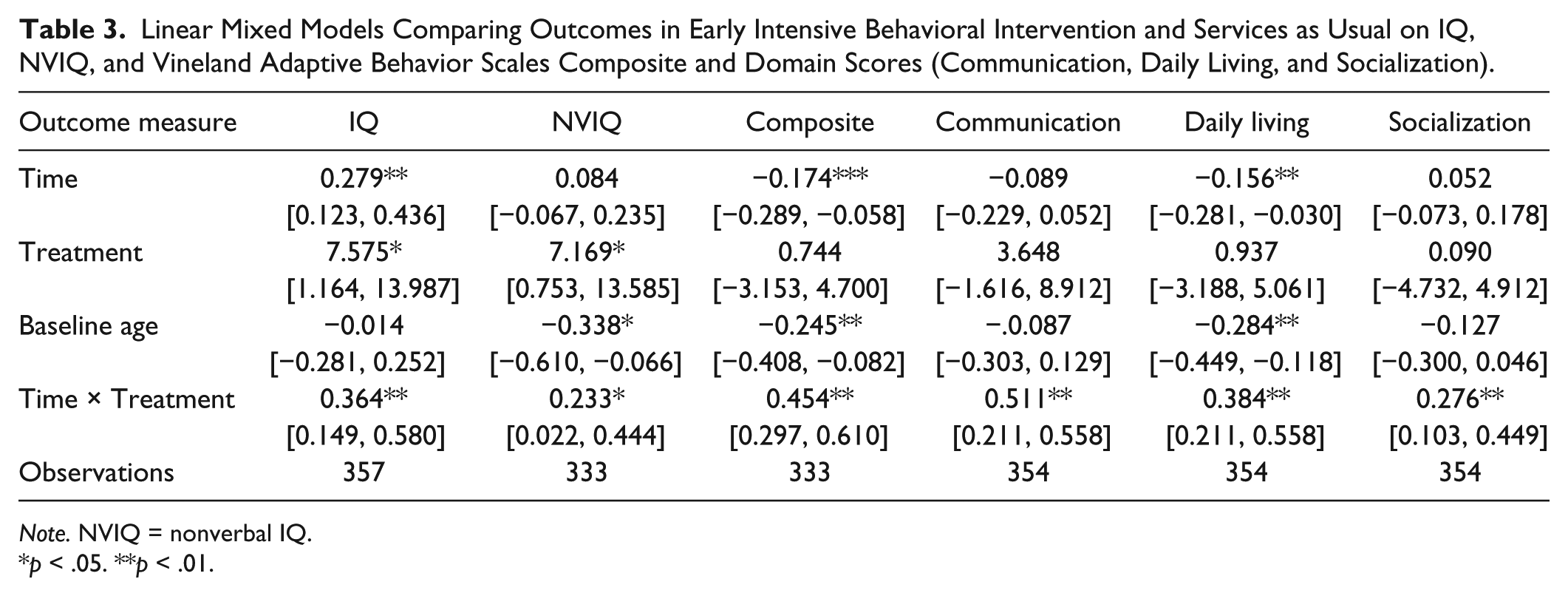
Table 2 summarizes the data in the EIBI and SAU groups on IQ, NVIQ, and VABS at each assessment point. See “Data for Individual Participants” in the Supplemental Materials for more detailed information. As shown in Table 2, baseline age was not significantly different in EIBI (M = 37.8) from SAU (M = 42.6), but baseline IQ in EIBI (M = 64.4) was marginally higher than in SAU (M = 58.2), t(92) = 1.85, p = .07. Table 3 presents the main findings of the statistical analyses. The cell in the first row and first column of the table shows that, on the primary outcome (IQ), there was a significant main effect of time, indicating that the sample as a whole showed an increase in IQ from baseline to the final assessment; the average increase was 0.279 IQ points per month (3.348 points per year). There was also a significant main effect of treatment, revealing that, across all assessments, IQ in the EIBI group tended to higher than in SAU. Baseline age (third row) did not correlate with IQ. The time-by-treatment interaction (bottom row) was significant, showing that the rate of IQ increase was higher in EIBI than SAU; on average, IQ increased 0.364 points per month more in EIBI than SAU (4.368 points more per year). Thus, the IQ gains in EIBI significantly exceeded those in SAU.
Outcome Measures (Raw Means and [95% Confidence Intervals]) at Baseline and Years (1-3) and Comparisons Between Groups Receiving EIBI and SAU.

Note. EIBI = Early Intensive Behavioral Intervention; SAU = services as usual; VABS = Vineland Adaptive Behavior Scales.
Administered at Year 3 only.
Linear Mixed Models Comparing Outcomes in Early Intensive Behavioral Intervention and Services as Usual on IQ, NVIQ, and Vineland Adaptive Behavior Scales Composite and Domain Scores (Communication, Daily Living, and Socialization).
Note. NVIQ = nonverbal IQ.
p < .05. **p < .01.
Although changes in NVIQ were smaller than changes in IQ overall (Table 2), the time-by-treatment interaction was significant (Table 3). On average, NVIQ increased 0.234 points per month more in EIBI than SAU (3.168 points per year). There was a main effect of treatment (Table 3), indicating that, across assessments, NVIQ tended to be higher in EIBI than SAU.
Scores on the VABS Composite and Domains (Communication, Daily Living, and Socialization) increased about 10 points over time in EIBI but showed little change or declined in SAU (Table 2); the declines over time were statistically significant for the Composite and Daily Living (Table 3). The time-by-treatment interaction was significant for all VABS scales (Table 3), demonstrating that gains in EIBI surpassed those in SAU.
Baseline age was significantly related to NVIQ and Vineland Daily Living and Composite (Table 3, third row), with younger age being associated with larger improvements on these measures. However, age was not significantly associated with other outcomes. An exploratory analysis, presented in “Comparison of Younger and Older Participants” in the Supplemental Materials, did not reveal a consistent difference in response to treatment between participants younger than 42 months and those 42 months or older at baseline.
At Year 3, the EIBI group scored higher than the SAU group on the test of academic achievement (WIAT), including Reading, Spelling, and Math (Table 2). These differences were significant for Reading t(61) = 3.56, p = .001, Cohen’s d = .90; Spelling t(58)=3.05, p = .003, d = .80; and Math, t(61)=3.05, p = .003, d = .77.
The EIBI group also had significantly less restrictive school placements (Table 4; see also “School Placement at Year 3” in the Supplemental Materials for a visual display of the same data). More children in the EIBI group than the SAU group functioned in the typical range on outcome measures; this difference was statistically significant on all measures except VABS Socialization and Spelling (Table 5).
School Placement at Year 3 for Children in EIBI and SAU.

Note. EIBI = Early Intensive Behavioral Intervention; SAU = services as usual. Wilcoxon–Mann–Whitney W = 455, p < .001, difference in location = −2.00 [−3.00, −2.00].
Number of Children in the Average Range on Each Outcome Measure/Number of Children With Available Data for the EIBI Group (n = 46) and SAU Group (n = 44) at Year 3.

Note. EIBI = Early Intensive Behavioral Intervention; SAU = services as usual; VABS = Vineland Adaptive Behavior Scales.
Discussion
The present study supports previous findings from investigators such as Eikeseth et al. (2007) that EIBI, using the Lovaas/UCLA Model, can be implemented in a nonuniversity setting and that favorable results can be achieved for children above the age of 3½ years at entry into treatment. All outcome measures reflect larger improvement in the EIBI group than in the SAU group. Mean changes from pre- to post-treatment across standardized tests ranged from 7.83 to 27.32 in EIBI, compared with −6.15 to 10.85 in SAU. Greatest mean improvements from baseline to Year 3 were in IQ (EIBI = 27.32, SAU = 10.85). EIBI participants also had less restrictive school placements than SAU participants. More participants in EIBI than SAU achieved school placements in general education at Year 3, and more participants in EIBI than SAU achieved scores in the average range at Year 3 on most measures. Overall, gains appear comparable to those in our prior study (Cohen et al., 2006) and in other reports on EIBI (Eldevik et al., 2009). Because these children were seen independently of the university-led project that was involved in our previous study, the results indicate that favorable outcomes can be sustained in a community setting. In addition, given the wide age range of our sample, the results also support previous findings that some children who are 4 to 6 years old at onset of EIBI can make substantial gains in IQ, adaptive behavior, and school placement (Eikeseth et al., 2007).
The design of the present study did not allow for testing which factors made it possible to maintain the effectiveness of EIBI outside of a university-led project, but the setting did include features considered to promote sustainability (Stirman et al., 2012). One such feature was ongoing community resources and collaboration (i.e., regional center funding and referral, school district IEPs with the EIBI BCBA guiding goals and behavior support). Another characteristic was the ABA agency’s priority given to EIBI as the primary service offered. The agency monitored EIBI outcomes through the independent evaluations described in the study. It also sought to build its capacity by encouraging the agency leaders who were primarily responsible for training supervision to become BCBAs. In addition, it aimed to refine and expand the UCLA model of EIBI by developing a more specific curriculum for social skills in Year 3 and enrolling children with ASD across a wider age range. Continuing efforts to refine the model include a norming and validation study of a direct measure of social perspective taking for use in future research and the development of center-based services as an option for children in EIBI.
Although early onset of ABA intervention is widely regarded as ideal (Lovaas, 1987), the current study provides evidence that EIBI can be effective throughout the preschool years (Eikeseth et al., 2007). Age was not significantly associated with scores on most outcome measures, and a comparison between younger and older than 42 months did not show a consistent advantage for either group. On average, children who were past their fourth birthday at baseline showed gains of 9.10 to 22.46 points across standardized tests at Year 3 in EIBI, compared with −6.91 to 9.63 in SAU. Year 3 scores for these children were 7.42 to 21.05 higher in EIBI than in SAU.
There were several limitations in the present study. The public funding source for this EIBI study mandated that children eligible for services receive a free and appropriate public education. Although this mandate has a strong rationale from a public policy standpoint, it led to a methodological limitation in the study because parents had the right to choose the placement for their child and, therefore, random assignment was not feasible. Also, there were missing data, particularly for academic achievement. While missing data are to be expected in a 3-year study in a community setting, missing data especially on achievement at Year 3 could have affected the results of the analyses.
Other limitations of the present study included additional factors that could not be controlled. Although the study team did not divulge children’s group assignment or school placement to the independent evaluator, some parents might have done so. Information regarding services in the SAU group was imprecise because it varied from agency to agency and was individualized by law. Still, this group offers a comparison to children with similar pretreatment characteristics. The different measures used in the study within and across assessment points present a potential gap in the study, although the different measures were used consistently between the EIBI and SAU groups. Unlike some SAU services, EIBI services required that an adult be present during all intervention hours, given services were provided in the home as opposed to a school setting where a teacher remained present; therefore, one parent was generally home during intervention hours. Thus, families could select EIBI only if they had the resources to meet this requirement. As a result, EIBI families may have had more resources than SAU families. Another limitation is that, to match the SAU group to the EIBI group, the independent clinician who performed the matching included a child who did not meet eligibility criteria because of having a baseline IQ of 32. Furthermore, for unclear reasons, the present sample contained a higher proportion of boys than would be predicted from prevalence estimates of the boy to girl ratio in the ASD population, although it was similar across both the EIBI and SAU treatment groups.
Areas to improve the research strategy in future investigations include larger samples to provide more precise estimates of ESs, measures of social validity to assess family perspectives, assessment of maintenance over time (Perry et al., 2017), and comparisons of EIBI to well-specified alternative interventions (Smith, Jordan, & Tiede, 2016). Comparisons of home- and center-based EIBI may be of particular interest, given that home-based services are often recommended (Lovaas, 1987) but center-based services impose fewer requirements on families to be present during intervention. Assessment of key social behaviors and behavioral excesses characteristic of ASD in naturally occurring settings (i.e., school, community, and home) during and post treatment would provide some valuable information regarding participants’ functioning in the real world (Brogan, Rapp, Sennott, Cook, & Swinkels, 2018). Incorporation of recent advances in ABA assessment (e.g., procedures for identifying potential predictors of intervention response such as assessing social engagement and responsiveness to social reinforcement) and intervention (e.g., procedures for using speech generating devices to promote communication) may increase efficiency or improve outcome (Smith et al., 2016).
The present study contributes to initial findings published in the field which show that some children aged 4 years and above at the onset of intensive behavioral treatment make gains. This finding supports the growing literature base that children younger than age 4 years and between the ages of 4 and 7 years may attain significant improvement with intensive behavioral treatment.
Supplemental Material
EIBI_Study_Supplemental_Material_4-5-18 – Supplemental material for Sustainability of Early Intensive Behavioral Intervention for Children With Autism Spectrum Disorder in a Community Setting
Supplemental material, EIBI_Study_Supplemental_Material_4-5-18 for Sustainability of Early Intensive Behavioral Intervention for Children With Autism Spectrum Disorder in a Community Setting by Chanti F. Waters, Mila Amerine Dickens, Sally W. Thurston, Xiang Lu and Tristram Smith in Behavior Modification
Footnotes
Acknowledgements
The authors express gratitude for the support of the Special Education Region 6 and Valley Mountain Regional Center “Autism Connection”, including Dr. Howard Cohen, PhD, Clinical Psychologist. The authors thank the Central Valley Autism Project clinical staff for their dedication and clinical efforts with the children and the families. The authors also thank Mieke San Julian, Research Assistant. Preliminary analyses have been presented at the University of California Davis Medical Investigation of Neurodevelopmental Disorders Institute (2003) and Association for Behavior Analysis conference in San Diego, California (2007, 2018), but findings have not been presented otherwise.
Declaration of Conflicting Interests
The author(s) declared no potential conflicts of interest with respect to the research, authorship, and/or publication of this article.
Funding
The author(s) received no financial support for the research, authorship, and/or publication of this article.
Supplemental Material
Supplemental material for this article is available online.

Author Biographies
References
Supplementary Material
Please find the following supplemental material available below.
For Open Access articles published under a Creative Commons License, all supplemental material carries the same license as the article it is associated with.
For non-Open Access articles published, all supplemental material carries a non-exclusive license, and permission requests for re-use of supplemental material or any part of supplemental material shall be sent directly to the copyright owner as specified in the copyright notice associated with the article.
