The building of and dissemination of professional knowledge in an educational or scientific field does not follow a clear or linear path but does rely on an accumulation of research (National Research Council, 2005). Three key mechanisms for disseminating professional knowledge in order to build a sustained and accepted body of knowledge are “professional associations, scholarly journals, and infrastructure supports like data banks” (National Research Council, 2005, p. 38). In the vision fields, the Academy for Certification for Vision Rehabilitation and Education Professionals (ACVREP) is an organization that codifies knowledge and duties for professionals in different vision-related fields. However, this report addresses the second mechanism, that of scholarly journals.
Publication in a scholarly journal has historically been a major avenue for disseminating knowledge within a professional field. It allows knowledge to remain intact for future readers and for that knowledge to be placed within a context in that professional field’s evolution. The Journal of Visual Impairment & Blindness (JVIB) is the oldest professional journal serving vision-related fields that is not primarily related to clinical vision measurement and treatment. In that regard, JAMA Ophthalmology (est. 1869), the American Journal of Ophthalmology (est. 1884), and Ophthalmology (est. 1896) are older. Existing journals that cover visual impairment as well as education and rehabilitation were formed more recently (e.g., Vision Research, est. 1961; Investigative Ophthalmology and Visual Sciences, est. 1962; the British Journal of Visual Impairment (BJVI), est. 1983; and Visual Impairment Research, est. 1999). JVIB has been published since 1907, when it was called Outlook for the Blind, and was described as a “forum for the free and open discussion of all topics connected with work for the blind” (Campbell, 1907, p. 1). It was renamed the New Outlook for the Blind in 1951 and finally became known by its current name, JVIB, in 1977. Started by Charles Francis Faulkner Campbell (son of Sir Francis Campbell), it has been the foremost journal publishing research and articles related to services for people who are blind and have low vision, and many notable people have published in its pages.
This report offers a snapshot of recent trends of knowledge transfer taking place in the primary journal for vision-related fields and a description of the people are who are driving that knowledge dissemination. Beyond the primary question of who is publishing in JVIB, a secondary question is whether a few people are responsible for the majority of articles or whether JVIB authorship is distributed more broadly across the vision professions. To address these questions, a spreadsheet was created of all authors appearing in the 176 issues of JVIB from the first issue of 2000 to the final issue of 2019. This time period was chosen to show recent trends in authorship, with many authors still being active in their professions.
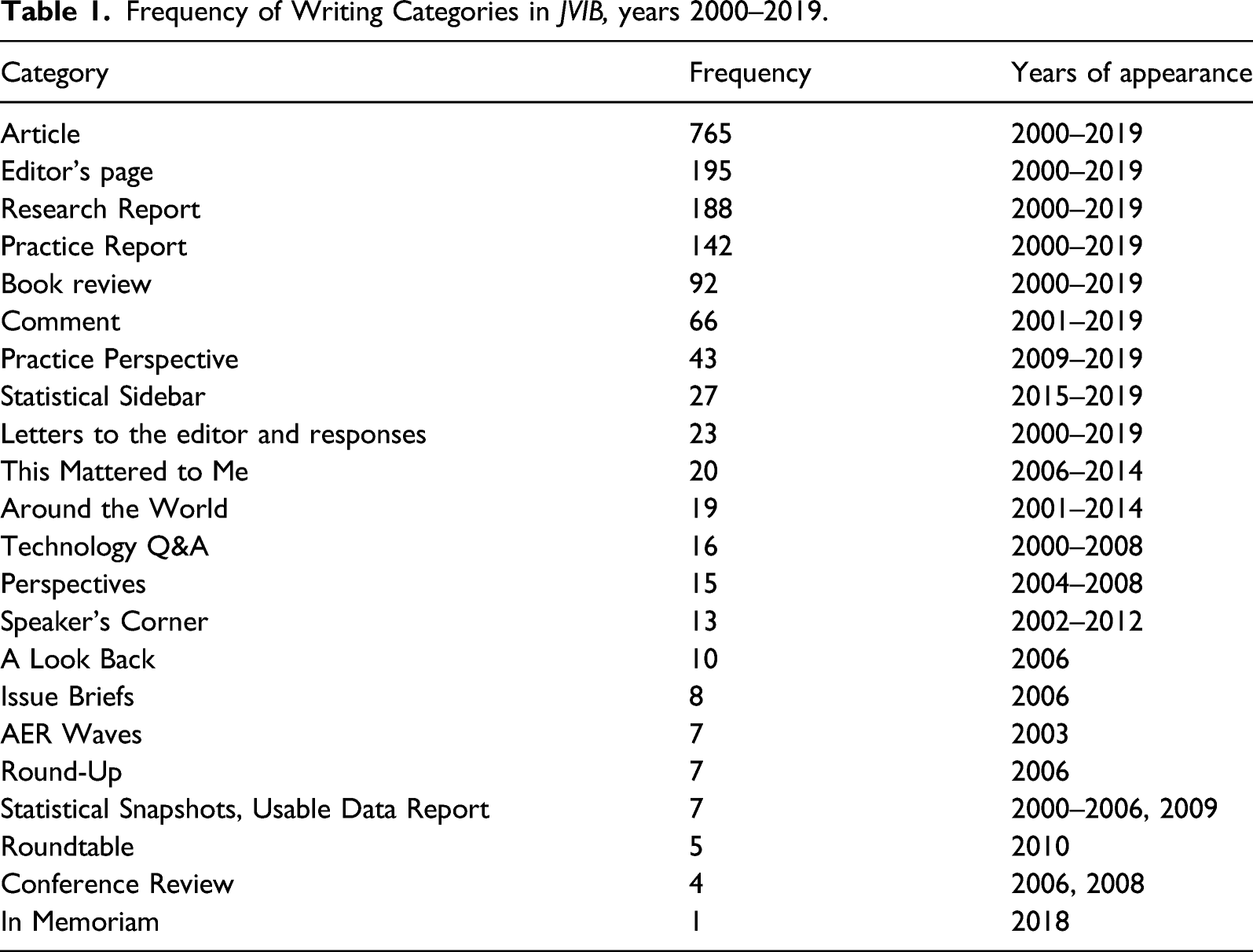
There were 12 issues of JVIB annually from 2000–2012 and 6 issues annually from 2013–2019 (with an extra issue in 2006 and only 11 issues in 2009, 2011, and 2012). Each piece of writing in the journal that had an author’s name attached to it to was categorized into 22 categories of writing, with the most common types of writing being articles, editorial pages, Research Reports, and Practice Reports (see Table 1).
Frequency of Writing Categories in JVIB, years 2000–2019.
Category
Frequency
Years of appearance
Article
765
2000–2019
Editor’s page
195
2000–2019
Research Report
188
2000–2019
Practice Report
142
2000–2019
Book review
92
2000–2019
Comment
66
2001–2019
Practice Perspective
43
2009–2019
Statistical Sidebar
27
2015–2019
Letters to the editor and responses
23
2000–2019
This Mattered to Me
20
2006–2014
Around the World
19
2001–2014
Technology Q&A
16
2000–2008
Perspectives
15
2004–2008
Speaker’s Corner
13
2002–2012
A Look Back
10
2006
Issue Briefs
8
2006
AER Waves
7
2003
Round-Up
7
2006
Statistical Snapshots, Usable Data Report
7
2000–2006, 2009
Roundtable
5
2010
Conference Review
4
2006, 2008
In Memoriam
1
2018
When applicable, each piece of writing was also categorized by content area. Not all writing had a content category (e.g., a conference review). Effort was made to use a single primary category, but when the content of a piece could not be adequately captured by a single content category, a secondary or tertiary category was also noted, which most frequently occurred for full articles. A content category was not assigned to 334 pieces, a secondary category was used 124 times, and a tertiary category was used 3 times. The frequency of primary content categories is shown in Table 2.
Occurrence of Content Categories in JVIB, years 2000–2019.
The most frequent content categories for articles and reports in each year from 2000 to 2019 are shown in Table 3. The total number of different categories in each year did not vary substantially over the course of two decades, varying only from 19 to 27 different content categories. Table 3 shows that the category of “psychosocial” was the first- or second-most common category from years 2000 through 2005 (as well as 2008), braille was the first- or second-most common category in 2006, from years 2010 through 2012 and 2015, and technology was the first- or second-most common category in 2003, 2012, and 2016 through 2018. Orientation and mobility was a consistently common category, being the first- or second-most common category in 2005, 2007, 2011, 2015, 2018, and 2019. Given that these are the primary content categories for articles and reports, they reflect trends in new knowledge being disseminated within the pages of JVIB.
Most Frequent Primary Content Categories by Year for Articles and Reports.
Year
Total number of categories
Most frequent primary content categories (down to frequency 6)
employment (11), international (6), psychosocial (6)
2014
25
2 categories at 5 occurrences (services, teaching)
2015
20
O&M (10), braille (9)
2016
19
technology (9), deafblind (6)
2017
20
services (7), technology (7), braille (6)
2018
27
O&M (7), technology (6)
2019
21
O&M (7), employment (6)
All authors listed on any piece of writing in the journal were entered into a spreadsheet. Table 4 shows the number of pieces of writing by how many authors contributed to that piece. For writings with six or more authors, all but one were articles, Practice Reports or Research Reports. The one item that was not one of these three types of writing was a comment on cortical or cerebral visual impairment (CVI) in 2010 that had 11 authors. Data in Table 4 indicate that 43.6% of all writings were by a single author, however, many of these were editor’s pages, book reviews, comments, or letters to the editor. In looking at articles and reports (both research and practice), only 21.1% were written by a single author and 54.5% were by one or two authors. These numbers indicate a relatively high level of collaboration in authorship that follows a trend in publishing across disciplines (Adams, 2012). For example, in an analysis of over 250 economics journals, single-author papers accounted for half of all articles in the late 1990s, but the proportion had dropped to about 26% by 2014, with articles by three authors increasing from about 11–25% (Kuld & O’Hagan, 2018). This trend in multiple authorship may reflect increased breadth of studies, greater interdisciplinary work, greater focus on the effect of research, and increased international collaboration (Barlow et al., 2017). The percentage of articles and reports written by a single author in JVIB was highest in 2000 and 2001, at 31% and 32%, respectively. This percentage gradually declined to its lowest in 2019 at 5%. Across the years 2000–2019, for 16 of the 20 years, two was the most frequent number of authors for an article or report in JVIB.
Number of Authors on Writings.
Number of authors
Frequency (all writings)
Frequency (articles and reports)
1
729
231
2
420
366
3
249
232
4
154
150
5
62
58
6
31
31
7
17
17
8
6
6
9
1
1
10
1
1
11
1
0
12
0
0
13
1
1
14
1
1
By way of comparison, one of the most similar journals to JVIB is BJVI. In terms of content, BJVI mirrored JVIB in having “psychosocial” as the most frequent content category for articles and reports. However, BJVI had “services” and “education” as the second and third most frequent categories. “Braille” and “technology” were fifth and sixth on the BJVI content frequency list, which came in slightly ahead of “O&M.”
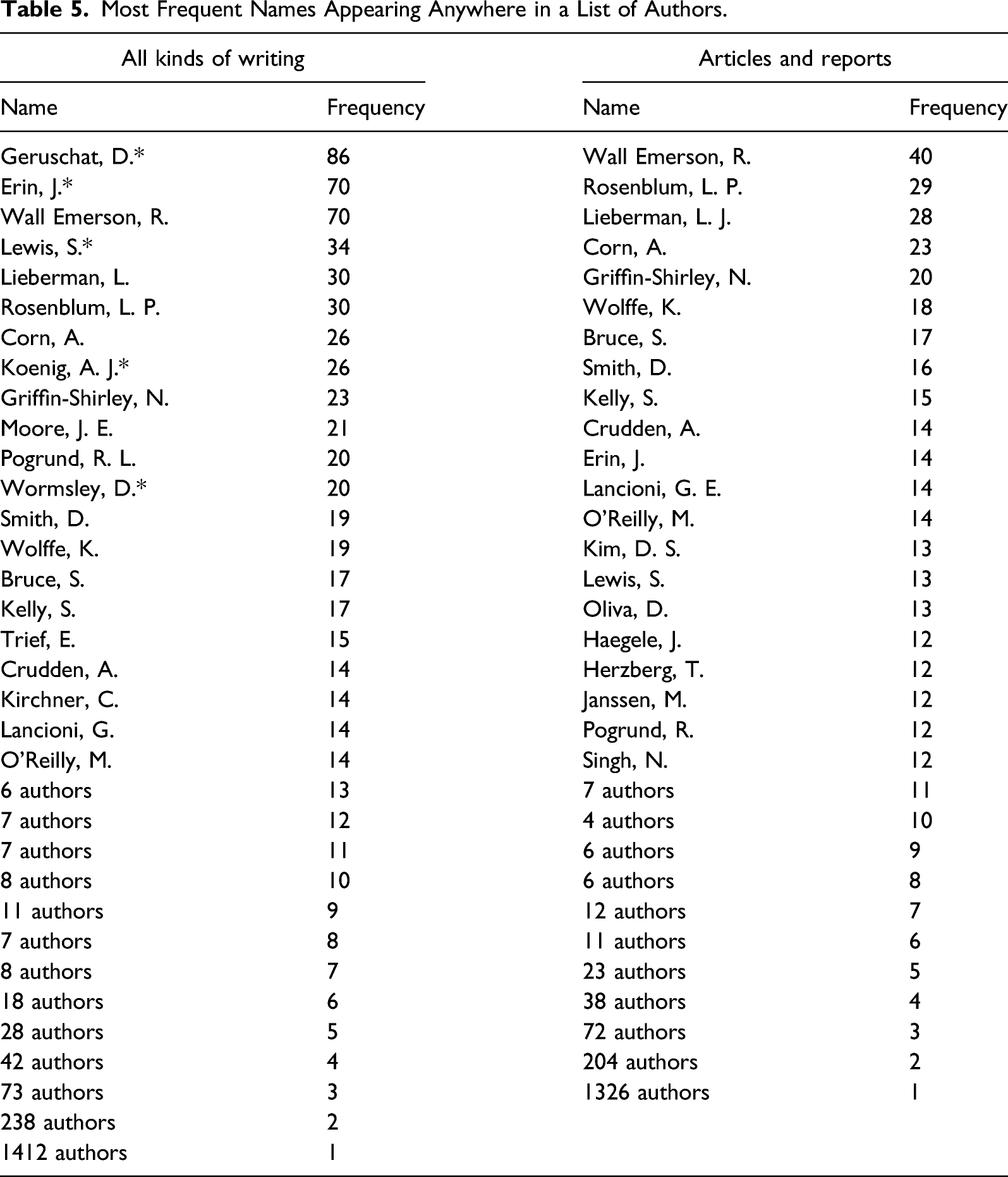
To explore whose voices we heard from most often in JVIB, authors were looked at (1) across all types of writing, (2) for just articles, Practice Reports, and Research Reports, and (3) by publication year. Lists of authors were compiled both by appearance anywhere in the list of authors or only as first author. The most frequent names appearing anywhere in a piece of writing’s list of authors, across all kinds of writing category, are shown in Table 5. This list includes 1884 different authors. Of the 12 most frequently appearing names, five were editors-in-chief for some span of time from 2000–2019 (denoted with an asterisk after the name). When the type of writing is limited to only articles and reports, there are still 1729 different authors appearing in JVIB's pages (see Table 5). Given that there were only 1095 articles and reports published in JVIB from 2000 to 2019, this is an average of 1.56 authors for each article and report. This number suggests that, although there are some names that appear more frequently as authors of articles and reports, the majority of knowledge being disseminated in the pages of JVIB is coming from a large and varied group of writers.
Most Frequent Names Appearing Anywhere in a List of Authors.
All kinds of writing
Articles and reports
Name
Frequency
Name
Frequency
Geruschat, D.*
86
Wall Emerson, R.
40
Erin, J.*
70
Rosenblum, L. P.
29
Wall Emerson, R.
70
Lieberman, L. J.
28
Lewis, S.*
34
Corn, A.
23
Lieberman, L.
30
Griffin-Shirley, N.
20
Rosenblum, L. P.
30
Wolffe, K.
18
Corn, A.
26
Bruce, S.
17
Koenig, A. J.*
26
Smith, D.
16
Griffin-Shirley, N.
23
Kelly, S.
15
Moore, J. E.
21
Crudden, A.
14
Pogrund, R. L.
20
Erin, J.
14
Wormsley, D.*
20
Lancioni, G. E.
14
Smith, D.
19
O’Reilly, M.
14
Wolffe, K.
19
Kim, D. S.
13
Bruce, S.
17
Lewis, S.
13
Kelly, S.
17
Oliva, D.
13
Trief, E.
15
Haegele, J.
12
Crudden, A.
14
Herzberg, T.
12
Kirchner, C.
14
Janssen, M.
12
Lancioni, G.
14
Pogrund, R.
12
O’Reilly, M.
14
Singh, N.
12
6 authors
13
7 authors
11
7 authors
12
4 authors
10
7 authors
11
6 authors
9
8 authors
10
6 authors
8
11 authors
9
12 authors
7
7 authors
8
11 authors
6
8 authors
7
23 authors
5
18 authors
6
38 authors
4
28 authors
5
72 authors
3
42 authors
4
204 authors
2
73 authors
3
1326 authors
1
238 authors
2
1412 authors
1
In the same time period (2000–2019), BJVI published 373 articles and reports by 725 different authors, for an average of 1.94 authors per article or report. This number indicates that both journals draw from a large group of writers and, since only 130 authors published in both journals between 2000 and 2019, the majority of authors tended to publish in one or the other journal (7.5% of JVIB authors published in BJVI and 17.9% of BJVI authors published in JVIB). Of the individuals who were authors on at least nine articles or reports in both journals from 2000 to 2019, only four published more in BJVI than JVIB (Graeme Douglas, Mike McLinden, Steve McCall, and Jens Pfieffer).
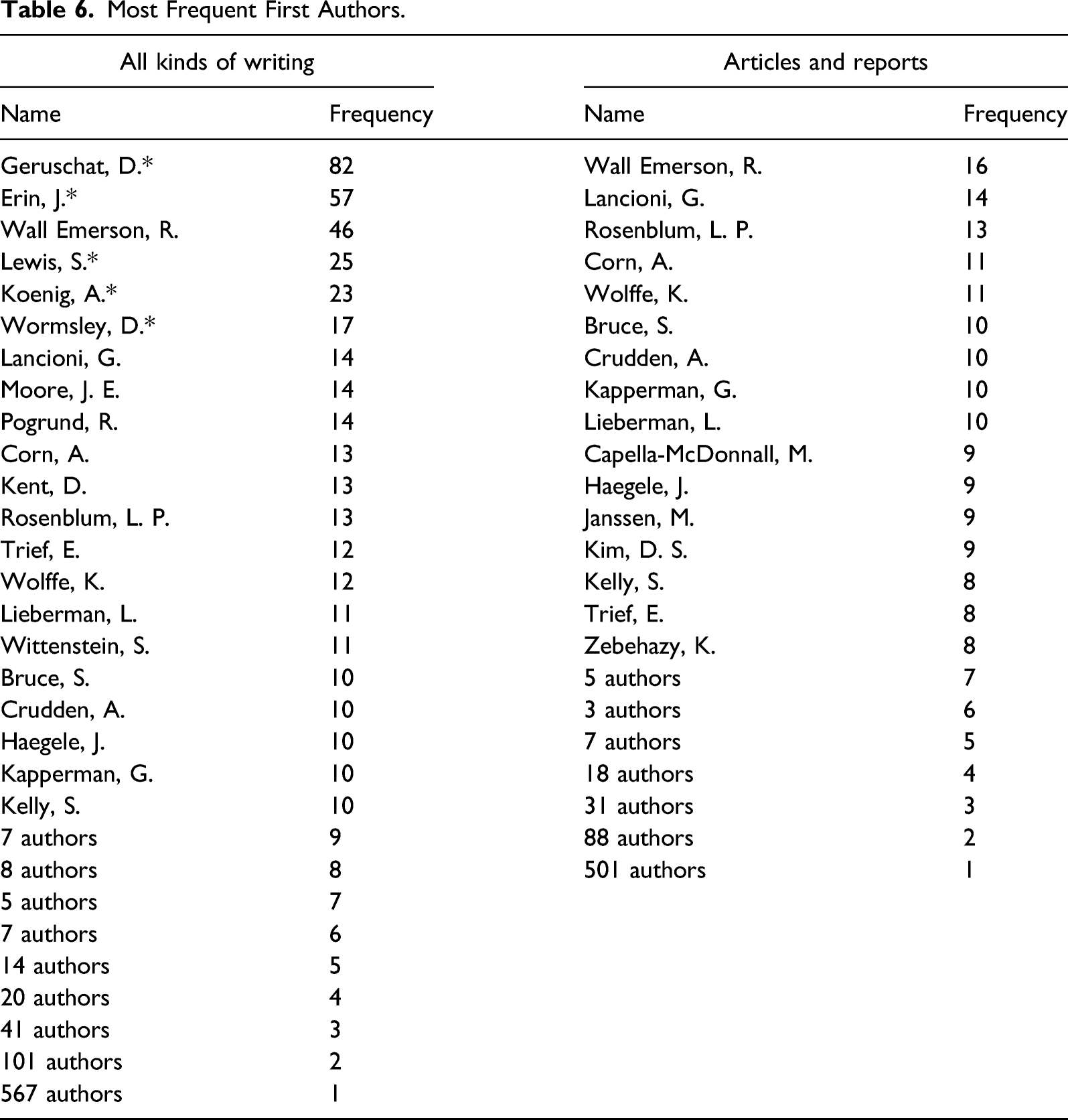
If the argument can be made that the first author of an article or report is most responsible for the content of the writing, looking at the distribution of first authors might also illustrate the principal voices being heard from in the pages of JVIB. The most frequent first authors, across all types of writing, as well as only for articles and reports, are shown in Table 6 (editors-in-chief are designated with an asterisk after their name). The same pattern of results as seen in Table 5 for all authors is shown in Table 6 for first authors. Of the 1095 articles and reports published in JVIB from 2000 to 2019, 45.8% were written by an author who was first author on only one article or report. This finding supports the idea that a varied group of researchers and writers are contributing to the knowledge being disseminated through JVIB.
Most Frequent First Authors.
All kinds of writing
Articles and reports
Name
Frequency
Name
Frequency
Geruschat, D.*
82
Wall Emerson, R.
16
Erin, J.*
57
Lancioni, G.
14
Wall Emerson, R.
46
Rosenblum, L. P.
13
Lewis, S.*
25
Corn, A.
11
Koenig, A.*
23
Wolffe, K.
11
Wormsley, D.*
17
Bruce, S.
10
Lancioni, G.
14
Crudden, A.
10
Moore, J. E.
14
Kapperman, G.
10
Pogrund, R.
14
Lieberman, L.
10
Corn, A.
13
Capella-McDonnall, M.
9
Kent, D.
13
Haegele, J.
9
Rosenblum, L. P.
13
Janssen, M.
9
Trief, E.
12
Kim, D. S.
9
Wolffe, K.
12
Kelly, S.
8
Lieberman, L.
11
Trief, E.
8
Wittenstein, S.
11
Zebehazy, K.
8
Bruce, S.
10
5 authors
7
Crudden, A.
10
3 authors
6
Haegele, J.
10
7 authors
5
Kapperman, G.
10
18 authors
4
Kelly, S.
10
31 authors
3
7 authors
9
88 authors
2
8 authors
8
501 authors
1
5 authors
7
7 authors
6
14 authors
5
20 authors
4
41 authors
3
101 authors
2
567 authors
1
In summary, the period of 2000–2019 saw shifts in the content focus of writing in JVIB. Although the journal publishes on a wide range of topics related to blindness and low vision, over the last 20 years, a focus shifted from writing related to psychosocial issues to braille to technology, with O&M being a consistent frequent topic throughout. In terms of authorship, JVIB publishes material from a wide range of individuals, with 1884 different authors appearing within its pages over the last 20 years. Articles and reports, which arguably reflect the core of new knowledge being disseminated in the journal, have seen a decrease in this period of single-author pieces, falling from a high of 32% in 2001 to 5% in 2019. The most common number of authors for an article or report was two. These data suggest that JVIB is accomplishing the mission of gathering and publishing information from a wide range of sources, as well as keeping up with changing trends in fields related to visual impairment. As for the names of the individuals recently appearing most often in the pages of JVIB, they join the rolls of past frequently appearing names. The history of the field of visual impairment is captured in the procession of names, ideas, results, and techniques that pass through the pages of JVIB.
Footnotes
Declaration of Conflicting Interests
The author(s) declared no potential conflicts of interest with respect to the research, authorship, and/or publication of this article.
Funding
The author(s) received no financial support for the research, authorship, and/or publication of this article.
BarlowJ.StephensP. A.BodeM.CadotteM. W.LucasK.NewtonE.NuñezM. A.PettorelliN. (2017). On the extinction of the single-authored paper: The causes and consequences of increasingly collaborative applied ecological research. Journal of Applied Ecology, 55(1), 1–4. https://doi.org/10.1111/1365-2664.13040
3.
CampbellC. F. F (1907). Editorial. Outlook for the Blind, 1(1), 1–3.
4.
KuldL.O’HaganJ. (2018). Rise of multi-authored papers in economics: Demise of the ‘lone star’ and why?Scientometrics, 114(3), 1207–1225. https://doi.org/10.1007/s11192-017-2588-3
5.
National Research Council (2005). Advancing scientific research in education. Washington, DC: The National Academies Press. https://doi.org/10.17226/11112