




Abstract
Changing demographics in the United States have dramatically shifted the racial or ethnic composition of the nation’s kindergarten through 12th grade (K-12) classrooms over the past couple of decades (Koss, 2015; Hughes-Hassel & Cox, 2010; Larrick, 1965), Sims’ (1982). According to recent U.S. Department of Education data (National Center for Education Statistics, 2020a), the percentage of White students in public elementary and secondary schools decreased from 61% to 48% between 2000 and 2017. By contrast, the percentage of Hispanic students increased from 16% to 27%, and the Asian/Pacific Islander student population increased from 4% to 6% during the same time period (National Center for Education Statistics, 2020b). Currently, children of color represent 53% of the school-aged population, up from 38% in 2000 (National Center for Education Statistics, 2020b).
Projections suggest that the rising cultural diversity in America’s schools will continue. Driven largely by increases in Asian/Pacific Islander and Hispanic students, the total enrollment of students of color is projected to increase 4% (from 53% to 57%) between 2017 to 2029. The White student population, on the other hand, is projected to decline 4% (from 48% to 44%) during the same time period (National Center for Education Statistics, 2020b). With the exception of a predominance of males, the demographics of visually impaired (i.e., those who are blind or have low vision) children are similar to the general education population (National Center for Education Statistics, 2020a).
In light of these demographics, the development of social understanding and acceptance of cultural differences by children of all races and ethnicities—blind and sighted—is vital to a healthy, global society. Children’s books are a valuable educational tool for facilitating this process. Through literature, children can find representations of their worlds and be exposed to other people and places (Bishop, 1990; Brooks, 2006; Hall, 2008; Barksdale-Ladd & Hefflin, 2001; Koss & Daniel, 2018; Landt, 2013; Peterson et al.2015). Unfortunately, culturally diverse characters and settings have historically been underrepresented in children’s books (Barksdale-Ladd & Hefflin, 2001; Hughes-Hassel & Cox, 2010; Koss, 2015; Larrick, 1965; Sims, 1982).
The “all too white world of children’s books” (Larrick,1965) is a longstanding problem that has been recognized by numerous educators and scholars (Barksdale-Lade & Hefflin, 2001; Hughes-Hassel & Cox, 2010; Koss, 2015; Koss et al., 2016; Larrick, 1965; Sims, 1982). Yet, the benefits of multicultural children’s books are well-documented. Culturally diverse books can bolster self-esteem (Hall, 2008; Barksdale-Ladd & Hefflin, 2001; Peterson et al.2015; Schrodt et al., 2015) and spark higher reading engagement (Brooks, 2006; Cartledge et al., 2016) among children of color. Furthermore, positive and accurate depictions of people of color can help mitigate the effect of racial stereotypes and bias that children are exposed to when they are young (Barta & Grindler, 1996; Colby & Lyon, 2004; Newstreet et al., 2019; Schrodt, et al., 2015; Tschida et al., 2014). As such, multicultural books serve as an important means through which children can receive self-affirming messages and develop social understanding.
Valuing and Analyzing Cultural Diversity in Children’s Braille Books
Children need to find images of themselves and their worlds, and also gain exposure to other cultures and experiences through the books that they read or have read to them (Bishop, 1990; 2003; Brooks, 2006; Hall, 2008; Hefflin & Barksdale-Ladd, 2001; Koss & Daniel, 2018; Landt, 2013; Peterson et al. 2015). The self-affirming and social awareness benefits of culturally diverse books extend to both sighted and visually impaired children. Contrary to conventional notions, research has shown that blind children are socialized to see race in ways that are similar to their sighted peers. In an interview study of blind adults, Obasogie (2014) found that blind individuals develop visual understandings of race and internalize racial stereotypes through social practices and experiences. As one respondent explained, “...we’re just as much a victim of racial prejudice, stereotypes, and misconceptions as anybody else. And the fact that we’re not clued to it directly by vision doesn’t, in my mind change that a bit. I think that I suffer all of the unfortunate characteristics of my upbringing regarding race that my [sighted] brothers and sisters do.” (Obasogie, 2014, p. 159).
Rudine Sims Bishop’s (1990) oft-cited metaphor for understanding how books enrich children’s lives asserts that books can be “mirrors” that reflect children’s worlds, “windows” into other worlds, and “sliding glass doors” that enable children to learn from and be changed by experiences different from their own. Although visually impaired individuals can have a conceptual understanding of this metaphor, a nonvisual alternative is more responsive to and inclusive of tactile learners. Therefore, we assert that children’s braille books can serve as “tactile models” that represent children’s worlds, “3D images” of other worlds, and “multisensory paths” that allow readers to imaginatively have new experiences by which they can learn and grow.
For example, a blind child reading Cora Cooks Pancit, a book about a young girl who helps her mother cook a traditional Filipino dish for the family, might think about a time when she or he stirred food in a large bowl with a big spoon, like the main character, Cora. In this way, elements of the story provide tactile models of the young reader’s world. Cora Cooks Pancit can also serve as a 3D image of a different culture, specifically Filipino family traditions. By extension, the book can also serve as a multisensory path enabling the young braille reader to imaginatively travel to and from their homes to Filipino households, learning about and finding commonality across different cultural traditions.
To provide maximum benefit for all children with regard to increasing social understanding, children's books need to provide authentic, culturally diverse textual representations like those found in Cora Cooks Pancit. Representation in text is especially important for visually impaired children who do not access information from illustrations. Text-based elements that signify cultural identity include language, names, themes, settings, and rituals. Sims’ (1982) survey of children’s books featuring African American culture is a landmark analysis with broad applicability to other nonwhite racial or ethnic groups.
Sims (1982) described three categories of books: social conscience, melting pot, and culturally conscious. Social conscience books, the smallest category, centered on themes of desegregation and integration, and were primarily intended to help white people learn about the condition of African Americans (Sims, 1982). Once common, but waning in number by the time of Sims’ (1982) study, the author levied a strong critique of social conscience books for their stereotypical representations and “literary mediocrity” (Sims, 1982, p. 18). Given the narrow historical scope and limited literary value Sims (1982) ascribed to social conscience books, the other two book categories were more pertinent to this study. Melting pot books depict primary or secondary characters of color in the illustrations without any distinct cultural references in the text. Culturally conscious books include textual elements (ethnic group settings and practices, linguistic patterns, and recurring themes) that identify the characters’ race or ethnicity (Sims, 1982).
Despite the social, educational, and emotional value of culturally diverse books that extends to all children, the degree to which published children’s braille books represent diverse characters and cultures is unknown. Although cultural diversity has received some attention by scholars in the field of visual impairment education (Conroy, 2005; Knowlton, 1997; Milian, 1999, 2000), the importance of multicultural braille books has not been addressed. In an effort to fill this void in the research, the study presented here analyzed the catalogs of two major braille book publishers, Seedlings Braille Books for Children (Seedlings) and the National Library Service for Blind and Print Disabled at the Library of Congress (NLS).
Research Questions
The current study was undertaken to examine the extent to which cultural diversity is represented in published children’s braille books. The following research questions guided this study: 1. What percentage of published children’s braille books feature nonwhite primary or secondary characters? 2. How are culturally diverse characters and cultures represented in published children’s braille books?
Method
The study (i.e., content analysis) was conducted in three phases. In phase one, we identified book titles for analysis. In phase two, books were systematically coded. In phase three, we analyzed the data. In the following section, we discuss each of these phases in depth.
Phase One: Identification of Braille Books
We selected the sample for this study from two major producers of children’s braille books in the United States: NLS and Seedlings. We chose NLS and Seedlings because they each house large collections of braille books and have online catalogs in easily accessible list or file formats. The most recent catalogs available on each publisher’s website at the time of our analysis were the NLS 2014-2015 Younger Readers catalog and the Seedlings 2019 catalog. In an effort to obtain a more recent NLS catalog, we discovered that NLS does not update their full catalog annually.
Culturally diverse racial groups represented in NLS books*.

Note. Numbers may represent more than 100% as some books feature multiple culturally diverse racial groups.
We found a total of 377 books across six categories in the Seedlings catalog and 189 books across 18 categories in the NLS Catalogs for Younger Readers, 2014-2015 (see Figure 1). Of the Seedlings books, we identified 180 books with human characters, two of which were omitted from our analysis because we could not access them. From the NLS Catalog, we identified 156 books featuring human characters, one of which we were not able to locate. Of the total 333 books, five appeared in both catalogs. We kept these duplicates in the total counts for each catalog, but removed them from the overall corpus, resulting in a total of 328 books analyzed overall (see Figure 1). Study corpus diagram.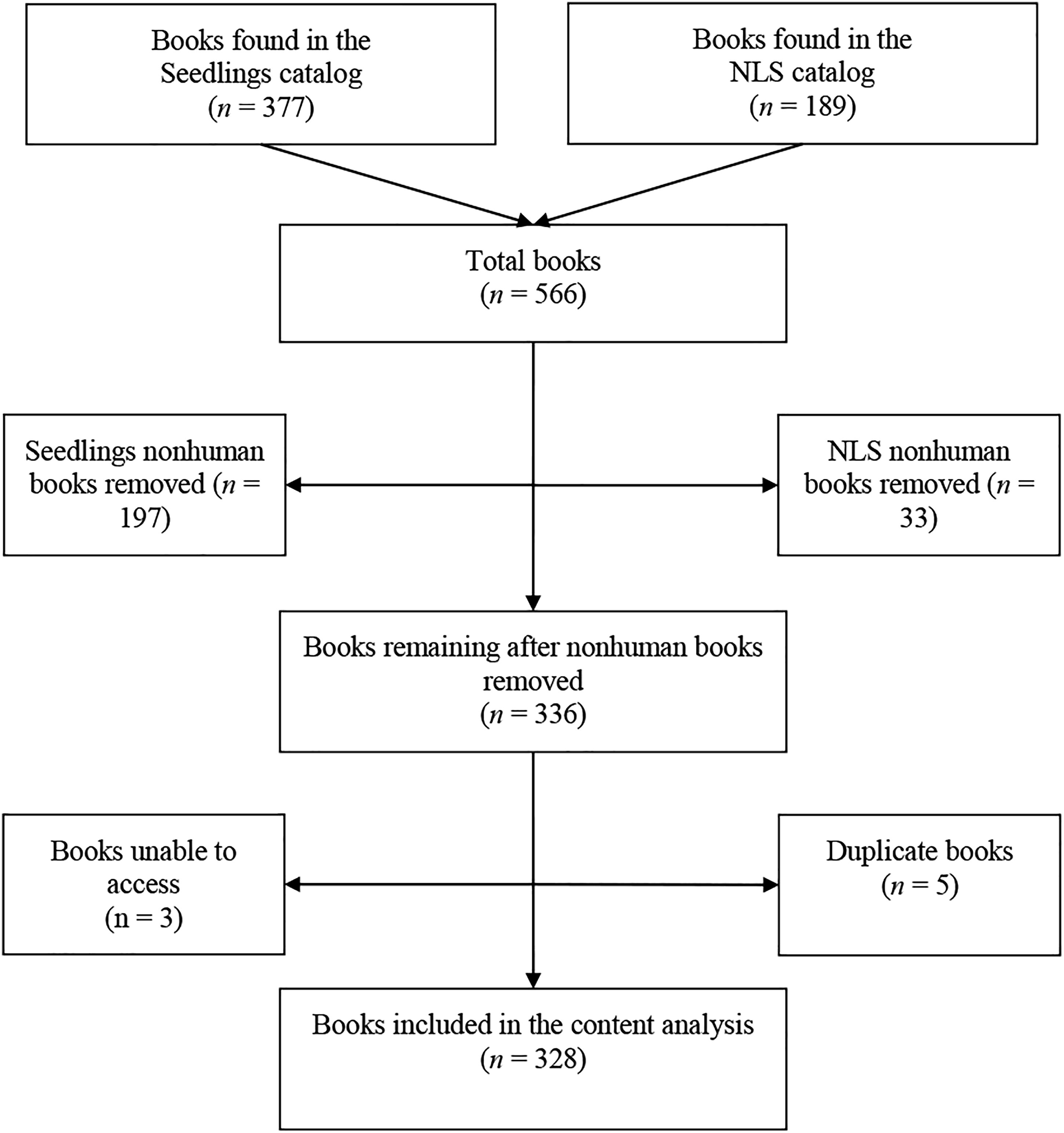
Phase Two: Coding
We conducted three procedures to code books. First, we coded for characters of color in children’s books, which included African/Black American, Asian, Latinx, Native/First Nations, Arab, and multiracial characters using a modified Children’s Cooperative Book Center (CCBC) coding schema. Specifically, books were dichotomously coded (yes or no) for featuring a character of color. Books were coded "yes" if the main character or a secondary character important to the story was a person of color or from a Native/First Nation. Books that only contained characters of color who did not play a significant role were not counted as featuring people of color. Books for which a primary or secondary race could not be determined were coded as "unknown."
Second, we coded the books dichotomously (yes or no) for their representation of diverse cultures, based on Sims’ (1982) schema for African American children’s literature as extended by Ramirez and Ramirez (1994) to each of the nonwhite cultural groups included in our analysis. Third, books with people of color as primary or secondary characters were coded as either "culturally conscious" or "melting pot." Specifically, we coded a book as being culturally conscious if it had one or more of the following features: (a) characters of color who told the story from their perspective; (b) a racial or ethnic group’s community or home as the setting; and/or (c) physical descriptions, names, language, cultural traditions, and/or themes that identified characters as members of one of the identified racial or ethnic groups. If none of these criteria were met, the representation of diverse cultures were coded as "melting pot." Careful effort was made to accurately discern the presence or lack of multicultural content in each book, and 25% were double coded and percent of simple interrater agreement [(agreement/total opportunities) x 100] was calculated at 98.33%.
Phase Three: Analysis
Upon completion of the coding, we analyzed the racial identity of primary and secondary characters across all the books. Specifically, we systematically calculated frequency counts and percentages to identify racial representation and frequencies of culturally conscious and melting pot books.
Findings
Below are the findings concerning racial or ethnic representation of primary and secondary characters among the books analyzed. We noticed a few patterns across the catalogs.
Race or Ethnicity of Primary and Secondary Characters
The representations of diverse primary and secondary characters in each catalog are described below. Note that the term Latinx is used as a gender-inclusive alternative to Hispanic and Latino.
National library service
Examination of the NLS catalog found that characters of color were represented in 22 (14%) of the books. African/Black Americans were featured in 13 books (8%), distantly followed by Asian/Asian Pacific American and Latinx characters, each found in 4 books (3%). Native/First Nations were represented in 2 books (1%). One book featured Arab characters. Multiracial characters were not identified in any of the books.
As shown in Table 1, characters of color were featured in 3 (43%) historical fiction books and 3 (27%) biographies. The single book in folk and fairy tales featured African/Black American characters. Characters of color were found in 4 books in the family category (21%), 1 book (13%) in the friendship category, 5 (12%) adventure books, and 3 (17%) growing-up books. Characters of color were represented in less than 10% of fantasy books.
Seedlings
Culturally diverse racial groups represented in seedlings books*.
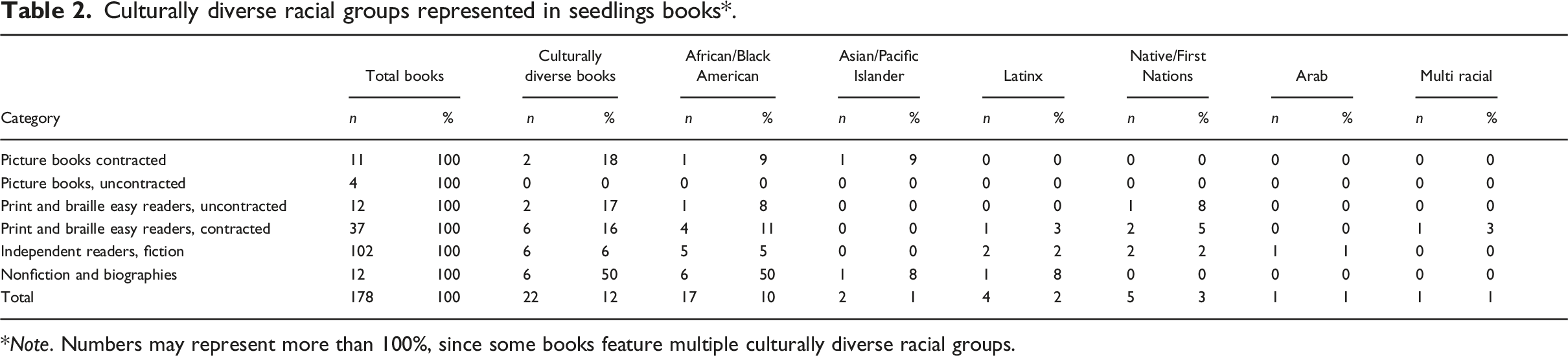
Note. Numbers may represent more than 100%, since some books feature multiple culturally diverse racial groups.
As Table 2 shows, there were 8 out of 49 culturally diverse books (16%) across the two easy-reader categories. The Nonfiction and Biography category had the highest percentage of cultural diversity, with six out of 12 books (50%) featuring characters of color. Half of these books presented African/Black Americans characters and culture. In the largest category, Independent Readers Fiction, six out of 102 books (6%) featured characters of color (See Table 2).
Representation of Diverse Cultural Content
In this section, we present findings on the representation of diverse cultures, drawing on Sims’ (1982) description of culturally conscious and melting pot books.
Representation of race or ethnicity in culturally diverse NLS books.

In the adventure category, 3 out of 5 (60%) of the books with characters of color contained culturally conscious elements. For example, Magic Tree House Merlin Missions: #14 A Good Night for Ghosts featured a New Orleans setting and jazz culture. A Perfect Time for Pandas, depicted several Chinese cultural elements. Scorpia Rising contained Arab characters and settings. All four books in the family category that featured characters of color were identified as culturally conscious. For example, The Accidental Adventures of India McAllister included themes of racial or ethnic identity, and Hold Fast presented city living, cultural heritage and traditions.
In the fantasy book category, the one book with characters of color, Starry River of the Sky, featured culturally conscious content. Similarly, Ninth Ward, the only book analyzed in the folk and fairy tales category, presented themes of spirituality, cultural heritage, and city living. As Table 3 shows, a total of 3 melting-pot books (14%) were identified, two of which were in the adventure category. These included Geeks, Girls, and Secret Identities, whose main character had an Asian name, but was void of other Asian cultural references in the text; and Super Hair-O and the Barber of Doom, which depicted characters of color in the illustrations with no culturally diverse textual features.
Seedlings
The content analysis of the Seedlings catalog revealed that the majority of books with characters of color featured culturally conscious content (n = 15; 68%). Several books presented traditional Native/First Nation cultures: Knots on a Counting Rope, Squanto and the First Thanksgiving; The True Story of Pocahontas; and Julie of the Wolves. Each contained cultural elements including dress, food, language, and traditional Native/First Nation religion and ways of life. The Indian in the Cupboard was not counted as culturally conscious due to its stereotypical and offensive portrayal of Native/First Nations people.
Representation of race or ethnicity in culturally diverse seedlings books.

We found that 7 (24%) of the culturally diverse Seedlings books were melting-pot books, which included God Loves You, the only picture book featuring characters of color. The independent reader books for ages 4–9 years had a total of 4 melting pot books: Miss Nelson is Missing, The Best Teacher in Second Grade, Nate the Great and the Big Sniff, and The Surprise Party.
Discussion
This study offered the first content analysis of cultural diversity in children’s braille books published in the United States. The major finding, that characters of color comprised just 16% of the primary and secondary characters in the study corpus, indicates that the cultural diversity in the United States and its K-12 schools is woefully underrepresented in the catalogs of two major children’s braille book publishers.
Characters’ race or ethnicity totals.
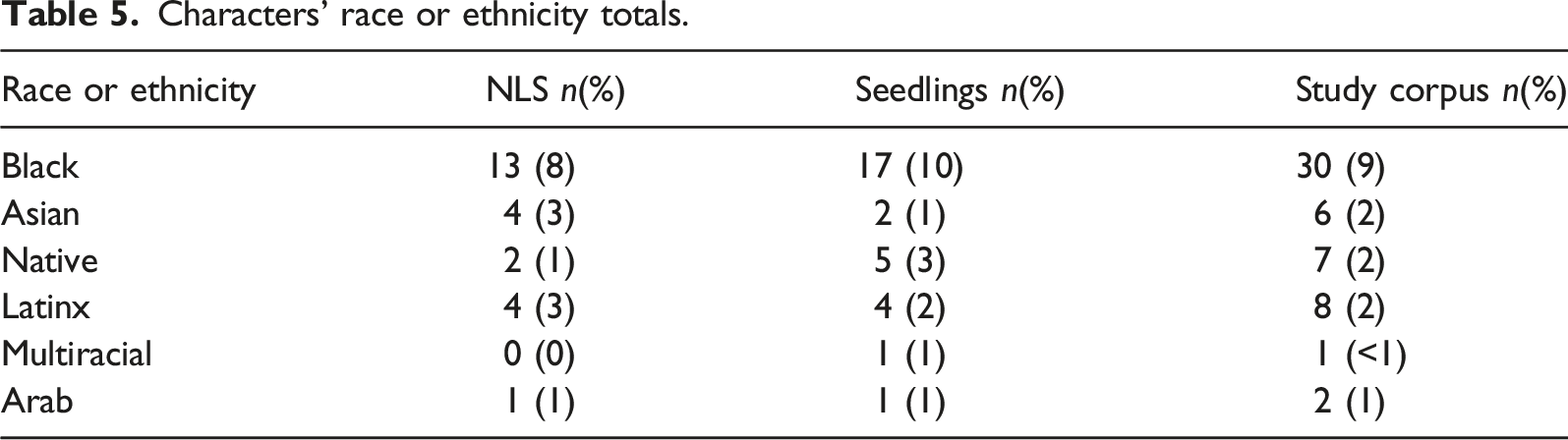
Multiracial characters were identified in only one book. Yet, 2.8% of Americans are of two or more races (U.S. Census Bureau, 2019). Native/First Nation peoples were the only racial or ethnic group that was slightly overrepresented, at 2% of the books analyzed. According to the U.S. Census (2019), American Indian/Native Alaskan people comprise just 1.3% of the population. The U.S. Census does not have an Arab racial or ethnic category. However, the authors believed it was important to include this demographic, which was represented in just under 1% of the study corpus.
These findings are sobering, particularly given what is known about the benefits of culturally diverse books for all children. Although the underrepresentation of diverse cultures in the larger children’s books market is a widely recognized, longstanding problem, the children’s braille book catalogs analyzed in this study present an even more stark shortcoming in this area. According to data on children’s books by and about Black, Indigenous/First Nation, and other people of color published in the United States in 2018, only 29% of 3683 books analyzed were about people of color (Children’s Cooperative Book Center, 2019). Although proportionately small, the reality is that there were approximately 1069 culturally diverse children's books available for braille production. Nonetheless, in this review of two major children’s braille book catalogs from around the same time period, the authors only found 51 culturally diverse books. As such, it can be asserted that there were approximately 1018 more culturally diverse titles in the children’s book market to choose from for braille production.
Earlier, we presented a nonvisual alternative to Bishops’ (1990) windows, mirrors, and sliding glass doors metaphor, asserting that braille books can serve as tactile models of children’s worlds, 3D images of other worlds, and tactile paths for imaginatively traveling to and from different worlds. We employed this alternative metaphor to explore the significance of our findings on cultural diversity in the NLS and Seedlings children’s braille book catalogs.
The first part of the metaphor speaks to books that affirm and represent children’s worlds as building blocks of a young child’s self-esteem and self-concept (Hughes-Hassell & Cox, 2010). Unfortunately, the results of this study indicate that racially and ethnically diverse visually impaired children have far fewer opportunities than their white counterparts to experience NLS and Seedlings braille books that can metaphorically serve as tactile models of their worlds.
Books can also enrich children’s lives by exposing them to experiences that are different from theirs (Koss, 2015; Tschida et al., 2014). However, the underrepresentation of diverse characters and cultures in the NLS and Seedlings books that were analyzed for this study reveals the catalogs’ deficiencies in offering books that, for braille readers, can imaginatively offer 3D images of worlds that are different from the dominant, white middle-class experience. This shortfall also means that children have limited opportunities to experience NLS and Seedlings books as tactile paths on which they can imaginatively travel to and from different worlds and develop better understanding of and appreciation for difference.
Implications
The underrepresentation of diverse cultures in children’s braille books has educational implications related to reading engagement and skill levels of braille readers from racially and ethnically diverse backgrounds. Research already exists that points to racial disparities in reading achievement and comprehension among visually impaired children (Blackorby et al., 2007). More studies are certainly needed in order to determine the extent of these racial disparities. However, access to more books that affirm their cultural identities and their worlds can be very beneficial for the literacy development of visually impaired children of color.
Teachers of students with visual impairments need to be aware of the literary and social benefits of culturally diverse books and incorporate more diverse books into their practice. Teachers need not wait for additional research or for the children’s braille book industry to publish more books featuring diverse racial and ethnic groups. Teachers of children with visual impairments can tap into the larger print children’s book market to build their own collection of homemade culturally diverse braille picture books. There are numerous multicultural books lists available online. A good place to start is Colours of Us (n.d.), a resource that offers extensive lists of culturally diverse children’s books.
Teachers of children with visual impairments can also assist families by preparing adhesive braille labels to add to multicultural, print children’s book to their home libraries. For very young children, multisensory experiences can be created by collecting culturally conscious objects related to the stories. Future studies should examine how culturally diverse books and other materials are used by teachers of children with visual impairments for instruction, assessment, and promoting parental involvement in braille reading activities in the home.
Another important area for future research involves the analysis of diversity more broadly in children’s braille books. Although this study focused on race and culture, the authors recognize that diversity also includes representations of other aspects of personal identity, such as disability and gender. Visually impaired children will benefit from exposure to braille books that reflect the plurality of personal identities that constitute the cultural diversity in the United States and the world. Some of these representations will model aspects of their own identities, and others will help them learn about and gain respect for people who are different from them.
Conclusion
As the United States and its school-aged population become increasingly more multicultural, books have an important role to play in developing children’s understanding and acceptance of themselves and others. When children are able to identify with the characters and settings in the books they read or have read to them, they can develop a positive sense of self. Children are also more likely to connect with the text and enjoy the reading experience (Koss, 2015) when they can make these cultural connections. Additionally, learning about different people and worlds through exposure to culturally diverse books can benefit all children.
The longstanding underrepresentation of cultural diversity in print children’s books is also an issue for the children’s braille book publishing industry. According to the results of this study, the NLS and Seedlings catalogs have significant room for improvement in offering a more robust and varied collection of books through which young braille readers from diverse cultural backgrounds can feel affirmed and all children can have opportunities to learn about and value different cultural experiences. To rectify this shortfall, NLS and Seedlings are urged to make intentional efforts to add more culturally diverse titles from the expansive print children’s book market—across a range of genres—to their braille book catalogs. Although this study focused on NLS and Seedlings, all children’s braille book publishers should take on this call to strengthen the diversity of their collections, for the benefit of all young braille readers.
Footnotes
Declaration of Conflicting Interests
The author(s) declared no potential conflicts of interest with respect to the research, authorship, and/or publication of this article.
Funding
The author(s) received no financial support for the research, authorship, and/or publication of this article.
