



Abstract
To be effective teachers of literacy for students who read braille, we need to know what our students’ strengths and needs are as all these components come together in braille literacy. Using an appropriate assessment that addresses the skill sets involved in braille literacy is critical to putting together effective intervention packages for our students. The first author used the Kamei-Hannan and Ricci Reading Assessment (2015) and the Braille Reading Analysis Chart (Harley, et al., 1997) to determine areas of need for a student in grade 2 in a braille literacy program. Needs included: identifying ending sounds and naming final letters and sounds; basic decoding of short and long vowel sounds; recognizing sight words; and identifying letters. Specific miscue patterns in tactile perception (reversals) were identified. Information gathered from these assessments was used to develop a targeted intervention package and informed the development of a balanced literacy program for this student. Following a period of implementation, data showed evidence of overall improvement in braille literacy skills.
Braille literacy involves the five components of instruction as identified by the National Reading Panel (2000): Phonemic awareness, phonics, fluency, vocabulary, and comprehension. It also involves tactile perception and efficiency skills and the use of braille contractions (Holbrook, et al., 2017). Effective teachers of literacy for students who read braille need to know what their students’ strengths and needs are, since all these components come together to develop a balanced literacy program for the student.
Diagnostic assessment should reveal strengths and needs in all areas of reading and should show the interactions between these skills. Early print readers acquire the skills needed to process and decode groups of letters and whole words sooner than their braille-reading peers acquire the tactile perception skills to do the same (Emerson, et al., 2009). Low fluency rates among early braille readers may not necessarily be indicative of a problem in reading, but rather it may indicate that the student needs more time to become proficient (Emerson, et al., 2009). When a student is not making expected progress in braille literacy, we are faced with the following questions: Is this a student who struggles with reading, or do they simply need more time and experience with the code in order to become efficient? Appropriate assessment designed to include all aspects of braille literacy needs to be used to determine instruction.
Student Profile
Parent permission was obtained to share information and data about the following student, and a pseudonym has been used. Ambrosi is a typically developing student who is congenitally blind. She is social, dynamic, and very active. Ambrosi attends a publicly funded school in one of Canada’s largest school districts. Upon entering school, the district required that Ambrosi participate in a thorough functional tactile assessment (FTA) conducted by two qualified teachers of students with visual impairments from the district’s Blind/Low Vision team. The FTA is a district-developed assessment that gathers data to determine appropriate level of service.
Ambrosi first received instruction in braille when she started a full-day kindergarten program at the age of 4 years. She did not receive early intervention exposure to braille, which would have allowed her to develop “pre-braille skills” prior to starting school. This report looks at Ambrosi’s development of braille literacy skills during 2nd grade (at age 7 years).
Based on her FTA and learning media assessment (LMA), the Blind/Low Vision team determined that Ambrosi’s primary learning medium was tactile, her secondary learning medium was auditory, and that her primary literacy medium was braille. Ambrosi’s report cards indicated that she fully participated in the curriculum at grade level with the exception of reading, and her individualized education programs (IEP) reflected that she had been making steady progress in braille literacy skills until the first mid-term report of 2nd grade.
At that time, Ambrosi’s reading rate recorded as words correct per minute (WCPM) was declining (see Figure 1). WCPM is a measure of reading fluency that “assesses both accuracy (the number of words the reader is able to identify) and automaticity” (Vacca, et al., 2018 p. 205). According to Kamei-Hannan and Ricci (2015), “faster readers exhibited fewer inefficient characteristics such as scrubbing or running a finger up and down over a braille cell, which often [indicates] difficulty with perceiving the letter or symbol” (p. 279). The teacher of students with visual impairments used the “repeated reading” strategy described by Vacca et al. (2018) to help develop fluency measured as WCPM: She asked Ambrosi to re-read a short text or passage, reducing the number of prompts and supports with each read until Ambrosi achieved a “level of automaticity that improve[d] speed and comprehension” (p. 198). However, when it became apparent that Ambrosi was no longer making progress, this measure of fluency did not identify which specific components of reading were problematic without additional assessment. Words Correct Per Minute (WCPM) Recorded on Third Repeated Reading of Passages.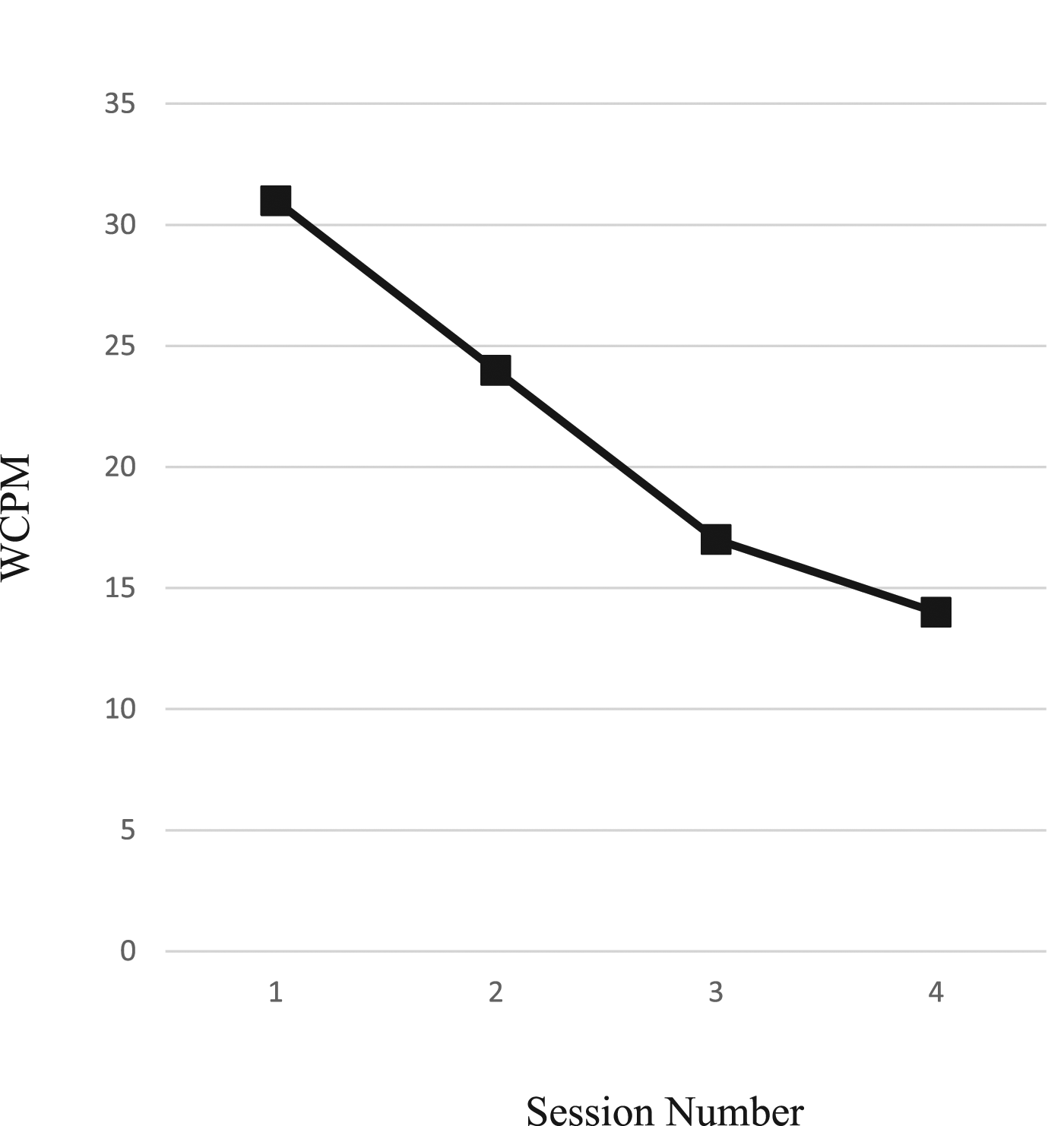
The Developmental Reading Assessment (DRA) (Beaver, 2006) and the Johns Basic Reading Index (BRI; Johns, 2017) were implemented following guidelines published. Although the DRA and BRI are two commonly used assessments in the school district, they are not designed with the braille reader in mind. Use of these assessment materials introduces the possibility of encountering contractions and symbols the student has not yet learned, as well as longer words that can be decoded with the use of picture cues. Student motivation became a factor in leading the classroom teacher and the teacher of students with visual impairments to question the results. In their opinion, Ambrosi performed several grade levels below expectation based on data collected from in-class reading assignments. Ambrosi expressed a high level of irritation and annoyance when presented with the assessment materials. She avoided the tasks by putting her head down and taking her hands off of the material, asking to be excused, and stating directly that the assessment material was too boring for her to do. As such, the school team was not able to determine a grade level with these assessments.
Determining the Intervention
It was difficult to determine if there were issues with the braille code, issues with reading, or if there was a combination of both occurring, and, if so, in what way. To help address this problem the Blind/Low Vision team recommended the use of the Kamei-Hannan and Ricci Reading Assessment (2015). This assessment is a diagnostic tool that “will provide in-depth analysis of a student’s abilities within several subskills of each component” (pp. 72–73) of literacy, and “is meant to be used with children who read print and/or braille” (p. 300). In addition to this tool, the teacher of students with visual impairments used the Braille Reading Error Analysis chart described in Harley et al. (1997) to analyze errors recorded during the reading assessment and running records from the student’s braille literacy lessons and classroom reading assignments to identify “patterns of perceptual errors” (p. 160).
Implementation of the Assessment
The assessment took place in two phases: baseline and follow-up. The baseline phase was conducted over a two-week period during the winter term as a series of short tasks integrated into Ambrosi’s braille literacy lessons. The teacher of students with visual impairments administered sections of the assessment that target pre-kindergarten– to 2nd grade–level skills (“Part 1: Phonological and Phonemic Awareness Skills,” “Part 2: Basic Phonics and Decoding,” “Part 4: Sight Words,” and “Part 5: Contractions”). Sections of the assessment targeting skills beyond the 2nd grade level, such as “Part 3: Advanced Phonics and Decoding,” were omitted. The teacher conducted the follow-up phase in late spring to determine if there was evidence of improvement in sections of the assessment that were not mastered during the baseline phase. Both phases of the assessment took place in the quiet work room where Ambrosi regularly participated in her braille literacy lessons.
Baseline assessment (see Table 1) revealed four major skill areas of need: • identifying ending sounds and naming final letters and sounds; • basic decoding of short and long vowel sounds; • recognizing sight words; and • identifying letters. Skill Areas of the Kamei-Hamman and Ricci (2015) Reading Assessment Scoring Below Mastery.

Armed with this specific knowledge, the classroom teacher and the teacher of students with visual impairments were able to move forward with creating a targeted intervention plan in addition to the regular classroom program to: • target decoding, including specific lessons on short and long vowel sounds; • practice identification of sight words and letter recognition; and • implement a guided reading plan to address specific areas of need for a student using braille, including picture reliance and introduction of contractions as they appear in text.
The teacher of students with visual impairments targeted issues with tactile perception and discrimination. Analysis of miscues using the Braille Reading Error Analysis chart (Harley et al., 1997) revealed that braille reversals posed a challenge for Ambrosi and, in the school team’s opinion, prevented her from successfully identifying certain letters and sight words.
Methods
Targeting Reversals
The focus of this report is on Ambrosi’s difficulty with braille symbol reversals, specifically “h” and “d” and “p” and “v.” Kamei-Hannan and Ricci (2015) point out “there are a finite number of potential configurations of the six dots within a braille cell, many of which are very similar,” (p. 278) and “the symmetrical shape of the cells, the number of similar configurations, and the use of contractions often lead beginning braille readers and students who struggle with reading to confuse or reverse symbols” (p. 279).
Swenson (2016) suggests that it is first helpful to determine whether or not the student can feel the difference between two confusing braille shapes. This determination will reveal if the confusion is caused by issues with tactile perception and discrimination or with memory (Swenson, 2016). The teacher of students with visual impairments ascertained through assessment activities and discussion with Ambrosi that she could not feel the difference between the shape of an “h” and a “d,” but she could feel the difference between a “p” and “v.” Therefore, different strategies were used to address each reversal pair.
Reversal Intervention Package
Strategies for “d” and “h” included: • over-teaching “h” without the presence of “d,” “f,” or “j”; • swing cell activities and constructing a corner board; • tracking sheets focusing on “h” without the presence of “d,” “f,” or “j”; • reading a story with focus on “h”; and • Logan braille coach activities.
Following the use of the swing cell to determine the shape of the letter “h” and the location of the unraised dot 4 within the shape, Ambrosi constructed what she called a “corner board,” based on Swenson’s (2016) “helper sheet” (p. 119). Here, she could relate the enlarged shapes (Velcroed onto a felt board) in each corner to the letters written in braille in each corner of the card in the center, focusing on the orientation of unraised dot. This was the only time the letter “h” was presented in the context of other upper cell signs.
Strategies for “p” and “v” included: • swing cell activities; and • short, code-based activities including three levels of task analysis worksheets from Swenson (2016).
Results
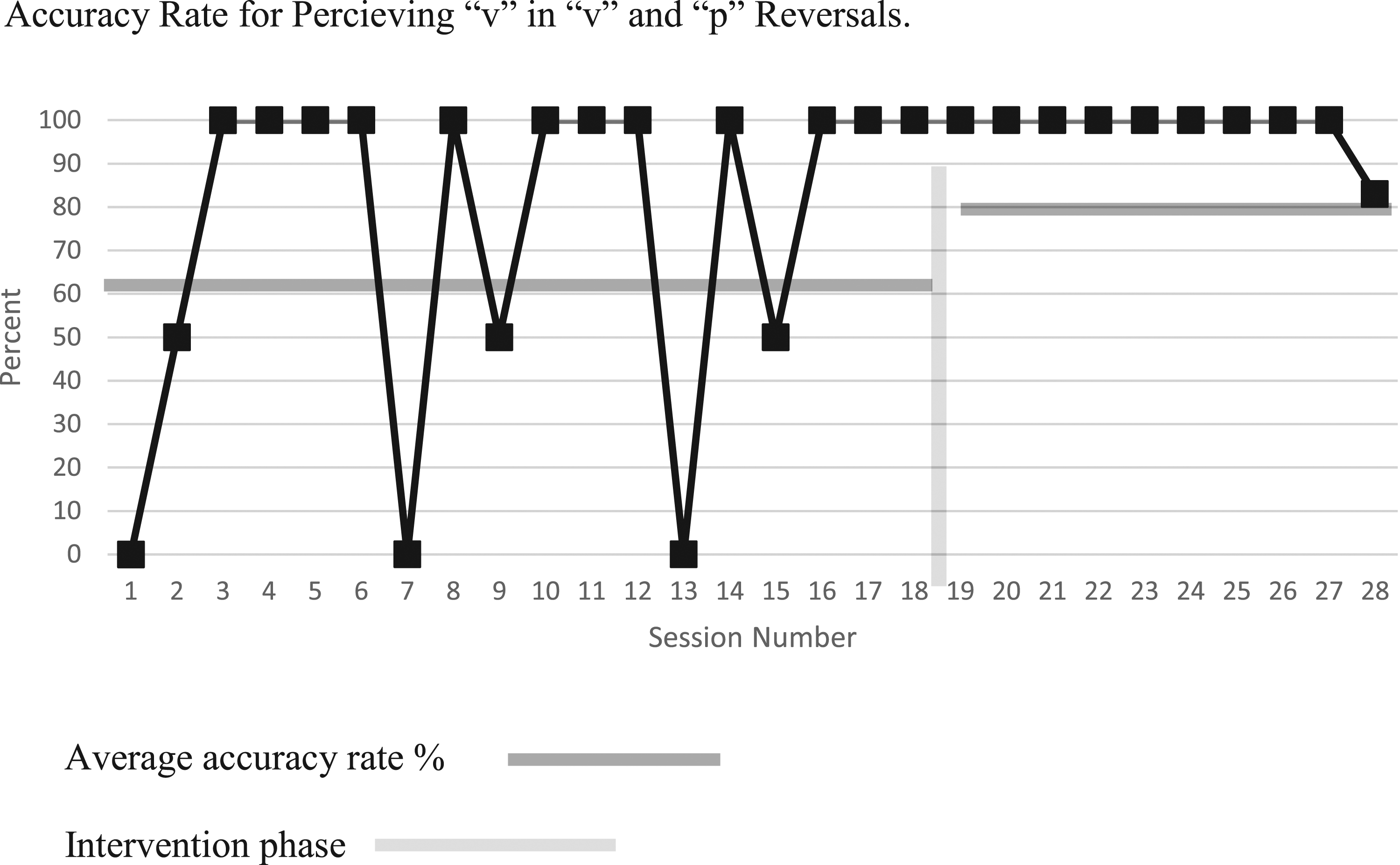
Baseline data from the Braille Reading Error Analysis (Harley et al., 1997) showed Ambrosi was inconsistently able to perceive “h” or “v” with an average accuracy rate of 76% and 75%, respectively. Following intervention, Ambrosi improved in accuracy and consistency to 99% and 98%, respectively (see Figures 2 and 3). Accuracy Rate for Perceiving "h" in "h" and "d" Reversals. Accuracy Rate for Perceiving “v” in “v” and “p” Reversals.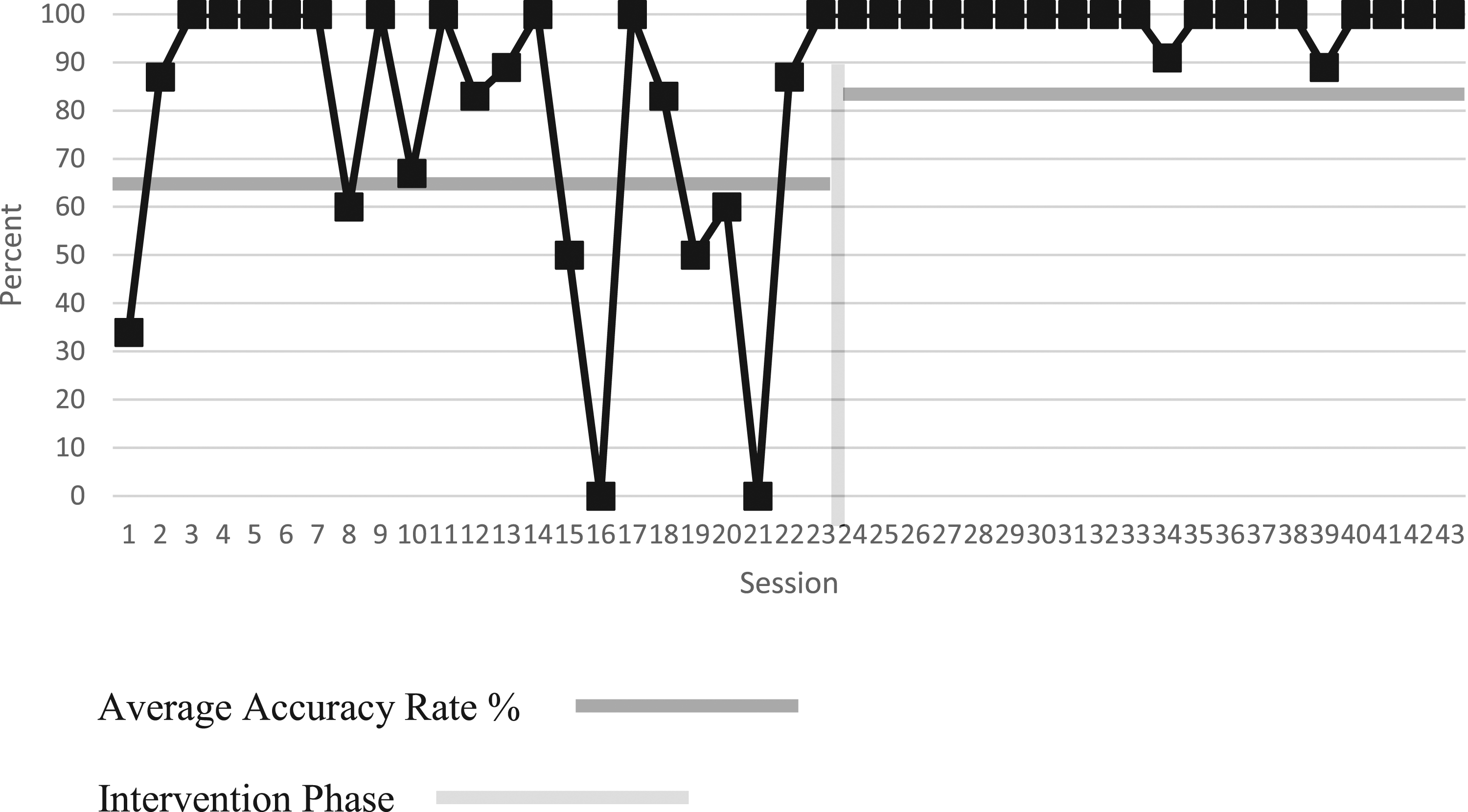
Follow-up assessment that was conducted in the spring using the Kamei-Hannan and Ricci Reading Assessment (2015) revealed an overall improvement for Ambrosi (see Figure 4). Ambrosi improved in all areas that she had not previously mastered and improved in tactually identifying letters and in recognizing both uncontracted and contracted sight words. She continued to need intervention for decoding short and long vowel sounds. Percentage of Skills Achieved. Words Correct Per Minute Pre- and Post-Intervention.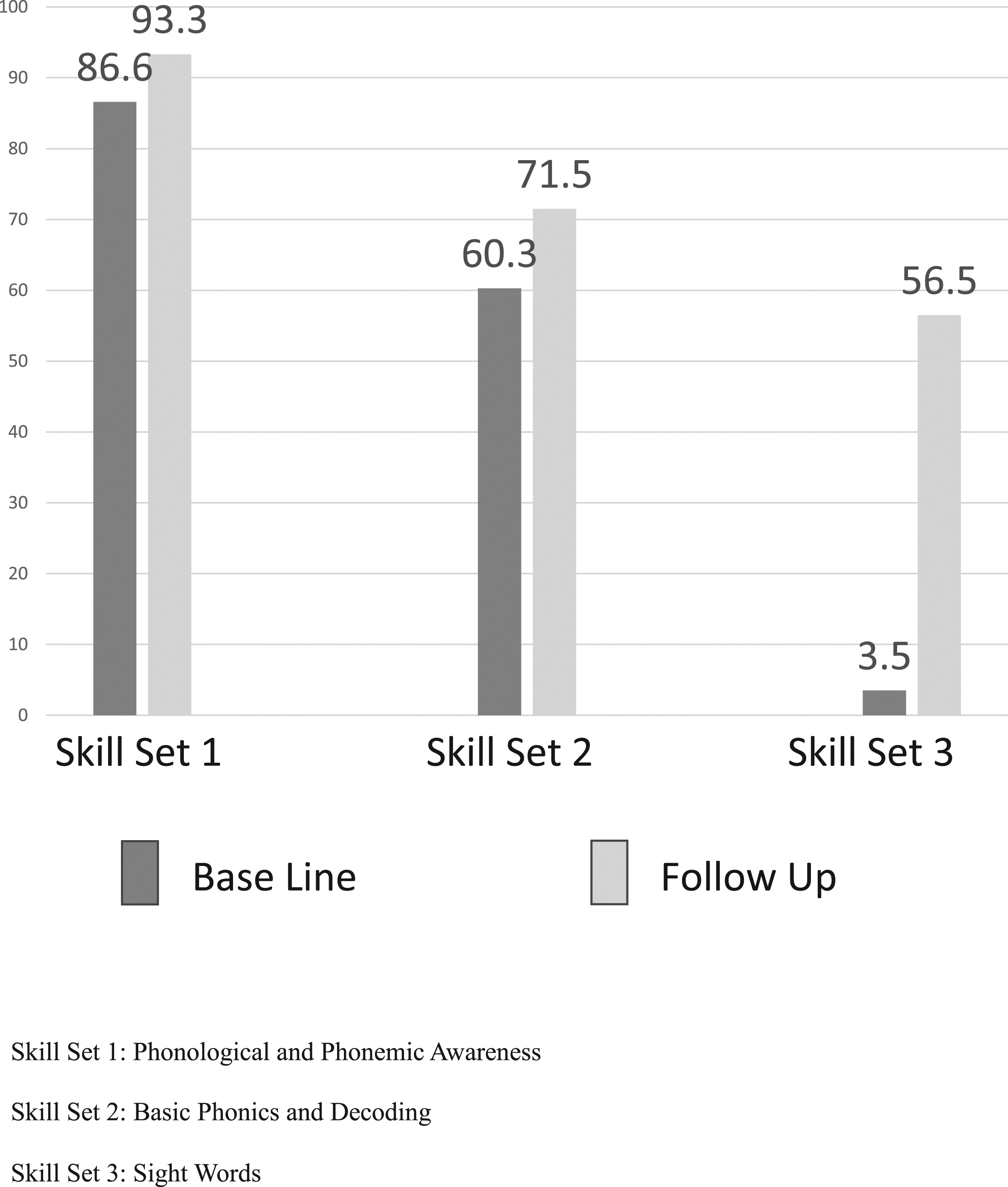

The strategies used to improve Ambrosi’s tactile perception of letters, recognition of sight words, and basic phonics and decoding were reflected in an overall improvement in her fluency, as measured by WCPM (Figure 5). Strategies described above were used to target other reversals as they became apparent throughout the course of literacy instruction during the school year. Additionally, the classroom teacher, in conjunction with the teacher of students with visual impairments, implemented a guided reading program that was created specifically for the needs of this student, in addition to the classroom literacy program. Ambrosi read and mastered more books (reaching a minimum of 25 WCPM) in the approximately 3 months following the intervention phase than she did in the 6 months preceding it.
Discussion and Implications for Practice
This report shows the importance of targeted, assessment-based intervention in braille literacy instruction to address needs that are specific to the braille code. Assessment-based instruction is key to identifying and meeting the needs of students who are visually impaired. Although it may seem like the time it takes to conduct the assessment could be taking away from precious and limited instructional time, in actuality, the results informed instruction so that it was effective.
Using a reading assessment that incorporates skills that are specific to braille reading enabled the teacher of students with visual impairments and the classroom teacher to interpret the student’s challenges with reading with the understanding of the interconnectedness of tactile perception and decoding. Without these tools, either teacher may have mistakenly interpreted these challenges to be with the braille code only or literacy only. Instead, use of additional assessment that included braille-specific skills aided in the development and implementation of a balanced literacy program for this student.
Implications for Teachers
The following are considerations for teachers of students with visual impairments who are working with their own students in braille literacy. Components of braille literacy should not be taught in isolation from each other; therefore, appropriate assessment tools designed for braille readers should be used to assess braille readers. Data collection from appropriate assessments leads to informed instructional programming. Collaboration with the classroom teacher and school teams is critical to meaningful assessment and instruction.
Suggestions for Future Research
To continue progress in the field of visual impairment in the area of effective early braille literacy instruction and acquisition, more research is needed. It could include further development of assessment tools that are specific to braille readers that target all areas of braille literacy instruction and a move from anecdotal to evidence-based research studies of various assessment and instructional strategies that are commonly used among early braille readers. Practice-based “action research” by teachers of students with visual impairments will contribute to the evidence of assessment and strategies that are effective with their students. Additionally, a compendium of effective assessments and tools that are designed to meet the needs of students who read braille should be developed to better inform educators of available resources.
Footnotes
Declaration of Conflicting Interests
The author(s) declared no potential conflicts of interest with respect to the research, authorship, and/or publication of this article.
Funding
The author(s) received no financial support for the research, authorship, and/or publication of this article.