



Abstract

Estimates from national datasets have revealed long-standing discrepancies in earnings between people with and without disabilities (Houtenville & Rafal, 2020; Maroto & Pettinicchio, 2015). For example, full-time, year-round workers with disabilities earned 87 cents per dollar earned by people without disabilities in 2017 (Day & Taylor, 2019). The pay gap between people with and without disabilities widened to 66 cents per dollar when including both full-time and part-time workers. Previous investigations of employment for Americans with visual impairments using national data have predominantly focused on employment rates and labor force participation rather than earnings (Houtenville, 2003; Kirchner et al., 1999; McDonnall & McKnight, 2021; McDonnall & Sui, 2019; Sherrod et al., 2014).
Information about the earnings of workers with visual impairments based on nationally representative data is limited. Using Survey of Income and Education data from 1976, Kirchner and Peterson (1980) documented substantial gaps in earnings between workers with and without visual impairments across occupational groups. Overall, workers with visual impairments earned 66.7% of what workers without visual impairments earned, and these gaps increased when a broad education level was considered. More recently, Erickson et al. (2020) examined annual earnings by disability type with 2018 American Community Survey (ACS) data and found that earnings of full-time, year-round workers with visual impairments were 82.3% of general population earnings.
Research with other data sources has focused on earnings and factors associated with earnings of Americans with visual impairments (Bell & Mino, 2015; Silverman et al., 2019), including vocational rehabilitation consumers (Bell, 2010; Capella, 2001; Clapp et al., 2020; Estrada-Hernández, 2008; Giesen & Lang, 2018). The average annual earnings of survey participants with visual impairments in 2011 were $40,134, and median earnings were $35,000 (Bell & Mino, 2015). In that study, annual earnings differed significantly by education level but not by the severity of visual impairment. In another survey study conducted from 2016 to 2017, people with visual impairments had average annual earnings of $44,879 and median earnings of $38,400 (Silverman et al., 2019). Bell (2010) documented a steady increase in average weekly wages of legally blind vocational rehabilitation consumers from fiscal years 1997 to 2007 and found that consumers with higher levels of education had higher hourly wages in fiscal year 2007. Although these studies provided information about earnings, the findings are not generalizable to the broader population of workers with visual impairments.
Gender inequalities in earnings have been documented in the United States since 1979 (Barroso & Brown, 2021; U.S. Bureau of Labor Statistics, 2021). Estimates of full-time, year-round workers’ median weekly earnings indicated that women earned 82% of what men earned in 2020 and that this gender pay gap was evident across all levels of education (U.S. Bureau of Labor Statistics, 2021). However, men and women who worked part-time had similar weekly earnings. When considering both full-time and part-time workers, women's median hourly earnings were 84% of men's earnings in 2020 (Barroso & Brown, 2021). Estimates from survey research and vocational rehabilitation data suggested that men with visual impairments had higher hourly and annual earnings than women with visual impairments (Bell, 2010; Bell & Mino, 2015). In 2011, average annual earnings of survey participants with visual impairments were $47,424 for men and $37,483 for women (Bell & Mino, 2015). Research has also documented that earnings disparities vary by both gender and disability type (Baldwin et al., 1994; Pettinicchio & Maroto, 2017); however, the intersection between gender and visual impairment has not been explored using national data.
The purpose of this study was to investigate the earnings of employed people with visual impairments and to compare earnings by gender, visual impairment, and education. Our research questions were:
What are the average and median annual and hourly earnings of men and women with visual impairments? What is the gender pay gap for people with visual impairments? How do the annual and hourly earnings of men and women with visual impairments compare to the earnings of men and women without visual impairments? How do the annual and hourly earnings of men and women with visual impairments compare to the earnings of men and women without visual impairments, given education level?
Method
Data Source
The ACS is an ongoing nationwide survey that provides personal and housing information for the United States annually, including educational attainment, occupations, income, earnings, and disability status. The U.S. Census Bureau produces ACS 1-year estimates based on data collected for geographic areas with at least 65,000 people (U.S. Census Bureau, 2020). The U.S. Census Bureau also releases the Public Use Microdata Sample (PUMS) files, a subsample of about two-thirds of the ACS's records, to enable data users to customize estimates for special populations (U.S. Census Bureau, 2021).
Data for this study were drawn from the person-level file from the 2019 ACS 1-Year PUMS to represent civilian non-institutionalized persons between the ages 18 and 65 who worked within the past 12 months. The study sample consisted of 1,521,934 individuals (weighted n = 160,452,588), including 19,460 individuals with visual impairments (weighted n = 2,031,140) and 1,502,474 individuals without visual impairments (weighted n = 158,421,448). People with visual impairments are individuals who responded “Yes” to the question, “Is this person blind or does he/she have serious difficulty seeing even when wearing glasses?”
Variables
This study included two categorical variables (gender and education level) and two continuous variables (annual and hourly earnings). Because we included all employed people regardless of full-time or full-year work, it was important to consider hourly earnings in addition to annual earnings. Education level refers to the highest degree or level of education that an individual had completed, recoded into six categories: (a) less than high school; (b) high school diploma or equivalent; (c) some college; (d) associate degree; (e) bachelor's degree; and (f) master's, professional, or doctoral degree. Annual earnings included the person's total earnings in the past 12 months, which consisted of two sources of income: (1) wages, salary, commissions, bonus, or tips from all jobs and (2) self-employment income (if applicable). Hourly earnings were not available in the dataset, so we computed hourly earnings based on three variables—annual earnings, the number of weeks worked in the past 12 months, and the number of hours worked per week [hourly earnings = annual earnings / (number of weeks worked in the past 12 months * number of hours worked each week)]. To remove extreme outliers, we excluded hourly earnings data for 0.58% of the sample. These individuals had exceptionally high hourly earnings (greater than $300/hour), which were likely incorrect values.
Statistical Analysis
We addressed the first, third, and fourth research questions by computing the means of annual earnings and hourly earnings by gender and education level for people with and without visual impairments. The gender pay gap (research question two) was determined by dividing the median earnings of women with visual impairments by the median earnings of men with visual impairments. All data analyses were conducted in SAS version 9.4. Sampling weights were applied to create nationally representative estimates.
Results
Basic demographic information about the samples is provided in Table 1. Annual and hourly earnings for men and women with and without visual impairments are provided in Table 2. All comparisons reported in this section are based on median earnings because average earnings are positively skewed. The hourly gender pay gap for people with visual impairments was 85.6%, meaning that women with visual impairments earned approximately 86 cents per dollar that men with visual impairments earned. In terms of annual earnings, women with visual impairments earned 77.9% of what men with visual impairments earned.
Sample Demographic Information.
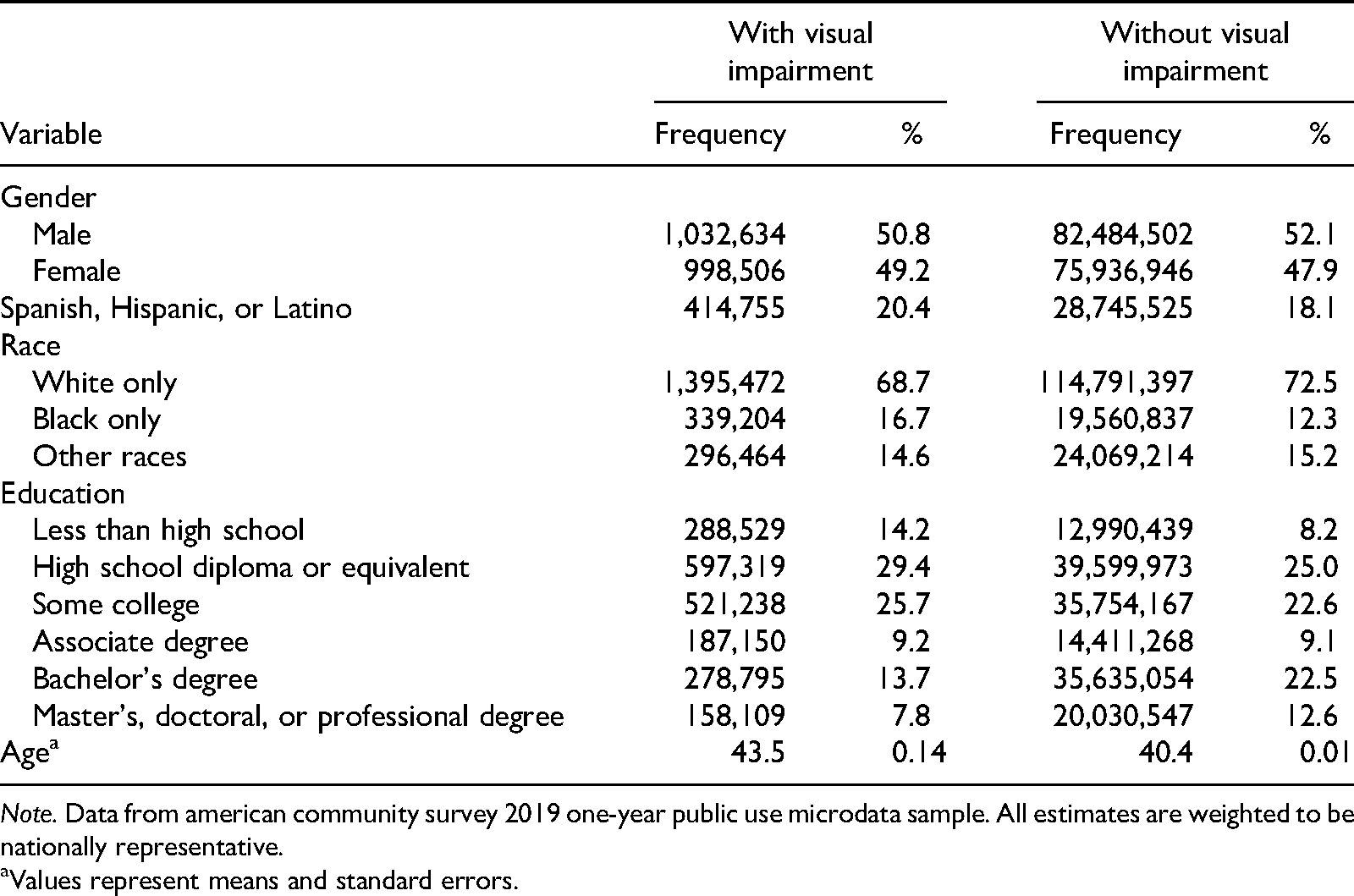
Note. Data from american community survey 2019 one-year public use microdata sample. All estimates are weighted to be nationally representative.
Values represent means and standard errors.
Annual and Hourly Earnings by Gender and Visual Impairment (VI).

Note. CI = confidence interval. weighted estimates from ACS 2019 one-year public use microdata sample. All numbers are rounded to represent U.S. dollars ($).
Comparing annual earnings of people with and without visual impairments (see Table 2), women with visual impairments earned 77.3% of what women without visual impairments earned, and men with visual impairments earned 71.2% of what men without visual impairments earned. In terms of hourly wages, women with visual impairments earned 81 cents per dollar that women without visual impairments earned, and men with visual impairments earned 80 cents per dollar that men without visual impairments earned. Annual and hourly earnings also differed between the groups based on education level (see Tables 3 and 4) but not in a consistent pattern. Earning gaps between people with and without visual impairments were smaller when education level was considered. Annual earnings differences ranged from 78.7% (no formal education) to 90.9% (associate degree) for women and from 74.6% (associate degree) to 83.1% (some college) for men.
Annual Earnings for Men and Women With and Without Visual Impairments (VI) by Education Level.
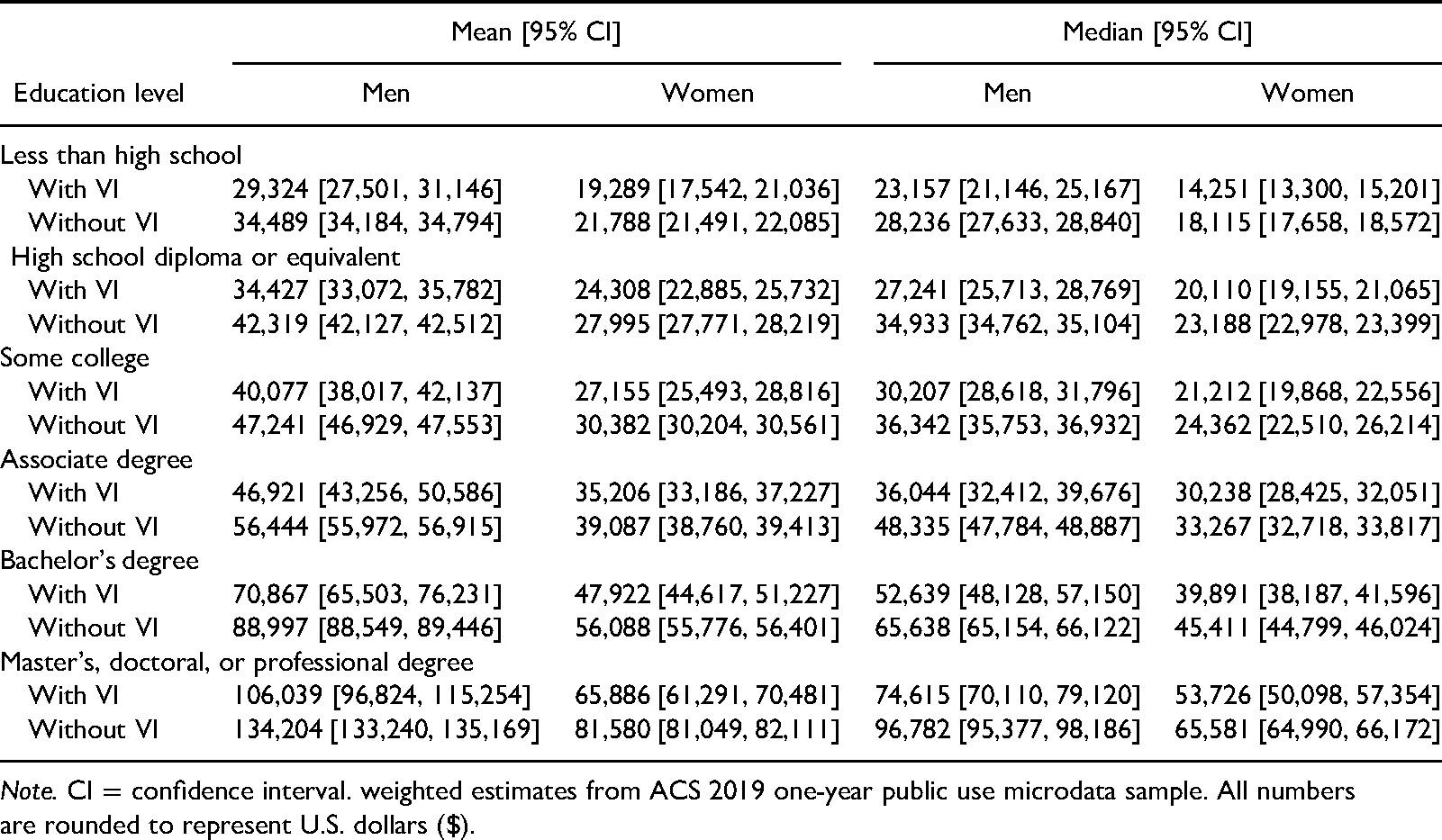
Note. CI = confidence interval. weighted estimates from ACS 2019 one-year public use microdata sample. All numbers are rounded to represent U.S. dollars ($).
Hourly Earnings for Men and Women With and Without Visual Impairments (VI) by Education Level.
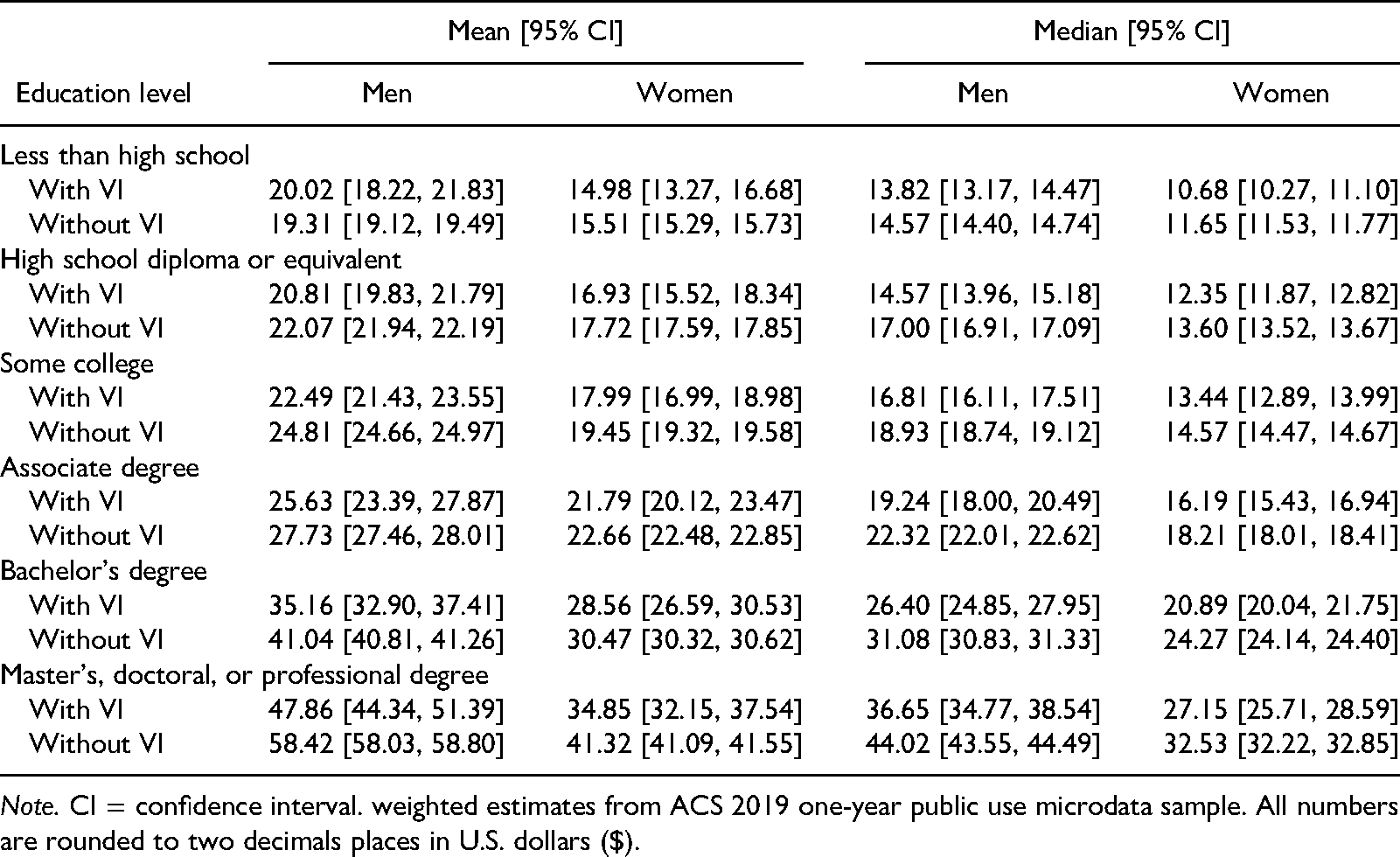
Note. CI = confidence interval. weighted estimates from ACS 2019 one-year public use microdata sample. All numbers are rounded to two decimals places in U.S. dollars ($).
Discussion
In this study, we provided current nationally representative earnings information for men and women with visual impairments (overall and by education level) and compared their earnings to those of people without visual impairments. Both men and women with visual impairments had lower earnings than men and women without visual impairments, but this gap was larger for men. This finding indicates a smaller gender pay gap for people with visual impairments than for those without visual impairments.
Earnings gaps between people with and without visual impairments have decreased since 1976 (Kirchner & Peterson, 1980), although not by a large margin. As expected, higher education levels were associated with higher earnings for all groups. Interestingly, the earnings benefit for educational advancement was greater for women with visual impairments than women without visual impairments for (a) obtaining a high school degree, (b) advancing from a high school to an associate degree, and (c) advancing from a high school to a bachelor's degree, but not for moving from a bachelor's to an advanced degree. For men with visual impairments, only moving from a high school to a bachelor's degree resulted in a greater earnings benefit compared to men without visual impairments.
Limitations of this study include using self-report data for earnings and identifying individuals with visual impairments. Additionally, ACS does not provide information about respondents’ type or level of visual impairment. It is relevant to remember that some of the observed differences in annual earnings are likely associated with part-time work, which is more common among women and people with visual impairments (McDonnall, Cmar, & McKnight, 2022).
To summarize our findings, men with visual impairments earned substantially more than women with visual impairments, and people with visual impairments earned less than people without visual impairments across all education levels. However, the earnings gap decreased when education level was considered, contrary to Kirchner and Peterson’s (1980) findings. Even though higher education levels for people with visual impairments are associated with a greater likelihood of employment (McDonnall & Tatch, 2021) and higher earnings, as documented in this study and others (e.g., Bell, 2010; Estrada-Hernandez, 2008), they do not entirely close the earnings gap between people with and without visual impairments. Investigating earnings of people with visual impairments by occupational field and other work-related and personal factors are important avenues for future research.
Footnotes
Declaration of Conflicting Interests
The author(s) declared no potential conflicts of interest with respect to the research, authorship, and/or publication of this article.
Funding
The author(s) disclosed receipt of the following financial support for the research, authorship, and/or publication of this article: The contents of this manuscript were developed under a grant from the U.S. Department of Health and Human Services, NIDILRR grant 90RTEM0007. However, these contents do not necessarily represent the policy of the Department of Health and Human Services and should not indicate endorsement by the Federal Government.
