



Abstract
Interprofessional cooperation has been identified as a critical skill to provide safe, high-quality, cost-effective, patient-centered healthcare (Zechariah et al., 2019). With the increasing importance of interprofessional cooperation, there has been growing support for interprofessional education within healthcare (Hughes et al., 2019). Specifically, the Institute of Medicine, the Association of American Medical Colleges, and the American Occupational Therapy Association (AOTA) have encouraged the use of interprofessional education and identified the ability to work in this model as a key competency for healthcare providers (“2018 Accreditation Council for Occupational Therapy Education (ACOTE) Standards and Interpretive Guide (effective July 31, 2020),” 2018; “Institute of Medicine (US) Committee on the Health Professions Education Summit. Health Professions Education: A Bridge to Quality,” 2003; “Interprofessional Education Collaborative. Core competencies for interprofessional collaborative practice: 2016 update,” 2016). Occupational therapy training programs must integrate interprofessional education into their curriculum in order to cultivate the skills for interprofessional cooperation in their students.
Low vision rehabilitation is primarily delivered in an interprofessional model (Owsley et al., 2009). Team members frequently include ophthalmologists, optometrists, vision rehabilitation therapists, orientation and mobility specialists, teachers of visually impaired students, low vision therapists, social workers, assistive technology instructional specialists, and occupational therapists (Berger et al., 2013; Hinds et al., 2003; Lahm, 2003; Lamoureux et al., 2007; Owsley et al., 2009).
☑Earn CEs Online
by answering questions on this article.
For more information, visit:
http://my.aerbvi.org/AER-Store/Publications/BKctl/ViewDetails/SKU/AER
The role of the occupational therapist in the low vision rehabilitation team is to support participation through environmental modification in areas such as contrast, glare, and lighting (Copolillo et al., 2007; Winner et al., 2014); visual skills training (Winner et al., 2014); basic and instrumental activity of daily living training for use of optical and nonoptical devices (Copolillo et al., 2007); and education regarding low vision (Liu et al., 2013).
Interprofessional low vision rehabilitation that includes occupational therapy (OT) has been shown to have a positive impact on quality of life, social participation, and depression (Deemer et al., 2017; Hinds et al., 2003; Lamoureux et al., 2007). Furthermore, increased access to vision rehabilitation and increased use of assistive and adaptive devices by people with visual impairments is an established goal of Healthy People 2020. However, this type of rehabilitation is underutilized and often not available, with just 3% of people with visual impairments receiving low vision services and 11.2% using assistive or adaptive devices (National Center for Health Statistics, 2016). The low utilization of low vision rehabilitation may be related to the availability of occupational therapists that feel adequately trained to provide this service.
Despite the growing need for low vision services, only 52% of occupational therapists reported that their entry-level education provided adequate preparation for low vision interventions (Winner et al., 2014), and 59% reported no low vision content in entry-level coursework (Copolillo et al., 2007). More recent curriculum surveys show efforts to include low vision content, with 89% of respondents reporting that low vision content had been included in the curricula (Deacy et al., 2012). Even when vision instruction for low vision is included, there is significant variability in the topics and depth of the educational content (Deacy et al., 2012). The lack of targeted low vision education may contribute to low confidence in providing low vision occupational therapy services, as occupational therapists report that comfort in providing services is correlated with entry-level preparation (Winner et al., 2014). The expanding need for low vision services requires occupational therapy educational programs to develop innovative, interprofessional models to meet this societal need.
Through a shared interest in addressing the need for training occupational therapists in low vision, the Occupational Therapy program and Wills Eye Hospital at Thomas Jefferson University developed an educational elective course in ophthalmology and low vision for occupational therapy students conducted in the setting of pediatric ophthalmology and ocular genetics clinics. The educational collaboration is designed to develop knowledge about vision, disorders associated with visual impairment, low vision, and its impact on patients and their families. The program goes beyond didactic coursework to allow students the opportunity to interact with eye care professionals, patients, and their families.
Methods
Institutional Review Board
This project was determined to be exempt from institutional review board review by the Wills Eye Hospital Institutional Review Board.
Course Design
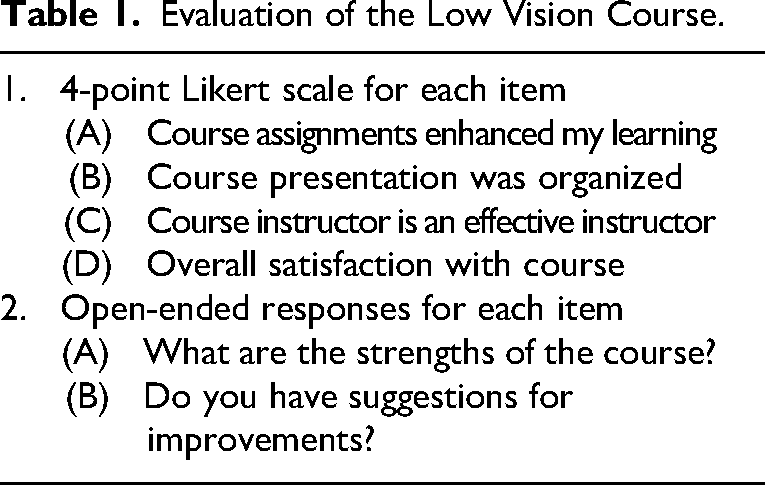
A 3-credit, 15-week course in low vision was created based on the review of evidence-based literature, current texts, and the expert opinion of two occupational therapists specializing in low vision rehabilitation in consultation with the Chief of Pediatric Ophthalmology and Ocular Genetics at Wills Eye Hospital, along with a pediatric ophthalmology social worker and low vision specialist. The course is a hybrid independent study elective offered in the second year of the two-year occupational therapy program, prior to fieldwork. Two quizzes composed of multiple-choice questions focused on knowledge, comprehension, and application of lecture materials were utilized to test participants understanding of the content. Additional assessment composed of a final independent research paper, reflective writings, and the development of individual treatment plans. A standard evaluation of the course (see Table 1) was provided to participants at the conclusion of the course.
Evaluation of the Low Vision Course.
Didactics
The course included didactic learning, clinical experiences, and reflective writing. Class lectures (see Table 2) were presented by an interprofessional team comprising of occupational therapists with expertise in low vision, a low vision optometrist, and a pediatric ophthalmology social worker. Classes consisted of guided learning activities, such as completing simulated vision assessments. This portion of the course focused on acquiring a fundamental knowledge of the challenges affecting people with low vision and the role of occupational therapists in managing these visual problems.
Occupational Therapy Course in Ophthalmology and Low Vision Lecture Topics.

Learning assignments included the development of a treatment plan for an actual patient and an in-depth research paper on an aspect of low vision practice. The topics for the independent research paper were determined by the clinical interests of the students, with guidance from the course instructors. The papers were required to incorporate the application of occupational therapy principles, including evaluation and intervention methodologies, and were designed to further the student's understanding of their desired topic.
Clinical Visits
The course was designed to extend beyond the classroom to include direct participation by attending Pediatric Ophthalmology and Ocular Genetics (child and adult patients) clinics at Wills Eye Hospital. This setting allowed students a wide exposure to common means of vision assessment, ophthalmic diagnostic testing, common and rare disorders that result in visual impairment, and the impact of low vision on patients and their families.
Students were required to schedule two three-hour visits to the Pediatric Ophthalmology or the Ocular Genetics clinics or both, as well as two additional visits to the Low Vision Optometric Clinic at Wills Eye Hospital. Students accompanied the ophthalmologists or optometrists and their trainees (fellows, residents, medical students, and optometry students) during the clinics, with the goal of observing all interactions. They were given the opportunity to view ocular abnormalities through the equipment used by the ophthalmologist or optometrist and were exposed to the intricacies of ocular examination and vision assessment, including a review of diagnostic test results. They observed the specialized refraction techniques that vary the working distance, and used enlarged charts, hand-held lenses, and prisms in a trial frame. The students were encouraged to become directly involved in the history-taking process by asking questions to the ophthalmologists or optometrists, patients, and their families throughout the examination process. When appropriate, students were encouraged to directly interview patients and families outside of the examination time (e.g., while the patient is being pharmacologically dilated) in order to learn about the day-to-day challenges of visual impairment. Students also participated in the Give Kids Sight Day Event at Wills Eye Hospital, a single-day outreach event that provides free vision screening, and if indicated, eye examinations and eyeglasses, for approximately 1,200 children from the community (Dotan et al., 2015).
Reflective Writing
Students were required to write reflections about each clinic experience, with a focus on a description of what occurred, their feelings about the experience, learning points from the experience, and new questions that the experience created. These write-ups served as an educational tool to increase awareness and insight into the experience based on the student's feelings and reactions (Williams et al., 2002). At the end of the course, reflections were shared with the clinicians whose clinics were attended by the students.
Results
Course Evaluations
All students exceeded the standard passing grade on the multiple-choice tests evaluating their knowledge of the course material. After course completion, each student evaluated the course anonymously using a Likert scale ranging from 1 to 4 for overall satisfaction and through open-ended comments on course strengths and opportunities (see Table 1). All 19 students (100%) reported being “satisfied” or “highly satisfied” with the course. A major strength of the course was noted to be the opportunity to observe clinics and to have direct interactions with the pediatric ophthalmologist and optometrist. There were no recommendations for substantive improvements for the course.
Reflective Writings
The students’ reflective writings demonstrated three main themes:
the impact of eye-related medical conditions on participation and daily life, insight into provider-patient interactions and relationships, and the potential role of the occupational therapist on the vision team as an agent to maximize participation in daily activities and life roles.
Further details of these reflections can be found in Supplemental Table 3.
Clinical Research Papers
Examples of the topics the students addressed in their clinical research paper topics included:
hippotherapy for children with visual impairments; low vision and the aging musician; the role of OT in children birth to 3 years with visual impairments; understanding Usher Syndrome: occupational therapy interventions and assistive technologies and adaptations; older adults and the impact of low vision on socialization and mental health; and interventions for children with low vision in mainstream and specialized schools.
Discussion
There is an increasing demand for occupational therapists who have the skills to provide low vision services. Despite evidence and guidelines highlighting the benefits of interprofessional low vision rehabilitation services (Deemer et al., 2017; Hinds et al., 2003; Lamoureux et al., 2007; National Center for Health Statistics, 2016), a small minority of people with visual impairments receive these services, and a large portion of occupational therapists feel that they are not adequately prepared to provide these services (Copolillo et al., 2007; National Center for Health Statistics, 2016; Winner et al., 2014).
Although low vision content is becoming more common in the curriculum of occupational therapy training programs, the content has not been standardized (Deacy et al., 2012). The lack of standardized training in the evaluation and provision of low vision occupational therapy services likely contributes to the low availability of these services. We therefore developed an interprofessional elective course for OT students to enhance their educations and encourage interest in the role of occupational therapists as team members in low vision rehabilitation and adjustment.
Raising the awareness of students about how eye conditions affect the experiences of individuals can act as a foundation for their ability to provide low vision services. A critical aspect of the course design is the use of reflection. The aim of the reflective process is for an individual to consider and analyze learning experiences in an effort to develop a deeper understanding of what they have observed (Williams et al., 2015). Reflection needs to increase awareness of thoughts and feelings, allow one to relate one's knowledge to what is observed, and then foster greater insight based on the application of this information to the experience (Williams et al., 2002). We believe the results of the students’ reflections demonstrated the impact of their experiences and the depth of their learning. The three major themes from the students’ reflective writings directly reflected our objectives in creating this course.
The shadowing sessions in this course provided students the opportunity to learn about the various challenges of low vision by directly observing and learning how the lives of patients with low vision are affected by ocular conditions (Liberati, 2017). The results of the multiple-choice examinations show that students were learning fundamental knowledge about such conditions. It is difficult for students to develop an awareness of the effect of medical and ophthalmic conditions without directly witnessing the clinical evaluations and interactions of vision professionals with patients and their families. Shadowing also generated insight into the demand and need for vision services among children in an underserved high-risk urban community. Increased understanding of the effect of visual impairment was illustrated in one student's comment: I spoke with the boy's mother about the challenges he faces with his injury. The most prominent were social participation and education. Since the injury, he has been experiencing bullying from kids at his school. He is teased about having to wear an eye shield and for taking longer with school-related tasks and activities. At school, his grades have dropped from As to Cs.
Students also reported better understanding of the professional relationship and the successful interactions between vision specialists and patients. Shadowing provides the OT student with the opportunity to go beyond static observation and didactic instruction to experience ophthalmic and optometric assessments and converse with professionals and patients directly. Observations of this interaction in the clinic provided students with an understanding of strategies and forms of communication that critically shape the provider–patient relationship. One student wrote, Dr. Levin … employ[s] strategies in order to remain client-centered and developmentally appropriate. He uses visual and auditory stimulation of the child's interest during assessments, such as an age- appropriate movie during an eye pressure test.
The program may also address limitations in access to low vision services. Multiple authors have reported that ophthalmologists and optometrists may not have adequate knowledge of low vision rehabilitation services and the type of patients who may benefit from these services, thus preventing or delaying referral (Copolillo & Teitelman, 2005; Overbury & Wittich, 2011; Pollard et al., 2003). Students began to develop a deeper understanding of the potential role of the occupational therapist as an integral part of the vision team. I was able to see from this experience how an occupational therapist may be included as a part of the healthcare team in more severe cases of albinism. For example, if she was experiencing more difficulties in school, an [occupational therapist] could evaluate to determine appropriate environmental adaptations to improve school performance. In addition, since driving was an extremely meaningful occupation that this patient was considering in the near future, an [occupational therapist] may be able to discuss alternate modes of community transportation, had it been determined that she would not be able to drive.
Our experience shows that OT students were satisfied with the course and valued the opportunity to gain insight into the effect of visual impairment (i.e., blindness and low vision) over all and low vision specifically. Didactic content follows the recommendations of the AOTA Low Vision Interventions systematic review (Berger, 2013; Liu et al., 2013; Smallfield et al., 2013). Furthermore, the use of an interprofessional education model as described in this course has been promoted as a crucial aspect of healthcare education and is consistent with the educational recommendations from the AOTA (“2018 Accreditation Council for Occupational Therapy Education (ACOTE) Standards and Interpretive Guide (effective July 31, 2020),” 2018; Hughes et al., 2019; Zechariah et al., 2019). Interprofessional cooperation has been demonstrated to improve patient safety, promote high-quality, cost-effective care, and improve both patient and healthcare professional satisfaction (Harry, 2014; Zechariah et al., 2019). The collaborative effort used in this course provides the OT students the opportunity for direct interaction with patients and eye care professionals in order to become familiar with the clinical reasoning that underlies low vision recommendations, which have been shown to increase comfort in providing low vision services (Winner et al., 2014; Workman et al., 2016). An additional benefit of the combined clinic and classroom model is to create a link between didactic learning and clinical experience, influencing future professional behavior (Kennel et al., 2009).
There are several limitations to this study. This course was focused on exposure and expanding understanding of the field of low vision and ophthalmology to OT students and did not directly prepare the students to provide low vision therapy. Additionally, the course enrolled only a limited number of participants from a single institution, which may have resulted in bias in the results and responses. Furthermore, the majority of the course evaluation relied on subjective feedback, which may inherently be varied and biased. Future work may benefit from larger enrolment in multiple institutions and the inclusion of additional topics of interest such as the use of assistive technologies. We believe that this work helps to highlight the importance of formalized low vision education within the OT curriculum.
A collaborative effort between occupational therapists and eye professionals is timely as there has been an increasing recognition by eye care professionals to address outcomes beyond medical and surgical management. These areas include reading (Brown et al., 2014), community participation, safety and device training (Markowitz, 2006; Schultz, 2008), and overall quality of life (Lamoureux & Pesudovs, 2011). We believe our program affords the ophthalmic, optometric, and OT communities the opportunity to learn from each other while developing enhanced low vision resources for patients. This course supports the value of implementing interprofessional training as an important adjunct to classroom-based interprofessional education (Acquavita et al., 2014).
Supplemental Material
sj-docx-1-jvb-10.1177_0145482X231169294 - Supplemental material for An Innovative Interprofessional Course in Ophthalmology and Low Vision for Occupational Therapy Students
Supplemental material, sj-docx-1-jvb-10.1177_0145482X231169294 for An Innovative Interprofessional Course in Ophthalmology and Low Vision for Occupational Therapy Students by Alison Bell, Lucas Bonafede, Arlene Lorch, Melanie Snitzer, Scott A. Edmonds, and Alex V. Levin in Journal of Visual Impairment & Blindness
Footnotes
Declaration of Conflicting Interests
The author(s) declared no potential conflicts of interest with respect to the research, authorship, and/or publication of this article.
Funding
The author(s) disclosed receipt of the following financial support for the research, authorship, and/or publication of this article: Supported in part by the Foerderer Fund (AVL) and the Robison D. Harley, MD Endowed Chair in Pediatric Ophthalmology and Ocular Genetics (AVL).

Supplemental material
Supplemental material for this article is available online.
References
Supplementary Material
Please find the following supplemental material available below.
For Open Access articles published under a Creative Commons License, all supplemental material carries the same license as the article it is associated with.
For non-Open Access articles published, all supplemental material carries a non-exclusive license, and permission requests for re-use of supplemental material or any part of supplemental material shall be sent directly to the copyright owner as specified in the copyright notice associated with the article.
