




Abstract
To those with high status, abundance is granted. Moving beyond the multitude of objective benefits, the authors explore how status, once conferred, colors the perceptual world people inhabit. In four experiments, participants’ status state influenced their judgments of status-relevant features in their environment. Participants in a state of high status reported hearing applause (Experiment 1) and seeing facial expressions (Experiment 2), in reaction to their performance, as louder and more favorable. In addition, expectations of how others will respond—expectations stemming from one’s current status state—accounted for this effect (Experiment 3). Finally, differences in judgments between participants experiencing high versus low status were observed only when the target of the evaluation was the self (Experiment 4). These results advance scholars’ understanding of the psychological experience of status and contribute to the growing literature on the dominant influence psychological states have on people’s judgments of their social world.
Not “Seeing is Believing,” you ninny, but “Believing is Seeing.”
Contrary to the age-old axiom “seeing is believing,” the possibility that the world we see is one we already believe in (e.g., Caruso, Mead, & Balcetis, 2009; Ehrlinger & Dunning, 2003; Halberstadt, Winkielman, Niedenthal, & Dalle, 2009; Lewandowsky, Stritzke, Oberauer, & Morales, 2005) has important implications for social judgment. Yet, within the domain of status, an ubiquitous and inevitable feature of social life (e.g., Barkow, 1989; Berger, Fisek, Norman, & Zelditch, 1977), extant literature suggests—seeing is believing. Specifically, the attributes and qualities we observe in others establish a set of beliefs and expectations about their abilities and value, which in turn determine how much status we accord them (e.g., Ridgeway & Berger, 1986). Even when considering ourselves, by observing how others respond to us we come to understand our place in the social hierarchy (Anderson, Srivastava, Beer, Spataro, & Chatman, 2006). Thus, whether focused on ourselves or on others, our ability to accurately interpret status hierarchies is rooted in the differences we see among actors (e.g., Berger et al., 1977).
Alternate to this perspective, we examine if people’s current beliefs about their own status position influence their judgments of what they see and hear in their social world. In addition to the numerous social benefits afforded to those with status (e.g., Frank, 1985; Ridgeway & Berger, 1986), we contend that the psychological experience of status provides another important benefit: a favorable lens through which to view one’s social landscape. Specifically, we suggest that a state of high status creates a set of beliefs and expectations that favorably color people’s judgments of their outside world. Thus, we contend, for those in positions of high status, believing is seeing.
Status Conferral and Benefits
Status is defined as the prestige, respect, and admiration an actor enjoys in the eyes of others (e.g., Anderson et al., 2006; Magee & Galinsky, 2008). Not surprisingly, across diverse arenas people strive for, relish in, and compete for status (e.g., Barkow, 1989; Flynn, Reagans, Amanatullah, & Ames, 2006; Frank, 1985; Loch, Huberman, & Stout, 2000; Pettit, Yong, Spataro, 2010).
The emergence and initial formation of status hierarchies are based on a consensual set of beliefs about the attributes and value of each actor (e.g., Berger et al., 1977; Ridgeway & Berger, 1986), such that a privileged few are accorded greater prestige, respect, and admiration, whereas others are accorded less. People are typically quite accurate when judging the status of others (Anderson et al., 2006), which requires that they accurately interpret the status cues in their social world. For instance, understanding who defers to whom, who is given respect and who is not, is learned by observing the verbal statements, inflections, physical gestures, and expressions taken in by our senses of sight and sound (e.g., Anderson & Kilduff, 2009; Tiedens, 2001). Thus, at its foundational level, the conferral, acceptance, and understanding of status dynamics between actors are mediated through what we see and hear.
Once conferred, status affords a multitude of benefits to its proprietor. Status offers an actor deference, respect, and privilege in social settings (e.g., Blau, 1964; Berger et al., 1977). High-status people benefit from the unsolicited help of others (Van der Vegt, Bunderson, & Oosterhof, 2006), an array of options as interaction partners (Barkow, 1989; Hardy & Van Vugt, 2006), and disproportionate credit for successful collaborative efforts (e.g., Merton, 1968). Moreover, those with high status are willingly granted influence over group decisions, praised for their performance, and voluntarily offered opportunities to express their opinions and perspectives (e.g., Berger et al., 1977; Ridgeway & Berger, 1986). In total, the social landscape for those possessing high status is a favorable place.
The Effect of Status on Perceptual Judgment
Although it is clear that status offers multiple social benefits, and our observations and judgments play a critical role in understanding the status of others, it remains unclear how people’s current status affects their perceptual judgments. Specifically, once status is conferred—that is, once an actor feels high or low status—the psychological experience of high versus low status may differentially affect this actor’s judgments of the status cues in her or his social world.
Insight into this question comes from a significant literature on what appears to be an inexorable link between people’s expectations and the resultant subjective perceptions of the people, objects, and events in their environment (e.g., Biederman, Mezzanotte, & Rabinowitz, 1982; Bruner, Postman, Rodriguez, 1951; Long & Toppino, 2004; Nevid, 1981; Sagar & Schofield, 1980; Sanford, Fay, Stewart, & Moxey, 2002). For instance, top-down beliefs can sway perception, such that the same wine is reported to taste better when priced at $90 than at $10 (Plassman, O’Doherty, Shiv, & Rangel, 2008). Moreover, existing beliefs can influence estimates of task performance (Ehrlinger & Dunning, 2003), in that chronic self-views affect people’s reports of their bottom-up experiences with a task (Critcher & Dunning, 2009). In addition, expectations based on prior memories can affect how new information is processed (Lewandowsky et al., 2005). Within the social realm, for example, people’s political partisanship slanted reports of the visual representativeness of a biracial candidate (Caruso et al., 2009). Similarly, people predisposed to see social hierarchy displayed a greater tendency to judge status differences between individuals in a photograph (Mast, 2005). Across a variety of domains, the sum of this work shows that our beliefs and expectations exert a profound influence over our perceptual judgments.
We contend that one avenue through which expectations may also be activated is the psychological experience of varying levels of status. Prior experiences observing how those with high status are treated (whether it be the self or others) are likely to promote a strong association between having high status and the well-enumerated benefits listed above (e.g., Neisser, 1967). Together, these observations and experiences should culminate in people forming a generalized image of a social world where high-status actors enjoy the respect, prestige, and admiration of others. Furthermore, feeling that one has high status is argued to equip an actor with a set of expectations of the rewards that should be bestowed on her or him (Berger, Fisek, Norman, & Wagner, 1995). In much the same way that people accord status to others based on expected future contributions (e.g., Berger et al., 1977), being in a state of high status may arouse a set of expectations around the social rewards (e.g., displays of respect, prestige, admiration, approval, and praise from others) they will receive by virtue of this elevated position. In turn, these expectations may influence how these status-relevant stimuli are judged. Therefore, our perceptions of the voluntary responses offered to us by others should be colored, in part, by expectations that arise from one’s status state. Given that the expected treatment of high-status actors should be greater than that for low-status actors, people in a state of high status should judge status-relevant stimuli directed at themselves as more favorable (e.g., more indicative of approval, appreciation, praise) than individuals in a state of lower status.
Overview
In four experiments we manipulate participants’ current psychological experience of status and examine its effect on their judgments of status-relevant cues. Specifically, we explore how one’s status state influences judgments of auditory (Experiment 1) and visual (Experiment 2) stimuli that are either relevant (i.e., applause, facial expressions) or nonrelevant (e.g., crowd noise, audience members’ clothing) to one’s status. We then examine if, as predicted, the status-infused actor’s expectations of others’ responses is the mechanism driving this effect (Experiment 3). Furthermore, in a final experiment designed to test the robustness and boundaries of this effect, we consider participants’ judgments of auditory status cues when these cues are directed at either themselves or others (Experiment 4).
It is also important to note that we focus on and measure the cognitive components of perception (i.e., judgment of a person or persons, object, or event—e.g., estimating the volume of a sound) rather than the sensory experience of a given stimulus (see Balcetis & Lassiter, 2010). Thus, the measures we employ capture participants’ perceptual representation of a stimulus—the higher-order cognitive evaluation rather than the lower-order sensory experience (e.g., Alter & Balcetis, 2011; Balcetis & Dunning, 2006; Bruner & Goodman, 1947; Dunning, 2001; Proffitt, Stefanucci, Banton, & Epstein, 2003).
Experiment 1
In Experiment 1, our primary objective was to examine if participants’ psychological status state influenced their perceptual judgments of how they hear others’ reactions to their performance. Voluntary applause, a status marker aligned with the noncoercive granting of prestige, recognition, and approval (e.g., Barkow, 1989; Huberman, Loch, & Onculer, 2004), served as our primary variable of interest. We predicted that participants’ status state would shape their perception of status cues (i.e., applause), such that participants experiencing high status would report hearing applause directed at their performance as louder than participants experiencing low status. Because high-status individuals should expect to be evaluated and received more favorably by others than low-status individuals, and because louder applause indicates greater approval and praise (e.g., Huberman et al., 2004; Ridgeway & Walker, 1995), participants’ status-consistent expectations should influence their judgments of the applause’s volume. However, because one’s status state should influence judgments of auditory stimuli only related to status, participants should not report hearing differences in non-status-relevant stimuli (i.e., ambient crowd noise).
Method
Participants and design
For $7, 86 university students (56% female, mean age = 21.00 years) were randomly assigned to a high-status, low-status, or control condition.
Procedure
On entering the lab, participants were each seated at a separate computer terminal. Participants were told they would be involved in an online study of virtual audiences. Specifically, the instructions asked participants to write four to five sentences that would be projected on-screen to an audience in a nearby classroom. Participants were told that they would all be writing about the same topic and that the audience was instructed to respond to each participant’s writing in the same way they would if the participant was actually in their room giving a presentation: They could applaud and/or cheer at various levels to show approval or not applaud or even boo to show indifference or disapproval. That is, participants were led to believe that the audience’s response was a direct reaction to their written performance.
Status manipulation
The content of the writing task served to prime different levels of status. Similar to the methodology of Lount and Pettit (2011), participants in the high (low) status condition were asked,
Please recall a particular situation where you had high [low] status in the eyes of others. By high [low] status we mean that you had a lot of [no] prestige, and were respected [not respected] and admired [not admired] by others. Please describe this situation in which you had high [low] status—what happened, how you felt, etc.
Participants in the control condition were asked to write four to five sentences describing their activities on a typical day. Participants were told the audience would evaluate how well their writing captured their assigned topics.
Manipulation check items
After submitting their responses and while awaiting the audience’s reaction, participants answered several questions. To measure participants’ current experience of status (α = .89), we asked participants in the high- and low-status conditions, “Based on the scenario you just wrote about, how much do you have each of the following: respect; prestige; status” from 1 (none or very little) to 7 (a lot).
Additional measures
All participants completed positive affect (i.e., enthusiastic, excited, glad, happy; α = .92) and negative affect (i.e., anxious, sad, tense, upset; α = .82) items from the expanded Positive and Negative Affect Schedule (Watson & Clark, 1994), which measured the extent to which participants currently felt each of the above from 1 (not at all) to 7 (a lot). Participants then completed three items from Rosenberg’s (1965) Self-Esteem Scale (e.g., “I feel that I am a person of worth, at least on an equal plane with others”; “On the whole, I am satisfied with myself”; α = .96) from 1 (strongly disagree) to 7 (strongly agree).
Audible audience response
Participants were then told they would hear the audience’s response through their headphones. All participants then heard 5 s of applause. After completing a set of filler items, participants were told they would hear the sounds in the classroom as the audience waited between evaluations. Participants then heard 5 s of ambient crowd noise. Participants reported the volume of the applause from 1 (no applause or extremely quiet applause) to 9 (extremely loud applause) and the volume of the ambient crowd noise from 1 (no talking or extremely quiet talking) to 9 (extremely loud talking). Finally, participants completed demographic items, were checked for suspicion, and were then debriefed and paid. 1
Results
Manipulation check
To ensure that our status prime had the intended effect, we compared participants’ responses on our three-item status scale in the high- and low-status conditions. As anticipated, participants in the high-status condition reported experiencing higher status (M = 5.41, SD = 1.06) than participants in the low-status condition (M = 4.29, SD = 1.59), F(1, 58) = 10.23, p = .002. 2
Perceptions of volume
An ANOVA with applause volume as the dependant variable revealed a significant overall model, F(2, 85) = 4.19, p = .02. As predicted, participants experiencing high status reported hearing the applause as louder (M = 6.69, SD = 2.06) than those in the low-status (M = 5.26, SD = 2.13), t(83) = 2.76, p = .007, d = 0.68, and control conditions (M = 5.54, SD = 1.79), t(83) = 2.12, p = .037, d = 0.60. The low-status and control conditions did not differ, t(83) = 0.53, p = .60. Also, as expected, no differences were observed between the conditions for volume estimates of the ambient crowd noise, ts < 0.87, ps > .39. 3
Additional analyses
Separate ANOVAs examined the effect of the status manipulation on participants’ positive affect, negative affect, and self-esteem. Positive affect, F(2, 83) = 0.39, p = .68, negative affect, F(2, 83) = 0.95, p = .39, and self-esteem, F(2, 83) = 0.59, p = .56, did not reveal a significant overall model. Moreover, an ANCOVA revealed that status remained a significant predictor of reported applause volume, F(2, 80) = 4.39, p = .015, even when controlling for affect and self-esteem. 4
Discussion
These results provide initial evidence that people’s status state shapes their perceptual judgments of status cues in their environment. Specifically, participants for whom feelings of high status were activated reported hearing the audience’s applause in response to their writing as louder than participants experiencing low status. Moreover, no differences were observed between conditions for judgments of the ambient crowd noise, suggesting that the influence of status on judgments is limited to status-relevant stimuli. Finally, these results also help establish that this effect is primarily the result of one’s status state, not positive or negative affect or self-esteem.
Although these results support our claims, a limitation of the current procedure was that participants both wrote about and were ostensibly evaluated on opposing topics. For instance, it may be harder to write about a time when a person had low status than high status (or vice versa). It is therefore conceivable that it was participants’ differing beliefs about the quality of their writing and subsequent expectations of how the audience would respond to the content that influenced their perceptions. Experiment 2 was designed to address this alternative explanation and examine whether status affects perception in a domain beyond auditory perception.
Experiment 2
To validate the robustness of our findings, in Experiment 2, we examined the effect of status on visual judgments. In addition to being among our most dominant senses (see Wade & Swanston, 2001), status markers of prestige, recognition, and approval are commonly interpreted through what we see (e.g., Barkow, 1989; De Waal, 2005). For instance, people learn from an early age that smiles and frowns can be a signs of approval and disapproval, respectively (e.g., Fernald, 1993; Rosenfeld, 1966).
Experiment 2 also sought to rule out an alternative explanation for Experiment 1—namely, that it was participants’ beliefs about their writing quality, and in turn their expectations of how the audience would respond, that influenced their perceptions. To account for this possibility, we asked all participants to first write about the same topic and then report their initial estimates of the audience’s response prior to the status manipulation. After completing the status manipulation, participants were shown the audience’s facial expressions in reaction to what they first wrote.
We anticipated that participants’ status state would again shape perception, such that participants experiencing high status would report seeing a greater percentage of smiling faces than participants experiencing low status. Furthermore, because the expectations associated with one’s status state should not include beliefs about non-status-relevant cues, estimates of these audience features should remain unaffected by the status manipulation.
Method
Participants and design
For class credit, 42 university students (71% female, mean age = 22.39 years) were randomly assigned to a high-status or low-status condition.
Procedure
Similar to the procedure in Experiment 1, participants were told they would be participating in an online study of virtual audiences. The instructions asked participants to write four to five sentences about their opinion of the police presence on campus and told their writing would be projected on-screen to an audience in a nearby classroom. Again, participants were told that everyone would be writing on the same topic. We also informed participants that each audience member was seated at a separate computer station with a camera attached and that the camera would automatically take a picture of each audience member immediately after she or he finished reading the participant’s response. Furthermore, participants were told that they would later be shown a single image, composed of all audience members’ facial expressions in response to their writing.
After submitting their written responses, participants indicated their expectations of the audience’s reaction. To measure expectations of the audience’s response, participants responded to two items (α = .85): “The audience will recognize the merits of my argument” and “The audience will respect my viewpoint” from 1 (strongly disagree) to 7 (strongly agree).
Status manipulation
While waiting to see the audience’s facial expressions, participants were asked to pretest some materials. The pretest materials were actually the status manipulation where, identical to Experiment 1, participants described a situation where they had high (low) status.
Visual audience response
Afterward, participants were shown, for 1 s, the faces of the audience members who ostensibly evaluated their response. The image that participants saw contained 36 total faces, randomly arranged on a 6 × 6 matrix. The 36 faces were actually composed of 6 unique faces, each randomly displayed 6 times. Of the original 6 faces, 3 (50%) showed a favorable expression (i.e., smile) and the other 3 (50%) a neutral or unfavorable (i.e., frown) expression. In addition, 3 faces were African American (50%), and for 2 faces the person wore a yellow shirt (33.33%). Of the faces, 3 were adapted from Baron-Cohen, Golan, Wheelwright, and Hill (2004), and 3 others were pretested to show similarly favorable or unfavorable expressions. Although all the faces were pretested, the duplication of faces was done to minimize the amount of variation within each of the favorable-, neutral-, and unfavorable-looking faces (suspicion checks revealed no participant recognized that the audience photo contained duplicate faces). We then asked participants to estimate the total number of people in the audience, the percentage of the audience that was African American, the percentage wearing a yellow shirt, and the percentage that visually expressed a favorable facial expression (i.e., smile) in response to their writing. After providing these estimates, participants completed a demographic questionnaire, were checked for suspicion, and were debriefed. 5
Results
Non-status-relevant audience features
As anticipated, no differences were observed for estimates of visual cues unrelated to status between conditions: number of people in the audience (Mhigh status = 34.89, SD = 12.49; Mlow status = 36.31, SD = 14.24), F(1, 40) = 0.12, p = .73; percentage of the audience that was African American (Mhigh status = 57.42%, SD = 18.81; Mlow status = 53.49%, SD = 12.65), F(1, 40) = 0.64, p = .43; percentage of the audience wearing a yellow shirt (Mhigh status = 35.84%, SD = 20.09; Mlow status = 31.68%, SD = 15.27), F(1, 40) = 0.55, p = .46. In addition, in neither condition did participants’ estimates differ significantly from the actual percentage (or number) of these audience features, ts < 1.71, ps > .10; suggesting that participants’ non-status-relevant perceptions were quite accurate.
Visual perceptions of approval
Next, we examined if the status manipulation affected the percentage of audience members that participants reported displaying a favorable facial expression in response to their writing. As predicted, participants experiencing high status estimated that there were significantly more favorable (i.e., smiling) faces in the audience (M = 63.70%, SD = 15.35) than participants experiencing low status (M = 53.50%, SD = 19.95), F(1, 40) = 4.10, p = .05, d = 0.63. Moreover, in comparison to the actual percentage of the audience that showed a favorable expression (50%), participants experiencing high status significantly overestimated this percentage, t(18) = 3.89, p = .001, whereas participants experiencing low status were quite accurate, t(22) = 0.98, p = .34. This was observed even though participants showed no premanipulation differences in their expectations of how the audience would respond, F(1, 40) = 0.13, p = .72. In addition, an ANCOVA revealed that status remained a significant predictor of the estimated percentage of favorable faces, F(1, 39) = 4.23, p = .047, even when controlling for premanipulation expectations of the audience’s response, F(1, 39) = 0.60, p = .44.
Discussion
Consistent with Experiment 1, and within a different perceptual arena, these results further confirm that people’s status state influences their perceptual judgments of the status cues in their environment. Specifically, participants for whom a state of high status was activated estimated that there were a greater percentage of favorable (i.e., smiling) faces in response to their performance than did participants experiencing low status. Moreover, estimates of non-status-relevant stimuli (i.e., number of people in the audience, percentage of audience that was African American, percentage wearing a yellow shirt) did not vary between conditions and were remarkably similar to the actual representation of these features in the photograph. A significant deviation (i.e., overestimation) from objective standard occurred only when participants experiencing high status estimated the percentage of favorable faces. In contrast, participants experiencing low status not only were quite accurate in their non-status-relevant judgments but also, unlike high-status participants, were unbiased in their status-relevant judgments as well (i.e., percentage of smiling faces). These results support our assertion that the beliefs and expectations that stem from experiencing high status positively bias individuals’ perceptions of others’ voluntary responses toward them.
Although Experiments 1 and 2 are consistent with our theory, several concerns remain. First, neither study explicitly tested the proposed mechanism (i.e., expectations stemming from one’s status-state) underlying the effect. Second, because status is often related to power (e.g., Magee & Galinsky, 2008) and power has been argued to increase people’s attunement to rewards and positive social evaluations (e.g., Galinsky, Gruenfeld, & Magee, 2003; Keltner, Gruenfeld, & Anderson, 2003), it is possible that the prior results are the result of feelings of power rather than status. Experiment 3 was designed to address these concerns.
Experiment 3
The results thus far suggest that individuals’ current status state can have a profound impact on how they judge the audio and visual status cues in their social landscape. In Experiment 3 we provide a critical test of our theory by examining if the expectation of how others will respond is the mediating process through which the psychological experience of high status sways perception. Moreover, we also employ a manipulation of status that holds power constant to further isolate the effect of status on perception.
Method
Participants and design
For $7, 70 university students (50% female, mean age = 21.43 years) were randomly assigned to a high-status or low-status condition.
Procedure
As before, participants were instructed to write four to five sentences that would be projected on-screen to an audience in a nearby classroom and told that all participants would be writing about the same topic. As in Experiment 1, participants would hear how the audience responded to their writing. Similarly, participants were told that the members of the audience were instructed to respond to each participant’s writing in the same way they would if the participant was actually in the audience members’ room giving a presentation. That is, participants were led to believe that the audience’s response was a direct reaction to their written performance. Participants then began the writing task, which involved writing four to five sentences explaining their rationale for their favorite band or musician.
Status manipulation
While waiting to hear the audience’s response, we asked participants to pretest some materials. The pretest materials served to manipulate different levels of status while controlling feelings of power. Specifically, participants in the high (low) status condition were asked,
Please recall a particular situation where you had high [low] status in the eyes of others. By high [low] status we mean that you had a lot of [no] prestige, and were respected [not respected] and admired [not admired] by others. Please be sure to consider a situation where your social position was based upon having high [low] status, and NOT based on high [low] power (for example: having formal authority/control over others [others have authority/control over you], being able to make people act in ways they would not otherwise [being made to act in ways you would not otherwise]). That is, you had higher [lower] status than others but the amount of power you had was no higher or lower than those around you. In four to five sentences, describe this situation in which you had high [low] status—what happened, what the experience was like, etc.
Manipulation check items
After submitting their responses, participants completed the three-item status scale (α = .87) from Experiment 1. In addition, participants also responded to three additional items measuring power (α = .84): “Based on the scenario you just wrote about, how much do you have each of the following: power; the ability to control others’ behavior; the formal authority to evaluate others” from 1 (none or very little) to 7 (a lot).
Expectations
Participants were then told that “before you hear the audience’s response, we would like to gauge your expectations of how you think the audience might respond to you.” Participants indicated their degree of agreement, from 1 (strongly disagree) to 7 (strongly agree), on the following five items (α = .82): “I expect to hear a favorable response; I expect to hear enthusiastic applause; I expect the audience to show they value my performance; I expect the audience to treat me well; I expect to hear obvious approval.”
Audible audience response
On completing these scales, participants were told they would hear the audience’s reaction to their writing through their headphones. All participants then heard 5 s of applause and reported the volume of the applause from 1 (no applause or extremely quiet applause) to 9 (extremely loud applause). Finally, participants completed demographic items, were checked for suspicion, and then were debriefed and paid. 6
Results
Manipulation check
To ensure that our status manipulation differentially influenced participants’ current status state but not their feelings of power, participants’ responses on both the status and power scales were compared across conditions. Participants in the high-status condition reported experiencing higher status (M = 4.98, SD = 0.74) than did participants in the low-status condition (M = 4.00, SD = 1.32), F(1, 69) = 14.45, p < .001; however high-status participants did not report experiencing significantly more power (M = 4.06, SD = 1.08) than low-status participants (M = 3.76, SD = 1.07), F(1, 69) = 1.36, p = .25. In total, our manipulation succeeded in differentially affecting participants’ experience of status while holding their feelings of power relatively constant.
Perceptions of volume
As predicted, participants experiencing high status reported hearing the applause as louder (M = 7.65, SD = 1.61) than participants experiencing low status (M = 6.69, SD = 1.86), F(1, 69) = 5.20, p = .03, d = 0.55. In addition, an ANCOVA revealed that status remained a significant predictor of estimated applause volume, F(1, 68) = 4.41, p = .04, even when controlling for participants’ current feelings of power, F(1, 68) = 1.42, p = .24.
Mediation analysis
We conducted mediation analyses to test whether participants’ expectations of the audience’s response mediated the link between status and judgments of applause volume (Baron & Kenny, 1986; see Figure 1). In the first regression equation, status (high status = 1, low status = 0) predicted judgments of applause volume (β = .95, SE β = .42), t(69) = 2.28, p = .03. In the second regression equation, status predicted expectations of the audience’s response (β = .66, SE β = .18), t(69) = 3.64, p = .001. The proposed mediator, expectations of the audience’s response, predicted judgments of applause volume in the third equation (β = .96, SE β = .24), t(69) = 4.00, p < .001. Finally, in the fourth equation, the direct effect of status on judgments of applause volume became nonsignificant (β = .39, SE β = .43), t(69) = 0.91, p = .37, when controlling for expectations of the audience’s response (β = .86, SE β = .26), t(69) = 3.29, p = .002. The significance of this mediation effect was confirmed with a Sobel test (z = 2.69, p = .007), providing further support for expectations of the audience’s response as the underlying mechanism driving the effect of participants’ status state on their perceptual judgments of the applause volume.
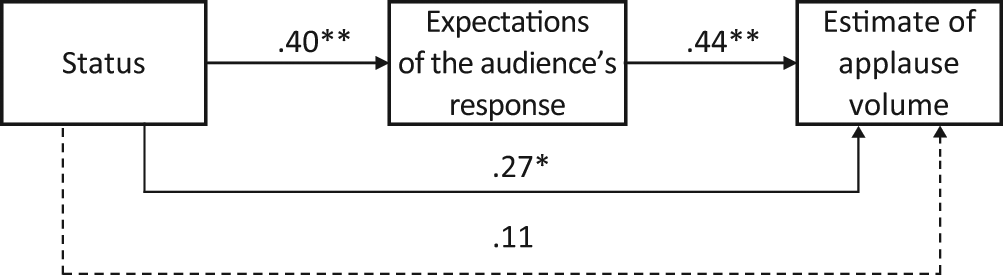
The mediating effect of expectation of the audience’s response on the relationship between status state and estimates of applause volume in Experiment 3
Discussion
The results of Experiment 3 provide direct support for our theory. Specifically, participants experiencing high status held higher expectations of how the audience would respond to their writing compared to participants experiencing low status, which in turn led to, and fully accounted for, their increased estimates of the volume of the audience’s applause. Importantly, these results were found using a manipulation of status that held feelings of power constant, thereby helping to isolate the effect of status on perception.
Although these results are theoretically supportive of our claims, two final concerns remain. First, it is possible that our findings are a consequence of a more global positivity bias; where people experiencing high status come to believe that others will readily offer praise and approval to all. These expectations would in turn lead to more positive judgments of all behaviors and cues, regardless of whether the behavior is directed at the self or others (i.e., a “rose-tinted lens” to view their social world). Second, it is plausible that the status manipulation triggered participants to, in hindsight, revise their beliefs about their writing. Participants experiencing high status may have retrospectively updated their beliefs about the quality of their writing, reevaluating it to be of higher quality than those experiencing low status, and as a consequence led to differences in expectations and subsequent judgments. Although Experiment 2 controls for participants’ expectations of how the audience will respond to their performance prior to the status manipulation, it remains possible that the status manipulation itself may have retrospectively augmented their initial estimates of writing quality. That is, irrespective of what participants are asked to write about, if participants’ postmanipulation estimates of the quality of their writing do not differ across conditions, and yet differences in perception remain, then expectations of how others will respond based on one’s current status state, and not beliefs about the relative quality of one’s writing, remain the most probable cause for this effect. Thus, to provide yet another and more stringent test of our theory, in Experiment 4 we predict that the effect of status on perception will be present only when the target of the evaluation or behavior is the self, while ruling out differential beliefs about the quality of one’s writing, measured after the status manipulation.
Experiment 4
We have asserted and provided evidence that the previously observed differences in judgments between participants experiencing high versus low status (Experiments 1 and 2) are the result of participants’ beliefs and expectations (Experiment 3) of how others ought to respond to them in light of their status. We now offer a critical additional theoretical test by examining if these perceptions are sensitive to the target of appraisal or are instead the result of a generalized positivity bias borne out of a state of high status. Since an individual’s status is determined by the responses and reactions of others targeted directly toward this actor (e.g., Berger et al., 1977; Magee & Galinsky, 2008), the beliefs and expectations that arise when a person is in a state of high or low status should be primarily associated with others’ behavior that is directed at the self. Not only is behavior directed toward another actor less relevant to one’s status than is behavior directed at the self, but also expectations of how others might be treated are unlikely to be activated when people are focused on their own status. Moreover, in the absence of any status-relevant information about an actor, people should lack target-specific expectations of how others might respond to this person, and in turn be able to provide an unvarnished account of these responses. We therefore predict that the previously observed differences in perception between participants experiencing high versus low status will hold only for self, as opposed to other, targeted appraisals. Moreover, we also measure participants’ postmanipulation estimates of the quality of their writing to ensure that differences in beliefs about writing quality do not account for downstream variation in perception.
Method
Participants and design
For class credit, 83 university students (55% female, mean age = 21.11 years) were randomly assigned to a condition in a 2 (status: high, low) × 2 (target: self, other) between-subjects design.
Procedure
Similar to the previous experiments, participants were told that they would be participating in an online study of virtual audiences where all participants would be writing about the same topic and that their writing would be projected on-screen to an audience in a nearby classroom. Participants were again told that the audience was instructed to respond in a similar fashion to how they would if the participant was actually in the same room giving a presentation. Like Experiment 1, what participants were asked to write about served as the status manipulation. However, unlike Experiment 1, to measure postmanipulation beliefs about the quality of their writing, we asked participants to indicate their degree of agreement, from 1 (strongly disagree) to 7 (strongly agree), with the statement, “I believe what I wrote is of high quality,” immediately after completing the manipulation. 7
Self versus other audience response
Participants were then told that they would be randomly assigned to hear how the audience responded to either their own writing or another participant’s writing. On the next screen participants learned the target of the audience’s response (self or other) and heard 5 s of applause. Participants reported the volume of the applause from 1 (no applause or extremely quiet applause) to 9 (extremely loud applause). Participants then completed demographic questions, were checked for suspicion, and were debriefed. 8
Results
Main analyses
A two-way ANOVA with applause volume as the dependent variable, F(3, 79) = 3.02, p = .04, revealed a marginally significant main effect for status, F(1, 79) = 3.50, p = .065, qualified by a significant status × target interaction, F(1, 82) = 5.84, p = .02. As predicted, volume estimates of self-targeted applause were again influenced by participants’ status state (high status: Mself = 7.72, SD = 1.71; low status: Mself = 5.90, SD = 2.56), t(79) = 2.94, p = .004, d = 0.83; however, when the applause was targeted at someone else (high status: Mother = 6.43, SD = 1.56; low status: Mother = 6.67, SD = 2.08), status had no effect, t(79) = 0.40, p = .69.
In addition, simple effects tests supported our primary hypothesis. Participants experiencing high status estimated that the applause was louder when it was in response to their own writing (Mself = 7.72, SD = 1.71) than when it was in response to someone else (Mother = 6.43, SD = 1.56), t(79) = 2.13, p = .04, d = 0.78, whereas participants experiencing low status reported no target-specific differences in the applause’s volume (Mself = 5.90, SD = 2.56; Mother = 6.67, SD = 2.08), t(79) = 1.29, p = .20 (see Figure 2).
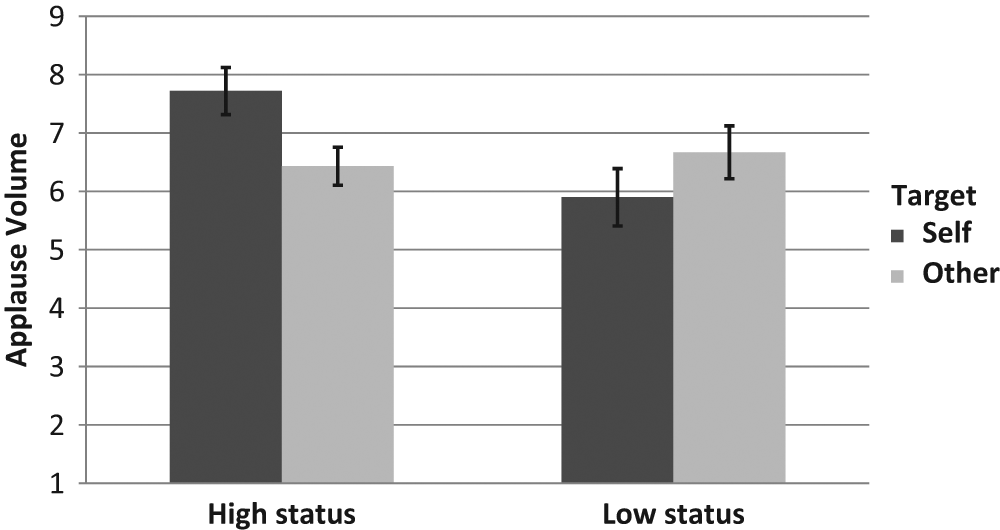
Effect of status state on estimates of applause volume as a function of the target of appraisal in Experiment 4
Postmanipulation beliefs regarding writing quality
A two-way ANOVA with participants’ poststatus manipulation beliefs about the quality of their writing as the dependent variable revealed no significant main effects or an interaction, Fs < 2.35, ps > .15. In addition, an ANCOVA with beliefs about the quality of one’s writing entered as a covariate and estimates of applause volume entered as the dependent variable again yielded a significant status × target interaction in the same pattern as described above, F(1, 81) = 5.21, p = .03, whereas beliefs about the quality of one’s writing showed no effect, F(1, 81) = 0.95, p = .33.
Discussion
Consistent with the previous experiments, these results again provide evidence that one’s status state influences perceptions of self-targeted status cues in the environment. Specifically, when the target of the audience’s response was the self, participants experiencing high status estimated the applause to be louder than did participants experiencing low-status. However, when the target of the applause was someone else, experiencing high versus low status had no impact on how the applause was judged.
These findings allow for greater confidence in our theoretical claims in several important ways. First, observing our previously established effect for self-judgments, but not other-judgments, helps alleviate concerns that a generalized positivity bias is driving our effects. Second, we provide evidence that regardless of what participants wrote about, postmanipulation beliefs about its quality not only were invariant across conditions but also, more important, did not influence the observed differences in judgment. By ruling out participants’ retrospective beliefs about writing quality as an alternate explanation, these results converge with Experiment 3 to support our claim that differences in judgments are based on high- versus low-status states evoking differing beliefs and expectations about how I will be received by others in light of my status.
General Discussion
The social world for those possessing high status is an enviable place. Beyond its social accoutrements, we have shown that merely being in a high-status state offers the actor an additional psychological benefit: a favorable lens through which to perceive others’ evaluations of the self.
In four experiments, we demonstrated that people’s status states affect their perceptions of the status relevant features in their environment. Specifically, exposed to the same audience, participants experiencing high status reported hearing applause as louder (Experiment 1) and seeing a greater percentage of favorable (i.e., smiling) facial expressions (Experiment 2) in response to their performance than did participants experiencing low status. In addition, these differences were fully accounted for by expectations of how the audience would respond (Experiment 3) and were present only when the target of the evaluation was the self (Experiment 4). Together, these results strongly suggest that one’s status beliefs are principally involved with status-relevant cues directed at the self and that such beliefs can positively bias our judgments of these cues.
These findings contribute to our understanding of social status in several important ways. Extant research on individual status has centered on the characteristics of those who are accorded status, in what ways status differences influence interpersonal interaction (e.g., Anderson, John, Keltner, & Kring, 2001; Berger et al., 1977), and how group members collectively work to protect the established hierarchy (Anderson, Ames, & Gosling, 2008). Instead, we focus our research attention on the psychology of the status holder, and the resulting perceptions that arise from this state, thus furthering our understanding of the psychological experience of status for the self.
Moreover, these results may offer one reason why having status positively affects the self (Baumeister, 1998; James, 1890). For instance, it has been demonstrated that a subjective belief in one’s status (e.g., perception of one’s standing on the social ladder) is more tightly coupled with psychological and physiological well-being than is socioeconomic status (e.g., objective measures of education, income, occupation; Adler, Epel, Castellazzo, & Ickovics, 2000). Although objective status markers clearly provide multiple benefits, our results suggest that it is perhaps the high-status mind-set that is among the most valuable of rewards. Given that experiencing positive and supportive reactions from others is believed to promote mental (e.g., Taylor & Brown, 1988) and physical health (e.g., House, Landis, & Umberson, 1988), the link between subjective status perceptions and psychological and physiological well-being may be, at least partially, accounted for by the favorable lens through which those who experience high status interpret their everyday lives.
Limitations and Future Directions
Numerous features of this research call for future study. First, we examined estimates of applause and facial expressions—social cues that, when directed toward a target, are of clear relevance to the target’s status. As highlighted in Experiments 1 and 2, judgments of non-status-relevant cues were unaffected by status, suggesting that status only affects judgments of a particular class of social behaviors that indicate voluntary approval. However, we cannot speak to whether status influences judgments of cues that signal disapproval. For instance, future work may examine if experiencing high status, in comparison to low status, leads people to report hearing booing and mocking at a lower volume or to report seeing a smaller percentage of frowns and scowls in an audience.
Second, although this work contributes to research documenting the intimate connection between our psychological states and resulting perceptions (e.g., Zhong & Leonardelli, 2008; Zhou, Vohs, & Baumeister, 2009), it is important to highlight that the data we report are the perceptual representations of an experience (i.e., subjective judgments). It therefore remains unclear whether participants experiencing high status actually heard the applause as louder and saw more positive faces, or if they just reported doing so. Admittedly, there is a fine line between sensory experience and our mind’s perceptual representation of the event; however, it is important to acknowledge this as a limitation of this and other work and pose it as an avenue for future study.
Third, although priming exercises (e.g., recalling and writing about an autobiographical memory) are well established to effectively induce real-world mind-sets (e.g., Fast, Gruenfeld, Sivanathan, & Galinsky, 2009; Galinsky et al., 2003; Small, Lerner, & Fischhoff, 2006), a limitation of the current work is the exclusive reliance on priming as a means of manipulating status. Although recent research relating status to initial trust judgments (Lount & Pettit, 2011) suggests that status primes and more naturalistic manipulations (e.g., titles, group memberships) are equally effective and produce parallel results, this feature of the current work still poses a limitation to its external validity.
Fourth, we offer an additional explanation for why a loss of status is particularly aversive (Pettit et al., 2010; Pettit & Lount, 2010). Our results suggest that losing status results not only in parting ways with the rewards that accompany having the esteem of others but also in letting go of the rose-tinted social world that high status provides. “Letting go” may, however, happen quite reluctantly (Sivanathan, Pillutla, & Murnighan, 2008), or not at all for high-status actors, as their ability to detect slippage in their status is likely to be clouded by their biased interpretation of others’ behavior toward them. Although people generally “know their place” (Anderson et al., 2006), our results raise several more nuanced questions around status perception in general (Pettit & Lount, 2011). Are high-status actors delayed or less able to recognize an initial erosion of their status? And, even when status is stable, do high-status actors view their perch atop the hierarchy as just a bit loftier than it is seen by those below? Such work could provide important insights into how status is perceived.
Fifth, although both status and power are relational in nature and highly related, status is a property of the relationship between actor(s) and observer(s), whereas power is grounded in the resources belonging to an actor (e.g., Magee & Galinsky, 2008). Therefore, social cues, such as voluntarily applauding an actor’s performance, are more aligned with the granting of prestige, recognition, and approval (i.e., status) than with the involuntary behaviors that result from ceding to an authority who holds formal control (i.e., power; e.g., Barkow, 1989; Huberman et al., 2004; Ridgeway & Walker, 1995). Given this, judgments of the willful, discretionary behaviors that others choose to display toward a target—behaviors that serve to accord and signal the status of an individual—seem particularly relevant to the study of status. However, power might produce similar effects to those observed here. People feeling high power may judge positive social cues as more favorable than those feeling low power, as power has the tendency to increase attunement to rewards and positive social evaluations (e.g., Keltner et al., 2003; Sivanathan et al., 2008). For this reason, we went to great lengths—in both our manipulations (i.e., holding power constant) and choice of dependent variables (i.e., voluntary applause and voluntary facial expressions of approval are argued to be involved with the granting of status rather than responding to a formal authority; e.g., Barkow, 1989; Huberman et al., 2004)—to ensure that the observed effects, at least in our studies, were the result of status.
Last, although we have established that status affects perception, the functional basis for these results remains unknown. One possibility is that differences in perception guide individuals toward appropriate status-based behaviors that secure their group membership. This would encourage high-status individuals to continually seize opportunities to contribute, behaviors that would preserve their access to the social rewards of status, and also deter low-status individuals from claiming more status than they are granted, a behavior that is reliably met with harsh sanctions from others (Anderson et al., 2008). Such differential encouragement could similarly facilitate group functioning and preserve the hierarchy, as it would simultaneously promote action from those who offer the most value while minimizing dominance behavior from those who offer the least (Berger et al., 1977).
Conclusion
The benefits of status, it seems, partially lie in our minds, which favorably directs the sights and sounds of our day-to-day lives. By demonstrating how status orchestrates individuals’ perceptions of their social world, we begin to gain a deeper and nuanced understanding of the psychology of status to the self.
Footnotes
Acknowledgements
We thank Emily Balcetis, Adam Galinsky, Geoff Leonardelli, Kathleen O’Connor, Madan Pillutla, Jin Seok Pyone, and Dennis Regan for their comments on this article.
The author(s) declared no potential conflicts of interest with respect to the research, authorship, and/or publication of this article.
The author(s) received no financial support for the research, authorship, and/or publication of this article.