




Abstract
Three studies examined cross-cultural differences in empathic accuracy (the ability to correctly infer another’s emotional experience) within the context of different relationships. East–West cultural differences in self-construal were hypothesized to differentiate levels of empathic accuracy across relationship types. In contrast to the independent self prevalent among members of Western cultures, members of Eastern cultures generally view the self as interdependent with those with whom they have a relationship. Easterners, relative to Westerners, are more concerned with the thoughts or feelings of close others and less concerned with the thoughts or feelings of those with whom they have no relational link (i.e., strangers). Across three studies, the authors found that East Asians, compared with European Americans, made more accurate inferences regarding the emotions of close others (i.e., friends), but less accurate inferences regarding the emotions of strangers. Furthermore, individual differences in interdependent self-construal among East Asians predicted the degree of empathic accuracy.
Empirical work has long confirmed that the ability to correctly detect what others are feeling promotes healthy adjustment, effective social support, and relationship satisfaction across life stages and relationship types (e.g., Gleason, Jensen-Campbell, & Ickes, 2009; Haugen, Welsh, & McNulty, 2008; Kilpatrick, Bissonnette, & Rusbult, 2002; Lorimer & Jowett, 2009; Verhofstadt, Buysse, Ickes, Davis, & Devoldre, 2008). However, little research has examined systematic differences that render some individuals better at empathizing than others, or the conditions that produce such differences. The present research examined cross-cultural differences in empathy and explored possible underlying mechanisms.
Empathic Accuracy
As a scientific construct, empathy has several distinct components (e.g., the experience of another person’s emotions, feeling concern for others, etc.). Much social-psychological research focuses on empathic accuracy or the ability to correctly judge the content of another individual’s thoughts and feelings (Ickes, Stinson, Bissonnette, & Garcia, 1990; Levenson & Ruef, 1992). Importantly, empathic accuracy bears on a variety of outcomes such as therapeutic success (e.g., Rogers, 1957), communication effectiveness (e.g., Mehrabian & Reed, 1968), affect regulation (e.g., Simpson et al., 2011), and the fulfillment of interpersonal goals (e.g., Gleason et al., 2009; Lorimer & Jowett, 2009; Papp, Kouros, & Cummings, 2010; Simpson et al., 2011; Verhofstadt et al., 2008).
Much research has examined the predictors of empathic accuracy. Several theories of empathy exist (e.g., Davis, 1994), many of which focus on the physiological or neurological mechanisms underlying the phenomenon (e.g., Bartz et al., 2010; Decety & Chaminade, 2003; Keysers & Gazzola, 2007; Levenson & Ruef, 1992; Preston & de Waal, 2002; Zaki, Weber, Bolger, & Ochsner, 2009). The majority of empirical studies have focused primarily on individual-level factors that predict empathic accuracy, such as the following: motivation (e.g., need to belong—Pickett, Gardner, & Knowles, 2004; attraction—Ickes et al., 1990), gender (Klein & Hodges, 2001; Stinson & Ickes, 1992), education level (Thomas, Fletcher, & Lange, 1997), self-monitoring, and grade point average (GPA; Ickes et al., 1990). In addition, studies have also examined relationship-level factors, such as relationship length and exposure to target others (Marangoni, Garcia, Ickes, & Teng, 1995; Thomas et al., 1997). With few exceptions (e.g., Soto & Levensen, 2009), few studies have attempted to tap broader predictors such as cultural background.
Culture and Empathy
Existing work suggests that culture plays a role in moderating empathic accuracy via differences in self-construal between members of Eastern and Western cultures. In the West, the self is typically thought of as a bounded, unique, and autonomous entity—that is, the independent self (Markus & Kitayama, 1991). In contrast, in Eastern cultures, interdependent self-construal is more prevalent, and the self is seen as more continuous with those of close others (Cousins, 1989; Fiske, Kitayama, Markus, & Nisbett, 1998; Heine, 2001; Kanagawa, Cross, & Markus, 2001). As a function of interdependent self-construal, Easterners’ feelings, needs, and thoughts are closely tied to the feelings, needs, and thoughts of others. Research indicates that East Asians’ emotional states are largely determined by interpersonal concerns (Kitayama, Markus, & Kurokawa, 2000; Mesquita & Karasawa, 2002; Scherer, Matsumoto, Wallbott, & Kudoh, 1988; Uchida, Norasakkunikit, & Kitayama, 2004). Furthermore, East Asians perceive emotions in the context of relationships (Masuda et al., 2008) and are more likely to experience emotions in response to close others’ behaviors (Stipek, 1998).
Given the importance of the role of others in determining the self within Eastern cultures, one would expect cultural members to dedicate much time, effort, and energy to knowing others’ wants and moods. Indeed, Yamagishi (1988) found evidence that Japanese monitor others’ needs, desires, and goals more so than European Americans.
Research has also examined the characteristics that make some individuals “easier” to read than others. Elfenbein and Ambady (2002, 2003), for example, argued for the expressor culture effect in emotion recognition—namely, that emotion recognition is more accurate for perceivers from the same culture as the expressors. Other studies, however, have found that the “ingroup advantage” in emotion recognition is not consistent across cultural groups. Lee, Chiu, and Chan (2005) argued that European American emotion displays offer greater signal clarity than Asian emotion displays, thus making it more difficult to decode emotions from Asian emotional faces than from European American ones. In line with this argument, Lee et al. found that Hong Kong Chinese exhibited more error when identifying emotions in Asian faces compared with European American faces. Indeed, a closer examination of the data from Elfenbein and Ambady (2003) by Lee et al. suggests that the expressor culture effect may only apply when expressor is Western, and not when Asian. In their analysis, they reviewed 182 studies, 38 of which examined Westerners’ recognition of ingroup emotions versus the emotions of an Asian group and 10 of which examined Asians’ recognition of ingroup emotions versus the emotions of a Western outgroup. Of the former, ingroup recognition accuracy was higher than outgroup recognition accuracy in 34 studies (89.5%), suggesting that European Americans are better at recognizing emotions in European Americans than in Asians. In the latter, ingroup recognition accuracy was higher than outgroup recognition accuracy in four studies, outgroup recognition accuracy was higher in four studies, and no expressor culture effect was obtained in the remaining two studies—that is, Asians are no better at reading Asian faces than European American faces. Thus, it is unclear from the existing research whether an ingroup advantage in emotion recognition emerges across cultural groups.
Despite the abundance of research on the emotional and social interconnectedness East Asians ostensibly have with close others, little work—if any—has examined whether such interdependence actually translates to more accuracy in detecting another person’s emotions. The few empirical studies examining the role of culture and interpersonal perceptual accuracy have mixed results. Soto and Levensen (2009) found no differences among four ethnic groups (European Americans, Asian Americans, Mexican Americans, and African Americans) in detecting online emotional experiences of strangers discussing a relational issue with their partners. Similarly, Iizuka, Patterson, and Matchen (2002) found that Asians and European Americans were equally accurate on an interpersonal perception task in which participants answered interpretive questions about videotaped interactions of strangers. However, this pattern emerged only when information was presented visually; when both visual and audio information were presented, they found Asians to be less accurate. Thus, it is unclear whether the greater concern for others’ needs among East Asians actually leads them to be more empathic interaction partners (i.e., whether they make more accurate judgments about others’ emotional states).
Nevertheless, existing studies suggest that East Asians are better at inferring others’ mental states. Wu and Keysar (2007) found that when Chinese and European Americans were asked to play a communication game that required taking the perspective of another person, Chinese participants exhibited eye-tracking behavior that reflected greater attunement to their partner’s perspective compared with European American participants. European American participants often neglected to take the perspective of their partner, whereas Chinese participants almost always took their partner’s perspective into consideration. As a result, European Americans, relative to Chinese, made more errors and exhibited longer response latencies on tasks where their partner’s perspective differed from their own.
However, the existing cross-cultural studies on empathic accuracy are limited to East Asians’ and European Americans’ empathic accuracy toward strangers; to date, no cultural studies have investigated empathic accuracy for relational targets, or individuals with whom a person is actually interdependent. Because East Asians’ interdependence applies primarily to individuals with whom the self is in relationship (e.g., Markus & Kitayama, 1991), it is important to consider the nature of the relationship and the interdependence such a relationship entails when investigating cultural differences in empathic accuracy.
The Moderating Role of Relationship Type
Cultural psychology has long affirmed that one of the core elements of East Asian interdependence is the priority of individuals’ mutual bond with close others, which emphasizes maintaining harmonious relationships (e.g., Kagitcibasi, 1994; Triandis, 1995). According to Yuki’s (2003) framework of East Asian collectivism, members of Eastern cultures chronically perceive themselves to be connected to close others, who form the core of East Asians’ ingroups 1 and consist of those whose welfare is tied to the self (Triandis, 1988). East Asians have been shown to be especially concerned with maintaining a high degree of knowledge about those with whom they are in relationships because such knowledge determines the expected behavior as good cultural and group members (Aoki, 2001; Hwang, 1999; Nakane, 1970).
In contrast to the high degree of concern that they demonstrate toward close others, East Asians typically view strangers as outgroup members and those whose welfare is not of much concern (Guan, Park, & Lee, 2009). East Asians, compared with European Americans, tend to exhibit less rapport with strangers across a variety of different contexts. For example, they behave in a more reticent manner toward strangers (Chen, DeSouza, Chen, & Wang, 2006; Chen et al., 1998) and exhibit less trust toward strangers with whom there is little potential for relational links (Yuki, Maddux, Brewer, & Takemura, 2005).
Western culture, on the other hand, is characterized by greater emphasis on individuals’ uniqueness, autonomy, and personal goals (Hofstede, 1980; Markus and Kitayama, 1991; Triandis, 1995). Furthermore, people in Western cultures tend to make group-based, rather than relationship-based, distinctions (Yuki, 2003; Yuki et al., 2005). Consequently, Westerners should behave more consistently across situations involving close others versus strangers than would Easterners. Because the Western, independent self is a bounded, autonomous entity (e.g., Markus & Kitayama, 1991)—rather than one defined by the maintenance of harmonious, interconnected relationships—and because Westerners tend to perceive individuals more in terms of their group membership than in relational terms (e.g., Yuki, 2003; Yuki et al., 2005), less focus should be placed on discerning the thoughts and feelings of relational partners above and beyond those of strangers.
Together, these findings suggest that East Asians, relative to European Americans, better infer the emotional states of close others but more poorly infer the emotional states of strangers. Hence, the pattern may not be due to a simple cultural difference in empathic accuracy. Consistent with past research demonstrating that relationship-level factors influence accuracy levels (Marangoni et al., 1995; Thomas et al., 1997), it is possible that culture affects empathic accuracy as a function of relationship conditions. Because East Asians’ interpersonal concerns are limited to those with whom they have a relationship (Cousins, 1989; Fiske et al., 1998; Heine, 2001; Kanagawa et al., 2001; Tafarodi et al., 2009), their heightened interdependence should affect only their interactions with close others and render them better at empathically “reading” such close others. Because East Asians, relative to European Americans, demonstrate less rapport with those whom they have little or no relational link (i.e., strangers; Chen et al., 2006; Chen et al., 1998; Yuki et al., 2005), they should be less able to empathically “read” such strangers.
Present Research
The present research examined cross-cultural differences in empathic accuracy by relationship types. In Studies 1 and 2, the accuracy with which European Americans and East Asians detected the emotions of strangers was assessed; in Study 3, accuracy in detecting the emotions of close others was assessed. We hypothesized that although East Asians would be more empathically accurate when reading the emotions of close others (e.g., friends), this culture difference would be reversed when reading the emotions of strangers. In addition, we hypothesized that cross-cultural differences in self-construal, particularly in relation to the interdependent self, would predict empathic accuracy.
Study 1
Cultural differences in ability to detect strangers’ emotions were examined. Experimental stimuli consisted of videotapes of European American and East Asian individuals describing a recent emotional experience. A separate group of European American and East Asian participants watched the videotapes and inferred the targets’ emotional states. Empathic accuracy was assessed as the absolute difference between the perceiver’s inferred ratings and the targets’ self-ratings.
Researchers have used several procedures to calculate empathic accuracy. Some have relied on open-ended data, whereby targets listed their actual thoughts and feelings and perceivers inferred the specific thoughts and feelings experienced by the target; independent coders subsequently assessed perceivers’ accuracy (e.g., Ickes, 1997, 2001; Simpson et al., 2011). Others have relied on emotion ratings. Some have measured accuracy by having targets and perceivers rate emotions on a continuous scale or dial (e.g., Levenson & Ruef, 1992; Zaki et al., 2009); others have relied on dichotomous Likert-type scale ratings of emotion and calculated empathic accuracy by taking the absolute deviation between perceiver and target’s emotion ratings (Côté et al., 2011; Kraus, Côté, & Keltner, 2010).
We chose to compute empathic accuracy using absolute difference (i.e., deviation) scores of dichotomous Likert-type scale emotion ratings. For example, a perceiver who rated the target a “2” on anger and a target who rated himself a “3” on anger would receive a deviation score of “1”; deviation scores were averaged for all the positive and negative emotion items separately. We chose to compute empathic accuracy using this method for two primary reasons. First, because we examined empathic accuracy in different relationship contexts (i.e., friends vs. strangers) across three studies, we chose a measure that would be accessible to familiar and unfamiliar partners; previous studies that have relied on open-ended thought and emotion listings have largely been conducted on familiar partners (e.g., spouses; Simpson et al., 2011). Second, we chose to use absolute difference scores of dichotomous (rather than continuous) emotion ratings because recent studies on cultural determinants of empathic accuracy have successfully relied on them as a direct and straightforward measure of empathic accuracy (e.g., Côté et al., 2011; Kraus et al., 2010).
Participants
A total of 27 East Asians and 48 European Americans participated in the study; the average age was 20.18 years (47% men). The East Asian sample consisted of first-generation (25%) and second-generation (75%) participants, and included individuals of Chinese (40%), Korean (36%), Japanese (8%), and Southeast Asian (16%) descent. The majority of East Asians (75%) reported English as a primary language spoken at home. Participants were recruited from the University of California, Santa Barbara’s (UCSB) psychological and brain sciences department research participation pool and received course credit for their participation.
Design
A 2 (target culture) × 2 (perceiver culture) design was used. The target and perceiver culture (European American, East Asian) were between-subjects variables.
Procedures
As in previous experiments using naturalistic measures of empathic accuracy (Ickes et al., 1990; Soto & Levensen, 2009; Thomas et al., 1997; Zaki et al., 2009), after arriving at the lab, participants were shown videotapes of individual strangers discussing various emotional experiences. Participants were randomly assigned to watch videotapes of either European American or Asian American targets. After each videotape, participants were asked to rate what the target in the videotape felt during the emotional experience using the Positive and Negative Affect Schedule (PANAS; Watson, Clark, & Tellegen, 1988). Afterwards, all participants completed demographic data about their age, gender, ethnic background, and so on.
Materials
The European American tapes consisted of six separate videos corresponding to six different targets, three male and three female undergraduates; the East Asian tapes consisted of five separate videos corresponding to five different targets, two male and three female undergraduates. 2 All targets were instructed to discuss a recent emotional experience of their choice, to explain what happened during the event, and to include any other relevant details surrounding the event without making explicit references to their emotions per se. After being videotaped, each target completed a PANAS concerning how they felt during the emotional experience.
Following procedures used by Côté et al. (2011) and Kraus et al. (2010), empathic accuracy scores were calculated by taking the absolute difference between the participant’s (i.e., “perceiver”) rating on each of the PANAS items and the target’s own rating on the item. Separate composite absolute difference scores for the positive and negative items were calculated for each target, and scores across targets were averaged to yield positive and negative scores of empathic accuracy for each participant.
Results
There was no effect of gender on either of the dependent variables of interest (i.e., absolute difference scores on the positive or negative PANAS composites), nor were there any interactions involving gender and culture (all ps > .14). Therefore, gender will no longer be mentioned for the remainder of this section.
Positive composite scores
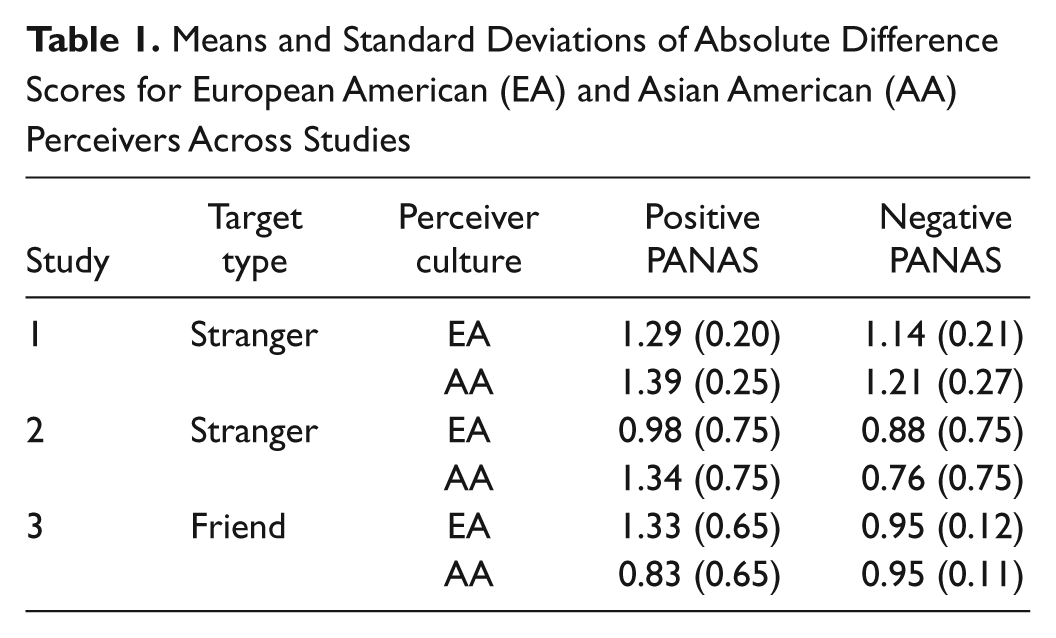
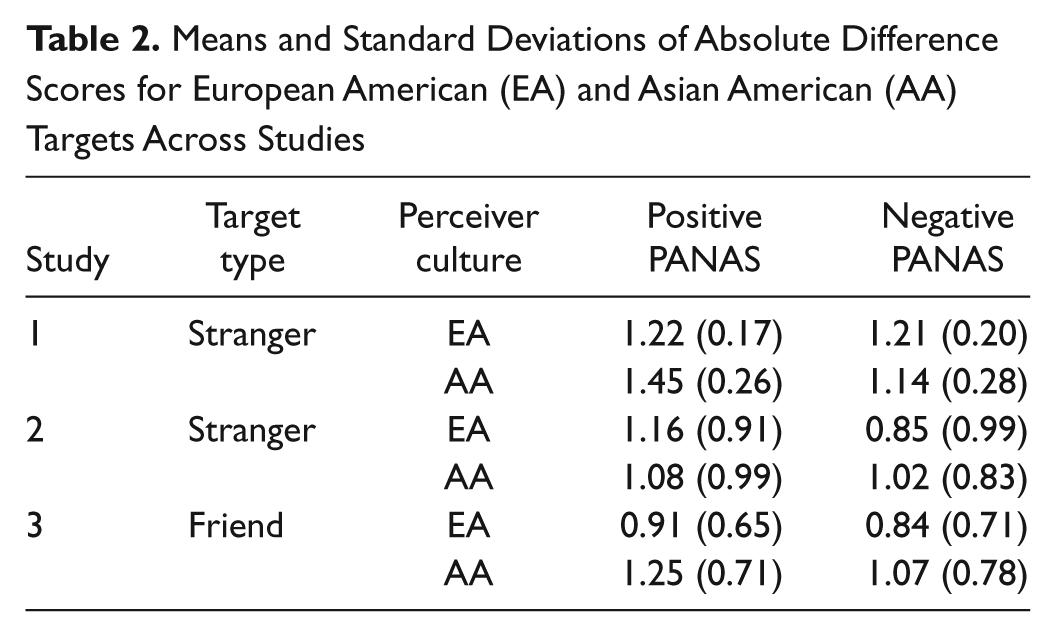
There was a significant main effect of perceiver culture on the absolute difference scores for the positive PANAS items, d = 0.44, F(1, 71) = 5.43, p = .023. East Asians deviated more from the target (M = 1.39, SD = 0.25) than European Americans (M = 1.29, SD = 0.20); see Table 1. In addition, there was a main effect of target culture, d = 0.99, F(1, 71) = 37.14, p < .001. East Asian targets led to greater deviations (M = 1.45, SD = 0.26) than European American targets (M = 1.22, SD = 0.17); see Table 2. No interaction between perceiver and target culture emerged, F < 1.
Means and Standard Deviations of Absolute Difference Scores for European American (EA) and Asian American (AA) Perceivers Across Studies
Means and Standard Deviations of Absolute Difference Scores for European American (EA) and Asian American (AA) Targets Across Studies
Negative composite scores
There was a marginal main effect of perceiver culture on the absolute difference scores for the negative PANAS items, d = 0.44, F(1, 71) = 3.01 p = .087. Consistent with the previous findings, East Asian perceivers deviated more from the target (M = 1.21, SD = 0.27) than European American perceivers (M = 1.14, SD = 0.21); see Table 1. There was also a marginal main effect of target culture, d = 0.45, F(1, 71) = 3.40, p = .069. European American targets led to marginally greater deviations (M = 1.21, SD = 0.20) than East Asian targets (M = 1.14, SD = 0.28); see Table 2. No interaction between perceiver and target culture emerged, F < 1.
Discussion
Findings from Study 1 provided evidence of cultural differences in empathic accuracy consistent with our prediction that East Asians, relative to European Americans, would perform more poorly in empathically inferring the emotional states of individuals with whom they have no relational link. East Asians were less accurate than European Americans in determining the overall emotions experienced by videotaped, stranger targets. East Asians were consistently less accurate across both types of emotions relative to European Americans, albeit this cultural difference was significant only for the positive emotions and marginal for the negative emotions. Via uniform, controlled stimuli (i.e., videotapes of unfamiliar confederates discussing autobiographical events), an East–West disparity in the accuracy with which individuals inferred others’ emotional states emerged.
In addition, marginal effects of target culture emerged. European American targets’ positive emotions were “easier” to read but negative emotions marginally more “difficult” to read. The findings regarding cultural differences among targets for positive emotions is consistent with existing research suggesting that Asians’ expressions of emotions are more difficult to decode overall (e.g., Lee et al., 2005). Although the pattern of results for the negative emotions emerged in the opposite direction, it is difficult to draw definitive conclusions based on the negative emotion data given that the effects were marginal. In addition, no interaction between perceiver and target culture emerged (i.e., there was no evidence for an ingroup advantage in empathic accuracy).
More generally, however, Study 1 was limited in the measure of empathic accuracy employed. As with previous cultural studies, empathic accuracy was assessed in a highly restricted context via controlled but artificial stimuli (i.e., videotapes). Furthermore, empathic accuracy was assessed in only one context—reading the emotions of complete strangers. While telling, Study 1 falls short of demonstrating how culture influences empathic accuracy in more naturalistic contexts, such as in person or with relational targets or both. To address these limitations, we conducted Studies 2 and 3.
Study 2
Cultural differences in individuals’ ability to detect emotions experienced by strangers in a live, online context were examined. European Americans and East Asians listened to a stranger discuss a recent autobiographical emotional experience in person. Participants subsequently reported their inferences of the target’s emotional state, and empathic accuracy was calculated by taking the absolute difference between perceiver’s ratings and target’s self-ratings.
Participants
A total of 71 European Americans and 69 East Asians participated in the study. The average age was 18.79 years (46% male). The East Asians were of Chinese (56%), Korean (32%), or Japanese descent (12%). The majority of East Asians (79%) were second generation; a minority were first-generation (15%) or third-generation East Asians born in the United States (6%). The majority of the East Asians (75%) reported English as a primary language spoken at home; whether English was a primary language did not predict empathic accuracy (i.e., absolute difference scores), r = −.21, p = .22. Participants were recruited from the UCSB’s psychological and brain sciences department research participation pool and received course credit for participation.
Procedure
Participants were scheduled in pairs. Upon arrival at the lab, participants were randomly assigned the role of either the perceiver or the target. This resulted in 21 European American perceivers paired with European American targets and 15 European American perceivers paired with East Asian targets, along with 20 East Asians perceivers paired with East Asian targets and 14 East Asian perceivers paired with European American targets.
Participants sat face-to-face in the laboratory room. The experimenter instructed targets to think about a recent emotional experience of their own choosing and talk aloud about the circumstances surrounding the event without using any explicit emotional language (i.e., they could speak about any aspect of the experience except directly refer to what they were feeling—for example, “I felt sad”). The experimenter instructed perceivers to simply listen to the target talk and try to infer, to the best of their ability, what the target was experiencing during the event. After asking whether either participant had any questions about the procedure, the experimenter told the target that she or he could start at any time, and left the room.
After 3 min, the experimenter returned to the room, separated the perceiver and target, instructing them to sit at separate cubicles and gave each a PANAS (Watson et al., 1988). Targets were instructed to rate how they felt during the event they discussed; perceivers were instructed to rate what they inferred the target was feeling during the event. Afterward, all participants completed the Twenty Statement Task (Gordon, 1968; Kuhn & McPartland, 1954), along with demographic data about their age, gender, ethnic background (i.e., place of birth and parents’ places of birth), and primary language(s) spoken at home.
Results
To account for the possibility that East Asian and European American targets shared emotional experiences that differed in valence, we computed separate positive and negative composite scores from the PANAS. There was no effect of target culture on the positive or negative PANAS composites, nor were there any interaction between target culture by perceiver culture (all Fs < 1). Asian and European American targets did not differ in the valence of the emotional experiences they discussed.
Absolute differences scores between the target and perceiver ratings on the PANAS were calculated using the same procedures outlined in Study 1. Separate positive and negative PANAS composite absolute difference scores were computed.
Neither an effect of gender nor a gender by culture interaction was significant (both Fs < 1) on either dependent variable of interest (i.e., absolute difference scores on the positive or negative PANAS composites), nor were there any interactions involving target gender and perceiver gender or gender and ethnicity (all ps > .32). Therefore, gender will no longer be mentioned for the remainder of this section.
Positive composite scores
A univariate ANOVA with perceiver and target culture predicting positive PANAS absolute difference scores revealed a main effect of perceiver culture, d = 0.48, F(1, 68) = 7.37, p = .008. East Asians exhibited higher absolute differences on positive PANAS items (M = 1.34, SD = 0.75) relative to European Americans (M = 0.98, SD = 0.75); see Table 1. No main effect of target culture emerged, d = 0.08, F < 1, (M = 1.08, SD = 0.99 for European Americans vs. M = 1.16, SD = 0.91 for East Asians; see Table 2) and no interaction emerged, F < 1.
Negative composite scores
A univariate ANOVA with perceiver and target culture predicting negative PANAS absolute difference scores revealed no main effect of perceiver culture, d = 0.24, F(1, 68) = 1.94, p = .16. European American (M = 0.88, SD = 0.75) and East Asian perceivers (M = 1.06, M = 0.75) did not differ in absolute differences on negative PANAS items (see Table 1). In addition, there was no main effect of target culture (M = 0.85, SD = 0.99 for European Americans; M = 1.02, SD = 0.83 for East Asians; see Table 2), d = 0.19, F(1, 66) = 1.12, p = .29, and no interaction, F < 1.
Self-construal scores
In addition, independent coders (α = .98) coded the Twenty Statements Test for the degree to which participants reported interdependent self-descriptions (i.e., self-statements that were relational in nature). Correlational analyses on the relationship between empathic accuracy (i.e., difference scores) and interdependent self-construal were conducted separately for East Asians and European Americans. East Asians showed a nonsignificant trend for higher interdependence to predict lower difference scores, r = −.25, p = .12 for positive PANAS composite and r = −.24, p = .14 for the negative PANAS composite. European Americans showed no relationship between the two (r = −.072, p = .67 and r = −.10, p = .56 for the positive and negative composites, respectively).
Discussion
Study 2 replicated the findings from Study 1 and demonstrated that during live interactions involving online measures of empathic accuracy, East Asians were less accurate at inferring the emotional states of those with whom they have no relational link (i.e., strangers) compared with European Americans. Furthermore, this cultural difference could not be attributed to East–West differences in the kind of emotional experiences targets shared because no valence differences were observed between East Asian and European American targets. In addition, East Asian and European American targets did not differ in their “readability,” and no interaction emerged between perceiver and target culture (i.e., no ingroup advantage emerged for empathic accuracy).
It is important to note that the primary finding regarding European Americans’ greater accuracy in inferring the emotions of stranger targets was strongly driven by empathic accuracy for positive emotions; although the means for the negative emotions emerged in the same directions, the cultural difference between the two groups was not significant. Possible explanations for this pattern are that positive emotions are relatively difficult to differentiate or “read” due to their diffuse nature (De Rivera, Possel, Verette, & Weiner, 1989; Ellsworth & Smith, 1988), lack of unique signal value (Ekman, 1992), and/or tendency to be “blended” or overlapped with other positive emotions (Ellsworth & Smith, 1988). As a result, the process by which others’ experiences of positive emotions are inferred may require more precise care and attention than the process of inferring others’ negative emotions. Consequently, cultural differences may more strongly emerge with positive emotions than negative emotions because negative emotions offer relatively clear and differentiated signals, whereas positive emotions do not.
The findings from Study 2 also suggested that self-construal may have important implications for empathic accuracy. Asians demonstrated a nonsignificant trend for greater interdependence to be correlated with smaller difference scores or higher empathic accuracy; European Americans showed no relationship between the two. We predicted that East Asians (a highly interdependent culture) would be less accurate at inferring strangers’ feelings than European Americans (a highly independent culture); hence, it appears illogical that greater interdependence in self-construal actually predicted more accuracy. We contend, however, that it is important to distinguish between culture and self-construal here; East Asians belong to a relatively interdependent culture but nevertheless exhibit individual and context-dependent differences in the degree to which they view themselves in an interdependent manner. As mentioned previously, East Asians’ interdependence is restricted only to close others and not strangers; we explicitly cite evidence suggesting that East Asians are actually less interdependent with strangers than European Americans are. We posit that East Asians should be less accurate when inferring the emotions of strangers because they typically do not perceive themselves as interdependent with strangers (i.e., less interdependence predicts less empathic accuracy or greater absolute difference scores).
Study 2, like Study 1, was limited by assessing empathic accuracy in one particular relationship context—that is, with strangers, or targets that possess no relational link to the individual. The question remained regarding how culture impacts emotional inferences when the target is someone with whom the individual is interdependent. Furthermore, the underlying cultural mechanisms accounting for such differences in empathic accuracy remained unclear. To address these questions, we conducted Study 3.
Study 3
Study 3 examined empathic accuracy among East Asians and European Americans in the context of close relationships. In contrast to the independent self-construal prevalent among European Americans, East Asians possess interdependent selves that are interconnected with those with whom they have a relationship (Cousins, 1989; Fiske et al., 1998; Heine, 2001; Kanagawa et al., 2001, Markus & Kitayama, 1991). We predicted that such interdependence would lead East Asians to better infer the emotional states of close others. Furthermore, we predicted that individual differences in interdependent self-construal would predict empathic accuracy—that is, those who perceive the self to be more interdependent would demonstrate greater accuracy in inferring others’ emotions.
Participants
A total of 68 European Americans and 62 East Asians participated in the study (of the 68 European Americans, 33 were participants and the remainder were brought as friends; of the 62 East Asians, 32 were participants and the remainder were brought as friends). The average age was 19.97 years (48% men). The East Asians were primarily of Chinese (50%), Japanese (25%), or Korean (21%) descent; a small minority were of Southeast Asian descent (4%). The majority of East Asians were second generation (72%); the remainder were first generation (24%) or third generation (4%). The majority (77%) of East Asians reported English as a primary language spoken at home (whether English was a primary language spoken at home did not predict overall levels of empathic accuracy, r = −.19, p = .25). Participants were recruited from UCSB’s psychological and brain sciences department research pool.
Procedure
Participants were instructed to choose a friend to bring to the lab. The participants and their friends answered a question regarding how long they had known the other person. The responses were highly correlated, r = .96, p < .001; thus, we averaged the two responses to form a composite relationship length measure. Only those who knew their friend for longer than 3 months were included in the study. In addition to the course credit participants received for participation, participants’ friends received a gift card worth US$10.
Upon arrival at the lab, participants and friends were randomly assigned to the role of the target or perceiver. Out of the resulting 64 total pairs, 32 involved European Americans as perceivers (22 were paired with a same-race target and the remainder were paired with East Asian targets) and 32 involved East Asians as perceivers (20 were paired with same-race target and the remainder were paired with European American targets).
Participants followed the same procedure used in Study 2 (i.e., the perceiver listened to the target discuss a recent emotional experience, after which both completed the PANAS). Participants then completed the Twenty Statements Task (Gordon, 1968; Kuhn & McPartland, 1954), in which they responded to the question “Who am I?” by filling in answers to the prompt “I am . . . ” 20 different times.
Results
To assess whether European American and East Asian targets shared emotional events of differing valence, positive and negative PANAS scores were computed for targets. There was a marginal effect of target culture on the positive PANAS composite, d = 0.43, F(1, 61) = 2.95, p = .091. European American targets rated their emotional experiences as marginally more positive (M = 2.59, SD = 1.03) relative to East Asian targets (M = 2.19, SD = 0.81). There was no effect of target culture on the negative PANAS composite, F < 1.
To assess whether European Americans and East Asians differed in relationship closeness with their friends, participants’ and targets’ responses on self-reported closeness were averaged (α = .86) to yield an overall score of relationship closeness. No cultural difference emerged (F < 1).
For the main analysis, separate positive and negative absolute difference scores on the PANAS were calculated using the same procedures as in Studies 1 and 2. To assess interdependent self-construal, two independent judges coded participant responses to the Twenty Statements Task attending specifically to the number of times the participant mentioned an aspect of the interdependent or relational self. Examples of responses that qualified were as follows: “I am a brother/sister/son/daughter,” “I am in love,” “I miss my family,” and so on. Intercoder reliability was high (α = .99).
There was no main effect of target or perceiver gender on either of dependent variable of interest (i.e., absolute difference scores on the positive or negative PANAS composites), nor were there any interactions involving target gender and perceiver gender or perceiver gender and perceiver culture (all ps > .16). Thus, gender will no longer be discussed for the remainder of this section.
Positive difference scores
A multivariate ANOVA with perceiver and target culture predicting positive and negative absolute difference scores yielded a main effect of perceiver culture on the positive absolute difference scores, d = 0.56, F(1, 61) = 6.83, p = .011. East Asians were more empathically accurate at inferring the emotions felt by friends (M = 1.00, SD = 0.52) relative to European Americans (M = 1.30, SD = 0.56). No main effect of target culture emerged, d = 0.12, F(1, 61) = 2.33, p = .13 (M = 1.12, SD = 0.54 for European American targets; M = 1.19, SD = 0.58 for East Asian targets), and no interaction between perceiver and target culture emerged, F < 1.
Negative difference scores
No main effect of perceiver culture emerged on the negative absolute difference scores, d = 0.04, F < 1 (M = 0.98, SD = 0.54 for European Americans and M = 1.00, SD = 0.45 for East Asians). No main effect of target culture emerged on the negative absolute difference scores, and no interaction between perceiver and target culture emerged, both Fs < 1. Please see Tables 1 and 2 for a summary of the descriptive statistics for perceivers and targets, respectively.
Across European Americans and East Asians, relationship length predicted the absolute difference in emotion ratings for the positive PANAS items (r = –.31, p = .003). Those who knew their friend longer were more accurate in identifying their friend’s emotional states (i.e., exhibited less difference between their ratings of their friend’s emotions and the friend’s self-ratings). The same pattern emerged for absolute differences on the negative PANAS items, albeit it was nonsignificant (r = –.14, p = .20).
Ancillary analysis
Given the identical procedures in Studies 2 and 3, we combined the data from the two studies to conduct an ANOVA with condition (stranger vs. friend), participant culture, and target culture using the separate positive and negative absolute difference scores. 3 For the positive absolute difference scores, there was no main effects of condition (F < 1), participant culture (F < 1), or target culture, F(1, 131 = 1.62, all p’s > .20. However, a condition by participant culture interaction emerged, F(1, 131) = 10.91, p = .001. East Asians demonstrated greater empathic accuracy when reading the positive emotions of friends compared with strangers, d = 0.86, F(1, 70) = 6.15, p = .016; European Americans, in contrast, demonstrated greater empathic accuracy when reading the positive emotions of strangers compared with friends, d = 0.76, F(1, 71) = 6.38, p = .014. For the negative absolute difference scores, no main effects or interactions emerged, all Fs < 1.
In terms of relational self-construal, collapsing across conditions, no main effect of culture emerged, d = 0.12, F < 1. European American perceivers (M = 1.54, SD = 1.35) and East Asian perceivers (M = 1.68, SD = 1.55) did not differ significantly in the degree to which they perceived themselves in relational terms. However, a significant culture by condition interaction emerged, F(1, 139) = 6.60, p = .011. European Americans demonstrated a nonsignificant trend toward a more relational self-construal in the stranger condition (M = 1.87, SD =1.64) than the friends condition (M =1.37, SD = 1.20), d = 0.34, F(1, 69) = 2.55, p = .11. East Asians demonstrated a more relational self-construal in the friends condition (M = 1.98, SD = 1.80) than the stranger condition (M = 1.24, SD = 0.92), d = 0.52, F(1, 70) = 4.71, p = .030.
Relational self-construal predicted empathic accuracy for East Asians, although the effects only emerged for the positive PANAS scores: r = –.23, p = .045. For the negative PANAS scores, no significant relationship emerged, r = –.03, p = .77. Relational self-construal did not predict empathic accuracy for positive or negative emotions for European Americans (r = –.11, p = .36 and r = –.10, p = .42, respectively). No evidence of mediated moderation (i.e., relational self-construal mediating the moderated relationship between culture, condition, and empathic accuracy) emerged.
Discussion
Study 3 demonstrated cultural differences in empathic accuracy moderated by relationship type. In contrast to the relative inaccuracy with which East Asians inferred the emotional states of strangers, when inferring the emotional states of close others (i.e., friends), East Asians were more accurate than European Americans. This demonstrated that cultural background and relationship type (along with its accompanying relational concerns) play important roles in determining the accuracy with which one individual infers the content of another individual’s feelings. Consistent with our predictions, those with an interdependent self-construal, that is, East-Asians, were better at inferring what a close other was feeling, compared with those with an independent self-construal, that is, European Americans. When the target was a stranger, however, East Asians were less accurate at inferring the other person’s feelings. Consistent with Study 2, this pattern was driven primarily by cultural differences in inferring positive emotions rather than negative emotions. More generally, this pattern of findings is in line with previous research indicating that the greater attention to, and concern for, others’ feelings, thoughts, and needs among East Asians only extend to close others (e.g., Markus & Kitayama, 1991; Tafarodi et al., 2009).
Furthermore, within the East Asian sample, degree of interdependence predicted empathic accuracy, such that those who viewed themselves in more interdependent terms were more accurate at inferring another’s feelings. The relationship between interdependence and empathic accuracy was extended across conditions. For East Asians, seeing the self in relation to others led to an increased ability to read others’ (positive) emotions, regardless of whether the other was a friend or a stranger.
In contrast, interdependence did not predict empathic accuracy for European Americans. The lack of relationship between self-construal and the ability to infer another’s emotions suggests that empathy differs for Westerners and Easterners. For Westerners, empathic accuracy, rather than being a process motivated by interpersonal concerns deriving from one’s own self-views, appears to function independently of self-other concerns. This finding is largely consistent with existing research on mainstream Western populations that has found a variety of individual-difference predictors of empathy that are unrelated to the interdependent self: need to belong (Pickett et al., 2004), attraction (Ickes et al., 1990), gender (Klein & Hodges, 2001), education level (Thomas et al., 1997), self-monitoring, and GPA (Ickes et al., 1990).
Interestingly, the European Americans in Study 3 demonstrated a marginal tendency to be more accurate at reading the emotions of strangers relative to friends. Although it is not entirely clear why this pattern emerged, we offer several possible explanations based on previous research on close relationships among mainstream North Americans. First, studies on mainstream samples has suggested that close relationship partners tend to feel that they already know their partner well and consequently do not need to attend to him or her (e.g., Kenny & DePaulo, 1993; Thomas & Fletcher, 1997). Second, strong biases have been shown to be prevalent in perceptions of relationship partners in mainstream samples—for example, idealization effects (Murray, Holmes, & Griffin, 1996) and the tendency to view one’s partner as similar to the self (Schul & Vinokur, 2000). Together, these biases—which pertain to relationship partners but not strangers—may have led European Americans to make erroneous inferences concerning their friends’ emotional states.
General Discussion
Across three studies, we found evidence for cross-cultural differences in empathic accuracy. In Studies 1 and 2, East Asians demonstrated less accuracy when inferring the emotions of stranger targets, relative to European Americans. In Study 3, we found that this cultural difference in accuracy was reversed when the target was a relationship partner (i.e., a friend). Combining Studies 2 and 3 demonstrated that this cultural difference in empathic accuracy is moderated by relationship type. Although East Asians were better at inferring the emotions experienced by close others (i.e., friends), they were worse at inferring the emotions experienced by strangers. The effect sizes across our studies ranged from “small” to “medium” (Cohen, 1992) and were comparable with the effect sizes found in existing studies of individual difference moderators of empathic accuracy (e.g., Klein & Hodges, 2001).
We hypothesized that this cultural difference was driven by differences in self-construal. In contrast to the independent view of the self prevalent among European Americans (i.e., a self that is bounded and autonomous), East Asians tend to hold an interdependent view of the self that views the self as connected to close others. Such interdependence leads East Asians to attend closely to the thoughts and feelings of relationship partners. We predicted that individual differences among East Asians in interdependence would predict empathic accuracy. Findings from Study 3 confirmed this hypothesis and showed that, for East Asians, a significant relationship emerged between interdependent self-construal and empathic accuracy. Those who saw themselves in a more interdependent manner were more accurate at reading other’s emotional states. In contrast, for European Americans, self-construal was unrelated to empathic accuracy.
Interestingly, we did not find any evidence of an “ingroup advantage” in empathic accuracy. Existing research on culture and emotion recognition (e.g., Elfenbein & Ambady, 2002, 2003) has argued that emotion recognition is more accurate for perceivers from the same culture as the expressors. Other studies, however, have found that this pattern is not consistently present across cultural groups (e.g., Lee et al., 2005, found that Asian faces were more difficult to decode overall among both Asians and European Americans). Taken together, the existing research suggests that the “ingroup advantage” in emotion recognition does not emerge consistently across cultures in the first place (i.e., a closer examination of the studies in Elfenbein and Ambady’s, 2002, meta-analysis and the findings by Lee et al., 2005, suggest that the effect more clearly emerges when the target is European American; it is unclear whether there is any advantage afforded to the ingroup when the target is Asian American).
Although the lack of evidence for an ingroup advantage among Asians in the present research is consistent with the aforementioned literature on emotion recognition, it is less clear why no ingroup advantage emerged among European Americans in our studies. One possible explanation is that the present research focuses on empathic accuracy, which we contend is a more elaborate and involved process than emotion recognition. For example, empathic accuracy involves taking into account additional channels of information beyond facial cues, which is what the majority of emotion recognition studies have relied on. Thus, it is possible that although an ingroup advantage may emerge under certain conditions when processing facial emotions, it does not emerge during higher order processes like empathy.
It is important to note that the effects of target culture did not emerge consistently across the three studies. The aforementioned finding by Lee et al. (2005) concerning the greater difficulty perceivers have when decoding Asians’ emotional expressions was consistent with the results from two out of the three studies presented here. In Studies 1 and 3, Asian targets were more difficult to read empathically relative to European American targets. In Study 2, although the means were in the same direction, no significant differences between targets emerged. Although we contend that empathic accuracy and emotion recognition are distinct, albeit related, processes, we acknowledge that the lack of consistency regarding effects of target culture is a limitation of the present work and a question future research can more closely examine.
It is also important to note that in Studies 2 and 3, the findings suggest that the aforementioned cultural difference in empathic accuracy is more strongly driven by positive emotions than negative ones. Several qualifications accompany this observation, however. First, across studies, the cultural patterns observed were largely consistent with negative emotions, albeit they were marginal or nonsignificant. This suggests that the predicted cultural pattern emerges across emotions but is simply more driven by inferences regarding positive emotions. Second, the lack of cultural differences in reading negative emotions most directly applied to Studies 2 and 3, which relied on live interactions, rather than Study 1, which relied on videotapes. One possibility for the difference, then, is that individuals were more selective in the kind of emotional events they shared during a live interactions (relative to individuals who were simply videotaped sharing an emotional event); it is possible, for example, that the live nature of the interaction prompted participants in Studies 2 and 3 to only share events that involved predominantly socially normative negative emotions (i.e., negative emotions that were fitting and appropriate for the situation), which, in turn, were easier to detect across cultural groups. Future studies can more closely examine the boundary conditions of cultural influences on empathic accuracy and more carefully control for the type of emotional events shared in different relationship contexts.
These findings offer several important implications. First, they contribute to theoretical and empirical literature concerning cultural differences in relationship-based behavior. Yuki’s (2003) theoretical model posits that, in contrast to the group-based processes prevalent among Western cultural groups, Eastern cultural groups tend to perceive the world around them on the basis of relationships. Empirical studies that have supported this distinction have largely focused on group-based behaviors in traditional intergroup contexts (e.g., Yuki et al., 2005). Our findings build on and extend this research by demonstrating how East–West differences in relationship-based judgments also play into interpersonal processes.
Furthermore, these findings offer important insight into how culture differentially influences the same emotional-cognitive process (i.e., inferring another person’s emotional state) across distinct relationship contexts. Classic cultural psychological work has compellingly outlined the ways in which Eastern and Western cultures subscribe to different models of the self and how these distinct self-construals have implications for a variety of psychological processes, including emotions (e.g., Markus & Kitayama, 1991). Furthermore, existing empirical studies have extensively demonstrated how the experience of one’s own emotional states diverges among Easterners and Westerners (e.g., Mesquita & Karasawa, 2002; Kitayama et al., 2000; Scherer et al., 1988; Stipek, 1998; Uchida et al., 2004). Little work, however, has been done on how culture and self-construal impact the judgment of other’s emotional states; furthermore, no studies to date have examined the important role of relationship type in moderating the link between culture and inferences about other’s emotions. These studies are the first of its kind to investigate how East–West differences in self-construal affect the inferences individuals make about the feelings experienced by strangers and friends.
Future Directions
Future studies should more closely examine conditions under which the interpersonal concerns characteristic of the interdependent self may actually motivate East Asians to avoid empathic accuracy. Existing research on empathic accuracy has demonstrated that correctly inferring a close other’s emotions may not always be beneficial; under certain conditions, accuracy can have relationship costs. Despite the broad array of data demonstrating the benefits of empathic accuracy, there are nevertheless conditions under which knowing another person’s internal feelings damages rather than helps the relationship. For example, Simpson, Ickes, and Grich (1999) found that anxious-ambivalent partners were more accurate in predicting their partner’s feelings during a relationship-threatening situation (whereby the partner viewed and rated opposite-sex others), but that such accuracy led to greater relationship distress, less confidence in the relationship, lower levels of perceived closeness, and a greater likelihood that the relationship would end 4 months later. Along similar lines, Simpson, Ickes, and Blackstone (1995) found that dating partners who were close but insecure exhibited the lowest levels of empathic accuracy during a similarly threatening relationship task. Thus, it is clear that those who are empathically accurate may incur relationship costs as well as benefits. Given the strong drive among East Asians to minimize disruptions to relationship harmony—a drive that explains their greater reliance on other relationship-buffering techniques like implicit (instead of explicit) social support (Kim, Sherman, & Taylor, 2008)—along with their greater avoidance motivation orientation in general (Hamamura, Meijer, Heine, Kamaya, & Hori, 2009), they may also be particularly sensitive to the relationship costs that empathic accuracy could entail and be motivated to avoid such costs. Future research can unpack these potentially opposing motivations and the conditions under which they occur. The answers to these questions may offer an important and nuanced look into the dynamic factors that affect empathy as well as the interplay of costs and benefits that empathizing incurs.
Footnotes
Acknowledgements
We would like to thank Delphine Courvoisier and Deborah McQuade for their helpful comments regarding the earlier versions of this article; we would also like to thank Richard Gavan, Brittany Carrico, and Joyce Van for their assistance in conducting these studies.
Christine Ma-Kellams is now at the Department of Psychology, Harvard University.
Declaration of Conflicting Interests
The author(s) declared no potential conflicts of interest with respect to the research, authorship, and/or publication of this article.
Funding
The author(s) received no financial support for the research, authorship, and/or publication of this article.