



Abstract
The emotion of disgust can influence people’s moral judgments, even if this emotion objectively is unrelated to the moral judgment in question. The present work demonstrates that attentional control regulates this effect. In three studies, disgust was induced. In an unrelated part of the studies, participants then judged a moral transgression. Disgust resulted in more severe moral judgments when attentional control (either measured by means of individual predisposition or manipulated with experimental control) was weak as opposed to strong (Studies 1-3). Findings further showed that attentional control mediated the positive relation between the intensity of participants’ disgust responses and the severity of their moral judgments (Study 2). Moreover, attentional control has its effects through the regulation of affective processing (Study 3). Taken together, the findings suggest that unrelated influences of disgust on moral judgments are contingent on the attention system.
As emotions reflect our moral beliefs and principles, they can guide our interpersonal actions and decisions in meaningful ways. For example, feelings of disgust motivate the rejection of people violating our key values (Rozin, Haidt, & McCauley, 2000). Accordingly, recent developments in the study of morality suggest that disgust may play an important role in moral judgments and decision making (e.g., Greene, Sommerville, Nystrom, Darley, & Cohen, 2001; Haidt, 2001).
However, sometimes the influences of emotions on our decisions are less straightforward. Indeed, emotions often arise due to the presence of arbitrary factors, such as the weather (Simonsohn, 2009) or having watched a sad movie (Forgas, 1994). Features of the situation that have little or nothing to do with someone’s moral beliefs may induce an emotion, and this emotion can exert an influence on subsequent behavior (for reviews, see Clore & Huntsinger, 2007; Forgas, 1995; Pizarro, 2000). Indeed, unrelated feelings of disgust (i.e., aroused by an odor or a filthy desk) can result in a stronger rejection of a moral transgression (e.g., Schnall, Haidt, Clore, & Jordan, 2008; Wheatley & Haidt, 2005). Accordingly, unrelated disgust influences may bring forth aversive consequences for interpersonal behavior (e.g., social exclusion and severe punishment). In the current article, therefore, we investigate when disgust biases our moral judgments and when this is not the case. In doing so, we highlight the involvement of the human attention system as a possible moderator.
One reason why disgust may have such an impact on people’s moral judgments is the strong influence of emotions on information processing. Attention is quick and frequently is directed in unintentional ways to affective information in the environment (Bradley, 2009). Furthermore, once emotional information has captured attention, this may trigger emotion-congruent cognitions (Blaney, 1986; Bower & Mayer, 1989; Siemer, 2005; Smallwood, Fitzgerald, Miles, & Phillips, 2009), even after the original stimulus is no longer present (Bradley, Cuthbert, & Lang, 1996). People’s initial emotional responses may thus be sustained, or intensified through attentional processes. This increases the likelihood that an emotional response will spill over into an unrelated situation (Andrade & Ariely, 2009; Nolen-Hoeksema, & Morrow, 1993; Siegle, Steinhauer, Thase, Stenger, & Carter, 2002).
This noted, research suggests that this enhanced processing of emotional material is not without boundaries. For example, evidence shows that individuals differ in their capacity to allocate attentional resources to certain aspects in the environment (Bishop, 2009; Derryberry & Reed, 2002). Situational constraints may also lead to differences in attentional control (Bishop, 2009; Smallwood et al., 2009). Attentional control, or the capacity to disengage attention from certain information, has been found to be a key factor in the modulation of emotional experience (Gyurak & Ayduk, 2007; Peers & Lawrence, 2009; for a review, see Derryberry, Reed, & Pilkenton-Taylor, 2003). Attentional control predicts levels of mood-disorder psychopathology in various populations (Muris, Roelofs, Meesters, & Rompelberg, 2004; Siegle et al., 2002). For example, anxious individuals display more efficient disengagement from threat-related information if they have strong rather than weak attentional control (Derryberry & Reed, 2002; Peers & Lawrence, 2009). Furthermore, people with weak attentional control display greater negative attention biases and are more vulnerable to negative thought intrusions than people with strong attentional control (Bishop, 2009; Derryberry & Reed, 2002). When attention is controlled by external task demands, such as when individuals are performing a cognitively involving task, people experience less intense negative emotions (Kron, Schul, Cohen, & Hassin, 2010; Van Dillen & Koole, 2007) and show reduced activity in emotional brain regions such as the amygdala and the insula in response to negative emotional stimuli (Erk, Kleczar, & Walter, 2007; Van Dillen, Heslenfeld, & Koole, 2009). Thus, both situational constraints and individual variations in attentional control seem to affect negative emotion processing.
On the basis of the evidence briefly discussed here, we therefore hypothesized that variations in attentional control should influence the impact of disgust on moral judgments. We propose a model in which an initial disgust cue captures attention, which then results in emotion-congruent processing, which, in turn, biases people’s judgments in unrelated moral situations. Attentional control processes, which may vary in strength over situations and individuals, regulate the extent of emotion-congruent processing, and hence the likelihood of disgust transferring to the next situation. More specifically, we proposed that because weak attentional control implicates difficulty in disengaging one’s attention from emotional cognitions (i.e., images, thoughts, feelings), people with weak attentional control (by means of individual predisposition or induced via experimental methods) should display relatively more intense emotional responses. As a result, they should show relatively strong disgust biases of their moral judgments. In contrast, because people with strong attentional control are more capable of self-regulating their attention, they more easily detach from emotion processing once the original emotional trigger is no longer present. As a result, they show relatively less intense emotion responses, such that unrelated disgust should be less likely to influence their moral judgments. In sum, we hypothesized that attentional control modulates the influences of unrelated disgust on moral judgment by regulating ongoing emotion-congruent processing.
Study 1
Study 1 attempted to provide the first evidence for our hypothesis that attentional control modulates effects of unrelated disgust on participants’ judgments of a moral transgression (in Study 1: keeping a found wallet). We manipulated disgust by means of sentences describing disgusting events versus neutral events. Because people with weak attentional control are less able to disengage their attention from any emotional cognitions than people with strong attentional control (Bishop, 2009; Derryberry & Reed, 2002), we hypothesized that people with weak attentional control should be more prone to disgust elicited by the sentences and therefore display harsher judgments of the moral transgression than people with strong attentional control.
Method
Participants and design
Seventy-four Leiden University students (32 men and 43 women, average age = 20 years, age range = 18-23 years) participated in the study in exchange for either course credit or money. The design of Study 1 consisted of a continuous measure of participants’ individual differences in attentional control and “emotion condition (disgust vs. neutral)” as a between-subjects manipulation. The main dependent variable consisted of participants’ judgments regarding a moral transgression.
Procedure
Upon arrival at the laboratory, participants were led to individual cubicles with a personal computer and were informed that they would take part in several unrelated experiments. The experimenter explained that the remaining instructions would be administered via a computer program and left the cubicle. After a brief introduction, we first assessed individual differences in attentional control by means of Stroop performance. We used the Stroop (1935) task, because previous research suggests that performance on this task is a good indicator of attentional control (Derryberry & Reed, 2002; Roelofs, 2003). During the Stroop task, color words are presented in either congruent or incongruent colored fonts, for example, the word “red” printed in red or in green. The task thus involves attending to a relevant feature (the color of the word) while ignoring a highly related, but nonindicative feature (the content of the word; Stroop, 1935). The more effective the participants’ attentional control, the faster they should (correctly) respond to incongruent color words.
We used a version of the Stroop task developed by Fennis and Janssen (2010). Participants received 32 randomized trials, of which 8 were congruent (a stimulus word was presented in a font color that matched its semantic meaning; for example, “blue” was presented in blue font) and 24 that were incongruent (a stimulus word was presented in a font color that mismatched its semantic meaning; for example, “blue” presented in red font). Participants were instructed to select, via a mouse click, the font color of each word (blue, red, green, or yellow) as quickly and accurately as possible.
After several filler tasks, participants were presented with five disgusting sentences or five neutral sentences. Examples of disgusting sentences were “When Elise took a bite of her apple, she discovered there was a worm inside” and “Gert accidentally stabbed himself in the finger when he tried to put bate on his fish hook.” Examples of neutral sentences were “Elise took a big bite of the apple she had brought for lunch” and “In the afternoon Gert went fishing at the stream near his house.” Participants were told that this was a study on imagination and that they had to read the sentences carefully, because they could expect some questions about the sentences afterward.
Next, presented as an unrelated task, all participants read about a moral problem. The problem consisted of a short story about a person who finds on the pavement a wallet with 200 Euros in it but without any clues about the identity of the wallet’s owner (i.e., credit cards, membership cards). Therefore, the person decides to not hand over the wallet to the police but instead take the money and throw the wallet away in a nearby garbage bin.
After reading the short story, participants rated four different items on a Likert-type scale ranging from 1 (very much) to 9 (not at all) to what extent they approved of the main character’s decision. The four items were as follows: Do you approve of the main characters’ decision? How wrong do you think the main character’s decision is? Do you approve that the main character keeps the money? and Do you approve that the main character does not hand in the wallet? Cronbach’s alpha was .86.
As a manipulation check, participants then again viewed the five sentences they had read earlier and indicated on a Likert-type scale ranging from 1 (not at all) to 7 (very much) how disgusting they found these sentences. Finally, participants were debriefed thoroughly and thanked for their participation.
Results
Manipulation check
A MANOVA of participants’ disgust ratings of the sentences with emotion (disgust vs. neutral) as a between-subjects variable confirmed that our disgust manipulation was successful, F(1, 73) = 17.50, p < .001,
Moral judgments
We conducted a generalized linear model (GLM) analysis of the mean score of the four moral ratings with emotion condition (disgust vs. neutral) as a between-subjects variable and with participants’ standardized Stroop interference scores as a continuous independent variable.
1
The analysis yielded a main effect of emotion condition, F(1, 72) = 17.86, p < .001,
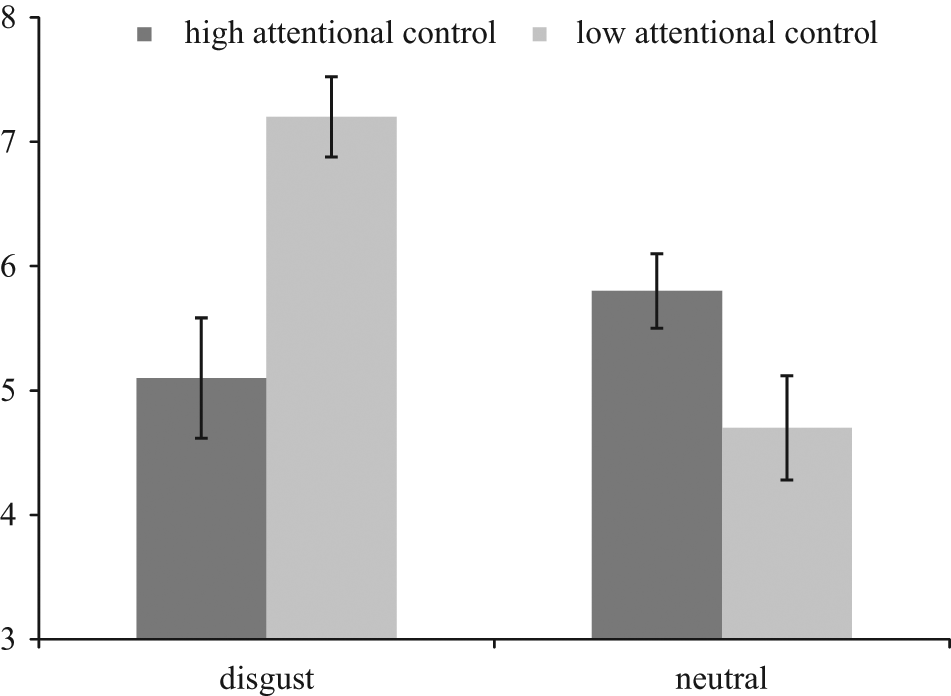
Mean rating of the moral transgression (1 = highly approve, 9 = highly disapprove) as a function of attentional control (Stroop performance) and emotion condition (disgust, neutral)
Discussion
The results of Study 1 provided first evidence of a relationship between attentional control and disgust in moral judgments. Participants who displayed strong Stroop interference (i.e., weak attentional control) made harsher judgments than participants displaying weak Stroop interference (i.e., strong attentional control) but only after reading the disgusting sentences. Stroop performance did not affect moral judgments following the neutral sentences, supporting our hypothesis that attentional control regulates the influence of unrelated disgust on moral judgments.
Study 2
Study 2 was conducted to replicate and extend the findings of Study 1. We used a different disgust manipulation (film clips) and examined its effects on a different moral problem. Moreover, we used the Attentional Control Scale (ACS; Derryberry & Reed, 2002), a validated and widely used self-report measure of attentional control (Bishop, 2009; Muris, Roelofs, Peters, & Boomsma, 2004; Peers & Lawrence, 2009) that has been found to correlate strongly with Stroop performance (Derryberry & Reed, 2002) and other performance-based measures of attentional control (Rothbart, Ahadi, & Evans, 2000). Most importantly, however, this time we assessed participants’ disgust experiences after the film clips.
We expected participants with strong attentional control to report milder disgust responses following the disgust film clips than participants with weak attentional control. In addition, we expected more intense disgust responses to relate to more severe moral judgments, and we expected this relation to be mediated by attentional control.
To test our predictions, all participants of Study 2 watched the disgusting film clips, after which participants rated the intensity of their emotions. Next, all participants waited in front of a blank screen and then judged a moral transgression (in Study 2: a case of adultery). We again hypothesized that people with weak attentional control should be more prone to the biasing effects of disgust on moral judgments than people with strong attentional control, as evidenced by more intense disgust responses, and consequently stronger rejection of the moral transgression.
Method
Participants and design
Ninety-seven Utrecht University students (38 men and 59 women, average age = 21 years, age range = 19-24 years) participated in the study in exchange for either course credit or money. We used participants’ scores on the ACS (Derryberry & Reed, 2002) as continuous between-subjects variables. The main dependent variable consisted of participants’ ratings of the moral problem.
Procedure
Upon arrival at the laboratory, participants were led to individual cubicles with a personal computer and were informed that they would take part in several unrelated experiments. The experimenter explained that the remaining instructions would be administered via a computer program and left the cubicle. To assess individual differences in attentional control, participants filled out the ACS (Derryberry & Reed, 2002). The ACS consists of 20 items that are rated on a 4-point Likert-type scale from 1 (almost never) to 4 (always), with two subscales labeled Focusing and Shifting. The two subscales correlated strongly (r = .70), and we did separate analyses with the two subscales, which did not yield different patterns of results. We therefore used the total scores in subsequent analyses. Example items include “It is easy for me to read or write while I am also talking on the phone” and “My concentration is good even if there is music in the room around me” (1 = almost never, 4 = always). Cronbach’s alpha was .69 (M = 2.56, SD = .48).
After several filler tasks, participants were presented with two short film clips. 2 The first film clip consisted of a young boy eating feces. The second film clip displayed a part of an amputation (Gross & Levenson, 1995). Participants were told to watch the films carefully, because they could expect some questions about the films afterward.
Participants were then told that the computers in the lab were relatively old and that it was possible that they had to wait for a couple of minutes before the next experiment would begin. Participants watched the blank screen for 3 min. This was done to create a clear division between the disgust induction and the moral judgments task, to underline that the two tasks were unrelated. In addition, the low attentional demand of watching a blank screen allowed participants to elaborate on the movie clips, that is, emotion-congruent emotion processing, something that we expected to be modulated by attentional control. Hence, we predicted that emotion-congruent emotion processing would be more likely for participants with weak attentional control, resulting in more intense disgust responses for this group compared with participants with strong attentional control.
In the moral judgment task that followed, all participants read about a moral problem. The problem consisted of a short story about a person leaving his or her family behind for a new lover. The main character feels depressed and frustrated with her current partner, with whom she has children. Subsequently she meets another person whom she falls in love with. She decides to leave her partner and move on with her life with the new partner, with whom she feels happier. For the male participants the main character was male, whereas for the female participants the main character was female. After reading the short story, participants rated four different items on a Likert-type scale ranging from 1 (very much) to 9 (not at all) to what extent they approved of the main character’s decision. The four items were as follows: Do you approve of the main characters’ decision? How wrong do you think the main character’s decision is? Do you approve that the main character leaves her children behind? and Do you approve that the main character chooses for herself? Cronbach’s alpha was .83.
All participants then indicated on 7-point Likert-type scales (1 = not at all, 7 = very much) how much disgust, sadness, and happiness they currently experienced. Finally, participants were debriefed and thanked for their participation.
Results
Regression analyses on participants’ moral judgments first of all revealed that subjective feelings of disgust (M = 5.12, SD = 1.55) were positively related to the severity of participants’ moral judgments, β = .22, t(96) = 2.15, p = .034. Neither sadness (M = 2.34, SD = 1.65; p >.150) nor happiness (M = 2.98, SD = 1.30; p >.150) predicted moral judgments significantly, confirming the effectiveness of our disgust manipulation.
Using the recommendations of Baron and Kenny (1986), we next examined attentional control as a mediator of the relationship between self-reported disgust and moral judgments using mediated regression analyses. These analyses first of all revealed a significant negative relation between disgust and attentional control, β = −.25, t(96) = −2.49, p = .014. The weaker the participants’ attentional control, the more intense their disgust ratings. When we next entered in a stepwise regression attentional control as an additional predictor to disgust, this yielded a significant negative relation between attentional control and moral judgments, β = −.53, t(96) = −5.93, p < .001. Moreover, including attentional control in the regression model reduced the formerly significant effect of disgust on moral judgments to nonsignificance, β = .09, t(96) = 0.98, p = .330. A Sobel test showed that this reduction of the standard regression coefficient was significant, z = 2.28, p = .020. Thus, in accordance with our predictions, these findings suggest that the effect of unrelated disgust on moral judgments was fully mediated by individual differences in attentional control.
Discussion
Study 2 was conducted to replicate and extend the findings of Study 1, using a different attentional control measure, a different disgust induction, and a different moral problem, and by assessing participants’ emotions in response to the disgust induction directly. The results of Study 2 showed that unrelated feelings of disgust, but not sadness or happiness, predicted participants’ moral judgments such that more intense disgust responses following the film clips were associated with more severe moral judgments. This is in line with previous findings illustrating the unique effects of disgust on the assignment of blame and punitive judgments (Clore & Huntsinger, 2007; Lerner & Keltner, 2000).
Most importantly, self-reported attentional control mediated the effects of disgust on participants’ moral judgments. We hypothesized that attentional control modulates the influences of unrelated disgust by regulating emotion-congruent processing. Thus, after the original disgust trigger is no longer present, people with weak attentional control should display more intense disgust responses than people with strong attentional control, because they experience more difficulty disengaging their attention from disgust-congruent cognitions. In support of this, attentional control was inversely related to the intensity of disgust feelings following the film clips, such that participants with weak attentional control experienced more intense disgust, and consequently, made harsher moral judgments than participants with strong attentional control.
Interestingly, attentional control was still related to moral judgments when we controlled for disgust in response to the film clip, such that more efficient attentional control was related to milder judgments (see also Moore, Clark, & Kane, 2008). Participants’ judgments likely reflected a combination of their emotional reactions to both the aversive film clips, and the moral transgression itself (i.e., the case of adultery), which may be one of the reasons why emotions have their effects (Lerner & Keltner, 2000). Given that attentional control predicts the individual’s susceptibility to prevailing emotional tendencies (Derryberry et al., 2003), attentional control should hence regulate not only the impact on moral judgments of disgust triggered by an unrelated situation but perhaps also the impact of disgust triggered by the moral situation itself.
A brief glance at our findings of Studies 1 and 2 might lead one to conclude that attentional control simply results in a more neutralized state, and consequently, reduces the biasing impact of disgust on unrelated moral situations. Such a conclusion, however, may be unwarranted. That is, Studies 1 and 2 suggest that people with strong attentional control are better able to control emotion-congruent processing, but this does not necessarily mean that people with strong attentional control will experience emotions as less intense in general. Rather, we argue that attentional control regulates the processing of emotion in accord with current task demands. Thus, when further emotion processing is not required, because it is task irrelevant, such as when the emotion trigger is no longer present, people with strong attentional control disengage their attention from images, thoughts, or feelings aroused by the emotional trigger, which then results in relatively weaker emotional responses. When the task requires further emotion processing, however, people with strong attentional control will not disengage their attention from emotion-congruent cognitions, which then results in relatively stronger emotional responses. To test this line of reasoning, Study 3 first induced the disgust manipulation and then manipulated via external task instructions whether participants engaged in emotion-congruent processing or not.
Study 3
We designed Study 3 to replicate and extend the findings of Studies 1 and 2 using a similar experimental set up as in Study 2. We sought to demonstrate that strong attentional control does not a priori result in weaker disgust responses but instead reflect more effective disengagement from task-irrelevant emotional cognitions. In Study 3, we therefore manipulated the allocation of attention after watching the disgust film clips such that it would either trigger emotion-congruent cognitions (feel condition) or would prevent emotion-congruent cognitions (distraction condition). In addition to the wait condition, which was similar to the wait condition of Study 2, we added a feel condition, in which participants focused their attention on their emotional responses, and a distraction condition, in which participants disengaged their attention from their emotional responses. Hence, in both the feel and distraction condition, attentional control was determined by external task requirements, rather than by individual variations.
In line with the notion that paying more attention to emotion results in intensified emotion processing (Kron, Schul, Cohen, & Hassin, 2010; Van Dillen & Koole, 2007), we expected the strongest disgust effects in the feel condition and the weakest disgust effects in the distraction condition, regardless of individual differences in attentional control. We reasoned that when task instructions were such that participants needed to engage in emotion-congruent processing (feel condition) or disengage their attention from emotional cognitions (distract condition), individual differences in attentional control would be less predictive of unrelated disgust influences on participants’ moral judgments. However, we hypothesized that when participants just waited, that is, when attention was not controlled by external demands following the disgust induction, individual differences in attentional control would again modulate unrelated disgust influences on participants’ moral judgments.
Method
Participants and design
Sixty-one Utrecht University students (25 men and 36 women, average age = 22 years, age range = 19-26 years) participated in the study in exchange for either course credit or €6). The experimental design consisted of a three (attention focus: feel vs. wait vs. distraction) between-subjects variable and participants’ scores on the ACS (Derryberry & Reed, 2002) as a continuous between-subjects variable. The participants were randomly assigned to the three conditions, feel (n = 24), wait (n = 18), and distraction (n = 19). The main dependent measure consisted of participants’ moral judgments (averaged across the four items, Cronbach’s α = .92). The same emotion scale of Studies 1 and 2 was used as a manipulation check.
Procedure
The procedure of Study 3 was similar to Study 2. However, this time, participants had different tasks following the film clips. In the feel condition, participants described how they felt while watching the film clips (see, for example, Gross & Levenson, 1997). In the wait condition, participants again watched a blank screen, similar to the procedure of Study 2. Participants in the distraction condition were presented with the classic game Tetris, which has been used previously as a tool to interfere with emotional thoughts (Holmes, James, Coode-Bate, & Deeprose, 2009). The object of the game was to manipulate blocks of various shapes, by moving each one sideways and rotating it, with the aim of creating a horizontal line of blocks without gaps. Participants were asked to play the game the best they could and were informed that their scores would be saved afterward. A pilot study confirmed that playing Tetris in itself does not affect participants’ moral ratings significantly. 3 All conditions lasted for 3 min.
After the attention focus manipulation, participants judged the moral problem used in Study 2 (the adultery case) and then reported their disgust, sadness, and happiness on 7-point Likert-type scales (1 = not at all, 7 = very much). Next, we assessed individual differences in attentional control by means of their total scores on the ACS (M = 2.51, SD = .49, α = .89). As in Study 2, there was a strong correlation between the two subscales of the ACS, Shifting and Focusing (r = .65), and separate analyses did not result in a differential pattern of findings. At the end of the study, participants were debriefed and thanked for their participation.
Results
Manipulation check
MANOVA, followed by planned comparisons (Fisher’s least significant difference), revealed a multivariate effect and univariate effects of attention focus (feel, wait, distraction) on emotion, multivariate F(2, 57) = 5.76, p < .001,
Attention focus and disgust in moral judgments
To investigate whether our attention focus manipulation affected participants’ moral judgments, we conducted a GLM analysis of the mean score of the four moral ratings with attention focus (feel, wait, distraction) as a between-subjects variable and with participants’ standardized attentional control scores as a continuous variable.
Mean Emotion Ratings Following the Moral Transgression as a Function of the Attention Focus Manipulation (Study 3)
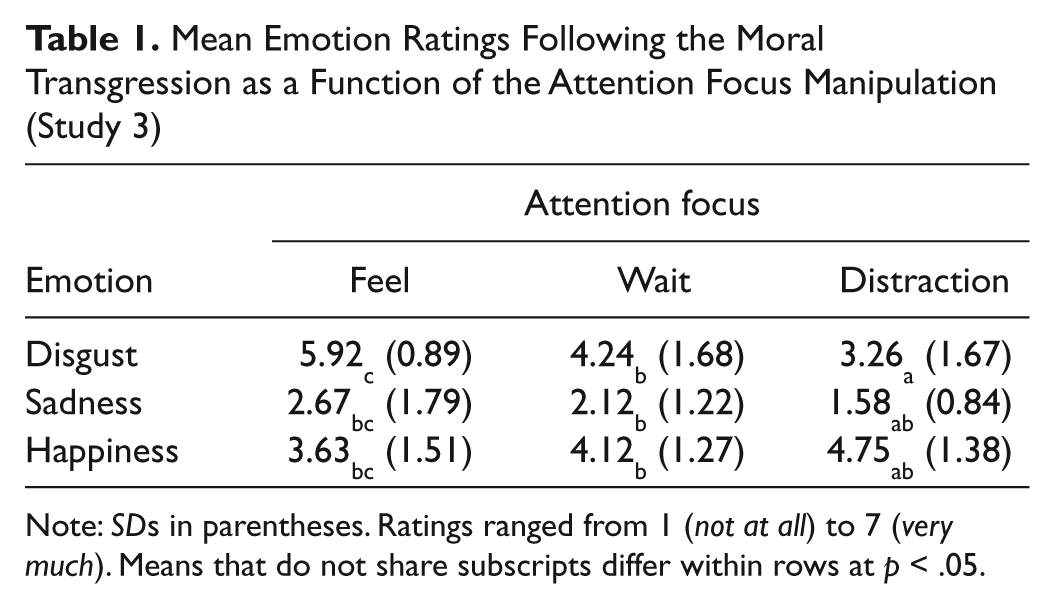
Note: SDs in parentheses. Ratings ranged from 1 (not at all) to 7 (very much). Means that do not share subscripts differ within rows at p < .05.
This analysis revealed a significant effect of attention focus on participants’ moral judgments, F(2, 57) = 33.52, p < .001,
Attention focus, attentional control, and disgust in moral judgments
Besides the main effect of attention focus, there was also a significant interaction between attention focus and attentional control on participants’ moral judgments, F(2, 54) = 4.70, p < .05,
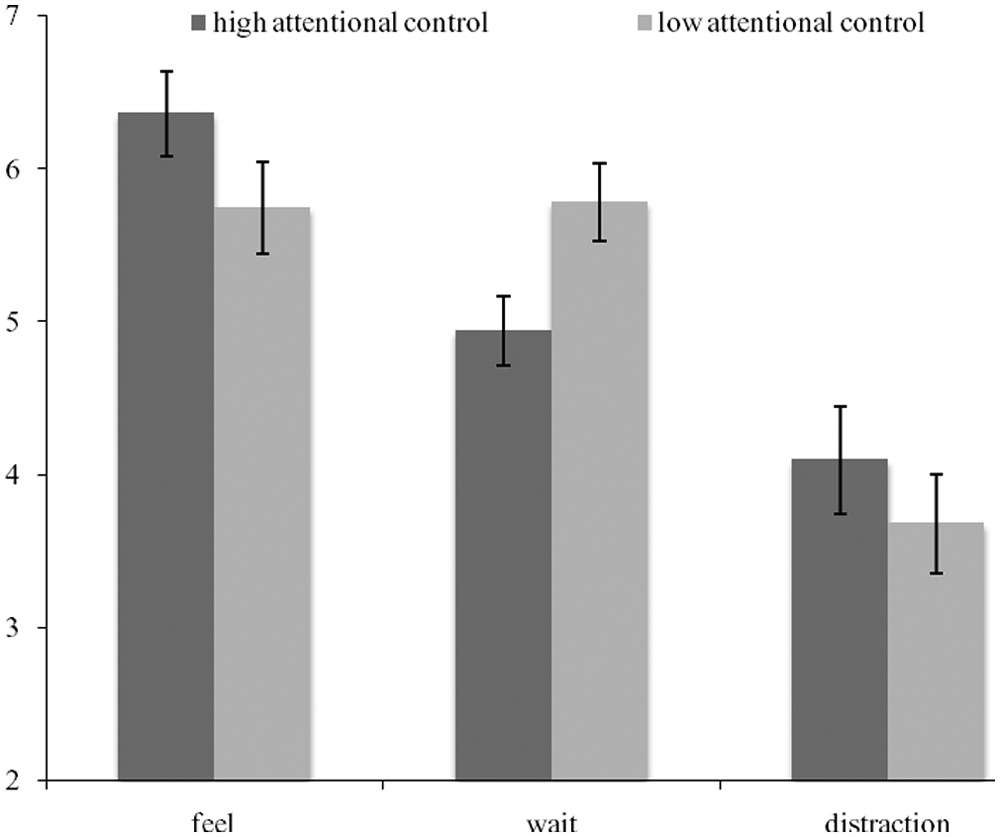
Mean rating of the moral transgression (1 = highly approve, 9 = highly disapprove) as a function of attentional control and attention manipulation (feel, wait, distraction).
Discussion
Study 3 provided further evidence that attention controls the influence of disgust on people’s moral judgments. Watching aversive film clips resulted in more intense disgust and in harsher moral judgments for participants who focused their attention on their feelings than for participants in the wait condition, whereas watching the same film clips resulted in the least intense disgust, and the mildest moral judgments, when participants played a distracting game of Tetris.
The findings of Study 3 underline our hypothesis that attentional control, at its core, regulates emotion-congruent processing, rather than simply neutralizing any emotional input. In particular, participants with strong attentional control did report more intense emotions, when they were explicitly instructed to focus on their feelings rather than wait, or play a distracter game of Tetris. Moreover, when instructed to focus on their feelings, participants with strong attentional control judged the moral transgression equally severely as participants with weak attentional control. Hence, attentional control appears to play a role in the effective down-regulation, as well as in the effective up-regulation of one’s emotional state, with its consequences for subsequent moral judgments.
In line with the first two studies, we found a moderating role of individual differences in attentional control on the severity of moral judgments when attention focus was not controlled by external task demands (i.e., in the wait condition), such that participants with weak attentional control again adhered to harsher moral judgments than participants with strong attentional control. This latter finding highlights our line of thinking that people who are more capable of controlling their attention are also more able to self-regulate ongoing emotion-congruent processing, and hence, the influence of unrelated disgust on moral judgments. The findings of Study 3 also point to the relatively automatic nature of unrelated disgust influences on moral judgment. Once disgust was maintained through an explicit attention focus, this resulted in harsher moral judgments for both participants with weak and strong attentional control. Thus, attentional control moderates emotion-congruent processing, and this in turn, determines the magnitude of unrelated disgust influences on moral judgments.
General Discussion
In this article, we proposed that attentional control processes regulate influences of disgust on moral judgments. Three studies indeed showed that individual differences in attentional control, measured via Stroop performance (Study 1) and the ACS (Studies 2 and 3), modulated unrelated disgust influences on moral judgments, such that people with weak attentional control displayed stronger disgust responses and more severe moral judgments than people with strong attentional control. We demonstrated these effects by both manipulating disgust (Study 1) and measuring individual differences in disgust (Study 2). Moreover, we showed that attentional control mediated the relation between disgust and moral judgment (Study 2).
By manipulating attentional focus in Study 3, we further showed that attentional control does not simply reflect the neutralization of emotion but rather involves the regulation of ongoing emotion processing. When following a disgust induction, people were instructed to direct their attention toward their feelings; this resulted in relatively stronger disgust responses, and consequently, more severe moral judgments, regardless of individual differences in attentional control. Interestingly, when following a disgust induction, people could not focus on their feelings because their attention was distracted by a cognitively demanding task; this attenuated people’s disgust responses and their effects on moral judgments, again for both individuals with strong and weak attentional control. The current findings thus suggest that both situational constraints and individual variations in attentional control determine the strength of disgust biases, with individual variations being most predictive in the absence of any external task requirements.
Although rationalist theories of moral psychology have long emphasized the role of conscious reasoning in morality (Kant, 1785; Kohlberg, 1973), recent work suggests that emotions play a key role in these judgment processes (Greene et al., 2001; Haidt, 2001). These newer theories argue that moral cognition relies on older affective systems, rather than on more recently evolved higher cognitive functions. In line with this notion, we found strong effects of emotion on people’s moral judgments. However, we also found attentional control processes to modulate emotion influences substantially, suggesting that emotion systems and attention systems interact in important ways in contributing to people’s moral actions.
The present work used self-report measures to assess participants’ emotional responses. Such self-reports may influence participants’ awareness of their feelings, which may subsequently bias any effects of emotion on behavior (Larsen & Fredrickson, 1999) and which makes it difficult to use self-reports as a repeated measure. Accordingly, self-report measures allow little insight into the temporal dynamics of interactions between attention and emotion systems. Using more implicit, online assessments of emotion processing in future research on this topic, for example, by means of neurophysiology, should circumvent this issue of self-awareness and may provide a better understanding of the involvement of attentional control processes in emotion effects over time.
Although our research focused on the influence of disgust on moral judgments, we do not think that our findings are restricted to the moral domain. Rather, we propose the involvement of a general-purpose attention mechanism in a wide range of emotion effects. For example, just as attentional control regulates the impact of unrelated disgust on moral judgments, attentional control may influence the effects of unrelated sadness on relationship satisfaction (Forgas, 1994) or the effects of unrelated fear on risk taking in financial decision making (Porcelli & Delgado, 2009).
Revealing the mechanisms underlying the effects of emotions on unrelated situations will advance our understanding of their influence on interpersonal behavior and may help develop interventions against the aversive consequences. Although our focus was primarily on understanding the nature and regulation of unrelated disgust influences on moral judgments from a theoretical perspective, insights in these mechanisms may also be of importance for understanding and predicting the dynamics of real-life social behaviors. The notion that attentional control processes are central to the regulation of unwanted emotion influences paves the way for applications to societal challenges in both formal settings (i.e., legal decision making, law enforcement) and informal settings (i.e., romantic relationships). For example, under circumstances where judges or other legal decision makers face a lot of distressing evidence, it would be wise to build in some sort of distraction period, such that they will not be overwhelmed by their emotions when making punitive judgments. Simple interventions, like inducing attentional load with neutral tasks such as the Tetris game, temporarily block emotion processing and may thus control negative emotions before they have their effects. Such attentional load manipulations are possibly more effective than traditional regulation strategies like suppressing emotional thoughts (Wegner, Erber, & Zanakos, 1993), which commonly result in paradoxical rebound effects, especially for people with weak attentional control (Wenzlaff, Wegner, & Roper, 1998). Moreover, the wide accessibility of mobile devices such as hand-held computers and smart phones allow for an easy implementation of attentional load interventions across many situations.
Concluding Remarks
The present article shows that attentional control processes regulate not only people’s own emotional experiences but also judgments concerning other people. Moral judgments can have important, long-lasting consequences, including effects on the outcome of punitive decisions. Hence, understanding the nature and regulation of emotional biases in moral judgments are of importance not only from a basic psychological perspective but also for understanding and predicting the dynamics of real-life moral judgments, such as legal decision making or philanthropy. We have shown that when people are able to control their attention to emotional content, they can manage the impact of disgust on their judgments. In other words, the human attention system modulates the effects of unrelated disgust on moral judgments.
Footnotes
Editor’s Note
Dr. Gerald Clore served as guest action editor for this article.
Declaration of Conflicting Interests
The author(s) declared no potential conflicts of interest with respect to the research, authorship, and/or publication of this article.
Funding
The author(s) received no financial support for the research, authorship, and/or publication of this article.