



Abstract
Building on research suggesting one primary function of religion is the management of death awareness, the present research explored how supernatural beliefs are influenced by the awareness of death, for whom, and how individuals’ extant beliefs determine which god(s), if any, are eligible to fulfill that function. In Study 1, death reminders had no effect among Atheists, but enhanced Christians’ religiosity, belief in a higher power, and belief in God/Jesus and enhanced denial of Allah and Buddha. Similarly, death reminders increased Muslims’ religiosity and belief in a higher power, and led to greater belief in Allah and denial of God/Jesus and Buddha (Study 2). Finally, in Study 3, death reminders motivated Agnostics to increase their religiosity, belief in a higher power, and their faith in God/Jesus, Buddha, and Allah. The studies tested three potential theoretical explanations and were consistent with terror management theory’s worldview defense hypothesis. Theoretical implications are discussed.
The tides of human culture have ushered in countless religious and supernatural beliefs. At various times and places over the course of history, vast religions have worshiped Gods such as Zeus, Osiris, or Thor, or any of various deities revered by so many tribal religions (Jordan, 2005). But the ubiquitous notion of supernatural agency is of course not just a memory of times past; these ideas continue to thrive, with throngs of believers following the deities of Islam, Christianity, Hinduism, and many others. Still, there are a considerable number of people who reject religions or doubt religious claims to know God (Ipsos/Reuters, 2011; Norris & Inglehart, 2004). Such convictions, both religious and skeptical, raise important questions about what motivates religious belief and faith in supernatural agents. Theory and research suggest that one primary function of religion is to help manage the awareness of death (e.g., Friedman & Rholes, 2007; Jonas & Fischer, 2006; for reviews, see Greenberg, Landau, Solomon, & Pyszczynski, in press; Landau, Greenberg, & Solomon, 2004; Vail, Kosloff, Vess, & Ashish, in press), yet relatively little is known about how faith in the supernatural is influenced by the awareness of death, for whom, and how individuals’ extant beliefs determine which god(s), if any, are eligible to fulfill that function. The present research therefore built on the foundation laid by Norenzayan and Hansen (2006) to investigate exactly how death awareness affects belief in various available supernatural agents and how individuals’ prior beliefs, religious or skeptical, influence those patterns of religiosity and faith in supernatural agents.
The Existential Function of Belief in Religion and Supernatural Agents
Numerous theorists (e.g., Becker, 1973; Burkert, 1996; Durkheim, 1912/1995; Freud, 1927; Fromm, 1950; James, 1902) have noted the functional significance of religious beliefs in helping people manage the awareness of death. As anthropologist Bronislaw Malinowski (1948) put it, “Of all sources of religion, the supreme and final crisis of life—death—is of the greatest importance” (p. 47). Although secular endeavors are often directed toward achieving symbolic immortality (Becker, 1973; Lifton, 1979), religions are unique in that they directly deny death by supporting supernatural beliefs about literal immortality. Religious beliefs typically involve some form of spiritual afterlife—with each religion offering its own version of the transcendent realm, from the Islamic gardens of delight, to Hindu salvation, to the Christian heaven—for those behaving in accord with the religion’s specific viewpoints and customs.
Indeed, correlational evidence shows that afterlife beliefs and religious faith are associated with reduced levels of death anxiety or death concern (e.g., Alvarado, Templer, Bresler, & Thomas-Dobson, 1995; Spilka, Stout, Minton, & Sizemore, 1977; Templer, 1970). Experimental research derived from terror management theory (TMT; Greenberg, Pyszczynski, & Solomon, 1986) further suggests that perceived legitimacy of afterlife and religious identifications help to buffer the psychological repercussions of the awareness of death (for review, see Greenberg et al., in press; Landau et al., 2004; Vail et al., 2010). Based on the works of Ernest Becker (1973) and Otto Rank (1936/1950), TMT posits that people manage the awareness of death, in part, by constructing and maintaining enduring cultural beliefs that offer guidelines for living a meaningful life and further promises death transcendence via secular (e.g., innovative business strategy, scientific contributions, rearing children, or other legacies) and/or religious (e.g., heaven, paradise, etc.) means. Accordingly, substantial research shows that when reminded of mortality (mortality salience [MS]), people more tenaciously defend their cultural beliefs and sense of self-worth (see Greenberg, Solomon, & Arndt, 2008, for a review). Such effects of mortality reminders were observed in research conducted by Dechesne et al. (2003). Interestingly however, when Dechesne et al. presented participants with information describing ostensible evidence for an afterlife, those defensive responses to MS were eliminated. These findings are one of a number of lines of work that highlight how religious beliefs may serve to buffer against the awareness of mortality (e.g., Jonas & Fischer, 2006).
To date, the most direct investigation of how faith in the supernatural realm may, at least in part, be influenced by the awareness of death was conducted by Norenzayan and Hansen (2006). In that series of studies, reminders of mortality led religious participants to express more faith in the existence of supernatural agents. Death reminders increased religiosity and faith in God in their first two studies, and ratings of faith in “Buddha/a higher power” and shamanic spirits in a third and fourth study, respectively. The latter study also found that MS only enhanced supernatural beliefs among religious believers, but not nonbelievers. Although we will consider these findings in more critical detail below, Norenzayan and Hansen’s research represents an important advance and provides foundational insights about how the awareness of death can boost faith in supernatural and religious beliefs.
Although faith in supernatural agent(s) may serve an important death-denying function, additional research is needed to more precisely understand how death awareness affects religious believers’ faith in the various available supernatural agents. For example, Muslims and Christians each believe in a supernatural agent, but they each also have different beliefs about which religion’s deities actually exist. The potential differences in such groups’ beliefs have not yet been systematically examined in research exploring the influence of death awareness on religious and supernatural belief. This leaves a noticeable and important gap in understanding why and how people may increase religious and supernatural faith when reminded of mortality.
Furthermore, although the available research showing that religious faith can serve a powerful terror management function may help to explain the ubiquity of religion (Landau et al., 2004; Vail et al., 2010), it should not be taken to suggest that the relationship is inevitable or even necessary. Although the majority of people around the world are religious, at least 10% of the population in postindustrialized nations regard themselves as not traditionally religious (Ipsos/Reuters, 2011; Norris & Inglehart, 2004), and individuals who label themselves as having “no religion” often do so for specific reasons. Both Vernon (1969) and Baker and Smith (2009) report that among those reporting “no religion,” roughly one fourth were Atheist, one fourth Agnostic, and the remaining 50% actually held supernatural beliefs but classified themselves as non-religious to distance themselves from undesirable religious groups. This is important because it shows, compared with others using the “not religious” classification, that Atheists’ and Agnostics’ classification as non-religious more accurately reflects distinct philosophical skepticism about religious and supernatural ideas.
Stemming from a long and rich tradition of skepticism, stretching back through Greek and Indic philosophy, the Renaissance, and contemporary thought, Atheism bases its rejection of religion and the supernatural largely on reason and empirical observation. Epicurean thought (e.g., Lucretius, C. 50 B.C.E./2007), advances in naturalism (e.g., Darwin, 1859), and other rational and scientific progress have been used to buttress Atheist arguments against religion and Gods, as have numerous other philosophical attacks against the logical inconsistencies, contradictions, and social failings of the various religions and their supernatural agents (e.g., Hume, 1779/1947; Kant, 1781/2008; Marx, 1843). Similarly, the Agnostic position, coined as such by Thomas Huxley in 1869, traces many of its roots through the epistemological skepticism of Hume (1779/1947), Kant (1781/2008), and Kierkegaard (1844/2009). But in contrast to Atheism’s outright rejection of religion, Agnosticism doubts religions’ claims about supernatural agents based on the observation that the supernatural is by definition beyond empirical verification and thus cannot be known to exist or to not exist (Russell, 1927/1957, 1947; Stephen, 1893/2007).
Although it seems plausible that each of these religious and skeptical beliefs may be directly related to the expression of religious and supernatural beliefs when managing the awareness of death, relatively little is known about the influence of individuals’ preexisting beliefs on the patterns of existentially motivated religious and supernatural agent beliefs. The present research therefore seeks to build on the foundation laid by Norenzayan and Hansen (2006) and addresses two central issues: (a) How does the awareness of death influence belief in various available supernatural agents? and (b) how do individuals’ prior beliefs, both religious and skeptical, impact the patterns of existentially motivated religiosity and faith in supernatural agents?
Three Potential Motivational Mechanisms Influencing the Patterns of Religious and Supernatural Agent Beliefs
Norenzayan and Hansen (2006) outlined three potential relationships between death awareness and faith in supernatural agency. One possibility is that death awareness triggers a “distinct cognitive inclination,” regardless of prior religious belief or unbelief, to accept religion and even unfamiliar supernatural agents. In this vein, some have interpreted findings that MS increases belief in afterlife and God as evidence that there are “no atheists in foxholes” (Willer, 2009). But because that research did not actually sample Atheists, it is difficult to accept that conclusion. Rather, Norenzayan and Hansen found that MS had no effect on belief in “God/a higher power” among “non-religious” participants, perhaps suggesting that belief in supernatural agents is not likely a distinct cognitive inclination. Yet, Norenzayan and Hansen’s “non-religious” group included Atheists, Agnostics, and those claiming “no religion,” making it difficult to understand which group’s philosophy was most clearly associated with the lack of belief.
A second possibility is that death awareness motivates religious believers, but not nonbelievers, to enhance domain-general religious beliefs, inclusively accepting all deities whether they are derived from one’s own religion or from competing religions. After initially demonstrating that MS enhanced religiosity and belief in God, Norenzayan and Hansen (2006) found in one study that MS motivated “religious” (mostly Christian), but not “non-religious,” participants to increase belief in the power of Siberian Shamans to harness ancestral spirits for guidance, and in another study, MS increased faith in “God/a higher power” and in “Buddha/a higher power.” Although the former could be taken as support for the domain-general possibility, Norenzayan and Hansen noted that in the latter the deity names were confounded with “a higher power.” Although ratings of faith in “Buddha/a higher power” were below the mean and unrelated to religious identification in the control condition, these ratings reached above the mean and were correlated with religiosity in the MS condition, which, as Norenzayan and Hansen (2006) pointed out, could be taken as evidence that those (mostly Christian) religious participants believed more strongly in Buddha after being reminded of death. However, the fact that each deity was confounded with the notion of a higher power makes it impossible to tell whether (a) increased faith on these items uniformly implied an expression of faith in a worldview-consistent deity (God) and an alternate religion’s deity (Buddha), indicating a broad defense of religious concepts irrespective of worldview content; (b) participants ignored the culturally alien “Buddha” moniker and instead increased ratings of faith based on the more culturally neutral notion of a “higher power”; or (c) the mostly Christian sample judged the conflation of “a higher power” with “Buddha” as rather unappealing in the control condition, but became motivated in the MS condition to ignore (rather than accept) the “Buddha” aspect of the items and more strongly express their faith in the “higher power” aspect of the items. Thus, the evidence regarding this domain-general possibility is mixed.
A third possibility, based on TMT’s worldview defense hypothesis, suggests that the influence of death awareness on religious beliefs and faith in supernatural agents would be determined by individuals’ preexisting worldview beliefs. From this perspective, it is important to note that faith in Gods, spirits, and the supernatural realm involves accepting and valuing the existence of things that cannot be directly verified. For this reason, religious beliefs, among numerous other cultural phenomena, rely heavily on consensual validation to support their perceived validity (Berger & Luckmann, 1967). Furthermore, as Berger and Luckmann noted, “The appearance of an alternative symbolic universe poses a threat because its very existence demonstrates empirically that one’s own universe is less than inevitable” (p. 108). Alternative religious beliefs, concepts, and followers introduce the possibility that one’s own religious beliefs and lifestyles might, in fact, not represent the righteous path to immortality. Indeed, monotheistic religions often explicitly proscribe alternative religions, viewing them as worshipping false Gods or as holding unholy beliefs undeserving of eternal life.
A number of findings are suggestive of the moderating role of individuals’ worldview beliefs in the relationship between death awareness and religious notions of supernatural agents. For example, death awareness can lead to various psychological reactions that shore up confidence in one’s own religious worldview and minimize the threat posed by alternative religious belief systems (Greenberg et al., 1990; Kosloff, Greenberg, Sullivan, & Weise, 2010). Other research among Christians found that perceiving the annihilation of followers of a competing religion, Islam, quelled the accessibility of death-related cognition elicited by threats to their religious worldviews (Hayes, Schimel, & Williams, 2008). In the context of the present analysis, the above findings provide at least some support for the worldview defense hypothesis, suggesting that the effect of MS on religious beliefs and faith in supernatural agents might similarly be channeled by individuals’ preexisting worldview beliefs.
In sum, the literature remains unclear about the motivational mechanism determining the patterns of religious and supernatural agent beliefs. Although initial findings cast some doubt on the “distinct cognitive inclination” hypothesis (Norenzayan & Hansen, 2006), additional research is needed to confirm this conclusion and to clarify the influence of the two distinct forms of skepticism: Atheism and Agnosticism. It is also, at this point, difficult to draw any clear conclusions about evidence regarding the second or third possible mechanisms determining belief patterns. On one hand, some evidence appears to suggest that MS motivates religious people to adopt a domain-general acceptance of supernatural agents, although some methodological ambiguities call this conclusion into question. On the other hand, although TMT’s worldview defense perspective suggests MS would impact religious and supernatural beliefs according to individuals’ prior worldviews and indirect evidence supports that perspective, little to no research has directly addressed this issue. The present research was therefore designed to more precisely determine which of the three theoretical approaches best describes the mechanism through which the awareness of death influences patterns of religious and supernatural agent beliefs.
The Present Research
The present research included several features to carefully explore each aspect of the three possible mechanisms. First, the effect of MS on religious and supernatural beliefs was examined among those with and without prior religious belief—that is, among unique samples of believers and Atheists. The “distinct cognitive inclination” hypothesis predicts that MS would increase religious belief and inclusive acceptance of all supernatural agents regardless of prior religious belief. Second, the present studies examined the effect of MS on potential expressions of faith in different deities among groups with different preexisting religious belief (i.e., among unique samples of Christians and Muslims) and religious skepticism (i.e., among unique samples of Atheists and Agnostics). The religious domain-general hypothesis predicts that MS would motivate believers, but not nonbelievers, to increase religious beliefs and inclusively accept alternative supernatural agents regardless of creed. However, TMT’s worldview defense hypothesis predicts that the effect of MS on patterns of religious and supernatural belief would instead be guided by the content of individuals’ prior beliefs.
Study 1: Christians and Atheists
Study 1 was designed to feature an initial test of critical aspects of each of the three hypothesized mechanisms. Unique samples of Christians and Atheists were recruited. All were reminded either of death or a control topic, and then asked to rate their religiosity and belief in a higher power, and to more specifically indicate their faith in each of three supernatural agents. The first two supernatural agents rated were Buddha and Allah, and the last one was God/Jesus. For Christians, Buddha and Allah represented worldview-inconsistent supernatural agents, whereas God/Jesus was worldview consistent. 1
According to the “distinct cognitive inclination” interpretation, MS would be expected to increase religiosity, belief in a higher power, and inclusive belief in Buddha, Allah, and God/Jesus among both Christians and Atheists. According to the religious domain-general hypothesis, MS should motivate a similarly inclusive pattern among Christians but not Atheists. From the worldview defense perspective, however, MS would also be expected to motivate Christians to enhance religiosity and belief in a higher power. But because Christianity is a monotheistic belief, MS would be expected to motivate Christians to express greater faith in the worldview-consistent deity (God/Jesus) while motivating them to more strongly deny the existence of the alternative religions’ supernatural agents (Buddha, Allah). Atheists would also be expected to indicate low religiosity and supernatural beliefs regardless of MS condition.
Method
Participants
Fifty-four introductory psychology students at the University of Missouri–Columbia (MU) were recruited based on responses to a prescreen survey in which they described themselves as either Christian (n = 26; age: M = 18.74, SD = .98; 8 male) or Atheist (n = 28; age: M = 18.64, SD = 1.19; 15 male). On a Likert-type item (1 = not at all, 10 = very much), Christians indicated a strong level of belief in afterlife (M = 7.81, SD = 2.35) whereas Atheists rejected afterlife (M = 2.16, SD = 1.79). In all three studies, course credit was awarded in exchange for participation.
Materials and Procedure
Participants were first welcomed to the lab by an experimenter who introduced the study as an investigation of personality styles and their relation to attitudes about certain personal and social issues. All three studies used paper-and-pencil questionnaires. A brief set of filler items bolstered the cover story, followed by the MS manipulation and dependent measures.
MS
Following previous research (Rosenblatt, Greenberg, Solomon, Pyszczynski, & Lyon, 1989), participants were randomly assigned to respond to either MS or a control topic. The MS condition asked participants to “Please briefly describe the emotions that the thought of your own death arouses in you” and “Jot down, as specifically as you can, what you think happens to you as you physically die.” The control topic asked participants to “Please briefly describe the emotions that the thought of events turning out differently than you had expected arouses in you” and “Jot down, as specifically as you can, what you think physically will happen to you as you experience something turning out differently than you had expected.” Although unexpected events might be viewed as a signal that an omnipotent supernatural agent does not exist, this control topic was chosen based on theoretical suggestions that MS effects arise because death thought threatens meaningful, coherent events (Heine, Proulx, & Vohs, 2006), undermines personal control (Kay, Goucher, McGregor, & Nash, 2010), and induces personal uncertainty (Van den Bos, 2009). Specifically, some evidence suggests that because individuals can at times be challenged to make sense of negative, unexpected, or unexplainable events, they can rely on religious faith, increasing belief in supernatural agency and attributing the cause of such events to God, to help restore a sense of order amid the chaos (see also Gray & Wegner, 2010). Because this control topic reminded participants of possible unexpected outcomes, it allowed us to determine whether such thoughts give rise to similar or different effects than does MS.
Delay and distraction
Next, the 20-item Positive and Negative Affect Schedule (PANAS; Watson, Clark, & Tellegen, 1988) and a word-search distraction task provided the delay needed to observe distal terror management effects (see Pyszczynski, Greenberg, & Solomon, 1999).
Religiosity
A Likert-type item asked, “How religious are you?” (1 = not very religious, 10 = very religious).
Higher power
A Likert-type item asked, “How strongly do you believe in a higher power?” (1 = not very strongly, 10 = very strongly).
Deity
A total of nine items, adapted from Norenzayan and Hansen (2006), assessed faith in each of three religious deities (three items each for Buddha, Allah, and God/Jesus). The items were (a) “Buddha/Allah/God (Jesus) answers prayers”; (b) “Buddha/Allah/God (Jesus) exists”; and (c) “Buddha/Allah/God (Jesus) sometimes intervenes in worldly matters.” The three Buddha (α = .92) items were presented first, then the Allah (α = .97) items, then the God/Jesus (α = .99) items. Each item used a Likert-type scale (1 = strongly disagree, 10 = strongly agree).
In all three studies, participants lastly completed a demographic questionnaire asking about age and sex.
Results and Brief Discussion
Religiosity
A 2 (Christian vs. Atheist) × 2 (MS vs. expectancy) ANOVA revealed an unqualified main effect of religious affiliation such that Christians reported being more religious than did Atheists, F(1, 51) = 134.39,
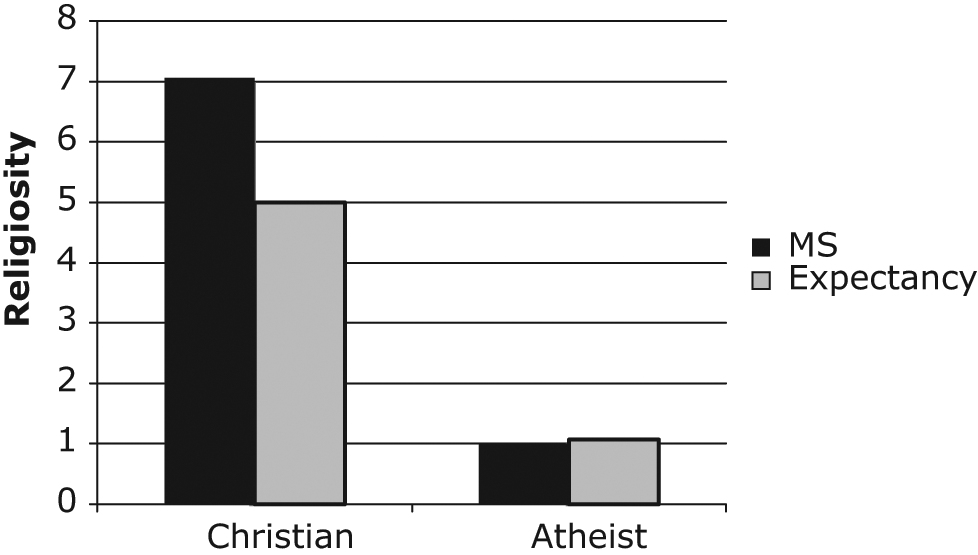
In Study 1, death reminders increased self-reported religiosity among Christians, but not among Atheists
Higher Power
A similar ANOVA revealed an unqualified main effect of religious affiliation such that Christians reported greater belief in a higher power than did Atheists, F(1, 51) = 104.22,

In Study 1, death reminders increased belief in a higher power among Christians, but not among Atheists
Supernatural Agents
A 2 (Christian vs. Atheist) × 2 (MS vs. control) × 3 (Deity: Buddha vs. Allah vs. God) mixed ANOVA revealed main effects of religious affiliation and deity (both Fs > 80.52,

In Study 1, MS increased Christians’ faith in God/Jesus and decreased faith in Buddha and Allah. Atheists did not express faith in any deity in the MS or control condition
Affect
No main effects or interactions emerged on positive or negative affect, all Fs < 2.00,
Study 1 provided initial evidence for the worldview defense hypothesis, finding that individuals’ preexisting beliefs guided their pattern of existentially motivated religiosity and supernatural beliefs. MS increased Christians’ religiosity and belief in a higher power, and enhanced their monotheistic belief in the worldview-consistent deity, God/Jesus, while more strongly denying belief in Buddha and Allah—two culturally alien and worldview-inconsistent deities. Similarly, Atheists rejected religiosity and supernatural beliefs regardless of condition. That effects emerged for Christians but not Atheists is inconsistent with the hypothesis that there is a universal “distinct cognitive inclination” for religiosity and supernatural belief. The religious domain-general hypothesis was also challenged to explain these results because MS did not simply increase the appeal of any supernatural agent. In fact, although Christians in the control condition allowed a slim, though skeptical, amount of belief in the existence of Buddha and Allah, MS motivated them to decrease their ratings of faith in Buddha and Allah such that they no longer differed from those of Atheists.
Study 2: Iranian Muslims
Although Study 1 found initial support for the idea that awareness of death motivates worldview-guided faith in religion and deities, it is of course limited by observing such effects only among Christians. The worldview defense hypothesis posits that this same mechanism would lead to different supernatural agent preferences among followers of other religions. Thus, a compelling examination of this hypothesis would test the same processes among a different religious sample. Study 2 therefore recruited Muslim students in Iran. Participants were again reminded either of death or a control topic, asked to indicate their level of religiosity and faith that a higher power exists, as well as their faith in each of three supernatural agents. This time, however, the first two supernatural agents rated were Buddha and God/Jesus, and the last one was Allah. For the Muslim sample, Buddha and God/Jesus represented the worldview-inconsistent supernatural agents, whereas Allah was the worldview-consistent one. Although the religious domain-general hypothesis predicts MS would motivate an inclusive pattern of belief in all three deities, the worldview defense hypothesis predicts that MS would enhance Muslims’ monotheistic faith in the worldview-consistent deity (Allah) and denial of the two alternative religions’ supernatural agents (Buddha, God/Jesus).
Method
Participants
Forty Muslim psychology students were recruited at the Islamic Azad University–Zarand Branch, Iran, in exchange for course credit (age: M = 19.20, SD = .97; 20 male). On a Likert-type item (1 = not at all, 10 = very much), these participants indicated a strong level of belief in afterlife (M = 9.48, SD = .93).
Materials and Procedure
Study 2 used the same materials and procedure as Study 1, but with two exceptions regarding the control condition and the order of presentation of the deity items: the control condition asked about pain rather than an expectancy violation; the three Buddha (α = .59) items were presented first, then the God/Jesus (α = .77) items, then the Allah (α = .81) items.
Results and Brief Discussion
Religiosity
A one-way ANOVA revealed that MS (M = 9.25, SE = .28) increased self-reported religiosity compared with the control condition (M = 6.25, SE = .28), F(1, 38) = 57.48,
Higher Power
A one-way ANOVA showed that MS (M = 8.30, SE = .35) increased belief in a higher power compared with the control condition (M = 6.45, SE = .35), F(1, 38) = 14.27,
Deity
A 2 (MS vs. control) × 3 (Deity: Buddha vs. Allah vs. God) mixed ANOVA revealed an unqualified main effect of deity, F(2, 76) = 1868.24,

In Study 2, MS increased Muslims’ faith in Allah and decreased faith in Buddha and God/Jesus
Affect
Two one-way ANOVAs revealed that MS increased positive affect and decreased negative affect (both Fs > 4.38,
Study 2 provided further, cross-cultural, support for the worldview defense hypothesis: that individuals’ preexisting religious beliefs guide their pattern of existentially motivated religiosity and supernatural beliefs. Similar to Christians in Study 1, MS increased Muslims’ religiosity and belief in a higher power. But, again, contrary to the religious domain-general hypothesis, MS did not increase the appeal of any supernatural agent. Rather, in line with the worldview defense hypothesis, MS motivated Muslims to enhance their monotheistic belief in their religion’s worldview-consistent deity, Allah, while more strongly denying belief in the alternative religions’ deities Buddha and God/Jesus.
Study 3: Agnostics
The first two studies extend prior work on the effects of mortality awareness on religious and supernatural belief by providing crucial insights about the guiding role of an individual’s preexisting belief systems. But whereas Studies 1 and 2 have examined samples holding very clear religious beliefs either in favor of one religion or another, or clearly opposed to religion altogether, some individuals take a more reserved stance and instead believe that the existence of supernatural agents is simply beyond verification. Specifically, rather than wholly rejecting religions and the existence of supernatural agents, Agnostics doubt religious claims about the supernatural because they view the existence or nonexistence of supernatural phenomena as simply beyond human reason or empirical verification. This skeptical, yet open-minded, view of the supernatural renders Agnostics a fascinating group to study.
To be sure, there are many complex epistemological reasons one might consider themselves Agnostic. But as several theorists have pointed out, when push comes to shove, everyone must ultimately make a decision—one cannot simultaneously believe and not-believe (Benedict XVI, 2006; Dawkins, 2006). Accordingly, Pascal (1669/1995) argued that when the agnostic perspective is pushed to make a decision about the supernatural, such as when contemplating the existential threat of death, the safe bet is to settle on the side of eternal life, the side of religion and the supernatural gatekeepers of immortality. Furthermore, because the agnostic view holds that supernatural phenomena cannot be “known,” each religions’ conceptualization of supernatural agents may seem just as likely.
Agnostics therefore present an intriguing and special case, in which all three explanations—worldview guidance, domain-general faith, and the distinct cognitive inclination—converge on a common prediction. Because the Agnostic worldview regards religious notions of supernatural agency as a possibility, yet a possibility which no single religion can positively verify, MS may motivate Agnostics to “hedge their bets” and increase religiosity, belief in a higher power, and faith in the multiple available supernatural agents.
Method
Participants
Twenty-eight MU psychology students were recruited based on a prescreening in which they described themselves as Agnostic (age: M = 18.36, SD = .68; 13 male). On a Likert-type item (1 = not at all, 10 = very much), these participants indicated a skeptical, yet not absent, level of belief in afterlife (M = 3.75, SD = 1.90).
Materials and Procedure
Study 3 used the same materials and procedure as Study 1, but with the exception that the control condition asked participants to imagine being lonely. This control topic was chosen because research has shown that social isolation can increase religiosity (Aydin, Fischer, & Frey, 2010) and thus addressed an alternative explanation that MS effects actually reflect a system designed to facilitate adaptive social coalition (e.g., Kirkpatrick & Navarrete, 2006).
Results and Brief Discussion
Religiosity
A one-way ANOVA revealed that MS (M = 2.86, SE = .43) increased self-reported religiosity compared with the control condition (M = 1.29, SE = .43), F(1, 26) = 6.75,
Higher Power
A one-way ANOVA showed that MS (M = 4.5, SE = .61) increased belief in a higher power compared with the control condition (M = 2.79, SE = .61), F(1, 26) = 3.94,
Deity
A 2 (MS vs. control) × 3 (Deity: Buddha vs. Allah vs. God) mixed ANOVA showed there was no interaction, F < 1. However, as depicted in Figure 5, a main effect of MS, F(1, 26) = 6.68,
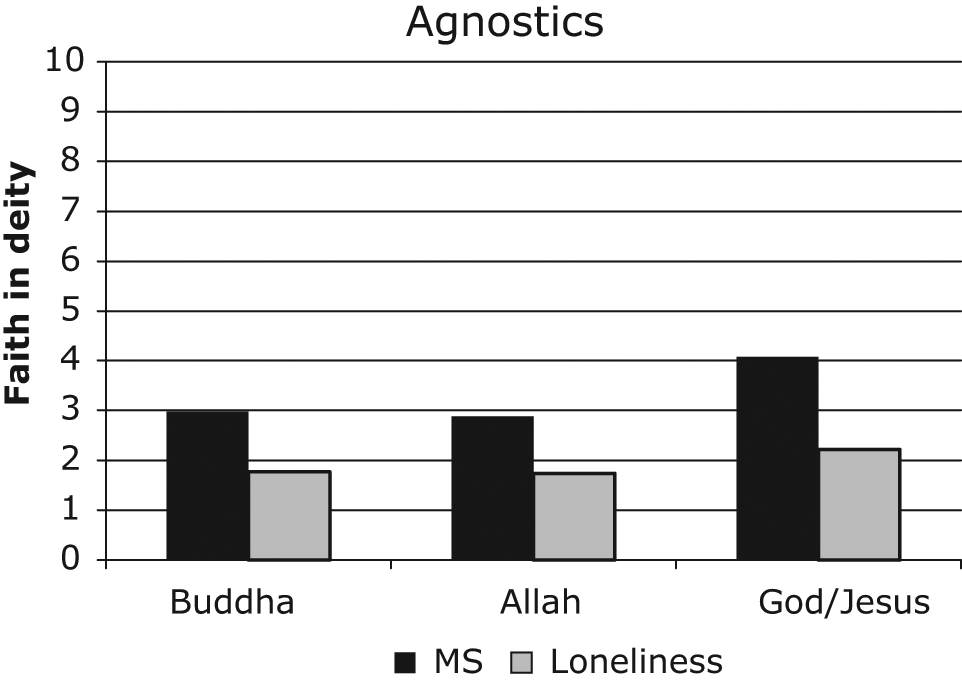
In Study 3, MS increased Agnostics’ faith in Buddha, Allah, and God/Jesus
Affect
Study 3 used an expanded version of the PANAS (PANAS-X; Watson & Clark, 1992) and a word-search distraction task. The PANAS-X contains 60 affect items measuring positive and negative mood, as well as 11 subscales: Fear, Hostility, Guilt, Sadness, Happiness, Self-Assuredness, Attentiveness, Serenity, Surprise, Fatigue, and Shyness (all α’s > .63). ANOVAs showed that MS did not impact overall positive or negative mood (both Fs < 1), and a MANOVA showed MS did not impact the affect subscales (all Fs < 2.64,
Although Agnostics showed initial skepticism about religion and supernatural phenomena, MS motivated them to increase their religiosity, belief in a higher power, and—in line with the Agnostic view regarding supernatural phenomena—increase belief in all three possible supernatural agents.
General Discussion
The present research explored how the awareness of death influences belief in various available supernatural agents and how individuals’ prior beliefs, whether religious or skeptical, impact the patterns of existentially motivated religiosity and faith in supernatural agents. In Study 1, MS had no effect among Atheists but enhanced Christians’ religiosity, belief in a higher power, and belief in God/Jesus and enhanced denial of Allah and Buddha. In Study 2, MS similarly enhanced Muslims’ religiosity and belief in a higher power and led to greater belief in Allah and denial of God/Jesus and Buddha. Finally, in Study 3, MS motivated Agnostics to increase their religiosity, belief in a higher power, and their faith in God/Jesus, Buddha, and Allah. We turn now to more carefully consider each of the three proposed mechanisms in light of these data.
First, in Study 1, Atheists denied religion and supernatural agency regardless of MS condition, reflecting the idea that Atheists are instead invested in making the best of their secular pursuits (e.g., Goldman, 1916/2007; Hirsi-Ali, 2007). This finding is consistent with both the worldview defense hypothesis and the religious domain-general hypothesis, as both predict that the Atheists worldview renders religiosity and supernatural belief an invalid buffering option. Indeed, much TMT research has shown that investment in secular belief systems (e.g., Greenberg, Simon, Porteus, Pyszczynski, & Solomon, 1995; Routledge & Arndt, 2007; Schimel, Hayes, Williams, & Jahrig, 2007) can serve a buffering function parallel to that offered by religion (e.g., Friedman & Rholes, 2007; Greenberg et al., 1995; Pyszczynski et al., 2006). Thus, although religious belief about an eternal supernatural realm may be a particularly potent buffer, it is not the only form of terror management (Vail et al., in press), and the present research converges with the extant literature to suggest that Atheists do not rely on religion when confronted with the awareness of death.
In contrast, the “distinct cognitive inclination” hypothesis suggested that MS would have universally enhanced religiosity and supernatural belief, reflecting the popular maxim that there are “no Atheists in foxholes.” Although the results for Agnostics in Study 3 might be seen as consistent with this possibility, the lack of MS effect among the Atheist sample in Study 1 was inconsistent with this hypothesis. Furthermore, the fact that there are Atheists in foxholes is apparent. Atheist groups have even taken form across all branches of armed forces in response to prejudice and to dispel what they view as naive conclusions about the existential comforts of religion (e.g., Military Association of Atheists and Freethinkers, 2011; Military Atheists and Secular Humanists, 2011; Military Religious Freedom Foundation, 2011). Outside the military context, research examining Atheists’ end-of-life preferences found that Atheists were adamant that health care workers respect their rejection of religion (e.g., no bedside proselytizing) and recognize their secular value as “moral and caring individuals, committed to their families, humanity and nature” (Smith-Stoner, 2007, p. 926). Thus, the present research converges with extant evidence to cast doubt on the “distinct cognitive inclination” hypothesis (also, Norenzayan & Hansen, 2006, Study 4), instead supporting the view that Atheists are invested in other cultural exploits and do not view religious worldviews as applicable or valid buffering mechanisms (see also, Vail et al., in press).
Next, MS enhanced Christians’ religiosity, belief in a higher power, belief in God/Jesus, and their denial of Allah and Buddha (Study 1), and enhanced Muslims’ religiosity, belief in a higher power, belief in Allah, and their denial of God/Jesus and Buddha (Study 2). These findings are consistent with TMT’s worldview defense hypothesis, in which these individuals’ preexisting monotheistic worldviews guided their patterns of existentially motivated religiosity and supernatural agent beliefs. As Nietzsche (1895/2003) observed, “One demands that no other kind of perspective shall be accorded any value after one has rendered one’s own sacrosanct with the names ‘God,’ ‘redemption,’ ‘eternity’” (p. 132, italics in original). These findings also converge with other research showing that MS can motivate derogatory social evaluations of those who follow a competing religious worldview and positive evaluations of those who share one’s own religious beliefs (Greenberg et al., 1990), a process that can impact such outcomes as mate selection choices (Kosloff et al., 2010) and violent attitudes (Hayes et al., 2008; Pyszczynski et al., 2006).
The religious domain-general hypothesis, in contrast, suggested that MS would lead both Christians and Muslims alike to enhance their religiosity and belief in a higher power, as well as increasing faith in God/Jesus, Buddha, and Allah. Indeed, prior research by Norenzayan and Hansen (2006) found that MS motivated religious (mostly Christian) participants to increase faith in “God/a higher power” and in “Buddha/a higher power,” perhaps suggesting that MS motivates an inclusive belief in supernatural agents, even including those of competing religions. Although Norenzayan and Hansen acknowledged that worldview defense plays a role, they further suggested that the literal immortality represented by these deities was simply too attractive to pass up. However, as those authors noted, God and Buddha’s names were each confounded with the domain-general concept of a higher power, making it impossible to distinguish whether participant ratings indicated faith in competing deities, the common religious concept of a higher power, or both. Thus, the present research assessed faith in specific instances of different deities (God/Jesus, Allah, Buddha) alongside, but not confounded with, creed-neutral measures of “religiosity” and belief in “a higher power.” Consistent with Norenzayan and Hansen, MS increased Christians’ and Muslims’ ratings on domain-general religiosity and faith in a higher power. However, when more precisely assessing faith in the unique deities, MS led these monotheistic religious participants to specifically enhance belief in their respective religion’s deity and more strongly deny belief in the alternative deities. These findings potentially clarify some of the ambiguities in previous research and provide important insights into how an individuals’ worldview helps guide the applicability and form of supernatural agent beliefs.
But whereas religions are confident in the existence of their familiar and knowable god and Atheism definitively rejects all notions of supernatural concepts, Agnosticism takes a more reserved stance: Agnosticism holds that the abilities of human reason are limited such that humankind cannot know whether god(s) exists or not (Russell, 1927/1957, 1947; Stephen, 1893/2007). Yet, as both Theists (e.g., Benedict XVI, 2006; Pascal, 1669/1995) and Atheists (e.g., Dawkins, 2006) alike have argued, although Agnosticism may be defensible theoretically, it is challenged in practice—at every moment one chooses to live either as if Gods and spirits exist or as if they do not; one cannot simultaneously believe and not-believe. On this note, Pascal’s (1669/1995) famous Wager passage addresses the agnostic perspective in light of the existential consequences hanging in the balance, suggesting that certainty about the limits of human reason takes a back seat to the prospect of supernatural agents and eternal life. Indeed, Study 3 showed that MS motivated Agnostics to increase their openness to religion, the possibility of a higher power, and, in line with their view that the supernatural is unable to be “known” by any specific religion, increased belief in each available conceptualization of supernatural agents: God/Jesus, Buddha, and Allah.
Study 3 represented an interesting special case in which each of the three possible mechanisms converged on the same prediction and were supported by the data. Study 3 was consistent with the worldview hypothesis to the extent that Agnostics preexisting beliefs allow for the possibility of a higher power and the existence of supernatural agents. Those findings were also consistent with the distinct cognitive inclination hypothesis and the domain-general hypothesis because MS led participants to express greater faith in multiple supernatural agents. Thus, domain-general supernatural beliefs may emerge in cases such as agnosticism, when people are skeptical yet open to religious ideas and not allegiant to a specific religion. However, the distinct cognitive inclination and the domain-general hypotheses were each challenged to adequately explain the worldview-guided patterns of religious belief that emerged among Atheists, Christians, and Muslims in Studies 1 and 2, whereas TMT’s worldview defense hypothesis was able to explain the results of each of the three studies.
Overall, the current research converges with a number of other studies suggesting that religious and non-religious people might differentially manage the awareness of mortality via religious and secular worldviews, respectively. For example, Norenzayan, Dar-Nimrod, Hansen, and Proulx (2009) found that non-religious, but not religious, participants derogated a Syrian student who condemned Western secular culture for losing its faith and spirituality and forecasted the downfall of Western culture as a result of that faithlessness. Other work has shown that people with stronger religious beliefs tend to become more invested in upholding and defending religious worldviews and tend not to become more invested in expressly secular worldviews after MS (e.g., Friedman & Rholes, 2008; Jonas & Fischer, 2006; Rothschild, Abdollahi, & Pyszczynski, 2009).
Although the present findings suggest the nature of an individual’s beliefs determines the form of their spiritual endorsements, at least under some conditions, considering the present studies alongside those of Norenzayan and Hansen (2006) invites questions about the potential role of contextual factors. Although each of the current three studies presented the culturally unfamiliar deities before the culturally familiar deity, 1 these items were presented together. Thus, it was possible that participants could have looked ahead and seen the other items before indicating their levels of faith (or lack thereof) on any particular item. Study 4 of the Norenzayan and Hansen (2006) paper appears to have used a similar procedure to assess faith in Shamanic spirits and God, but Norenzayan and Hansen’s Studies 1 to 3 each inquired about one supernatural agent with no alternative deities. Thus, it is possible that religious participants’ worldview beliefs guide supernatural agent preferences when presented among a spread of alternatives, but that the motivation for literal immortality can direct religious participants to believe more strongly even in a culturally unfamiliar supernatural agent if it is the only one available at the moment. Willer (2009) found that MS increased afterlife beliefs and that those increased afterlife beliefs mediated increased faith in God. Yet, the present findings suggest that future research may want to further explore how that mediating process (increased belief in afterlife) can be channeled into other religious forms. It could be that such belief in afterlife requires a legitimizing myth, a reasonable expression to give form to that underlying desire for eternal life. When given among a spread of options, as in the present studies, the form of that expression may conform to the content of one’s religious cultural beliefs; but when no worldview-consistent options are available, it might be that some religious individuals will be inclined to use an alternative myth to legitimize their increased afterlife belief. These possibilities represent potentially generative directions for future research and could inform a more sophisticated understanding of how existential motivation influences religious and supernatural agent beliefs.
The present research also raises a number of other generative avenues for future research. The first is about how existential motivations might impact followers of non-monotheistic religions. Individuals following non-monotheistic, polytheistic, or broadly syncretic religions (e.g., Hinduism, Buddhism, Baha’i), and even individuals following monotheistic/Abrahamic religions with a Quest orientation (see Batson & Schoenrade, 1991; Beck & Jessup, 2004), tend to believe that other religions can offer potentially valid and unique spiritual connections to the divine. In these cases, both the domain-general and worldview defense mechanism would appear to converge on a common prediction, though for somewhat different reasons. The domain-general hypothesis would of course predict that reminders of mortality should intensify religious belief generally as well as faith in any available supernatural agent with which such participants are presented. From a worldview defense perspective, efforts to manage death awareness will depend on one’s worldview beliefs, whatever they may be—a process which is not limited to monotheism. So, even though such individuals may have a culturally familiar or favored conceptualization of the divine (e.g., Krishna, Buddha, God), the worldview defense mechanism predicts that MS would not only motivate increased faith in the familiar religious worldview but would also motivate a worldview-consistent openness to alternative or unfamiliar religious ideas—as seekers of the divine. This interesting possibility has yet to be directly tested, but the present research is consistent with this idea. The present research found that MS led to monotheistic faith ratings among adherents to monotheistic religious worldviews (Christians, Muslims, Studies 1 and 2) but more open-minded faith ratings among those who were open to the possibility of supernatural agency but not necessarily invested in a monotheistic worldview (Agnostics, Study 3).
Similar questions can be raised about the patterns of effects among followers of certain other Eastern “religious” worldviews. As examples, Confucianism is a codified moral and ethical system that is nontheistic and does not involve spirits and supernatural agents (and thus is frequently not classified as a religion); and although Taoism similarly focuses on maintaining a peaceful relationship between humanity and the natural cosmos, it involves deities and views several past humans as having attained immortality. In the context of followers of Confucianism, Taoism, or other similar belief systems, the worldview defense hypothesis suggests that awareness of mortality would motivate increased adherence to the worldview’s moral and philosophical teachings and values, and if relevant would also enhance belief in the supernatural agents associated with that view.
Conclusion
Taken together, the present three studies provide further insight into the function that religion serves, for whom, and how individuals’ extant beliefs determine the god(s) that can fulfill that function. Evidence converged to support TMT’s worldview defense hypothesis: that individuals’ preexisting worldview beliefs would guide their patterns of existentially motivated religiosity and supernatural agent beliefs. Importantly, this research was the first to specifically examine the moderating role of different preexisting belief systems on the expression of religious terror management processes. These studies offer an improved understanding of how and why religious individuals tend to believe so strongly in their own religion’s Gods yet deny the Gods of competing religions. This research was also the first to explore the influence of existential concern on important and unique groups of skeptics, which have previously been grouped together as “non-religious.” The present research showed that these groups differed sharply in their openness to religious and supernatural ideas after being reminded of death. Although Atheists’ persistent rejection of religion was consistent with their investment in secular rather than religious culture, Agnostics’ doubt about religious claims to know God still allowed them to “hedge their bets” in the face of death by increasing belief in multiple religions’ deities. This research thus shed some much-needed light on the function, form, and even applicability of religious and supernatural beliefs in quelling the awareness of death.
Footnotes
Acknowledgements
We thank Andrew Bleckman and Michael Sappington for their help in collecting data for this article.
Authors’ Note
We wish to explicitly note that the various religious beliefs discussed in this paper were considered from an academic standpoint and do not necessarily reflect the viewpoints of the authors.
Declaration of Conflicting Interests
The author(s) declared no potential conflicts of interest with respect to the research, authorship, and/or publication of this article.
Funding
The author(s) disclosed receipt of the following financial support for the research, authorship, and/or publication of this article: This research was partially supported by a National Science Foundation Graduate Research Fellowship and National Cancer Institute Grant R01CA09658.